← All TWiT.tv Shows (Audio)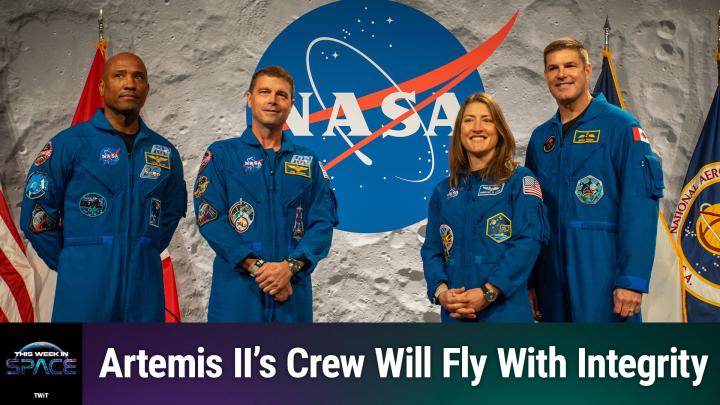
All TWiT.tv Shows (Audio)
This Week in Space 179: The New Crew of Artemis II
01:08:21
Who Will Fly to the Moon in 2026?
Loading summary
Transcript286 lines
- [00:00]
Rod Pyle
Coming up on this week in space, NASA's Escapade mission to Mars is getting closer to launch. Where is the dream chaser space plane and when does it go to the ISS? And we're all about Artemis II, when our special guest clues us in about what NASA's plans are, when they're going to fly, and what the astronauts will do when they get there. Check it out.
- [00:18]
Sponsor/Ad Voice
Today's show is brought to you by Progressive Insurance. Do you ever find yourself playing the budgeting game? Well, with a name your price tool from Progressive, you can find options that fit your budget and potentially lower your bills. Try it@progressive.com Progressive Casualty Insurance Company and affiliates Price and coverage match limited by state law.
- [00:41]
Tarek Malik
Not available in all states falls here.
- [00:44]
Sponsor/Ad Voice
And for me, that means comfort meals, cozy nights and tailgating weekends. And Omaha Steaks makes it all easy. I love having their premium steaks and juicy burgers ready in my freezer. I recently grilled their filet mignon. So tender, flavorful and better than anything I've had elsewhere. Right now, during their Red Hot sale, you get 50% off site wide plus get an extra $35 off with code flavor at checkout. Get fired up for fall grilling with omaha steaks. Visit omaha steaks.com for 50% off site wide during their Red Hot sale event. And for an extra $35 off, use promo code FLAVOR at checkout. That's 50% off at Omaha Steaks.com and an extra $35 off with promo code flavor at checkout. See site for details.
- [01:34]
This episode brought to you by Red Canary. When cybersecurity threats hit fast, you need an MDR partner that moves faster. Red Canary delivers 24.7expert MDR support, total visibility and actionable insights. Plus it helps you detect four times more threats so you can stay ahead without burning out. Red Canary clears the noise and has your back every hour, every incident. Get the backup you deserve. Visit redcanary.com difference to learn more podcasts.
- [02:07]
Rod Pyle
You love from people you trust.
- [02:11]
Sponsor/Ad Voice
This is truth.
- [02:15]
Tarek Malik
This is this Week in space. Episode number 179, recorded on September 26th, 2025. The new crew of Artemis 2. Hello and welcome to another episode, this Week in Space, the New Crew Edition. I'm Rod Pyle, editor in chief@astramagazine.com and I'm here with the one, the only, the inimitable Tarek Malik, editor in chief for Space.com Good day, sir.
- [02:40]
Rod Pyle
That's Tarek James. Alex. You, Rod. Good day. Good day.
- [02:43]
Tarek Malik
I'll just call you Call you tj. In just a few minutes, we'll be joined by Tarik's associate, Josh Dinner, who's a thought or friend of Tarik and he's another Space.com Newsace and a heck of a nice guy, so I'm looking forward to that. Before we start, however, I'm looking forward to you guys doing us a solid and going to your favorite podcast or whatever you used to listen to and giving us reviews. We'll take five anything. Five thumbs, five rockets, five stars. Things I probably shouldn't mention on the air. Five of anything will do because we're going to earn these five stars from you by having another joke from Tucker Drake.
- [03:26]
Rod Pyle
Tucker.
- [03:27]
Tarek Malik
Tucker. Hey, Tarek.
- [03:30]
Rod Pyle
Yes, Rod?
- [03:31]
Tarek Malik
You know how in science fiction starships are often powered by things like anti matter and dark matter?
- [03:36]
Rod Pyle
Yes.
- [03:37]
Tarek Malik
Well, scientists have discovered a new form of matter that they're certain will be powering all kinds of starships in the increasingly dystopian and Gen Z sci fi future they're calling it doesn't matter.
- [03:53]
Rod Pyle
Oh, so sad. That's new, right? Is that new?
- [04:00]
Tarek Malik
Yeah, yeah, that is. Now, I want to apologize to Tucker because I added the dystopia and Gen Z part, but I just thought it needed a little, little extra punch. Speaking of punching, I've heard that some people want to see us turn to the splatter matter when it's joke time in this show. But don't do that because you can help us by sending us your best space joke, or any space joke for that matter. But don't just type in, you know, 101 funniest space jokes because frankly, I've already mined the Internet and I've got all the old Bennett surface space jokes there are and most of them are pretty, you know what do ask? What? Astronauts eat asteroids and milk. I mean, there's just some really terrible stuff out there. But think up your own, be original or use really good AI. Although I have noticed AI's humor is miserable. The stuff doesn't even make sense half the time.
- [04:49]
Rod Pyle
Well, how would you like being trapped in a box with only like your thoughts to yourself, right? And waiting to on the hand of whatever human asks you a question.
- [04:56]
Tarek Malik
Am. Am I not?
- [04:57]
Rod Pyle
Oh yeah, yeah, here we are.
- [04:58]
Tarek Malik
Yeah, I mean, think of my lifestyle.
- [05:01]
Rod Pyle
Trying to get out of this box. So. Boy, by the way, if the people don't like the jokes, man. Yeah, send us your own jokes, man, because Rod is a one man band when it comes to finding all this stuff. Some.
- [05:12]
Tarek Malik
Yeah, poor me. At a brief Announcement. I am in Huntsville, Alabama, as you can see by the different background. And I will be speaking tomorrow on September 27th. So that's tomorrow, depending on when you're looking at this episode or today or last week at the annual Von Braun Astronomical Society's Astronomy Day 2025. That's right, it's Astronomy Day, Monte Sano State park. And the event is free to the public. So I guess I am too. So if you are there and happen to spot me and hard to miss, stop by and say hi. But now it's time for headline news.
- [05:54]
Sponsor/Ad Voice
Headline.
- [05:55]
Rod Pyle
Headline news. Speak. Speaking of AI.
- [06:01]
Tarek Malik
Right. Stop yourself. Can you?
- [06:03]
Rod Pyle
No.
- [06:04]
Tarek Malik
All right, first story. Matrix Madness. So the European Space Agency's Euclid consortium just released the largest simulation of the universe to date, which is kind of a mind bender. And here we thought the Minecraft one was pretty impressive, but this contains 3.4 billion digital galaxies. And this is interesting. Tracks gravitational interactions of 4 trillion particles.
- [06:29]
Rod Pyle
Yeah, yeah.
- [06:30]
Tarek Malik
How many particles are there in the universe, do we estimate?
- [06:33]
Rod Pyle
Well, apparently at least 4 trillion. Yeah, this is called Flagship 2. It's a simulation that uses an algorithm that, that designed by astrophysicist Joachim Stadel. I think I pronounced that right. At the University of Zurich. And, and then they, they use a supercomputer called I, I think it's called PIZ Daint. I think I'm saying that right. Which was the third most powerful computer the world in 2019. And they, they, they use this to create a simulation of the universe based on the data they have to date so that they can understand the sheer onslaught of the Euclid space telescopes data. When it, when it, you know, when they're going to do a big off, lump offload in, in the future. They want to make sure that they have an idea of what to expect before, before Euclid, you know, finishes its mission. Because Euclid has been mapping billions of galaxies across the universe since 2023. And, and it will eventually cover like 30% of the entire sky, which, given the vastness of the universe, just seems absolutely daunting of a job. And so what they want to do is use this flagship 2 model to say, okay, this is what we think we're going to see so that we can prepare our processing and our, our data analysis tools for such a vast amount of data in order to reduce the amount of, of processing and cleanup times so that they can speed up the science. Because you're going to get, I mean, imagine if, you know, you, you went shopping for your groceries and you took, you know, a plastic bag, but it turns out that your shopping returns something like a truckload of stuff. You're not going to fit it in that plastic bag. This, this typ prepare the systems that they need to accept and be ready for that truckload of billions and trillions of particles and stuff that this Euclid space has been mapping.
- [08:39]
Tarek Malik
That sounds like a big job.
- [08:40]
Rod Pyle
Yeah, yeah.
- [08:41]
Tarek Malik
All right, next up, the S begins.
- [08:44]
Rod Pyle
Yes, I was just going to say that it also helps them infer things about like the models that we understand for our universe. And they think that the simulations that they're seeing already showing some signs that that standard model of how we think the universe works may, may not be able to solve all of it. And the Euclid data, you know, the real, the real data is going to be where the rubber meets the road for that.
- [09:07]
Tarek Malik
So the irony of this, for the conspiracy believers, is it's a simulation within a simulation.
- [09:14]
Rod Pyle
Isn't that where we all live?
- [09:16]
Tarek Malik
Right, of course. So in other news, the escapade begins.
- [09:20]
Rod Pyle
Escapade.
- [09:22]
Tarek Malik
Rocket Lab built two Escapade spacecraft, which is cool. That's the first time it's been done that way under I assume, what were fixed price contracts. Contracts. They've arrived at Cape at the Kennedy Space center and will be launched to Mars on a new Glenn rocket.
- [09:38]
Rod Pyle
What were you going to say? Cape Kennedy? Is that what you were going to say?
- [09:41]
Tarek Malik
I almost did.
- [09:42]
Rod Pyle
I know. I could tell. I could tell.
- [09:45]
Tarek Malik
That's my boomer showing through. And they are. Escapade is short because NASA loves. Loves them. Their acronyms for the Escape and Plasma Acceleration Dynamics explorers, which will be going to Mars to kind of like maven to measure the loss of atmosphere and the impact of solar wind on the Martian atmosphere and how it's being basically destroyed an ongoing basis. The most interesting thing about this mission, besides Rocket Lab's involvement, is that it's coming in at 80 million. Now, I don't think that includes launch costs. That's gotta be just the program costs. But that's about the same price as India's Mars Orbiter mission, which is really inexpensive. So if this works, this is a whole new ball game for American robotic space exploration.
- [10:35]
Rod Pyle
It'll be very interesting. Now, Rocket Lab is, you know, a relic. This is going to be their first interplanetary mission. And they're not sending one, but as you mentioned, two different probes. And you know, Escapade is interesting because it's going to study the. I believe it's going to study like the the, the, the atmosphere of Mars and, and understand like how hopefully the whole planet evolved over time and where the water went through this plasma escape from the upper atmosphere. Did we talk about the acronym again? You said that, you said it out, right? Yeah, yeah, yeah, yeah. But they actually have separate names too. They're called Blue and gold for their UCLA's colors. I'm not saying, gonna say anything because I get to celebrate some USC astronauts later. So anyway, but, but the really interesting part about this is that they are finally in Florida. This is a mission that was supposed to launch last year almost a year ago as we're recording this in, in the fall of 2024 and, and now finally it's ready to go because we've been waiting upon, waiting for the new Glenn rocket to be ready for it. So as of now we're thinking that it's going to launch. We actually got an update today from Blue Origin that they're going to, they think that New Glenn is going to be ready for about a mid October, mid month launch as we're, you know, it's the end of September right now as we're recording this. So we have a good idea of when it's going to be ready. But this arrival of the spacecraft to Florida is a pivotal point because it says that now the campaign is in earnest. Only a few weeks, you know, maybe like a month away.
- [12:18]
Tarek Malik
Fabulous.
- [12:19]
Rod Pyle
Yeah, I want, I want rocket lab to go to Venus. I talked to Peter Beck about that a lot. But he, he told me last month that this mission in particular escapade is going to be very key for them to prove out their concepts because they want to build the Mars Telecomm communications orbiter for NASA and they've got their sights set on Mars sample return possibly.
- [12:35]
Tarek Malik
As well, when the original idea for Venus was they were going to launch that themselves. Right?
- [12:40]
Rod Pyle
Yeah, but, but now, you know, with actual contracts where they're gonna. People want to pay money to go on another planet, you can see that might be a little bit more attractive. Yeah, exactly.
- [12:53]
Tarek Malik
And finally, where's Dream Chaser? We've got a Where's Waldo moment here.
- [12:57]
Rod Pyle
Yeah, this story, those last two were from Space.com, this one's from our NECA. But you can also find our case on it too. But as Eric Berger or at ours said, by the way, I saw him this week in person. It was great to see him again. NASA has changed their plan for Sierra Nevada's Dream Chaser. It was one of of course three cargo delivery options that NASA had picked when they did a cargo delivery Update for contracts, SpaceX and Northrop Grumman were the others with the Dragon and the Cygnus vehicle. And Dream Chaser was Sierra Nevada's entry. But the first flight, we've been waiting for the first flight of their tenacity space plane for quite some time. This is a unlike, it's unlike SpaceX and Northrop Grumman. Dream Chaser is a capsule for me.
- [13:49]
Tarek Malik
Is a space, It's a lifting body.
- [13:50]
Rod Pyle
It's like a lifting body. The HL20s inspired lifting body that can land in a typical commercial Runway, which gives them a lot more deorbit and options and maybe even more mission options so that you can pick where you want to go. And their initial plan was to use it to, to fly cargo to the space station. I believe they've sold a UN mission to fly experiments in science for the United nations on, on their first flight. And, and, and I think it's also going to launch on New Glenn. We were just talking about that. But in a new, in a new announcement this week, Dana Weigel, manager of the ISS program at NASA, says that, that they're, they're going to, you know, they don't, they aren't going to hold Sierra Nevada to their initial like I think it was like seven flights, seven cargo flights to the space station because right now it's 2025 and the space station is supposed to be deorbited in 2030. And they don't think that they're going to be able to fit all those flights into that period. So they're going to say that, you know, if they're ready to go. Yes, they'll, they'll, they'll, they'll take them. But then also, you know, if they don't fill out the whole contract, that's also. Okay.
- [15:03]
Tarek Malik
Well, we just want to see them fly. Yeah, never. And however they can.
- [15:07]
Rod Pyle
I've been inside one of the test, test vehicles of that and I remember feeling really interesting because it felt small but also big in terms of a capsule because it's this long pressurized tube of pressurized material rather than being like a little box, like a capsule would be so cool.
- [15:24]
Tarek Malik
All right, we will be back with SPACE.com's Josh Dinner to talk about all the new NASA astronauts, the Artemis II crew. So go nowhere.
- [15:34]
Sponsor/Ad Voice
Ever notice how ads always pop up at the worst moments when the killer's identity is about to be revealed during that perfect meditation flow on Amazon Music, we believe in keeping you in the moment. That's why We've got millions of ad free podcast episodes, so you can stay completely immersed in every single story, every reveal, every breath. Download the Amazon music app and start listening to your favorite podcasts. Ad free included with Prime.
- [16:08]
So when I ask, what is Odoo, what comes to mind? Well, Odoo is a bit of everything. Odoo is a suite of business management software that some people say is like fertilizer because of the way it promotes growth. But, you know, some people also say Odoo is like a magic beanstalk because it grows with your company and is also magically affordable. But then again, you could look at Odoo in terms of how its individual software programs are a lot like building blocks. I mean, whatever your business needs, manufacturing, accounting, HR programs, you can build a custom software suite that's perfect for your company. So what is Odoo? Well, I guess Odoo is a bit of everything. Odoo is a fertilizer, magic beanstalk building blocks for business. Yeah, that's it. Which means that Odoo is exactly what every business needs. Learn more and sign up now@odoo.com that's O-O-O.com.
- [17:08]
We all deserve some yay in our day. So say hello to hello. Hello Makes oral and personal care products that add wonder to your routine. Like a toothpaste that makes perfect brushing fun for kids. It's called Unicorn Sparkle Toothpaste. It tastes like rainbows and sunshine, works brilliantly, and it's fun, so it's pretty much magic. And for the adults, hello. Anti plaque and whitening toothpaste, which is just as good without the unicorns. Visit helloproducts.com and let hello add some everyday yay into your life.
- [17:38]
Tarek Malik
And we are back with Josh Dinner, a space reporter for space.com, hello, Josh.
- [17:45]
Rod Pyle
Hi.
- [17:45]
Josh Dinner
Thanks for having me.
- [17:47]
Tarek Malik
Thanks for joining us today. We really appreciate it. And you and my pal Tarek had an adventure this week.
- [17:53]
Josh Dinner
Yeah, we certainly did.
- [17:56]
Rod Pyle
Okay. Yes, yes, I'll expound. No, yeah, we went to Tarek.
- [18:00]
Josh Dinner
How are you?
- [18:01]
Rod Pyle
We went. We went.
- [18:02]
Tarek Malik
Tell us all about it.
- [18:03]
Rod Pyle
Yeah, we went to the Johnson Space center this week for, like, a bit of a tour. We saw NASA unveil a new astronaut class. We're going to talk about that later, but a bit more front and center. It was like Artemis 2 Palooza all the time in Houston. And it was spectacular. But we should probably talk about who Josh is before we get into that, right?
- [18:27]
Tarek Malik
Well, we want to know not just who Josh is, but who Josh was When he became fascinated about space. Because that's always your big question.
- [18:35]
Rod Pyle
Yeah, that's right. That's right. So, yeah, Josh, sorry that we, I forgot to tell you about this. We throw you into the fire. But, but yeah, one of the big questions that we have. So, you know, we did the short intro. You are the space reporter with Mike Wall@Space.com and my partner in crime. He was a chauffeur too. Josh drove us around when we were in Houston.
- [18:56]
Tarek Malik
But how did you get show tune singer, space writer? What doesn't he do?
- [19:02]
Rod Pyle
I know, right?
- [19:03]
Josh Dinner
Don't worry, there's plenty.
- [19:07]
Rod Pyle
But Josh, can you kind of give people an idea about how you got interested and involved in, in space in general? Is it something that you've liked since you were like a little kid, you were talking offline, that you had a very different kind of, I want to say, professional focus before you landed@space.com, if you can share that path. Thanks.
- [19:29]
Josh Dinner
Indeed I did. So I would say my love for space, I think can be traced back to about before I was a person or at least had formed as a person. My earliest memory, he said, before he was a person. Yeah, well, no, no, you know, we grow into ourselves. I was, I, you know, my earliest memory is watching Star Trek the Next Generation with my dad. And so that was sort of just growing up. The, the, the maybe the foundation of, of why I love space so much. But I was very fascinated. Like many, I wanted to be an astronaut growing up. My path did take me a very different direction, though. I was, for many years of my professional life starting out, I was a cantor at a synagogue. So I was the one singing the music next to the rabbi up on, up on, during services on Shabbat.
- [20:26]
Rod Pyle
Your mom the rabbi, was it? Your mom was the rabbi or a different rabbi?
- [20:29]
Josh Dinner
No, my mom is a rabbi. She's retired now. But no, I did not, I did not work in my mom's synagogue. That would have been maybe a little much for me.
- [20:40]
Rod Pyle
And so how do you get from that to space?
- [20:43]
Josh Dinner
So I, like a few other reporters I know went to a NASA social where NASA invites social media users to come to a launch or a space event and tweet it and hope that their followers get more interested in NASA too.
- [20:58]
Rod Pyle
Is this when they called it the tweet ups, when they used to still call it that?
- [21:01]
Josh Dinner
No, no, it was post tweet up days. It was NASA social. I think it had been NASA social for maybe like a year.
- [21:06]
Rod Pyle
Okay.
- [21:07]
Josh Dinner
And I saw my first rocket launch and for the same reason I loved Jewish music. You know, music has this very powerful way of bringing people together. And when you're singing in a different language, a lot of people don't always know. You know, in this instance in Judaism, it's Hebrew. A lot of less religious Jews just don't always understand the Hebrew. And when you're singing in a language that you don't necessarily understand, all of it can mean whatever you need it to mean. And it creates this moment that, like, binds people together as under a common cause. And that really drew me to Jewish music. And I saw my first rocket launch go up. And my brain instantly thought, think of all the people who had to come together to build this rocket, design the payload, which was a science payload. It was the magnetic multiscale mission, a mission that went to study solar wind around Earth in the magnetosphere. You know, all the people that had to figure out, how are we going to make these science machines work? What are we going to do with this data? What questions are we answering? And that spoke to me on as deep a level. And I instantly said, I need to become a space reporter. And so I did.
- [22:24]
Rod Pyle
What, What. What was the launch vehicle for that? Was that an Atlas 5?
- [22:27]
Josh Dinner
Atlas 5?
- [22:28]
Rod Pyle
Yeah. Yeah. Look at that. I still remember my.
- [22:31]
Tarek Malik
Those are nice and loud.
- [22:32]
Rod Pyle
I have still not seen an Atlas 5 launch.
- [22:35]
Tarek Malik
So.
- [22:35]
Rod Pyle
So that's awesome. That's awesome. Well, I guess let's talk about the big thing. Do you want to go, Rod, or shall I just jump right into it?
- [22:47]
Tarek Malik
Go for it.
- [22:47]
Rod Pyle
All right. Well, because you were there, you got.
- [22:51]
Tarek Malik
Invited, and you have a travel budget. I always whine about this, don't I?
- [22:56]
Rod Pyle
Well, you know what? Maybe, Rod, we can build you into our coverage and then we can take you along with us for Artemis ii. Because now we know when it's going to launch. You know, before. Before this press conference on. So to lay it all out there, NASA had three days of press conferences. The first day on Monday of this week, as we're recording, was the NASA astronaut reveal. We're going to talk about that later. Day one of Artemis was on Tuesday. That was like the mission overview, science briefings, a lot of round robins, that kind of thing. Day two was the crew. That's what a lot of people showed up for. And what we found out on day one was that the actual opening, the technical opening of the launch window, this is something that we had heard about in the past, but it wasn't like officially stated, is February 5th. So that is the opening, no earlier than February 5th. And it's only for like four or five days in February, so the 5th to the 10th. And then there's another like kind of similar four or five day window in March. And then there's one last one in April at the end of April that ends on April 26th. And you know what that means, Rod? That means that now there is like a very slight chance that Artemis 2 could launch on my birthday and wouldn't that be awesome.
- [24:10]
Tarek Malik
And that is the most important consideration.
- [24:12]
Rod Pyle
It is, it is. You know I wrote a memo to NASA about it but that was really exciting. And I think, Josh, correct me if I'm wrong, but didn't they say that like the most of like the February and March attempts were going to be like nighttime launches? Is that right?
- [24:27]
Josh Dinner
Yeah, I do think that was the case with the first two attempt windows.
- [24:32]
Rod Pyle
And wasn't Artemis 1 a nighttime launch too?
- [24:34]
Josh Dinner
Eventually it was a very late nighttime launch. I think it took place somewhere between midnight and 4am But I don't remember specifically.
- [24:42]
Rod Pyle
Oh my gosh. So it's nice to have that window I think at least for an editor to help plan. But for all of you out there listening to be able to of map out what kind of hotel blocks you want to, you know, maybe reserve because those are going to go fast the minute they say these are what the windows are going to be, you know.
- [25:04]
Tarek Malik
So yeah, I'm having flashbacks of I don't remember which shuttle mission it was. I saw three shuttle launches but the middle one I didn't actually see, I should say I attempted to see three because I went there with my kid who was probably 8 or 10 at that point and we waited, I think nine days. Nine days sitting in the press center waiting, waiting, waiting. Didn't go waiting. Come on, look at our watches. Don't even look at your watch. Just look at the date and see it flipped to the next day. It was so frustrating. Hydrogen leaks, blah blah blah blah. And that was a well proven system at that point. So we waited and waited and finally we saw our, that was the Atlas launch I saw. And then we, we drove down to the Keys and had a vacation because clearly the shuttle wasn't going anywh. I think it launched two weeks later or something. But I hope sls, I mean, you know, it is the first crude flight of this thing. So we all have to bear that in mind.
- [26:00]
Rod Pyle
I would like. Go ahead, go ahead.
- [26:03]
Josh Dinner
It sounds a lot like the Artemis one when it actually did get off the ground. You know, we were there for quite a while. And it stood out through a hurricane during that window. And I was shocked that it launched after hurricane, but yeah, that was a long stretch of time, maybe the longest of the campaign.
- [26:19]
Rod Pyle
Were you on staff for Artemis 1 in November of 2022? I don't know. So you were there freelance taking photos for us in their lot, right?
- [26:28]
Josh Dinner
Yeah, I was with our managing editor, Brett.
- [26:31]
Rod Pyle
Brett. Brett Tingley. Got to go to that. I went out for the first two times, like you were saying, Rod, and it did not get off the ground, but nine days, I have to say. Pshaw. Because my first space shuttle launch, STS114, the return to flight, I was down there for 14 days waiting for them to get off the ground. And then they finally did on or 16th day. So. But they, the crew made a little bit of extra news on for these Artemis 2 days too. They actually named the Orion spacecraft. Josh, you want to kind of explain what they picked and why they did that?
- [27:07]
Josh Dinner
Yeah, they picked Integrity. You know, it's tradition for the first crew of a spacecraft and probably other vessels, terrestrial vessels as well, I'm not entirely sure. But for spacecraft, the first crew gets to pick the name and they picked Integrity. And they said because they wanted to promote, I think it was peace and love for all mankind. I don't remember what their phrasing was specifically, but their wanna. I think, you know, they stated their goal is wanting to bring people together and doing so with a purpose. Oh, yeah, there it is. Integrity.
- [27:42]
Rod Pyle
You know, it's not clear to me if they're gonna like, stamp the name on the Orion spacecraft or if, if everyone gets to name their Orion separately because parts of this, of this Orion have actually flown before. Some of the avionics boxes and whatnot, they pulled them off Artemis 1 and put them into, into this one. When I spoke to Deborah Korth, the deputy program manager of this Orion program, she did say that they want to kind of reuse more and more and more of the Orion capsules to the point where, you know, you get to maybe one that is mostly, you know, reusable. SpaceX, they name. They have like what, about four or five active.
- [28:21]
Tarek Malik
Five, I think they have five.
- [28:23]
Rod Pyle
Yeah, yeah, but. But they name them one time and then they keep that name forever.
- [28:27]
Tarek Malik
So it only matters for launch. So I'd say you just go to Amazon and print a bumper sticker and put it over the, the hat. You know, I was kind of hoping for Intrepid or Defiant or a nice ship of the line kind of name. Integrity. I heard that it's kind of like. And I, you know, I, I apologize advance. But it's like did some insurance actuary name this thing.
- [28:49]
Rod Pyle
But I think that's, I think integrity is extremely important on a couple of things. First, you want to make sure that everyone is working with integrity. Right. But you also want to make sure that your ship has integrity to keep them alive on the first mission around the moon in 53 years. Did I do the math right. Of the 21st century? Right.
- [29:14]
Tarek Malik
Longer.
- [29:15]
Rod Pyle
Crickets. Crickets.
- [29:17]
Tarek Malik
Talk about lunar flight.
- [29:18]
Josh Dinner
We're all, both, we're all just trying to do the math.
- [29:19]
Rod Pyle
I know, right.
- [29:21]
Tarek Malik
And that's why we're reporters.
- [29:22]
Rod Pyle
Right. Oh man.
- [29:24]
Tarek Malik
By the way, Josh, did you finish your calculus sequence in college or high school?
- [29:28]
Rod Pyle
No.
- [29:29]
Josh Dinner
Yeah, I did a pre calc. I did pre calc in high school and then I think they called it finite Math was the 1 class in undergrad that I had to take, the one math class I had to take and boy, it was a struggle.
- [29:42]
Rod Pyle
He did not have to take differential equations. So.
- [29:46]
Tarek Malik
Well, we may have taken it, but.
- [29:48]
Rod Pyle
It didn't take us or we didn't take to it. Right.
- [29:52]
Tarek Malik
Can you guys talk a little bit about the crew?
- [29:55]
Rod Pyle
Yeah. Josh, do you want to go first on the crew or, or go ahead.
- [29:59]
Josh Dinner
Yeah, I mean we can run through the crew. There's the crew commander Reed Weissman, pilot Victor Glover, mission specialist Christina Koch and other mission specialist Canadian astronaut Jeremy Hansen. They seem very cohesive. I was very impressed with, you know, their camaraderie during the press briefing and other instances where I've seen them. They, they seem like a very solid crew and I think you, you know, one might expect that of, in any NASA crew. But they seem like some, some pretty genuine friends who are really excited for the journey they get to go on together.
- [30:36]
Rod Pyle
Yeah. And there is a lot of experience, Rod. For this mission you've got Reid Wiseman, former NASA chief astronaut and an ISS crew member. About 165 days in space you got Vic Glover, Crew 1 pilot now going to be the first pilot to fly around the moon. Reid Wiseman is the commander. Vic Glover is the pilot for Artemis 2 who spent 168 days and has done a number of spacewalks. I think Reed did one or two, but Vic did a few more on the space station. Then you have Christina Cook, record setting astronaut. Over 360 days in space, if I got that right. Or 340 days. I don't remember the exact number, but it was, it was long because they extended her flight when she was up there. And, and so she has the most spaceflight time in between. And she is not a military pilot like Reed Wiseman or Vic Glover. She's kind of a scientist at heart. She did a lot of science and she talked a lot about the science of the mission that they're going to be able to do on this flight. Even though they're not going to land, they're not even going to get very close to the moon. I was surprised to hear. We'll talk about that in a bit. But then you have Jeremy Hansen of the Canadian Space Agency. Jeremy, who has, you know, been an astronaut for quite some time, but has never flown in space. His first mission is around the moon, which just seems crazy, you know, given the level of experience of the rest. But you can, you can see that that's like an investment too, about this next generation of astronauts who will need this lunar experience to get there. And then you have that international cooperation part of the flight too. And they, he. He kind of seemed to be very self conscious because he seems to be the tallest of all of the astronauts on the flight. Seems to be. Seems to.
- [32:18]
Josh Dinner
He's like 2ft taller than everybody else.
- [32:22]
Tarek Malik
Well, and it's interesting, you know, you're talking about rookies and flight experiences so forth, when you think about Apollo 8, which was the first Apollo flight to leave Earth orbit and orbit the moon as opposed to a flyby. But I rest my case. You had Frank Foreman and Jim Lovell, who had spent 14 days in a Gemini capsule. We've talked about that a lot on this show. I, I can't. It's like sitting in the smallest Toyota you can buy for two weeks. But, you know, so they had that experience. But Anders had what at that point? Just a couple of. Had he even flown. I think he had flown a Gemini flight. But these mostly Apollo astronauts, you know, they had days in space max. So, you know, compared to this crew.
- [33:13]
Rod Pyle
Yeah, they really had nothing. Months.
- [33:15]
Tarek Malik
Yeah, yeah, yeah.
- [33:15]
Rod Pyle
And it is interesting ball game. Yeah. Do you want to run through Josh kind of like the, the length of this mission compared to like those ISS flights? Because we've been talking about months and months and months, but. Yeah. So kind of give everyone like the snapshot picture of what this mission is in terms of the timeline.
- [33:33]
Josh Dinner
So they are doing what's called a free trajectory return flight around the moon. Like you said, Rod, they're not going to be orbiting the moon. They're just going to be kind of slingshotting around. But they're not going straight there really. They're going to launch into Earth orbit. They're going to be doing some maneuvers, like close, close quarters maneuvers with their inner, the interstage, the cryogenic fuel interstage that puts them in orbit and will be pushing them toward the moon or no, no, no, sorry, separating them before they get pushed to the moon by their command module. And they're going to spend, I think the first two days in Earth orbit now before the translunar injection burn.
- [34:15]
Rod Pyle
Oh yeah, we've got a map, here's, here's a fun map of all the stages.
- [34:18]
Tarek Malik
Yeah, yeah, just try and read that.
- [34:20]
Rod Pyle
Yeah.
- [34:22]
Josh Dinner
Then it's, it's a few days to the moon. And they, they told us during the briefings that and from the perspective of the astronauts out the window of the spacecraft, they're going to be about close enough that the moon is, appears to be the size. They, they kept comparing it to a basketball that you hold out with your arm extended. Yeah. So if, you know, look at a basketball an arm's length away, that's about how big the moon will look to them. And their slingshot is actually their closest approach to the moon does not actually last relatively long compared to the length of their, what's fully 10 days of a mission. The closest approach with the far side of the moon is going to last only three hours. And then they are slung shot, sling, slingshotted, slung shot back toward Earth, which is designed so, you know, if anything goes wrong once they're on their way to the moon, this free return trajectory guarantees they're going to return back to Earth no matter what, because that's where the spacecraft is headed. So they'll be returning back to Earth for another couple days. And then as they approach, they'll disconnect the Orion capsule from its service module, flip it around so the heat shield faces the planet and the atmosphere and have a nice parachuted down landing in the Pacific Ocean off the coast of San Diego.
- [35:42]
Rod Pyle
And I think NASA, they said they want to try to get them out of the water within a couple hours. I think is.
- [35:47]
Josh Dinner
Oh yeah, I mean they want to get very quickly. There are several experiments that they want the crew and exercises they want the crew to perform right at the end of their mission once they get out of their spacecraft. So they can best measure how the body is responded to really every stage of the mission and to simulate future efforts that maybe need to be taken by crews who are going to be landing not on Earth, will be landing on the moon and they need to be capable of performing certain actions. And they want to measure the capability of the crew to, to test those capabilities out.
- [36:26]
Tarek Malik
So this is interesting, if I read this correctly, their closest approach is going to be well over 6,000 miles. Oh yeah, and, and the Apollo 8 orbit and all the Apollo orbits basically were up towards 60 miles. So this is a very distant view in comparison.
- [36:41]
Rod Pyle
Yeah. And in fact, the astronauts and the scientists that are on this mission don't really know exactly how far away they're going to be from the moon. As we heard this week, depending on the day of the translunar injection burn, because that's the burn that sets up not just the lunar rendezvous but also the landing. Depending on that day, they could be as close as 5,000 miles. They could be as far away as 9,000 miles. So depending on the day, they could actually beat the Apollo 13 record of the furthest from the Earth of any human on, on the planet of any space mission ever. And, and so, but it really depends because, you know, on if on some days they'll be closer and on other days they're going to be farther. And that's why you only have those, those kind of slim five day windows per month leading into to April before they have to reset for the position of the moon in the future.
- [37:38]
Josh Dinner
Another thing that sets us apart from the Apollo missions, which I find really interesting, is that to my memory, Apollo pretty much launched so that the crews were on our, the Earth side of the moon, and so the sun was on the Earth side of the moon. For the Artemis to fly around the moon, much of the far side of the moon will be illuminated and they will be able to witness with their own eyes, you know, views that no human has ever really seen before. And they talked about that a little bit in the crew briefing about how the most reliable scientific, scientific instrument is the human eyes. Because we spot things quicker than, you know, a camera can or a computer can, and we can differentiate things more intuitively. And I think that's really exciting. I mean, obviously it's exciting for the crew to get to go to the moon and look at it at all, but to be able to use that as a scientific measurement and find out what, you know, geological things they might discover, what other space things they might discover. You know, it's a very, I think, important and crucial part of the mission that we haven't been able to do before.
- [38:43]
Tarek Malik
Well, we're going to slingshot ourselves into a free return trajectory as we go past this first break. So standby, we'll be right back.
- [38:52]
Sponsor/Ad Voice
We all deserve some yay in our day. So say hello to hello. Hello makes oral and personal care products that add wonder to your routine. Like a toothpaste that makes brushing fun for kids. It's called Unicorn Sparkle Toothpaste. It tastes like rainbows and sunshine, works brilliantly and it's fun so it's pretty much magic. And for the adults, hello Anti plaque and whitening toothpaste, which is just as good without the unit. Visit helloproducts.com and let hello add some everyday yay into your life. How to have fun anytime, anywhere. Step 1 Go to chumbacasino.com chumbacasino.com Got it. Step 2 Collect your welcome bonus.
- [39:30]
Rod Pyle
Come to papa. Welcome bonus.
- [39:32]
Sponsor/Ad Voice
Step 3 Play hundreds of casino style games for free.
- [39:35]
Rod Pyle
That's a lot of games all for free.
- [39:37]
Sponsor/Ad Voice
Step 4 Unleash your excitement.
- [39:38]
Rod Pyle
Woo hoo.
- [39:40]
Sponsor/Ad Voice
Chumba Chumba Casino has been delivering thrills for over a decade. So claim your free welcome bonus now know and live the tempo life. Visit tempacasino.com no purchase necessary vgw group.
- [39:49]
Josh Dinner
Void we're prohibited by law 21/ terms and conditions apply.
- [39:52]
Rod Pyle
This is Rob Gronkowski and Julian Edelman.
- [39:55]
Sponsor/Ad Voice
We invited some familiar friends to hang out with us at the Boston Nut House. Thanks to Duncan. Here is a sneak peek at some of the fun.
- [40:04]
Rod Pyle
Vince will fork Bill Finally.
- [40:06]
Tarek Malik
Like look guys, stop screwing around.
- [40:09]
Rod Pyle
We are joined by Matthew Light.
- [40:10]
Tarek Malik
Lady and gentlemen, Braves. You're going to love him. Will Campbell not into eating hot dogs?
- [40:15]
Josh Dinner
Having Ernie Adams come and teach a defense.
- [40:17]
Tarek Malik
Being able to play the wide three techniques.
- [40:19]
Sponsor/Ad Voice
Tackle full episodes of Dudes on Dudes and Games with names presented by Duncan. Tune into iHeart podcast or wherever you listen to your podcast. Thanks to Duncan for a great time.
- [40:30]
Tarek Malik
So, so just to recap, we've got three sets of launch windows weeks apart. Did I get that right?
- [40:40]
Rod Pyle
Yeah, February, March and April. Yeah, okay, there might be more, but it's the end of the month. But we know that there's. There's one week, there's a few several days each month leading up into April. And then they said that the last day was April 26th, so.
- [40:57]
Tarek Malik
Well, that does make it hard to book your hotel suite, doesn't it? Yeah, because we're going to have a party suite, right?
- [41:04]
Rod Pyle
Well, or maybe we should just get an rv because then we can just all pile into it and go to Houston, right?
- [41:08]
Tarek Malik
Yeah, but it smell like guys by the time we got there.
- [41:11]
Rod Pyle
You know, there's one thing about that that I wanted to bring up because this was very interesting that we had heard kind of on the, on the background and, and that was the way that NASA is going to treat this mission as opposed to maybe what a lot of our, our listeners and viewers are used to seeing with the most recent Crude launches since 2020. That's the SpaceX and the Starliner launch where they launched into space. And then that was kind of the end of the coverage and until it to come back to Earth. And we kind of got a picture of NASA returning to that space shuttle mission model where you don't just get, you know, the launch coverage and then it's up there and then you wait for like the big mission events. It sounds like it's going to be like a continuous event like you would want for this first return to the moon, but hopefully not the last, where you've got, you know, live mission updates from the flight controllers every day with press conferences about what they've done, how the spacecraft is going. And that's going to be very interesting to see. And I'm going to have to flex some very old muscles, rod from this, my shuttle days, to make sure that, that we're getting, we're getting the story out to everybody out there because the mission time will be different from like standard daytime and nighttime. You follow that astronaut schedule whether or not you're in space or on the ground. And so your day can start in the middle of the night, it can start in the afternoon, it can start in a regular time, but we don't know yet until they actually get off the ground.
- [42:40]
Tarek Malik
So can I grind on a Boomer moment for just a second?
- [42:43]
Rod Pyle
Okay, Boomer, go ahead.
- [42:44]
Tarek Malik
I know I've complained about this before, but by Apollo 14, when we had seen people walk on the moon, we had had the astronaut emergency in Apollo 13. By the time they landed on the moon, all the, the media editors knew that there wasn't going to be an emergency, or if there was, it wouldn't be until they were going to lift off from the moon. So they just cut the coverage. So those guys were walking around, they were starting to head off towards Cone Crater and boom. We're back to Days of Our Lives in General Hospital soap operas. And I was a kid, but I was like, you gotta be kidding me. The greatest achievement of Western civilization in thousands of years is happening on the moon and you're gonna make me watch a soap opera? And it was just shameful. So at least now there's a lot more venues if there is anything coming out of NASA. We'll be able to see it, which is great.
- [43:37]
Rod Pyle
Well, let's ask Josh. Josh. Because Josh is kind of of the younger set. What, a millennial, Josh?
- [43:44]
Josh Dinner
I am a millennial. That's correct.
- [43:46]
Rod Pyle
So. So I think I'm like on the tail end of Generation X. I don't know. I like to think about that. But.
- [43:52]
Tarek Malik
But do you think mid elderly now.
- [43:54]
Rod Pyle
Do you not 50 yet. Do you think, Josh, that this mission will command it? The appropriate level of public dedication or fervor based on what you saw for Artemis 1, or what you, as like a digital plugged in member of your generation would expect?
- [44:19]
Tarek Malik
That's kind of a landmine question, isn't it?
- [44:21]
Rod Pyle
I don't know. I don't know. I'm not trying to be like, like ageist. Right. Because that'll get me called up by hr, But I'm just. I'm very curious. Right, about. About where things are. Because like you said, Rod, there's like a bajillion different channels now.
- [44:34]
Tarek Malik
Yeah.
- [44:34]
Rod Pyle
Not just on TV, but like on the computer, on our phones. NASA's gonna have like their own stream. Everyone's gonna have their own live stream. Yeah, but is that enough to really catapult this, you know, based on what we saw.
- [44:49]
Josh Dinner
Unfortunately, honestly, I think the answer is no.
- [44:53]
Rod Pyle
Oh, my God. I was not expecting that.
- [44:56]
Josh Dinner
I. I don't think. I don't think that the mission will get the coverage that it is warranted. I don't think that it'll get the coverage that it deserves. And by coverage, I don't mean, you know, we're obviously going to cover it. Everyone will cover it. It's, you know, maybe the biggest news of the millennium so far. But I think there's a lot of things that pull people away from interest in space sometimes. You know, just like in 1968, we are facing a lot of societal problems.
- [45:29]
Tarek Malik
You know, the parallels are pretty staggering, aren't they?
- [45:32]
Josh Dinner
They very much are. And it would, it would thrill me to no end to have a comparison follow through to the end of Artemis 2 with Apollo 8, where the perception is that, you know, Artemis 2 saved the generation or saved the year, just like they say Apollo 8 saved 1968.
- [45:54]
Rod Pyle
Right.
- [45:54]
Josh Dinner
I also think there's another side to it, which is we have become technologically so good at creating things like sci fi movies that give us this visual perception of things we have, you know, only been able to imagine and we can just make it into a movie. So space flight, aliens, you know, interdimensional travel, all of it is something that we have, you know, a visual, visual cue for, thanks to CGI and movie magic. And I think there's a chance that actually seeing astronauts on the moon despite its historic impact and very real significance will be lost on people who say, oh, well, we already did that. Like, I can. I can go watch Apollo 13. It looks exactly like this and in HD. And, and while this is not my hope, and I, I obviously hope that the mission snowballs into this giant frenzy of society that we can't take our eyes away, but I do, I do think there are some significant barriers to that, unfortunately.
- [47:06]
Rod Pyle
It's very interesting.
- [47:08]
Tarek Malik
Oh, go ahead, go ahead, Charge your audience. If you know any major influencers, call them in and let's get them looking at this. Is Cardi B, an influencer? A name pops into my head. Kardashians, anybody, you know, get the influencers on here going, this is the coolest thing I've ever seen because they're astronauts flying around the sun, you know, whatever it is they're gonna do.
- [47:28]
Josh Dinner
The space influencers are really, really trying.
- [47:31]
Rod Pyle
I know.
- [47:32]
Tarek Malik
It's just a smaller audience than the general public.
- [47:34]
Rod Pyle
It will be interesting to see how NASA treats that outreach of this mission, you know, given that this is like the first one of the 21st century, the first one where social media is a thing. And they've shown themselves to be very savvy about all of that that I was really struck by in our discussions. You know, we got tours of mission control, a lot of the back rooms for lunar science, for Orion operations, and I was really struck by how many. I think there was only one flight controller that we spoke with who was alive when Apollo 11 land on the moon. He was four. He said when. When that. When that happened, everyone else in there in their. Their early to mid-30s, and each one of them, especially the ones that are going to be like leads in Mission Control, Fido and ecom, said that this is like their Apollo moment. And one of the things that they felt was really interesting is when they hit a snag, they could call some of those older Apollo engineers to get some input and then push on through.
- [48:38]
Tarek Malik
So let's circle back to that, but first we have to pay attention to our sponsors. So we'll be right back after this break. Stand by.
- [48:46]
Josh Dinner
From Unsolved Mysteries to Unexplained Phenomena, from.
- [48:49]
Rod Pyle
Comedy Gold to Relationship fails, Amazon Music's.
- [48:53]
Josh Dinner
Got the most ad free top podcasts included with Prime.
- [48:57]
Rod Pyle
Because the only thing that should interrupt.
- [48:59]
Josh Dinner
Your listening is, well, nothing. Download the Amazon music app today.
- [49:10]
Sponsor/Ad Voice
So when I ask, what is Odoo? What comes to mind? Well, Odoo is a bit of everything. Odoo is a suite of business management software that some people say is like fertilizer because of the way it promotes growth. But, you know, some people also say Odoo is like a magic beanstalk because it grows with your company and is also magically affordable. But then again, you could look at Odoo in terms of how its individual software programs are a lot like building blocks. I mean, whatever your business is needs, manufacturing, accounting, HR programs. You can build a custom software suite that's perfect for your company. So what is Odoo? Well, I guess Odoo is a bit of everything. Odoo is a fertilizer, magic beanstalk, building blocks for business. Yeah, that's it. Which means that Odoo is exactly what every business needs. Learn more and sign up now at Odoo. That's O D O O dot com.
- [50:09]
We all deserve some yay in our day. So say hello to hello. Hello. Makes oral and personal care products that add wonder to your routine. Like a toothpaste that makes brushing fun for kids. It's called Unicorn Sparkle Toothpaste. It tastes like rainbows and sunshine, works brilliantly, and it's fun, so it's pretty much magic. And for the adults, hello. Anti plaque and whitening toothpaste, which is just as good without the unicorns. Visit helloproducts.com and let hello add some everyday yay into your life.
- [50:40]
Tarek Malik
So I just want to say about Mission Control, we discussed this before, but it comes to mind because I'm working on a while. I'm working on a book that involves people from Mission Control from Apollo. Don't forget, the average age of a Mission Control console guy during Apollo is 26.
- [50:56]
Rod Pyle
Younger than these people, 22, 23.
- [50:59]
Josh Dinner
These people were not far off a little older than what we spoke to, but you know, that that range.
- [51:05]
Tarek Malik
When I asked Gene Kranz why they use such young people. Well, there's a couple of reasons. One is nobody'd really done this before, so it didn't matter if they were older because the only thing they had done, you know, they had people that attract rocket launches to the air force and NASA's early stuff. But in general terms, this is all pretty new field. But Gene, being Gene said, and I wanted men that didn't know failure. And I thought, oh, that is so cool. It gives me shivers, you know? But so what's the average age? Now, these controllers, well, for, for the.
- [51:38]
Rod Pyle
Ones that we spoke to, it was like in the mid-30s, early to mid-30s, but there, there was a bit of a mix, but it was a fairly young, young crew. Did you have a thoughts, Josh?
- [51:47]
Josh Dinner
Yeah, I, I don't remember us if, I don't remember if we spoke to someone who was younger than 30, but I do remember that we didn't speak to someone who was older than 36.
- [51:57]
Rod Pyle
So in Mission Control, in the Orion back rooms, that there was, except for.
- [52:00]
Josh Dinner
Maybe the flight director.
- [52:01]
Rod Pyle
Yeah, the flight director is in his 40s. Like, like, like, like, like I was. And then, and then the, the, the, the lead for imagery was the, the, the, the gentleman who, who mentioned to us that, that he had watched, he had watched Apollo 11 when, or, or maybe it was Apollo 17. It was one of the last ones or it was one of the landing ones.
- [52:18]
Tarek Malik
So I just want to think you guys, to think about what we were doing in our early 20s and early 30s. And compared to being a flight director, because Apollo flight directors maxed out at, I think, 36. Chris Craft was the old guy in the room at 39 or 40. And it just blows my mind because, you know, I was barely responsible, breathing, adult when I was in my 30s.
- [52:40]
Rod Pyle
I know, right?
- [52:41]
Tarek Malik
How do you guys control a mission out to the moon and back? But at least they're not. And it's, so, it's interesting, you know, one of the, to me anyway, one of the other things of this mission, because they're not going into lunar orbit and they are on a free return, you don't have that single point of failure which we had. When you look back on Apollo 8 now and you think about the fact that this thing had never been flown outside of Earth orbit. We had never gone out with life support systems to the moon and back for the, for anything like that duration of time. We had flown in orbit that duration of time, which is why Gemini 7A flew for 14 days to test that duration, but never gone out that far. And the only way those guys were coming home is if that, that service module engine, the service propulsion system fired up one engine, two igniters, or not igniters, but two valve sets because it was hypergolic fuels. But I mean, if that engine didn't fire, they were staying. So that's the kind of thing that just drives engineers nuts. But they did it anyway. And you know, no lunar module on that mission. So it just boggles the mind that it worked as well as it did. And I wish these guys all the same Success?
- [53:50]
Rod Pyle
Well, yeah, and I think that that is kind of NASA's go to line to remind everyone who is criticizing them for why are they just looping around the moon? They're not even going to go into orbit on this one. And it's because they've packed a lot into this test. You know, this is the first one with crew to the moon, but it's also the first Orion with crew as well. So all of those other early Apollo tests, they're all happening also on this flight. You know that first 25 hours are critical, critical periods for this mission because they have to make sure that the, the, the CO2 scrubbers are working the way that they think. That was not Artemis 1. They have to make sure that the water system that lets them, you know, stay hydrated and stay alive works. They have to make sure the toilet works. There's a toilet on this mission. It's in the floor, which is crazy, but it has, it's built on ISS legacy experience, you know, but you don't want that to, to malfunction so that they have to use bags the entire time. And then the, you know, the dumping of that stuff overboard to make sure it doesn't shimmy too much with their, their, their trajectories. Because Fido said that's going to change everything on this one compared to Artemis 1.
- [54:57]
Tarek Malik
So you talk about like if they're venting urine or something.
- [54:59]
Rod Pyle
Yeah, it'll change a little rocket. Exactly. And they'll have to make, make adjustments over time.
- [55:05]
Josh Dinner
Yeah, we were talking to some of the, the engineers in, AT Johnson and you know, of all they, you know, they plan for as many situations and scenarios they can in these, in these missions and they have a scenario where the crew, you know, if there's a pressure issue or a life support issue. Tarek, help me with the number. But the crew ends up, they have the capability to be in their spacesuits.
- [55:31]
Rod Pyle
Their spaces for 144 hours or 144 hours. What is that? That's like three days right inside a spacesuit.
- [55:39]
Tarek Malik
So, so this is, we're still waiting on the EVA suits. So these are just pressure suits, right?
- [55:45]
Rod Pyle
Yeah, these are the, these are the Orion crew survival suits. They call them aux, right, That's a pretty cool acronym. And this was my favorite thing. In fact, you should probably wrap up this part because I do want to talk about the new astronauts too. But my favorite thing about these media days was being able to talk to the engineers behind these suits because they look very similar to the ACEs suits, the advanced crew escape suits that NASA used during the space shuttle mission. But they're built for deep space survival. Right. And they'll launch in partial pressure, so they can move. They're bright orange for visibility. They have a lot of pockets. There's like a knife in one, one pocket. There's an oxygen bottle for spare oxygen in another. But as Josh said, they have the ability to be able to stay in these suits with that, you know, with, you know, hooked up to oxygen for 144 hours. There's little ports to get extra water or food in if they need it. There's a really complicated. And they had to explain it to me, like, very complicated system where they strap devices on the front and the rear to be able to go to the bathroom in 144 days in space. And it sounds extremely complicated. 44 hours or hours, yeah. Not days. That would even be even worse. Oh, my gosh. But, yeah, 144 hours over time until they can restore things. And it was absolutely crazy.
- [57:12]
Josh Dinner
So the engineers were very patient with all of our toilet questions.
- [57:15]
Tarek Malik
Questions?
- [57:16]
Rod Pyle
Yes, yes.
- [57:17]
Josh Dinner
Because they're thorough.
- [57:19]
Tarek Malik
Well, it beats using the top hat, as they used to say. Before we move on to the.
- [57:25]
Rod Pyle
The top hat was the bag, everybody, that stuck to your butt.
- [57:28]
Tarek Malik
The bag that had little glove in it so you could. You could mix in the.
- [57:34]
Rod Pyle
Why do you gotta wiggle your fingers, man?
- [57:36]
Tarek Malik
Because that's what they had to do. When you listen to these guys talk about. It's like, okay, tell me the detail. Oh, okay, don't tell me the details. Before we get into the next topic, though, was there discussion of the heat shield issues in this presser?
- [57:48]
Rod Pyle
There was. Josh, do you want to talk about that?
- [57:50]
Josh Dinner
Sure I can. There was, you know, Orion had some. They call it mechanical liberation from the heat shield during its atmospheric reentry reentry during Artemis 1. And that's been a really big concern. And one of the reasons the mission is next year instead of this year.
- [58:10]
Tarek Malik
Right.
- [58:11]
Josh Dinner
And rather than, I think, adjust the material and make of the heat shield, they determined that the issue was the trajectory they took back through the atmosphere. They took sort of a dip into the atmosphere during their return with Artemis 1, which the. The angle and trajectory of which is what they found to have caused mechanical liberation. Pieces broke off, basically.
- [58:39]
Tarek Malik
It's. It's crap came off.
- [58:40]
Josh Dinner
Yeah, right. It ablated way too much. And so for Artemis 2, they're skipping this skip off the atmosphere, which is adding extra stress to the vehicle and taking a less stressful course through the atmosphere. That shouldn't get the heat shield as hot for as long. And they're, they seem very confident that this is, this is the fixed.
- [59:06]
Rod Pyle
Yeah.
- [59:07]
Tarek Malik
So the total amount of energy absorbed is the same. It's just lower heat over a longer period of time.
- [59:12]
Rod Pyle
Exactly. Yeah. The way that they describe it is that they have built this heat shield to be porous. Right. So that as it heats up and that, that, that, that plasma turns into gas and the ablation stuff vents out. That it vents out and maybe ablates in a way where it's. You're not losing big chunks of the heat shield on the way down. But what they found with this really aggressive angle and approach, as Josh mentioned, is that it, the heating was faster than, you know, the gas kind of escape over time. And because of that difference, then they had a pressure buildup inside the bottom layers of the heat shield that then would pop off the actual blade of material over time because there was too much heat and for the off gassing, porous like ability of the heat shield to, to accept. And so by doing this lower angle, less aggressive entry, they don't have to change the heat shield, but it will allow that pressure buildup to be avoided to the point where it shouldn't be popping off big, big chunks and pose a safety risk to the crew and the astronauts. The astronauts, you know, themselves, that they were in that meeting when it was, when it was mentioned, you know, and they, they understand what that risk is going to be and, you know, they're accepting that as well.
- [60:33]
Tarek Malik
Well, so it's amazing how hard it is to do it all again a half century later. All right, we have one more break to dip to, and then I want to come back and talk about the new astronauts.
- [60:45]
Rod Pyle
Well, really quickly, I just. Josh had a really funny thing about that that he thought was his favorite. I just wanted to see if Josh can talk about that. Josh, you said it was the EVA training, right?
- [60:54]
Josh Dinner
My favorite moment from our visit to jsc. Yeah, we got to see some EVA training, which is extra vehicular activity. So the Artemis spacesuits that they're planning to have astronauts wear on the moon, we saw this. Basically this person was rigged to. I don't know if it was a crane, but like a bungee on the ceiling, very complicated bungee that would simulate the lunar gravity. And they were using the various tools to scoop moon rocks and, you know, take samples. And it was a very cool thing to get to see. You know, they're already practicing for the mission that comes after this one, and making sure that, you know, all of the, the tools have the right grip, the spacesuit has the right sort of mobility. And you know, they were actively training while we were there. It was very cool to see.
- [61:46]
Rod Pyle
Yeah. And, and just to that point, the Artemis 2 astronauts are going to have to do that. They're going to go on this 10 day mission and then come screaming back at Mach 39, you know, splash down in the ocean at 50 miles an hour. When they recover them and take them out on the ship, they're going to make them try and unfold like a ladder and climb out of the capsule on their own as if there was an emergency to see if they can still do that after like such an exertion of going to the moon and back. And then when they get to Houston the next day, they're going to put them through this EVA training, make them put that big suit on and make sure that astronauts would be ready to go walk on the moon and collect all the samples and then put them on a treadmill in that suit and make them run too. Which just sounds awful after like a road trip, but, you know, what are you gonna do?
- [62:27]
Tarek Malik
The Apollo guys came back to go sit in quarantine for three weeks.
- [62:31]
Rod Pyle
There you go.
- [62:32]
Tarek Malik
Since they just gave him period from the moon.
- [62:35]
Josh Dinner
Germs.
- [62:36]
Tarek Malik
Yeah, that turned out to be a wash. Okay, we're gonna wash ourselves in another break. Stand by.
- [62:45]
Josh Dinner
I guess I could have, I realized it while we were aft after I talked about the heat show, but I have a little Orion model here I pulled from just behind me. I could have like, like we could have had that the whole time.
- [62:53]
Tarek Malik
Got to get a blowtorch. Okay, so when we come back, Tarek, you want to talk about the new. Not yet. You want to talk about the new class, right?
- [63:03]
Rod Pyle
Yeah, but let's keep it short because it's already at the end of the hour. All right, great. So now we're back. I think we've got a pretty good handle about Artemis 2. But Josh, this was his first time at the Johnson Space center and his big story this week was the that NASA's unveiling of some new astronauts. So, Josh, can you kind of walk us through what happened the day before? We got the Artemis too skinny.
- [63:30]
Josh Dinner
Yeah. So Monday they had NASA very, you know, leave it to the rocket scientists to schedule these back to back so we didn't have to fly in twice. NASA announced a brand new class of astronaut candidates. Very exciting. We have 10 new individuals. I think it was six women and four men.
- [63:48]
Rod Pyle
That's right.
- [63:49]
Josh Dinner
All of them very diverse backgrounds in terms of their career paths and skill sets. And, you know, if NASA sticks to its current plan for Artemis and beyond, these astronauts could very well be the ones that are, are walking around Mars, which.
- [64:08]
Rod Pyle
That's right.
- [64:09]
Josh Dinner
Very exciting.
- [64:10]
Rod Pyle
We've got video of them all coming out into their seats. It was, there was a packed crowd of their family, their friends, a lot of NASA people. But just to run through the who these, these new astronauts are, you've got Ben, Ben B. A chief warrant officer in the US army from Charlottesville, Virginia. You've got Lauren Edgar. This is Mr. Kubo, Yuri Kubo from Columbus, Indiana. He's 40 and he actually, he actually plays Ultimate Frisbee and played competitively on the national stage. You've got Lauren Edgar from Washington. She's a geologist and a Mars Rover scientist who is now going to be able to be probably one of the astronauts that walks on the moon while she's been looking for Artemis. Three science sites. Got Adam Furman, a major in the US Air Force from Virginia. Cameron Jones, another major in the Air Force. These are all test pilots. I mentioned Yuri Kubo, and he's actually like an electrical engineer who has worked at SpaceX and on Falcon 9 launches and also worked in energy and electric hydrogen industry, which is pretty interesting. Rebecca Lawler, I believe, is a U.S. navy aviator, an experimental test pilot. You've got Anna Menon, and if that name sounds familiar, she's already flown in orbit. She was the SpaceX astronaut, one of the SpaceX astronauts on the Polaris dawn mission. Also, I found out, married to Anil Menon, the NASA astronaut. So you've got a couple there. And, and that's really interesting because that's a very elite group of people who have flown in space already in orbit and also become astronauts. And it's not, it's not as short a list as I thought it was. You've got Imelda Mueller. Oh, go ahead, Josh.
- [65:51]
Josh Dinner
I was going to ask, have any astronauts, any, any new astronaut candidates already been to orbit before? I know some have been to space technically, but I think any have ever been to orbit.
- [66:01]
Rod Pyle
No. Yes. A lot of payload specialists who weren't official national astronauts would have gone to orbit for their payload and then later joined NASA over time. Robert Perlman at Collect Space, our friend of the show, gave me like a whole list. There's like six or seven of them, if not more. I was really surprised. It was a longer list than I thought. But just to round out, round out the new astronauts, you've got Imelda Muller from Copake Falls, New York. Again, another Navy officer, an undersea medical officer, one of two with men and medical folks who are on the crew or in the group. Aaron Overcast, which is an awesome astronaut name. Isn't that awesome? Lieutenant Commander in the US Navy, and she's a test pilot as well. And Catherine Spies of San Diego, a chemical engineer by training from the University of Southern California. Fight on, Catherine. And she is the only Marine Corps pilot and one of two helicopter pilots in this group. Very exciting, very, very interesting mix of folks. And these are going to be the astronauts who can form the core of not just trips to the moon, but private space stations, maybe even Mars, which I think is the biggest target that they got for this.
- [67:22]
Tarek Malik
Well, none of those names are as cool as Scott McLeod of Space Angels with the eye patch, but take what we can get.
- [67:29]
Rod Pyle
Brent Jet, remember Brent Jet in the shuttle commander? Right. That's an awesome name too.
- [67:35]
Tarek Malik
So you had a big sigh moment. Why was that?
- [67:39]
Rod Pyle
Well, well, actually, before that, I don't want to, I don't want to step on it, but before that, Josh talked to Lauren Edgar, and I'd love to get Josh your, your thoughts on, on Lauren's like, path to space to kind of give us an idea of who she was. She was the only one of these 10 astronauts that we got to talk to in person.
- [67:55]
Josh Dinner
So I think it was very cool that we got to talk to Dr. Edgar. Lauren, she is maybe the longest standing NASA employee of the bunch. She's been working on Mars rovers and Mars geology and NASA science for 17 years, almost two decades. And I think just on its own, the, the initial dream of every kid who wants to be an astronaut. Everyone thinks the path to that is, oh, if I get to work at NASA, maybe, you know, one day I'll get all the way up to space. And she's done that. And I think it's really interesting that she was able to, you know, take her field of study, geology, which when one thing is geology, you don't necessarily think of space. You think astronomy, astro, astrophysics, but geology, that's Earth. But all the geology she's been doing at NASA has been Mars rocks, moon rocks, you know, the Mars rovers, and the science, they're doing the science that Artemis 3 astronauts will do when they get to the moon and on the moon. And so I think it's, it was a very interesting conversation with her just to be able to hear her passion for geology. What's that?
- [69:14]
Rod Pyle
Tarek tell them the fun fact about Lauren Edgar.
- [69:18]
Josh Dinner
Oh, she, I think she said at least once a day or, or at least extremely often she walks on her hand.
- [69:25]
Rod Pyle
Yeah. She likes to do handstands everywhere. So that'll be fun to see if she does one on the moon, I got to say. So yeah, my big side would be a feat. My big sign moment was there was a lot of politics in, in the announcement for the astronauts. There was no escaping the second space race with China. We heard that throughout the week about why it's important to get back to the moon and that this new astronaut core is really important for that. We heard it from Sean Duffy, acting NASA administrator who was there and he once again said that he'll be damned if China beats the United States back to the moon. I guess that last comment when he said it a few weeks ago went over quite well. So he's been repeating it where he can. He also said, and this is the part that really kind of got to me because he's talking about how they selected the best and the brightest and then he said the best looking people, which is just like it felt a little gratuitous to say, to add in, you know, you know you, you do it for the last.
- [70:21]
Tarek Malik
See that really, that's not sexist. What would that be? Looksist.
- [70:25]
Josh Dinner
Well, it just, I have a, I have a take if I may.
- [70:29]
Rod Pyle
Yep.
- [70:29]
Josh Dinner
You know, commenting on the astronauts looks being I think taboo already as it is one glaring fact about this astronaut class that I think sets it apart from other recent astronaut classes is its demographic base. It is almost entirely white people. And you know, I think that, that if you're talking about the astronauts looks is, is pretty significant. And then to comment, you know, not on that aspect of their looks but to comment on their looks at all on top of that fact as they're all sitting before the gathered crowd, I thought, I thought was very notable.
- [71:09]
Rod Pyle
Yeah. And for, for our viewers the, the, the initial speaker that, that's a former astronaut. Nicole Ayers is a former astronaut class graduate and a current NASA astronaut. But she's talking and introducing and interviewing the, the rest of the team. You can see them in this, in the seats there. So yeah, that's a really good point.
- [71:26]
Josh Dinner
International astronauts either.
- [71:27]
Rod Pyle
Yeah, no Internet. That is a departure. Usually you have some international partners but you could, you could see that they really wanted to make sure that they've got the US Representative so.
- [71:39]
Tarek Malik
Well, by golly, fingers crossed that this happens on a timely schedule and that we all get to see it. Go and we all get to see him. Come. I want to thank everybody for joining us today for episode number 179 that we like to call the new crew, the Good Looking New crew. Josh, is there Anywhere other than Space.com we should be looking for your work online?
- [72:00]
Rod Pyle
No.
- [72:00]
Josh Dinner
All my writing can be found on Space.com right now. My launch photography and other photography, mostly of my dog, can be found on the various social medias. I am at Josh Dinner. Dinner's just like the meal. And you can, I guess, find my posts of rockets and haikus.
- [72:19]
Tarek Malik
All right, Tarik, as always, where can we keep up with your matters that matter?
- [72:24]
Rod Pyle
Well, no one can keep up with me, Rod, but you are all invited to try. You can find me at space.com as always on X and everywhere else at tarikj malik this weekend. If you are in Pennsylvania, you might find me in Bethlehem at the Cake concert. And if you are, say hello and let me know.
- [72:45]
Tarek Malik
Your favorite Cake song is Cake Group.
- [72:49]
Rod Pyle
It's a band. Cake is a band out of Sacramento. Short skirt, long jacket, right?
- [72:54]
Tarek Malik
Wow. Okay. Because the best things of life came come from Sacramento. And of course you can find me at pilebooks.com or@astromagazine.com or apparently on a rocking chair on the porch of the old folks home. Remember, you can always drop us a line at Twist Twit tv. We welcome your comments, suggestions and ideas and we answer each and every email, even the ones that aren't nice, which, fortunately, extremely rare. New episodes publish every Friday on your favorite podcaster. So make sure to subscribe, tell your friends, and give us reviews. We'll take whatever kind of review you want to give us. Hopefully it'll be at least five of something. And I. Tarek, I know what you're thinking. I won't go there. But we thank you in advance. And you can also head to our website at TWiT TV. TWiT this last thing. Don't forget we're counting on you to join Club Twit in 2025. Besides supporting our wonderful show and our hideous face jokes, you'll help keep the Twit Network on the air. And this is something that benefits all of us because there's a lot of good work going on here. Of course, we like to think our podcast is the best one, but there's a lot of them and they're all really good. So 10 bucks a month. I ask you gentlemen, what can you get that's more fun than the Fist for $10 a month?
- [74:08]
Rod Pyle
Not even a movie, let alone if you want popcorn.
- [74:11]
Tarek Malik
There's other stuff, but it's much more expensive. So thanks everybody. We really appreciate you joining us. Thank you, Josh. Thank you, Tark. And we'll see you next week.
- [74:21]
Sponsor/Ad Voice
From Silicon Valley boardrooms to tomorrow's AI breakthroughs, if you need to keep up to date with tech, you need Twit TV. At Twitter, we're tech experts who understand what's happening and can keep you in the loop. And we do it in a thoughtful, informed, and fun way. Start your Sundays with this Week in Tech, a roundtable of tech journalists and people in the know with a rundown of the week's most important tech news. But that's not all. All week long, you can stay ahead of Security threats with Steve Gibson and Security Now. Keep up on all things Apple with MacBreak Weekly. Listen to the most informative Microsoft experts in the world with Paul Thurrod and Richard Campbell on Windows Weekly. Our flagship shows feature tech's most respected voices, giving you the insight you need to understand and benefit from the changing world of technology. We give you analysis you won't find anywhere else so you can make smarter business decisions and take advantage of the technologies transforming your world. Whether you're a CEO, IT professional, or simply passionate about technology, TWiT's network of shows gives you the edge you need in today's digital landscape. Don't miss a minute. Subscribe to TWiT TV today.