← All TWiT.tv Shows (Audio)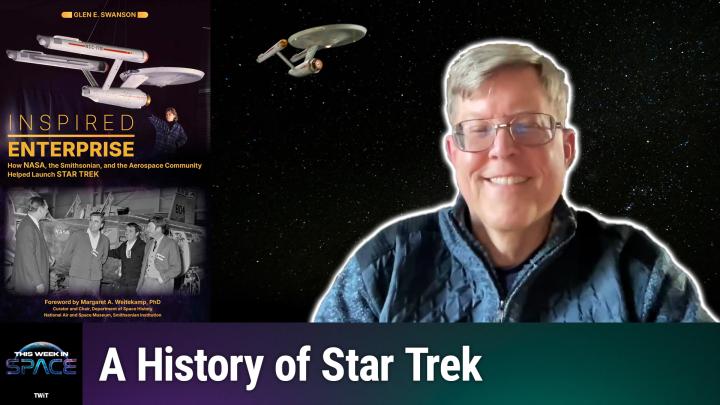
All TWiT.tv Shows (Audio)
This Week in Space 187: An Inspired Enterprise
01:08:30
A History of Star Trek with Glen Swanson
Loading summary
Transcript186 lines
- [00:00]
A
Today's show is brought to you by Progressive Insurance. Fiscally responsible financial geniuses, monetary magicians.
- [00:09]
B
These are things people say about drivers who switch their car insurance to Progressive and save hundreds.
- [00:16]
A
Visit progressive.com to see if you could save Progressive Casualty Insurance Company and affiliates. Potential savings will vary.
- [00:24]
B
Not available in all states or situations.
- [00:27]
C
For everyone who solves crime from their couch, knows more about forensics than their own job, and has trust issues with small town sheriffs. Amazon Music's millions of podcast episodes are calling. Just download the Amazon Music app and start listening to your favorite true crime podcasts ad free included with Prime.
- [00:46]
D
Oh hey. Welcome to gift wrapping.
- [00:48]
E
Whoa. So is Saldana.
- [00:49]
F
Hey, can you wrap these please?
- [00:51]
D
Wow.
- [00:51]
A
IPhone 17s.
- [00:52]
F
You splurged at T Mobile. You can get four iPhone 17s on them. The new center stage front camera is amazing for groups selfies. It's the perfect gift for everyone.
- [01:01]
D
I'm the worst.
- [01:01]
A
I only got my mom a robe.
- [01:03]
F
Well, it's better than socks.
- [01:04]
A
So I have to trade in my old phone, right?
- [01:07]
F
No @t mobile. There's no trade ins needed when you switch. Keep your old phone or give it as a gift.
- [01:12]
D
Incredible.
- [01:13]
F
In fact, wrap up my old phone too for my Aunt Rosa.
- [01:16]
D
Forget that.
- [01:16]
F
Aunt Liz will be jealous.
- [01:18]
A
Sounds like my family drama.
- [01:19]
F
Oh, I got it. I'll give it to my abuela. I'll take reindeer paper with. Hey, where are you going?
- [01:23]
D
To T Mobile.
- [01:24]
C
The holidays are better. AT T Mobile get four iPhone 17s on us. No trade in needed when you switch.
- [01:29]
E
Plus four lines for just 25 bucks a line.
- [01:31]
A
And now T Mobile is available in.
- [01:32]
E
US cellular stores with 24 month legal credits and four eligible board inside essentials.
- [01:37]
B
For well qualified customers.
- [01:38]
E
Auto pay + taxes, fees and $35 device connection charge credits and imbalance due if you pay off earlier. Cancel Contact Us Finance Agreement 256 gigabytes $830 required Visit T mobile.com Coming up.
- [01:46]
D
On this Week in Space Comet 3 I Atlas officially a comet, not a spacecraft. SpaceX has some trouble with their brand new starship Booster and Inspired Enterprise. Author Glenn Swanson tells us the inside story of of what inspired Star Trek.
- [02:03]
E
Check it out. Podcasts you love from people you trust. This is trit.
- [02:13]
B
This is this Week in space episode number 187 recorded on November 21, 2025. An inspired enterprise. Hello and welcome to another episode of this Week in Space, the Inspired Enterprise edition. I'm Rod Pyle and Editor in Chief Badass magazine. I'm here with my very own Rocket Pocket man Tarek Malik, editor in chief of space.com.
- [02:36]
D
Hello, Rod. I like your, your fit today. Looking, looking pretty good there.
- [02:41]
B
It's, it's bulging a lot less than it used to.
- [02:44]
D
I at least wore a tie, right, so there is that.
- [02:47]
B
But I have a, I have a priest collar here, so. We are soon going to be joined by Glenn Swanson, who's a former chief historian at the Johnson Space center, an author, and now also working in STEM outreach. But more importantly, we're welcoming Glenn today as the author of the new Star Trek history book inspired Enterprise, which I just got done reading and I think you'll enjoy it. If you're a fan of the show, there's a lot of stuff in there you haven't heard before. But before we do that, we need you to do us a solid. Make sure to like subscribe and go give us a five star thumbs up rating on all them their podcast venues because we love you and we need you to show us your love. And now, in complete contravention of you liking us at all, I have a space joke direct from the Mists of time. Are you ready, my friend?
- [03:36]
D
I'm ready. I'm ready, Rod. Lean on me.
- [03:38]
B
This is personalized.
- [03:39]
D
Oh, wow.
- [03:40]
B
Hey, Tarik.
- [03:41]
D
Yes, Rod?
- [03:42]
B
How do you keep a dumb space writer in suspense?
- [03:46]
D
I don't know. How do you. Am I going to be offended by this remark? I don't know.
- [03:50]
B
So I'll tell you tomorrow. Oh.
- [04:00]
D
So frustrating. A Beatles moment.
- [04:02]
B
Now, I've heard some people want to suspend us indefinitely when it's joke time in this show, but you can help by sending us your best, worst or most indifferent space joke to us@TwistWit TV. Now, before we we launch into the headlines, we're coming up on Thanksgiving, so we'll be dark next week and back the week after. But Tarek, what are you grateful for in space 2025?
- [04:28]
D
Well, it's been a bit of a stressful year, I think I can say in general. So I'm going to say that I'm very grateful for the diversion of Comet 3i a atlas that we've had all year round since its discovery in the summer. From is it an alien spaceship? To is it going to survive the swing past the sun to December 19th? Close. Close approach. I, I, I, I've just, I've loved everyone getting so gaga over it. Even Kim Kardashian mentioned it. That's pretty exciting.
- [04:56]
B
Boy, that's a high bar, isn't it?
- [04:58]
D
I'm just saying, you know, that it's beyond just the space nerds when a Kardashian is talking about it.
- [05:04]
B
Well, I think if, if the Kardashians and Joe Rogan are talking about it, we have Avi Loeb to thank for that one way or the other. Most people aren't saying thank you to him, but there you go. Well, my, I think my high point is has to be the second flight of the new Glenn. It's worked well both times on its two maiden flights and if you can have two maiden flights and landed on the seagoing barge on the second one. So I think they're on their way. SpaceX has some real competition coming and it's nice to see Blue Origin starting to have things coming out of the back end of their factory after all that stuff went in the front end of their factory. So we're very happy to see that. And they're already planning an update and we'll speak.
- [05:46]
D
I was going to say, you see, they announced a super heavy version of it. So it's going to be pretty exciting.
- [05:50]
B
Yeah, but I believe that's in our headline news section.
- [05:53]
D
Is it? Is it? I don't know.
- [05:55]
B
I think so.
- [05:55]
D
No.
- [05:56]
B
Well, but to discover what's in our headline news section, let's go to headline news.
- [06:08]
D
Getting better at it. Getting better at it.
- [06:10]
B
3 I Atlas just keeps giving. Yeah, I kind of headlines and new imaginary passes on it. And by golly, we now have some new images that don't look like a spaceship. How about that?
- [06:24]
D
I kind of left the cat of the bag in my what I'm thankful for. But this was, this was why it was really kind of front of mind for me. But at long last, NASA has finally had their big press conference this week about Comet 3i Atlas. I keep wanting to say 3ia Atlas, but it's just 3i Atlas and it's the third interstellar comet that we've seen come through the solar system. And for the last month or so we haven't been able to get any information from NASA about what they found in October when it made its pass by Mars and, and close approaches. So we got all of that NASA says pretty definitively it does not look like a spacecraft, it looks like a comet, it acts like a comet. Let's just accept that it's a comet and see what we can learn about this alien dust from a star system beyond our own. But we got amazing new images from not just a spacecraft at Mars, but the Psyche Spacecra solar spacecraft. Parker Solar probe I think was one of them. So they have all of these pictures from across the solar system and, and from different angles, too, that really give them different views of what this comet is like. And it just might be one of the most observed simultaneous comets from space of all time because of this, the way that it's, it's been coming in. And hopefully this NASA press conference, which was a couple of days ago as we're recording this, will put to bed a lot of, like the conspiracy theorists who say that NASA has been trying to hide this information because there was some sort of alien discovery in it, cover up. They didn't announce it because all of it happened during a shutdown. And so they couldn't say anything about it. And that was, that was like the big story in October. It was that they were being accused of hiding something. What they found. Now they laid it all out there. You can download the images, see everything up close. Not a, not a spaceship, definitely a comet. Still very, very cool. And mark Your calendar is December 19th. It will be its closest to the Earth, which is going to be our best time to see it. But it is on the other side of the solar system, so it's pretty far away.
- [08:29]
B
So I take it Dr. Loeb hasn't come out with any fresh pushback since the press conference.
- [08:33]
D
Before the press conference, he issued a new statement, like on medium, saying that it could be a spaceship, but it could also just be a very interesting comment.
- [08:41]
B
So that guy. Okay, hey, SpaceX has a new starship design called version three that we've been anticipating, but apparently it's not quite ready for flight.
- [08:56]
D
No, no. Did you see this, by the way, today, or no?
- [08:58]
B
I did. I saw the headline, but I didn't see any video.
- [09:01]
D
Yeah, so they were testing the new booster, booster 18. So it's the first version three. It's supposed to be a more powerful, more capable version of the starship. And I think we've got like a, like a Twitter embed of this from Starship Gazer in the story itself. John, line 22. Yeah, on line 22 there. Because something happened during the tests and there was like a, a depressurization event or something. But there is very clear damage to this vehicle. If you got to scroll all the way down and expand the, the embed in there, John, a little bit more. A little bit more. I think right there. If you do the Seymour, you can see that there's this huge kind of buckling in the bottom half of the booster. And there is video, I think, from LabPadre on X that you can Actually see the, the real time event of when this happened, it looked like a little bit of a mini explosion, but it clearly wasn't that because it's not blown apart. It looks like it just kind of like crumpled, which you know, could be a failure of their pressurization. You know, when it's not fueled, you need to have the tanks pressurized because they're so huge. Something might have happened on, on that or maybe just the, the size of it. It just couldn't stand up while it was being moved around. Not a good sign though, Rod, for, for this first version of what's supposed to be the one that goes to the moon, the version three. So. And they have to, they have to get this, you know, under control in order to make their next, their next launches. And this comes at a time where SpaceX already, there was a memo that, that was reported on this week is saying outright they're not going to be ready for a 2027 flight to the moon. 2028 is probably going to be it at the earliest right now. So you know, that, that, that, that goal line keeps getting farther away as, as, as these happen. Meanwhile, like, like we were talking about, Blue Origin announced plans to scale up their new Glenn rocket to have even more engines on both first and upper stages to make it more capable of as well as reusable and has been.
- [11:11]
B
As has been discussed by us on this show before. Maybe we ought to get somebody to talk about this. There are alternative mission designs that could utilize new Glenn and Falcon Heavy and get all this done in terms of a human lunar landing if they would just shift gears and go for it instead of forcing SLS and what's becoming a more and more doubtful starship on us, although we'll probably get some mail for that. But really guys, you know, years and years and years behind Elon could afford to do this faster. So get with the program. All right, I'm just going to read this as you wrote it. Tarek, this is your headline. Are you ready? Uranus is so bright.
- [11:54]
D
Oh, pull him up the planet. Uranus. Uranus. Uranus. Uranus.
- [12:02]
B
All right, I was off there.
- [12:04]
D
Uranus is. I will never, I will never. I don't apologize. Will never apologize for a Uranus joke ever. Hey, if there's anything I put in the little smiley face with the sunglasses in there for your tar. Today is a very special day. Uranus is at opposition, which means that it's the. Uranus is the brightest in the sky that it's ever been for the year and that it's going to be because it's directly opposite the sun as on the side of the sun from us. So this is a really great time to go and try and find it usually with a telescope because it's kind of hard to see. But it's off in the eastern sky just after sunset tonight. And you're going to want to look for the, the stars in the constellation Taurus low on the eastern horizon around with like the Pleiades and they're, they're going to be a bit of a signpost to help you get to, to the. I was going to say the gassy planet but I'm not going to. Although I think I just already have right to Uranus itself in the sky and it's just a fun a bit, it's going to appear a bit between above the Taurus constellation and below the Pleiades star cluster. And I hope you all get a chance to see it because it's, it's not a planet that we get to see all the time. This is the best time to see it. And yeah, I am thankful for that Uranus joke too, Rod.
- [13:26]
B
I laud you. I'm just trying to look up when the next opposition is after this. Do you happen to know.
- [13:35]
D
Well there's an opposition every year because it's, it's relative, it's opposite us in the sky. Right. So it's always, there's always going to be an opposite of side of the sun for us. So. But this is when it's brightest each time. So it's not like it's the closest of its orbit because its orbit takes forever.
- [13:53]
B
So. Yeah, because its orbit is like 250 years or something, isn't it?
- [13:56]
D
Yeah, yeah, but, but every planet has an opposition to Earth every year when it's directly opposite us in relation to the Sun.
- [14:05]
B
Alrighty. Well that's been fun and exciting and I thank you for bringing that back into family time for us. We'll be back shortly with Glenn Swanson, author of Inspired Enterprise. Stay with us.
- [14:19]
A
Hey there, it's Leo Laporte, host of so many shows on the Twit Network, thinking about advertising. In 2026 we host a network of the most trusted shows in tech, each featuring authentic post read ads delivered by Micah Sargent, my co host and of course me. Our listeners don't just hear our ads. They really believe in them because we've established a relationship with them. They trust us. According to Twit fans, they've purchased several items advertised on the Twit Network because they trust our team's expertise in the latest technology. If Twitch supports it, they know they can trust it. In fact, 88% of our audience has made a purchase because of a twit ad. Over 90% help make it and tech buying decisions at their companies. These are the people you want to talk to? Ask David Coover. He's a senior strategist at ThreatLocker. David said, TWIT's hosts are some of the most respected voices in technology and cybersecurity, and their audience reflects that same level of expertise and engagement. It's the engagement that really makes a difference to us. With every campaign, you're going to get measurable results. You get presents on our show episode pages. In fact, we even have links right there in the RSS feed descriptions. Plus our team will support you every step of the way. So if you're ready to reach the most influential audience in tech, email us PartnerWIT TV or head to TWiT TV Advertise. I'm looking forward to telling our qualified audience about your great product.
- [15:49]
G
Ever notice how ads always pop up at the worst moments when the killer's identity is about to be revealed? During that perfect meditation flow on Amazon Music, we believe in keeping you in the moment. That's why we've got millions of ad free podcast episodes so you can stay completely immersed in every story, every reveal, every breath. Download the Amazon Music app and start listening to your favorite podcasts. Ad free included with prime.
- [16:22]
A
This episode is brought to you by Red Canary. When it comes to the security of your business, it's not enough to feel safe, you need to prove it. With Red Canary, you get the data, visibility and expert partnership that make your impact unmistakable. Their MDR detects four times more threats than the competition, giving you the clarity and confidence to show leadership the real value of your investment. Behind every alert, there's a Red Canary expert ready to respond, day or night. That's non stop protection. Measurable performance and a calmer, more focused team. Turn protection into proof. Visit redcanary.com difference to learn more.
- [16:54]
H
AI agents are everywhere, automating tasks and making decisions at machine speed. But agents make mistakes. Just one rogue agent can do big damage before you even notice. Rubrik Agent Cloud is the only platform that helps you monitor agents, set guardrails and rewind mistakes so you can unleash agents, not risk. Accelerate your AI transformation@rubrik.com that's R U B R-I K.com and we are back.
- [17:25]
B
With the one, the only Commodore Glenn Swanson Glenn, thanks for joining us today. How are you?
- [17:31]
E
Oh, it's my pleasure. I'm delighted to be here, Rod. Thank you for having me.
- [17:35]
B
It's our pleasure entirely. Can you give us a quick rundown in your history because you've had some interesting jobs, one in particular that might be of interest to our audience.
- [17:44]
E
Well, I've always been interested in the history of spaceflight and so I've tried to, you know, craft that into an occupation, preferably one that might be able to make a living at. And so my, my formal degrees are. I have a major in history from Western Michigan University and then I went on to get a master's in space Studies at University of North Dakota. And so I kind of worked my way through. I founded a magazine called Quest in the early 1990s and which is still in print. In fact, it's finishing its 32nd year of continuous publication, which is really unusual for a print publication. And of course it is the only peer reviewed publication or journal on the history of space flight. That's, that's out there. And I've been particularly proud of that. I've. I started it in 1992 and ran it for about five years and then went through other owners. And Scott Saknoff is currently the publishing publisher and he's been doing a tremendous job continuing that publication. So, yeah, magazine and then teaching. And then bring us fast forward to the late 1990s. I worked for NASA as the chief historian of the Johnson Space center and. And then from there I moved back to Grand Rapids and where I am right now, and that's where I grew up. And then I started doing writing, more writing and working part as a physics instructor at Grand Valley State University here. I did that for about 12 years. And then around the pandemic I started writing, which a lot of us did to occupy my time, and started working on this book, which I'm going to be talking about here, inspired Enterprise. So that's kind of it in a nutshell. I was born in 1963, so there's a lot of years in there. But yeah, that's kind of my background and it's always had interest in the history of science and technology and space flight in particular.
- [19:57]
B
He's a young mantoric.
- [19:59]
D
Well, I was gonna say judging by his background, I guess he might have an interest in science fiction and Star Trek.
- [20:07]
E
Oh yeah, yeah, that's always in the background there. Oh yeah. Star Trek has always motivated me into my profession, which a lot of people it has. And I'm still A big fan of the genre, science fiction in general as well as Star Trek.
- [20:22]
B
Have you ever attended the Grand Rapids Symphony?
- [20:26]
E
Yes, I have.
- [20:28]
B
Maestro is an old friend of the family. Just wondered.
- [20:31]
E
Oh, excellent.
- [20:32]
B
Past Maestro. David Lockington.
- [20:35]
E
Okay.
- [20:35]
B
But that, that aside, I'd like to ask you if you could start as you did with the book, talking about a little bit, and I know this could be an episode in itself, just this question, but just a little bit about Gene Roddenberry, how he came to Star Trek and what his inspirations were.
- [20:53]
D
Let's, let's say the name of the book real quick so that, oh yeah.
- [20:57]
B
That'D be a good idea, wouldn't it? Inspired Enterprise.
- [21:01]
E
Yes, with the subtitle of how NASA, the Smithsonian and the Aerospace community helped launch Star Trek. And that's important because the book, There's a lot of books that have written about how Star Trek has influenced other individuals, including yourself or the group here, listeners. A lot of people may have been inspired to pursue professions as a result of watching either the original series or the many spin offs that have followed. But not a lot has been written about what inspired Star Trek. You know, what were the agencies and entities, individuals that inspired Gene Roddenberry as well as the other producers, directors that were gathered around Roddenberry to create the show. And I, I touch on that quite a bit because my, my book covers the period, basically 1966 to 1976. And I think that's, that's an important period of time of course, because it's covering the creation of Star Trek Second Life as a syndicated phenomenon that just kind of broke all records. But, but Gene Roddenberry, getting back to your question, of course, some, many of your listeners probably are familiar with him. You know, he grew up in Texas, that's where he was originally from. And then his father was a police officer, worked and then they moved to California, which is where Gene Roddenberry then went to school. He worked for the Los Angeles Police Department with his influence with his father and then wrote on the side. He started writing on the side as well. And then I should say probably prior to that he was in the military, he was an Air Force pilot, which comes into play significantly in his influence showing in the series itself as well as the individuals that he gathered around him. He was a B17 pilot, flew missions, and then also he became a pilot for Pan Am after the war as well. So he could talk the talk, which was an important thing that I found in researching the book that opened up doors that I think would have been More difficult to crack. If there was any other showrunner trying to start a show, especially in the 1960s, a serious show about science fiction. And that helped an awful lot.
- [23:30]
B
Sorry Tarek, I know you were going to go next, but I just do have a quick question. You might have been born a little late for it, at least in first run, but I'm guessing you never had a strong motivation to write inspired Lost in Space, which was the competition for Star Trek at the time.
- [23:48]
E
Is that question to me or.
- [23:51]
D
Yeah.
- [23:51]
E
Well, you know, I do have to confess to give credit to Lost in Space. I grew up on Lost in Space. You know, being in 1963, I was pretty young and Lost in Space was shown during the family hour, shown earlier than Star Trek. Star Trek, when it first started on Thursday evening, started 8:30 and okay, you can do the math. 1966, I was three years old. That's pretty young to stay up that late, especially in the 1960s. So I wasn't able to stay up to watch Star Trek. But I do remember watching Lost in Space as a young kid and being captivated by it at least the first season with the black and white episodes. And it was my mother who later on introduced me to someone called Mr. Spock. He says, have you ever heard about Mr. Spock? And I said no, because, you know, I didn't catch it when it's first run because it showed at 8:30 on Thursdays. Then it moved to Friday nights, remember, which was even more of a death knell for the show because a lot of the demographics, you know, of the people who watched it went out that night, the young people that watched it. And then finally it moved to 10 o' clock Friday night. And so there's just no way that I could watch it while it was originally aired. But I picked it up in syndication. So I was a syndication kid, but I, I gave Lost in Space credit for certainly capturing my attention when I was really, really young. And of course during syndication in the 70s, I was older, more mature, understood Star Trek and the quality of the writers that were present in that. And so there was no turning back. So no, in researching and writing the book inspired Enterprise. I haven't found a lot of people who were inspired by Lost in Space, but Lost in Space was definitely a different type of show. Definitely, you know, it was science fiction, but obviously it was less serious. But it did fill a niche and there were individuals who, you know, watched it and were captivated, you know, for what it was. But. But Star Trek was a different animal, you're right.
- [25:56]
B
And with Irwin Allen typically Lost to Space, Voyage of the Bottom of the Sea, and others, the first season in Black and White was the only watchable one because after that you got things.
- [26:05]
D
Like the Carrot Man, Land of the Giants.
- [26:08]
B
Yes, but.
- [26:11]
E
Tunnel and you know all of those, you know the giants, and I remember watching those again in syndication, but just not being as drawn to them as Star Trek. They were fun. And of course, you know, when you're watching network television, even the syndication, you're forced to see what's you have a limited number of shows, and so when they were on, I would catch them. They were definitely more interesting than other fare, but not the same as Star Trek.
- [26:39]
B
All right, well, let's inspire ourselves by running to a quick break and we'll be right back. So stand by.
- [26:44]
A
Hey everybody, it's Leo laporte. You know about Mac Break Weekly, right? You don't? Oh, if you're a Macintosh fan or you just want to keep up what's going on with Apple, this is the show for you. Every Tuesday, Andy Anako, Alex Lindsey, Jason Snell and I get together and talk about the week's Apple News. It's an easy subscription. Just go to your favorite podcast client and search for Mac Break Weekly or visit our website Twit TV. You don't want to miss a week of MacBreak Weekly.
- [27:13]
C
Imagine you're a business owner relying on a dozen different software programs. Each one is expensive, overly complicated, and worst of all, none of them are connected. It can be incredibly stressful right now. Picture Odoo CRM accounting, inventory, manufacturing, marketing, HR and more. Odoo brings all the tools your business needs into one simple platform and all seamlessly connected. Everything works together, giving you the peace of mind that your business is running smoothly from every angle. Odoo's open source applications are user friendly and designed to scale with your business, saving you time and money. Say goodbye to juggling multiple platforms and hello to efficient integrated management. Stop wasting resources on complicated systems and make the switch to odoo today. Visit odoo.com o-oo.com and discover how Odoo can simplify and streamline your business operations. Odoo made simple AI agents are everywhere.
- [28:14]
H
Automating tasks and making decisions at machine speed. But agents make mistakes. Just one rogue agent can do big damage before you even notice. Rubrik Agent Cloud is the only platform that helps you monitor agents, set guardrails and rewind mistakes so you can unleash agents, not risk. Accelerate your AI transformation@rubrik.com. that's R U B R-I K.com.
- [28:42]
G
You know you've reached peak couple energy when your Undies Match Me. Undies Match Me has you both covered literally in super soft, ultra modal undies, socks, PJs and loungewear. Festive prints. Check. Cozy vibes. Double check. And right now, it's steal season. Get up to 50% off site wide for Black Friday and Cyber Monday. Take your couple game to the next level with me. Undies Match Me. To get deals up to 50% off, go to meundies.comfort promo code comfort. That's meundies.comfort. code Comfort.
- [29:13]
D
That's interesting, Glenn, that you said that it was kind of your mom that introduced you, I guess, to Spock, if not to Star Trek. Overall, I think I first watched Star trek in the 80s also in syndication, because my cousins were watching like a horror movie and I was really scared of it. So I, I went to a different TV to look for something else and saw an old. I think it was on the VHF or the UHF channels, one of those, you know, the bunny ears that we had back then. Rod, when was your first Star Trek episode?
- [29:44]
B
Probably about a third of the way through the first season. My sister and I would fight over which one to watch. Although since they weren't time contemporary, I'm not sure why we were fighting. Probably just because we enjoyed it it. But I'm old enough to have seen it in first run.
- [29:58]
E
Yeah.
- [29:58]
D
And Glenn, you said that you were really drawn to the inspiration of the show, you know, and how it led to. And I was really surprised because when, when I think of space and Star Trek kind of colliding, you know, perhaps like maybe a lot of folks, you know, before they read your book, I would, I would lead to, you know, the Enterprise space shuttle, you know, and, and the big, the big reveal for that and how the crew came out for. And the big naming campaign. Hey, that's great. But I was really surprised at like the backstory on the creation of the show and the research that went into it, you know, in the real space science that, that Roddenberry looked to. I mean, can you kind of give us a little bit about. About that?
- [30:42]
E
Sure. Well, that was one of the things that I was drawn to while I was working at NASA as their chief historian is, you know, I took my copy of the Making of Star Trek, which was our bible that was. Was put out in 1968 by Steven Whitfield. It was, you know, behind the scenes about the show, and there was A photograph in that book that was taken that shows Gene Roddenberry and Jimmy Doolan, who is Scotty and DeForest Kelly, who is, you know, Bones, Leonard McCoy standing in front of a lifting body, a Northrop lifting body down at Dryden. Now Neil Armstrong Flight center and with NASA with the NASA meatball, you know, printed on the side. And as a kid I remember seeing that, I thought, oh wow, now you know, there's a connection here between Star Trek and nas, you know, science fiction and science fact. So I remembered that when I moved to Houston to start working there and I took my tattered copy of Making a Star Trek with me and you know, I vowed to see if I could find anything, any connections between the agency and Star Trek. And I did find that photograph and a series of photographs that were taken and a date. And they were taken on April 13, 1967, which is really early on in the Star Trek, Star Trek's production. It was still during the first season where apparently the whole cast and crew or a significant number of them were invited to Dryden to tour the hangar and see a lot of these real space vehicles. And unfortunately I haven't been able to find the story other than they were invited there. But I've got photographs, you know, there's photographs and I reproduced some of those in the book that shows them looking at the X15, you know, here was a real spaceship, you know, that flew to the edge of the space, you know, Von Karman limit, up to 50 miles. And so here's Star Trek people from the 23rd century or people acting from the 23rd century peering into real space. And I can't help but think that they were motivated and inspired by looking at a lot of this real hardware. And I have to give hats off to NASA for inviting them. Something must have moved them. They certainly watched the show, the engineers, technicians and even the astronauts to say, hey, there's something here we should really try to make available as much as possible, you know, things that we're doing on to help with the series. And of course that took me off over the years to, you know, find more connections during that early time between not only that federal agency, but then, but then others. And you know, I found the Smithsonian connection which was a really big surprise finding. You know, we all know that the 11 foot filming model is there. We see it now in the renovated halls of the building. But you know, what's the story behind that? Were there politics involved? Of course there's politics involved in Washington, you know, so there's gotta be politics involved. But what else was involved? You know, what's the paper trail on that? And so that was a really big surprise when I wrote the book. And that turned out to be the largest chapter, which, when I originally set forth to start it, that wasn't, you know, the NASA connections I thought would be the largest section on there, but the Smithsonian one was the biggest and one of the more significant ones that I found. And that's just one of the pleasures. When you start doing research, you find those other paths, you know, that you're not expecting.
- [34:05]
B
Well, thank God Houston has NAS to get the enterprise sent to them. Like some other things. Just as a very brief aside, you know, when this show came out, the stuff on television that had already been done, especially with regard to space and science fiction, didn't look like this at all. So we had a lot of Western, Gunsmoke and Rawhide and all that stuff mostly started earlier, but there's still a lot of Westerns on TV. We had Batman, we had the man from U.N.C.L.E. and girl from U.N.C.LE. mission Impossible, Wild, Wild west, which was kind of science fictiony, but nothing like this. And of course, Lost in Space and Spade of Others, a lot of comedies and so forth. So really, this was kind of a standout series for adults. The first, first real attempt, I think, of any kind, really. Even within movies for a truly adult space show.
- [35:00]
E
Yeah, right, exactly. And, you know, even from the get go, the ship itself was very adult. One of the things, you know, you look at, in fact, a lot of writers and the media had a difficult time figuring out, you know, the orientation of the ship. You know, there's infamous photos of the thing being photographed upside down. Well, there's no up and down in space, of course, but you. You see this thing floating because they weren't sure of it. But when you first look at the ship, it shows maturity. It shows. My gosh, those are windows in there where before you would see the Jupiter 2, this little stereotypical flying saucer, the land of the giants ship or other little things, little ships. This one had. It looked like it actually has functionality to it, that there was some thought that was put into it. And then that, of course, carries over throughout the show. These are the voyages of the Starship Enterprise. You know, in the introduction, you know, the ship plays a very prominent role throughout the whole thing. And so that level of maturity, you know, is. Is evident. And not only, not only from. From the look, but the. The caliber of the writers that they had. You know, they had science fiction Writers, professional writers do scripts and you know, and then they had technical consultants, you know, that would look over these things and I cover those in. Well and that was unusual for a show, certainly for a science fiction show to have, you know, your, your scripts and things like that not only look, looked over for the, the legal issues, you know, oh gosh, we're using this person's name, are we going to be sued or something? But also does it make sense? You know, does is this something that really makes sense? Is it believable? And you don't really see that in Lost in Space, certainly in the end result of the shows or some of the other others. But you do see that in Star Trek.
- [36:58]
D
Yeah, it's interesting because I think the more known kind of pitch of what Star Trek was supposed to be was it's gonna be Wagon Train to the Stars. And then that's how Gene Rodman was able to push it forward to get it made. But in looking through the book and kind of hearing about these technical advisors that were there from the start, folks from the Rand Corporation, I think really stuck out to me as well that there was that concept at having a higher brow than like a space Western to begin with to really do something different. And I'm just curious why you feel in your research that was really important to Gene Roddenberry and then I guess to the showrunner overall to kind of paint like this science fiction story with that gravitas of real space science.
- [38:00]
E
Well, it was important because it distinguished it from others fare that was on at the time. Now, going back to the sales pitch of A Wagon Train of the Stars, you know, that was important because westerns were extremely popular and Gene Roddenberry cut his writers teeth as a writer for have Gun, Will Travel. He wrote for westerns because, because they were very, very popular and they still were during the time of Star Trek, Westerns were extremely popular. And so he realized that in order to try to get attention for his show from, you know, producers to executives to consider funding it is to take this slant, you know, have it, have it be this wagon Train to the stars, but, you know, be a science fiction show. And then throughout his pitch, if you look at the actual, you know, documents that he produced, he would frequently toss in the Rand Corporation, for example, and other believable things. He even had a formula for the odds of, you know, finding habitable worlds that he used in his initial pitch. And it's written again in Making of Star Trek right at the beginning. And that was actually drawn out from A report that the Rand corporation did called Habitable planets for man and he cites that in his pitch. So he's putting scientific authenticity into his story and hope that that angle or that pitch will distinguish it from the other fare that's out there and that they'd be willing to take a gamble. And fortunately they did well. Recall that the initial pilot, the cage, they thought that it was too cerebr. Remember that's a common phrase that was floated around that it would be too far over people's heads, the viewers heads. It was an excellent pilot. It really was done really, really well. But of course then they agreed to do a second pilot where no man has Gone before. And unlike the mythos that jeed Roddenberry pitches that this was the first network to have a second pilot. No, that's not true. But it makes good copy and that's always important when you're trying to sell show. But you know, where no man has Gone did sell it, the second one. But yeah, that was important and it's carried out throughout the show as he's putting these things together. And part of that is due to the proximity of Hollywood Desolu studios to the aerospace industry as a whole. In the research that I did with my NASA connections during the 1960s when Star Trek was created, created 70% of the US's aerospace might was located in the state of California. Now that's not hard to believe, okay, because again, the 1960s we had the Apollo program, you know, Mercury, Gemini, we were going to the moon, you know, meeting Kennedy's goal by 1969. So there's this definite overlap. But yeah, there's a lot of aerospace presence in California and 25 of the largest aerospace companies were located right in the greater Los Angeles area. I mean you can still see remnants of that today. So Hollywood Desilu Studios, you know, Gene Roddenberry could literally like walk across the street and tap into some of this, this resources that are there to apply it. And again, his pilot expertise, he could talk the talk with a lot of the engineers gave him a little bit of an edge that, that allowed him access to these things. And we see that, we see that in the show. You, you'll see that in my book I have a whole chapter about the aerospace industry's influence on the. NASA's influence on the series. I mean NASA even had a head of west coast operations in the 1960s. I found correspondence. They set up an office because they had so many contracts going on in Southern California that they set up an office where NASA actually had a branch there to. And Gene Roddenberry tapped into that. There was a lot of Wes Orudzinski, I think was the contact. He was the NASA rep that was in Southern California time. And there's just streams of correspondence that I found in the Gene Roddenberry papers between them and you know, the studio saying, what can we do? You know, what can we help you with? What, what, what, what do you need? We're available.
- [42:32]
B
All right, well, we're gonna head over to our west coast contract office to go ahead and go to a break. So go nowhere.
- [42:38]
A
Hey, everybody, Leo Laporte here and I'm gonna bug you one more time to join, join Club twit. If you're not already a member, I want to encourage you to support what we do here at Twit. You know, 25% of our operating costs comes from membership in the club. That's a huge portion and it's growing all the time. That means we can do more, we can have more fun. You get a lot of benefits ad free versions of all the shows. You get access to the Club Twit discord and special programming like the keynotes from Apple and Google and Microsoft and others that we don't stream otherwise in public. Please join the club. If you haven't done it yet, we'd love to have you find out more at TWiT TV Club TWiT. And thank you so much.
- [43:26]
I
Tis the season for identity theft. This time of year most of us are checking off our holiday gift lists. But guess what? Identity thieves have lists too. And your personal information might be on the them. Protect your identity with LifeLock. LifeLock monitors hundreds of millions of data points every second and alerts you to threats you could miss by yourself. Even if you keep an eye on your bank and credit card statements. If your identity is stolen, your own US based restoration specialist will fix it, guaranteed or your money back. And all plans are backed by the million dollar protection package. The last thing you want to do this holiday season is face drained experience accounts, fraudulent loans or other financial losses from identity theft all alone. Make this season about joy, not identity theft. With Lifelock, save up to 40% your first year. Call 1-800-LIFELOCK and use promo code iheart or go to lifelock.com iheart for 40% off terms apply.
- [44:26]
B
So you write quite a bit in the book, Glenn, about the models of both the Enterprise and and the Klingon D7 battlecruiser, which as people who watch this show with any regularity know that I Like to harp about the fact that I worked on D Space nine for three years in the effects department. And one of the things that, that I was gifted, I didn't take it on my own when I left was a, I guess it was about 2 1/2ft long D7 battlecruiser that had battle damage on it to the point that it was barely recognizable but it still still a photograph show Klingon battle cruiser.
- [45:06]
D
But that aside, he was gifted gift. It was, it actually was gifted.
- [45:11]
B
I mean other people were gifted bigger things than that. But I was, I was not.
- [45:17]
D
I'm pretty sure that's rod speak for the door was open, no one was looking.
- [45:22]
B
Handed to me by Gary Hutzel who was the effects supervisor at that point on, on Deep Space and had also done all of Next Gen. He left with some better things than I did, however. But that's not what's important. What's important here is that AMT came out with a model of the Enterprise which for those of us who assembled the first version of it, didn't fit together very well. And then later with the Klingon Battlecruiser and I think a couple others. But those did a lot to push the show, didn't they?
- [45:52]
E
Oh yeah, yeah. That's actually the second largest chapter in my book other than the Smithsonian is the AMT chapter. Because I kept finding more and more connections with it. And that was in part because I'm from Grand Rapids, Michigan, West Michigan. And anything related to Michigan history I'm fascinated with. And AMT Aluminum Model Toys Corporation was started in Troy, Michigan on the east side of the state. And so I was naturally drawn to it just because of the connections to my home state. But yeah, AMT took a gamble, a big gamble at that time, I mean AMT was known for car kits. I mean they were the largest, at one point they were the largest, largest manufacturer of injection molded cars, you know, hot rods and things like that. They had the Munstermobile and the Dragula, you know, car from the Munsters. And among other things they kind of did celebrity cars. That was one of their big things. And so to even consider to do something that doesn't have four wheels and 20,000 cylinders and whatever was just not, not in there in their nature. So when they did approach Star Trek rather early on in the fall of 1966 to pursue a contract for putting out a model, I have to confess that was just a huge gamble because they've never done anything like that before. They never did anything rocket related, did very few Aircraft. So this was a big step for them. So they did, they negotiated with the, with the television show early on. In exchange for producing a model kit of the enterprise, 18 inch plastic model kit, they would produce a 22 inch miniature filming miniature of the shuttlecraft, the Galileo, as well as the full set Galileo set that you see, the large one that you see in the, in the series. And then of course, the hangar bay, you know, some place for it to go. Because the cast wrap series, you know, just starting out or even, you know, it was always cash strapped. Money was always a big issue. They looked at that and said, hey, that's great, you know, we'll, we'll, we'll, we'll agree to it. And so AMT signed a contract in the fall of 66, you know, just after the series started, that they would do this, do this model and the early advertising that they had for it just to show your listeners how hesitant they were about what the Star Trek stuff was all about. Or even if it would go beyond maybe eight episodes. Because it's possible, possible the show could have been canceled before the first season is done. That's typical in television. You know, it could have just disappeared. It could not, it might not have been picked up for the rest of the season. That was a big turning point. It always is when you're, when you're doing new shows. So they started advertising in the fall for different trade shows. This spaceship model, they called it a spaceship and they showed a picture of the Enterprise. They didn't even connect it to Star Trek, it was just spaceship. One of the first ads with a number next to it and a price for the dealers. It was a dollar fig. You know, you could buy this thing for $1.50. So they took this a tremendous gamble. And as we all know, the gamble paid off. Because as the series progressed, even during the first season, that model kit became a record breaker not only for AMT but for the industry as a whole. That kit sold over a million copies in less than the first year of production. And I've heard that rumor prior to going into research that, that, that, that was the case. And I was hesitant to believe it until I started finding documentation to the effect. And yes, they produced over a million kits and sold over a million kits of that thing because the model kit came out in the summer of 67. Okay, so there was enough time for the series. You know, it started in September of 66 and ran through June of 67. And the model kits came out about that time and they just flew off the store shelves. So they struck gold. That kit was extremely popular and because of the popularity of that, they reasoned, let's do another kit. And so the Klingon ship was negotiated. They wanted to do a bad guys ship. And so the Klingon ship was negotiated in the fall of 67 and then that model kit came out in 68. And of course there was a connection to that too, to the original series. Because the series, series in during, especially during the third season, which is what we're talking about now, didn't have. They had even less money than they did during the first season. And it shows in some of the episodes. They said, well, in exchange for introducing the ship, the Klingon ship, because the Klingons were introduced prior to the third season as a bad people, you know, as the enemy of the Federation. But nobody had knew what their ship looked like because they couldn't afford to do a ship of it. So AMT produced a model, a filming minute. They actually did two of them in exchange once again for the rights to a plastic model kit of it. So it was AMT's faith in the show that gave us the Klingons, you know, the Klingon ship which we finally got to see infested with Romulans during the Enterprise incident in the fall of 68. Because even though it was filmed with Elan of Trois as being introduced, it wasn't shown in the order that they were filmed. When fans started to see the Klingon ship, they saw it infested with Romulans and so they were confused. And it wasn't until later episodes that it finally was clear that yeah, it definitely was a Klingon ship and it can be infested with Klingons. So yeah, we owe quite a bit to AMT Corporation in helping to carry on interest in Star Trek because the model kits were so interested to people. Bottom.
- [51:57]
B
We gotta run to another break in a second. But I just wanted to mention real quick, for anybody who hasn't watched the original series since it was the original series or in reruns a few years back, as I'm sure most of you know, Paramount commissioned redoing the effects and it, it was bid by a few places including the shop I worked at, but finally done under the tender guidance of Michael Kuda, who was the art director on I think Next Gen and everything forward from there. Studio art guy and I, I thought, I don't know how you feel, Glenn. I, I thought they did a tremendous job. There's a couple of them that aren't perfect. But, you know, this is CGI from late 90s, early 2000s, I believe. But I thought it made a lot of the episodes a bit more watchable in today's market.
- [52:46]
E
Mm, yeah, I agree too. It was important at that time in the 2000s because a lot of, you know, television had gone a long way in fidelity and special effects and so forth. And it was important to kind of breathe new life into some of these old episodes. So I'm fine with, with the new ships that they incorporated into that and the effects that they did, but I'm, you know, of course my heart goes to the original series and the original effects that are on there, but you can, you can switch between them. I know DVDs, Blu Rays, you know, you could still be able to watch the originals versus the newer effects. But it's interesting to note even now the newer effects or then newer effects are looking a little aged compared to even, you know, the effects and quality that they could produce now. So it's, it's always a cycle. So maybe they'll do another reboot with some other effects using today's technology.
- [53:44]
B
I guess you mean some of the modern spin offs, which to me look an awful lot like very busy video games. But I digress. Let's segue to a quick break, then we'll be back with Tarik's next burning question.
- [53:56]
J
So when I ask, what is Odoo, what comes to mind? Well, Odoo is a bit of everything. Odoo is a suite of business management software that some people say is like fertilizer because of the way it promotes growth. But you know, some people also say Odoo is like a magic beanstalk because it grows with your company and is also magically affordable. But then again, you could look at Odoo in terms of how its individual software programs are a lot like building blocks. I mean, whatever your business needs, manufacturing, accounting, HR programs, you can build a custom software suite that's perfect for your company. So what is odd? Odoo? Well, I guess Odoo is a bit of everything. Odoo is a fertilizer, magic beanstalk, building blocks for business. Yeah, that's it. Which means that Odoo is exactly what every business needs. Learn more and sign up now@odoo.com that's.
- [54:53]
H
O d o o.com AI agents are everywhere, automating tasks and making decisions at machine speed. But agents make mistakes. Just one rogue agent can do big damage before you even notice. Rubrik Agent Cloud is the only Platform that helps you monitor agents, set guardrails and rewind mistakes so you can unleash agents, not risk. Accelerate your AI transformation@rubrik.com that's R U V R I K.com you know you've.
- [55:26]
G
Reached peak couple energy when your undies match. Meundies Match Me has you both covered literally in super soft, ultra modal undies, socks, PJs and loungewear. Festive prints. Check. Cozy vibes. Double check. And right now, it's deal season. Get up to 50% off site wide for Black Friday and Cyber Monday. Take your couple game to the next level with Meundies Match Me. To get deals up to 50% off, go to meundies.com comfort promo code comfort. That's meundies.comfort code comfort.
- [55:56]
D
I just did a quick check, Glenn, because you said, said that original AMT model was a $50 when it came out.
- [56:04]
B
And with light bulbs.
- [56:07]
D
Yeah.
- [56:09]
B
Light bulbs.
- [56:10]
D
And I did a quick check. And the 1966AMT Star Trek Enterprise spaceship model kit, because it says spaceship right there. Spaceship is 200 $190 on eBay or best right now.
- [56:27]
B
Is that actually an original unopened one? Because that seems awfully cheap.
- [56:33]
D
Says complete. So is that is the.
- [56:36]
E
Glenn, is the box art? Looks like a art. Is it a drawing? Because that's the first kit. There's an actual artwork done.
- [56:45]
B
That looks like a drawing done.
- [56:46]
E
That's it. Yeah, I see it in your windows. That's the, that's the first one. Yeah, with the art. And you'll notice that it says deep space lights. That was advertising. And you'll notice the little sensor under the saucer has these little light trace paths to accent the fact that those light up. Because the first model kit did light up, but the only lights that were lit were the bridge dome on the top of the saucer and then the little dome underneath the nasals. You know, the warp engine domes did not light up until a later edition where you have almost like a photograph of a completed model kit orbiting earth. That one was the third or fourth version that came out that included the, the light up warp engines. An interesting note about those grain oh wheat bulbs. I always thought it was grain. Grain a wheat bulbs, you know, of wheat. It's grain oh wheat. They actually, that's what they're called. Those things were cost more than the model kit because they were imported from Japan at the time. The little wires, the, the bulbs and then the little metal contacts that the, those were all in, like in a little package you know, a little packet imported from Japan and those cost more than the kit. And so that later on had an effect for AMT's decision to stop offering them because they actually sent letters out to people. And I got a copy of that letter saying that, yeah, the, the darn bulbs cost more than the model kit, so we've got to stop producing them.
- [58:27]
B
That's great.
- [58:28]
D
I, I, I, I have a, a Star Trek, I think five or undiscovered country model that I snapped the nacelle connection points when I was assembling it and so they would not anchor in anymore. I mean you could super glum, but they would snap off and it broke my heart. And it's still in my closet incomplete right now. It's so back, back in Stockton. It's so, so frustrating.
- [58:53]
E
But that kit is so endearing to so many readers. When I was researching the book, I did a little aside thing because the 45th anniversary of the kit, you know, because it came out in 1967, so the 45th was what, 2022? 79. Yeah, 2022. And so I kind of did a special 45th anniversary logo that my friend Carl Tate put together. And then I did a collage poster because when I was researching the book, people would send me information about the kit, how much they enjoyed it, and so they'd send me photographs with their kit. And so I put together this big collage of about 65 photographs of all these kids with their kits. And then the little story about how their kit meant so much to them, you know, even though it was sagging the cells. This was during a time when to feed your fandom, it was very rare to find anything and even more rare to find anything of quality. A lot of companies like Remco and others would take a gun or a helmet and slap a Star Trek logo or put Mr. Spock on it and call it a Star Trek product. Whereas the AMT kit was quality, you know, as well as the Klingon D7, even though the nacelles were just a pain in the butt to put on properly. But it still was, you know, 18 inches of amazing quality for that time. And it meant a lot to a lot of kids when they had it.
- [60:20]
D
It's interesting how things have evolved too, because now, I mean, we're talking about a model that, you know, inspired kids that was, you know, inspired from NASA science, you know, to make the show in the first place, you know, in the 60s, that $1.50 just to get your fix. And I think last week or two weeks ago, we got the. The latest Star Trek model, which is the. The. The. The Next Generation Enterprise from lego, and it's $450 and has a typo in it, too, where instead of boldly go, it says baldygo. You know, boldygo.
- [60:54]
E
Oh, wow.
- [60:56]
B
Well, at least doesn't say baldly go, which would refer to William Shatner.
- [60:59]
D
I resemble that remark because.
- [61:02]
B
Well, I can beat that. As let regular listeners know, I. I had an encounter with the 1701 miniature, which was eight feet long, and that was $180,000 in 1978.
- [61:16]
E
Oh, my gosh, I am so envious of you. When did you see it, Rod? What year did you see it?
- [61:23]
B
We actually went to Pacoima, which is where Paramount stored all their. Their stuff and uncrated it and brought it down to the studio to shoot. It was either a book cover or calendar in 1993.
- [61:35]
E
Okay.
- [61:35]
B
But it was before it was repainted. And I. Sorry, for regular listeners, you've heard this before, but it was just exquisite. So I walked in on a hot summer afternoon. I walk into the stage. Gary already had it set up and lit, and it was like it just sucked the air out of the room to see this thing. And no matter how close you got, the detail never fell apart to the point that when you're lying under the software, as you move the viewfinder down, these little. It had this pearlescent, grainy paint on it that would kind of pop as you move the camera. I mean, as you saw in the first movie. So it's just an amazing, amazing ship. I did want to ask about some of the movie influences on Roddenberry, which kind of surprised me. Primary of which is Robin Zicruso on Mars, which as a kid I thought was one of the best things ever going. And I said, still think it's better than most people do. But it's interesting that that popped up as an influence and that I guess because of that he. At one point, Roddenberry actually considered Paul Mantee as the captain. And I think he would have made a pretty good captain.
- [62:47]
E
Yeah, he was on the short list. There's a document in the Roddenberry archives at ucla, which, by the way, for your listeners, it's a wonderful resource that folks can go and visit. There's a huge collection of papers from Gene Roddenberry that they donated and it's accessible to the public. You just, like most archives, make an appointment, but I made numerous trips there to go through that. And in there, there is A copy of a memo that Bob Jusman and Gene Roddenberry wrote early on in 1964 when they were working on the original pilot and listing the possibilities for, for the captain, you know, who to play it, and Paul Manatee was one of them. That was, that was listed among them. And then of course, there was other correspondence in there about how he was interested in Robinson Crusoe on Mars. And there's a lot of connections in there. I mean, a lot of your readers might know that Forbidden Planet also was a big influence, you know, on the show. The crowd, the appearance of, of the doorways. There's, there's just a lot in that movie packed into that movie that influenced, of course, that was much earlier than Robinson Cruse. So Robinson Cruce was about 1964. It came out right around the time when Roddenberry was working on the first pilot. And so he actually ordered a copy of it. There's a memo saying, hey, I want to show this to everyone in my group here. Please order a copy of it so that we can have an in house viewing of the show. There's some good stuff here and there, there, there is. If your listeners haven't seen it before, I highly recommend it. It's really good. There are things in it that there are stretches, but Byron Haskin, for example, directed that. And Byron Haskin was an assistant director on the first pilot that Gene Roddenberry did. And he and Bai didn't get together that well, you know, as far as they kind of smashed heads. But Byron Haskin also worked on Outer Limits, among other things, so he was definitely an influence in the show. And then the sound effects, you listen to the sound effects from War of the Worlds, which was another Byron Haskin direction. When the Martian rays are firing, if you listen to that, well, that's the phasers firing, the disintegrator rays, the ones that fire at the wingtips, that foong, foong, foon, that effect called them the skeleton rays.
- [65:13]
D
There you go.
- [65:14]
E
That's sort of like Wilhelm Scream. You know, it's been used iconic in many things and that was carried over into, you know, Robinson Crusoe on Mars and then obviously into Star Trek as well. And there's other connections too. I think one of the people that worked on the music for Robinson Crusoe on Mars was also involved with Star Trek. And you'll read more about that in my book. But yeah, there, there's influences in there. Oh, the other thing too is, oh, what's his name? The, the one that Played opposite Paul Manti, the, the one that played Friday.
- [65:48]
B
Victor London.
- [65:49]
E
Victor London. He was the first.
- [65:51]
D
These names I gotta give credit to.
- [65:54]
E
Yeah, Victor London. He was the first screen scene Klingon. Okay. In Star Trek.
- [66:00]
B
I said that, yeah. Made that connection.
- [66:03]
E
And there was just recently a friend of mine, Bill Cool Kobiak, posted a clip showing him again, which I've never seen. And it just verifies that that's him. He's there. He's waiting to enter the room with the Organians. Okay, remember that episode, you know, where he comes in and. And is there. Well, he was the first screen scene Klingon. So you've got another Rio Robinson cruise on Mars connection.
- [66:31]
B
His Russian sailors tunic.
- [66:33]
E
Right, right.
- [66:36]
D
Well, Glenn, you mentioned coming across the bible of the making of Star Trek when you were a JSC chief historian. And I think for the space side of our listeners, I was curious what that experience was like being the chief historian and kind of seeing those ties that NASA has had with Star Trek. And then also just kind of what, what a space historian or what a NASA chief historian does at Johnson Space Center. I mean, that's where the astronauts live, right? They do all things there, right?
- [67:10]
E
Yeah, the Johnson Space center is, you know, their charter is as human spaceflight. And so that's the main thing that they do. And when I got the position out there, I came in mainly under George Abbey, who was the acting director at that time. And he had started up a program to capture oral histories. A lot of people that worked on the Apollo program. You know, at the peak of the Apollo program, there was about a half a million people that were involved. And the astronaut stories are well told and well preserved to a larger degree. But the people that worked in the trenches, you know, the movers and shakers that really made the program possible, their stories need to be captured and they're aging as well. And so he launched a program and he hired other historians as well to work in capturing their stories. But he wanted a trained historian, preferably someone with spaceflight history background. And so I came in and worked there for about four years, kind of overseeing the oral history program, but also getting my fingers into a lot of the other history related material that they had on file there. And of course I had access to a lot of other federal repositories, you know, the National Archives and other things as well. So that badge, the civil service badge, gave me some good access to materials that normally would be a little bit more challenging to get access to as a general public. And so I Started finding material. And one of the things that I found, and I carried my copy of making a Star Trek with me, you know, when I moved down to Houston, is I found a report that they had on file that was a collection of papers that were presented in 1959, 1960. It was a symposium that NASA and the Rand Corporation put together about human spaceflight or manned spaceflight. Space stations. On manned space stations. And on the COVID of that bound collection of reports and papers was some artwork that looked an awful lot like the K7 space station. And it turns out that it was.
- [69:20]
D
The K7 station from.
- [69:23]
E
From Trouble With Tribbles. Yeah. That Rod worked on as well when they did Trials and Tribulations.
- [69:29]
B
Yeah.
- [69:30]
E
The remake. They rebuilt the K7 space station, so. So that, you know, that wet my appetite that, you know, just finding that. And I actually corresponded with Micah K. And my friend Dwayne Day, who ended up writing an article in the Space Review about that, you know, finding in that material that was in the early 2000s, I believe. And so that kind of launched, you know, my. It got my curiosity going. What else could I find, you know, what else might be related to NASA and Star Trek? And so that's really kind of what launched my, you know, trying to find other things during the course of my work. Work there. But I really enjoyed the work. It was a wonderful four years working at JSC with all these other historians. I mean, there are other historians involved as well on the project, and they were wonderful people to work with.
- [70:20]
D
Yeah, I was really struck by that K7 note. And, John, it's on line 48. I think we have a link where there's a picture of it. But in the Space Review article that I had read that you had written about the. That the, like, you can see the Douglas Air, like, rendering of this expandable or unfoldable space station. And then there's the K7. And it's the same thing. The top, it's the center part with the cone, which was great. And I have actually since spoken to astronauts who said they were inspired to become an astronaut because they watch Star Trek as kids. And we're here talking about how, you know, NASA and progenitors inspired Star Trek. It's like this big circle, which is interesting. Mae Jemison, of course, was on Next Generation. You had Terry Verts, Mike Fink on Enterprise, you know, Jose Hernandez, too. That's right.
- [71:16]
E
Also, also attributes Star Trek to his decision to, you know, wanting to become an astronaut.
- [71:22]
D
Thank you for naming my hometown astronaut, by the way.
- [71:24]
E
Oh, really? You know, I met him. He came to Grand Rapids. We had him as a speaker at our Roger that conference. And the photograph in my book of him holding the model, I prepped that model for him to give to him during our conference because I knew he played with that model. He talks about it in his book that he wrote about how that really inspired him to become an astronaut. And he actually talks about that when Chang Diaz, I think, was the interviewer when he became, became, you know, selected to be an astronaut. He talks about Star Trek and then, you know, watching Neil Armstrong land on the moon.
- [71:59]
D
Yeah, and there's a movie about him too.
- [72:02]
B
Well, let's get to the important part now. And John, if you can bring up line 54, I'm told, Glenn, that if you know where to write, you can get a signed copy of your book.
- [72:15]
E
You can. Yes, you can write me at my website address. I don't know if that's on there. Just Glenn Swanson, Space. And it'll send me an email and you can purchase a book from me just in time for Christmas. And I'll send it to you in a really cool mailer that's very attractive. It's got NASA Trek logo all around it. And then I'll throw in a bunch of freebie items too, that, you know, little bonus things. So, yeah, feel free to contact me and I'll send you a copy. I mean, you can still get a course on Amazon, but you can't get on sign copy, you know, and you can't get all these freebie items. So feel free to reach out to me. I'll be happy to send you a copy. Let me know what you'd like to inscribe it to and how many copies you want.
- [73:02]
B
The more the better. And Christmas is coming, you know, and, you know, for dad, if you're trying to find a book for dads of a certain age, this would be a good choice. And you also have a couple of other books coming out of your family in the near future.
- [73:15]
E
Yes, my wife is working on a book as well that's. Well, it's, it's in its final stages and it's called the Ultraview Effect. How Awe Wonder Has Inspired Astronauts to Think About Space. And that's going to be out through the University of California and it's going to be published in the spring of next year. So it'll start to appear out in May. So if you just do a Google search for Ultraview Effect, University of California, California Press, you'll, you'll see the press releases and so forth on it. So she just finished that. It's in its final stages. She just signed off on the initial galleys and everything. So that's well into production. And then my wife and I, along with another individual, John Lomberg, who worked on the Voyager project, are working on a book which we hope to get published in time for the 50th anniversary, the golden anniversary of the Voyager Golden Record. So I'm kind of taking a dive away from science fiction to some degree and Star Trek and going into science fact. But the book on the golden record is going to be really, really good. I'm looking forward to it. So that's going to be hopefully out in time for the anniversary in 2027.
- [74:31]
B
Well, having ready writing, I can say all those books are good. So the one that is out already is very good and I'm sure the other ones will be just as good. I want to thank everybody for joining us today for episode 187 that we call An Inspired Enterprise. Isn't that a clever title, Glenn? Where should we go to find more information about you online?
- [74:52]
E
You can just go to www. Glenn Swanson, Space. That's my my blog or my website and you'll see my past articles, information about me, and then of course the obligatory email contact form so you can read me through that and I'll be happy to correspond with you. I'm also on Facebook as well, just under Glenn Swanson, so feel free to friend me as well.
- [75:16]
B
All right, Tarek, where are you hanging your geeky hat these days?
- [75:19]
D
Well, you can find me@space.com as always, also on Twitters and Blue Skies of the world at Tarekj. Malik J is really important. It's silent space.com and you can find me on YouTube @spacetronplays playing video games games like there's no tomorrow.
- [75:36]
B
So because that's sophisticated. And of course you can find me at pilebooks.com or@astormagazine.com where I like to hang out with the national space society@nss.org Please remember you can always drop us a line at Twist Twit tv. We welcome your comments, suggestions, ideas. We do answer each and every email, even the unfriendly ones. So please feel free to contribute. And don't forget to send that special space joke because we're running the tanks. Running a little low on space jokes. New episodes published every Friday on this on your favorite podcaster. So make sure to subscribe, tell your friends and give us reviews. We'll take whatever you got, but five of something would be good. And you can also follow the Twitt tech podcast network at Twit on Twitter and on Facebook and twitter.tv on Instagram. Glenn, I thank you. Tarek, now you're here all the time. And John, thanks for handling the console as we zoom through space here. We'll see everybody next week. Take care, guys.
- [76:34]
D
No, we won't. It's a holiday. We'll see everybody next week. That's right. See everybody after the week after Thanksgiving. That's our next episode, everybody.