← All TWiT.tv Shows (Audio)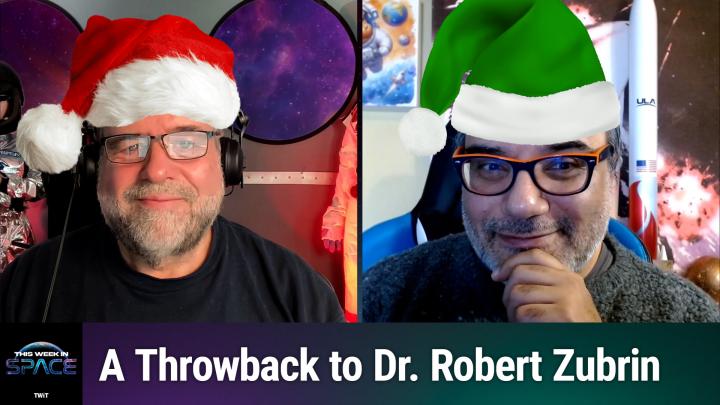
All TWiT.tv Shows (Audio)
This Week in Space 191: Mars Throwback
00:53:36
The Pioneering Work of Dr. Robert Zubrin
Loading summary
Transcript85 lines
- [00:03]
A
Podcasts you love from people you trust. This is trite.
- [00:10]
B
This is this Week in Space, episode number 191, recorded on December 26, 2025. Mars Throwback. Hello, and welcome to the holiday edition of this Week in Space, the Mars Throwback edition. I'm Rod Pyle, editor in chief of at Aster magazine, and I'm here with my favorite Christmas elf, Tariq Malik. How are you, my little elf?
- [00:33]
C
I'm doing well, Rod. I'm doing well. Happy holidays. How are you doing?
- [00:37]
B
I'm good. And I should mention you're the editor in chief for Space.com because there might be one or two people in the entire planet Earth that don't know that. This week we're going to revisit one of our most interesting interviews from 2025, and that was with Dr. Robert Zubrin, who's the head honcho over at the Mars Society and the creator of the Mars Direct Plans for a Rapid Excursion to the Red Planet. Just something that he wrote about. I think it was in the 80s. Yeah.
- [01:03]
C
The case for Mars in the 90s. All that's all that stuff. Yeah. I mean, out there at the beginning.
- [01:08]
B
And was incorporated into the NASA Mars architecture later on. So this is. This was very influential stuff, and he's got a lot to say. But before we say that, we'd like to remind you to do us a solid. Make sure to like and subscribe and subscribe and do all the other podcast things, because we're counting on you. Now sit back, relax, and onward to Robert Zubrin. Welcome back. We are here today, much to Our Delight, with Dr. Robert Zubrin. Now, this is a long resume, so I'm just going to abbreviate a few things, but at the very least, you are a nuclear and aeronautical engineer with a doctorate in, I believe, aeronautical engineering. Correct.
- [01:50]
A
Nuclear.
- [01:51]
B
Nuclear. That's harder. And a founder of president of the Mars Society and the founder of Pioneer Astronautics and a holder of multiple patents. How many patents do you have now?
- [02:02]
A
About 21.
- [02:06]
B
I was going to say, having applied for one, I find that very impressive. So thank you for coming on the show. Today we're going to be talking about Mars, but as always, at this point in the show, Tarek has his favorite question to ask.
- [02:18]
C
Yes. Well, thank you so much for coming on. You know, my big question that I like to start off with is kind of your first, I guess, introduction to space, I guess, also to Mars, maybe. What made that stand out? Like, was it something that really grabbed you when you Were like a kid or is it something that you found later in life through your professional studies or even work there?
- [02:44]
A
No, it's from when I was a kid. I was 5 when Sputnik flew and it's the first major world event that I can remember in terms of happening in my lifetime and experiencing it and while to the adults, but it may have been terrifying because it meant the Soviets could hit us. To me, as a five year old kid who was already reading science fiction, it was absolutely exhilarating. What it meant was that all these stories about space travel were going to be true. Okay. And so I wanted to be part of that. So, you know, I'm much, well, I'm about 10 years younger than Homer Hickam. He was a teenager when Sputnik happened and people know the story of how it impacted him and his friends. But even down to age 5, it had that impact. And, and my parents encouraged my interest. My father bought me a telescope, I did drawings of the moon through the eyepiece and I read all the science I could. And it rapidly became clear to me, however, that of all the planets that were within reach, Mars was the place that was by far the most interesting. It was the place where we might discover life and it was the place that we might settle. And so really from a very young age I became interested in space and wanting to get involved in it.
- [04:08]
C
Oh, that's great, that's great.
- [04:11]
B
I remember sometime around 1968, I surprisingly, actually, given the lack of rigor in my process, won the science fair that year and got a book certificate, the Romans books in Pasadena, and ran in there and got von Braun's Mars project because I thought this was going to be the epic read of my life, only to discover it was mostly numbers and formulae and descriptions of a mission. Do you remember the first time you picked that up?
- [04:41]
A
I actually didn't pick up the Mars project until like the 80s. I found it in a used bookstore in Seattle. But so, but I mean, I was certainly aware of the general scheme of the von Braun with the wheel space station and space shuttles and building things at the space station to send giant spaceships off to Mars with small landing crafts and so forth. And I actually. Never thought that much of it. That is, I, I never thought highly of it actually. And when I first got involved with space professionally, I set myself the task of coming up with a mission architecture that I considered far more practical. So.
- [05:39]
B
Right. You mentioned Mars Direct, which is one of your trademark things. And if you could just give us some Background on that and what, what made it what it is today.
- [05:50]
A
Sure. In 1989, on the 20th anniversary of the moon landing, the first President Bush got up on the steps of the Air and Space Museum, flanked by Armstrong and Algen and Collins, the Apollo 11 crew, and said, you know, this is the 20th anniversary of the moon landing. That was great. That's what America's all about. And therefore I am as president. They're committing us to go back to the moon and on to Mars and this time to stay. It's great stuff. And so in response, NASA went off and conducted a gigantic study which took 90 days to do. And so the report was called the 90 Day Report on how this might be accomplished. And what they went with was a variation on the von Braun mission architecture, which was build a giant space station to use the giant, construct gigantic interplanetary spaceships and also lunar bases and so forth, and then sell this thing off to Mars. And they set a 30 year timeline on this and a price tag of $400 billion, which immediately tanked the program in Congress from sticker shock. And I and a number of other engineers at the Martin Marietta Company, which is where I was working at that time, went to the management, we said, look, you know, this doesn't make any sense. They're designing the most complex mission they possibly can in order to make everyone's pet program mission critical. And it's killing the program. And unless someone comes up with a more sensible plan, there will be no initiative. And management agreed. And by the way, that was very brave of them because the conventional wisdom in the aerospace industry is agree with whatever NASA is saying, no matter how stupid, because they don't want to be contradicted. But the Martin management at that time said, you're right. And so they pulled together a team of 12 people from the whole Huge Martin company, which was like 100,000 people. So it was 12 of us. I was one of them. It was called the Scenario Development team. And we were charged with coming up with an alternative plan. And because there were a lot of creative spirits in this group, we could not agree with each other. And we actually came up with three different plans. And management, once again thinking very clearly, did not try to reconcile all three plans into one to come up with a company line because the plans had very different philosophies behind them. They really couldn't be reconciled. And they just said, okay, we're going to float all three and we'll see which one catches fire. And the one of them that did catch Fire was the one that was developed by me and another engineer named David Baker, which was the Mars Direct Plan. And this was a complete break with the von Braun architecture. It was didn't need any space station, any on orbit assembly, any advanced propulsion. It was direct flight to Mars with two launches of a heavy lift vehicle comparable in capability to a Saturn V. The first would send to Mars an Earth Return Vehicle with no one in it. And it would then make its return propellant. Methane, oxygen out of CO2 and water, which is available on Mars. And then once that is done, then you shoot the astronauts out to Mars in a Hab module that flies one way to Mars. And you land it near the Earth Return Vehicle. And they use it as their house on Mars for a year and a half until the launch window opens up to go back to Earth. And then you get in the Earth Return Vehicle and you fly home. And each time you do this, you add another habitat to the base. And before you know it, you have the beginning of the first human settlement on a new world. And there was frankly nothing in this that was beyond the technology of the 1990s looked at in 1990, which is when we first set this thing forth. This was humans to Mars by 1999. And we were invited to go brief this at a variety of NASA centers. And to our surprise, actually, but very pleasant surprise, we got a very powerful reception, including at places like Marshall Space Flight center, which we have the most conservative center in NASA. They liked it precisely because this was radically conservative. They had already seen all these briefings from other people showing in giant solar electric spacecraft with kilometer square solar panels doing this and that. And they said that's science fiction. This was Apollo times two. And in 1990 there were still a lot of people in NASA who actually had done Apollo, okay? And the, the, the, the. And they said this is something that we could do. And so it caught fire. And. But then it became controversial because the space station people were very upset because they felt we were de. Justifying their program. At that time. The justification being advanced for the space station was that it was a necessary platform to build interpl spaceships on and we weren't using it. So there was a big pushback. And what started as a blitzkrieg turned into trench warfare, but nevertheless it made an impression. And then a couple of years later, Mike Griffin became associate administrator for Exploration at NASA and he liked the plan. And he had me go back to Johnson Space center and say, I want you to brief them on this again. And I'm Going to tell them. They have to listen. And they did. And so they then went and composed their own version of Mars Direct. And it was altered somewhat. Instead of two ships, it was three ships. And instead of a crew of four, it was a crew of six. And they had more of different kinds of equipment. But fundamentally it was the same philosophy. Direct flight to Mars, no on orbit assembly, no advanced propulsion, use of in situ resources, starting on the very first mission. And then the same team that costed out the 90 day report at $400 billion, costed out this new architecture at 55 billion. And, and then, you know, and I was there saying, well, you know, you don't need this and you don't need that, and we could get it down to 30 billion. And Carl Sagan actually intervened and he said, look, Bob, it doesn't matter whether it's 50 billion or 30 billion. It matters that it's tens of billions, not hundreds of billions. Okay? And so I said, okay, yeah, okay, sure. So. And there. And there it was.
- [12:45]
B
And that by Carl Sagan.
- [12:46]
A
And you can actually see the result of that study. That was NASA design reference mission number three. And it's the best.
- [12:55]
B
Second, Robert, because I do want to ask you more about the DRMs that we have to go to a real break now. We'll be right back.
- [13:02]
D
Hey, don't let me interrupt. I know we're having a blast here reliving 2025, but I thought this would be a good time to mention something we do every year around this time that's very important to us and to our ad sales. It's our Twit survey. We do it because we don't really. And no podcast does know anything about you. That's, I think, a good thing. We respect your privacy, but we also would like to know a little bit about you to the degree you're willing to help us out. Just some basic information that helps us go to advertisers and say things like, well, 80% of our audience is it decision makers, that kind of thing. That's why we do this annual survey should only take a few minutes of your time, as I said, is one of the ways you can contribute to keeping Twit on the air. If you would like to, before too long in the next couple of weeks, do it now while you're watching. Go to Twitt TV Survey 26. It's our annual 2026 TWIT Listener and Viewer survey. It's very important to us and I thank you. I really appreciate. And of course, if you don't want to do it, or there's questions you don't want to answer, that's fine too. But anyway, you can help us out. We appreciate it. All right, now back to the show.
- [14:16]
B
So just for the break, you were talking about the design reference missions. Can you tell us a little bit, if you could just back up a step, what the point of the design reference missions and Design reference architecture is and how they adopted parts of your plan?
- [14:30]
A
Well, the design reference missions was attempts by NASA to design a Mars mission so as to see what technologies are actually needed to do it. And there were elements of DRM3 that in my opinion, were not necessary because you always have this effect when you have large NASA teams that there are people there who want to make sure their pet technology is included in the script. And so there was some of that happening in Design Reference 3. Design Reference Mission 3, but much less of it than what happened in the other DRMs. And the. And this is really important because this is the whole problem in NASA. If you want to know, this is the problem in Artemis right now. Okay, there's two ways NASA does things. In one case, they have a purpose driven approach in which they spend money to do things. In other cases, they have a vendor driven approach in which they do things in order to spend money. And the vendor can be an aerospace company, it can be a NASA center, it can be a technology program, it can be a congressional district. Okay, but in other words, are you running your company to please your vendors, or do you simply make minimum use of your vendors to get from them what you need to do what you want to do? Okay, and the problem with the Artemis program, you see, is that unlike Apollo, which was mission driven, where they said we got to get to the moon by 1969, what's the simplest way to do it? Okay, here's the plan. Lunar Orbit Rendezvous. We can do it with a Saturn 5, a command module and a limb. And we'll design this whole thing as one piece and it all will fit together and it's going to go okay. That's how Apollo was designed. Okay? They, they didn't do Apollo in order to give business to the LEM people. Okay?
- [16:32]
B
Right.
- [16:33]
A
Now, Artemis, on the other hand, is, for instance, has five primary flight elements, which is the sls, the Orion capsule, the Starship, the National Team lander, and the Gateway. And these are five separate projects which each have been funded for their own reasons, for their own terms. And they're trying to create a mission architecture that somebody will give Everybody a part in the play, okay? So it's like trying to rewrite Macbeth to give the ballerina and the football star a role, okay, in the school play. And, and that's what you get. So. And it becomes extremely inefficient. That is, the Artemis, unlike Apollo, is a vendor driven program. Okay. And if you look around NASA at various programs, well, unfortunately it is the human spaceflight program which has deviated most in the direction of being vendor driven rather than purpose driven. Whereas the Science Directorate, for example, they didn't land Spirit and Opportunity on Mars in order to give money to the airbag people. Okay? That, you know, the big airbag consortium was. No, they just for that mission, they felt the airbags was the right landing system and so they gave it to them. And if they thought they could do it cheaper with something else, they would have chose something else.
- [17:55]
C
I'm glad you brought this up because you actually lay a lot of, of of those points out in your recent piece in, in the new Atlas there. It's line 38 there, John, too, where you talk about how this, this Mars dream is back, but also that there's issues which a lot of them you just kind of laid out right there about NASA's, NASA's role and like vendors versus like the purpose and whatnot. And I'm curious where you see the push, the drive or the opportunity for the human exploration of Mars now given that, as you point out, both in that piece and as I've written a story about it too@space.com, that it came up in the inauguration speech itself. It came up again in the, I think his joint session speech or the President Trump, that it's very much back at the forefront. So is this a sweet spot now to really crystallize that effort so that, you know, we don't look back at 1999 and think, man, we could have been there, Rod. We could have been there and watched the Matrix on the surface of the moon in 1999. That is so frustrating. So I mean, is this like a, a hot, a hot button? Like this is like, it's like now or never to, in order to get.
- [19:17]
A
I don't know about now or never, but yeah, we've had particular chances to get people on Mars. If Apollo had been followed through, we could have had people on Mars by 1981. 81, yeah, that's what NASA's plan was at that time. They just. Nixon administration canceled the Apollo follow on. Okay. If 1989, 1990, if the Bush administration had forced NASA to take a mission driven approach, a purpose driven approach to Mars instead of a vendor driven approach, which fundamentally was the difference between Mars direct and the 90 day report. They designed the most complex mission they possibly could in order to give everybody apart. We designed the simplest mission we could in order to get to Mars as fast as we could. And, and now we have this opportunity. Now. Okay, look, you obviously have the. Elon Musk is a Mars advocate and is an extremely powerful position right now. He has the President's ear, without question. And we've heard that Musk has said, I want to get people on Mars. Okay, so there's an opportunity now to get a humans to Mars program going. However, there is also, this is fraught with peril because the Trump administration and, and Musk are far more polarizing than say, John F. Kennedy was. And Apollo was the nation's program. It wasn't a Kennedy hobby horse, okay? Or I mean, there's no comparable figure to, to Musk in 1961. But it wasn't, you know, Von Braun's hobby horse or Walt Disney's hobby horse or whatever. I mean it was the nation, okay? And the so and, and especially since, yeah, they are so polarizing. This has got to be made a national program not a must deal. Okay? So, so I, I disagree strongly with those who say, well, look at what a mess NASA made of Artemis. Let's just give the Mars program to SpaceX. That would absolutely kill it because the conflict of interest would be over the.
- [21:30]
C
Top and, and administrations are fleeting. Right. You got, he's got four years and then we see a flip flop in, in, in, in space policy. They're going to say let's go to Venus next and then what do we got? Right.
- [21:43]
A
Right now. Furthermore, the intellectual basis of the program has to be broader than Musk's personal desire to have a city on Mars to preserve the light of consciousness after the Earth is destroyed. Okay. I, I don't think that idea has a lot of buy in. I, I think it actually puts a kind of a skunk essence on, on the program. Actually. The, the, you know, it's like white flight or something. I mean, or, or the Mask of the Red Death where you have people hiding in a castle while everybody else dies at the plate. I, I don't think people want to go to Mars for that reason. I don't think they should want to go to Mars for reason. We don't go to Mars out of despair. We go to Mars out of hope and we go to Mars for the Science for the challenge and for the future. Now that most people right now who are thinking about Mars are thinking about the science now. So we got to make this program something that will be shown to be of enormous benefit to science. Now, I do not believe it is possible for them to land a starship on Mars in the 2026 opportunity. I don't think that's realistic at all.
- [22:49]
C
Oh, we should point out. Yeah, Elon has said he wants to launch to Mars in 2026 with uncrewed and then 2028 with crude. So. Sorry, I didn't mean to interrupt. People know that if they weren't following.
- [22:59]
A
That, I would double the time spans on both of those. I would say that if we do this right, if we are aggressive and a lot of things are done and we're a bit lucky, we can have a uncrewed starship on Mars in 2028 and a crude expedition to Mars in 2033, eight years from now. Eight years is the same amount of time from Kennedy speech to Apollo 11 moon landing. And we are much closer today to being able to send humans to mar. They were to being able to send people to the moon. Okay, so this is doable. Although it, it's a much more aggressive schedule than NASA in recent years has been used to. To embracing. Okay. The, the. But nevertheless this could be done. However, however they say don't.
- [23:45]
C
Don't get a start on an sls. Right Rod? Yeah.
- [23:48]
A
Right. Do not. So the thing is this though. We should land a starship on Mars or try to land a starship on Mars in the 2028 opportunity, but we don't land there. A Tesla robot mannequin. Okay. You know, I mean it's all fun to send a Tesla car on interplanetary trajectory to show that the Falcon Heavy could do great stuff. Okay. But if we're sending something and landing it on Mars, it's got to be a bona fide science expedition. And if you can land starship on Mars with anything like the payload that Musk claims for it must claims 100 ton. Let's give them 30. Okay. That still be good. Okay. Because the Curiosity landing system is all seized by perseverance. Can land one. We land 30 tons on Mars. We can land 15 rovers and 15 full size helicopters. Not little ones like ingenuity, but big ones that are carrying five or seven instruments each. And so we got rovers going out in all directions, helicopters going out in all directions, bringing back samples. And then we have a well instrumented lab in the starship lander itself. And so you got what I call a robotic expedition to Mars that in terms of its capability as a science mission is two orders of magnitude more effective than anything that, you know, JPL and company have been able to do up to date.
- [25:16]
C
So now crazy.
- [25:17]
A
Well, no, it can be done.
- [25:19]
C
In other words, I mean, crazy. That'd be awesome to see. I mean, they would probably put some optimus robots walking off the, the thing too.
- [25:27]
A
We can have that too. But what we really have to have is a powerful science expedition so that we can show the science community the gains they can get out of not only this introduction of heavy lift that we now have here, starship, but heavy landing capability, okay? That Mars science can be improved by two orders of magnitude doing this. And now you get buy in from the science community and the university based science community tilts left. Okay, so now you can get Democrat support for this. Because if this is just about Musk landing his mannequin on Mars, as soon as the political fortunes of war shift, this program is dead. Okay? And by the way, this cannot be done. Musk's Mars architecture, which is a derivative of the Mars Direct mission plan, it involves making your return propellant, methane, oxygen on Mars out of Martian water and CO2 that requires power on the surface. And if you do it with a return vehicle as large as the starship, which is six times as large as the Earth return vehicle that I designed for Mars direct, instead of 100 kilowatts of power, you need 600 kilowatts of power, means you got to have a nuclear reactor on the surface of Mars. And that can certainly be done. We had nuclear power in this country before we had color television, okay? But it's a new development and it involves controlled materials, which means it's not going to happen at SpaceX. It needs government involvement. And so this has got to be a public private partnership. We got to bring the country together around this. And preferably I'd like to bring the free world around this, but at least we got to bring, make this bipartisan within the United States. And so by making it about science rather than Musk's fascination with the, you know, the Isaac Asimov foundation series where they put the colony on the planet terminus so that when the galactic empire falls, I mean, Musk actually calls his Mars colony terminus. You know, okay, the, the, the, the. So we get, we get out of Asimov and we get into something that the nation can buy into and in fact the world scientific community can buy into and we show everyone really a great thing that we're doing. And yes, we also, as Apollo did, astonish the world with what free people can do and re establish American leadership in space and on Earth.
- [27:59]
B
Okay, let's take a quick break again and we'll be right back with our next question, which is one that I hold dear. So stand by.
- [28:07]
D
Hey everybody, Leo Laporte here and I'm going to bug you one more time to join Club twit. If you're not already a member, I want to encourage you to support what we do here at Twit. You know, 25% of our operating costs comes from membership in the club. That's a huge portion and it's growing all the time. That means we can do more. We can have more fun. You get a lot of benefits ad free versions of all the shows. You get access to the Club Twit discord and special programming like the keynote spot from Apple and Google and Microsoft and others that we don't stream otherwise in public. Please join the club. If you haven't done it yet, we'd love to have you find out more at TWiT TV Club TWiT and thank you so much.
- [28:57]
E
When the holidays start to feel a bit repetitive, reach for a Sprite Winter Spiced Cranberry and put your twist on tradition. A bold cranberry and Winter Spice Flavor Fusion Sprite Winter Spice Cranberry is a refreshing way to shake things up this sipping season and only for a limited time. Sprite obey your thirst.
- [29:20]
A
So good, so good, so good.
- [29:22]
E
New Year New gear. Thousands of fresh active styles are at Nordstrom Rack stores now. Save on top brands like Nike, Puma and free people starting at just $35.
- [29:34]
A
How did I not know Rack has Adidas?
- [29:35]
D
There's always something new.
- [29:37]
E
Plus, join the Nordy Club to shop new arrivals first. Unlock exclusive discounts and more. Great brands, great prices. That's why you Rack.
- [29:50]
F
This message may be shocking to many millennials. If you are one, you might want to sit down. Right now, loads of people are searching the following on low rise jeans, halter tops, velour tracksuit, puka shell necklace, disc belt. You likely placed these in the dark of your closet in 2004, never to be seen again. But if you can find it in yourself to dust them off, there are a lot of people who will give you money for them. Sell on Depop, where taste recognizes taste.
- [30:20]
B
So I just want to change trajectory for a moment because I think you were kind of leading up to this point possibly. There's been a lot of discussion about, you know, when you talk about building any kind of facility on Mars, whether it's a landing pad, a small habitat or a city, you're talking about introducing humans, human processes, possibly human bacteria and all the things that go with a base, whether it be nuclear reactors, waste, whatever it might be. There is a not insubstantial group of people that feel that we shouldn't, quote, make the same mistakes we made on Earth, unquote. And they've been called the rocks have rights crowd versus the, you know, Mars is probably a sterile dead planet. And I'm simplifying here, obviously, and something that human beings need to utilize to their best advantage. And I pretty certain you have an opinion on that.
- [31:17]
A
Yeah, I do. These people are not arguing ethics, they're arguing aesthetics. And they're adopting an anti human aesthetic. Okay, you know, what a beautiful planet there would be if not all these ugly life forms were here, you know, you know, it's sort of like the aristocratic aesthetic. Oh, what a beautiful country this would be if not for all these ugly little shacks. This is an anti human point of view. It is not valid. Human values need to be based around human flourishing, okay? And look, okay, they're taking a anti interference argument and they're extrapolating it into a domain where it does not work, okay? What I mean by that is, okay, when I was a kid, Christopher Columbus was a hero, okay, we had Columbus State parades, okay, that, you know, to the world he gave a world that, that's what it says on side of the monument to Christopher Columbus in Columbus Circle. And now in the more recent period, the people have questioned that. They said, well, you know, Columbus is pretty brutally treated. The Indians in the Caribbean, pretty bad. And look what he led to. The destruction of the Native American cultures in North America and the exterminate or near extermination of the bisons and the redwood trees and all this, okay? Now I will concede the point that in the colonization of America, for example, by Europeans, that there was a lot of value that was destroyed. There were the Native American cultures, the bisons, the redwood trees, the carrier pigeons, all that kind of stuff. On the other hand, something was created, okay? A nation of 330 million people committed to liberty, which has invented steamboats and telegraphs and light bulbs and airplanes and nuclear power in the Internet, okay, that so something was destroyed, something was greater. I happen to believe that more was created than more was destroyed. But I will admit that something was destroyed. However, if there had been nothing here when Columbus landed except an absolutely Barren desert with no native Americans, no bison, no redwood trees, no grass, nothing but some bacteria in the groundwater. And from that we built this continental nation committed to liberty, which made all these inventions and set up all these universal and used bookstores and stuff. Okay, would there be people picketing Columbus Day parades today? I don't think so. Okay, so this is, and, and furthermore, look, everyone, and I'm certainly with the Sierra Club on this one, if anybody proposed that we take Earth as it is now and turn it into a planet that looks like Mars, that this would be crazy. This would be a crime against life and everything. Okay, sure, I'm with you on that. And it would be an act of environmental devastation and civilizational devastation. Well, if that is true, if we take something that looks like Mars and turn it into something that looks like Earth, okay, that has got to be a tremendously constructive act, okay? If humans can make the environment worse, humans can make an environment better. Okay, you, you can't just say that whatever we do, it's wrong, okay? That's simply anti human bigotry. What? Whatever you do, any change is, makes things worse. Okay, no, that, that has, has no validity. Now, as far as the planetary protection is concerned, there is one argument that they bring up which is not insane, which the previous argument was, okay, but it's simply wrong, okay? Which is that it will hurt Mars science if humans go to Mars, because we will let loose bacteria and then you'll never know if the microbes you found on Mars were native or if they were introduced by you. Okay, now this is a rational discussion, but they are mistaken, okay? Because look, if you go to Mars and you find microbes that are different either fundamentally or even superficially than Earth microbes, then you know you didn't bring them, okay? Now if you find microbes that are identical to Earth microbes, if they are native, they will have created residues, biomarkers, fossils. This is how we know there was life on Earth before there were people, okay? We, because we. They left behind records. This is how if you fly to Paris, you know, the French were there before you got there, because there's all these buildings here, okay, Feet, feet, feet, feet. But on the other hand, if you go there and you find E. Coli on Mars and no evidence of any past, no biomarkers, then it means you brought them. It's that simple. So, and now, so that's how you know the difference. But furthermore, if you have people on Mars, you can do vastly more science on Mars than if you don't. I mean, what's the planet we know the most about? It's the Earth. Why? Because we're here. And we'd know a lot less about Earth if we weren't here.
- [36:48]
C
I think Steve Squires once told me that if they, he had had like a human geologist on Mars, that they would accomplish basically in a week what the whole mission accomplished in like 10 years. Because they could have just, they could just do it all themselves or something like that. So I totally see the relevance of like that having someone on the ground.
- [37:09]
A
Yeah. Now I do want to bring something up though, which is important because I want to come back to the Trump musk Mars opportunity. And, you know, I've talked about something that needs to be done as part of it, and now I need to talk about something that must not be done if it's to succeed, which is the massive cuts planned for the NASA space science program by the Trump administration. They're Talking about a 50% cut, not okay, so this means losing Hubble, this means losing Curiosity, maybe even perseverance. It may even involve losing Web only a few years after it was launched. And if you come on and you say, look, what are you worried about Hubble and Web for? We're giving you the planet Mars. Okay, you know, you're going to get a Bronx cheer from the science community on this. And you know, and, and, and as you may know, in 2005, when Administrator O' Keefe tried to abandon Hubble and it, you know, passed it off saying, well, I'm doing the Moon and Mars. What are you worried about Hubble for? You know, the Mars Society and I led the assault saying, no way. Okay? No way. We are not giving up the science we have for science we might have. We are not, you know, and furthermore, look, if you're afraid to send a human crew to repair Hubble, there's no way you're going to the moon or Mars. So just don't give us that stuff.
- [38:33]
C
And it came up again also with spirit and opportunity. I mean, they were in and deep extended missions when budget cuts were proposed for those ones. And they ended up going like, I think another, like many, many more years beyond that when that reverse that decision, like didn't go through.
- [38:49]
A
Absolutely. And it would have been incredibly wasteful to curtail them a decade prior to their final demise. And Look, I mean, O' Keefe wanted to terminate Hubble in 2005. And here we are, it is, is 2025 and it is still working. 20 years. And the, the, and, and it's a Better telescope, by the way, than it was Its first 15 years because the, the repair mission also upgraded it, and now Webb's going to be harder to upgrade. But certainly we don't want to turn off working spacecraft. We don't want to turn off the Voyager probes that are proceeding into interstellar space, or the New Horizons probe, you know, or Juno or any of this. Okay? These things are expensive to have created and, and, but they're not that expensive to run and to lose them, to lose the exoplanet telescope, you know? No, and there's. There'd be nothing more certain to put the mark of Cain on this program to. Than to have it used as a cover for wrecking NASA's existing space science program. So if you care about space science or if you just care about this program, you got to insist that these cuts be absolutely reversed.
- [40:08]
B
Reversed or at least moderated to the point that they might be a few surgical cuts. I mean, it always kind of dings my heart. And, and, you know, the Voyager probes are a very emotional conversation for a lot of people because they've been there so long, we've anthropomorphized them and so forth. But I'm sure you've been to Voyager Mission Control. I mean, it's a couple of banquet tables, a couple of old sun workstations, and a handful of people. It's not expensive to run those things. And they're still doing great science out there with what they have left. So the idea of cutting that, or dare I say, some of the, some of the earth science work that NASA does.
- [40:44]
C
Well, I mean, which.
- [40:45]
B
They're not a big fate. There are many that aren't fans of the administration. Something else. Tarek, hold that thought. We got to go to our last break, and we'll be right back. Standby.
- [40:54]
A
Hi there.
- [40:54]
D
Leo laporte here. I just wanted to let you know about some of the other shows we do on this network you probably already know about. This Week in Tech. Every Sunday, I bring together some of the top journalists in the tech field to talk about the tech stories. It's a wonderful chance for you to keep up on what's going on with tech, plus be entertained by some very bright and fun minds. I hope you'll tune in every Sunday for this Week in Tech. Just go to your favorite podcast client and subscribe. This Week in tech from the TWiT network. Thank you.
- [41:26]
F
Toast the holidays in a new way and raise a glass of rumchata, a delicious creamy blend of Horchata with rum. Enjoy it over ice or in your coffee. Rumchata. Your holiday cocktails just got sweeter. Tap or click the banner for more. Drink responsibly. Caribbean rum with real dairy cream. Natural and artificial flavors. Alcohol 13.75% by volume 27% 1.5 proof. Copyright 2025 Agave Loco Brands, Pojoaquee, Wisconsin. All rights reserved. Ford BlueCruise Hands Free highway driving takes the work out of being behind the wheel, allowing you to relax and reconnect while also staying in control. Enjoy the drive in BlueCruise enabled vehicles like the F150 Exposure Explorer and Mustang Mach E. Available feature on equipped vehicles. Terms apply. Does not replace safe driving. See Ford.com BlueCruise for more details.
- [42:25]
E
This episode is brought to you by State Farm. Listening to this podcast Smart move Being financially savvy Smart move. Another smart move having State Farm help you create a competitive price when you choose to bundle home and office auto bundling. Just another way to save with the personal price plan. Like a good neighbor, State Farm is there. Prices are based on rating plans that vary by state. Coverage options are selected by the customer, availability, amount of discounts and savings and eligibility vary by state.
- [42:55]
C
Yeah, no, yeah, I was just going to say, I mean we were talking about all the things that are on the table right now and you and I discussed on the show, Rod, just before that and Robert just mentioned it, James Webb still in the very active mission phase, facing 20% cuts potential, you know, and which is unheard of, you know, not even in an extended phase for that. Hubble facing the same amount right now there too. Chandra on the chopping block, you know, if that actually holds out. So we'll have to see how that all evolves over time, you know, because you see that trade, you know, it's not, it's not the best.
- [43:31]
A
So no, it's foolish and frankly it's criminal. It's a crime against science and a crime against civilization in a way. Because you know, Hubble and Webb are not just world class scientific instruments, they are cultural symbols. They are what the Gothic cathedrals were to medieval civilization, which was a symbol of their highest ideals in, in their case, Christianity. In our search for truth through science and for us to abandon that would be like blowing up our own Gothic cathedrals and it means complete abandonment of our own ideals. And this is something we, we absolutely cannot afford.
- [44:25]
B
So kind of pursuant to this, I would like to get your point of view on the question of US China competition. You know, we're we're, we're facing down the idea that they may get back to the moon before, or get to the moon with humans before we return to the moon with humans. And there is a camp that says this absolutely cannot happen because it's a geopolitical disaster for the US in terms of non aligned nations and all that. And then there's the camp that says, look, we've already been there, it doesn't matter that much. And then there's a third camp that says, fine, let's go skip the moon and go to Mars. So my, my real question, I guess is how do you feel about the idea of competition versus possible coopetition or even outright cooperation in the big picture with China and other powers?
- [45:11]
A
Well, I think that we should cooperate with our true allies, which is the rest of the free world. And unfortunately, the Trump administration seems to have some difficulty in distinguishing between people like Canada and people like Russia, you know, because like, one of them wants to kill us and the other one has been running an early warning system for us for the past 80 years. You know, so there's a difference there. But we, I, I'd like to cooperate with the other parts of the free world. Canada, Europe, Australia, Japan, South Korea, Korea, from other countries, Israel, okay. On this, I think we should compete with China and to the extent they're still players, Russia. It can be an Olympic spirited competition for honors in terms of who can do the most to advance human knowledge of the solar system. And then with respect though to the particular issue of the moon that you brought up up, I believe that if we go to Mars with the correct mission architecture, we can use the same hardware to do the moon and that is starship plus star boat. Okay? And I discussed this in some length in this article in the New Atlantis that you showed the, the listeners, okay, the, the starship is a great reusable launch vehicle and it could be a great tanker to put into lunar orbit or Mars orbit, but it defective to use as an ascent vehicle from either of those places because it is so heavy. Okay, this is the weakness in the SpaceX mission architecture. One size fits all. And what is needed here to make this work right, is something that's a lot like a starship, but about a factor of 5 or 10 smaller. So I call it the star boat. And so, you know, I mentioned that you, if you want to get a starship to take off of Mars and fly back to earth, you need 600 kilowatts. If you used a star boat to take off Mars and Go back to earth, you need 100 kilowatts. If you used a star boat to take off of Mars and go to Mars orbit, to rendezvous with a starship, you need 50 kilowatts, okay? And the. To make the propellant. And similarly, if you put a starship in low lunar orbit and then you go back and forth to the surface with the starship starboard, which is a methane oxygen vehicle, it would use the same propellant as starship. Okay? So the starship could be a tanker for Starboat. And you go up and down with that. We could get five times as many missions for a given amount of launch activity as you can with the current architecture. You know, instead of each mission requiring, you know, four, 14, excuse me, Starship launches, you could do it with two or three and the. And, and do much more competent exploration of the moon. Now, I believe the system should be designed for Mars. And then you say it's designed for Mars, it can also do the moon. So therefore, the star boat would have thermal protection, which it does not need on the moon, of course, unless it wanted to actually take off the moon and fly all the way home to Earth, which is what it might do on certain occasions. But, but the idea is, look, in Apollo, we didn't need a space station to do Apollo, but we did use the Saturn 5 to launch the Skylab space station after we went to the moon.
- [48:58]
B
Interesting.
- [48:59]
A
So there were all these people who are running around saying, you can't go to the moon without a space station. And we said, phooey, we certainly can. And we did. But nevertheless, a space station has certain value in its own terms, okay? And by designing the Apollo hardware, we were able to do the moon and also, incidentally, do Mars. Okay? Excuse me. Also incidentally, do the space station. Okay? And so similarly, you know, you might buy a car for certain purposes, but you can also, you know, sleep in it overnight by the side of the highway if you don't want to check into a motel. That's not why you bought the car, but it's something that it'll. You can do with it. And the. The similarly, we designed this mission architecture. Starship plus Starboat gives you Mars. Starship plus Starboat gives you the moon. And we don't need the gateway, and we don't need SLS and we don't need Orion and the national lander. I believe that contract should be turned into a Starboat contract. Okay? It was ridiculous for NASA to get. Okay, national team got contract because they had sufficient pull that when the human Landing system was given to Starship. They yelled and they screamed, demanded they get a contract too or they would hate NASA. And the. And so they said, fine, here's your contract. Have a good day. And NASA didn't even have the guts to say to the national team, we'll give you your, your $3 billion, but you got to use methane oxygen so we could use you as a landing craft refueled by starship in orbit. They allowed it to be an incompatible lander, which is crazy, okay, since they were already funding Starship. You know, it's, it's like someone going to the Air Force and say, got a new fighter plane for you, but it uses propane as fuel. In the Air Force, instead of saying no, we use jet fuel, saying sure, do whatever fuel you like. So this is what you do, okay? You, you, you, that, that contract needs to be rewritten into being a Starboat contract. And it has to be made compatible with starship in terms of the connectivities and everything to allow it to be refueled off a starship. And then with those two mission elements, you got the moon and you got Mars.
- [51:24]
C
Yeah, yeah, that was going to be my next question. I was going to ask all about Starboat, the 21st century case for Mars. But you did it. Well, you already got me there.
- [51:32]
B
You nailed it. So this is your wrap up comment. If you've got something you want to tell it to the mountain. Here we are all.
- [51:39]
A
Yeah, well, a couple of things. As people know, I'm the head of the Mars Society and the Mars Society is as about to launch a campaign in alliance with the Planetary Society to stop these cuts in the NASA space science program. This, the science program needs to be defended in its own terms. It is the jewel in the crown of NASA and frankly, it's one of the jewels in the crown of, of America. Okay, that, that's what it is. It's, it's one of those things. America is controversial in many ways, but one thing we do that is universally admired is our space exploration. And it's by far the most effective part of NASA because it's the part of NASA that is purpose driven as opposed to vendor driven. Okay? So we want to save that for its own purpose. But also if it is allowed to be cut, it will, it will put the mark of Cain on the MAR initiative that Musk is trying to start. He may not see that. He is apparently a bit drugged with power right now, but believe me, this is so we, we have to make this program one that says this is not something that was used to destroy science. This is something that is going to be used to greatly increase our science beyond anything we had ever thought we could do. And so there's that. And so we want people to support that campaign. And people could start supporting that campaign right now, now by calling or writing their congressman and say, say no to the cuts in NASA science budget. Okay, that's, it's crazy. It should not be done. Okay, we paid for Hubble, we paid for Webb. Destroying them is an act of vandalism against America's property and against America's reputation and against science. And then secondly, the Mars Society is having its next conference at the University of Southern California, which is in Los Angeles. It's going to be October 9th through 11th. And we actually have our call for papers is posted on the Mars Society website, marsociety. Org right now. And so you can register for the conference and if you have an idea you want to talk with about to the conference. And we are taking abstracts on everything from near term ideas for, you know, life detection experiments to be landed on Mars or instruments to how to do a human Mars mission to how to have a human Mars city on Mars or you know, you know, in, in what the form of government should be or how to terraform Mars, everything from the near term to the furthest out. We're interested in hearing about you. You write an abstract of 300 words and if you're accepted, you get a chance to talk to the convention and, and, and possibly have be published in proceedings as well as well. And finally, one last thing is if you haven't read it, of course, the book that explains most of my ideas on how to do missions to Mars is my book the Case for Mars. But I also have a new book out this year called the New World on Mars, which is my ideas on colonizing Mars. That is because we soon will be able to go to Mars in significant numbers. And the big question is going to be what are we going to create once we're there? And that's what I address in my book, the New World on Mars, which is on Amazon.
- [55:07]
B
Excellent. And if it's like the rest of your books, it's very worth reading. So please check it out. Want to thank everybody for joining us today for episode 191 that we're calling the Mars Throwback edition. Tarek, what did you find most compelling in that talk?
- [55:22]
C
I'll tell you, you know, it's always great to talk about Mars.
- [55:25]
A
Do tell me.
- [55:27]
C
But one of the things That I always thought was really interesting is the, you know, Bob really talked a bit about how he thought Starship was overpowered for what we're trying to use it for, to get to the moon and Mars. And he wants to see like a, like a slimmed down version of starship. He called it Starboat. You know, if folks might have heard that part. And in that, in the months since we talked to Dr. Zubrin, SpaceX has now committed to a slimmed down version of Starship to try to get people to the moon for Artemis 3 because NASA's complaining to them about it taking too long. So a bit of precious there, I think from Robert Zubin about maybe it.
- [56:04]
D
Was our show that took the balance.
- [56:06]
C
I know, right? Could it be. Was Sean Duffy listening when he started to complain? I guess we're going to find out.
- [56:11]
B
I kind of doubt it. Well, we hope you had a sensational holiday. I know we did. And we'll see you in the new year. So stay spacey.
- [56:31]
F
The Uniswap Wallet makes it easier and safer to own and use crypto. Created by pioneers of the crypto economy, the Uniswap protocol has powered over $3 trillion in trading volume and it's trusted by tens of millions worldwide. With the Uniswap Wallet, you can discover, swap and manage your crypto all from your phone. Buy your first crypto assets in just a few taps and start exploring the freedom of decentralized finance with Uniswap. Tap the banner to get started.
- [57:00]
C
Hey, Ryan Reynolds here for Mint Mobile.
- [57:02]
A
You know one of the perks about.
- [57:04]
C
Having four kids that you know about is actually getting a direct line to the big man up north.
- [57:09]
A
And this year he wants you to know the best gift that you can.
- [57:12]
C
Give someone is the the gift of Mint Mobile's unlimited wireless for $15 a month. Now you don't even need to wrap it.
- [57:18]
A
Give it a try at Mintmobile.
- [57:19]
C
Com.
- [57:20]
F
Switch Upfront payment of $45 for three month plan equivalent to $15 per month required new customer offer for first three months only. Speed slow after 35 gigabytes if network's busy, taxes and fees extra. See mintmobile.
- [57:30]
B
Com.