← All TWiT.tv Shows (Audio)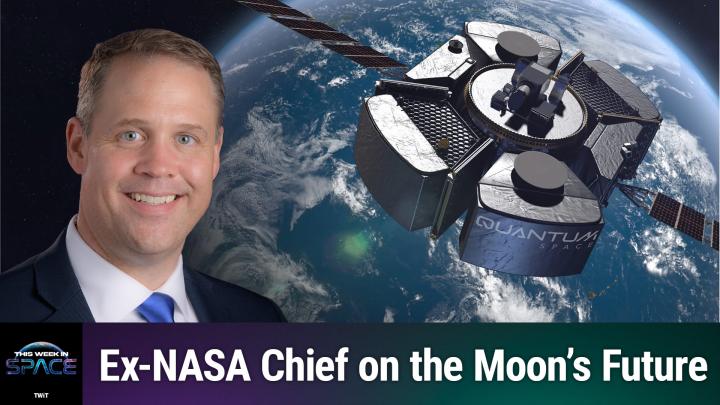
All TWiT.tv Shows (Audio)
This Week in Space 214: Moon Man
01:09:08
With Former NASA Administrator Jim Bridenstine
Loading summary
Transcript148 lines
- [00:00]
Tarek Malik
Coming up on this week in space, NASA's Artemis 3 mission gets its astronaut crew. SpaceX goes out of this world with the world's largest IPO. Elon Musk is a trillionaire. And former NASA chief Jim Bridenstine visits the show, now CEO of Quantum Space, to talk about Artemis, to talk about private investment and how their new Ranger spacecraft at Quantum Space is going to do everything from orbit to cislunar space. Check it out.
- [00:27]
Jim Bridenstine
Podcasts you love from people you trust.
- [00:31]
Tarek Malik
This.
- [00:32]
Rod Pyle
This is true. This is this Week in space, episode number 214, recorded on June 12, 2026. Moon Man. Hello, and welcome to another episode of this Week at Space, the Moon man edition. I'm Rod Pyle, editor in chief of Ad Aster magazine. And I'm with the one, the only, Tarek Malik of Space.com. bring it together for Tarek.
- [00:58]
Tarek Malik
Tarek. Tarek.
- [01:00]
Jim Bridenstine
Okay, you're done.
- [01:00]
Tarek Malik
Go n.
- [01:04]
Rod Pyle
Whenever you children are done, I want to announce more importantly that we're going to be talking to one of our favorite former NASA administrators, Jim Bridenstine, which is a real treat for us. And I know we're all going to enjoy it. So will you. But first, something you may not enjoy. A space joke from Rancher Reagan. Hey, Tarek.
- [01:23]
Tarek Malik
Rancher.
- [01:24]
Rod Pyle
Hey, Tarek.
- [01:25]
Tarek Malik
Yes, Rancher. Yes, Rod?
- [01:27]
Rod Pyle
How do you get a John Deere to the moon?
- [01:30]
Tarek Malik
I don't know. How do you.
- [01:31]
Rod Pyle
With that tractor beam, of course.
- [01:34]
Tarek Malik
I like that. I like that.
- [01:37]
Rod Pyle
Wow. No sound effects or anything?
- [01:38]
Tarek Malik
No, there was a. There was a snare shot. Okay.
- [01:42]
Rod Pyle
Now, I've heard that some people want to put us under the wheels with John Deere.
- [01:46]
Tarek Malik
No, that joke was good. No, no. Trombone.
- [01:48]
Rod Pyle
You can help by sending us your best, worst or most different space joke at Twist Twit tv. And we'll be happy to blame it on you on the air. But before we do that, let's go to headline news.
- [02:01]
Tarek Malik
Headline news.
- [02:02]
Ad Read Voice
Headline news.
- [02:03]
Tarek Malik
Oh, really early. Really early. I am out of sorts.
- [02:09]
Rod Pyle
Let's out of sorts flag him off from that carrier landing it was attempting. Hey, guys, guess what? The SpaceX IPO is here. Run, hide, do a drop drill, whatever. Head for your bomb shelter. Biggest IPO in history has landed. Tarek, you have been tracking this. Give us the good and the ugly.
- [02:31]
Tarek Malik
I mean, it happened right within 20 minutes of going public this morning on the NASDAQ. SpaceX helped make their CEO, founder, Elon Musk, a trillionaire. The world's first. It's the world's largest ipo. They opened actually more at A higher price per share than they thought they were going to do. Because last night, as we're recording this, the night prior to going public, they set the stage, they set the price per share at $135. They went public this morning at $155. And they're selling something like 555 million shares for this, this, this offering right now. And I mean, by all accounts, it seems like it's going to like, shatter records that they're going to make the money that they were hoping to get to and that they are indeed valued at that 1.77 trillion that they were, they were talking about, you know, and so I guess time will tell if it stays that high or not. SpaceX as a public company is very different than the original SpaceX that was founded in 2002 by Elon Musk to get people to Mars with reusable rockets. Now it is an AI company and an orbital data center company and a Twitter social media company and all sorts of things. So it's got a lot of, what is, we call it a lot of fingers in a lot of pots. Is that how you say that?
- [03:50]
Jim Bridenstine
Right.
- [03:52]
Rod Pyle
And it's up over 10 points from where it opened, according to John.
- [03:56]
Tarek Malik
I haven't, I haven't checked it. Yeah.
- [03:57]
Rod Pyle
So 166.36.
- [04:00]
Tarek Malik
It seems like it was going well. Yeah. So, I mean, the chances are high, by the way, the chances are high that this is going to remake the landscape for space industry. Leonard David, friend of the show, had a deep dive on this for the offering for Space.com today, which you can check out on our website, all about how there is now going to be a flood, something like 4,000, according to the New York Times, of new millionaires, all with experience or expertise in commercial spaceflight operations.
- [04:32]
Rod Pyle
Millionaires and billionaires.
- [04:33]
Tarek Malik
And billionaires from SpaceX because, because they were early employees at SpaceX and now, you know, some of them are former. They've left the company, but now they can do so much more in the industry because they are millionaires or billionaires now, like you were talking about. And that can have a ripple effect because we've already the impact that post SpaceX employees have had on industry with new companies or new services or that sort of thing. And this is going to kind of kick that up to a million. And at the same time has shown the world and the investing world that there is an appetite and a market and people that are ready to invest in these companies that they see as either potential performers are already performing like SpaceX has, as like the dominant launch provider on the planet right now.
- [05:25]
Rod Pyle
Now it's also going to be interesting not just in space, but in investment in general. Here we have a company that's rolled out saying we're worth almost 100 times our revenue when before it was anywhere from 3 and up. Not sure how you make that math work, but, you know, if they make it work, that's, that's going to, I guess, change how we do things.
- [05:47]
Tarek Malik
I am very interested in SpaceX as a public because it means that there is much more quarterly visibility into how this company performs, which means we'll know so much more about the ins and the outs of their, their Prof. Their profits, their losses, what they're doing, what their plans are, you know, all of that stuff. And I think that it's going to be very interesting to see how their current efforts across the board, AI data centers, what are they called? Mass drivers on the moon. Right. How that all works alongside like their starship and other obligations now because we're going to see more now.
- [06:24]
Rod Pyle
Let's hope they can make it work. Next up, a story we are calling Space Men. NASA has come out to announce the crew of Artemis 3. And it's four men, all undoubtedly very, very qualified. But we've had some pushback.
- [06:41]
Tarek Malik
Yeah, well, this was exciting news. And then also I guess the expected backlash that you would get from it after like the big deal that actually guest of the show today, Jim Bridenstine, when he was NASA admission made when they rolled out the Artemis program, which was this was the twin sister of Apollo and it would include women flying to the moon and landing on the moon, which we already saw with Christina Cook on Artemis 2. But on Tuesday of this week on what was that, June 10, NASA announced the crew of Artemis 3 and it is led by NASA astronaut and commander Randy Bresnik. You have European Space Agency astronaut Luca Parmitano serving as the pilot and then NASA astronauts Andre Douglas and Frank Rubio as mission specialists. The backup crew was NASA's astronaut Bob Hines. They're all dudes, every single one of them, you know, and, and while a NASA chief, Jared Isaacman, you know, kind of cautioned people after the fact in a gaggle to our writer Josh Dinner, who was there at in Houston for the announcements to not read too much into that, that they are the best of the best for the missions that they're going to be asked to, there was backlash from folks like Emily Calandrelli and Kelly Girardi. You know, those folks out there who are big influencers in the space circuit, who are really disappointed that there is not a woman on this crew, when this is probably one of the more critical test flights, if not the critical test flight that is going to set the stage for the crewed moon landing on Artemis 4 in 2028. And right now it doesn't seem like there's going to be, you know, there's any going back. NASA says, you know, they're, they're committed to this flight. The crew is in training, they launch next year sometime and maybe, just maybe, they'll dock with both starship and blue moon from blue origin and, and we'll actually see some moon landers that we've been waiting so long for.
- [08:38]
Rod Pyle
Well, maybe someday we'll see an all female crew headed out that way, which would be pretty exciting.
- [08:43]
Tarek Malik
Yeah, yeah, for sure. All right, as long as maybe they don't have what's her name on it, right? Katy Perry. Right.
- [08:53]
Rod Pyle
Wow.
- [08:53]
Tarek Malik
No.
- [08:55]
Rod Pyle
Okay, next up, was it?
- [08:56]
Tarek Malik
No. Is that too soon? Everyone, I remember I defended that fight. I said that I thought it was unfair, that treatment. That was off color joke. I apologize everyone. We can edit this part out, right?
- [09:09]
Rod Pyle
I got a full court press defense of that flight recently. Somebody, and I said, you know, I don't completely disagree with you, but it was almost deliberately portrayed in such a way that it was going to stick in people's craw. And I think that was the mistake.
- [09:23]
Tarek Malik
Yeah, yeah.
- [09:24]
Rod Pyle
Between the whole big and the hair styling and the interviews saying, as I recall, I'm studying astrology and physics or something and it's like, you know, could have handled that better, but let's move on. Scientists propose spraying chemicals in our Earth magnetic field to protect us from powerful solar storms. You've, you've, you've sourced the story and my only question is, besides solar storms, which are important, how about solar radiation in terms of climate change?
- [09:54]
Tarek Malik
Well, well, you know what I, I, I was going to start off with, oh my gosh, it's chemtrails in space. But no, no, you went a different way. No, this was really weird. I picked this story not because like it was like a super big newspaper, but just because it's really strange. Right, because we hear all about how a geoengineering on Earth about how to protect the Earth from climate change that you were just talking about right now. And this is like the first I've heard of a theory to try to ward off the impacts of space weather rather than being like setting up early warning systems to know that it's going to happen. And they call it, and I kid you not, it's called storm wall and it is better right dome right now. Well, I'll tell you, it's, it's a, it's a concept by these, these scientists out of Boston University. Brian Walsh is the team lead there. And they ran these computer simulations that showed that you could station satellites in orbit around the Earth. And then as, let's say you're going to get some sort of Carrington event level solar storm, you know it's coming because it takes, you know, it can take a day or two for the particles to actually slam into the Earth. So you see it, you know it's coming. They would release a set of compounds and, and I've got a list here. Let me, let me.
- [11:18]
Rod Pyle
Is it like iron filings or something?
- [11:20]
Tarek Malik
It's, it's like that, but it's like, it's like a barium, lithium, sodium or calcium. So these are like these, it's like
- [11:28]
Rod Pyle
what I drank for my last colostomy.
- [11:30]
Tarek Malik
They, they call it, they call it a mass loading material that you can just stay, you can store it as either a solid or a liquid that or you can vaporize it as you need it and you, you seed it and then it, it basically intercepts the charged particles and it does not have like the, the disruption effect that it would normally have on the ionosphere that, that a normal, a normal ionic geomagnetic storm would have.
- [11:59]
Rod Pyle
So does that mean we have a huge charged cloud out there, like a giant capacitor?
- [12:03]
Tarek Malik
Well, I guess as I understand it, it would be a big cloud of electrically charged plasma. That's what it, that's what it does.
- [12:09]
Rod Pyle
So Jammer B is working on this right now. We're gonna, we're gonna get something from him any second.
- [12:14]
Tarek Malik
Ionizes the vaporized particles so the sunlight would ionize it all and then it all turns into a big cloud. I don't. It sounds like it's gonna take it. And instead of it getting stuck on Earth, this plasma drifts back towards the sun. Is what it says. The face, the face that. The sunward edge of the magnetosphere. And then it thickens the, between Earth and the storm so it makes like a shield. Does that make it like sense? It makes like this.
- [12:41]
Rod Pyle
According to Jammer B. It sounds sketchy. So I don't know, it doesn't make sense to him.
- [12:45]
Tarek Malik
But I just think it sounds weird. It sounds so weird because they're talking about like, like seeding the magnetosphere to make this like, like shield around the planet against the sun. I don't know, it's, it's weird to me.
- [12:57]
Rod Pyle
Well, I just want it to be the galactic barrier out of the original Star Trek. All right, we're going to be back in just a moment. Strap into your seats with former NASA administrator, congressman, and now CEO of Quantum Space, Jim Bridenstine. So stick around.
- [13:13]
Sponsor Voice
Hey, guys, let me interrupt for just a moment to tell you about our sponsor for this week in space, threatlocker. We love Threat Locker. Threat Locker, Zero Trust platform. Those are the keywords. Zero Trust now delivers the industry's most comprehensive suite of zero Trust solutions, not just endpoints. Zero trust with ThreatLocker protects networks. Now this is new. And the cloud. By extending zero trust enforcement to cloud services and company networks, ThreatLocker ensures that devices are validated through a secure broker before they can connect to other resources, to your network, to your SaaS, products, things like Salesforce, Microsoft 365, Asana Workspace, Google Workspace, and GitHub. So the Upshot of that means even if the user has been phished, even if you know they've been, they've been compromised, attackers would actually have to get physical access to their laptops or their phones and then get through whatever biometrics you put on there before they can attack those resources. That's incredible. Threadlocker works in every industry. They've got excellent 24. 7 US based support. Windows, Mac, Linux environments. Absolutely. And Threat Locker enables comprehensive visibility and control. It's great for compliance. Just take a look at some of the users on the web page. Or in fact, listen to this from Rob Thackeray. He's the end user technical architect at Heathrow Airport in London. Now, this is vital, right operation. They cannot go down for ransomware. He said this quote, threatlocker was the most intuitive solution we tested. And the responsiveness of the organization, the willingness to engage with us, to set up a demo, to work with us on weekly audit reviews was very good. It's great to have an ongoing relationship with a company that's so responsive to our requests. ThreatLocker is trusted by some of the biggest in the business. JetBlue, the Indianapolis Colts, the Port of Vancouver. And Threat Locker consistently receives high honors and industry recognition. They're a G2 high performer and best support for enterprise. Summer 2020. Peerspot ranked threat locker number one in application control. GetApp gave them the best functionality and features award in 2025. And the awards go on and on. You can confidently ensure users have access to a consistent, safe network connection, offices, remote users, internal servers, critical services can maintain smooth operations without the need to open inbound ports or deploy traditional VPN solutions. Your end users are going to get the same secure, reliable internal system access they need they expect without big complex infrastructure changes on your part. It's just easy to implement and it really, really works. Get unprecedented protection quickly, easily and cost effectively with ThreatLocker. Visit threatlocker.com TWIT to get a free 30 day trial and to learn more about how ThreatLocker can help mitigate unknown threats and ensure compliance. That's threatlocker.com TWIT we thank them for supporting this Week in Space. You support twists when you go to that site, so please do threatlocker.com TWIT now back to you.
- [16:31]
Rod Pyle
And we are back with Jim Bridenstine, former NASA Administrator, former Congressman and naval aviator and current CEO of Quantum Space. Jim, thank you so much for joining us today.
- [16:42]
Jim Bridenstine
My pleasure. Thanks for having me.
- [16:44]
Rod Pyle
Now before we roll into this, I do want to point out for audience, we believe, as does AI, but we believe between the three of us that Jim was the youngest NASA administrator in history, which is saying a lot, although he almost got beat by Jared Isaacman. But what happened, Jim?
- [17:03]
Jim Bridenstine
Well, I'd have to go back and look at his birth date and everything, but I think he was about to be the youngest NASA administrator and then, and then his nomination got pulled and when he got re nominated, I think he was a little older than I was by the time he got confirmed.
- [17:19]
Rod Pyle
Heck of way to lose a record. Tarik has a question for you that he likes to ask every single week.
- [17:25]
Tarek Malik
Yes, we have a lot of serious questions to ask about you and NASA Artemis as well as quantum space. But one question I like to kind of ask everyone that comes on is kind of what their path to space was because you've had a very interesting approach. You know, is it something that captivated you when you were a kid and you were like, yeah, I'm going to find a way to one day lead the space agency of the United States. Or was it something that you just kind of fell into just as happenstance as your career progressed?
- [17:56]
Jim Bridenstine
It's such an interesting question and I'll be honest, I don't know how exactly it happened, but I will tell you, the progression was when I got to Congress, I worked really hard to get on the Armed Services Committee in the US House of Representatives. And then I was actually put on the Strategic Forces Subcommittee, which was not at the time, it was not A highly sought after subcommittee. It was the subcommittee that dealt with our national security space capabilities. But I was also recruited by Lamar Smith, who was the chairman of the Science Committee. He recruited me onto the Science Committee and then he made me chairman of the Environment Subcommittee. Well, the Science Committee oversees NASA and the environment subcommittee oversees NOAA. So I was at NOAA. 40% of NOAA's budget is space. So between the Strategic Forces Subcommittee, the Space Subcommittee of the Science Committee, and the and the Environment Subcommittee of the Science Committee, I was dealing with space almost all the time. And it was really a tornado that hit more Oklahoma, where I really delved into space from the weather perspective. The question was, how do we give more people. How do we give people more lead time on basically a tornado? And the answer was, well, right now we're giving people warn on detection, which means people on average are getting 13 minutes, which means half the people are getting less than 13 minutes. We needed to move to a day where we could warn on forecast. And so we started looking at different ways of doing warn on forecast. Space was a piece of that puzzle. So I started delving into the weather issues as it related to space. But I was also at that time on the Strategic Forces Subcommittee, dealing with a lot of national security space capabilities. And after a year or two of being in Congress and dealing with space exclusively, we drafted a very comprehensive space reform bill called the American Space Renaissance Act. And it was really just a checklist of things that our country needed to do to be competitive in space into the future. And then ultimately, that kind of launched me as the space guy in Congress. I was part of a small group in the House of Representatives. I was very supportive of Mike Rogers and Jim Cooper when they were creating the Space Force. At the time, they called it the Space Corps, not the Space Force. But I was very involved in that, very supportive of it. And then when that finally became law, I was actually at NASA. So it seemed like when I was in the House of Representatives, I was dealing with space all the time. And I would say that's pretty much what made me a space guy.
- [20:56]
Tarek Malik
Wow.
- [20:57]
Rod Pyle
So when you were nominated, there was a kind of a weird flurry of news stories. You know, half of them said, former naval aviator and Congressman nominated to lead NASA.
- [21:08]
Tarek Malik
Yay.
- [21:08]
Rod Pyle
And then the other half said, wait a minute, this guy was running a museum. How does that make him a competent NASA administrator? And so we kind of were watching that from the sidelines, of course, those of us who covered such things. But you rapidly, you hit the ground Running on your feet and within short order did something that had been tried three other times and did not succeed and is now succeeding, which is a return to the moon for NASA astronauts and international astronauts. So I wonder if you could sort of talk about that experience first. You know, these sort of. I don't know if I'd call them challenges to your nomination, but there was some pushback, which you overcame handily in the end, and then your early days, being faced with the work you had to do at NASA.
- [21:55]
Jim Bridenstine
Yeah. So the pushback. Look, I was the first NASA administrator that came from the political realm. I was an elected member of the U.S. house of Representatives from the state of Oklahoma. And you can imagine I was also the selectee of President Trump. And in that environment, there's just going to be criticism. And the reality was, whether or not I was qualified for the position of NASA administrator, because I was coming from the political arena, there was going to be criticism, period or period. End of story. And by the way, I thought my nomination was bad. Then I saw Jared Isaacman go through his nomination. He actually had the nomination. Then he lost the nomination, then he got the nomination back. This is just the era we live in. If you're a presidential appointee confirmed by the Senate in this era, in all circumstances, you're going to have challenges. And so I'm not. I wasn't, believe me, it was a really hard time in my life going through that, but we got confirmed. And I hope that during my time at NASA, people realized I wasn't what people were trying to make me out to be. You know, people just presume a whole lot about you based on, you know, votes that you took even years ago that had, you know, every vote has, you know, thousands of items in it. And they can nitpick and they can take things, they can create stories about you and all that happened. But I'm not worried about it. It was. It was the politics of the day. And I had the great opportunity to run what I think is probably the greatest agency in America, and that. That is NASA.
- [23:46]
Tarek Malik
You named Artemis, right? So, yeah, well, you came out there, you named Artemis, and now they're actually flew into the moon.
- [23:53]
Jim Bridenstine
Yeah.
- [23:54]
Tarek Malik
Going back, it's all sorts of stuff. It's a.
- [23:58]
Jim Bridenstine
We architected the Artemis program, and it's. It's moving forward. It's. It's going to evolve and change as time goes on. But, boy, I'll tell you, we forever have been trying to go to the moon and having programs get canceled. And this one had just to be clear, it had strong bipartisan support, and it stayed in place through the Biden administration, and it's staying in place in the Trump administration. And there's a lot of hard work to get to that point.
- [24:27]
Rod Pyle
Excuse me, Tarek, I know it's your turn, but it was remarkable when we saw the Biden administration come in and nothing much changed. I mean, you still, you stepped out of the role, which, you know, was unfortunate, but I understand how that works to some extent. But the fact that it continued on supported at similar levels was pretty remarkable given the history of what NASA's been through.
- [24:50]
Jim Bridenstine
Yeah, that's right. So when I was the NASA administrator, there was a time when, you know, we had to. We had to. The Vice President Pence announced down in Alabama at a National Space Council meeting, which, by the way, was a very important capability in that time. But at the National Space Council meeting, he said, we're going to go to the moon and we're going to land by 2024 by any means necessary. And of course, when I heard by any means necessary, of course, 2024 is extraordinarily aggressive. I don't want to dismiss that at all. But also, 2024 means we got to have a bigger budget. We can't just say we're going to go land on the moon in 2024 without getting a bigger budget. So as soon as I got back to my office, I started working on how do we increase the President's budget request to reflect the new agenda. And we were able to get multiple billions of dollars added to the NASA budget. We did an amendment to the President's budget request after the budget request was already out on the street. That is a unique thing to do. It's sometimes challenging, but it was my opinion, having been a member of the House of Representatives, that it was the only right way to go. And by the way, we didn't have to do it. We did it because it was the right thing to do. It was a harder way to go. But when we did it, we built consensus around the agenda. That was the intent. And ultimately there was some talk about taking the money from the Science Mission Directorate to fund the moon program. And I was absolutely dead set against that. We cannot cannibalize one part of NASA to feed another part of NASA, because that's how you turn this into a political fight. And if you want to have a political fight, I'm okay with that. I've been in the political realm. Let's do that. But if you want to really get to the moon, which I know the vice president and the president both wanted to do. If you really want to get to the moon, we got to avoid the political fight. We've got to build the bipartisan support and we need to go win. And to do that, we had to increase the budget, not cannibalize NASA. Ultimately, they came up with a plan that was to take it from Pell Grants, which created a whole new flurry of media stories. But just to be clear, as a former member of Congress, I know firsthand Pell Grants are always over appropriated. It becomes a magical piggy bank for the executive branch. Just to be clear. And Obama used over appropriated Pell Grants for his programs. We were going to use over appropriated Pell Grants for our programs. And just to be. I want to be really fine point on this. Not a single person who qualified for a Pell Grant didn't get a Pell Grant. Everybody got a Pell Grant. So we used those resources. The news made a big hoopla out of it. Even though President Obama did the same thing thing, and nobody said a word. But we. So we just, we took that Money, we increased NASA's budget, and we put together a program to go to the moon. Now, once we got the money, or once we let people know where we intended to get the money, my number one highest priority was to get bipartisan support. So immediately we reached out to Speaker Pelosi. I did a town hall in San Francisco. In fact, it was at the Ames Research center in the San Francisco area, Mountain View, California. Did a town hall there with her on Women's Equality Day. And we talked about Artemis being the goddess of the moon, the twin sister of Apollo. This time when we go to NASA, we're going with all of America, including landing the first woman on the moon. And through all of that, Speaker Pelosi became a believer. She became a supporter. After doing our town hall on Women's Equality Day in San Francisco, we got in the simulator and we landed on the moon together three times. It was like being on a date with my grandma. And I say that in jest. She was a gracious woman. And I will tell you, I was worried because I came from the Republican side of the House of Representatives and she came from the Democratic side. And she was, of course, the former speaker at the time. In fact, she was the speaker at the time because now I'm at NASA and the Democrats had taken control. Or actually, no, I don't think she was. I think she was still the former. But either way, we did the town hall together. And, and she told the Artemis story for the Artemis program. And no, better, like better than I could have told it. And, and on top of it all, like, I was really worried as a Republican male at Women's Equality Day in San Francisco. I was a little worried about what the reaction to me being there might be. But she gave the most gracious introduction she gave me and people cheered for me. And I told the story of Artemis and why we're doing this. And Speaker Pelosi became a real champion. I mean, a real champion. And, and because of that, it did survive from one administration to the next.
- [30:08]
Rod Pyle
Well, it's nice to hear some stories of political unity in these times. Unfortunately, we don't get Pell Grants on this show, so we're going to have to go to a commercial break. So stand by everybody. We'll be right back. Zootopia 2 has come home to Disney. Let's go get ready for a new case.
- [30:23]
Ad Read Voice
We're going to crack this case and prove we're the greatest partners of all time. New friends, you are Gary Destiny and your last name, the snake Dream Team.
- [30:33]
Jim Bridenstine
Habitats.
- [30:34]
Ad Read Voice
Zootopia has a secret reptile population.
- [30:38]
Rod Pyle
You can watch the record breaking phenomenon at home.
- [30:40]
Jim Bridenstine
You're clearly working it. Zootopia 2 now available on Disney. Rated PG.
- [30:48]
Ad Read Voice
Tomorrow morning is knocking. Stock your fridge now. How about a creamy mocha Frappuccino drink? Or a sweet vanilla smooth caramel maybe? Or a white chocolate mocha? Whichever you choose, delicious coffee awaits. Find Starbucks Frappuccino drinks wherever you buy your groceries. Have no fear. Chosen Foods is here to defend your favorite foods from the forces of seedy oils and sketchy ingredients. With cooking oils, salad dressings and mayo. All powered by the good fats from 100% pure avocado oil and simple delicious ingredients.
- [31:16]
Jim Bridenstine
Chosen foods.
- [31:18]
Tarek Malik
Well, you know, I'm glad that, you know, you laid out kind of that progression for Artemis. I remember that by any means necessary speech by then Vice president Mike Pence. I remember it sounded like it was a poke with a stick, as I like to tell my staff when it's time to get things going. And I'm curious now that we've got Artemis 2 behind us in a spectacular fashion earlier this year, you know, what you took away from that mission, watching it unfold, knowing that you kind of helped keep that ball not, not just rolling, but setting it up so that that foundation was there to build on so that they could do that. And then if you think that new goal of 2028 is on track now we just got the Artemis 3 crew named earlier this week, and it seems like a lot more is happening. A lot more faster, I guess, or a lot more visible for the, for the public, at least.
- [32:13]
Jim Bridenstine
Yeah, no, I think that's good. And I think what Jared is doing is important and good. I worry that we don't have a lander. The SLS rocket is working. It's been criticized a lot because of cost and time and everything else. The bottom line is the first time SLS launched, it was rated for crew and it was ready to go to the moon on the first launch. That's hard to do. And yet it did it. In fact, on its first launch, it launched Orion to the moon with a single vehicle, one single launch. Orion went to the moon. The second launch we had crew on is a very capable machine. The RS25 engines are stunning. The SLS rocket is the most powerful rocket ever built. You've got the ICPS upper stage, which it looks like will be replaced with Centaur five upper stages. You've got the Orion crew capsule. This system is fully integrated, designed from the ground to be human rated on day one. And it has all worked. Now, that doesn't mean it's perfect, but what it means is we know what works, what we don't have. And this is the challenge. We still don't have a lander. And without a lander, you can't land on the moon. It's really that simple. And I worry that over time, that's going to come back and bite us. I do think we need a lander. Whatever it takes. Whatever it takes to build a lander soonest is what we ought to be doing as a country. So that's kind of my, my outlook on it.
- [33:54]
Sponsor Voice
Yeah.
- [33:54]
Rod Pyle
And I guess I would just add, regardless of who builds the lander, it probably needs to be designed in such a way that it can fly on any of the major boosters because, yeah, you know, we, we know that Blue Origin's doing the blue moon now. They had that, that new Glenn accident and, you know, one question that comes to mind is can that be launched on a, on a Falcon Heavy? And it's frustrating to watch. And as much as, you know, we really are all in for those companies to succeed and the fact that they have skin in the game is, is remarkable. But it's just, I mean, I hear you from the sidelines here, not being anywhere near D.C. it really is frustrating to see the struggle with these landers. And I guess especially, you know, not to criticize anybody, but the SpaceX plan, for a person who doesn't really know much about engineering, seems very daunting. I mean, that is some really complicated choreography when you've got this orbiting stage with the cryogenic fuel boiling off, trying to refill it enough times to get to the moon, we don't know how many times yet.
- [35:03]
Jim Bridenstine
And it has to be human rated. I mean, that's the hard part is people underestimate how challenging it is to do it to begin with and then do it with the level of confidence and margin required for it to be human rated.
- [35:21]
Rod Pyle
Although fortunately, with this unusual architecture that has been put together, it doesn't have to be human. Ready to bring them home, which I imagine will save a lot of time.
- [35:29]
Jim Bridenstine
Yeah. But yes, if you can get them there, bringing them home is the, is kind of the next big step. But I'll just tell you, the architecture is extraordinarily complicated. I don't think there's any argument about that. And we need a lander. The genius of Apollo. And I'm just going to go back to Apollo, the genius of Apollo was its simplicity. They just said we're going to go to the moon with a single rocket, we're going to do lunar orbit rendezvous and we're going to go down to the surface of the moon and we're going to come back up to our command module and we're going to fly home. They designed that thing to be as simple as you could possibly make it. And because of that they were able to land on the moon eight years after John F. Kennedy declared that we were doing it. It's, it's really remarkable what they did.
- [36:29]
Rod Pyle
And that's, that's including two years lost to the Apollo 1 fire. So when you really think about it was about five and a half. Although they did have, you know, let's be fair, they had a lot more funding than you did with Artemis right there.
- [36:41]
Jim Bridenstine
A lot of people say that. And by the way, I've been guilty of saying it too. They had a bigger percent of the federal budget for sure, a bigger percentage of the federal budget. Back then it was like 4 1/2% of the federal budget. Today we're less than one third of the Fed, less than 1/3 of 1% of the federal budget. So I would also say, yes, I think in real dollars we're down significantly, but not maybe down as much as you might presume. And I'll tell you why. When you compare the spending relative to the federal budget, number one, your budget can shrink. Number two, the Federal government budget grows. So because the federal budget is so much bigger than it used to be, it's a smaller portion of the federal budget. I want to be clear, I am a gomer for making sure that we have a bigger budget for NASA. I mean, the challenge with NASA is we're talking about an agency that has a $24 billion budget. You could eliminate the entirety of NASA and it does not have an impact on the debt or the deficit. It's just not that big of an agency. However, like I said, 1/3 of 1% of the federal budget. So it's just not so. But here's the thing. If you increased NASA's budget by 50%, it would have a huge impact on the capability that we bring to this country. And if. And if you Crush it by 50%, it has a huge impact the opposite direction. And yet in either case, it doesn't really have an impact on the deficit or the debt because it is such a small agency. It is the best brand that the United States of America has by far. There is nothing close. When the NASA administrator shows up in Europe, when the NASA administrator shows up in Japan, people come in droves. It's like I'm Mick Jagger when I go to these other people. And it is remarkable. Everybody has a thirst for NASA all around the world. And I think we cannot dismiss how powerful that is for our country. When I was the NASA administrator and we landed INSIGHT on Mars, it was the ninth time in human history that anybody had landed on Mars. And every time it was done by the United States. And we put a press release out and it was on the COVID of every newspaper worldwide. Insight was just like trying to understand Mars quakes. That's what it was there to do. It wasn't like it was even looking for life or anything. It was just looking for marsquakes. And yet it was on the COVID of every newspaper, including in Tehran, if you can imagine.
- [39:36]
Tarek Malik
Wow.
- [39:36]
Jim Bridenstine
And the Tehran newspaper, it literally said the hardline newspaper of the Islamic Revolutionary Guard Corps. And they had an article about landing on Mars. I mean, that's. It's hard to get those types of good messages about the United States behind countries that really don't like us. And yet we can at NASA uniquely. And it changes the way young people think about our country in a positive way. I just don't think we can dismiss the power of that.
- [40:08]
Rod Pyle
Yeah, I think that's a really good point. We're going to go to a break in a second, but I have kind of a. Might be a Silly question, but it's something that would certainly occur to me if they ever had the bad judgment to make me NASA administrator, which is, did you ever wake up one morning and think, you know, I know Jeff Bezos, I know Elon Musk. Can't these guys just come together and fund NASA for the next 50 years? Because they can afford that, if you
- [40:32]
Tarek Malik
look at the raw dollar, especially now. Right?
- [40:35]
Jim Bridenstine
Yeah, yeah. I'm not going to say I haven't had that thought, but I would think that if they, if they were in charge of NASA, they would want control over it and they'd want to figure out how to make money from it. So I want to be clear, there is huge value in having private companies do these things. I mean, they're putting their own money into these programs in a way that we couldn't do if we were just doing it ourselves. So I want to be clear, it's very valuable. I also think there is a unique capability that the US Government needs, a unique need that we have and a capability to deliver on that need that the American taxpayers expect. And that is how do we shape perceptions and of the United States around the world, how do we do science, exploration, discovery? There's a lot of what we do for which there's not necessarily a market yet. But when we do what we do, there will be a market that forms behind it. And that market is massive. We're seeing that with SpaceX now. We've seen it. I mean, just look at the SpaceX IPO. I mean, that we look at Starlink, we look at what they're doing with the moon and access to space and other things. The market is real, it's big. But it wouldn't exist if NASA didn't blaze the trail.
- [41:55]
Rod Pyle
All right, well, let's blaze the trail into our next break and we'll be right back.
- [41:58]
Ad Read Voice
So stand by experience, a membership that backs what you're building with American Express Business Platinum. Get 2 times Membership Rewards points per dollar on eligible purchases in key business categories, as well as on each eligible purchase of $5,000 or more on up to $2 million in eligible purchases per calendar year. American Express Business Platinum. There's nothing like it. Terms apply. Learn more@americanexpress.com Business Platinum.
- [42:30]
Tarek Malik
Jim, you know, it's really funny that you mentioned the contributions and the roles that industry has because now you are CEO of Quantum Space, which had some news this week of its own. And I really wanted to make sure that we took this opportunity to ask you about basically about what Quantum Space is doing because it sounds really cool with this Ranger spacecraft. And then a lot of the other news that came out this week. And so I guess my next question then is what is quantum space and what brought you to the company at this point?
- [43:06]
Jim Bridenstine
No, it's a great question. So remember I served on the Armed Services Committee Subcommittee on Strategic Forces. And before that I was a Navy pilot. I can tell you every domain of warfare, air, land and sea. Every domain of warfare is dependent on space. The way we do intelligence, surveillance, reconnaissance, communications. The way we send high resolution motion picture images around the globe so that decision makers can make good decisions. The way we do navigation, the way we use that timing signal from the GPS Constellation. We use that to network everybody in theater so we know where the good guys are and where the bad guys are. The way we do missile warning, the way we do missile tracking, the way we do nuclear command and control. So much of what we do is dependent on space. Ultimately as a Navy pilot, you know, we use precision targeting, GPS coordinates. All of that is dependent on space. So much so that the adversaries of the United States have begun targeting space. And we saw this really early in my days in the U.S. house of Representatives. They're launching direct ascent anti satellite missiles. Co orbital anti satellite satellites. So think of a satellite designed to kill another satellite. Jamming, spoofing, dazzling. Using laser energy to confuse a satellite, directed energy to kill satellites. These are all technologies that are proliferating and have already proliferated. And so we have to do things differently. When I was in the house, our big objective, apart from just creating the space force, another big objective was taking these massive Battlestar Galactica satellites that are big juicy targets and spreading them out. We call it distributing the architecture or disaggregating. And by the way, instead of building a single multibillion dollar satellite where a $500 million missile can destroy a $2 billion satellite and in the process have a huge consequence on the war, the terrestrial war fight. Instead of losing in the economies of force and losing in the war fight, we have to change the dynamics. So instead of building multibillion dollar satellites, we're going to build satellites in the tens of millions of dollars. We're going to build thousands of them. We're going to network them together in low earth orbit. We're going to complicate the targeting solution for the enemy. And then they have to launch a $500 million missile to take down a $30 million satellite. The economies of force are against them and it doesn't affect the outcome of the war. So this is what we were working on in those days in the House of Representatives. Now, as you've heard a lot of people talk about, space is now very congested, it's very competitive, and now it's even contested. And so what we're seeing is there's a lot of constellations going into low Earth orbit. We see it with Starlink and Amazon, Leo and Kuiper and Oneweb. And we haven't even talked about what's happening in Europe, what's happening in Japan. Of course, China has.
- [46:25]
Tarek Malik
China, Yeah.
- [46:26]
Jim Bridenstine
I mean, you throw China in there. Low Earth orbit is super, super congested and competitive and even contested. So what we have to do now is we have to distribute the architecture further. So to distribute the architecture further, we need to get to higher energy orbits, medium Earth orbit, all the way out to geostationary orbit, even beyond geostationary orbit, and into cislunar space. And so we do that by building high energy satellites. You hear the Space Force talk about sustained maneuver for dynamic space operations. You hear them talk about maneuver without regret. In fact, General Shaw, who's a friend of mine, he was the deputy commander of US Space Command, he described it at the space Symposium from a stage. He described the GSAPP constellation. GSAPP is a satellite in geostationary orbit. It gets up close and it looks at adversary satellites and it provides information about what those satellites are doing and where they are and that kind of stuff. Now, what he said was imagine having a GSAP satellite. He said, imagine this. Imagine your. Imagine you are buying a recreational vehicle, a camper. And when you buy your camper, you have to make it last for it's $250,000 and you have to make it last for eight years. And you get one tank of gas. He said, that's how we're doing space. That's how we're doing our missions in geostationary orbit. And it's unacceptable. We're missing targets. We're not seeing what we need to see. So what we're doing at quantum space is we're building highly maneuverable satellites that are designed for maneuver without a grit, maneuver without regret. So we're going to higher energy orbits, medium Earth orbit, geostationary orbit. We can also be in low Earth orbit. We can do it all. But we are also capable of going all the way out to cis lunar space, even beyond the moon, to the L2 point a million miles on the other side of the Moon. We can do all of those activities because we're designed for high energy dynamic space operations. It's also true that we're payload agnostic. So we can put any payload. It can be an intelligence, surveillance, reconnaissance, communication, navigation, alternative gps. We can do missile warning. We can, we could do data centers. If somebody wants to do a data center, we can do that as well. So there is no limit to what our spacecraft can do from a payload perspective. We are just building the highest performance satellite you can imagine. So the F18 behind me, think of an F18 except for space. So we're building this with the purpose of serving what the space force calls the theory of competitive endurance. And within that theory of competitive endurance, they've laid out three pillars. Number one is to avoid operational surprise. That means we've got to go out and get domain awareness. We have to see what's happening in deep space. Think about deep space the same as a Navy guy would think about undersea warfare. It's about stealth. Well, we got to know what's going on out there. We've got to know what they're up to. And because there's things in deep space and we don't know what they are, but we know somebody has control over those, and we've got to go find out what they're capable of. So that's one thing. Second pillar is to deny first mover advantage. So when you talk about denying first mover advantage, that's really about proliferating the architecture further. If they can take down a $2 billion satellite with a $500 million missile and it changes the outcome of the war, that's a first mover advantage. Well, then we proliferated into low Earth orbit. Now there's a new threat out there that people are talking about publicly. And the new threat is somebody could detonate a nuclear weapon in space. Well, as it turns out, the further and further you get from the Earth, space is really big and you can't hold it all at risk. Even with nuclear weapons, you can't hold it all at risk. And so we need to proliferate further. And then, and then the third, the third pillar is counterspace campaigning. And that is how do we, as we're using space to affect the terrestrial war fight? The adversary is going to work to deny us that ability. Yet we have to be able to work through that. So we're building satellites to do just that. And at the same time, we have to be able to deny the adversary their ability to use space to affect the terrestrial war fight. So we have to be able to have freedom of action for US and deny freedom of action for the adversary. It's no different than in the air domain. In the air domain, we call it air superiority. In the space domain, we're applying that language now. It's called space superiority. So this is what quantum space is building. We're building it with a vehicle. We call it the Ranger spacecraft. It is a satellite. But the reality is it's more than a satellite, it's a spacecraft. It's a highly maneuverable satellite designed for dynamic space operations.
- [51:41]
Tarek Malik
Is it? Oh, sorry. Can I ask one more, Ron? Because it sounds to me that it's like a Swiss army knife space tug for the military to be able to put whatever payload they want, go to wherever they want in orbit and achieve whatever the mission I guess would require at that.
- [51:58]
Jim Bridenstine
At that point, you could characterize it that. That way I would say we're not a tug. I heard you say the word tug. A tug takes you from low earth orbit to geostationary orbit, but your satellite is still not maneuverable.
- [52:11]
Tarek Malik
Yeah.
- [52:12]
Jim Bridenstine
What we're building is the highest performing satellite bus that exists on the market.
- [52:16]
Tarek Malik
Okay.
- [52:17]
Jim Bridenstine
So if we're going to be targeted with a missile, we're going to get out of the way. But we also have not only the ability for high energy maneuver with chemical propellant, we also have electric propulsion on board the same vehicle. And in fact, we can use the chemical propellant to do electric propulsion. We call it multimode. So we have the ability to do high energy and high efficiency. We have the ability to be refueled and we have the ability to refuel others. And we have the largest fuel tank available on the market. So when you add these things together, you have the highest performing satellite that exists. And you've got a sustainable, durable asset. And an asset that has more delta V or more ability to change velocity than any other satellite on the market. That's what we're building.
- [53:06]
Tarek Malik
It's a race car, not a tug.
- [53:08]
Jim Bridenstine
Yeah, yeah. It's the difference between an F18 and a cargo plane. We're not building the cargo plane. We're building the F18.
- [53:17]
Rod Pyle
All right, we're going to boost ourselves into an advertising orbit for just a few seconds. So go nowhere. When you think like an athlete, setbacks don't stop you. But mindset alone doesn't get you moving again. That's where Icy Hot steps in. Ice works fast. Heat makes it last. So when the rest of the world settles because of the a setback, Icy Hot accelerates your comeback with fast acting, powerful pain relief. Icy Hot. You're so back. It doesn't sound like exactly what you're doing, but do you see small sats at some point as kind of becoming part of the drone warfare of orbit? If you have a lot of small sats, especially if they. If there's a way for them to act as chaff and put out multiple signals without cluttering up low Earth orbit in particular. Is that something you see in the future?
- [54:12]
Jim Bridenstine
Yeah, small sats definitely have a future, not just in low Earth orbit, but geostationary orbit, medium Earth orbit. I do believe that there's a great opportunity there. Again, the key is sustained maneuver for dynamic space operations. What you'll find is the more mass your satellite has, the less dynamic it is because it just takes a lot more energy to move it around. So small sats, I think, are going to be key. We're going to see more and more small sats in higher orbits. I think geostationary orbit. In fact, if you look at the Andromeda mission, this is a mission that the Space Force designed. It said you got to have a satellite that can operate in geostationary orbit. It is, in fact, a smallish satellite, but it has to operate in geostationary orbit, has to be able to do rendezvous and proximity operations even with non cooperative targets. Rendezvous in proximity. But at the end of the day, you also have to have hydrazine fuel, and it has to be refuelable. So all of these things. For the first time, I think we're seeing contracts come out from the Space Force, and they required the size of the spacecraft. So you're seeing them say, we want small spacecraft, we want refueling, refuelable spacecraft, and we want spacecraft that can do RPO and not run out of gas. I mean, if you run out of gas, you just become a brick in space. So these are the capabilities that are being built. And we're on the Andromeda contract. When it came out, it was a $1.8 billion contract. If you'll notice, the Space Force budget went from like 31 billion. The new budget request is for 71 billion, if you include reconciliation in it. So the Space Force budget is more than doubling. And of course, when that came out, they said, okay, well, Andromeda is going from a $1.8 billion IDIQ contract to a $6.2 billion IDIQ contract. And that happened just in a matter of a few short weeks. So what we're seeing is the budgets for these missions are going up. The number of missions that are coming out, those are going up. And I'll tell you, I'm super proud of all that because I'm glad to say that I participated in the U.S. house of Representatives on the committee that established the Space Force. And when we did it, we did it with a purpose. We wanted to have a military service that could compete for resources commensurate with the other services. As dangerous as space was becoming, nobody wants to think about space as a war fighting domain. Certainly the people who have to fight and win wars like to think about it the least. But the reality is we have to be able to defend in space.
- [57:06]
Tarek Malik
You mentioned the Andromeda contract and I know there was a DARPA cislunar contract as well that Quantum Space announced earlier. And I was really curious how the news earlier this week as we're recording the podcast with the plans to go public with the Special Purpose acquisition company.
- [57:27]
Rod Pyle
Right.
- [57:27]
Tarek Malik
Is that, that I did I did I invest to speak. Right, right.
- [57:30]
Jim Bridenstine
Spac.
- [57:32]
Tarek Malik
I'm curious how that sets up Quantum Space to pursue not just those contracts, but kind of the work that you're doing there to, to be in that space, to be a public company.
- [57:41]
Jim Bridenstine
Yeah, no great questions. Number one, the, the DARPA mission is called Lasso. It's to low lunar orbit. By the way, I'm, I'm a, I'm a knucklehead for the moon. I love the moon. The guy who created the Artemis program now has a mission to go to the moon with a national security company, which I think is pretty cool. But it is DARPA partnered with NASA. We're going to test new propulsion capabilities, new navigation capabilities, autonomous capabilities. But we're also going to have sensors on there that can help us characterize the water ice on the moon for an eventual moon base. So all of that to me is super excited. I'm glad we can participate in that now. That's right. Now these are contracts for development. Eventually we're hoping those turn into contracts for actually going to the moon, which is super exciting. That's Lasso. Second question is when you think about how big the Space Force is getting and how these big contracts are coming out fast, we're trying to make sure that we're ahead of the curve. And so we went public, we announced that we're going public with a spac. We're merging with Inflection Point Capital Six, I think it's called. Inflection Point Six is the name of the spac. It's trade. It trades on the NASDAQ and we announced that we're going to merge with those Guys, in the coming months, what that does is they've got a. They've got a lot of money on their balance sheet. We additionally about 250 million on their balance sheet. We additionally went out and raised an additional pipe, private investment in public equities. That's another $300 million that was secured. And so with these capabilities that are coming online from the Space Force, we want to make sure that we can get ahead of it with our own capital so that we can get our product on market and start serving this as fast as we can. Here's what we know. It's about speed. And getting access to the public markets for us is about going as fast as we can possibly go. China is not slowing down, therefore the Space Force is not slowing down. Therefore, we have to go as fast as we can go to get in front of the opportunities that are out there.
- [60:01]
Rod Pyle
So I wanted to pivot to Moon basis for a question because you said you're a moon guy. We're calling you the Moon man for this episode because you got us started again. Thank you for doing that. So there's a chance China's going to make their first landing before we get our seventh landing, which is an important thing to remember. And it seemed to me, and this is just completely subjective viewing on my part, that the next step, I mean, Congress doesn't like to fund second best, I don't think, but that the pivot from that would be. Well, we wish it had gone otherwise. But the important thing is the moon base. So what's the first step on securing? I don't want to say securing territory, because that's not you're doing, but. But securing sighting for the moon base. And it would seem that, I mean, we've talked about Moonfall on the show, but it seems like another very strong way of doing that is to be the first to land a reactor there, because that gives you kind of a de facto safety zone. You put something down, an area that you want to work, and it kind of all makes sense. Are we going to see a reactor race once the first landing takes place? And let's just remind the audience, the first Chinese landing is basically Apollo 11. It's an engine engineering mission set down, gather some rocks, get back in orbit and prove that the system works. And then they'll follow on as they follow on. And of course, they've got this robust robotic mission. But any thoughts on this?
- [61:28]
Jim Bridenstine
Yeah. So the first thing is we have a pretty good idea of where all the water ice is. The water ice is Key for building a moon base, you need to have, obviously, oxygen to breathe, hydrogen for fuel, H2O for water to drink. So that's key. That's a starting point. On top of that, you want to go to the parts of the Moon where you think there's going to be the best opportunities to get resources that would be valuable. So we think about, like, there's been a lot of talk about Greenland lately, a lot of talk about Ukraine, precious metals, rare Earth minerals, all these kind of things. When we think about rare Earth metals, they're generally not Earth metals at all. They're asteroid impacts from billions of years ago. The challenge with the Earth is you've got this thick atmosphere. And so most of what collides with the Earth, it just burns up in the atmosphere and we never see it again. When something does hit the Earth, it's, you know, the Earth has this active geology, active hydrosphere, active atmosphere. Anything that impacted the Earth billions of years ago is not today where it was billions of years ago. And when you find it, it's in very trace amounts. Well, the Moon doesn't have an active geology. It doesn't have an atmosphere, it doesn't have a hydrosphere. I would caveat that it does have a hydrosphere. New water ice is being made on the Moon all the time. That was an interesting discovery that happened when I was at NASA. Not that I'm taking credit for it. It just happened while I was there. But at the end of the day, getting to the water ice and getting to the places where these resources might be could be of great value, I would also say. So I guess the point is we could find large deposits of rare Earth metals, or in this case, they'd be rare lunar metals on the Moon. And then I would also say, you know, I'm starting to become quite a believer in helium 3. If you can have nuclear fusion, which is looking more and more real every day, but if you can have nuclear fusion with Helium 3, you can power the city of Houston for an entire year with a Mountain Dew's worth of helium 3.
- [63:43]
Tarek Malik
He said mountain Dew. Yay.
- [63:48]
Jim Bridenstine
I hope they're one of your advertisers.
- [63:50]
Tarek Malik
I don't know.
- [63:51]
Jim Bridenstine
I guess they are now by default.
- [63:53]
Rod Pyle
There you go.
- [63:54]
Jim Bridenstine
But at the end of the day, I think it's important for us to recognize that the Moon has real value. And that value, I think, is it goes beyond just the value of the surface. We think about the Moon as a gravity well where we can do all kinds of different orbital physics from the Moon as it relates to the Earth Moon system, we can get into different orbits around the Earth that we can't really get into just launching off the Earth or itself. So the Moon gives us great opportunity. It's also a great staging place. If you can build something around the Moon, it gives us a place from which you can push out to Mars with hardly no energy at all. Because if you're in orbit around the Moon, especially near rectilinear halo orbit around the Moon, we can push out to Mars without hardly any energy. So that's really what the gateway was about. I understand the gateway has been kind of repurposed for the surface of the Moon, which, by the way, I think is probably a good plan, but with bigger budgets, there's more opportunities. I would encourage everybody to look at how to get a bigger budget and then also build a gateway as a purpose. For the purpose of pushing out to Mars.
- [65:12]
Tarek Malik
Yeah.
- [65:13]
Rod Pyle
So I think my last question is specific to what you just said. You know, we talk a lot about first mover advantage with this, this lunar competition. We find ourselves in once again, second space age or second space race, I should say. How does first mover, in your mind, how does first mover advantage advantage work with a human landing versus a robotic one? Are they equivalent? Is the human. I mean, obviously the human landing has more news or media impact, but in terms of the geopolitics of the Moon, how does that play out?
- [65:48]
Jim Bridenstine
Yeah, so usually when you use the phrase first mover advantage, that is a kind of a theory of. It comes from theories of warfare where if you have an asset that gets attacked and by attacking it, it affects the outcome of the war and you can't reconstitute it quickly. And that's a first mover. You want to avoid putting yourself in a position where you've created something where the enemy has a first mover advantage. I think when you talk, what you're talking about is, no kidding, being first to the Moon and looking at it from a perspective of economic capability. And I think there is an argument to be said that says, hey, we want to be on the moon first because we want to have the access to those resources. Well, the Moon is smaller than the Earth. We have to remember that the Moon is still really, really big. So I think at this point there's enough room for everybody. And by the way, if everybody shows up, I think that's a really good thing for humanity. It doesn't bother me at all that there's a space race. So I think that's Good. But I would also say, you know, I think there are important points that we want to get to that are going to be important for the future. And if we can be there first, we should definitely do it.
- [67:16]
Tarek Malik
Well, speaking of the moon, is there, is there a future where quantum space not is just insist lunar space, but is on the moon or, you know, running one of those helium three refineries or whatnot? Is that something that you've been thinking about or is it just kind of getting the satellites where they need to be and the contracts fulfilled that you've already got lined up?
- [67:37]
Jim Bridenstine
So I'll tell you this. Quantum Space is currently owned by Cam Gafferian. And Cam Gafferian is an entrepreneur's entrepreneur. No matter what idea I come up with, it's not big enough. He's had a lot of success with SGT Technologies, which is Stringer Gafferian Technologies. He sold that to kbr. Then he created Axiom, which is building a space station to replace the International Space Station. He also created spacesuits with Axiom spacesuits to go back to the moon. And he's created private astronaut missions to take astronauts to and from the International space station using SpaceX Falcon 9 rockets and crew dragons. He also created intuitive machines which competed for and won these lunar lander competitions with NASA to take NASA's payloads to the surface of the moon. They've now landed on the moon twice. He has created a lot of these companies. When you start opening your mind up and you start thinking, what is the reality that the future could hold? I would say you're probably not thinking big enough. No matter. No matter how big you're thinking, it's not big enough. So I would say, look, we don't have any plans to land on the moon right now, but knowing what I know about my new boss, there's going to be a lot going on in the future.
- [69:07]
Tarek Malik
Watch this space.
- [69:08]
Rod Pyle
Well, that's fantastic. Jim, I want to thank you for joining us today for this episode. And I know our audience is going to be very excited to hear from you. Where's the best place online to keep up with your latest achievements and efforts?
- [69:23]
Jim Bridenstine
So I would just encourage everybody to go to QuantumSpace US. It's QuantumSpace US. We got a new website. We're going to continue adding more content to it. Like I said, we've got new capital coming in with the announcement of the spac, and we're going to be doing bigger and better things and we're excited to serve this country.
- [69:45]
Tarek Malik
Made in the United states manufactured in Tulsa.
- [69:48]
Rod Pyle
Quite a career. And Tarek, let's just bear in mind he's still a young man like us,
- [69:55]
Jim Bridenstine
getting older every day.
- [69:56]
Rod Pyle
No, let's talk about that. Tarek, where can we find you on the interwebs these days?
- [70:01]
Tarek Malik
Well, you can find me@space.com as always on all the socials at Tarekj. Malikaj is important. And this weekend, celebrating my 21st wedding anniversary. Happy anniversary to my wife out there. So very excited.
- [70:16]
Jim Bridenstine
That's awesome. Congratulations.
- [70:18]
Rod Pyle
Happy anniversary. I made it to 23. And you can always find me, of course@pile books.com or@astromagazine.com Remember, you can always drop us a line and a space joke, we hope, at Twisted Twit tv. We welcome your comments, suggestions and jokes. New episodes publish every Friday on your favorite podcaster. So make sure to like, subscribe and tell your friends. We love the adoration. And you can also head to our website at Twit TV Twists. Finally, you can follow the Twittech podcast network Wit on Twitter and on Facebook @Twit TV on Instagram. Gentlemen, I thank you and I hope we have a chance to do this again.
- [70:56]
Tarek Malik
Thank you.
- [70:57]
Jim Bridenstine
Thank you. Hey, sweetie. Your mother showed me this Carvana thing for selling the car. I'm gonna give it a try. Wish me luck. Me again. I put in the license plate. It gave me an offer. Unbelievable. Okay, I accepted the offer. They're picking it up Tuesday from the driveway. I haven't even left my chair. It's done. The car is gone. I'm holding a check anyway. Carvana, give it a whirl. Love ya.
- [71:32]
Ad Read Voice
So good you'll want to leave a voicemail about it. Sell your car today on Carvana.
- [71:37]
Jim Bridenstine
Pick up Fe.
- [71:37]
Ad Read Voice
These may apply.