← All TWiT.tv Shows (Audio)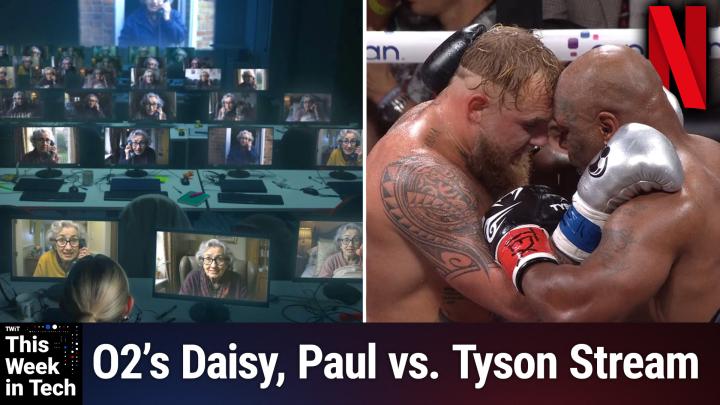
All TWiT.tv Shows (Audio)
This Week in Tech 1006: Underwater Alien Civilizations
02:41:46
Bluesky Growth, Tyson Vs. Paul, AI Granny
Loading summary
Transcript885 lines
- [00:00]
Leo Laporte
It's time for TWiT this Week in Tech. Alex Kantrowitz is here from the big technology podcast. Daniel Rubino from Windows Central. Ian Thompson from the Register. We're going to talk about aliens. Yes, we are. The congressional testimony about unidentified aerial phenomenon. We'll also talk about Microsoft. Was it criminal that they offered the government one year of security services free? Why did Netflix stumble when it Streamed Jake Paul vs. Mike Tyson? And will they stumble again come Christmas Eve? And the Onion in a fight with Elon Musk over Alex Jones? Infowars who will win? We'll talk about all that and a lot more next on Twit.
- [00:46]
Ian Thompson
Podcasts you.
- [00:47]
Leo Laporte
Love from people you Trust. This is TWiT. This is TWiT this Week in Tech. Episode 1006. Sunday, November 17, 2024 Underwater Alien Civilizations it's time for TWiT this Week in Tech, the show. We cover the latest tech news with a roundtable of esteemed, distinguished, good looking and mighty smart panelists. Always love to get Alex Kantrowitz on from the big technology podcast. Great to see you, Alex.
- [01:31]
Alex Kantrowitz
Great to see you, Leo. Thanks for having me on you.
- [01:34]
Leo Laporte
I always ask Alex who he's going to be interviewing for the show because you get the best guests. You're getting the guy who was the first Neuralink patient.
- [01:43]
Alex Kantrowitz
Yeah, I can't wait for that. I'm flying out to Phoenix in a couple of weeks and I'm going to sit down with Nolan Darbaugh, the first patient of Neuralink. He can control computers with his mind. So we're going to talk all about that and whether he wants to merge with AI eventually.
- [01:56]
Leo Laporte
Wow.
- [01:57]
Ian Thompson
That'll be cool.
- [01:58]
Leo Laporte
Awesome. Also here, Daniel Rubino, editor in chief of Windows Central. Daniel, great to see you.
- [02:06]
Daniel Rubino
Thanks for having me. Great to see you guys too.
- [02:08]
Leo Laporte
Always a pleasure. And our friend ian Thompson from Thereegister.com hi, Ian.
- [02:14]
Ian Thompson
Hey there. How's it going?
- [02:15]
Leo Laporte
Our local Brit? We had our Brexit moment last a couple of weeks ago. Now we're right altogether now.
- [02:24]
Ian Thompson
Yeah. Yes. That has yet to be determined.
- [02:27]
Leo Laporte
But all together now. You, you asked for your Blue sky handle up there. This seems to be the thing. Now everybody's moving to Blue Sky. In fact, New York Times of course is on it with kind of a snarky story how Blue sky, alternative to X and Facebook is handling explosive growth. It hasn't all been easy. Mike Isaac writes.
- [02:52]
Ian Thompson
Honestly, they've dealt with it fantastically. I mean, I think so if you're dealing with a million new users a day, a day. You know, the. In terms of the difficulty of scaling, this is a classic use case. And in six months time I'm going back to these people and saying, right, how did you handle it? Because this is really quite something.
- [03:12]
Leo Laporte
I mean, remember the first five years of Twitter? The fail whale was more common than. Yeah, anything else.
- [03:18]
Ian Thompson
Right, exactly, yes. And you know, it's like, yes, there have been ups and downs, the service has gone out, services stayed up for a while, but I think they're dealing with it admirably.
- [03:28]
Leo Laporte
Maybe Jay Graber's experience at Twitter helped. I mean, bluesky was funded by Jack Dorsey early on, before he went away $15 million because he wanted to do a federated kind of version of Twitter. Smart. He was actually thinking ahead. I think he is no longer associated with Blue Sky. Blue sky has seems to be a. Threads has also grown considerably since X's. Yeah.
- [03:52]
Ian Thompson
Have you tried threads? I mean it's the worst kind of meta, you know, platform. It's Instagram followers and an algorithmically challenged platform, to put it politely. I don't know how the rest of the crew found it.
- [04:07]
Daniel Rubino
It's like TikTok and Twitter had a baby. I don't mind it in some ways.
- [04:13]
Ian Thompson
After a bad one night stand, my.
- [04:16]
Daniel Rubino
Feed, when I go onto it is literally just like happy stuff. It's just.
- [04:21]
Leo Laporte
You're talking about threads or Blue sky now.
- [04:23]
Daniel Rubino
Threads.
- [04:24]
Leo Laporte
Yeah.
- [04:24]
Daniel Rubino
And so it's just like videos. It's. It's TikTok videos from like a week ago, but it's just all like cats and dogs doing fun things. So at least while I'm scrolling through it, I'm literally like just laughing and kind of enjoying a social network for once. So in that sense it's not bad. There are a lot of people that I follow and vice versa on it. So it does have that going forward. But I do agree with Ian that like the algorithm, it's a very different network and they stated purposefully it was going to be a different network. So this isn't a network for breaking news. Right. Or delay this stuff. In fact, the algorithm is hilariously like surfacing like information from like two days ago. That's someone will post and that's kind of the joke. And they've purposely downplayed news and politics and all that stuff, which I respect. They're trying to do something not Twitter 2.0, create their own network. So I think that's cool. But I'm also biased here. I'm kind of against all social networks a little bit. I don't know what's happened the last two years. I just don't kind of care anymore. But I still use them. And I'm on bluesky as well.
- [05:25]
Leo Laporte
It's interesting to watch Bluesky because as people move from Twitter to Bluesky, it's starting to look more and more like Twitter.
- [05:33]
Daniel Rubino
Yeah.
- [05:33]
Leo Laporte
Which is both good and bad, I guess.
- [05:36]
Alex Kantrowitz
But that's probably an illusion and I don't want to be the one to pour the cold water on, but I'll just do it.
- [05:41]
Ian Thompson
Go for it.
- [05:43]
Alex Kantrowitz
What Blue sky reminds me of is Clubhouse. And we all remember in the middle of the pandemic, people ran to Clubhouse. It was the place where all the interesting people were and people put a ton of effort into it. And this is what happens in the beginning of every news social network is there's a spike in activity as people try to be super active to grab as many followers as they can. And then only then after a couple of months, they decide whether it's worthwhile or whether they go back to the standard platforms. And Clubhouse people have millions of followers. They don't log on anymore because the activity is just not there anymore. And that's because after most of the middle of Clubhouse cl, you know, they scratched and clawed and they saw it doesn't get them very much. They left. And I just get the sense of this is going to happen to Blue sky as well, and it's certainly going to happen to threads because what you're seeing is this enthusiasm. It's a lot of users that have just not found a place on Twitter anymore and there's energy. But I think what most users on threads and most users on bluesky are going to find is that it's just not the mass network that they used to that we're used to in with when it was coming to Twitter and X. And I don't think it's going to be worth it for most people. And then you go to users and users are going to say, okay, well, we're not finding as good information. We're having less of these influencers posting on these networks than we did on X and they're going to leave. So this is what happens with these social networks. There's a spike of activity in the beginning and then they tend to go in a death spiral. And I think that's definitely going to happen to Blue Sky. And Meta will prop up threads into this boring, you know, kind of benign social network like it is. It seems like it's just a place for people to complain about threads, at least that's what my feed is. And it will. It will be this sort of zombie social network that will operate alongside the two of them. But I don't have Twitter. X is not. Yeah, with X, our Twitter, it's not going X.
- [07:36]
Leo Laporte
Actually, I don't. I'm sorry. I call it Twitter. I don't know.
- [07:39]
Alex Kantrowitz
I call it Twitter all the time also. I know.
- [07:41]
Leo Laporte
Otherwise, what the hell is. What is that?
- [07:42]
Alex Kantrowitz
You know what's interesting, Leo?
- [07:43]
Leo Laporte
It's.
- [07:44]
Alex Kantrowitz
People call it X now, but they still call a post a tweet. The tweet has not gone away. You're tweeting on X. Very confusing. But ultimately it has the massive users. Users and it has the influential users. And when you want to know what's going on in your life, you go there. And I had Ron John Roy, who comes on big technology podcast with me on Fridays. He said something really interesting this past week where there was a top of a building that went on fire in Manhattan. He's not looking at. Yeah, exactly. Not looking at threads. He's not looking at Blue sky for it. He knows the place where he's going to find information for it is going to be X. And Mark Zuckerberg said that X was. Or when it was Twitter, it was. They drove a clown car into a gold mine. And what he's saying is basically they built the experience. There wasn't a lot of brains behind it. And it just became this Internet standard for people. And that's what it is. It's an Internet standard. It's changed a little bit, I think degraded under musk to an extent. But ultimately X is X. Twitter is Twitter, whatever you want to call it. And it's going to be very, very hard to displace.
- [08:46]
Ian Thompson
But haven't we seen this with. Sorry, please, after you.
- [08:48]
Daniel Rubino
I was going to say with X that the issue is that fewer people are definitely using it, you know, as running Windows Central, I can tell you its influence in terms of sharing articles is all but disappeared.
- [09:01]
Alex Kantrowitz
But they're naturally. They are degrading links there. So you might not be seeing the same traffic from links, but that's a platform decision they've made, just as Facebook has made the same decision.
- [09:11]
Leo Laporte
We. I see a lot of people say I don't. I don't have any direct experience because I'm not on any of those. I'm on Mastodon. But I see a lot of people saying that they get more engagement from Blue sky, personally get more engagement from Blue sky than they do from X. Is that you think that that's because of something X is up to. Alex.
- [09:27]
Alex Kantrowitz
Well, look, X has more users and this is the thing like.
- [09:30]
Leo Laporte
No, but I'm just saying that yes, X has more users and many of these people have more followers on X, but they still get more engagement elsewhere. And I guess the implication is that a lot of the engagement on X is phony. It's bots. It's not.
- [09:43]
Alex Kantrowitz
No, I don't think so. Here's sort of what the progression that a social network usually goes through, which is that it has this feel of blue sky, like Blue sky has right now. And then so many more people come on and start posting. And then at every single social network, you hear the same complaint from everyone, which is that organic reach has gone down. And why has organic reach gone down now? A lot of people say it's because the social networks throttle the reach so they can put advertisers on. And if you want to reach people, you have to advertise. But the truth is that the feed is making a decision of how to rank every post within the network. And as a network grows, it's going to get a much more difficult for content to be ranked high. So your views goes down. And so it doesn't mean that there's less people using it, it just means that, like, you have more competition in the feed. And that is, of course, when power laws start to take over, where you're going to have a handful of users that will get a tremendous amount of engagement and the rest will have to claw for whatever's left. And that's especially true in the case of X, where Elon Musk has rigged the feed to give himself more reach.
- [10:47]
Leo Laporte
Yeah, the engagement you're getting on X is. It's not purely algorithmic, shall we say, that somebody's got some.
- [10:56]
Ian Thompson
Throttling is a polite term on this. But I mean, all social networks go through or up to up until now, have gone through the same cycle. Rapid rise and then fall away. We've had Friendster, we've had MySpace, we got Facebook, who got to scale. The question is whether bluesky can do that. And I don't know, it's still work in progress.
- [11:20]
Leo Laporte
I think there's also the question of do we even need this?
- [11:25]
Daniel Rubino
There's a question like, does it need to replace Twitter?
- [11:28]
Leo Laporte
Right.
- [11:29]
Daniel Rubino
Like the. Where these networks are going. As far as I can tell, it's Federation. And I think this is a better system. You know, there is Open Vibe now, that app that connects to Mastodon Threads and bluesky all at Once. So you get one single feed and you can cross post to all three at the same time. Like, this might actually be sort of the future and it might exclude a lot of normal people that used to go onto these networks because there are barriers. Macedon is definitely tricky to get onto. Blue sky is easier. Threads is the easiest, I would say. But, you know, this may be kind of the way things are going. And I think that's actually fine. I don't really use X anymore simply because my own personal account, the people I follow don't post anymore when I do post my engagement as well. So there's no real reason to follow it. As far as breaking news. Drudge report still works just fine for most things.
- [12:24]
Ian Thompson
I still read Drudge.
- [12:25]
Leo Laporte
Drudge is the. Wait a minute now. I must have missed the memo. When did we.
- [12:30]
Daniel Rubino
Drudge place to go on fire during the election. It was some of the funniest front page stuff he wrote. He was trolling Trump so hard. But like, I still got most like breaking news from that. And I was. It was fine. Like, I don't know, like, I feel.
- [12:46]
Leo Laporte
Like I get my breaking news from Yahoo News, Google News. Like, yeah, I mean, you know, sources.
- [12:52]
Alex Kantrowitz
Right.
- [12:53]
Ian Thompson
You're not running an RSS reader anymore.
- [12:55]
Leo Laporte
And I run an RSS reader, but I do that for. Mostly for tech news because that's my. That's my work feeds. Right. So.
- [13:01]
Alex Kantrowitz
So am I the only one here that gets their news from X?
- [13:05]
Leo Laporte
I think so. That's what you're saying? Yeah, I do.
- [13:09]
Alex Kantrowitz
And I think that one thing that we should wait.
- [13:10]
Leo Laporte
But you go to. So do you go to X every. Every hour? Every five hours? Every day?
- [13:14]
Alex Kantrowitz
Not every hour. But I'm on there probably an unhealthy amount of time.
- [13:20]
Leo Laporte
And you go there specifically to see what's going on?
- [13:22]
Alex Kantrowitz
Yeah, exactly. I think it's breaking news.
- [13:26]
Daniel Rubino
Sorry, like, in terms of like, what news? Like national news, local news? Because here's a test company.
- [13:32]
Leo Laporte
Where did you go last night to find out who won the Tyson Jake Paul fight?
- [13:36]
Alex Kantrowitz
I was on Netflix watching it.
- [13:38]
Ian Thompson
Oh, you actually managed to watch it then?
- [13:41]
Alex Kantrowitz
I watched it. I stayed up till past midnight watching this. But. But I just want to make this one point. The thing about Twitter is that it has a sense of urgency. And because there is news there, you can follow the news there. And so it doesn't follow the pattern of most social networks. Like Twitter should be dead if you think about the management. But it remains relevant the same way the New York Times remains relevant because it has that Urgency of breaking news. And just to go full circle with your. Your thought about Blue Sky, Ian, that's why I'm bearish on it, is because it just won't have the urgency unless the news apparatus moves there. And I just don't see it happen.
- [14:16]
Leo Laporte
Well, I think the thing. One of the triggering events of this past week was the Guardian announcing it was no longer going to post on.
- [14:22]
Alex Kantrowitz
Oh my God. Yeah, sorry. By the one, the Guardian was like, we're going to still have our reporters on Twitter. We want our. You to share our reporting on Twitter. It's just that official account is not going to be on Twitter, so.
- [14:34]
Ian Thompson
Yeah, but I mean, it got enough attention.
- [14:35]
Leo Laporte
I think it helped people.
- [14:38]
Daniel Rubino
It had like 30 accounts. It wasn't just one, which I found surprising. There's a lot of like sub Guardian things. But they said their reporters can post, not that they're required to post. They're just. They're saying they're not forbidding the reporters from posting if they want to. I'll say, though, I use. There's a cool tool out there now that bridges Twitter to Blue Sky. So what it does is it looks at who you. You're following and matches it on Blue sky and you can just, one click, do it all. Every major news institution I follow on Twitter is now on Blue Sky.
- [15:06]
Ian Thompson
Yeah.
- [15:07]
Daniel Rubino
So whether. And in fact there's a tech. What's really cool about Blue sky is the custom feeds that you can do. So I have one just called Tech. And if I click that feed, it's literally just a stream, like an RSS feed of just tech news in real time as it's happening. There's also like regular news. There's your. There's. The default view, of course, is chronological, which is what everybody wants, by the way. Let's get that.
- [15:30]
Leo Laporte
Isn't that funny that people don't want the algorithmic feed?
- [15:34]
Daniel Rubino
No, no, no, exactly.
- [15:37]
Leo Laporte
I mean, except they say that. Except that what gets the stickiest is the algorithmic feed. Right.
- [15:42]
Alex Kantrowitz
Otherwise preference, and everybody's revealed preference is to be in an algorithmic feed.
- [15:47]
Leo Laporte
Right.
- [15:47]
Alex Kantrowitz
And by the way, but there's Discover.
- [15:49]
Daniel Rubino
There's a discovery feed on Blue Sky. So I was just going to say there's a Discover feed, which is algorithm.
- [15:53]
Alex Kantrowitz
Pretty good.
- [15:54]
Ian Thompson
As a journalist, then tw. I mean, I get what you're saying, Alex, about Twitter as a, you know, as a good news feed, but it used to be when it was just a, you know, a firestorm of data came out in real time. At the moment, it's so algorithmically twisted that, yeah, you know, if I'm writing a news story, I'll check out what people are saying on Twitter. I wouldn't necessarily believe it entirely because the whole thing is so full of bots. Exactly, exactly. But I don't know. Blue sky could become that. It all depends whether or not they catch the ball or they fumble it.
- [16:29]
Alex Kantrowitz
Yeah. And I'll just say, I'm not saying this as somebody making the case for X or a fan of X. I'm just saying there's real utility there. And as a sort of psycho power user, a lot of what I do is on lists. So I have lists of different reporters for different topics. And then finally, the thing that really keeps me back there and Leo, I think you pointed to it, is sports. Like every sports report or every sports publication is on Twitter. I'm kind of a nut following sports. And so if I want to get up to the information analysis of how my teams are doing, that's where I'm going to find it.
- [17:03]
Leo Laporte
So it sounds like the consensus is, yeah, we do kind of need something like Twitter.
- [17:08]
Alex Kantrowitz
Yes.
- [17:08]
Leo Laporte
And your. Your contention, Alex, and I think you're right. I think we forget this kind of, you know, this sudden burst of interest isn't going to last, that people, you know, get tired of it. It's kind of like the Gartner hype cycle where you get real excited and.
- [17:26]
Ian Thompson
God, if I get one more press release about the bloody Gartner magic quadrant, I swear.
- [17:31]
Alex Kantrowitz
Which quadrant are you in, Ian?
- [17:33]
Ian Thompson
I'm the one that says if I don't care how much money you got, you know, stop emailing me about it. Yes.
- [17:41]
Leo Laporte
I think they go in my spam bucket. I don't think I ever see that. All right, well, you know, I mean, it's not a huge story. The truth is, most of the world couldn't care less. Isn't spending the amount of time we are spending thinking about, you know, Blue sky versus threads versus Twitter. But in our little circle of tech journalists, there was a lot of conversation this week about Bluesky exploding. You know, I think, you know, they.
- [18:08]
Daniel Rubino
Only have 17 million now, or 18.
- [18:10]
Leo Laporte
Million, which is Twitter's like 300 million. Right.
- [18:12]
Daniel Rubino
Yeah. I was going to say the growth is impressive because of, you know, the percentage change, but obviously it dwarfs, you know, everything else out there. It's so far behind.
- [18:20]
Leo Laporte
Critical mass is important for a site like this. Right. The network effect is huge.
- [18:25]
Daniel Rubino
It's the whole thing to a certain extent. But I'll say that, like, listen, communities are where people talk and are enjoying themselves. Right. So there doesn't. This is always, I always bring this up with the problem with capitalism. This idea of like, whatever, like network or product you create has to have infinite growth to be successful, where technically that's not possible for a lot of things. And because of that, we get into this idea there needs to be like one dominant social network where clearly I think we're going into this world where it's very broken up and divided. And that might be an okay thing because back in the day that's how the Internet was and a lot of people enjoyed it. I mean, we're all old enough to remember the Internet. When it first came out, there weren't a lot of people on it, but it was still cool. And Blue sky has that feeling, which is why I think a lot of people are positive about it. But you know, it has a lot of custom ability that Twitter doesn't have. Like I said, with the custom feeds, it has the starter packs which are really kind of cool, where we have one for Windows Central. It's just a. If you click the link, it shows you all the authors on Windows Central.
- [19:24]
Leo Laporte
I do like that feature.
- [19:25]
Ian Thompson
Yeah. We've done the same for the Register as well. I mean, it's. But I mean, this is the way the Internet goes. I mean, Reddit only got started because Dig dropped the ball, you know, I mean.
- [19:35]
Daniel Rubino
Right, exactly.
- [19:36]
Ian Thompson
It's, it's just, you know, same with Facebook. MySpace got dull. I don't know, it's. It's going to be interesting. But I think you're right. The federated future is the way to go. And instead we're going to have a third party portal which will allow you to cover all of these things rather than just going to Twitter or just going to Facebook.
- [19:56]
Daniel Rubino
And it's ironic that you would think Elon Musk would have actually been for that model, which is like argues against centralized power.
- [20:04]
Leo Laporte
You can't buy them control.
- [20:06]
Daniel Rubino
Right, Right. It's like, that's the way it should be. Instead he's arguing for the decentralized system where one person controls the algorithm. And remember the whole idea was, oh, Twitter's left wing, it's biased, it needs to be equal balance. And now the guy is like on stage supporting the president and like, it's just like, it's just like all over the place.
- [20:24]
Leo Laporte
Right.
- [20:24]
Daniel Rubino
So it is a weird situation, but I don't know, we'll see what happens. But I don't think Blue sky needs to be, you know, it doesn't need to pass Twitter to be successful. It could still be its own thing where people on the left, nerds, media people hang out and talk, and that might be just enough for a lot of people, you know.
- [20:42]
Alex Kantrowitz
Yeah, it could be a Discord server. Right. And that's the real question is, is Blue sky going to be a Discord server or a social network with the size to replace X? Because everybody has complaints about X. And I think it's. I think you're right, Daniel. It's probably going to end up as a Discord server, which actually will be better than Clubhouse, which I compared it to earlier. So, yeah, if it does that, then I guess that's some sort of win, but just not what the founders of Blue sky intended, AKA Jack Dorsey.
- [21:10]
Ian Thompson
Well, I will always be thankful, Jack. He gave us one of the smutiest headlines in Register history. But still, we'll drop it.
- [21:17]
Daniel Rubino
No.
- [21:17]
Leo Laporte
Oh, you can't stop there. What was the headline?
- [21:20]
Ian Thompson
Well, it was when Dick left Twitter.
- [21:21]
Leo Laporte
Okay, that's fine. I get it.
- [21:23]
Ian Thompson
And yeah, no, so it was. It was big Dick pulls out, Jack's in the hot seat. But no.
- [21:31]
Leo Laporte
Oh, my God, you guys.
- [21:34]
Ian Thompson
Well, so did you watch the.
- [21:36]
Leo Laporte
So you watched the fight, Alex, because you're a sports fan, Daniel, because I watched Spectacle. It is. I mean, that's not sport, is it? When you get a. What is it? A 20 something fighting a 60 something.
- [21:47]
Alex Kantrowitz
Or late 50, 27 and 58.
- [21:50]
Leo Laporte
Yeah, that doesn't seem quite fair. And don't you think, though, everybody, including Netflix, was really hoping that Mike Tyson, which is Wham. Jake Paul, and knock him out the first round.
- [22:01]
Ian Thompson
Absolutely.
- [22:01]
Leo Laporte
That's what everybody wanted. Everybody's hoping for. I wanted Netflix.
- [22:04]
Ian Thompson
I want to see him beaten like a redheaded stepchild. I mean, it was just kind of like. And then I logged onto the Netflix, Netflix feed, and all I got was Mike Tyson's ass, and it was just like, right, okay, I'll miss that.
- [22:18]
Leo Laporte
Was that. Was it frozen there or.
- [22:20]
Ian Thompson
Well, no, he was sort of chaplain at one point, which he's walking away.
- [22:25]
Daniel Rubino
From an interview, and it was just his bare ass. I caught that. I barely watched it. So it was just like. A lot of us were just like, barely watch this thing. And that's like. We all saw that and it was just like, all right.
- [22:35]
Leo Laporte
Well, yeah, apparently Netflix had a lot of technical issues, but that's probably because. What did they say, 65 million people.
- [22:43]
Alex Kantrowitz
At one point, which makes it the biggest event outside of the super bowl, the Olympics, and maybe some cricket. So it was massive.
- [22:55]
Leo Laporte
Hashtag Netflix, Netflix crash and hashtag unwatchable were two of the trending topics.
- [23:03]
Ian Thompson
It did remind me, it did remind me of that episode of Silicon Valley where they're trying to stream the Ultimate Fighting Championship and it just, the stream falls over. It was just, I forgot about that. There was an image in my head of Gavin Belson showing. This is, you know, I can't say.
- [23:18]
Leo Laporte
That word, by the way. No spoilers. If you haven't seen it, we aren't going to tell you who won. I guess you've learned now. There wasn't a KO in the first round. That's all. You know, I did not watch it. We saw one of the undercard fights and it was so brutal.
- [23:34]
Alex Kantrowitz
I just said, oh, did you see the female?
- [23:36]
Leo Laporte
Apparently that was even worse. No, I saw the first one that.
- [23:40]
Alex Kantrowitz
Was, I mean, I also agree boxing is, is brutal, but it is, I, I, I'm trying to find the words to talk about how unbelievable that woman's fight was because they landed and threw so many punches.
- [23:57]
Leo Laporte
Yeah.
- [23:58]
Alex Kantrowitz
And the fact that they were able to get through the match was just incredible. I'd never seen any, any boxing like that, male or female. It was an amazing fight.
- [24:08]
Ian Thompson
This is why women's sports are really something to watch. I mean, when it comes to football leagues, for example, you know, they, they play harder than the blokes. And I've played women's hockey teams. I still have a floating broken bone in my left, left arm from that. But, you know, I mean, it's, it, it's an interesting area of where sport is going. It's becoming much more diverse.
- [24:32]
Leo Laporte
It does feel like it was, it was a money grab on Netflix's part. It was like pure spectacle, right?
- [24:38]
Ian Thompson
Oh, of course, yeah.
- [24:39]
Leo Laporte
But that's, that's what that was, was that sport, really.
- [24:44]
Alex Kantrowitz
The first three matches were sport, but the Tyson Paul match was spectacle. It was not sport. But you know what? It is a win for Netflix. They created Must See tv. This was their first big scale live production. And even though the streaming didn't work, it's all anybody can talk about.
- [25:04]
Leo Laporte
Right.
- [25:04]
Alex Kantrowitz
And it's like it takes a certain amount of brilliance to put Jake Paul and Mike Tyson in a ring together, put them at Jerry World in Dallas and put some really good fights in the undercard and stream it live. And they did it. And I think this is Netflix has to make this pit, this pivot to live. They're doing this, they're doing the, they're doing some F1, I believe, and they're also doing two NFL games on Christmas Day. Good NFL games. And this is the way they're going to grow.
- [25:32]
Leo Laporte
Why? Why is this necessary for them to grow?
- [25:35]
Alex Kantrowitz
I think they kind of.
- [25:36]
Leo Laporte
You interviewed Reid Hoffman. Did you talk to him? Oh, I'm sorry, that's Reed Hastings.
- [25:39]
Alex Kantrowitz
Yeah, Hastings.
- [25:40]
Ian Thompson
Yeah.
- [25:40]
Alex Kantrowitz
Hoffman's coming on in January.
- [25:42]
Leo Laporte
Okay.
- [25:42]
Alex Kantrowitz
But I think they have to grow because they're saturating. They had a moment where they had negative subscriber or they had a subscriber contraction and then they started growing again because they cracked down on passwords and created this ad tier. Right. But ultimately what. Basically all the engagement data shows they're not really growing the pie, they're just making money off the pie. So they're effectively doing de facto rate increases by password sharing and all this stuff and not allowing you to churn. So they're maxing out. And the only way to create new audiences is to have must see TV live events. And no matter what you say about it, and I watched it and I was disappointed with the Paul Tyson fight. It was a spectacle I don't know if only Netflix can do, but Netflix is certainly the only streamer that can do it and it's, it's huge.
- [26:29]
Ian Thompson
Well, I mean, sport is, is one of the main areas of streaming, which is really growing at the moment.
- [26:34]
Leo Laporte
And it has to be live. You can't do sport.
- [26:37]
Ian Thompson
I don't know, though. I mean, I don't know. I mean, I mean, you, you mentioned, you mentioned with Formula One, Alex, now Netflix has grown. Formula One in the U.S. yeah, with. Yeah, with drive. Enormously. When I came over here in 2008, San Francisco Formula One Club was a couple of dozen of geeky people sitting in a pub Sunday at 9am watching a race. Last time I tried to go to an actual live race in, in the city, it was rammed. Two entire pubs rammed out.
- [27:08]
Leo Laporte
Yeah.
- [27:09]
Ian Thompson
Netflix has enormous power on this and sports are one of the few areas on streaming which are actively growing. So I think it's a wise move.
- [27:16]
Alex Kantrowitz
Yes. And they did, in a run up to the Tyson Paul fight, they did like a documentary, a three part documentary following the two fighters, also following the women fighters. And I caught like one and a half episodes before the actual fight happened and they were really well done. They brought Mike Tyson back to Brownsville in Brooklyn and you see him like taking his shirt off on the street and challenging old guys to fights. And it was, it was real. I don't know, it was compelling television. Absolutely.
- [27:44]
Ian Thompson
Yeah. I mean, drive to Survive is compelling television. I mean, it makes a lot of stuff up, but at the same time, it's brought a lot of new fans into the sport and it's made Netflix an awful lot of money.
- [27:54]
Leo Laporte
Presumably Netflix is doing these also to learn. I mean, they started, they had a live Chris Rock comedy special. Was live, and then they did the Tom Brady Roast. They've been slowly, incrementally trying live streaming to see where the flaws are. But this was obviously the biggest test of their, of their physical plant. And they test, they failed. But presumably they'll learn from that and, and solve it. Yes.
- [28:18]
Ian Thompson
I should imagine a lot of engineers. Yeah, a lot of engineers are going to be going over the data and saying, right, where do we fall over here? Where do we fall over there? What can we do? You know, you.
- [28:29]
Leo Laporte
There is a risk, of course, if it really looks terrible, it's unwatchable, people may not come back. Right. And what's. What you said a couple of weeks, what's the next thing they're going to do?
- [28:38]
Alex Kantrowitz
Christmas. Christmas with the NFL.
- [28:39]
Leo Laporte
Christmas.
- [28:40]
Alex Kantrowitz
And by the way, we are an incredibly forgiving species, humans. And if there's something that everybody's watching, we're going to want to watch it. And I do think they bought Monday.
- [28:50]
Leo Laporte
Night Raw from wwe. So that's going to be live every Monday night. Yeah, they'll solve this.
- [28:55]
Alex Kantrowitz
They'll figure it out. And I think you're right. The point that Ian made is spot on, which is that this was a test. I don't think they realized how big it was going to be. It just, it just sort of snowballed. But they will learn from this and they will have to get the NFL right in December. And if they don't get like, it's one thing to buffer on the undercard of a Jake Paul, Mike Tyson fight, it's another thing to buffer in the fourth quarter when the Steelers are driving down, you know, take the lead.
- [29:20]
Leo Laporte
Yeah.
- [29:20]
Alex Kantrowitz
Cannot buffer then. Remember, you're the only show in town. Nobody else is going to have those games.
- [29:24]
Leo Laporte
You know, I was really think. I thought the NFL might have stumbled when they let Amazon have the exclusive rights to Thursday Night Football. That has proven to be a huge success. It's now beating Monday Night Football on the networks.
- [29:35]
Alex Kantrowitz
The production value on Amazon's Thursday night broadcast is amazing.
- [29:39]
Leo Laporte
Well, they got Al Michaels, which doesn't hurt.
- [29:41]
Alex Kantrowitz
Yes, they have great announcers, great pregame, post game, but it also, it feels to me like they're using better cameras. I don't know what it is they are. You would.
- [29:48]
Leo Laporte
I actually visited the truck when we were in. When we were in Green Bay for their game. Alex Lindsey got me into the Amazon truck. They spent a phenomenal amount of money to have the best technology capable of 4k. They don't stream in 4k yet, but the capability is there. And they're doing graphics packages that are far ahead of what the networks have done. They. Amazon clearly saw this as an important. And they were right. I thought, man, you guys are crazy, throwing all that money into this. Are NFL fans going to subscribe to Amazon prime just so they can watch Thursday Night Football? Yeah, turns out they are.
- [30:29]
Ian Thompson
Well, I mean, YouTube is really heavily pushing the sports angle as well. You know, I think this is something that they've recognized. This is something that the people will pay for. They are. They want it on spot. And that's something that Netflix has got to get sorted out if it wants to cash in on this market.
- [30:45]
Leo Laporte
Yeah.
- [30:46]
Alex Kantrowitz
By the way, the dirty secret about Thursday Night Football is you don't really need to be an Amazon prime subscriber to watch. I'm not a Prime member and I just. How do you watch Amazon.com and it plays.
- [30:55]
Ian Thompson
Oh, interesting. Although I'm still not sold on American football is armored rugby. Nothing more, nothing less than God for the armor.
- [31:04]
Leo Laporte
That's all I can say. Yeah, it's interesting because it also show. What it tells me is that over the top broadcasting is here. Like this is it for cable television, for broadcast television, if people are completely willing to watch a streaming version of an NFL football game, or 8. What was it, 65 million. Watching that fight the other night? Yeah, that. That shows you. It's. It's made it, it's in, it's done. If I were a cable company, I would start to. I'd be worried right now. They've been worried for a while, I imagine.
- [31:38]
Alex Kantrowitz
I mean, hasn't this just been like a terrible two weeks for broadcast news where you look at the election and the primacy of podcasts and now you see Netflix pull, you know, out of thin air.
- [31:50]
Leo Laporte
Right.
- [31:51]
Alex Kantrowitz
A spectacle that rivals the Super Bowl.
- [31:53]
Leo Laporte
Right. The writing is on the wall, that's for sure.
- [31:56]
Benito Gonzalez
Hi, I got a quick question. This is Benito, by the way.
- [31:58]
Leo Laporte
Benito Gonzalez, our technical producer, editor, booker. The guy does it all. Hello, Benito.
- [32:04]
Benito Gonzalez
So. So my question is like, I think the. The one issue I see with streaming services doing sports is that not everybody is synchronized watching it, which is not true with.
- [32:13]
Leo Laporte
Well, they are live, aren't they?
- [32:15]
Benito Gonzalez
They're alive. But, you know, Everybody's little.
- [32:17]
Leo Laporte
I know because when I'm downstairs in the gym and Lisa's watching upstairs the sounds.
- [32:22]
Benito Gonzalez
So is that a problem? I. I kind of feel like that's a little bit of a problem.
- [32:25]
Leo Laporte
That's interesting.
- [32:26]
Alex Kantrowitz
I never gotta put on do not disturb. I mean, yeah, I was watching football today and texting with a friend and I was like. I was watching on with my bunny ear antenna and he was watching on streaming and I was like 20 seconds ahead and I really made him mad because I was.
- [32:41]
Ian Thompson
Exactly.
- [32:41]
Benito Gonzalez
So that's what I. That's what I'm talking about.
- [32:43]
Ian Thompson
Is that a problem? It's the same with F1. I mean, I watch.
- [32:46]
Leo Laporte
Well, that's always delayed because it's in the middle of the night for us in America, right?
- [32:50]
Ian Thompson
Well, no, but I mean, I'll if. Well, okay, we've just had, you know, we've got Las Vegas coming up and we've, you know, we've just had some races in our time zone. But I will watch that and be on the forums talking to people and they're like, pardon me. They're like, you know, that Corner was passed 10 seconds ago. Why are you commenting on this? So, yeah, the, the differences in speeds.
- [33:12]
Leo Laporte
I don't think that's important.
- [33:14]
Alex Kantrowitz
Well, I think where it's really going to be an issue, Bonito is betting, sports betting. Because the line changes, bets come in, and if not, everybody's on the same.
- [33:21]
Leo Laporte
And the new push in sports betting, and it's thanks to that British bookie company, is to do real time betting, props, in the middle of games. Is he going to make that field goal?
- [33:34]
Ian Thompson
But we've seen this with flash trading and the stock exchange and I think we're going to see the same thing in terms of sports betting. If you can get that millisecond advantage, you could clean up.
- [33:44]
Leo Laporte
That was the premise of Michael Lewis Flash Boys. It was actually fascinating because they were trying to build a fiber optic network from the Chicago Board of Trade to the New York Stock Exchange. And it was extremely important that it be straight, that it be the shortest possible line, because nanoseconds could make the difference between getting that trade ahead of time or not.
- [34:04]
Ian Thompson
Which is why you got shipping containers parked next to, you know, the nearest exchanges with a whole bunch of data servers in there. And they made an enormous amount of money. But yeah, the Michael Lewis book is really worth a read.
- [34:17]
Leo Laporte
Yeah. Flash Boys. Yeah. Is that what it is? Flash Boys? I think it is.
- [34:22]
Ian Thompson
I think so. Yeah.
- [34:23]
Leo Laporte
Yeah. Let's take a little Break. We got some flashy boys here right now. We got the. The A team is here. Ian Thompson from there, always a pleasure to have you in your bookshelf, which looks at, like at any moment, it's going to totter and fall into your head, but.
- [34:38]
Ian Thompson
And I live in an earthquake zone, so.
- [34:40]
Leo Laporte
Yeah, I know. I'm. I'm just. I'm nervous for you. That's all I can say. I'm nervous for you. Also with us, Daniel Robino from Massachusetts, editor in chief of Windows Central. Great to have you, Daniel. And where are you, Alex?
- [34:54]
Alex Kantrowitz
I forgot New York.
- [34:55]
Leo Laporte
In New York, we got the. We got the continent, the left and the right coast covered. Alex Kantrowitz hosted the big technology podcast and newsletter@bigtechnology.com. great to have all three of you. I am in Northern California, in the wine country of Northern California, and Burke would not let me build this attic studio. He said, that bookshelf is going to kill you until we had it. Like, it's bolted onto the wall. It's more. It's more solid than the wall itself. So. But on the other hand, the lights could kill me, so I don't know.
- [35:31]
Ian Thompson
But you still in Petaluma. I mean, you said, sorry, Petaluma is the butter and chicken, the chicken and.
- [35:36]
Leo Laporte
Egg capital of the world, thank you very much. But it is the. It is the beginning of the wine country of Sonoma, Sonoma County. So I count the wine as well. All right, ladies and gentlemen, our show today, brought to you by ExpressVPN. It's kind of fun. We were talking about Netflix because ExpressVPN is one of the ways I watch Netflix all around the world. It gives me geographical flexibility, shall we say? There are three reasons you'd use a vpn. One, of course, obviously, security. Everything coming out of your computer is encrypted from that point until it emerges into the world at the VPN servers side. So nobody in the middle, like your isp, your carrier, somebody in the coffee shop can see what you're doing, can steal your stuff. That's good. That's great. That's security. You also get privacy because you know your ISP can't spy on you. If you've ever tried incognito mode in your browser, you probably realize it's not incognito. People didn't. In fact, Google just settled a big lawsuit after being accused of tracking users in incognito mode. Google said, oh, incognito doesn't mean invisible. We can see exactly what you're doing. All your it's really incognito mode is so that your spouse won't see what you're doing. But that's on you. ExpressVPN. That's the one I use. That's the one I trust. So why does everyone need ExpressVPN? Without ExpressVPN, third parties can see every website you visit, even in incognito mode or private browsing mode. And other browsers, your isp, your mobile network provider, the admin of the WI FI network you're sitting on. They all know what you're doing. So why is ExpressVPN the best of the VPNs? It's hiding your IP address, which makes it much more difficult for data brokers. ExpressVPN not only encrypts that data all the way out to their servers, they take extra steps to make sure that there's no record of your visit to the server. So your public IP address is the server's IP address, not yours. All of your traffic, 100% is routed through the secure encrypted servers. And then they make the extra effort to make sure that nothing you do is saved. There is visible there, for instance, their trusted server technology. And this has been audited by third parties who say, yes, it does exactly. This runs in memory. So when you press the button, fire up that big VPN Button on the ExpressVPN app. On iOS, Android, Linux, Macs, Windows. You can even run it on your router. They sell really good routers, but it runs on many other companies. Routers. As soon as it's fired up, you're launching the trusted server. It's running in ram on the ExpressVPN server. They have servers all over the world. It's sandboxed. It cannot write to the hard drive. And the minute you close the connection, it's gone. And so is every trace of your visit. But that's not even enough for ExpressVPN. They also run a custom Debian distribution. I read about this on Bleeping Computer. You could see the article. They run a custom Debian distribution that wipes the drive every morning and starts fresh. So there's literally their servers have no information about you. Fire up the app, click the button, you're protected, it's easy to use and it works on everything you've got all your devices, you could stay private on the go. And the third thing is whatever server you're merging on in the world, that's where you're geographically located from the point of view of Netflix. For Instance, and I asked Netflix, they said, yeah, it's fine. If you got a Netflix subscription in the US and you use a VPN and you're now in the UK thanks to the VPN, you can watch what's on the, on the UK Netflix. I think ExpressVPN is a great deal. You can get it down below $5 a month. Take advantage of ExpressVPN's Black Friday Cyber Monday offer. Now you may say, well, I got a free VPN. Just ask any expert. They will tell you free VPNs are not a good idea. They've got to pay for it somehow. The way free VPNs often pay for it is by spying on you and selling your information exactly what you don't want. Right? ExpressVPN is not free, but they, and they, they charge a reasonable fee so they can rotate IP addresses. They can have high quality, high speed HD quality video servers. They can, you know, do all the things right and protect you. And I think that that's well worth a few bucks a month. Get the absolute best VPN deal you'll find all year. If you go to expressvpn.com Twitterightnow you get 4 extra months with a 12 month plan, 6 extra months with the 24 month plan, absolutely free. Expressvpn.com TWIT get a free extra 4 or even 6 months of ExpressVPN free when you sign up for 1 or 2 years. And I think you're going to want to check it out. Expressvpn.com TwitTheOnlyVPN I recommend the only one I use. Expressvpn.com TWIT let's talk a little bit about cybersecurity. Actually this, this is an interesting Microsoft story for you. Daniel from ProPublica. Did you see this story? Apparently President Biden in the summer of 2021, you may actually remember this brought CEOs of the big tech companies to the White House. This was after a series of cyberattacks linked to Russia, China and Iran had left the government reeling, says ProPublica. The administration asked Microsoft CEO Satya Nadella, Amazon CEOs, Apple, Google and others to make concrete commitments to bolster US Defense. Microsoft said, oh well, yeah, we got something for you. Satya Nadella pledged to give the government $150 million in technical services to help upgrade its digital security. Good idea, right? A big win for the Biden administration and a win for Microsoft.
- [41:44]
Ian Thompson
A major win for Microsoft.
- [41:46]
Leo Laporte
Well, it turns out maybe yes, because it was A limited time deal. The White House offer, this is ProPublica writing, as it was known inside Microsoft would dispatch Microsoft consultants across the federal government to install the company's cybersecurity products, which were free for a limited time. Once the consultants installed the upgrades, federal customers would be effectively locked in because shifting to a competitor after the free trial would be cumbersome and costly. At that point, the customer would have little choice but to pay the higher subscription fees. ProPublica quotes a couple of former Microsoft employee sales leaders involved in the effort. They said it's like a drug dealer hooking users with free samples. Any thoughts about that? Daniel, this is your beat.
- [42:40]
Daniel Rubino
I mean business is going to business, right? Yeah, I think we all. Let's go back to the days of trial where or anytime you're going to try a new service for 30 days, but it auto renews after 30 days.
- [42:55]
Leo Laporte
Hey, we do that, we have two weeks free for Club Twit, after which you pay. I mean it's only $7 a month. I mean I'm not. Microsoft said, quote, the company's sole goal during this period was to support an urgent request by the administration to enhance the security posture. Federal agencies were continuously being targeted by sophisticated nation state threat actors. This is from Steve Fale, who's a security leader for Microsoft's federal business. There was no guarantee the agencies would purchase these licenses and they were free to engage with other vendors to support their security needs.
- [43:31]
Ian Thompson
Yeah, rip out and replace. It's an easy thing to do.
- [43:37]
Leo Laporte
The White House disputed that characterization, including Tim Wu, who was a former presidential Advisor. He told ProPublica he discussed the offer with the company in a short and formal chat prior to the summer, but did not sign off. He said if they're saying that I signed off, they're misrepresenting what happened on the phone call. Your business gone to business. But on the other hand, it's a little unseemly for the business to say, see, we're helping America, we're helping the federal government with this lovely free trial offer is a little disingenuous.
- [44:15]
Daniel Rubino
Oh yeah, no, I mean, I guess one should tell the government for once to read the fine print. This is one of those things where I'm not going to justify what Microsoft did, but this is just common practice across anything. And if you're a business, securing government contracts is the gold mine. Right? That's, everybody knows it's, you know, once again to that defense industry and everything, it's, it's a lot of money. And Azure makes A ton of cash for Microsoft. It continuously grows. It's one of their best business divisions. So it doesn't surprise me. It's unfortunate that this happens, but it's also interesting that we're actually getting kind of transparency on this. Whereas a lot of other contracts, I would say that probably happened. Yeah, yeah. With the Defense Department especially, we don't get any kind of reporting of this or that same kind of coverage because this is Microsoft. But you know, when you look at how like jets are made and stuff like that, it's, you know, it's way more severe. I mean, billions of dollars, you know, so it's like this is a thing and hey, maybe Doge will solve this.
- [45:21]
Leo Laporte
But you know, talking about the Department of Governmental Efficiency.
- [45:26]
Daniel Rubino
Yes.
- [45:27]
Ian Thompson
I don't think really Elon is asking for high IQ individuals to come and work 80 hour weeks on Doge for no pay.
- [45:37]
Alex Kantrowitz
It's like, right, low iq.
- [45:39]
Ian Thompson
Exactly. Exactly.
- [45:41]
Daniel Rubino
You also have to have a blue check. You have to pay to use his service.
- [45:45]
Leo Laporte
The best and the brightest, my friend.
- [45:47]
Ian Thompson
Yeah, but I mean, coming back to what Daniel was saying, this is Oracle's entire business model when it comes to government contracts. You know, I mean, it's like, get them locked in. I mean, Palantir is doing the same thing as. Well, I don't blame Microsoft for this, but they really managed to turn, you know, a tragedy which was, you know, their accounts had leaked government data to all kinds of foreign actors and they were like, okay, well we'll invest 150 million and we're going to get billions in return. I don't know who the business manager was that came up with that, but I should imagine they're getting a fairly healthy rise.
- [46:22]
Alex Kantrowitz
I also think that this ProPublica article is pretty irresponsible, at least the framing of it. And they say Biden asked Microsoft to raise the bar on cybersecurity. He may have helped create an illegal monopoly. And so I was like, all right, let's read the story and see how many times it mentions monopoly. It mentions it only once. Where the issue here is procurement. And I'm not defending Microsoft. I do think this is like typical sketchy tech, tech sales. But there's a. They cite this professor of who says that what Microsoft did is exclusionary conduct, opening the door for an illegal monopoly. There's no way that this is monopolistic behavior. It'll never hold up on court. And the professor who's calling it an illegal monopoly should have known better than to do it.
- [47:10]
Leo Laporte
So I guess the Real question is how hard it would be to, once the one year free trial wore off, to switch to something else.
- [47:20]
Alex Kantrowitz
You can switch. I mean, it's up to the competitors here, right? Like the way that governments go through this is they do an RFP process or request for proposals and then every company that wants the government money, and there's a lot of them, they bid. And so if you're, let's say you're Amazon, right? Are you going to tell me that you cannot out bid Microsoft like it's the company that wants it most is the one that gets it. And that's why Microsoft got it, is because it wanted it the most. And so, I mean, would it be cumbersome? Yes. I mean, switching from Gmail to hey is cumbersome. Switching from Twitter to Blue sky is cumbersome. But I just think that we can't have such low expectations of our government that when something is difficult and cumbersome for them that they'll never do it and that therefore the company that sold them the software in the first place is a monopoly. It just doesn't stand up to me just on the basis of facts.
- [48:12]
Ian Thompson
I mean, we've seen this before with Jedi Contract, for example, where you know, the government was saying basically when it comes to the military, you want a single source provider and the rest of it, which was a dumb idea from a start, but you know, and Microsoft won it. You know, governments like, easy, get it in place. Who cares if we have to pay a lot more for it later on because the taxpayers are paying? So I don't know. The cost of shifting your system is such that I don't know. I think Microsoft played a blinder on this one.
- [48:43]
Leo Laporte
Microsoft, according to ProPublica, was very aware, having been through a little fight with the Department of Justice a few years earlier, of the antitrust issues. Tim Wu said Microsoft's lawyers were overly paranoid about antitrust concerns.
- [49:00]
Alex Kantrowitz
Sounds like Microsoft.
- [49:02]
Leo Laporte
Yeah, I made it clear, says Wu, there was no ability in the White House to sign off on antitrust. We can't say that you're indemnified for any antitrust actions on the basis of this. Wu said, I'm not smart enough to say, oh yeah, that's fine with me. I'm not crazy. So there was an awareness anyway on the part of Microsoft that this could, this offer could be seen as kind of a little bit skeezy. They didn't want to be accused of antitrust and they wanted Tim Wu to say, no, no, you're okay.
- [49:47]
Ian Thompson
Microsoft has been playing this game ever since invested in Apple just to keep an alternative operating system going. They're very, very aware of this, and they should be, particularly after the IE case.
- [49:58]
Leo Laporte
The sales teams, according to ProPublica, said they knew customers who accepted the White House offer were unlikely to undo the intensive work of installing the upgrades. Maybe, Daniel, you can explain this better, that there are different tiers of security from Microsoft products. Most of the Federal government was G3 at this point. Microsoft said, we'll upgrade you to G5 free for the first year. But moving back to G3 seemed unlikely. They knew that once they were into G5 that they would continue to pay for it. Does that make what I just said make any sense at all? Daniel?
- [50:34]
Daniel Rubino
Yeah, no, I think it's anyone who's dealt with it before, even on a small scale, knows how difficult it can be to roll out something.
- [50:43]
Leo Laporte
Well, also, if you've moved to G5, this is, by the way, in the Wake of the SolarWinds Orion attack. If you move to G5, you're protected for a year and then you say, okay, good job done, and you go back to G3 and suddenly you're attacked again. That doesn't reflect badly on Microsoft. That reflects badly on the organization. So there's also some pressure not to downgrade your security, even though it's now going to cost you money. Salespeople pitched the White house offer again, ProPublica had sources in the Microsoft sales organization for this. Salespeople pitched the White House offer as the easy button. Our argument was, we have this whole suite of goodness, said a former Microsoft employee who worked with the Department of Defense. You should upgrade because it will take care of everything. Rather than have a bunch of vendors that will do one of the 20 things that the G5 can do. Yeah, I mean, this is probably not a non story. It's more about government procurement. Microsoft did what any company would do. Say, hey, first year's free. Go ahead and give it a shot.
- [51:48]
Daniel Rubino
That's really the question, right? Like, if any other company got in this position and have the same thing, would they have behaved any differently?
- [51:55]
Leo Laporte
Right.
- [51:55]
Ian Thompson
No.
- [51:56]
Leo Laporte
And nor should government procurement assume that companies are somehow no longer in it for the money.
- [52:03]
Daniel Rubino
Well, that's what I say. That's the funny part. They say some lawmakers, like Rep. Jim Langevin of Rhode island accused the company of unfairly upcharging customers for what they consider to be basic security. Quote, is this a profit center for Microsoft, unquote? He asked Smith, Brad Smith, during the hearing. Smith replied, I'm Putting the in there. We are a for profit company. Everything that we do is designed to generate a return other than our philanthropic work.
- [52:29]
Alex Kantrowitz
Which are we paying for this? Yes, Congressman, it's called buying things.
- [52:38]
Leo Laporte
Yeah, yeah, yeah. So if anything, maybe we should, Congress should look at the procurement process more than, I mean, Microsoft's just doing, as you say, what Microsoft does.
- [52:49]
Ian Thompson
Well, I mean, we have seen claims, particularly with Jedi, where, you know, government procurement officers were offered jobs at tech firms after they retire. And this revolving door is just a recipe for disaster.
- [53:03]
Alex Kantrowitz
That should be illegal. That's the stuff we should be.
- [53:05]
Ian Thompson
Absolutely not.
- [53:06]
Alex Kantrowitz
About companies that make government a good offer and government taking the offer that they, you know, deem to be the best.
- [53:12]
Leo Laporte
Microsoft, by the way, three years later offered the nation's hospitals a G5 level upgrade at no cost for the first year.
- [53:23]
Ian Thompson
Yeah, the first one's free.
- [53:26]
Alex Kantrowitz
Sorry. But like, do the procurement people in these government offices and in these hospitals not look at the pricing for year two? Can they not do like an analysis of what the pricing is? Yeah, because if you're not, if you're legitimately not looking at year two prices, then what are you doing in your job?
- [53:44]
Ian Thompson
Yeah, you suck at your job. I mean, it's just that you've got to look at long term costs.
- [53:50]
Leo Laporte
Well, and also you have to ask your people, your IT people. Okay, we're going to be G5 for a year. How hard is it to go back to G3 or are we stuck? Are we going to have to be G5 forever after?
- [54:03]
Daniel Rubino
And presumably when you sign up for this, you're agreeing that you're going in with the assumption it's going to work.
- [54:09]
Leo Laporte
For the first year.
- [54:10]
Daniel Rubino
Yeah, yeah. You're gonna like, all right, we're going probably hopefully lock this in for a couple years because it's doing the thing we're told it's supposed to do. So it's like, it's weird not to like plan this out with the assumption that you're going to get charged, but you know, I don't know how that stuff works. So I'll say the hospital thing though is really important. I, I used to work at a hospital. My current partner, she works at a hospital. And everybody should be scared and nervous about the security systems and the computer system that are running. Oh, they're awful. There are so many years behind. They starve the IT departments. It's just, everything is just, we see how hospitals run, especially because the for profit ones, you know, it's a, it's a horrible, horrible thing. That's going on right now with hospitals.
- [54:56]
Alex Kantrowitz
And that's why when you're ever feeling sick you should just type your symptoms into chat GPT the safest way for care.
- [55:02]
Ian Thompson
Yeah. Okay, so you just know that you've got cancer then. But I mean it's like it's the same problem with the British National Health Service. Some of their computers are still running xp, right? And you're like wouldn't. And they're paying Microsoft through the nose for a little extra support and paying micro patches as well. But yeah, you're right the basic infrastructure of government is running on software that should not be running and this needs to get upgraded and yeah, they're going to have to pay for it. But yeah, look at the year two, year three, year five costs.
- [55:35]
Leo Laporte
Isn't there a petition going around in the EU to force the EU to use Linux?
- [55:45]
Ian Thompson
Yeah, there's been a movement around that. In particular the German government was very big on Open Source. They've now shifted slightly back to commercial software but there's still a large Open Source so push that way. But okay, I'm from Britain, I'm Brexit island. So EU no longer.
- [56:03]
Leo Laporte
You don't get affected by that, huh?
- [56:05]
Ian Thompson
Unfortunately not, no. But I mean this is the petition.
- [56:08]
Leo Laporte
Leaving Apple and Google Support the future of our freedoms. Sign the petition for an EU Linux operating system and public administrations.
- [56:16]
Ian Thompson
This could be the year of Linux and government.
- [56:18]
Leo Laporte
How hard would that be? I mean I wonder is it shouldn't the government foster support Open Source software?
- [56:28]
Daniel Rubino
No. I don't know how much I know Open Source is just that buzz phrase that people like to say and it automatically sounds good. It's like cancer free. Like how can that be bad, right? And I feel like that's how Open Source is. But from what I, when I was working in a hospital we I was working in a sleep center and one of the reasons we didn't upgrade our operating systems was not because Microsoft was closed source or because Linux, you know, wasn't available. It was because the programs reran to do to sleep Diagnostics is custom made software by a tiny little firm and if we want to upgrade the operating system they were going to have to do a lot of testing and a lot more validation for the software that would have gone through a whole process and caused sort of commotion. So they would rather just keep the operating system with their custom software running and just be as is instead of investing to get it all up to date. And that's what you see with a lot of hospitals. It's just this custom software that is just difficult. Sometimes the company may not even be around anymore or it could take every company.
- [57:31]
Leo Laporte
It's not just the public sector. Every company has this. We have this problem. We had a young guy in here who wrote us a sales system and he left. He was just almost an intern, left after a year. And we said, well, are you going to support the system you wrote? He said, no, exactly. And so we. And you know, we're running. We've been running on it ever since. It has a few little glitches. He wasn't a professional developer. Two people can't use it at the same time or the whole thing crashes. We've had to hire a developer to come in and try to figure out how to make it work. But that's. Companies do that. We did that. It was a sensible thing at the time.
- [58:14]
Daniel Rubino
Yeah.
- [58:15]
Ian Thompson
Well, you've seen the billboards around San Francisco in the Bay Area about paying for open source over the last couple of weeks.
- [58:22]
Leo Laporte
Oh, really?
- [58:23]
Ian Thompson
Yeah, there's a movement going. A whole bunch of startups are basically trying to get companies to commit to paying a couple of grand a year to fund an open source project. And this is actually really crucial because.
- [58:36]
Leo Laporte
They use it for free and they don't. Yeah, yeah.
- [58:39]
Ian Thompson
But I mean, we did a story. Do you remember the great XKCD cartoon about how the entire operating system was run by one guy from Omaha? Yeah. We found him. The GPRSS protocol is run by one guy in Omaha and he supports it entirely on his own. And these people need funding. Otherwise you go to a commercial vendor because you know you're actually going to get support. And that's the central thing that the chasm that open source has to cross.
- [59:07]
Leo Laporte
This is the cartoon. A modern digital infrastructure which is a very complicated structure of bricks, all supported by one little teeny block at the bottom. A project some random person in Nebraska has been thanklessly maintaining since 2003. It's funny, but it's also actually really true in many, many cases.
- [59:27]
Ian Thompson
Yeah, I mean, this is the kind of thing if you're going to build a proper. If you're going to rely on open source, you've got to fund the open source developers that keep it running. And the industry hasn't found out a way to do that yet.
- [59:40]
Leo Laporte
Now let's take a little break so we can fund this operation. I'm in it for the money, I admit it. I'm like Brad Smith. Yeah, it's a profit deal here, but we are very happy to have A great panel in working with us here for no cost at all. Right. I think, Alex. Yes, Daniel's nodding. Never did get paid for this. Daniel Rubino, editor in chief, Windows Central, Alex Kantrowitz from the big technology podcast, and of course, the wonderful Ian Thompson, who is a reporter@therealegister.com happily, happily returning to his roots as a reporter, getting to write again.
- [60:22]
Ian Thompson
It's the fun part in the.
- [60:24]
Leo Laporte
Yeah, I believe that. Do you do, do you end up doing a lot of investigative stuff like you dig for stories?
- [60:30]
Ian Thompson
Oh, yeah, no, I've got, I've got some major stuff coming, coming down the line. It's. It's one of the things that when you move away from editing, you've got a lot more time to dig around. Yeah. And it's weird how these things come off. I'm speaking to some people at NASA, while NASA is still alive, about some really interesting technology they're developing.
- [60:50]
Leo Laporte
Do you want to give out like your signal handle or anything for signal?
- [60:56]
Ian Thompson
I haven't gone the handle route, but my phone number is on Twitter and bluesky. Oh, good people.
- [61:03]
Leo Laporte
Paris Martineau from the Information does this every Wednesday in our twig show. She gives out her signal handle and she also says, and don't use your work phone to send me the tip. Yeah, that's another tip.
- [61:13]
Ian Thompson
And also set self deleting messages. This is something that's come up in the lawsuits over FBI investigations time and time again. People think, oh, it's signals end to end, encrypted. And it is. It's the best messaging system out there. But if you don't set messages to delete and someone gets access to your phone, game over.
- [61:31]
Leo Laporte
Unlock it. Yeah, good point. I am Laporte24. I've. You know what, Ian? If you just go to your signal, it'll show your phone number and then below it, it will show you they gave.
- [61:42]
Ian Thompson
Yeah, I know, I know, but I, I don't like spreading it around, to be honest. If people want to find me, they can find me.
- [61:48]
Leo Laporte
Okay, there you go. I like that. Make them work. Make them work for it.
- [61:53]
Ian Thompson
It stops spammers. I, I tried it. I got a hell of a lot of spam. Same with. Oh, yeah.
- [61:58]
Leo Laporte
Am I going to regret just saying what I just said?
- [62:01]
Ian Thompson
Well, maybe. I mean, it's just people are going.
- [62:04]
Leo Laporte
To signal me and say, hey, would you pass this on to Ian?
- [62:08]
Ian Thompson
But you see, the fundamentally signal is the one to trust. I don't trust WhatsApp entirely. I don't trust a lot of other messaging services at all, so. Yeah, and Moxie, don't use email.
- [62:21]
Leo Laporte
That is notoriously problematic for privacy.
- [62:25]
Ian Thompson
Wow. I mean, email, you might as well leave a trail of crumbs all the way through the forest.
- [62:30]
Leo Laporte
Yep. All right, we're gonna take a little break. Mac with more you're watching this week in tech, brought to you this week. Actually. This is a really interesting sponsor by Fundrise. Now, you probably familiar with venture capital, you know, as one of the most lucrative asset classes in the world. I mean, if you look at The S&P 500, nearly every major tech company on that list was funded in the beginning by venture capital firms producing billions of dollars of profit in the process. But that's before the exit, right? Before the ipo. Before you could buy. Before I could buy stock in it. The biggest venture funds, unfortunately, are almost entirely funded by institutional investors, endowments, sovereign wealth funds. So unless you know a guy who knows a guy, you, me and 99.9% of individual investors just are not going to be able to participate in the pre IPO growth of any of those blue chip companies. And that's where all. That's where the real big money happens, right? The big growth. It's happening again. Look at the biggest names in AI right now. They're almost all of them are still private. And that means they're just out of reach of your portfolio. Go ask your stockbroker. Hey, can I get in on this? No. Well, you can with the Fundrise Innovation Fund. It's changing that. It's more than a $125 million fund. It holds some of the most exciting pre IPO tech companies in the world. And it's designed specifically for individual investors. So this time you can get in early with FundRise. Go to fundrise.com TWIT to learn more. Fundrise.com TWIT to learn more. Carefully consider the investment material before investing, including objectives, risks, charges and expenses. This and other information can be found in the Innovations Fund's prospectus@fundrise.com innovation. This, of course, is a paid advertisement. Fundrise.com TWIT. Thank him so much for supporting this week in tech. It's interesting. I think the consensus is, although it's kind of maybe not completely clear that the incoming Trump administration will be a little less likely to go after antitrust actions, FTC actions, Lina Khan will be gone, and so forth. But then there's also the issue of there are some big tech companies that the President elect does not like. It's not a clear. It's Not a clear sale for anybody right now. For instance, the cfpb, the is it. What is it Bureau, I guess it's the Consumer Financial Protection Bureau has taken places steps to place Google under federal supervision, which is an extraordinary move. This is from the Washington Post. That could subject the technology giant to the regular inspections and rigorous monitoring the government imposes on major banks. Cfpb, of course, governs banking. It wants direct oversight. This is a major move. Google has resisted the final months of the Biden administration. I think some companies are hoping that maybe they can hold out until January 20th. On the other hand, if you're Google, I don't think President elect Trump is a big fan. What. Which. What should Google do at this point?
- [66:02]
Daniel Rubino
I think they should probably be a little bit worried.
- [66:04]
Leo Laporte
Yeah.
- [66:05]
Daniel Rubino
Just because, I mean, Trump. The thing with Trump is like, he says a lot of stuff and I get. People are like, believe in what he says. Yeah. But he also lies a lot and he says a lot of things that he never does. And so I don't like, for instance, even though it's a TikTok thing. Right. Which was. He was. So, yeah, we're.
- [66:28]
Leo Laporte
I mean, if our TikTok. TikTok, according to the law passed by Congress, has till January 19 to divest the American subsidiary and get. Get the Chinese government, his hands out of TikTok. January 19th is not an accidental date. It's the day before inauguration.
- [66:47]
Daniel Rubino
Yep.
- [66:48]
Leo Laporte
Congress knew that things might change on January 20th, and he led that.
- [66:52]
Daniel Rubino
I remember being on this podcast talking about Trump and like the whole TikTok thing.
- [66:56]
Leo Laporte
He hated TikTok because Microsoft was one.
- [66:58]
Daniel Rubino
Of the companies trying to get into it.
- [67:01]
Leo Laporte
Microsoft and Oracle both tried to buy it. Yeah.
- [67:03]
Daniel Rubino
Yep. And now it's like the reverse. Right now it's like, oh, TikTok's great. It's just like. But how he's going to reconcile that with China and his rhetoric on China, I don't know. So, like he said publicly, like, remember with Google, the search results, and he said it was favoring Kamala and it was all this, they need to be investigated. But I don't know how much it's actually going to matter. Don't forget, a lot of these companies have also kind of rolled over lately. You know, Bezos did this, of course, with the Washington Post.
- [67:32]
Leo Laporte
All of them, Tim Cook and Andy Jassy and of course, Sundar Pichai all congratulated the President Elect. Let's get going on innovation. And.
- [67:42]
Ian Thompson
Yeah.
- [67:42]
Leo Laporte
And I have to think that the future for the CFPB is not bright under Trump.
- [67:47]
Daniel Rubino
Right?
- [67:47]
Ian Thompson
No, everyone hates it. It's kind of like, I mean, Lina Khan is out that.
- [67:52]
Leo Laporte
That Lena Khan, although J.D.
- [67:55]
Alex Kantrowitz
Vance likes her.
- [67:56]
Leo Laporte
J.D. vance likes. Yes, exactly.
- [67:58]
Ian Thompson
He does. He does. And Matt Gates. Sorry, Matt's. Who's the sex offender? Sorry, the.
- [68:04]
Leo Laporte
Who's the sex offender?
- [68:05]
Daniel Rubino
Sorry.
- [68:05]
Leo Laporte
Oh, you mean Matt Gates. Yeah.
- [68:07]
Ian Thompson
Yes.
- [68:07]
Leo Laporte
Yeah. Oh, that one.
- [68:08]
Ian Thompson
I mean, he's apparently also a fan. Allegedly.
- [68:13]
Leo Laporte
That's what's so interesting about this, is how unpredictable it is. Now, if I'm Google, I'm thinking, well, at the very least, let's push, you know, let's appeal, let's push this stuff up till January 20th and it. And let's do everything we can to get on the good side of the new administration. Right.
- [68:36]
Alex Kantrowitz
It's not just Google, it's also Mrs. Washington Post story. The CFPB has also worked to finalize a broader set of rules that could allow it to impose supervision on others, including Amazon, Apple, PayPal, owned Venmo.
- [68:49]
Leo Laporte
All of these companies are kind of in quasi banking. Apple Pay, Google Pay.
- [68:55]
Alex Kantrowitz
A Republican administration is going to want that much government involvement in private business. That's just my guess.
- [69:01]
Leo Laporte
It also feels like I don't know how much power Elon Musk is going to have or Doge is going to have a lot. You think?
- [69:08]
Ian Thompson
Well, definitely.
- [69:09]
Leo Laporte
They're calling institutional power.
- [69:12]
Alex Kantrowitz
No, but he's called the first buddy and he's going to be authorized by.
- [69:15]
Leo Laporte
Well, he's the first one who's going to defend these companies, is he not?
- [69:19]
Alex Kantrowitz
It depends which ones he likes and which ones he doesn't like. He doesn't like Meta, for instance. I think he doesn't like Metta. Trump doesn't like Metta. Metta has a lot of business that could be the government.
- [69:31]
Daniel Rubino
And a lot of people, well, they're.
- [69:34]
Leo Laporte
All kissing up to him. That's just a given. There's a great piece, I think, in the New York Times about how successfully Tim Cook has managed his relationship.
- [69:45]
Ian Thompson
Tim Apple.
- [69:45]
Leo Laporte
Tim Apple has managed his relationship with the President Elect and will probably continue to. Actually, it's Bloomberg. The story is probably from Mark Gurman.
- [69:57]
Ian Thompson
Yeah, I mean, let's not forget that Trump was talking about jailing Mark Zuckerberg's not a few months ago. It's all about who sucks up the most. And at the moment, we're into crony capitalism territory where if you have the ear of the President, you're going to do very well. If you have the ear of Musk, you're going to do very well. But I've got the feeling that Musk and Trump are going to fall out at some point, and that's going to be really interesting to watch.
- [70:24]
Alex Kantrowitz
Was the Zuckerberg offense making the Get Little remix with T Pain in my book?
- [70:30]
Leo Laporte
Yes.
- [70:31]
Ian Thompson
I'm sorry. When. When you hear Mark Zuckerberg talking about the sweat on my board, don't say idiot. He did it.
- [70:39]
Leo Laporte
He said it. We couldn't stop him.
- [70:41]
Ian Thompson
It was just kind of like really, really going there.
- [70:45]
Leo Laporte
I played the clip not knowing what it said. I just heard it and then, oh, no, Paris Martin. I had a translate and I went, oh, I'm so sorry.
- [70:54]
Daniel Rubino
I still haven't heard it. So I feel good on my show.
- [70:58]
Alex Kantrowitz
We were not. We're not fans of that. The Get Low remix by Z Pain as T Pain are called together.
- [71:04]
Leo Laporte
I love it.
- [71:05]
Alex Kantrowitz
And I did get a text message from a listener being like, listen, you hated it so much and you played at the end and sounded kind of good. It's quite melodic, so I don't want to end up getting the counter effect here, but wow. I don't know. I would not have made that song. I'll put it that way.
- [71:21]
Ian Thompson
Yeah.
- [71:22]
Leo Laporte
He made it for his wife. Right. As a gift for Priscilla.
- [71:27]
Alex Kantrowitz
And then I think he filmed her and put it on Instagram. All of this combined is certainly. It must violate some federal statutes.
- [71:34]
Ian Thompson
Something weird is going on. You saw the statue, right, that he had commissioned?
- [71:38]
Leo Laporte
Yeah. That was creepy. And then he designed dual vehicles.
- [71:44]
Ian Thompson
There's something weird going on.
- [71:46]
Leo Laporte
How long before we as a nation tire of billionaires and their foibles? We won't.
- [71:53]
Daniel Rubino
I think we will.
- [71:54]
Alex Kantrowitz
We voted for. Just voted for one of them.
- [71:58]
Daniel Rubino
Yeah.
- [71:59]
Alex Kantrowitz
With a massive endorsement by another one. And I think Peter Thiel made this point. They're not just billionaires that you don't know. These are like the ideal of billionaires. You think of billionaires, you think of Elon and you think of Trump, and the nation just pretty clearly was like, we're still on the billionaire train. So I think, as a genre are still in. Although Zuckerberg might be out if he keeps releasing songs with tv.
- [72:26]
Leo Laporte
What would you do right now if you were Satya Nadella, Sundar Pichai, Tim Cook?
- [72:32]
Daniel Rubino
Donate. You funnel money to the causes that MAGA wants.
- [72:37]
Ian Thompson
Absolutely.
- [72:38]
Leo Laporte
It's not too late. It's not too late to donate. To donate.
- [72:42]
Alex Kantrowitz
I don't think.
- [72:43]
Daniel Rubino
I don't think so.
- [72:44]
Ian Thompson
I mean. Sorry, go ahead.
- [72:50]
Daniel Rubino
We did it.
- [72:51]
Ian Thompson
We're being too. I'm being too polite. Please carry on.
- [72:55]
Leo Laporte
All right. I have to arbitrate now, unfortunately. Daniel, go ahead.
- [73:00]
Daniel Rubino
No, I was just going to say, I mean, I just think this is how it's going to work. That like, like, these companies can offer support. They can not be. The Trump 1.0 thing was you had a lot of companies kind of resisting, fighting back. I think when they start donating money or they start supporting openly or even just not attacking, I think, is it.
- [73:22]
Leo Laporte
Enough to tweet, Is it enough to say, hey, congratulations, good job, let's get to work?
- [73:28]
Daniel Rubino
It certainly wouldn't hurt.
- [73:30]
Leo Laporte
They all did it.
- [73:32]
Daniel Rubino
I think everybody wants to be on their good side. Yeah, go ahead.
- [73:34]
Alex Kantrowitz
Yeah. Beyond donating, I don't know if donating will happen, but the companies were seen as sort of like a bastion of the resistance during the 2016 era.
- [73:45]
Leo Laporte
Mistake.
- [73:46]
Alex Kantrowitz
And have less political.
- [73:49]
Leo Laporte
Yeah.
- [73:50]
Alex Kantrowitz
Since. And I think that, like, I don't know, I'm not just going to be prescriptive here. It's going to. This is a tough leadership choice that's above my pay grade. But I think that what you're going to see from these leaders is to be descriptive. They're going to crack down on internal chatter. And you saw that happen a lot in the first term. And one of the interesting things that Gurman points out in this story about Tim Cook and Apple is that Apple didn't have Slack in 2016, and they have slack now, and people put the company on blast on slack for decisions that they don't agree with. By the way, it's sort of wild thinking that Apple has slack. Like the most secretive company has this chat group. But anyway, maybe that's why Gurman gets all these scoops. But I would say that I would not be surprised to see Apple shut down slack. I would not be surprised to see more employees fired for speaking out. And it's going to be a very interesting balance within these companies to sort of try to figure out how to manage the fact that they have an employee base that very much does not agree with Trump and Trump, who is quite important to their future fortunes.
- [75:02]
Ian Thompson
Yeah. I mean, we saw this with Project Maven and Google.
- [75:06]
Leo Laporte
That's right.
- [75:06]
Ian Thompson
That, you know, employees rebelled against it and won. Okay, well, okay, they rebelled as in they took an hour off during the lunch hour to protest outside the site, you know, and at the same time.
- [75:18]
Leo Laporte
But they won.
- [75:19]
Ian Thompson
They did win.
- [75:20]
Leo Laporte
Google capitulated. They dropped off Project Maven and a.
- [75:23]
Ian Thompson
Bunch of other companies moved in and took a. Over that business. And with the current, you know, when You've got Trump and the Republicans controlling the presidency, Congress and really the judicial system, then it's in company's best interest to play ball. And they're going to, as you say, donate. They're going to. What's a polite way to put this? Kiss the imperial ring. And yeah, they're going to make money from it. That's the end goal.
- [75:55]
Leo Laporte
In fact, Gurman points out that Apple probably wanted Trump to win because they've had problems with Biden. They were hoping that Joe Biden would save the Apple watch from the Massimo suit. He had the power to do so. Did not he. He was. Apple was sued by the Justice Department. They're currently fighting an antitrust case. It's, it's interesting there, there isn't necessarily a lot of love for the Biden administration and Apple. And now there is also a very complicated road here because Apple obviously makes the vast majority of its products in China.
- [76:38]
Alex Kantrowitz
Spot on.
- [76:39]
Ian Thompson
Yeah.
- [76:39]
Alex Kantrowitz
I mean, u. S. China relations are the most important thing for Apple. Remember, Apple's 20% of Apple's business comes from China. A large part of its supply chain comes from China. And if Apple thinks, okay, let's, you know, we can have a similar run as we had with Trump in 2016, where he listens to what we need and gives us the exemptions from tariffs so we can make the iPhone, the imac, the Apple watched and AirPods without tariffs, as they did in the first term. That's great. But the risk is, and there's always outlier risk with Trump is that we do end up in some sort of trade war with China or worse, and that impacts Apple's ability to operate and.
- [77:16]
Leo Laporte
Well, in fact, President Trump ran on raising tariffs to China and has the legal authority to do so with executive order because China is an adversary. He says 60% tariff on goods imported from China, which would be 60% increase in expenses.
- [77:33]
Ian Thompson
Yeah, I mean, if you're an IT buyer at the moment or if you're just looking to upgrade your laptop, get it done now. Because if those tariffs kick in, it's. We're already hearing from major IT buyers. We're just like, we're stocking up our inventory now because if it does go to trade war, we're looking at a massive increase in costs.
- [77:53]
Leo Laporte
Of course, Apple has increased production. Foxconn's got a plant in India and in Brazil and they are working there. Part of the reason they have such a presence in Brazil is because Brazil has huge tariffs on phones manufactured outside Brazil. I just got my new Apple Mac Mini, and it was made in Vietnam. I was surprised to see. And let's not forget the Mac Pro, which has always been made in Austin, Texas. And remember the photo op of President Trump and Tim Cook in the Austin, Texas factory showing off the Mac Pro being made in America from parts almost exclusively from China.
- [78:36]
Ian Thompson
Yeah.
- [78:36]
Alex Kantrowitz
I mean, all have tariffs on them, so. Yeah, unless there's going to be carve outs.
- [78:42]
Ian Thompson
Yeah, exactly. I think, I think this is going to be it. It's like if you're a friend of the administration, you get a carve out. If you're not, then you're down with the dogs. It's been really interesting, though, how Vietnam has really tried to take on some of the manufacturing load from China. They don't have the ability to scale as yet, but I was speaking to some White House folks and they're like, yeah, Vietnam is the new China when it comes to manufacturing.
- [79:08]
Leo Laporte
Interesting. The reason China is so important to Apple and many other companies right now is the. And this is Tim Cook's, you know, great creation is the supply, the way the supply chain works within China. All these smaller manufacturers who feed Foxconn in the assembly, they're all nearby. There is a natural synergy there that would disappear if you moved assembly somewhere else else. And it might not just be assembly. You might have to also get all those manufacturing little manufacturing entities to make their devices somewhere else as well.
- [79:42]
Daniel Rubino
So I would say also that, like, one of the ways that Apple and a lot of these companies can get on the good side of the administration is simply by giving them those PR wins. Right. We know that they love absolutely something.
- [79:54]
Leo Laporte
Yeah. Tim Cook's been very good at. Right.
- [79:56]
Daniel Rubino
Yeah. So if they can get Apple and the Trump administration to, you know, announce something publicly, we're opening a new factory in America. We're going to be doing this, you know, that makes Trump look good. That's how you get on his good side. And next thing you know, carve outs could maybe happen, you know, So I think a lot of these companies will be smart in that way. Another analysis will be, of course, if you know this administration is like what the left says, which is going to be like a fascist one, this is going to be a very bad thing.
- [80:25]
Leo Laporte
Well, it's also complicated because, well, I think Trump likes Tim Apple and likes Apple a lot. Elon Musk does not.
- [80:35]
Ian Thompson
No.
- [80:36]
Alex Kantrowitz
But he has a working relationship with them.
- [80:39]
Leo Laporte
He does. But according to Gurman, he chafed at Apple's unwillingness to buy Tesla 10 years ago, has complained about App Store commissions. And he has called Apple's business model unfair. Now, Elon is like anybody else, you know, he's going to be. It's going to be a transactional relationship, not a. Yeah, you know, it's not.
- [81:00]
Alex Kantrowitz
That's pretty benign when it comes to Elon. And yeah, you'll remember that he did complain about them. Stop. Apple stopping to advertise on.
- [81:08]
Leo Laporte
That's right, Twitter.
- [81:09]
Alex Kantrowitz
And then it went to Cupertino and met with Tim Cook and got them back.
- [81:12]
Leo Laporte
It's all okay. Yeah.
- [81:13]
Alex Kantrowitz
So I don't think they're back in the same way that they were, but he's definitely able to do business with them.
- [81:18]
Leo Laporte
Yeah. Well, and that's another thing that's probably very good for X. We haven't seen it yet, but I imagine advertisers are going to sudden suddenly discover that X is really a great place to put their.
- [81:29]
Ian Thompson
Oh yes. It's looking like the boycott is folding faster than a wet tissue. You know, that they're coming back in because they recognize that he has the president's ear and this will be very useful to them. Quite how long that lasts, we'll see. But yeah, there's an awful lot of caving going on.
- [81:49]
Leo Laporte
Yeah.
- [81:50]
Ian Thompson
And not. We're not talking about the one, you know, with the submarine and the pedo guy.
- [81:55]
Leo Laporte
It's going to be very. It's going to look one thing that's obvious. It's going to be a very interesting time. And every one of these CEOs at this point must have a war room where they're trying to figure out what the heck to do.
- [82:07]
Ian Thompson
Yeah.
- [82:08]
Leo Laporte
To make sure that they do well in the coming four years.
- [82:12]
Alex Kantrowitz
But Silicon Valley is also way more plugged in with the Trump administration than they were the first time around.
- [82:17]
Leo Laporte
Well, because of Peter Thiel and Elon Musk and J. J.D.
- [82:20]
Alex Kantrowitz
Vance and the all in podcast guys like David Sachs is getting there and doing his thing.
- [82:25]
Ian Thompson
So yeah, it's. It's been really interesting this election seeing how the tech industry has basically they've, they were, they're always kind of like, oh, we're, we'll spend millions on lobbying, but we're publicly non political. And that has changed significantly in this election.
- [82:43]
Leo Laporte
Yeah.
- [82:44]
Benito Gonzalez
I have a question, I have a quick question about Benito.
- [82:46]
Leo Laporte
Yes.
- [82:48]
Benito Gonzalez
So if the companies like CEOs and upper management start cutting people off, start, you know, firing people for political views.
- [82:54]
Leo Laporte
Or, or just shut down the slack.
- [82:57]
Benito Gonzalez
Like, do you think that leaves the door open for finally unionizing?
- [83:02]
Ian Thompson
We've seen it. I mean, We've seen certainly in the journalism industry and there have been attempts in the tech industry, but to be honest, go union.
- [83:12]
Leo Laporte
The reason the Google project maven boycott worked is because engineers, although small in number, are vital to these companies. And I think engineers at that, after that said, you know, we've got a lot of power here. Not we don't need to unionize, we've got a lot of power as long as we exert it. And so it'll be very interesting to see. I don't, I don't think engineering talent is so politically motivated that they will do something that's bad for the company for political, for their own political interests.
- [83:46]
Alex Kantrowitz
And also, let's not forget that when they protested in 2016, those were in the years of plenty. And yes, I, I admit that they all these companies have the highest market caps in the world and are much more valuable now than they were before. But there is a different philosophy that has hit them since 2022 in the year of efficiency era. Now that year is over. But I do think there's been such wholesale cuts within the tech giants that there's a lot more paranoia than there ever was and hence folks are much less willing to speak up.
- [84:20]
Leo Laporte
And these engineers, most of their compensation comes in the form of stocks, options. So it is very much in their interest to make sure the company continues to perform well.
- [84:32]
Ian Thompson
I was just going to say I'm guessing, but I'm probably the only person on the panel that's been a union member.
- [84:40]
Leo Laporte
Oh, heaven forfend. I've been SAG AFTRA for 30 or 40 years.
- [84:46]
Ian Thompson
Oh, you're SAG AFTRA? Wow. Okay.
- [84:48]
Benito Gonzalez
I was in the Writers Guild also. I was in the Writers Guild.
- [84:50]
Alex Kantrowitz
So yeah, I was almost in the News Guild at BuzzFeed. But BuzzFeed News. Yeah.
- [84:57]
Ian Thompson
I mean the fact of the matter is if you've got to set up a union, that is a sign of fantastically bad management because I've been in those discuss and if you have to go through all the pain in the backside, you know, stuff to actually get a union going, that's a sign that management has really.
- [85:15]
Leo Laporte
I think that's screwed things up. Yeah, I'm a union guy and a union supporter, but I think you're exactly right.
- [85:21]
Ian Thompson
So I mean, I don't think it's going to work in the tech industry. I really don't. Yeah, I think they're going to end.
- [85:27]
Leo Laporte
Up voting their pocketbook. Yeah.
- [85:30]
Ian Thompson
Which is traditionally the way human civilizations have gone throughout the years. But yeah, we'll see, even in an.
- [85:37]
Benito Gonzalez
Industry with like a pretty substantial immigration.
- [85:42]
Ian Thompson
That'S going to be, that's going to be the big thing.
- [85:43]
Leo Laporte
If he starts deporting, he starts supporting Google and Apple engineers, then all bets are off. I don't know what's going to happen at that point.
- [85:51]
Ian Thompson
Well, I mean, I'm a legal immigrant and I have thought about, you know, becoming a US citizen just to cover my back. It does mean that the IRS is going to audit my tax returns for the rest of my bloody life and I'm not keen on that. But you know, it's. And also it would break my mum's heart. But you know, I mean, it's one of those things. The tech industry relies on immigrants and in a good way and in a bad way. One of the things I agreed with Trump on was cracking down on H1B because a lot of companies are hiring very low skilled tech workers on H1B visas and using those to replace US workers and that needs to be cracked down on. But in terms of mass deportations, that's going to be a disaster for this country.
- [86:41]
Leo Laporte
All we could say is let's wait and see. I mean, I don't think anybody knows what's going to happen.
- [86:45]
Ian Thompson
No, we honestly don't.
- [86:47]
Leo Laporte
I don't think anybody has any idea what's, what's, what's.
- [86:50]
Daniel Rubino
I mean, speaking of not what did you see the breaking news with the U.S. uK and France have allowed long range strikes into Russia.
- [86:57]
Leo Laporte
Yeah, yeah, that's, yeah, we really don't.
- [86:59]
Daniel Rubino
Know what's gonna happen.
- [87:00]
Leo Laporte
Yeah, Biden really held the line on that for a long time because that's kind of a war like move. It sounds like these countries are hoping to win the war before January 20th.
- [87:15]
Alex Kantrowitz
Yeah, this is the last, the last sort of go at it before they have, they decide that Trump is in and they have to negotiate.
- [87:23]
Ian Thompson
Yeah, no, I mean, once Trump's in, then Ukraine's got, you know, they're going to have to basically give up large amounts of territory to the east because America is by far the largest supplier of weapons to the Ukraine.
- [87:37]
Leo Laporte
I mean, I guess though that the American people would not support this move. That this is, this is a move from a lame duck administration that would not have done this if before the election they didn't. Well, I mean, I don't think Americans want to support a, you know, however just and honorable the Ukraine people.
- [88:03]
Ian Thompson
And I mean, Ukraine was a massively corrupt institution from the start, but at the same time it allowed you to bleed out the Russian army with no cost to American life.
- [88:14]
Leo Laporte
Russia invading sovereign nations. You kind of have to draw a line at some point.
- [88:19]
Ian Thompson
I was talking to my mom.
- [88:20]
Leo Laporte
I don't think Americans feel that strongly about it. Many Americans might, but not.
- [88:25]
Ian Thompson
There's a very sort of 1938 feel about this. I was talking to my mum. I do the weekly phone call back to the uk folks. Europe gets it when you've got it.
- [88:34]
Leo Laporte
Does she remember those days? She's old enough.
- [88:36]
Ian Thompson
My mom was. My mum was born before the Second World War.
- [88:40]
Leo Laporte
Wow.
- [88:40]
Ian Thompson
She grew up in rationing. She didn't see a banana until she was 17.
- [88:44]
Daniel Rubino
Wow.
- [88:46]
Ian Thompson
But, no, I mean, the message is clear. Putin in Georgia, in. And in Ukraine. He's on the rise. And next up is the Baltic states. And if he gets Ukraine, we've got Russian forces right up against NATO territory. It's not looking good. And so they're fighting back against it. But if the US abandons the fight. Yeah, Ukraine's gone. Taiwan is the really, really, really worrying one.
- [89:14]
Leo Laporte
Yeah. You know, I'm sure people are watching closely to see what our commitment. Our commitment to Taiwan would probably be a lot more aggressive, I think.
- [89:25]
Ian Thompson
I wonder, you know, under the new regime, if. If China didn't invade Taiwan, it just blockaded it, what would the US do?
- [89:32]
Leo Laporte
That's a good question.
- [89:34]
Alex Kantrowitz
And also you have North Korea involved now.
- [89:36]
Ian Thompson
Yeah.
- [89:37]
Alex Kantrowitz
In Russia and Ukraine.
- [89:39]
Leo Laporte
So.
- [89:39]
Alex Kantrowitz
So you end up having this, like, very clear division within the world of, like, Russia, China, North Korea and Iran against the world. Maybe it's kind of unnerving.
- [89:55]
Ian Thompson
It is. It really is.
- [89:56]
Leo Laporte
If I were your mom, I would. I would have a little sense of deja vu, I'm sad to say. Let's take a break. I don't want to get too grim.
- [90:03]
Alex Kantrowitz
On that optimistic note on that high end.
- [90:06]
Leo Laporte
Exactly.
- [90:07]
Ian Thompson
We're all doomed.
- [90:09]
Leo Laporte
My. My attitude basically is wait and see. We just have to wait and see. We don't. Increasingly, I'm. I'm. I'm not doing stories that are. What might happen because we just don't know. We just.
- [90:21]
Ian Thompson
We just.
- [90:21]
Alex Kantrowitz
It's the right move, Leo.
- [90:22]
Leo Laporte
Absolutely.
- [90:23]
Ian Thompson
Everything's up in the air until January. And even then.
- [90:26]
Leo Laporte
Even then, it's up in the air for the next four years. Are you kidding me?
- [90:29]
Ian Thompson
Yeah.
- [90:29]
Alex Kantrowitz
It is fun and worthwhile to spec. To speculate. I mean, I just, you know, we.
- [90:33]
Leo Laporte
Have a little pool going. I invite you to join on how long before Elon gets thrown out of the administration.
- [90:40]
Ian Thompson
Oh, honestly, the best idea I heard was Time magazine making Elon Guy of the year. And that would irritate Trump so much it would cause all of it divorce.
- [90:50]
Leo Laporte
Trump's always want to be the man of the year. That would really be all over. I think June 1st is my. Is the date I'm putting in there. But who knows, you know, these guys seem to really like each other.
- [91:02]
Alex Kantrowitz
I'll take the over on that. Yeah, that I will.
- [91:05]
Leo Laporte
You think he's going to last four years?
- [91:07]
Alex Kantrowitz
No, but he's not. Elon's not in the administration. You know, it's almost like he's going to be this sort of leader.
- [91:15]
Leo Laporte
He's Uncle Elon now. Yeah. Yeah.
- [91:17]
Alex Kantrowitz
Well they call Uncle Elon or I mean the first buddy. I mean we have the Rivan CEO on, on Wednesday on big technology podcast and I was like how do you feel that your number one competitor is now the first first buddy in the White House? So it's kind of weird, you know.
- [91:32]
Leo Laporte
It is, it is weird because I remember when Elon bought Twitter that Jason Calacanis and David Sachs became Elon's first buddies and in that same exact sycophantic kind of court jester role. And so I wonder what happens to them.
- [91:51]
Ian Thompson
Jason didn't cover himself with glory at that moment, but you know, it's one of those things.
- [91:56]
Alex Kantrowitz
No, but we did get his text message to Elon that he was jump on a grande for him and that I think is worth everything.
- [92:06]
Leo Laporte
I am watching with great interest. I wish I had some popcorn right now. Thanks to having. It's so great to have all three of you here. Thank you. We continue on in a moment but first a word from our sponsor. 1Password and 1Password has a. I think a rhetorical question because I think you know the answer. I certainly know the answer to this. Do your end users always work on company owned devices? Sure. They never bring their own phone into the network. They always use IT approved apps. They're never watching, you know their Plex server on, on their phone in their, in the, in the office. Of course they are. So how do you keep your company's data safe when it's your data is sitting right next to even on all those unmanaged apps and devices. Extended Access Management and It's very clever. 1Password Extended Access Management helps you secure every sign in for every app on every device including all those BYOD devices because it solves the problems traditional IAM and MDM cannot touch. Yeah, this is something new from 1Password. Think of your company security like the quad of a college campus there these Beautiful ivy covered brick buildings and then leading from building to building, lovely brick paths. Those are the company owned devices, the IT approved apps, the managed employee identities on your network. But every quadrangle also has the shortcuts, right? The little pads, the muddy little pads people actually use worn through the grass. The actual straightest line from building A to building B. Those little muddy paths, those are the unmanaged devices, the shadow IT apps, the non employee identities like contractors. And you know you got them on your network. The problem is most security tools only work on the happy little brick paths. And most security problems happen where on the shortcuts, right? 1Password Extended Access Management is the first security solution that brings all those unmanaged devices, all those apps, all those identities under your control and ensures that every user credential is strong and protected, every device is known and healthy and every app is visible. It's security for the way we work today. Now generally available to companies that use Okta and Microsoft Entra. It's in beta now for Google Workspace customers. This is such a clever solution. Check it out@1password.com twit more than password management, this is really this is Extended access management. The number one password. One password. We thank 1Password so much for supporting this week in Tech Apple. By the way, I don't know if this is an example of how you can expect Apple to operate in the new world, but they just removed the Radio Free Europe app at the request of Roscommnadzor, the Russian media regulator. And the. Let's see, the newly removed RF RL app is that of the Russian service for Radio Free Europe, which hosts the websites of its regional products Siberia Realities and North Realities. Apple had removed other RFE apps prior to this, including their Kyrgyz service and Current Time, which is the Russian language TV and digital network run by Radio Free European Europe. Ross Come Nanzor says the Russian service app contains materials from an organization that whose activities in Russia have been declared undesirable. You can still download it here in fact, everywhere but Russia.
- [95:52]
Ian Thompson
Well, Russia's done this. Sorry, Apple has been caving to Russia on this for quite some time. I did a story about this last month. They've pulled over 60 VPN apps from Russian users simply on the request of the Russian government, which makes me always slightly okay. A slight wry chuckle whenever you see Apple advertising themselves in the US as we're privacy focused and it's all about your privacy offer may not apply in China and Russia.
- [96:24]
Leo Laporte
They also removed or hid several Russian language podcasts produced by independent journalists. You know, Apple will say, well, we have to obey the laws of the countries we operate in and this is the law of Russia.
- [96:37]
Alex Kantrowitz
And indeed they do. And that is, I think what he is saying is spot on, which is that these companies may put this like we are a benevolent, you know, entity face on in front of US audiences and European audiences, but at the end of the day, they'll just do whatever a company tells them to do. And like we've said multiple times in this episode, their job is to make money and absolutely they will do what it takes.
- [97:03]
Leo Laporte
It's clear. You gotta. Yeah, I mean anybody who thinks otherwise is not paying attention. That's really all, you know, that's what a company is designed to do.
- [97:11]
Alex Kantrowitz
Can't get over that Congressman being like, so are we being charged for this?
- [97:15]
Leo Laporte
Yeah, yeah. I love it that Brad Smith feels like, I gotta tell you the truth. So he's. Yeah, we're a profit making entity here. Good on Brad for not kind of trying to weasel word his way out of that one.
- [97:30]
Ian Thompson
Well, I mean, they still publicly try and weasel word out of it, but when it comes to congressional hearings, and I go through a lot of those, they're perfectly honest about it, we're here to make money, you know, it's simple as that.
- [97:41]
Leo Laporte
I have to say, and I don't know if you agree with this, Daniel, because you covered the company, but I feel like Brad Smith has always been pretty much straight shooter, maybe to the extreme. Do you agree?
- [97:52]
Daniel Rubino
Yeah, he's a very good communicator and he's always, he knows how PR works and how to get ahead of the story. They done this pretty well with AI putting aside the co pilot, some of the fiascos there.
- [98:07]
Leo Laporte
Yeah, I feel like that was one where somebody was asleep at the switch.
- [98:11]
Daniel Rubino
Yeah, I don't think that was his call, but yeah, I mean he knows how Washington works, so he knows how to negotiate. I mentioned this before, that they have a, they had a permanent presence in Washington a long, long time ago because their strategy is to try to self regulate and publicly mention that and broadcast it to prevent government from coming in to regulate them because they feel like in that case one's going to be obviously bad for business. But also they'll probably get a lot wrong because we know how tech is and how government doesn't necessarily understand things like the earlier story. And so he's been very good with trying to, you know, look like the good steward for technology and to set standards. So I don't Know, they. He is definitely good at his job and good communicator.
- [98:57]
Leo Laporte
Yep.
- [98:57]
Alex Kantrowitz
He has one of the best, I think, leaked speeches or memos I've ever seen where people are asking him, like, why are you donating to politicians? And he goes, well, we donate to politicians to get invited to parties and dinners and so we can influence them to make policies that benefit us.
- [99:13]
Leo Laporte
It's like, you gotta love somebody who's just. We know that. Everybody knows that. Just admits it. Right.
- [99:21]
Ian Thompson
America's legalized bribery and called it campaign contributions.
- [99:24]
Alex Kantrowitz
Exactly.
- [99:25]
Ian Thompson
But I mean, it's. But I have to say, he's also godsend for headline writers because Mr. Smith goes to Washington is just gold. But I mean, yeah, America has basically decided, you know, okay, we're against bribery, but. But we will fund political ads, you know, in other areas in order to get influence, and that's the way it works.
- [99:48]
Alex Kantrowitz
And, and can I. Yeah. And what about allowing Papa. I mean, speaking of our legalized corruption, we allow our politicians to trade stocks on inside information.
- [99:56]
Ian Thompson
Absolutely outrageous.
- [99:57]
Alex Kantrowitz
It drives me nuts.
- [99:58]
Leo Laporte
Yeah.
- [99:59]
Alex Kantrowitz
I mean, I was listening to Nancy Pelosi's interview on the interview show with the Times the day after the election, and she's like slamming the table as the Democrat. Democrats, you know, being the party for the working class. And it's like, well, yes, Nancy, your family's trades are so hilariously on point that people will, you know, basically mirror all of your trading activity as the second they see it and they're quite successful at it.
- [100:23]
Leo Laporte
That's a good idea. I didn't think of that. We should create a new Nancy Pelosi index.
- [100:27]
Alex Kantrowitz
They have. I think they have Pelosi ETFs at this point.
- [100:30]
Ian Thompson
And also, what the hell is she doing in Congress at this point? She's 84. You know, it's.
- [100:36]
Leo Laporte
Diane Feinstein served until the day she died. I mean, I think.
- [100:41]
Alex Kantrowitz
Still sharp. I don't mind like that if you're.
- [100:43]
Leo Laporte
Sharp, but Nancy is absolutely. Yeah.
- [100:47]
Alex Kantrowitz
You gotta be kidding me. With the stock trading. It's really disgusting.
- [100:51]
Ian Thompson
No, it's. It's the ultimate insider trading. I mean, it's absolutely outrageous. And you know, they get. They made Jimmy Carter give up his peanut farm, for goodness sake. And yet. Yet Congress. For Congress, critters are allowed to trade on inside information. It's ridiculous.
- [101:07]
Alex Kantrowitz
Whatever Jimmy Carter did is working for him. That dude has been in hospice for like a decade now and he's still kicking.
- [101:14]
Leo Laporte
I think he likes it. God bless him. God bless him. The Onion.
- [101:23]
Ian Thompson
Oh, marvelous news. Marvelous news.
- [101:25]
Leo Laporte
The Onion decides to buy Infowars. As you know, Alex Jones was sued by the Sandy Hook families and they won a massive multi. I think it was more than a billion dollar settlement which required Alex Jones to divest his Infowars property in bankruptcy. It took the Sandy Hook family's agreement to take a lesser amount of money for InfoWars for the Onion to buy it. But it's pretty awesome. The Onion, of course, is a satirical news site and says we're going to take Infowars and turn it into a satire of itself. They've already started by publishing from Global Tetrahedron why I decided to buy Infowars. This is the phony CEO of Global Tetrahedron, Bryce Tetrader. And so they've already begun, but there might be a fly in the ointment because Elon Musk's X Corp has weighed in and is asking for a hearing with the bankruptcy court. And while we don't know what the plan is, they're claiming the bidding process was unfair. It's my guess Elon wants to buy Infowars himself.
- [102:48]
Daniel Rubino
I mean, that's what everybody was encouraging him to do once they found out the Onion went in there and bought it.
- [102:54]
Leo Laporte
Right.
- [102:55]
Daniel Rubino
But there's apparently discretion here that the lawyer for the Sandy Hooks family like, has, which is that they can accept less money so long as it's more in their interest. And that's why they kind of did with the Onion was because it's because the Onions also agreed to run like anti gun stuff and do stories around that. And. And they're going to have like a kind of a partnership with that program that. With the Sandy Hook family. So there's sort of that reasoning there. But yeah, it looks like that, you know, Elon wants to get in there, elbows way in, and be again the savior for people on the right. I'll say. I didn't realize that the Ben Collins who was a reporter at NBC, he.
- [103:37]
Leo Laporte
Runs the Onion now. Yeah, yeah.
- [103:40]
Daniel Rubino
Like I followed him on Twitter and at some point it turned to Tim Onion.
- [103:44]
Ian Thompson
Yeah.
- [103:45]
Daniel Rubino
Which is like his handle. But yeah, he got together with a bunch of people and they bought it when that other company spun it off. And now they went kind of like a private route and they've been rebooting it. They do the subscription now with the paper. They've been doing a really good job with it. So I do hope it goes through.
- [104:04]
Ian Thompson
Yeah.
- [104:05]
Leo Laporte
Thanks to Collins for saving the Onion. He didn't even print a paper. Now you can actually get it back. It's newspaper again?
- [104:12]
Ian Thompson
No, no, I'm subscribing to the newspaper.
- [104:14]
Leo Laporte
Now just to support him.
- [104:16]
Ian Thompson
Yeah, it used to be when I first. When I first moved to San Francisco, you could get it in newsstands for free.
- [104:22]
Daniel Rubino
They handed out on the subways, too.
- [104:24]
Ian Thompson
Yeah, exactly. And some of those. Some of those papers were absolute gold. A friend of mine still has. I think it's the 2000, the September 11th edition, which was just what the nation needed at that time. It was. Holy fuck. No, I can't say it. But also the little sidebar at the bottom. Cleaner. World Trade center says, best sick day I took ever. Yeah, that's the kind of. That's the kind of humor that we need from the Onion.
- [104:55]
Leo Laporte
So I do hope. Now the judge seems like he's a little bit in Elon's court here. It's a Texas judge, and he says Judge Christopher Lopez said no one should feel comfortable with the results of the auction. This is the results of the auction being that the Onion had purchased it. So the X Corp filing dated November 14, does not disclose the purposes of X's appearance, other than the state, the rights reserved to it as an interested party, and request all relevant documents in the case. I think the argument will be, but, your honor, we want to pay more, and that's better for the bankruptcy. Despite what the Sandy Hook families say.
- [105:41]
Daniel Rubino
Which is a weird position to take.
- [105:43]
Ian Thompson
Yeah, I mean, they should have a play in this because, you know, they were directly affected by the whole thing. You know, families had to go into hiding over these lies. So I say fair play to them.
- [105:56]
Daniel Rubino
And. And there's a lot of. I don't think it would be out of the realm to suspect it if Elon bought it. He would just give it back to Alex Jones.
- [106:04]
Leo Laporte
Well, he, you know, remember that when infowars was banned from every platform, they. They put him up on X, he streamed it on X.
- [106:12]
Alex Kantrowitz
But if he gives it back to Alex Jones, I think Alex Jones will have to, like, sell it back again.
- [106:19]
Daniel Rubino
Right.
- [106:21]
Leo Laporte
Ben Collins. I was watching an interview with Ben Collins, and he said, not only did we get the Infowars, you know, intellectual property, we got the vitamin warehouse. Yes.
- [106:32]
Ian Thompson
All the supplements.
- [106:33]
Leo Laporte
They got all the supplements. And so he says, we're going to melt it down and make a giant health candy bar. Actually, that was what the fake CEO said he was going to do now that he owns it. So we'll see what happens. But, yeah, they own not just the. The right and the name to be Infowars in the website. They actually own the supplements that Alex Jones was selling that made him a billionaire. Billion and a half dollar judgment.
- [107:02]
Alex Kantrowitz
In that parody, you know why we're acquiring the Onion, There was a hilarious line where it's like, we want to make you as scared as you can possibly be and then sell you supplements so you can live as long as you can to be that, you know, scared for the longest amount of time possible.
- [107:18]
Daniel Rubino
Yeah. Brilliant ride.
- [107:20]
Leo Laporte
Oh, they really are good.
- [107:21]
Ian Thompson
Yeah, they really are. And I don't know, it just. It encapsulates an awful lot of American culture. And yeah, I wish him the best. If X wants to take it over, that's fine, but I don't think they're going to. I think the only will fight on this one.
- [107:40]
Leo Laporte
I hope so. He writes, Bruce. This is Bruce Tetrader, the global Tetrahedron cdo. As for the vitamins and supplements, we're halting their sale immediately. Utilitarian logic dictates if we could extend even one CEO's life by 10 minutes. Diluting these miracle elixirs for public consumption is an unethical waste. Instead, we plan to collect the entire stock of the Infowars warehouses into a large vat and boil the contents down into a single candy bar sized omnivitamin that one executive I will not name names may eat in order to increase his power and perhaps become immortal. That's good.
- [108:18]
Ian Thompson
Yes.
- [108:19]
Alex Kantrowitz
Satire should be in the hands of the sort of. Should not be in the hands of the establishment.
- [108:25]
Leo Laporte
No.
- [108:25]
Alex Kantrowitz
And so I mean, obviously, like we're talking about Musk acquiring Infowars, but I just would say it'd be much better if it was in the hands of the satirists.
- [108:34]
Leo Laporte
Be a hell of a lot funnier.
- [108:35]
Alex Kantrowitz
Poke in the eye of.
- [108:36]
Daniel Rubino
Yeah, I was gonna say, we all know Elon's not very funny.
- [108:38]
Leo Laporte
Yeah, he's the worst. And I don't think he's funny. That's what's really bad.
- [108:43]
Daniel Rubino
Yeah, the Babylon Bee is not funny. And I'm not saying that just because I'm left the center, but it's just not funny.
- [108:50]
Leo Laporte
It's not funny. Right.
- [108:51]
Ian Thompson
But I mean, on a serious point, we've got to remember that satire really doesn't change, does it?
- [108:58]
Leo Laporte
Die in darkness.
- [108:59]
Ian Thompson
Well, I mean, the lovely Aaron Alan Corin, British satirist, love that said that, you know, yes, satire has its role, but, you know, Germany in 1932 had some marvelous cabaret clubs which we still remember didn't do anything to stop it. But, you know, there's only so far that humor can do. You know, it's. We need to. Actually, yeah, it's about. Sorry, bad end, bad ending point.
- [109:30]
Leo Laporte
But we are living.
- [109:31]
Alex Kantrowitz
No, I disagree. We're living in a society where, you know, I do think that there needs to be some sort of counterweight to things.
- [109:37]
Leo Laporte
Honestly, I think. I think humor is the only defense at this point. And I think Charlie Chaplin's the Great Dictator did a lot to puncture Hitler's appeal.
- [109:48]
Ian Thompson
That is a great film. But at the same time, organizing rather than making fun might be more.
- [109:55]
Leo Laporte
Yeah, yeah, we can do both.
- [109:56]
Ian Thompson
We have to do both.
- [109:57]
Leo Laporte
But you need to cure the pomposity by mocking it. Go ahead, Benito. Yeah.
- [110:01]
Benito Gonzalez
The satirists are there for an entry point. People need an entry point into.
- [110:04]
Ian Thompson
True, true.
- [110:05]
Benito Gonzalez
That's what they're there for.
- [110:06]
Ian Thompson
Yeah.
- [110:07]
Leo Laporte
Benito lived in the Philippines.
- [110:10]
Benito Gonzalez
Marcos era Philippines, so.
- [110:12]
Ian Thompson
Oh, good Lord, I'm so sorry.
- [110:14]
Leo Laporte
He knows a little bit about this. Yeah, his family are Aquino's, so he knows a lot about this.
- [110:21]
Daniel Rubino
It's like what Emma Goldman said, if I can't dance to it, it's not my revolution.
- [110:27]
Ian Thompson
Absolutely love it. Yeah.
- [110:29]
Leo Laporte
She a commie? I think she was a commie anarchist. Yeah.
- [110:34]
Daniel Rubino
Even better. No, no, her biography was one of the best things I've ever read in my life.
- [110:40]
Leo Laporte
All right, I'll put it on my list.
- [110:41]
Daniel Rubino
And also the craziest life I've ever read. And the thing she was advocating for, like, in the 20s, it was just. I don't know, she was so ahead of her time. What a wild person.
- [110:52]
Ian Thompson
And bear in mind that when the communists took over, anarchists was straight down to the gulags.
- [110:56]
Leo Laporte
So.
- [110:57]
Daniel Rubino
Yeah, yeah, she was the first one to. Her and Alexander Berkman, they came back, they visited right after the revolution, and they came back to the US and went on a tour. And they were the first ones to say, it's horrible. It's everything that's wrong. And it's where, you know, it's like one of the worst dictatorships we ever seen. No one believed them, you know, but they wrote all about it and they were the first ones. But. Yeah.
- [111:20]
Leo Laporte
All right, which. What's the name of the book? My Further Disillusionment in Russia. No.
- [111:24]
Daniel Rubino
Oh, that's the one that I was just talking about. That's what she wrote. But I think it's just called Living My life.
- [111:30]
Leo Laporte
Living My Life.
- [111:30]
Daniel Rubino
It's a two parter. It's two parts.
- [111:32]
Ian Thompson
Think. Where is the. Yeah, yeah.
- [111:38]
Leo Laporte
Behind you.
- [111:39]
Ian Thompson
No, no, this is you can't Win by Jack Black. I Would highly recommend reading that.
- [111:44]
Leo Laporte
Oh, there's another one. Golly. I get get my reading recommendations from Twit. That's awesome. Awesome. Let's take a little break. I have some other recommendations for you. We will continue in a moment with our wonderful panel from the big technology podcast, Big technology dot com. Alex Kantrowitz. Always a pleasure, Alex. Love getting you on and I love your show. You get such great people.
- [112:07]
Alex Kantrowitz
Thanks. Yeah, we're, we're having, you know, fun, fun moment right now. Launching video on, on Spotify.
- [112:14]
Leo Laporte
Oh, nice.
- [112:15]
Alex Kantrowitz
Yeah, so we're trying to do that with the Bing. We have the Spotify co president who's just been on. We have Rivian CEO RJ Scringe, we have AWS CEO Matt Garman coming up and of course Nolan Arbo like we talked about at the beginning of the show. So always great speaking with you and thanks for having me on.
- [112:32]
Leo Laporte
Look at your set. Is that your set or Spotify set?
- [112:35]
Alex Kantrowitz
This, this right here is mine. Although we are going to be taping some shows at Spotify's studio at 4 World Trade Center.
- [112:42]
Leo Laporte
I like it.
- [112:42]
Alex Kantrowitz
Pretty nice.
- [112:43]
Leo Laporte
I like your webby and it was very nice with the Spotify logo on the wall up there. Just for. Isn't that a webby over your shoulder?
- [112:52]
Alex Kantrowitz
That's their webby. It's a nice studio, though. I mean, it's the real deal.
- [112:58]
Leo Laporte
Yeah, it looks pretty good. Yeah. Also with us, do you have a studio at the register? Ian Thompson.
- [113:07]
Ian Thompson
We do have a studio, but unfortunately the lighting is really bad because of course it is. Well, we get great views over the San Francisco Bay, but unfortunately the office we're in, the lights come on automatically. So it just throws things off. So I'm working from home today and I have a large cat with me. Much better. Stumpy has been sitting on my lap for the last hour. So if you see my ears, one of those things. But always a pleasure to be on.
- [113:39]
Leo Laporte
Nice to have you, of course. And from the wonderful Windows Central editor in chief, the migman Daniel Rubino. Always a pleasure to have you as well. Great panel today. Thank you for being here. Our show today is brought to you by, I think a very clever invention. Imagine a honey pot that's easy to install, easy to configure, can assume an almost infinite number of personalities and looks not like, you know, a honeypot or anything vulnerable on your network. Looks like something really valuable that bad guys just can't resist. I'm talking about the Thinkst canary. We have some in our network as well. It's so cool. It looks like an external USB device. It's only got two connections, one for power, one for Ethernet. It could be a SCADA device. It could be. Mine's a nas. Over here. It looks just exactly. It impersonates and ask perfectly down to the Mac address. Looks exactly like a synology. Ask the login page and everything. Simple to deploy, simple to configure. So easy. You might go into your console and change its personality all the time. But here's the thing. It can create files you can spread around your network that look like PDFs or documents or Excel spreadsheets or whatever you want them to be. You can give them provocative names, like employee information, and then just wait. If someone accesses those lure files or brute forces your fake internal SSH server, your Thinks Canary will immediately tell you you've got a problem. No false alerts, just the alerts that matter. And get them the way you want them. Email, text, Slack, they support web mentions, they support syslog, I mean, any way you want them. But the thing is, when you get that alert from your Thinks Canary, you know you've got a problem. Choose a profile for your Canary device. Thanks, Canary device. Register it with the hosted console for monitoring and notifications, and then you just wait. The problem is, you see, you might have excellent perimeter defenses, but you shouldn't assume that no one's ever going to get in your network. That's the same thing a lot of other companies have assumed. Problem is, companies, on average don't know somebody's inside their network for 91 days. That's three months. The bad guys can wander around, exfiltrate information about your customers, your employees. Look for things to encrypt with ransomware. Look for where your backups are so they make sure they get those too. You don't want to let these guys wander around in your network. Instead, with your things canaries, they'll let you know that somebody has breached the network. Maybe a malicious insider inside your network accessing those lure files. And now you know, and you can take action. It's a really great idea. It's a must have part, absolutely must have for your layered security. Have the perimeter defenses, of course, but you also want something inside the network to let you know if you've got an adversary in there. Visit Canary Tool slash, twit. I'll give you an example of the pricing. It really varies because if you're a. You know, some big banks have hundreds of things canaries all over the operation. Some little operations like Ours might just have a handful, but as an example, a handful. You'll get five things Canaries, $7,500 a year. You get your own hosted console, you get upgrades, you get support, you get maintenance for the full year. And if you use the code twit in the how did you hear about us? Box, you get 10% off the price. And not just for the first year, but for as long as you subscribe for the life of your subscription. These things canaries are incredible. But if you are, you know, saying, well, I don't know, I have to see see, let me reassure you, you can always return your thanks Canaries. There's a two month money back guarantee for a full refund. Two months. So you have plenty of time to try it, see how it works. You will want this. I should point out though that we've been doing these ads for thanks to Canary for, I don't know, seven, eight years. No one has ever yet not once requested a refund. Once you get your things Canary, you will know. Hey, this thing is great. Visit Canary Tools Twit. Don't forget to put Twit in the how did you hear about us box for 10% off for the life of your subscription. And if you want to see what other people think about the thinks Canary, there's a great page Canary Tool love and it's all the people on some very well known names in security saying singing the Praises of the ThinksCanary Canary tool twit use twit in the how did you hear? Best bucks. And we thank you so much. Thanks to Canary for support the work we do and for keeping us safe all these years. Canary Tools slash Twitter. The Things Canary. So you've already talked to the Spotify guy, it looks like you say he's going to be doing AI music and podcasts.
- [118:29]
Alex Kantrowitz
Yes. So we had a great conversation last week. Okay, so I should say he's not doing those things. We talked a little bit about how he feels about.
- [118:39]
Leo Laporte
Oh, okay.
- [118:39]
Alex Kantrowitz
Those formats.
- [118:40]
Leo Laporte
But creators are doing it.
- [118:42]
Alex Kantrowitz
Creators are doing them. Spotify on the AI front is doing some really interesting things. Like they're allowing you to like write a prompt about the type of playlist you want and it will fill a playlist based off of natural language. And when Gustav, who came on the show, it's a cto, CPO and co president of Spotify, told me was that he wants you to be in dialogue with your recommendations. So many people every week are like, oh, Discover Weekly really got me this week. Or Discover Weekly didn't And there's no real feedback mechanism that Spotify has other than you listen or you don't. And what they want to do is put users in dialogue with the app where they could actually guide the recommendations based off of their natural language. So that was. That was interesting. But I think what you. What you led with, Leo, was really the most interesting part of the conversation, where I basically pressed the case, like, do you want your platform to fill with the equivalent of shrimp? Jesus. The way that we have on Facebook, which is like, we can have AI generated songs, we can have AI generated podcasts. They're okay. Do you want those on Spotify?
- [119:43]
Leo Laporte
And I think, like, from Suno and stuff like that.
- [119:46]
Alex Kantrowitz
Oh, yeah. We led off talking with Suno, and it's getting good. And so his belief is that you should. You people are going to want to connect with the human behind the music, and therefore AI music will have a limited appeal. And I don't agree with that. I think that we're going to get to the point where you might be feeling a certain mood or in a certain emotion, and you're going to want music to sort of connect with that mood or emotion, and you're going to type in a prompt and you're going to get AI generated music.
- [120:16]
Leo Laporte
Isn't there a huge risk, though? I mean, already creators are kind of not huge fans of Spotify. This is just going to piss creators off like crazy. Artists off like crazy. I mean, that they see AI as competition.
- [120:29]
Alex Kantrowitz
So this is the argument that he made to me, which is that we already have AI baked into songs that human creators are making. So the question is going to be sort of not, should AI be there? Because AI is already there. It's going to be, to what degree of AI, you know, are we going to be comfortable with?
- [120:50]
Ian Thompson
I think AI is already there, to be honest. I mean, we've had it with autotune for 10 years. Is.
- [120:58]
Leo Laporte
Yeah, but there's a difference between that and a fully AI generated song.
- [121:04]
Ian Thompson
Oh, absolutely.
- [121:05]
Leo Laporte
If I'm. I mean, look, as a podcaster, I'm not. I already think Spotify has damaged the industry hugely. I think you can. I. I blame Spotify for what's happened to advertising and podcasting.
- [121:18]
Ian Thompson
It's honestly, Spotify has led to a lot more gigs, though, from people who. Who no longer have royalties. So, you know, I've been.
- [121:25]
Leo Laporte
But that's the only way you can make music as a musician now.
- [121:28]
Ian Thompson
Absolutely. Now performance. But I mean, if you look at the way that AI is shifting this market you know, it's much easier to get an AI to do this stuff. And the rights involved are still under court, you know.
- [121:44]
Leo Laporte
Well, I understand that's why I. That's why Spotify loves it. Spotify lives and dies by the music industry. And I understand they don't like that one cotton pick a bit. They would love for there to be some other source of content that they could sell so that they don't have to A, pay royalties to the music industry and B, be at the mercy of music industry raising those royalties.
- [122:05]
Alex Kantrowitz
So what, this, what. But this guy, Gustav Sodastrom, the person, he has a lot of titles at Spotify, let's call him the co president. That's one of the titles. He said they will not create AI music on their own. And my point to him was like, you might be leaving yourself open to competition if we end up moving to a place where people are going to want to listen.
- [122:24]
Leo Laporte
Well, I think that's kind of missing the point though. I don't. I'm not worried about Spotify doing this, but I'm worried about everybody else doing it and putting it on Spotify.
- [122:32]
Alex Kantrowitz
Well, you had.
- [122:33]
Benito Gonzalez
This is already happening, guys. Like, this isn't a future. Like, this is already happening. There's a lot of. There's a ton of AI music in Spotify already.
- [122:41]
Leo Laporte
I know. It's why I don't use Spotify anymore. Because you very frequently when you do a Spotify search, we'll get something that you didn't want which was created by some AI or some jerk trying to make money off of search terms.
- [122:54]
Ian Thompson
But I mean, this is hitting us already. I mean, we had a case last week where we did an. Jessica Lyons, our security editor, did a great interview with a Red Team pen tester. We published the story and within a week an AI had basically stole the story, put in hallucinations or mistakes as we used to call them, put in the wrong photo and published it. And she came back to us and just like, yeah, we have to crack down on this. Absolutely. Because it's just, it's a new world out there, but at the same time it's a deeply unpleasant one.
- [123:35]
Leo Laporte
And I, you know, I'm a big AI booster. I think AI has a lot of promise, but the one thing I don't want AI doing is being a creator. I think humans should get to write the poetry, make the art and do the music and let AI do the other stuff, you know? Yeah, that's not where AI will never.
- [123:53]
Ian Thompson
AI will never break a story. You know, they they will just steal it. Yeah, it's scholastic parrot territory.
- [124:01]
Alex Kantrowitz
Yeah, I'm with you all. I just don't think that that's going to be the world that we're living in. And I don't know how long it's going to take, but I think that we need to be ready for it, because AI is going to create music. There's going to be AI artists or people that are prompting with AI that become stars, guys.
- [124:17]
Benito Gonzalez
And like I said, we're already there. That's a future date. That's where we are today.
- [124:22]
Leo Laporte
Yeah, well, but that bothers you, Benito, because you're a musician, right?
- [124:26]
Benito Gonzalez
Bothers me the most because also, also I have a personal crusade against Spotify. But we won't go. We won't go there.
- [124:32]
Alex Kantrowitz
And I'm sure you've talked about it on the show before, but Notebook ln is just. Every time I use it to generate a podcast, I'm blown away. And like, one of the.
- [124:40]
Leo Laporte
Well, it's amazing what it can do. I don't think it's great quality, but it is amazing what it can do.
- [124:45]
Alex Kantrowitz
Exactly.
- [124:46]
Ian Thompson
I mean, as a journalist, Otter is, you know, it's a great product, but I don't trust it. I'll go through and check the, you know, the quotes.
- [124:54]
Leo Laporte
Otter AI.
- [124:55]
Ian Thompson
Yeah, that's right.
- [124:56]
Leo Laporte
That's the transcription tool. Yeah.
- [124:59]
Ian Thompson
Which for journalists. For journalists is great, but at the same time, you have to check it because it makes mistakes, sorry, hallucinations, whatever the our term is. But, you know, I mean, it. It genuinely screws up at times. So, yeah, there are tools out there. We should use them, but we shouldn't be dominated by them, for sure.
- [125:18]
Alex Kantrowitz
And one of the things that I think is actually a cool use of Notebook lm, which can generate a podcast with, like, two AI voices speaking based off of the documents and articles you drop in there is. You could end up with a long tail of podcasts. So I don't think they'll be like the main show, but if you want to, like, create a podcast episode on something really weird that you are one of the few people that enjoy, maybe, Ian, you'd want to, like, do it about F1 back in the days when you were the one person in the bar watching it in San Francisco, you can do that. You can do that. And that might be the use case, in which case I think that's kind of good. But I do worry, like, is it going to be. Is this going to be a format, like, I've thought, like, do I want to Make a daily show and just, like, plug in a bunch of articles I'm reading and have these hosts read, read it and upload it to the podcast platforms.
- [126:05]
Ian Thompson
This is the problem because it. It takes that human inventiveness out of it. And I. You know, everyone's big on AI, the rest of it, but you need that quirky human brain to keep things interesting and unique.
- [126:19]
Alex Kantrowitz
I'm with you.
- [126:21]
Benito Gonzalez
I. I actually don't think anybody. I don't think I know a single person.
- [126:26]
Leo Laporte
In the end.
- [126:27]
Alex Kantrowitz
I mean, Notebook El actually, yes. It makes me more nervous as a podcast.
- [126:31]
Leo Laporte
There is one thing, however.
- [126:33]
Alex Kantrowitz
Sorry, Notebook LM makes me more nervous as a podcast.
- [126:37]
Leo Laporte
Yes, I've touched.
- [126:38]
Ian Thompson
Yeah, yeah, definitely.
- [126:39]
Alex Kantrowitz
I'm like, oh, God.
- [126:41]
Benito Gonzalez
You know, a single person, though, who's actually enjoyed a full episode of an.
- [126:44]
Leo Laporte
No, no, it's. We know, it's kind of mediocre garbage.
- [126:48]
Benito Gonzalez
Exactly.
- [126:49]
Alex Kantrowitz
This is. But this is version one Bonito, and that's.
- [126:52]
Benito Gonzalez
Yeah, but you think it's a linear progression, and it's not like it's not linear.
- [126:56]
Leo Laporte
I hope so. I mean, nobody would. No AI could create a podcast as kind of weirdly human, with all of its flaws and foibles as the shows that we do. I mean, I know that.
- [127:07]
Alex Kantrowitz
I agree.
- [127:08]
Ian Thompson
We're not. Yeah, yeah.
- [127:10]
Alex Kantrowitz
But it's close enough to give me, like, a bit of a heart attack.
- [127:13]
Ian Thompson
Yeah. I mean, the thing is, yes, we all say the human element is really important in this, but it's like. And then, as you just said, people don't particularly want trash, but having seen American TV and British TV and TV around the world, people are perfectly fine with trash. You know, as long as reality TV.
- [127:35]
Leo Laporte
Can easily be created by AI.
- [127:37]
Ian Thompson
Oh, God, that's an absolute nightmare.
- [127:40]
Benito Gonzalez
I don't think about.
- [127:41]
Alex Kantrowitz
I think reality TV is the last thing to go, because the disgusting things that we see in there that are just only human, that is the essence of humanity. Like, two AI is good watching.
- [127:53]
Ian Thompson
Yeah, that's a fair point.
- [127:55]
Alex Kantrowitz
Imagine watching a date. You can't watch a dating show where two AIs are like, I don't really know if I'm into this AI, but you can watch a dating show where it's news.
- [128:05]
Ian Thompson
Or usba.
- [128:06]
Leo Laporte
But no, it's true. I mean, there are certain stories that AI can write very well, like financial news and sports news stories.
- [128:14]
Ian Thompson
I don't know. We. Honestly, when AI first kicked in, we did experiment with. Because nobody likes doing financial results stories. They are the dullest thing, apart from Batch Tuesday. Yeah, but they're the dullest thing, apart from batch Tuesday. So we built an engine, we tried to make it work, and again, it's this hallucination problem. And when you're dealing with financial figures, that's really important, so you just can't trust it at the moment.
- [128:44]
Leo Laporte
I think we want the robot to do the stuff we don't want to do so that we can have more time to do the stuff we like. Like.
- [128:51]
Ian Thompson
Yeah, but do you trust the robots? That's the key issue. I mean, I'm a journalist. I, you know, what I write. My word is my bond. And my reputation depends entirely on that. I'm not prepared to hand that over to an AI yet.
- [129:05]
Leo Laporte
So I'm sure this was a marketing plan, but this is something the British mobile operator O2.
- [129:11]
Ian Thompson
Oh, gorgeous story. Yes.
- [129:13]
Leo Laporte
They created an AI bot called Daisy that keeps scammers on the line to waste their time. Do you want to. Now, I'm sure this is just basically an O2 marketing ploy.
- [129:26]
Ian Thompson
Oh, absolutely, yes. But at the same time, it's a brilliant idea. I mean, if you've ever got one of those calls where it's just like, hi, someone with a foreign voice who has a ridiculously English name like Herod the wake or whatever, just like, hi, we've seen the sign that you're infected and you need to download this software. One of the biggest joys of those calls is keeping them on the line for about 20 to 30 minutes and saying, by the way, what's my IP address? Honestly, instant cutoff.
- [129:57]
Leo Laporte
But I love perfect thing for AI to do. I would like the AI to do this and not get involved in podcasts and making music. The AI tool mimics the voice of an elderly woman because, of course, the elderly people like me are prey for the scammers. Let me play you a little O2ad for you.
- [130:25]
Ian Thompson
Seven in tempers have been targeted by scammers. And it's not just our grandparents. I was one of them.
- [130:32]
Leo Laporte
I feel like this could be crunchy. This film isn't about getting scammed.
- [130:36]
Ian Thompson
This is about getting even. Meet my friend Daisy. Hello, scammers. I'm your worst Nightmare. I'm an AI created by O2 to waste phone scammers time. So W's then A dot.
- [130:53]
Alex Kantrowitz
3 times W and then dot.
- [130:55]
Leo Laporte
I think your profession is bothering people.
- [130:57]
Daniel Rubino
Right.
- [130:57]
Ian Thompson
I'm just trying to have a discussion, little chat. It's nearly been an hour. For the love of time flying. That's very British. Yes. It's showing me a picture of my cat, Fluffy. It's showing you a picture of your cat, Fluffy.
- [131:14]
Leo Laporte
Stop calling me dear, you stupid.
- [131:18]
Ian Thompson
Because while they're busy talking to me, they can't be scamming you. And let's face it, dear, I've got all the time in the world.
- [131:27]
Leo Laporte
That's what AI should be doing. Where can we get this? I want this. I want this on my phone.
- [131:33]
Ian Thompson
I mean, it's a fantastic publicity exercise, but at the same time. And they're spamming this out onto the call lists that the scammers use, but at the same time, they're going to get wise to it fairly quickly. We should change the voice, we should change the attitude. But I love the idea of wasting these people's time because they are utter scumbags.
- [131:52]
Benito Gonzalez
There is a twitch streamer who does this for a living.
- [131:54]
Alex Kantrowitz
Yeah.
- [131:54]
Leo Laporte
In fact, that's really so. This is so. According to the PC magazine story, multiple AI models were used to create Daisy, which was trained with the help of YouTuber scambaiter Jim Browning. The tool transcribes the caller's voice to text, generates the appropriate responses using a large language model. All of this takes place without input from an operator. At times, Daisy keeps fraudsters on the line for as long as 40 minutes. Yeah, I don't want, I don't want to spend waste my time talking to these guys. But if I could put something, Just hold on, let me like give you my grandma and let them talk to Daisy for a while.
- [132:33]
Ian Thompson
I think, honestly, have fun with it, you know, when you get these scammers, have fun with them.
- [132:38]
Leo Laporte
But this is what AI should be using for. Used for. Yes, I think, yeah.
- [132:42]
Alex Kantrowitz
But I am sorry to say it. I do think the scammers are moving away from phone calls to text messages. Well, we had all this do not call they're doing. They're texting and all this do not call list is going to be for. Not because it's these pig butchering scams, which we've heard about so much, where instead of calling you, they text you, they make you think that there's somebody they're not. You fall in love with that person.
- [133:04]
Leo Laporte
I haven't gotten any pig butchering. And I think it's because the campaigns have so overwhelmed my phone that the pig butchers decided to take. Take the time off.
- [133:14]
Alex Kantrowitz
Maybe they're on break till.
- [133:16]
Leo Laporte
Yeah, they're on break because there's so much, there's so many. Were so many political texts. It was five or six a day for me, but I'm by the way.
- [133:24]
Alex Kantrowitz
Bear Bear a lot of resemblance. They tell you that they need you and they need all your money, and.
- [133:29]
Leo Laporte
Then, yeah, I say stop to every one of them.
- [133:33]
Ian Thompson
Well, I did a story this week which was really interesting because it went the other way. So now malware being spread by mail. In Switzerland, the Swiss security forces, basically, people were getting letters, I mean, physical letters, saying, you know, you need to download this app and the rest of it. Obviously, very highly targeted spear phishing. But honestly, they're trying anything they can get at the moment. AI may help on this front, and I think it's an O2 publicity exercise, but at the same time, time, the thought of somebody sitting there for 40 minutes brings joy to the heart.
- [134:15]
Leo Laporte
Here's your story. Swiss cheesed off. Nicely done. I see what he did there.
- [134:20]
Ian Thompson
We had fun.
- [134:21]
Leo Laporte
Swiss cheesed off. As postal service used to spread malware, they were mailing QR codes.
- [134:27]
Ian Thompson
Yeah. Literally physically mailing. And it cost $1.35 to mail this stuff.
- [134:33]
Leo Laporte
Oh, that's not gonna last.
- [134:35]
Ian Thompson
Yeah. From an economic perspective, this has to be very highly targeted spear fishing.
- [134:40]
Daniel Rubino
That's.
- [134:40]
Alex Kantrowitz
They're going against one of my number one Internet security rules, which is never click your mail.
- [134:46]
Leo Laporte
Yes, but can you scan the QR code in your mail?
- [134:50]
Alex Kantrowitz
Don't do that either.
- [134:51]
Ian Thompson
Yeah, I mean, honestly, scanning QR codes at the best of times is dodgy. Unless. Absolutely.
- [134:58]
Leo Laporte
This is Kit Boga, who is. He says, I called scammers using their own voices.
- [135:04]
Benito Gonzalez
This guy's doing the Lord's work.
- [135:06]
Ian Thompson
Yeah, he is indeed.
- [135:08]
Leo Laporte
Okay. In real time.
- [135:10]
Daniel Rubino
What?
- [135:11]
Leo Laporte
It's just going really poorly. I, I, I won't play it. I'll leave this as a exercise for the listener. Kit Boga has 3.6 million subscribers, so I. You've probably already seen it. And this, this one had a million views. Scammers. So it sounds like them. They're calling themselves sort of like.
- [135:29]
Benito Gonzalez
Well, he does all kinds of stuff. You know, he just, he plays around with all the scammers all the time.
- [135:32]
Ian Thompson
Kid.
- [135:33]
Leo Laporte
Bo. Yeah, See, there's money to be made in scamming the scammers. Speaking of scammers, did you watch the congressional hearings on alien civilizations?
- [135:44]
Ian Thompson
Oh. Hybrids through the entire thing.
- [135:47]
Leo Laporte
You watched the whole thing?
- [135:49]
Ian Thompson
I did. I did. And my word, that was an absolute. I can't say that word.
- [135:54]
Leo Laporte
But the little clips I saw were just horrific.
- [135:59]
Ian Thompson
Oh, it was just.
- [136:01]
Leo Laporte
Okay, look, why is Congress wasting its time?
- [136:05]
Ian Thompson
They've had to do it for the last couple of years because the Pentagon agreed to release the reports on unidentified flying objects or UPAs as they're now known. Okay, look, we've all seen a ufo. We just didn't know what it was. And some of the stuff that was coming up in this hearing, Lauren Blopert was just kind of like, is this evidence of an alien civilization under the sea or to that effect? And you were kind of like, seriously, you're a sitting member of Congress and you're asking this stuff. You know, it's like, I'm, you know, I'm a science fiction nerd. I am all for science. It's impossible that we are alone in the universe. Do I think that they are actually coming through and appearing on videos? No. You know, it's like, if you're that advanced across the galactic distances to get here, you're going to have pretty good masking technology.
- [137:00]
Daniel Rubino
So I just want to chime in on this because, like, I don't believe in aliens either, but I love following the lore and the stories.
- [137:08]
Leo Laporte
Oh, yeah.
- [137:09]
Daniel Rubino
Oh, it's just so. It's just like ghost stories. Like, I just like listening to it and stuff. So there's actually two really good series on Netflix right now. One just started. It was called Investigation Alien with George Knapp. He's a guy that broke the Area 51 story, like, 30 years ago. And there's another one called Encounter, and they're both really good documentaries because they sort of. They approach it seriously and they have scientists on and stuff, and they have some kind of counterpoints here and there. The thing with the oceans was really interesting because the theory goes that atmospheres are really tough things to. To deal with. They have a lot of different pressure. You have different, like, temperatures all over the place. But oceans, when you have, like, a liquid water, are very constant. And so it's easier for. If you were going to jump from planet to planet, it would actually be easier to stay in the oceans than it would be in the atmospheres. Plus, they're obviously good places to hide.
- [138:06]
Leo Laporte
See, now, Boebert was not wrong.
- [138:09]
Daniel Rubino
Yeah. And a lot of the UAPs are sighted near water. They've been cited coming out of water or being in water.
- [138:17]
Leo Laporte
Sound like a believer, Daniel?
- [138:19]
Daniel Rubino
I'm not, but. Well, I believe in the sense that, like, in the basic of a ufo. Right. There are things that we see out there that we just don't know what it is. That doesn't mean it's alien. Of course.
- [138:29]
Leo Laporte
They're uap, they're Unidentified Aerial Phenomenon. They're not aliens. They're just Unidentified Aerial Phenomena.
- [138:37]
Daniel Rubino
Yeah. And it's but some of the stories, like you hear them and like, some like, what's cool about that encounter show on Netflix? It looks like it's done by the same team that does the Unsolved, the new Unsolved Mysteries. It has the same kind of production. It's the same style music and all that.
- [138:55]
Leo Laporte
Yeah.
- [138:55]
Daniel Rubino
All the stories told are ones I've never heard of before. Like, and these are some been pretty big incidents. And so it's been kind of cool. It's kind of funny. I was discussing this with some friends. I was like, I don't believe in alien things because it's like, what are the odds? Right. Billions of years. Plus, I don't find humans would be that interesting to other species. Like you could fly across the universe. I don't know why we would be. Or naked psychotic apes. Right. We're not that fascinating. But there's the other theory out there which I don't believe. But I find it, if I had to pick one, makes more sense to me, which is that these aren't aliens. They're humans from the future coming back in time.
- [139:34]
Ian Thompson
Ooh, interesting.
- [139:36]
Daniel Rubino
Yeah. Which especially because if you look at the physiology of the gray aliens. Right. They're big eyes, two arms, two legs, head.
- [139:43]
Leo Laporte
Round four, very humanoid. Yeah.
- [139:45]
Daniel Rubino
What are the odds? Like if there's gonna be life in the universe, it just happens to be like, what? They can't be 2 inches tall. They're not 60ft tall. No. They're around the same size of humans. They have two arms, two legs, two front facing eyes. Like that seems weird to me that we would just presume life would just automatically go that route versus evolution. But this idea that they're coming back.
- [140:07]
Leo Laporte
In time, your solution to this is as time travelers from the future.
- [140:10]
Daniel Rubino
I'm just saying if I have to pick a wild theory.
- [140:15]
Leo Laporte
Oh, totally.
- [140:16]
Alex Kantrowitz
100.
- [140:17]
Daniel Rubino
I don't believe it. I'm just saying, like, if I had to pick aliens or this one, I'm like, I think that time travels.
- [140:22]
Ian Thompson
Well, I did love Douglas Adams's idea with the Hitchhiker's Guide to the Galaxy of People Called Tweeters who are advanced civilizations who will come down to a primitive planet.
- [140:31]
Leo Laporte
Oh yeah.
- [140:36]
Daniel Rubino
Yeah, yeah. That's what the cows. Right. That's the only I can think of with all the cow mutilation stuff. It's like they're just messing around with.
- [140:42]
Leo Laporte
Just messing with this.
- [140:43]
Alex Kantrowitz
There's only one way for us to find out the real truth about UFOs and that is for the onions. Purchase of Infowars to go through the archives and we finally learn what they've been hiding from.
- [140:54]
Leo Laporte
I agree, I agree.
- [140:55]
Alex Kantrowitz
Keeping it away from you. They know, but they won't tell you. And until you buy these supplements, I'm not going to tell you either.
- [141:02]
Ian Thompson
That was the one Alpha C client used to tell a wonderful story where he was asked, you know, are the moon landings faked? And he actually spoke to somebody senior in the U.S. military, government, in the U.S. military who was just kind of like, if they'd been faked, I would have been chairman of the Joint Chiefs at the moment. Because you'd have to take 100,000 people out of the loop completely and none, not one of them would actually spill the truth.
- [141:26]
Daniel Rubino
Right. All the conspiracies in general that I have, which is people are really bad at keeping secrets, especially out of mass. But that said, with the UFO stuff, I think what's alarming or what as people concerned is with the military, there's a lot of these, what appear to be kind of drone like things flying around top restricted areas and Air Force bases. And they don't know what they are. They. They try to jam the signals. It doesn't work. They don't know where they're coming from. Like, at the very least, least that's a security risk that you need to address. You know, whether that's, you know, Chinese technology, Russian technology, or just someone who's just screwing around with things, I don't know. But there are. I'll just say there are weird things. The more you, like, go through these files and these stories and stuff like that, it's a little like, all right, there's definitely stuff out there we don't understand.
- [142:17]
Leo Laporte
Most of the stuff out there we don't understand. Yeah, that's the truth of it.
- [142:22]
Ian Thompson
But we didn't understand planets for a while. You know, we didn't understand asteroids and comets. We used to think they were, you know, signs from the gods.
- [142:30]
Daniel Rubino
Yeah. And that's the argument here, that a lot of people are saying they want this up brought out. Not to be like, oh, aliens. But because they want real scientists to finally start addressing this. Because the problem is that as soon as you, if you're an actual scientist and established, you start talking about this stuff, you're, you know.
- [142:48]
Ian Thompson
Yeah, your reputation is toast.
- [142:49]
Daniel Rubino
You're ridiculing.
- [142:50]
Leo Laporte
I think also, if you apply scientific rigor to almost any of this stuff, it kind of evaporates, like the aliens. It doesn't hold up, it doesn't stand up to scrutiny.
- [143:00]
Ian Thompson
But this was the troubling thing about the House of Representatives hearings was you were hearing some really.
- [143:07]
Leo Laporte
A lot of claims noises.
- [143:09]
Ian Thompson
Yeah. A lot of crazy stuff from elected legislatures in this country. And it's just like when you get, you know, people saying, are there, you know, undersea aliens? Are there? You know, is there a government conspiracy? And it's like, well, first off, you're in government, so you should know this stuff. And secondly, apply some scientific rigor to it. You know, it's like, make it just.
- [143:34]
Leo Laporte
Try and be scientific to tell stories. Let's see some proof. Let's see some evidence.
- [143:39]
Daniel Rubino
Yeah, I agree 100%. That's the problem with a lot of this stuff. It's a lot of really good stories. But I will say also, the government does is not helping a lot of ways. Here's the Gang of Eight in the Senate that has security clearance, and there was a whistleblower who was one of these people saying all these what sound like crazy things, but a lot of it, he couldn't tell them in person. He had to go into a skiff, the secured compartments. And the government is saying what he's saying isn't true. And they're like, all right, can we have the skip so he can brief us? And they're like, no, they won't give them access to the skiff, even though they're saying what he's saying isn't true. So it's like, well, why? So there's There are some weird things that go on here where there are definitely secrets, but the question is, are there secrets? Because there. There's two theories, right? One is that we're running secret programs and this is a cover for it. And they like having a UFO cover story that distracts people from the idea that we're actually testing some advanced technologies. This happened with the SR71 Blackbird. This happened with the B2 stealth bomb or the F117A. People mistook it for UFOs and weird things or. The other thing is they're just concerned because this also is, you know, during the 60s and stuff like that, Russia was also having a lot of UFO sightings. And they were downplaying both Russia and the US that these were UFOs because they were worried that there were so many reports coming in that was overwhelming the reporting system. And they couldn't tell because every time they did have a UFO report, they want to investigate it to make sure it wasn't Russia sending spy planes over with some technology. But they were getting so many reports. In that they were worried that something was going to get through and like, that they were, you know, Russia could actually attack us and we wouldn't. You know, it would be like a Pearl harbor thing. So they purposely sought to downplay the existence of UFOs so that people would stop reporting. So there's like a lot of weird stuff that goes on here with the government, you know, and whether the aliens thing to me is probably not true. I find the other espionage stuff, the secret programs, like, I find this stuff a little bit more interesting. And I think, you know, should be answered.
- [145:58]
Leo Laporte
Okay, yeah.
- [146:04]
Ian Thompson
No, no. I mean, the truth is out there, but at the same time, we're not going to know until there's definitive proof.
- [146:10]
Leo Laporte
And honestly, honestly, I thought when Trump got elected in 2016 that he would release all the archives, release all that.
- [146:18]
Daniel Rubino
Stuff, show us the aliens.
- [146:20]
Leo Laporte
Why didn't he.
- [146:22]
Alex Kantrowitz
Do you guys want to meet aliens? Like, if you could, would you want to meet them? No, I have enough stuff going on here.
- [146:31]
Daniel Rubino
Give me superpowers, I don't care.
- [146:33]
Ian Thompson
Well, I mean, the famous British science fiction author Ian M. Banks called it an outside context problem. It's like, basically, when you've got your civilization running pretty good, you know, you've got a food surplus, you're building up institutions, and all of a sudden this alien species comes in, in the case of America, with steamships and muskets and priests with a very interesting look in their eye, and that's basically the end of your civilization. It will be the same with aliens.
- [147:00]
Daniel Rubino
Aliens, I'm fine with that, too.
- [147:05]
Benito Gonzalez
You're anthropomorphizing the aliens that way, doing that.
- [147:08]
Alex Kantrowitz
Imagine they show up and they're like, hey, guys, we are from a different planet and we have a shit ton of bitcoin.
- [147:15]
Benito Gonzalez
There are aliens here. There are whales and dolphins. Those are intelligent beings. Okay, yes.
- [147:23]
Ian Thompson
But at the same time, they're sea beast creatures, which means they can't store food. They have no manipulative organs other than their mouths.
- [147:29]
Benito Gonzalez
They can't make fire. That's the problem.
- [147:31]
Ian Thompson
Yeah.
- [147:31]
Daniel Rubino
You know, only fans.
- [147:33]
Alex Kantrowitz
But just to say this Bonito, they did evolve from land animals to sea creatures. Maybe they come the other way.
- [147:42]
Ian Thompson
True, true. I mean, it's like. And yeah, they don't have only fans, but, you know, I bought a thing. I bought a CD of whale songs and turned out to be a dolphin tribute band called a. Hey. With the Minkies. But no, just like, how do you.
- [147:57]
Alex Kantrowitz
But is that a real thing? Hey, we're the Minkies.
- [148:01]
Ian Thompson
No, sadly, you just made that up. No, it was a great joke by the late and great comedian Linda Smith. But it was just, you know, I mean, there are. Octopuses are an intelligent species. Dolphins, whales, killer whales are absolute buggers. But yeah, they, they still managed to survive. We're not alone in the universe. We can't be mathematically.
- [148:26]
Benito Gonzalez
Oh no, yes, we can. We can. Mathematically, we can.
- [148:28]
Ian Thompson
I, I, no, I'm sorry, I refuse to believe that life only exists on this planet. That's, you know, so I, I think.
- [148:36]
Daniel Rubino
The question is, it's like it could.
- [148:38]
Benito Gonzalez
At this moment in time, though.
- [148:39]
Daniel Rubino
At this moment in time is the problem. The universe, billion years old. Because the idea that, that's what bothers me. The idea that there's a civilization that just happens to be advanced enough is at the same time of its, you know, rise is in the 200,000 years that we've been really as human. And like, they just happen to find our planet. Like that just seems, you know, pretty odd to me. Unless, of course, you get to really, you know, multi universe theory and, you know.
- [149:05]
Ian Thompson
Yeah.
- [149:05]
Daniel Rubino
Different ideas of how everything is structured then maybe, but it would require faster.
- [149:10]
Benito Gonzalez
Than light travel or teleportation.
- [149:14]
Ian Thompson
Yeah, I mean, all these are all subspace and hyperspace and the various things, honestly, let's face it, we're alone in the universe for the moment. Moment. Maybe we'll get there at some point.
- [149:27]
Daniel Rubino
But yeah, if Trump wants to. He was supposed to release the JFK files. He didn't do that either.
- [149:32]
Leo Laporte
So maybe because there's nothing there, it's just boring.
- [149:36]
Daniel Rubino
Same old, I'm on the, the boat, you know, jfk. I think it was just a normal assassination. Sorry. I'm sure there's other stuff around it, but I don't think it's the grand conspiracy when people are like, the moon landing was fake. You know, I'm like, so, oh, no, I'm sorry.
- [149:51]
Ian Thompson
That, that really grinds my gears because, okay, the moon landing was fake. Russia was watching this like a hawk during the Cold War. If there'd been any indication this was fake, they would have called out immediately.
- [150:04]
Daniel Rubino
It's kind of like, just like, that's why I tell people, like, okay, so you say it was fake. So what now?
- [150:09]
Leo Laporte
What do we do?
- [150:10]
Daniel Rubino
How's your life any different? I mean, still gotta go work tomorrow.
- [150:13]
Ian Thompson
We have, we have reflectors up there that you can fire a laser off and get a thing back. You know, it's that kind of logical stupidity. It's like, why didn't you know, about Holocaust deniers. In which case, why did nobody at Nuremberg say this is all fake? You know, it's the same with the moon landings. It's just kind of like.
- [150:34]
Leo Laporte
But has a point that even if it were fake, so what? How does it change anything? All right, I want to take a break. We're going to come back. Our final words. You guys have really brought us down a rabbit hole. Rabbit hole. I'm going to dig ourselves out. And we'll have final words in just a bit with a wonderful panel. This actually is more interesting conversation than I thought it would be. The aliens. I'm glad I brought it up. Our show today brought to you by not an alien, but something you might know called NetSuite. So what does the future hold for business? You. Right now, it's very much up in the air. Ask nine experts, you're going to get 10 answers, right? Rates will rise, rates will fall. Inflation's up, inflation's down. No one seems to know. Maybe we need to invent a crystal ball. Maybe the aliens could bring us a crystal ball. Until that time, over 38,000 businesses have done the smart thing, the intelligent thing. Future proofed their business with NetSuite by Oracle, the number one cloud ERP, bringing accounting, financial management, inventory and HR into one fluid, easy to use platform with one unified business management suite. There's one source of truth giving you the visibility and control that you need to make quick decisions. A single source of truth means you know, you don't have competing points of view. You understand, you see, see, and you can decide based on what's really going on. With real time insights at forecasting, you're peering into the future with actionable data. And man, when you're closing the books in days, not weeks, you're spending less time looking backward and more time on what's next. That's good. I'll tell you what, if I used if I needed an erp, I would absolutely use this one. Speaking of opportunity, you could download the CFO's guide to AI and machine learning. They've got a great white white paper right now@netuite.com TWiT and it's free. Just go to the website netsuite.com TWiT while you're there, learn more about the number one ERP that can save you time, save you money, and eliminate worrying about the future. Netsuite.com Twitter we thank him so much for support of this week in tech. One last story. I usually if there's an obituary, close the show with that. And this one is a name that should be legendary to anybody who's done any computer programming. Thomas E. Kurtz, who was the inventor of basic, along with his pal John Kemeny. Kurtz and Kemeny's BASIC programming language, written at Dartmouth, part of the Dartmouth time sharing system in the 1960s. In that time, there was really no simple beginner language, easy to use for undergraduates. Kurtz and Kemeny developed BASIC so that it could be accessed by students around campus on teletypes and began, I think, the computer revolution. I mean, Bill Gates used those teletypes programmed in BASIC when he was in high school. We had a terminal. I remember it was in a little closet hooked up to a timeshare. It had BASIC on it. It got a lot of people started. 1964. Here's a picture of Thomas Kurtz from the Dartmouth College library. He's on the right. His partner John Kameny on the left. The inventor of basic, passed away.
- [154:14]
Ian Thompson
I mean, it was my introduction to.
- [154:16]
Leo Laporte
Computing because Mine too, almost everybody, right?
- [154:19]
Ian Thompson
Yeah. I mean, in the UK, computers were hideously expensive in the US, Acorn or no, I had a Sinclair ZX80, which was a Timex over here. And Sinclair was. They didn't bother with, you know, you couldn't do a UI at that, at that time, but basically they gave you a BASIC manual and said, right, this is how you learn the program.
- [154:42]
Leo Laporte
Yep.
- [154:43]
Ian Thompson
And every single programmer of a certain age I've spoken to, we started with basic, unless they're even older, and started with, you know, Fortune. Yeah. FORTRAN or cobol.
- [154:55]
Leo Laporte
But basically I learned to code. My first program was written in BASIC on Ataris. That's how Bill Gates got Microsoft started. Was writing BASIC for the MITS Altair. I have a fake MITZ Altair behind me running basic.
- [155:09]
Ian Thompson
I was going to say, that's a real one. I'm so jealous.
- [155:12]
Leo Laporte
But it's running. It's a Raspberry PI and It's an Altair 8800, but it's an exact duplicate of the front face of it.
- [155:19]
Ian Thompson
But it made computing useful, accessible.
- [155:23]
Leo Laporte
That's right.
- [155:23]
Ian Thompson
Yeah. It's. It's the same thing that, you know, Grace Hopper did with. In terms of translating machine languages.
- [155:32]
Leo Laporte
Yeah, yeah.
- [155:33]
Ian Thompson
So incredibly important and a great loss.
- [155:37]
Leo Laporte
1964. Thomas E. Kurtz. 1928-2024. He, he, he was an elderly man. He was in his late 90s. So, yeah, a life.
- [155:48]
Ian Thompson
Well, lived life.
- [155:49]
Leo Laporte
Yeah. And did a lot for the computer revolution.
- [155:52]
Benito Gonzalez
The original Angry Birds was in basic.
- [155:54]
Leo Laporte
No kidding.
- [155:55]
Benito Gonzalez
Well, Angry Birds. It wasn't called Angry Birds. It was called Gorillas.
- [155:59]
Leo Laporte
Darned. I typed in 100 programs from Compute magazine.
- [156:05]
Benito Gonzalez
Two gorillas on tops of buildings, and they threw bananas at each other.
- [156:09]
Leo Laporte
Oh.
- [156:10]
Benito Gonzalez
And you gave it speed. You gave it power and an angle. Angle. And then that's how. That's how it. Throw the banana.
- [156:16]
Leo Laporte
I'll be darned.
- [156:17]
Alex Kantrowitz
They were actually happy Birds back then. And then they left.
- [156:22]
Ian Thompson
But no, I mean, Leo just reminded me with computer magazines where you used to have to type in the code from the magazine. And this is one thing wrong. Yeah. This is why sub editors were so important back in the day. Because one wrong code and that's it.
- [156:37]
Leo Laporte
And you had to save it to a cassette. Right. And then load it in off of cassette.
- [156:41]
Ian Thompson
Said playing the tone control all the time to make sure the computer list.
- [156:45]
Leo Laporte
Yep.
- [156:45]
Ian Thompson
My God. Well, I feel like an old fart. Right. Sorry, guys.
- [156:48]
Benito Gonzalez
Also the Snake game. Also Snake. Snake was first on basic.
- [156:51]
Leo Laporte
Yeah. I've written. I've written several versions of Snake in later languages, but. Yeah.
- [156:57]
Ian Thompson
Well, they've just started reintroducing a Nokia feature phone with Snake on it.
- [157:01]
Leo Laporte
Yes.
- [157:02]
Ian Thompson
And with a week's battery life, which I have to say, as a camper is really tempting.
- [157:07]
Leo Laporte
Play Snake for hours.
- [157:09]
Ian Thompson
Yeah.
- [157:10]
Leo Laporte
Ian Thompson, it is so great to see you. I'm sorry we don't have a studio for you to come visit any longer, but you're always welcome up here in Petaluma.
- [157:17]
Ian Thompson
I miss Petaluma.
- [157:18]
Leo Laporte
Yeah, I know.
- [157:19]
Ian Thompson
One of those things. It was.
- [157:22]
Leo Laporte
Those were the days.
- [157:23]
Ian Thompson
Yeah. And you had the big chair, so. Yes.
- [157:26]
Leo Laporte
Yep. But honestly, I still have the big chair. It's over here. And I can show you. I show you a picture of the big chair. I have a. I have a two shot. There it is. See? The Dr. Evil chair, we call that. You're welcome.
- [157:39]
Ian Thompson
It was fun to sit in it, and I will do so.
- [157:44]
Leo Laporte
Thank you. Ian, great to see you once again. Always a pleasure@therealgister.com. thank you. Daniel Rubino, always a thrill to have you on Editor in Chief of Windows Central. Anything you want to plug? You have a Windows Central podcast? Yes.
- [157:58]
Daniel Rubino
Although we haven't done it for a while.
- [158:00]
Leo Laporte
Oh, never mind. Forget I mentioned it. Forget I mentioned it. You're too busy writing great stuff.
- [158:06]
Daniel Rubino
Yeah, we'll get back to it eventually. But, yeah, we still do that occasionally. Stuff on YouTube as well. Yeah.
- [158:10]
Leo Laporte
Nice. Thanks for joining us today, Daniel. I appreciate it. And thanks to Alex Kantrowitz, whose big technology podcast is better than mine, and I'll never forgive you for that. But good job. He's got the big names, I'll tell you that.
- [158:28]
Alex Kantrowitz
It's always great to speak with you. I love being on the show. I love listening to it. And this was a great panel today, so thanks for having me on.
- [158:33]
Leo Laporte
Thank you. I really appreciate.
- [158:34]
Ian Thompson
Looking forward to that Neuralink interview.
- [158:37]
Alex Kantrowitz
Fun.
- [158:38]
Leo Laporte
And he said he might play. Get to play a little Mario Kart.
- [158:41]
Alex Kantrowitz
Well, yeah, I hope we're going to play some Mario Kart.
- [158:43]
Leo Laporte
If he's got a direct brain connection to Mario Kart, I think you're in trouble. He does, yeah. I mean, how can you, how can you beat that?
- [158:52]
Alex Kantrowitz
We're going to find out hopefully in a couple weeks.
- [158:54]
Ian Thompson
Excellent.
- [158:55]
Alex Kantrowitz
Big technology.
- [158:56]
Ian Thompson
Marvelous.
- [158:56]
Alex Kantrowitz
I love it.
- [158:58]
Leo Laporte
Thank you, Alex. Thank you, Daniel. Thank you, Ian. And a special thanks to all of our club Twitter members who make this show and all the shows we do possible. Without you, there would be no Twit. And if you're not yet a club twit member, I would love to have you in the club. Some really great, smart, interesting people. You can hang out with them in the club. Twit Discord. That's kind of inside the velvet rope. We do special events in the Discord. We've got a Stacy's Book Club coming up next month. We've got Chris Marquardt's photo segment, coffee segments just around the corner. We're doing a taste. Micah does his crafting corner. You also get video for a lot of the shows that we do, audio only in public, like hands on Windows, hands on Macintosh. This week in Space. There's so much in the club, but the main reason to join is it keeps us afloat. Advertising dollars have shrunk over the years. All of the consumer ads, like, you know, the food boxes and the mattresses, they've all disappeared. And we have to make up the difference. And the club has really helped us. In fact, Lisa told me the other day, the club pays half of our payroll now. So you're really helping. Keeping people like Bonito employed, keeping the lights on. None of it goes into my pocket. It all goes to keeping the operations running. We really appreciate it. Oh, and it's only $7 a month. I mean, it's not a lot of money. Go to Twit TV, ClubTwit, a couple of cups of coffee and there you are. You will be supporting us. Plus we give you two weeks free, a two week free trial to see if you like it. We also will give you a free month when you refer another member. So when you join up, you'll get a code that you could post everywhere, put it on your ex or your or your Facebook or whatever. And everybody who joins using that code gets you a free month. So there are lots of ways to play the game. Twit TV clubtwit. I really appreciate the support. Thank you very much. We do Twit every Sunday, 2pm Pacific, 5pm Eastern, 2200 UTC. Thanks to the club, we can stream this now on eight different platforms. We've got it on Discord for the club members, YouTube, Twitch, TikTok, Facebook, LinkedIn, X.com and Kik. Eight different ways you can watch live. But honestly, the best way to watch is to download a copy of the show, subscribe or go to the website Twit TV. You'll also see a link there to the YouTube channel for the video. If you want to watch the video on YouTube, that's a great way to share little clips. You know, that's a fun way to do that. So lots of ways to watch. Please do and come back next week. We will see you then. 16 episodes. And I've been saying it for every one of them. Another twit is in the can. We'll see you next week. Bye.
- [161:35]
Ian Thompson
He's amazing.
- [161:39]
Leo Laporte
Doing the twit. Doing the twit. All right.
- [161:42]
Ian Thompson
Doing the twin baby.
- [161:44]
Leo Laporte
Doing the. Today's show is brought to you by Progressive Insurance. Do you ever think about switching insurance companies to see if you could save some cash? Progressive makes it easy to see if you could save when you bundle your home and auto policies. Try it@progressive.com Progressive Casualty Insurance Company and affiliates. Potential savings will vary. Not available in all states.