← All TWiT.tv Shows (Audio)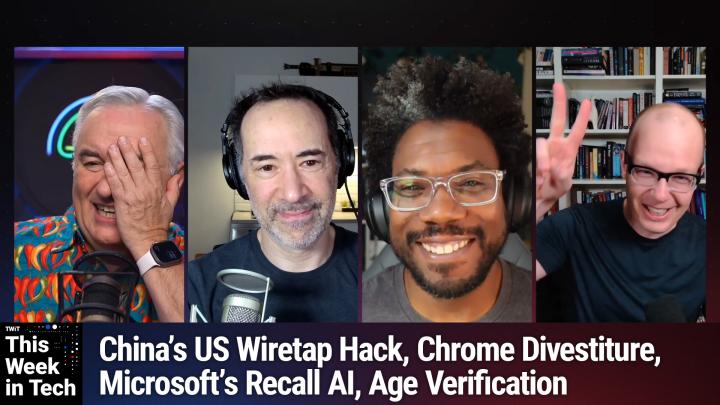
All TWiT.tv Shows (Audio)
This Week in Tech 1007: All the Hotdogs in the World
03:09:01
China's 'Salt Typhoon' Hack, Google on the Chopping Block, Recall AI
Loading summary
Transcript872 lines
- [00:00]
Leo Laporte
It's time for TWiT this Week in Tech. I have a great panel. All daddies, actually. It's kind of interesting. Patrick Baja is here. Wesley Faulkner and Alex Wilhelm will talk about what some are calling the worst hack in our nation's history. There hasn't been a lot of press coverage, and I think that's because there's not a lot we can do about it. The Supreme Court's gonna decide the fate of America's low income broadband fund. Spirit Airlines files for bankruptcy. And then we'll talk about Mark Zuckerberg's plan to make the app stores do the age verification. We got some good parenting advice along with that. It's all coming up next on Twit Podcasts you love from people you Trust. This is TWiT. This is TWiT, this Week in Tech, episode 1007, recorded Sunday, November 25, 2024. All the hot dogs in the world. It's time for TWiT this Week in Tech, the show. We cover the week's tech news and it's. It's. It's daddy time on the show. Every single one of you has young children, except me. I have all. I have adult children, but we're all daddies here. It's so. It's so nice. Alex Wilhelm now with two, count them, two babies. One girl, one boy, or what?
- [01:29]
Alex Wilhelm
Two girls.
- [01:30]
Wesley Faulkner
Two girls.
- [01:31]
Alex Wilhelm
Both girls, yes, sir.
- [01:32]
Leo Laporte
How has that been?
- [01:34]
Alex Wilhelm
You know, everyone told me two under two is a lot. Good luck. And I said, we. We got this in the bag. No, we did not. Two under two is a lot. It's a lot, ladies and gentlemen, it's.
- [01:44]
Leo Laporte
More than twice as much. I will. I will tell you that it is. Once they're out of diapers, like, life gets a little bit better.
- [01:50]
Alex Wilhelm
You just set that clock, Leo, to zero. You know, like when you have a new baby, everything that you'd earned with the preceding child, like the ability to sit up, just gone.
- [02:00]
Leo Laporte
Starting over.
- [02:01]
Wesley Faulkner
Yeah. And when they're both cranked at the same time, I.
- [02:05]
Alex Wilhelm
So, right. Right before this, Wesley, I went inside to go say hi to the spouse and say, hey, I'm going to go record now, you know, and then I went in the house and just both babies were going at it, and I was like, all right, well, have fun.
- [02:16]
Patrick Beja
I'm going to go do a show.
- [02:17]
Leo Laporte
He says he feels Alex was very guilty doing this show, but it's also a. Think of it as a respite. You don't do it that often. Once in a while. Wesley Faulkner is Also here your kids are a little bit older now. They were when we first started working. They were. They were pretty young.
- [02:30]
Wesley Faulkner
Yeah. 12 and nine now.
- [02:31]
Leo Laporte
Yeah. That's gotta be interesting.
- [02:35]
Wesley Faulkner
Uh, so. Hi, Oliver. Hi, Violet.
- [02:38]
Leo Laporte
Are they watching?
- [02:40]
Wesley Faulkner
No, but last time they're like. Do you ever, like, shout us out when you're on the podcast? I'm like. They're like, well, so I typically avoid.
- [02:49]
Leo Laporte
Asking names because I don't know how people feel about outing their kids. It's not exactly national television or anything, but I don't know how you feel. So I just. We just.
- [03:01]
Patrick Beja
No, but this is the audience that can dox you like. That's true.
- [03:04]
Leo Laporte
These guys have the skills, that's for sure. That is Patrick Baja, who we've had on many, many years. For many, many years. You're probably the longest running twit regular on the show. And you were in Finland. You are now back in France.
- [03:20]
Patrick Beja
I am back in France, yes. And my superhero wife is taking care of the. Of the two kids.
- [03:26]
Leo Laporte
Also, this show, we shouldn't say is a daddy show. This is a show where the wives are doing all the work and we get to play. Although Alex would rather be playing Factorio.
- [03:38]
Alex Wilhelm
Look, I didn't want to make it seem like I don't want to be here. I've been looking forward to seeing everybody. All I'm saying is Patrick would.
- [03:45]
Leo Laporte
Might rather be playing. Playing, you know, League of Legends. But other than that, are you. Do you play League of Legends, Patrick, or just watch?
- [03:53]
Patrick Beja
Yeah, so I play a little bit. I mostly play the iPad version, which will get me like angry looks from the actual PC players. I did play that a little bit, but it's a little bit more. It's easier to get into. The games are shorter, so I play that to relax. And putting League of Legends and relax in the same sentence isn't really possible, but it is possible with Wild Rift.
- [04:19]
Leo Laporte
So nice.
- [04:20]
Patrick Beja
I play that.
- [04:21]
Leo Laporte
Wild Rift. Is that. Is that what the.
- [04:23]
Patrick Beja
It's the name of that. That game, that one. They had huge ambitions when they first launched it. It seems they didn't reach the goals they set for themselves. And it's mostly popular in Asia, but I keep it going here. So you don't know. I might be playing it right now.
- [04:40]
Leo Laporte
It's possible I might be a Viking on the other screen right now, building my little house. And Wesley Faulkner. What game do you play? We now have. All of us have been outed.
- [04:54]
Wesley Faulkner
Genshin Impact most of the time.
- [04:56]
Patrick Beja
Nice.
- [04:57]
Leo Laporte
Kind of a classic there.
- [04:59]
Wesley Faulkner
Yes, it's It's. I've gotten into it recently and so I kind of started all over.
- [05:04]
Leo Laporte
Nice.
- [05:05]
Patrick Beja
I like that you can get a bunch of people together and just ask what game you're. Are you playing amazing these days? Yeah, just like, you know what, what TV show do you like? And it's like, ah, and everyone book you're reading. Yeah, exactly.
- [05:18]
Leo Laporte
What are those?
- [05:19]
Alex Wilhelm
I'm. I'm reading a good book right now.
- [05:21]
Leo Laporte
What are you reading?
- [05:22]
Alex Wilhelm
I'm pulling up my audible account to tell you.
- [05:25]
Leo Laporte
I'm reading Exodus by Peter F. Hamilton, which is a thousand pages of hard sci fi 50,000 years in the future. So it's very different. I like it. He's a good writer, though.
- [05:37]
Alex Wilhelm
I'm reading Empires of Dust, a series by Anna Smith. Spark. My first real dive into the grim dark genre. And it's kind of.
- [05:46]
Patrick Beja
Is it really the right time for that, Alex?
- [05:49]
Leo Laporte
It's already grim dark out here. But see, that's why escapism is great, because that's escapist grimdark.
- [05:56]
Alex Wilhelm
It's just sad. It's about. It's about an addict essentially doing bad things and I'm like, well, this is just my life. Like, what are we doing here? Why am I listening to this? Who bought it? Oh, it was me. Yeah, I bought it. Yeah.
- [06:06]
Leo Laporte
All right, all right.
- [06:07]
Patrick Beja
I'm reading Thinking Fast and Slow, which explains a lot about the world. Yeah, really good.
- [06:13]
Leo Laporte
Yeah, very timely, I think. How about you, Wesley? You got a book?
- [06:19]
Wesley Faulkner
I'm reading the Half Built Garden.
- [06:21]
Leo Laporte
Oh, what's that about?
- [06:22]
Alex Wilhelm
Wait, I read that.
- [06:24]
Wesley Faulkner
Yeah, it's a sci fi novel. I am writing my own book and it was suggested to me by my co podcast host that I do another show with that. That they read it first and they said that I should read it because it's similar to what I'm writing.
- [06:43]
Leo Laporte
Oh, congratulations.
- [06:44]
Alex Wilhelm
Is this the book about the aliens come and the planets being healed by the little community groups and then how they interact? Okay. Yeah.
- [06:52]
Leo Laporte
Again, timely.
- [06:54]
Alex Wilhelm
That book is so crunchy. That book makes the Corvallis, Oregon look. Look like hardcore right wing. It is such a hippie environmental riff. It's great, but that's wonderful.
- [07:04]
Leo Laporte
That's wonderful. Well, congratulations on the incipient book. That's great, Wesley. See, that's what happens when your kids get old enough that they can go to the mall.
- [07:15]
Wesley Faulkner
It's probably like two, three years out. It's very.
- [07:18]
Leo Laporte
No hurry. I don't want to rush you, but I guess we should get into the news after all. I'll start My timer. Now that part can be just the settling in portion of the show. So nice to see you.
- [07:31]
Wesley Faulkner
Moose bouche.
- [07:32]
Leo Laporte
Yes, our moose bouche. I like it. The chef has prepared a little something about gaming and books to begin your 28 course meal. Because there's a lot of.
- [07:43]
Patrick Beja
This is.
- [07:43]
Leo Laporte
It's so funny how sometimes there's a lot of news and sometimes there's nothing. And this week there's a lot of news. In fact, I want to cover what is, I think maybe a very undercovered story that's now being called the worst hack in our nation's history. China has been taking advantage of the fact that our infrastructure is. Our phone infrastructure is antiquated. Plus thanks to our law enforcement officials who decided about almost 20 years ago now that wow, we're going digital, we better have a way to tap digital phones. They put a back door in the phones in the, in the telecom infrastructure so that they could tap it. Unfortunately, when you put a back door in something, I think we now learned that that is hard to keep that a secret. And now the Chinese are in. I don't know how we get out or get them out. Salt typhoon is what the Western intelligence agencies are calling the hackers. First reported in October. I don't think we really talked about it for quite a while. Mark Warner talked with the Post and the Times this week to say it is the worst telecom hack in our nation's history. He's the chairman of the U.S. senate Intelligence Committee. And I didn't realize this, but Warner's background, he was a telecom executive in the 80s and 90s. My hair is on fire, he told the Washington Post. Not a problem if you're using signal, but it is a problem if you're just sending regular texts, end to end encryption over text between Apple devices and Android devices, for instance, until recently, until rcs. Actually, no, it's still not encrypted because Apple doesn't support encryption with rcs. So those texts are interceptible. The hackers breached the system, he said, not for the election, but months earlier, in many cases as long as a year ago. So they've been sitting in there and listening. Now the Post says fewer than 150 people have been identified as having their text messages or phone calls monitored. But let me tell you, it's the right 150. They're all in the D.C. area and they're very much involved in our national politics and our intelligence agencies and our law enforcement agencies. This is, I feel like maybe, is it too complicated or maybe law Enforcement is a little bit embarrassed that they asked for this backdoor in telecommunications and now it's been hacked.
- [10:43]
Alex Wilhelm
You know, I think the lack of response is a little bit like climate change and that it's a little hard to pin down how this impacts any individual person. Like, if I go to my friends here in town, I'm like, hey, you know, biggest telecom hack in American history. They're going to blink at me twice and go like, okay, cool.
- [10:56]
Leo Laporte
But if you fix the bridge traffic now. We do. Yeah.
- [10:58]
Alex Wilhelm
Right. So I think this is just too far removed from the average person to have the kind of, like, coverage layer that I think you think it deserves. But I do think that we should stop giving foreign hacking operations such awesome names. Salt type. Absolutely brilliant. Why don't we call them like, you know, the idiot circus?
- [11:17]
Leo Laporte
Right?
- [11:18]
Wesley Faulkner
They should call it fancy offshore backup.
- [11:20]
Leo Laporte
That's what they should call backup. So all of this. Ron Wyden pointed this out last month and I mentioned it, but we didn't really. You know, maybe Alex, you're right that it's just hard to kind of dig into this story. So back in 1994, then FBI Director Louis Freeh asked for backdoors and wiretaps to digital telecommunications. He says we can't get in. And CALEA was passed the Communications Assistance for Law Enforcement act. That's now 20 years ago. Of course, this is really an important. Maybe this is the biggest takeaway from this. Backdoors inevitably get hacked. You can't backdoor encryption safely, period.
- [12:12]
Wesley Faulkner
And we're seeing that law enforcement is always going to push for access no matter what, even if it does compromise security. I think we're talking about the iPhones rebooting story later. But it's one of those things where if they see a change or they see that it could, like, influence their dominance in the space, they are going to fight back because that's their bread and butter. That's how they survive. By just sopping up as much information as possible.
- [12:37]
Patrick Beja
Yeah, and that's their. That's their role. I mean, that's why you have. You should have a balance of power in most things. The law enforcement wants to get access to more information, to do their job more effectively. And you need to have other people who are like, well, wait a second, how can this happen?
- [12:56]
Leo Laporte
I'm not going to blame you, but you are in the country that arrested Pavel Durov because he wasn't giving French law enforcement backdoor to Telegraph. Telegraph.
- [13:06]
Patrick Beja
No, that's not what he wasn't giving. He wasn't giving the information that he was being, that was being tested. It's not like they were asking, you know, we should be able to have access to all of the communication of telegram. They wanted information, most likely metadata, that he had access to. And he has no infrastructure to comply with regulation like this.
- [13:30]
Leo Laporte
You're pretty sure that they weren't saying break end encryption? Well, actually, they didn't have to with Telegram because their end encryption is terrible.
- [13:38]
Patrick Beja
We just learned last week, actually, that there has been a series of arrests, something like 20 people that were participating in a child exploitation ring just a week ago. And it would be surprising if those two weren't related since Durov and his team ended up cooperating. It wasn't like, I don't think, like, the principle of it. I can understand that people will be a little bit cautious about what this means, but I don't think what the authorities were asking for was unreasonable. And it certainly wasn't full backdoor. Even though, of course, European authorities, just like they do in the US and everywhere, will push for that. Although now with Seoul Typhoon, I think it gives fuel to the people who say, see, maybe not. And just to be clear, it's only text messages that are intercepted, Right? Like, imessage is safe WhatsApp and end to end encrypted messaging.
- [14:43]
Leo Laporte
And presumably phone calls object to those.
- [14:46]
Patrick Beja
Right?
- [14:46]
Leo Laporte
Right. Although who makes phone calls anyway?
- [14:49]
Patrick Beja
Well, I mean, the 150 people who were targeted are probably in an age bracket where they do spend time on the phone. So it's not like, you know, it's trivial. Certainly it's a big deal, but it's not everything on your phone. It's surprising, though, that I didn't even know about that law. And the fact that there was someone at a computer with a password going like, okay, I log into the system and I can see in all of the telecommunication infrastructure in America, that's like, crazy.
- [15:20]
Leo Laporte
It's free at the time, promised there'll be no backdoor. We will protect this. It'll be safe. Don't worry about it. And, you know, Maybe it took 20 years, so maybe he was sort of right. I don't know.
- [15:32]
Alex Wilhelm
Leo, can I quibble about something that we're saying here with 150 people thing? Because I just pulled up a tweet from Josh Rogan. He's a Post contributor, and he said that Senator Rounds said that China's salt typhoon hack gave the Chinese Communist Party the. The ability to read your text and listen to your conversations. So to me, that puts US A little bit more on the. On the phone.
- [15:53]
Leo Laporte
They're in the phone network.
- [15:54]
Patrick Beja
Yeah.
- [15:54]
Leo Laporte
I mean that if it's not end to end. Encrypted. They got it.
- [15:58]
Patrick Beja
Yeah.
- [15:59]
Leo Laporte
And our phone systems, because of Kia, are. Are wide open, you know, because there's a back door.
- [16:07]
Wesley Faulkner
I'm assuming even the encrypted messages, if they're text messages, they could easily see where the source.
- [16:13]
Leo Laporte
Yeah. You see the meta.
- [16:15]
Wesley Faulkner
So they, they even know, like, if who's calling.
- [16:20]
Leo Laporte
Yeah. The Chairman of the Joint Chiefs of Staff is, Is talking to, you know, Joanne, I don't know who he's talking to. He's talking to somebody. Then, you know, you know who they're talking to. You may not.
- [16:32]
Wesley Faulkner
But then that also talks to foreign endpoints. Right. So if it goes off the network into another network.
- [16:38]
Patrick Beja
That's right.
- [16:38]
Wesley Faulkner
They would, if they had access to those networks as well. There's multiple layers in which that data can be.
- [16:43]
Alex Wilhelm
Oh, so essentially the Chinese Communist Party now has better intelligence on Tulsi Gabbard than we do here.
- [16:49]
Leo Laporte
Exactly. That's the example I should have given. If Tulsi Gabbard is calling Vladimir Putin or Donald Trump is talking to Vladimir Putin, or, you know, Elon Musk is talking to Vladimir Putin, presumably now the Chinese know that, and that's valuable. Certainly that's something.
- [17:04]
Wesley Faulkner
And they can see who that person calls next, right?
- [17:07]
Leo Laporte
Yeah.
- [17:08]
Wesley Faulkner
And maybe match those things up.
- [17:10]
Leo Laporte
Wow. Yeah. You get that. You get the idea. You see why it's a problem. According to the executive director of U.S. cyber Command, who. Not Barron Trump. That's next. That's next year. Morgan Adamski said that the Chinese linked cyber operations are aimed at gaining an advantage in case of a major conflict with the US They've compromised. And by the way, this is not just salt typhoon they've done. They've compromised our grid, They've compromised a lot of our infrastructure and IT networks so that they can, according to Adamski, carry out disruptive attacks in the event of a conflict. They're just sitting there. They have access to heating, ventilation and air conditioning systems and server rooms. They have access to the grid, the power grid, to water controls. This is all from US officials saying they have this access.
- [18:09]
Patrick Beja
So what do they do now? I mean, what does the American infrastructure do? Do they just change the password? Use like password manager? Like what happens next? Do they repeal the law? Do they remove the back door? I'm sure a lot of law enforcement agencies rely on it to.
- [18:29]
Leo Laporte
Well, according to the New York Times, they're concerned.
- [18:35]
Patrick Beja
I'm sure they're evaluating and.
- [18:37]
Leo Laporte
Deciding what to do concerned. The problem is, of course you need to know where they are and how deeply ingrained they are. And yeah, I'm sure they're trying to do something about it.
- [18:47]
Wesley Faulkner
The thing about telecoms that they have infrastructure that they don't want to replace. Security is expensive and that's hardware and software and the expertise of staffing and the maintenance. They try to do these capital expenditures, build out these networks and then just ride them until they explode, patch of them. And the modern security needs modern equipment. And to be able to replace all of that equipment and make sure it's up to date is not something that they've been incentivized to do. They want to take as much money off the top as they can.
- [19:20]
Leo Laporte
So thank you. So wait, are you saying TikTok? That's all I can say. It's about, that's what we're doing. We're banning TikTok. That'll fix it.
- [19:29]
Patrick Beja
But Wesley, do you think they're just, they don't have the like ability to fix it? Like they're just leaving it as is and the Chinese have access to it and, and that's it.
- [19:39]
Wesley Faulkner
I think if you can see what are the negative consequences that is imposed on them as of now, you can see that there is no incentives to fix it. They're not losing their license, there's no threatening of anything. It's just like business as usual. And so there's no incentive to change it.
- [19:56]
Alex Wilhelm
Am I insane that it's weird that we're doing business with China as a nation, like with trade and rules and ships and planes while they perniciously undermine our national security day to day?
- [20:09]
Leo Laporte
Well, what's the alternative, Alex? What would you do instead?
- [20:12]
Alex Wilhelm
Well, I mean we could collapse their economy overnight by stopping imports.
- [20:15]
Patrick Beja
Well, you collapse yours at the same time.
- [20:18]
Leo Laporte
I think we might find out. I think we might find out. I think that's on the table.
- [20:23]
Alex Wilhelm
I'm not trying to say that I, Alex Wilhelm, have the solution here. I'm just saying it's very strange that we're sitting here going, China's going to attack Taiwan by 2027, they're in our systems, they're going to shut off.
- [20:31]
Leo Laporte
I think you go the other way. Personally, I think your best bet is to strengthen ties and to get more economically intertwined so that there's less incentive for China to break. To be a bull in the China shop, right? Make it so that it's more dangerous for them. That is Taiwan.
- [20:50]
Patrick Beja
And this is. I mean, this is the way it's worked since the end of World War II. Right. Intertwine economically, all the economies you can, so that no one has an incentive to send bombs on one another. And we've seen time and time again that when the economies are not working together, then that's when the real issues start happening.
- [21:11]
Leo Laporte
Yeah, I mean, I think sometimes it doesn't work. Russia feels free to operate because they are kind of already a pariah. Right? They were. They've been a pariah. So they have less to risk. And sanctions haven't slowed them down much because I guess.
- [21:24]
Patrick Beja
Well, it's starting to have.
- [21:25]
Alex Wilhelm
Yeah, it's starting to.
- [21:26]
Leo Laporte
Yeah.
- [21:27]
Alex Wilhelm
And they have a segregated interest on this. But I mean, like, like, I mean, the, the other side of the coin here, the people that we're talking about being bad actors, have essentially to, you know, break themselves off from the global Internet and become technology islands. I just find it very strange that this is not just because there's not bullets, Leo. We don't tend to treat this stuff the same way. Like if.
- [21:48]
Leo Laporte
No, I agree, it's aggression, but the Chinese have been doing this with. Everybody's been saying this with IP for at least 50 years. As soon as something is released in the United States. I remember in Beijing, going into the basement of a shopping mall and every dvd, every book, every bit of content that was created in the United States was illegally, you know, was pirated there. And Nice pirate. They looked exactly like the real thing. You know, they had the album art and all that stuff that's been going on forever. It's always bugged us, but. Yeah, but what would happen? Well, this is not really for this show because this is a technology show.
- [22:31]
Patrick Beja
Sorry, my bad.
- [22:33]
Leo Laporte
Well, you've been working with Jason Calacanis.
- [22:35]
Alex Wilhelm
I knew that was going to come in.
- [22:38]
Leo Laporte
It's understandable.
- [22:39]
Wesley Faulkner
But also keep in mind that the information we have is asymmetrical. They are. If all of the breaches that they've discovered that we're doing until they don't have their security, they're not.
- [22:48]
Leo Laporte
Do you have a view into them? I doubt exactly.
- [22:51]
Wesley Faulkner
I'm guessing that we're working on it. And this is something that's probably.
- [22:54]
Patrick Beja
Yeah, I'm sure there are some things happening, but this is par for the course. And as you were saying, Leo, the alternative is like cut off relation, like trade relations and it absolutely makes things worse. Absolutely.
- [23:07]
Leo Laporte
You say you have a reason to have a war. I mean, then.
- [23:09]
Patrick Beja
Exactly. Then they have no. Nothing to Lose, not go into Taiwan.
- [23:13]
Leo Laporte
This is from the New York Times story. U.S. communication system is built on a mishmash of aging systems which made it far easier for the Chinese to break into upward of 10, count them, 10 telecommunications companies. @ the White House meeting, the message delivered by top American intelligence and national security officials was despite the aging technology, the telecommunication companies need to find, need help, need to help find a permanent way to keep them out of the systems. Doesn't sound like they're trying to do it. And by the way, making the necessary fixes could create painful network outages for customers. Critical parts of the American telecom system are too old to upgrade with modern cybersecurity protections. This is, it's interesting. We've always, you know, we were the first cell network users. We, you know, we were. The Internet started here and often when it's old infrastructure, you're at a disadvantage to countries that just leapfrogged, you know, countries that didn't have a big telecommunications, a big phone system, went straight to cell phones and leapfrogged us. I think that we've seen that again and again. We have a disadvantage by being the first movers. We have a lot of old stuff, it's kind of like Windows. We got a lot of old stuff, old code in there. Some parts of the system date to the late 70s or early 80s when landlines, not cell phones, dominated the network. One participant in the meeting again from the New York Times, said the only solution to the problem was ripping and replacing whole sections of the network, a process that companies slow to invest in. Brendan Carr, who is the inbound chairman of the fcc, says one of the things he wants the federal government to do is provide more economic support for rip and replace take. You know, that's what they did, that's what they did in, in Europe with the Huawei equipment. They took it out.
- [25:13]
Alex Wilhelm
I think that's smart. I mean, Brendan Carr is not going to be my favorite FCC chairperson, but I do think on China his hawkish positions at least match my own. Bringing up TikTok again, Leo, I mean he's always been on the no side of that, which I've respected. I wonder if we have the national will to spend money on things just given the current political climate because it would take, I don't know, Wesley backed me up here, 10, 15, 20 billion to rip and replace a big chunk of the US wireless telecom system.
- [25:43]
Wesley Faulkner
But it's not just that, it's just what's next, right? So it's removing old stuff and putting in new stuff, but it's the ongoing support. If you're familiar with all the revisions of iOS and Android, there are constant security threats and some of those are built into the software, some of that's built into the hardware. So it needs to be not just let's rip and replace, but there needs to be something that causes an ongoing vigilance that's made to make sure that not only this is something that is done, but it's something that is a focus, meaning that there needs to be a czar, there needs to be some protocol, there needs to be some certification, there needs to be inspections, there needs to be some sort of ways to audit these systems, has someone be able to prioritize those. And it's going to cost money either going to come from the subscriber or come from the federal government. And with DOGE being enacted in terms of how we spending our money, I don't know exactly if there's going to be an appetite to be able to spend money on these telecoms to get up to speed, I think it'll be pushed into saying, well, let's just move over to satellite, let's move over to whatever Elon does to fix it. And then more abandoning what we have rather than actually reinforcing it.
- [26:59]
Leo Laporte
You could bet Elon saying right now, you know who's, you know what, they're not in, they're not in Starlink, by the way, to answer your question, apparently we have been hacking them similarly. In fact there, let's see. This is again from the New York Times. There are limits to how far the United States can press its case with China. So far the Chinese hack appears to involve only surveillance. Well, yeah, I'm sorry, okay. That's something the United States does regularly. The Chinese telecommunications company and is a form of espionage considered fair game as the two superpowers navigate a higher stakes era using spy technology, updated spy technology. So in other words, we've done it too. However, one senior American official said, told the New York Times, I'd have to say the Chinese have matched or exceeded what we can do and we didn't see this one coming. This, this was, you may remember that Biden and Xi Jinping of China met in Lima, Peru last weekend. And this was in fact one of the converse topics of conversation at these high level meetings. I don't know, what do you, I always wonder, what do you say? Knock it off. No, no. Knock it off. No, please knock it off. No.
- [28:19]
Patrick Beja
What you do is that you maybe on principle say, well that's not really cool what you did, but really what you should do is upgrade your infrastructure as we've been discussing. And it's fair game. You know, just like I was saying earlier, the law enforcement authority is going to push to get access to your encrypted data. And there's someone that should be saying, no, you can't do this, because this and that reason in espionage, the spy agencies are going to try to exploit every way they can to do their job. And I think that's expected. I think that's fair game. And your role is mostly to make sure that their job is really difficult and to secure your infrastructure. And you can't tell China, don't even try spying on us. Like, everyone does it. The US does it in Europe, everyone does it.
- [29:19]
Leo Laporte
What you do is you set some limits, you set some. Look, we're going to spy on you, you're going to spy on us, but you can't break the grid or things like that. Remember that the Office of Personnel Management was hacked by the Chinese back in 2015. And at that time, President Xi promised to abide by a new limits on espionage. Obama went to him and said, hey man, that's too, that's not cool. And President Xi said, okay, fine, okay. For a few months the accord stuck. The volume of the attacks diminished. But by the time Obama left office, it was clear that Chinese hacking operations had shifted from military units to intelligence agencies which work with greater stealth. Honestly, I think that's part of the problem, is that we don't. You nailed it, Wesley. We don't know what to do. We've really got no grand solution. So all we're going to say is, well, okay, we'll limit our stuff to surveillance. If you limit your stuff to surveillance.
- [30:23]
Wesley Faulkner
And just do that though, because it's China today, but it could be Russia tomorrow or North Korea. We can't do it. As in on their side.
- [30:31]
Leo Laporte
Well, we should fix stuff, obviously.
- [30:33]
Wesley Faulkner
We should just fix it on our side.
- [30:34]
Leo Laporte
Yeah, yeah, yeah. But that's the question. Can you really ever. Is there any such thing as a perfect protective network?
- [30:42]
Patrick Beja
Well, there isn't anything perfect.
- [30:44]
Leo Laporte
They're not even using two factor authentication in the US Telecommunications.
- [30:48]
Patrick Beja
It can't be perfect, but I'm sure you can make it better. You can do it so there isn't a back door that you know, if you have the password, you get access to everything. Like that's the lesson here, that unless.
- [30:59]
Wesley Faulkner
We'Re talking about quantum entanglement or something.
- [31:01]
Leo Laporte
Well, and the Chinese are working hard on quantum Computing, obviously, the Biden administration, again from the New York Times, has said very little about the attack. Much of the resistance came from the Justice Department and the FBI, which, oh, what a surprise, didn't want to upend their own investigations. You can't close that back door. We need it. Same reason we don't have privacy protections in the United States, because intelligence agencies like it that the data brokers collect information about us and sell it to them. That saves them a lot of time.
- [31:36]
Alex Wilhelm
You saw that Wired story about data tracking and US Soldiers being tracked around to nuclear vaults and brothels?
- [31:42]
Leo Laporte
Yeah, yeah.
- [31:44]
Patrick Beja
Oh, it's.
- [31:45]
Leo Laporte
It's like this is out in the open. That is so strange. Yeah. I mean, it's a big story. I guess maybe there's nothing to say about it except it's going on.
- [32:03]
Patrick Beja
Surely they're working on a fix. Like, surely they can't just leave it open and let the Chinese have full visibility on the network. I don't know that it's going to be an easy fix, but they're going to try. That's.
- [32:19]
Leo Laporte
You would think. You would think. But notice we don't have national federal data protection in this country. And this Wired story is a perfect example. More than 3 billion phone coordinates collected by a single U.S. data broker expose the detailed movements of U.S. military and intelligence workers in Germany. And the Pentagon is powerless to stop it because it's legal to do this in the United States. And I have to say, I think the only reason it's legal to do this in the United States is so these data brokers can help our intelligence agencies gather information.
- [33:00]
Wesley Faulkner
This is like one of those cartoons where someone goes to hell and you're like, oh, you like hot dogs, do you? Here's all the hot dogs in the world. So the only way we're fighting them is just giving them too much data. And so they find a way to store it and process it and correlate it. So we're all.
- [33:19]
Leo Laporte
We're all tasked now with burying the Chinese and hot dogs, everybody.
- [33:24]
Wesley Faulkner
Also, if we generated fake data and just. Just like with the AI and poisoning the well, if we can just make our own, like. Like way of just flooding the zone with a whole bunch of just fake coordinates. Fate data, fake people, fate, like all that stuff, then they would have to do the work of filtering that out as well. That's the only other way. Make our own data broker and just pollute the whole thing.
- [33:54]
Alex Wilhelm
Well, that's Twitter's approach to management today with its own platform. And it's not Going so good, Wesley. So maybe it'll work. In this case, I'm in favor of that. Also, synthetic data is something I keep hearing about from AI companies, and I don't actually know how good it is, but I wonder if we could use that same system to do what you're saying. That'd be efficient.
- [34:11]
Leo Laporte
Well, the FTC's solution. And of course, remember, in two months, everybody at the FTC is out. But for the next two months, the FTC's solution is to file lawsuits to make these data brokers not watch US Military installations.
- [34:29]
Wesley Faulkner
Oh, so give us a list of all the US Military installations, including the secret ones. Yeah, that'd be great.
- [34:34]
Leo Laporte
That's the solution. Don't monitor that. Don't. Look, you can't. No, you can't.
- [34:39]
Patrick Beja
Look.
- [34:43]
Leo Laporte
I don't know, you're right. I'm sorry I brought this Chinese thing up. There's nothing you can say about it. We're just. We're just kind of.
- [34:50]
Patrick Beja
Well, I mean, it's a new cold war.
- [34:53]
Leo Laporte
It's a. And I tell you what, I'm sorry if John Le Carre needs to start writing some novels about this, because this is the new spy game, isn't it?
- [35:04]
Alex Wilhelm
It's not very sexy. It's not very exciting. It's not very James Bond. It's not very, you know, secret martinis. And if you can make a bunch.
- [35:13]
Leo Laporte
Of guys playing Dota or League of Legends interesting, a bunch of guys sitting there, jaw down like this, you can make this interesting.
- [35:24]
Wesley Faulkner
Not until they use it. They actually have to use it. They have to, like, make some. Some.
- [35:30]
Leo Laporte
That's really the pain right now. They're just sitting there, which is super smart. Yeah, they're just sitting in the grids. And in a way, maybe this is them saying, don't start anything with us because, you know, we've got our hands around your neck. To which I hope we're responding. Well, guess what? It's like a Mexican standoff. We got our hands around your neck.
- [35:50]
Wesley Faulkner
Mutually Assured Destruction.
- [35:52]
Leo Laporte
Yeah, that kept us out of a nuclear war for almost a century.
- [35:56]
Wesley Faulkner
Yeah, but no one, no average American is going to complain about this until our networks are down for a month.
- [36:03]
Leo Laporte
Or that's what they're worried about. Yeah, yeah, yeah, a nuclear, like, power.
- [36:07]
Wesley Faulkner
Plant, Chinese guy containment or something like that. That's. That's the only thing that's going to cause them to say, oh, yeah, this is a problem they need. It's. It's not. It's not the precursor. It's not Prevention that gets the attention. It's the, like, the aftermath and the response. And so if there's no incursion, there's no response, that is going to be seen as important. And that's why if you look at cybersecurity across the board, it's all like that, because all of it is theoretical until something happens. And even a data breach, it's like, well, they didn't do anything with the data or won't come back to us. Most people are like, well, how do I spend the money on preventing something? Or making our quarterly numbers and raising our share price? Which one is going to. I'm the CEO, I'm in charge. Which one of the things is going to impact me immediately? And I think it's also the price.
- [36:59]
Leo Laporte
We pay for living in a free country that will never be as secure as an authoritarian country like China, because we believe in free speech and freedom and we're not going to lock everything down. The degree to which you'd have to lock things down, of course, if China can't even do it, I don't know who can.
- [37:21]
Patrick Beja
No, but I mean, there is a middle ground. You could first of all not have a law that says you need to have a backdoor into your entire telecommunications.
- [37:30]
Leo Laporte
That was a bad start. 1994. That was a bad start.
- [37:33]
Patrick Beja
Yeah. And you can invest in your infrastructure and maybe even legislate to make sure that the infrastructure is more secure than the one that you have now, that you can't redirect the entirety of your profits to your shareholders. You need to spend some of it to upgrade your infrastructure and meet some cybersecurity standards, at least. Because when I hear that the infrastructure hasn't been changed since the 70s, I'm pretty sure there was some opportunity at some point to evolve it slowly to make it a little bit more modern and secure. So I don't think it's just, oh, well, it's either that or you live in communist China. I think there is a middle ground, which, by the way, is probably called Europe, but it's like a compromise.
- [38:27]
Alex Wilhelm
There it is.
- [38:30]
Wesley Faulkner
Well, that's a very logical argument, Patrick, and I'm sure legislature will take that under advisement and do the right thing.
- [38:38]
Patrick Beja
But, you know, okay, do I get on my soapbox now or do I wait a little bit later?
- [38:43]
Leo Laporte
Because I want to take a break. Save the soapbox. I will mention when we're talking about 70s technology, there's something called the signaling system 7 or SS7, which is in our phones systems. It's how the phones make calls. And it is known to have serious flaws for more than 20 years. And the problem is we can't take it out because everybody uses it. It's on your cell phone, it's on every telecommunication system everywhere, and it's flawed and we can't fix it. And that's that. And we've known about this for a long time. So this is, in fact, this may well be how the Chinese got in. I don't know how they got in. But we've, we've been talking about SS7 and security now for almost as long as security now has been going on. And I imagine there are better systems, but this is that same problem of, you know, you don't want to break everything in order to make it work better, more securely. Let's take a little break. I'm sorry about that. I won't bring up anything that we can't fix anymore. It just, you know, when I read this headline like the worst hack in the nation's history and nobody's disagreeing with it, I wonder why we don't talk more about it. Maybe this is why there's not. Sorry. Too bad, too bad. Nothing we can do about that. I hope you enjoy it. Enjoy your, enjoy your freedom. We got a great panel. I think we have a lot to talk about and prepare yourselves because Soapbox from Patrick Beja is coming. Patrick Beja is here. Always a welcome guest, as are Wesley Faulkner and the wonderful Alex Wilhelm. Great to see you all. All daddies, all daddies this week. And because of it, in every case, there is some poor woman taking care of the kids right now. So we thank the mothers and the wives for making it, making this show possible in more ways than one, I think. This episode of this week in Tech brought to you by Melissa, the trusted data quality expert since 1985. Melissa is kind of an amazing company. Since 1985, they've been helping people keep their supplier lists, their customer lists accurate up to date. And now Melissa is in. This is really good news. If you use Stripe, it's in the stripe app marketplace. That means stripe customers. This is a real synergy. Stripe customers now have access to the same data quality service leveraged by large global enterprises every day. A lot of small business, pretty much every small business, I go to my local bagel shop, they use Stripe. Stripe's integration can include things like address validation, which validates global addresses both at the customer and invoice levels within Stripe automatically auto completion capabilities. So you could start typing an address you've seen this and it reduces the number of keystrokes required and maybe even more importantly, make sure that only valid addresses enter the database. Plus, it's very easy to use. Users can easily configure the app with a few steps. If you've been using Stripe for your little small business, this will be such a nice integration for you. Support for both customer accounts and invoice level validation. And the app offers smooth management of API keys and subscriptions, facilitating transitions from free to paid services as you need them, comprehensive support and quality assurance always from Melissa. Users have direct access to Melissa experts, ensuring high quality service and support Melissa not just Stripe businesses, but every business can enhance operational efficiency, boost customer satisfaction and maintain overall financial health. That's a strategic goal for any forward looking business. And those businesses that rely on Stripe are no exception. They have an ever expanding tool set at the ready with Melissa. Oh, and by the way, if you're at all concerned, Melissa understands your data is precious to you and your customers. That's why Melissa's services understand compliance like no other. You get secure encryption for all file transfers and information security ecosystem built on the ISO 2701 framework, adherence to GDPR policies, SoC2 compliance. So you can use Melissa inside Stripe or wherever you use it with confidence. Get started today with 1000 records cleaned for free. That's always, that's a great offer. Always a great offer. And melissa.com twit one more great way you can use Melissa now with Stripe. You know they've got an API, they've got Google and Microsoft integration. That's it's everywhere. Melissa M E lissa.com twit we thank Melissa so much for supporting our shows for so many years. It's been a great relationship. Now Patrick, if you want to get on a soapbox now, you could. Or if you want, I can give you another story that will trigger a apoplectic fit and you can get excited again. We got to. You got to build up to it. I understand.
- [44:00]
Patrick Beja
No, let's go with the other story. I'm sure I will get riled up.
- [44:04]
Alex Wilhelm
Honesty.
- [44:06]
Leo Laporte
So as you know, Google was sued by the Department of Justice, lost. The judge ruled against them in August, saying Google illegally monopolized the search market. And now it's up to the judge to decide on what remedies he will rule on that. Judge Ahmet Mehta will rule on that in the next. When is it, Alex? It's a couple of months away, I think.
- [44:32]
Alex Wilhelm
Yeah, a couple of months away. I'm just going through my Personal notes of the actual. Yeah. So the DOJ will file revised proposed final judgment on March 7th.
- [44:42]
Leo Laporte
Okay.
- [44:43]
Alex Wilhelm
So expect a lot of back and forth between now and then.
- [44:46]
Leo Laporte
So the DOJ is at this point lobbying in effect. The judge saying, well, your honor, what you. What Google really should do and coming up with remedies. And of course, the judge will pick some and so forth. Some say this is just a negotiation to kind of head towards a consent decree between Google and the doj. The clock is ticking, I have to say. Although it's unknown whether the new administration will be pro Google or anti Google, it could go both ways. So so far the DOJ has come up with the most controversial proposal of all, saying Google should be forced to sell Chrome. Oh, and while you're at an Android. Okay, Alex.
- [45:32]
Alex Wilhelm
Okay, so the.
- [45:33]
Leo Laporte
So what do you think? Just Bloomberg says Chrome's worth $20 billion. I don't think Chrome's worth a penny, but go ahead, tell us what you think.
- [45:42]
Alex Wilhelm
So I just wanted to say on the Android point, the proposed final judgment did say that Chrome should be divested. It gave Android a bit of a pass, but it did say that if Google behaves poorly, then. And should, then you could say divestiture as well. Okay, so the question then becomes, you know, how much of this do they expect to get? Leo? And I do think this is a bargaining position. Yeah, I don't think Chrome is going to get divested because I think you're dead on. It doesn't have any value outside of being a search delivery and advertising delivery mechanism for.
- [46:14]
Leo Laporte
Well, that's, that's the thing. I mean, I think the DOJ is saying, let's cut off their legs by. But every remedy they propose is worse for everybody else. For instance, saying, don't pay Apple $20 billion a year anymore.
- [46:29]
Alex Wilhelm
So I talked to JP Schmetz from Brave. Brave has their own browser and also their own search engine based on Chromium. Well, I mean, what are you going to do?
- [46:42]
Leo Laporte
Well, that's part of my. Part of my question is, isn't Chrome open source? Can't anybody make a Chrome browser, including Opera, Vivaldi, Brave Arc, and Microsoft Edge, all based on Chrome? So what happens if Google sells Chrome? What happens to the open source project? It doesn't make any sense to me.
- [47:05]
Alex Wilhelm
Do you think the open source project of Chromium dies if Chrome is divested from Google?
- [47:10]
Leo Laporte
No. Well, right now. Go ahead, Wesley. You probably know more about this than I do. You cover open source, so the new.
- [47:17]
Wesley Faulkner
Owner would be responsible for that. Open source program.
- [47:20]
Leo Laporte
And so right now it's mostly Google engineers, not all, but mostly Google engineers.
- [47:24]
Wesley Faulkner
And so once again, if it's they need to know if it's going to be profitable for them. It's depending on what their goals are, what they value. And you mentioned the other browsers that are based off Chromium, including Edge, that if it is sold off Chromium could go closed source because it does take maintenance to keep it up to date.
- [47:48]
Leo Laporte
But the second before they go closed source, Wesley, doesn't somebody just fork it? In fact, aren't people forking it right now?
- [47:54]
Wesley Faulkner
Here's the problem with that. The fork is going to be all the old stuff and they're going to do whatever they want, but the number one browser will still be Chrome. And so when they diverge in terms of the underlying things and how things work, then the forks themselves will then render pages and not work the way that they are expecting the browser. And not only is Chromium built based on these other, these other browsers, but Chromium is used for testing. A lot of like automation platforms that do web testing use Chromium under or Chrome to test websites compatibility to make sure that these are all automated.
- [48:40]
Leo Laporte
Let's say Google sells Chrome tm, whatever that thing is and Chromium is forked. Microsoft Edge still going to be Chromium go beyond the fork, right? In fact, Google, the only, the only hardware that Google's installed by default on Chrome, the new Chrome would be installed by default on. Well, there wouldn't be any because who, well who depends who buys it, right? Does Microsoft buy it? Then maybe it is the number one browser still because it's Edge. If Apple buys it, maybe it stays a dominant browser because it's Safari.
- [49:16]
Wesley Faulkner
It would be wrong person that's going to uninstall Chrome as soon as purchased by someone else. I mean that's not going to happen. All of these people are trying to download and Chrome already.
- [49:28]
Leo Laporte
Yeah, you're okay. So it's how did Google get to be dominant? That's actually an interesting.
- [49:33]
Patrick Beja
Yeah, you're all acting like there wasn't a different time when Chrome wasn't the dominant browser if it used to be. First of all, I'm not sure that this remedy is the smartest one, but let's set that aside for a second. The problem is not the dominance of Chrome in this specific case, it's the link between Chrome and Google. So even if Chrome stays dominant without the links, the direct links to Google, then you've achieved the thing you wanted to achieve, which is reduce the dominant, the synergy between the two, which gives Google more power. And if it doesn't, if it becomes less relevant and somehow after a few years it's not as powerful as it is today, then it gives the opportunity, there's a vacuum and it gives the opportunity for another actor to take its place. Or maybe you have a more fragmented browser market which has its own challenges. Obviously if you have different rendering engines, it's all like, we've seen this situation in the past, it is more chaotic for websites, but it's not the end of the world. And again, the goal here is to sever or to remove the advantage that Google has by also owning Chrome. So all of this that you're discussing is not untrue, but in this discussion it's a little bit besides the point. If you want to reduce Google's power, you have to find ways to do that. If you think Google doesn't have too much power, then that's fine, they can keep everything they have. But if you think they do, then you have to find ways to get them to collect less data, to have less different levers to influence the way the web works, et cetera, et cetera. And I think maybe forcing them to divest Chrome could lead to that outcome. If it's the, you have to think.
- [51:32]
Wesley Faulkner
About the harm that will cause regular consumers, not just because, well, Chrome right now is being used and all the benefits is going to Google. I think we can agree on that. So they are running Chrome as a loss leader to get this data and this access. If this is sold to another company, another player, their incentive is not to just keep it the way it is. Their incentive is now to find out how they can make that a profit center for them. It needs to be worth it for them, which means that they are going to try to monetize that data to other people other than Google. So instead of all the information going to Google bad, right, it's going to be like highest bidder, how can we make the most use of this data and who can we now sell it to? So it's either their sell the data or they're going to just find ways to make it Chrome plus. Now in order to like actually have secure browsing or to be able to turn off cookies, the regular Chrome, you could choose how much visibility. But now Chrome plus is the only one that you can get these options to. So it's just that the consumer itself could be harmed by the profit making that they'll need to make, to make this something that they continue.
- [52:49]
Patrick Beja
First of all, I think there would be solutions to those issues which you all are not going to like because you're American and you don't want the government to get involved in anything. The first step to my soapbox, Leo. And secondly, those are again, kind of besides the point. But what can happen there is that Chrome becomes less strong without the backing of Google. I believe that is one of the outcomes. And so you re inject a little bit of competition in the browser market. I think that is not everything you're all saying is true. I'm not saying it's not true, obviously, you know, but you're only seeing the downsides of those changes. And there would be some upsides, not the least of which is fostering competition, which is a basic tenant of, you know, capitalism and a healthy, a free market. Currently, it's very difficult to compete with Chrome, not because it's Chrome and it's everywhere. We've seen situations where there was one dominant browser before, but because Google is pushing it so much.
- [53:58]
Leo Laporte
I think, actually now that we're talking about it, you can understand how, by the tyranny of the default, people who use Apple products are using safari, they're using WebKit, is the engine in Safari. Until Microsoft abandoned Internet Explorer, that was dominant because that's what everybody used. Windows was using. How did Chrome not have. I mean, the only. They have Android. Are we counting Android in the total installed base?
- [54:27]
Patrick Beja
That's no idea.
- [54:30]
Leo Laporte
Yeah, I mean, if we are, then that's certainly a big. That's half of the cell phone market in the US and more than half, 80% in the rest of the world. I don't understand. So you're selling. What are you selling? You're selling the name and the current code base and perhaps you're selling the install base.
- [54:48]
Patrick Beja
That's what you're saying, the install base project.
- [54:51]
Leo Laporte
You can't sell Chromium. How do you sell Chromium?
- [54:56]
Patrick Beja
No one's talking about Chromium. They're talking.
- [54:58]
Leo Laporte
But that's code base. So I don't understand.
- [55:01]
Patrick Beja
You said the install base. You sell the install, you're selling the installed base.
- [55:05]
Leo Laporte
You're saying, okay, so now, because you.
- [55:08]
Patrick Beja
Have Chrome on your computer now, Chrome.
- [55:10]
Leo Laporte
You'Re going to keep getting it from, let's say OpenAI buys it now it's going to be OpenAI's Chrome. And you just assume because of the tyranny of the default or inertia in any way that nobody's going to say, oh, I don't want to use OpenAI Chrome and we'll go to Firefox or something.
- [55:26]
Patrick Beja
No, I mean, some people might say that.
- [55:29]
Leo Laporte
Why is Chrome so dominant? Is it better than anything else?
- [55:32]
Patrick Beja
It was much better. I think it still is. Yeah. Sorry, Alex.
- [55:36]
Alex Wilhelm
No, no, it was so much better. People forget this. When Chrome came out, they pitched it as the fastest browser.
- [55:42]
Leo Laporte
I know why Google Search is dominant, because it was better than any other search. So Chrome also, huh?
- [55:47]
Alex Wilhelm
It was better and then it got worse. Much like Google Search, which used to be a magic answer service and is now a way to shove more ads into my life. But I just did a search of the proposed final judgment from the DO from the DOJ. In this case, 0 mentions of chromium, 8 mentions of chrome just for reference.
- [56:07]
Leo Laporte
Yeah, I almost wonder, do they know that there is a source code is open?
- [56:12]
Patrick Beja
It's not what they're after.
- [56:14]
Leo Laporte
Okay, so they're selling the. Now that helps Patrick. So they're selling the installed base, basically.
- [56:19]
Wesley Faulkner
And the name, but also the code. I mean, if they aren't selling the code as well, then they can say, oh yeah, we'll sell Chromium or Chrome to OpenAI. Now we have Chrome too. And you can still get that. They would have to be banned from making browsers, which means that is one.
- [56:36]
Leo Laporte
Of the concerns is that they could be banned, but only for a limited time, so that Google would. 10 years.
- [56:44]
Patrick Beja
The problem is not that Google is making a browser. The problem is that Google's browser is dominant. So if you tell them, okay, you start again from scratch and if you become dominant again, we'll address that at that point.
- [56:57]
Leo Laporte
Right.
- [56:57]
Alex Wilhelm
So the PFJ says very specifically that following its divestiture of Chrome, Google may not reenter the browsing market for five years. And five years is banned from owning or acquiring any investment or interest in any search or search text provider that might do browser. So they have that written in. But it doesn't solve any of the issues we have about Chrome itself. But at least Google couldn't just dive back in with Chrome.
- [57:19]
Leo Laporte
Not for five years.
- [57:20]
Alex Wilhelm
The rechrome five years comes fast.
- [57:23]
Leo Laporte
The other issue really is the search, right? Because. So the problem is that there are, there are two dominant search. And it seems like what the DOJ is trying to do is cut off the things that channel people into search. But what if instead, and they've talked about this too, they forced Google, the license search, to say, okay, here's the. Here's the index. DuckDuckGo. You have full access to this.
- [57:52]
Patrick Beja
That seems like a much more severe attack into the core of what Google's business is. And I think that's a much more serious concern if you do that. Currently, the things that are being talked about, including, let's say they can't pay Apple to be the default search engine on iOS. I mean, obviously Apple is not happy about not getting 20 billion euros dollars.
- [58:21]
Leo Laporte
But it put Firefox out of business because the hundreds of millions of dollars they get yearly from Google right now is the only thing keeping Mozilla foundation or maybe.
- [58:30]
Patrick Beja
Well, possibly.
- [58:31]
Leo Laporte
So that would, by the way, be the counter effect. That would be a negative consequence of this. Right.
- [58:38]
Patrick Beja
Well, maybe someone else would pay Firefox to be the default search engine.
- [58:42]
Leo Laporte
Maybe the new Chrome owners.
- [58:44]
Patrick Beja
No. Maybe Bing, maybe Microsoft. You know, Mozilla just did a huge layoff.
- [58:48]
Wesley Faulkner
They don't have money.
- [58:50]
Leo Laporte
Yeah, they didn't lay off people from the mo. From the Firefox side. They laid off the Mozilla foundation people. But still it is. They're on the edge and their share is shrinking. And to me that's terrible because the worst thing we could have is a browser monoculture like bananas.
- [59:08]
Wesley Faulkner
But it's not the search or even the browser, it's the ads. Right. So if, if the money is still coming into Google through ads, no matter if other people have a better search or others.
- [59:19]
Leo Laporte
Yeah. Maybe force Google to sell the ad business.
- [59:21]
Wesley Faulkner
It's the ads that's causing them to have this chest full of money to be able to throw at people.
- [59:26]
Alex Wilhelm
Yeah, but that is Google. If you take away the search ads, you take away most Google's business and then what's left? YouTube and Cloud. And YouTube is just ads.
- [59:34]
Leo Laporte
I think they should be forced to sell YouTube because I think that's a real conflict of interest.
- [59:38]
Alex Wilhelm
But okay. That's more of a penalty though, I feel, than a remedy to the issues that were raised.
- [59:45]
Leo Laporte
Well, yeah, I'm not the judge, but my opinion, the problem with Google is that it's compromised its search results by having all these other sidelines like ad sales. It is both the buyer, the seller, and the market maker. It's in every bit of that. Owning YouTube is another huge conflict of interest because their ad results are inevitably going to be full of YouTube ads. So they're in effect, search results are promoting YouTube. I mean, there's all sorts of conflicts of interest. Google started with a very pure, excellent search engine which has gone downhill as it has slowly allowed these other interests to change its search results. Don't you think?
- [60:29]
Alex Wilhelm
Yes. Does anyone deny that?
- [60:32]
Leo Laporte
Nothing. But it's become very profitable as a result. This is the classic Cory Doctorow and shitification.
- [60:37]
Alex Wilhelm
Shitification, yeah, exactly.
- [60:41]
Patrick Beja
Oh please, go ahead, Alex.
- [60:43]
Alex Wilhelm
I just wanted to bring up one element from the proposed judgment that we might all like, which is that it might require Google to quote, make its search index available at marginal cost and on an ongoing basis to rivals and potential rivals. So would that ameliorate enough of their search advantage to make the ads point less salient?
- [61:03]
Leo Laporte
No, I just. You just said that that kills Google because that's what that's Google right there is the search results.
- [61:10]
Alex Wilhelm
Yeah, well, search index available at marginal cost, does that just mean they still.
- [61:14]
Leo Laporte
Have to do it?
- [61:15]
Alex Wilhelm
Yeah, that they didn't train on versus I think what that means is the.
- [61:21]
Leo Laporte
Problem we're seeing here is that, yeah, Google has gotten too big and there's definitely an antitrust action here. It's almost impossible to know what the remedy is. Isn't that the case that there really is no fix for this? It's just like the Chinese hacking. It's just basically it's like the Microsoft DOJ case. At the end of the 90s there was.
- [61:46]
Patrick Beja
I don't think there's no remedy. Yeah, there's no perfect remedy. But there are. I mean Google is a gargantuan business with a lot of different activities that all feed into one another. If you want to say, you know, I feel YouTube is a slightly different issue, a different beast and maybe you could break them up. It's not impossible, but it's not. It doesn't address the same problem, I feel. But I'm not in Google's books. But I feel like Chrome probably gives them a significant advantage as a search engine because more than Android or less than Android? Oh, I don't know. But Android as well, that's why they're both. Even if Android is less mentioned, it's also the same kind of thing. I don't think divesting Google of Chrome is as ludicrous an idea as people are saying it is currently. Again, I'm not saying it's perfect, but I think it could chip away a little bit at that power and I don't think it's ridiculous to consider it.
- [62:59]
Leo Laporte
Should antitrust regulators consider the cost to users of a punishment to the company?
- [63:06]
Patrick Beja
Yes, but not only the direct cost, as Wesley pointed out. There are obviously issues that this creates for the consumer. But I think the main problem of a monopoly and of anti competitive behavior is that a lot of the time it does. Not all the time, but a lot of the time it does benefit the consumer to an extent. But then it also smothers competition which would benefit the consumer hopefully, but in a less certain way. Hopefully down the line. This is what the United States was built on, competition, the free market, freedom of enterprise and the problem of monopolies that we've seen in the tech industry is that they make this a lot more difficult. Right. So down the line a more healthy competitive browser market could benefit the consumer at some point.
- [64:09]
Alex Wilhelm
I think that's dead on. But I think it's much easier to point out the near term concrete harms versus understanding the long term benefits. This goes back to our climate change point about, you know, the hack story. Here's the thing that I wonder, Leo, to your point of can we do anything about this now that we've let these companies, the Magnificent Seven as they're often called, get so big and become so large and enmeshed? I wonder if we've missed the boat on reasonable antitrust activity apart from fines.
- [64:36]
Leo Laporte
Yeah, I wonder if certainly it would have been better to stop Facebook from buying Instagram and WhatsApp would have been better to stop Google from buying YouTube. I mean it had. But the problem is we were in the post Reagan era where antitrust action was anemic and government wasn't willing to do that.
- [64:56]
Patrick Beja
Honestly, I also think it's very easy to rewrite history. Now Instagram, yes, it was probably a play to buy out to competitor, a potential future competitor.
- [65:07]
Leo Laporte
They tried to buy Snapchat, they couldn't, but at least they could buy Instagram.
- [65:12]
Patrick Beja
But you see the success now of that move, it wasn't a given back then. I don't think there were a lot of competitors to Instagram and of course with the power face Facebook it grew. And the know how of Facebook, it grew more.
- [65:25]
Leo Laporte
Historically since Reagan we haven't really done much to stop mergers.
- [65:29]
Alex Wilhelm
Right up until Lina Khan.
- [65:31]
Leo Laporte
Yeah, until Lina Khan. And maybe I have a feeling this Lina Khan interregnum is brief and we're going to go back to an era where companies are allowed to grow.
- [65:44]
Wesley Faulkner
I think I have a possible solution for this discussion about Chrome and Google. What if Google is no longer allowed to have exclusive contracts with anyone internally or externally, which means that Google Chrome could stay with Google. But anything that is offered in Chrome that advantages Google Chrome needs to offer it to everyone else.
- [66:06]
Leo Laporte
I like that. That's a good structural solution.
- [66:09]
Wesley Faulkner
So Google needs to pay for whatever that they're doing for search results or. But they have to make it open and they have to be competitive to other actors who want to be in the search part of Chrome. Look like you can't.
- [66:27]
Alex Wilhelm
Is that a browser ballot screen type thing? Wesley?
- [66:29]
Leo Laporte
I'm just.
- [66:30]
Wesley Faulkner
No, no. In terms of the business, the Chrome needs to operate as a business internally to Google. Meaning that they can't just have their only client be Google. They have to now be able to say, oh, you want this search box, who wants to buy it and how often do you want it to show up. I like that. And then just like the Apple chose Google to be their exclusive search box, Google will need to charge like pay Chrome to have that advantage.
- [67:01]
Patrick Beja
But that's the same as divesting it but making it more difficult because they still have the offices inside Google. Right? It's. But it changes operate as a separate entity.
- [67:11]
Wesley Faulkner
It changes the economics of why they do. Why they do Chrome. If they're doing it for the data, then they need to also then sell the data to all the other people who are interested into that data stream. If they're interested in placements that needs to be available for everyone else to be able to put it in there. So it changes the economics for running the browser to the point where if it is the best browser, it still continue to do so. But the advantages of having the best browser in terms of the way that it sends the telemetry back to someone, you have to be able to sell that and make that open. If there's something that says, well, we don't really want anyone else to have the telemetry, that means Google can't have it either. Right? So it's either opening it up to everyone or making it so that no one else can have it.
- [68:00]
Patrick Beja
I think that would work, but it's the same as making it a separate entity but making it much more difficult to make sure they're doing that fairly. Because it's still inside who there's a.
- [68:11]
Leo Laporte
Precedent and that's what Microsoft. That's why there was an ombudsman inside Microsoft after the consent decree with the DOJ. What is it now? 20 years ago, for a long time there was ombudsman in there watching and making sure that Microsoft was a fail dealer. And I think you can look back at the DOJ's action against Microsoft and say that that had actually the browser ballot aside, that had a positive outcome and Microsoft became much less rapacious in the marketplace and it did allow, frankly allowed Google and other companies to rise up. So maybe that Is this, that is the solution. Maybe that's where they're headed. I've heard people say this is just all negotiation prior to a consent decree. The real problem is this is going to go on for years. The new administration is going to come in with different priorities. That. Not that they like Google. It's kind of hard to predict what the new administration is going to do because D.J. vance is a big fan of Lina Khan.
- [69:11]
Wesley Faulkner
J.D.
- [69:11]
Alex Wilhelm
Vance, my favorite. D.J. vance, his alter ego.
- [69:15]
Leo Laporte
J.D. i'm going to call him D.J. but anyway, Vance the VP or is he a PV? I don't know. Yeah, I don't know what his role will be in the administration as it is. It seems like he's fading fast into the, into the.
- [69:28]
Alex Wilhelm
No, I, I, my, my conspiracy theory is that quite a lot of the support for Trump.
- [69:33]
Leo Laporte
Peter Th.
- [69:34]
Alex Wilhelm
And technology.
- [69:35]
Leo Laporte
Musk. Yeah.
- [69:36]
Alex Wilhelm
Is setting up. No, it's setting up 2028. I think they wanted to put Vance in for eight years. So I think that's, that's the lever here. Did anyone read Google's response by the way, to the doj?
- [69:48]
Leo Laporte
Because yeah, they said they were putting their thumb on the scale. Does anybody know what that means? Am I the only one old enough to know?
- [69:56]
Alex Wilhelm
No, I've used, I've used actual physical scales, but I just liked that they said the DOJ had a chance to propose remedies related to the issue in this case. Instead, DOJ chose to push a radical interventionist agenda that would arm Americans. And I'm like, you can just feel the corporate spittle flying out of their mouth as they type this hate memo like how dare you come for us.
- [70:16]
Leo Laporte
We are Google.
- [70:17]
Alex Wilhelm
We are Mountain View. You shall not, you shall leave us alone. We shall make your browser even over time.
- [70:21]
Wesley Faulkner
Ha ha.
- [70:23]
Leo Laporte
That's why some people still have butchers who weigh your meat when you get it instead of just going in pre wrapped. Is that what you're telling me?
- [70:31]
Alex Wilhelm
Yes. What I'm saying is the scales have been thumbed.
- [70:35]
Leo Laporte
There are thumbing on the scales. Go ahead, Patrick. I'm sorry.
- [70:38]
Patrick Beja
There was a time not so long ago where when the conversation about we call them in France, Gaffam, which is Google, Apple, Facebook, Amazon, Microsoft.
- [70:48]
Leo Laporte
Yeah, we call it Fang here.
- [70:50]
Patrick Beja
Yes. It's the equivalent the conversation was, do they have so much power that they are unstoppable? You know, they have more power than governments and we cannot do anything about it. That was maybe five years ago.
- [71:05]
Leo Laporte
Yeah.
- [71:07]
Patrick Beja
And since then things like, you know, our rgpd, what's the GDPR gdpr. Gdpr, sorry, yes, I'm using the French acronym and the DSA and DMA came into effect, by the way, that's why.
- [71:20]
Leo Laporte
I call him DJ Vance. I was using the French initialism. I hope you understand.
- [71:24]
Patrick Beja
Absolutely.
- [71:25]
Leo Laporte
Yeah.
- [71:27]
Patrick Beja
So they came into effect and they are far from perfect. I will be the first one to agree with everyone on that. But it did change the conversation. It did show that if you have the political will to break up or not break up, but curb what is essentially a series of monopolies that are harmful to the tenants of capitalism. Capitalism is one of the main elements of it is a fair market. If you can't compete, if you can't be an entrepreneur and have enterprise, you're not in a proper capitalistic market. And the entity that is supposed to help when one of the private enterprises amasses too much power is the government. There is no one else, there's no one else to help out there. And I feel like a lot of the conversation in the US is a lot of people going like, somebody should do something. And then you're like, yes, there's someone that is there to do something. Oh, but not you. It's like, you know that story, this is my soapbox. You know that story, that story of the guy, the religious person who's stuck on a roof in a flood and there's a boat that shows up and he's like, you all know the story, right? The boat shows up and he's like, oh, you can come with us. He's like, no, no, no, the Lord will save me. And the boat goes away and then there's a helicopter and he's like, no, no, no. And in the end he drowns and he goes to the pearly gates and he meets God and he's like, you were supposed to take me. And God is like, I sent you a boat, I sent you a helicopter. What the hell, man? And so I feel like a lot of this is that. And there is an entity whose role is to do that, and when they try to, it's a self fulfilling prophecy. You say, no, you shouldn't do it. No, you're not able to do it because you focus on the issues of what the remedies or proposals are, which of course there are. But the alternative is that these monopolistic companies are amassing more power and nothing is stopping them and the market is not fair.
- [73:55]
Wesley Faulkner
That's an accurate description, yes.
- [73:57]
Alex Wilhelm
But this is why I wrote an essay back in early 2023 entitled, if you like startups you should love antitrust.
- [74:03]
Leo Laporte
Because I would make the same point supports innovation, right?
- [74:07]
Alex Wilhelm
A free market that is not ruled by three people will be more competitive dynamic over the long term. Even if back to our short term long term dichotomy, there will be some pain in the near term. So Patrick, I have to say hard agree. Didn't expect to hear that from our resident Frenchman today coming from the eu.
- [74:24]
Leo Laporte
Well, everybody knows Frenchmen are socialists, so it's okay.
- [74:28]
Patrick Beja
No, I'm very. I'm considered a horrible capitalist in France.
- [74:34]
Leo Laporte
I'm sure you are, but I sense.
- [74:36]
Patrick Beja
A deep friendship growing. Alex, we agree on a lot of things.
- [74:39]
Alex Wilhelm
I know, but don't worry. A deep capitalist in France means that you're only slightly center left in the United States.
- [74:45]
Patrick Beja
Oh, probably far to the left in the us but this situation currently that we have with these big monopolies is advantageous to a lot of us. I'm not saying I do love having the ease of use of iOS. I think having a forced opening of the OS so that you can install a lot of different third party apps or even app stores makes the experience worse. I think the user experience is worse and I understand that Apple is not happy about it. But the flip side of that is that you force a little bit of competition into that dominant platform. Is it going to succeed? I don't know. Maybe not. Maybe it's just going to inchify everything even more. But you need to try and force it by legislation when the market is not working because one company was too successful and they were very successful because they offered superior product in some ways that some customers wanted. It doesn't mean that it's not a problem now that they've achieved the size they have and someone should do something about it. Guess who can do something about it.
- [75:58]
Wesley Faulkner
It's not legislation though, it is the the the economics of enforcement. So the downside of doing the wrong thing needs to override the upside of doing the wrong thing. And so even though that we have these laws since they are not enforced equally or the downside does not override the upside, meaning that they can still be massively profitable or they can still take the money off the top and just pay the fine as a tax until that system in terms of really enforcing and making the downside economics a motivator for not doing the wrong thing no matter what legislation is passed, as long as the penalties don't overweigh the advantages, it'll still continue.
- [76:45]
Patrick Beja
Well in the EU the penalties do overweight like they are compliant 10%. The penalties are like 7% of global income. Like it's insane. Maximum. Of course no one's ever going to enforce it that much, but it scares them because it is a lot of money. And the main part, the most important part, is they can't afford to not operate in the EU because it does make them a lot of money. Right. It's 450 million customers or potential customers. So they have to operate in the eu, so they have to follow EU rules. And I love that they're making a lot of money. Again, capitalism is awesome. It's given us a lot of cool stuff and a lot of productivity and well being. But at some point you need to protect capitalism.
- [77:31]
Alex Wilhelm
Yes, but I think it's really interesting the way you set that up, Patrick, because you're essentially saying that Europe will show a different way to approach digital regulation, antitrust and innovation because they're so important economically they can have their own norms that are then kind of like forced onto us tech companies to some degree. What's interesting about that is it's essentially an argument for a more dynamic Europe because the stronger economically Europe is, the more influence it will have, ergo, how much it can help us with our antitrust work. Because we don't pass legislation in this country anymore, so we can't really do anything. So essentially what I'm saying is, can you fix the European economy to bring less chaos to the United States?
- [78:08]
Leo Laporte
We have been relying on GDPR on Europe for our, at least for privacy regulations. Maybe it should. You know, there's also a case to be made that there's a certain amount of stagnation that happens in Europe because it doesn't have the go go mentality, the free for all capitalism that the United States has. You don't have as many startups, you don't have as much innovation, you don't have the venture capital infrastructure that we have in the United States.
- [78:35]
Patrick Beja
Right, absolutely. And I would even go farther. I would say that if we did have as dynamic a startup ethos as you guys do in the U.S. maybe there would be too much lobbying for us to pass those laws that I just talked about. Maybe it wouldn't be possible. So, you know, the world is what it is. It is. You know, we have to do the best we can with what we have. And the fact that we are so crappy at making billion dollar companies or thousands of billions of dollar companies means that we can enact those laws. And maybe that's not such a bad thing.
- [79:14]
Alex Wilhelm
No, no.
- [79:15]
Leo Laporte
In other words, we'll throw stuff up against the wall. It's your job to clean it up.
- [79:19]
Alex Wilhelm
I don't think that. I don't think Patrick's being fair to Europe. So I'm going to go ahead and get on my American soap ass here.
- [79:24]
Leo Laporte
We got to take a break. We're way past and you got to charge your jewels, so hold on. We got to take a break. But I do want to give you a plug, Mr. Alex Wilhelm, because you did write this article in your newsletter, which everyone should subscribe to. Cautiousoptimism News. If you like startups, you should love antitrust. This is your bread and butter now, right? You've left TechCrunch. You're now on your own.
- [79:50]
Alex Wilhelm
Yes. So I run. This is my blog. I now have a corporation with a friend of mine that.
- [79:56]
Leo Laporte
An S Corp.
- [79:57]
Alex Wilhelm
It's an llc.
- [79:58]
Leo Laporte
Llc, okay.
- [79:59]
Alex Wilhelm
But we have corporate bank accounts now.
- [80:01]
Wesley Faulkner
So it's a good feeling, isn't it?
- [80:03]
Alex Wilhelm
I have a small business. No, it's the worst feeling of all time. Do you know what you don't have when you work for yourself? 401k. Matt Patrick. That's like social insurance over in Europe.
- [80:12]
Leo Laporte
I know we do that for our employees, but we don't do it for ourselves.
- [80:18]
Alex Wilhelm
No.
- [80:18]
Leo Laporte
Can I advise you something? And Anthony Nielsen, who is filling in for Benito Gonzalez today, is our technical director and producer. Cover your ears. You don't want any take. He's taking the headphones off. You don't want employees, Alex, whatever you do, no employees. Okay? I'm just saying, I've been a manager.
- [80:39]
Alex Wilhelm
Enough times to not want to do that again. And the whole idea is to do more independent work versus forced corporate work.
- [80:47]
Leo Laporte
Look, journalism is struggling right now, and we're all trying to find new ways to succeed in a market that is completely disintegrating. So, yeah, I honor you for doing that. That's great.
- [80:58]
Alex Wilhelm
Thank you very much, Leo.
- [80:59]
Leo Laporte
Much appreciated. Yeah, yeah. Well, you know, it's pretty much who's on these shows these days. You guys are all independent, and I think that that's really the future. But the problem is you got to eat, you got to pay the rent, and it can be very challenging, very difficult. So keep up the good work and everybody support Alex because he's a great writer and has lots of insight, cautious optimism. News. There you go, little heart. Go charge your jewel. This episode of this Week in Tech, brought to you by. He Thought. I'm not joking there. He goes by Shopify. Okay, you can put your headphones back on, Anthony and Actually, in all seriousness, I love our employees. I really do. And starting a small business is actually a great thing. It's been 20 years now. Our 20th anniversary is next year in April, and it's been an amazing ride. When you think about starting a business, a small business, you might think, where does the infrastructure come from? You know, do you want to build it all yourself? Maybe not. When you think about the businesses who started small, but who sales rocket like Allbirds. I'm wearing them right now or in tucket. I wear on ticket shirts all the time. If you think about an innovative product, a progressive brand, great marketing, right? But the key, and take it from me, the often overlooked secret to any small business is the businesses behind the business. For instance, I think about my son, Salt Hank, who has a business, right, Selling salt, soon to be selling pickles. How do you get started when you're just some guy on TikTok on Instagram, you're doing some cooking. Shopify. That's the secret for shoppers. The secret is making it easy to buy. It's making buying simple for millions of businesses. That business is Shopify. Yeah, I love that sound. Nobody does sales better than Shopify, home of the number one checkout on the planet. And yes, Salthank.com uses Shopify. Shop pay is amazing. The not so secret secret was Shop Pay. That boosts conversions up to 50%. That's incredible. That means far fewer carts going abandoned, way more sales being made. Love that sound. So if you're growing your business, your commerce platform better be ready to sell wherever your customers are, whether they're scrolling or strolling on the web, in your store, in their feed, and everywhere in between. Businesses that sell more sell on Shopify. By the way, Salt Hank is opening his first brick and mortar store in New York City early next year. And again, thank you, Shopify, for making that possible. Upgrade your business. Get the same checkout that Allbirds uses. Sign up for your $1 per month. $1 per month trial period. That's awesome. @shopify.com Twitter. That's all lowercase. S H O P I f y shopify.com to upgrade your selling today. Shopify.com twit one more time. Yeah, that's the sound of money coming in. It's really both. My kids use Shopify for their online stores. And someday your kids will too, you guys, if you're lucky.
- [84:28]
Alex Wilhelm
I wonder if we'll still have an economy by the time my kids are Shopify storage.
- [84:32]
Leo Laporte
I'm not quite so sure I know how that feels. I know, I know. It's a little scary. You know, science fiction always talks about so much. Science fiction talks about a future where corporations run the world. Right? Where conglomerates run the world. And it feels like maybe those sci fi authors had an insight that we're kind of heading in that direction. Is that a bad thing or good thing? I feel like democracy is starting to. Is it worse? Yeah, it feels like democracy is starting to fail us a little bit, though. I don't know what we do.
- [85:01]
Patrick Beja
Wesley, did you not hear my soapbox segment?
- [85:08]
Leo Laporte
Oh, yeah. All right. Okay, let's see. Moving on. Windows 365 link. Microsoft is now selling a $350 computer that streams Windows from the cloud. That's pretty an interesting solution to a security. An endless security nightmare, right? Microsoft keeps it up to date. It's sandboxed. You're not running win 32 locally. It's all run in a protected environment in the cloud. Fanless, compact. And here's the interesting thing, and I don't know exactly how this is happening, these are copilot PCs as well. So Microsoft has been selling this concept of copilot plus PCs. You're seeing the ads for it now. Smarter they're running Snapdragon, not Intel Recall is coming out now. It's finally available to the Windows insiders in beta. AI is everywhere. Copilot is everywhere. Is this an interesting move? Does this mean that the desktop PC era really is dead and that everything will be streaming in the future?
- [86:20]
Alex Wilhelm
How old is everyone on the show today? Who's the oldest person here?
- [86:24]
Leo Laporte
You perfectly know that, Leo. I think you know that. Look at my hair.
- [86:29]
Alex Wilhelm
I am not. I once got in trouble for an age related problem. So I've learned my lesson. Leo, how many times have we had the thin client conversation?
- [86:38]
Leo Laporte
Oh yeah. It's funny because our good friend Gina Smith ran was CEO of a company that Larry Ellison of Oracle had founded, I think it was called. Think it was exactly that. It was a client, a thin PC client. The problem was the network wasn't advanced enough. This was 30 years ago. It is now, isn't it?
- [87:00]
Alex Wilhelm
Yeah. And the difference between I think earlier thin client potential moments and now is the fact that a lot of AI processing just can't be done, I think on device. And I know that the Copilot Plus PCs have Snapdragon chips and they can do some on device AI processing. But even Apple's latest iPhones send some of their AI queries to the secure compute environment. So my thought is that maybe this Actually is the time for Linux on the desktop, but the Windows equivalent, which is thin clients becoming mainstream. I'm optimistic.
- [87:32]
Leo Laporte
I'm surprised that this doesn't happen sooner. It's still going to be a problem because Microsoft charges a little too much. I think for the Windows in the cloud, it's pretty expensive. I can't remember what it was, but it was over $100 a month. It was a very expensive proposition.
- [87:47]
Alex Wilhelm
That's crazy. What are they on?
- [87:52]
Leo Laporte
Well, I mean, I think everybody would run it if you could get a $350 computer that's basically a Chromebook, isn't it, and have all the work be done in the cloud.
- [88:01]
Wesley Faulkner
One issue is that a Chromebook you can run offline. This one you can't.
- [88:06]
Leo Laporte
I guess you can run a local line.
- [88:07]
Wesley Faulkner
Yeah. You can store things locally. And this has like, somewhat like some processors, some storage, and it also has some ram, but it's really beefy. But it also doesn't seem like it's optimized.
- [88:22]
Leo Laporte
It's not designed to be a desktop, it's really designed to be a connect.
- [88:26]
Wesley Faulkner
It's almost just like they're repurposing old hardware to be able to do this. But there's no specific acceleration, hardware compression.
- [88:34]
Leo Laporte
That's all in the cloud.
- [88:35]
Wesley Faulkner
I would, that would expect. But for the transmission though, in order to make those packets go a little smoother.
- [88:40]
Leo Laporte
Right.
- [88:41]
Wesley Faulkner
The hardware acceleration in terms of the compression of the. The packets doesn't feel like it's built into this. So that's one thing that I'm like, why is it. Why do you need 8 gigs of ram for this? Why, why not just to. Why a Raspberry PI theoretically could, could run what they're asking for. So I'm guessing the. The 349 is to cover the cost of maintenance and replacement. Also it should have cost 365. That's.
- [89:06]
Alex Wilhelm
Thank you.
- [89:07]
Leo Laporte
Oh yeah, it's Microsoft 365 and they're charging 395. Good Lord. They need to hire you, Wes.
- [89:15]
Wesley Faulkner
But the question is what is this for? And in terms of what makes this hardware unique and that they're charging so much for it. They're not releasing too much of the specs, but if this is supposed to be cloud connected, they really should talk more about security, talk more about the type of OS that's built into it, the type of secure connections that it can establish, but the optimizations to make sure those connections stay stable or that the compression is highly optimized for talking to the server specifically so that when it's connected that it can get an advantage even on a slower connection. Is there a heartbeat that's created so that even if the OS is not local still they can do some things in terms of the asynchronization that the diff. So you don't have to keep sending all the information, but some of it can be.
- [90:01]
Leo Laporte
You used to work at IBM, didn't you?
- [90:03]
Wesley Faulkner
Now I'm just saying.
- [90:04]
Leo Laporte
Now I remember.
- [90:06]
Wesley Faulkner
That's what they should be talking about why to buy this box and why this would be the best thing. Because it's hardware wise, made to work on the server side to make sure that you get the optimal experience.
- [90:19]
Leo Laporte
You know what the problem I have is? I'm answering all those questions in my head like this is what I would say, this is what I would do. And you're right, Microsoft has dropped the ball on this since they started offering Windows in the cloud. It's almost as if they don't want to. It feels like to me this should be the future of Windows.
- [90:36]
Wesley Faulkner
Yeah, it should be. It's a path to moving to 100% subscription for Windows. Never buy it, just subscribe to it.
- [90:43]
Leo Laporte
That's what they want. No, that's what they want. That's what they've always wanted. Right.
- [90:47]
Patrick Beja
I think the concept of cloud streaming isn't ready for main device.
- [90:53]
Leo Laporte
We do it for gaming, don't we?
- [90:55]
Patrick Beja
Well, not as the main device. I think some people use it. Some people use it a lot but they're also avid gamers that have local system as well. I mean there are some stadia fan people who are going to get on.
- [91:11]
Leo Laporte
My case and Amazon has its system.
- [91:15]
Patrick Beja
Yeah, Luna works well. But I think for computer work as for video games at this point and for the foreseeable future, it's a technology that is a side thing for heavy users and I don't see someone betting all of their or committing entirely to only a cloud system. And so I think the idea of the link, what is it? Windows 365 Link is appealing until you get into the nitty gritty and find all the cases where it will create issues for you. At which point you're like oh well I would at least need like a laptop also. And if you have a laptop then you don't need that thing. I think we're not in a situation maybe it will come, maybe it won't. But I think at this point it's not viable as your only solution.
- [92:14]
Leo Laporte
Would you guys related to this? They've announced that you can now install Recall, which was Microsoft's solution that was widely excoriated by security experts. That records every few seconds a shot of your screen, saves it, indexes it using a variety of different AI models. So it does OCR on it, it analyzes the images and then makes it searchable. Experts said, good, that's great. You're going to create a large ball of information on everybody's computer that hackers just can't wait to get a hold of. Microsoft responded by saying, well, we got all this security and I think they probably have reassured a lot of people. They are rolling it out now to Windows Insiders. Wesley, are you going to install it the minute you it's available?
- [93:05]
Wesley Faulkner
100%. I mean, if someone has local. Local access to your system, you're screwed. Yeah, you're screwed.
- [93:11]
Patrick Beja
Thank you. Thank you. At last someone tells the truth. I mean, initially, when they first rolled it out or tested it, the security was abysmal, which was the database was unencrypted. It was like horrendous. But if it's. It's secured properly, then anything that it can give away, if someone can get to it, you're in trouble anyway, so.
- [93:36]
Wesley Faulkner
Right. And China has it already. Right. I think we already started.
- [93:40]
Patrick Beja
I think that's a lesson from the first part of the show.
- [93:43]
Leo Laporte
So you like the idea of having, like, searchable everything you've ever done.
- [93:50]
Wesley Faulkner
I have a horrible memory and if this can help me, what are.
- [93:55]
Alex Wilhelm
Then.
- [93:56]
Wesley Faulkner
Yes. Why wouldn't I do this? I was on the computer when I found the information. The information is cached somewhere in a browser, stored in a directory. It's already there. Like I said, if someone had local access, they would be able to find us forensically anyway. So this makes it easy for me to find. So, yes, I'm sure China is able to give me a copy of my backup if I ask for it. That'd be great.
- [94:25]
Leo Laporte
But you're an advocate. I don't think I'm saying anything out of school, but I say you're an advocate for neurodivergence and that's somebody I think would be very interested in this. People who have ADD issues or are dyslexic or can't remember things, or it's.
- [94:43]
Wesley Faulkner
The end of the quarter and you have to do your own review and you have to say, what did I do?
- [94:47]
Leo Laporte
People like Alex, who is his own boss. Yeah, yeah, yeah. What did I do?
- [94:52]
Alex Wilhelm
What was that?
- [94:52]
Leo Laporte
Receipt was a lot of factorio. That's.
- [94:55]
Alex Wilhelm
Sadly, that's not that's not lucrative yet I get paid no money from Factorio, but I will say Factorio made by Wube software, which is Polish, I believe, which is in Europe. So shout out to European entrepreneurs.
- [95:07]
Leo Laporte
Leo Valheim is Swedish.
- [95:11]
Alex Wilhelm
Yes. And Spotify is Swedish.
- [95:14]
Patrick Beja
There are some. There are. Mistral is French.
- [95:17]
Leo Laporte
I mean, I. Yeah, yeah, yeah. Which is a very good AI. Yeah.
- [95:21]
Alex Wilhelm
It's very, very, I think common now amongst theoretical.
- [95:25]
Leo Laporte
Do we say Mistral. Isn't that the. Isn't that the wind that drove Van Gogh crazy? Yeah. Okay.
- [95:31]
Patrick Beja
Oh, well, maybe I think there are.
- [95:34]
Alex Wilhelm
Several things that drove Van Gogh crazy.
- [95:35]
Leo Laporte
But it's a kind of wind in the south of France. Correct. Right. Am I right? Yes, yes, go ahead. I'm sorry, I'm just, I'm just saying.
- [95:44]
Alex Wilhelm
That people, I grew up in the toby keith Post 9 11America of freedom fries and the French are jack offs. And it was wrong then and it's.
- [95:54]
Leo Laporte
Wrong directly wrong now.
- [95:55]
Patrick Beja
Yes.
- [95:56]
Alex Wilhelm
I think we should give them more credit for trying something different other than let's give Elon Musk all the money and hope it works.
- [96:03]
Leo Laporte
How do we get to France? Wait a minute, I'm sorry, I'm confused.
- [96:06]
Alex Wilhelm
Because before the last ad break I was going to advocate for European competitiveness in the digital era and you said.
- [96:11]
Leo Laporte
No ad break and I did not around to that.
- [96:15]
Patrick Beja
All right, we do. We didn't. Oh, sorry, go ahead.
- [96:18]
Wesley Faulkner
I was gonna say with the people leaving X now they have a lot of competition with Blue sky threads and Mastodon. It's hard to find where you posted something or where you saw something. So if I had recall, I would be able to find it. So now we're back to Recall, bringing it back around.
- [96:39]
Alex Wilhelm
Well done.
- [96:40]
Patrick Beja
And even though we do have a lot of theoretical and academic expertise and excellence, we do not have. We're not the continent that birthed any of the fangs or any of those. But recall, I would install in a heartbeat as well. I think it is a really interesting use of AI because chatbots are cute. But the really interesting implementations are when you put these technologies to work for the consumer, for the user. And taking a photo, a screenshot of your computer every few seconds so you can then feed it to an AI, an RG your system into being useful for you is a really clever idea and there are a ton of those. But I think ultimately, and there are going to be edge cases where, you know, someone else used your computer to do something and the information is going to come out in those searches and it's going to be like, oh, security flaw in that thing. If your coworker types something on your computer, yes, that is going to exist. But I think the benefits for user usability are going to far outweigh those issues.
- [98:01]
Alex Wilhelm
Yeah, this.
- [98:03]
Leo Laporte
Go ahead, Alex.
- [98:04]
Alex Wilhelm
Oh, I was just gonna say.
- [98:05]
Leo Laporte
Are you gonna use recall? Are you in favor?
- [98:08]
Alex Wilhelm
Oh, yeah, totally. I just think. I think. I think it's wussy. I want something a lot more.
- [98:12]
Leo Laporte
You know, that's what I was gonna say. It's not enough. It should be on all my devices.
- [98:17]
Patrick Beja
Because it's localized to you all the time. Siri and Alexa should index everything you say all the time.
- [98:24]
Leo Laporte
Gordon Bell, who was one of the original digital equipment geniuses. His wife, Gwen Bell, got severe Alzheimer's. She's passed in. Factually, he just passed a couple of months ago. And he was very keenly aware of losing memories. And he wore. When I met him, he wore. Wearing a camera around his neck. This is many 30 years ago. Recording stills from his life. He had this whole concept of you want to record everything that happens to you. This was so far ahead of time. There was no way to analyze it, no way to get. You know, we didn't have AI like we have today. We don't have as. Didn't have as much storage and all of that. But now we can do that. And I want to do it. I think it's a great idea. I would record every moment because I know at some point I will lose my mind. And then I will be able to, you know, relive those moments. I'll be able to ask questions of that data. What are my children's name names again? Things like that. That would be very useful, especially if they're tied to some sort of.
- [99:24]
Wesley Faulkner
That person listening.
- [99:24]
Leo Laporte
Yeah. Who's that DJ guy? You're never gonna let me live that down, are you?
- [99:30]
Alex Wilhelm
No, but, Leo, I think you're dead on. And the thing that I want more than anything else is a AI that's mine. Maybe this is just an instance of a model, per se.
- [99:41]
Leo Laporte
Well, that's what's gonna happen, isn't it? Yes. Because it's gonna be trained on your life.
- [99:45]
Alex Wilhelm
Yes, but I. But I. But I need it to be on my iOS device and my gaming PC and my iMac. And this, you know, whatever this is macro. And I'm just terrified that we're going to end up with os. Segregated personal AI agents.
- [99:59]
Leo Laporte
More silos, which we don't want. More silos, which is terrible.
- [100:02]
Alex Wilhelm
So recall. Yes.
- [100:04]
Wesley Faulkner
Need one company to buy everything yeah.
- [100:06]
Alex Wilhelm
We could call it. We could call it Total Recall.
- [100:09]
Wesley Faulkner
Yeah.
- [100:10]
Patrick Beja
Or either one company buys everything, or you force open the platforms and allow access, deeper access to the OSS, including iOS, so that competitors can offer services like these and have those services on every device.
- [100:28]
Leo Laporte
This circles around to the Google problem. This is how you solve it. You make everybody license their knowledge. But how do we solve the security problem?
- [100:37]
Alex Wilhelm
Well, China's already solved.
- [100:38]
Patrick Beja
No, that's. Yeah. So China, everyone has everything. There's no security. That's it, we're done.
- [100:43]
Leo Laporte
That's why I don't. I mean, what's wrong with TikTok? So what if China knows where I am right now? Oh, do you?
- [100:50]
Alex Wilhelm
Serious question or rhetorical question?
- [100:52]
Leo Laporte
Serious.
- [100:52]
Alex Wilhelm
Okay. So my. My take on TikTok is that we should not allow a different country to steer our less informed population. And I.
- [101:02]
Leo Laporte
They're doing it anyway. Facebook and X. What are you talking about? They're doing it. Russia has a propaganda channel that's on cable called rt. What are you talking about?
- [101:13]
Patrick Beja
And Leo, the answer is not what are you talking about. The answer is you do something about those two. And RT has been banned. I don't know what's happened in the us but it has been banned in Europe because it is a propaganda machine from a state that we are kind of actively at war with. And that is viewing disinformation. The case of X is kind of a little bit peculiar because it's been used in certain ways, but it is still controlled by an American citizen.
- [101:46]
Leo Laporte
Right.
- [101:47]
Patrick Beja
So that does change things. And I do understand. I don't think now TikTok is probably not going to be banned, but the concern that the algorithm is so powerful and could be altered or directed by a foreign entity, not even adversary. Like you've said on this show multiple times, traditional media does have rules for those specific cases. Foreign citizens cannot own some of the traditional media. Why? Because the power of information is great and you don't want that influence to be possible. I don't understand why people say, oh, but for TikTok, it's different. I think the same argument can be made and it's valid.
- [102:34]
Alex Wilhelm
I agree with that. And I think the point that we're making about RT on another platform, so, for example, RT on YouTube, I think that's very different because one is the application layer of digital media and one is the root layer. So the algorithm is what I think steers the whole ship and having that. Having the rudder of what most people think, because everyone uses TikTok except for me. Apparently in the hands of a company that is co owned literally by the Chinese Communist Party is a mistake. And I just, I find it very odd that people that I talk to on the business side kind of foment and complain about capitalism and so forth, but I'm like, no, this is, this is international politics. This is geopolitics. This is different. It's not just the profit motive that matters here.
- [103:15]
Leo Laporte
All right, let's take a break. Good stuff. You guys are changing my mind as we speak. I'm going to get recall on all my devices. I'm going to send the information to China, but I am not going to use TikTok.
- [103:27]
Patrick Beja
Oh, I use TikTok.
- [103:28]
Leo Laporte
Huh.
- [103:29]
Patrick Beja
Well, I like. Yeah, I like it too.
- [103:32]
Leo Laporte
I love TikTok.
- [103:33]
Patrick Beja
You know, the theoretical problem does.
- [103:36]
Leo Laporte
Alex, you're missing something great. You should just try TikTok.
- [103:39]
Alex Wilhelm
No, my, my friend Aaron was on TikTok and I followed her and she was big on like lesbian talks. And now whenever I fired up, it's.
- [103:45]
Leo Laporte
Just all like, oh, yeah, well, TikTok. So that's really the best thing about TikTok. The algorithm is super good and it knows what you see and it. When we'll look at. But my son got his business started on TikTok. Salt Hanks, you know, has done very well. He had two and a half million followers on TikTok. Moved most of them to Instagram. He's doing YouTube shorts. Just put out. Have I shown you his cookbook lately? Just put out a cookbook. It was the best selling cookbook in the world for one week. We hit the New York Times bestseller list. Yeah. And now he's opening a Salt Hanks deli in, in. In New York City. So.
- [104:21]
Alex Wilhelm
All right, I'm buying this.
- [104:22]
Leo Laporte
Thank you, TikTok. I don't. You know, maybe, maybe, maybe I'm gonna find out that my son is a Chinese spy. I don't know. But for now.
- [104:31]
Alex Wilhelm
Well, actually, what the real connection here, Leo, is because your son used TikTok and help ingrain it further into the American psyche. It boosted the company's business, which means that ByteDance is worth more, which means that Jeffrey Yass had more money as a ByteDance investor to give to the Trump campaign to get him back into the office. So essentially it's.
- [104:49]
Leo Laporte
That was a roller coaster ride.
- [104:52]
Alex Wilhelm
Trump won. So don't buy salt hang. I'm going to buy.
- [104:57]
Leo Laporte
No, no, that's not.
- [104:59]
Patrick Beja
No, no, he's back on Instagram now and YouTube. He's back on Good American.
- [105:04]
Alex Wilhelm
I'm Literally buying right now.
- [105:07]
Leo Laporte
We are streaming literally Right now on TikTok. I hope you don't mind that. Did you know that you'll never see it? Should I have told you? We stream now on eight different platforms. We stream in Discord for our club members. Hello, club members. Thank you for your service support. We stream on YouTube. Thank you, Google for your support. We stream on Twitch. Thank you, Amazon for your support. We stream on LinkedIn. Thank you, Reid, for your support in Microsoft. I guess so that's the. We're getting the fangs here. We stream on Facebook. There's meta. Thank you, Facebook. We stream on TikTok. We stream on X. Thank you, Elon. And we stream on Kik. I don't know who to thank for that.
- [105:48]
Patrick Beja
Yeah, that. That one I'm not sure is the.
- [105:51]
Alex Wilhelm
They're an F1 team. Kick Sauber. Right. So shout out.
- [105:54]
Leo Laporte
Yeah, yeah, yeah, yeah. They're terrible F1 team, but terrible, terrible, terrible. Anyway, thank you to all of our streaming partners. Thank you mostly to our club members who make make all of that possible. If you're not a member of the club and you want some of the exclusive access to exclusive shows. Micah just did his crafting corner. We've got Stacy's book club. Coming up, our photo segment with Chris Marquardt. He's going to do an hour with us talking about photography, reviewing viewer photos as well. Lots of stuff coming up. I hope you will join the club to be part of that, to enter the club to a discord and get ad free versions of all the shows. In fact, if you're not watching this live, if you're watching this recorded, you're not seeing this ad. If you're a club. Excuse me, if you're a club member, seven bucks a month, that's all it costs. Doesn't go into my pocket. It goes to support our many wonderful employees like Anthony. And honestly, it's what's keeping us afloat. So Please consider TWiT TV. Club TWiT joining Club Twit. There are some other benefits, by the way.
- [107:03]
Patrick Beja
This is.
- [107:04]
Leo Laporte
A lot of people have taken advantage of the two week free trial offer, which is great. Please do see if you like it. And I wish more people were doing this. You will get a referral code when you join. Spread that around, put it on all your socials because you'll get a free month for everybody who joins Club Twit because of you and your referral code. So take advantage of that. Thank you, Club Twit members. Twit tv Club Twit. Hello, Doug. And he's watching on X. Hello, there's somebody watching on Kik right now. Kazendo. Hi, Kazendo. I can see all the people watching on all the platforms. Our show today, brought to you by Veeam. This is actually a very important company. If you have a business. You know, one of the things keeping you up at night at night is loss of data. We call it data resilience. And if you think about it, ransomware is about the worst thing that could happen to any business. Without your data, your customers trust turns to digital dust. That's why Veeam's data protection and ransomware recovery ensures you can secure and restore your enterprise data wherever and whenever you need it. And that means no matter what happens, Veeam is the number one global market leader in data resilience. Trusted by. Get this stat, 77% of the Fortune 500 use Veeam to keep their businesses running when digital disruptions like ransomware strike. I've always wondered why companies get bit by ransomware. You don't have to. You need Veeam. Veeam lets you backup and recover your data instantly, no matter where it lives, across your entire cloud ecosystem. In fact, Veeam's so good, it'll proactively detect malicious activity before it bites you. It'll also encourage you to do something you should be doing anyway, but I bet you're not, which is automating your recovery recovery plans and policies so that you are ready for whatever happens. Plus, Veeam has the best support people, recovery experts. They can even get you out of a ransomware jam. Get real time support from the Veeam experts. Data is the lifeblood of your business. Get data resilient with the number one leader, global leader in data resilience, Veeam V double E A m. Go to veeam.com to learn more. There's no reason, there's no reason for people to pay millions of dollars to ransomware hackers when Veeam will protect you. Veeam.com oh, he's rubbing his hands together. Are you excited about something? You want to dig into a story? Alex Wilhelm, is there something you see that you go, I can't wait to chow down on this fine news story.
- [109:56]
Alex Wilhelm
Or no, I was just excited to be here. I just like Twit. This show is so.
- [110:02]
Leo Laporte
I love having you on. Yeah, you're great.
- [110:05]
Wesley Faulkner
You're great.
- [110:05]
Alex Wilhelm
Most podcasts are like, you know, stressy and stuff, but Twit is just like, I don't know, it feels like hanging out in the backyard.
- [110:11]
Leo Laporte
You do you still do this weekend? Startups?
- [110:14]
Alex Wilhelm
Yeah, yeah, yeah. Co host.
- [110:16]
Leo Laporte
That's a great show. And you talk to really important people on that show.
- [110:20]
Alex Wilhelm
Yeah. It's been interesting to be Jason's co host as American politics has changed.
- [110:26]
Leo Laporte
I wonder. Yeah. Does he disappear a lot?
- [110:30]
Alex Wilhelm
No, I mean, he's. I have only so much visibility into his schedule and so forth because we just kind of do the show together. Right. But I've never had a coworker who had friends who were so involved with the running of the country.
- [110:46]
Leo Laporte
No kidding. Well, he does the all in podcast with David Sacks, who I do not approve of. Well, Jason's politics, I suspect, have swung a little bit. Of course, he's best buddy to the President's elect's best buddy, right?
- [111:00]
Alex Wilhelm
Yeah.
- [111:02]
Leo Laporte
Elon Musk.
- [111:04]
Alex Wilhelm
Jason, to his credit, while his other all in co hosts all kind of veered into the Trump camp, stayed in the middle.
- [111:12]
Leo Laporte
Oh, good. Okay.
- [111:14]
Alex Wilhelm
Yeah. So I would give him actual real points for pushing off pressure from his friends, I would think, for staying independent, I imagine.
- [111:22]
Leo Laporte
Yeah.
- [111:22]
Alex Wilhelm
You know, politics and technology do seem to be right now, inextricably linked, and.
- [111:26]
Leo Laporte
Which is unfortunate because I honestly don't want to talk about politics at all anymore. I feel like that that show is over. But maybe not, because you're right. I mean, half the things we talked.
- [111:37]
Alex Wilhelm
About here have a political element.
- [111:40]
Wesley Faulkner
Well, the FCC is political. The. The hacks are political. Everything is in politics because it's policy that got us here.
- [111:46]
Leo Laporte
You know, I read Brendan Carr's chapter in the 2025 Project 2025 document, and actually, I had to agree with, like, a lot of the things he said, which really frosted me. I didn't want to agree. But let me give you some of the things that Brendan Carr, who will be the chairman of the fcc, he's been a commissioner for a long time. He is one of a number of Project 2025 contributors joining the Trump administration. He wants to rein in big tech. He says that meta Alphabet use content moderation techniques, including shadow banning and demonetization, to censor conservatives on their platforms without offering detailed reasoning for their motives. Now, I understand that that is a stalking horse for the right wing. However, I kind of like his idea of saying that there should be a transparent appeals process so that if a user's accounts are being demonetized or banned, they can ask why and they can appeal it. I think that's not a bad idea. You agree?
- [113:01]
Wesley Faulkner
Depends on the level of information of the party. Like for instance, if they're harassing someone.
- [113:07]
Leo Laporte
Yeah. So that they.
- [113:08]
Wesley Faulkner
Knowing that this person reported you could.
- [113:12]
Leo Laporte
That's potentially problematic.
- [113:14]
Wesley Faulkner
More endangered.
- [113:15]
Leo Laporte
That's a good point.
- [113:16]
Wesley Faulkner
There should be some level of transparency, some level of appeal. But there's also, we've seen with open comments or writing Congress people that that itself, like the appeals process can be spammed as well. So there's other problems related to that. Mandating that they can is one thing. Mandating how they do it is another. So I agree that there should be one. But the heavy hand of how they can do it and what data is shared with them is the sticky point where in some cases it makes sense, in some it doesn't. And so a blanket mandate maybe, even though on its face sounds great, but it may not make sense in all cases. And just the one size fits all kind of approach. This is something that doesn't sound like maybe a strong recommendation, but a mandate is different.
- [114:15]
Leo Laporte
FCC has no, by the way, I don't think has any mandate to deal with this at all. This would have to come from Congress. Right.
- [114:25]
Wesley Faulkner
Especially after the Chevron deference and being overturned.
- [114:28]
Leo Laporte
Yeah. The FCC doesn't regulate Internet traffic at all. But he does think section 230 needs to be modified. I disagree with him on that point.
- [114:40]
Patrick Beja
I think that's the issue even with what he's saying. What you were mentioning earlier about the information for people who are banned or moderated, which taken in isolation, I believe is a good. Seems like a good policy. It's good intent. You should have more transparency on why. We've all had some experience with a platform that has imposed a penalty on us and we're like, why? What happened? How do I get in touch with a real human about something like that? So in isolation, that's good. The problem is this declaration of intent from him is aligned with a desire from the political, from the right to essentially be allowed to not be moderated, which is related to the Section 230 thing, which I think is a problem. The reason, and we've seen academic studies on this multiple times, the reason the right is more moderated than the left is that they say things that are more subject to moderation than the left. And I'm not going to go into specifics because the people who are for it understand it. The people who are against this or on the right don't want to hear it. But the reality of it is that the right is now on a war path to say, you are not allowed to moderate anything. We say you're not allowed to label disinformation or misinformation. And I think that's detrimental to the democratic process, which requires the citizens to be well informed. And I think that's a big problem.
- [116:33]
Wesley Faulkner
And think about it, Leo. You run your own Mastodon server. You don't allow everyone to join you.
- [116:39]
Leo Laporte
I kick people.
- [116:40]
Wesley Faulkner
What if every person that you don't allow or get cooked off, what if they wanted to do an appeal process?
- [116:45]
Leo Laporte
Right.
- [116:45]
Wesley Faulkner
What if. What if it's like, no, I'd shut down the server. Exactly right. So it's, It's. It's prohibitive for you. So that's why the 1:1 size fits all for everyone doesn't necessarily work and could be detrimental to you even being able to continue.
- [117:01]
Leo Laporte
I wonder how Elon would feel about this. Because it cuts both ways. You know, Elon may not want to reveal why he's shadow banned quite a few people actually, on X. So it cuts both ways. All right, let's throw that one out. How about this one? Car takes a hard line against Chinese tech companies. He says, as we know, they're Affiliated with the CCP, they're a threat to national security. Supports banning TikTok because it provides Beijing with an opportunity to run a foreign influence campaign in the US he supports, as we mentioned earlier, increased federal funding to a rip and replace program for network infrastructure containing insecure Chinese technologies. And he's in favor of closing loopholes and further regulating Chinese tech firms to prevent them from accessing American markets. Yep.
- [117:49]
Wesley Faulkner
I know. The administration's been yelling for more regulation. Right? That's been.
- [117:53]
Leo Laporte
Isn't that ironic? It used to be Reagan's Republicans wanted government out of everything, and this is quite the opposite.
- [118:01]
Wesley Faulkner
Chinese technology is not specific enough.
- [118:04]
Leo Laporte
Good point.
- [118:05]
Wesley Faulkner
I thought.
- [118:06]
Leo Laporte
It's Chinese technology, isn't it?
- [118:07]
Wesley Faulkner
You also have to define Taiwan as China and think about the implications there. So that means that it would have to be funded, right? You would have to pay for all of this. And this is. Are we sending money to private companies to find. To buy chips here that don't exist to replace these chips that they want to replace? There's no step two that makes sense. You get rid of this, you stop it, then what?
- [118:34]
Leo Laporte
All right, well, what about this one? Okay, you're right. I don't like this guy anymore. He says he wants a series of moves to allow the private sector to develop network infrastructure. He specifically mentions Elon Starlink, which, by the way, we use as backup here. Last week, because of the heavy rains In Northern California, Comcast went out and I was using Starlink for the show on Wednesday for this week in Google. So I got. Elon is on my roof right now aiming the satellite. He does say the FCC should increase the pace. It reviews and approves satellite launch applications for both Starlink and Amazon's nascent Kuiper, which is I don't even think out yet.
- [119:21]
Wesley Faulkner
But the thing is we haven't been slowing it down. They supply the paperwork, it gets reviewed. How many of those Starlink satellites are in orbit right now? Right. It hasn't been, they haven't been held up by regulations. It's just making sure they're safe. They can deorbit all that stuff. There's a lot to do. How do you make that faster is unless you skip all the safety checks, which it sounds like an Elon thing to do. If you can pinpoint why they've been going so slow. Do we need more staff? Do we need better ways of handling and modeling the data to make sure it's safe? There's all of that can be done without a mandate externally in terms of getting rid of regulations.
- [120:03]
Leo Laporte
It is pretty ironic that he believes federal government should take a more hands off approach to allow the private sector to innovate and compete in the communications sector. Except for used guys that are shadow banning conservatives. No, you guys, we're going to put hands on you.
- [120:18]
Alex Wilhelm
Right. Speaking of ironies, there is a free speech argument to be made that corporations being allowed to moderate as they want their own platforms is a form of speech. And so by telling them what they can't do there is speech infringement.
- [120:31]
Leo Laporte
Yeah.
- [120:31]
Alex Wilhelm
Essentially. So people can post what, what had Nazi memes on your. On X. I mean it's just blows my mind.
- [120:38]
Patrick Beja
It's very, I would, I would argue, I mean I think this would not, I, I have no idea but I think it would not pass the Supreme Court test because companies have a right to speech as well. According to.
- [120:54]
Leo Laporte
Right. First Amendment. That's right.
- [120:55]
Patrick Beja
Yeah. I, I would suspect it wouldn't work out but they've been trying, you know, several states have been trying to put this into, into place and I suspect it's gonna, that we're gonna see it happening. I mean the legislation might go, might be voted in and we'll see if it survives challenges.
- [121:17]
Leo Laporte
Supreme Court's first decision. Speaking of the Supreme Court came out on Friday dismissing Facebook's appeal. A lower court had revived a shareholder holder lawsuit. Shareholders are upset that Cambridge Analytica got Facebook user data and sued Supreme Court. Did not give them certior. So they said, basically, we're not going to. No, we're not going to get involved. The decision the lower court made was accurate. The U.S. court of Appeals for the 9th Circuit ruled in favor of a class action lawsuit from Facebook shareholders.
- [122:03]
Alex Wilhelm
Excuse me, I'm going to say territories.
- [122:05]
Leo Laporte
Yeah.
- [122:06]
Wesley Faulkner
For this case, it makes sense to me that Met is right. Actually, looking at this, what they said is that the Cambridge Analytica release was, let's say, a previous year, then three years later, that's when it was used for the Trump campaign. And then that hurt the shareholders. The release was public information at the time, where it was then used and then politicized. And it was in the news during the Trump win. So they disclosed that data. What they didn't say is they give a forecast of saying how it could be used in the future to be detrimental. There's no way they'd have a crystal ball. And if they were trying, if they needed to say every different way that things could go in the future, that could hurt them. That doesn't really make sense. And it doesn't really help with shareholders making adequate judgment about what they invest in, what problems can happen in the future. So being able to predict the future should not be a crime, especially if.
- [123:06]
Leo Laporte
You do it right. Yeah. Supreme Court also getting involved in the fate of America's low income broadband fund. They said the fcc, this is since Chevron, the Chevron ruling, the FCC overstepped its bounds in creating this broadband subsidy program, the Universal Service Fund, which you probably notice on your phone bill a little ding for that. That money has been going to provide Internet connectivity to low income people in rural areas that are underserved. I don't know. I like this fund, but I think that maybe this is something they're right, that this is something Congress should have done, not the fcc. Of course, the people suing are the phone companies who don't want to be responsible. They don't want to take the money, you know, have to pay this fund. What do you think?
- [124:10]
Alex Wilhelm
Again, we don't understand how much of the US Is going to change now that the Chevron.
- [124:15]
Leo Laporte
Yeah, this is just the beginning, especially.
- [124:18]
Alex Wilhelm
Because with the new administration coming in, I presume they'll have less interest in keeping up certain things that might now be suspect. I just think it's pretty sad that as a nation we pay a tiny tax to help other people access the Internet. And the moment we can tear that down, it appears that we're going to. Sometimes I bemoan the Fact that we don't seem to have a lot of collective will to help one another. Even though, much as Patrick, I am a capitalist, I just, I don't know why capitalism can't have a heart.
- [124:46]
Leo Laporte
This has been going on for decades, this Universal Service Fund.
- [124:52]
Patrick Beja
I could talk about healthcare, I won't. But it's not even about having a heart. I think obviously that's part of the, the question. But it's about infrastructure. You need decent infrastructure in your country, in the entire country, in order for it to run properly or you actually disenfranchise parts of it. And there have been programs, infrastructure programs in the US that were ambitious and they weren't incompatible with the spirit of enterprise and capitalism. This is, I wouldn't go so far as to say perversion, but a new idea that you can't do anything. That is in the realm of gathering resources from everyone to do something that individual actors can't do on their own. I don't know if in this case maybe it wasn't the FCC's role and maybe it should have been Congress, but it's a general, it seems to be a general trend that goes in that direction. And I think it's not just detrimental. You could argue about the morals of it, but I think infrastructure in a country is important. You could talk about transport, you could talk about electricity. The Internet is part of that. That and you need good Internet for the economy. It's not just about Google doing this and Apple doing that and Silicon Valley doing startups. It's about you being able to get Netflix in your backwater part of your county in that state. It's about your business being able to charge with this new tool from whatever company does with the cash register connected to the Internet. It's about important stuff. Yeah, it's what if.
- [126:59]
Alex Wilhelm
But what if we stopped trying to put wires in the ground when we have satellite Internet that's now faster? Because you started that riff with it's about infrastructure. And I think that's up until Starlink, a very solid point. We had to go out and put wires in the ground. Leo made a point that he did a show on Starlink. That's how good it is now. Nixon Kuiper from Amazon and hopefully one more from a non fang company, that would be lovely. But to me, if we could just take this money and just buy everyone's Starlink terminals and just turn them on. Yes, that would funnel money to someone that I think we all have interesting views on, but it probably faster, Patrick, so why not Just do that and.
- [127:33]
Patrick Beja
Wrap up because there's not enough competition there yet again, capitalism, free market, you can't put all of this power into the hand of one entity. And it doesn't matter if it's, you know, Elon Musk or anyone else. And I think there is nothing as reliable as fiber in the ground. And you need that in order for the country, you know, pretty soon we're not going to have phone lines, we're not going to have TV signal. It's all over the top.
- [128:02]
Leo Laporte
It's all over the Internet. Yeah.
- [128:04]
Patrick Beja
Yeah.
- [128:06]
Leo Laporte
I should point out that the Supreme Court has not ruled. This is just. They're giving cert to a pair of cases so that they. They can rule. They may very well say, no, no, no, this is good. The Universal Service Fund's a good thing.
- [128:18]
Wesley Faulkner
I doubt it, but it's not a good thing or a bad thing. I think we're talking about whether we should be investing in people getting Internet access. I think that's something we can all.
- [128:27]
Leo Laporte
That's a good thing.
- [128:28]
Wesley Faulkner
But the problem, maybe this isn't the question. Is it legal? Is it legal? So the. So that's what they're going to determine.
- [128:35]
Leo Laporte
Whether the cases with according to the Verge center around whether Congress inappropriately dedicated lawmaking function. Again, this goes to Chevron deference to the FCC by letting it set contribution rates for telecommunications companies to pay into the nonprofit usa, the Universal Service Administration Company, which manages the usf. It also asked whether the FCC delegated too much authority to a private entity. Maybe they did by letting USAC manage the subsidy program.
- [129:05]
Wesley Faulkner
I think we all will be grateful for this case. It should. Should go to trial. It should be adjudicated. And hopefully we can now understand more and have more clarity about these agencies and what power they should have. This with tossing out the Chevron deference, it made it like what's what. Everything is a giant question mark. We've seen this with.
- [129:26]
Leo Laporte
I'd feel better about it, Wes, if we had a effective Congress.
- [129:31]
Wesley Faulkner
Yes. But the thing is, what. What are the lines? And they're still fuzzy. It's like free speech. What is considered fair use when.
- [129:38]
Leo Laporte
When I think it should be Congress's job, not the FCC's job.
- [129:44]
Alex Wilhelm
Yeah. I mean, gerrymandering has turned Congress into literally a circus. So we don't have a functioning way to actually pass laws in this country, let alone, you know, big ambitious laws.
- [129:54]
Leo Laporte
Yeah. And it's unfortunate that the courts are jumping in and maybe deregulation isn't a bad thing, but Congress has to then step up and make regulations. If they're not going to let the regulators.
- [130:08]
Patrick Beja
I don't know the makeup of the US Congress or what they do and don't do obviously as well. Not a lot, Patrick, but I do have a feeling that every country has like every citizen of every country have mixed feelings about their legislative bodies. And I wonder how much of it is again, kind of a little bit self fulfilling. Like surely there are people in Congress who are wanting to do the right thing and it's not helping that everyone, including the people who are progressive, are like, oh, but no, Congress can't do anything. It's like again, this, somebody should do something. But then you, you refuse that somebody is doing something. I don't know. That's outside the.
- [131:04]
Leo Laporte
I agree, I agree. I don't know what the answer though is.
- [131:07]
Alex Wilhelm
I mean, well, this is why democracy.
- [131:09]
Leo Laporte
I'm just saying the fact that we have an ineffective Congress, they passed fewer laws last session than I think ever in history. Yeah, let's fix it. We just had an election. I don't think we fixed it.
- [131:22]
Wesley Faulkner
Yeah, this is the China hack all over again.
- [131:24]
Leo Laporte
Yeah, right.
- [131:25]
Wesley Faulkner
Unless something bad breaks, then it will not capitalize people to say we need to fix it. And that includes democracy itself. And so if you remove these regulations because regulation equal bad, and then we have all this and people are like, why are things so bad? Oh, remember the regulation. And then it will come back. And so it's cyclical. We're going to go through this phase where we go to things that are broken. Things.
- [131:51]
Leo Laporte
Maybe the EPA shouldn't regulate water safety, but somebody better. Yeah, exactly.
- [131:58]
Alex Wilhelm
I'm sure there'll be a new oil lobbyist in charge of that. But this is just the, the, this is the Battlestar Galactica quote. This is all, this has happened before, will happen again. Right, right.
- [132:07]
Leo Laporte
Okay.
- [132:07]
Alex Wilhelm
So science fiction is predictive of our future. I, I just, I worry though, in this new cycle of deregulation leading to chaos, leading to more regulation. I just, I worry about the people who are going to die because the way that I always like to think about regulations is that they're written in blood, especially in industrial terms. So it's going to be really hard on the people actually with a wrench in their hands.
- [132:26]
Leo Laporte
Well said, well said.
- [132:28]
Wesley Faulkner
Yeah.
- [132:28]
Leo Laporte
Let's take a break.
- [132:29]
Wesley Faulkner
That's the consequences. Elections have consequences.
- [132:32]
Leo Laporte
Elections have consequences. That's exactly right. Let's take a break. We will have more with our wonderful panel. Wesley Faulkner is here. Wesley, what's the plug go to wesley83.com and look at all the things he's up to. Yeah.
- [132:46]
Wesley Faulkner
My plug is to say hi to Darren Cohen. I said I would give him a shout out on Blue Sky. He said that he watches the show and so I want to say hi, Derek. Yeah.
- [132:57]
Leo Laporte
Are you all over Blue sky these days? Is that like your new Twitter?
- [133:01]
Wesley Faulkner
I hop around. I'm a little social slutty right now.
- [133:04]
Leo Laporte
Yeah.
- [133:05]
Alex Wilhelm
Yes, same.
- [133:06]
Leo Laporte
Socially slutty. You're on Mastodon, Threads, Blue Sky. You got. All of this is@your Wesley83.com link.
- [133:14]
Wesley Faulkner
GitHub. GitHub.
- [133:16]
Leo Laporte
I got a GitHub. You know, my. My thing lately is I moved my blog to Micro Blog. And it's. The whole idea is posse, post once and then syndicate everywhere. So post there. Go to Mastodon and Threads and Bluesky. Not to Twitter because their API isn't. Isn't open. But I like that idea. That way, you know, I'm everywhere and conversations on all those platforms get looped back into the blog. And I think that's. To me, that's the right way to do it. But that's just me.
- [133:47]
Wesley Faulkner
Yeah. I just don't want to pay the money. I guess I'm cheap. The monthly fee is prohibitive for me to like. Well, I do this often enough to make it make sense.
- [133:57]
Leo Laporte
Right. Exactly.
- [133:58]
Wesley Faulkner
No. So it's a great service. I've looked into it.
- [134:02]
Leo Laporte
Five bucks a month.
- [134:03]
Wesley Faulkner
Wesley, I'm unemployed right now, okay?
- [134:06]
Leo Laporte
Oh, okay. Sorry. We'll send you some money. We'll get you set up on Microblog.
- [134:10]
Wesley Faulkner
Yeah, that's what I should be plugging is microblog.
- [134:12]
Leo Laporte
Yeah, your GoFundMe. Get him on Microblog. Are you. You are looking for work?
- [134:18]
Wesley Faulkner
Yeah, always.
- [134:19]
Leo Laporte
So jobs. This guy. If you don't hire him, this is the. One of the greatest guys out there. It's a mistake. It's just. He's awesome. Wesley Faulkner. Wesley83.com Hire him. Our show today. I'll give you a plug in a bit. Patrick, I'm working my way through.
- [134:37]
Patrick Beja
My shows are in French, I don't think.
- [134:39]
Leo Laporte
You know, you don't do the English one anymore?
- [134:42]
Patrick Beja
No, I had to stop. I had too much work and then the kids. But. But we'll.
- [134:48]
Leo Laporte
We'll get back to it.
- [134:49]
Patrick Beja
We can talk.
- [134:50]
Leo Laporte
I think all shows should be in French. I've. I can't wait till AI is smart enough to translate this into French. And then it'll sound so much sexier and so much more intelligent. Be so much better in French. Our show today. Time for a little capitalism. Our show today, brought to you by Lookout. Today. Every company, every company is in the business of managing data. That means, yeah, every company's an increased risk of data exposure and loss. There's cyber threats, there's breaches, there's leaks. The cyber criminals are getting more sophisticated every day. Modern breaches now happen in minutes, not days, weeks, or months. They can happen like that. And at a time when the majority of sensitive corporate data, your sensitive corporate data, has moved to the cloud, the traditional boundaries no longer exist. Not everything is safe on a hard drive in your offices. The strategies for securing that data, which is all over, have fundamentally changed. That's why you need Lookout. From the first phishing text to the final data grab, Lookout stops modern breaches as swiftly as they unfold. Whether on a device in the cloud, across networks, working remotely at the local coffee shop, Lookout gives you clear visibility into all your data at rest and in motion. You'll monitor, assess, and protect without sacrificing productivity for security. And the IT department will love it, too, because with a single unified cloud platform, Lookout simplifies and strengthens reimagining security for the world. That will be today. Visit Lookout.com today to learn how to safeguard data, secure hybrid work, and reduce IT complexity. That's Lookout.com we thank them so much for their support. Now this week in Tech, we thank you for supporting us by going to lookout.com and if they ask you, say, I heard it on Twitter. I heard it on Twitter. So this is. Boy I. Mark Zuckerberg's clever. He. He says, you know, we shouldn't have to worry about verifying ages on Instagram and Facebook. That should be the job of the app stores. They should verify the ages. They have all the data. Why are, why are you lawmakers trying to get us to do it? This is a big campaign to get federal and state lawmakers to tell the app stores, hey, you guys, you know how old these people are? You ought to. You ought to make them do it. Two congressional Republicans preparing a New age verification bill that will do exactly that. Mike Lee of Utah, John James of Michigan should be introducing legislation, according to the Washington Post, any day now. It would be the first of its kind. On Capitol Hill, lawmakers have called for expanding guardrails for children and about the risks of social media. The measure would give parents the right to sue an app store if their child is exposed to certain content. It's not Facebook's fault. It's not Instagram's fault. It's not even TikTok's fault, it's Apple's fault.
- [138:09]
Alex Wilhelm
The biggest flaw with this that I see immediately is that I can go to facebook.com and that's not mediated through an App Store. And it's probably gonna be a little tricky to tell where a person signed up for a service. Right. Am I crazy?
- [138:21]
Wesley Faulkner
Also, you can sideload apps now, especially on Apple and Android devices. And so centralizing it in the App Store to do that check means that people can sideload apps and still get around it, not just using the website. And what it also does is makes the App Store as the arbiter of truth for these store for these services. Well, that's easier for them.
- [138:49]
Leo Laporte
Exactly.
- [138:50]
Wesley Faulkner
But the thing is the App Store should allow this, but it should be a service. The Google Play Store should be able to, should do this, but it should be a service. The people should be able to opt into that service. That'd be something that should supply to, but they should be able to use another service if that is at all possible. So pushing the blame on the App Stores in one way makes sense, but like what Alex was saying, there's other ways to get to the site into this content.
- [139:16]
Leo Laporte
Age verification is of course a huge problem because it's a privacy issue. I mean, not only do kids have to verify, but adults do. Everybody does, right? Prove that you're an adult. I guess the argument is, well, the App Store has more ways of knowing that they might have your credit card, for instance. They might, you know, be. There might be other information.
- [139:37]
Wesley Faulkner
Apple, they know the person. But if a parent hands a phone to their kid, you could already lock down apps. You, if you can say they don't, they don't get to install any apps without my say so.
- [139:49]
Leo Laporte
I agree with you. I think it should always be the parent that does the age verification. Right?
- [139:53]
Wesley Faulkner
Yeah.
- [139:53]
Patrick Beja
You know, there are limits to that, I think. Yes, theoretically, yes. But you also can give the parents need tools in order to be able to implement those choices in moderation. But this isn't even about that. And your points, all of your points are well taken, Alex and Wesley. I think obviously there are, as in everything, instances where it doesn't work. And setting aside the interest of Zuckerberg himself and the interest of the app stores, I'm wondering if there isn't something there that indeed the stores or the platforms, really, that's what we're talking about, could have an easier way implementing those age verifications, which are incredibly difficult to do because you're talking about credit cards, Leo, the age verification is not just are you over 18 or not? Or it could be 13, 16. It's very difficult to do. I don't know that it would be easy for the app stores, but it seems to me that maybe they would have more like we are. I think maybe especially with Apple, but we are more readily, we're more ready to give them information, private information, than we would be to Facebook. And also you centralize it. Yes, there are third party app stores and all of those issues, but you centralize it and then you just get like a token or something that says yes, you are that age that you are claiming to be with the service and you don't need to exchange that private information. I don't know how it would work technically, but my gut says it could be easier for Apple or Google to verify it than it would be for Facebook and a million other services that would.
- [141:52]
Alex Wilhelm
Okay, but do we want to give them that power? I mean, here's a quote from that Post story that the congressman shares the concerns of many parents across Michigan and the country who believe app stores are not doing enough to protect our kids on social media. What a strange sentence, Patrick.
- [142:06]
Patrick Beja
The phrasing is weird.
- [142:07]
Alex Wilhelm
Yes, app stores are not doing enough to protect our children on social media.
- [142:12]
Leo Laporte
Wait a minute. That's like if you're a shopkeeper and you sell magazines of an adult nature, isn't it your responsibility to keep the kids from buying it?
- [142:23]
Alex Wilhelm
You're not allowed to sell it on.
- [142:26]
Wesley Faulkner
The app store, but the magazine is also available in on the street and. Right, but. But they are shrinking the responsibility from where the content lies. They're moving it further away from the center of where the blame is. The if that is something where the vendor needs to protect their user base, the vendor needs to protect their user base.
- [142:51]
Leo Laporte
Right.
- [142:52]
Wesley Faulkner
From your same analogy, what if that shopkeeper was your best friend who's selling door to door magazines? They could do it. If they're a small like vendor going to door to say, hey, I'm just selling magazines, they're not the big store. So just because they're a smaller operation, do they still not have the same burden to make sure that that's protected? If you centralize where the responsibility lies to only these two app stores and the content is in getting it.
- [143:26]
Leo Laporte
Would Playboy know if somebody under the age of 21 or 18 is buying the Playboy? Only the shopkeeper would know that. Or the.
- [143:34]
Patrick Beja
There's a.
- [143:34]
Wesley Faulkner
If there's only two shopkeepers, but they're not.
- [143:37]
Patrick Beja
Well, no.
- [143:38]
Leo Laporte
But there is, by the way, that works. That's kind of how it works.
- [143:42]
Patrick Beja
If every app and every website has. You were talking earlier about the risks and the practicalities of things. If every website has to verify your or every app has to verify your age, it's a bigger deal than if you can centralize it somehow and give the information only to the entity that you trust, maybe a little bit more than, you know, whatever app that's developed in whatever country by whoever that you need to send your ID card copy.
- [144:16]
Alex Wilhelm
No, but Patrick, you're saying, okay, look, here's two cups of poison. One will kill you faster. Don't you want the one that will kill you slower? I don't.
- [144:23]
Patrick Beja
Yes, I want the one that will kill you slower. But then also.
- [144:27]
Leo Laporte
Is that more painful, though? That's the question.
- [144:30]
Alex Wilhelm
There's a third cup that's empty, entitled. We don't centralize age verification rules, but we do Schlitz.
- [144:36]
Leo Laporte
It's not Schlitz's responsibility to see if you're 21 or 18 to buy my beer. It's the shopkeeper's responsibility.
- [144:44]
Alex Wilhelm
But on Schlitz.com I just have to scroll a little wheel and say, yes, I'm 21.
- [144:48]
Patrick Beja
Yeah, I think the other, I think the other part of that conversation, and maybe it's different in Europe and in the US but the other part of that conversation is that we're starting to realize we need, and I hate to say that, say it like this, but we need to give parents. I'll say it like that. We need to give parents the tools to help the children, to help them moderate what the children can see. Because.
- [145:16]
Leo Laporte
But isn't it ultimately your job, Patrick, as a father, to say to your child, you're not old enough to install Instagram? I'm not going to let you have Instagram yet. I mean, you know better than anybody, it's not about age, by the way. Some 13 year olds would be old enough, some wouldn't. It's really about the maturity of the child and only the parent knows that. I think the parent really is the ultimate gatekeeper and should be. Yes, and I agree with you. Tools, whatever tools you need. If you need a tool to tell how old your kid is, okay, but whatever tools you need. But really the tool is. You have to. The phone should have parental control goals, which they do. Right. And the parent has the ultimate responsibility of deciding whether even to give the kid a phone or not.
- [146:01]
Patrick Beja
Yes, I agree. I agree, but I think there are limits to that. Not every Parent is super tech savvy and that goes into other things as well.
- [146:10]
Leo Laporte
I know, but kids are. And kids are also going to go in and get a beer sometimes at the, of course, convenience store.
- [146:16]
Patrick Beja
Absolutely.
- [146:17]
Leo Laporte
You can't, Nothing's perfect. But I think parents are the, are really the ones who should make these decisions.
- [146:21]
Wesley Faulkner
Yes.
- [146:21]
Leo Laporte
And I'm not against giving them tools, but parental controls are tools.
- [146:26]
Patrick Beja
I think we agree, but I think currently in our world of tech and Internet, the tools are maybe a little bit lacking and maybe they could be better.
- [146:38]
Leo Laporte
What do you think, Wesley? Because you've got a 12 year old, so you're right in the middle of this right now.
- [146:43]
Wesley Faulkner
So the phone's locked down. They can't use it outside of our view. And so it stays home. They can't take it, it doesn't leave the house. And there we, we have the parental control. So I know what apps on there and they can't install new apps without talking to us first. There. They have no social media access.
- [147:02]
Leo Laporte
And what is their reaction to, especially the 12 year old?
- [147:05]
Wesley Faulkner
It's, they don't know what they're missing because they never experience it. So I'm not taking anything away from them.
- [147:11]
Leo Laporte
It's normal. This is your job, first place. You also don't let them have a beer. I mean, it's just, it's your job.
- [147:17]
Patrick Beja
There, there's, there's a big rupee.
- [147:19]
Leo Laporte
Great.
- [147:21]
Patrick Beja
There's a big conversation happening here about porn sites, I guess all over the world about porn sites. And I think we are a little bit on. We don't realize the damages this is making. And I wouldn't realize if I hadn't been educated about it a little bit by people who are saying, you know, doctors and experts who are saying it is changing the relationship kids, very young teenagers sometimes have with sexuality and sexual partners. And so the idea that you need to lock down porn sites and to have them do age verification properly is not as ridiculous as we would think it would be. Because, Wesley, you're saying the phones are locked down. Do they not have access to the Internet? Maybe they don't and maybe that's the.
- [148:19]
Wesley Faulkner
Way they don't have the browsers. But the cry of like, these companies aren't doing the same thing. Coming from the same party that says we can't teach sex education in schools. You can't shrug your responsibility. You can't just say on one hand they can't be exposed, but on the other hand we can't give them the tools so that they can Even understand what can and cannot be done.
- [148:42]
Patrick Beja
Absolutely.
- [148:43]
Wesley Faulkner
Removing. Removing something and just saying, let's just act like it doesn't exist is not a solution.
- [148:51]
Leo Laporte
I think no one will argue. Well, no one on this panel would argue with that. That's obviously something you have to do. I do. I mean, gosh, you got to. My kids are old enough that I didn't really have to worry about this when they were that age. It's a tough thing to do. I think you were smart to draw the line when you did. You're right. Some parents won't. But I don't want the government or Facebook or any company to tell me what my kids can and can't do. That's my job.
- [149:18]
Patrick Beja
Can I believe that's not.
- [149:20]
Alex Wilhelm
Patrick, please, just.
- [149:22]
Patrick Beja
You know, the government tells your kids what to do all the time about a lot of things, and it is a very slippery slope to be saying, oh, I don't want the government to. To tell me about this or that. Because then you generalize it and you again, go to. Someone should do something, but not the government. When that someone is the government. The government tells your kids what to do all the time about a lot of things. I don't think the Internet. I mean, obviously there are things that would not make sense, but I don't think the Internet is completely. It should have nothing to do about the Internet just because it's the Internet and we know it and we're, you know, comfortable in it.
- [150:06]
Alex Wilhelm
I just find it very strange that right now we're discussing earlier on the show the idea that the Republican party wants to do away with section 230 to limit corporations ability to filter trash from their platforms. But at the same time, the same party is saying that, nah, nah, nah, nah, nah, nah, we must protect the children and we must have age gated verification for lewd content. Good luck sorting out what that means. So my thought here is that I think that having this land on the government side, Patrick, in an American context, means handing over control of what we can say and see and hear and read to people who are very socially conservative to the point in which we're going to end up with the Amish Internet. I say with a lot of love to people who are less technology savvy, but the point is, it's just. It's just maddening. Tries me nuts how they talk out of both sides of their mouth. That's my point. Sorry, I just wanted to shout, but.
- [151:00]
Leo Laporte
But we could talk out of one side of our mouth so we can say we can at least on this show, say what should happen and, and whether we get it, we or not. I think the government, the government says things like you have to wear seat belts, you have to wear a helmet if you're under 18, things like that. Those are, I think, reasonable laws. Is it a public safety issue? Maybe it is, Patrick. Maybe it really is a public safety issue.
- [151:26]
Patrick Beja
I think we don't see as much because of our age and our comfort with the Internet. The real issues that it can create pornography is one, but social media is another. But I'm curious, I'll ask this question to sort of recenter the question about tech stuff, like pure tech stuff. Let's say there was a way and maybe there isn't. Let's say there was a way to determine someone's age without compromising private data. Would that be okay to implement in various apps? Would you be okay with that?
- [152:09]
Alex Wilhelm
I don't want to get the government.
- [152:10]
Patrick Beja
I don't forget about the government. Like each.
- [152:15]
Leo Laporte
Let's say there is a new technique, the facial recognition technique that with absolute accuracy, the camera on your phone can say how old you are and then give you access to age appropriate stuff. Would that be okay? Is that okay, Patrick? Is that a. Yeah, that's.
- [152:29]
Patrick Beja
I think that's the way I would phrase it better.
- [152:33]
Alex Wilhelm
As long as I'm the one deciding what is and what is not okay, then I'm fine with that.
- [152:38]
Leo Laporte
Yes, but the government says you can't.
- [152:39]
Patrick Beja
Drink or smoke before a certain age.
- [152:41]
Alex Wilhelm
Oh, I don't agree with that either.
- [152:43]
Patrick Beja
Oh, okay.
- [152:45]
Alex Wilhelm
So, I mean, I've heard that in.
- [152:46]
Leo Laporte
France you give your kids wine sometimes watered down a little bit. I've heard that.
- [152:50]
Patrick Beja
Well, a long time ago, probably, yes. But I want to make up not so much nowadays.
- [152:54]
Alex Wilhelm
Wesley makes a really good point. I want to go back to Wes's point about sexual education in the United States because it's. It might sound odd to our foreign audiences, but in the US what counts as lewd has various interpretations across the political spectrum based on religion mostly, and.
- [153:10]
Leo Laporte
Different states, by the way.
- [153:11]
Alex Wilhelm
Different states. And so what we're saying here is we're framing this around parents taking care of children. And I think it's gonna be very hard to argue against that. But the way this would be implemented, I think, Patrick, in the US in a practical sense, without Leo's magical machine that knows my age perfectly every time, is that we're going to have people who are very, very opposed to any discussion of human sexuality at all trying to ban that from Anyone over the age of 18 or let's say you're.
- [153:36]
Leo Laporte
Gay or you think you might be gay and you're 12 years old and you want to know what does that mean? Am I. That would very likely by count as lewd in Oklahoma.
- [153:47]
Alex Wilhelm
Yeah. And Utah and Louisiana.
- [153:50]
Leo Laporte
It's really very hypothetical because there is no way of ascertaining somebody's age without violating every user's privacy. In the UK for a while they talked about, oh, you just go into a pub and you buy a pub will give you a certificate saying what your age is. So they literally floated this as an idea.
- [154:13]
Patrick Beja
Actually, in France currently the law has passed and is in effect that porn sites have to verify the age of their youth.
- [154:22]
Leo Laporte
And how do they do that? That's true. Nobody knows.
- [154:26]
Patrick Beja
No.
- [154:27]
Leo Laporte
Well, and is it to their.
- [154:30]
Wesley Faulkner
Is a gallery that has nude art? Is that a porn site? Like what is. Well, I remember National Geographics when I was a kid. That was my porn site. Like, yeah, like how do you define this so that it applies to the places that matter?
- [154:43]
Patrick Beja
I think, I think maybe you can get someone to make a list and it works well enough for the.
- [154:49]
Leo Laporte
You know, there are some states have done that. There are states that have done that in the United States. And those states, most reputable porn companies withdraw, so to speak.
- [154:59]
Patrick Beja
And then that's what's happening here as well.
- [155:01]
Leo Laporte
Yeah, because they don't want responsibility and they're. And what you get though is the. Is the non reputable companies.
- [155:10]
Patrick Beja
But I, Yeah, it's complicated, but I see where you're coming from and I understand that concern.
- [155:19]
Leo Laporte
It's intractable. It's really.
- [155:20]
Patrick Beja
Yeah, it's. It's really difficult. And no matter what you do, there are going to be like negatives to it which are serious and concerning.
- [155:29]
Wesley Faulkner
All right, since this is the pop up. Since this is the pop up podcast, I'm just going to say this to all the other parents listening. One bit of advice that I got was that the world is a very large place and your job is not to keep the world out because that's an impossible task. Your job is to give your kids the tool to take on.
- [155:47]
Leo Laporte
Bingo.
- [155:48]
Wesley Faulkner
All the things that they're going to experience because you don't have control about what they'll eventually run into.
- [155:54]
Leo Laporte
That's right.
- [155:54]
Wesley Faulkner
So giving them the tools mentally and emotionally and understanding how they can navigate the world, that is not under your control, that is your primary role. Because if your role or your thinking is that I'm just going to keep the world Out. That's not going to happen.
- [156:11]
Leo Laporte
Bingo. Well said. Well said, Wesley.
- [156:14]
Patrick Beja
Yes, but. And also, don't call me but.
- [156:21]
Leo Laporte
No, I think that that's, that's absolutely true. It's true. That's how I raised my kids. I was a very laissez faire parent. I let them play video games as long as they wanted and whatever. But I did what you said, which is I tried to instill in them and it's not, you know, as a parent, you really are a role model. Try to instill in them the values and the judgment to navigate the world that I knew that I couldn't control, even when, frankly, even when they were young. You know, after about 10, the peers, the peer group becomes much more important than the parenting group. So you want to make sure they're prepared for that. I agree with you, Wesley. I think that's true.
- [156:57]
Patrick Beja
You don't like, though, guys, it's not. No, it's not like you're making it seem. The subtext is so laws don't matter. And I know that's not what you mean, Wesley, obviously. No, but there are still laws and still things that collect the laws. It's a bad word, I think in the US it's things that we collectively decide, okay, this we should agree, all of us kids shouldn't do. And so we'll do what we can to make sure they don't do it right. And we're okay with it in the physical world. And it seems that when we're talking about it in the, in the digital world, all of a sudden it becomes, oh, but they want to do this because of that and they wanted. Which is not wrong. I understand. But it doesn't mean that there shouldn't be any rule for anything ever, because there are issues that are real in the, on the Internet as well.
- [157:50]
Leo Laporte
All right. Yeah, we're going to move on. Stand by. Last segment coming up. Then you all can go have a beer if you're over age, over the age of 21.
- [158:02]
Wesley Faulkner
Or root beer.
- [158:03]
Leo Laporte
Or root beer. What is the drinking age in France?
- [158:07]
Patrick Beja
18.
- [158:10]
Alex Wilhelm
Similarly well kept as the United States 21 year old rule. Or is it a little bit porous?
- [158:14]
Patrick Beja
Oh, I was drinking a little bit. I never drank a lot. But yes, kids drink and do other things before they're 18. Of course, you know, there are rules and laws that are there that you know are going to be broken, but it's still important to have them.
- [158:32]
Alex Wilhelm
Yeah, that's a very reasonable point.
- [158:35]
Leo Laporte
I learned as my kids became adults and started telling Me, what they did when they were little. I was dismayed, shocked. I went, you were doing what? You were. Oh, my God. I had no idea.
- [158:50]
Alex Wilhelm
And now they're New York Times bestselling authors.
- [158:52]
Leo Laporte
Yeah. So there. No, I don't. I don't. I have no idea how to parent. I just did the as. Nobody does, right? They don't give you a manual.
- [159:02]
Patrick Beja
Nobody does.
- [159:03]
Leo Laporte
You gotta figure it out on your own.
- [159:05]
Alex Wilhelm
I still remember the moment I realized that parenting is not a thing you do. It's just. No, it's not like a specific act. It's how you interact with the child at all moments.
- [159:15]
Wesley Faulkner
Yes.
- [159:16]
Alex Wilhelm
And that scared the pants. I thought you could, like, go parent and then live. No, no, no. Parenting is how you live. You have to be good all the time.
- [159:24]
Leo Laporte
And you are. No. And let me tell you this. I don't know if it'll help or hurt. You are going to traumatize your children.
- [159:30]
Alex Wilhelm
Thanks, Leo. My newest daughter's two and a half months old, and you already told me that I'm going to screw up.
- [159:35]
Leo Laporte
You can't help it. When they are nonverbal, when they're little and you're in the room with them and you leave, they don't know that you're coming back. They. They go, oh, my God. I'm all on my own. They have no idea. You have traumatized them merely by leaving the room.
- [159:54]
Patrick Beja
So I think Wesley has pretty good handle on all of this. I want him to be my coach.
- [160:00]
Wesley Faulkner
The goal is when they go to inevitably go to counseling. You want to make sure they talk about your partner more than you.
- [160:07]
Leo Laporte
It's her fault. She did it. All right, let's take. We really have to take a break. Last break. This is a great panel. The daddy panel. I like it. I like it. And if you are a new parent, God bless you. That is a difficult and challenging job. And the most important thing we'll do this week at Tech is brought to you by bit. Warden, I. Look, if there's one thing I told my kids, they didn't listen. By the way, you need a password manager. Kids, you need, and I tell you now, you need a password manager. You do. There's just no way you can make up good, long, strong passwords and remember them for the hundreds, maybe thousands of places you need them. When I was a kid, you only needed a locker combination and maybe a bike combination and your home phone number. You only had to remember three different things. You didn't have a thousand passwords. What you do now, so you need a password manager. And there is no better password manager than Bitwarden. It is open source, gpl, open source, the real deal. It is both for individuals and businesses. Now I think it's really important for businesses to use password managers because your employees are going to if you don't, they're going to put the passwords on little post it notes on their screen or underneath their desk blotter. You need to do it. You need Bit Warden. It'll generate an autofill so they don't even have to ever type them in strong, long unique logins. It also does that with credit cards, with identities, even passkeys for new accounts directly from the inline auto fill menu. Let me make this clear. You go to a web page, all of that stuff is automatically entered. Ah, and here an even more important point. Only on the real page you cannot be phished because Bitwarden knows if it's the real page or not and will not fill it in unless it is. Bitwarden continues to expand its integration ecosystem across key platforms to support seamless operations and elevated security. This is great for your business. For instance, Microsoft Intune Right it enhances device security and user identity management by enabling secure Bitwarden app deployment on any intune managed endpoint that includes desktops and mobile devices. Or what about rippling? Many companies use it for hr, right? It simplifies employee onboarding and offboarding using Bit Warden, allowing IT teams to assign and revoke access as employees join and leave right within rippling. So employee joins, you can assign them a new Bitwarden account all within Rippling Vanta. Here's another example. Vanta combines Vanta compliance, auditing and reporting with secure password management. So if your organization needs to meet SoC2 ISO 27001 or other standards, Vanta will help you do it with Bitwarden. Rapid7 ensures improved threat detection and response by correlating credential usage with security events, strengthening proactive monitoring and intelligence for enterprise security teams. Whenever I say open source, people say, well you know open source. It's not for business. Oh, it is. And it integrates with the tools you use to improve your security. It increases the flexibility to centralize security management across existing technology stacks and on all your employee devices to maintain control over sensitive information. Bit Warden users can even seamlessly connect tools for IT management, compliance and security to improve and standardize the deployment of enterprise credential management throughout your entire organization. Your business deserves a cost effective solution that can dramatically increase your chances of staying safe online. So you should switch to Bitwarden today. It only takes a few minutes to switch, whether as a business or from as an individual. They support importing from most existing password management solutions. And when I say open source, let me tell you why that's important. It means Bit Warden source code can be inspected by anybody. It's published, they regularly audit it, and from third parties, they publish the third party reports. A lot of companies will not do that. Bitwarden does. So you know exactly what's going on at Bit Warden. I love Bit Warden. For your business, you can get started today with Bit Warden's free trial of a teams or enterprise plan. And if you're an individual, I cannot recommend Bit Warden more highly. Free for life because it's open source. I said to them, oh yeah, you're going to rug pull, right? It's free for the, for the first year, but then you're. No, they said we're open source. It's free forever. You can even as an individual, host your own vault if you want. So Bit Warden is such a good solution, whether for a business or for your home. And if you've got relatives who don't use password managers, oh, I don't want to pay for that. It's free across all devices. As an individual user, I'm talking unlimited passwords. IOS, Android, Mac, Linux, Windows. I'm talking pass keys, even hardware keys. All of that part of the free Bitwarden password manager for your business. I, by the way, I pay, you can see, I pay the $10 a year just because I want to support them. I love these guys. For your business, for your home, for yourself, for your friends, for your family. Bitwarden.com/twit. Consider this a public service announcement. Get Bid Warden, you need it. Bidwarden.com Twitter. You know what you should be talking about on Thanksgiving on Thursday. Hey mom, how do you keep track of your passwords? Oh, hey dad, do you have a password manager? Do you know what that is? But you know what? Bring a USB key to Thanksgiving. Bring a little USB key with Bit Warden on it. Give it to all of them, make them all sign up. That would be your gift for Thanksgiving. All right, quickly, we'll just do a few more because I know you guys gotta get back to spanking your kids and stuff. Amazon's Echo. It was supposed to get AI not working so well. Apparently part of the problems is it takes forever to you go, hey, Echo. And it goes. What? What time is it? Wait a minute, wait a minute, let me think. Apparently it's very high, very high latency with this AI, which actually, if you think about it, makes sense.
- [166:40]
Alex Wilhelm
Yeah, but it sounds like a moody teenager. Leo.
- [166:44]
Leo Laporte
Hi. Yeah, what? What do you want? No, no, come on, man. So here's the solution. They say, well, okay, so maybe we aren't going to have, you know, an AI chat bot in this thing, but what if we partner? This is actually what the rabbit R1 did, right? We partner with Uber and Ticketmaster and Instacart and so it's not a skill. Remember, they used to have skills in Amazon's Echo. It's built in. So the things that you might have turned on skills for in the past, it's built in. What do you think? Is this a good way to go? It's the only way I use these. Huh.
- [167:26]
Alex Wilhelm
Like, does anyone actually keep using any of their Amazon hardware devices? No, I'm not being facetious. I'm curious.
- [167:32]
Leo Laporte
I'm just losing money.
- [167:35]
Alex Wilhelm
My father.
- [167:35]
Wesley Faulkner
Also missing the thing is this enhanced Echo. I'll just say Echo is supposedly supposed to be a subscription. On top of that.
- [167:44]
Leo Laporte
Yeah. $5 for what do they call it? Pro, Echo Pro or something like that. Yeah.
- [167:50]
Wesley Faulkner
So this, this new version, it will not be free. And so it's not just will you still use it? But will you pay for it?
- [167:56]
Leo Laporte
Will you pay for it?
- [167:57]
Wesley Faulkner
You know, delayed answers.
- [167:59]
Alex Wilhelm
Ever since they put, they decided to make prime worse by putting ads in the prime shows, I just don't think I need to give Amazon any more money because they've decided that I'm a schmuck and then I'm just going to take it.
- [168:11]
Leo Laporte
So it's called inchification. And we've seen this, we've seen this before.
- [168:16]
Patrick Beja
A couple of bucks. I mean, I, I don't love the fact that they added ads, but they, they've been offering this thing for. Not for free, but Amazon prime gives.
- [168:28]
Leo Laporte
How much is prime in. In France?
- [168:30]
Patrick Beja
€70. So like 80 bucks.
- [168:33]
Leo Laporte
So it's much more here in the U.S. is it?
- [168:36]
Patrick Beja
How much?
- [168:37]
Leo Laporte
No one knows.
- [168:38]
Wesley Faulkner
Over 120, right?
- [168:39]
Leo Laporte
Yeah, something. It's over.
- [168:40]
Alex Wilhelm
It's over 120 prime for so long. It's like I literally don't know what.
- [168:44]
Leo Laporte
I, I pay for it and I don't know what it costs. Yeah, that's, that's an example of stupidity.
- [168:48]
Patrick Beja
But I mean, yeah, okay, maybe, maybe if it's that much, you, you want to get more out of it. But here, it's so cheap. It's like I, they give you, like the gaming stuff and the music and.
- [169:00]
Leo Laporte
They just have it Europe as as fast as they did.
- [169:03]
Patrick Beja
Oh, it's inchidified. It's just cheap. Cheaper to get intensity we ads.
- [169:09]
Leo Laporte
Do you notice not paying for prime that your Amazon shipping is slower?
- [169:14]
Alex Wilhelm
Amazon shipping to me only comes in two varieties. It'll be here this afternoon or it'll be here whenever the hell they decide to see.
- [169:19]
Leo Laporte
Yes, that's the same as if you're prime, by the way.
- [169:23]
Alex Wilhelm
Yeah, no, that's my point. Like prime used to be defined. Like if I, if it was prime, it was two days. Now Amazon's like, well, do you want this afternoon? I'm like, sure. Or do you want it 2/3 whenever we get it?
- [169:35]
Leo Laporte
Yeah.
- [169:35]
Wesley Faulkner
Yeah.
- [169:36]
Alex Wilhelm
Also on the point about prime differential between the two countries and the cost there off. Just keep in mind that in 2023 France's GDP per capita was 44k and in the US it's like 86.
- [169:47]
Leo Laporte
So we can afford it, man.
- [169:49]
Alex Wilhelm
And that's not a, that's not a dis. Keep in mind earlier I was making the point for European dynamism. I'm just saying that there is a PPP or a purchasing price parity differential here to keep in mind.
- [169:58]
Leo Laporte
Prime is $139 a year in the US so it's twice what it is. Yeah. In France.
- [170:04]
Wesley Faulkner
And I do want to comment. Go, go.
- [170:07]
Alex Wilhelm
No, what's the ad free version cost. Because isn't there a way to pay more now for prime to not get.
- [170:11]
Patrick Beja
Yes, you can pay a couple of bucks extra per month.
- [170:13]
Leo Laporte
I've pressed that immediately.
- [170:16]
Alex Wilhelm
I want to know. Patrick says a couple bucks, Leo, you pay it. How much is it?
- [170:19]
Leo Laporte
I don't know.
- [170:23]
Alex Wilhelm
Jassy gets away with it.
- [170:24]
Leo Laporte
This is how Andy rocket money here and just.
- [170:27]
Patrick Beja
I'll tell you absolutely the reality is I don't watch Amazon prime all that much. There was a show about the French big brother, like the reality TV thing, the first one which was really well done actually it's a French show and I watched that. I was surprised at the amount of ads to be honest. There was a lot, but only because I'm used to having no ads anywhere ever. But yeah, to me it seems acceptable but.
- [170:56]
Alex Wilhelm
Well, I just, I find it so funny that we have a European on the show today. And I say that with nothing but love. Who is arguing in favor of more American style capitalism than I am? I feel like we should citizenships by.
- [171:07]
Leo Laporte
The way, that's why we have Patrick.
- [171:09]
Patrick Beja
On because I will not take that trade.
- [171:11]
Leo Laporte
Alex.
- [171:12]
Patrick Beja
I'm sorry, I'm Very fine here.
- [171:15]
Alex Wilhelm
Go back to Finland.
- [171:18]
Leo Laporte
So I think it was the UK that invented these super low cost airlines like Ryanair, right?
- [171:25]
Patrick Beja
Yeah.
- [171:25]
Leo Laporte
It was like $5 to fly to France. But if you want to use the toilet, that'll be a couple of bucks more if you want to bring me. So we that inspired something called Spirit Airlines in the United States. Have any of you ever flown those big yellow lemon colored planes? What do you think Wesley? You like Spirit?
- [171:43]
Wesley Faulkner
Oh my gosh, it was the worst experience ever. Um, because worse is even if you have to have a connection cuz the connections could be like I don't know, a day apart. Um, so it, it's just not very convenient and. Yeah, and there's very little one and only time. One and only.
- [172:03]
Leo Laporte
Yeah, I did it once and I, and I told Lisa we're never doing this again. There's a leg rooms like this. So your knees are guarantee you, I don't care how tall or short you are up against the seat in front of you, you pay for everything. Bags you do get to go to the bathroom for free. But bags, water, anything you gotta give them extra money for. Anyway. They just filed for reorganization, Chapter 11 bankruptcy, which is not that much of a surprise. They've lost more than two and a half billion dollars in the last four years.
- [172:36]
Alex Wilhelm
Do you remember how to make $100 million, Leo? Start with $10 billion and build an airline.
- [172:42]
Leo Laporte
Buy an airline. Used to be a winery, but now we've, now we have an airline.
- [172:47]
Patrick Beja
Hey, can I go back to Alexa for just a second?
- [172:52]
Leo Laporte
Yes, sure.
- [172:53]
Patrick Beja
There's. There's one thing which I think is really interesting that's happening in the AI space in the, you know about now, which is companies are figuring out ways to make the AIs do stuff and because until now they've basically been. The most impressive aspects have been chatbots so they can give you information but they can't really do much. And Anthropic has been, has unveiled their tool that basically you install a program on your computer and then it takes a screenshot, sends it up to the Entropic servers and then sends back the information to do stuff with your mouse and keyboard. And so you can ask it to do stuff and it will actually do it on your computer. Same thing with Alexa which, with those partnerships potentially with uber and others. IOS is also working on actions. Apple is working on actions for iOS for Apple intelligence or whatever. I think this is going to be.
- [173:54]
Leo Laporte
OpenAI also announced that they, you know.
- [173:57]
Patrick Beja
It'S a rumor, it's A. It's a rumor and we don't know how it's going to work. Probably it's going to be like entropic. What's it called? Director. I can't remember the code name.
- [174:06]
Leo Laporte
Computer use. It makes me nervous.
- [174:08]
Patrick Beja
Operator. It's operator. I think. Operator. I think. Yeah. But I think this is going to be a really interesting shift if it does work out. And it's not like 15 seconds of delay between each screenshot and action instruction relay. It's really interesting because this is when AI shifts from. Yeah, as I was saying, just giving you information in the form of in pictures or chatbots or music into actually doing stuff for you, which would be amazing if it can do it.
- [174:41]
Leo Laporte
We talked about this on Windows Weekly on Wednesday. Microsoft at Ignite said AI is going to be agentic. That's the phrase they use. It's going to be an agent. It's going to be your representative out in the real world, which I'm okay with. As long as you don't give it nuclear weapons. That never ends well.
- [175:01]
Wesley Faulkner
The talk about using Echo to do that for you, in terms of taking.
- [175:07]
Leo Laporte
That's exactly what they're doing, right? Yeah.
- [175:09]
Wesley Faulkner
But every service that you mentioned is not free. Those are costs. So they're trying to actually train people to spend money using these devices.
- [175:18]
Leo Laporte
Right.
- [175:19]
Wesley Faulkner
And so it's making people more accustomed to having this done on behalf with not just doing a task, but charging you money and making sure that they profit off of that. So I do think it's.
- [175:32]
Leo Laporte
We're a capitalist society. We've established that.
- [175:36]
Wesley Faulkner
Well, we also established that Amazon is losing money on their voice assistants and $10 billion. This is the way that they're trying to make it more sustainable in the future.
- [175:46]
Alex Wilhelm
You know, they can afford it, though. I mean, $10 billion, we all can look at that number and go, oh, gosh, that's a lot of money. But then what is Meta spending on reality labs every quarter. What, three? Three and a half?
- [175:55]
Leo Laporte
Yeah.
- [175:56]
Alex Wilhelm
So, I mean, maybe it's just worth it. Maybe they just don't care.
- [176:01]
Patrick Beja
It seems like a big maybe, but.
- [176:03]
Alex Wilhelm
I find it very funny that they're willing to piss away $10 billion on stupid little gadgets no one really wants. But it cost me 299 more a month to get Ad Free Prime. I looked it up.
- [176:13]
Leo Laporte
Three bucks a month.
- [176:14]
Alex Wilhelm
Why don't they just stop losing money on Echo and give me back my Ad Free Prime?
- [176:18]
Leo Laporte
Genius. You know what somebody told me, I think it was last week on the show is that the companies make more money on the advertising than they do on the fee that you might pay to get rid of the advertising. So they actually want you to do the advertising they like.
- [176:32]
Alex Wilhelm
I just want to watch the Expanse without insurance commercials piping in going, hi, have you switched to Especially because the.
- [176:38]
Leo Laporte
Expanse was not made for commercial interruptions. Right? Or was it when you have a show that doesn't pause?
- [176:46]
Alex Wilhelm
It's problematic Also, they're just so disruptive and terrible. And I just want one surface in my life to be ad free. And I find it very frustrating that I keep having to fight.
- [176:54]
Patrick Beja
Just pay for it. Three, two. What did we say? 299.
- [176:57]
Leo Laporte
Alex, pay for it. That's. That's. It's called. Look, we charge people seven bucks a month not to get ads in our.
- [177:05]
Alex Wilhelm
Shows because Leo, you're Leo Laporte. You're a legend. We all like you. We're here because we think you're handsome. You know, you're not. You're not the parent company of AWS that also owns Whole Foods. No, you know what I mean. Like, I don't give.
- [177:19]
Patrick Beja
Alex, are you saying that because Amazon is successful, they should give away prime video for free?
- [177:27]
Alex Wilhelm
No, I'm saying that I pay 100 and apparently $30 a year for a service and have for a very long time. I'm an early customer. I'm an early adopter of Amazon Prime. You're welcome, Seattle.
- [177:38]
Patrick Beja
So they should maybe break out the different services that they offer with Amazon prime and let you pay for that one. Or not if you want it or not.
- [177:46]
Alex Wilhelm
Like if it was 20 bucks and unbundling. So, yes, I'll take that. But I. When a corporation says, we've had an agreement and now I'm going to make it worse and tough, I just don't think that my role in capitalism is to go, oh, damn, there's nothing I can do. No, it's to foment and to complain and to use.
- [178:03]
Leo Laporte
I should have warned you all. I forgot. Usually I tell people this ahead of time. Alex Wilhelm is a young man in an old man in a young man's body. And he is. He is just yelling at the clouds.
- [178:17]
Alex Wilhelm
All the time, yelling out the cloud, duh, aws. And I'm also not that young anymore. I'm just old and cranky now. Leo, like that's what's happened. You've known me too long. Anyways.
- [178:28]
Wesley Faulkner
He needs to pay to get rid of ads. Is that some people should pay Alex to not to hear him complain?
- [178:34]
Leo Laporte
No, no, no, no. I would pay to hear him complain.
- [178:37]
Wesley Faulkner
At least 3.99amonth.
- [178:39]
Leo Laporte
That's 3.99amonth well spent.
- [178:41]
Alex Wilhelm
I will shut up for 3.99amonth per person. To be clear. I will go away if enough people pay for that. I want to go write novels.
- [178:48]
Leo Laporte
How much is your newsletter?
- [178:50]
Alex Wilhelm
$10 a month.
- [178:52]
Leo Laporte
There you go.
- [178:53]
Alex Wilhelm
No, it's free. It's mostly free, but you can if you want. Yeah, there's. I do very few paywalls. I want to keep it as free as possible for everybody.
- [179:00]
Leo Laporte
But you want to make. You got to pay the rent. You got two little mouths to feed.
- [179:04]
Alex Wilhelm
No, I married a doctor.
- [179:05]
Leo Laporte
Oh yeah, you're good. Little house behind the house and yeah.
- [179:09]
Alex Wilhelm
I'm in the shed right now, Leo.
- [179:10]
Leo Laporte
Yeah, his shed by the way is where I used to play as a 12 year old. People, people know this. I've said it before but Alex lives in my childhood home. Which is weird as hell and completely coincidental. But true.
- [179:25]
Alex Wilhelm
Yes, but the next time you come over all the 55 inch Samsung frame set up so you can. You can see how cool.
- [179:31]
Leo Laporte
Where's the frame going? In your little. In your study?
- [179:33]
Alex Wilhelm
No, no, no, no. It's replacing our horrible curved TV we've hated for a thousand years.
- [179:37]
Leo Laporte
Oh, those Samsung curves. That was a bad idea. I had a curve.
- [179:40]
Alex Wilhelm
Yeah, yeah, we got it for free from my father in law and then we just kept it.
- [179:43]
Leo Laporte
So there's no reason a screen should curve unless it's so wide that it wraps around you.
- [179:48]
Alex Wilhelm
I do have an ultra wide gaming monitor now from Dell that I really like.
- [179:52]
Patrick Beja
Yes, same thing. I have a perfect one here.
- [179:55]
Alex Wilhelm
We're back to being friends again. Good.
- [179:57]
Patrick Beja
All ends well.
- [180:00]
Leo Laporte
How wide is it? 49 inches. Is it that wide?
- [180:03]
Patrick Beja
No. 34. Yeah. 3, 4.
- [180:06]
Leo Laporte
Alienware Lisa has a 49 inch Predator the wraps around but she does spreadsheets on it. It's like girl, what you doing? I have a 55 inch OLED. That's what I play.
- [180:20]
Patrick Beja
Valheim on 49 is essentially 227 inch. I think it's the Super Ultra.
- [180:26]
Leo Laporte
Right.
- [180:26]
Patrick Beja
So it's 2227 which makes sense because you many people have too monitors anyway.
- [180:32]
Leo Laporte
Yeah, that's what she does. Well, she has a third monitor too. So she's got the 49 inches plus a 27 inch monitor.
- [180:39]
Alex Wilhelm
Now I see where you guys get along.
- [180:42]
Leo Laporte
She likes. She. She was so mad because I. I bought the 55 inch OLED and then she said well, I want a giant screen too. I said, well, you don't really need it. And she was so pissed off.
- [180:53]
Alex Wilhelm
I could have told you.
- [180:54]
Leo Laporte
That was probably rightly so. Right, yeah. So where, where do we get your. Your newsletter, Mr. Alex Wilhelm? Optimum. What is it?
- [181:03]
Alex Wilhelm
Cautious Optimism.
- [181:05]
Leo Laporte
Cautious Optimum. Awesome. Cautious Optimism News. Yes, yes. The robotussen is going to my head. I'm sorry.
- [181:14]
Alex Wilhelm
I'm trying to find a balance between people who think that technology companies are the devil incarnate and people think that they are going to bring us in to a rapturous utopia instead. I like to be optimistic about business and technology, but reasonably skeptical as well.
- [181:29]
Leo Laporte
Also listen to him on this Week in Startups every week. And we love having you on. Thank you. And thank, please thank your lovely wife Liza for letting us have you all evening.
- [181:41]
Alex Wilhelm
I will indeed, Leo. And as always, the next time you're in town, please come over, we will look for you.
- [181:46]
Leo Laporte
I popped by the. About two years ago, I was in town, I was walking by his house and he came out the door and I said, alex. And he looked at me, it was like, do I know you? I said, it's me, Leo. And he said, I've never seen you outside the studio. I can't.
- [182:05]
Alex Wilhelm
You were wearing one of those British like racing driver hats from like the 30s. And you didn't look like Leo Laporte. You looked like man visiting child in college environment.
- [182:13]
Leo Laporte
Yes, exactly. That's exactly what I was. Anyway, thank you, Alex. Thanks so much. Thank you. Wesley Faulkner. Wesley83.com is the link tree. What kind of job would you. What would be the perfect job for a Wesley Faulkner?
- [182:30]
Wesley Faulkner
To be a kept man where money just flows independently wealthy. I would love that if that's.
- [182:37]
Leo Laporte
Yeah. It's not all it's cracked up to be though. Yeah, you gotta labor involved.
- [182:43]
Wesley Faulkner
Yeah, it's a weird, weird time in tech to get a job right now because. Yeah, yeah, it's especially as we get closer to the holidays. Why hire someone when the people who would train them or the work they're gonna do is not gonna be super impactful? So, you know, fourth quarter, the fourth quarter right now is just like, you need to lean in. People are leaning their books to make it their fourth quarter look good. So it's really, really hard to find right now.
- [183:09]
Leo Laporte
Well, never mind then, don't hire this guy. But in two years, come back and we'll talk about your novel.
- [183:16]
Wesley Faulkner
You mean two months? Two months, come back and hire me or hire me now. I'll take, I'll hire. I mean, if you're looking for.
- [183:22]
Leo Laporte
Wesley is one of the greatest guys ever. He's so.
- [183:24]
Wesley Faulkner
Community management or developer relations. That's kind of my jam. But I'm very flexible.
- [183:30]
Leo Laporte
Yeah, he's adorable. Wesley83.Com. Thank you, Wesley. Always a pleasure to see you. We'll have you back real soon. I'm not waiting two years. And Patrick B. It's been a year. I'm glad we've. I. I don't know how you fell off the list, but I'm glad to have you back. We'll have you back again soon. His website is not patrick.com. that's the home of La Rendezvous Tech.
- [183:58]
Patrick Beja
You'll find the links to everything I do on I. I need to update it because there are some.
- [184:03]
Leo Laporte
I see the Phileas Club. Still. You should.
- [184:06]
Patrick Beja
That's the English one.
- [184:07]
Leo Laporte
Yeah, yeah. But super laser punch. Is that in French?
- [184:12]
Patrick Beja
Yeah, it is in French. It's. It's a just a side project. We have fun with it. We do Marvel stuff. We just reviewed Agatha all along.
- [184:23]
Leo Laporte
Oh, yeah, that was good. It was pretty good.
- [184:25]
Patrick Beja
I was surprised.
- [184:26]
Leo Laporte
I like her a lot.
- [184:27]
Patrick Beja
She's. She's very good. Catherine, one of my favorite actors. Yeah, she's good. Yeah. You worked at Blizzard.
- [184:32]
Leo Laporte
Did you celebrate the 20th. This week was the 20th anniversary of World of War Warcraft?
- [184:39]
Patrick Beja
Well, yes, obviously. 30 years of Warcraft. 30 years of World of Warcraft. 10 years of Hearthstone. I was at the company when we launched Hearthstone. It was a fun, weird time. Wow. I did celebrate. I have kind of a weird relationship with Blizzard because of all the stuff that's come to light in recent years. And I was watching the celebration. I don't know anyone at that company anymore. Like, there's maybe one person who I had met, but it's. It's a bit. But, you know, it's. It's a special game for a lot of people and for me as well. That's how I got my start. I was doing a podcast about World of Warcraft in French in 2006.
- [185:23]
Alex Wilhelm
Wow.
- [185:24]
Patrick Beja
Yeah.
- [185:25]
Leo Laporte
Just when the. When you touch an orc in Warcraft in France, what does it say?
- [185:34]
Patrick Beja
I play in English.
- [185:36]
Leo Laporte
Stop touching me.
- [185:38]
Patrick Beja
Yeah, that's.
- [185:39]
Wesley Faulkner
That's.
- [185:41]
Patrick Beja
Yeah, it's. It's translated, but I don't know. I play in English on all my games.
- [185:46]
Leo Laporte
That's one of the. That was one of my favorite games. Work, work, work, work.
- [185:51]
Patrick Beja
Yeah, absolutely. Probably. That's probably.
- [185:57]
Leo Laporte
Patrick, a pleasure. Also, this is so fun for me to get together with the three of you. Thank you for Being here.
- [186:04]
Patrick Beja
Thanks for having me.
- [186:05]
Leo Laporte
Thanks to our wonderful audience who puts up with us for three hours every Sunday. We do 2pm Pacific, 5pm Eastern, 2200 UTC, which means Patrick's up late. Yikes, I forgot.
- [186:18]
Patrick Beja
Half past two.
- [186:19]
Leo Laporte
Yeah. Middle of the night. Now you can watch us. Yeah, no kidding, right?
- [186:25]
Patrick Beja
Which is probably why I haven't been on for a little while.
- [186:28]
Leo Laporte
Like, it's well, but we will call more often. I love getting you on. It's just great. And it's really nice to get the European perspective as well. I really appreciate that because it's easy for us to get very US centric on the show. And I think it's important to remember that we have 30% of our audiences outside the U.S. we've got to broaden our knowledge. If you want to watch live, as I mentioned, we're on eight different streams. YouTube, Twitch, Tick Tock, X.com, linkedIn, Facebook, Kik, and of course for our club members in the club, Twitter, Discord. But. But most people don't watch live. I mean, who has time to, you know, settle down every Sunday evening for a show? So what you should do is download it. You get a copy at our website, Twit tv. There's audio and video. You can also, if you go to Twit TV and you go to the this Week in tech page, you'll see a link to a YouTube channel. It's all video, all the time. Great way to share clips. If you had a, you know, like if you want to share Wesley's parenting advice, which I thought was really good, you can clip that out. YouTube makes it easy. Send it to somebody. It helps promote the show too. We appreciate that. And of course, easiest thing to do, as with all podcasts, is get a podcast client. Subscribe that way you'll get it. We have been doing this show for 20 years. Our 20th anniversary will be in April. It is kind of an amazing. We have crossed a thousand show mark. It is kind of an amazing thing and it is really a tribute to all of you for putting up with us for so very long. Thanks especially to those employees that I mocked earlier. If you do have employees, Alex, have our employees. They are the best. They are really, really great. Anthony Nielsen, stepping in for Benito Gonzalez for the next few weeks. Thank you, Anthony, for the job you do. He's amazing. Editor, producer, technical director. He's technically our creative director. But Benito Gonzalez, who's the normal producer of the show, Kevin King, John Ashley, we've got great people in our studio crew who's basically one person now, Burke McQuinn, and of course, the CEO of Twitter, Lisa Laporte, my wonderful wife, who is now mourning a 49ers loss to her son's favorite team, the Green Bay Packers. Anxious to go downstairs right now. Thanks for everything, everybody. We'll see you next week. And as I've said for 20 years, another Twitch is in the camp. Doing the twit, all right. Doing the twin, baby. Doing the twin, all right. Today's show is brought to you by Progressive Insurance. Do you ever think about switching insurance companies to see if you could save some cash? Progressive makes it easy to see if you could save when you bundle your home and auto policies. Try it@progressive.com Progressive Casualty Insurance Company and affiliates. Potential savings will vary. Not available in all states.