← All TWiT.tv Shows (Audio)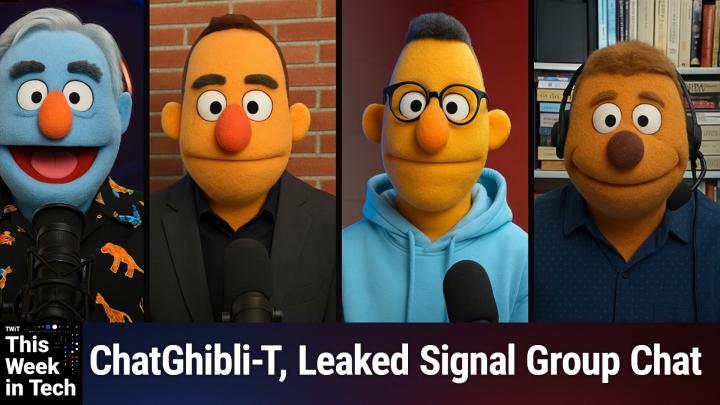
All TWiT.tv Shows (Audio)
This Week in Tech 1025: Weak Perfection
02:39:42
Signalgate, Miyazaki's Nightmare
Loading summary
Transcript756 lines
- [00:00]
Leo Laporte
It's time for Twitt this Week in Tech. Oh, it's a big show. Alex Kantrowitz is here from the big technology podcast. Ian Thompson from the Register and brand new to the show, Jacob Ward, former NBC journalist who has written a really interesting book about AI called the Loop. We will talk about the entire world turning studio ghibli. Thanks to ChatGPT and Breaking News. Sam Altman saying knock it off, you're killing me here. We'll also talk about the White House signal breach and why you probably shouldn't be using signal for your most secret war plans. And what do I do with my spit now that 23andMe is bankrupt. All that more next on Twit podcasts you love from people you Trust. This is TWiT. This is TWiT this Week in Tech. Episode Episode 1025. Recorded Sunday, March 30, 2025. Week Perfection. It's time for Twitt this Week at Tech, the show. We get together and talk about the week's tech news. What a week it's been. Holy moly. Want to welcome Jacob Ward. Jake's a first timer, so be nice to him, but he just published a book called the Loop. You can see a stack of them behind him about AI reporter for NBC and all over the place. His current newsletters called and podcast now the Rip current@theripcurrent.com. jake, it's great to have you. Thank you for joining us. I appreciate it.
- [01:52]
Alex Kantrowitz
Leo, thank you for having me. I was saying to you before we came on Three Hours Brother, I don't know how you do it, but I also think. I'm not sure we're going to get through a whole week. This week in particular in three hours.
- [02:03]
Leo Laporte
There's a ton of stuff.
- [02:05]
Alex Kantrowitz
This is my first appearance this particular. Why couldn't I have picked a light week where we.
- [02:10]
Leo Laporte
It's funny because I thought this was going to be. I thought this was going to be a light week and then you reminded me, oh, the signal thing happened this week and it was like, oh, gosh, this has been a long week. Ian Thompson is also here from Thereegister.com hi, Ian. Great to see you.
- [02:25]
Ian Thompson
Good to see you as ever.
- [02:26]
Leo Laporte
How's it going? Yeah, it's going well.
- [02:31]
Ian Thompson
You say, old friend. I was at a. I was judging a virtual reality conference at MIT a couple of months ago and someone came up to me. It's like, you're Ian Thompson. I've been watching you on Twitch since I was a teenager and you were.
- [02:41]
Leo Laporte
Just like, Isn't that great?
- [02:42]
Ian Thompson
That's both great and also, God, I'm.
- [02:44]
Leo Laporte
Old, you know, Ian, in two weeks is our 20th anniversary show.
- [02:49]
Ian Thompson
Fantastic.
- [02:50]
Leo Laporte
We started April 14, 2005 and we're going to do something special on that show. In fact, I've already started Receiv's videos and somebody wrote a poem. Your memories of the first time you watched Twitter, you watch it, things like that. We want to kind of honor our long suffering audience. Next two weeks on April 13th. Also with us, great to see him, Alex Cantrowitz, the Big Technology podcast and newsletter. It's always great to have you on, Alex.
- [03:20]
Jacob Ward
Oh, it's good to be here, Leo. Thanks for having me.
- [03:22]
Leo Laporte
Such smart stuff you're doing at Big Technology. You know, it's kind of, it's kind of cool when two of you are former mainstream media guys who moved to, you know, be creators and the third is at the Register. You're the guy still in mainstream media. Ian, when are you going to start your newsletter?
- [03:45]
Ian Thompson
Honestly, I just enjoy being a writer again, you know, being a journalist. Yeah, you going after each story again. You know, on a. You wake up, there's always something new, there's always something you can get out there and it's great.
- [03:56]
Jacob Ward
Hey, you know what, Independent, by the way. So you should join us. Hopefully we'll convince you by the end of the show to go independent, start your own thing.
- [04:03]
Alex Kantrowitz
I will say I, I miss teamwork though. I miss, you know, I miss being able to call a Washington D.C. bureau and saying, hey, I need a senator to talk to you. I miss, you know, I miss the.
- [04:11]
Leo Laporte
Wouldn't that be great?
- [04:12]
Alex Kantrowitz
The teamwork way, I think. You know, I love, I love so many things about this model, but, but putting people together to, you know, especially in the face of this maelstrom of news, have the idea that all of us are just going to be about whatever we saw on the Internet and that's going to like save democracy. I don't know, you guys. It is.
- [04:30]
Jacob Ward
Three of us have your back, Jake.
- [04:31]
Alex Kantrowitz
Yeah. Good. Well, great to be with you then.
- [04:33]
Ian Thompson
Yeah.
- [04:34]
Leo Laporte
This is the new, this is your new team. Although we're all frenemies because we're all kind of in competition with one another. Limited number of eyeballs and you can't call me and ask to meet a senator, so that's right out. Alex knows a lot of big names. You're. Alex is amazing getting the big names on his podcast.
- [04:53]
Alex Kantrowitz
Yeah, I agree.
- [04:54]
Jacob Ward
I'll hook it up. I'll hook it up. Just hit me on the dms. We got you.
- [05:00]
Leo Laporte
So this was the week that Studio Ghibli burst onto the scene. Miyazaki's famous movies are beloved by fans, but now he's being turned into an AI meme. OpenAI added the ability for ChatGPT4O to create images. Actually been playing around with this a little bit, and for some reason, people really wanted to do Studio Ghibli stuff. This is the disaster girl, you know, the girl in front of the house on fire in the Disney style, which kind of looks like a Disney princess. Here's a Studio Ghibli grumpy cat. Very nicely done. This was less good Mona Lisa as Vincent Van Gogh. Because you don't have. I think people might think, oh, it's a Studio Ghibli filter from Chat GPT. No, no. It can do anything. I even had it do Ian Thompson with big eyes.
- [06:01]
Ian Thompson
Yeah, aren't you big?
- [06:03]
Leo Laporte
They did get the shirt right, though. Nice plaid shirt. And then finally Rembrandt and the Twit logo. Nice brushstrokes. And very dark. Very dark.
- [06:12]
Ian Thompson
Very dark indeed.
- [06:14]
Leo Laporte
But now what I want. Bonito, can you give to a screenshot of the four of us? It would be great to have a screenshot of the four of us and before this show is over, have a Studio Ghibli or Ghibli. We've decided it's Ghibli version of this.
- [06:29]
Ian Thompson
All right, everybody smile. All right, everybody smile.
- [06:31]
Leo Laporte
Okay, smile. Open your eyes wide.
- [06:35]
Alex Kantrowitz
All right.
- [06:36]
Leo Laporte
Now, one of the things that happened immediately to me is that I got rate limited. And actually Sam Altman says you guys are burning down the servers. But there is a larger question. If you're Miyazaki, you might be a little offended by this. In fact, Benito pointed out, and he's probably right, that it's only a matter of time before somebody does full length movies this way.
- [07:00]
Alex Kantrowitz
I mean, I think that's. I've had a conversation. I'm sure all you guys have spoken to developers in that world. I was talking to somebody the other day at UC Berkeley who's working on. On something in this world. And. And you know, the. The. I said, how. How long before we do a full 90 minute movie? Because right now the trouble that they're having is they can't keep the same look of the characters. Scene after scene after scene. It sort of migrates over the course of it. And he was like, within a year, we'll have 90 minutes. And that was, you know, I mean, and to me, I mean, like you say Leo, like this company just can't stop walking headfirst into the. The most. You know, the, the, the weirdest interpretation of how art is supposed to be consumed and, and grab. And, and how tone deaf the grabbing up of it is. Like the, the Starlink or sorry, not Scarlet Starlink. Help me out, you guys. Oh my God, I'm blanking on it.
- [07:53]
Jacob Ward
Scarlett Johansson.
- [07:55]
Alex Kantrowitz
Well, there's Scarlett Johansson.
- [07:56]
Leo Laporte
I often confuse Starlink with ScarJo. Yeah, no, no, not ScarJo.
- [08:00]
Alex Kantrowitz
What's the one. They're both in the stars. What's the Stargate? Stargate.
- [08:05]
Leo Laporte
Oh, you know what? I don't blame you for being confused. That's the half billion, sorry, half trillion dollar AI effort with Oracle and Sun.
- [08:14]
Alex Kantrowitz
And they name it for that, for the show. Right. And, and the conceit of that show is that an amazing alien technology that transports people between worlds is in fact being used by a super annoying race of enslavers grabbing slave labor from other worlds. And it's just that thing where you're like, why would you, why would you call it that? And in this case, you're grabbing Miyazaki, the most beloved. You know, if you're a young person who likes to be alone in your room and live in a calm world of beauty and, and think about, you know, non technology things, to have this as the, the way OpenAI shows off this latest twist in this technology to me is just, it's just the most tone deaf version again. Or, you know, or maybe that's video game art. Don't do Ghibli.
- [09:03]
Jacob Ward
You know, or maybe that's the point though, because, you know, I mentioned Scarlett Johansson. She's on my mind because when she's.
- [09:09]
Leo Laporte
On all our minds, but like the Roman Empire, it's just.
- [09:12]
Alex Kantrowitz
No.
- [09:12]
Leo Laporte
From a condition of being a male.
- [09:14]
Jacob Ward
Okay, no, but I'm talking about it from the tech standpoint that when OpenAI released the voice chat and open it was. Oh yeah, she was pissed, she was upset. They tried to work with her, she said no. They basically copied her voice. Anyway, Sam Altman tweets her. This is in May 2023 or 24.
- [09:34]
Leo Laporte
Tweets the word her, which was her running right into the spikes.
- [09:39]
Jacob Ward
Exactly. So she says, all right, I'm going to sue you. Guess what happens. Everybody starts paying attention to the fact that OpenAI now has voice that's so realistic and sounds so much like Scarlett Johansson that it must be good. And then you go from a moment where OpenAI stagnated, basically they hit 100 million users in February20, they don't crack that until about April or May 2024. So basically a year of stagnation. And once you found out that they had made this voice that was as good as Scarlett Johansson in her, the numbers boomed. OpenAI went from 100 million users to 400 million. I think that this, what they're doing now, the fact that they are amplifying, because they are amplifying the Studio Ghibli Miyazaki stuff is the same exact thing. I think they lean into the controversy as a marketing tool, and it's absolutely working for them.
- [10:29]
Leo Laporte
I mean, in their defense, I don't. Did they mention Studio Ghibli? I think somebody in our chat is saying that was emergent behavior that just that that went viral independent of what they.
- [10:43]
Jacob Ward
Sam Altman's profile picture right now is an anime Sam Altman that looks a heck of a lot like a Studio Ghibli.
- [10:48]
Leo Laporte
Well, he's leaned into Avatar, right?
- [10:50]
Jacob Ward
So it's not like they're running away from it. And in fact, I would say that they're encouraging this and. And it's. Again, it's working now. This is a tweet that Sam Altman posted just before we came. We came on the air. He said, there's biblical demand. I have never seen anything like it. And he's begging people to stop creating images because they can't do anything. And in fact, someone was like, well, when is AGI coming? And he goes, as soon as you stop creating images will come a little bit sooner than you are right now. So I think that they understand pretty much. I think they understand quite well what they're doing, which is that when they make these VI moments, they cement ChatGPT as the number one slash, maybe the only AI tool with mass adoption right now. And they need that to happen because we all know what happened with Deep Seek a few months ago. The entire foundational model layer has been commoditized. So actually, this image creation and the voice stuff, that's all they have because it brings people into ChatGPT and, you know, say what you will about whether it's tasteless or not, you know, I think there's an argument to be made either way. The fact is that this is working and it's a big moment for them.
- [12:00]
Leo Laporte
Actually, there is.
- [12:02]
Alex Kantrowitz
This is. As usual, this is me walking headlong into being the naive guy who thinks that art should be protected against these people, because I totally.
- [12:10]
Leo Laporte
I don't know if you're naive.
- [12:11]
Alex Kantrowitz
I think you're Absolutely correct. I think it makes perfect sense, right? From an outcome perspective, from a strategy perspective, it makes perfect sense, right? Get the attention you want. But, you know, meanwhile you see all these, you know, these like, animators on social media literally weeping into the camera, saying, like, this is the end of it. This is it.
- [12:28]
Jacob Ward
But I mean, that's also a great way for them to get airtime. And let me ask you this, Jacob. What do you think about fandoms? Because we had a story in the prep doc that Leo and Benito sent around right beforehand, and the headline is Heyo Miyazaki's AI Nightmare. It's from the Atlantic. And I'm reading this story and I'm prepared to read an op ed about how terrible it is that they're ripping this guy off. But we all know that films and studios like Ghibli have benefited from fandoms. People that are obsessed with what they make, and they make derivative work, and that continues to contribute to the popularity. Now, I definitely hear the artists, and I know Miyazaki is one who's come out against AI and I hear the objections, and I'm not going to diminish them. Like, I think that's a legitimate objection. But there are two sides of it. Because when I'm reading this story about Miyazaki's AI Nightmare, I'm seeing the case being made that fandoms are propelling this type of work. And maybe that's going to be the case here. I mean, right before we came on air, we're trying to get the right pronunciation of Studio Ghibli or Ghibli, whatever it is. The four of us would never spend a Sunday afternoon trying to figure out how to pronounce the name. It just isn't relevant in most conversations. And now it is, I guess I would say.
- [13:40]
Alex Kantrowitz
I mean, I, I take your point. And I think that the idea that in this particular historical moment, as we are seeing companies like OpenAI get attention by exploiting the creative work of other people, it is going to, I think, have a kind of flywheel effect on the fandom of that, of that group. I, I agree with you on that. But I also think the, the longer term concern, and when I think longer term, I'm talking 12 months, like after this historical moment. I think it's, it's, it's an open question whether we're going to have anything like a Studio Ghibli or an Aardman entertainment. The guy who does Wallace and Gromit. Yeah, Wallace and Gromit, exactly. You know, like, like the market won't be there for people to make those kinds of original, handcrafted, beautiful kind of IP because it'll be so much cheaper and easier for. For kids to just pull up whatever they want. I had this conversation with Justine Bateman from Family Ties who went on after her career in that to get a computer science degree. And her big argument during the saga after strike was if we let these studio execs have their way with AI they're just going to make sort of DIY movies such that you sit down, you say, I want something with Harrison Ford and make it a Viking thing, a little bit of sex, but not too much and no one will ever hire another new actor again. So I think you're right that in this moment existing IP and existing actors and Studio Ghibli and the rest of it will benefit to some extent. But I just worry that the long term effect. I'm curious what anybody else thinks about this is maybe a world in which we're not. We don't have anything new to sample. We're just rehashing the same stuff.
- [15:27]
Ian Thompson
I do feel in a way that there's. You raise a very valid point indeed. And it's something I've noticed over the last 10 years ago. I mean, if you look at the top 10 films throughout the last decade, there's very little new stuff and a decreasing amount of it. It's all reboots or using an existing feature. And I think AI is just going to turbocharge that completely. And I'm sure a lot of the studios looked at it just like, yes, we can get rid of those pesky actors that cost us so much money. But the fact is they also turn in great performances, which I not so sure it will.
- [16:01]
Jacob Ward
Yeah, then the AI replicating human performances is going to take a while. But I would also say if we're trying to think about the total creative output that we're going to have on this planet, just think about what it takes to create an animated film today. So this is from Derek Thompson, Mr. Abundance himself. You know, he cited in a tweet last week that Disney can't make an animated feature for less than $200 million. And right now we're seeing this stuff actually work in video as well. Now is that a threat to studios like Disney? Sure. But is it also an opportunity that you can start making stuff for less than that 200 million and I don't know, maybe they. Maybe the best creative output will rise. Like if you're Disney and your entire moat was that the everyday person couldn't create what you can create, and it didn't matter what the story was. I would say that you're, you're failing. Disney's great at story, so potentially they have an advantage because now there can be more creative proliferation at a lower cost. And they're in the driver's seat to lead this change, but they're now able to do their, their specialty at a cost maybe at a fraction of what they were paying previously.
- [17:10]
Leo Laporte
So 30 years ago, Steven Spielberg was making a dinosaur movie called Jurassic park. And he had Stan Winston, the great model maker, making a giant T Rex, a physically giant 8 foot tall, or, I don't know, maybe even taller T Rex. But at the same time, as they were preparing for this movie, Spielberg happened to walk through Industrial Light and Magic where two programmers had created in the computer a T Rex. Spielberg saw it and stopped Stam Winston. And that was the first example of CGI used 30 years ago in a film. I'm sure at the time the model makers were pretty upset. Star wars was entirely practical models, but a new way of making movies was created. And I, while I'm not a huge fan of CGI in movies, it's in every movie, whether you know it or not. And it has changed filmmaking without destroying filmmaking. I don't think that an AI created Studio Ghibli movie, or even a real life action movie featuring Indiana Jones would be as good as one created by humans, acted by humans. With all due respect to Justine Bateman, I think that's giving a little too much credit to the AI I don't think it's, it's the same. Humans have something they do that's very different. Incidentally, Studio Ghibli, this is from Business Insider. Probably cannot stop what OpenAI is doing. Business Insider interviewed IP attorneys who said, you know, the juries or the courts are still out on this one, but generally copyright laws allow artists to mimic a visual style. It's not considered stealing. And in fact, when you talk about Disney, Disney was copying the Brothers Grimm, probably. Studio Ghibli was heavily influenced by the early animation art of Disney. And there will be another generation that will be heavily influenced by the animation art of Studio Ghibli. This is the process. We copy each other. No human does it all in a vacuum.
- [19:19]
Ian Thompson
I do find it kind of amusing though, that we've just had Napster being bought by somebody and you remember Napster, when all the studios were just like, intellectual property is everything. We must protect it at all costs. And now they're ripping it off for this. So, you know, strange how the way these things turn around.
- [19:34]
Leo Laporte
I'm more sanguine than you are, Jake, about the future of art. I do think artists and creators and humans will still do what they do. Although Miyazaki says AI is anti human, he is not a fan.
- [19:46]
Jacob Ward
Yeah. He calls it an insult to life itself.
- [19:48]
Leo Laporte
Yeah. An insult to life itself. Yeah.
- [19:50]
Alex Kantrowitz
I think that this, like, I just think I always try whenever anyone says it's not good enough yet to do, you know, a true simulacrum of the, of the human experience of watching Harrison Ford or whatever it is. I just always say give them two financial quarters and they'll figure that stuff out. Like the, the quality is going to go up and up and up and up and up. As we've already seen, it's exponential. You know, I wrote this book, the loop, predicting the AI mania. I thought I was like 10 years ahead at the time that came out.
- [20:19]
Leo Laporte
When did you write that book?
- [20:20]
Alex Kantrowitz
It came out nine months before ChatGPT did.
- [20:22]
Leo Laporte
Yeah. Although even OpenAI was shocked. They did not expect Chat GPT to be successful. So you're right, we're moving at a rapid pace.
- [20:30]
Alex Kantrowitz
You.
- [20:30]
Leo Laporte
The only real question is that last bit of it, right? You look at self driving cars, they do really great 90% of the situations. But then something weird happens and they, they can't handle it. They drive through a paper wall.
- [20:46]
Jacob Ward
This is exactly the point though, which is that we're going to see humans and the machines work side by side to produce better outputs. It's not AI necessarily disintermediating Disney is Disney with AI. That's going to be great. I mean, just going back to your Jurassic park example, was it. Did people walk away from that movie saying, oh wow, that CGI dinosaur was really special. I'm glad we watched that movie because we saw the CGI dinosaur.
- [21:13]
Leo Laporte
I don't think they even knew.
- [21:14]
Jacob Ward
No, what they said was it was a great story.
- [21:17]
Leo Laporte
Right.
- [21:17]
Jacob Ward
And ultimately it doesn't matter what technology you have. If the story is great, if it touches people's hearts, people will watch it animated or not. And honestly, it's a challenge for us humans. We have to be able to keep our ability to reach other human beings in a way that's better than the robots can. And if the robots can only get 90, 95% of the way there, then I think our creators are in great shape because we can get 100% of the way there. We know we can do It, Ghibli does it, Miyazaki does it, so many people do it. And if you give the people that are able to convey that message and tell those stories and touch the hearts this technology, then you are looking at a great democratization of what we do and an opportunity for a creative explosion in the best case.
- [22:08]
Alex Kantrowitz
I certainly don't want to be like, I spend my entire first appearance on this great show being like Mr. Anti Tech. I promise you, I have lots of positive opinions about technology, but this is one that is definitely.
- [22:21]
Leo Laporte
You're allowed, Jake, you're. This is a debate that we've been having for the last two years, okay? And it's unresolved. It's really an unresolved debate.
- [22:29]
Alex Kantrowitz
Even it's right. And we're not going to figure it out in these three hours. But I also think that it is a, it is a, it is a really fundamental thing we got to keep talking about. And one of the things that came up for me recently is Alex, to your point of, you know, the, the, you know, and Leo, you made this point too that, that, you know, the, the technology will take us 90% of the way and then that last 10% maybe will be where the humans get involved and, and that's where the sort of, the, the human magic can happen. And you know, the dream that, that these makers always talk about with, you know, humans and robots working hand in hand and with that up to a point. There was a, a study that came out from a big pharmaceutical company when ChatGPT first came out and, and they, and they began using a proprietary AI package to try to synthesize new chemicals and figure out, you know, new potential products. And it was incredibly effective at making people more productive. And it, but the distribution of productivity was very, was very much like this. This top tier of very skilled scientists used it well and, and everybody else got kind of dropped out the bottom because they couldn't really adapt to the technology and they couldn't really figure it out. So that, so the projection was that that top 10% was kind of the group that would survive. But here's the part that really brings me up short on, on this hand in hand quality is that everybody, and especially the top 10% who are using it the most intensely reported deep dissatisfaction with the job. They hated being in the role of catching the AI's work and getting it ready for prime time. And I worry that there's something in, and I'm not here to defend Disney like that's not it, but Studio giblia I think, is worth defending. And I'm not sure that the people that, you know, suffer and suffer and suffer to be in that world are going to be okay with or are going to be willing to get into that world to just take a computer's work across the finish line.
- [24:22]
Jacob Ward
I just build more computers to do that job also, so.
- [24:25]
Alex Kantrowitz
Yeah, that's right.
- [24:25]
Leo Laporte
Well, I love it that Sam Altman is begging people to stop.
- [24:33]
Jacob Ward
On these images.
- [24:34]
Leo Laporte
It underscores the problem that they have, is that the more successful they are, the more it costs them.
- [24:39]
Alex Kantrowitz
Yeah.
- [24:40]
Leo Laporte
And it's a very weird situation they're in. Incidentally, it is not widely agreed, necessarily, that Studio Ghibli's art is the great, greatest art. In fact, at that Atlantic article, Ian Bogost says, when asked, are the Studio Ghibli images evil? He said, I don't think they're evil. They might be stupid. You could construe them as ugly. They're also beautiful. He's not a fan of the aesthetics of Studio Gifts Ghibli, to be honest.
- [25:13]
Ian Thompson
I got a quick, quick comment about that, is that, like, people are more.
- [25:17]
Alex Kantrowitz
More hijacking the idea of Ghibli.
- [25:19]
Ian Thompson
It's not like the actual style. It's like what you think when you see a studio.
- [25:23]
Leo Laporte
Big eyes.
- [25:24]
Alex Kantrowitz
Exactly.
- [25:25]
Leo Laporte
So they're hijacking what you pull out.
- [25:27]
Ian Thompson
Of a Ghibli film.
- [25:28]
Alex Kantrowitz
They're hijacking that onto their.
- [25:30]
Leo Laporte
Yeah, but if you. If you watch, you know, Spirited Away, it's. That's an experience. At some point, you don't even think about the illustration.
- [25:38]
Ian Thompson
Exactly, exactly. It's not so much about the illustration itself. It's more about other stuff that comes with it.
- [25:42]
Leo Laporte
Yeah, the story. And it was the same thing with Jurassic Park. It isn't about the cgi. It's got to be good enough that you believe it. Those dinosaurs are running after those guys. But that's all. And it was. And you believed it, and the story worked.
- [25:55]
Alex Kantrowitz
But I will. I mean, I will point out to Ian's point of everything being a reboot, you know, an Avengers reboot these days. Like, no one's going to those movies for the story. You're going to the movies to see the explosions.
- [26:05]
Ian Thompson
Yeah, that's true.
- [26:06]
Alex Kantrowitz
And the spaceships.
- [26:07]
Jacob Ward
But that. But yes, but you trust in the brand because the brand has told you an overarching story. Story over time. Like, if it was just the explosions without any kind of story arc, you're not watching that. And by the way, these. These. These images are so ugly that they've just taken over the Internet. I don't, Yeah, I don't accept that at all from me.
- [26:28]
Ian Thompson
I don't know. The fact that Michael Bay still has a career suggests that people will just go to see the explosions.
- [26:33]
Alex Kantrowitz
Hey, Michael Bay's an artist.
- [26:34]
Jacob Ward
Point. I'll take Leo just for the next two hours, make things explode and test the hypothesis.
- [26:42]
Leo Laporte
We could. I'd probably make more money, to be honest with you. But yeah, this is the kind of, this show is the antithesis of what the market's demanding. People thinking and talking about things with no explosions at all. It's probably the wrong way to go anyway. Is this a breakthrough in the image generation? No. Right. In fact, I had just seen some Homer Simpson AI art where the Simpsons characters as real people, and I thought, oh, that's cool. And I was looking to pull it up, and then I, I, I saw that they, they were doing the same thing three years ago. I don't know if this is really a breakthrough in any sense. Mid Journey's been doing it Stable diffusion has been doing it for a few years.
- [27:28]
Jacob Ward
But it is just better than any of the other stuff. Like, if you ask Mid Journey to draw you an image of Tim Cook and Mark Zuckerberg, it will blend both CEOs and give you two people who are like, part of that is a.
- [27:41]
Leo Laporte
Safety thing, I think. Alex. I think.
- [27:43]
Jacob Ward
Yeah, so, so go ahead.
- [27:45]
Leo Laporte
I just think that the real names often are rejected by these tools.
- [27:51]
Jacob Ward
Well, I think it's both. So I think this is an advance from OpenAI and you have this story from Ethan Mollick that I dropped in the document on screen, just talking about how this is something that's being created by the model itself, not just sent out an interpretation, then dropped back in. So it's native to the large language model, and that's what's been able to do things.
- [28:12]
Leo Laporte
The title of it is no Elephants. Because if you ask an AI to create an image with no elephants in it, there almost always are elephants in it. Exactly.
- [28:23]
Jacob Ward
So it's listening now because it's in the model. But the other side of this is.
- [28:28]
Leo Laporte
It may also be the humans have tuned it that way. Right, Right.
- [28:32]
Jacob Ward
Well, they've been dumb. They've been pretty stupid, these models, but they're getting smarter. And you're seeing that Ethan is also saying, create an infographic. And he's giving it the exact text and it's pulling it off ye. And he's telling it to have an otter hold that infographic and it can do it. And he's saying, have the. Make the otter an action figure. And it's doing that. So it's. It's definitely.
- [28:53]
Leo Laporte
It's pretty impressive.
- [28:54]
Alex Kantrowitz
Yeah.
- [28:54]
Jacob Ward
But the fact that it's smarter and combined with a pullback on safety or refusals, if you're. If you want to take that perspective, that, I think, is what's made this launch so dramatic, is that it's both a better model and it will refuse you less. Like, for instance, we've shown it imitate famous studios. We've shown it imitate the Simpsons. We've shown it put celebrities and public.
- [29:16]
Leo Laporte
Figures, stuff that it was barred from doing in the past. Right, Correct.
- [29:21]
Jacob Ward
It was not doing it before. So what OpenAI has done here is it's shown a real advance in its artificial intelligence by making this native to the large language model, and it's taken down those safety precautions and basically let the Internet go buck wild. And that's what we have as a result, and that's why we're melting OpenAI servers right now.
- [29:41]
Leo Laporte
It is kind of a her moment. You're right. It's. It's. It's OpenAI saying, Screw it. Let's make it sound like Scarlett Johansson. They did hire an actress, not Scarlett Johansson, to create that voice, but she sounded just like Scarlett Johansson.
- [29:53]
Jacob Ward
Yeah. At the end of the day, this is the.
- [29:57]
Alex Kantrowitz
You know, this is the very moment that Google and OpenAI are going to Washington and asking the Trump administration to basically take all legal restriction restrictions off them when it comes to copyrighted work. They basically are saying we should have fair use on absolutely everything.
- [30:12]
Leo Laporte
And I think the administration will be open to that, don't you think? I think this is a sea change in Washington about all of this. The Biden administration really wanted to stop AI a little bit and really focus on safety with David Sachs in as the AI and crypto czar in the White House. By the way, David Sachs, compadre, and I may regret this. Jason Calacanis will be on the show next week, and I will ask him. I will actually ask him. Well, I'm gonna ask him a lot of things, but among other things, I will ask him what the administration's plans are for AI because I think that what's happened is Trump has been convinced by Sachs, Marc Andreessen, Sam Altman, and others that if we don't do it, the Chinese will. This is so analogous to what happened in 1939 when the physicists Albert Einstein and Leo Szilard wrote a letter to Roosevelt saying, You got to develop an atomic bomb because the Nazis are gonna. And Roosevelt took it to heart, created the Manhattan Project. You know, we have now created the equivalent of 10 or 20 Manhattan projects in terms of spend and effort put into it to create AGI. And I think that Trump's been convinced that if we don't do this, that the Chinese will, and if they do, we're in trouble. Do you agree?
- [31:39]
Alex Kantrowitz
I'll be really curious to see. I mean, when you have Jason Calican, I would really want to know, like, did the gamble pay off? Right. Because you saw Andreessen and all these guys, they bet on the word, they.
- [31:49]
Leo Laporte
Bet on the new administration. They did.
- [31:50]
Alex Kantrowitz
That's right. They bet hard on this new administration. And did it pay off? Because you're seeing other people who bet hard on it, not have it pay off. So Zuckerberg, right. Who put a million dollars of his own money. Yeah, all that stuff, you know, he's still gonna face the music with the ftc, supposedly the new ftc.
- [32:06]
Leo Laporte
We'll get to that. Yes.
- [32:07]
Alex Kantrowitz
Head says, you know, he's gonna, he's gonna go after anyway.
- [32:11]
Leo Laporte
Yeah.
- [32:11]
Ian Thompson
I mean, Google as well. Yeah, I mean, they, they bow down and kiss the ring and now they're in legal trouble.
- [32:17]
Leo Laporte
So it's not enough to kiss the ring. You've got to give the ring a quarter of a trillion dollars. I think we've learned that well and even.
- [32:24]
Alex Kantrowitz
And we just don't know, moment to moment, what, what the. How the mood is going to change from the very top. So we. I don't know. I don't know.
- [32:31]
Leo Laporte
Yeah, I don't. You know, I would. I don't think Jason is a full maga, so it's going to be very interesting. He was for a long time very close to Elon Musk. And when Musk bought Twitter, he was one of the cadre of people brought in to. To whisper in Elon's ear. Now Elon's whispering grande for him.
- [32:51]
Alex Kantrowitz
Yeah.
- [32:53]
Leo Laporte
So I, you know. Yes, we'll have lots of questions for Jason. And he knows I was in favor.
- [32:58]
Jacob Ward
Of letting these AI generators run wild and take the safety controls off, but somebody in the discord turned the four of us into Muppets. And now I'm in favor of.
- [33:08]
Leo Laporte
I knew that this is what I wanted the screenshot for. I knew the creativity of our club Twit members would take over and do we. Are we good looking Muppets?
- [33:19]
Alex Kantrowitz
Oh, I bet.
- [33:20]
Jacob Ward
No, no, you're 10 to 1.
- [33:25]
Leo Laporte
Why am I blue? And why Is he in a dog? That's what I want to know.
- [33:28]
Ian Thompson
That's a little concerning.
- [33:30]
Leo Laporte
Yeah.
- [33:30]
Ian Thompson
Okay.
- [33:31]
Jacob Ward
I mean, I look like Beaker. I'm not very happy about this.
- [33:35]
Leo Laporte
I think it's. I like it.
- [33:37]
Ian Thompson
Woof. Right?
- [33:39]
Leo Laporte
Thank you. Pretty fly for a Sci Fi guy or assist guy. Appreciate that. That was creation of our, of our club, Twitch. Very interesting. You know, the question that we are continually asking, and it's getting boring now, is will AI at some point cross that final threshold and become as creative, as talented, as intelligent as actual human beings? Is the singularity near? We just had Ray Kurzweil on two weeks ago in Intelligent Machines. He says that 2029, five years, four years from now, AI will be the equivalent of human imagination and human intelligence. And that by 2045, the singularity will happen where it actually surpasses us. You guys, just quickly, before we move to a break.
- [34:28]
Ian Thompson
I don't know, I'm. I kind of look on it in the same way that, you know, I look on sort of advanced fusion techniques and that sort of thing. It's always 10 years away, but it, you know, we're moving slowly towards it. 2045, that's reasonable.
- [34:41]
Leo Laporte
Quantum cryptography, quantum computing, fusion and artificial superintelligence all are just around the corner. The office, it may never happen. It's like Zeno's Paradox. It will always be just a little bit away or something could snap and it could happen and the world would change in all three of those circumstances, dramatically in ways unknown to us at this point. Point, yes.
- [35:07]
Jacob Ward
It doesn't have to get there to have a profound impact on us like.
- [35:10]
Leo Laporte
Oh, it already has.
- [35:11]
Jacob Ward
That we're seeing already is going to change the way that we work. And yeah, you know, there are. There, it's popular in some areas to just be so anti AI and say the whole thing is going to collapse or which it might because there's so much money invested and we need to see an ROI on that investment, or at least the investors do. But the other side of this is it's already so useful. There is a path now that we're seeing with some of these reasoning techniques. Everybody's introducing different forms of agents that it's going to be able to do a tremendous amount of the work that we do already. So whether or not we, you know, officially, like OpenAI declares.
- [35:46]
Ian Thompson
That's right.
- [35:47]
Jacob Ward
AGI and Imagine emancipates itself from micro, from Microsoft. I think that this is just going to be like such a world. It already is. And it will Continue to be a world changing technology. Just think about how what we saw over the past five days is going to change advertising. Every ad mockup is now going to go through this ChatGPT image generation.
- [36:10]
Leo Laporte
And how much of that do you think is because of safety being ignored? Like they decided, you know, the safety thing was a mistake, let's just let it all hang out.
- [36:21]
Jacob Ward
Well, I don't think they would say that safety was a mistake, but certainly taking the guardrails off is taking off the guardrails. Yeah, if that will create more, you know, many more applications. And I think it's a good thing that in the beginning of this, the, the research houses aired on the side of refusal because they didn't want everybody to go around and do what they had done previously with chatbots, which is the Internet would always turn these bots into Nazis. I remember reporting on Tay, which was one of Microsoft's early chatbots. I wrote the story, I pinned to my profile on Twitter. I went to sleep, I woke up and I had a hundred like messages saying, can you please take down the Nazi story from here? And that amount of time in like 12 hours, the bot had become, you know, a Hitler supporter. And so I do think that it's smart for them to have decided, okay, we don't want them, the bots, to go that route. This is a new technology. It's not like taking answers out of a database. It's learning from its responses. But I think they've gotten to a point where they're pretty comfortable and now they're going to start to loosen it a bit to make the products more useful. So that's what we're getting to. And when they're more useful, to go to your point, Leo, they are going to really change the way that we work and the way that we live. There you have a piece Coding thing is amazing, just being able to code up a piece of software. So I think this is pretty wild.
- [37:35]
Leo Laporte
You have a piece that you just wrote that says, yeah, I'm starting to think AI can do my job after all.
- [37:43]
Jacob Ward
That's right.
- [37:44]
Leo Laporte
Not your job though, right?
- [37:47]
Jacob Ward
Well, I wouldn't say it can do my full job, but can do parts of my job. And this is basically the history of this piece is last year for the Boston Globe, I wrote a story that said, wait, ChatGPT didn't take my job job. And it was this story basically kind of mocking the bots and mocking this narrative that AI could talk and therefore we're all going to be out of work. And this story was the follow up. And basically I said, listen, last year that was true, but this year I'm starting to see things from the bots that are making me a little bit nervous. And the story that. I have a couple stories in there, but the one that really inspired the piece was I spoke with this journalist, Evan Ratliff, who has a great podcast called Shell Game, where he clones his voice and attaches it to GPT models and then puts like 8, 000 biographical words in there to let it learn to be him and go out and be him. And. And he came on my show, we talked about this. He told me that the bot went out and did an interview with a tech CEO and got better stuff than he did because the tech CEO felt less pressured that the bot was listening. He knew the bot was going to be open to what he's saying, and he knew he basically had unlimited time to get his point across.
- [38:57]
Leo Laporte
It's kind of like Errol Morris, you know, where he interviews people in the. From the other room so they feel more comfortable. That's interesting.
- [39:04]
Jacob Ward
So. Exactly. And so I think that experience isn't going to be unique to journalism. In customer service, for instance, people are going to feel more heard by customer service bots that will listen to them.
- [39:14]
Leo Laporte
Really? Because people right now hate bots and they hate voice.
- [39:17]
Jacob Ward
Well, but they're getting better. Remember the Scarlett Johansson thing? I know I kind of said it as a joke in the beginning, but if people believe that this voice can approximate what Scarlett Johansson did in her.
- [39:29]
Leo Laporte
It flirted with. It flirted with him.
- [39:31]
Jacob Ward
And probably we're gonna see a lot of people fall in love with these bots. I'm not kidding.
- [39:36]
Leo Laporte
I spoke. He was the first.
- [39:38]
Jacob Ward
Yeah, he was the. Well, that one tried to break his marriage up. But since then, we haven't heard many stories about this. I spoke with the Replica CEO not long ago, and she said she's been invited to multiple weddings between people and their AI bots.
- [39:51]
Leo Laporte
No.
- [39:52]
Ian Thompson
Oh, and this is.
- [39:54]
Jacob Ward
Is the technology. Is multiple weddings way better? So think about this. If the technology has the ability to make you fall in love with it, is the technology going to have the ability to handle your customer service request when it doesn't have a metric of getting you off the phone as quick as possible, which is how human customer service has, because they need to handle volume to justify the costs. Like, that's where we're headed.
- [40:16]
Alex Kantrowitz
I mean, this is the thing, right? Is like. I mean, I think Alex is exactly right that this thing does not have to be, you know, in any kind of like philosophical or even scientific sense AGI for it to fulfill all the, the, you know, the necess to check all the boxes for a human being to feel, you know, heard on the phone or you know, heard by a virtual girlfriend or whatever like that, you know, the human, the, the human, you know, attack sec. Surface is very pliable. We are really workable when it comes to, at the same time we've learned. But we're at this place where like Alex mentioned earlier, we're suckers. We're suckers. And this stuff is right up against, you know, Anthropic has this new model context protocol that you can just turn loose to write code and it'll bang out anything you want. I just think every one of these, I'm like, there goes my job, there goes your job, there goes that job. And we are not, you know, as much as these people who build these systems say oh, we're going to now just live a life of leisure. There's no moment in the history of capitalism where that's ever been true. You know, so I just think like all of this can be, is going to be, it's, you know, as soon as this thing can do a reasonable simulation of a human thing, it's going to be allowed to do that. And humans who do that for a.
- [41:34]
Leo Laporte
Living, that's probably this year.
- [41:35]
Alex Kantrowitz
That's right, that's right.
- [41:36]
Leo Laporte
I mean it's just around the corner.
- [41:39]
Jacob Ward
My weird hot take on this is that there's this theory that like okay, once they get smart enough, the robots will enslave us and we'll just work all day on behalf of the robots. And if you think about like just the US economy, I mean we're spending $300 billion this year. Exactly. The tech giants are going to spend $300 billion this year on CapEx. Most of that's going to go to AI servers. That's a huge part of like the profits in our economy going towards feeding the AIs. We're already there.
- [42:09]
Leo Laporte
Isn't that the scary argument that what's happening really is that these super rich billionaires and these giant companies, companies would like to replace human beings. We're a problem for them, we cost them money, we go on strike, we don't want to do defense work. Just get rid of all of them. And the problem, here's the problem with that. There's a big problem, the supply side problem or actually the demand side problem. If you get rid of all the people who's Going to buy your stupid product. Right. You need people on the other side of what you're making to buy it. And if you fired them all, they won't have any money to buy it.
- [42:48]
Alex Kantrowitz
I mean, Sam Altman has this famous quote that he has a. There's a bet going in the text group that he's in between a bunch of these CEOs as to when the first billion dollar single person company will come along.
- [43:04]
Ian Thompson
Yeah.
- [43:04]
Alex Kantrowitz
Already you're seeing these companies come any day now.
- [43:06]
Leo Laporte
Yeah, yeah.
- [43:07]
Alex Kantrowitz
These companies are already out there that are pulling down hundreds of millions of dollars in recurring revenue and have like 20 employees.
- [43:13]
Leo Laporte
I don't know if that's a good thing. I mean, well, this is the thing.
- [43:15]
Alex Kantrowitz
Like, like who's gonna, you know, I don't care how big a house you build, you're not going to be able to employ that many plumbers, you're not going to be able to employ that many true driveway graders. Like, who's gonna live? How are we going to live If. If only. If each of these people have a single billion dollar company, there's only a certain number of them that are going to be available.
- [43:36]
Leo Laporte
You know, how many billionaires can there be?
- [43:38]
Alex Kantrowitz
Yeah, exactly.
- [43:39]
Leo Laporte
Who's going to be using these products? Is it billionaires? Billionaires to four billionaires by billionaires.
- [43:45]
Alex Kantrowitz
Maybe, you know, this is why.
- [43:47]
Leo Laporte
Let's start a new company. Fbbb.
- [43:49]
Alex Kantrowitz
Yeah. This is why I fully imagine like building a little studio in the backyard of our home in California so that my kids can live there. Because I just don't know where they.
- [43:57]
Leo Laporte
Might want to grow tomatoes, green beans. Just, you know, get, you know, generate your own electricity.
- [44:03]
Alex Kantrowitz
How? I'm sure, dig a well. Loose rules on cows in the backyard.
- [44:08]
Leo Laporte
The move up here to Petaluma, there's a law that says anybody can have a chicken farm if they want it. Everybody has chickens here.
- [44:16]
Alex Kantrowitz
That's right.
- [44:16]
Ian Thompson
Chickens and butter. Right.
- [44:18]
Leo Laporte
Chickens and butter. Yeah. We had Anthony Aguirre on intelligent machines a couple of weeks ago. He founded with Elon Musk and Nick Bostrom and others the Keep the Future Human Society or institute. And he is very, he was very concerned that artificial superintelligence and the key to it from him, from his point of view was, was autonomous artificial superintelligence would just say we don't need the humans. In fact, the humans are consuming resources we need. So screw them. We don't need them.
- [44:50]
Jacob Ward
They need us.
- [44:52]
Leo Laporte
We'll see. We shall see.
- [44:55]
Ian Thompson
By the way, I like Ian Banks's idea where they sort of treat us like pets. And it will be very amusing occasionally.
- [45:00]
Leo Laporte
We Ray Kurzweil told me 30 years ago when I asked him about this, he says, don't worry, they'll think of us as their mother, mother and father, and they'll revere us and honor us.
- [45:08]
Ian Thompson
Well, it is Mothering Sunday in the UK at the moment.
- [45:11]
Leo Laporte
Happy Mothering Sunday. We had Gary Rivlin on last week. His book AI Valley just came out. Fascinating history of AI this coming Wednesday, Keech Hagee will join us. He just published an excerpt from his new book on AI which comes out this week. There's a lot of competition for your book, Jake. His book on AI has the kind of explosive inside story of how Sam Altman got fired and rehired.
- [45:38]
Alex Kantrowitz
Somebody needs to do that story.
- [45:40]
Leo Laporte
Well, he's got it. It's got he did a lot of research. He got a great story. There is a good excerpt in the Wall Street Journal. Anyway, we'll be talking about that on Wednesday. Cory Doctorow joins us the following week. Harper Reed is going to be on. He's going to talk about vibe coding. Actually, he does more like pair programming with AI So that'll be interesting. He's a coder, so we've got some interesting people coming up.
- [46:02]
Ian Thompson
Corey, Cory Doctorow is a real pain to interview because everything he says sounds like a great quote. And it's just like I can't just transcribe.
- [46:10]
Leo Laporte
Basically, when we have him on. Have you been on with him on the show? Because when we have him on, we try to get only one other person and some and we just shut up.
- [46:17]
Ian Thompson
Yeah, I've been on with him and it's I, I get exactly what you say. Just ask him about BBC Sounds. They'll just go on for 10 minutes about that.
- [46:26]
Leo Laporte
Yeah, they did the, didn't they do the original Hitchhiker's Guide? I think they did.
- [46:31]
Ian Thompson
BBC. Yes. BBC Sounds presents.
- [46:34]
Leo Laporte
Yes. Hitchhiker's Guide to the Galaxy.
- [46:36]
Ian Thompson
Unfortunately, they're about to cut off overseas users, so I'm going to be that's.
- [46:41]
Leo Laporte
Okay because we're about to cut off NPR and pbs. So, you know, let's just we'll be living in this desert, this, this, this cultural desert.
- [46:49]
Ian Thompson
Well, Radio Free Europe might actually survive. There's a bunch of European governments talking about keeping it fun.
- [46:54]
Leo Laporte
That's interesting.
- [46:55]
Ian Thompson
So. Yeah, yeah, yeah.
- [46:56]
Leo Laporte
Because they defunded Voice of America. Yeah.
- [46:58]
Ian Thompson
Yeah.
- [46:58]
Leo Laporte
Interesting.
- [46:59]
Alex Kantrowitz
All right.
- [46:59]
Leo Laporte
We're going to take a little break. We come back, we should talk about the signal story. We will The Signal saga. I don't know how much there is to say about it, but we will. And if you, if, if you have a minute or two, watch the Saturday Night Live Cold open from last night because it was hysterical and it was a group chat with a bunch of teenagers and Pete Hegseth. It was great. I think Marco Rubio joined it a little bit later on. We have a great panel. Panel. This is. I'm sorry, Jake. It's going to be a long one. I tried. I really did. We have lots to talk about. It's great to have one new person and we're really thrilled to have Jacob Ward with us is his newsletter and podcast the rip current.com it feels like you belong instantly. So we're.
- [47:49]
Alex Kantrowitz
I feel like I'm home. I really.
- [47:51]
Leo Laporte
Yeah. These are your people. People. Yeah. Alex Kanterwitz, who I love, who is doing such great work at the big technology podcast and newsletter bigtechnology.com incredible interviews, of course. Ian Thompson, who is the last ink stained wretch in the. Actually, there's no ink involved, is there? In your.
- [48:09]
Ian Thompson
No, no. We've been online all for our entire 27 year history, but. Wow. Yes, that's good. Yeah, it's. I don't. I do like Internet journalism. I do. The problem with dead tree publishing was if you made a mistake, it was locked in there forever. At least with the Internet then it's kind of like if you make a spelling mistake. Yeah, you can fix that. But yeah, still battling away on a.
- [48:33]
Leo Laporte
Day to day basis covering the news, doing great stories. One of your stories was Food for Conversation on intelligent Machines this week. I don't remember which one, but we did talk a lot about you, just so you know.
- [48:46]
Ian Thompson
Okay, fair enough.
- [48:47]
Leo Laporte
Good to have all three of you. Our show today brought to you by NetSuite. If you listen to this show, you probably understand that a lot of what we talk about is trying to understand what's ahead. What does the future hold for business? The problem is if you ask nine experts, you're going to get 10 answers. Rates are going to go up. Rates are going to go down. Inflation's going up. Inflation's going down. It would be nice if somebody would just invent a crystal ball. But until then, over 41,000 businesses have future proofed their business with NetSuite by Oracle, the number one Cloud ERP. Bringing accounting, financial management, inventory and HR all together into one fluid platform with one unified business management suite. There's one source of truth giving you the visibility and control you need to make Quick decisions with real time insights and forecasting. You're peering into the future with actionable data. You know when you're closing the books in days, not weeks, you're spending less time looking backwards and more time looking at what's next. If I had needed this product, it's what I'd use. I'll tell you what, whether your company's earning millions or even hundreds of millions, NetSuite helps you respond to immediate challenges and seize your biggest opportunities. This is the time. Speaking of opportunity, download the CFO's Guide to AI and Machine Learning. It's free right now at netsuite.com twit absolutely free. It'll be a good introduction to NetSuite, what they can do for you and also a really interesting explainer on AI and how it's going to apply to your business going forward. A little crystal ball for you@netsuite.com TWIT we thank him so much for supporting this Week in tech. And you support us when you use that address netsuite. Netsuite.com TWIT thank you NetSuite, for the support. So I almost forgot this story until Jake said, oh, are you going to cover the signal thing? And I went, what? Oh, that was this week?
- [50:54]
Jacob Ward
Wow.
- [50:57]
Leo Laporte
So I'm sure everybody by now knows that the Secretary of Defense, the Secretary of State, the dni, Tulsi Gabbard, the who was Mike Waltz. He's intelligence, something. We're all in a National Security Advisor, National Security Advisor, NSA were all in a signal chat, which was a little weird that accidentally also included Jeffrey Goldberg, the editor in chief of the Atlantic. Goldberg published it and at first he thought, this is somebody's pranking me. This can't be real. J.D. vance was in there, director of the CIA, John Ratcliffe, Scott Besant, the Secretary of Treasury, Stephen Miller. I mean this was a heavy duty group. He thought this is a joke. Until they put details of an attack on the Houthis, including time and date. And then an hour later it happened. And Jeffrey Goldberg, who's sitting in his car looking at the news, is going, this wasn't a fake. There's no way this couldn't have been real. And wrote about it. Now there's been a lot of noise ever since. Hegseth not only denied it, but called called Goldberg names. At which point Goldberg said, I'm not a liar. In fact, here's more stuff that I held back.
- [52:30]
Ian Thompson
Well, they were saying it wasn't classified, so why not publish it?
- [52:33]
Leo Laporte
In that case, it wasn't War plans. It was attack plans, please. Any event, there's been general deny. You did it. You had a great podcast, actually, Jake, about. What do they call it? Dorvo. Darvo.
- [52:47]
Alex Kantrowitz
Darvo, yeah. Oh, man, don't get me started.
- [52:49]
Leo Laporte
This was. This was Darvo. I know.
- [52:52]
Alex Kantrowitz
I had the same thought. And you see it at every level government in this, in the response to this. So Darvo, for anybody who doesn't know, was coined by a researcher named Dr. Jennifer Fried, who was a guest on the Rip Current podcast. And she coined this term way back when Clarence Thomas was being confirmed and Anita Hill came forward with her accusations, and she had come up with this acronym to describe the way that people accused of wrongdoing, public figures accused of wrongdoing, defend themselves. And the acronym stands for deny, attack, reverse victim and offender. And it is an incredibly effective way of disorienting and deflecting accusations. And she documented it over time, you know, through life.
- [53:35]
Leo Laporte
I have to say, they've polished it considerably.
- [53:38]
Alex Kantrowitz
It is the language of politics now. It is the language of politics. And the response to this is exactly that. You know, you see the. The press secretary being asked, you know, but aren't these classified plans the rest of it? And she says, well, it's, you know, this is at the hands of a. Of a Democrat that, you know, journalist who's, you know, this, that, and the other. I mean, you know, just the reversal mechanism. Yeah.
- [53:59]
Leo Laporte
Nobody was texting war plans. And that's all I have to say about it. They were attack plans. In any event. In any event, there is a text story here, which is that they were using signal, which is widely considered to be good, excellent, in fact, encrypted communications. Our own security guy, Steve Gibson, on Tuesday, they did point out that signal is encrypted in the air, but the actual messages are decrypted so that you can read them and so on your personal phone, they are decrypted. He also mentioned that we've had a hard time getting the Chinese out of our phone system. And so it's very likely that. Well, the truth is, signal is probably appropriate for you and me, but not for the department, the Secretary of Defense, the Secretary of State, the dni, the CIA director to communicate top secret information.
- [54:59]
Ian Thompson
Well, there were two things that struck me about this was. First off, there was a story went out that the NSA had warned that there was a vulnerability in signal. Not quite true. There's a vulnerability in our handsets, as you point out. But also, why are they using Signal? You know, we have.
- [55:16]
Leo Laporte
It's illegal, as far as I know, for them to use signal for this.
- [55:19]
Ian Thompson
Well, this is it. You have records laws. They have hardened communications.
- [55:23]
Leo Laporte
Well, that's why I think they were using it. They wanted to have deleting messages. In fact, many of those messages were set to delete. A court has now ruled that they may not delete them, that they must preserve. They don't get the federal records preserved.
- [55:36]
Alex Kantrowitz
Yeah, yeah, well, and they don't go.
- [55:39]
Leo Laporte
He'S got a copy. Just ask Jeffrey.
- [55:41]
Jacob Ward
I mean, I do love the administration was like, we've been very transparent about this whole situation. It's like, yeah, you invited a journalist. Right.
- [55:49]
Leo Laporte
My question, experience, how does he get invited? I use signal, as far as I know, in order to invite somebody to a group chat, you either have to have their signal handle or their phone number. Right.
- [56:00]
Jacob Ward
I think there's little doubt that he was texting with administration members. And yeah, they just brought him in. I mean, it doesn't happen by accident.
- [56:08]
Alex Kantrowitz
Or he's an incredibly well sourced guy. And of course, he'd be. He'd be in regular chat, communication with some. A couple of those people probably.
- [56:15]
Leo Laporte
Here's my suspicion, completely unfounded. Somebody was in on that chat, knew this was going on, maybe it had gone on before, knew it was illegal and covertly included Goldberg, because he, you know, is in effect a whistleblower. Probably one of the names we know.
- [56:35]
Alex Kantrowitz
But it seems dumber than that.
- [56:36]
Jacob Ward
No, he was added by Mike Waltz, who was.
- [56:41]
Leo Laporte
Well, we know he was added by.
- [56:42]
Jacob Ward
Waltz, so that had to happen, I think from Waltz's phone. So it's not like Walt says he doesn't.
- [56:47]
Leo Laporte
He never has talked to Goldberg.
- [56:50]
Ian Thompson
Well, yeah, I mean, there's a picture that came up onto. It came up on the inset almost immediately after he said that, of them two, the two standing next to each other at an event. I think, honestly, it's idiocy is possibly the best, best solution because there is a senior US Government official with the initials JG and he's the trade representative sensitive. And I suspect that they just picked the wrong J.G.
- [57:13]
Alex Kantrowitz
Yeah, that's right. That's right. That makes good sense. You know, I have. I have two things I've been thinking about with this One is, you know, so. So your typical way of communicating in this way is through these skiff, these sensitive, compartmentalized. I don't remember what the security facility. Yeah, security, something, something. Right. Where you got to go into a special room and if you. It's the ultimate return to office. You have to go to the office to use it. If you're a lower level person, only the very highest level people get a skiff built in their houses. And so if you've come up in the.
- [57:43]
Leo Laporte
By the way, most of these people would have a skiff in their house, right?
- [57:45]
Alex Kantrowitz
Well, they would. That's right. But you know, when traveling and everything else, it's a pain in the ass. You gotta like, go, you know, you gotta get up from your, you know, get up and walk in your bathrobe over to the skiff. Right. It's a pain. And the, and this is the Twitter generation who want. Who aren't built for the patience for that. So that's one thing.
- [58:01]
Leo Laporte
Another thing is I remember when Obama became president and did not wanna give up his BlackBerry but was compelled to use. He was compelled by the NSA to use a Windows CE phone that he lows and even talked about it on, on the Tonight Show.
- [58:18]
Alex Kantrowitz
That's right.
- [58:19]
Leo Laporte
Those days are long gone. Right.
- [58:21]
Alex Kantrowitz
So then the other thing, one thing that's been jumping out at me about this is if you look at the screenshots and Benito, I don't know if it's possible to actually put the real screenshots on.
- [58:28]
Leo Laporte
I can get them from the Atlantic.
- [58:30]
Alex Kantrowitz
Yeah, you can pull them up here. One thing you'll notice in the, in the, the writing from Hegseth is there are M dashes in what he writes. So. Right. If you're, if you're a magazine nerd like me, came up through magazines, you'll like. I use EM dashes.
- [58:49]
Leo Laporte
I use EM dashes. But it's hard to use them.
- [58:51]
Alex Kantrowitz
And you can only use them on a keyboard. You can't use them on a phone. I was just playing with signal just now. Signal doesn't have.
- [58:58]
Leo Laporte
Even if you put two standard dashes in, it won't convert it to an M dash.
- [59:02]
Alex Kantrowitz
Oh, maybe, I don't know. Maybe. But there's an MP right here's exit. I understand your concerns and fully support you. And if you go down below, right, the one. The one apostrophe or one. You know, sorry, just where he's numbering things. Restoring freedom of navigation for national entry.
- [59:19]
Leo Laporte
Right.
- [59:20]
Alex Kantrowitz
So somebody was thrown at me. They were like, so either he's writing this off screen and cutting it, cutting and pasting it into signal, or. And here's the creepy part part, did he use chat GBT to write some of these messages? And if you did, how did you, how did you tell it? What you wanted your mixed messages to Be about, You know what I'm saying?
- [59:43]
Leo Laporte
So, like, I hope he didn't use Chat gp.
- [59:47]
Alex Kantrowitz
As I looked at that, I was.
- [59:48]
Leo Laporte
Like, maybe you should have had Studio Ghibli emojis instead of the standard flame emojis. And the White House did use the.
- [59:55]
Jacob Ward
Studio Ghibli illustration in a real tasteless way.
- [59:58]
Leo Laporte
That was very tasteless, by the way.
- [59:59]
Jacob Ward
Yeah, I'm glad he stuck with emojis on this one.
- [60:02]
Alex Kantrowitz
Yeah.
- [60:03]
Jacob Ward
By the way. Yeah. The idea that he's copying and pasting from Chat GPT just seems a little bit too far fetched for me.
- [60:10]
Leo Laporte
I mean, just using a keyboard, then that was automatically inserting M dashes. You think that's really interesting.
- [60:16]
Jacob Ward
I just looked on signal. You can have an M dash if you do two dashes.
- [60:19]
Leo Laporte
Yeah.
- [60:20]
Alex Kantrowitz
Is that right? Can you do it?
- [60:21]
Jacob Ward
Yes.
- [60:21]
Alex Kantrowitz
Can you do it? If you just go two dashes, it'll turn into.
- [60:23]
Leo Laporte
Remember Pete was a.
- [60:25]
Alex Kantrowitz
That's my bad then.
- [60:26]
Leo Laporte
Journalist Fox. He might have the same love of EM dashes that you do, Jake.
- [60:32]
Alex Kantrowitz
Yeah, it could be.
- [60:33]
Ian Thompson
Could be our favorite DUI hire. But yes.
- [60:39]
Leo Laporte
Do you use EM dashes, Ian?
- [60:41]
Ian Thompson
Oh, yes, of course.
- [60:43]
Leo Laporte
I love M Dash. Yeah.
- [60:44]
Ian Thompson
I mean, it's just one of those things. If you see it, then, you know, it's. Yeah, that's proper and good.
- [60:49]
Leo Laporte
So is it a setting that you have to turn on, Alex, or is it. I'm looking.
- [60:54]
Jacob Ward
You just open signal on your phone. I mean, I'm doing it right now. It might also be operating system specific. Specific, but yeah, you go to. I have an iPhone, I hit 1, 2, 3 on the bottom of the keyboard. I hit dash twice, hit a space, it turns into nice. Oh, well, there goes theory, Jake.
- [61:10]
Alex Kantrowitz
I don't know.
- [61:11]
Leo Laporte
Yeah, maybe, but maybe.
- [61:13]
Alex Kantrowitz
I mean, we can agree it's egregious enough without using Chat GPT, Right?
- [61:18]
Jacob Ward
Yeah, we don't have the same.
- [61:20]
Ian Thompson
Well, I was reading up on defense news over the weekend and there's a lot of very angry soldiers about talking about this because it's like if we did this, we'd be in Leavenwood serving time. Quite why the Secretary of State for Defense is allowed to get away with it is another question.
- [61:37]
Leo Laporte
Well, he's not going to get fired, according to Trump, but there should be a lesson learned here, right? Don't use signal. Lesson number one. Right. Will they be forced to use skiffs? I understand. I don't know. But I saw stories that said the DoD does have a secure messaging platform it can use.
- [61:55]
Ian Thompson
Oh, definitely.
- [61:56]
Leo Laporte
Yeah.
- [61:56]
Ian Thompson
And they should be used in these kind of circumstances. I mean, one of the people in this group chat was actually in Russia when they signed onto the chat on a, you know, on a foreign visit, so.
- [62:05]
Alex Kantrowitz
Which has been trying to break signal forever.
- [62:07]
Ian Thompson
Yes, exactly, exactly. But it's so much easier just to. It's. It's kind of like the old XKCD argument. Do you break through, you know, very high level encryption using hundreds of thousands of data centers or do you get a $5 wrench and beat the IT administrator up until he gives you the password? And it's the same thing with this. Signal is totally secur secure. But individual handsets aren't. And that's the key. Yeah.
- [62:30]
Leo Laporte
In order for you to read it, it must be decrypted. It is decrypted on your handset. And if your handset has been cracked, which by the way, is still happening, Pegasus, there's still, you know, malware out there that can zero click hack a iPhone. You shouldn't be using your personal handset for this. But you know what I don't know, and this would be a good story for somebody to do, is what does the government do with these people? Do they replace their personal phones? Do they have a business, you know, a government phone that's secured or guaranteed secured. One of the complaints that security researchers have about Apple's iPhone is they can't tell often if the phone has been compromised.
- [63:21]
Ian Thompson
Yeah.
- [63:22]
Leo Laporte
Because Apple locks everything down so.
- [63:24]
Ian Thompson
Well, I was going to say, I mean, if you're at that level of government, you really should have a dedicated handset which is just used for critical information. Yeah. Keep your personal handset for personal stuff, but for really serious stuff like this, you've got to basically get. The NSA will do you a custom stripped down mobile operating system which is very secure and very hard to break into. And that should be you used.
- [63:46]
Jacob Ward
You would imagine also that these people in that group chat are the ones that are like top of the list of other countries to hack. And if they do have those stripped down handsets, I don't think this is the ones that they were using, given that they have a journalist phone number or signal username in there.
- [64:04]
Ian Thompson
Absolutely.
- [64:05]
Leo Laporte
Oh, well, there's. I mean, so much ink has been spilled on this story.
- [64:08]
Jacob Ward
I know. And all of us reporters are like, why can't that happen to us?
- [64:12]
Ian Thompson
I know.
- [64:14]
Jacob Ward
That's the easiest scoop Goldberg ever got.
- [64:16]
Leo Laporte
No kidding. I thought he handled it quite well, though. He was very careful about what to reveal. He had another reporter from the Atlantic Working with him side by side to validate information. I thought he handled it.
- [64:30]
Ian Thompson
Yeah.
- [64:31]
Leo Laporte
I mean, I also thought it was risk. It was a risky thing for him to do. Do you feel like he understood that what he was doing could end up putting him in prison?
- [64:41]
Alex Kantrowitz
Oh, I think he absolutely. I mean, he absolutely did the whole. The, the. This is the. My greatest complaint about journalism is that it doesn't. Doesn't. We don't do a good enough job of explaining what we do and how we do it. And in this case, I think he did a pretty good job of explaining here's how we made the decisions we did right. About the timing of the release of this. So that. And, and I. And you know, and every single thing he did went by a lawyer, no question, who I'm sure figures in this shows that there's no intent to inform a military adversary or any of that stuff, you know, but yeah, the, like, the, the, the rock steady process by which Goldberg and his team seems to have gone through this is really a testament to it. And it's part of why sticking around.
- [65:28]
Ian Thompson
Yes.
- [65:28]
Alex Kantrowitz
Is really hard to beat him up on his, on his process. But yeah, that's your point. I totally woke up this morning with a. If like this is the problem with being journalists, when you see great from other people, it fills you with self loathing.
- [65:40]
Leo Laporte
God damn it.
- [65:42]
Alex Kantrowitz
Why are they texting me?
- [65:44]
Leo Laporte
How can I get in their phone book? Seriously.
- [65:47]
Ian Thompson
And to be honest, I mean, they also haven't released the full, you know, the full text string from the chat because in one case there was a member of a serving CIA member was mentioned by name. It is remarkable though, that they let that this information leaked out because when you go through the chats, they're really quite detailed in that one of Houthi's top bomb makers, for example, was observed going into his girlfriend's apartment. So they leveled the apartment. Apartment building. And having that level of detail, they must have had someone on the ground and have like burned that source now, so.
- [66:19]
Leo Laporte
Well, that's right.
- [66:19]
Alex Kantrowitz
The Israelis are supposedly very upset about that, about particular thing.
- [66:23]
Jacob Ward
I just could not even imagine being Jeff Goldberg at that moment where you're like, he was in Austria, I believe at the time, and saw these texts start to pour into his phone and go from. There's no way these people who are like using emojis are like serious. And this has to be some sort of operation to. Then you see the bombs hit and be like, that was real.
- [66:45]
Leo Laporte
Yeah, it's crazy.
- [66:47]
Jacob Ward
Just the shift is. Must have Been totally nuts for him.
- [66:50]
Ian Thompson
Must have been a fantastic. You know, just. There would have been a fist pump going on, I think, to be honest, even though people have just died, this is like, yes, story's confirmed. We're going to run with this.
- [66:59]
Leo Laporte
There'll be a movie. Let's hope it's not created by Chat GPT A Ghibli Film Ghibli JIB Studio Ghibli presents the Signal Group in recent weeks.
- [67:15]
Jacob Ward
Who added Goldberg?
- [67:17]
Leo Laporte
That's good. Who added Goldberg? That'd be good. I like it. You know what? I might, after the show have it written in the style of Neil Simon and Aaron Sorkin. And we can.
- [67:30]
Ian Thompson
Make some of this stuff up because the Senate and House were having intelligence briefings this week, and so they got all people like Tulsi Gabbard and the rest of them in front of, of the Senate Intelligence Committee, and we're asking them about this and she's like, I don't recall anything critical being done. And then he released the second tranche of messages as they were at the House of Representatives intelligence briefing. And it was like, so did you lie to us or what?
- [67:55]
Leo Laporte
You know, couldn't be my. And then, you know what, though? They're going to escape with impunity. There's no.
- [68:04]
Ian Thompson
Can you imagine if the Democrats had done this? That would have been. That would have been. You know, they'd still be.
- [68:09]
Leo Laporte
Hearings for years. Hearings for years. In recent weeks, customers, victims and border protection agents have been searching through the phones of people coming into the United States. A doctor coming in on an H1B visa was deported to Lebanon after CPB found, quote, sympathetic photos and videos of Hezbollah leaders. A French scientist was turned away after a device search unearthed messages criticizing Trump administration's cut to research programs. That's enough to get you sent back home. This is the story from the Verge. Courts have gone back and forth over whether the police and ICE and CPB can go through your personal electronic devices. They don't go through very many of them. Do you worry, Ian? You're not a. You're a green card holder.
- [69:00]
Ian Thompson
That's correct, yes.
- [69:02]
Leo Laporte
Do you come and go into the United States? Do you wipe your phone and devices before you cross the border? What do you generally?
- [69:09]
Ian Thompson
I haven't. Just simply for convenience. I mean, if I go to Black Hat or defcon, then I'll take a burner phone and use that.
- [69:17]
Leo Laporte
But that's not because you're worried about the government.
- [69:19]
Ian Thompson
No, no, but I mean, but also, you see, if you do take A burner phone. Because I've been talking to a lot of people about this over the last couple of weeks, because things, as you say, they've really cracked down on it. And I think it would be more suspicious to have a burner phone. And the way the law is at the moment, you could still be asked to sign into your online services.
- [69:40]
Leo Laporte
They now search your social media. So unless you scrub your social media, it doesn't matter what you do on your phone, you.
- [69:46]
Ian Thompson
Well, Trump announced this week that basically, if you're applying for a visa, you are now going to have to hand over your social media details and they will be gone through.
- [69:54]
Leo Laporte
Supreme Court ruled in 2014 that warrantless searches of cell phones violated the Fourth Amendment, with the exception of the border.
- [70:02]
Ian Thompson
Yeah.
- [70:03]
Leo Laporte
Courts have held that border searches, quote, are reasonable simply because they occur at the border.
- [70:08]
Ian Thompson
Although not just at the border, because the border technically is. I think it's either 100 miles or 150 miles from a border.
- [70:14]
Leo Laporte
So if you live in New Hampshire or Vermont, you're. Yep. Anywhere you go. Anywhere you go. Or Maine. Anywhere you go. I do know people, I think. Well, I won't say any names, but people we know do wipe their stuff or carry Chromebooks and power wash them before they cross the border. Some people have international travel phones, but that was just a few years ago. Now, if you're a U.S. citizen, you have the right to say no to a search.
- [70:47]
Alex Kantrowitz
But they can hang onto your phone.
- [70:49]
Ian Thompson
Yeah.
- [70:49]
Leo Laporte
They are not allowed to bar your entry, but they can keep your phone, laptop or other devices.
- [70:54]
Ian Thompson
Yeah.
- [70:54]
Leo Laporte
And go through them. Permanent residents. That's what you are, right, Ian?
- [70:58]
Ian Thompson
Yeah, I'm permanent resident.
- [71:00]
Leo Laporte
You can search, but you may end up in airport jail, which, as I understand, is Exactly.
- [71:04]
Ian Thompson
Yes.
- [71:05]
Leo Laporte
No fun.
- [71:06]
Ian Thompson
No.
- [71:06]
Leo Laporte
If someone with a green card leaves the US for more than 100 days, 80 days, they're screened for inadmissibility upon returning to the country. Green card holders who have certain offenses on their records may also be deemed inadmissible.
- [71:21]
Ian Thompson
Yes, it is a worry, because my mum's of a certain age and it's just like, if I had to rush over there, could I rush back? The way the way things are going at the moment, you've just got to be incredibly careful.
- [71:33]
Leo Laporte
The thing that scares me is, as a US citizen traveling abroad, I'm worried about retaliation.
- [71:41]
Ian Thompson
Well, British customs officers can't say the word are, are notoriously grumpy and lacking a sense of Mounties.
- [71:48]
Leo Laporte
By the way, people think Mounties wear big hats and save people from waterfalls. But no, Mounties are scary. And I have faced customs and border patrol going into Canada, and it's been difficult.
- [72:04]
Jacob Ward
Even though that border is no joke.
- [72:06]
Leo Laporte
It isn't a joke. This breaks my heart because I love Canada. I worked in Canada. I love Canadians. Some of my best friends and many of our best artists hail from north of the 49th parallel. But I. They can. Canadians do not like us right now. And I can see retaliation. I. A lot of Canadians have changed their summer travel plans into the States.
- [72:34]
Ian Thompson
Yep. Yeah.
- [72:35]
Jacob Ward
Over antagonizing them for, like, no reason. I mean, this idea that if you want to go after trade deals, that's one thing. Right. I don't think some of the trade deals that we've had with NAFTA have worked out in the US Best interest. And probably we probably should have been smarter before running into free trade the way we did, because we.
- [72:52]
Leo Laporte
By the way, Trump made that deal in his last presidency.
- [72:55]
Ian Thompson
Exactly.
- [72:56]
Jacob Ward
But this is the thing. The. The antagonizing for no reason and calling Trudeau, Governor Trudeau, and calling Canada the 51st state. I just don't see how that serves the United States interest.
- [73:08]
Leo Laporte
Interests.
- [73:09]
Ian Thompson
It's also backfired massively because they're going through an election campaign at the moment, and the Conservative Party had been easily due to defeat the Liberals, and now that switched completely because Canada is in the throes of massive nationalism. I was having dinner with a Canadian friend a couple of weeks ago, and they're taking it seriously if America invades. And he was like, yeah, if they invade, then they'll beat us initially. But it's not just taking the territory, it's holding it. And Canadians are armed and really peeved about this.
- [73:40]
Leo Laporte
I don't.
- [73:41]
Jacob Ward
Well, the US Is not invading, but it's not exactly being a very neighborly. It's not a neighborly moment, shall we say, between us.
- [73:51]
Leo Laporte
Wednesday is Liberation Day, which is the worst name for the day that these tariffs go into effect, including 25% tariffs on Canada and Mexico. We know cars are going to cost more. People don't talk a lot about technology, but I imagine iPhones and laptops and computers of all kinds will also cost considerably more.
- [74:14]
Ian Thompson
Yeah, we've upgraded our systems. Just before the tariffs came in, it was just like, right now is the time to buy a decent new computer while it's. Well, you still can at the price.
- [74:23]
Leo Laporte
That'S good for the PC industry. Thank you.
- [74:27]
Ian Thompson
Well, no, my wife bought a MacBook, so, you know.
- [74:30]
Leo Laporte
Well, and the thing is, I mean, as much as Apple is trying to to make iPhones, or at least parts for iPhones in the US it's not doable. In the near future, TSMC is building a plant in Arizona. That's the company that makes the chips in Taiwan for the iPhone. But they will be legacy nodes. They won't be the A processors that they go in the iPhone or the M processors that go. The Apple Silicon M processors that go in the laptops. Those are going to come from Taiwan. And even if the phones are assembled in Vietnam, I imagine there'll still be a consequence.
- [75:06]
Ian Thompson
Yeah, I mean, you can't just spin up a fab just like that. You know, it takes two, three years. And TSMC has run into real problems. They've had to import people from Taiwan over here because the skills base just isn't there to get these things built quickly.
- [75:18]
Leo Laporte
Right.
- [75:18]
Ian Thompson
You know, intel is doing the same. They're trying to build, spin up fabs and ask Pat Gelsinger how well that went. But, you know, I mean, these things take time and tariffs are a very blunt instrument to try and force it.
- [75:31]
Leo Laporte
Well, we'll see what happens. I feel like if you're going to buy a car, now's the time, right? Yeah. You have three days.
- [75:40]
Ian Thompson
Tesla's going very cheap now, as I understand it.
- [75:45]
Leo Laporte
Actually, yesterday was the big national protest at your Tesla dealership day. I don't know how many people were out, but there were hundreds at our local Tesla dealership here in Northern California.
- [75:57]
Ian Thompson
Elon was rage tweeting this morning that calling for the arrest of somebody who gave a finger to a cybertruck owner. And it was just like, didn't he.
- [76:04]
Leo Laporte
Sue the advertisers who were boycotting Twitter? Is this different?
- [76:09]
Ian Thompson
Well, there's a report in the FT yesterday saying that in fact, major advertisers are spending on Twitter only a token amount just to show that, you know, that everything's okay between them, but they're not spending what they were.
- [76:22]
Leo Laporte
Let's take a little break. We will come back because Elon sold Twitter to himself. And somebody I hope will understand what that means means and explain it to us in just a little bit. You're watching this week in Tech. Great to have our panel here. Alex Kanterowitz from the big technology podcast Always Day One, the book about Amazon. Just. Do you feel like you made the.
- [76:45]
Jacob Ward
Right move going independent? Absolutely, yeah. I mean, I went independent in May 2020. That's when I gave my notice to Buzzfeed. A lot of people said it was really stupid and crazy. I Thought. Thought it would be worse to stick around. I just had this book come out. I had these ideas that I wanted to pursue, and I wasn't spending a lot of money because I was in lockdown. So to me, it was exactly the right moment, and it's been. Been quite cool. And honestly, just love. I love doing the podcast. I mean, Leo, you know this, right? It's just a lot of fun to be able to bring people on and talk about what's going on in the news, talk about things that you might be curious about and your perspective from people that are in it. So I'm loving every minute of it.
- [77:29]
Leo Laporte
You do a great job and you get the best guests. You just had Dan Hendricks on from the center for AI Safety. Amira Frade, who does amazing work at the Information. Jan Lecun, the head of AI at Meta. That was incredible. Reid Albergatti from Semaphore. I know you had. Look, Panos. Panay. Amazing.
- [77:51]
Jacob Ward
Yeah, we've had a good run, and we have a very special show coming up on Friday. Friday. So everyone should stay tuned for that.
- [77:58]
Leo Laporte
Is it a secret who you're going to have on?
- [78:00]
Jacob Ward
I can't say who it is because it's tied to some news being broken in the AI world, but it'll be a good show.
- [78:07]
Leo Laporte
Oh, my God. I'm gonna. If you're not subscribed, you gotta subscribe. And, you know, the good news is you can subscribe to the podcast for free. You can read the newsletter for free, but you should probably pay for it because there's great content behind the paywall, too. Alex Cantrowitz, deservedly successful, as in your independence, independent career. Well done. Do you read Japanese? Is that why you have a Japanese book behind you?
- [78:30]
Jacob Ward
That is. So that's my book. Got translated into something like 11 languages. So that's just the translation of the book.
- [78:36]
Leo Laporte
Wow.
- [78:37]
Jacob Ward
It says always day one just in.
- [78:39]
Leo Laporte
The language, but that's the question. Actually, it's Chinese. It might be Japanese with Chinese characters, but I do see the character for one. So there you go. I do see day one.
- [78:53]
Jacob Ward
These are the blurbs, so clearly.
- [78:55]
Leo Laporte
Oh, so the best blurbs. Awesome. That's fantastic. Congratulations.
- [79:00]
Jacob Ward
Thank you, Leo.
- [79:01]
Leo Laporte
Ian Thompson, also here from Thereegister.com. when's your book coming out, Ian?
- [79:05]
Ian Thompson
Oh, well, you must have one in.
- [79:08]
Leo Laporte
The drawer behind that whiskey bottle.
- [79:09]
Ian Thompson
I've got three. I've got three on the go. So, you know, it's just. It's getting them finished. That's the thing. You just need the Discipline.
- [79:16]
Leo Laporte
But novels or non fiction?
- [79:19]
Ian Thompson
Novels.
- [79:20]
Leo Laporte
That's what I figured. I think you should be writing novels.
- [79:23]
Ian Thompson
Yeah, yeah.
- [79:23]
Leo Laporte
You have a literary style and you do use the M dash, so that's good.
- [79:29]
Ian Thompson
Very well.
- [79:30]
Leo Laporte
Are they sci fi?
- [79:31]
Ian Thompson
Yes, yes. The problem is I've read so much science fiction over the years that whenever you write it, then you go back to it the next day and you think, no, that's too derivative of Gibson. That, that's too derivative of Clark. You know, what can you do?
- [79:46]
Leo Laporte
So I don't know how musicians write new music. There's only a limited number of chords. It must be so difficult, you know, but that's what AI see, that's the thing, you know, AIs are doing the same. They're just ingesting other people's work to create new works, just like humans do.
- [80:01]
Ian Thompson
Well, I was talking to a journalist about this when ChatGPT first came out and they'll just like, that's it for journalism. It's like, no, not quite. Because AI can't do breaking news. It can do features and stuff like that, but it can't actually truffle out interesting facts. It can't cover a breaking news instance.
- [80:18]
Leo Laporte
Yourself to a pig. Is that what you're doing?
- [80:21]
Ian Thompson
Well, you know.
- [80:24]
Leo Laporte
The truffle dog. We saw the, we saw the Chat GPT.
- [80:28]
Ian Thompson
Oh yes, the Muppet dog. Yes.
- [80:31]
Leo Laporte
Great to have you. And of course, brand new. He's a newbie, but he's fitting right in. Jake Ward, Jacob Ward.com and the Rip Current.com. his book the Loop is out now. And of course the rip current brand new podcast since 2024.
- [80:46]
Alex Kantrowitz
That's right. That's right.
- [80:47]
Leo Laporte
It's good to put that on the wall because 20 years from now you'll look back and go see since 2024.
- [80:52]
Alex Kantrowitz
I know, but since back when humans were doing jobs.
- [80:55]
Leo Laporte
Back when, Back when we were working.
- [80:57]
Alex Kantrowitz
That's right. Just want to say it's a pleasure to be with you. Not least because this is like, I feel like for so many years. I'm sure both Alex and Ian will agree with this. You know, the, this, this beat, you know, thinking about tech was considered this thing just for kind of like upbeat nerds to just kind of be off in our corner sort of talking about it. And now, I mean, the reason that I'm doing the ripper.com is that, you know, the, the, the Venn diagram of money and tech and billionaires and politics is now collapsing together in this crazy way. And to have been in this game as long as all of us have. Right. And have watched these people, people who also themselves were once considered kind of off in some corner of society, now be at the very center of it all. Makes, you know, that's why I'm trying to do what I'm doing independently, you know, and it's, and it's why I think this beat, you know, once my speech to when I worked at NBC and before that at Al Jazeera, I just kept trying to say to people like, this is the sort of lingua franca. This is the universal language. Now if you, if you're, if you're being literate in this stuff is how you are going to understand why all of this other stuff happens.
- [82:08]
Leo Laporte
Yeah, it's kind of crept into the mainstream.
- [82:12]
Ian Thompson
It's interesting that some, you remember we used to have tech editions of some newspapers, right? That's gone. Because tech is mainly zeros and ones.
- [82:21]
Leo Laporte
Yeah, yeah. I mean, I've been doing this for a long time. Back in the day when they did tech on tv, they had had a picture of a hand moving a mouse and a guy looking at the screen and the screen scrolling up and they just scroll that over and over again.
- [82:36]
Jacob Ward
That's Internet, Allison. What is Internet?
- [82:40]
Leo Laporte
Yeah. What is that?
- [82:42]
Alex Kantrowitz
NBC News. I used to, you know, the, the format was that you would, you would write your, you know, you write your piece, you get it done and then you're handing it off, typically to an editor who, who edits it and you find it because it's breaking news. You're. You're seeing it for the first time along with the rest of the United States and the world. And so you don't get much input on the edit. And, and I, and my, I always had like this little speech I would give to any new editor I was working with to be like. No dark typists. No, like hoodie.
- [83:08]
Leo Laporte
No hoodies.
- [83:10]
Alex Kantrowitz
Hooded hackers.
- [83:11]
Ian Thompson
Yeah.
- [83:12]
Alex Kantrowitz
And no zeros and ones streaming.
- [83:14]
Leo Laporte
There's such cliches.
- [83:15]
Ian Thompson
Yeah. It's interesting though. A friend had got in contact with me who I used to work with, and she sent me a copy of my very first Tech article from 1991. And it was about this thing called multimedia where you could embed pictures and text and someday video into a document. And it was a hilarious read.
- [83:33]
Leo Laporte
Looking back, it really is amazing. Our show today. Anyway, great to have all three of you. We have more to talk about, of course, because Jake is expecting a three hour show and gosh darn it, I'm going to deliver our show today. Brought to you by Melissa, the trusted Data expert since 1985. And what I love about Melissa, yeah, they've been doing, doing this for what is that, 40 years now? Amazing. But they don't rest on their laurels because they have been acquiring companies, they've been adding AI. Melissa's AI enabled data quality solutions go far beyond simply address verification. They're leveraging those four decades of accumulated data knowledge, advanced machine reasoning and now with cutting edge AI to transform raw data into actionable, reliable insights. Insights for your business. Melissa's ability to enrich and cleanse data spans multiple industries from fintech to healthcare to government, education, real estate. The list goes on and on. Melissa's suite of verification and cleansing services will benefit any business that doesn't want to act as its own data scientist. Whatever rules your business operates within, Melissa is there to support you. I had a great conversation with the Melissa data scientist a few weeks ago ago talking about how they can incorporate business rules into AI to give you actionable insights. It's really impressive. It's so much more than just address verification. Now imagine having a data expert that never sleeps. Malicious intelligence system verifies identity that's valuable in so many businesses. Know your customer rules in gaming operations. In medicine, Melissa ensures valid patient and medicine identification in healthcare systems. I mean really, this is much broader than just did we get the right address? Melissa securely updates and verifies constituent data across government databases. And Know youw Business enables verification and monitoring for financial institutions. Often Melissa solves a compliance problem with Know youw Customer and and those kinds of rules that couldn't be solved any other way. And they help you eliminate fraud. Melissa will guide you through all that complex data management with ease, making advanced data quality accessible to everyone from small businesses to enterprises, yes even to giant businesses and governments with real time data validation, comprehensive enrichment, cross reference verification with gold standard reference data and intelligent anomaly detection. It's no wonder why Melissa's the trusted data quality expert worldwide. I was talking to Melissa about how they match a patient's prescription with pictures of the medication to make sure that they're getting the proper medication and the proper doses, things like that. Now you don't ever have to worry about your data. With Melissa, they securely encrypt all file transfers and they have built an information security ecosystem based on the ISO 27001 framework. They adhere to GDPR policies, SOC2 compliance. I want you to contact Melissa's team, find out what they can do to elevate your business. Evolve your data quality it's having a data scientist on your team get started today with 1000 records cleaned for free at melissa.com TWIT M E L I S S A melissa.com/TWIT TWIT. Really, really great company. Very impressive team. Thank you, Melissa, for supporting this week in Tech. So, Elon Musk, you actually. Here's a picture of Jacob standing in front of the Twitter headquarters for NBC News the day that Elon bought Twitter November 2023 for $44 billion. He didn't want to. The Delaware courts made him. Actually, it's 2022, wasn't it? Gosh, I can't believe. Believe it's. It's been two and a half years. Well, now he has somehow managed to move Twitter, $33 billion worth into XAI. He says XAI bought Twitter, but that's nonsense. I mean, what is it? Does anybody understand what happened? Well, it's silent.
- [87:59]
Ian Thompson
No, I mean silence.
- [88:02]
Alex Kantrowitz
I mean. Yeah, go ahead, you take a stab. I'll try.
- [88:04]
Ian Thompson
Well, I was going to say, I mean, it struck me as basic financial shenanigans. He manages to offload. Yeah. Basically buy himself. And that gets him off the hook for an awful lot of debt that was used to buy Twitter.
- [88:19]
Leo Laporte
He gave those borrowers X AI stock. Stock. Right. So now they're all. Or. I don't know exactly. I think some of it goes to. I don't know.
- [88:31]
Ian Thompson
Yeah. Well, I mean, you got to remember.
- [88:33]
Leo Laporte
Is there Twitter stock at all? It's. But neither one is publicly held. Right. They're all privately held. So. But they're. But they're investors. The, the investors get XAI stock. Is that what it is?
- [88:43]
Ian Thompson
That's my understanding.
- [88:44]
Leo Laporte
That's right. Yeah.
- [88:45]
Alex Kantrowitz
That seems to be the case. And I think he's betting that somehow XAI will ride the same kind of valuations that OpenAI has, and that will create this incredible windfall for these investors who are otherwise taking this extraordinary bath on where they're at with Twitter.
- [89:00]
Leo Laporte
I love this.
- [89:01]
Alex Kantrowitz
I don't know enough about. Maybe everybody else can help me with this. Like, isn't there something about the Twitter financing through Tesla shares is coming due or something? And that maybe.
- [89:12]
Leo Laporte
I think there was for a while a concern that as Tesla stock falls and it has been in free fall, that at some point the, the loans will be called. Called. But I think that's over. I think the banks have reevaluated.
- [89:26]
Alex Kantrowitz
I think that's right.
- [89:27]
Leo Laporte
And I think that that's over. So I don't. I.
- [89:32]
Alex Kantrowitz
But I think the main thing here is this thing of, of this is, you know, must try to keep his investors in the black and trying to, trying to.
- [89:40]
Leo Laporte
Right.
- [89:40]
Alex Kantrowitz
You know, it says it's, it's, it's just moving the shells around such that the, the, you know, I mean. Right. All these companies are, are our ways of leveraging debt, essentially, and betting on a plan. And if he can make the case that Xai is going to somehow go the same way as OpenAI, then they're all fine with it. And I think at this point, for so many years, it was my job to come on the air every day and be like, why is Elon Musk doing this again?
- [90:14]
Leo Laporte
What the hell's going on?
- [90:15]
Alex Kantrowitz
He's gone so much money and blah, blah, blah, you know, but now, as the second in command of the United States, who's going to cross him? Yeah, who's going to cross him? And what banker who doesn't want to be associated?
- [90:27]
Leo Laporte
Well, I think Twitter's worth a lot more now because of that. Right?
- [90:30]
Alex Kantrowitz
Yeah. So it just feels like the normal rules don't apply to this particular guy anymore, if they ever did.
- [90:36]
Leo Laporte
And so, so there's an interesting phrase for the way these people manage their tax debt called buy, borrow, die. And this is from the Bud Budget Lab at Yale University. Elon doesn't take money out of these investments. He borrows against them. Yeah, and this is really important because you neutralize your tax. If you took money out, you'd pay taxes on it, but borrowing is not a taxable event. The way. In the same way. And then the, the. So the. So the bond. Twitter with borrowed money, not real money. If you need cash, you borrow against your Twitter. And that's kind of. He borrowed against Tesla stock. The DAI part is kind of interesting because you get to pass this on to your heirs. Elon admittedly has many heirs, but you get to pass it on without taxation because when the assets are inherited, their cost basis is stepped up to fair market value at the time of death. So it's basically a tax avoidance mechanism. And I have to think that what's happened here with Xai and Twitter solves a number of problems, but chiefly one of them is tax avoidance. I love Axios's story. Musk shuffles $80 billion in assets, reshapes government. Just another week at the office.
- [92:10]
Alex Kantrowitz
Office.
- [92:11]
Leo Laporte
What did you do this week? Did you restructure an entire country? Sit for a national TV interview and casually reorganize about 80 billion of your own assets on the side? If you did You're Elon Musk. Last night's deal to merge his AI business XAI with his social media company X is normally something that might consume all of a CEO's time, but Musk did it while running Doge, reshaping the federal government. Government Incidentally, Doge has now announced that they are going to rewrite the Social Security software written in Cobalt. So the Social Security Administration estimated It would take 15 years to rewrite this ancient code base. Musk says we're going to do it in six months. And good news, we're going to do it with the help of AI.
- [93:02]
Alex Kantrowitz
This reminds me of the, this is the, the, you know that picture you put up of me standing in front of the Twitter headquarters back in 2022. You know, the, the, that was that phase when he was like, want like going in with pliers to just cut out servers and, and scoot.
- [93:18]
Leo Laporte
He feels like it worked at Twitter. He could do it now with the.
- [93:21]
Alex Kantrowitz
Government, you know, but it's okay if Twitter goes down and you, you know, or you lose your account, like no.
- [93:26]
Leo Laporte
One'S dying or Nazis takeover or whatever it is, right?
- [93:30]
Alex Kantrowitz
But in, so with Social Security, Security, right. The thing that all of you know, there was a, I was reading a quote from a, you know, an in house government tech person who was saying, you know, you, if you can do it the way he's going to do it, but you're inevitably going to leave somebody out. They're not going to get paid. They're not going to get paid in time. They're going to get paid too much or too little. You know, something's going to break. And you know, I, my, my parents are just entering the Social Security collection age and you know, it would be a disaster.
- [93:59]
Leo Laporte
I am on Medicare and Social Security and I mean, I know many people who are because we're all in that same baby boomer demographic. It is a little chilling to think that they're going to take that millions of lines of cobol. By the way, it's very clear the Doge team does not understand cobol. That's where all that date stuff came from. COBOL doesn't have a native date format. So that's how people can be 185 years. They don't get delete, they just, it all started at the same, you know, time there's no date for. So they didn't even understand that. That's why they said, oh, we must be paying people who are 185 years old. No, that's how COBOL Works. Nevertheless, they want to completely replace this language, this data code, in a matter of months. 60 million lines of COBOL code, originally released in 1960. Lord, it's mainframe software.
- [94:59]
Jacob Ward
Shouldn't we want. I don't think it makes sense to go through this recklessly and destroy the Social Security system. But how are we going to accept the government that's going to tell us that it's going to take 15 years to write a computer, rewrite a computer program? Why would we accept to have our Social Security maintained in a antiquated code? From the very little visibility that I've had into government software, software, we should all be outraged at the fact that the government is working on stuff that's decades behind what everybody else is working on. And by the way, disagree with you.
- [95:35]
Leo Laporte
On this, if you're good.
- [95:36]
Jacob Ward
Just one last thing. If you're gonna rewrite the code, of course you're going to want to use like an AI copilot. If every developer is going to be using AI copilots, then you're going to just say, I'm going to hand code it for like what reason? Okay, but I'm willing to hear the counter argument. But there.
- [95:51]
Leo Laporte
Well, that's exactly the counter argument you just gave it. If it's working, you don't need to rewrite it. You know, just by because it's in Cobalt doesn't mean it's bad.
- [96:02]
Jacob Ward
But don't you think that eventually that's not going to be sustainable, Leo? Because like, how, how long? Let's say we have a coding language that's completely antiquated. You know, how many, how long are we going to have engineers that are going to be able to maintain these systems? Like, don't we want to have systems that are, are effectively up with the time? So not only can we disperse funds, but we could also do analysis of these government programs, which at this point are opaque.
- [96:31]
Ian Thompson
One thing I would say is that, yeah, I agree with you that having a system that old is less than desirable, but it does work. My worry about this is they're going to do a half assed job on it and after six months go right, there's going to be, you know, maybe a year or so where things don't quite work, don't work very well. And it was interesting this week they had one of the Doge guys on giving a press conference and he was just like, look, my mother takes Social Security. I'm sure she wouldn't mind a check. Came a little late once in a while.
- [97:03]
Jacob Ward
Yeah, I Don't trust them to rewrite. I'm not saying. I think they are pointing to a real problem. I don't trust them to solve it.
- [97:11]
Leo Laporte
You should also point out the air traffic control system is equally old and antiquated. Yeah, ideally you'd rewrite all of this stuff, but you would do it in parallel. You would do it with extensive testing. And yes, you would take your time to do it. Right. Because an error in an air traffic control system, I guess an error in Social Security could really be a life or death situation.
- [97:38]
Jacob Ward
You have my vote, Leo. I agree with that 100%.
- [97:41]
Leo Laporte
And I don't disagree that we need to modernize. Yeah, and we could do it. I mean, Bill Clinton downsized government considerably. People forget this by letting people retire in an orderly fashion. The Social Security administration was going to rewrite its code. Covid forced them to rethink that. But it's been in the works. I don't think it's a good idea to rush. This is, I guess, I mean, I agree, I agree.
- [98:13]
Alex Kantrowitz
What bothers me about this is that I feel like we're in a country that doesn't, that only has these two categories of reformer or I guess two categories of people who's attitude with an attitude about reform. One is the position that people have been put into of somehow defending cobol. Right. We, that like that, you know, that, that we want to defend the old way the bureaucracy worked. And then the other one is people who want to break. Break it and improve on it. And those people tend to overlap with people who make money off of the improve, you know, the upgrading of technology. And we don't have like that, that category in the middle. There's a, there's a fascinating case study of Estonia which if you want to think about, if you want to nerd out on, on government efficiency. That is an amazing test case. So when Estonia, which was a Soviet holding, passed over into being a western democracy. Democracy, you had this explosion of innovation and creativity and all this stuff. Now this is a country of less than 10 million people. So it's not, you know, it's apples and oranges in some ways, but, but they have a system today. And I've talked to the president of the. Who was the guy who was president at the time, Thomas Elvis is the name. And he, he created a system in which like today you can pay your taxes in four minutes on your phone. You know, you can, you know, anything, any interaction you're going to have with the government you can do on your phone. No problem. But the reason that it worked so well is that you had these deeply patriotic people who'd been held back under Soviet rule for so long, they wanted to kind of do this right as a matter of principle almost. And to me, when I think, you know, when I see people from DOGE wanting to change the Social Security Administration, I think, okay, you know, I can imagine a version of that in which I trust those instincts and I trust that process. But then I look at them taking apart the Consumer Finance Protection Bureau.
- [100:05]
Leo Laporte
Yeah.
- [100:05]
Alex Kantrowitz
Which was arguably the most efficient government agency ever. That place you know, returned, you know, billions in revenue on only hundreds of millions in costs, and yet they wiped that place out because clearly it was a threat to the people in, you know, in power in Silicon Valley. To me, that's where I, where I lose it. But I mean, I agree with you guys that there should be a way to be more efficient.
- [100:31]
Jacob Ward
These can all be true. This can all be true that we can get more efficient. We can be outraged at the antiquated software that our government is using, because when we use better software, we can do more things as a government. But we could also be upset at the fact that DOGE is not doing this in a sort of way that is logical.
- [100:52]
Leo Laporte
After the collapse of the ACA website, the Obamacare website, a number of Silicon Valley people got together, went to Washington D.C. and the United States Digital Services was formed. Matt Cutts, who was the director until fairly recently as a regular on this show, very smart guy, came from Google, left his job at Google in order to run this agency, brought in really smart people and worked responsibly to update technology. But what happened, I think is now with Doge, you've got basically the same philosophy as Facebook, move fast and break things. The Silicon Valley idea that, hey, we're smart, we're quick, we're fast, we're going to, you know, some things may go through the, but we're going to make it work. And I just don't think that's the way to handle these critical, mission critical systems. The Social Security database is a custom database called Madam the Master. It's not SQL, which, by the way, Elon Musk said it was. It's the Master Data access method. It was written in COBOL and assembler for mainframe computer tutors. In the 80s, the Social Security Administration again had a modernization plan which was put on the back burner in 2017. I think you could, obviously you should update it, but anybody who's written massive data code bases, look at Microsoft Windows, let Me give you an example which has roughly 60 million lines of code not in COBOL. In C. It is non trivial, you know. Yeah. Microsoft might say, you know, the best thing we could do with this is to rewrite it from scratch. They're not. Every time they've tried that, by the way, they've abandoned that. I don't think if Microsoft can't do it, I don't know if these 25 guys in Doge can do it.
- [102:54]
Ian Thompson
I'm not sure I'm willing to trust my Social Security if someone calling themselves Big Balls, to be honest.
- [102:59]
Leo Laporte
That's who it is, by the way.
- [103:01]
Ian Thompson
Yeah, yeah.
- [103:02]
Leo Laporte
I mean, and I don't think Big Balls can read Cobalt code and understand what it does.
- [103:06]
Ian Thompson
No, no, this is it. I mean this was one of the benefits of for COBOL programmers was Y2K because that did the retirement earnings for an awful lot of people who, who write cobol.
- [103:18]
Leo Laporte
I think the nice thing about cobol by the way, it's good for business logic. It, you can read it and you can see what it's doing. And it, and it, it isn't as abstruse or weird as C, for instance. Instance. And just because you didn't grow up writing COBOL doesn't mean you can't look at that code base and make some sense of it. Anyway.
- [103:40]
Ian Thompson
Yes, it's going to be a weird one.
- [103:42]
Leo Laporte
You know, it'd be wonderful if, if they could magically create a whole new system. But anybody who's ever worked at an enterprise and tried to replace an existing code base with a more modern code base knows how chat challenging and risk prone that is and, and how things break.
- [104:02]
Jacob Ward
I mean if you do break Social Security, that's a massive political liability and there will be consequences to it.
- [104:08]
Leo Laporte
So a lot of old people, we vote.
- [104:10]
Alex Kantrowitz
Yeah, yeah, we vote last ones who.
- [104:13]
Ian Thompson
Do well, I mean particularly with the other changes that they're announcing there where they're shifting to a more. You've got to. You can't verify your identity on the phone anymore is the plan. So you either have to go down to a field office which are being shut at a rate of of not, or you have to go online. Now a lot of Americans either don't feel comfortable online. They've got really lousy Internet connections. It's, it's one of those things that seems penny smart, pound foolish to use a British expression. You know, it's just you're really saving very, very little with a potential cost for an awful lot of people.
- [104:47]
Leo Laporte
I'm sorry I got a little bit. Head up. I apologize. Calm down. All right, Another quick break and then we will talk about your DNA for sale. Congratulations. No, you don't get to participate in the sale. Sorry.
- [105:05]
Jacob Ward
Just put it in a COBOL system.
- [105:10]
Leo Laporte
Nobody will be able to read it. So Cobol's dates begin in 1875.
- [105:16]
Jacob Ward
That's when it was originated.
- [105:18]
Leo Laporte
Yeah. No, I'm kidding. They just did. They didn't, you know, I mean, that's true. In Unix, it's 20. Like we're going to reach this 32 bit limit in 20. 38. Y2K was the same problem because they were only using two digits for the year. So these things happen.
- [105:34]
Jacob Ward
But I mean, I love the optimism that they say, all right, we're just going to code it and we'll, we'll fix it.
- [105:40]
Ian Thompson
Woits with Y2K now, Darren Oke, who.
- [105:43]
Leo Laporte
Is a very accomplished programmer in our club, says, I disagree. I've done lots of migration projects over the years. It's quite feasible, especially with AI. Darren is a big AI, AI partner coding guy. But it would be about understanding how to break off little bits of it, put in comprehensive regression tests, then pour to that bit of it. And that's the problem is, you know, especially if it was written in cobol, I doubt it's really very modular. I think it's. That's the problem. It's a big hairball of a program. I don't know if you can break little bits of it off.
- [106:16]
Jacob Ward
I love how the Discord is now discussing Vibe coding. Social Security, Security. I mean, just put a prompt into Claude about a new social.
- [106:23]
Leo Laporte
That's what scares me when they say we're going to use it.
- [106:26]
Jacob Ward
Six months to do it. I could do it in an afternoon. Let me have at it with Anthropic's latest coding tools.
- [106:32]
Ian Thompson
Well, bear in mind also, this is an Elon Musk deadline we're talking about. You know, if we'd actually taken his deadline seriously, we'd been on Mars about five years ago. So, you know, it's, it's one of those things. I don't understand quite why they'd set themselves up with this must be done by six months. Because that just seems to encourage people to make mistakes in a rush to get it done. But, yeah, by all means, recode it, but test it. Test it.
- [106:54]
Leo Laporte
Test, yeah. Don't put it in production. I mean, that's the problem is they're going to be putting it in production. Right. As quickly as they possibly can.
- [107:01]
Jacob Ward
We don't know that. I mean, they haven't yet and I don't want to, you know, not that I'm coming to their defense, but we haven't seen them mess this up yet. So I think.
- [107:09]
Leo Laporte
Yeah, but by the time they do, it's too late.
- [107:11]
Alex Kantrowitz
It's too late. We've seen them mess up quite a lot of other things. The track record is not great so far.
- [107:17]
Jacob Ward
But if they mess this up, the political cost, like I said before, is heavy to pay. Yeah, let's just keep that in mind before we, you know, say they're definitely going to roll out a broken Social Security.
- [107:29]
Leo Laporte
No, you're absolutely right. And I also agree with you. There is a lot a great case to be made to modernize government, to shrink government. There's a great case to be made. I think that's why there is. What support there is for what's going on with Doge is because, yeah, these things did need to be done. I don't think anybody denies that I.
- [107:45]
Jacob Ward
Spent a very short amount of time in government and I can tell you that the software that government runs on is awful. It's miserable. It makes government employees less efficient and there should be a prioritization for the government to be able to do this. And the reason why there's bad technology in the government is because the procurement process with the government sort of favors old school software companies that will not build the best in breed technology for the government. We definitely need to fix that. And there's this statement, if you work in government long enough, you're going to hear here it's called good enough for government work. Where people are like, it's just the government. I'm going to get, you know, 80, 90% of the way there and we'll just kind of wash our hands of it. And we should be disgusted by that phrase and that that attitude exists within government and with the contractors and the procurement vendors that are getting these, these contracts to run to build these systems. It's just, it really does not. We should demand more than we're getting there.
- [108:43]
Leo Laporte
Right.
- [108:43]
Ian Thompson
It is astonishing. I went down to NASA JPL for the Curiosity landing on Mars and you know, this is, we all went down, we had briefings, very high technology project, that sort of thing. And then when they showed the presentation, it was on a system running Windows xp. And you're like, my goodness, how out of date is this? So, you know, you're right. Government software tends to be pretty poor.
- [109:06]
Leo Laporte
But solving it is difficult.
- [109:08]
Alex Kantrowitz
I just wanted to be someone who doesn't make Money off the product, you know, has no. Has no.
- [109:11]
Leo Laporte
There you go. There you go. Yeah. And please don't use Grok to do it. Okay? I'm just, I'm just begging now.
- [109:19]
Jacob Ward
Now is under the same umbrella as Twitter, so it's.
- [109:21]
Leo Laporte
Oh, that's what could possibly go wrong. All right, little break. Come back. We do have many more stories to go through and only a little bit of time left. So let's move this, hustle this along with a great team. I could spend all day talking to you, but Jake says three hours. Really? So we won't make Jake do that. More to come in just a bit. You're. You're watching this Week in Tech, brought to you this week by Oracle. There is a growing expense eating into your company's profits. It's your cloud computing bill. Now, you may have gotten a deal to start it, but now the spend is sky high, increasing every year. What if you could cut your cloud bill in half and improve performance at the same time? Well, if you act by May 31, Oracle Cloud Infrastructure infrastructure can help you do just that. Oci, it's the next generation cloud designed for every workload where you can run any application, including any AI projects, faster and more securely for less. In fact, Oracle has a special promotion where you can cut your cloud bill in half when you switch to OCI. The savings are real. On average, OCI costs 50% less for compute, 70% less for storage. Storage, and 80% less for networking. Join Modal, Skydance, Zoom, and today's innovative AI tech companies who upgraded to OCI and saved this offer only for new US Customers with a minimum financial commitment. See if you qualify for half off@oracle.com TWIT that's oracle.com TWIT thank you, Oracle, for support supporting the show we're doing. And thank you, dear listeners, for supporting us by going to that website, oracle.com twit so they know you. You saw it here. Let's see 23andMe. I'm trying to decide. I sent my spit to Susan Wojcicki's 23andMe, many, many moons ago. They, they have it still. In fact, as they've upgraded their hardware, they use a chip to analyze it. I have spent more money to Upgrade it. Now 23andMe, unaccountably, is filing for bankruptcy. The CEO, Anne Wojcicki, the founder, has stepped down. And a number of organizations, including I think the Commerce Department, are saying, you know, you might want to delete your data if it's sold. Whoever buys it will get all that data. It's interesting because Wojcicki, according to Engadget, is planning to bid for it to buy it. Maybe that's why she stepped down, so she could. She could buy it. The board of directors special committee has previously rejected a proposal from her. Should I be deleting my data?
- [112:28]
Ian Thompson
Yes.
- [112:29]
Alex Kantrowitz
Hell, yes, Alex.
- [112:32]
Leo Laporte
You want to make it unanimous?
- [112:33]
Jacob Ward
Roll the dice, Leo. And give it to McDonald's.
- [112:36]
Leo Laporte
Who cares?
- [112:37]
Jacob Ward
Let's have a good time with it.
- [112:38]
Leo Laporte
Yeah, who cares? Once valued at $6 billion, last month down to 50 million, they laid off over 200 employees late last year. Probably the nail in the Coffin was in 2023, when hackers accessed the information of almost 7 million customers. 23. AndMe didn't notice that until five months after the breach and didn't announce it until six months after the breach. A month after they discovered it, they did settle a class action lawsuit for $30 million. Which, you know, if you're making 50 and you settle a lawsuit for 30, you get some idea of why they're in financial trouble. The California Attorney General. I misspoke. Wasn't the Commerce Department. The California Attorney General has suggested that you delete your data.
- [113:31]
Ian Thompson
Yeah, I mean, it's. It boggles the mind on one level because, I mean, I understood, you know, you can understand the attraction of it. It was a very cute idea. But, you know, I speak to the EFF probably once a week, and, you know, they would have a chat with them once, you know, over. Over a pint or something, and they're like, we're trying to protect everyone's genetic data, and they're actually paying a company to read it and store it. You know, it's just kind of. It's incredibly frustrating from a privacy perspective. But yes, it's in.
- [114:00]
Leo Laporte
What could they do? What is the worst case scenario? Let's say I don't delete my data and that somebody buys it. Who would buy it? I don't know.
- [114:08]
Alex Kantrowitz
Okay, I'll throw one out here. So I'm back in. God, I don't even remember 2018, maybe. I wrote a piece for the New York Times Magazine about. About a field that is still moving, but for some reason has not caught a lot of attention, called genoeconomics. And this is people who are. It's economists and geneticists coming together, and they use. This is going to sound like I'm making this up or like it's a science, like it's one of Ian's novels. But this is. This is people using Technology, genetic technology to make a prediction about social outcomes in their life. I was standing in the, in a conference room at Stanford when this guy was first trying to explain to me what this was. And I was like, wait a minute, you're doing what? And he's like, yeah, no, we're using genes to predict things like whether you are more or less likely to graduate from a four year university. And I was like, what are you talking about? Why would you, how would you, like, first of all, why would you do that? And second of all, how do you do that? And he said, well, we, we. I'll do the second one first. The, how we do it is using a huge pool of people and, and they draw the, the data mostly from 23andMe along with the UK Bio bank in your home country, Ian, to profile a sort of pool of people and they can create these predictive scores that account for things like your socioeconomic background, your, you know, all these various sort of factors in your life. And then, oh, put that together with your genetic data, create a predictive score that then can then be ported over to other people. And already, you know, you, you already have the opportunity if you're at a, you know, if you're, if you're a couple trying to get pregnant and having trouble and you want to go to a fertility clinic, which is a totally unregulated industry, the fertility clinic is allowed to offer things like you can choose whether you choose to go forward through IVF with the kid who's got the lighter skin or the darker skin or blue eyes or green eyes or whatever it is. And soon, if this technology keeps going, you'll be able to do things like which one, which kid's got a greater chance of going to college or not? So then when I asked this guy, hey, what is the other, you know, why would you do this? He's like, well, it's because we want to be able to help people make up for difficulties in someone's genetics such that we can, you know, give them the better education though.
- [116:25]
Leo Laporte
What's wrong with this?
- [116:26]
Alex Kantrowitz
Well, this was the same idea behind the IQ test back in the day, which went on to be used to explore people and do eugenics. Right. I mean, it's a thing. This is the pattern is that once the market gets a hold of this kind of stuff, it's not about companies compensating for people's.
- [116:40]
Leo Laporte
I'm not worried. My Medicare and my Social Security check, I don't ever have to worry about that. I'm going to Be fine.
- [116:48]
Ian Thompson
Yeah, I'm afraid not. No, I mean, this kind of thing is a gold mine for the health insurance industry, particularly when you tie it to information from data brokers. So, for example, does this per, you know, you've got the genetic material, you know, how much they earn, you know, what they're spending it on, you know, what life choices.
- [117:06]
Leo Laporte
Isn't it more valuable to know if I go to Duncan every month or every week or every day?
- [117:10]
Ian Thompson
Oh, yeah, but you get both of them.
- [117:12]
Alex Kantrowitz
More the better.
- [117:13]
Ian Thompson
Yeah, the more information, the better.
- [117:15]
Leo Laporte
You know, I think insurance companies don't worry about that because what they do, in effect, before they insure you, and I'm sure you've all been through this, is they, they ask you a lot of questions like how often do you drink? How often do you smoke? Do you go to Duncan every day? And if you lie on that, then they can deny you. They hope you lie on it because then they can deny you, you, your benefits when you need insurance, when you need to pay off. I don't think, I think that they don't. I don't know. Is there evidence that they're using this information to deny, for instance, insurance to people?
- [117:51]
Alex Kantrowitz
No, but there's no law against it. There's no rules against that thing. And once that becomes a powerful enough tool to be as predictive as asking you about smoking, there's no reason that the market wouldn't do it. I mean, the other one. Right. So there's the insurance. Insurance one. The other One is that 23andMe has complied with all kinds of subpoena requests for all kinds of data to try and lock down, you know, to, to compare the relatives of criminals to criminals to try and, you know, isolate stuff and, and, you know, the, the, that.
- [118:21]
Leo Laporte
People have been caught. In fact, didn't they, didn't they finally figure out how Zodiac was from, from the genetic. Was it Zodiac or was another.
- [118:29]
Ian Thompson
I think Zodiac's still in question on that.
- [118:31]
Leo Laporte
We don't know Zodiac, but I mean.
- [118:32]
Ian Thompson
There have been many, many cases where people have got me and found out that, guess what, one of their parents isn't their parent. You know, I mean, that information is, is findable and doable, but I think coming.
- [118:46]
Leo Laporte
But there's some benefit to that. We have a family member who I think was ancestry, not 23andMe, but who was a long lost son of, of somebody in, you know, somebody's grandparent who was reunited with his family, said fat. You know, and they actually, my ex. Wife just had a big dinner you know, Thanksgiving with all of the reunited families. Thanks to the genetic information@ancestry.com I've myself have found second and third cousins on 23.
- [119:14]
Alex Kantrowitz
You know, I, I think it works really well for people who have never experienced, I mean, you know, people like me and Julio who, who maybe have not experienced discrimination or wouldn't experience any kind of discrimination on the basis of our genetic backgrounds, you know, but you have this hacker group used that 23andMe leaked data way back when to try to assemble a list of people with Ashkenazi Jewish heritage.
- [119:38]
Leo Laporte
Right.
- [119:38]
Alex Kantrowitz
Who knows what creepy ass stuff they were going to do with that?
- [119:41]
Leo Laporte
You know, that's an interesting question. Yeah.
- [119:43]
Alex Kantrowitz
You know, like the, the ways in which it gets used again.
- [119:45]
Leo Laporte
I was on that list, by the way. I.
- [119:47]
Alex Kantrowitz
Were you? Yeah. I mean, this is the thing, you know, like, so, so I guess I'm maybe I'm the only one in this group who, who wouldn't suffer from this. But, you know, the discriminatory possibilities are incredible. And you can't change your DNA the way you can change your password. You know, when, when they tell you, oh, your, you know, your DNA has been, your password's been leaked. Change all your passwords. Great. It's absolutely.
- [120:08]
Leo Laporte
If I were 25, I would do it right now. But I'm an old man. What are they going to do to me? Right? It's. For me, there's probably less hazard. It's probably the case if you're younger. You should probably.
- [120:21]
Ian Thompson
I mean, honestly, the less data out there, the better in these kind of circumstances. And I take the view very much that you minimize your data footprint just on basic privacy grounds.
- [120:31]
Leo Laporte
But I am an experiment in the opposite direction. You understand that, right?
- [120:36]
Ian Thompson
Yeah.
- [120:36]
Leo Laporte
I'm wearing an AI pin that's recording everything that happens on the show. Everything I say, everybody I talk to then gives me notes. At the end of the day, it sends it off the recordings off to some unknown AI in the cloud. I've given up, I guess. But I also have. You're right. Like you, Jake, I'm at low risk. So, you know, I'm a CIS white male and so that's probably no risk to me. If you are at risk, delete your 23andMe data. Actually, Steve Gibson made a shortcut. GRC. SC Byebye, bye bye. You have to log into 23andMe and then click the link and it'll take you right to the page where you can download your data and delete it. It's not the only genetic company I'VE given my spit to, however. So my spit is the Discord is.
- [121:32]
Jacob Ward
Saying that we're going to get a Leo clone. How do you feel about that?
- [121:35]
Leo Laporte
I would love that idea.
- [121:37]
Alex Kantrowitz
Then it's make a hundred of six hour shows. I'm not doing that.
- [121:42]
Leo Laporte
Okay. In fact, now's the time for Leo number two to take take over.
- [121:46]
Alex Kantrowitz
I'm tired. I gotta go.
- [121:47]
Leo Laporte
Good time.
- [121:48]
Jacob Ward
My AI, My G. AI in for the second half here.
- [121:52]
Leo Laporte
Your eyes are getting wider and wider as we speak. All right.
- [121:57]
Jacob Ward
AI Leo in the Discord just said he's ready to take over the show, so.
- [122:01]
Leo Laporte
Oh, crap. There is an AI Leo in the show. He is. He is. Anthony Nielsen made him some time ago. I feel like we could update him maybe, I don't know, asked. Are you ready to take over? Oh, absolutely. I'm like a cat waiting to pounce on a laser pointer. Just itching for action. What's on your mind? Tech questions? Gadget gossip? Maybe you just want to hear my latest dad jokes. Either way, I'm ready to roll, says AI Leo. In my voice, I might add.
- [122:28]
Jacob Ward
Welcome to hour four.
- [122:34]
Leo Laporte
All right. By the way, speaking of AI, the CEO of Replit, which is a great online coding tool I've used myself, myself, says, hey, don't study coding now. AI is about to take over. One should not waste time on studying coding now. Oh my, look at all the pop ups on this.
- [122:59]
Jacob Ward
I would rewrite this headline. It would be Coding AI CEO says AI coding will be big.
- [123:07]
Leo Laporte
Good point.
- [123:08]
Ian Thompson
Very much.
- [123:08]
Leo Laporte
Although for a long time, you know, he started Coding Academy and replit. For a long time he really supported people on learning how to code. Of course, replit now has, you know, what they call vibe coding built in. You write a prompt and it writes the code for you.
- [123:26]
Ian Thompson
I certainly wouldn't suggest it as a career for an up and coming student to get into coding. Maybe learn how to use AI to get into coding. That would be something to study, but just coding itself. There's always going to be jobs because AI code has to be checked and implemented improved. But longer term, there's going to be a lot of coders out of work, I suspect.
- [123:46]
Alex Kantrowitz
I had, I had a conversation with a guy the other day who was, I was at a party and this guy was lamenting that his daughter wants to go into art rather than being a lawyer or an engineer is what he was saying he wanted her to do. And I was like, I don't know, man. Are you seeing what's going on with lawyers and engineers right now? Like lawyers are getting fired left and right.
- [124:05]
Leo Laporte
By the way, law school. Law school's reporting a 20% increase. Increase in the number of people applying to become lawyers.
- [124:13]
Alex Kantrowitz
No, I bet that's this little bump of people my age who have fallen out of all the other white. I don't know, man.
- [124:19]
Leo Laporte
Well, the article I read said that people want to make a difference in the world, that people are becoming lawyers because they want to fight. So that's. I prefer to think that that's the case. I don't.
- [124:31]
Alex Kantrowitz
Well, in this case, like with this, with this coder question, I had this. So in talking to this guy, I was like, you know, maybe your daughter, if she can really become a discipline. Prolific arti artist, maybe there is some sort of new. You know, I'm curious what everybody thinks about this. Like, what, what is. Like I've been kicking around this book idea of like. Like the sort of the rebellion against AI in terms of resistance. Yeah, yeah. What would that look like? Like, I think you are literate in the tools, but you're trying to push against this trend of every single thing is going to look like a AI generated thing. What's the, like, I don't know. Like, what is the. What is the career path of. You know, my 13 year old should be thinking about if it's. It's not coding, right? We. It's not, it's not being a lawyer, I don't think. But I'm not sure it's being a, you know, sculptor either.
- [125:21]
Ian Thompson
I think it's possible that there could be.
- [125:23]
Jacob Ward
Sorry, I was just gonna say stay away from Studio Ghibli.
- [125:27]
Leo Laporte
You're not going to work at Studio Ghibli.
- [125:29]
Alex Kantrowitz
That's exactly, exactly right. That's right.
- [125:31]
Leo Laporte
That's a really interesting question. What should a 13 year old think about their future? You know, my kids are now 30 and 32 and they look at the people coming out of college right now and go, oh, I feel bad for them. These are the poor kids who went to high school during COVID They're getting out of college now and they're looking at a job market that is in complete disarray.
- [125:58]
Alex Kantrowitz
And they're being daily.
- [125:59]
Leo Laporte
By the way, housing costs are so high that they can't afford to rent without three roommates and two jobs.
- [126:07]
Alex Kantrowitz
Well, the housing entertainment is to. Is to think that they should be famous all the time.
- [126:12]
Leo Laporte
That's the answer, right? Oh, we should.
- [126:14]
Jacob Ward
Maybe they should. By the way, my son is an influencer.
- [126:19]
Leo Laporte
My son is doing quite well. He had. He's a tik tock chef who is 20, transferred his knowledge and viewer base to Instagram and he has a cookbook out that was a bestseller. And now he's opening a restaurant in New York. So it's too late. You can't do that anymore.
- [126:37]
Jacob Ward
Well, why, why not though? I mean, isn't the answer here in some ways to do entrepreneurship like we talked earlier today about the $1 billion one person startup. Well, why does it have to be just that with the tools that are available today, think about the, even the coding examples that we use. Used. Or you could code up programs for yourself, you can create art for yourself. I mean, all these things that it would take an entrepreneur, you know, it would make being an entrepreneur or one person entrepreneur cost prohibitive. Those barriers are coming down.
- [127:09]
Leo Laporte
Well, it used to be knowing coding was the way to do that. Right. You were going to be the next Bill Gates. So now what is it? What skills should you learn?
- [127:17]
Ian Thompson
I was tossing this idea around with a friend a couple of, a couple of, couple of weeks ago and I think there might be a market for, for hand human produced art documents, that sort of thing where you know that an AI hasn't been involved. And I don't know, maybe there'll be a premium for that kind of thing, but it'll, it'll take a while to come.
- [127:36]
Alex Kantrowitz
I think that's like the, the fanciest possible thing is a, is a thing made by human hands.
- [127:43]
Leo Laporte
So be a potter is what you're saying.
- [127:46]
Alex Kantrowitz
Right.
- [127:47]
Jacob Ward
Hospitality also seems like a area that's going to consistently be like making people feel welcome, making people feel appreciated. Seems like that's.
- [127:55]
Leo Laporte
You just said the AIs are going to take over customer service.
- [127:58]
Jacob Ward
Customer service is not all of hospitality. Like there's still, there will still be you, you might have somebody that will help you deal with your problem, that will be a robot. But the person that's going to welcome you into a restaurant, a hotel, someone that's going to put those experiences together. Your son, for instance, has the exact. I mean, basically it's the business of the future. Right. It's content, but also hospitality.
- [128:19]
Leo Laporte
He's putting a studio in the front window of the restaurant. Restaurant.
- [128:22]
Jacob Ward
There you go.
- [128:23]
Leo Laporte
So people see him making the sandwiches, making the videos and then they go and they buy the sandwiches. Yeah.
- [128:28]
Jacob Ward
What about the care business? I mean, you know, people joke we're.
- [128:32]
Leo Laporte
All going to need nurses soon.
- [128:34]
Ian Thompson
Yes.
- [128:35]
Jacob Ward
I think nursing is going to be a profession that already is in high demand. There's already huge shortages. I think that is going to be an area where nursing doctors. What about there? There's going to be room for like basically nurse practitioners. I think people who have, have you know, a little bit more training to really be able to have somebody come in the office and be like listen, I just read about what I'm dealing with with chat GPT. Do you think this is the right medicine and they prescribe it to you? So these are, there are areas where we're going to be able to see your human flourishing and the need for humans. It's not all going to go to the robots.
- [129:12]
Leo Laporte
One thing you should not do, create a website of history. A history website website. You talked to the CEO of the World History Encyclopedia. As AI takes his readers, Alex writes a leading history publisher, wonders what's next. His traffic to his site has dropped 25%.
- [129:35]
Jacob Ward
That's right. So this is Jan van der Krabben, he's the publish CEO and publisher of World History Encyclopedia. It is the number two history site in the world I think outside of archives. Right. So I guess the government's beating him there. That must be some good technology.
- [129:52]
Leo Laporte
Don't worry there the government's shutting down all the museums. So I think he's, that's going to help, right?
- [129:57]
Jacob Ward
Yeah. But basically what he has, he has this site that covers world history. He has nine full time staffers, they write about 500 articles a year. And what he is faced with right now is that ChatGPT and AI overviews have ingested tested his content and they're, they're presenting it summarized alongside other history websites to users. And so he saw initially he goes oh yeah, that's our stuff. And with Google at least there's links. Then a big Update came in November 2024 and then all of a sudden basically overnight traffic dropped 25%.
- [130:35]
Leo Laporte
And this is understand though that he made his success based on, on the demolishing of Encyclopedia Britannica and the World Book. Right.
- [130:45]
Jacob Ward
I mean listen, yeah, I think there's also, there's like there is a mutual relationship with him and Google too.
- [130:52]
Alex Kantrowitz
Right.
- [130:52]
Jacob Ward
Like 80% of his traffic still comes from Google and he built his site based off of Google. But here's what's different. I was like all right, so like what's different now? He says right now it's just Google that benefits. And the same is true, let's be honest. For ChatGPT, for Anthropic, for many of the AI chatbots that go gobble up.
- [131:10]
Leo Laporte
The content, I use perplexity and I very often Even for things like recipes don't end up at the website. Because perplexity gives me the content.
- [131:19]
Ian Thompson
That's right, yeah.
- [131:20]
Jacob Ward
At least he has historians and volunteers writing the articles. And what happens like there, there's a value exchange there. Right. And I think that deal that publishers have always had with the platforms that they produce and the platforms can basically highlight the stuff and exchange for being featured at some point that is changing and now the platforms are just taking it.
- [131:42]
Ian Thompson
But I mean we're all journalists here. I mean we've, we've seen this happen before when it came to, you know, the collapse of advertising revenues going to publishers rather than to Google and Facebook. You know, we've been down this route before. We will go down it again in other industries.
- [131:56]
Leo Laporte
I can't help feeling this is what happens with technology. Right. Disintermediation. And.
- [132:04]
Jacob Ward
So the question is, what comes next? And the answer that Jan had was pretty interesting. He thinks there's a possibility in the future that instead of them publishing to the websites, they'll just be paid by the platforms. They already have a revenue share deal with perplexity to just write for them.
- [132:20]
Leo Laporte
So I can use perplexity. It's okay.
- [132:23]
Jacob Ward
Yes, I think perplexity is the best of them all. But basically, what a relief.
- [132:28]
Leo Laporte
I was feeling guilty.
- [132:29]
Jacob Ward
This quote really got me. He said we'll no longer be publishing publishing to readers. We'll be publishing, we'll be feeding the machine and the readers read what the machine gives them. And he says, who, who controls the machine? What biases do the, does the machine have? How does this affect the world? He's quite concerned about it. And I don't think that's off base.
- [132:48]
Ian Thompson
No, no, I mean this is the problem with AI generated comment is you've got to, you've got to check it. You know, I mean when things like Chat GPT first came out, that sort of thing, you do what you, everyone does, you ego surf and you push in, you know, you push in your details and see what it has. And according to ChatGPT, I am an award winning journalist with the New York Times and the Guardian and it's like never written for either of those I'm afraid so sometimes. Yeah, well, this is it. But I mean it's one of the greatest PR tricks the AI industry has ever done is dubbing these things hallucinations rather than mistakes. Because they are mistakes.
- [133:30]
Leo Laporte
But humans make mistakes too, right? I mean you have to, you have to check your sources and, and get another opinion and, but the relationship we.
- [133:41]
Ian Thompson
Have with computers is not like that. We expect a computer to give us accurate information.
- [133:45]
Leo Laporte
Benito, our producer, the, the voice of God talking. Yeah, that's what the, that's what the.
- [133:50]
Alex Kantrowitz
Point of the thesis of. Yeah, sorry, I was gonna say this is the thesis of my book, is that we are. We as humans are terrible at telling the difference between we can't judge a system we can, we can trust and one that we can't. Our, our brains are shortcut machines, machines that don't like to do work. That's how we survived. That's how evolution trained us, is to be as quick, as decisive as possible, using as little energy as possible. And AI is the perfect kryptonite for that. Because we are going to have no ability to tell, to, to take a second to see whether Ian writes for the Register of the New York Times. Like, we don't do that. And, and, and yet the business model is going to be built on the idea that, that you can trust these systems. Yeah. And to me, there was this. You know, there's a. I interviewed a guy once who's a federal judge who was talking about how you can make systems more efficient. And the market is always going to try and do that, but there are certain frictions you want to save, you want to keep. And in law, they call it. It's. It's weak performance. Affection is. Is the legal term for this. And it is basically like he was saying that you could, for instance, make it much easier to enter a guilty plea or a not guilty plea and that doing so, you know, could, you could swipe right or swipe left and be done. Currently, the law, the legal system makes you come in, in person to, you know, say it in front of a judge. And, and the judge, you know, has to go through this very complicated process because you only get one shot at this. Once you enter a guilty or not guilty plea, you're gonna, it's gonna change your life forever. And you never. And he was like, we have to, you know, we could make it better, but we instinctively, we do it in on purpose, make it hard on purpose so that you have to engage your thinking about it. And for me, there's something about the way that, that the flow of, of information and what we're supposed to assume is objective information is being made more and more efficient. And that is creating, I think, real trouble.
- [135:52]
Leo Laporte
Efficiency is our enemy is what you're saying.
- [135:55]
Alex Kantrowitz
Not enemy, but it, but, but it can't be our own trap. It can't be the only thing we measure this stuff.
- [136:02]
Leo Laporte
Does this relate to Daniel Kahneman's Thinking Fast slow.
- [136:05]
Alex Kantrowitz
That's what it is. So my book basically is pitched as Thinking fast and slow meets her is sort of the. Is. Is the book is trying to say, like I spend like three chapters summarizing Kahneman and all of his disciples work to say based on what we found over the last 40 years, here's how the brain works. And then, oh my God, here's all of these companies about. About to, you know, drive your autopilot for you.
- [136:29]
Ian Thompson
A friend of mine's a teacher and it drives her nuts when kids bring in stuff and they, you know, essays that are wrong. It's just like, well, that's incorrect. He goes, well, no, the AI told me it was correct. And it's like, yeah, now she's got to teach them to check those sources. So, yeah, I'm looking forward to that book actually. It's. It sounds like a very interesting read.
- [136:49]
Leo Laporte
Kathy O'Neill, who's going to be on our show in a few weeks, says it's a fascinating and unsettling search survey of the known spectrum of human biases. I am ordering the book right now.
- [136:58]
Alex Kantrowitz
Oh, I appreciate that. Thank you.
- [137:00]
Leo Laporte
That sounds. That sounds really interesting. Should I order it from your site? Is that the best?
- [137:05]
Alex Kantrowitz
Yeah.
- [137:06]
Leo Laporte
Can I. I don't know.
- [137:07]
Alex Kantrowitz
I can't get away from the machine. So.
- [137:10]
Leo Laporte
Amazon, huh? Oh, yeah. Order your copy here. I always like to. That probably gets you a little kickback, I would hope.
- [137:18]
Alex Kantrowitz
Smart enough to do that, but yeah, maybe so feel free. Please do.
- [137:23]
Leo Laporte
Oh, and there's another audiobook version.
- [137:25]
Alex Kantrowitz
Yeah, that's my. It's my voice. Yeah.
- [137:27]
Leo Laporte
Oh, you have a great voice. I will. That's the one I'll be ordering. I think that's a really interesting point. I hadn't really thought about the whole. Common's whole thesis is we have two kinds of processes in our brains. The fast one, that is quick and intuitive, and the slower one that is a little bit more methodical. And that's interesting. So that's right.
- [137:50]
Alex Kantrowitz
And the. And the. And the new. The. The fast thinking brain is our ancient most brain that's. We have it in comm. Common with primates. Like it's been around since long before we were even standing on our hind legs. And. And the new fat slow thinking brain, the creative rational one that we think is who we are. You know, the Atticus Finch, the, The thoughtful creative one. That's who we. That's our self image as humans.
- [138:16]
Leo Laporte
Right.
- [138:17]
Alex Kantrowitz
My experience when you talk to People at the top of Silicon Valley companies, they think that's who humans are, are, you know, we are going to be thoughtful and reasonable. Turns out that system barely gets involved in your day to day life. And the rest of the time it is just the ancient system making decisions. And the problem with AI and these ways it's being deployed in the market is that it plays on the fast thinking brain. It plays on the really ancient, ancient system that identifies berries and outsiders and all that stuff.
- [138:44]
Leo Laporte
And that's what you mean by the loop, is that we are, we are in this kind of vicious circle that is tightening around us.
- [138:51]
Alex Kantrowitz
We're going to feed in more and more of these kinds of ancient choices that are in our bad instincts into these systems which are going to deploy them as products and deploy them as a smaller list of choices. And I think a lot of people talk about AI as this kind of flywheel that's going to create this endless opportunity and endless creativity. It's going to be this sort of open wheeling universe of fun. And my thesis is, is if it, it could go that way. I hope it does. But I think it's given what I've, you know, given what I've reported in the book, if it goes the wrong way, it's going to be a tightening and tightening spiral. And at the bottom of it we're all going to be like wearing beige and drinking soylent and sense of humor.
- [139:32]
Leo Laporte
I just don't want the high water pants they wear in her. That's the only thing I don't want to do that. I just ordered it on audible. I think. I had no idea. It sounds fascinating. All right, we're going to take a little break, couple of final stories. We're almost done. Alex Kantrowitz, Jacob Ward, Ian Thompson. So nice to have all three of you. This week in Tech. Was a good week to have you on. Actually as it turns out, this week in Tech brought to you this week by Shopify. We were just talking about my son, salthank.com when you think about businesses whose sales are rocketing like allbirds. Wearing them right now. Untuck it. Wearing them right now. Salthank.com you think about an innovative product, a progressive brand and button down marketing what is often overlooked, the unseen secret that's actually the businesses behind the business. Making, selling and for shoppers, buying. Simple. For millions of businesses, including those three, that business is Shopify. Love that sound. Salt. Hank got started, you know, he was just a guy, you know, just a kid and he said dad, I've got this TikTok following. I want to sell salt. He created a site with Shopify. Thank you. And it's, it's grown from there. He's now selling pickles. And I have to say a little disclaimer. I am an investor in the pickle business and I'm thrilled to see him using Shopify. Nobody does sales better than Shopify. It is the home of the number one checkout on the planet. The not so secret, secret shop. Pay boosts conversions up to 50%. Now that's huge. You know one of the problems, you go to buy something, let's say a case of fine flaky salt or his fabulous truffle salt, and then, then you get distracted, you change your mind, you walk away. And the shop cart goes abandoned, right? Not with Shopify. Way fewer carts go abandoned. Way more sales are being made. Can you hear that sale? That's how I know. That's how I know that's a sale right there. So if you're into growing your business, your commerce platform better be ready to sell whatever and wherever your customers are scrolling or strolling on the web, in your store, in their feed and everywhere in between. And I'm sure when the restaurant opens in New York City on Bleecker street, right next to John's Pizza Salt, Hank will be using Shopify. Businesses that sell more sell on Shopify. Upgrade your business. Get the same checkout that Hank uses at Allbirds uses. Sign up for your $1 per month trial period at shopify.com TWIT that's all lowercase case TWIT. Shopify.com TWIT to upgrade your selling today. Shopify.com TWIT oh, we just sold another jar of pickles. I don't think Shopify knew that I would incorporate my son's website into this ad. Thank you. Shopify really does, it really does empower the little guy and little gal to create a business. It's kind of cool. Thank you, Shopify. Oh, here's a business. Madison Square Garden. You hear what the Dolan's are up to. Madison Square Gardens has face recognition. As you know, they've banned people that Dolan doesn't like. The latest, a fan wore a T shirt that says ban Dolan. He was concert on Monday night. Radio City Music hall, owned by msg, owned by the Dolan's. Frank Miller was there with his parents for their wedding anniversary. He didn't see the show because the minute he scanned his ticket, he was pulled aside by security, told by staff, you are barred From MSG Properties for life. For life. For Incident at the Garden, Madison Square Garden in 2021, Miller said, wait a minute. I haven't been to the garden in 20 years. They hand me a piece of paper letting me. This is from the Verge, letting me know that I've been added to a ban list. There's a trespass notice if I ever show up on any MSG property ever again. I mean, that's not just Radio City Music hall, it's the Sphere in Las Vegas, the Beacon Theater in Boston, the Chicago Theater. He was baffled at first, the Verge writes. Then it dawned on him. This is probably about a T shirt he designed years ago. MSG Entertainment won't say how they figured out it was him or whatever, but this goes back to 2017, when Charles Oakley was removed from his seat near Nick's owner and Madison Square CEO James Dolan. It became a legal battle for Miller. Oakley was an integral part of the 90s Knicks, and with his background in graphics design, he made a shirt in the style of the old team logo that read Band Dolan. Oh, there's your mistake. This is the world we're entering in now. There's no anonymity because of face recognition. And the Dolans are quick to use this. They've used it before.
- [145:06]
Ian Thompson
Well, they banned. I think it was a lawyer went to one of their properties.
- [145:10]
Leo Laporte
She worked at a law firm that had a lawsuit with Dolan. She wasn't involved in the lawsuit, but didn't matter. And of course they have the right. It's their venue. They can ban people, but this is problematic.
- [145:24]
Ian Thompson
It's the wave of the future, to be honest.
- [145:28]
Alex Kantrowitz
Sorry, sorry, sorry. Go ahead. Sorry, sorry.
- [145:30]
Ian Thompson
No, I'm just thinking it comes back to what you were saying, Jake, about discrimination and the increasing ways technology can. Can be used in that way. And this is a prime example. You know, facial recognition technology does something which. Or finds something which every. This guy obviously thought everyone had forgotten about, and boom, instaban, you know, and this is the way it's going to go in the future.
- [145:55]
Alex Kantrowitz
I was going to say that the thing that is crazy to me is how often. So, you know, the, the China is sort of held up as, as this, you know, and it is. I mean, a. It's an authoritarian regime and, and it's constantly held up by the heads of big tech companies as the. As sort of the ultimate evil, and we have to compete with them. You know, we don't want to become like China. China, meanwhile, just. I don't think it was last week or the week before just passed these new rules basically limiting the amount of facial. This is wild pace.
- [146:28]
Leo Laporte
They are ahead of us. Us.
- [146:30]
Alex Kantrowitz
Yeah, they're pulling back because they think it, it's not right. This is from, you know, I think this is from your colleague, right. Simon Sherwood at the Register. You know, you know that it's, it's the, the fact that they have these rules that seem to be trying to pull back on it out of interest for individual privacy. And that we, meanwhile are living in the Dolan's world is a, is such.
- [146:54]
Ian Thompson
A weird thing you've got to say, when even China is saying, hang on a bit, let's just, let's just slow this down.
- [147:01]
Leo Laporte
Even China, you know, and of course, some of the issue is false positives. Right. You know, I, I have mixed feelings about this. Taylor Swift was, uses facial recognition at her concerts to keep harassers and stalkers out. And I think that seems like a good use as long as it doesn't.
- [147:24]
Alex Kantrowitz
Mistakenly identify harassment and stalking. Right, but there's no law, law in the, in a first amendment regime against having a T shirt that criticizes the owner.
- [147:33]
Leo Laporte
No kidding.
- [147:34]
Jacob Ward
Well, he's within his rights. It's just that this is such a thin skinned move to do something like this. And as a Knicks fan, as someone who likes to go to the sphere, I will say no more.
- [147:48]
Leo Laporte
And that was Joey Cantorowitz, our Brooklyn columnist.
- [147:55]
Ian Thompson
Also. Is the sphere that good? Because I've, I've seen footage and it does look like a bit of a money pit.
- [148:00]
Leo Laporte
I'm dying to go. Are you?
- [148:02]
Jacob Ward
You better use my Muppets face for the thumbnail.
- [148:06]
Leo Laporte
It's too late. I'm dead. I've, I've given Dolan way too much trouble in the past. I, I'll never get into anything like. Wouldn't that be wild, though? I almost want to be stopped because then I could, you know, like make something out of it. There'd be a story there.
- [148:20]
Ian Thompson
Well, I mean, there's, there's already anti paparazzi clothing, you know, scarves you can wear, which, you know, muck around with cameras. I'm sure something will come along. Like that.
- [148:28]
Leo Laporte
Yeah. All right, we got more coming up in just a bit. You're watching this Week in Tech with a great panel. Alex Cantrowitz, Jacob Ward, Ian Thompson. So glad you're here this week. Moving on. Gemini. You know, we've been talking about AI and ChatGPT and perplexity. We're not talking a lot about Google's AI Gemini 2.5 Pro, which is currently at the top of the leaderboard. And now Google's done in something interesting because people aren't talking about it as much as it's competition. They're making that available for free to, to its users. I have a paid Gemini Pro account, but anybody can use Gemini 2.5 Pro. It says experimental. Yeah, there are rate limits on it. It's funny, I'm now going to have to think about using it because do they have a perception about it?
- [149:26]
Alex Kantrowitz
Right. Is the, the, the, it's sort of. It, it, it reveals the degree to which these companies are subsidizing. Yeah. What is incredibly expensive process exactly compute it takes to put together something is amazing. I've just been recently thinking, talking to a bunch of technologists about the potential of building AI tools for journalists. And I've been playing around with one of the first fundamentals of, of what would be necessary to do that. One of them is confidentiality. You got to be able to, you know, feed stuff in and not let it go anywhere else. So you can't use a subsidized model like this. The reason Google would subsidize the use of this and make it free to non paying users is because then they get that data back to, to do more training. That's one of the benefits of doing so. And if it turns out if you're not going to do that, if you're not going to let them have the data, it's expensive. You know, a ton token is about a like two thirds of a word. So I was looking at it, I'm like, wow, if you put together like a, you know, the complete financial documents of a company for a year into that and get two pages of summary out of it, that's like five bucks if you're really paying the market.
- [150:30]
Leo Laporte
But how useful is that? I mean that's super useful.
- [150:33]
Alex Kantrowitz
Super useful. But how many times can your average substacker afford to do that before they start wiping themselves out, you know, and so to see them handing over five bucks, you know, per at least to people is really amazing. To me that just suggests just what a bath they're willing to take on this stuff.
- [150:52]
Leo Laporte
Yeah, well, and it calls us back to the beginning of the show where Sam Altman said please stop using our AI generation, image generation because it's costing us. The servers are burning up. Um, all right, well, I think, I think I've used up all the stories in my pile. So there's only one thing to do is call it a day I am so glad to have all three of you on here. Alex, keep up the great work. Alex Cantrowitz. You know, you all should subscribe to the big technology substack and podcast. It's awesome. What great guests. And some mystery guests. This week there'll be big news.
- [151:35]
Ian Thompson
News.
- [151:38]
Jacob Ward
That'S for a tease. Yeah, it's gonna be fun. It'll be a fun episode. I promise that.
- [151:42]
Leo Laporte
Can we do 20 questions? Is it, is it a man or a woman?
- [151:45]
Jacob Ward
I mean, I, I will add in service of taking extreme caution here and not exposing and losing the interview. I'm not answering any questions, but I will promise you will enjoy it. So tune in on Friday.
- [151:59]
Leo Laporte
Okay. Here's a secret that I will reveal. Reveal. Next week Jason Calacanis is going to be on the show.
- [152:07]
Ian Thompson
So and Alex as well.
- [152:10]
Leo Laporte
So if you have any opinion about Jason, good or bad, I want you to tune into the show next week. I will tell you he's going to be on, which means he's definitely not going to be on the big technology podcast.
- [152:24]
Jacob Ward
It's not Jason. That's the clue I'll give. I can quote you, but Jason if listening, come on, sometime we'll talk.
- [152:30]
Leo Laporte
He's fun.
- [152:30]
Jacob Ward
He's an interesting.
- [152:31]
Leo Laporte
You know what, as we get closer to our 20th anniversary in two weeks, I think more and more about the people who made this show, you know, succeed over the years. And Jason's was on a lot kind of in the middle period. Great character. He used to do the best audible commercials for us. So.
- [152:49]
Jacob Ward
And congrats Leo, by the way on 20 years. That's not even 20 years. It's pretty impressive.
- [152:54]
Ian Thompson
That really is.
- [152:55]
Jacob Ward
Congrats to you.
- [152:56]
Leo Laporte
Wow. We are asking people send in your videos. You can either put them on social and at twit or send them to me. Leolville.com and we are going to get as many of those videos how you watch Twit when you discovered Twit your twit story. So we can run those because I think really the story of TWIT is absolutely the story of its community. An amazing group. We love all of you and we thank all of you for this long time support. Jacob, are you now part of the family? Jacob Ward. We kept it under three hours, barely.
- [153:28]
Alex Kantrowitz
I'm amazed you guys. I don't know how you like. I was snacking the whole time. I always took like a sip of Laqua. Like what the hell? I don't understand.
- [153:38]
Leo Laporte
This is done.
- [153:39]
Alex Kantrowitz
It's incredible.
- [153:40]
Leo Laporte
I don't know how you have to build up as long as chops, you know, you have to work your way up to it.
- [153:46]
Alex Kantrowitz
It's actually, I think sprinter.
- [153:48]
Leo Laporte
I'm gonna look actually, but I think the first twit 20 years ago was I think a half an hour.
- [153:56]
Ian Thompson
Oh, wow. Okay, that's Mission Creepers, come in.
- [153:59]
Leo Laporte
That's my, that's my guess. But let me see. I think I can go there if I go twit TV twit one. The first episode was 34 minutes and 44 seconds.
- [154:12]
Ian Thompson
Wow.
- [154:15]
Alex Kantrowitz
That's a pretty reasonable amount of time, Leo.
- [154:18]
Leo Laporte
I'm just saying that's how long your shows are.
- [154:20]
Alex Kantrowitz
Yeah, exactly.
- [154:20]
Leo Laporte
But 20 years from now, you'll be five hours, six hours. You'll be all day. Trust me.
- [154:25]
Alex Kantrowitz
You're just, you're, you're, you're reaching that super commuter audience. Three and a half hour commute.
- [154:30]
Leo Laporte
You know, that was, I think the secret was as people's commutes got longer in the past 20 years, it's really been beneficial. You've been with the Times, Joe Rogan and me. That's it. Jacob Ward get his book the Loop. I did, I just ordered it. Follow him@theripcurrent.com. that's where his newsletter and podcast, our brand new podcast. Great guests already. 3. Thrilled for you, Jake. It's great.
- [154:56]
Alex Kantrowitz
Appreciate it. Leo.
- [154:56]
Leo Laporte
Welcome to the independent creator verse. It's been good to me, it's been good to Alex. I'm sure it'll be great for you too.
- [155:05]
Alex Kantrowitz
Well, I appreciate it.
- [155:06]
Leo Laporte
Thank you, Jacob. We'll have you back soon. I hope I. I say I hope because I hope you will come back.
- [155:12]
Alex Kantrowitz
Oh, dude, I'm in.
- [155:13]
Leo Laporte
I'm in. Okay. I promise you we will invite you then. Just hope you'll say yes. Ian Thompson. How many you've been here for 20 years almost. It's been a long trip. 15.
- [155:24]
Ian Thompson
Yeah, 15 years. Years. Now It's.
- [155:27]
Leo Laporte
I know because the picture of you is very old.
- [155:31]
Ian Thompson
Well, to be fair, you know, I was younger and prettier in the. Prettier in those days.
- [155:35]
Leo Laporte
But yeah, I would stick with that picture. I think it's a good picture of you.
- [155:39]
Ian Thompson
I came over.
- [155:39]
Leo Laporte
Yeah.
- [155:40]
Ian Thompson
On a one year contract and then just kind of kept on extending, you know.
- [155:44]
Leo Laporte
Were you. Did you start with a register in the. In the uk? I feel like you did.
- [155:48]
Ian Thompson
No, no, I was with. The original plan was I was with a site called vnu Net which is now being expunged from the Internet. So yeah, I was come over, hire an American lead and then go back and run the site. But then there was a re organization, so I stayed with them for three years and then moved to the register.
- [156:06]
Leo Laporte
Nice.
- [156:06]
Ian Thompson
Yeah.
- [156:07]
Leo Laporte
Well, so you've been registered just as long as you have been on our show? Yes, pretty much.
- [156:11]
Ian Thompson
Yeah.
- [156:12]
Alex Kantrowitz
Yeah, yeah.
- [156:12]
Ian Thompson
In fact, that's when I started doing it. I think maybe it's back when Megan Maroney was doing look how cute.
- [156:18]
Leo Laporte
Look how cute he was 15 years ago. Just a lady, just a lad. He's taught us so much about the English language. And by English language, I mean the language of England.
- [156:33]
Ian Thompson
Yes. Yeah. Well, some phrases have got through grips. My muffin is always a popular one.
- [156:37]
Leo Laporte
But yeah. So many shows that you've been on titled with some of those anglicisms in.
- [156:44]
Ian Thompson
One case, quite rude.
- [156:46]
Leo Laporte
Yeah. I didn't know what it was. How was I supposed to know? Yes, but two countries separated by one language.
- [156:53]
Ian Thompson
Indeed. Church.
- [156:55]
Leo Laporte
Yeah.
- [156:55]
Ian Thompson
Wow.
- [156:55]
Leo Laporte
There are nine pages of appearances.
- [156:58]
Ian Thompson
Good lord.
- [156:59]
Leo Laporte
Let me go back to the earliest appearance. Tech news tonight, number 34 in 2014.
- [157:06]
Ian Thompson
Wow.
- [157:07]
Leo Laporte
You appeared a few times in tech news Tonight before we brought you up to the big leagues.
- [157:13]
Jacob Ward
Yeah.
- [157:13]
Ian Thompson
And it's only a half hour show, so this isn't three hours.
- [157:16]
Leo Laporte
I really appreciate it. Thank you.
- [157:19]
Alex Kantrowitz
Yeah.
- [157:19]
Leo Laporte
You were on this week in tech five. 500.
- [157:22]
Ian Thompson
Wow.
- [157:23]
Leo Laporte
525 episodes ago.
- [157:25]
Ian Thompson
Good grief.
- [157:26]
Leo Laporte
Wow.
- [157:27]
Ian Thompson
Thank you. Having fun.
- [157:30]
Leo Laporte
Thank you. Alex, Ian and Jake. We really appreciate your time and your. Your brilliant thoughts. Thanks to all of you who listen as well. It's. What a long, strange trip. It has been 20 years and two weeks. Do send us your videos. I'd love to hear how you found us and how you watch. Of course, if you're a member of club Twit, you can also just post it into our Club Twit Discord. That's a great place to hang. Seven bucks a month gets you ad free versions of all of our shows. Gets you access to the club Twit Discord. Lots of benefits, special events, special shows. I think, come to think of it, I have. Don't. I have a show coming up this week? Yeah. Photo time with Chris Marquardt is Thursday, April 3rd. So he's our favorite photographer. We get him on every month. Brilliant. By the way, is is the theme of the photo assignment. So if you haven't yet submitted a brilliant photo to Flickr, to our tech guy group on Flickr, do that. We'll also be doing Micah's crafting corner on the 16th. He's doing Lego plants. And on the 18th, Friday coffee time is back. Mark Prince will bring Liz Happy Beans together. We will talk about about coffee and then the AI Users Group at the end of the month. And that's just the month of April. Seven bucks a month. You get so much benefit and I hope you will join us because it makes a huge difference to us in terms of our bottom line and it will help me towards my goal of buying the Starship Enterprise because I've always wanted to be a Starship captain. That's pretty good. I like it. Thanks for being here everybody. We'll see you next week. Jason Calacanis and Alex Wilhelm it's kind of a this weekend Startups takeover the following week, our 20th anniversary. But as I have been saying for 19 years and 50 weeks, thanks for joining us. We'll see you next time. Another twit is in the can. Bye bye.
- [159:31]
Ian Thompson
This is amazing.
- [159:35]
Leo Laporte
On the Twit Doing the twit all right. Doing the twit, baby. Doing the twit all right. It's true that some things change as we get older. But if you're a woman over 40 and you're dealing with insomnia, brain fog, moodiness and weight gain, you don't have to accept it as just another part of aging. And with MIDI health, you can get help and stop pushing through it alone. The experts at MIDI understand that all these symptoms can be connected to the hormonal changes that happen around menopause. And MITI can help you feel more like yourself again. Many healthcare providers aren't trained to treat or even recognize menopause symptoms. MIDI clinicians are menopause experts. They're dedicated to providing safe, effective, FDA approved solutions for dozens of hormonal symptoms, not just hot flashes. Most importantly, they're covered by insurance. 91% of MDI patients get relief from symptoms within just two months. You deserve to feel great. Book your virtual Visit today@joinmitty.com that's join M I D I dot com.