← All TWiT.tv Shows (Audio)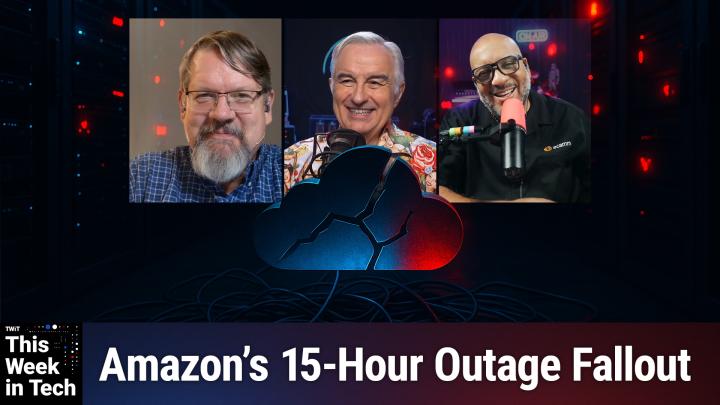
All TWiT.tv Shows (Audio)
This Week in Tech 1055: The Garden of Thorns
02:59:42
AWS Outage Exposes Our Cloud Dependency
Loading summary
Transcript957 lines
- [00:00]
Leo Laporte
It's time for TWiT this Week in Tech. Doc Rock is here. Richard Campbell from Windows Weekly and Net Rocks. We're going to talk about the Amazon outage. Wow, what a mess that turned out to be. We'll also talk about the TikTok deal. It's apparently going to happen on Thursday. And foreign hackers breached the US Nuclear weapons plant. That and a whole lot more coming up next on Twitter. Podcasts you love from people you trust. This is. This is TWiT. This is TWiT this Week at Tech. Episode 1055, recorded Sunday, October 26th, 2025. The Garden of Thorns. It's time for TWiT this Week in Tech Show. We cover the week's tech news. We were going to have Stacy on the show today, Stacy Higginbotham. But she's on an island in the middle of the Pacific Northwest and there is no power. And so she couldn't join us. But that's okay because we have two other people who could be on an island. There's Doc Rock, I believe you're on an island.
- [01:12]
Doc Rock
I'm absolutely on an island somewhere in.
- [01:15]
Leo Laporte
The middle of the Pacific. Doc, it's great to see you.
- [01:17]
Doc Rock
We used to say that in the radio station. We used to say somewhere in the middle of Pacific Ocean in a little grass shack that wasn't.
- [01:22]
Leo Laporte
Do you ever get island fever? Do you ever freak out that you're in the middle of the Pacific Ocean, thousands of miles away from civilization?
- [01:29]
Doc Rock
No, because I'm a. I'm a very weird. I'm gonna say something that nobody believes. And it took me a long time to convince my family, but I am broken. I am 100 fearless. The only thing I'm afraid is rats, because I grew up in the east coast. And themselves, it's sensible.
- [01:46]
Leo Laporte
Sensible because they have no fur on their tails. That's. That's creepy.
- [01:49]
Doc Rock
So growing up in a house with a bunch of scared people, like, I just went out of my way not to even think about things like that. So I'll probably be the idiot that dies first when the zombies come because I don't have a scare muscle.
- [02:00]
Leo Laporte
Nothing scares him. With us, also from Utrecht in Holland. Am I saying that right, Richard Campbell?
- [02:06]
Richard Campbell
Well, this is not the state of Holland, but it is the Netherlands.
- [02:09]
Leo Laporte
So wait a minute. Now I'm really confused. Oh, yeah. In my youth, we called it Holland, but it really is the Netherlands.
- [02:16]
Richard Campbell
Yeah, there are multiple provinces of the Netherlands, one of which is Holland.
- [02:21]
Leo Laporte
Why do we call it Holland?
- [02:23]
Richard Campbell
Well, because, you know, that's where I am from.
- [02:25]
Leo Laporte
Americans. Because we're Americans. You're in the Netherlands, the Low Country. It's great to have you, Richard. Normally, of course, it'd be up in Madeira Park, British Columbia, but is on the road lectures, which people often mistake.
- [02:39]
Richard Campbell
For an island, but is not. It's a bit of a.
- [02:41]
Leo Laporte
You are not. You're on the water. You're on the wadah, though. But you are part of the land mass. So how many, show of hands. How many of you, for instance, had an eight sleep bed that wouldn't recline because of the Amazon power outage? We learned a lesson, didn't we, this week, about how much we are reliant on AWS.
- [03:06]
Richard Campbell
Well, most especially East 1, because it's the original.
- [03:11]
Leo Laporte
Yeah. So I didn't notice it that much. When was the outage? It was 15 hours. It was a long outage, according to ours. Do we know when it was? It was. Ookla said the Down Detector service received more than 17 million reports of disrupted services offered by 3,500 organizations. The three biggest countries where reports were originated were the US, the UK and Germany. Snapchat was down, Roblox was down and AWS was down, of course, because that was an AWS outage. Amazon now says the root cause. It's always DNS, isn't it? If it's not bgp.
- [03:56]
Richard Campbell
This was a weird database, right?
- [03:58]
Doc Rock
I thought it was Bravo Database or something like that.
- [04:01]
Leo Laporte
It was Dynamodb.
- [04:03]
Doc Rock
Dynamodb.
- [04:04]
Richard Campbell
Dynamodb, yeah. But it was get two different instances of the DNS writer running at once because the first one ran too slowly, so it kicked off another one and then that one overwrote. Then the old one overwrote the stuff from the new one.
- [04:17]
Leo Laporte
They had what is famously known in computer science as a race condition, which is one of my favorite errors, first of all, because you can't predict it. It's kind of chaotic. It's when two threads, two processes race each other and it's unpredictable who's going to win the race. So the settings are conflicting and a race condition is a notoriously difficult thing to discover because unless you're really careful about locking each of the threads, it can Happen. So the DynamoDBS DNS management system, which is used for the load balancing, periodically creates, it's an automated system, new DNS configurations. This is from Ars Technica, based on reporting from aws, creates new DNS configurations for endpoints within AWS, like AWS east, because two of them tried to do the same thing. The race condition resided in The DNS enactor. It went cuckoo is the technical term.
- [05:30]
Richard Campbell
The old instance erased the new entries and the new instance erased the older entries and. No, there's no entries.
- [05:35]
Leo Laporte
They fought. It's after you, Alphonse. No, after you, Alphonse. No, after you, Alphonse. And nothing ever worked. So that.
- [05:42]
Richard Campbell
Yeah, it was DNS, but only because there was no DNS.
- [05:46]
Leo Laporte
Right. So then that. According again, this is a great story at Ars Technica. The damage resulting from the failure then put a strain on EC2, which was located in US East 1, even after DynamoDB was restored. This is the problem with these. They're all reliant upon each other. There was a cascading failure. EC2 worked through, quote, a significant backlog of network state propagations which needed to be processed. Amazon's engineers went on to say, while new EC2 instances could be launched successfully, they would not have the necessary network connectivity due to delays in the network state propagation. In other words, no DNS, no connectivity. Yeah.
- [06:27]
Richard Campbell
So I launched it. You just can't talk to it.
- [06:30]
Leo Laporte
Just sit there. Ah, man, I've never been in a network operations center during a crisis like this, but I bet you have. Or you.
- [06:39]
Richard Campbell
Oh, yeah, we call it, you know. Well, you have this situation where you bring your service up, but there's so much backlog of traffic that it immediately knocks the service back down again.
- [06:48]
Leo Laporte
Yeah.
- [06:49]
Richard Campbell
So you're kind of like, what do we do? Like, I. I know we need to turn it on, but every turn it on, it kills it. So you've got to kind of throttle traffic, get it fully started. You know, wait a minute to let it warmed up enough that it can take more traffic on, like. And meantime, the backlog just keeps getting bigger.
- [07:05]
Leo Laporte
Yeah. And the engineers are sitting there. Reminds me of something like CHERNobyl and the HPO kind of fictionalized story of Chernobyl where you watching the. The nuclear reactor. Engineers look at it and they just. There's. It's like it's a cascading series of failures.
- [07:25]
Doc Rock
It's that look of. Yeah, the. Oh, right. And what's crazy is.
- [07:33]
Leo Laporte
So.
- [07:33]
Doc Rock
I mean, it's probably Manassas or one of the other places a little bit up there in Virginia. My sister doesn't live too far from an Amazon data center. And it's. They, They've been building these for a long time, but now there's so many. And if you look into like Richmond and Norfolk has a big one, of course, because of the naval base and things like that. It's weird that it started in just such a small little place that otherwise is very mundane. Like Manassas is a very chill part of Virginia. A lot of not. Not a. Not a. Not a lot going on. But behind the trees, everything you do, everything you care about, your mattress is controlled by behind these trees. So it's uncanny in so many ways. But then it also goes to show you how tied in we are. Well, and we're already having a problem with data centers affecting residential neighborhoods. But like, yo, we kind of need the data center. So, like, what are we going?
- [08:32]
Leo Laporte
Well, and also, maybe we should be more resilient. Like, why is a mattress calling out to Amazon Web Services before it can recline?
- [08:39]
Richard Campbell
Even if it is, why isn't it got a backup one. Right. I think a lot of cases here, what you're seeing is people just found out their stuff was misconfigured because it should have failed to another section or to a different region, including a bunch of Amazon's own services. But that's pretty typical with these sort of originals, is that you still have some old stuff there you haven't quite balanced out across the new networks yet. And you find it out the hard way.
- [09:03]
Doc Rock
This is what you realize that when the thing went out, you couldn't put your back up. That was the problem. The mattress was stuck too late.
- [09:09]
Richard Campbell
Yeah.
- [09:11]
Leo Laporte
My. I have to say my Matt, my Helix sponsor, but I'll say it anyway. My Helix mattress has a little. It's funny, when I set it up, it has a recliner. It has a little adapter for a 9 volt battery so that if the power goes out, you can still recline it. Which I thought, that's a thoughtful little thing. I didn't connect the battery, but I know that that's there. And I guess I could run downstairs, get a 9 volt battery for stuck.
- [09:36]
Doc Rock
My thing has some kind of LG Bluetooth in it. I don't use it. I just use the controller, the little remote that comes with it. But my phone, if I go to Bluetooth to add something new, I always see these two LG because I have a split king.
- [09:49]
Leo Laporte
Yeah.
- [09:49]
Doc Rock
And I see these two LG Bluetooth devices that want to talk to my phone. And I was like, why do I want to Bluetooth connect my mattress? There's no speaker, but I guess it was so that there's an app that you can use that speaker.
- [10:00]
Leo Laporte
And that's part of the problem. Everybody wants an app.
- [10:04]
Richard Campbell
Yeah.
- [10:04]
Leo Laporte
Not because it's better for the end user, but because that's Better for them because they can. They get information from your telemetry, but from.
- [10:13]
Richard Campbell
You know, as an, as a home assistant aficionado, one of my basic tests is unplug the Internet.
- [10:19]
Leo Laporte
How does your house see what happens? What a great idea. Everybody, right now, go unplug your Internet. No, wait a minute. Don't. No, no.
- [10:27]
Doc Rock
I need to do. This week. I'm trying to set up home assistant and of course I have a bunch of Macs. So I'm like, I'm not going to do it on the Mini because I heard so many weird things about doing on the Mac. So I have an old Lenovo notebook and I pulled it out and I tried to get it on with Ubuntu and it just will not behave like it is acting. So I'm thinking, should I buy a yellow or green or whatever the heck that thing Leo has in his hand now?
- [10:50]
Leo Laporte
This is it. You know why I have this? Because Richard Campbell, a guy named Richard Campbell told me, get the H8 green guest.
- [10:58]
Richard Campbell
Get it green.
- [10:58]
Leo Laporte
And then I also got the little dongle.
- [11:00]
Doc Rock
I don't know if I go to.
- [11:01]
Leo Laporte
Amazon, the ZBT one. This is for Thread.
- [11:04]
Richard Campbell
Yeah. The sky. The sky connected. It needs to be on that cable. So it's away from the USB controller.
- [11:09]
Leo Laporte
Yeah. Because it'll interfere.
- [11:10]
Richard Campbell
That's not optional. You'll look at it go, that's stupid. Plug this guy connected in there and then wonder why nothing works. Yeah, no, you need that.
- [11:17]
Leo Laporte
But then I just disconnected it. So nobody.
- [11:19]
Doc Rock
That's better than buying a nook.
- [11:22]
Richard Campbell
I mean you can.
- [11:23]
Leo Laporte
It is all bad nook.
- [11:24]
Richard Campbell
Yeah, but cheaper. What's nice about those little odroids is no spinning fans.
- [11:29]
Leo Laporte
Right.
- [11:30]
Richard Campbell
Made for the purpose like pre configured. When you're not happy with it, unplug it and plug it back in again like there's nothing to do.
- [11:36]
Leo Laporte
Did.
- [11:36]
Richard Campbell
By the way. I got enough stuff to take care of. I just want to work on things that, that I can be away for a week and they don't break. And that's what that thing does.
- [11:45]
Doc Rock
Oh, that's brilliant. I. I did the crazy thing. I went to Home Depot. They had a sale. I should have known better. I was in a rush, about to leave on a trip to come to Boston and I bought 40 whiz bulbs because my other ones were slowly starting to die. And Apple Home and Wiz are not friends.
- [12:01]
Richard Campbell
They're not friends each other. They're like, HA is your bridge for all of that. Right?
- [12:06]
Leo Laporte
And then you have an HA app on the phone. Right. And that's what your master controller. Now, it's not a prettiest app I've ever seen.
- [12:12]
Richard Campbell
Well, you can make it prettier if you care.
- [12:14]
Leo Laporte
I've seen people do, you know, kind of dashboards on tablets and stuff, they hang on the wall. There's things to do. So you nailed it, which is that US East 1 is the oldest AWS.
- [12:26]
Richard Campbell
That's it.
- [12:27]
Leo Laporte
Endpoint. And so there's. This is what Ookla said. The affected US East 1 is AWS's oldest and most heavily used hub. Regional concentration means even global apps often anchor identity, state or metadata flows there. And when a regional dependency fails, as was the case in this event, that impacts worldwide, because many global stacks go through Virginia at some point, just as you said, Doc, behind those trees, the whole world, even Germany, is being controlled.
- [13:02]
Doc Rock
Because you can hear that sucker and you can feel it. It's not that you can hear it. The hearing part, it depends on how old you. But you can feel it like your bones vibrate.
- [13:11]
Richard Campbell
Yeah.
- [13:11]
Doc Rock
Because of all of the air fans that are going at one time.
- [13:15]
Richard Campbell
A lot of the subsea cables across the Atlantic land at Reston, Virginia. So that is where the Internet comes from Europe into the US So that's why data centers get positioned there, because you're close to the backbone that stretches across the ocean.
- [13:30]
Leo Laporte
So good on Dan Gooden, I'll give him credit. Very good piece in Ars Technica explaining the whole thing and the dependence we all have on. On aws. And I guess we learned a lesson. All this happens from time to time. In fact, inevitably I'll hear from the people say, see, this is why the cloud is a bad idea. I don't think that the cloud is a bad idea.
- [13:51]
Richard Campbell
Now this is misconfiguration on the customer's part. You need to be able to not have US east in your life. You need to have any given center not be in your life and you still function or you're not credible. Like that's what the job is, is to, you know, you're building resiliency and resiliency means I don't care what centers down. We still work and degrade gracefully. Right. They, at the minimum, those beds response to I can't connect is to go flat.
- [14:16]
Leo Laporte
Yeah, right.
- [14:17]
Richard Campbell
That's not a big piece of software.
- [14:19]
Doc Rock
Correct.
- [14:19]
Leo Laporte
Right. Degrade gracefully. That's. That's kind of my hope in my later years.
- [14:26]
Richard Campbell
We're all trying, Leo. We're all trying. There's some services are going offline, but at least they're degrading gracefully.
- [14:32]
Doc Rock
Well, I want to clear something up in my head for nobody else else. Just in case anybody else missed it. When you say customer, you mean end user or customer as in Helix Matrix company.
- [14:42]
Richard Campbell
Yeah, I mean really, Helix should be, you know, if it wasn't Helix, by.
- [14:45]
Leo Laporte
The way, it was Casper. Or not Casper. Eight Sleep. Eight Sleep.
- [14:48]
Doc Rock
That gives you a trouble with another picking an app.
- [14:52]
Richard Campbell
But if I'm the eight sleep IT guy, part of my job is to.
- [14:55]
Leo Laporte
Now you have a lesson.
- [14:56]
Richard Campbell
Something offline.
- [14:57]
Leo Laporte
Yeah.
- [14:58]
Richard Campbell
So my, you know, as the old IT guy who's been through this a few times, when I look at what's going on in here, it's like this is a configuration failure. Right. I don't even know what's gone wrong with Amazon. But for my responsibility to my company, I should not be subjected to that. I should be able. My configuration should tolerate it.
- [15:16]
Leo Laporte
We are an interesting situation. We actually, I think we talked about this. Maybe it was on Mac Break Weekly or Windows Weekly. Richard, of course, a regular on Windows Weekly with Paul Thurat. But single point of failure is kind of what's going on right now with the eu, with the Quartz, with Epic, with Google, with Apple. The single, the choke point is the App Store. And we've set it up now that these most important computing devices in our lives, which is our smartphones, whether it's Apple or Android, essentially, are controlled entirely by an App Store, which is controlled by a single entity, which means that entity is vulnerable whether it's to the US Government or to the eu. Cory Doctorow has a good piece on this. The Mad King's digital kill switch, he called it in his pluralistic blog. Corey's really a master of the language. But what he's talking about is this is a kill switch, in effect for any government that can go to Apple. It's certainly a kill switch for Apple. Google, historically, Android has had kind of a backdoor because they've allowed you to sideload.
- [16:27]
Doc Rock
So.
- [16:28]
Leo Laporte
But Google in the last month has started to change that by requiring that even third party apps, the developers have to be notarized by Google, have to be approved by Google. So even F Droid and these other third party app stores will ultimately be routed through, in effect, Google. And Google has a kill switch now on everybody on every app running on Android, just as Apple does. And while I trust Apple and Google, well, I sort of do. I mean this comes up and Corey's reminding us about Apple and Google both pulling down ice apps like Ice Block. Apple also removed an app that didn't tell people where ice was, but merely recorded or stored videos of ice in action. Google and Apple both said that ice was a protected class, which I don't think is really what the point of protected classes are. And so we're going to pull all of those apps, not just the apps that say, here's where ice is right now, but the apps that have recordings of ice Action. We're going to pull those all off the app store. And he says that's the problem. Now is again, and I'll say Cory is outspoken. He says, of course iPhones can technically run apps that Apple doesn't want you to run. All you have to do is jailbreak your phone and install an independent app store. Just one problem. The US Trade rep bullied every country in the world into banning jailbreaking, meaning that if Trump, a man who never met a grievance that was too petty to pursue orders. Tim Cook, a man who never found a boot he wouldn't lick. Okay, this is a little over the top. To remove apps from your country's app store, you won't be able to get those apps from anyone else. That is a single point of failure. And I think it has the same kind of fundamental flaw that we saw here with aws. When you have a single point of failure, you're vulnerable.
- [18:35]
Richard Campbell
I gotta tell you, this is my month in Europe traveling. I've been in Lisbon and Oslo and Stavanger and Trondheim and now in the Netherlands. I've never seen so many people talking about how do I be independent of American cloud products.
- [18:50]
Leo Laporte
Big tech, yes. Not just cloud.
- [18:52]
Richard Campbell
They're very much big tech. They're very concerned about US Companies because they're watching u. S company behavior right now and saying, my employer doesn't want me to be subject to this.
- [19:02]
Leo Laporte
Yeah, that's.
- [19:03]
Doc Rock
That's a weird thought when you think about it. And it's weird because, like, we complain every day in the office. Don't tell Ken and Glenn. But they were like, we're not going to do any, like, ecamm email on Google products. So we have to. We use like a rack space thing, which that drives me crazy because it's missing all the cool stuff that, you know, Gmail has. And of course, like, now I use notion mail. It's a killer client. I can't use it with my ecamm mail account. So I still have to depend on Apple mail, which just irritates me. Funny from the Apple guy. And now when you see stuff like what's Going on right now. You kind of get it. Like there, there, what was paranoia to me 5 years ago kind of makes sense. You know, you just, it just seems like you see this coming from a whole bunch of places. And I'm hearing more and more people say that, like, how do we, how do we get to this particular point? Even to the point where Jack from Patreon is like telling people, put your phone down. I'm like, wait, Jack, you make all your money from people being on their phone. But he's like, yeah, some of y' all need to chill out.
- [20:04]
Leo Laporte
Corey talks about, I remember when Russians stole Ukrainian tractors, tractors and drove them to Chechnya, but they were all John Deere tractors and so Deere remotely bricked them, which he says, a lot of us cheered that high tech comeuppance. But when you consider that Donald Trump or another government could, well, I guess not another, the US government could order Deere to do this to all the tractors, this gets a lot more sinister.
- [20:32]
Doc Rock
We talked about this during csam. It was a very similar kind of, you know, process. Like, you know, any one company can just, you know, especially when you consider the current administration and you consider what they were trying to do with CSAM and they could be like, look, well, we're going to stop your, you know, such and such merger if you don't just like completely blend the yellow and black sites from all devices that you made.
- [20:55]
Leo Laporte
So what do we, what I mean, did we take a wrong turn in technology by allowing this or. It's not too late, isn't it? I mean, I can use, I guess I could use open source software, I could use Linux. There aren't any really good open source phones people have been trying. The fairphone is close, but it's.
- [21:14]
Richard Campbell
We've had periods where we've had more open source options and so forth. Of course there's ways. There's no reason we couldn't start jailbreaking again. It's just most people don't want to work that hard. The App Store is awfully convenient.
- [21:24]
Leo Laporte
Right.
- [21:24]
Richard Campbell
And the resistance to jailbreaking has got more to do with enforcement than it has to do with technical problems.
- [21:31]
Leo Laporte
Right.
- [21:31]
Richard Campbell
So it all depends on where we get to on this. But it has people double, you know, thinking twice about an awful lot of their dependencies and just saying like, what are we prepared to accept?
- [21:43]
Leo Laporte
Yeah, just as this AWS outage probably did the same thing for a lot of companies. Yeah, can it.
- [21:51]
Richard Campbell
But the reality here is multiple cloud would have helped, but it wasn't actually the problem. Multiple region is all you actually needed. And I just wonder how many of those IT folks thought they were multi region and only found out when the most important region went down. Oh, there's one service only in US east, and then nothing works.
- [22:12]
Leo Laporte
Wow.
- [22:14]
Richard Campbell
Typically an authentication, any of those things? Oh, yeah, no, this. Like I said, there's a big configuration wave coming here because you just found out what sole dependency you had on US east, including a bunch, I think, of Amazon services themselves. Like, it wasn't just the products.
- [22:31]
Leo Laporte
I mean, okay, so there, there's a way out. We're not stuck in this.
- [22:40]
Richard Campbell
No, I mean, it is a reminder you haven't tested efficiently.
- [22:45]
Leo Laporte
The problem is often the convenience overrides.
- [22:49]
Doc Rock
I see what you did there.
- [22:50]
Leo Laporte
I know.
- [22:52]
Doc Rock
I do it all the time. I catch myself.
- [22:53]
Leo Laporte
I don't do that anymore. Convenience overrides. Convenience overrides prudence. It's. It's just more convenient, it's easier, it's simpler. And so people often kind of by default choose convenience. It's. It's in a way, another way of talking about the tyranny of the default.
- [23:11]
Doc Rock
It's just 100%. Here's the exact way it is. Example. Here's the exact example. So I'm sitting here Sunday night and I'm ready to publish YouTube video. And yeah, it's kind of late because we have family stuff. It was about 10 o' clock and I'm. I've been on Photoshop since version one, like before it was an Adobe product even. And I make my th thumbnails for YouTube in Adobe Express because it's just easier, right? Like, I could absolutely do it in Photoshop. And I was trying to do some edits and like the page started tripping and I was like, what the heck is going on? So it got to the point where I actually went on to Threads and X and I said, hey, Adobe, like, what's cracking with Express? Like, it's absolutely not working. And they were like, oh, can you check these endpoints for us? And so that was the beginning of the spiral. And then as I, you know, been on the net longer, my YouTube video didn't upload, which never happens. Like, it always uploads and it's done. And I was like, this is really strange. But then I found out, you know, when I woke up the next day, that, yeah, basically the east coast was like, we're not sending any data this way. But it's funny because all I had to do was just close Express and go to Photoshop and finish my dang thumbnail. It would have taken me 10 seconds, but I got stuck as a computer person trying to solve the problem instead of going to my fail safe, which in a way it goes to what Richard said about a configuration problem. Even in our heads, something as simple as this is not working. Let me stop, let me go grab the 316 because it works just as good as a 13 millimeter if you jiggle it right. You sit there, you try so hard to make that 13 millimeter work and it's like, Bro, grab the 3 16.
- [24:48]
Leo Laporte
You're not jiggling it right.
- [24:52]
Richard Campbell
I'd rather go to the store and buy another bit. Right? Like, yeah, yeah.
- [24:58]
Leo Laporte
I never tried that. I'll have to try that. All right, well, let's take a little break. Oh, one more kind of footnote to that Thursday. This morning on CBS's Face the Nation, Treasury Secretary Scott Besant said Thursday that Trump and Xi will consummate the TikTok deal. I hope they don't do that in public.
- [25:20]
Richard Campbell
Who gets Prima Nocturne in this?
- [25:23]
Leo Laporte
That's a good question. Who's the virgin? Is the question.
- [25:28]
Richard Campbell
I'm even sad I brought it up. I apologize.
- [25:32]
Leo Laporte
Sorry. Most people don't speak Latin, so you're safe. So I guess we'll find out Thursday exactly what the deal is. I know what the US has said the deal is but China's never said that's the way it is. So we'll find out. The outlines of the deal are that TikTok will be in the United States, 80% owned by non Chinese but not all American investors. That the data will be stored in the US on Oracle servers. This is Project Texas. That's been going on for some time and that TikTok will now move to a new app in the U.S. the U.S. version of TikTok. I don't know what it'll be called. There's some question in my mind about whether TikTokers will care enough to move or. And I'm sure that really going to.
- [26:22]
Richard Campbell
Convince 100 million kids to change a class. Yeah, I think that's interesting.
- [26:25]
Leo Laporte
I mean, you know my son who started, you know, TikTok really made his career started on tick tock but was wise enough to also have a presence on Instagram. It's not as big and on YouTube it's not as big. So he's on all, you know, as. As one should be as we are. You should be on as many platforms as you're as possible. Right. Be everywhere your your viewers Are right. You would agree with that document. I know you're a YouTuber. Yeah.
- [26:48]
Doc Rock
And I agree that he put some kind of crack in them. Pickles.
- [26:53]
Leo Laporte
Buy more pickles. I am an investor in the pickle business.
- [26:57]
Doc Rock
Way too many.
- [26:58]
Leo Laporte
I talked to Saul Hank, the other day. He said, yeah, I don't think the pickle business is going anywhere. I said, son, that's my. That's my investment. That's my investment. Can you transfer it over to the. To the sandwich shop? Because that's going great. No, no, dad, you invested in the pickles anyway.
- [27:18]
Richard Campbell
I don't.
- [27:18]
Leo Laporte
I'm happy to help Henry out. Not that he needs. I need his help more than he needs mine at this point, but it's smart. But my point is. Yeah, exactly. My point is. I. You know, I don't. I think he'll keep doing TikTok. Why would he stop? He's already on it.
- [27:35]
Richard Campbell
And if there's two tick lock clients. So you post on both.
- [27:38]
Leo Laporte
Can you. Will you be able in the United States to post on the Chinese or Chinese, the global TikTok? Yeah. What will happen? Well, that.
- [27:46]
Doc Rock
There is nothing, you know, they haven't been able to do with a little.
- [27:51]
Richard Campbell
A little bit of VPN action. You're good.
- [27:54]
Leo Laporte
Interesting.
- [27:55]
Richard Campbell
Look, I'm from Switzerland. Let me post.
- [27:57]
Doc Rock
Yeah, there'll be some Raspberry PI. That's like splitting your apps based on blockage. You know, every.
- [28:04]
Richard Campbell
Just ask every teenager in Australia. Every kid in the UK.
- [28:08]
Leo Laporte
Oh, not in Australia. December 10th. They're not allowed to use social media if you're under 16.
- [28:15]
Richard Campbell
My goodness.
- [28:17]
Leo Laporte
How's that gonna go? How is that gonna go? Can you imagine taking a 15 year old who has a very elaborate social life, curated on Instagram and Meta and Snapchat and being told by the federal government. The government in Australia. No, you've gotta abandon those accounts. Their suggestion. By the way, they have a whole page of ways to wean your teenager off of social media. Their suggestion is have them schedule regular phone calls with their friends.
- [28:48]
Richard Campbell
There you go. Like it's 1973.
- [28:51]
Leo Laporte
What the hell? What?
- [28:56]
Richard Campbell
The checklist is very short. Select a VPN provider, configure account for another country.
- [29:01]
Doc Rock
We received a question. Which VPNs are publicly traded? So we can make a little loot.
- [29:07]
Leo Laporte
This might be the time. December 10th is the cutoff couple.
- [29:09]
Richard Campbell
Well, put a couple of dollars into each room because they're all going to do well.
- [29:12]
Leo Laporte
Last week, Harper Reed, who was on the show and is a hacker, he said that's how Hackers are born.
- [29:17]
Richard Campbell
You know, they just told us to hack.
- [29:19]
Leo Laporte
You're going to have a. Actually, it's probably good for Australia. You're going to have a whole generation that is mastering technology because they want to use Instagram or Snapchat or TikTok or.
- [29:30]
Doc Rock
And the bigger thing that these guys never think of, and this is being a problem right now, remember, the malware is cutting through YouTube videos and they're putting it in because they're like, oh, here's how you cheat at Roblox. And if you go to this app and download this, you can get like unlimited money.
- [29:45]
Richard Campbell
Hold that thought.
- [29:46]
Leo Laporte
We're gonna talk about that. That the. Yeah, there's a. Yeah, there's a whole section of YouTube stuff coming up. We got a YouTuber in the house, man. Doc Rock at Doc rock on the YouTube. He also is a director of strategic partnerships at Ecamm, and we are thrilled to have him. We use Ecamm, as you know, Doc. We're using it right now and love it and love it. And Richard Campbell's also here, host of windows weekly.net rocks and runners radio. He has three podcasts, ladies and gentlemen, and he still finds time to travel the world. What are you talking about? In Utrecht, I've got.
- [30:26]
Richard Campbell
The Undersea infrastructure talk, the new one. Oh, very cool. Which we're doing data as well as electrical and polar petroleum oil, lubric products. Of course, we have to talk a little about the Baltic Sea incidents in that, but really getting. Reminding people that, you know, I think Starlink's very cool. It also moves about 1% of Internet traffic. 98 of it moves under the sea. Wow.
- [30:49]
Leo Laporte
By the way, I do have Starlink as my redundancy, my backup for my landline, cable Internet, so that if. If the Comcast goes out, I've got Starlink they just arrested in Myanmar one of these. God, I don't know what you call them, these prison camps that they use for people to do pig butchering. They get overseas workers to come and take their passports and force them to send out these phony text messages. And they just arrested. I don't know why. Because Myanmar has basically been looking the other way. The. The government there is not exactly. I don't know how you put it, Friends of the west, but they just shut this down. And there was a picture. Let me see if I can find it. Of the Myanmar police standing over dozens of starlink. All right.
- [31:56]
Richard Campbell
I mean, Myanmar is run by a military junta, you know, a group of generals who rule under martial law.
- [32:03]
Leo Laporte
Yeah, this might be related, the fact that SpaceX is pulling the plug on those Starlink satellites. So maybe they were no longer functioning. So the ruling hunter said, all right, we're going to pretend to shut these guys down.
- [32:18]
Richard Campbell
There you go.
- [32:19]
Leo Laporte
Since we can't use, they can't use them anymore, you will see. I got a pig butchering text message this morning from somebody saying, hey, I missed our golf date. Can we make another one? I don't play golf.
- [32:33]
Doc Rock
Oh my gosh. I get some of the most hilarious ones. They're so funny.
- [32:38]
Leo Laporte
I was really tempted to say something like, oh, I'm at the club right now. I can't. I want to imply that I'm really wealthy and I'm stupid and maybe they would like, continue because the whole point of these, right, is that eventually they say, hey, I got a great crypto deal. Maybe you'd want to get in on it, you know, so they can get some money out of you.
- [32:59]
Doc Rock
When I got one of those and I was being a dumb and I was playing along with him in this email and then I was like, yo, don't worry, I got as much money as you want. Like, just let me know, like, what do you mean, you guys, what do you do? I was like, oh, yeah, I'm the Nigerian prince from all of those emails.
- [33:13]
Leo Laporte
Did he hang up?
- [33:14]
Doc Rock
100%.
- [33:17]
Leo Laporte
I don't, I don't play with these guys because I know that many of them are, are really slave labor, you know, that they're kind of trapped there and forced to do this.
- [33:24]
Doc Rock
So there's a great guy on YouTube that you can see when he calls them. And he, you know, some of them, he therapies and don't get him in trouble, but he tells him to get out of there because he's going to send the authorities. And some of them that are just weird, like, he just gets them, he calls them by their first name and he's like, oh, I can see you in the camera. You're sitting right next to like Richard and Leo and dod.
- [33:42]
Richard Campbell
Oh boy.
- [33:43]
Doc Rock
And then they start trying to, to, you know, unplug everything. It's really funny.
- [33:48]
Leo Laporte
All right, let's, let's take a little break and we will come back, we'll Talk about the 3,000 YouTube videos that are malware traps. Holy cow. Holy cow. Just a bit. You're watching this week in tech. We're glad you're here today. Our show today brought to you by Deal new sponsor. Want to welcome them to the network. If you've ever wanted to hire an engineer overseas. You know, get really excited here. This guy's really good, really talented. And then realizing that hiring an overseas worker is harder than getting your VPN to connect in your hotel wi fi, then you need to know about Deal. I mean there is, there is a lot to do. There's entities set up, there's local payroll laws, compliance loops. It's a total nightmare unless you use Deal Deal fixes it. One global AI powered platform that lets you hire onboard and pay anyone anywhere, fast and compliantly. No third party vendors, no duct taped integrations, no jiggling the 13 millimeter bit trying to make it fit of 15. Just one clean system for HR, IT and payroll that scales with your team. Sign up new hires in minutes, ship their devices, grant system access and run payroll in 100 plus countries. Think of it as DevOps for people operations, global infrastructure that just works. The CEO of Air Wall X said it best. He said quote deal lets us hire and support top talent anywhere without slowing down. See why over 35,000 companies trust deal. VisiT-E-E-L.com twit that deal.com twitter-el.com twit welcome deal to the this week in Tech and we thank you for your support. So doc, tell us this story. 3,000 YouTube videos. How can a YouTube video be malware?
- [35:46]
Doc Rock
Because what they're doing. Okay, so the video basically says, okay, like say you're playing, you know, we farm or whatever and you want to get free farm berries. If you go to the link in the bottom, you can download this app, the hack, right? And it's a Dropbox link or already, you know, insanity. But when you tell kids that their worth is based on how well they can play some particular game, Call of Duty, Roblox, I forget the other one just went out of my head for a second that my nephew plays with Minecraft. Minecraft. There we go.
- [36:19]
Leo Laporte
How could you forget Minecraft?
- [36:21]
Doc Rock
No idea, bro.
- [36:22]
Leo Laporte
I am almost 60.
- [36:24]
Doc Rock
That's how the. But you tell these kids that their worth is based on how well they play these sort of games or whatever, right? And at some point in time they're like, okay, I need a leg up. And that's how way back, you know, when we first had the app store, you were having parents with 1200 bills of buying smurfberries from some, you know, weird app. And this is terrible because people don't know this stuff. And you know, they didn't grow up like us, where we were tech savvy enough to know you don't get, get. You know when someone says, hey, you can get the whole Star wars movie if you click this. We knew better. Like, that wasn't the move. You went to, you know, Limewire or some touring site, but you didn't go to these other sites that promise to hook you up type thing. And unfortunately, as smart as they are.
- [37:09]
Leo Laporte
And These are probably 8 year olds, they're 10 year olds, they're kids. They're really little kids. And that's so the. It's been code named the YouTube Ghost Network by Checkpoint. Google has removed a majority of these videos. But, you know, it's like whack a mole. You remove them, but a thousand more appear immediately. They've been doing this for years, since 2021. According to this story from the Hacker News, it uses hacked accounts. So it's taking legit accounts that have some, probably have some reputation and replacing the content with malicious videos. What looks like a helpful tutorial, according to Checkpoint, can actually be a polished cyber trap. All right, well, teach your kids, I guess. I don't know what, how, what do you do?
- [37:59]
Richard Campbell
I mean, yeah, I'm kind of surprised. Their tools can't do things like it walks you through how to disable Defender, so it won't actually block it. There's some pretty clear cues. It says, if this saw. If this video is telling you to do this, this, this is not a good video.
- [38:14]
Doc Rock
The problem is it's not just the kids don't understand this kind of stuff. So many of the parents don't understand this kind of stuff. Because we all know when we were coming up and we were the nerds and you would try to help your friends and tell them these are the things that you need to know, they would always say, like, yeah, I don't want to know that kind of stuff. I just want to turn it on. And I just want to use Excel and I want to do my files. I want to cut it off. And I'm like, no, it's not like that. It's like saying, I want to drive a car and not know how to change a tire. But then they.
- [38:38]
Leo Laporte
Would it help if the kids weren't using. Would it help if the kids didn't use Windows or if they were using a Chromebook or an iPad or something that these Steelers don't work on?
- [38:47]
Doc Rock
The graphics cards don't work well enough on those sort of machines. I mean, okay, let's put it this way. You and I both know the best gaming machine in the world would probably be a mag. But because it's a little safer. But.
- [39:00]
Leo Laporte
Right.
- [39:00]
Doc Rock
They don't. We don't even have the graphics capabilities for the way the games are written. Right. We are perfectly fine and final cut and after effects and you know, folding.
- [39:09]
Leo Laporte
Most of the time. The reason these things work is because it's not on the kids computer. It's on dad's computer or mom's computer. Because these are info stealers. They're crypto stealers. The kid doesn't have anything worth stealing, but usually the parent whose computer they're using does.
- [39:25]
Doc Rock
And if you, if you have your house network set up in a way where you haven't set up a VLAN for your kids.
- [39:31]
Leo Laporte
Yes.
- [39:31]
Doc Rock
If it gets on the segment, the kid, it just went out.
- [39:34]
Leo Laporte
Yeah.
- [39:35]
Doc Rock
So like, yo, my niece is on her own little VLAN ain't got nothing to do with the rest of us. Like, I can see stuff and I can control it. But she's in the VLAN and she's smart. But even her, she recently had a friend send her a message in the text saying that they, they lost her phone. This is their new phone. Keep this number. And oh, I'm trying to send you this thing on ig, but it won't let me tag you. What's the password to your IG account? And she did it. She called me like two seconds later. She knew I just did something dumb.
- [40:04]
Leo Laporte
Oh, and.
- [40:05]
Doc Rock
And so she lost her whole IG account and had to start all over. And this is at 15 with the nerd uncle who taught her all of this stuff. And she still got caught up in the emotion of helping out a friend who obviously the person who was, you know, setting them up knew their whole little team, like who's doing what? That the friends are having problems with their, their parents or whatever because they're, you know, let's say Alphabet and you know, parents didn't like that.
- [40:32]
Leo Laporte
Right.
- [40:33]
Doc Rock
You know, and, and yeah, so they played them, played them 100. And I'm like. And so thinking about what Richard said for these kids playing the game, imagine these guys are getting smart enough, especially on Tick Tock where a lot of it can just be in a chat in the Tick Tock, right. You put in some, you know, cosplay girl that has way too impressive body parts for the age group. But the boys that are watching it are 13 and they see the QR code that comes up and says if you do this, you can get better on Fortnite. They're just going to screenshot it, go there, download that thing to their phone and then connect it to the house WI fi and then now they got everything like this is legit, what they can do.
- [41:14]
Leo Laporte
Wow. I remember periodically going into the kids computers and wiping them and getting rid of all the malware. And then, you know, I mean this is. Anybody who's known as somebody who's computer literate is going to get called by friends, neighbors, and you're going to go over there and you're going to find a machine that is just a mess. Just a mess every time.
- [41:37]
Richard Campbell
Right.
- [41:38]
Doc Rock
All we have was dad's hitting magazines in the foot chest at the end of the bed. It was so much easier.
- [41:44]
Leo Laporte
Much easier.
- [41:46]
Richard Campbell
I was telling the story of Jobs's old thoughts on Flash letter and how he, he would, you know, he really. Yeah. And it was because the flash was killing the iPad for battery life. Was never meant for that. But he was also, you know, part of his complaint was the old browser plugin model was a catastrophe for security.
- [42:04]
Leo Laporte
Yeah.
- [42:04]
Richard Campbell
And whenever. Yeah. And people are like, I don't remember. It's like, do you remember every Christmas going over to your parents place and replacing their address bars? Because every address bar has been malwared out.
- [42:15]
Leo Laporte
Everyone's buddy on there and.
- [42:17]
Richard Campbell
Right. Everyone.
- [42:19]
Leo Laporte
You know, that was just Thanksgiving is coming. I know you've had your Thanksgiving already in Canada. Yeah. But for Americans, we're going to all be going to relatives houses. We will be doing that.
- [42:31]
Richard Campbell
I used to just put together the USB keys, you know, be ready to go. Every machine.
- [42:36]
Leo Laporte
Yeah. You bring the boot disk and go fix everything. And you can ever fix it completely. You know, there's always.
- [42:43]
Richard Campbell
You're just trying to just. You're scraping the croft off as much as you can hope for.
- [42:48]
Leo Laporte
It's probably how dental hygienists feel every six months. You know, we're going to do it our best, but if you don't floss, we can't help you. Yeah.
- [42:54]
Richard Campbell
What are they gonna do?
- [42:55]
Leo Laporte
Cover story. I don't know if you saw this doc on the Hollywood Reporter cover story. The over 10 trillion served. And it's. I, I think the only one I recognize here, these are Obviously all huge YouTube stars is Marques Brownlee. But you probably recognize a few more of those.
- [43:13]
Doc Rock
And Trixie, Trixie's over there holding Trixie.
- [43:16]
Leo Laporte
With a wig that looks like Trixie. That's a big wig.
- [43:21]
Doc Rock
So this is so impressive right now is I, I have recently been, I got coach YouTubers who are trying to, you know, get their channel together. Most of them are Gen Xers. And I told them to do an exercise for me because they, you know, they're still stuck on. Our generation is very stuck on trying to get it perfect. Like, everybody wants to look like Leo, right? They want a nice setup. They want all this stuff.
- [43:40]
Leo Laporte
It's nice of you to say so. I wish I looked like Leo.
- [43:45]
Doc Rock
I said, hey, go. Go to your history and look at what you watch. When you're watching on television, you don't care. And it's probably a person just doing a person stuff.
- [43:55]
Leo Laporte
That's right.
- [43:55]
Doc Rock
Like, I would watch a video where, you know, say Richard's out back and he's restoring an old Chrysler or something. And you just sit there and you watch that because you're just trying to chill out and trying to, you know, get away from the stuff we were just talking about. And there's this new thing coming up and Neil is pushing hard because YouTube on television stats are insane. And what people are looking for, especially in our age bracket, kids are moved out or whatever, is. We're looking for a connection, just a sense of something that, that we enjoy. So if you were rebuilding an SE30, put a camera up, you ain't got to say nothing, and just sit there and work on your SC30 in silence and watch how much people watch it like it's kind of nuts. You'll find 5, 600 people staring at you. Try to put together an old SC 30, 20 happen to talk, you'll double that amount.
- [44:41]
Leo Laporte
20 years ago, this is the first YouTube video uploaded. All right, so here we are, one of the elephants. Cool thing about these guys is that they have really, really, really long. The first YouTube video. Just so guys, right?
- [45:03]
Doc Rock
Huh? It was a dating app first.
- [45:05]
Leo Laporte
Oh, is that the plan?
- [45:07]
Doc Rock
Okay, that was the plan.
- [45:09]
Leo Laporte
This is. This is one of the founders, Javad Karim. I remember interviewing Steve Chen. In fact, before they sold to Google, when I was up in Canada doing Call for Help in Canada, we talked to Steve Chen or maybe. No, no, actually it wasn't. It was on one of our shows on Twitter. It was on Net at night or something like that. And I said, what are you going to do? You're getting sued mercilessly by NBC. You know, almost all the content that's up there that's successful on YouTube was from Saturday Night Live and other big shows. And he didn't. He seemed fairly sanguine. He must have been. Already had gone to the. Where was it they met? At a Denny's or something with. With Sergey and Larry. And they were about to get purchased for I don't know, a billion or so 20 years later. And this is the story, really interesting story. It's, it's fascinating to me that Hollywood Reporter, which is kind of, you know, the bible of Hollywood, of, of the, of the, of the US cultural, you know, Mecca of Hollywood TV and video is saying, I mean YouTube just ate TV and it's only getting started and putting that on the COVID The new fame. 50 hottest influencers on the planet. Over 10 trillion served in only two decades. YouTube has grown from a user generated circus to the most powerful entertainment platform on earth. Yes. They have an interview with the CEO and one of the things Moen says is we are now more popular than TV. More people watch YouTube now on their big screen TV in their living room than watch regular television. Sure.
- [46:48]
Richard Campbell
And you're seeing the implosion of Late Night with Colbert and all these things. Where do you think they're gonna go?
- [46:54]
Leo Laporte
Dude, they already have.
- [46:56]
Doc Rock
Way better now. Conan has a show on YouTube. He has three shows on YouTube actually. Conan show is way better now without all the rigmarole of the.
- [47:04]
Leo Laporte
He's just sitting in a room with microphones. It's a radio show.
- [47:07]
Richard Campbell
Yeah. He probably has a team of a, maybe a team of a dozen behind him, not 200. So you know, and he's the reality.
- [47:15]
Leo Laporte
Much money is he? Or maybe not possibly.
- [47:17]
Doc Rock
He's making more.
- [47:17]
Richard Campbell
He's making more because, because he's reaching more people.
- [47:20]
Doc Rock
100 also Trevor Noah and this came up for a while ago. So at one point after, after the Rogan deal, a bunch of the podcast distributor type people, Wondery, who is Amazon screwed up with that one? We won't get into that.
- [47:33]
Leo Laporte
It's gone.
- [47:34]
Doc Rock
They all tried to go find some, you know, people to help them run these things. And even Apple and subscriptions. One of their first subscriptions was a Dave Chappelle subscription in order to get, you know, subscriptions done on Apple podcast. And what's absolutely insane is I look at the guys who left TV to go do their own stuff on YouTube and they are all absolutely crushing it. So when Steve got in trouble and then Jimmy a couple weeks later, I'm like, guys, don't sweat like you're, you're in like flannel. And I know, I called, I called my friend that works on Kimmel's team. I was like, bro, if you need a hand, I will set you up. I'm charging you. I was like, I'm not even going to charge you. Just out of pure love.
- [48:12]
Leo Laporte
He already has millions of Downloads on his videos on YouTube.
- [48:15]
Richard Campbell
Right.
- [48:16]
Doc Rock
22 million subscribers on the channel.
- [48:19]
Leo Laporte
And that's more than watch the show. Correct. By far.
- [48:23]
Doc Rock
I don't know how he structured the deal cuz sometimes those channels like Colbert whatever actually owned by cbs, sometimes they're owned by that person's production company who is a part of the process.
- [48:34]
Leo Laporte
Yeah, but people I gotta tell you.
- [48:36]
Doc Rock
Was part of the production company.
- [48:37]
Leo Laporte
People don't watch the Colbert YouTube channel because it's owned by CBS.
- [48:41]
Doc Rock
They watch it for.
- [48:42]
Leo Laporte
For Colbert or Jimmy.
- [48:44]
Richard Campbell
Yeah.
- [48:45]
Leo Laporte
So all you have to do is create your own and people will go to it. Yeah. 21.6 million subs. I'm sorry, I didn't mean to play it. 21.6 million subscribers. Yeah. He doesn't need ABC.
- [48:58]
Doc Rock
Nope.
- [48:58]
Richard Campbell
You can make another one tomorrow.
- [49:00]
Doc Rock
You know one of my, one of my clients, you know, ECAMM users, they have a TV show on FanDuel network and part of of Prime Video and it's called foul territory. And it's basically a bunch of ex MLB players that talk about the game today and they are phenomenal. And I know what they call what they sort of spent to build their studio because well it runs an eCamm. It's not dissimilar from sort of what you do. But they have so many people watching this show because you're not just these weird pundits that never played the game. You got ex ballers sitting here talking to you, telling you this kind of stuff. And you know they can bring because of their connections, they could bring in current players, they could bring in current.
- [49:38]
Leo Laporte
So I think it's really interesting that Conan did not try. You know what right now is going on with Colbert and Kimmel and all the others is they're taking clips from a traditional Tonight show set and just putting the little clip up. What I thought was really interesting that Conan did not attempt to recreate a night Tonight Show. He is doing a radio show. They're just sitting in a room with microphones. Is there, is there a lesson from that? I mean is 100%.
- [50:08]
Doc Rock
It's like $10,000 worth of production costs. Maybe a little more because he's using. You know the yellow Technicas are a thousand a piece but still it's right.
- [50:18]
Leo Laporte
It's a very nice radio studio, but it's a radio. It didn't. Should, should, should Kimmel and Colbert and everybody else be thinking about that? Should be. Be thinking let's not duplicate the TV show. Let's do something that's appropriate for YouTube. But is there even a thing that. Is there even a book about what's appropriate for YouTube? It's. Whatever.
- [50:38]
Doc Rock
It doesn't matter. It doesn't matter. It's actually better if you dumb your production down, because gurus have pissed off so many people lately that people aren't looking for gurus. People are looking for normal looking people who act like them, who.
- [50:54]
Richard Campbell
The only thing people want these days is authenticity, and simple is authentic.
- [50:59]
Leo Laporte
Yeah, it could be. It could be Conan o' Brien driving a car with Kevin Hart.
- [51:05]
Doc Rock
Remember? Remember Jerry drove everybody around.
- [51:08]
Leo Laporte
Comedians in cars with coffee.
- [51:10]
Doc Rock
Those are the best conversations. Those are some of the.
- [51:12]
Leo Laporte
Was that a TV show or was that a YouTube?
- [51:14]
Doc Rock
It was a Netflix show. It was Netflix.
- [51:16]
Leo Laporte
Yeah, but it could have been a YouTube show. I mean, really, it was a YouTube ethos. It was short, it was funny.
- [51:22]
Doc Rock
Oh, and we. We just need to add one more touch. Point. Point. Guess who is starting to do podcasts on their app? Netflix. There will be Twitch channel on Netflix, bro.
- [51:36]
Leo Laporte
Wait a minute. They're putting us on Netflix?
- [51:39]
Doc Rock
Well, you're gonna do it. Well, not you, Lisa. You ain't doing.
- [51:44]
Leo Laporte
What. What's this all about?
- [51:46]
Richard Campbell
Don't worry. Lisa will tell you soon enough.
- [51:51]
Doc Rock
Hey, look, I know, I know. My sister probably already got people on the phone. Hey, we need a slot. We need to be on this. Trust me, Lisa got a handle. You just keep doing what you do. You just show up and look cute. Leo. Yeah. Netflix is dropping podcast because, again, like. Like, Neil is right. Or Mohan. I think I. I can call him by his first name, but he. They are crushing it. And he told everybody last year, and everybody doubted it because they can't believe it. Last January, like 2025, the. The report was over a billion hours of podcasts served on tv. Not phone, not car, not Samsung refrigerator, just tv. Because when you're at home and you got a vacuum or clean the house or sort your CD collection, you just.
- [52:37]
Leo Laporte
Put it on this tv.
- [52:39]
Doc Rock
I put Andy and. And. And Alex and Leo telling me that I do not need to buy a new Apple Vision Pro. Your old one is fine.
- [52:49]
Leo Laporte
By the way. That's true.
- [52:50]
Doc Rock
I felt some kind of way about this conversation, but I'm cleaning the house, right? Karen is like, dude, your area is starting to look a little effed up. Can you straighten it out? And I just put the boys on and I'm doing my stuff, you know? And Karen's like, why are you always watching your virtual friends? I was like, I actually know these guys. It's not My virtual friends.
- [53:06]
Leo Laporte
You actually literally know us. Yes.
- [53:08]
Doc Rock
Yeah, she's make fun of me because, like, I'll be yelling at y'. All. I be saying, that ain't right. You said that wrong.
- [53:14]
Leo Laporte
You should call in. I gotta get a hotline. Little red phone here that I can say, wait a minute, Doc, Rock's on the line. What is it, Doc? You are wrong.
- [53:24]
Doc Rock
I want to make sure I point this out because it means so. It means the world to me. About three or four years ago, when my father in law got sick and moms was just spending a lot of times in the house by herself, and, you know, she's watching TV and was nothing really on. And it just allowed her to fester because she couldn't keep her brain entertained. I told her to stop watching Food Network because she was overcooking because there's nobody in the house. Because dad was interesting, right? So she was overcooking and just making stuff. And then the amount of leftovers that we were getting. And she can cook. It's not bad food. Like, she's Okinawan. She can cook.
- [53:55]
Leo Laporte
Yeah.
- [53:55]
Doc Rock
Well, I was like, mom, check this out. I bring up the YouTube button on the phone. I mean, on the remote, I was like, here's on the Sony. Press the button that says YouTube. She goes, I don't watch YouTube. I was like, lady, just listen. And I take her to the channel and I showed her where all of the Okinawan programs are. Old movies, old music, things that, you know, remind her of home. Then I showed her all of the Japanese shows. And then she's like, I found this really good Okinawan TV show on YouTube. And she says, YouTube tune with an end. And then, you know, she's watching all these videos.
- [54:22]
Richard Campbell
Lovely.
- [54:23]
Doc Rock
And then she's like, I was watching the Japanese show and your big head popped up on my screen. And she said, you were live streaming. And I was like, yeah. And now some of my students, like, when they're making their videos, they talk to her. They say, hi, Baba. And she has conversations with my friends who are streaming because she thinks that they can, you know, hear her. And, you know, it's always funny to her that they call her out. But she watches YouTube religiously now because she can do it. What she wants her graft, right? Is that long Okinawa and, you know, Japanese cooking shows. And she's good.
- [54:58]
Leo Laporte
Should I be doing just now? This is has nothing to do. And I apologize to our audience who probably want to hear us talk about actual stories, but should I be doing anything differently?
- [55:05]
Doc Rock
Doc, as far as what you're doing now, no, you're fine because you're putting out long content. And the most important thing right now because the world is getting sick of AI slop. And I want everyone to hear this. If you're thinking about it, you've been scared. This is your opportunity. The world is sick of AI slop. People are looking for real deal human connection. Just like Richard told you a little bit ago. People are looking for real people just doing real stuff. And if you make long content about whatever it is you're interested in and just show up in your most authentic self, you're going to be fine. Because that is what everybody is starving for right now. 100. That's why you watch people sleep.
- [55:41]
Leo Laporte
Actually quit. To be honest. That's what I said to myself 20 years ago when I was a refugee basically from TV. And we very early on decided to do live video, which at the time was a great expense and a lot more technically difficult. And nobody was doing it in podcasting. They were all audio. But for some reason I have you.
- [56:02]
Doc Rock
Down as sort of like DJ Kool Herc, where you were the reluctant pioneer. And most people who watch hip hop today have no idea who DJ Kool Herc was. But he basically started what we know.
- [56:13]
Leo Laporte
As most people watch podcasts and YouTube don't. No idea who I am. So.
- [56:18]
Richard Campbell
Yeah.
- [56:18]
Doc Rock
And I'm like, you're seriously one of the OG pioneers. Tim. Tim Stewart told everybody at the podcast Awards that you are. I saw Tim say it out loud and I'm like, Tim Street.
- [56:29]
Leo Laporte
Yeah, yeah, I was in the room. Yeah, I remember that. Yeah.
- [56:33]
Doc Rock
One of the first. You're so he was.
- [56:35]
Leo Laporte
Early on he was the inventor of French Maids tv which was. Was.
- [56:41]
Doc Rock
Probably.
- [56:42]
Leo Laporte
It wouldn't fly today, but it was young women in French made costumes. Not overly sexy, just regular French made costume. Just explaining how things worked. It was an interesting concept. Tim's very.
- [56:54]
Doc Rock
It was Benny Hill explanation.
- [56:56]
Leo Laporte
Yeah, it was Benny Hill explanations. I know. I think this is a very interesting time we're in. Will people stop watching? What's the future hold for Netflix or network television even?
- [57:10]
Doc Rock
I think Netflix is smart because they're figuring out things. They're bringing in games, they're bringing in podcasts, they're going to bring in live streams. Netflix is going to try to catch back up and they will be Pepsi. They would just stay second place and kick button second place, which is not bad. Other players are losing their cookies because they're spending so much money. And you know, there's I mean this.
- [57:31]
Leo Laporte
Article points out that YouTube has spent more on content then Netflix and Paramount combined. $32 billion last year.
- [57:41]
Doc Rock
Correct. Because they pay all of us.
- [57:43]
Leo Laporte
Yeah, they're not really spending money. Like they're not saying to a producer here, make a movie on this subject. They're just paying YouTube creators.
- [57:49]
Doc Rock
They did try that though at one point. YouTube tried to.
- [57:52]
Leo Laporte
I know, I remember they didn't try that and it was a failure. In fact, I remember some big Hollywood guy coming to us saying, you know, you should get in on this. Didn't they put out like a hundred million dollars? You should get on, on this. You know, $100 million they're giving away way. And I said, yeah.
- [58:07]
Richard Campbell
You know, the other thing that occurs to me is that YouTube's Put the Adpocalypse behind them now. You know, they, they fell apart a few years ago when they're point with their, their top people were doing inappropriate things and scaring off advertisers. And that seems to have just gone by like. I think the world has gotten crazy enough that what used to be adpocalypse worthy is just Wednesday day.
- [58:30]
Doc Rock
People are also self censoring themselves. YouTube has a new play.
- [58:34]
Leo Laporte
Sorry Benina, people are self censoring themselves.
- [58:36]
Doc Rock
That's why we get weird words like unalived in the exicon. Yeah, exactly, exactly. You get unalived. So. Okay, so let me explain one more thing to you real quick. YouTube is doing a test right now that I know exactly where to do it. And it's funny because people like so happy. So if you're watching the video on YouTube and then, sorry, Leo, Leo's about to do a, an ad read which I'm watching it later. You could press a button and skip over that ad and yeah, even my ad reads.
- [59:03]
Leo Laporte
They can do that.
- [59:04]
Doc Rock
Yeah. Now because they. What was happening is the AI is detecting where the ad reads are.
- [59:08]
Leo Laporte
Oh.
- [59:09]
Doc Rock
So that you can skip over the ads that are you getting paid directly. But YouTube gets no money out of this ads. Right, but all they're doing is training the AI so that if you're on YouTube and the person is watching without a paid subscription to Premium Premium, I will add an insert point.
- [59:25]
Leo Laporte
Do they stick their ads over our ads?
- [59:28]
Doc Rock
Not yet.
- [59:30]
Leo Laporte
That's coming.
- [59:30]
Doc Rock
Not yet. But they don't make any money.
- [59:33]
Leo Laporte
So. That's a really good point. They don't make money over the interstitial. They call them interstitials. The ads that I read, they don't make any money on. Yeah, they make money on the ads that they put in. So it's only a matter of time. If they can see our ads, then they're going to put something else on top of it.
- [59:47]
Doc Rock
So for YouTube and in future in general, the better way to do it is instead of doing an ad read the way you currently do it, you do an ad read read in a sense the way you do when you talk to me about your love for ecamm. We're just having a conversation.
- [59:59]
Leo Laporte
Yeah, but that, See, I don't do.
- [60:00]
Doc Rock
That in the room.
- [60:02]
Leo Laporte
This is because that's a crypto ad. That's a hidden ad. Yeah, and by the way, being it's also illegal under FTC rules, but I think it's also deceptive. Of course it was.
- [60:13]
Doc Rock
See in YouTube you have to say that it's a sponsored video and you have to say that you're doing an integration. So if I were going to make an ad had for Zojirushi, but my thing is a tutorial on how to cook 10 really cool one pot, dump everything in the pot, press the button, meals using the Zojirushi, I'm going to say that this is a sponsored video, but the whole video is not. An ad is teaching you how to use it.
- [60:37]
Leo Laporte
Right.
- [60:37]
Doc Rock
But then you'll see like, man, I do need to get one of those because just throw rice and salmon and press the button to walk away. Add some pesto and stare it up. Oh, off the hook, by the way. Try that out. Nice.
- [60:48]
Richard Campbell
But doc, you're talking about the arms race, right? When the ad stopped after the odd apocalypse, when ABS stopped paying, these YouTubers tried to stay in business. So they started doing inline ads. They did their own sponsorship deals, they had to to stay afloat. And now the software is able to detect them. So we're in the next stage of the arms race where YouTube's going to try and reassert themselves over that.
- [61:09]
Leo Laporte
This is one of my concerns is that YouTube, because it's so powerful, puts its thumb on the scale and in fact it very much impacting the style, the content, the way people create YouTube videos for that reason. And so it's why there's so much link bait in YouTube videos. It's why Mr. Beast is on top, because Mr. Beast's model works in this perverse incentive system that YouTube has created. And that's the biggest problem I have with YouTube. YouTube is it, it, it warps the content to fit its needs to fit the algorithm.
- [61:46]
Doc Rock
The algorithm chasing them also like they.
- [61:48]
Leo Laporte
It's not just the Algorithm, it's also advertising.
- [61:50]
Doc Rock
And they change that algorithm all the time. So, like, people are constantly trying to chase it, right? Yeah, you can't chase it. And the new algorithm has nothing to do with popularity anymore. So Even people like Mr. Beast are going to start to lose some money, which is why he's doing things with Amazon, these other sort of prepaid situations. The algorithm works as follows. Now, it's all based on interest. So if I told you what I just told you about the Zojirushi, and all of a sudden you went tomorrow and you looked at two videos about that, the next time you sit on your television and notice what you get asked to see on TV versus iPad versus iPhone. Completely different because it understands your viewing behavior. It's working like TikTok. It is an interest model, not necessarily a popularity game game. I see channels every day with a person that has three subscribers and they just started out, but the video is about 3D printing. Well, YouTube absorbing the heck out of that.
- [62:43]
Leo Laporte
It's in their interest to make new stars too, right?
- [62:45]
Doc Rock
Because 100%.
- [62:46]
Leo Laporte
Yeah, yeah.
- [62:46]
Doc Rock
So people say, well, they. They smash the small channels. That don't make any sense. They make money selling ads, bro. They're trying to get everybody to be on the platform as long as possible.
- [62:55]
Leo Laporte
So we make very little money. I should point out, we make very little money on YouTube. YouTube, and. Which is fine with me.
- [63:01]
Doc Rock
Same here. But it's. It's the. It's the gateway to. Okay, like when. When we go to, you know, back in Petaluma and you took me to the restaurant Helena's, and, you know, we have a good breakfast, every time I send somebody, they're going that way. I'm like, stop over there and eat. It's the Discovery Channel. It's not, you know.
- [63:18]
Leo Laporte
Yeah, that's why we did video. It was exactly why we did video in the first place. Yeah. All right. Gotta. Gotta take a break. Because of course those of you watching on YouTube are gonna see an ad for something completely different. But that's okay.
- [63:31]
Doc Rock
Not yet.
- [63:32]
Leo Laporte
They haven't done it yet. You could press the skip button if you wish. That's all right. We don't have to hold you hostage. But if, on the other hand, you see something on one of our advertisers and it's something you'd be interested in, I think that's good for everybody. It helps us. Of course, the best thing to do, and I wish, honestly, I wish we could survive this way, is just to have the listeners pay for it, right? I couldn't possibly use YouTube if I didn't have YouTube Premium. The ads would just kill me. Right. And so YouTube makes plenty of money that way. I would love it if we could just be listener supported only. That's why we had Club Twit. And it's frankly, it's been very successful. I mean, I really appreciate all you club members. Thank you. And if we just get a few more, that would be the next. Honestly, that would be the next stage. Because that then YouTube wouldn't be able to. You wouldn't have to worry about skipping ads. Right. Is club membership. Oh, well, someday, someday that will happen. But for now, we still love our advertisers. Very happy to. In fact, this one is. Is something I use every single day. It's Zapier. You know about Zapier? I use Zapier to put our shows together. Zapier takes the tools that you use, everything from Google Docs to Zoom to whatever you use, and connects them together to make workflows. I've been doing this for years. I've been using Zapier. So right now I have a bookmarking app, Raindrop, that I, when I'm reading news stories, I bookmark it in Raindrop. Zapier sees that there's a new item in Raindrop. It automatically posts it to Mastodon. We have a special account for Twit news that goes there. And at the same time, it also moves and it does it exactly as I ask it to and formats it and everything moves that story to a line in a Google Docs spreadsheet, which then our producers use to create the rundowns for every show. That's just a simple example of how Zapier is saving me hours of effort and clicks. And they do so much more now because. Because they've added AI. We've been talking about AI like crazy. We even have a show on AI. But let's face it, talking about the the AI trend doesn't help you particularly be more efficient at work. For that, you need tools. And that's why I love Zapier. Zapier is how you break that AI hype cycle and put AI to work across your company. What is Zapier? Zapier is how you actually deliver on your AI strategy, not just talk about it. With Zapier's AI orchestration platform, you can bring the power of AI to any workflow, so you can do more of what matters. For instance, I could connect a top model Chat, GPT, Claude, whatever. I think I'd probably Use Claude for this to that workflow I just described. And Claude could synopsize the story that I bookmarked and put the synopsis in the spreadsheet, or put it in a special rundown, maybe create a briefing paper for our hosts. All of that automatically. With Zapier, you connect the top AI models to the tools you're already using. You can add AI exactly where you need it. That could be an AI powered workflow, of course, but it also could be things like an autonomous agent, a customer chatbot. It could be what I'm doing, which is taking an existing workflow and adding a little AI at just the right spot to make it even more useful. You can orchestrate it, whatever it is, with Zapier. And Zapier doesn't require a PhD to use. It's for everybody. You don't have to be a tech expert. And the proof is in the fact that teams have already automated over 300 million AI tasks using Zapier. Join the millions of businesses transforming how they work with Zapier and AI. Get started for free visit zapier.com TWiT that's Z-A P I E R.com TWiT zapier.com Twitter I'm telling you, you will will find it amazingly useful. And we thank Xavier so much for supporting this week in tech. Well, actually, as long as we're talking about the future of streaming, Doc, you wanted to talk a little bit about the future of F1 racing. So Apple announced this in Austin last Saturday. They made a 3/4 of a billion dollar deal with Liberty Media. Liberty Media, the big cable company, used to be. It's John Malone's company. Used to be cable, now they're in. They've got their fingers in a lot of pies, but they own Formula One and they sell the broadcasting rights. The broadcast rights in the US were ESPN's for the last few years. Apple came in with a big checkbook and stole it away, basically. So starting next year, Formula 11 will be on Apple TV, not on ESPN. But more than that, and this was a sticking point. I think it's one of the reasons this took a long time. Apple asked Liberty, can you just stop that streaming app? You got the F1TV. I pay 150 bucks a year to watch F1, not on ESPN, where I don't really want to watch it.
- [68:49]
Doc Rock
Is it a $10 plan or the $14? I guess $14 plan? Never mind.
- [68:52]
Leo Laporte
Yeah, I'm on the high end because I have it on all my Apple TVs. I have it on my, my laptops. I have it everywhere in the house so I can watch. Plus, it's better than watching on TV because F1TV, the streaming app, lets you see all the different drivers from their point of view. You can hear the driver radio for all the different teams. You have a data. You have amazing. I mean, there's so much telemetry. You have a map of the racetrack and where everybody is. There's a lot more information. And you can. I use a program for the Mac that lets me take all of those things, arrange them on the screen so I can. On a big screen, I can really be immersed. I'm a little disappointed Apple's going to take that over.
- [69:30]
Doc Rock
No. Because we're going to get the Apple Vision Pro version, bro.
- [69:34]
Leo Laporte
I would.
- [69:34]
Doc Rock
You know what? I would buy a Vision Pro.
- [69:37]
Leo Laporte
I would buy a Vision Pro if they do that.
- [69:39]
Doc Rock
Yo. Because they. Okay. One of the cool things, because Apple, you know, and their, their sensor game and their cameras, they design custom cameras to go into the wings. They designed custom cameras to go into the Halo and into the front valence. So.
- [69:55]
Leo Laporte
Which is tricky because you cannot slow these cars down with your little cameras. This is, this, this race is so close that it's literally matters of hundredths of a second.
- [70:05]
Doc Rock
Brother didn't take a dump before he started. He could come in fourth place.
- [70:10]
Leo Laporte
Exactly right. The weight. In fact, this year, one of the drivers was disqualified because he weighed a few ounces too much. So this is a big. This is. You can't put these things on here willy nilly.
- [70:20]
Doc Rock
But Apple's got the methodology between Apple and espn. Espn. Because where ESPN screwed up is they never went to the Disney Imagineers.
- [70:29]
Leo Laporte
Yeah.
- [70:29]
Doc Rock
And said, how do we make this even better? How do we make this more palatable to the United States audience? And the whole reason why Liberty even went to bed with ESPN Post knocked them. Prima knocked him. No. I do call back. My bad, Richard.
- [70:48]
Leo Laporte
That was a callback we could have done without. Okay. But now everybody's going to look that.
- [70:52]
Doc Rock
One up to try to get the US audience to grow. Right. Which is the reason why NBC in the Premier League did the. That, that deal 10 years ago. And NBC put the Premier League on. I'm a Manchester fan for years. And NBC brought so many more of my friends to that game. And so I think Apple is the best position to do this because they could actually put, put tech behind it and they could actually put some development and they could bring some things to the table that is more than just taking a prepackaged picture and putting it on the Internet.
- [71:28]
Leo Laporte
I hope so.
- [71:28]
Doc Rock
That's why Apple's going to crush. And they made their 750 back in the movie. Dude, they got 625 out of the movie.
- [71:34]
Leo Laporte
Oh, Apple can afford three quarters of a billion dollars. They got that change in the couch. That's easy, you know, I mean, you.
- [71:39]
Doc Rock
Know, oh, it's going to be phenomenal. And they're absorbing the subscription, and so you take away the plus, okay. Where everybody got mad about him, like, dude, it's a name. A rose by any other name still smells like Apple TV.
- [71:50]
Leo Laporte
Nobody ever called it Apple TV Plus.
- [71:52]
Doc Rock
I never called it Apple TV plus neither. But now you're going to get the F1 subscription built in. They made the mistakes with MLS. They wrote those mistakes down, and they learned from it. And now this next deal, I pretty much sure that they're going to knock it out of the freaking park. And I am looking forward to haptics in my phone when I'm watching on my phone and somebody hits a wall.
- [72:18]
Richard Campbell
Yeah.
- [72:19]
Doc Rock
You know, like, did you watch the trailer?
- [72:22]
Leo Laporte
The haptic trailer for Formula One? The Movie? F1. The Movie. No. No. Oh, did it buzz?
- [72:28]
Doc Rock
You go to your Apple TV and you go to haptic trailer and you watch it and it just does things. Your photos dripping in your hand while you're.
- [72:35]
Leo Laporte
I still haven't seen the movie. I'm such a cheapskate. I'm waiting until December two twelfth when it's for free.
- [72:39]
Doc Rock
I'm with you. I didn't want to watch it in the theater, and I'm waiting for it to come where I can just watch it at home because I have Bowers and Wilkins. So my theater sounds like the.
- [72:48]
Leo Laporte
Oh, it'll sound good. That'll sound.
- [72:50]
Doc Rock
I don't want to. I didn't want to. I'm not paying 700 bucks for popcorn.
- [72:55]
Leo Laporte
My neighbor. My neighbor mixed it, so he works at Lucas. Yeah, yeah.
- [73:01]
Doc Rock
Super cool. So I'm going to crush the this. And when I saw the story, I was like, leo, because I know you and I both are like, hardcore.
- [73:09]
Leo Laporte
Don't say anything about Mexico City. I was not able to watch the race today. And I mean either because you started show very important race today. So we don't.
- [73:17]
Richard Campbell
It makes you wonder if that movie had tanked, if they still would have probably got this question. Yeah, this is probably like a test case for him.
- [73:25]
Leo Laporte
Yeah, well, it's a problem in America because most of the races happen in the middle of the night in the U.S. so must be.
- [73:32]
Richard Campbell
And you really need to watch them live.
- [73:34]
Leo Laporte
Well, you don't. And that's the test. Right. Do you need to watch them live? I don't watch most of them live.
- [73:39]
Doc Rock
We'll see. Based off of the things that you could do in the F1 app now and based off of what Apple would be able to add to the table then things like the Vision Pro or whatever, the cheap version of the Vision Pro eventually comes out in the new version of Apple tv. Would it eventually.
- [73:51]
Leo Laporte
I would. Honestly, if they do put. If they do. There was a third party app which Apple killed or we think Apple killed for Formula One. On the Vision Pro where you. Exactly. You were in the. Like, it was amazing. Where you could see all the. It filled your vision with all the details and the stats and stuff.
- [74:08]
Doc Rock
And you come in. You know, I think this is funny. I think that for NBA and for Premier League, mls, all these games, you're going to be able to buy virtual stubhubs. Okay. So in other words, if you want to be at Snapdragon and sit in 119.4s section, I just know because that's where I sat for the Manchester game, I'm going to be able to buy that same seat again and be like, baba, remember I took you to the Premier League game in San Diego? And she's like, yeah. I was like, look, we can watch it now. So put on this on your head.
- [74:39]
Leo Laporte
And I'll be on YouTube.
- [74:41]
Doc Rock
And no, it'd be an Apple TV. But you'll be able to pick, like if you call Apple anniversary, if you had an anniversary at a Patriots game or something and you want to relive that moment, you'll be able to buy.
- [74:52]
Leo Laporte
A seat for courtside at the NBA game.
- [74:56]
Doc Rock
Yeah, there's just a virtual courtside, you know, and I know a bunch of people that, you know, Apple didn't buy.
- [75:01]
Leo Laporte
This to save the Vision Pro though, right?
- [75:04]
Doc Rock
No, it's not just because of Vision Pro. They bought it because of Apple tv.
- [75:08]
Leo Laporte
Apple really looks like they're kind of losing interest in the Vision Pro.
- [75:12]
Doc Rock
They've been crushing it on their, their content creation though, like their shows. Severance, I mean, but women.
- [75:19]
Leo Laporte
Yeah.
- [75:19]
Doc Rock
You know.
- [75:19]
Richard Campbell
Yeah.
- [75:21]
Doc Rock
What was the lily glass stone? The.
- [75:24]
Leo Laporte
Oh, yeah, yeah, yeah.
- [75:26]
Doc Rock
I mean, crushed it. Absolutely crushed it with that morning show and Ted Lasso, of course. So yeah, these guys, they're. They're starting to get to a point where they're making, oh my God, Hercules. Favorite show.
- [75:40]
Richard Campbell
Yeah, I'm gonna Push back on the. On the AR view off the halo though, because we are not F1 drivers. And that is too fast.
- [75:49]
Leo Laporte
You will throw up, you will be.
- [75:50]
Richard Campbell
Sick and you will be frightened. Those are not normal humans.
- [75:55]
Leo Laporte
No, that's true.
- [75:56]
Doc Rock
They are not 20 of those people in the world, guys with a neck like this.
- [76:00]
Richard Campbell
Yeah, because they pull three GS in the turns.
- [76:03]
Leo Laporte
It's crazy.
- [76:03]
Richard Campbell
It takes a lot of muscle power.
- [76:05]
Leo Laporte
Crazy.
- [76:06]
Doc Rock
I'm falling down the steps.
- [76:08]
Richard Campbell
Do you remember that clip of that driver going around the stall driver in the, in the, in the tunnel? It was played everywhere. And it's literally a fraction second. He comes around the corner, there's a car stopped and he goes around him. This not normal. Those are weird humans. I would.
- [76:23]
Leo Laporte
But you know what?
- [76:24]
Richard Campbell
I'd watch that clip from a first person view once or twice. Then I'd throw up, probably watch it again. But those reactions are unbelievable.
- [76:35]
Leo Laporte
It's pretty amazing.
- [76:36]
Doc Rock
Yeah, it's cool. I just think it's something about that, that thing in. In I'm watching Monster now, right, on Netflix and they're going into the Ed Gein story, right? And I won't get into it because it's heavily mother orbit. But when Albert Hitchcock brought the novel cycle to the television, his whole thought process was up until what had happened in World War II. We always had all of the monsters on TV were fictional. Frankenstein, Dracula, Creature from the Black Lagoon, you know, werewolf, whatever. The egging story was the first time that human heinousness was actually told out to the world. Normally those stories was hidden. And if you go back into history, you realize we had a bunch of like civic leaders who were that crazy too. But you just didn't hear about it because they were rich and those stories got buried and Silver Son, etc. But he changed the way we have a relationship because he says, the thing about Hitchcock was, he says no matter how messed up his is, you're the problem because you can't take your eyes off of it. Huh?
- [77:47]
Leo Laporte
He was a. He was really a sicko.
- [77:51]
Doc Rock
No, he was too.
- [77:52]
Leo Laporte
I loved his movies, but he was not normal.
- [77:55]
Doc Rock
Huge fan. But his whole point was, it's the reason why when you're driving, everyone says, how come everybody stops and stares at the accident?
- [78:02]
Leo Laporte
Right?
- [78:02]
Doc Rock
And you say that you don't do it. But fam, if I'm recording you on the dash cam, I guarantee you every time you drive past one of them, you bitched about the traffic. And when you get there, you.
- [78:11]
Leo Laporte
You're like, we have to. So we're rubberneckers.
- [78:14]
Doc Rock
We can help it, right?
- [78:15]
Leo Laporte
Actually, we have a problem here in Petaluma because there's a corn maze right on the highway and it is always slow going. The corn maze, it's like, dude, it's there every October. You haven't you. Why are you slowing down?
- [78:28]
Richard Campbell
Didn't sneak up on you.
- [78:31]
Leo Laporte
Now that would be scary if the corn maze snuck up on us. We had a good time, by the way, on Friday, Friday in our corn maze with Micah Sargent, our D and D Dungeon master. He led us through a corn maze that was so much fun. Paul will probably talk about it on Wednesday on Windows Weekly. Richard But Paul Thurat, I know you wanted to go, but you couldn't because you were traveling. We had Jacob Ward, Paris Martineau, Jonathan Bennett from the Untitled Linux show, and we were adventurers in a corn maze. It was a lot of fun. If you're a member of Club Twitter on the Twit plus feed, you can watch it. Let's take a little break, come back with more. I would have thought after that corn maze adventure that I would have a hard time sleeping, but in fact, I was just looking at my sleep score. You know the little sleep app I use, the Oura ring gives you a crown when you have a really good sleep score. I got a crown. I got a crown last night. And I'm going to give credit to our sponsor, Helix Sleep. I love my Helix Sleep mattress. In the northern hemisphere, we're getting ready for the cool season, I guess. Darren, down in the southern hemisphere, you're getting ready for the hot season. Now those of us in the north are going to spend more time indoors, which means probably more time on our Helix Mattress. You know, watching, you know, spooky shows on tv, cuddling up with a kitty. I know we do that. We love to do that, reading, a good book, healing. Helix is the mattress of my dreams. It changes everything. No more night sweats, no back pain, no motion transfer. I used to pop straight up when the cat jumped on the bed because I thought we were having an earthquake. Earthquake. And no, it was just the kitty cat. Actually, it's funny because we did have an earthquake a few weeks ago in the Bay Area. And the Helix mattress just kind of kept me calm and cool. I didn't jump out of bed. Don't settle for one of these mattresses. You can see them made overseas. They're low quality, questionable materials. They smell like a container ship when you take them out of the box. Not the Helix Sleep. Rest assured, your Helix mattress Is assembled, packaged and shipped from Arizona within days of placing your order. Yes, they build them to order and they smell fantastic. You take them out of the box. Helix has been recommended by multiple leading doctors of sleep medicine, medicine, psychology, neurobiology as a go to solution for improving sleep. You know how important sleep is. One doctor of sleep medicine says, quote, helix offers different options to give great support regardless of what position you sleep. The materials used also help prevent overheating during the night. In a Wesper sleep study, Helix measured the sleep performance of participants after switching from their old mattress to a Helix mattress. Look what they found. 82% of participants. Participants switching from their old mattress to the Helix saw an increase in their deep sleep cycle. I did. In fact, participants on average achieved 25 more minutes of deep sleep per night. Let me just check. I'll tell you right now. Last night, how much deep sleep did I get? I got 6% more. 34%. My REM was an hour and 47 minutes. Wow. Oh, I just slept like a dream. 85 sleep score. Thank you, Helix. Thank you. And that's what they found in this study. In fact, participants on average achieved 39 more minutes of overall sleep per night. Imagine what your life would be like if you had a great night's sleep every night, if you felt great every morning. I don't have to imagine time and time again. Helix sleep remains the most awarded mattress brand. Wired's best mattress of 2025 Good Housekeeping's Bedding Awards 2025 for premium plus size support. That's important. You don't want the mattress to sag underneath your weight. And the Helix holds me beautifully. GQ gave it their sleep awards for 2025 for best hybrid mattress wire cutter New York Times Wirecutter 2025 featured for plus size Oprah's Daily Sleep Awards 2025 best hotel like feel. It's like you're at the best hotel you've ever stayed at and, and you just, you get in bed and you go, oh, I wish it were like this at home. Well, now it can be. Go to helixsleep.com Twitter 20% off site wide during the fall savings event. That's helixsleep.com TWIT 20% off site wide. This offer ends October 31st. Make sure you enter our show name after checkout so they know we sent you. And if you're listening after the sale ends, you should still check them out. Helixsleep.com Twitter's always great deals there. Back to the news. Hacker news. Foreign hackers. We Found out breached a US nuclear weapons plan and guess how they did it.
- [83:22]
Richard Campbell
SharePoint on prem. SharePoint at that. Which there's excuses for.
- [83:28]
Leo Laporte
Yep. Is it. It's the 20. What is it the 2019 version of SharePoint probably has a. A flaw in it. This is about the last place you'd want bad guys to be. The Kansas City National Security Campus. A key manufacturing site within the National Security. Nuclear Security Administration. They did. Why were they running unpatched SharePoint on prem. Is it.
- [83:51]
Richard Campbell
Well, and it was a recent exploit. It's only a month or two old. They just haven't got. You know we would talk about this on Run Eyes Radio. It's like the exploits are so serious, the risk of being down for a bad patch is lower than the risk of not patching. And so you know, it's very even these guys are diligent. They're probably still testing the patch.
- [84:09]
Leo Laporte
Right.
- [84:10]
Richard Campbell
But then what they should have done is just deployed it and dealt with the problem if somehow it broke.
- [84:14]
Leo Laporte
This was fixed in July though, right? I mean it's not like that's still.
- [84:18]
Richard Campbell
Pretty recent for your typical workflow.
- [84:20]
Leo Laporte
Yeah.
- [84:21]
Richard Campbell
You know, and if you're still doing it the old fashioned way these days it's more of a mindset of get the patch in, deal with possible problems with the patch.
- [84:29]
Leo Laporte
Actually as I look at this article, they were breached the day before the patch.
- [84:33]
Richard Campbell
Right. So it was out there.
- [84:34]
Leo Laporte
So it wasn't even their fault.
- [84:36]
Richard Campbell
Yeah. Fortunately, other than why you run an on prem. SharePoint, you know, was patched Cherry Point online.
- [84:44]
Leo Laporte
Right. Well, they say the department, this is the Department of Energy saying the department was minimally impacted due to its widespread use of the cloud.
- [84:52]
Richard Campbell
Right.
- [84:52]
Leo Laporte
And very capable cybersecurity systems. Only a small number of systems were impacted. So that's good news. 80% of the non nuclear parts in our nuclear stockpile come from that campus. So it could have been. Could have been pretty bad. Here's just a tip, a warning. Don't use a browser from China called the Universe Browser. Okay. They claim perfect privacy's protection. That should be a giveaway.
- [85:28]
Richard Campbell
The Nigerian prince compels you.
- [85:30]
Leo Laporte
Yes. The Universe Browser is created for all of you. It says it's equipped with the virtual technology of cloud. It says, oh, this is an easy operating and high efficiency browser and is also your personal computer. Don't do it. Don't do it. It phones home. It links to online gambling websites in China. It is sad to say they think it's been downloaded millions of time. All Internet traffic Is routed through servers in China. Covertly installs several programs that run silently in the background. Key logging, that kind of thing.
- [86:08]
Richard Campbell
Boy.
- [86:08]
Leo Laporte
Oh, so you know, know maybe don't install the Universe browser. Just, you know, it's a public service announcement.
- [86:18]
Doc Rock
I saw this video Leo the other day and it was Kung La and she was going around talking to people who had actually got phone calls and put their money into these Bitcoin ATMs.
- [86:32]
Leo Laporte
Oh yeah, I saw that story.
- [86:34]
Doc Rock
Oh my God. You got to ask yourself like how, how the dude was like, yo, I gave, I put in like 11 grand or something, something. And so what these people were doing were going in and the law enforcement were like taking a sawzall and cutting the machine open and trying to get these people's money out. Well, the company that makes the machines are suing the cops, right? Cutting open the machines. It's not our fault, man, we're not the scammer. But once it goes in there, we need our cut, you know. And I was like, bro, this story is crazy. And you have to wonder like how many people have this happened? So as a public service announcement, this is something that we talked about in my family because trust me, my mother in law gets these calls and she is English as a second language. And I go, if anybody calls you to even remotely starts talking about money, switch to Japanese, never say another word and tell them to call, you know, one of us. And then I said, none of us are going to call you and ask you for money because we got access to the accounts anyway. But you know, we have a code word. And she did mention in that thing from a cyber expert was like, make sure you two people in your family, if, if, if Rich is going to call and ask you for money, there's a, there's a secret code word that everybody in the family knows so you know it's not a fake because of course you can do a voice now so anybody can call Baba and sound like me. And even more so, you could probably do it with my same Japanese accent, which is a little funny because I kind of, my Japanese is kind of Yakuza but with an American twitch to it.
- [88:02]
Leo Laporte
Isn't Yakuza the mob? The mafia in.
- [88:05]
Doc Rock
Yeah, but I, I spend a lot of time in Osaka and if depending on where you are in Osaka, you're going to be Kansai Bin. So I speak more Kansas than traditional Japanese. And you'll pick, you'll pick it up anyway. It's just like, you know, people in New York have fugazi not everybody's Italian but.
- [88:19]
Leo Laporte
Right. But they all forget about it. Yeah.
- [88:21]
Doc Rock
You know, and these one words that were words but they're eight words but they're one word in New York. Right. You just have those. So there's certain colloquialisms that come up. But yeah, I just think that's an important story that everybody should watch. Even though you're probably as a tech nerd mostly we're going to sit there and go like how could you fall for that? That. But trust as a person who has two members in their family that you know have dealt with dementia or one now left us because of it. You, anybody could be of that age where you might believe this kind of stuff. So it was a crazy story. It's very, you know, and when you see that you know like the browser, like how could that many people download it? Well that's easy for us to say as nerds but there's a bunch of people that would download it that you know in your.
- [89:01]
Leo Laporte
Well, just remember that the son of quack quack Gambino uses icloud and that's what got him in trouble. The Justice Department, you may have read this story arrested a bunch of mobsters for a fraudulent poker game. They had hacked the car shufflers which is kind of brilliant. The FBI played up the fact that an NBA star was involved in and a Portland Trailblazers coach was involved. That really isn't a big part of the story. They were both kind of shills for it. You know they did ads for was really a mafia hack and it was icloud backups that helped the NBA catch them. I'm glad they use icloud. I recommend it. But don't assume that you are safe. Federal investigators used photos and data stored in icloud accounts to uncover the multi state poker rigging scheme. The group relied on modified shuffling machines and subtle signals to manipulate high stakes games across state lines. The icloud data included imagery of key evidence such as an X ray table used to rig an X ray table used to rig poker games. Several deckmate shufflers disassembled to show their circuit boards in a computer program program that tracked information from the altered machines. You know I, I, I respect the quack quack and and others for their good backup hygiene but maybe don't assume that your your stuff is is absolutely.
- [90:44]
Richard Campbell
If you're a criminal you should back up locally.
- [90:46]
Leo Laporte
Yeah. Still back up or encrypt. Right.
- [90:49]
Doc Rock
And don't use AWS East.
- [90:51]
Leo Laporte
Yeah. Spanish G Louis app flapper and Flappy, quack, quack, Juice, Black, Tony, Sugar, Albanian Bruce, Screwly, and Stanley.
- [91:01]
Doc Rock
Where Bruce is from?
- [91:04]
Leo Laporte
Osman Hoti, also known as Albanian Bruce or Big Bruce. Big Bruce also John, South, Kurt, Doc, Black, Rob, Pookie, and Jay.
- [91:15]
Doc Rock
And what I got to do with this. Wait, how did I get in there?
- [91:20]
Leo Laporte
No, it was the other Doc. The other Doc.
- [91:22]
Doc Rock
I was saying, like, I could do Doc Rivers. I'm a Celtics fan, but come on, don't ask me.
- [91:27]
Leo Laporte
That's pretty crazy.
- [91:28]
Doc Rock
I did. I did mention that to my friends. I was like, one of the reasons why everybody went ham on the NBA guys is because instead of looking at these criminals over here, let's go picking something that would really make people mad. The idea of basketball people cheating on basketball or any other sport, person cheating in sport is more crazy to most Americans.
- [91:48]
Leo Laporte
You expect the wise guys to do it, right?
- [91:50]
Doc Rock
It's more crazy to most Americans than some politicians hiding a list that they should publish. So let's change the look from there over to the sports guys, because everybody cares about that.
- [92:00]
Richard Campbell
It's a hotter headline.
- [92:01]
Doc Rock
Yeah, so.
- [92:02]
Leo Laporte
And it was better for. The FBI don't know any better.
- [92:05]
Doc Rock
They don't know nothing.
- [92:06]
Leo Laporte
They were doing ads for it. They were. They were the front for it. They didn't. They probably didn't know what they were. That we're getting involved in. Here's the. One of the images taken from the icloud account of a deckmate to disassembled deckmate two shuffler. That's pretty.
- [92:23]
Doc Rock
Watch a video from Wired on how it works, and. Oh, it is.
- [92:27]
Leo Laporte
It's pretty sharp. Yeah.
- [92:29]
Richard Campbell
Clever.
- [92:29]
Doc Rock
If you go on YouTube and look at Wired and deckmate, and it's only like maybe a week old. That video is really incredible. And the guy's dealing the hands after he's programming it in with the. With the PC, like what he wants to cover come out. It is crazy. Absolutely crazy how well it works.
- [92:45]
Leo Laporte
Wow. There was a camera in there. So they. So there's a camera in the deck mate. And so as it's shuffling, the camera records the order of the deck, and then they somehow communicate that to the player. So they actually know what the other people's hands are.
- [93:02]
Doc Rock
Yeah, they get taps on their wrist like a nausea watch, Right. Oh, has a full house.
- [93:09]
Leo Laporte
And that's pretty. Pretty amazing.
- [93:12]
Doc Rock
So, yeah, they had the wired guy, an unskilled poker player who's the wired guy, beat, like, really good poker players.
- [93:20]
Leo Laporte
Well, yeah, of course you're gonna beat him if you know what their hands are yeah.
- [93:23]
Doc Rock
So he was like, how did. How did you bluff me with a pair of jacks? And the other poker player guy got pissed because this dork beat him in the game. And that guy just looked like a net beer from Portland. And he smoked this guy and the other guy got legit man mad. So they had to confess because he couldn't understand.
- [93:39]
Leo Laporte
So they weren't. They weren't necessarily telling what the cards were. They were telling him when to bet, when to raise, when to. When to fold.
- [93:45]
Doc Rock
Yes, that's what it was. It was fold, call, bet.
- [93:48]
Leo Laporte
Yeah.
- [93:48]
Doc Rock
Much simpler. Yeah.
- [93:50]
Richard Campbell
Wow.
- [93:51]
Leo Laporte
Yeah, that's. This is a good video why? On the Wired YouTube channel.
- [93:56]
Doc Rock
And if you know where to buy that watch. I'm going to Vegas next month. Somebody give me a link, affiliate link.
- [94:02]
Richard Campbell
You might get uninvited.
- [94:07]
Leo Laporte
But really it's not Vegas that lost. I guess they lost a little.
- [94:10]
Doc Rock
It was the private rooms. Yeah, everybody's doing the private rooms. And then they're doing like, you know, like leg tappers or like feet tappers. You know, things that are much more easy. I don't think they were as high tech as to figure out how to do it in a watch yet, but that would even be more smart because, you know, no one's expecting the watch.
- [94:25]
Richard Campbell
Right.
- [94:25]
Doc Rock
They might get patted down and they might feel your leg thumper.
- [94:29]
Leo Laporte
So it's a few years after the COVID pandemic, but Financial Times has this story. Rubbish. IT systems cost the US at least $40 billion during COVID And you can blame COBOL. You can blame COBOL for that.
- [94:53]
Doc Rock
Covid put a lot of my question core.
- [94:57]
Leo Laporte
This is a working paper from the Atlanta Federal Reserve Board. States that used antiquated unemployment insurance benefits Systems experienced a 2.8% decline in total credit and debit card consumption because they used the systems are done in COBOL. Real GDP cost of 40 billion million $2019.
- [95:25]
Doc Rock
When I was in school in 99, Mrs. Susan Lai, my teacher, she made us do Cobalt. And all I wanted to know was PHP and C because I wanted to know how to write Apple apps and web apps. And she forced us to read this is the companion, this big obnoxious book. And she forced us to learn Cobalt because she's like the Hawaii best banks and the. The Hawaii state systems need you guys to go in and save them from the Y2K. So we had to sit through multiple, multiple classes chasing that freaking period at the end of the line, which would break the whole code. So you could write 3,000 lines of code and you forget one period and it wasn't. There's no easy grip and replace. You can't find the missing period, so you had to stare at all the code to try to find the broken period. I hate this language so much.
- [96:18]
Leo Laporte
Oh, wow, you still have it? The Wiley Syntax Reference Guide saw this story, bro.
- [96:24]
Doc Rock
It shook me to my. Because it brought me back to college. Like, I wasted so much money on weed because I had to study this crap.
- [96:31]
Leo Laporte
Rich, did you ever have to learn cobalt?
- [96:33]
Richard Campbell
No. I mean, I learned it in passing, but I never made any money from it.
- [96:36]
Leo Laporte
It was very English, like. Right. That was the whole idea. Was. It was.
- [96:40]
Richard Campbell
Yes. Yeah, it was.
- [96:42]
Leo Laporte
That's always a bad idea in programming language garbage.
- [96:44]
Richard Campbell
It was a procedural batch language. Right.
- [96:47]
Leo Laporte
It was good for the time, but worse than Fortran? Different than Fortran.
- [96:51]
Richard Campbell
Yeah, Fortran was more practical. The hell? They still. Well, to be clear, in at least the NET world, both Fortran and Fujitsu Cobal are maintained as. NET languages. So they're still out there.
- [97:00]
Doc Rock
Oh, there's tons of banks that are still using.
- [97:03]
Richard Campbell
You gotta migrate off this stuff.
- [97:06]
Doc Rock
Oh, my God, it was so crazy. And you find out, like, whenever a major system goes down here, here. The problem is there's a shortage of cobalt coders. And so they came to university in Hawaii and said, I know all your IT guys want to learn web programming and app development and gaming and whatever, but we need you to teach them, Cobal. And my teacher bit the bullet. I wonder if they took her out to dinner and styled her out. Because she made every single freaking one of us in the IT program get good at Cobalt. Like, and it was a language is terrible.
- [97:36]
Leo Laporte
They should have touched a common list. You would have had something. Something of, you know, useful or force.
- [97:42]
Doc Rock
Man, I was trying to learn Dreamweaver back then. You remember Dreamweaver?
- [97:46]
Leo Laporte
Wow.
- [97:47]
Doc Rock
I was like, I signed up for the Dreamweaver class. Oh, we're canceling that because not enough people signed up, but guess so.
- [97:52]
Leo Laporte
They gave you.
- [97:53]
Doc Rock
Yes. They were forcing us all to do Cobalt because they. We. They needed us to fix the cobalt.
- [98:00]
Richard Campbell
These cobalt developers are aging out right there.
- [98:03]
Leo Laporte
Yeah, yeah. They brought. We. We brought them out of retirement in 1999. Nine.
- [98:07]
Richard Campbell
Yeah.
- [98:08]
Leo Laporte
25 years ago. But if they were retired 25 years ago.
- [98:12]
Richard Campbell
Yeah, they're in their late 80s.
- [98:15]
Doc Rock
We're in their 60s in 99.
- [98:17]
Richard Campbell
Yeah, right.
- [98:18]
Doc Rock
The dudes that came in to, like, give us the pep talk were in their 60s and 99. And here I am, like, young, stoned. I ain't Got time for this mess?
- [98:28]
Richard Campbell
Wow, this is, this is on the banks at this point. I mean, IBM still makes the Z series. Like you can buy a machine, a modern computer that'll run cobalt, but.
- [98:38]
Leo Laporte
Well, I'm sure, I mean, do we know how much of the nation's infrastructure and financial services are still running?
- [98:45]
Doc Rock
Like traffic lights and you know, the water, sewage, like gate management systems for overweight, stuff like that. Yo, those got, those are all the old systems, bro.
- [98:55]
Leo Laporte
It works.
- [98:55]
Richard Campbell
Yeah, got to. Well, it does it because it wouldn't be in the news if it worked.
- [99:00]
Doc Rock
Yo, and then you had to like, you couldn't just do it on your computer and upload the code. You had to do it on the vax. Like we had that gigantic IBM vax. We had to work on the Vex.
- [99:10]
Leo Laporte
I'm like, bruh, we're going to take you from the 1960s back to 2025 and counter strike. Now we've all played Counter Strike, right? I mean it's, it's. Wasn't it originally a Halo Half Life user hack? Half or half Life? That's right, it was a Half Life user hack which became probably one of the most popular multiplayer games out there apparently. Now Bonito has a very good theory on this, but apparently Counter Strike outfits and weapons, there's a very big thriving marketplace valued literally at billions of dollars in these cosmetics, they call them. You can buy keys to loot boxes, but you can also buy the containing the contents of loot boxes. Knives and gloves apparently were very valuable. For instance, the Doppler Ruby butterfly knife could fetch as much as $20,000 in real money, I might add, on third party storefronts. Well, a couple of days ago, October 22nd, Valve updated counter Strike and changed just a subtle, subtle little thing. The second highest tier covert can now be traded up and turned into the highest tier knives and gloves. I don't understand what I'm talking about. So if you want to correct me, anybody, go ahead, ahead. I've got the hotline open to you, doc. But what basically happened is billions of dollars in market value, $1.75 billion was lost in effect overnight. The butterfly knife now going for $12,000 because they're dumping them. Well, they're dumping them because they're not really worth that much. You could trade up to them. Now instead of them being impossible to.
- [101:24]
Richard Campbell
Get, you get a bu of the, of the stealth knives, combine them to make a covert knife.
- [101:28]
Leo Laporte
That's the concept, right? Right, right. So there are, there are people sellers in the Counter Strike Third party market who are saying I've lost millions. Millions.
- [101:46]
Richard Campbell
From electrons.
- [101:47]
Leo Laporte
Well and, and crazy. Valve is completely reasonable. Up to. Do you think Valve knew what they were doing? So Benino has a theory. He says this is like the high end art market, that people are actually using this to launder money, ill gotten gains, cryptocurrency and so forth. So it's not so much the butterfly knife, the Doppler Ruby butterfly knife as a way of getting turning your money into something real.
- [102:16]
Doc Rock
Any unregulated marketplace turns into that eventually.
- [102:20]
Leo Laporte
Yeah, right.
- [102:21]
Doc Rock
I'm guessing if you're Strike it was World of Warcraft. There were people that were like training their characters and selling them for four or five thousand dollars and so you could go into these weird browsers and you know, buy a elevated orc or something. I don't know about Warcraft but one of my friends like he was like selling characters and skins and stuff and you know, it got nefarious and so he stopped doing it.
- [102:45]
Richard Campbell
Well, but the money, the money laundering side is from any country, from any form of currency. You can buy into this market and then sell them again in a more controlled market like US dollars. So it's just a way to try. It's a way to transport money across borders.
- [103:00]
Leo Laporte
Right. Well which makes me think maybe Valve knew that and wanted to kind of eliminate that as something.
- [103:10]
Richard Campbell
Yeah, I mean it has really that exchange difference is going to matter to a launderer.
- [103:15]
Leo Laporte
They're willing to take a point because.
- [103:16]
Richard Campbell
They'Re willing to cents on the dollar. Right. They don't care.
- [103:19]
Leo Laporte
Yeah, yeah, yeah, yeah.
- [103:21]
Doc Rock
I don't think Valve really cared because this to them this actually makes them money like this, this secondary market actually.
- [103:27]
Leo Laporte
Oh, do they get a cut of this?
- [103:28]
Doc Rock
They don't get a cut of this but they get a cut.
- [103:30]
Leo Laporte
People play the game buying the original.
- [103:32]
Doc Rock
Loot boxes and stuff like that.
- [103:33]
Richard Campbell
Right, right where they can now they can combine a bunch of the obtainable things to get the unobtain attainable.
- [103:39]
Leo Laporte
Right.
- [103:40]
Doc Rock
I didn't realize it was still that big. I thought we all migrated to Call of Duty. When Call of Duty came out I left Counter Strike. But I feel like you know, the whole idea of buying color coded, you know, ASDWs and all of that all came back from the Counter Strike days.
- [103:56]
Leo Laporte
Yeah, it was the first. Yeah, yeah. Oh well I'm sorry if you have a lot of money invested in Counter Strike Cosmetics.
- [104:04]
Richard Campbell
Cosmetics.
- [104:07]
Doc Rock
That'S a name for a company.
- [104:09]
Leo Laporte
You could be a Counter Strike.
- [104:10]
Doc Rock
Counter Strike Cosmetics.
- [104:12]
Leo Laporte
Maybe I should start a YouTube channel selling counter strike cosmetics for manly men.
- [104:17]
Doc Rock
That's crazy.
- [104:17]
Leo Laporte
You know, just dab a little bit on your nose to reduce the shine and the girls will go crazy. GM has had a big event this week and announced a bunch of interesting modifications, including what they say will be an eyes off, hands off self driving system. Not next year or the year after, but 2028, starting with the Cadillac Escalade IQ. This was at the GM forward event on Wednesday in New York City. Super Cruise is a foundation this feature Super Cruise which is actually I've driven Super Cruise in a Cadillac and it's really good. Good and does a lot of things. One of the things Super Cruise did, Sam and Bull Salmit took me out and in his review unit is if you, if it can't see your eyes, it starts shaking the wheel, it starts annoying you saying look, look, you're not watching the road. So. And by the way, this is difficult to do at highway speeds. I actually covered my eyes, but I peaked. But it, the camera in the, in the dry, in the steering, steering wheel thought I had stopped paying attention and let me know, well, soon you won't have to pay attention. One of the things GM does do is it made sure that Super Cruise was on mapped highways, not on city streets and so forth. Unlike for instance Tesla's full self driving.
- [105:44]
Doc Rock
I sent a tweet out the other well was a, it was a threads and an Instagram post because I was driving, I was going to Waikiki Key and this person in the Tesla kept coming into my lane and I sent a tweet. I was like, yo, dear Tesla driver, how about you let the car drive because you're obviously not that good at it. I stopped using weaving. I'm like get out of here.
- [106:04]
Leo Laporte
Tesla can be kind of aggressive. I think that probably was a human driving. And that's actually really the real point of this is however bad it gets with self driving vehicles, they get a lot more attention when they get in accidents. It's still much better than humans 100.
- [106:18]
Doc Rock
Because this person was terrible. I don't know what the heck they were doing. And I was like, yo, let the car drive. I feel safer because you kept working into my lane and whatnot. Well, every time I get a rental car that has it, I check out each different brands, like who's getting better? And I have to say I just had a Volkswagen Atlas. That's a big, you know, humongous Volkswagen. That thing was good. That thing was amazing at driving.
- [106:42]
Leo Laporte
I was so Tesla's Full self driving. I don't have a Tesla anymore. I had a Model X for a long time and enjoyed it.
- [106:48]
Doc Rock
Why'd you give it up, Leo?
- [106:50]
Leo Laporte
The lease ran out and my wife said it's Christine and it's trying to kill me and so you need to get rid of it. She swore that it would veer into highway dividers or at least try to, so she had to grab the wheel. There was a curve that we go by frequently on Highway 101 that seemed to confuse. Use it.
- [107:09]
Richard Campbell
It always gets wrong.
- [107:11]
Leo Laporte
Yeah, it also had gull wing doors which were supposed to have center sensors in the tips of them so it wouldn't hit people in the head. Apparently didn't because every time I closed the doors, it would hit Lisa.
- [107:23]
Doc Rock
Yeah, so. Oh my God. Tell Lisa that Katie just reviewed Christine the movie on her podcast. So it's really funny that you made that reference.
- [107:32]
Leo Laporte
She called the car Christine, the killer car and the Stephen King.
- [107:36]
Doc Rock
Such a good, good movie.
- [107:37]
Leo Laporte
So Carpenter. Yeah, John Carpenter. That's right. But it wasn't his, was it? Not a Stephen King.
- [107:42]
Richard Campbell
It's a Stephen King story.
- [107:43]
Doc Rock
Yeah, Stephen King story.
- [107:45]
Leo Laporte
And the Carpenter made the movie.
- [107:46]
Richard Campbell
Yeah, yeah, yeah.
- [107:47]
Leo Laporte
Like the fog. Anyway, Tesla modern Tesla's full self driving have different settings. There's one called Sloth. Elon always likes these names which relaxes acceleration and stays in its lane. So you should have told your neighbor, driver, use Sloth Moth. But there's another one which I don't recommend called Mad Max.
- [108:09]
Richard Campbell
Why? Why do this?
- [108:11]
Leo Laporte
Why do this, Elon? Why? Mad Max speeds and swerves through traffic to get you to your destination. Faster, man. Now the National Highway Transportation or sorry, Traffic Safety Administration wants to know a little bit more about, about Mad Max mode there.
- [108:31]
Richard Campbell
It's the mode where you get to climb on the hood with a flaming guitar.
- [108:36]
Doc Rock
The one that has the chainsaws coming out. That's the one that makes the chainsaw.
- [108:39]
Leo Laporte
Yes. Yeah. Crazy. Dozens of complaints of Tesla EVs running stop signs. It was. I remember this because Elon didn't like to stop at stop signs. They would do Rollings California, what we call California stops at the stop sign or crossing into oncoming traffic while operating under full self driving. According to Reuters, NHTSA is now seeking more information from Tesla about Mad Max mode.
- [109:08]
Doc Rock
They should have patches you can download so you can download like New York Taxi Driver when you got to get to the airport.
- [109:16]
Leo Laporte
I think that's. I think, you know, I used to have in the, in the model. I see. I at the time I thought, oh, Elon's doing good for the world. He's changing the world. I really want to support him. So I bought things like the biohazard protection mode, which even had a biohazard logo on the button. Was it on screen button? And all it was was a HEPA filter in the. In the. But he called it bio weapon protect. And so that was cool. And I bought it because I thought, oh, that's cool. And I want to support what Elon's up to. I don't know.
- [109:47]
Richard Campbell
Back when we still thought Elon was cool. Quirky.
- [109:50]
Leo Laporte
Yeah, just quirky. That's all. Just a little quirky.
- [109:54]
Doc Rock
A little quirky. I was just having flashbacks of. Of. Of two weeks ago when I was in Mass. They should have the Sumner Tunnel mode where your car just basically stops and move three feet every 10 minutes. God.
- [110:07]
Richard Campbell
Yeah. Southern. Yeah, Southern Cal. Raining on the highway. Southern Cal mode. Everybody stop.
- [110:12]
Doc Rock
Oh, that's the same in Hawaii. And yet it rains here every day, but nobody knows how to drive.
- [110:16]
Leo Laporte
I fly to Boston's Logan Airport to visit. When I go out to visit my mom and my sister in Providence, I fly into Logan. And last time I flew in, I got in late at night. It was a delayed flight because of big storms on the East Coast. And of course, that's when they fixed the tunnels in the Big Dig.
- [110:32]
Richard Campbell
Right.
- [110:33]
Leo Laporte
So I had a very round, a very circuitous route to get from the airport to Providence. I mean, it was crazy.
- [110:41]
Richard Campbell
I'm surprised you're not flying in the TF Green, man. That's an easy airport.
- [110:44]
Leo Laporte
You know, I did once, I thought, oh, this is going to be great. I'll fly right to Providence.
- [110:48]
Richard Campbell
Yeah.
- [110:48]
Leo Laporte
The problem is I had to fly to Baltimore to get to Providence. There's no direct flights from San Francisco, so.
- [110:54]
Doc Rock
So when you're going that way, that's the same route that I would take to get to Amesbury because Providence is only like another 20 miles past Amesbury.
- [111:02]
Leo Laporte
I wish there were a direct flight to Providence, but there. But there isn't.
- [111:05]
Doc Rock
And there was a. Why don't you fly into Manchester? Because that drive back on Manchester, that.
- [111:09]
Leo Laporte
Skinny street is Logan, is only half 45 minutes to an hour away from Providence. It's easy if you don't.
- [111:16]
Richard Campbell
Or tanked. And then it's three hours.
- [111:23]
Leo Laporte
Automatic is back at it. Suing WP engine over trademark violations. I love Matt Mullenweg. I think he's a little bit. This is a hot button for him.
- [111:35]
Richard Campbell
How long has this been going on?
- [111:37]
Doc Rock
Seems like it's like the Apple and Samsung one back in the very beginning with like now years of just craziness.
- [111:44]
Leo Laporte
So WP Engine sued Automatic, but Automatic is countersuing now. They say that the problem is that the big private equity firm Silver Lake, which bought WP Engine in effect was.
- [112:01]
Richard Campbell
Also in the Electronic Arts deal too. Right?
- [112:03]
Leo Laporte
Yeah. Silver Lake's a big one. Automatic says that following the quarter of a billion dollar investment from Silver Lake, the WP Engine sought to, quote, sought to inflate its valuation and engineer a quick lucrative exit. That's what private equity often does. That's what happened to Red Lobster and other famous private equity investments. It did that by describing itself according to the countersuit as quote, the WordPress technology company. I could see how that might be. Annoy WordPress a little bit and allowed its partners to refer to it as WordPress Engine. The true name is WP Engine. To avoid stomping on WordPress's trademark automatic claims products, WP Engine released like quote core WordPress and quote headless. WordPress further obfuscated the company's role and WP Engine did not follow through on its commitment to help with the development of WordPress. WordPress is an open source project and typically when you make a lot of money on open source project, it's kind of considered proper to contribute back to the project.
- [113:14]
Richard Campbell
Even if it's just money, Right?
- [113:15]
Leo Laporte
Even if it's just money. Yeah.
- [113:17]
Richard Campbell
And we did, we did a show recently talking about a company was heavily using an open source project, didn't have the people for it, so they offered bounties on issues that they cared about. So other.
- [113:26]
Leo Laporte
That's a good way to do do it. Yeah.
- [113:29]
Richard Campbell
Like just kick the cash in to get the code written to move the project forward.
- [113:32]
Leo Laporte
Yeah. In fact they. Automatic says Silver Lake actually approached Automatic to buy WP Engine at a $2 billion valuation. So maybe there's more to this story.
- [113:48]
Richard Campbell
This could all be tactics to try and roll it up.
- [113:51]
Leo Laporte
Yeah, well, and we've seen private equity do, do that time and time again.
- [113:55]
Richard Campbell
So you can take our 2 billion now or we can slowly take it out of you in legal fees, which we like.
- [114:00]
Leo Laporte
Right, right.
- [114:02]
Richard Campbell
It's. It's still extortion.
- [114:05]
Leo Laporte
Here's another interesting bad actor. The venture capital fund A16Z. They backed a startup that sells synthetic influencers.
- [114:15]
Doc Rock
Oh my God.
- [114:16]
Leo Laporte
Andreessen Horowitz is funding a company. This is from 404 Media. They do good work. Is funding a company that clearly violates the inauthentic behavior policies of Every major social media platform.
- [114:28]
Richard Campbell
It's AI Astroturfing.
- [114:30]
Leo Laporte
Yeah. The startup, it's called Double Speed pitches an astroturfing AI powered bot service. Quote this is in the pitch. This is on the Double Speed site.
- [114:44]
Richard Campbell
They're excited about it.
- [114:45]
Leo Laporte
They're excited about it. Our deployment layer mimics natural user interaction on physical devices to get our content to appear human to the algorithms. Okay. It uses AI to generate social media accounts and posts with a human doing a little bit 5% of touch up work at the end of the process. Okay.
- [115:09]
Richard Campbell
Well we get the AI life to life for you so you don't have to.
- [115:13]
Leo Laporte
Yeah. Our system analyzes what works to make the content smarter over time. Time the best performing content becomes the training data for what comes next. Double Speed also says its service can create slightly different variations of the same video. Saying quote, one video 100 ways winners get cloned, not repeated. And the 404 actually has pictures of this. This is not a real person. This is an AI generated influencer.
- [115:41]
Doc Rock
It, it looks kind of uncanny. Canny.
- [115:44]
Leo Laporte
Does it? Could you tell? Do you think you could tell, Doc?
- [115:47]
Doc Rock
Well, I'm looking at it big on my screen right now and I'm like this one's. Well, I'm not seeing it move. And it still is hard to tell, but if you see it move, sometimes it's easier because the eyes just always.
- [115:57]
Richard Campbell
Look and people are getting real sensitive too. Valley. Yeah, don't.
- [116:03]
Leo Laporte
But I, But I also think that's it's going to be harder and harder to see it. Right. I mean look how far we've come in just a few years.
- [116:12]
Richard Campbell
Yeah.
- [116:13]
Leo Laporte
These are all fakes. Fake. Yeah. A Reddit spokesperson told 404 that it would violate their terms of service. No response from TikTok, Meta and X, but I think probably they would say the same.
- [116:29]
Richard Campbell
But now they're funded by Andreessen. It must be good, right?
- [116:32]
Leo Laporte
Yeah. They raised a million dollars from A16Z in their accelerator program. Program.
- [116:38]
Richard Campbell
That's surprising. That's. That's very little money from, from asics.
- [116:41]
Leo Laporte
Well, it's kind of seed, seed capital. Right. This is their Speedrun accelerator, a fast paced 12 week startup program that guides founders through every critical stage of their growth. But you know, there's companies like advance.
- [116:53]
Richard Campbell
Your criminal organization as quickly as possible.
- [116:56]
Leo Laporte
It's not. That's the point though. It's not criminal, is it? It's just, it's a violation of terms of service. But it's not. You're never going to jail for it.
- [117:04]
Richard Campbell
I Wish.
- [117:05]
Doc Rock
Oh, that's crazy.
- [117:08]
Richard Campbell
This is like you. Yeah. You're just financed. AI slop. Excellent.
- [117:12]
Leo Laporte
Exactly.
- [117:13]
Doc Rock
It's a breach of the social. Really. It's a breach of the social.
- [117:16]
Leo Laporte
That's what it is. But look at this is, you know, I think what happens when you have kind of mass violation of the norms, which is going on in the United States right now by people in power. It empowers other people to do the same. It's like, oh, oh, it's okay. Game on now. Norms, who cares? It's not against the law. I'm going to do it. It's okay. Remember, remember, greed is good, right?
- [117:43]
Richard Campbell
Yeah. Gordon Gecko.
- [117:44]
Leo Laporte
Gordon Gecko.
- [117:45]
Doc Rock
Lawful evil.
- [117:46]
Leo Laporte
Michael Douglas.
- [117:47]
Doc Rock
D and D speak. It's lawful. Evil.
- [117:49]
Richard Campbell
There you go.
- [117:50]
Leo Laporte
Yeah, lawful, but it's still evil. All right, let's take a little break. Then I'm going to talk about nuclear reactors with you, Richard Campbell, because. Okay, Natrium, as you see. Do you call it natrium or natrium?
- [118:02]
Richard Campbell
Natrium is closer to the.
- [118:04]
Leo Laporte
These are sodium. Sodium. The na is sodium. Right. Sodium based nuclear reactor salt. We'll talk about that in just a second. But first, a word from our sponsor. We're so glad to have you, Richard Campbell. Normally you'll see him every Wednesday and run on Windows Weekly.
- [118:21]
Richard Campbell
All these are true.
- [118:23]
Leo Laporte
He also does run his radio, Radio Net Rocks. And you'll find them all@runasradio.com There you go. I got it in. Thank you, Richard. And he is a very popular public speaker traveling the world to talk about all sorts of interesting things. Doc Rock, you'll find him on YouTube at doc rock@YouTube.com and he's Director of Strategic Partners Partnerships at ECAMM. And he lives in the purple. Oh, you don't have a purple muff anymore. You have an orange muff.
- [118:50]
Doc Rock
I switched to pink because I. October.
- [118:52]
Leo Laporte
Oh, for October.
- [118:54]
Doc Rock
Yeah, I mean, I, I make them so I have all of the colors.
- [118:57]
Leo Laporte
They're back there. How is that business going, by the way?
- [119:01]
Doc Rock
It's good. I. I had to ship all of them home because of the dang tariffs. And so now instead of having them shipped directly from my factory in Hong Kong, I had to bring them home. So I have 4,000 of them in the other side of that wall. Kind of obnoxious. Smells like foam.
- [119:15]
Leo Laporte
You have 4,000 documents, pops. Yeah. In your house?
- [119:20]
Doc Rock
Yeah.
- [119:21]
Leo Laporte
So how did you avoid the tariffs on them? They're made in Australia.
- [119:24]
Doc Rock
Because I got it home. I got it home time. And I literally had to pay crazy amounts to fly them home because I had to beat the date until I got him in like two days. And they said, oh, we're going to punt it for 45 days. And I was like, I won't say those words on your show.
- [119:41]
Leo Laporte
I'm just going to show you something.
- [119:45]
Doc Rock
It was kind of crazy, but the amount of work it took to breathe in 45 days.
- [119:49]
Leo Laporte
But I am going to be, I'm going to be sporting it. Not for Halloween, but the next time there is a gathering of like minded civic people in the town square in my vicinity, I shall be wearing my giant chicken costume.
- [120:06]
Doc Rock
Oh, I like it. I like it.
- [120:09]
Leo Laporte
And I'm gonna write Taco right across.
- [120:11]
Richard Campbell
Oh, nice.
- [120:11]
Leo Laporte
Right across that. So awesome.
- [120:14]
Richard Campbell
I know.
- [120:16]
Doc Rock
Yeah. I went rally here just to take pictures because I got, I got this kind of 2017 Leica and I wanted to go, oh, fun. It's a Leica cl. That's really beautiful. And man, the side, the creativity and the signs that people were coming up with were so good. I was like, I gotta get it.
- [120:33]
Leo Laporte
The signs are amazing. And you know what I'm loving is how peaceful it is. Because of course, of course, our Constitution of the United States guarantees, protects your right to peaceful protest, to peaceful assembly. And that's a constitutional right, the first Amendment. So I love it that people, instead of, you know, setting fires, they're just wearing inflatable costumes.
- [120:54]
Doc Rock
Although frogs are sold out. You can't be a frog.
- [120:58]
Leo Laporte
That's why I got a chicken. Well, the other reason I got it is because I heard that in one case, the National National Guard put the tear gas in the pepper spray in the vent. Spray into the vent, the fan that keeps us inflated. So I thought maybe if my head's not inside the chicken, that would be a better, a better place, a bit.
- [121:18]
Doc Rock
More calm than that, you know, Hawaii. We just have food, bro. We got a lot of people and then there's food.
- [121:23]
Leo Laporte
I love it. There's all these instructions about how to put it on because apparently people can't figure out it out. And they said, this is. You're inside the chicken walking. Please don't put your head in the inflatable chicken. You are those. I love it.
- [121:40]
Richard Campbell
Yeah.
- [121:40]
Leo Laporte
Anyway, Doc Pop. Where can I get a Doc Pop?
- [121:44]
Doc Rock
Doc Pops dot com? Two Ps though.
- [121:46]
Leo Laporte
Two P. Two P. Yeah, two P in the dock.
- [121:48]
Doc Rock
The other one was stolen or, or, you know, squatted. I don't know.
- [121:52]
Leo Laporte
But these are, you know, I know a number of people who use these. These are great pop figures. Filters, you've done a. You've done a wonderful. A wonderful job.
- [121:59]
Doc Rock
Thank you. I don't make one small enough for Richard's countrymen, but maybe one.
- [122:03]
Richard Campbell
Yeah, I know you can't do anything but a little define here.
- [122:05]
Leo Laporte
Tiny little pop filter here.
- [122:08]
Richard Campbell
I've got to.
- [122:09]
Doc Rock
Amazing, though.
- [122:10]
Richard Campbell
It's good, Mike. Priced accordingly. But I've had it for a lot of years.
- [122:14]
Leo Laporte
Yeah, we used to. We used to use those all the time.
- [122:18]
Richard Campbell
I got these for. For panel discussions because when you put them on people's head, then when they look at each other, it doesn't change the face on the mic.
- [122:25]
Doc Rock
Oh, I thought you were doing your Janet Jackson era.
- [122:28]
Richard Campbell
Yeah, no, that would. Then I'd have the aluminum cones on as well, which is a whole other thing. They're hard to pack. Ask me how I know, but your.
- [122:37]
Leo Laporte
Dock pop fits a variety of microphones, including the Shure MV7, which is the podcaster microphone of choice.
- [122:43]
Doc Rock
Yeah, that was one. The number one reason why I did it was because of podmics, because nobody had anything for podmics and Rode was doing really good with the those. And then the podmic one would fit Ohio PR 40 because I have one in the drawer.
- [122:57]
Leo Laporte
Oh, it would. Oh, well, now I'm going to order some.
- [122:59]
Doc Rock
It just won't look as cute as that setup you got, though.
- [123:03]
Leo Laporte
I like how cute it looks. This is not. I Love this. Dear YouTube, this is not an adult product. It is a microphone cover. Stop banning my products. Mahalo. They think it's an adult product.
- [123:17]
Doc Rock
Dude, I got my. My. The YouTube store has banned my product so many times. And I'm like, they.
- [123:23]
Leo Laporte
Oh, because it's called a muff.
- [123:25]
Doc Rock
I have no idea. I don't even have that word on there. It's because I guess if you. If the AI is looking at the picture and you don't know what it is.
- [123:32]
Leo Laporte
Well, especially the flesh colored one, right? You should never have made a flesh colored doc pop.
- [123:38]
Doc Rock
I was like, I'm over.
- [123:39]
Leo Laporte
YouTube is killing hot dog or pop. What is it?
- [123:44]
Doc Rock
That's funny.
- [123:46]
Leo Laporte
All right, we'll be back with more in just a bit. But first, a word from our sponsor. Sponsor. Suddenly very popular in Australia. ExpressVPN. This is the only VPN I use, the only one I trust, the one I recommend to all you Australian teenagers. A few decades ago, private citizens used to be largely that private. A lot has changed thanks to the Internet. Think about everything that you do online. Think about where you've browsed the videos, you've watched the pop filters, you've bought the things you've tweeted. Now imagine all that data being crawled, collected and aggregated by data brokers, and it's become a permanent public record. Your dossier. Having your private life exposed for others to see was something only celebrities used to have to worry about. But now it's everybody. It's everybody. To keep my data private when I go online, I don't trust incognito Mode. I trust ExpressVPN. In fact, it's great when I travel because I can still catch the football game or the F1 race. Everyone needs ExpressVPN. One of the easiest ways for data brokers to track you is through your personal unique IP address, whether it's on your phone or at your house. That reveals information about your location as well. So it's a twofer. With ExpressVPN, your IP address is not visible, it's hidden. You arrive at that site, at that video, with an IP address from ExpressVPN. That makes it much more difficult for data brokers to monitor, track and monetize your private online activity. And ExpressVPN is the best VPN because they invest the money they make. It's not free. You don't want a free VPN because if you're not paying them, you're the product, right? You have to trust the VPN. ExpressVPN invests in its infrastructure. They rotate their IP addresses, which means you are more private, more anonymous. And it works better for getting around geographic restrictions because it's not obviously a VPN IP address. They also invest in their infrastructure they use, and it's been vetted and validated by third parties. This trusted VPN server, which is. It's incredible, runs in RAM without its sandbox. It cannot write to the hard drive. And when you close the ExpressVPN connection, it disappears. No trace of your Visit remains on ExpressVPN servers. But that's. They even go beyond that. That's not enough. They use a custom version of Debian that wipes the drive every morning on reboot. So that's a fresh install every single morning. ExpressVPN. This is why I love ExpressVPN. It's the only one I use. It encrypts 100% of your network traffic, keeps your data safe from hackers. When you're on public WI Fi, it works everywhere. You do phone, laptop, tablet. You can even put it on your router so it protects the whole household. All you do tap one button, you turn it on and you're protected. They Even have an optional dedicated IP service. This is brilliant. It's engineered with innovative zero knowledge design, which means not even ExpressVPN can trace an IP address address back to the user. This is what I, I mean, they go the extra mile. Sure. They don't record your address. Sure, they wipe the hard drive every day, but if you want, you can even get it so they don't Even know what IP address belonged to. Your visit to ExpressVPN. I love it. Secure your online data today. Visit ExpressVPN.com TWIT that's E X P R-E-S-S VPN.com TWIT Find out how you can get up to four extra months. ExpressVPN.com TWIT thank you ExpressVPN VPN for protecting us. We appreciate it. ExpressVPN.com TWIT okay, back to the show. So Bill Gates, I'm sure there are others invested in this, but he is.
- [127:44]
Richard Campbell
A very well known investor's in there. There's a bunch of tech billionaires involved.
- [127:48]
Leo Laporte
Yeah. In a new form of kind of. Would it be safe to say this is one of the modular nuclear power plant technologies?
- [127:57]
Richard Campbell
I mean, sort of not really. Modular is not well defined anyway.
- [128:00]
Leo Laporte
But they're small, right? They're not.
- [128:03]
Richard Campbell
They're not as big. This would be a 350 megawatt where typically light water reactors like the new AP1000 that were built in Georgia just recently were 1.2 gigawatts, which is actually for 300 megawatt loops together per reactor.
- [128:18]
Leo Laporte
So what's the point of making a smaller reactor?
- [128:21]
Richard Campbell
Well, in this case is because it's a test article more than they want to prove.
- [128:25]
Leo Laporte
They could make big ones down the road.
- [128:26]
Richard Campbell
You would make multiples of these. And then one of the clever things about the design is it is a way to make multiples of these.
- [128:32]
Leo Laporte
So typically a nuclear reactor, I remember from playing a game on my Atari 400 called Scram, where you were operating a nuclear power plant and there was, I don't know, earthquake and emergency. And when the reactor core is breached or there's if even if you just want to turn down the amount of power you're generating, these rods, these nuclear rods are submersed into a liquid that stops the reaction, right?
- [129:03]
Richard Campbell
Well, they go between the core. So normally the core assembly, these are solid fuel rods immersed in water. The water works both as what they call the working fluid, the thing that transmits heat and the moderator. And you slide these rods in of boron which is a neutron absorber between them and stop the reaction.
- [129:19]
Leo Laporte
So the rods are what's slowing down.
- [129:21]
Richard Campbell
The slows the reaction.
- [129:22]
Leo Laporte
Reaction. Okay. But they are in the water as both a coolant. It cools them. But the heat then transfers to turbines which generate electricity.
- [129:29]
Richard Campbell
There's an intermediary step there. That water is radioactive. It's contaminated by the rods. Keep that in a what we call a primary loop. You also pressurize it so it can get hot enough to. To make the turbines. But makes sense. And then you use a steam generator basically on a secondary loop to make steam to.
- [129:46]
Leo Laporte
So there's no contact between the steam and coolant.
- [129:49]
Richard Campbell
And that's normal primary loops and separate loops. The way you do this, it's safe, it's appropriate. And for this particular reactor design even more important.
- [129:57]
Leo Laporte
So they use. Now not. They use sodium.
- [130:00]
Richard Campbell
Yeah.
- [130:00]
Leo Laporte
That's what makes atrium reactor different.
- [130:03]
Richard Campbell
Why the word natrium. And in this case, natrium is the working force fluid. Sodium is the working fluid. There is no moderator. This is what's called a fast neutron reactor. And we've experimented with fast neutron reactors the entire time in the nuclear industry. The upside to fast neutron reactors is they're somewhat simpler. The downside is they're very hard to control. Putting control rods in them is difficult. And so most of the time we have problems with them. They damage themselves and so forth. Then one of the innovations, you know, the upside of using molten sodium is it carry so much heat you don't need to pressurize it. So you don't have the problem of pressurized piping and so forth. But you do have the problem of molten sodium. It's opaque. So you cannot see anything in the reactor if and when it's running. It also burns in atmosphere and catches it explodes in water. So putting a nutrium fire out is not a trivial problem. Problem on the other hand, it's not pressurized or 10 would tend not to explode. It's usually steam explosions we're dealing with anyway. And as soon as it cools below about 100 degrees centigrade turns to a solid anyway. So there are some upsides except for that part where now it's exposed to atmosphere so it burns and explodes and creates more fires and. But the upside of the fast neutrons is that it tends to make fewer fission products. Moderated neutrons, or what they call slow neutrons, make cesium and iodine and other materials that stay radioactive for a while. Fast neutrons tend to break atoms down better. So it's a Good way to burn fuel up. What's innovative in the TerraPower design, in this design that Gates has designed it is by using fluorine salts to transmit off of the primary loop into the secondary loop. They don't have to turn the reactor reactor down. They can just leave it running all the time. Which is the safest way to operate a fast reactor. You get it up to full power, you leave it at full power all the time and you just keep dumping heat into your molten salt storage tanks and then use as much as you need against your turbines. When you have excess heat, you just put more of it because fluorine salts can get to a thousand degrees centigrade and they're still perfectly stable.
- [132:14]
Leo Laporte
Oh, that's interesting.
- [132:15]
Richard Campbell
So they're avoiding the main areas issue, which is you don't need to constantly control the rate of, of reaction inside the reactor, which is the hard part with these fast neutron reactors.
- [132:27]
Leo Laporte
So that he said rods going up and down.
- [132:29]
Richard Campbell
Yeah.
- [132:30]
Leo Laporte
You don't, you don't need to do.
- [132:31]
Richard Campbell
That because you're not trying to manage the water so carefully. You have sodium and the sodium doesn't need as much care and feeding. Yeah, right. There is problems with servicing. Eventually you're going to need to refuel it, which means now you do shut it down. Down. Then you have to pump all the, then the sodium out, any traces left behind. When you open the reactor replace the cores are going to burn. So you really need to flush things out. Like that whole process is tricky but otherwise, you know, this is. Would be a nuclear waste burner. If you can make it work right. It reads new fuel and it will burn it up fairly well.
- [133:08]
Leo Laporte
Is this a breeder reaction reactor then?
- [133:10]
Richard Campbell
It's a kind of breeder reactor. But if the trick with the radioactive, you just keep going with it. It eventually shatters everything and you have, you're left with lead. So it does, it does break things down.
- [133:21]
Leo Laporte
Right, right.
- [133:22]
Richard Campbell
But it'll, you know, eventually as the fuel gets to that point it starts to slow down anyway and you have to change the fuel up.
- [133:29]
Doc Rock
Didn't we try this? We've.
- [133:32]
Richard Campbell
Yeah. Reactors in Argon. Argonne had a fast. We've built lots of fast reader reactors. The Russians used to have one running.
- [133:40]
Doc Rock
What's the other one? Ffft. FFF Something. They tried to do like a fast, fast something test facility.
- [133:48]
Richard Campbell
They've built a bunch of them. Yeah. It's just that they're very tough to manage. And the problem and the argument is we've been trying to manage them like slow neutron reactors. And that's a mistake. And so Terra Power is trying to come at it from a different direction. It's still pretty experimental until I have lots of concerns with this. I mean I, I'm glad they're doing an experiment and they don't have a license to build a nuclear reactor right now. Like they, they currently have a license to build the turbine side and the molten salt side. That's it. They are still trying to get their traveling wave reactor design approved enough to actually install it. But I guess they have enough money to build half of the system. It's just a non nuclear nuclear half.
- [134:30]
Leo Laporte
Okay, so.
- [134:34]
Richard Campbell
Why.
- [134:35]
Leo Laporte
So Bill Gates putting a lot of money into this. That's why they have a lot of money. Terra Power is his investment. There are others. But why do we need nuclear reactors? Don't we? Are we. I mean look what's happening in China with, with renewables like.
- [134:50]
Richard Campbell
Well, China's also building a lot of nuclear reactors too. The challenge on the power grid is baseload power. Right. All of our renewables are intermittent. Even hydroelectric is intermittent. What do you. When you, when can you generate power under any conditions that doesn't fluctuate and that is non carbon emitting. And when it comes to baseload non emitting energy, nuclear is it. So we don't need a lot of it. You wouldn't use, you know, we're always going to use a combination of solutions. But for baselo power especially, this is what, where nuclear comes to play. And I would argue with the contemporary light water reactors you have now with the AP1000 which we have a pair in Georgia, there's now going to be a couple built in Florida. We have a very safe light water reactor design already.
- [135:34]
Leo Laporte
That's of course the question. It's, it's, there's no, there's no issue about pollutants. You're not burning anything. But there's the issue of the nuclear waste.
- [135:44]
Richard Campbell
Yeah.
- [135:44]
Leo Laporte
And there's an issue of safety. So these new designs, they're safety Safer?
- [135:49]
Richard Campbell
Yeah. All three gen with gen 3 plus designs or have passive shutdown. We can question that with this particular reactor just because of the nature of sodium reactors that they just have more significant failure modes. Where the water reactor designs are now so mature they're what they call walk away safe. They literally don't have enough thermal mass to, to damage their course. They will naturally recirculate water on their own. And so then you, you know we talked about the last May the one of the ways when I Talk about nuclear powers is say you want to know how rare nuclear power accidents are? You know the names of them? Yes, there are electrical generation accidents, typically fatal ones, several a year making electricity dangerous. Oh, it's just that we don't talk about those ones. They're not remembered.
- [136:38]
Leo Laporte
Nuclear power, it's like self driving vehicles versus. Yeah, yeah, well.
- [136:43]
Richard Campbell
And so Fukushima, the last major accident we've heard about, reactor one through three, you know four was shut down at the time. You forgot about five and six. There were actually six reactors there. But five and six were both three gen gen three reactors that were more modern than one through four and they had passive shutdown. So the earthquake happened, they were all scram, nobody was generating electricity and those two reactors just cooled themselves down. That's as they do. The others needed to have water pumped over them. And then the tsunami overtopped the tsunami wall. And because they put the generators in the basement instead of on the roof where they were told to put them, all the generators got flooded and then they couldn't pump water and that created the crisis.
- [137:21]
Leo Laporte
Okay, but what about waste?
- [137:25]
Richard Campbell
You know there's two things to know about the waste. One is it's not very much and so even with the amount of nuclear power that we would would need, it's relatively easy to manage and we can do that. The second is we could be reprocessing the fuel. It's not, it's something the French have always done. It's more expensive to do than just using new fuel and stolen storing the old stuff. But it makes far less waste if you do it that way. At the end of a six year run on a set of cores for a light water reactor, it's still 95% uranium. It just needs to have the fission products taken up from it. It needs some additional enriched uranium added to it and it can be used again. Which is what the original plan was, except that we found there was far more uranium than we knew and it was cheaper to make new rods than to reprocess old rods. So we stopped. Plus some political things but we'll leave that part out. And in theory you store that fuel in a way where you could retrieve it when you do mature. A design like this one that will actually consume high actinides and it's process or any of the molten salt reactor designs that are also able to do that. So there's a case for operate these things knowing you can store the fuel reasonably and know you can reprocess it.
- [138:36]
Leo Laporte
At a later time and you could store it somewhere. So part of the problem is what is the half life of the, of.
- [138:42]
Richard Campbell
The waste if you leave it as a high radioactive. As it stands, a typical reactor is going to produce one large can everybody every two years that has a 10,000 year burn down time.
- [138:56]
Leo Laporte
And that barrel of nuclear waste would be hazardous to human life for 5,000 years.
- [139:02]
Richard Campbell
10. Yeah, and probably longer. And the challenge there is actually you've got to contain it in a way that that thing's going to stay unbreached. But still you'd want to set it up so you can retrieve it because very likely if you mature some of these other designs, you're going to use that as fuel. Yeah, well Annette, the fins now have a storage facility for the their light water reactors based on exactly that design that given the maturation of a waste burner they will take that fuel out and use it as fuel. They'll retrieve it.
- [139:31]
Leo Laporte
There's a Wikipedia article about it. There's been an interesting side business of creating nuclear waste warning messages that people 10,000 years from now, when languages change and so forth, might be able to, to understand. If you think about it, I mean. Yeah, I like your thought that probably we'll be able to use it and reduce the waste considerably.
- [139:54]
Richard Campbell
If not, one would argue we could dump even more money into this design and get to that point. But come of the molten salt. I just spent some time with Copenhagen Atomics and those guys using the thorium cycle could be burning up waste as fuel as well. There's a bunch of ways to do this. We need these technologies and if we spend the money to mature them, we have ways to put you used to it. Again, it's not going to be the only way we'll generate electricity. You'll only need a handful of these plants. I would argue the United States needs 16 for their base load generation combined with various renewables and geographic opportunities like hydroelectric and the Brockies. And you're there, but you have stable baseload that is reliable.
- [140:35]
Leo Laporte
And of course all of, of this is going to become more and more of an issue as AI demands more.
- [140:41]
Richard Campbell
Power consumption continue to expand for whatever reason.
- [140:44]
Leo Laporte
It's not just AI. I mean we, we, we say AI and AI takes I think a lot of heat for that. But we're using the Internet like crazy. We're using power for all sorts of things.
- [140:54]
Richard Campbell
We're also finding consequences for using natural gas at homes. And so we're pushing towards more heat bumps, induction heat and induction cooktops and so forth. Yeah, houses are Going to consume more electricity. We need to provide more.
- [141:06]
Leo Laporte
Right. It's just going to be what's happening. This is a great article on Wikipedia because besides, I mean, you could see what an interesting challenge this is to make a sign that would somehow keep people from digging where there's nuclear waste without them knowing English or what the nuclear waste symbol is. And one of the things I would.
- [141:24]
Richard Campbell
Expect we're going to dig it up before we get to that point.
- [141:27]
Leo Laporte
I hope that's the case. We'd have to worry about. About it. One of the things Sandia has done is come up with some physical markers that are not signs. There's something they call the landscape of thorns, which is a mass of many irregularly sized spikes protruding from the ground in all directions.
- [141:46]
Richard Campbell
It gives you a sense of this is not a friendly place. You don't want to be here.
- [141:50]
Leo Laporte
Yeah, Come here. Menacing earthworks. Large mounds of earth shaped like lightning bolts emanating from the edges of a square sight, they'd be visible from air. An enormous slab of basalt or black dyed concrete, rendering the land uninhabitable and unfarmable. I'm a fan of the landscape of thorns. I think that might be kind of. That might be kind of effective. The problem with these kinds of techniques.
- [142:16]
Doc Rock
Is that people of the future might think something valuable is buried there because.
- [142:19]
Leo Laporte
Someone'S trying to protect it, whatever it is. Somebody put a lot of energy into keeping us away from this. I think we better dig.
- [142:25]
Doc Rock
That's why we. The pyramids.
- [142:27]
Leo Laporte
Right. Maybe those were a landscape of thorns. We just didn't know any better.
- [142:36]
Richard Campbell
Well, it. The nuclear power talk's been very popular for. And we explore all these subjects for that.
- [142:42]
Leo Laporte
It's fascinating. It's really fascinating. And I, I think we all acknowledge that. We know we need to. We're not going to cut back on our need for any energy at all. It's only going to expand. We also know that we cannot burn fossil fuels indefinitely. A, we're going to run out. B, we're polluting the planet to the extent that it will not be habitable if we continue to do so. So we've got to find some alternatives.
- [143:08]
Richard Campbell
And we have them. We just have to choose to use them. We've. We've made. We've made nuclear power more difficult than it needs to be.
- [143:14]
Leo Laporte
And what about, what about fusion? Is that anywhere on the horizon or is that just pipe dream?
- [143:21]
Richard Campbell
Well, it's, you know, for a long time. For more than 50 years. They said it was 50 years away.
- [143:26]
Leo Laporte
Now there's like AGI right.
- [143:28]
Richard Campbell
And that's sort of a 20 is 20 years away thing. There is some progress meeting main spots. Eider's getting close to first light. The the fact that Commonwealth fusion is working on the rebco based based magnetic coils which are much more powerful for making a smaller tokamak that's capable of it. Try Alpha energy out of western Washington with their pinch design is interesting. Like there's and many have tech billionaires behind them. Gates one is in on a commonwealth. I think Bezos is involved with trialpha. Like there's involvement everywhere. So they.
- [144:06]
Leo Laporte
Well these guys have more money than God. They can afford to spend a few billion on speculative things.
- [144:12]
Richard Campbell
It's very hip to have your own nuclear fusion project.
- [144:15]
Leo Laporte
As a tech billionaire they have gains. And for those of you in American schools who never learned about any of this, nuclear power works with fission just like a nuclear bomb splitting up atoms and creating highly radioactive side effects. But fusion works like the sun does, which is by breaking down larger molecules into smaller all the other way around.
- [144:42]
Richard Campbell
I mean taking hydrogen atoms and baking them into helium atoms, helium harmless. In other words helium into lithium, lithium to beryllium and it breaks down. And when you get to iron and your star goes red giant and everything dies. The big difference of course is the sun uses gravity to do its fusion. And we, if we try and do that, we lose the planet, which is not a good outcome. Trying to do magnetic containment, you want.
- [145:06]
Leo Laporte
You want a way of creating energy that does. Doesn't take more energy to work than it creates.
- [145:12]
Richard Campbell
And at this point with fusion we're trying to get the phrase is Q, the measure is Q. So we're trying to get a q of 1, which is that as much energy as we put into the fusion reaction is emitted from the reaction. Not captured, just emitted. And we haven't gotten to that yet. We still put in more energy than it's actually emitted in the fusion reaction so far. And realistically for a power plant plant you need a Q of about 50 because you're going to have losses in capture and conversion. So we're just a long way away. But arguably the biggest issue with fusion, if you're really going to get serious about this, and I'm sorry we're in the weeds is the lowest temperature fusion we can handle right now is deuterium tritium fusion. So these are isotopes of hydrogen. Deuterium has one neutron on it. Normally hydrogen has none. Deuterium has two and is a radioactive, radioactive compound that second Neutron doesn't hang around for very long. Somewhere in the neighborhood of a few weeks, it's going to pop off. And so deuterium's naturally occurring. You can find it in ocean water. We extract it that way. It's a bit expensive to do, but it's not catastrophically so. Petridium is basically not naturally occurring. We have to breed it from lithium six. And that takes a lot of energy. We currently make a few grams of tritium a year. We primarily use it to seed our thermonuclear bombs. And now we're going to need kilos of it to be able to run fusion reactors with it. And that takes a lot of energy in an infrastructure we don't have. And it emits neutrons in its fusion reaction, but it's the relatively low temperature one. There are other fusion reactions we can use that are anisotropic. They don't emit neutrons, and they use common compounds, the lightest of which would be a boron proton fusion. But that's a tenfold increase in energy requirement to operate that reactor. So, yeah, we, we're close to being. We can make our reaction happen, but it's not actually efficient enough. And we don't have any way to make the fuel at scale. So there's a few problems.
- [147:12]
Leo Laporte
Just speed bumps on the road to the bright future. If they did invent, boy, it was great. The world, everything had changed, Right.
- [147:22]
Richard Campbell
Well, they keep talking about power too cheap to measure. And then you get into. Except you need to make the fuel and you'd have to do the capture systems and you have to maintain the pressure.
- [147:29]
Leo Laporte
This is why I'm kind of fond of the idea. The sun is beaming all of this energy to us all the time. We just need to get better at capturing that energy, whether it's solar or wind or geothermal or something.
- [147:44]
Richard Campbell
Something at geostationary orbit. It's about 1350 watts per square meter. So I know it's all that energy, but we really use a lot of energy. So to be able to capture enough sunlight to make a gigawatt, you need a collector several kilometers in diameter. It's. They're big.
- [148:02]
Leo Laporte
Yeah.
- [148:03]
Richard Campbell
And it's. That's complicated. Right. It just takes a lot of space to collect that amount of power.
- [148:08]
Leo Laporte
Right.
- [148:08]
Richard Campbell
And our current photoelectric approach is. Are about 20% efficient. So you're getting typically less.
- [148:15]
Leo Laporte
But it's not just solar. There's also wind, there's also tidal action. There's all sorts of interesting ways to capture the energy.
- [148:23]
Richard Campbell
Yeah.
- [148:24]
Leo Laporte
The Earth is generating.
- [148:25]
Richard Campbell
It just takes, you know, we, it takes time and complexity and it doesn't work all the time.
- [148:30]
Leo Laporte
Well, there's an incentive now. Let's. That's, that's.
- [148:33]
Richard Campbell
And it's improving. By far solar is our cheapest power generation source. The second cheapest. Cheapest is wind.
- [148:38]
Leo Laporte
Yeah.
- [148:39]
Richard Campbell
You know, we've matured those technologies to the point where we're building them. In fact, you know, again, I'm working on my scripts for the Power Geek out for the end of the year. And even with all the effort that the current administration has gone against renewable energy, the United States is going to end up in the end of 2025 building a huge amount of solar and wind. Record year quantities.
- [148:59]
Leo Laporte
Economics dictate it.
- [149:00]
Richard Campbell
If nothing else, it's the cheapest power source. Why would anybody take. Turn away from it? Right.
- [149:05]
Leo Laporte
Where can people. Obviously you're not gonna put your talks on. On YouTube because my talks are on YouTube. Are they?
- [149:12]
Richard Campbell
Yeah, you can search for Richard Campbell Nuclear Power. You'll see this talk.
- [149:16]
Leo Laporte
Oh, well, thank you. Is that you or somebody else did that?
- [149:19]
Richard Campbell
That's. That's part of my deal with the NDC folks is they do those publications.
- [149:24]
Leo Laporte
It's all on YouTube, isn't it, Doc?
- [149:26]
Doc Rock
That's right, dude. Everything is there. And when he said the reactor in Georgia was 1.2 gigawatts, I was like, is it 1.2 or 1.21?
- [149:37]
Leo Laporte
There it is. Somebody's put the link in our, in our club discord. Yeah. Under 300.
- [149:43]
Richard Campbell
Yeah. They really efficient, cost effective. GE triple cycle steam turbines are about 300 megawatts, 320 depending on the model. And so we tend to be build all our steam generators per turbine, which is why you see These units of 300 on all these reactor designs, there'll be 600, 900 or 1.2 is a couple of 1.5 in other parts of the world because it's just the number of steam generators that you use. And that's saying if you're doing coal, saying you're doing oil, even natural gas, although combined cycle is a little more complex. They still have a 300 megawatt turbine involved in that. It's just a normal pattern.
- [150:20]
Doc Rock
You said something and then Leo was cracking the joke about everything being on YouTube. But I just discovered something recently that I have no idea how I didn't know because I used to be there pretty much every weekend. But you know that during the whole cold boom in West Virginia, there was a situation where they were trying to unionize. And then the mafia dudes that kind of ran the coal mines didn't want them to unionize. And their form of protest was to wear red bandanas. So the word that we use, redneck, has nothing to do with being from the South. Redneck comes from the cold miner protesting for their unionization. So to this day, in certain towns in West Virginia, you know how you have the band across the street for decorations? They use red bandanas, red bandanas as the decoration. So we have been miscoining the word redneck for many, many, many years.
- [151:11]
Leo Laporte
Soon everybody in Northern California will be called chicken foot. And I just, I want to be the first to say that. We're going to take a break and wrap up with some fun final stories. By the way, you may have noticed we didn't talk about AI once. Practically. This whole, I mean, crazy talk, yeah, normally it dominates the conversation, but there have been plenty of other things to talk about this week. We're glad to have you here, doc rock of YouTube fame and Richard Campbell of Windows Weekly and Net rocks fame and run as radio fame. Our show today brought to you by Zscaler, the world's largest cloud security platform. And actually, AI is a real topic of discussion at zscaler. See, in business, AI is both a wonderful thing and a nightmare. Obviously, the potential rewards of using AI in your business are too great to ignore. But so are the risks. Not only the risks of bad guys using AI to break through your defenses, but the risks of your own employees using your private Data and public AIs losing sensitive data. There's a lot of risk and a lot of reward. Fortunately, you can manage all of that with zscale. Zero Trust plus AI. Generative AI obviously increases opportunities for threat actors. They are using it to rapidly create phishing emails. They can write malicious code, they can automate data extraction, and they can do it at scale faster than you can devise a defense. I mean, just look at the headlines. There were 1.3 million instances of Social Security numbers accidentally leaked to AI applications. ChatGPT and Microsoft. Copilot saw last year nearly 3.2 million data violations. So it's not just the bad guys. It's your own team. It's time for you to rethink your organization's safe use of public and private AI. Just check out what Siva, the director of security and Infrastructure at Zwara, says about using Zscaler to prevent AI attacks. Watch this With Zscaler being in line, Security protection strategy helps us monitor all the traffic topic so even if a bad actor were to use AI, because we have tight security framework around our endpoint, helps us proactively prevent that activity from happening. AI is tremendous in terms of its opportunities, but it also brings in challenges. We're confident that Zscaler is going to help us ensure that we're not slowed down by security challenges, but continue to take advantage of all the advancements. With Zscaler Zero Trust plus IT AI, you can safely adopt generative AI and private AI to boost productivity across business. Zscaler's Zero Trust architecture plus AI helps you reduce the risks of AI related data loss and and protects against AI attacks, guaranteeing greater productivity and compliance. Learn more@zscaler.com security that's zscaler.com this solution everybody needs to check out zscaler.com security I guess this is worthy of notice if you're a hacker. One of the things hackers like to do is put the game Doom on everything from wristwatches to little Raspberry PI devices. But this is the weirdest one I've ever seen. A programmer from Iceland, Olafar Wargay, a senior software developer who now works in Norway, showed off at the Ubuntu Summit how he, a self described professional keyboard typist and maker of funny videos, ended up making what is the outlandish port of Doom, yet it's running on the European Space Agency's Ops Sat satellite. It's a flying lab for testing novel onboard computing techniques. It has an experimental computer on board, more powerful than typically 10 times more powerful than typically used on spacecraft, WAG explained. OPSAT was the first of its kind devoted, demonstrating drastically improved mission control capabilities when satellites can fly more powerful onboard computers. So it's an onboard arm dual core Cortex A9 processor. Not the fastest thing on Earth ever. But he decided he was going to get Chocolate Doom 2.3, which is an open source version of Doom, to run on it. It was Already running Ubuntu LTS 18.04 LTS he says Chocolate Doom has libraries available for 1804. He literally updated the software from Earth in orbit. He says it's relatively straightforward, see few external dependencies. It's easy to port. The only sign Doom was running in space at first was a link lone log entry. So the team used the satellite's camera to snap real time images of the Earth and then swapped Doom's Mars skybox for actual satellite photos. They took a screenshot from the satellite and put it in the sky. Let me see if the image is here in this article from ZDNet, pretty wild. There's no gaming consoles in space. Apparently it ran beautifully because it's on a bunch of. No, there's no images. Shoot. I was hoping we could see Doom running on a satellite, but you just have to use your imagination. Well, if they can run Doom on a satellite, I guess we can probably do nuclear fusion. I'm just thinking possibly. All right, one AI story. I'll put one in. People are begging the Federal Trade Commission for help, saying Chat GPT has created psychosis in them. Several attributed delusions, paranoia and spiritual crises to chat GPT. On March 13, a woman from Salt Lake City called the FTC to file a complaint against Chat GPT on behalf of her son who was experiencing a delusional breakdown. Ah, well, this might, this might explain it. ChatGPT was advising him not to take his meds and telling him his parents are dangerous. That seems like a legit complaint.
- [158:13]
Richard Campbell
Let's face it, the software is not telling them that. The software is an obsequious fan that always thinks, thinks everything you do is excellent. So it takes a minor personality quirk and turns it into a full blown multiple health crisis by just reinforcing your thoughts to you over and over again.
- [158:32]
Leo Laporte
Good point.
- [158:32]
Doc Rock
In the latest update of 5, they even added a Sick of fancy patch in order. No, I'm not even joking. This is.
- [158:40]
Richard Campbell
And it upset the customers.
- [158:42]
Doc Rock
Yeah, they added a Sick of fancy patch in order to try to quill some of this. And, and I. The reason why I wanted to speak about it because like, you know, of course AI is being told to be scary by everybody. And I'm, I'm not a conspiracy theorist. I swear I'm not. But I swear every time we do something that's going to make us smarter and all of us OG techs remember this. The default from everybody in power is where the people can't get too smart. So let's just tell them it's dangerous. So all the way back from Compus Serve to AOL to, you know, being able to Wikipedia like everything as it got, we are able to find out more information. They just told us it was scary. And yes, I can see how this could be negative and I can see where it could go. But I mean, you kind of don't really need AI for that either because we had humans in the world, very famous ones where they're constantly surrounded by yes people, sycophants. And then they get more and more, more, you know, egotistical narcissistic elon statistics. I Don't know what you want to call it, but it is kind of wild that there was even a person who you wouldn't see striked as a person who would fall for this. And he was in the. The YouTube version of this story the wired person put together. And it goes to show, you can judge a book by its cover. So going back to what I said hours ago ago about the loneliness epidemic.
- [160:08]
Leo Laporte
Yeah.
- [160:09]
Doc Rock
There are people who are trying to have social conversations with their AI, and I'm. I feel like I've added to the problem because I tell creators all the time to talk to their bot to help them figure out their. Their listener avatar or their viewer avatar.
- [160:26]
Leo Laporte
And yeah, it's great for stuff like that. Yeah.
- [160:29]
Doc Rock
But, you know, but if you're asking it, like, oh, you know, when I started doing my. My ADHD journey, I was super late to the game, but I finally decided to go after hanging out with a bunch of my friends at Max Doc, you know, people that I used to work with, and then go, dude, you're one of us. You're definitely on the street. You should actually talk to somebody.
- [160:46]
Leo Laporte
You're one of us.
- [160:47]
Doc Rock
I went to go see. Right. You know what I'm saying? Like, you. Leo's like, dude, you didn't have to tell me. You have. I've known that for years about you. But I always thought, you know, like, oh, I can just keep getting away with it. Well, as you get older and your memory gets worse. Well, you can't keep getting away with it. The tricks that we probably use to deal with deal with it don't work as good when you start.
- [161:04]
Leo Laporte
That's true. That's a good point. Yeah.
- [161:06]
Doc Rock
Right. And so, you know, I'm saying I'm a therapist, whatever. And I could just imagine, like, if I tried to have these conversations I have with my therapist with ChatGPT, I might get wildly different answers.
- [161:17]
Leo Laporte
The problem, of course, is you can't expect somebody who is mentally ill to necessarily have the discrimination.
- [161:23]
Doc Rock
And if you live in a place where you can get that kind of services without, you know, costing an arm and a leg, I. I am, you know, blessed that my company gives us decent health care. So you can. Can you imagine someone who hears from somebody else who has a therapist tell them that, oh, you have some form of autism or some sort of, you know, dissociative disorder, you say, okay, let me go talk to Chat gbt. Because, Will, it knows a lot of stuff and it can mess you up. Like, I totally get that. And I was recently Talking to a doctor who says they have a subset of these LLMs that's made for doctors where you have to have your MPI and number to go in and talk to it. But it is a well controlled and they're like, yo, we're able to do so much more with diagnosis and sharing, you know, things in a journal and peer testing and all that. So it's phenomenal. But you don't hear about those stories. You hear about the people who told it like, oh, should I increase my dose? And then they took too much and got sick or something, you know.
- [162:16]
Leo Laporte
And yeah, unfortunately, you know, this AI is such a new technology that we are perhaps giving it too much, much credence in some cases, like the Baltimore school that used AI to detect guns. Of course I understand why schools, you know, really think this is an important thing to do. There's a company called Omnialert that has alert software that is an AI gun detection tool company. Says without magnets or metal detectors, it works with cameras. Right.
- [162:56]
Richard Campbell
So it's shape recognition. Yeah, unfortunately, because that's never wrong.
- [163:00]
Leo Laporte
A 16 year old student, of course he was black, which might have not helped.
- [163:06]
Doc Rock
I was gonna ask this question, are you telling me the answer right now?
- [163:09]
Leo Laporte
Yeah. Was thrown. So the teenager had just consumed a packet of Doritos, stuffed the packet in his pocket. Omnilert said he has a gun. Police, eight cop cars showed up. The teenager, 16 year old teenager, said they all came out with guns pointed at me saying, get on the ground. They cuffed him, searched him, found not a gun but a Doritos packet and let him go. But imagine how you're sitting watching a football.
- [163:43]
Doc Rock
Oh, you went way cleaner than me, dude. I was going back to that old joke about in your pocket or happy to see me.
- [163:49]
Leo Laporte
I was not going there.
- [163:53]
Doc Rock
You know, talking to.
- [163:55]
Leo Laporte
I was not going there. No, no, the kid was let go. Thank goodness. Because humans came and immediately noticed that it was not a gun, but it was a Dorito bag. But this is the problem. I mean we trust the. I think we maybe sometimes put too much trust into these AIs. Sometimes times. All the time.
- [164:12]
Richard Campbell
Yeah. Well, long, long before the LLM showed up, we were already using the excuse of, well, the computer says, yeah, that's right.
- [164:20]
Doc Rock
Yeah, 100%.
- [164:21]
Leo Laporte
That's right, 100%. And then we, and then we started saying, and I see this all the time. I was at. I went to the doctors and there was a long line to check in and they said, well, the computer's down. That's the, that's what we say nowadays. Oh, the computer's down. Yeah. I think we've learned the computer does make mistakes and we are expected to be down more often than not.
- [164:44]
Doc Rock
Well, it is wild because it in one sense it elevates the level of dumb stuff you can say to people with no consequences. Yeah.
- [164:53]
Leo Laporte
Just blame the computer. Yeah.
- [164:54]
Doc Rock
And. Well, I mean just the ability to have access to go in someone's random video and say something about them. You don't even know that person just because you had a bad day. But then you combine that with then people going to try to use it to help deal with it after somebody's said something heinous to you. It's like you're getting a double dose of unnecessary, you know, information put into your head.
- [165:14]
Leo Laporte
So, yeah, you have to be more cognizant as, as General Tab says in our club, to discord. If they were Cool Ranch Doritos, he should have been arrested. Not a fan. Not a fan.
- [165:27]
Richard Campbell
I'm thinking he wasn't. And he wasn't arrested. He was just threatened.
- [165:31]
Leo Laporte
He was just threaten.
- [165:33]
Richard Campbell
Yeah.
- [165:33]
Leo Laporte
And really it really the reaction was the problem, wasn't it?
- [165:37]
Richard Campbell
Everything? Well, yeah, we're using AI is the new excuse for laying people off inappropriately. Like we just. In the end these are all people's actions and excusing and using the excuse of a piece of software told me to.
- [165:51]
Doc Rock
But there's also, there's Also all the CEOs and executives, this is how they're pitching this stuff for.
- [165:56]
Leo Laporte
This is what they're telling us to use it for. Oh yeah. Oh yeah, yeah.
- [166:00]
Richard Campbell
Those that would profit from you decide agreeing.
- [166:03]
Leo Laporte
Yeah.
- [166:04]
Doc Rock
So in a way it's the rush to all of the profit oriented stuff that you can do on it. I mean, do you remember the backlash, the immediate backlash when Delta said we're going to use AI in order to just keep an eye on pricing for flights and everybody immediately went to Delta is going to use it to charge us more for tickets. And that's not what they said. They said they're going to do it in order to do better loads. And the way a company buys jet fuel, fuel they buy based on the loadouts, which is why there's such a holes about you and your overweight packages. And every one person that gets on the plane goes, I am 52 pounds. I am not that big a deal. Why are they going to charge me 150 bucks? Because I'm over. Well, because there's 388 of y' all on a. On a. Yeah, but.
- [166:53]
Leo Laporte
Yeah, but there's a guy sitting next to me weighs more than fifty pounds more than I do.
- [166:57]
Doc Rock
One hundred percent. A hundred percent. And right. So you know what I'm saying, like, this is why it's difficult for U S Airlines, especially. U S Airlines charge more for over than others, because like on Japan Airlines, if everybody. There. There's not that many people overweight on that flight, Trust me, I'm. I'm there all the time. Right. It's us. And so we panic and we say that they're going to use it to, you know, basically rip us off. And that wasn't technically Delta's intention, but. But we all went there automatically because that's just the way they were always told that all the companies are trying to come after us, but if they could come up with a way, we.
- [167:32]
Richard Campbell
Got a pretty good case that they are, Doc. Right, like, that's. If you're spending money on technology, it's because you think it'll make you money.
- [167:40]
Doc Rock
Oh, yeah, I think to make you money. But sometimes to make the money isn't by raising a ticket, is by making more tickets available so you can fill more butts in a season. You have less chance to have an empty plane means. So, yes, you're making more money, but it doesn't have to be. I'm charging the customers more for each individual ticket. Well, I feel bad because everybody automatically wins.
- [167:58]
Leo Laporte
I promised no AI stories, and I ended the show with two AI Stories.
- [168:02]
Richard Campbell
There you go.
- [168:03]
Leo Laporte
I. My bad. I apologize.
- [168:05]
Doc Rock
We're listening to Allen Iverson.
- [168:08]
Leo Laporte
What about. What about Allen iverson?
- [168:10]
Doc Rock
Oh, he's A.I. that's. That's my running.
- [168:12]
Leo Laporte
Oh, I get it. Oh, yeah, yeah. We were talking about. About basketball. That's it. That's a ticket. That is Doc Rock, the master of YouTube, director strategic partnerships at eCamm. We still love our friends at eCamm. They made this show possible as they do all our shows. Thank you, Doc. Great to see you. Buy your doc pops@docmerch, right? Docmerch.com, is that right?
- [168:37]
Doc Rock
Yes, 100%.
- [168:39]
Leo Laporte
I'm gonna get a few.
- [168:40]
Doc Rock
Right now, you're learning how to code streams, like live. Those are coming. Those are big right now. Just sit down and work.
- [168:46]
Leo Laporte
Oh, you know, I did that. Okay, so last year, code in December, you know, they do this coding challenge, advent of code. And I'm not a pro coder by any means. I'm a. I am a complete novice, but I love coding, and I did four or five videos of me solving the first few days of the advent of code. It was a lot of fun. It's a lot of fun.
- [169:07]
Doc Rock
Maybe I'm going to build my home assistant and I'm going to buy a green one and two.
- [169:11]
Leo Laporte
Ha on your do it live.
- [169:13]
Doc Rock
Yeah.
- [169:14]
Richard Campbell
Yeah, it's fun.
- [169:15]
Doc Rock
I don't know why I need to buy a yellow one, but it said it had more power and it was only.
- [169:18]
Leo Laporte
Is yellow better than green, Richard?
- [169:20]
Richard Campbell
No, well, the yellow is the older one. And it. But it had integrated zigbee in it, which is kind of convenient. It just didn't work as well as that external. So I recommend the green.
- [169:30]
Leo Laporte
I did what Richard said. I bought the green.
- [169:32]
Doc Rock
I'm gonna listen to Richard H. A green.
- [169:34]
Leo Laporte
And the other thing is you're supporting this project, right? By buying their hard hardware. And it's a really good project. It's. It's a bunch is a cool way.
- [169:42]
Doc Rock
To discover how to do something. And like I, you know, everyone thinks you need to be an expert. And so I like doing things where I prove that I can take on something with no skills whatsoever and people will sit there and watch you go through it. And I did that with DaVinci Resolve back in July. I did DaVinci Resolve over 40 and 30 to show that even as an old cat, I could learn something new. I mean, I kind of cheated because I've been a pro editor for years, but. But it would still start something you have no idea about and just go in and stop feeling like everybody needs to be an expert to be online. You just really gotta talk to people. And I got a lot of good feedback from that. They're like, I'm so glad you're doing this because I thought only nerds can do this. But I can use this program.
- [170:19]
Leo Laporte
$129 for ha green. It's Richard Campbell certified in a dongle. It's kind of a neat story really, this whole homosexual consistent thing. It's basically all. They're all volunteers, right? It's just.
- [170:35]
Richard Campbell
Well, they're now making enough money that they're paying some of their people. It's one of the good news open source stories where when they created their web proxy product called Nabu Casa so they're. So that you could use your own.
- [170:48]
Leo Laporte
Client in order to support them. I subscribe to Nabukasa. Yeah.
- [170:53]
Doc Rock
Direct so they can get, you know, the most money.
- [170:56]
Richard Campbell
It's either way. It doesn't really matter in that respect. But subscribe to Nabu Casa so you can use your phone client and that they use that money to pay their developers so they can stay in the project better. And what they've been doing is gradually acquiring many of the best open source related product projects in that space so they can support more of them.
- [171:15]
Leo Laporte
That's really cool.
- [171:16]
Richard Campbell
Yeah, they've really pulled the non aligned home automation community together so you don't have to be in the Google camp or the Amazon camp, you can be in the everything camp.
- [171:28]
Leo Laporte
This is the solution to big tech is absolutely individual open projects.
- [171:33]
Richard Campbell
You know one of my favorite stories is Chamberlain the, the, the garage door company and I hope they're not a sponsor who had. Originally they had been supporting Open source and Home Assistant for a while but then they decided that they didn't want to do it anymore and basically closed off their APIs and basically broke everybody that had it automation with them. And within a week a group of of Home Assistant guys had built a separate controller that you could connect to their system and bypass it entirely and use Home assistant anyway for $50.
- [172:05]
Leo Laporte
Can you talk to this? I mean it's not. Can you like use an Amazon Echo or Google Assistant to talk?
- [172:11]
Richard Campbell
Yeah, so you can use Amazon and Google with it as well. There's plenty of DIY solutions but recently the home assistant folks have started shipping their own voice module and it's fairly reasonable price, still considered a beta. And then you have a choice of using onboard voice recognition or if you'd like to use OpenAI you can you just a configuration setting. You can set it out and pay for your OpenAI API or what? Or a local whatever you prefer. So the level of functionality is up to you. But the voice unit I, I've tried a bunch of different ones and the one that the HA guys are making making as a good spousal acceptance factor. It does the right thing. When you call to it, it makes a little chime to let you know it's heard you. Then you can give it the commands you want.
- [172:55]
Leo Laporte
What device do you run it on? Is there a hard.
- [172:58]
Richard Campbell
No, it's standalone usb.
- [173:00]
Leo Laporte
It just connects this device and you plug it in.
- [173:04]
Richard Campbell
Yeah, it's a little, it's a little box. It's a little pack of cards with a USB plug on it to plug it in. Connects to your WI fi and then talks to your Home Assist Home Assistant boss.
- [173:13]
Leo Laporte
I'm going to get some of these.
- [173:14]
Richard Campbell
And they recognize what room it's in. So we think of it like those. Remember those little Google home pucks? Yeah, like one of those. Except if you don't want it to make a trip to the cloud. You don't have to. You know, the thing about HA is this philosophy of don't be Internet or cloud dependent if you don't want to be.
- [173:31]
Leo Laporte
So every integration is identified that lesson with, with aws.
- [173:35]
Richard Campbell
Aws. So every integration you can look at on HA will be labeled as Am I local or cloud? Am I event driven or polling? Right. And so ideally you want, if you care about being able to function offline, you want all local integrations. And you can do that. Many of the products offer a mix of those configurations. So it's like, hey, use cloud for these features. But if you want to stay, particularly home, you have these features instead. It's up to you.
- [173:59]
Leo Laporte
This is brilliant.
- [174:00]
Doc Rock
I'm going to order Bluetooth thing. What is that?
- [174:03]
Richard Campbell
Yeah, there's your, there's your little home, your little brick.
- [174:06]
Doc Rock
Look at that, Leo.
- [174:07]
Leo Laporte
Yes.
- [174:07]
Doc Rock
That little blue USB that I need, I can't find it on Amazon.
- [174:11]
Richard Campbell
Sky Connect.
- [174:12]
Doc Rock
Sky Connect. Okay. That's the word. Mahalo. Live shopping people. This is the Internet in 2025.
- [174:20]
Leo Laporte
Every time I get Richard on a show, I, I, I buy more stuff. Yeah, well, no, I'm always like, pumping you for information. You're just a font of useful information. That's Richard campbell. Run his radio.com is his home. We'll see him on Wednesday. Good. Are you leaving Utrecht or are you gonna.
- [174:37]
Richard Campbell
No, I'm here till Friday. So this will probably be, this will probably be the set for Windows Weekly. Just because it's going to be too late at the arena, so. Yeah, we'll see. Although maybe with Paul on the line, I should be in the tub. I could do the tub from the.
- [174:53]
Leo Laporte
Please do the tub. It would be so you could just, you know, pretend to be bathing, you know?
- [175:00]
Richard Campbell
Yeah, something like that.
- [175:00]
Leo Laporte
Richard, before the show began, we should explain.
- [175:02]
Richard Campbell
Richard said, oh, you weren't here yet, Doc. I have to show you the picture of this rig. I'm in this hotel room and for whatever reason I believe the, my, my hosts decided it was a perk. There's a huge bubble tub in the middle of this freaking room.
- [175:17]
Leo Laporte
And I was right in front of him. It's right in front of him.
- [175:20]
Richard Campbell
You can't see I'm sitting beside it. Because I've tried. I hate doing hotel shots with, like, the bed in the background. I always want to try and set something up where you don't, you're not staring at the hotel.
- [175:30]
Leo Laporte
Yeah, I don't like that. Yeah.
- [175:32]
Richard Campbell
So I spend some time and Move things around and try and find a way to get a set. And I finally realized, like, this is plank running across this huge tub. That's for putting, you know, putting a book or your drink or something on while you're sitting in the bubble tub. Right. So I shifted the plank around. I'm like, oh, I can set it up against this. So I'm sitting beside the tub using. Using the plank for the computer. And I've got my. My camera arm and light strapped.
- [175:54]
Leo Laporte
Take a picture of it and post it, will you? I want to see this. I gotta see. Richard, thank you so much for staying up. He stayed up late with us. It's now at one o' clock in the morning. Yeah. All right. Well, thank you, Richard. We really appreciate it. He missed out a whole evening down in the bar, so.
- [176:09]
Richard Campbell
Hey, my liver thanks you. Probably. It's probably the best.
- [176:13]
Leo Laporte
Honestly, I always thought of these shows and I hope they're our. You, our wonderful listeners. Think of them as just sitting around at a bar at a table with. With good friends, talking about things that we're interested in missing.
- [176:25]
Doc Rock
The F1 race.
- [176:26]
Leo Laporte
Yeah, I don't mind that. I have it on my.
- [176:29]
Doc Rock
I'm gonna go catch up on tv.
- [176:30]
Leo Laporte
Yeah, I gotta go watch it. Thank you, everybody, for joining us. We do TWIT every Sunday afternoon, 2 to 5pm Pacific, 5 to 8 Eastern, 2100 UTC. Middle of the night in Holland. Holland. What did I say? Holland for the Netherlands, because we don't call it Holland. You can watch us live on YouTube, Twitch, TikTok, Facebook, LinkedIn, X.com and Kik. Actually, we're going to take TikTok out of that because it's too complicated for us. We're working with them to try to make it a little bit easier, but they don't really want people streaming the way we stream, so. But that's still plenty of other places you can watch live. You don't even have to watch live because it's a piece of podcast, for crying out loud. We record the dawn thing and then we're going to edit it up and put it out. You can go to the website Twit TV to get a copy of it and you can. Thank you. Thank you, General tab. I'm going to show that you can also. You can also get it on YouTube. There's a YouTube channel dedicated to this, of course. And finally, the best way to get it is to subscribe. That way you'll get automatic. Just find your favorite podcast client and subscribe to Twitter. It's Free to do that and you'll get it automatically the minute we're done. If not, you could also join the club if you don't want the ads. $10 a month. We have a free two week trial. There's even a coupon on there right now if you want to give it as a gift. TWiT TV Club TWiT. General Tab has turned us into. I don't know, I think we're Dutch. Merchant looks very Dutch. Yeah, Dutch. This is the East India Company deciding whether to invest in Doc Rock's plan to find the Passage. The Northwest Passage or something.
- [178:16]
Richard Campbell
I think Doc's wearing the mayor's collar, right?
- [178:18]
Doc Rock
There's a Lord Mayor in the Welsh places. You get the collar.
- [178:24]
Richard Campbell
Yeah, that's right. We might be solicitors, Leo. You definitely have the better hat.
- [178:30]
Leo Laporte
I have a very nice outfit. If I had that outfit, I'd be very, very happy.
- [178:34]
Richard Campbell
Thank you, General Dad.
- [178:35]
Doc Rock
Soon to be on Netflix too.
- [178:37]
Leo Laporte
The prompt was. He says put these gentlemen in full. Proper 17th century English capitalist regalia. So we are with the East India Company.
- [178:46]
Richard Campbell
Nice.
- [178:47]
Leo Laporte
Thank you, Richard. Thank you so much. We appreciate it. Doc Rock, always a pleasure to have you both on and we will see you next time. Time Everybody else on TWiT, have a great night. Oh, I have to say this. I've been saying it for 20 years. I almost forgot. Another twit is in the can.
- [179:01]
Doc Rock
Amazing.
- [179:12]
Leo Laporte
Morning.
- [179:13]
Doc Rock
Zoe got donuts.
- [179:14]
Leo Laporte
Jeff Bridges, why are you still living above our garage?
- [179:17]
Doc Rock
Well, I dig the math and I.
- [179:20]
Leo Laporte
Want to be in a T mobile commercial like you.
- [179:22]
Doc Rock
Teach me. So, Dana. Oh no, I'm not really prepared.
- [179:27]
Leo Laporte
I couldn't possibly at T Mobile get the new iPhone 17 Pro on them. It's designed to be the most powerful.
- [179:33]
Richard Campbell
Iphone yet and has the ultimate pro camera system. Wow, impressive.
- [179:37]
Doc Rock
Let me try. T mobile is the best place to get iPhone 17 Pro because they've got the best network.
- [179:43]
Richard Campbell
Nice.
- [179:44]
Doc Rock
Jeffrey, you heard them.
- [179:45]
Leo Laporte
T mobile is the best place to get the new iPhone 17 Pro on.
- [179:49]
Richard Campbell
Us with eligible traded in any condition.
- [179:52]
Doc Rock
So what are we having for launch?
- [179:54]
Leo Laporte
Dude, my work here is done. With 24 month bill credit is on.
- [179:57]
Richard Campbell
Experience beyond for well qualified customers +.
- [179:58]
Leo Laporte
Tax and 35 device connection charge credit send and balance due to payoff earlier. Cancel Finance Agreement. IPhone 17 Pro 256 gigs $1099.99 and.
- [180:05]
Doc Rock
New line minimum 100 plus a month.
- [180:06]
Leo Laporte
Plan with auto pay plus taxes and fees required. Best mobile network in the US based on analysis by Oklahoma Speed Test Intelligence Data 1H 2025 Visit T mobile.com AI agents are everywhere, automating tasks and making decisions at machine speed. But agents make mistakes. Just one rogue agent can do big damage before you even notice. Rubrik Agent Cloud is the only platform that helps you monitor agents, set guardrails, and rewind mistakes so you can unleash agents, not risk. Accelerate your AI transformation@rubrik.com that's R U B R-I K.com hi, I'm Chris Gethard.
- [180:44]
Doc Rock
And I'm very excited to tell you about Beautiful Anonymous, a podcast where I talk to random people on the phone.
- [180:48]
Leo Laporte
I tweet out a phone number.
- [180:50]
Doc Rock
Thousands of people try to call you. Talk to one of them. They stay anonymous. I can't hang up. That's all the rules. I never know what's gonna happen. We get serious ones.
- [180:58]
Leo Laporte
I've talked with meth dealers on their way to prison. I've talked to people who survived mass shootings.
- [181:02]
Doc Rock
Crazy, funny ones. I talked to a guy with a.
- [181:04]
Leo Laporte
Goosebump laugh, somebody who dresses up as.
- [181:06]
Doc Rock
A pirate on the weekends. I never know what's going to happen.
- [181:08]
Leo Laporte
It's a great show.
- [181:10]
Doc Rock
Subscribe today. Beautiful Anonymous.