← All TWiT.tv Shows (Audio)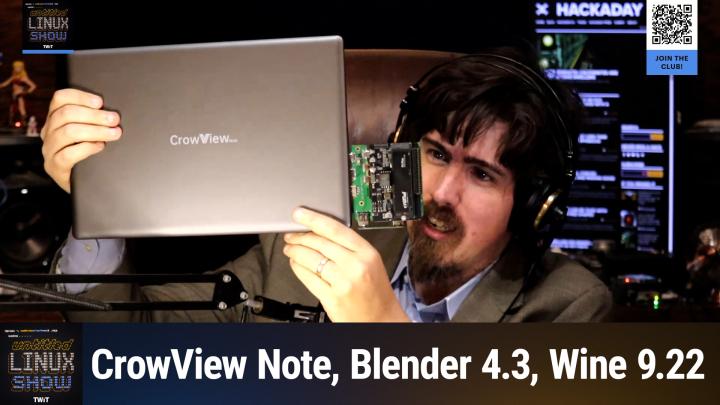
All TWiT.tv Shows (Audio)
Untitled Linux Show 179: Shape Up or Compile Out
01:54:51
FreeCad, Wine, and CoCs
Loading summary
Transcript269 lines
- [00:00]
Jonathan Bennett
Hey, this week we talk about releases, bug fixes, even some Windows news. There's cad, there's Digicam, and there's wine. It's a lot of fun. You don't want to miss it, so stay tuned.
- [00:09]
Jeff Massey
Today's show is brought to you by Progressive Insurance. Do you ever think about switching insurance companies to see if you could save some cash? Progressive makes it easy to see if you could save when you bundle your home and auto policies. Try it@progressive.com Progressive Casualty Insurance Company and affiliates. Potential savings will vary. Not available in all states.
- [00:33]
Ken
Got great ideas but no idea how to build a website? Get bluehost with their AI design tool, you can quickly generate a high quality, fast loading WordPress site instantly. Once you've nailed the look, just hit enter and your site goes live. It's really that simple. And it doesn't matter whether you're a blogger, influencer or just starting your side hustle, bluehost has you covered with built in marketing and e commerce tools to help you grow and scale your website for the long haul. And when you upgrade to Bluehost Cloud, you get 100, 100% uptime and 24. 7 support to ensure your site stays online through heavy traffic. Bluehost really makes building your dream website easier than ever. So what's stopping you? You've already got the vision. Make it real. Visit bluehost.com right now and get started today.
- [01:23]
Rob
Now AT T Mobile get four 5G phones on us and four lines for $25 a line per month when you switch with eligible trade ins. All on America's largest 5G network.
- [01:34]
Marius Nestor
Minimum of 4 lines for $25 per line per month with auto pay discount using debit or bank account, $5 more per line without autopay plus taxes and fees and $10 device connection charge phones via 24 monthly bill credits for well qualified customers. Contact us before canceling entire account to continue bill credits or credit stop and balance on a required finance agreement due Bill credits end if you pay off devices early. Ctmobile.com.
- [01:54]
Jeff Massey
Podcasts you love from people you.
- [01:57]
Ken
Trust this is.
- [02:04]
Jonathan Bennett
This is the Untitled Linux Show. Episode 179 recorded Saturday, November 23rd. Shape up or compile out. Hey, it is Saturday and everybody I think at this point knows what that means. It's time for the Untitled Linux Show. We're gonna talk about open source and some hardware, lots of Linux news, all kinds of good stuff. You don't wanna miss it. And it's not just me. We've got a trio. Not the Quartet. Our quartet's down to three to mess up a line from a beloved cartoon feature film. But hey, it's fun to be here. We got Jeff, we got Ken. How you guys doing?
- [02:40]
G
Really good, really good, doing good.
- [02:43]
Loquatius
I got a couple of good articles that I'm really looking forward to talking about.
- [02:47]
Jonathan Bennett
Ah, I have some I'm looking forward to talking about too. Before we get to that, we've got a new segment in the show and that's called reviewing stuff. Rob convinced Jonathan to buy. And we're going to start with the Crow View Note. This laptop there, let me get in the picture with it. It's kind of big, this laptop sized thing. It's not exactly a laptop with a Raspberry PI 5 hanging off the side of it. And I figured I would tell you guys about it. It has indeed come in and there are a couple of things I really, really like about it. And then there are a couple of things that really sort of irritate me. And then one more thing that I just, I hope that they fix at some point in the future. So it is essentially a keyboard, a monitor and a battery. So inside it is keyboard, touchpad. It is all the guts of like a laptop but without the motherboard. And then you have the motherboard hanging out the side of it in the form of the Raspberry PI. And then they also send along the little adapter board. That's what you see between the PI and the device. And then I've got one of the NVME carrier boards on top there because who wants to use an SD card? Not me. There are a couple things that's cool about it. I didn't realize this at first. It does have a built in battery, so it does work as a laptop. So I'll hit the power button here and you might be able to see lights come on. Green light on the piece and it's probably not going to show up real well on my camera here, but it is booting and there is a button you can press to get the battery life. How much battery life is remaining? Yeah, my camera is. Oh, there we go there. You should be able to see part of that. I hold it just right and so that's the Raspberry PI booting up and it's ready to go. I don't have a GUI on this particular PI. It's cool. I really dig it. I really like having the sort of the extra screen here and the fact that the Raspberry PI hangs off the side of it. I like it for A lot of things. It's going to be really cool. I already have some kind of thoughts about what I'm going to do with it. I'm plotting, I have plans. There is one thing in particular that was obviously not thought through very well and that is that when it ships, it comes with a couple of laser cut acrylic pieces that sort of sandwich in with that carrier board and so it goes under it like this. And the idea is that, you know, you got your carrier board here and the PI sits here. If you have the official Raspberry PI cooler, that cooler has pegs that go through the bottom of the PI to hold it on and the pegs don't fit when this thing is on there. That annoys me. That's not okay. That was not the thing I wanted to find, thankfully. Take a screwdriver, take it off. It works just fine without it. The other thing that is just a little bit of a problem is you've got a Raspberry PI hanging off of the side of your computer. As Loquatius says, it is sort of mad Maxiesque. It's a little, it looks cobbled together. And so the only thing that's holding that on there is on one side it's a usb, a, a USB C and hdmi. And on the other side it's two, is that mini or micro HDMI and a single USB C. I guess, I guess there's also the USB to USB bridge board up here. But still, like it feels to me that might be a little fragile in the long term.
- [06:35]
G
It doesn't look good in a kid household.
- [06:39]
Jonathan Bennett
I would not want my 5 year old or my 3 year old to try to use this correct or even.
- [06:44]
G
Be around or I mean, right?
- [06:48]
Jonathan Bennett
It's, it's like it needs, it's like it needed just a little bit more work on the, the actual like fitting together. On the other hand, the way that it's put together does make it very, very flexible. And I don't mean that like in a physical sense. Like it's, it's flexible. No, that's not good. But it's flexible in that like you could just, you can plug any device in because it's got an HDMI port and USB port and it'll spit power out. So that part is good. The feel, the fit and the finish is not bad. The keyboard is not the greatest keyboard, but it's not terrible either. It works, it's serviceable.
- [07:24]
Loquatius
So you plug a good keyboard into the Raspberry PI right at that point.
- [07:32]
Jonathan Bennett
You would just use a portable monitor as well instead of this thing, right? Like, so you could do that, but you're sort of beginning to defeat the point of it. There is one more thing that, like I just now realized that's on here that is really cool and that is it does have a power switch on this little adapter board between the two, there's a power switch to be able to turn things off all the way. So that is cool. And then of course you can shut things down, power it off and save your battery life. So overall I really like it. I am legitimately going to use this. I've got to. I've got to figure out a way to give this. To give the PI itself a little bit of support rather than it just hanging out beside it. This is not great. And I will tell you what I think they need to do for their next version. I don't understand why they did not do this yet. There's a good reason why they did not do it yet. But it makes so much sense for the next one. And that is when the PM5 finally comes out here, I think in just another month or two. It's coming soon. Like we've already seen. We've already seen official leaks about it. When the PM5 comes out, rather than hanging the pie off the side, they just need to make a cutout here, put the Py CM5 right there and then ideally have another cutout to be able to put an NVMe drive in there. And there you go. That would be the way to do it. Then you have a full on laptop that is powered by a Raspberry PI CM5 that theoretically, maybe when the CM6 comes along, maybe it'll just fit and just work. I don't know. So I would love for Elecro to do that with the CroVue Note 2 and if they won't do it, then maybe Framework can come along or even somebody else can partner with Framework and make a board for Framework laptops that you can just slot a CM5 into.
- [09:27]
Loquatius
Do we see a partnership between Raspberry PI and Framework? Maybe in the future?
- [09:34]
Jonathan Bennett
I would not be against that. That's the sort of thing I could imagine people doing. I would like to see it. I think it'd be really cool. I would love to have. I'm excited about having this, right, like the ability to have a Raspberry PI 5 in a notebook factor. I just would love for it to not have the entire Raspberry PI 5 hanging off the side.
- [09:59]
Loquatius
Like the old time NIC cards used with laptops.
- [10:04]
G
Yeah. When you said if it was underneath kind of inside there, I immediately thought a framework. I was like, that sounds very Framework esque.
- [10:12]
Jonathan Bennett
Yeah, it does. It sounds a lot like something they would do. But I could. I could see El Crow doing it too. Like, it's so close. What they have here is. Is so close to it. Yeah, it's.
- [10:23]
Loquatius
I've only got one question. Can it run Blender?
- [10:28]
Jonathan Bennett
I think so. I'm pretty sure the Raspberry PI 5 can. Well, I mean, you can run Blender on this display because like I said, it's got an HDMI port on it, so you can run anything you want to on that.
- [10:40]
G
Just make sure you got a lot of free time.
- [10:43]
Jonathan Bennett
Yeah, yeah. I think Ken is itching to tell us about Blender and something that happened with them this week.
- [10:52]
Loquatius
Actually, Jonathan, you're right. I am. First, though, I do want to thank Marius Nestor, since he's the one that wrote up about the Blender Foundation's release of a major update for its powerful free cross platform and open source 3D graphics and modeling software. Of course, I'm referring to Blender, in this case, version 4.3, it introduces an experimental Vulkan backend on Linux and Windows systems to render the user interface. This can be enabled over the default OpenGL back end, and here you're going through the menu by selecting preferences, then interface, developer Extras, then system, then back end. According to Marius, there are some limitations like lack of support for GPU subdivision and OpenXR, and slower performance compared to the OpenGL backend. Now Blender 4.3 also introduces a toggle for fast GI approximation, improved light and shadow linking to be feature parity with cycles, a new metallic BSDF node in the Shader editor, a new Gaber noise texture node, a theme entry to drive the color of the motion path line before and after the current frame, an eyedropper button for properties where a bone can be chosen, and support for action selectors for data blocks in the Properties editor. This release also brings support for hardware accelerated ray tracing on Linux, a revamped grease pencil feature to remove deeper limitations and improve overall performance, an updated volume scattering node that now supports more phase functions, more compact representation for B splines for optics, a diffuse roughness input for principled bsdf, and a new minimum stretch iterative unwrapping method. The video sequencer has been updated as well, with support for adjusting sound strips on a subframe level with the slip operator, Much faster color balance and tone map modifiers as well as saturation and multiply strip color controls, snapping support for the preview area, faster loading of thumbnails for movie and image strips. Box select as the default tool for timeline area as well as connect and disconnect strips for easy selection and transformation. Since I have only mentioned about half of the changes and improvements, I recommend reading Marius article for the rest of the details. And it includes a link to Blender 4.3's release notes and a 25th, 27 minute video recap.
- [14:06]
Jonathan Bennett
You know, I know that Blender does video editing stuff. I've never tried it and I'm now thinking that I need to try it. I use for the video editing stuff that I do, which is Floss, I use kdenlive, which works well most of the time. It has a tendency to be a little bit off on the audio video sync like it will sync properly in the preview, but then I render it out and upload it to YouTube and it's off just enough to tweak me when I go to listen back to it. And then I've tried OpenShot, which OpenShot is more powerful. OpenShot has terrible problems with performance, particularly when you're doing stuff on the timeline. So I gotta go in and try Blender and see if it would work as a non linear video editor. It would be kind of weird to use it for that. But it's in there, right? It's part of what it does.
- [15:02]
Loquatius
Yeah. You can do that.
- [15:03]
G
Yeah.
- [15:04]
Jonathan Bennett
Gotta try it.
- [15:04]
Loquatius
Or you could just scroll straight to ffmpeg.
- [15:08]
Jonathan Bennett
I like being able to scrub back and forth in the timeline to make stuff work. You know when you have. When you have an audio source from here and a video source from here and you got to line them up, trying to do it on the command line is just. It's a little dicey.
- [15:21]
G
We're not all like you, Ken. We're not super wizards on the command line.
- [15:26]
Loquatius
Not. Not a super wizard. I've just got a lot of experience using the command line.
- [15:34]
Jonathan Bennett
That's how anyone gets to be a wizard.
- [15:36]
G
Lots of experience.
- [15:37]
Jonathan Bennett
That is how that works.
- [15:38]
G
Well, spoken like a wizard. Oh, no, it's just. It's nothing.
- [15:42]
Jonathan Bennett
You all right? Well, there's another release this week that I am pretty excited about and I've not. I'm not on it yet, but I think I will be soon. And that's wine 9.22. And specifically this one has some more Wayland stuff in it. We talked about this a couple of weeks ago that Wine has now a Wayland back in so not everything is running on X way or yeah, through X Wayland because Wine goes to X. Well now in 9.22 it is the Wayland backend by default. And I think that's going to be really interesting. I think there's going to be some bugs that get fixed, maybe some performance improvements as a result of that. And there are other changes in there. You know, of course there's the always popular various bug fixes, but there's also like some display mode virtualization which is really important for certain old games. The locale data they have updated, more support for network sessions in Direct Play and then of course Wayland by default. And there's, there's more than that. Of course we've got the link to the, the actual Wine release and there's just, you know, pages and pages and pages of changes like there always is with Wine. Most people these days, I suspect use Wine through Proton and it will, it'll take a little bit for this Wine version to end up in Proton, like several months if you want to get to it sooner. And this is what I'm going to do. There is the Proton GE is usually what I use and that's Glorious Eggroll you might think. What kind of name is that? Glorious Egg Roll is the nickname of the developer. Honestly I forget what his real name is. He's become a little more public here recently. But there is so GE Proton 920, which I think that is based on wine 9.20 that came out two weeks ago. And so, you know, give it another two weeks and we will probably see the 9.22 release. And what he does is he takes like the set of patches that make Proton what it is and rebases those to the more up to date Wine. I think he'll also pull some stuff in from Wine Staging, which is yet another source of Wine goodness. And so if you really want to try some of this stuff out sooner. Gloria Seggrel and GE Proton is the place to go look at. And there are tools, we talked in the past about tools about how to manage all that with your Proton install and lots of tools around this.
- [18:22]
G
I was going to mention Proton Up QT is what I use to install Glorious Eggroll. So it'll just give you a list and you can just add and subtract out of Steam and it just a couple button clicks and it takes care of it for you.
- [18:36]
Jonathan Bennett
Yeah, and it's also available on platforms like Lutris and Play on Linux. I don't know if Play on Linux even exists anymore. But like Lutris, I know it's there. And so you can go in and say list all of the different wine versions and the Glorious Egg Roll is going to be one of the options. So there are plenty of places to be able to find that and get it.
- [18:53]
G
I was going to look here.
- [18:55]
Loquatius
They don't start saying anything about red wine or white wine in the future.
- [19:00]
Jonathan Bennett
I mean, we've got wine. There was a, there was Sedega for the longest time, which is a type of wine. And that was another building, I think that was built on top of wine. Yeah, people, it's the funniest thing about open source developers. We like our puns. It's like we're all about the dad jokes.
- [19:19]
G
And just side note, if you did want to install Glorious Egg Roll on Steam Proton up Qt, we talked about that on episode 166, August 24th of this year.
- [19:31]
Jonathan Bennett
There you go.
- [19:32]
G
But if you search it, it's pretty self explanatory. You run it and it's like, oh, do you want this? Yes. Click Install the install.
- [19:40]
Jonathan Bennett
Yep, yep. Pretty easy stuff.
- [19:42]
G
Yep.
- [19:43]
Jonathan Bennett
All right. Jeff and I both found this to be a really interesting story and I'm gonna let Jeff have it because I've got something else I can talk about. What is FreeCAD and what's new with it?
- [19:56]
G
Well, we talk about a lot of different programs here on the show, but one of them that we don't talk about very much is CAD software Computer Aided Drafting. Today we're going to change that and we're going to talk about FreeCAD with their 1.0 release. Now, free CAD is an open Source CAD and 3D modeling programmer that builds off the open cascade code coin 3D library and uses a QT toolkit so it can work across multiple platforms. FreeCAD has been around for quite a long time with its first 0.11 release in March of 2011. It's only now in 2024 that we have the 1.0 release. Now it has a lot of differences, different uses, and as such it can be used by those wanting to be architects. It has a panoramic environment, meaning the shape of your item can be based off or. Sorry, it has a parametric environment, meaning the shape of your items can be based off the properties such as numeric values, text on, off buttons, or even other objects, and all shape changes are recalculated on demand. So you could have 2D or 3D drawings, both for 3D printing and CNC machining if you so desire. And it's basically it's an all around, very good all around CAD program. Now free CAD used to have a whole bunch of topological man, it is a rough day today, I gotta tell you. And this is the kind of sausage making topological yes, this is the kind of sausage making you get here on the Untitled Linux Show. There's no second takes. This is all real. This is authentic here. So there was naming issues that are mostly gone now. So if you're. If you reference geometry in a part and then delete that geometry, your model shouldn't break anymore. Now FreeCAD now also has an integrated assembly workbench written by the Onsell team and it currently supports bottom up design approach. Now there's also a new material system as well. It should help you or help which should help the appearance of the materials in your model, in your design and edit. Support for using vector functions from the Vector API in expressions Introducing the app colon colon var set property container is a core feature to allow users to define properties that can now be used in models and renames the attachment property to attachmentsupport, which may affect the opening of format of older FreeCAD versions. FreeCAD does have this to say about the file format, so this is from them and I'm quoting. Although precautions have been taken to guarantee that files created with the new 1.0 version can still be opened in older versions of FreeCAD. Some new features introduced in 1.0 cannot be understood by earlier versions and can cause models saved with 1.0 to break or present problems when opened in an earlier version of FreeCAD. So they have tried to keep backwards compatibility, but there are certain limits. You can't add things and have it work for things that didn't exist in the older versions of the program. Now there are many more improvements and I've just touched on a few of them. So take a look at the show notes and you'll find Well I said 2 but should be 3 articles talking about the release and in those articles you can find the GitHub page so you can get the source code if you so desire. There's a flathub and an app image version for those that don't want to compile and but many distributions have it in their repositories or soon will as the new version propagates through. You know, I looked at my Kubuntu repositories and version 1.0 is already there. So you most likely already have it or if not soon will. But you can always get the other other ways too, if you so desire. One note I do want to add is while the comments were mostly positive, some people did say that the software was confusing or they had issues. I personally have engineers who work for me and use SolidWorks and AutoCAD among other professional programs and just I can tell you, you know, CAD software, especially high level software, can be kind of hard to use and complex and you also have to have good design practices, processes in place. So I always say think of CAD software like programming language. It isn't hard to jump in, but to get the most out of it, there's going to be a learning curve and good practices that need to be used. So if you don't find yourself, so you don't find yourself in a corner, you know, you just the way you can program yourself in a corner, you could design yourself in a corner. So I don't want to scare anyone, you know, this is something you could easily get going on. But keep in mind that, you know, a few tutorials can go a long way. You know, it, this, this is CAD software can be very complex, but it doesn't have to be. So I still recommend people give it a shot and you know, play around with it. So. Happy designing.
- [25:01]
Jonathan Bennett
Yeah. So a couple thoughts with that. First off, they have tutorials and there's a bunch of them on YouTube as well. There's places you can just jump in and get started. And I would, if somebody really wants to learn this, the Computer Aided Design, I would say get yourself a, you know, reasonably priced 3D printer to go along with this. Like if you want to make an investment to it, go with free cad and a 3D printer. That way you can design something on CAD and then actually make the physical object that you can put your hands on. And that's going to go a long ways towards helping you actually learn how things work. And yeah, I've done after just a little bit. The CAD work that I've done is actually through, through. It's not free CAD. It's one of the open source, other open source CADs, but it's one of the ones that is a scripting language. And I can't tell you at the moment what it is.
- [25:55]
Loquatius
There's a couple of them that are scripting languages.
- [25:57]
Jonathan Bennett
Yeah, there's one in particular that's pretty, that's pretty common.
- [26:04]
G
Well, and the reason I brought up some of that stuff is because in the comments there are certain people that said, well, I tried to do this and things broke and there was other people that, hey, I'm a CAD designer and that'll happen with anything. You have to kind of redesign how you're doing things. And I would actually the one I'm.
- [26:21]
Jonathan Bennett
Thinking of is OpenSCAD or OpenSCAD. That is the one that is a scripting language. So that is another option to look at.
- [26:27]
Loquatius
And the S stands for scripting cad?
- [26:29]
Jonathan Bennett
I think so. Well, maybe it's either scripting or solid.
- [26:33]
Loquatius
While you're looking, I do want to bring up something that Jeff didn't mention about this version of FreeCAD. This particular release is to one of the former free CAD developers who passed away a few weeks before the release.
- [26:49]
Jonathan Bennett
Came out dedicated to him. Yep, I did see that.
- [26:53]
G
And I would add on to what Jonathan said about 3D printer. I would even get an existing model that you can load into the CAD software and just play with it. So you're not just saying, man, okay, I got a block I'm playing with or a circle or you have a more complex model and go, oh, what if I did this? What if I did that? Oh, I totally messed it up. Well, I'll just reload it and you know, play again. And it gives you a little more framework to play with sometimes.
- [27:22]
Jonathan Bennett
Yeah, yeah, that makes sense.
- [27:24]
Jeff Massey
Today's show is brought to you by Progressive Insurance. Do you ever think about switching insurance companies to see if you could save some cash? Progressive makes it easy to see if you could save when you bundle your home and auto policies. Try it at progressive. Com, Progressive Casualty Insurance company and affiliates. Potential savings will vary. Not available in all states.
- [27:47]
Ken
Got great ideas but no idea how to build a website? Get bluehost. With their AI design tool, you can quickly generate a high quality, fast loading WordPress site instantly. Once you've nailed the look, just hit enter and your site goes live. It's really that simple. And it doesn't matter whether you're a blogger, influencer or just starting your side hustle. Bluehost has you covered with built in marketing and e commerce tools to help you grow and scale your website for the long haul. And when you upgrade to Bluehost Cloud, you get 100% uptime and 24. 7 support to ensure your site stays online through heavy traffic. Bluehost really makes building your dream website easier than ever. So what's stopping you? You've already got vision. Make it real. Visit bluehost.com right now and get started today.
- [28:37]
Rob
After investing billions to light up our network, T Mobile is America's largest 5G network. Plus right now you can switch. Keep your phone and we'll pay it off up to $800. See how you can save on every plan vs Verizon and at&t@t mobile.com Keep.
- [28:53]
Marius Nestor
And switch up to four lines via virtual prepaid card. Allow 15 days qualifying unlock device credit service ported, 90 plus days with device and eligible carrier and timely redemption required. Card has no cash access and expires in six months.
- [29:07]
Jonathan Bennett
All right, Ken, do we want to talk about the head janitor of Open Source?
- [29:13]
Loquatius
I think he's proud of it too, according to Stephen Vaughn Nichols.
- [29:17]
Jonathan Bennett
Me too. I knew that that was my title.
- [29:21]
Loquatius
But Stephen Vaughn Nichols wrote about a key leader who helped define why some people love the Linux foundation and others hate it. Some folks see the organization as leading open source projects into the future, while others resent it because of its corporate connections. Everyone agrees that by overseeing more than 1,000 open source projects, the Foundation's influence can't be ignored. That presence is in large part because of Executive Director Jim Zimlin's outstanding leadership. Now, Stephen first met Jim Zimlin when Zimlin was the head of the Free standards group, or FSG. The FSG's main project was the Linux Standard Base. I'm going to say LSB for that in the future, but that was the project. The LSB's goal was to get everybody on the Linux desktop world to agree on standards to ensure compatibility among distributions and their applications. And that's a goal I think we are still struggling a little bit to achieve, though we are getting closer. Another group, the Open Source Development Labs, or osdl, was working on standardizing enterprise Linux. The two nonprofits had the same goal of making Linux more usable and popular. So they agreed to merge. Zimlin was picked to head this new group, called, as we all know it, the Linux Foundation. At the time, Zimlin told Stephen, and here I'm quoting, the combination of the two groups really enables the Linux platform and all the members of the Linux foundation to work really effectively. I clearly understand what the organization's charter needs to be. We need to provide services that are useful to the community and industry, as well as protect, promote, and continue to standardize the platform, end quote. Stephen believes this has been achieved, and I kind of agree with, and I think it has been too. Now, around 2000 or 2010, the foundation's scope expanded. Its initial focus was on Linux. Until then, the organization had hosted about a dozen projects related to the Linux operating system. However, as Linux gained dominance in various sectors, including high performance computing, automotive Embedded systems, mobile devices and cloud computing, the Linux foundation started to broaden its horizons at the recent Linux Foundation Members Summit. Zimlin recalled how the foundation became a foundation of foundations 20 years ago, supporting developers and communities that wanted to leverage open source. Now, I think I've been talking about Steven's article for three minutes, so I'm going to wrap it up here. But I do recommend reading Stephen's article to find out why the Linux foundations and Zimlin's work isn't done yet. I found it to be an interesting read.
- [32:53]
Jonathan Bennett
Yeah, we're going to talk about Linux and the foundation and all of that here in a little bit with, in my opinion, not quite as flattering news. So it is good to see this side of it and we do appreciate all the work that they do has been in the balance. It has definitely been a good thing.
- [33:10]
Loquatius
For Linux and for Torvald as well.
- [33:15]
Jonathan Bennett
Yes, I think the foundation now pays both Torvalds and Greg Koh Hartman's salaries. So definitely a big part of the.
- [33:23]
Loquatius
Zim's their boss, though I don't think they really care. Notice that.
- [33:28]
Jonathan Bennett
I mean, I don't know that anybody is Torvald's boss. I think he could pretty much write his job at any of about 15 major companies anywhere and. Okay, Mr. Torvalds, we'll do whatever you say, Mr. Torvalds.
- [33:42]
G
15? That's just on Tuesday.
- [33:46]
Jonathan Bennett
Yeah, well, I'm thinking big companies. Like, big companies he could go to.
- [33:55]
G
Yeah, I think all of them is the answer.
- [33:58]
Jonathan Bennett
I couldn't see Torvaz at Oracle just put it that way.
- [34:03]
Loquatius
Personality conflicts, something like that.
- [34:05]
Jonathan Bennett
Yeah, it's just culture clash. Right. But a lot of other places I could see him walking in and just. Okay, sure you could, yeah, we'll pay your salary. How much did you want? Okay.
- [34:16]
G
It would help him out a lot.
- [34:18]
Jonathan Bennett
It might. All right, so let's talk about. Well, one of those places that came to mind actually is IBM because of Red Hat. Let's talk about Red Hat showing up in an unusual place and that is on Windows. So you may not realize it, but wsl, the Windows subsystem for Linux, is a bit of a pain in some ways, or at least it has been until now. And you may also have realized if you're like me and you like Fedora and Red Hat, that there wasn't an easy way to get either of those distros on wsl. And that is now changing because Red Hat and Microsoft have teamed up to basically figure out what Red Hat on WSL should even look like. And the simple answer is it looks like a TAR file rather than a. What was it? An AppX bundle. So this was the deal. The article here says that previously the developers had to package TAR files into an AppX bundle and write Windows specific code to set up users and distribute via the Microsoft Store. And now it's just a TAR file with a conf file added in there in utc. And that's it. That's all you have to do. So that makes things like Fedora and Red Hat possible. The actual news here is that there is, there is about to be. And they've announced official support for running Red Hat Enterprise Linux on wsl. I've not seen whether this is going to be free or if you have to pay for it. I know there are some ways to get Red Hat for free for developers, but like if this is going to be inside the Microsoft Store, is it going to be a free product there? Is it going to be a paid product? I don't know. I do hope that this paves the way for Fedora to show up. I would, I would personally appreciate that a lot. Or at least I would I guess, if I actually ran Windows on any of my platforms. I don't really have a machine to put this on. But that said, it would be handy from time to time be able to get Fedora on Windows. But also in thinking about this, the fact that it is now just a TAR file with a conf added to it, that lowers the bar for a bunch of other distributions showing up and maybe even doing some homebrew distros and running those under wsl. You know, just make your own distro or repackage your own distro. Take a, take an install and turn into a TAR file to be able to have all of your stuff pre configured on there. So WSL getting better and better. And that's pretty cool. I like that.
- [37:03]
G
I still wonder how long before we go and have a LSW Linux subsystem for Windows.
- [37:09]
Jonathan Bennett
I'm pretty sure that's called wine.
- [37:12]
G
Well, and I've said this before and this is still my long term prediction. It's like a lot of that WINE code that they've got too many decades in there to untangle. You start running Linux and then you have little Windows virtual machines that you can isolate and have security on. It's tying in more and more.
- [37:35]
Jonathan Bennett
Yeah. So.
- [37:36]
Loquatius
And then you need some way for them to communicate with each other. Right.
- [37:40]
Jonathan Bennett
So you see a future in which the official Windows Hypervisor is the Linux kernel.
- [37:46]
G
Yeah. And then you can run, because that's a good way that you could. If nothing else, they could break backwards compatibility kind of with Windows as far as the coding and say, okay, we're going to take Windows wherever they stop. Here. This will run all your previous versions of stuff. Now we've got a new version going forward and we don't have to untangle. When you hear Steve Gibson, some of those people talk about, some of that code's been in there for 20 plus years, 30 years. How do you get it out of there without breaking everything? And you say, well, here's our clean break. It's now just running on a little, you know, hypervisor.
- [38:26]
Jonathan Bennett
And I will say that they did that. They actually did that already with Windows xp. You may not remember this, but there was a Windows XP mode. It got built into Windows 7. Oh, yeah, Vista 7, I think it was 7. And so, and I ran it for at least one customer. They had something that would not run on Windows 7. And so I had the Windows XP mode. And that was literally a Windows XP virtual machine.
- [38:52]
G
Oh, I didn't know that.
- [38:53]
Jonathan Bennett
Yeah. The problem with that is that they pulled support for it so quick. That support for that did not last very long, but it was out there for a while. And that's exactly what it was. It was just an official virtual machine. Okay. You need your old program to work here. It works here.
- [39:06]
Loquatius
Be glad you don't have to support anything that was designed in Windows version one.
- [39:13]
Jonathan Bennett
That was a long time ago.
- [39:15]
G
That's basically called DOS.
- [39:18]
Jonathan Bennett
I have actually helped people with Windows 3.11 software. And somebody else had a Windows either 95 or 98 machine that they needed the software on to continue to run. And in both of those cases, we actually did it in DOSBox.
- [39:35]
G
Okay. Yeah.
- [39:37]
Jonathan Bennett
Yeah. The, the Windows 3.11 just runs as an application, like the, the program that they had runs as an application in DOSBox. And then the Windows again, it was either 95 or 98, and I cannot remember which. You can load the entire disk Image in and DOSBox will boot it like a virtual machine, which is just crazy. I think it's 95. It's just crazy that DOSBox could do that. And then of course, you go and you find the right, you know, the right flavor of it that has printing support. Because of course, everybody needs printing support for their old computer programs because that's.
- [40:09]
Loquatius
Why they're running the old computer program to print out from.
- [40:13]
G
Yep. Yeah. I was gonna say I, I wanna. No, I'm not all up on Windows, but isn't me and back, you know, everything pre XP. Basically just a graphical interface on top of DOS.
- [40:28]
Loquatius
No, not coming. No, no.
- [40:31]
Jonathan Bennett
90, 95 was where they went to a real mode that was not just DOS, I believe, but in 95 and I think 98 as well. There was a button there to reboot into DOS mode. Windows 3 was just an application on top of DOS.
- [40:49]
G
Okay.
- [40:51]
Jonathan Bennett
Yeah.
- [40:51]
Loquatius
The applications that you ran in it were designed to use its window management for painting the screen with the graphics that it wanted to use to display. Like with CorelDRAW CC. Mel, there's an old one.
- [41:17]
Jonathan Bennett
Now what Windows XP did bring is that was the first of the home editions, right. You have Windows 2000 that was professional Windows that was built on top of the Windows NT kernel. And Windows XP is where they merge those two streams and everything since XP has been based on the NT kernel. So that's why, that's why 95 and 98 were so odd and backwards compared to XP.
- [41:44]
G
Until maybe Windows 12 when it's based on the Linux kernel.
- [41:47]
Jonathan Bennett
Hey, maybe, maybe. Oh, just to get an idea of why, of how, of how weird things are in the Windows world, you realize we skipped Windows 9. Do you know why we skipped Windows 9?
- [42:05]
G
No idea.
- [42:06]
Jonathan Bennett
Ken, do you know why Microsoft skipped Windows 9?
- [42:08]
Loquatius
I remember, I heard that because so.
- [42:12]
Jonathan Bennett
Many programs were just doing a string compare and they would go Windows 9 * essentially. And if it matched, sorry, you can't run this on Windows 95 or Windows 98. And apparently Microsoft actually had problems in the testing room running Windows, a thing called Windows 9 because so many programs would bail out early thinking it was on 95 or 98. All right, put it in a little.
- [42:40]
G
Box and seal it away.
- [42:42]
Jonathan Bennett
Yeah. All right, let's move on and let's talk about what's next. Servers. Jeff, take it away. Tell us what's going on in the server world.
- [42:53]
G
We're going to the opposite end of the technology here. We're going to hit some latest, greatest here. So E wraps is going to be turned on. So AMD, such as the Ryzen 9000 series and Ryzen AI 300 series or the EPIC 9005 touring launch, get more performance. Good news, right?
- [43:17]
Jonathan Bennett
I'm sure some of you, we like more performance.
- [43:19]
G
Yeah, I'm sure some of you just said though, said, wait, what era P S E wraps. What, what is that? Well, it stands for Enhanced return address Prediction Security. So the short version, it's, it's something that its goal is to help recover some of the performance that security mitigations introduced following sector the ER spectre over the past several years. So ERAPS is a new defense for mitigation of certain classes of speculative attacks such as return stack buffer poisoning. Now, AMD included this note with the patch Remove explicit RET stuffing filing on VME exits and context switches on AMD CPUs with E wraps feature Zen 5 so with enhanced return address prediction security feature, any hardware TLB flush result results in flushing of the RSB AKA RAP in the AMD spec. This guarantees an RSB flush across context switches. This feature also explicitly tags hosts and guests addresses, eliminating the need for explicit flushing of the RSB on VME exit. So the BTC underscore no feature in AMD CPUs ensures RET predictions do not speculate from outside the RSB. Together the BTC no and E Wraps feature ensure no flushing or stuffing of the RSB is necessary anymore. Well what does that mean if you don't really know a lot of that? It just means you're supposed to go faster and it's supposed to be safer. It's reevaluating the security changes and I won't go into all that. But what happens when Michael Larbel over at Phronix hears about this? Well he actually runs a bunch of benchmarking tests on this feature to find out does it really improve things? Well, he used the 612 kernel and then he would, he would run it stock and then he would add the patch. Now it was originally in the branch to land in 613 the the E wraps but has since been removed. So they just pulled it here really recently right before the show. So it's probably the speculation it's going to show up in 6:14 which will, it's going to, that'll be next year. We're not expecting 6:13 to be out until January. Well Michael ran a bunch of benchmarks and found that there was an improvement, but the amount depended on how much IO was involved and if there was a lot of context switching. So if neither of those happened then the results were the same. So you didn't lose any performance. It just didn't help. But when it did help it actually had a nice little improvement. Now it's not going to be earth shattering, you know, it's just, it's just a few percentage points but kind of like we talked in the past, that's where we get to speed up as you just kind of get a few percentage here and A couple percentage there and pretty soon it's like, wow, things are really moving. So currently it looks like in 6:14, unless you're going to take, take the code and apply it yourself, there should be a nice speed up coming our way. Now I have a second story in here which has to do with the number of memory channels with an AMD EPYC motherboard, specifically 8 versus 12 channels. Again Michael Larrabel ran a lot of benchmarks. In this case nearly 200. And similar to the last story, if there's a lot of IO. Then there was a nice improvement. If the workload was mostly computational, then the results were pretty flat. So it didn't hurt, it just didn't increase. So for example, Blender didn't see an improvement. You know, it's chugging away inside the cores. It's not hammering the memory hard. While things like TensorFlow, which is machine learning software and OpenVino, which is an AI toolkit, had rather large improvements, well they're hammering the memory because they're going over their data sets in this case. Michael Arable said he felt much better about his decision to buy a 12 channel motherboard rather than save a little money on the 8 channel motherboard. So he liked the speed up, but he thought the speed up improvement was worth it. And I would say if you can always, when in doubt, get the, get more channels, fill more channels. That's why, side note, when you have a motherboard they tell you and it, even though consumer motherboards are two channel, don't just put a module into one channel, populate them both. It, it will speed things up a little bit. Take a look at the article in the show notes and find out how your workloads can be approved and you know, happy computing.
- [48:10]
Jonathan Bennett
Yeah, with the, with the E wraps, one of the things that interests me is every benchmark he ran shows an improvement. Now some of them are very small, but they all show the improvement. And what will happen with some of these changes is most everything will be an improvement and then some things will actually run slower or when things like the, the 12 channel on, on EPIC here, there are some of them that are a dead heat or you know, and so you're within the statistical noise and so you'll actually see the wrong one will be ever so slightly faster. But with the ERAPS change, everything improved. And so that, that's kind of a strong indicator that this really is a good, a good change that everybody's going to benefit from.
- [48:50]
G
Yeah, I considered some of them kind of in the realm of noise. So maybe they weren't. You know, I just kind of had a rounding error, I guess.
- [49:00]
Jonathan Bennett
Well, they were.
- [49:00]
G
Yeah. It never hurt, Right?
- [49:03]
Jonathan Bennett
Right. That's essentially what I mean. It never hurt. So it never got far enough into the realm of just noise that it looked like it hurt. Yeah. The whole speculation thing with Spectre and all of those has changed so many assumptions about computing. It used to be that, you know, you could do all of this stuff you did, like the CPU didn't have to care about. The CPU didn't have to care about the way the operating system thought. Right. Because all of this stuff, the operating system took care of it. And then the CPU could take all these shortcuts and, you know, you know, you would unwind it afterwards and then everything would get presented to the operating system and it would take care of the rest and nobody would care. And then Spectre and Meltdown came along and suddenly there was all of these extra, extra data sources that nobody realized were there that individual applications could pull from. You know, they could detect differences in cache timing. They could detect whether something had been loaded into cache or not. And it just changed the game. And it, you know, we see stuff like this and we are just now coming out on the other side of the shakeup that was Spectre and Meltdown. And that's been a long time ago. It's been.
- [50:20]
G
Yeah.
- [50:21]
Jonathan Bennett
Is that it getting on to be a decade now? When did Spectre Meltdown first come out?
- [50:27]
G
I thought it was more like five years ago. Six years ago?
- [50:30]
Loquatius
Same five, six years ago.
- [50:36]
G
If it was, that would be kind of in the realm of the silicon pipeline. By the time you say, okay, we're going to design with this in mind, simulate it, build it, you know, so on it. It takes a few years for that to go through.
- [50:52]
Jonathan Bennett
Six years ago is when the YouTube videos were posted. So, yeah, about then. Not quite. Not quite a decade. So I guess when we get to the point of being a decade, it will be pretty much taken care of. We'll be completely on the other side of it. Right. And we're just now seeing where CPUs are coming out, like you said, where this has been part of the entire pipeline.
- [51:11]
G
Yeah, it definitely takes a while.
- [51:13]
Jonathan Bennett
Yes, yes. Everybody's got to get on board. Yeah.
- [51:18]
Loquatius
The first mitigation was back in October of 2018.
- [51:22]
Jonathan Bennett
Yeah, yeah. But that was all software that was doing things in software that people never thought you would have to do, because who cares? It's a little faster. Who cares? Well, turns out that's A problem?
- [51:36]
G
Yeah, it's just garbage data. Who's going to worry about the garbage data? Oh, it's not garbage.
- [51:43]
Jonathan Bennett
Yeah, yeah. All right.
- [51:47]
Loquatius
Who's always digging through the garbage, right?
- [51:49]
Jonathan Bennett
Well, let's talk about. Let's talk about GNU's Linux libre. Ken, what's up with. What is GNU up to these days?
- [51:59]
Loquatius
Well, we're going to go to Marius Nestor, since he wrote about the GNU Linux Libre project releasing the gnu Linux Libre 6.12 kernel. Now, I'm going to start off by asking, do you seek 100% freedom for your GNU Linux library or computer? If you do, then this kernel is for you. The GNU Linux Liberate kernel targets software freedom lovers and Linux purists who want to build a 100% free GNU Linux computer without any proprietary drivers of code. It is based on the just released Linux 6.12 kernel series. So that's why we're calling it the gnu Linux Libre 6.0 kernel, which cleans up CPM, QE, QMC, SoC support. And that's a lot of. That's a long Alphabet there, but basically that's about some audio drivers. Then there's also Realtek's 8852 BE VT, Wi Fi driver, AM logic, BT protocol support. Another is the AMCC QT 2025PH. Then there's AW96103 or the AW96105 proximity sensor, and Texas Instruments TLV320AIC31XX codecs. Now, the GNU Linux Libre 6.12 kernel also cleans up the Renaissance XHCi controllers and the intel is H or integrated Sensor hub. These are human Interface device drivers, and it updates BLOB names to clean up MHI PCI host, Adreno 620 or 621S R8169, Qualcomm's Q6 V5 remote pros, the RTW 8852C and RTW 8922A drivers, and cleans up blob names in Texas instruments Pru AM 642 and Qualcomm's ARM 64 device tree sources files, or DSTs, as they're sometimes called. Now, since the KS 7010 and Intel Skylake audio drivers have been removed from the upstream kernel, this release will also drop, cleaning them now. GNU Linux 6.12 kernel also cleans up a newly added sourceless GPL program that was disguised as a sequence of hex numbers. Marius article contains links to the official website, as well as to the freesh project and RPM Freedom websites. Who uses the GNU Linux kernel now?
- [55:24]
Jonathan Bennett
The deblobbed kernel? Very few. Very, very few people. So we actually. Back on FLOSS Weekly episode. I just found it. Where was it? 425, which was a very long time ago. You get to see a much younger Jonathan Bennett in his previous location, which is not nearly as luxurious as this set is, we shall say. So we had John Sullivan from the Free Software foundation and we talked about their de blobbed kernel a bit. And I don't love it. And that's because I understand some things. What they do is they refuse to ship firmware blobs. So you have to remember, you have to understand when you plug a device in, this is true of a lot of devices, or when it's on your motherboard, it doesn't have any firmware on it. And so when your driver first initializes it, one of the initialization steps is to stream the firmware blob over to that device, which then boots on the device and then they begin communicating back and forth. Of course, let's be clear. For those of us that are fans of free software, of open source, in an ideal world, we would have access to the code that makes up those firmware blobs. That is ideally true. I will agree with that. That is a point that FSF makes that I fully agree with. In an ideal world, we would like to have access to the code that is in those blobs. We would like to have the ability to fix things, to write, to compile it ourselves, to fix things and send it upstream to Logitech or whoever, to be able to make things better. So I fully agree with that point. Here's the thing with the Free Software foundation, when they de blob those, they are of the opinion that if that firmware blob lives on that device, it's fine. We don't care. We pretend that it's not there. It respects your freedom. If we have to upload the firmware blob from the CPU to that as part of initialization, then it has to be open source for it to be able to meet their criteria. That argument just doesn't work for me. It just doesn't. I care like. So I care more about whether I can see into the firmware on a device. I care much more about that than does my computer have to handle that firmware to be able to initialize, particularly if that firmware is available under a license that allows someone like the kernel to redistribute it. Right? So you do get into this weird problem and this is true of some devices where here's the firmware code out there, it's on the Internet, it's on the webpage. But it would be a copyright violation to include that inside the kernel sources. And therefore you can't use it. Like, okay, obviously that's a problem. But most companies have gotten past that. They realize that that's a terrible idea. So for most of these pieces of firmware, it's out there, it's redistributable, it's just not open source. And so the Free Software foundation says it's not open source, therefore we can't touch it. So Linux and even Red Hat and Fedora, they have come to this point of. It's unfortunate, it's not open source, but we know the firmware has to be there one way or the other. So long as we have the legal ability to redistribute it, fine, we'll make it part of the kernel. We'll ship it out with the kernel firmware. That's what's going on here. And that's why I'm not running the deep lob, as they put it. Free software, foundations, kernel.
- [59:17]
Loquatius
It's easier if you've got open hardware to run it on, right?
- [59:20]
Jonathan Bennett
Open hardware would be amazing. It's just extremely difficult to make money from open hardware. I've actually run into this a little bit recently. I like open hardware like I do. It just does not make the same kind of economic sense that open source software does. Because with open hardware, it used to. Right. But it has become so inexpensive to get things fabricated now, not necessarily silicon, but like PCBs. It has become so inexpensive, you can send, you know, 100 bucks, you can send off and get 20 PCBs. And you know, if the person that made it did the design, if he wants to sell them for $50 apiece and you can buy them from China for $15 a piece, which is actually about how that works out for most. Most of the time. It's just, it's so. It's. It's really hard at that point to make something open hardware and make any money off of it at all. So. But that's an entire rabbit trail. That's not what we were talking about at all.
- [60:27]
G
Well, and if you really. And it's the basics of software and hardware, right? Okay, I write a little program, I can give it to the a billion people and it doesn't really cost Me anything if I get it on GitHub or whatever. So I'm not paying the server fees or whatever. Hardware can be a little tougher. And then even just making it, you know, okay, I give the plans out. Well, who's going to make it? Well now you got to have material costs and you, I mean it, little, little tougher.
- [60:56]
Jonathan Bennett
Yeah. And so, you know, you could look at one side of this like, well, it's, it's free to give it away and so you can sell your open source software and that's easy to do when it comes to open source hardware. The other side of this is there is a financial cost involved in being able to sell it. There's not a financial cost involved really in being able to sell open source software. You can set up a website for next to nothing and take payments on PayPal. Okay, pay me $15 on PayPal or you know, Patreon or there's a Buy me a coffee. You can say, buy me a coffee. Hey, if you want to use this program, buy me a coffee. And so now you're selling your open source program, which is great. There's no problem with selling open source, but the barrier to entry for selling open source software is basically zero. But to sell open source hardware you have to put the money up front to be able to make the hardware. And then if someone else can, you know, undercut you by having a Chinese fab do it for next to nothing, well then it becomes really difficult to even get your money back on doing it.
- [62:03]
G
So it's, and they're, and even if they undercut you, they're probably not going to say, look, it's open source and we have this, it could be and you'll never know.
- [62:12]
Jonathan Bennett
Yeah, Keith, Keith is telling me to plug it. That is actually not the one that I've been using. But yes, yes, there is one of those fabs that sponsors a lot of people on YouTube, people that we enjoy listening to on YouTube. Some friends of ours on YouTube get sponsored by that particular company but they're not sponsoring us so I'm not going to name them.
- [62:32]
G
Well, and there's printers you can set up to print PCBs, basically some basic circuitry. And yeah, yes.
- [62:43]
Jonathan Bennett
I've seen people get CNC machines set up. In fact, this is very tempting to me. I am thinking about trying to invest in one of these at some point. You can get a copper clotted board, you know, double sided copper clotted board. So it's, it's, it's the green fiberglass Board basically is what they're made out of. And then they chemically put a layer of copper on the top and the bottom. You put that into like Even just a 2D cnc machine. It doesn't have to be the whole 4 axis cnc thing. It could just be not much more than a milling machine really, so long as it can do it.
- [63:15]
G
It's what they look like. I've actually seen them in use and you. We used to use them long time.
- [63:22]
Jonathan Bennett
Ago, but for doing prototyping. It's kind of like the equivalent of a 3D printer. Actually. It's very, very, very much like the equivalent of a 3D printer, except for PCBs. And so what you do is you program it in and your machine will go on and it'll mill out all the copper that's not supposed to be there. And at the end of it you get a PCB that you made in like 30 minutes.
- [63:43]
G
I'll say. It's kind of not a 3D printer, it's a 3D eraser.
- [63:47]
Jonathan Bennett
Yes, yes, that's exactly what it is.
- [63:50]
G
Yeah, like I said, we used it for prototyping. Oh, long, long, long time ago. It won't handle anything we do now. But yeah, you just like you said, plated and then you just etch away what you don't want and here's your circuit, away you go.
- [64:09]
Loquatius
So you're saying basically you just prototype it. Once you've got the design to where you want it as hope and hardware, then you just release the plans and let everybody pay for all the hardware and the manufacturing.
- [64:26]
Jonathan Bennett
I mean you can do it that way. And so if you don't particularly want to make any money off of it, then that makes a whole lot of sense. You can do it as open source.
- [64:33]
G
Hardware that way, but you still had to prototype it. You might have had to go through five or six boards before you got it right. And the bits and everything else that.
- [64:44]
Jonathan Bennett
There'S still a decent chance you're a couple hundred dollars in, depending upon what you're doing.
- [64:48]
Loquatius
So sort of like setting up for podcasting?
- [64:53]
Jonathan Bennett
Yeah, yeah, I suppose so.
- [64:55]
Jeff Massey
Today's show is brought to you by Progressive Insurance. Do you ever think about switching insurance companies to see if you could save some cash? Progressive makes it easy to see if you could save when you bundle your home and auto policies. Try it@progressive.com Progressive Casualty Insurance Company and affiliates. Potential savings will vary. Not available in all states.
- [65:19]
Ken
Got great ideas but no idea how to build a website. Get bluehost with Their AI design tool, you can quickly generate a high quality, fast loading WordPress site instantly. Once you've nailed the look, just hit enter and your site goes live. It's really that simple. And it it doesn't matter. Whether you're a blogger, influencer or just starting your side hustle, bluehost has you covered with built in marketing and e commerce tools to help you grow and scale your website for the long haul. And when you upgrade to Bluehost Cloud, you get 100% uptime and 24. 7 support to ensure your site stays online through heavy traffic. Bluehost really makes building your dream website easier than ever. So what's stopping you? You've already got the vision. Make it real. Visit bluehost.com right now and get started today.
- [66:09]
Rob
After investing billions to light up our network, T Mobile is America's largest 5G network. Plus right now you can switch keep your phone and we'll pay it off up to $800. See how you can save on every plan versus Verizon and AT&T. @t mobile.com Keep and switch up to.
- [66:27]
Marius Nestor
Four lines via virtual prepaid card. Allow 15 days qualifying unlocked device credit service ported 90 plus days with device ineligible carrier and timely redemption required. Card has no cash access and expires in six months.
- [66:38]
Jonathan Bennett
All right, so let's talk about, let's talk about the code of conduct in the Linux kernel.
- [66:45]
G
Well, I was going to say did you want to go to that or did you want to go mine first and then in case yours, there's a discussion to go with that.
- [66:54]
Jonathan Bennett
Do you want to talk about. Yeah, we can, we can do that. Let's, let's let Jeff go first. He's going to tell us about Digicam and then we're going to talk about code of conducts.
- [67:02]
G
That's probably going to take a bit.
- [67:03]
Jonathan Bennett
Yeah.
- [67:04]
G
So just going to throw in here that DigiCam 8.5 is released and you know, we haven't talked about that in a while. So a little refresher of what is Digicam? The developers, you know, this is from them, they say it's an advanced open source digital photo management application that runs on Linux and you know, some other platforms. The application provides a comprehensive set of tools for importing, managing, editing and sharing photos and RAW files. Basically it's a tool to enhance and organize all your photos. Personally, I use Digicam and I look forward to the new version. Now I say right up front, I'm not a power user. I, you know, very, very basic user but I, I do and I really like the program. One of the big improvements that they did add to this version is to the face management feature where they've integrated deep learning models to the face pipeline for faster and more accurate face detection and recognition. You know, think automatic tagging of photos so every photo of your Aunt Becky is now can easily be found. Now this first appeared in version 8.3 so this is a further refinement of the tool. This is not just the out of the gate. They have changed the default facial recognition model to the U Net Capital Y U Capital Net and they found it outperformed and was more accurate than the two previous previous models they used and has more configuration options to enhance the overhaul accuracy and that you can fine tune facial detection for specific scenarios such as large group photos and portrait photography. There's also an improvement in the color label usability for identifying important items using color labels by implementing a narrow linear gradient color bar around the image thumbnail. In the previous release, the color label feature drew a bright border frame around the thumbnail, which was deemed a bit intrusive in the user interface, especially when multiple labels were used in an album. In addition to the refinements and new features, more than 160 bugs have been fixed since the last release and Digicamp does call out. They spent a lot of time working with users to validate the fixes they put into the release. So they really try to make sure that when they fix a bug, they really fix it. And it's not only one instance of it, it's completely squashed. Several internal components have been upgraded, such as the internal RAW decoder library. There's several others that they've revved up as the libraries have had more refinements themselves. So if you just take a look at the article linked in the show Notes for a full release, details where they go into all the changes have happened and a link into the Digicam release webpage if you have, you know, if you have a lot of photos that you want to organize and maybe have some that need a little touch up. I do. I highly recommend Digicam if you want to know even more ways to use the program. They also raise money by selling a recipe book which can help you get the most out of the program and it can be purchased for 999 USD US dollars and it's a DRM free book and it will work on any reader or software that supports the EPUB standard epub and if you get one of the books like say today you go out and say, I want it. You buy it. Any future editions you'll get for free. So it, it's not required, but it's just something if you want to support them and get a little more out of the program, you know, I, I recommend that. So Happy organizing Digicam is cool.
- [70:35]
Jonathan Bennett
It does have some real power features in it. One of the ones I like about Digicam is like, it's got, it's got stuff like lens correction in there. So you can say, here's the camera I use, here's the lens I use, apply the correction model. And so it'll, it'll like re. Warp the image to try to get rid of any lens artifacting that's in there. It can do, it could, it can reprocess bracketed images. That's where you, you take three pictures very, very quickly in a row. One of them underexposed, one of them overexposed, and then one of them exposed right on. That way you get like a broader dynamic range. And it's had that feature for a long time now where it could pull those together and calculate them. It's got some cool stuff in there. It's really powerful.
- [71:15]
G
Yeah. From basic. Oh, I just want to remove some red eyes out of a picture to stuff like Jonathan's talking about. Like I said, I find it useful. And I'm not a power user. I'm not Ken level wizard with this program.
- [71:34]
Jonathan Bennett
Yep. All right, let's. Okay, now let's talk about code of contacts. Oh, so I became aware of this about. Not quite a week ago, several days ago, the first story. And I've got linked store on Pharaonics and that's got links, of course. And then I've got linked also to a couple of posts from Kent Overstreet. Now, Kent is the bcashfs guy. And part of this is very ironic. You may remember that Torvalds had something of a rant about BCASH FS in the past couple of months and how that Kent either needed to. Let's see, how did Torvalds put it? Get a clue or pack up his toys and go home, I believe is what Mr. Linus Torvald said. Which is very, very interesting context to keep in mind as we talk about what's going on here. So back on the 20th, so three days ago, when Kent Overstreet pushed in his changes for the 6.13 lumis, Torvalds responded by saying that no changes from Kent were being requested or were being accepted at the moment because of an open issue with the CoC board, the CoC conduct board. And so there's multiple facets to this. One of the first ones is that there is a new patch, in fact, a very new patch. Let's see, when was this? November 14th of this year. So, you know, basically a week, a week and a half old. And this adds an enforcement for unacceptable behavior, the enforcement for a Code of Conduct violation. And one of the things that it does is it denies patch contributions and pull requests. It adds the ability for the Code of Conduct Committee to ban a violator from participating in the kernel development process for a period of up to a full kernel development cycle. And the Code of Conduct Committee could require public apology as a condition for lifting the ban. And the first poor SAP that this got used against was Kent. And Kent Overstreet. And so he has got a couple of blog posts about this and he starts out by saying, yes, there's some problems. And he also does say, yes, I messed up. I was a little too overzealous. And I'm not quoting him exactly, I am of course using my own words to restate what he stated. But he did say yes, he was a little overzealous in the point that he made. In one of the curl mailing list messages that he sent, he used some profanity and told someone that he did not think that they were. Well, it basically said that the actions you have taken and the way you've approached this does not give me a whole lot of confidence that you really know what you're talking about and you need to either shape up or get out. Which again, sounds a lot like something Torvalds told the Kent not very long ago. So it got reported to the Linux Code of Conduct Committee and the Code of Conduct Committee has come back with their, with their ruling and they are disallowing any changes from Kent for the 6.13 pulse cycle. And Kent of course has responded to this and he has, for the record, been very magnanimous. We shall say in his response he has not publicly apologized and he makes the case that the thing that he did, the way that he put it, he's not going to apologize for what he said, although he has, how shall we say it, he has expressed disappointment in himself, I believe we shall say, but is not going to, not going to apologize in the way that they are asked for. He says my response was to say no to a public apology. I'm reading from his blog now for a variety of reasons, because this was the result of an ongoing situation that had now impacted two different teams and projects. And I think that issue needs attention and I think there's a broad issue at stake here regarding the CoC board, but mostly because he says this kind of thing feels like it ought to be kept personal. So we have for the first time now in the Linux kernel action on the code. Because of the code of conduct and the code of conduct committee we are keeping code bug fixes out of the kernel. This is not okay. You could, you can keep people away from conventions if you want to, like that's fine. Keeping bug fixes out of the kernel because of code of conduct violations is not okay. And the reason I say this and the reason I'm going to stick to my guns on this basically forever is because the Linux kernel is in so many places and it's so important. In so many places you literally have people's lives depending upon the Linux kernel. In some of these instances, very big, very important things happen because of the kernel. There are cars that run with the Linux kernel, there are airplanes that run with the Linux kernel. And not shipping a bug fix with the Linux kernel because you got butt hurt over something somebody said is not okay. That's pretty much my take on this. And if I keep going it's going to turn into a rant and I'm going to say some things that I will regret later. But that is my take on this. It is not okay. And this is not the place that we want to be at. Mr. Kent here is much, Mr. Overstreet here is much nicer about it than I am. But I am livid over this. It's not okay and not everybody will agree with that and that's all right. Like you can have a different opinion on this than I do and that's fine, we can still be friends. But oh, I do not like this at all.
- [78:27]
G
Yeah, well one, it was funny Linus kind of saying what he said because he was for those that are newer to Linux, years ago he used to have some really. Sentence enhancing.
- [78:47]
Loquatius
He had some very diatribe adjectives.
- [78:51]
G
Yes. Otherwise known as sentence enhancers that made your lips tingle that he would, I mean his keyboard would flame when he, you know, some of his, his rants didn't. Diatribes. It's like holy smokes. Yeah. You know I get what they're trying to do but it, it for me it's kind of where, where's the line at? How much is like oh, just don't, don't be so sensitive versus okay, you're Kind of being abusive and really, you know, I, I understand it. I just, I sometimes worry about the over use of it or the strictness of it can maybe be too far sometimes because, because you could, you could argue earlier in the colonel days, they had some really pretty brutal bare knuckle, yes, knock down, drag out. You know, it's like, okay, we get, we got to take it down probably a level here because it would scare some people away. But you also have to like, there's a lot of, like, kind of like there's a lot of cultures, a lot of people, a lot of you just can't take everything. Sometimes you just need to hear what the person's saying and not necessarily how they're saying it.
- [80:14]
Jonathan Bennett
And so I, I wanna, I do, I want to make something clear. Like those of you listening, if you're going to get into kernel development, if you're going to do development, if you're going to work on a team anywhere, you should just as a rule not write anything while you're angry. You should just as a rule not use any profanity or vulgarity in your emails or communication with your team. It's a good idea and it's part of being professional. I have no problem with saying, look, this is the way that we're going to do this. But again, this use of the code of conduct like this and the fact that there is a code of conduct committee that like can demand an apology from someone and we're going to block your work before unless you apologize. No, no, I'm not okay with that.
- [81:03]
G
That to me is going too far. That is, you know, I'm kind of okay with, hey, take the sentence enhancers out of it. Don't use the profanity. And part of this too is I've had personal experience with this. I've been on the receiving end or some of my team with written communication, which already is kind of a poor medium, you can't see how the person's intent, you can't see the inflection of their sentence or hear the inflection of their sentences, their body language, all that. Yeah, right. Where you'd get something that sounds really offensive. And some of my team would be, I can't believe they're saying this to me. I can't. And I said, well look, first of all, you know, I knew the person was like, the English is not their first language. And I said, re read this as if you were asking a question, not as a statement. And so then they would reply that way and come to find out, the person's like, yeah, I. Because I really don't understand this. I was a. So they were asking a question about something, not saying, you did this wrong. They're saying, is this how this works? And it was all just a miscommunication. Even though it had the same words, it didn't have the. Oh, is.
- [82:23]
Loquatius
You know, punctuation can make a difference.
- [82:26]
G
Yeah. And especially if. If not only is maybe English your second or third language. People that have English as their first language don't always have good punctuation and sentence structure and aren't as careful in articulating their written word. And I always try to tell people assume best intent and just really read what they're trying to tell you, not how maybe it's coming off. Because there's. I've got a ton of examples where it wasn't meant maliciously. It wasn't meant mean. It was just phrased poorly and was actually a question or help me understand or, you know, it wasn't. Jonathan doesn't know what he's talking about. He's like, does Jonathan know this? I don't understand. Help me, you know, kind of question.
- [83:17]
Jonathan Bennett
I was in a private discussion just last week where we had. Both guys have become friends of mine. One is not a native English speaker and the other. So we're talking about something with business. And the other guy says, man, I feel like we're just kind of twiddling our thumbs here because something was taking longer than we wanted it to take. And he says, I feel like we're just kind of twiddling our thumbs here. We really ought to go after. Go for. Go for the kill on this, essentially. I don't think that's exact words. He did exactly say, we're twiddling our thumbs. And the other guy that was part of the conversation just exploded. Like, what do you mean I'm twiddling my thumbs? I'm the one working hard here. And it's like, whoa, dude. I'm pretty sure he did not mean that as a personal attack. I think you took that, like, way the wrong way as opposed to how he meant it. So that is very much a thing. And text is very hard because of that. In fact, that particular group, we've had that same problem a couple more times. We had one guy that tried to. He made a statement. And so I was out running errands. And so I'm walking out of one store and I text the first couple words of a response and hit enter and, like, stopped at a Stoplight and text the next couple words and hit enter. And so he reads, like, partway through that, and he's like, oh, that's fine. Nobody's listening to me. I'm gonna resign. And I came back later, after I had more time. I'm like, dude, I was trying to ask you this. And that was. That was. And he later we explained what was going. He's like, I'm sorry for being overdramatic.
- [84:45]
G
Well, it happens, you know? And Wizard Wizardling in the chat makes a good point. He said, this is what emotes are for, even if you dislike them. I'm not a big, you know, emoji person, but a lot of times when I'm typing, I'll make sure that I put one in there so people can see. You know, even with people I know, like in the back chat, sometimes I'll make fun. You know, I'll poke at Rob or Jonathan or Ken or somebody, but I make sure to put, like, a little smiley face or the tongue sticking out face so they know it's just. I'm just teasing and making fun. I'm not criticizing or upset or anything like that. I'm just being goofy or whatever.
- [85:25]
Jonathan Bennett
Yeah. And so obviously we're talking about one thing where people can be misunderstood. There is an entirely different realm of this conversation where. And I think this is probably more what happened in the kernel. People were genuinely frustrated with each other, and people were genuinely like, I don't. I don't think a winking emoji. One, would have been appropriate. Or two, because I've gone and looked at the actual. The actual message that the code of conduct committee complained about here, and you go and you look at the message and you said, my perspective, when I went and looked at it, first off, I would not have written this message. Those are not words. Those are intentionally words that I keep out of my vocabulary. It's one, two, I think we're all adults, and so, like, those are words that we should not blush at when we read. That's just not really realistic in the world that we live in. It would have been best for him to have not exactly said this the way that he said it, but four, I'm pretty sure Torvald said something really similar just a few weeks ago. And so there's these things you put together. This is not just a black and white issue. It is appropriate to go to somebody like Kent and say, hey, that was a little across the line. Maybe let's not do that in the future. And I think that would be appropriate. And I think it's inappropriate to not pull bug fixes into the kernel because of it.
- [86:47]
G
Yeah. And I think another facet we haven't talked about is that, you know, a lot of times people have put a lot of work into whatever they're working on. You know, okay, this is my big project. I've spent hundreds, if not thousands of hours on. I've. You know, this is. Means so much to me. And somebody comes in and pokes a hole and, oh, you screwed up here. Oh, my God. You know, it can feel almost like a personal attack because this, this project is your baby. Almost.
- [87:20]
Jonathan Bennett
Yeah.
- [87:21]
G
You know, you. You have kind of almost. You have an emotional attachment to it. And, you know, sometimes you got to step back and say, wait a minute, they said you found a bug. Okay, let's not. Or there's an issue. Whatever it is. You know, and not. Kind of like you said, don't. Don't emotionally write.
- [87:40]
Jonathan Bennett
Yeah. You know, it's interesting. It's interesting when. When Torvalds was asked years ago. So we should. But I think people that listen to the show know about this. We've talked about this in past. Torvalds used. And you mentioned it. Torvalds used to be very profane, very out there. And he has. Recently, they finally went to him and they said, look, we would appreciate if you tried not to use profanity on the mailing list. This is really the conversation that happened a couple of years back. We would appreciate it if you didn't use profanity on the mailing list. He's like, oh, okay, I'll try to do that. And so he now, I think, actually has like a filter in his outgoing email that'll ding at him if he puts profanity in an email. It's something like that.
- [88:19]
G
Well, he had a class, too. Sensitivity training or communication class. He was gone for like, he took some time off.
- [88:30]
Jonathan Bennett
Yeah. I don't know if he actually went to one of those classes or not.
- [88:33]
Loquatius
Or just watched the movie.
- [88:35]
Jonathan Bennett
Yeah, I don't know. I don't know. Anyway, so, yeah, he chilled out on some of that. But back years ago, before this happened, people would ask him about that, and his story was always that. But very early on in the kernel development process, like the early kernel versions, there were a couple times where people had written stuff and he didn't approve of it, and he tried to be nice about it, and they continued working on it, and then they finally got to the point to where it was like a completed patch set ready to go in. And he finally said, I'm not going to pull this. Like the whole idea is a bad idea. We're not going to pull this into the kernel. And to hear Torvalds tell about it, there were at least one person that got just about suicidal over that. And so that's what Torvalds made the decision of, if I don't like something, I'm going to just blatantly tell people that. And that was for the longest time that was his, you know, that was his approach to this, is if there's a problem, I need to blatantly tell someone about it because it's going to cause much bigger problems if I try to, you know, tiptoe around the issue. That's one of the other things that, you know, if done improperly, code of conducts can be a problem with. I'm not going to say that a code of conduct is always a bad thing and that it's used badly in every project. I have read some code of conducts that I do not like and I've read some that are actually pretty decent. So, you know, I mean, use your brain. Everybody's going to come at this from a little different perspective.
- [90:04]
G
And my personal feeling is there needs to be just a checks and balances, something to, you know, if you get somebody on the code of conduct team or a couple people that really get wild, there's got to be some way to go. You know what, you guys are just getting out of hand. Let's, let's tone it back. Let's.
- [90:22]
Jonathan Bennett
You know, I personally think it's probably a bad idea to have a code of conduct team. I think you just need to have some people that are in charge of the project, like, so your leads of the project. They need to be your code of conduct team. That, that is, that is my opinion. Because when you have a separate, like siloed entity, a siloed group that may have other goals other than the good of the project as a whole, that's going to be when you get into problems. So in thinking about this, one of the other things I thought of like, okay, so you think about like the Linux foundation and Linux as a whole. What is the purpose and the purpose of Linux? The purpose of the foundation, like the group doing it should be and for years now has been to create the best Linux kernel release, have the fewest bugs in it, to make the best release, to get the code as complete and as good as possible. And now you have the Code of conduct committee, that that is not their goal. They Have a different goal, obviously, based on what they've done and based on this patch where, you know, we're going to keep people from adding things to the kernel. That is not the goal of the code of conduct committee. And you have a. You have a literal conflict of interest there where their goal is something else. And, you know, to hear certain people talk about it, they, they do not make themselves necessarily. How do I want to put this? They are not under that same law themselves. We shall say, based on some anecdotes that. That have gone around. Again, those are anecdotes. We don't know that for sure. So I'm not going to name names or anything like that, that they go.
- [92:01]
Loquatius
By the do as I say, not as I do rule. Are you.
- [92:06]
Jonathan Bennett
I mean, that's the problem. Just about any time you put somebody in power, is that there is that temptation.
- [92:11]
G
Well, here's a devil ad, a devil's advocate thought, okay, what if this was kind of an example just to show that they have some power so that the next time they can say, hey, just knock this off, and then it'll carry more weight. And they're not just a. Who is this group? Whatever. I don't know. Ignore them. And they actually have some teeth now.
- [92:33]
Jonathan Bennett
That's probably what happens. I would agree. That's probably what happened. I think this is a really bad instance to use to make the example of now.
- [92:42]
G
I will say I am really excited to see where this file system goes because it sounds like it might be the file system of the future if development continues and all the features get added. It's still very early stages, but. So I did not want to see this. I'm.
- [93:03]
Jonathan Bennett
Yeah. Yep. All right. So I, I think, I think we can. We can just kind of summarize all of this. The. The actionable items sound like I'm a manager now. The actionable items for our listeners. Be kind when you write your emails and try to, try to understand everything in the best possible light. And you will just do better in life. Life.
- [93:27]
G
Don't. Don't assume negative intent.
- [93:29]
Jonathan Bennett
Exactly.
- [93:30]
Loquatius
And get somebody to proofread that email before you send it.
- [93:33]
Jonathan Bennett
That's a good idea. So, like, if you, if you are hot over something and you. You feel like you need to send an email out, you know, some. Get somebody you trust and say, hey, this is what I want to say. Is this stupid? And hopefully you can find somebody that'll.
- [93:46]
Loquatius
Let you know that'll be honest.
- [93:48]
Jonathan Bennett
Yeah. Yeah. Just make sure there's not a code of conduct over that conversation or else they'll be afraid to be honest with you. All right.
- [93:59]
G
I've had some scathing emails that I've had to write that I've fed through AI to help please make this business professional. And it's done a rather good job.
- [94:10]
Jonathan Bennett
Yeah, yeah, there you go. All right, let's move on to some command line tips, something a little bit more fun to talk about. We're going to let Ken go first and he is continuing to do we're going to do quite a bit. We're going to do two pipewire things essentially today. But Ken, what is your pipewire related command line tip?
- [94:29]
Loquatius
Well, this week's pipewire command is PW container. It simulates the behavior of Flatpak or other containers by creating a new temporary Unix socket. It uses the Security Context extension API to create a server with the given properties. Clients created from this server will have the security properties attached. I'm going to go ahead and bring up the first screenshot I took of running this on Tumbleweed and of course I start off with pwcontainer help and it just displays the help screen where you will see the options such as the dash dash help dash dash version, dash dash remote and dash dash properties. These of course show the help show your version. The dash dash remote will show the will either show or let you enter the remote daemon name and the dash dash properties let you sit context properties and even gives a example of doing a default context properties for pipewire. Now the second example I've got is using Dash S version again. My tumbleweed system is using lib pipewire version 1.2.6. Now on the next screenshot I'm going to show what happens when you just run PW container without any options behind it. It just creates a new socket. This particular one is called/temp/PipeWire G8X WUR and the screenshots 2 through 5 will demonstrate starting PW container and one turner and then running PW top, which I've covered previously in batch mode. If y'all remember from when I'd covered it before, the dash B is batch. Dash N says to just do it once and then I'm setting up the remote I want to go into for that same socket that I just read out and when you hit enter on that you get an output from it and it's showing the displaying the what top would give you. For the container that I created in the first terminal, I actually had to set up two terminals for playing with this. Then we go on to screenshot five, and it shows where I used control C to actually cancel out. And then after I canceled out that remote terminal out of that remote terminal session, I tried running the command again, and it came back saying, host is down. So it did show that I was looking at a remote host. So that's how you create a remote host and how you can access it. Now in screenshot 6, I am using PW container to start Audacious playing a Kansas song, Carry On Wayward Son. And then if anybody remembers what. What the single ampersign does, it just basically moves that into the background so that you can immediately run the next command, which in this case is PW top. So when I hit enter on that, I had Audacious come up. It's playing the song, and you'll see where PW top is showing the data rate that I had captured in the screen capture. Where for those of y'all listening that on the far left, it shows that it's running. Then it has the ID of 58 for the ALSA output to the. Basically to my headset. And then it shows id90 for the audacious applications output output. Then it's got its quantum rate, the wait state, busy and wait over quantum and busy over quantum. And then it shows the format, which is interesting. Is the line for the Audacious showing floating point 32 while the output to the headset is showing that it was just a sample sim, a static 16 bit rate, but cool stuff. And then you go to the last one and it shows what happened when I closed Audacious. It just. Everything just gets zeroed out in the top. And I'll let y'all go back to the When I covered PW top to find out how to get out of that.
- [100:10]
Jonathan Bennett
There you go. Yeah, interesting stuff. Be able to keep your application separated by pipewire terms.
- [100:17]
Loquatius
Yep.
- [100:18]
Jonathan Bennett
All right.
- [100:19]
Loquatius
May come in handy for some of the things you do, Jonathan.
- [100:23]
Jonathan Bennett
Maybe. I wonder if that would give me better performance and get rid of some popping. Maybe I have to look into that. All right. Something else that I do is I use a program called Carla. That is, it was originally written for Jack, although we're now in the pipewire world, and so they have some bug fixes for pipewire and such. Carla lets you do fun things. Not only can you do all the connections you can like with Jack, so your QPW graph and all of that. Carla also works as a plugin host and so you can have your VST plugins, so you can do things like have an equalizer or a compressor. And so those are a couple things that I do on the machine behind me. So I've got, I've got a. I've got a nice speaker system back there, but I also have a subwoofer. And I found that a lot of people editing their YouTube videos do not edit them with a subwoofer. And so you will get videos where there's all kinds of low frequencies that are very loud and it's just because on little laptop speakers you don't hear it. And then I've also found things like where people will have the music turned up way too loud and then it'll get quiet when people talk. And so just some YouTube videos need a little bit of help. And so I'm just in the, in the habit now of I run Carla all the time with a, with that compressor on there. And then I can go in and add an EQ if I need to for a particular video. Well, Carla is great. Carla has a missing feature and that is you can't minimize it to the dock. You can only minimize it as a window. But it seemed like for the longest time that it would be really great to be able to, you know, close it. But it still show up, you know, up in the, I guess on your screens. It's going to be up here in the little corner on the top right or on KD in KDE world, you know, it's down here on the bottom right where you're docked up applications are. And I run on Wayland. I don't run X11 anymore. I run on Wayland. And so, you know, I hadn't found a solution to make this happen. Well, I, I took a look again at one of them that I had looked at earlier and that is K Docker. Now you may think, oh, K Docker, that's only for kde. No, no, no, it runs with. It runs with basically all of your major desktops. It runs with Gnome. It runs with all of them. And if you go to the Kdocker site, which, first off, it's funny because if you just search for Kdocker, you will first land at the 1x site and it will say, this is no longer the valid site. Click here for the 4x version and you go there and there's a link there that says, this is no longer the site. Click here for the modern version. So you have to click through a couple of times to actually get to the current website. I always thought that was funny. When you get there and you finally land on their GitHub page, it will tell you kdocker does not work on Wayland. And so last time I looked at it, I saw that and went, oh, while I'm running on Wayland, I guess it won't work for me. That's not actually true anymore. It is possible to run Kdocker and it will work on Wayland. However, Kdocker, the way Kdocker is intended to work is you run it from your command line and it will say click on the window you want to dock and then it's supposed to detect which window you click on. That does not work under Wayland. So the solution, all of that to say this, the solution is you run kdoc. And I had actually downloaded Compile Kdocker myself. It was not available in Fedora. I think it is available in some distros, but I downloaded it and compiled it. The solution is you add an environment variable before you run. It's qt, qpa, Platform, xcb and then you run K Docker and then you run the command that you want it to dock. You can't do the click on it thing, but it will work if you give it the command you want it to run. And so in my case, it's the environment variable kdocker, Carla and then the carxp, the config file, essentially the saved session that I want Carla to load. So I have that set up now whenever my computer boots and it logs into KDE for the first time, that string gets run as an automatic auto start program and that launches Carla makes all of the audio connections and then minimizes it down to the system tray. And it is not visible any longer as one of my open windows. And it's a silly thing, but that makes me so happy to not have to see it as an open window anymore. I was so thrilled when I discovered that I could make this work. And I figured there's some of you out there that get annoyed by such things just the same way that I do.
- [105:04]
G
I like that that makes you so happy.
- [105:06]
Jonathan Bennett
It does. It's the little things. It's the little things that make you happy.
- [105:09]
G
It's the little things, y'all.
- [105:11]
Jeff Massey
Today's show is brought to you by Progressive Insurance. Do you ever think about switching insurance companies to see if you could save some cash? Progressive makes it easy to see if you could save when you bundle your home and auto policies. Try it@progress progressive.com Progressive Casualty Insurance Company and affiliates. Potential savings will vary. Not available in all states.
- [105:35]
Ken
Got great ideas, but no idea how to build a website, get bluehost with their AI design tool, you can quickly generate a high quality, fast loading WordPress site instantly. Once you've nailed the look, just hit enter and your site goes live. It's really that simple. And it doesn't matter whether you're a blogger, influencer or just starting your side hustle. Bluehost has you covered with built in marketing and e commerce tools to help you grow and scale your website for the long haul. And when you upgrade to Bluehost Cloud, you get 100% uptime and 24. 7 support to ensure your site stays online through heavy traffic. Bluehost really makes building your dream website easier than ever. So what's stopping you? You've already got the vision. Make it real. Visit bluehost.com right now and get started today.
- [106:23]
G
It's better over here.
- [106:26]
Rob
ATT customers switching to T Mobile has never been easier. We'll pay off your existing phone and give you a new one free all on America's largest 5G network. Visit t mobile.com carrierfreedom to switch today.
- [106:40]
Marius Nestor
Pay off up to $650 via virtual prepaid MasterCard in 15 days. Free phone up to $830 via 24 monthly bill credits plus tax. Qualifying port in trade and service on Go 5G next and credit required. Contact us before canceling entire account to continue bill credits or credit stop and balance and required finance agreement is due.
- [106:54]
Jonathan Bennett
All right, Jeff, you've got something here that also really intrigues me. You talk about it. I'm going to get a piece of hardware and show you why it intrigues me.
- [107:02]
G
Okay, so for those, those that don't know, this is going to be kind of part two from last week's. So last week's we talked about NG Spice, which is a program used to simulate mixed signal circuits, if you remember, mixed signals where there's both analog and digital components in the same circuit. It's very powerful, but it runs off a file which contains the language of sorts, which is how the model simulates a circuit. Not directly a language, but I won't go into all the details of it. Most people just don't go in and just write the file to generate what they need. I mean, you can, you can do it by hand, but most don't. I mean it, it's almost like HTML, where sometimes you might look at the code and say, hey, why isn't this working quite right? But you're not actually hammering it all out yourself. And I said not to worry about it because I have something that will help for writing that file. Now this week we have the tip and I don't even know how you pronounce this QUCS S which stands for quite Universal Circuit Simulator with SPICE now it allows you to create a circuit using a graphical interface. CUCS S isn't a circular circuit simulator and that's why it says with SPICE. Now there is a program without the dash S that is a simulator package in all one. But it looks like it hasn't. The last update was like, I think it was like seven years ago or something like that. I think it's been quite a while, but, but this one is still actively developed. So you draw the circuit with the components you want in this program. You kind of like a circuitry CAD program and you can set up places to monitor the circuit, such as voltage or current or other signal processing. You know, you pick points on your circuit where you say what's the voltage here? And you can monitor it. There's some frequency things you can do. There's, there's, there's a bunch of signal analysis that can be done. And then once it's done, once you have that all laid out, then you generate the SPICE file which then you feed it into NG SPICE and you'll get the results of that. So the two programs together will kind of form a complete package. So you have, you have your graphical assembly of the circuit and then you have your actual computation results. Simulation part of the circuit market. So like I said, unlike some other programs out there and you got to look because there's quite a few out there, but this one is actively being developed along with Ng Spice. The latest release of QUCs S is 24.4.0, which was released October 31st. Now I'm not going to go into how you use the program as it's outside of the time we have, but just know that, you know, it can go from very simple circuits to. It's been used for several documented research projects, basically meaning it has very powerful capabilities. You could, you can do professional level stuff on this, but you can also do basic circuit playing around. You know, if you want to kind of work with the kids and teach them how like a little basic, you know, here's, here's a battery with a light bulb equivalent type circuit. So you can get the program from a lot for a lot of different distribution repositories. And it also can, it comes in app image format if it happens to be that your distribution of choice doesn't have it in its repositories. So if you take a look at the link in the show notes. It's a link to the main site, and it's got all the details to get you started on your circuit simulation adventure.
- [110:50]
Jonathan Bennett
So the thing that I have is. Here we go. It is a modular synthesizer. It is a DIY kit from a company called Befaco. And I've got it all put together. And it makes noise. It just doesn't quite make the noise that it's supposed to make. And I'm trying to figure out why still. And, you know, I've got some tools to troubleshoot it with, but I don't necessarily know what it's supposed to do when it's working correctly. So it strikes me that plugging in this circuit, I mean, it's two parts. There's a decent. There's a decent bit of components on here. Right. But it's not too terrible plugging in what this circuit is supposed to look like into something like this and saying, okay, here's my test point. What voltage should I be reading? And then go to the real thing and read voltage? Might be useful for figuring out where either I messed up or I've got a dead component. Or maybe there's a problem with the components that was shipped to me. Yeah. Because I've spent a couple of hours now staring at this thing going. I don't see any bridge solder joints. You know, that's. That's me in here way too late at night with, you know, a magnifying glass. I don't see any problems. So.
- [111:59]
G
Yeah, no. No blackened components or.
- [112:01]
Jonathan Bennett
No, no, Definitely do not let the magic smoke out. It sounds almost right. It's just. Just, you know, one of the things is supposed to be, you know, how long does the sound last for? And it's like no matter where I put the knob, it's just a momentary sound.
- [112:16]
G
So, yeah, it just makes one big pop sound. And then it only. But it only does it once.
- [112:20]
Jonathan Bennett
Yeah, it's the minor pop continually. Yeah. No magic smoke pop. No magic out pop. Yeah, pretty much that's about what it sounds like.
- [112:29]
G
And that's where you could get in there and even maybe look and say, you know, from what I'm getting, it looks like maybe this resistor or this cap or this whatever capacitor to me.
- [112:41]
Jonathan Bennett
Yeah, might be. That's what I figure.
- [112:44]
G
Well, it could be off.
- [112:45]
Jonathan Bennett
Maybe.
- [112:45]
G
Maybe the design, it is wrong. Or it could be that the variance in your components is off, you know, and. Yeah, it definitely. This set of programs that do it, you know, you design it out and simulate it.
- [113:02]
Loquatius
Or maybe you got a Chinese made capacitor.
- [113:06]
Jonathan Bennett
I mean, that's possible. It probably wouldn't be the capacitor. So in this case it. It would actually be very possible that you would have a sort of a bogus IC because this has like five or six different integrated circuits on it.
- [113:17]
G
So I was going to ask if it had LCR circuits in it or if it actually had digital components in it.
- [113:24]
Jonathan Bennett
I think most of them are lcr. I don't know this one has any digital and maybe all analog. You know, you get into like the hardcore synth stuff and people don't like digital in there to some extent.
- [113:35]
G
So for those that don't know, LCR is impedance, L is an inductor, C is a capacitor and R is a resistor. And with those three components you can set up an oscillation by changing the value of the components. So you can set up oscillations, I guess.
- [113:57]
Jonathan Bennett
Yeah, I can even send you. So they've got befeco, by the way, is really cool. They've got a lot of their stuff out as sort of open source hardware. And so I can shoot you the. You can even get the schematic if you want to look at it and I can describe to you what it's doing. Get some free tech support from the buddy Jeff here.
- [114:17]
G
I Surface mounted it all. Here you go with the.
- [114:22]
Loquatius
I'm going to say Crookes S. Would you be able to scan a schematic in using a scanner and just put it straight in that way or do you have to actually enter everything in?
- [114:37]
G
You can scan a schematic if. Okay, are you talking, if you're talking on the circuit board, you can scan them, but it has to be a single layer because modern circuit boards can be multiple layers deep. I mean, you can have 16, 20 layers in there and you're not going to be able to unless you got special X ray machines and you. I mean, at that point it's easier to probably rebuild it yourself than go through the reverse engineering on it. If it's a digital version, yeah, you can also scan it in and depending on the program, some of them will allow you to read the. Depending on the images they use. So like if you. The symbol for a capacitor or transistor, if it's industry standard and they didn't kind of make up their own or have a funky weird one, it can read it in. But there's, there's always a manual tweak involved too. It doesn't. It's not always perfect.
- [115:36]
Loquatius
Doing a text recognition that's really interesting.
- [115:42]
Jonathan Bennett
I mean I figured there were programs out there that would do that, but I've never played with one. That's really cool that they're that common and usable.
- [115:49]
G
Well, they're not really that common. I don't know if they're that common. I'm in a realm where I have access to things.
- [115:55]
Jonathan Bennett
I suppose that's true.
- [115:57]
G
Oh yeah, this is. But when I say scan in the circuit too, it's not like you really can't have the components on there because then it's blocking where you can see all the traces and all that. So if you got a whole bunch of stuff on top of it, it's not really gonna. But if you a lot of manual fixing.
- [116:20]
Loquatius
Manual, that's got schematics in it that you'd be able to scan that in.
- [116:25]
G
Yeah.
- [116:26]
Loquatius
Assuming it's using standard diagrams.
- [116:31]
G
Yeah. And yeah, I'll be honest, sometimes it's just easier and faster if you just draw it yourself. You just look at it and go, okay, I put this here and I put the transistor here. And it, you know, because a lot of these programs you can get pretty, pretty fast with. I've. Probably the one I've got the most experience with is I've used a bunch of some of these before, like P Spice and you know, some of those, they're a little more commercial variant, but there, it doesn't take long. Oh, I want this. And the thing is too, with these programs you can either go, okay, I'm just going to put a transistor here, or you say, I need a, I don't know, you know, Motorola 3176 transistor that's gonna. And it will model the exact characteristics of that transistor because they put it on curve tracers, things like that, and they're all a little unique and you can kind of model the uniqueness and find out, oh, if I use this intel transistor versus a Motorola, oh, I get a little different result and what's the variation in it? And I mean you can really get in the weeds there, but.
- [117:49]
Jonathan Bennett
And sometimes it matters.
- [117:52]
G
It does. There are certain things where you can have close tolerance components, but I know one application I can think of like for transistors they have to actually measure them every time to get the exact value they need because it is so exact. It's got to be perfect. And having the tight tolerance isn't enough. It's not tight enough. Bin them out and they just measure. Nope, no good. Nope, nope. Oh, yep, this one will work. Okay, keep that one then. Yep, yep, yep.
- [118:24]
Jonathan Bennett
Cool. All right, well, that's our tips, that's our news. Let's see if the guys have anything they want to plug or get to. I know Ken does, but we'll let Jeff go first. Maybe some poetry again this week.
- [118:37]
G
We do have a little bit of poetry, as always, you know, I'm on Mastodon, Jeff, Underscore Massey. I don't really post much, so you can follow me and I'm not going to clog up your in feed. You know, I'm going to have to actually post something one of these days just so people know. But yeah, I do have quite a few followers anymore. People keep following in and trickling in. So hey, thank you, Appreciate it. You know, little, little thumbs up support, I figure for the show, but time for a little poetry. And in case you missed last week, we're opening the spectrum of what we call poetry. So this week it's give thanks to co workers, you know, tech savvy and smart it pros. If this hardworking bunch fixed your laptop at lunch, buy them a beer and let the gratitude. Gratitude show. Thank you everybody. Have a great week.
- [119:25]
Jonathan Bennett
It's great. All right. And Ken, well, yes, what I want.
- [119:31]
Loquatius
To point out is how you can participate in how Debian 13 will look. I've got a link in the show notes that basically it points to where you can help shape Debian 13 by casting your vote for Trixie's desktop artwork. And yes, I voted.
- [119:53]
Jonathan Bennett
Did they give you a sticker?
- [119:55]
Loquatius
No, they didn't. They did let me print out what I'd. My submissions were.
- [120:01]
Jonathan Bennett
There you go.
- [120:03]
G
Just out of Curate. Real quick, what was your top pick?
- [120:08]
Loquatius
I'd have to see the list again.
- [120:10]
G
Oh, mine was Desert Moonrise. That was my favorite.
- [120:14]
Jonathan Bennett
They're all pretty decent, actually.
- [120:16]
G
Oh yeah, there's not a bad one in there. Yeah, that was my favorite.
- [120:20]
Jonathan Bennett
Yeah. Cool. All right, thank you guys both for being here. I do want to plug mainly Hackaday and Floss Weekly. So of course we appreciate Hackaday. And so if you want to follow, if you want to follow me and more stuff that I do, there is the security column goes live on Hackaday every Friday morning and then we record Floss Weekly over there on Tuesdays and that goes live on Wednesdays and make sure and check that out. Want to also let you know that if you're not a part of Club Twits, if you're listening to this or watching us live on the various places where we're live. We would love for you to come and join the club. It's about the price of a cup of coffee per month and it is definitely worth it. You get ad free access to all of the shows, you get the video version of this show on demand and you get to support the TWIT network. And boy, that's sure worth it. Get it for yourself. Give it away as a Christmas gift. Boy, be a great Christmas gift to give to the other techies in your life. And yeah, don't forget about that. All right, we will see you next week on I think it's getting to be close to the holiday season so so my plan is to be back next week unless somebody tells me otherwise. Anyway, we will see you all next time on the Untitled Linux Show.
- [121:40]
Jeff Massey
Today's show is brought to you by Progressive Insurance. Do you ever think about switching insurance companies to see if you could save some cash? Progressive makes it easy to see if you could save when you bundle your home and auto policies. Try it@progressive.com Progressive Casualty Insurance Company and affiliates. Potential savings will vary. Not available in all states.
- [122:06]
Rob
AT&T customers Switching to T mobile has never been easier. We'll pay off your existing phone and give you a new one free. All on a America's largest 5G network. Visit t mobile.com carrier freedom to switch.
- [122:19]
Marius Nestor
Today pay off up to $650 via virtual prepaid MasterCard in 15 days. Free phone up to $830 via 24 monthly bill credits plus tax, qualifying port and trade in service on go 5G next and credit required. Contact us before canceling entire account to continue bill credits or credit stop and balance and required finance agreement is due this sale season.
- [122:35]
G
Ritual is urging you to think about what's essential. Your daily health. Pretty essential. Making sure your products are heavy metal, tested, clean, label project certified and sourced through a traceable supply chain. Also essential. So this Black Friday skip the micro trends and put your savings where they your health with 40% off daily essentials like stress relief and synbiotic plus for gut support, head to richwool.com podcast and shop responsibly.