← All TWiT.tv Shows (Audio)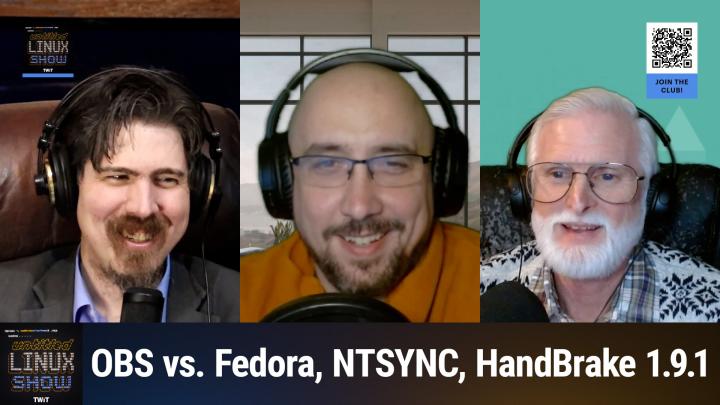
All TWiT.tv Shows (Audio)
Untitled Linux Show 190: A Fedoraish Direction
01:19:37
Controversies Abound, NTSYNC Lands, and OpenSUSE Pivots
Loading summary
Transcript197 lines
- [00:00]
Jonathan Bennett
Hey folks, this week we're talking about the Rust feud as it continues to play out inside the kernel. But there's better news like NTSync and HDR finally landing. You can't use them yet. We dive into what the timer interrupt is in Linux. Talk about the updates to Handbrake, kde, Plasma and more. You don't want to miss it, so stay tuned.
- [00:19]
Lenovo Ad
Stop hitting snooze on new tech. Upgrade the whole team@lenovo.com Unlock AI experiences with the ThinkPad X1 Carbon powered by Intel Core Ultra processors so you can work, create and boost productivity all on one device. Win the tech search for business PCs@lenovo.com.
- [00:43]
Rob Campbell
Lenovo Lenovo.
- [00:49]
Ameca Insurance Ad
At AMECA Insurance, we know it's more than just a car. It's the two door coupe that was there for your first drive, the hatchback that took you cross country and back, and the minivan that tackles the weekly carpool for the cars you couldn't live without. Trust Ameca Auto Insurance. Ameca Empathy is our best policy.
- [01:21]
Jonathan Bennett
Podcasts you love from people you trust. This is Twit. This is the Untitled Linux Show. Episode 190, recorded Saturday, February 15th. A Fedora ish direction. Hey folks, it's Saturday and you know what that means. It's time for the Untitled Linux Show. We're gonna get geeky with Linux and open source software. All kinds of good stuff. It's not just me. And today we've got as Co hosts, Mr. Rob Campbell and Mr. Ken MacDonald. Welcome to both of you. Glad you're both here.
- [01:57]
Rob Campbell
Thank you. I had to tear myself apart away from Civ 7 today.
- [02:03]
Jonathan Bennett
Yes, there is that little game that has released, Civilization 7. You running that on your Linux machine?
- [02:08]
Rob Campbell
Yes. Under Steam.
- [02:11]
Jonathan Bennett
Yeah. Under Steam's Proton. Yeah.
- [02:13]
Rob Campbell
I couldn't find a native Linux version to buy and install.
- [02:17]
Jonathan Bennett
Probably not, not at this point. Some of the earlier Civilization games I think did have native Linux ports.
- [02:24]
Rob Campbell
Well, they said this was coming out with native Linux support.
- [02:27]
Ken MacDonald
Just play free Sieve until the native one comes out. That's a good one.
- [02:33]
Jonathan Bennett
Yeah. Support Steam True anymore though, you have to kind of wonder when they say that it's coming with native support, are they talking about Proton? All right, well, we've got news and Rob is going to be brave and kick us off talking about the big news from this week. In fact, before we got the show started, somebody in our chat room said, did you see this news? We're like, yes, we saw that news. That's probably what we're going to be talking about for most of the show. So Rob, in the way that only you can take it over and tell us what the latest drama is in the open source world.
- [03:10]
Ken MacDonald
So last week Jeff and I shared some overlapping stories involving some drama fighting about Rust being in the Colonel and then he evolved into Hector Martin getting involved and and saying I'm out of here. Removing himself as the maintainer for the Apple Silicon kernel code and deciding he was no longer going to upstream Asahi code into the kernel. Well this week the plot thickens and there is a lot to update everyone and I'm going to try to hit the high points in in the order that that they happen that they came out. So last week it was hinted that Apple silicon maintainer, co maintainer I mean Sven Peter may find a way to keep upstreaming into the Linux kernel. And good news. Shortly after the show it was confirmed that Sven will keep patches going upstream and helping him will be another existing Asahi developer that I haven't really heard of. I think he's only been around for a year. His name is, I may say this wrong, I'm sure I am Janny Grun now. So Janny has been working on the downstream Asahi kernel well, well since April as well as working on a number of drivers. Jany has the blessing of both Sven and Hector Martin. But with this blessing comes some other bad news for Asahi Linux. At least a few days later where the founder and lead project developer on Asahi Linux, Hector Martin, has announced he is resigning as as the lead developer, stating it's become less fun over time. A lot of users are, you know, are expressing frustrations that they don't support the M3, the M4 or certain features aren't working and it's just not being fun anymore. Here's the quote from what he said. Hector Martin says quote I'm resigning as lead of the Asahi project effective immediately. The project will continue without me. I'm working with the rest of the team to handle transfer of responsibilities and administrative credentials. My personal Patreon will be paused and those who support me personally are encouraged to transfer their support to the SAH Linux Open Collective. GitHub sponsors does not allow him me to unilaterally pause payments, but my sponsors will be notified of this change so they can manually cancel their sponsorships. I want to thank the entire Asahi Linux team without whom I would have never gotten anywhere alone. You all know who you are. I also give my utmost gratitude to all my Patreon and GitHub sponsors who made the project a viable reality to Begin with and from me, you know, we thank you too Hector, for your hard work. And it sounds like many aspects of the project, you know, were becoming frustrated. I can understand that. And this fight over the kernel maintenance issues was maybe just kind of a final straw that tipped things over. So then bring us back to the kernel maintenance issues and the fighting that was going on over rust in the kernel and a maintainer blocking and all that. Everything that. If you need a recap, check out last week's when Jeff talked about it. So it appears folks have decided to create a Rust kernel policy to avoid future conflicts. It lays out key topics like how Rust for Linux is not an effort by the Rust project or the Rust Foundation. It says how many key kernel maintain or it says how many key kernel maintainers do support Rust in the kernel and how changes are not allowed to be introduced if a C change breaks a Rust enabled build. And, and with the exception for Rust subsystems, also it states that duplicate C or Rust based drivers are not allowed. However, subsystems may temporarily allow them to make it easier to introduce Rust support and get it working smoothly. So this policy was published by Miguel Ojeda and he is a Rust for Linux contributor. So, you know, personally I guess I would feel maybe a little confident about this policy if it actually came from Linus Torvalds. Great kh, the Linux Foundation. I'm not sure how individual contributors, especially one aligned with Rust is, is doing this policy. And maybe I haven't seen it yet, but I guess at this point it just kind of seems like, you know, if an employee, you know, me, is like, I'm going to write a policy and tell my CEO, CEO how he should act.
- [08:39]
Jonathan Bennett
I don't know, Miguel, Miguel is essentially the Russ for Linux guy. He's, he has been the guy that is, that has made all of this happen. So like if I were, if you were to ask me like who, who is the one person that could write the Rust the Rust Colonel policy, that it would be him.
- [08:57]
Ken MacDonald
But he's also on the Rust side. I guess I would like to see support on the seaside of the Colonel.
- [09:04]
Jonathan Bennett
Saying, oh, I see what you mean, I see what you mean.
- [09:06]
Ken MacDonald
You know, we're the sea guys. You know, it's the sea guys who are telling the Russ guys to get out of here, that your code doesn't belong here, whatever. You know, I'm maybe exaggerating. So now it's Russ guy saying, oh, here's a policy so you can accept our stuff where I'd really feel more comfortable if is the C guys saying, here's the policy, we'll accept your stuff under these conditions. Because it's like me saying, no, boss, you're going to accept this because I wrote this policy saying you are.
- [09:38]
Rob Campbell
We got to remember this actually got started as a hobby for one of the Linux kernel maintainers.
- [09:44]
Jonathan Bennett
Yeah. Then everybody realized that it might be a good idea to be able to do this. Yeah. So I have thoughts on this. First off, there were bound to be conflicts. We talked about this last week. There were bound to be conflicts between the C coders and the Rust coders. They come at things from different perspective. It does add to the maintenance burden for the sea maintainers. So it's not surprising that there are conflicts and that it's taking time to work through it. I understand that Hector is just tired and needs some time away from it, and that's fine. Good for him. Like, good for him for realizing that he needed to step down, taking some time away. Hopefully he'll find, you know, something else to be able to pay his bills, be able to move on to something that he really enjoys. We wish him well. I don't think that, especially because we have other people already stepping up to maintain it. It sounds like the Apple Linux on the Apple Silicon is going to continue on. There's a lot of people that are using it now and excited about it. It seems to me that Rust in the kernel is going to continue on, at least for now. And again, we talked about that last week. So this in and of itself probably should not have been a huge story. Right. Like, in some ways, of course it is. But on the other hand, it's kind of. It's normal around the kernel that people burn out, people get tired of doing it and they move on. And, you know, dozens of people have gone through the same thing and have not written a huge blog post about it. And we've probably never talked about it. Every once in a while we'll talk about one that says, I need. I need a break from it every.
- [11:28]
Ken MacDonald
Once in a while. And then sometimes right away afterwards you have another one that has issues with the kernel.
- [11:35]
Jonathan Bennett
So I've got a story here too, and it's a follow on. Very much a follow on. So Carol Herbst has been a. No, no view. No, we always used to say no view. And then we got told, no, no, it's nouveau. It's French. So the Nouveau Driver developer, he is a Red Hat employee and has been working on Mesa and some other things. He today has announced that he is Resigning as the nouveau driver maintainer. And it's interesting, right? So he starts out by saying that he's been thinking about doing this for a long time because he's not really doing the work anymore. Like, he's on there by name, but he's not reviewing, he's not maintaining, he's not writing any of the code for the kernel. He's moved on to other things. And he picked this particular moment when the kernel was sort of. There was a little bit of a drama, bit of a flame war going on to. To make his statement that he was stepping out. I consider it unfortunate that he decided to make sort of a political statement about it on his way out. So one of the other maintainers, in talking about Rust, use the term, use the phrase, we are the thin blue line. And this is, this is an American politics thing for so. So for those of you that are not up on American politics, first off, lucky you. Secondly, this is a reference to the police and the idea that the thin blue line is the police doing their job to prevent society from falling into chaos. That is a. Well, okay, so in some places, among some people, that is a very controversial thing to say. In other places, among other people, that is not controversial at all. So let me put it this way. I live in Oklahoma. In Oklahoma, we can say this, and nobody cares. You even get some nods like, yeah, yeah, of course. People can imagine, like, what would happen if there weren't a police presence at all in a society. You would have problems. You go to certain other places and you make this statement and you. You just about get rotten tomatoes thrown at you because, well, it's, it's. In some places it's considered to be a racist statement. And I'm sure in some places people do mean it with that sort of a tinge. I will say that in the times that I have heard it, at least in person, I do not think that is the case. So that's the background for those of you that are not involved in US Politics. Carol Herbst says in response to that, this is not okay. And he says this isn't creating an inclusive environment. It isn't okay with the current political situation, especially in the US and then he says this, and this is really interesting, a maintainer speaking. Those words can't be kept. That is an interesting statement. I disagree with that statement. And I think actually that is a dangerous statement to make because that is the statement that says someone that is from the other side of things politically needs to be cast out of this project. And that's not what open source is supposed to be about. So I reject this. I think Karel Herbst is wrong and you can agree with him and disagree with me, and that's fine. That's one of the interesting things here is like, I'm okay with you disagreeing with me, but he's not okay with people disagreeing with him anyway. I see this honestly as a disgruntled employee that's just trying to make a mess on his way out of the company. I think, I think that is what's going on here. And I think we should just treat this as. That this is someone that's mad, that's leaving, is worked up over something or other. But you probably shouldn't take their words too, too much to heart too seriously because that's literally what he is doing. He is trying to cause drama on his way out the door. So that, that is my take on this. And feel free to take, have a slightly different take if you guys want to.
- [15:59]
Ken MacDonald
Well, you know, maybe in defense of, of the maintainer who said it, you know, whether or not what his intentions were or beliefs are or how he meant to use it, the phrase alone is at least some places used to be to, to represent police or being that. That thin line between, you know, the, the public and, and everything going bad. So it's, it's like some. One defense, at least I've heard, is that, you know, all he was saying is that, you know, as a maintainer, we're just the people here kind of making sure the bad stuff doesn't come through and, and just kind of protecting it and, and you know, saying it that way, I mean, maybe if, if, because the phrase is seen negative in places, maybe just saying, you know, where the place of the colonel would have been the safer route, but you know, maybe he's from a place like Oklahoma and did not even think about that. The fact that it's, it's.
- [17:16]
Jonathan Bennett
Yeah, it's, it's probably worth pointing out that it may not have been the, the wisest thing like it. Safest way to make his point to do it this way. Ken, you have thoughts?
- [17:27]
Rob Campbell
I do. I'm going to be putting words into some people's mouths with my thoughts here. So I'm going to apologize up front.
- [17:36]
Jonathan Bennett
Do it carefully.
- [17:37]
Rob Campbell
But from reading everything, I get the impression the maintainer was trying to say that as maintainers, we want to try to keep chaos out of the code. And unfortunately, the phrasing he used to say that was a politically charged one. Yes, I have Seen a lot of phrases over the years that I've watched tv, listen to the radio, and now even listen to the streaming, what streams on the Internet. Seeing some phrases that as a youth I didn't take any notice of, become politically charged. And unfortunately, I think this is one of those situations where a phrase is picked up the charge and shocked somebody else.
- [18:46]
Ken MacDonald
Yeah, that may be another thing. You know, maybe it's not just the location where he's at or the people he hangs out with. Maybe it's. I don't know how old this maintainer is either. Maybe, you know, he, he grew up, you know, like you, I guess.
- [18:59]
Jonathan Bennett
Yeah. So I, I would say that we have to like, make some assumptions. No matter what we, we go to, to understand all the like, shades of meaning, you have to make some assumptions and that's that, that's just the fact of it. Right. So you have to either assume that he knew that this was going to be sort of a controversial thing to say and said it anyway, or didn't think about it being a controversial thing to say and it's just something that is part of his vocabulary. I don't, I don't really care. People say controversial things on the LKML all the time. Like, that's not news, that's not new. These things happen. Personally, about all of this story, the one that bothers me the most is the idea that if someone makes this statement, they need to be pushed out of the project. And I am not in agreement with that. I think that is a terrible idea.
- [19:57]
Ken MacDonald
I mean, let's be fair about this. We're talking about the. No, how do you say it?
- [20:03]
Rob Campbell
Nouveau.
- [20:05]
Ken MacDonald
Nouveau. We're talking about the nouveau driver, which is like anyone who knows anything, it's like the first thing they try to replace with the actual proprietary driver. Unless they are all, all about freedom and don't want the quality of life that the proprietary one gives you. But I know that's the first thing I did when I had Nvidia and well, now the first thing I do is I just don't use Nvidia. But.
- [20:32]
Rob Campbell
What I want to bring up though is you still got two people that are going to be remaining as nouveau kernel maintainers and they're also going to be working on replacing it with Nova.
- [20:47]
Jonathan Bennett
Yeah, that's an interesting point. Nouveau is destined for legacy support and they've got some new stuff coming along to, to replace it. So, I mean, so if we want to be a bit harsh here about this particular maintainer, according to even his own Words, nothing of value was lost. Right. He wasn't actually doing the work anymore. And so that's why I say this is sort of like a disgruntled employee trying to make a mess going out the door. He, he could have just, you know, nicely said, I haven't been doing this work quite a while. Why don't we go and take my name off the list. And he decided to make a political statement. A political statement that will rile up people in exactly the same way as the Thin Blue line statement did. Right. So you have the people on the other side of this that are going to get mad because he took kind of like me. I get a little frustrated by it that he took this side of an argument and you have people that got mad that he took the other side of the argument. And so like there's just no making everybody happy. Yeah.
- [21:55]
Ken MacDonald
Anyway, not to bring it up at all and just say, you know what, I'm, I'm out there.
- [22:02]
Jonathan Bennett
Is there, there, there has been, I've seen a couple of projects now that they've talked about this and it's just our rule is we do not talk about, we do not make political statements at all. Period. We do not care what side it is. The partisan politics thing, we just do not do it in any of our official. You cannot come to discord into our random off topic channel and talk about political things. We do not make political statements based from our, you know, our X account or our Facebook account. We do not ban people from making political statements on their own accounts. And I personally, I think that is probably the, the, the, the best direction to take with open source projects. And so, you know, in that case, if so, say that the kernel were kind of theory crafting here, say that the LKML came to that point, then it would just be a, hey, we understand the point you're trying to make, but this is a sort of political statement. Please don't.
- [22:55]
Ken MacDonald
LKML Linux KERNEL mailing LIST Yes.
- [22:58]
Jonathan Bennett
Yes. All right, well, let's talk about some better news. Actual progress code being written.
- [23:07]
Rob Campbell
Waiting to talk about this.
- [23:09]
Jonathan Bennett
Ken, tell us about Handbrake.
- [23:11]
Rob Campbell
I'll be more than happy to, especially since this is coming from Marius Nexter. He wrote about Handbrake 1.9.1 being released this week as the first maintenance update to the latest Handbrake 1.9 series of this free and open source transcoder application for digital video files. It improves support for SRT files with OpenLAD subtitles, improves AVC AV1 video decoding by updating to the LibDAV1.D version 1.5.1 library, as well as improving AC3 and EAC3 extra data in MKV files. HandBrake 1.9.1 also fixes an issue that could happen when chapter titles are not UTF8, fixes FFV1 pixel format selection when using a hardware decoder, fixes GCC14 build failures on Arch64 or ARM64 and updates to the Lib JPEG Turbo version 3.1.0 library for preview image compression. Now I'm going to cut it short here since the rest of Marius article covers fixes related to an operating system from Microsoft that I'm not too concerned with myself. If you are, I do recommend reading Marius article so you can get information about those fixes.
- [24:55]
Jonathan Bennett
Yeah, so I you know I use Handbrake. It's been, it's been a bit but getting like DVDs in particular up into my Kodi instance. Super useful tool. So good to see them making progress and keeping that project ongoing.
- [25:11]
Rob Campbell
I've used Handbrake with some of the time shifted programs. I have to transcode them so that my Plex server doesn't have to worry about doing it.
- [25:26]
Jonathan Bennett
Yep, yep, I am. I am on Team Cody, not Team Plex. But that's okay. We can agree to disagree.
- [25:33]
Rob Campbell
Well actually been bouncing between that and just using a network connection and playing with vlc.
- [25:40]
Jonathan Bennett
That works too.
- [25:42]
Lenovo Ad
Stop hitting snooze on new tech. Upgrade the whole team@lenovo.com Unlock AI experiences with the ThinkPad X1 Carbon powered by Intel Core Ultra processors so you can work, create and boost productivity all on one device. Win the tech search for business PCs@lenovo.com.
- [26:12]
Ameca Insurance Ad
At Ameca Insurance we know it's more than just a car. It's the two door coupe that was there for your first drive, the hatchback that took you cross country and back, and the minivan that tackles the weekly carpool for the cars you couldn't live without. Trust Amica Auto Insurance Ameca Empathy is our best policy.
- [26:43]
Jonathan Bennett
All right, Rob, you just have all of the controversy today.
- [26:47]
Ken MacDonald
That's what I do.
- [26:48]
Jonathan Bennett
This one is different. At least we don't have to step into political waters to talk about this one.
- [26:53]
Ken MacDonald
Nope.
- [26:53]
Rob Campbell
Just legal waters.
- [26:56]
Ken MacDonald
Yes, a little. Well, potentially potential legal waters at some point here. But so you know, everyone is angry these days and, and now two of Jonathan's favorite companies are feuding.
- [27:14]
Jonathan Bennett
Projects, not companies.
- [27:17]
Ken MacDonald
Projects. Projects. Right.
- [27:18]
Jonathan Bennett
Much, much less. I will, I will just, I will just step in here and say much less love loss Loss, Yeah, much less love lost. There we go. For the company, particularly behind the distro there than the distro itself.
- [27:31]
Ken MacDonald
Good point, good point. So the two projects that, I mean, I know Jonathan is using these right now. In one corner we have Jonathan's favorite Linux distro, Fedora, and in the other corner we have a piece of software we all love on the show. We're all using it, we all use it. Every panel here. And that's OBS Studio. So Fedora, you know, they like to package their own flat packs for software and they build it from their RPMs and apparently they don't do a great job maintaining them. So the issue is that the unofficial OBS Studio Flatpak, it's in poor condition, causing many users to report issues to the OBS Studio developers mistakenly thinking they are using the official build. A few weeks ago OBS requested the removal or yeah, to remove the unofficial OBS flatpak, which. Or just present it better, you know, keep it up, make it work, test your work before you publish it. And it sounds like folks at Fedora were not taking this issue seriously, with one of them apparently even resorting to name calling by labeling the OBS Studio devs as being terrible maintainers. So now OBS lead Joel Bethke has stated that if Fedora doesn't remove all of OBS branding from the unofficial flat pack by February 21, a very special day for me for other reasons. It's my birthday. They will pursue legal action against them. And since then, you know, since these threats of legal action, you know, this little OBS Studio project going against, well, someone with the backing of IBM in.
- [29:34]
Jonathan Bennett
A, in a way, in a way.
- [29:38]
Ken MacDonald
I mean, I, I don't know how, I don't know how that would turn out. Maybe they would just let them fend for themselves, but it looks like we're not going to get to that point. Threats were enough. Fedora got scared or they realized the flaws in their ways. So since then, Fedora contributor and member of the Fedora Engineering Steering Committee Neil Gampa, has opened an issue to remove the OBS Flatpak from the registry. Seems they already started this and there's some, A few things wonky and flat pack about it. So you may want to get your OBS Studio somewhere else at the moment, but it's not going to be, it sounds like it's not going to be in there in the future at all. Or maybe it's not today. I don't have Fedora, but yeah, it looks like they're going to back down and stop maintaining that and that's less work for. For them. But you know, this isn't the first story we've had where developers have had issues with unofficial Flatpak releases being poorly maintained and causing issues for them. I think it was just a couple months ago I had a story on Open an Open Seuss maintainer and bottles having a feud, if you don't recall. I don't know. Look, about two months back Open Seuss maintainer removed the donation link for bottles because Bottle about Open Seuss was doing a poor job. And I kind of like the, the way OBS is doing it. Sounds like a. A more maybe productive. I mean it worked pretty fast. But you know, it really brings back. I mentioned this last time. If, if you're gonna main if you're going to maintain a a package, make sure it works, test it or just don't maintain it if you don't have the time, you know, focus your attention on what you do have time to do.
- [31:34]
Jonathan Bennett
Yeah, there. There was one thing about this that really surprised me and that is that I didn't know that Fedora maintained these sort of these packages in this way because like they have RPMs and there are the official packages that are outside of the RPMs. It's like why, why does Fedora have their own like feed of this thing? That's one unofficial but also not how Fedora officially packages things like I don't see the point of having this extra flat pack. And then apparently also there was something like depending upon how you went to install it, Fedora was automatically redirecting you to the Fedora version of it, which that does sound a little sketchy.
- [32:21]
Ken MacDonald
Sounds a little bit like an Ubuntu APT redirecting you to Snap Snap. Yeah, I guess they're not the only ones.
- [32:27]
Jonathan Bennett
Yeah, apparently so. Anyway, all that to say, you know, it's a weird story. I'm glad that they finally put their heads together and figured out what they're going to do. You never like to see like two different open source projects threatening legal action. It's just not a. It's not great maybe.
- [32:49]
Rob Campbell
And it's not cheap.
- [32:51]
Jonathan Bennett
Well, threatening legal action is cheap, actually. Following through is not. It costs lots of money, makes lawyers very rich. Yeah, it would have been nice if the OBS folks had talked to someone, you know, made made contact with the right person rather than having to threaten legal action first.
- [33:12]
Rob Campbell
Who is the right person though?
- [33:14]
Jonathan Bennett
That's sounds like it sounds like Neil Gampa. He is he's, he's a pretty reasonable fellow and I've talked to him before, I've talked to him about things and he's part of the Fedora release team. He's part of the, mainly the KDE side of Fedora. But he does more than just kde and it sounds like he's the one that finally made stuff happen here. I got to looking and I actually run OBS Studio from inside the Flatpak and I do that because it automatically comes bundled with things like the Chromium browser extension so that you can show web pages inside of OBS from within.
- [33:50]
Rob Campbell
Side of which Flatpak.
- [33:53]
Jonathan Bennett
Well, on this machine it's POP os, so it is the flat pack. Yes, the, the, the unofficially official flat pack. Because it sounds like. Didn't it, didn't they say that was going away too?
- [34:07]
Rob Campbell
No, they were going to be updating the runtime in it, hopefully.
- [34:12]
Jonathan Bennett
Okay.
- [34:13]
Rob Campbell
So a lot of applications that you can get in Flatpak where they need to update those run times.
- [34:22]
Jonathan Bennett
So I'm sure what happens is they've got the flatpak build set up as part of like their continuous integration suite on GitHub and it's got the scripts to pull everything down, but they to be able to do like reproducible to have a sane build process, they specify the version numbers on things and it's, I'm sure it's just nobody's gone in there and messed with that script and updated that version number of you know, like what GNOME libraries are going to be on the back end of that Flatpak. So that's, that's fairly typical. That's just busy work that somebody needs to be reminded to go to.
- [34:57]
Rob Campbell
Set up a reminder the next version comes out, we need to update that script.
- [35:02]
Jonathan Bennett
Well, you can, you can actually do that. Boy, there are some people that are just the GitHub integration wizards and one of the things that they will do is they will set up to automatically run some of those, you know, go check for updates as a GI run. And so like every time, every time you do a release you then get ping an email or a new issue, you can also set it up to open an issue. Hey, this library is out of date. Hey, you know, this is out of date. You really got to update it. And yeah, it's, it's a, it's a lot like there's a lot of wizardry in making the continuous integration on something like GitHub really, really sing well and do what you need it to do. But when you have it set up and it's actually working well. It's really nice. All right, so we could make some.
- [35:48]
Rob Campbell
Money off the teaching that potentially.
- [35:51]
Jonathan Bennett
I'm sure there's classes, I'm sure there's people out there that do it. So I want to talk for a minute about a couple of things that have landed really cool things that have landed that for various reasons are not working or available yet. And the first one is NTSync, not in sync, but NTSync. And that is a. It is a synchronization primitive from the Windows NT kernel that is now inside of the Linux kernel. And it is literally just there to make Wine work better. We've talked about this a couple of times and once just a couple of weeks ago, I believe. And this, it makes a drastic difference on games and some of their FPS numbers, some of them getting like 200% increases on FPS, going from not playable at all to buttery smooth. And it takes this way that the NT kernel expects to be able to synchronize things and it moves it into the kernel. And once you get everything wired up to use it, it is amazing. Now, there are a couple of problems, which is why we're talking about it. One, it's a character device, which means it's in dev, it's a char device dev. NTSync was only read write to users by default and it is new enough that systemd doesn't know to change the permissions on it. And so that essentially means that it was useless out of the box because you run all of your Windows games as your user and that was not the same user as that device. And so you either had to go in and change the permissions or set up a new group. Not something that every Linux user knows how to do. And so there's a patch now that's been pushed to the. To the driver. I don't know that it's been accepted, but they have indicated that it's acceptable. That would change the defaults on that file to something like a 666 or 444, make it more accessible. And then there's also work being done to get it inside mainline Wine. So the other interesting thing here is you've got, you've got Wine, you've got Wine Staging and you've got Proton. I believe there are patches in Wine Staging and Proton that will make use of NT Sync, but it's not in upstream Wine yet. And that's because the upstream Wine guys are much pickier about, like the they're much pickier about the sort of hacks that they're willing to pull into Wine. There is a patch there that someone is working on that they're hoping will be acceptable and so maybe it'll show up there soon. But again, I believe this is, this has already landed in Bhutan and Wine staging, so that is that. And then the other thing that has finally landed, and I mean finally landed, is the HDR protocol for Wayland. They finally merged it and this has been an open merge request for five years now. In fact this is merge request number 14 on the Wayland GitLab. And I am just quickly looking to see they're up to. Okay, they're only up to 381, but still number 14 out of 381. A very early merge requests, one of the earliest that have not been either merged or closed. Hundreds and hundreds of comments, people being less than useful in some of those comments. But they finally got, you know, everything straightened out and everybody happy or at least happy enough. It finally got merged and so now we finally have HDR and Wayland. And you say, oh great, that means that we have it in Chrome and Firefox and everywhere else too, right? No, Nope, nope, nope, nope, not yet. It is in kde, I believe they did implement it in the still being developed version of Gnome. So in like the next release of Gnome it's going to have some of these extensions exposed. Gamescope has it working and the MPV video player has it working. And in fact I have done a command line tip in the past here where I have an alias that's HDR play that has the various flags you need to get the MPV to actually play a video in hdr. Cause I think at the time it wouldn't by default. It might now, but at the time it by default did not do so. There is a patch in Firefox being worked on that would enable HDR for video playback. And I don't know that it has not made a whole lot of progress here recently. I was told that it actually worked for a small time, like a real short amount of time it actually worked, but it now no longer works. And I've tried a couple of times to compile it and get it working. So you know, it's, it's, we're, we're waiting. It's last updated two days ago, but that one's been open for five years as well. It's Mozilla bug 1642854 and unfortunately the guy that is doing the work on that has not been. Not been around for a few days. So we are still sort of, sort of waiting to see what happens with that. So we've got two really cool things that have finally landed in Linux and you can't very easily use either of them, but it's closer, we're getting closer.
- [41:32]
Ken MacDonald
The hard stuff is done.
- [41:34]
Jonathan Bennett
Yeah, that's actually true. That's actually true. I've actually, I've really been thinking about going to Chromium and opening a bug and just say, hey, it's here, it's here, let's do the thing. Come on, guys. Because I haven't found one. I haven't found an open bug in the Chromium source code. There's like a really old bug where someone's like, yeah, that should totally work at X11. I don't think so. So I might just go reopen that one and update it. Wayland.
- [42:01]
Rob Campbell
So with this, does this mean we'll also start seeing blue filter like options?
- [42:07]
Jonathan Bennett
Those are already out there. You can already run like Nightlight, I believe. Is. Is that what KDE calls their solution?
- [42:14]
Rob Campbell
Yes, it is.
- [42:15]
Jonathan Bennett
Yeah. So that'll. That'll do. Red tint and blue tint, depending upon the time of day, which. I ran that for a while. I don't know if it actually helped me sleep, but it was cool that you could.
- [42:24]
Ken MacDonald
Now, with this, it means I need a new monitor.
- [42:27]
Jonathan Bennett
It means you need a new monitor. Yes. Go, go invest in like an OLED, some big 4k HDR OLED monitor. Ah, they're.
- [42:38]
Ken MacDonald
I have been thinking I really need to get a nice new gaming monitor. You know, some of the games I've been playing with people and they're describing what they have, like, oh, that seems like that could be kind of nice. Here.
- [42:51]
Jonathan Bennett
Make sure you get one that has DisplayPort. Oh, yeah, because HDMI. HDMI is sort of crippled.
- [42:57]
Rob Campbell
Then you need to get KD, KDE Plasma 6.3 for managing that new monitor.
- [43:03]
Jonathan Bennett
There are some interesting things in 6.3. Ken, you've got that story, don't you?
- [43:08]
Rob Campbell
Yes, I do.
- [43:09]
Jonathan Bennett
Well, let's do it.
- [43:11]
Rob Campbell
And this story this week is coming from Saurav Rudra and Marius Nestor. They both wrote about the latest KDE Plasma 6.3 desktop environment release. Now, according to Sarav, it aims to be the ultimate desktop for digital artists. Plasma 6.3 ships with a revamped drawing tablet page in the system settings app that allows artists to easily map the entire screen area of a drawing tablet. Surface shows information related to tilt and pressure. This is during your stylus testing allows tweaking the pressure curve and range of a style stylus and remapping or swapping of stylus buttons. Now Kwin will now snap elements to the screen's pixel grid, eliminating blurriness and gaps while producing a sharper, more crisp image on that new monitor rom. The overhauled fractional scaling makes the experience of using a high resolution display much better than before, according to Marius. The ability to clone a panel, support for remembering the active virtual desktop per activity, an option to prefer screen color accuracy in Kwin, and support for viewing battery cycle count in Infocenter are some other highlights of KDE Plasma 6.3. The K1 window and composite Manager received improvements in choosing a default scale factor for devices with small screens and support for the automatic scale factor chooser to select a scale factor that's rounded to the nearest 5% rather than the nearest 25%. Also, it's now possible to temporarily disable K1 window rules instead of deleting them. Also new is the ability to show low battery notifications for wireless headphones that properly expose battery information, the ability to configure the touchpad to be automatically disabled when plugging in a mouse, and the ability to set keyboard shortcuts to move windows between custom tiling tile zones based on directionality. Now I've only touched on some of the highlights from Marius and Saurabh's articles. If you do want more details, then follow the show note links to the respective articles.
- [45:55]
Jonathan Bennett
Yeah, I I am not running 6.3 yet. I have. I'm tempted to. I'm tempted to to again run the Bleeding Edge packages and I'm waiting to.
- [46:05]
Rob Campbell
See which one I'm going to have when I reboot into Tumbleweed tomorrow.
- [46:11]
Jonathan Bennett
You'll probably have whatever you had when you left it and you'll have to do updates to get something new.
- [46:17]
Rob Campbell
Yeah, I can't remember if I did an update right before before shutting down or not. Yeah, I usually do.
- [46:23]
Jonathan Bennett
Yeah. When Was the actual 6.3 release date?
- [46:26]
Rob Campbell
Oh, let's see. I said I want to say it was back around the last couple of days.
- [46:35]
Jonathan Bennett
Looks like the 11th. So four days ago is at least when this says so cool. Yeah I will so I will get it to it.
- [46:47]
Rob Campbell
I just need to pull up the about system information to check and see which one I've got.
- [46:54]
Lenovo Ad
Yeah yeah Stop hitting snooze on new tech Upgrade the whole team@lenovo.com Unlock AI experiences with the ThinkPad X1 Carbon powered by Intel Core Ultra processors so you can work, create and boost productivity all on one device. Win the tech search for business PCs@lenovo.com.
- [47:26]
Ameca Insurance Ad
At Ameca Insurance, we know it's more than just a car. It's the two door coupe that was there for your first drive, the hatchback that took you cross country and back, and the minivan that tackles the weekly carpool for the cars you couldn't live without. Trust Ameca Auto Insurance. Ameca empathy is our best policy.
- [47:57]
Rob Campbell
All.
- [47:57]
Jonathan Bennett
Right, so Rob, we've talked about politics, we've talked about legal issues. What more could Linux geeks get offended and upset about? What else do you have in your toolbox?
- [48:10]
Ken MacDonald
All right, here's one you're really going to get angry about here.
- [48:13]
Jonathan Bennett
Systemd is all that's left, right?
- [48:16]
Ken MacDonald
System D. So this isn't going to be a very long story and very few of us are likely to be using this feature. But I just thought it was really cool so I wanted to bring it up and share with everyone. And to all you systemd haters, too bad. So you all know. Well, maybe you don't all know, but many of you probably know what Pixie boot is. Pixie spelled pxe. So that allows you to boot from an ISO on the network. You know, kind of like instead of booting from a USB or an optical drive or your internal hard drive, you could boot from a Pixie server set up for this. Well, systemd, I just wanted to bring the drama today so I had nothing left. But systemd is adding a feature similar to PKCE boot, except it is allowing us to boot from HTTP as in boot from the Internet. The ability to let systemd boot directly into disk image downloaded via HTTP. They keep saying HTTP everything I write. Hopefully they have HTTPs at least someday. I don't know. But anyway, downloaded via HTTP within the initial RAM disk init RD during the Linux boot process eventually. This should allow you to point a UEFI to a single URL where it can then load the unified kernel image from and then in turn picking up the root file system and booting it up. Leonard Pottering, the guy who's been working on doing all this work, he's already looking to extend this into supporting NVME over TCP and other features in the future. Which is cool. So, you know, maybe not something everyone's going to use. That's a freaking awesome feature in System B, I think. And you know, I like to see you do that with your system. By five I was combining V&5 system B, system 5 init system.
- [50:47]
Jonathan Bennett
Yeah, this, this is, this is actually kind of fun. I'm reading through the Mastodon thread here about what he is hoping to accomplish with this. And for him it's just to be able to spin up images and test them out faster. Which you know, that's cool in and of itself.
- [51:05]
Ken MacDonald
I mean for that purpose, if you're, I don't know, it's not too fast, it's not too slow to do it. Just a pixie boot. But I suppose if he doesn't want to download it.
- [51:17]
Jonathan Bennett
Yes, yes. He also talks about being able to boot directly from a tarball. You can boot into a tarball now with just a uki. So like there's some, there's some interesting stuff there. It would not terribly surprise me to see like netboot images start to use this.
- [51:33]
Ken MacDonald
Yeah. Oh yeah, that'd be a pretty, a pretty slick way. I mean, yeah, they already have in the Net boots are very minimal. Downloading, download ISO and just gets it all from the Internet. I mean you could just put it the point where you just point to it and boom, install.
- [51:49]
Jonathan Bennett
Yep, very cool. All right, so I've got a bit of a geeky story here about the kernel and that is the timer frequency. And so there is a proposal to change the kernel's default timer frequency. I figured we could talk for just a minute about what exactly this means. The default frequency right now is 250 hertz. And that essentially means that 250 times a second the timer interrupt runs. That means that program execution goes away from user space, enters kernel space and the scheduler runs. It looks at what's running, what needs to run, pushes out the next slice of time. In the scheduler, it runs at 250 hertz. And the proposal is to push that to a thousand hertz essentially to, to schedule the system in 1/1,000th of a second slices. And that's, that's fairly interesting. And so Michael Larabel looked at that and said well, I wonder what that's actually going to do on benchmarks, as he is want to do. And he ran several different things. Some of them did much better under the new proposed thousand hertz, some of them did better under the old 250 hertz. LL, for example, the AI benchmark did much better. Nginx did it better under the thousand hertz. But then you get to things like darktable did much better under the 250 hertz. And it kind of extrapolates out to programs that are just going to. They Get a task and they churn on that task for a significant amount of time, like what darktable does. And so by significant I mean in, like in kernel time, it's going to churn on that for a while. Then you will probably do better with fewer interrupts, with fewer of these timer interrupts. But when you're looking at something that is sort of very, very quickly moving from thing to thing, and sometimes nginx is going to be one of those, you might do better with the faster interrupt timing. And so it's interesting just to look at the different use cases. Some games do better with one, some games do better with the other, and for some things it seems like it's basically a dead heat. It has been suggested, I've seen it elsewhere, that this might improve system responsiveness to user input just a little bit. I don't know if that's enough that the majority of us would really be able to tell, but theoretically it could. And then the one other thing is that a lot of distribution kernels, so Ubuntu's kernel already compiles in and says let's use the 1000 hertz. So it's just. It's an interesting little change that may or may not land, but I figured it would be good to talk about what exactly that means. Why we care about. I think believe this is also called the tick rate. Why we care about that.
- [55:00]
Ken MacDonald
So is that something that would be user configurable or would you have to compile your kernel for. Do you know?
- [55:07]
Jonathan Bennett
I believe it's. I know it is a compile time option. I'm not sure if it is possible to change that on the fly or not.
- [55:16]
Rob Campbell
Or you have two versions of the kernel compiled and set up your boot menu, whichever one you're using. So you can switch between one to the other, depending on what you need to do.
- [55:30]
Jonathan Bennett
That would take a reboot though, so, you know, that's quite a bit longer than just being able to cat a value to something in slash, slash, slash sys slash proc.
- [55:38]
Ken MacDonald
Yeah, I'd hate to reboot every time I want to do a different, you know, run something else. But I guess it's better than recompiling the kernel every time.
- [55:46]
Jonathan Bennett
Mm, absolutely.
- [55:48]
Ken MacDonald
I'm just wondering, you know, like, unless.
- [55:50]
Rob Campbell
There'S some way to switch kernels without rebooting.
- [55:55]
Jonathan Bennett
Only sort of.
- [55:57]
Rob Campbell
Only sort of basically run up a vm.
- [56:02]
Jonathan Bennett
Well, no, there's more than that. So you can. You can jump execution. In fact, this. This used to be a thing that was done more Commonly you can jump execution into a new kernel, but it's actually very similar to a system reboot. It's basically doing a reboot without turning the power off.
- [56:21]
Ken MacDonald
Yeah, the old system System V couldn't you just run a. Do a new init and I don't remember.
- [56:31]
Jonathan Bennett
Yeah, there was a way to do it. I think there's even a CPU instruction to do it. I don't know. I. That is. That is not something that I ever had to do and it's not something that hardly anybody does anymore. So it's. It's sort of black magic to me.
- [56:48]
Ken MacDonald
I'd be. I'm just curious if I could improve my web server's performance with.
- [56:53]
Rob Campbell
With the. It'd almost be like having to reboot int and bring back up. Just run up one application. Like switching from darktable to nginx.
- [57:09]
Jonathan Bennett
Yeah, it's. It's. But you're. You're replacing the running kernel out from underneath itself. I will see if I can find this. This bit of Internet lore that I have obviously forgotten. It's at your time.
- [57:19]
Ken MacDonald
Use that as your tip next week. How to change your kernel while running.
- [57:24]
Jonathan Bennett
See, that's crash everything that's going to make it sound like I endorse this idea. I do not do a real reboot. It's much safer endorse it. All right, Ken, tell us what's new with OpenSUSE Tumbleweed.
- [57:41]
Rob Campbell
And this is coming from Bobby Barsoff. According to Bobby, big changes are landing in OpenSUSE Tumbleweed starting with snapshot 2502 11. So it's actually already out. Selinux will become the default mandatory access control system for new Tumbleweed installations. Now, Selinux, or to say it the full name Security Enhanced Linux is a security feature built directly into the Linux kernel that controls what applications and users can access on a system. It sets strict rules about what programs end users can do, which helps prevent unauthorized access or damage if a system is compromised. Now, we've heard Jonathan talk about that sometimes. Now, according to Bobby, the maintainers have confirmed that existing Tumbleweed installations will remain untouched. Thankfully, if any user prefers app arbor during a fresh installation, the installer will provide a simple option to switch to AppArmor. It is worth noting that this shift does not apply to OpenSUSE's Leap 15X series, which will remain on its existing security model. For Tumbleweed, the first boot after installing Selinux can take a little extra time to complete system labeling a little. So don't be alarmed at things seem to run a tad slower immediately after setup, Bobby also includes a link to opensus announcement in his article. As always, you will find a link to Bobby's article in our show notes.
- [59:34]
Jonathan Bennett
Yeah, so K exec is the command I was thinking of and that will be very interesting to look into. But the idea of a Selinux system relabel, or in this case an initial labeling of the system, that takes some time. Yeah, I've had to sit and wait for machines to finish that before they will continue booting up the relabel. It can take some serious time.
- [60:03]
Rob Campbell
Enough time to get a cup of coffee or to eat a full meal.
- [60:06]
Jonathan Bennett
It depends upon how big your hard drive is and how fast it runs.
- [60:11]
Ken MacDonald
It depends on how big your cup of coffee is.
- [60:16]
Jonathan Bennett
So like if you have a big RAID array and you have to relabel everything on it and it's multiple terabytes.
- [60:21]
Rob Campbell
Maybe just go to bed, go for a vacation.
- [60:25]
Jonathan Bennett
I more than once I've started a process and then just gone to bed and hope it'll be done in the morning.
- [60:31]
Rob Campbell
Wake up and it's only halfway.
- [60:33]
Jonathan Bennett
That's usually not a good sign.
- [60:35]
Ken MacDonald
It's been years since I've done that, but I've done it.
- [60:38]
Jonathan Bennett
Yeah, no, I mean doing something like a DD Rescue on a disk.
- [60:42]
Ken MacDonald
Okay, I guess, yeah, I've done things like that, but it's still been quite a while since I've had to do that.
- [60:48]
Jonathan Bennett
I've got a disk I just gave up on the DD Rescue because on a 500 gigabyte disk I was down to 5 megs that it couldn't pick out in various places along the disk. And so just today I started the copy back over to the new SSD and then we'll pop that into the computer and see if it's got enough of it to be able to boot or not. We'll see. Hopefully. Anyway, Sclinux. I'm a fan of Sclinux. I think it is worth it. It's very fascinating to see OpenSUSE going in sort of even more Fedora. Ish direction.
- [61:26]
Ken MacDonald
Does fora use app image?
- [61:28]
Jonathan Bennett
Oh yeah, no, Fedora uses Selinux.
- [61:31]
Ken MacDonald
Oh, oh, they're going. Never mind. Yeah, yeah, yeah.
- [61:35]
Jonathan Bennett
So.
- [61:38]
Rob Campbell
Ubuntu uses App Armor. Correct.
- [61:42]
Ken MacDonald
I'm more familiar with App Armor, but.
- [61:44]
Jonathan Bennett
Yeah, they do basically the same thing. So much so that I don't think you can effectively run them at the same time. I think I step on each.
- [61:53]
Rob Campbell
Not sure you'd want to run them at the same time.
- [61:55]
Jonathan Bennett
It's like having two antiviruses installed at the same time on a Windows machine.
- [61:58]
Rob Campbell
Like I said, I don't think you'd want to run them at the same time.
- [62:02]
Ken MacDonald
When things don't work, I don't run either. I just turn the whole thing off.
- [62:06]
Jonathan Bennett
Yeah, when things don't work, you just walk away. There's no running required if you have to run away. Things really went badly.
- [62:15]
Lenovo Ad
Stop hitting snooze on new tech Upgrade the whole team@lenovo.com Unlock AI experiences with the ThinkPad X1 Carbon powered by Intel Core Ultra processors so you can work, create and boost productivity all on one device. Win the tech search for business PCs@lenovo.com.
- [62:45]
Ameca Insurance Ad
At Ameca Insurance we know it's more than just a car. It's the two door couple that was there for your first drive, the hatchback that took you cross country and back, and the minivan that tackles the weekly carpool for the cars you couldn't live without. Trust Amica Auto Insurance Ameca Empathy is our best policy.
- [63:16]
Jonathan Bennett
Oh, all right Rob, let's talk about Etsy Keeper.
- [63:22]
Ken MacDonald
Etsy keeper pronounce it etc keeper I'm not gonna bring up anything to display so this is gonna be an audio only get to look at you look at me if you're watching the video which is pretty awesome too but etc keeper I I linked some documentation the show notes to the ubuntu documentation on it but you can use you know it integrates with like app T8F yum I know there's a pacman integration even though I didn't necessarily see that was official pacman being arch but anyway what etc keeper is because that's what I've been calling it. It's a version control for your system configs or your etc etc folder. So when you install this and initialize it by default it commits daily but then it also commits before and after package installation. If you got the hooks into your package manager which most will be by default you can also manually make a commit to ect Maybe you were in there and made a manual change to an etc file an etsy file and you want to save that make a commit. You just do the command is sudo etsy keeper space commit space quotation and you put like a comment reason in there for your commit. It's very much like git before Etsy you can do other things such as etsy keeper space vcs space log and then do a specific file like Slash Etsy Spa/Password and then you can see the the commit log for that specific file or you could do them all would be crazy. You can do the same thing. Etsy Keeper VCS status, which will just show the status. Like it'll show that maybe you're on the master branch and if there are any changes pending to be committed, if you change a file or something. And then you could also do, you know, lots of other things you could do, like a diff to see what's different, see what's changed since you've done a commit. So if you want to keep versioning of your Etsy, just Etsy Folder. Etsy Directory. Folder is a Windows term. Don't know why let that slip out your Etsy Directory. You know, this is an excellent tool for you because it's pretty much automatic, has hooks into your stuff and it'll just do its thing. And then you can always look back at old commits and see what changed. If something's not working right for you and you don't remember what you changed, you can look back at that too, just by, you know, doing a log and compare it with this commit to that commit and make your change.
- [66:37]
Jonathan Bennett
For saying folders instead of directories. For absolute. For absolution, you must say the GNU Linux copy pasta three times. Oh, okay.
- [66:52]
Ken MacDonald
Myself out. Bye bye.
- [66:54]
Jonathan Bennett
That's. Nah, that's fun. All right, Ken, you've got yet another pipewire command.
- [67:01]
Rob Campbell
Yes, I do, and this week it is pwconfigure. This command can be used to debug pipewire server and client configuration files. Now, as with all the pipewire commands, and let me go ahead and bring up my screenshots here. You can use the H or help to show a basic help screen. And of course you'll see, for those of you all listening, I've brought up terminal showing PW config space h and one of the commands that it mentions that you can use is dash dash version, which I also rent, which gives you the compiled and linked version that the command works is working with. Now, the default action when running PW config without any options or flags is to list the default pipewire config paths. And for those of you all listening, I just switch to another screenshot of my terminal where I showed running PW config and the default config path in this case is/user ser pipewire pipewire conf con conf. So that's what my pipewire system's default configuration is running off of. And as we also. You can also use a dash end or dash dash name and give the name of the configuration file that you're wanting to look for. In this case, I did PW config space-n space pipewire-pulse-conf and it comes back saying that the default config path is user ser pipewire pipewire pulse config and it also showed that I've got two other configuration files set up to override that. One is home dad slash dot config slash pipewire slash pipewire dash pulse dot com D nice level dash dash eleven dot config and the second one has the file name itself is RT Preo83. This is to change the real time or configuration options for the pipe wire pulse. Next that you thing that you can use a PW config for is to list out the configuration file and it'll start off by giving you the config name or config name and the name of the file its path and also list out everything in it like context properties, contact SBA libraries, context modules. This actually takes several pages or several screenshots here. As you see, I'm going through for those of y'all listening, there's a lot of text there.
- [71:05]
Jonathan Bennett
A lot of it's commented out too.
- [71:08]
Rob Campbell
Yes, you wanted to change it. You can take uncommon like one of them is for pulse dot rules. You could uncomment the client name equals Firefox and then uncomment application process binary equals teams and then uncomment application name equals speech dispatcher and it uses the tilde as a wildcard in front of that. Can you guess what that might do, Jonathan?
- [71:45]
Jonathan Bennett
Probably a match all it's going to that exact that exact change? No, I'm not sure.
- [71:55]
Rob Campbell
I haven't tried it myself since I don't have teams installed, but I suspect it would allow you to set it up so that it would use Firefox with the teams binary for passing the speech.
- [72:12]
Jonathan Bennett
Could be, could be.
- [72:14]
Rob Campbell
Haven't played with that part yet. And then you can also use the command by putting dash in the name of the configuration file list and follow it with context properties so it will list the properties that you have. In this particular example, it shows configure that it's going to configure properties in the system where you can set mem warn mlock which is a boolean. You can set a true or false and also shows what you can set the default clock quantum limit. You could say have a rule set up so that you can change it to 8192, but that gives you quite a bit of capabilities.
- [73:14]
Jonathan Bennett
Did you Come across the dash R flag in that?
- [73:20]
Rob Campbell
Yes, I did, and I played around with it, but because I didn't have anything worthwhile. You'd use that when you're doing the merge to reformat basic.
- [73:33]
Jonathan Bennett
Yeah. The other thing that I found useful just now, looking at it, dash R will go in and strip out all those comments. So if you don't. If you don't want to see all the things that are all the lines commented out, dash R will just give you the meat of your config file.
- [73:45]
Rob Campbell
Yep.
- [73:46]
Jonathan Bennett
So, yeah, all right. I've got a pretty neat command line tip, at least I think it is. I'm going to see if I can share. There it is.
- [73:54]
Ken MacDonald
We'll be the judge of that.
- [73:56]
Jonathan Bennett
You'll be the judge of that. Well, that's fine. So I am looking at the pwdump command output here and it is very, very long. This is all from a single run of pwdump. Lots and lots of output. Because it's dumping the entirety of your pipewire status. Well, it's in JSON and there is actually a JSON parser, and that is jq. And so I spent a little bit of time fiddling around with this and it took me a little while to get exactly what I wanted this to do, but I finally found it. And so you could pipe the output From PWDump into JQ and then you can do something like this and it will give you. Essentially you're writing a query. It's sort of similar to an SQL query in some ways, but we can break this down one thing at a time. So if we just pipe pwdump straight into jq, it basically just passes it through unchanged. We can then. And you generally put your JQ command inside of single quotes. So we can do like just. I think a dot is going to pass it through unchanged. But if we were to do and then single square brackets, it's going to essentially strip the top level of brackets off. So it's. And in. In JSON terms, what it's doing is it's going into that first array and it's just giving us the output of the first array. Well, so then once you do that, you use the literal pipe symbol to pipe from your individual bits inside of jq. So our dot square brackets dives into the first array because the pwdump output puts everything in an array and then we can say we want to select where the id. So I'll pull this back up and you can see it here. The ID field is set to 19 and so this is another object inside of this JSON field. We want to select the Object where the ID key is set to 19. And so it's just select and ID equals. Equals 19. You know, we run that and it gives us just that little piece of the entire pwdump. And so you could, you know, you could be a little bit more creative here if you wanted to. I believe you could say something like dot type. And obviously There aren't any type 19s, but we could say, I want to see the types where it's a pipewire interface module and that's going to give us all of those. And so that's an easy way to kind of navigate and pick out just the bits of information you want. And JQ is super interesting for a few other things. For example, I use it actually in a GitHub continuous integration pipeline. We use JQ to pull things from the GitHub API and it gives us to it in JSON and then we run that through JQ to pick out just the one little bit of data that we need to set into a variable to be able to do the next thing. But it is a really useful piece of kit, piece of tool to have in your sysadmin and command line cowboy toolbag.
- [77:25]
Rob Campbell
I think I can find some uses for that just with. Just exploring my pipewire configuration.
- [77:33]
Jonathan Bennett
Yeah, no, that's what last week when you saw it, when you did that, and I saw that it put out so much JSON output. Like, oh, there was a, there was a command that did this and I went and looked for it. It's like, yeah, jq, that's right. Had to do a little bit of reading on exactly how it, how you do the parsing and how you do a select and how you do piping and all of that. Because, you know, the first time I went to do it, I didn't include the single quotes and so I tried to pipe it and bash is all like, we have no idea what the select command is. Okay, fine.
- [78:05]
Rob Campbell
Had fun with those types of responses.
- [78:09]
Jonathan Bennett
Yes, yes.
- [78:10]
Ken MacDonald
DNF, install select.
- [78:14]
Jonathan Bennett
Yeah, and iLag. I don't know if we've done JQ. We may have done it, but we didn't dive into the syntax and it was just a great fit for what Ken came up with last week.
- [78:27]
Ken MacDonald
You might have just mentioned it.
- [78:29]
Jonathan Bennett
Yeah, I may have mentioned it as a way to parse JSON, but now we actually dove into, here's how you write JSON code with it.
- [78:36]
Rob Campbell
I need to use it to dig through to Find out we're got a loopback device being generated in my configuration files.
- [78:46]
Jonathan Bennett
Yeah, you might be able to do exactly that. It calls it the. It's like said for JSON. That's what they say on the official site. JQ is like said for JSON.
- [78:57]
Rob Campbell
So they said JQ is like said for Jason.
- [79:00]
Ken MacDonald
Yes, they said it first.
- [79:01]
Jonathan Bennett
They said it first. All right, I'm gonna let each of the guys give their plugs whenever they want to get the last word. We'll let Rob go first.
- [79:10]
Ken MacDonald
All right, whatever we want to. This one's gonna be exciting, guys. You ready? Here we go. Come connect with me. To find me, you go to robertp Campbell.com and there you'll find near the top and a nice little semi transparent gray rounded corner rectangle versus I'm Rob Campbell at the top. At the bottom of that you'll see some icons. You'll see a LinkedIn icon that's way to the right. That takes you to my LinkedIn profile where you can connect with me there. Or if you prefer, Twitter. I'm not all that active there, but I have an account there. If you just want to connect with me and show off to your friends that you're connected with me. But not a lot of activity. The place I have been the most active lately is Blue sky. And that's just because that's somehow where I suddenly got the most followers. I'm over 500. So let's have a goal and let's get. Let's get me to a thousand. So Blue sky or I am still active on Mastodon. Lots of times I. I double post these. So if you like the freedom of Mastodon, come and connect with me there. And if it doesn't matter to you or you want to do them all or you want to do none of them, it doesn't matter. This last one here is the place where you can donate a cup of coffee to me. And I haven't had one for a good. Feels like a month or two since they're on Christmas time. So I really could use a coffee.
- [80:47]
Rob Campbell
Because nobody has the money to. They're still trying to pay off that debt from Christmas.
- [80:53]
Jonathan Bennett
It might be. All right, Ken, anything you want to plug?
- [80:56]
Rob Campbell
Yes, I do have article by Liam Provman where he talks about an old suite learning new tricks. It's in the show notes, so follow it and read what the Liberty office announced at Fostin.
- [81:15]
Jonathan Bennett
An old suite learning new tricks. I will have to take a look at that. All right, thank you guys for Being here, I appreciate it. All right, so if you want to follow me, you can find my stuff over on Hackaday. It's where Floss Weekly is at. That's where my Security Security column goes live every Friday morning. We may skip it for a week. Uncertain yet? The future is very uncertain for me here for a few days. But if I do end up going off to a security conference, which is the current plan, then probably won't have the security column this week and we'll double up on it next week. But anyway, you can follow me there at the Hackadays. Other than that, we just appreciate everybody being here, appreciate those that support TWiT. If you're not a part of Team Twit, you should really come join Club Twit about the price of a cup of coffee per month. You can support the shows and the network that you love and we would love to see you there. But regardless, we appreciate everybody that watches and listens, both live and on the download. And we will see you next week on the Untitled Linux show.
- [82:17]
Club Twit Ad
Hey buddy, are you a geek? Are you a tech enthusiast? Then I would love to invite you to join a tech community like no other. You can gain exclusive access to our incomparable quality tech content for just $7 a month. With Club Twit as a member, you'll Enjoy all Twitt TV shows ad free, plus access private video feeds for insider shows like iOS Today, home theater Geeks and so much more. Dive into the members only Twit plus bonus feed for behind the scenes content, club discussions and special events. But here's the best perk. Join our incredible Discord community to watch live show productions, chat with hosts and participate in exclusive members only activities. It's your backstage pass to the world of twit. Whether you're a tech enthusiast or a lifelong learner, Club Twit elevates your knowledge while entertaining your interests. Get two weeks free when you sign up now for $7 a month and unlock un unparalleled access at Twit TV. Club Twit. That's Twit TV Club Twit. And from the bottom of my heart, thank you and welcome to the Club.