← All TWiT.tv Shows (Audio)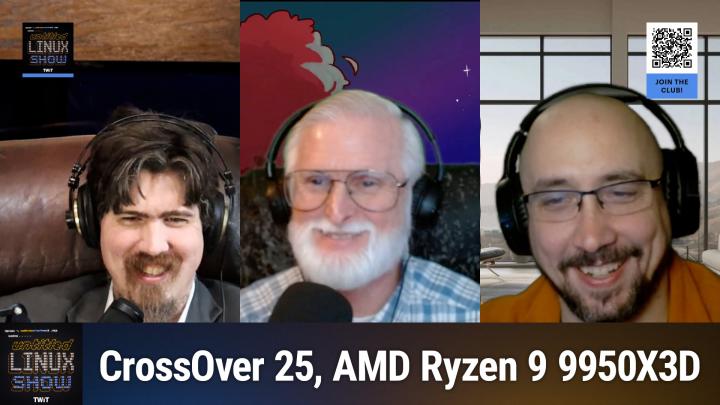
All TWiT.tv Shows (Audio)
Untitled Linux Show 194: Less Useful Than ReactOS
01:22:04
Rust Coreutils, the Zed Editor, and React's New Competition
Loading summary
Transcript241 lines
- [00:00]
Jonathan Bennett
This week we're talking about Ubuntu and the Rust Core Utils, Garuda's new Cosmic Edition, there's updates to Audacity and pipewire and more. Intel has a new CEO, AMD has a new killer cpu, and lots more. It's been an exciting week. You don't want to miss it, so stay tuned listeners.
- [00:19]
NerdWallet Ad
Are you looking for a shortcut to better auto insurance for you? Something that takes all the research off your plate. Something that's easy, Something that matches you with lower rates. Something genius that. That's where NerdWallet comes in. Their nerds already did the work for you. Just answer a few questions and ta da, you'll be matched with top insurance providers in your area. Find the right rate for you@nerdwallet.com after all, using NerdWallet is more than smart. It's genius. Not all applicants will qualify for the lowest monthly payments. NerdWallet Insurance Services, Inc. California resident license number OK 92033 hey prime members, Are you tired of ads interfering with your favorite podcasts? Good news. With Amazon Music, you have access to the largest catalog of ad free top podcasts included with prime membership. To start listening, download the Amazon Music app for free or go to Amazon.com/freepodcasts that's Amazon.com/freepodcast to catch up on the latest episodes without the ads.
- [01:14]
Ryan Seacrest
Hey, it's Ryan Seacrest for Albertsons and Safeway. It's Stock Up Savings time now through March 25th. Spring in for storewide deals and earn four times the points. Look for in store tags to earn on eligible beverage items from San Pellegrino and Pepsi or breakfast favorites like Chobani, Greek Yogurt, Dan and Oikos yogurt and Pete's Coffee, plus many more. Then clip the offer in our app for automatic event long savings. Stack up those rewards to save even more restrictions apply. Visit Albertsons or Safeway.com for more details.
- [01:46]
Jonathan Bennett
Podcasts you love from people you Trust this is TWiT. This is the Untitled Linux show, episode 199 recorded Saturday, March 15th. Less useful than React OS. Hey folks, it is Saturday and you know what that means. It's time to get geeky with Linux Open Source hardware software. It's the Untitled Linux Show. We're gonna have a lot of fun today. It is not just me. We've got can and we've got Rob. Jeff is off at an undisclosed location taking care of something, but I'm sure he'll be back another week but for now it is the trio, the three of us, and we've got some stuff to cover. We're going to let Rob go first. And Rob, this is a story that really caught my eye this week and it is something sort of surprising that Ubuntu is doing. What thing are they doing that's so surprising?
- [02:42]
Rob Campbell
Well, you know, as we all know, we've seen a lot of drama over Rust and Linux over the past month or so, and the results are in that it isn't going anywhere. You know, the heads of Linux themselves are all behind bringing Rust into the kernel. Well, you know who else apparently likes Rust? As Jonathan already implied, it is Canonical. So starting with the Ubuntu 25.10 release slated for late this year, Canonical engineer John Seeger announced plans to make use of more Rust written components in Ubuntu. He says, and I quote, Starting with Ubuntu 25.10, my goal is to adopt some of these modern implementations as the default. My immediate goal is to make Utils Coreutils implementation the default in Ubuntu 2510 and subsequently in our next long term support release, Ubuntu, which, which would be Ubuntu 26.04 LTS, if the conditions are right. So, and the reason, you know, that he has that, that they have the Canonical as with Ubuntu appear to be the same reasons we keep hearing over and over again. You know, the big one being added safety provided by the Rust programming language and the other one that at least for a long time I didn't really know is a benefit, but we seem to keep hearing this is the performance benefits of Rust. Apparently. You know, I don't know if it's the Rust language itself or people just getting a fresh crack and having crack at it, having more time to focus on the big issues on these little side bug cases caused by Rust. I don't know what it is, but apparently performance is a benefit. So the first Rust components being evaluated for Ubuntu 2510 are the Utils version of Coreutils, Findutils and diff Utils, along with also the Rust written pseudo replacement which is sudo rs. John also says we need to do, we need to do so carefully and be willing to scale back on the ambition where appropriate to avoid diluting the promise of stability and reliability that the Ubuntu LTS releases have become known for. But I'm confident we can make progress on these topics over the coming months. And you know, with this Announcement it's just in time for the release of rust Core Utils 0.030 as they work towards compatibility with the Core Utils 9.6. I'm not sure how their version goes, but I suppose I could have dug into it. But to me, 0.0.30 sounds like a very early release to be going into an lts. But apparently it must be more stable and further along than that version number makes it appear if they're willing to put it in LTS already.
- [06:17]
Jonathan Bennett
Yeah. So I've been impressed over the years with the UU tils. We interviewed them on Floss Weekly back several months ago and they actually work pretty closely with the Core Utils guys. And there's another. I can't remember what the name of the other project is. There's one more project. Utils is the Rust one, isn't it? There's coreutils itself, there's Utils, which is Rust, and there's one more project that is another reimplementation of coreutils. I can't remember at the moment what it is, but they all work together pretty closely to develop like a test suite that they run all of them through because they want them to, except for the few cases where they want them to behave differently. They want that to happen on purpose. Otherwise these are all supposed to behave exactly the same for every test case imaginable. And the fact that they have that compatibility really running pretty well at this point is probably why they're willing, why Ubuntu is willing to even consider doing this.
- [07:26]
Rob Campbell
I wonder if there'll be a point where the Rust Core Utils puts the original C based Core Utils out of a job.
- [07:37]
Jonathan Bennett
Maybe, but it's going to be like a long time, right? That's not going to happen anytime soon, right? Interestingly, coreutils is a reimplementation of the original Unix coreutils tools. So we're not even, we're not even on the original one still. It's, you know, we're like two, two, two reimplementations away removed from that now. Fun stuff. All right, Ken, do you have the Audacity to talk about this story?
- [08:10]
Ken Starks
I do. In fact, Bobby Borisoff and Morris Nestor had the Audacity to write about the popular open source audio editing software audacity releasing version 3.7.2. This release offers a series of fixes and quality of life improvements. According to Marius, Audacity 3.7.2 improves the Ubuntu 22.0 for AppImage bundle by fixing an issue with the FFMPEG multimedia server. Loading it also address adds a new option to the Turn off to turn off automatic tempo detection. That way, if you don't want it to automatically detect the tempo when you're editing something, you can turn that off. Now Bobby wrote about Audacity 3.7.2 fixing the issue. We're applying effects across multiple tracks, with one of those tracks being empty, causing crashes. And we can thank Govinda Madhava and I apologize if I mispronounce that for fixing label text using the wrong color in dark themes. And also Christopher Rooney for returning the residue option in noise reduction. Now audacity 3.72 also fixed some crashes emanating from the Mixer window, adding an info box when saving a project in a new version, breaking compatibility with old one, adding a new Get Effects button next to the Upload Audio button, and adding UUID instance support. Now, since I've only touched on some of the improvements and fixes, I do recommend finding about others through Bobby and Morris's articles. We've got them linked in our show notes. Have we posted them in the Discord chat yet?
- [10:19]
Jonathan Bennett
That's the first thing I did.
- [10:20]
Ken Starks
Okay. The second thing was the live stream.
- [10:23]
Jonathan Bennett
Yes, for one, I am happy to see Audacity continue on and the fact that they are continuing to release updates. We've talked about this before, but once upon a time Audacity got taken over by new owners and it was a little sketchy there for a minute and people were sort of abandoning ships and so I'm just, I'm sort of happy that they are continuing to push it out and seems like we're not particularly having problems with them anymore.
- [10:48]
Rob Campbell
Has has anybody heard anything about the, the fork or forks that were supposed to replace it due to all that uproar? I I think it just kind of went away as far as I as far as my circles go, but I.
- [11:04]
Ken Starks
Think the fork ended up bending back into osteoporosis.
- [11:11]
Jonathan Bennett
Was Tenacity one of them?
- [11:13]
Rob Campbell
Oh, I think so. I think that was one of them. I mean they're probably still out there.
- [11:18]
Jonathan Bennett
Maybe, but I had noticed about Rebase. So the Tenacity Last update on GitHub was a couple of months ago and it's in the that they're in the midst of a huge rebase. They're rebasing against upstream Audacity, so it's not a hard fork.
- [11:35]
Rob Campbell
Oh yeah.
- [11:37]
Ken Starks
I find that it's easier for me to record vinyl with Audacity than when I've tried doing compared to using Ardor?
- [11:49]
Jonathan Bennett
Well, I mean, that's the thing with Audacity, right. The things that it can do, most of them are going to be a little bit easier. I've heard it described as. When it comes to working with audio, it's like Notepad, whereas our door is more like a full fledged word processor suite. I think it's fairly typical. Fairly.
- [12:05]
Ken Starks
In other words, it's the Notepad version of a DAW compared to hardware.
- [12:10]
Jonathan Bennett
Yes, yes, exactly.
- [12:11]
Rob Campbell
Yeah. I've used Audacity quite a few times over the years, but my needs have been so basic. I've used maybe some of the filtering, tried to take out a little background noise or really have fun and play around and put some echo in there, but that was never any serious, serious reasons at that.
- [12:32]
Jonathan Bennett
Speaking of the background noise, one of the things they mentioned here in these headlines is they added the residue option back. I don't know why they would have removed that. Because it's super useful. That is when you're doing. When you're doing filtering, trying to get rid of that background noise, you hit residue and it will play you just the part that it's removed. And so that's useful because if you can hear people's voices in there, you know, you're getting rid of some of the signal that you wanted to keep, whereas if it's just all hiss and static, then, you know, you're getting rid of what you wanted to. So.
- [13:00]
Ken Starks
Yep.
- [13:01]
Jonathan Bennett
All right. This. I have a story and it is one that I am sort of sad that Rob is not here for. And that's because he has been sort of covering this beat about intel and I'm here.
- [13:14]
Rob Campbell
That would be Jeff. That would be Jeff. You're thinking of.
- [13:16]
Jonathan Bennett
Did I. Did I really?
- [13:19]
Rob Campbell
Rob is here.
- [13:20]
Jonathan Bennett
I saw Rob's name and that's what came out of my mouth, I'm sure.
- [13:23]
Ken Starks
No, you're not Rob.
- [13:24]
Rob Campbell
I'm not an. I'm not. I'm not the guy covering this stuff.
- [13:27]
Jonathan Bennett
But Jeff is not here. Wow.
- [13:30]
Rob Campbell
I understand. I know you can't get my name off.
- [13:34]
Ken Starks
You and Jeff look so much.
- [13:35]
Jonathan Bennett
Yeah, they look so similar. That's what it is. I get it mixed up all the time. Anyway. Not here. So we. I will have to cover it as well. I can. Which, as you can already tell, is going to be challenging. Intel is a new CEO and the new CEO is. How does exactly Tan. It's like Wing Boo. Hang on, it's right here. Lip Bhu Tan. It's a Malaysian name, which is why I have trouble trying to come up with it and pronounce it. He's been with intel sort of on and off for a while. He came into the company as the result of an acquisition of another sort of Fabless company, which is, which is interesting. And he was pushing back when he was part of the board, part of the leadership of intel, he was pushing to, as he says, reduce Intel's bloated US Task force. So he was very much on board with, we're paying too much overhead for people. We need to eliminate some of those positions. And he was removed. He made the argument that the task force there, the workforce was inefficient and overly bureaucratic. He was removed from his position, kind of demoted. And then eventually as things changed at intel, he has been brought back and now put in charge as the CEO. And he has noted some things that he wants to work on. One of the big things is intel wants to become a fab for other companies. And that's something that he has some experience and sort of the other side of that being the Fabless company coming to a fab. And of course he also wants to, he also wants to concentrate on artificial intelligence like everybody else in that industry does. Right now. I think he's sort of required to say that or else the markets will just have a fit. So far, investors seem to be taking well to this news. Intel's stock price is up at the time of this article writing was up by like 15%. That's just the market doing its thing. No real changes have happened yet. And as Jeff has reminded us several times, these things in places like intel, the, the Q and A on a chip may be starting now. So like, you know, it's going to be the chip after that that he really has his hands in the very beginning of. And there's going to be like a two year lag until that actually makes it out the door. So if intel has a turnaround in the next two years and they release awesome chips, it is not Tan that did, was his predecessor, Pat Gelzinger. And then, you know, two, two and a half years go down the line, then we can start looking at the things that they do. And that will be Mr. Tan at work. So it's challenging to try to discern how well he's doing until that happens. But intel finally has somebody once again at the head.
- [16:46]
Rob Campbell
You know, that scenario of lagged results or whatever reminds me of so many other things in life.
- [16:53]
Jonathan Bennett
Yes, yes, you have to play the long game.
- [16:56]
Ken Starks
At least he's got experience with chip making.
- [17:00]
Jonathan Bennett
And you know he is an engineer, right? That's one of the one one of the things we've said as well. If intel got another bean counter at the top, they might have really have problems. And he actually has a physics and engineering background, so he's got that going for him for sure.
- [17:13]
Rob Campbell
Yeah. So set that clock and let's see where we're at in 2027. I don't know what year it is. I had to figure that out first.
- [17:22]
Jonathan Bennett
Yeah. Goodness. I sometimes too.
- [17:26]
Ken Starks
The big question is what where will intel be in 2030?
- [17:31]
Jonathan Bennett
Hmm. Yeah, that'll give him some time to get some chips out. They'll probably be on another CEO by then though, let's be honest.
- [17:38]
Ken Starks
That's what I was wondering if he'd still be the CEO.
- [17:42]
Jonathan Bennett
Oh, hard to tell.
- [17:43]
NerdWallet Ad
Listeners, are you looking for a shortcut to better auto insurance for you? Something that takes all the research off your plate, Something that's easy, something that matches you with lower rates. Something genius. That's where NerdWallet comes in. Their nerds already did the work for you. Just answer a few questions and ta da. You'll be matched with top insurance providers in your area. Find the right rate for you@nerdwallet.com after all, using NerdWallet is more than smart. It's genius. Not all applicants will qualify for the lowest monthly payments. NerdWallet Insurance Services Incorporated, CA resident license number OK 92033 hey, it's Ryan Seacrest.
- [18:14]
Ryan Seacrest
For Albertsons and Safeway. It's Stock up savings time now through March 25th. Spring in for storewide deals and earn four times the points. Look for in store tags to earn on eligible beverage items from San Pellegrino and Pepsi or breakfast favorites like Chobani, Greek Yogurt, Dan and Oikyo's Yogurt and Pete's Coffee, plus many more. Then clip the offer in our app for automatic event long savings stack up those rewards to save even more restrictions. Apply. Visit Albertsons or Safeway.com for more details.
- [18:43]
NerdWallet Ad
Discover the art of adventure in Cedar City and Brian Head, Utah. Here you can discover southern Utah's first artists at the Parowan Gap petroglyphs or carve a fresh trail at Brian Head Ski Resort. Paint the town red, perusing Cedar City's unique shops, museums and savory bites. Marvel at nature's masterpieces at nearby Zion, Bryce and Kolob Canyons and be mesmerized by the endless starry nights at Cedar Breaks National Monument. Your Inspired adventure awaits. Plan your trip today@Visit cedarcity.com all right.
- [19:14]
Jonathan Bennett
So let's talk about some Linux stuff. We've been everywhere else. Rob, what is the new news in Cosmic?
- [19:23]
Rob Campbell
Yeah, so time for another Linux distro that is showing some Rust. Love Garuda Linux. So Garuda isn't adopting the Rust core utils, at least I don't think they are. I'm sure you can get it there, but it's not by default. But they are adopting another future heavyweight in Rust based in Rust based desktop environments. Let me get that out of my tongue there. I just had a nap so I didn't have time to warm up. So. And of course as Jonathan pointed out, I am talking about Cosmic. So the Cosmic Desktop, it's written by System 76 for POPOs, but they've been designing it in a way that's been making it open for everyone else. And even though it's only on the Alpha 6 release, the buzz in the community is making it appear like this Rust based desktop will. It's going to be a huge thing once it's out there because Garuda, Garuda being it's one of the more popular Arch based Linux distros. I mean there's not a lot of Arch based Linux distros, but it's definitely one of the more popular ones.
- [20:47]
Jonathan Bennett
I was gonna say. That's not saying much, man.
- [20:50]
Rob Campbell
But you know what they do, I mean one thing, they make it easy to install Arch, you don't have to use the script, you know, it installs like any other distro and they like to bring put a lot of their own flair and design style into, into their desktops. So you know, they already have several additions, you know, including KDE Plasma, Gnome, Xfce, Cinnamon, Hyperland, Sway i3 and others. And now they're adding the Cosmic desktop to the mix. So you know, like I said, they often do tweaks and refinements to really snazz up their desktop. But Cosmic at this time is pretty much bare bones. You know in their announcement what they say is quote, it is very bare bones at the moment. Basically just the stock Cosmic packages on Garuda base. But if there is community interest in this, we can certainly build it up as people chime in with their tweaks and ideas. So if you like Cosmic you want and you like Arch based distros like Garuda, but you really want some, some fun Garuda style tweaks, try it out, give them the ideas, but they did add a few things in including their brand new welcome app called Garuda Rani as well as the Garuda Settings Manager, Fire Dragon Web Browser, Garuda Boot Repair, Garuda Schrote, Garuda Network Assistant, Garuda System Maintenance, Garuda Boot Options and other tools. But you know, being the desktop is in alpha there, there will be missing features and bugs but it is fairly usable and available for download today if you wanted to give it a spin. So for those watching, you can see my background. I took a, I took a screenshot of when I was installing it. So there's the installation installer right there behind me. But then I also have let me get to the right screen here. I have it running here on a VM to give it a shot, see what it looked like. You know, I had the terminal running and it pops up, you know, with the nice. I don't know what software they use but Neo Fetch like display there but it looks pretty much like Cosmic. For those who have seen Cosmic before, they don't have their fun fancy touches in there, but going through it seems like a lot of the features are in there already.
- [23:39]
Jonathan Bennett
One of the things that'll be fun going forward is to see the Garuda team add their touches and their customizations to that. Because you look through some of their other like editions, they have a bunch of them for one thing but you look through them and they have some pretty heavy customization that they do with the theming and defaults and all kinds of stuff like that.
- [24:00]
Rob Campbell
Yeah.
- [24:01]
Ken Starks
In fact Bobby Borisov was impressed with one of the editions. It's called the Mocha Edition. Sounds like it's.
- [24:14]
Jonathan Bennett
Sounds familiar.
- [24:14]
Ken Starks
Kuchin themed KDE Plasma experience.
- [24:18]
Jonathan Bennett
Interesting.
- [24:20]
Rob Campbell
Yeah, because I'm sure a lot of these other distros are going to use the standard, the default popos or not POP os, Cosmic Desktop or pretty close where I could really see Garuda taking it to the next level, which would be fun. I mean yeah, I made myself. I may just want to run something a little more stock but it's fun to see some, some fun tweaks to it.
- [24:46]
Ken Starks
Yeah. You wouldn't like to try out the Hyperland edition of Garuda?
- [24:52]
Rob Campbell
I might. I've been interested in Hyperland but I have never tried it yet.
- [24:55]
Jonathan Bennett
That might actually be an interesting way to approach Hyperland because everything I've always heard about it is like it's awesome once you get all of your customization done. But you just about have to have become a developer to be able to do that. And from what I understand of Garuda, they go in and they, they, they, they're opinionated and they do some of that setup for you. So that might actually be the sweet spot in getting a taste of what hyperland can be like.
- [25:21]
Rob Campbell
Yeah. I will say the whole install process for, for Garuda was, it was pretty slick. And even the post, post installation, they had a, a nice way to help get you started. A nice wizard, I guess, to help get things installed. I didn't really go into it. I kind of clicked through, looked at it all and moved on. Since I'm only doing this for demonstration purposes today.
- [25:48]
Jonathan Bennett
How many desktops do you have queued up that you need to try daily driving before you can get to something running on Garuda?
- [25:55]
Rob Campbell
Daily driving, you've got like two, right?
- [25:59]
Jonathan Bennett
You said you would try one and then there was another one that you said you'd try after that.
- [26:03]
Rob Campbell
I don't, I don't remember what I said I'd try after Mint.
- [26:06]
Jonathan Bennett
But maybe one of these days, eventually Rob will make it through his backlog and he'll land on Garuda for a while.
- [26:13]
Rob Campbell
There's all kinds of. There's so much to try out there.
- [26:16]
Jonathan Bennett
Oh yeah, that's half the fun of it, right?
- [26:18]
Rob Campbell
Try them all. They're like Pokemon.
- [26:21]
Jonathan Bennett
Gotta try them all.
- [26:22]
Ken Starks
Just trying to think is with my integrated video card on my system, if it would, if it's capable of running OpenGL 3.3.
- [26:35]
Jonathan Bennett
Yeah, should be. It should be. You've got a Ryzen AMD GPU built into that, a Ryzen CPU with their GPU core built into it. So yeah, it should be pretty up to date with all of that. Now, it might not do it super fast, especially if you try to do something like ray tracing, but it can do it. I mean, that's what they put in the Steam decks, essentially that same kind of processor. So.
- [27:03]
Ken Starks
Try that out then. I doubt that old Lenovo laptop with the intel integrated.
- [27:12]
Jonathan Bennett
No, probably not. Probably not. Speaking of trying things out though, Ken, I hear that there is an update to pipewire. What's going on there?
- [27:21]
Ken Starks
Yes. In fact, we can thank Bobby Borisoff for writing about the first bug fix update to Pipewire. We just had version 1.4 come out. Was it a little over two weeks ago now?
- [27:33]
Jonathan Bennett
It's not long. Yeah.
- [27:35]
Ken Starks
And now we're getting version 1.4.1. Now this update introduces backward compatibility for systems without the USB MIDI protocol or um P support, thus restoring MIDI functionality on older kernels and Al sub versions now. Pipewire version 1.4.1 also fixes some problems with disappearing devices by handling split PCM wrong channel specifications. It also adds an error string to the device names when the UCM configuration has an error. Bobby feels pipewire1.4.1 brings in a range of quality of life improvements and compilation fixes, including resolving a crashing issue in the Bluetooth module that occurs when receiving an incoming call. Now you can read Bobby's article that I've got linked in the show Notes for more details. Since I'm just touching on some that I thought were worth touching on.
- [28:42]
Jonathan Bennett
Yeah, I'm trying to figure out what exactly split PCM is and it looks like that is when you have one port that can be an input and an output. Seems to be the case in my in my initial googling of the thing.
- [28:58]
Ken Starks
Because when I was looking into the article let me just find the change log again.
- [29:14]
Jonathan Bennett
It said what something about split PCM and devices disappearing?
- [29:21]
Ken Starks
Mentioned the split PCM twice.
- [29:29]
Jonathan Bennett
Yeah, that's not a term. Kind of surprisingly it's not a term I'm was familiar with before this, so I'm going to have to go. I may have devices that have that, but I'm not real familiar with what exactly it is. Split PCM Split pcm? Yes. Google is not super useful in which is which is weird usually with computer terms. Google is really really snappy and really good at telling you what it is.
- [29:56]
Rob Campbell
Google hasn't been good for years.
- [29:59]
Ken Starks
Changelog One of the highlights is it talks about handling split PCM wrong channel specification and that it fixes some problems with disappearing devices. Then it goes down under the Spa vs Handle Split PCM too few or too many channels. So so it sounds like it's talking like when you've got a 5.1 or 7.1 pcm channels that could be here's.
- [30:25]
Rob Campbell
What AI is telling me. Split PCM refers to the process a pulse code manipulation audio file into multiple segments or channels. This can be useful for various audio editing tasks, such as isolating individual tracks, creating separate audio files, or enhancing specific parts of a recording. For example, tools like descript allow you to split PCM audio files into separate tracks, making it easier for audio engineers and podcasters to edit and refine their content. Similarly, you can use software like FFMPEG to split a PCM stream with multiple channels into individual mono or stereo streams.
- [31:09]
Ken Starks
And I can see where pipewire would use that possibly to map the different channels to the different channels on a 5.1 or 7.1 system.
- [31:20]
Jonathan Bennett
Yeah, it Sounds like that's very much what it's about. All right, well, good thing that that doesn't crash or cause problems anymore. There is a new tough guy in the CPU world and this kind of caught me by surprise this week actually it is the new AMD 9953dx. And so this is AMD's top level CPU with the 3D V cache stacked in this case underneath the chip rather than on top of it. So we've talked about these chips before, they are generally great for gaming and this is not the only 3D VCACH chip, it's not the only x3D chip that AMD has in this current generation. This is the top, the tippity top of them. And I've got links off to the Linus Text Tips video about it on a. It's not on the main channel, it's on like tech Quickie. So it's, it's a shorter video about it. Really interesting shows some of the Windows stuff. Talks about the chip itself, but we've got a couple of Pharonics articles here about what it does on Linux and I was, I was really, really quite impressed. It is. So the second article I've got linked here is his initial review of it. And as you go through and punch through the different tests he ran, this thing is basically on top out of all of the chips that he has access to. And if it's not on top, everything but like one program he tested it is tied as a dead heat on top in some cases against the non x3D version, the 9950X in some cases versus one of Intel's chips that trades blows with it. The Core Ultra 9 285k is another one of those really impressive chips. But if you need multi threaded or single threaded, it looks like performance. This thing is pretty crazy for almost all use cases. One of the disadvantages that these have had in the past is because they stacked the extra cache on top of the chip, it made cooling a problem. And the fact that they figured out a way to put it on the bottom side means that you can now cool these things very, very effectively and that no longer a problem. And then the other article is that they've already pushed out a bit of an optimization for the Linux kernel specifying sort of what bits are supposed to go into the cache. And that is really a black magic sort of thing. So if you look through the results on that, you have some of these that it's a huge win. Like in Python Python, the PI performance benchmark, you know, it's a like a 33% improvement. It goes from 668 milliseconds down to 444. So you know, almost exactly two thirds the time taken, which is huge. But then you have some of these where it is actually it performs worse than the stock configuration. So it's very much. It's one of these things where, you know, you have to test it, see how it's going to perform on your particular workload, whether it makes sense to go and turn this on or not on this particular chip. But the 9950x3D just in general is pretty impressive for 16 cores and getting a whole lot of performance out of those cores. And the overall price, I believe was669,699. This is the sort of thing I should have put in my notes, but it's pretty impressive.
- [35:20]
Rob Campbell
Yeah, that'd be pretty awesome. But that's half the price of my last computer, so.
- [35:27]
Jonathan Bennett
That's true. That means you can spend, you can spend a whole lot of money on building a computer if you want to put one of those in it. But at the same time you can go spend, you know, over a thousand dollars for computer components pretty easily. So it's not that terrible.
- [35:38]
Rob Campbell
Six hundred for, for the cpu, a thousand for the gp. Well, if I get the new one, I could spend 3,3000 I think these days on the 50, 50, 90 or whatever.
- [35:49]
Jonathan Bennett
And if you can find them in.
- [35:52]
Rob Campbell
Stock, well, you gotta, you gotta go into the scalpers, otherwise they'd be a lot cheaper.
- [35:59]
Jonathan Bennett
6.99 and the MSRP is 6.99.
- [36:02]
Ken Starks
And it would be just out of the box replacement for the AMD Ryzen 7 I have. Right.
- [36:12]
Jonathan Bennett
Possibly you'd have to check the socket. You have to check the socket. And you'd also want to check for probably a BIOS update on your motherboard to be able to support the newer chip. Yeah, because AMD has done a socket rev. I think your machine is new enough that it's going to be on the same socket. But I would definitely be looking into BIOS updates first. It's a particularly fun thing when you buy a motherboard and you buy the latest CPU and you put it in there and the motherboard goes, I don't know what to do with this, man. I don't have new enough BIOS for this. It's like AMD was. There was actually a time where AMD was shipping people like their bottom end previous generation CPU just to drop in motherboards to be able to flash them with the newest bios. And then you know, it's like, please ship that back to us. It's only worth 20 bucks, but we would still like it back.
- [37:06]
Rob Campbell
I would check the socket first. If it's not going to fit, it doesn't matter if the BIOS works or not, but if the socket fits, eventually you'll probably get an update to the bios.
- [37:18]
Jonathan Bennett
Very likely. If not already very likely.
- [37:21]
Ken Starks
Probably need to check and see if there's updates to the BIOS anyways.
- [37:25]
Jonathan Bennett
Yeah, it used to be the case that we would say if it's working, don't update the bios. But that's not really the case anymore.
- [37:32]
Rob Campbell
And unfortunately we do not have a story for you.
- [37:36]
Ken Starks
If there's been firmware updates to the chip, you may want to update the bios.
- [37:42]
Rob Campbell
Yeah, using fwopd.
- [37:44]
Jonathan Bennett
That's one way to do it. Definitely one way to do it.
- [37:47]
NerdWallet Ad
Listeners, are you looking for a shortcut to better auto insurance for you? Something that takes all the research off your plate. Something that's easy, Something that matches you with lower rates. Something genius. That's where NerdWallet comes in. Their nerds already did the work for you. Just answer a few questions and ta da, you'll be matched with top insurance providers in your area. Find the right rate for you@nerdwallet.com after all, using NerdWallet is more than smart. It's genius. Not all applicants will qualify for the lowest monthly payments. NerdWallet Insurance Services, Inc. California resident license number OK 92033 hey prime members, are you tired of ads interfering with your favorite podcasts? Good news. With Amazon Music, you have access to the largest catalog of ad free top podcasts included with your prime membership. To start listening, download the Amazon Music app for free or go to Amazon.com ad freepodcasts that's Amazon.com ad freeppodcasts to catch up on the latest episodes without.
- [38:41]
Ryan Seacrest
The ads hey, it's Ryan Seacrest for Albertsons and Safeway. It's Stock up Savings time now through March 25th. Spring in for storewide deals and earn four times the points. Look for in store tags to earn on eligible beverage items from San Pellegrino and Pepsi or breakfast favorites like Chobani Greek Yogurt, Dan and Oikios Yogurt and Pete's Coffee, plus many more. Then clip the offer in our app for automatic event long savings. Stack up those rewards to save even more restrictions apply. Visit albertsons or safeway.com for more details.
- [39:13]
Jonathan Bennett
All right, let's see Rob, what's new? We're going to do. We're going to do some Windows stuff. What's new in Crossover, Rob?
- [39:21]
Rob Campbell
I mean this is Windows stuff, but I'm not the. I'll just get into it. So crossover 25 from Codeweavers is out today and I'm proud to say that Jeff is a happy supporter of them. Jeff is the one supporting these Windows initiatives, not me. So we know who the real so.
- [39:47]
Ken Starks
That he can run Windows on Linux.
- [39:50]
Rob Campbell
Well, not Windows, but Windows apps on Linux. He uses VirtualBox to run Windows on Linux for his accounting software once a year. So he's probably getting around to that if he hasn't done it yet. But crossover, so what Crossover is. It's the commercial essentially the commercial version of Wine. You know that it buying that helps pay for the development and, and what this it sees some of the best improvements. Well, I'd say first, but sometimes only because Crossover 25 is built on top of Wine. In this case it's built on top of wine 10 to run windows games and apps on Linux and Mac OS and being one of the few ways to run newer versions of Microsoft Office and Office 365 on Linux. So I hear Jeff would be the expert on this. Okay, I joke. Actually he supports them. He says it quite often. He isn't actually a current user but he thinks it's a good product to support, which so do I. Anyway, this release brings more than 5,000 changes with with this big upgrade that it also pulls in BK D3D 1.14, molten VK1 2.10, wine, mono 9.4 and other updates. So yeah, you know, most, if you're talking about games, most Linux gamers do quite well with Proton. But for you shameful Mac OS users out there, Crossover is now more seamless with more settings and enhancements and it includes DXMT as a metal based implementation of direct 3D11 on Mac OS. So there's something for you guys too. I mean Mac os, you're a Unix E like too, so you know you're okay kind of. So highlights, highlights for games in this. You know, maybe you don't want to use Steam or maybe you got the game somewhere else, who knows. But there are some highlights and some of these new games that it supports is avowed Far Cry 6, Tear Down, Fallout 76, need for Speed, Heat, The Last of Us Part 1 and Red Dead Redemption 2, which that's, that's a good Game I haven't played in years, but I like that game. So good to hear. There's another way to play it on Linux now. So anyway, even if you don't need extra features from crossover, like Jeff says, it is still good, a good company to support for their roles in Wine and Proton. So we should all strive to be more like Jeff. Except for the fact that Jeff isn't here today, but we'll forgive him for that. Oh, and one other cool tidbit. The corporate office for codeweavers. It's less than an hour away from me. It's like 80 miles away, I think it is. Which I know for you people overseas and the little country of the uk, that's like all the way across the country, but that's like just down the street for us in the us so anyway, if you're looking for someone to hire, I'm not too far away. But I like the product. I've used it a long time ago and I don't know, I really been meaning to try it again and to support them.
- [43:32]
Jonathan Bennett
But I'm reminded of Doc Searle's take on this on one of the great differences between the United States and other countries, particularly in Europe. We think 100 years old is old and they think 100 miles or 100 kilometers is far. We sort of laugh at each other over that. All right, I'm gonna actually jump in. Unless Ken wanted to talk about crossover, I'm going to jump in after he's done with another Windowsish story.
- [44:03]
Ken Starks
Steam. I did want to note that this should help speed up the startup time of Steam for me.
- [44:13]
Rob Campbell
No, Steam doesn't use the crossover though.
- [44:17]
Ken Starks
Yes, they do.
- [44:18]
Jonathan Bennett
Really?
- [44:19]
Ken Starks
They help provide inputs to the Proton.
- [44:22]
Rob Campbell
Well, they provide inputs, but it's not directly utilized.
- [44:27]
Ken Starks
Sometimes it is.
- [44:29]
Rob Campbell
Some of the features are, but not. It's not the whole code base. They use features that they've learned from that. But the whole code base from. From the crossover doesn't go over well.
- [44:39]
Ken Starks
One of your articles, even the one by Saroof Rudra, he. That's what he says, that it actually will help to give Steam a faster startup time.
- [44:57]
Rob Campbell
Well, I imagine.
- [44:59]
Jonathan Bennett
I imagine that code will eventually make it. If it's not there. I mean, who knows, it may land in Proton first, but if not, it'll eventually land there. Right. Like they're not going to just sit on this patch.
- [45:09]
Rob Campbell
The game's good, the game stuff, maybe it will, but I mean from historically, like the last thing I've heard, I haven't looked into this Slightly. But like Crossover has supported a fairly recent version of Office for quite a few years now. But with. With Wine at least maybe Proton. But I don't think Proton is going to focus on this with the regular Wine. You still cannot to. It's still quite a ways behind where the Crossover was several years ago last I've heard.
- [45:44]
Jonathan Bennett
That's probably true. You know, Wine really doesn't like pulling in single application fixes. They want everything to be more like standardized and applied. Yeah, that's one way to put it. Whereas Crossover, they are. They're all about getting individual applications like Office to work work. So kind of makes sense.
- [46:04]
Ken Starks
Yeah, they're bread and butter.
- [46:07]
Rob Campbell
So I mean very well. Maybe the game pieces of this will travel over to Proton, which it probably makes sense because Valve actually pays code weavers to.
- [46:19]
Ryan Seacrest
For.
- [46:19]
Rob Campbell
For Proton stuff. So it's all the same people there. Makes sense for them to bring that to it. But whereas like the application stuff, well, nobody's paying them except for the Crossover users.
- [46:32]
Ken Starks
Now how does Crossover do with the Windows Audio stack?
- [46:39]
Jonathan Bennett
Much better than React OS does. So I've got a couple of stories here that are also about Wine. Not on Linux, but via free and open source software. So one of the things that I followed for a long time now is React OS and that is the project to re implement the Windows NT kernel as an open source project. It has been interesting for a long time, it's been only reasonably useful and only recently has that really become a thing. But they have announced a sort of a major step forwards in what React OS can do. React OS can now boot and bring up the Windows Audio stack, but it can't actually play any sound yet. This is sort of where we're at with React os. Like it's got. It's got lots of cool support, lots of things sort of stubbed out but there are some outstanding bugs and there's not any actual sound that it can produce yet.
- [47:45]
Rob Campbell
So that sounds like when Rust first came to Linux kernel. Like the very first one's like well we got Rust in there. It doesn't do anything yet.
- [47:52]
Jonathan Bennett
It doesn't do anything yet. Yep. So that is React os. And then there is another alternative to React OS that I came across this week and it is free 95 but this is. It's the most minimal possible project at this point. And if you see the screenshots it's. It looks ugly. Looks Nothing like what Windows 95 looks like.
- [48:26]
Rob Campbell
Well wait, you just contradicted yourself. I mean Windows 95 was pretty ugly.
- [48:31]
Jonathan Bennett
They can both be ugly and in different ways.
- [48:35]
Ken Starks
Makes me think more of DOS instead of Windows 95.
- [48:38]
Jonathan Bennett
Does look a lot like an old Dos Gui.
- [48:42]
Ken Starks
Now here's the big test. Does it run doom yet?
- [48:45]
Jonathan Bennett
We are pretty sure the answer is no, not yet.
- [48:49]
Rob Campbell
It looks a lot like. Well, I was going to say like Windows 3.1, but no, it's. I guess it's DOS. Wow.
- [48:57]
Ken Starks
So it makes me think of creating menus on dos.
- [49:02]
Jonathan Bennett
This, this is. This is interesting. They do have some source. Right. And they come. It's out there enough that like you can, you can run it. It actually does something. But it's still pretty minimal. This, this seems to me like this is probably something that's going to. It's going to take quite a while to. To really hit its own. It's already up to a 0.2.0 alpha and it again, it can actually do something like that is something. But I don't. I don't know. I don't know. This is really going to be as. Let me put it this way. At this point this is less useful than React os. There you go. Rob's got it up. That's what it looks like.
- [49:53]
Rob Campbell
Freebir. Yeah, and that's what it looks like when all the programs are closed on the desktop. How do you open them again? There's no. Nothing there.
- [50:04]
Ken Starks
I'm sure you write command line. Of course, yeah.
- [50:06]
Jonathan Bennett
Use command line. Who knows? So anyway, I, I just, I found it fascinating that these are sort of our two alternatives to. To Wine for running Windows stuff without Windows.
- [50:18]
Ken Starks
I just wondered, are either one of these 32 bit?
- [50:25]
Jonathan Bennett
I would imagine that free 95 is maybe both.
- [50:29]
Ken Starks
And that might run on the old Dell system I've got sitting in a closet.
- [50:33]
Jonathan Bennett
It might. You could try it. You could try it.
- [50:37]
Rob Campbell
How old is reactos? I swear there was something. It's been in development since 96.
- [50:43]
Ken Starks
It's at least 10 years old.
- [50:45]
Rob Campbell
96.
- [50:46]
Jonathan Bennett
96. That's like almost 30 years old.
- [50:49]
Ken Starks
Okay.
- [50:51]
Rob Campbell
Yeah, I remember something like this a good 20. 20. It may have been years. It might have been this.
- [50:58]
Jonathan Bennett
It may have been React os. Yes. Which, you know, to be fair, back then this is what reactos looked like, right? It was about like this and they've just had a long time to work on it. Of course, Windows has continued to change in that time, which is one of the reasons why it's continuing to be a moving target.
- [51:17]
Rob Campbell
Yeah, it still looks like. At least last time I looked at. It's more like the Windows 98, I think style.
- [51:25]
Ken Starks
Or maybe Windows has finally stopped supporting eight bits.
- [51:30]
Jonathan Bennett
Oh, that happened a long time ago.
- [51:31]
Ken Starks
Yeah. Did they stop supporting 16bit? I think so.
- [51:36]
Jonathan Bennett
When they went to 64bit installs by default for all of Windows that's when 16 because it couldn't go back to architecture versions. So you had to run Windows 30. You had to run Windows 32 bit to be able to run the old 16 bit stuff.
- [51:51]
Ken Starks
Was that with Windows 7 or Windows 10? They started doing the 64 bit by default?
- [51:58]
Jonathan Bennett
I don't. I think maybe 7. I don't remember for sure.
- [52:01]
Rob Campbell
I think it was Windows 10.
- [52:02]
Jonathan Bennett
That could be. I don't remember for sure. One of the other.
- [52:05]
Rob Campbell
We'll have to ask Jeff.
- [52:07]
Jonathan Bennett
Yeah, he'll know. I don't know man. Reactos. I'm looking at screenshots, it doesn't look too terrible. I wouldn't mind using that.
- [52:15]
Rob Campbell
I've played with it before. It's. I mean.
- [52:19]
Ken Starks
But what you use on it.
- [52:23]
Jonathan Bennett
Oh, I don't know. I mean you could have a lot of fun and do something like pull Claris works out or one of those old time period appropriate editors from the 90s.
- [52:32]
Ken Starks
But I can give you one that definitely would not work on it.
- [52:35]
Jonathan Bennett
What's that?
- [52:36]
Ken Starks
Zed Editor.
- [52:37]
Jonathan Bennett
No, probably wouldn't. Zed is one of those up and comers. They've got something pretty new coming out, don't they?
- [52:44]
Ken Starks
Yes they do. We actually first covered this Rust based code editor back in episode 160. So if y'all want to see when we originally talked about it, go back to that and watch it when it officially launched for Linux. And I've been using it off and on since then. This week Michael Larabel wrote about another update to the Z editor. Zed has now added native git integration for enhancing the developer experience. Starting with Z version 0.177. You can view your diffuser stage changes and commit as well as push from within the editor. According to the z.dev blog post, they built Git integration with three priorities. First was speed. Using git from within ZED should feel faster than using the command line. Jonathan, I suspect you may disagree with that one. Then you've got Git native. The bloggers say they're not reinventing the wheel, just giving you first class access to the git features you already know. And they're wanting to put the keyboard first, meaning you're limited by the speed of your fingers, not your elbows. Now you can find links to Michael's article as well as to Zed's Blog post and release notes in our show notes and I did want to give you a quick look at what it looks like when you have the Git panel open. So let me switch to my display real quick.
- [54:36]
Rob Campbell
So, keyboard first. Is this like VI or vim where you're going to get stuck in it because you don't know the right keyboard commands?
- [54:44]
Ken Starks
Yes, it does.
- [54:47]
Jonathan Bennett
Really stuck in Zed and.
- [54:54]
Ken Starks
Just get it up here. But it's interesting because right now mine's got Initialize repository because I don't have a git repository attached to the Z.
- [55:17]
Jonathan Bennett
It's like Zed is becoming more of an IDE than just a text editor, which is. Which is interesting.
- [55:23]
Ken Starks
Yes, it is. And let's try this for a minute.
- [55:32]
Jonathan Bennett
I was doing some reading and apparently you can install different kernels, not like OS kernels, but code execution kernels to be able to run things like Python and HTML and all of those from right inside of Zed, which in and of itself is pretty interesting.
- [55:50]
Rob Campbell
Php, Can I run php?
- [55:53]
Jonathan Bennett
Probably. I don't know. I bet we could find out. Can you run php? Z supports running code in multiple languages. To get started, you install a kernel for the language. Currently supported languages are Python. Wait, there's more to that. TypeScript r as in arc, r as in Zeus, Julia and Scala. So no, no php. No php. Love for you, man.
- [56:19]
Rob Campbell
Let's go to the next story. I'm not interested yet.
- [56:26]
Jonathan Bennett
I do have one more actually, a kind of a set of stories to cover. And then Ken, I know you're working on getting that pulled up. If you manage to do it by the time I get done, then we can take a look at what it.
- [56:38]
Ken Starks
Actually looks like and I can use it for when I do my command line tip.
- [56:43]
Jonathan Bennett
There you go. So I wanted to talk real quick about a couple of interesting things in plasma. So they are working on. This is the Pointed Stick blog by Nick Graham. They're working on 6.4.0 and there's a couple of things that really caught my eye in here, one of which is there's now when you're copying files from one place to another, you can click on that notification and you now get a graph like you know, another operating system that we all know. But it's kind of. It's kind of fun to see that land in. In kde and it looks great. You know, there's some other things like disabling system tray icons provided by apps. There's a sidebar style UI elements now will overlap panels when shown outside of edit Mode. So that's like you've got a thing on the side and a thing on the bottom. Which one is supposed to be on top? It's a little bit smarter about that. K Runner is actually going to put your favorite actions at the top as opposed to just interspersed some fun things like that. Bug fixes, Plasma 6.4 is going to be, it's going to be cool. I think that's going to be the first one that is going to release after the HDR spec got 100% nailed down inside of Wayland. So 6.3 has support for it, but 6.4 is going to use the correct terminology and all of that. That's sort of what's going on on the back end there. But the other thing that I saw from Nate was that he started a company and this really intrigued me. He is announcing Tech Paladin Software. So Nate and I believe several other people were working at BlueSystems GmbH as KDE developers. And just as the passage of time, as things change, they sort of came to the conclusion that it's time to do something different. Based on, based on what I've seen, it was a friendly, you know, a friendly separation of ways. But Nate and a friend of his, a former developer, David Edmondson, is now running Tech Paladin Software. And it is going to be sort of the new place for KDE support. And there's a question here, basically, does this mean that you can fix this awful bug that I'm experiencing? And he says, why yes. As a matter of fact, if you would like to sponsor a bug fix or a new feature or custom development work, do get in touch. And then they've got the link off to techpaladonsoftware.com and an email address there. So this is actually pretty interesting. If there was something that really bugged you about KDE and you say more than just I want to make a bug report about this, you wanted to say I want to pay somebody to fix this. There you go. There is somebody that is a KDE expert that you can pay to fix it. And it's always good in my opinion to see these kind of companies form behind open source projects because generally it's the people that already love the project that do it. And it's just a way for them to actually turn into a business and make some money at it rather than just always doing it in their spare time. So I, I approve. Very good and best of luck to them.
- [60:06]
Rob Campbell
It makes me question though, why don't like these projects? Do A lot of that stuff themselves. Why doesn't, why didn't KDE just do that themselves? Or, you know, other ones?
- [60:18]
Jonathan Bennett
KDE and Firefox and a lot of these, they're actually nonprofits.
- [60:23]
Rob Campbell
Oh, well.
- [60:25]
Jonathan Bennett
And you can do some of it nonprofit, but from what I understand in most countries writing computer code is not considered a nonprofit action. So there's just sort of a disconnect between the idea of doing it as a nonprofit and paying engineers to do the work to write the code. It's a weird little wrinkle in tax law, more or less.
- [60:52]
Rob Campbell
I wonder like if they somehow could just like even if they didn't take that money, if it just went directly a pass through directly to developers, that there's some way they could get around that just to help improve their code base.
- [61:05]
Jonathan Bennett
But yeah, I mean, it's possible. It may also be that Nate and the other guys don't really want to work for the larger KDE organization. They want to be able to work for themselves and you know, that's fine.
- [61:16]
Ken Starks
Too, and maybe launch a cryptocurrency of.
- [61:19]
Jonathan Bennett
Their own that very rarely works out well. Well, in fact, I know of one open source project that did that that seems to have been, seems to be working out for them. And you know, for that one there's about 500 or maybe a thousand that it did not, it did not go well.
- [61:38]
Ken Starks
Million.
- [61:39]
Rob Campbell
Either way. You know, if, if these projects can't do it because of just how they're set up or don't want to because of the various things you mentioned, this at the very least brings up a great business idea that others could emulate for other projects.
- [61:58]
Jonathan Bennett
Yeah, sure. You know, I've talked with a couple of projects about things like this and there is sort of this business model coming out of, to particularly places like Europe where they're adding, they're adding a regulation that says, you know, you've got to have your software bill of materials. You, you're not allowed to ship software that has known CVEs in it. You've got to have, you know, this kind of, you got to be able to attest to this thing about all of your software. It's like these big companies, they're using open source projects and they'll come to the open source project said, hey, we need you to fill out this paperwork for us. We need you to attest to this. And I've said this for years, but it's kind of getting picked up on in other places. And that is sure, we will be glad to do that. Here's our hourly rate. We will be glad to contract ourselves and you can support the project and we'll do that for you. That is absolutely the correct answer.
- [62:48]
Rob Campbell
So just to play devil's advocate, I don't foresee this happening. But you know, what if too many people got this idea and like, well, I don't want to give myself freely and help this open source projects. I want, I want you guys to pay me and then I will help this open source project.
- [63:10]
Jonathan Bennett
I think there's kind of a self limiting factor on how well that's ever going to work. If, if too many people do it, they'll just start killing projects and then, you know, you'll kind of learn that that's maybe not what you want to.
- [63:22]
Ken Starks
Do or it may turn be advantageous because then the person that needs that bug fixed can ask for proposals on how much they need to pay.
- [63:39]
Rob Campbell
Yeah, yeah. And then those corporations, and then they'll.
- [63:42]
Ken Starks
Get what they pay for.
- [63:43]
Rob Campbell
Those corporations using that and aren't supporting the project will have to, in a way, I mean, not directly to the project, but to somebody who's doing the coding for the project. And that improves the project.
- [63:55]
Jonathan Bennett
Yeah, that is the idea.
- [63:58]
Ken Starks
The bug fix gets pushed forward into the project to fix that bug and.
- [64:03]
Jonathan Bennett
Ideally the developers get paid, Everybody's happy. That's the way it's supposed to work. All right, Ken, did you have that the ZED editor pulled up and ready to go? Yeah, There we go. Let's take a look at that. It's green.
- [64:17]
Ken Starks
You go and you can see my mouse. But over here, this is the Git panel that you can pull up from down here right now. You see it says I have no git repositories because I was just playing with today. But I can initialize a repository, but I want to look into the documentation first before I do that.
- [64:43]
Jonathan Bennett
Understood. It reminds me a lot of VS code actually the way VS code is set up with putting the panel over there and being able to pull up from the bottom and all that.
- [64:50]
Ken Starks
Yeah, you got a project panel you can pull up and you can see I've got it set up for managing my configuration files for PipeWire at the moment. And then you've got an outline panel, you've even got a collaboration panel. So if I wanted to collaborate with anybody on the configuration files or any other projects I might work on, I could do that. And of course I can use it to sign in up here. And it's got the Git option for pulling up the GitHub Go Pilot once you're logged into GitHub.
- [65:31]
Jonathan Bennett
Oh, interesting.
- [65:33]
Ken Starks
As well as pulling up a terminal panel.
- [65:37]
Jonathan Bennett
Definitely something they need. What good is an editor without being able to get a terminal inside of it? Right?
- [65:42]
Ken Starks
Right.
- [65:44]
Rob Campbell
I remember you demoed this some time ago now and I remember you showed.
- [65:47]
Ken Starks
Us July of last year.
- [65:49]
Rob Campbell
Oh wow. Almost. Almost a year. I remember you showing us all the different theme colors you could do. Well, not all of them because there.
- [65:55]
Jonathan Bennett
Was a lot, but yeah, a bunch of them. Yeah. All right, very cool. So that is our news for the week. A little bit shorter. We had a bunch of short stories today, but that's okay. Let's get into some command line tips and I think Rob has got us.
- [66:10]
NerdWallet Ad
First Listeners, are you looking for a shortcut to better auto insurance for you? Something that takes all the research off your plate. Something that's easy, Something that matches you with lower rates. Something genius. That's where NerdWallet comes in. Their nerds already did the work for you. Just answer a few questions and ta da, you'll be matched with top insurance providers in your area. Find the right rate for you@nerdwallet.com after all, using NerdWallet is more than smart. It's genius. Not all applicants will qualify for the lowest monthly payments. NerdWallet Insurance Services, Inc. California resident license number OK 92033 hey, it's Ryan Seacrest.
- [66:43]
Ryan Seacrest
For Albertsons and Safeway. It's Stock up Savings time now through March 25th. Spring in for storewide deals and earn four times the points. Look for in store tags to earn on eligible beverage items from San Pellegrino and Pepsi or breakfast favorites like Chobani, Greek Yogurt, Dan and Oikos yogurt and Pete's Coffee, plus many more. Then clip the offer in our app for automatic event long savings. Stack up those rewards to save even more restrictions. Apply. Visit Albertsons or Safeway.com for more details.
- [67:11]
Amex Ad
From taco night in Tulum to sushi in Tokyo, every bite is rewarding and Postworthy with MX Gold's 4X Membership Rewards points at restaurants worldwide. Wherever you dine, points are piling up, so bring your friends along for your next course. Because it's not all about the posts, it's about the company and the memories. How can Gold from Amex sweeten your next food moment? Learn more at americanexpress.com Explore-Gold terms and points Cap apply.
- [67:42]
Rob Campbell
I do and I am continuing on with a series that I started last time I was on the show and the series I am following up on is More utils, which is an extension of core utils and some of these utilities in here in the more utils we have gone over. So I'll just be skipping those when I get to them. But one that we haven't, that I'm going to go over today is if utils. That's if sorry, if data. I mean which is if D A T A. So if data is like the if command for, for networking if config command or I guess IP is, is now the new command. But what this does is it pulls a lot of all the same stuff, but it could pull individual stuff, individual pieces out. So a good way for like if you're scripting or, or using in a program and you want to just know what your IP is, you know, you could run IPA and grep it and, and pull all that data out. But with this you don't need to do all that grepping and everything. So if you just type I have data, it's going to show you all the different flags. Dash E to report the existence of the interface, dash PRE to print out the whole config, dash PE to print yes or no of it's an existence PA print out the address PN net mask P capital N the network address. And some of this is in more networking terms, if you don't know what a broadcast or network address is, you kind of have to understand some NETworking along with NPU and things like that. In way at the bottom there's a BIPS so you can see the incoming bytes per second or BOPS for outgoing bytes per second. So for those watching, I'm just going to run through a few of these here. So for starters, if I did if data space dash P actually I want to make sure I know my interface. So dash P space. And then your interface which is mine is ENS18. So that's going to just show everything. It's going to show the ip, the, the NET mask, the broadcast, the mtu. So you can also, if you want to just, just see what the address is, dash PA and it's just going to show the IP address. You know, obviously if I do the others, it's just going to show the others out. It's going to show the individual items from there. Now if I do pf, that's print flags, it's going to show all the flags of that interface broadcast direct loopback. Another one if I do. So like I said, the bips B, I, P S and Then the interface, it's going to GO and it's 776 incoming bytes per second. Or I could change that to BOPS and see how many this is outgoing. Well, I got nothing outgoing this time.
- [71:11]
Jonathan Bennett
Bips and bops.
- [71:13]
Rob Campbell
Bips and bops 42 if I do that again. So yeah, I'm not going to go through all of those, but those are kind of the key ones. So you can use that to quickly have a script. You want to quickly grab what your IP address is and do something with it. So that's the data command from more utils.
- [71:32]
Jonathan Bennett
Yeah, that's actually pretty important because there's some of the other interface, some of the other commands that if you put them in a script, it'll say something like warning, the output of this is not stable. And it's essentially, it's essentially telling you we may change the way this spits information out and not warn you about it. So it's pretty useful that if data has that as an option. I thought about doing Ethtool as my command line tip and it gives you some of those same bits of information, but turns out we've already covered that one, so I, I did not, I did not double cover it. We're actually going to let Ken go next. What is your command line tip, Ken?
- [72:12]
Ken Starks
Well, my command line tip is PW Profiler, which is another one of the pipewire commands. It is used to profile your current pipewire configuration and let me go ahead and bring up the screen. And as you can see, of course it's got the dash H and dash dash versions, so you can display the help screen. For those of you all listening, I've actually got that help screen displayed. You can find a link to the screenshots I took in the show notes. And then you've also got the dash dash version for seeing that the PW profiler that I'm using was compiled with libpipewire 1.1.2.4. So yeah, I'm a bit behind. It's Ubuntu Studio 2410, maybe by 2510. But you've also got the other obligatory dash R to provide a remote daemoning. Now with profile, it's got a dash O that allows you to indicate the profiler logs name since the default is profiler log. If you're doing wanting to set a baseline and then do a comparison after making some changes, you may find it easier to change that to like say a baseline. And then, for example, I, for demonstration purposes, I profiled my system with no external audio devices. In other words, I disconnected this mic, disconnect the webcam since it's got a built in mic and also also made sure that my USB connection from my vinyl record player was not hooked up. And Rand let me switch to the next screenshot here.
- [74:19]
Jonathan Bennett
Yeah, I'm curious what the output on this looks like but.
- [74:25]
Ken Starks
On the command line what you'll see when I with me running PW profiler space dash O space 202503140150 log guess what time I ran that at? It started off by saying logging to that file, then attaching to profiler ID 5, then logging driver 49. For those of you listening, I'm not going to read the full line for the next ones. I'm just going to start continue by saying logging follower 90, log follower 80 and logging follower 174. The only one of those that I actually know what it's connected to was 90. That's the VLC media player that I had playing back a video multimedia file for test purposes. And as you're reading on down it shows that it was logging 10,857 samples for 230 seconds. And it gives you the CPU3 ratings. I'm going to assume one was low, high and then the median. And then it came up saying dumping scripts for three followers and then it tells you to run and here it's got an in quote single quotes sh space generate timings sh and load timings.HTML into a browser. So I ran that and then I did a listing of the directory that I was in at the time I ran it. For those of you all listening, it does include the log file I created. It also includes five plot dot plot files. Timing one dot plot through timing five plot and you'll see also when you look at the screenshot that it's got timing what.1.svg through timing 5 SVG as well as a timings HTML. I'm going to exit out of the displayer and since I'm on while I'm online here, I'm going to switch to Google and put it in full screen mode. Make it easier for everybody to see. But I did screen copy this by the way, so you can look at it later if you want to. It's just not going to be an HTML file to pull up. But it starts off with the first graph from the timings One is for audio driver timing. The graph is set up so it's got microseconds running up the left side audio cycles. Think frequency for that it would be the easiest way to think of it. And with the graph it's got a lot of squiggles right around the 21,370 look, that's what I'm going to ballpark it at. Going all the way up to 1100 cycles. It's got a legend in the top right of that graph for audio driver delay, audio period and audio estimated, each color coded. And it looks like most of it's for the audio period. And a lot of flips going all the way around there, jumping around the audio cycle. The next one is for driver end date and that also has the same X and Y axis for microsection and audio cycles. This time it's only got, according to the legend, one bit of data that it's plotting. And it would look like if you've ever used Audacity with the spectrum like that spectrum when it's all in one color with spikes. The next one is for clients end date. And here it's actually got four different bits of data that it's plotting. One for audio period. One of them is for the VLC media player and then for the other two followers that were mentioned on the command line. But the one that's only shown is the audio period. Well, no, take that back. VLC shown all the way at the very bottom. So for the microseconds it's only at the 0 microseconds, but it does go all the way up to the 11,000 audio cycles. Now the interesting one that I thought was a sketch client scheduling latency because during the test, since my basic configuration for the internal audio devices, that still allows me to switch the audio between my headset and the audio going over HDMI to my Sanyo tv. I started off for the first and half minute, three and a half minutes having the audio going to my headset over a five minute. This for out of a five minute period. Then about the three and a half minute mark, I switched it to the Sanyo TV's audio output and let it run for the remaining minute and a half. And of course after at the five minute mark, I just press control C to just end the profiling. But what's interesting on this client scheduling latency is that at about. I'd call that 9,000 seconds. Would you agree, Jonathan?
- [81:20]
Jonathan Bennett
Something like that. Yeah.
- [81:22]
Ken Starks
Or 9,000 audio cycles. It's showing that the other two blips. So I'm wondering if that's showing when I switched the audio outputs so that it was going from the VLC media player to the TV instead of to the headset and you've got the client's duration, it's showing this similar.
- [81:55]
Jonathan Bennett
I could see this being super useful when you've got. When you're messing around with pipewire and you've got a problem. Like suddenly you do something and your audio starts getting all crackly. And then you want to try to figure out like, okay, which application caused this, which driver caused this, which hardware device looks like. That's the kind of information that you would need to really try to dive in and troubleshoot some of those things or at least get pointed in the right place for where to look. So very neat. Unfortunately, the Internet does not have much information on how to actually interpret those graphs. I did a little bit of Googling, so you're sort of on your own to try to figure out what that means. I imagine that you could go to, if you had a problem that you were trying to work through, you could go to the actual Pipewire GitLab and talk to them there. And they have, in my experience, been pretty helpful in trying to help people figure stuff out.
- [82:50]
Rob Campbell
Did you try asking AI?
- [82:53]
Jonathan Bennett
I did, and it told me something about password managers. It thought PW Profiler was a password manager. So that didn't really help much. The AI is not very helpful here. I've got a real quick command line tip. It is exch, which stands for exchange. And this one is for that once in a while case where you've got two files and you just need to swap them. You've got maybe one that's the backup. Maybe one is the A file and the other is the B file. You made some configuration changes. You want to save both of them. You just want to swap the names of the two files. So exch, it does an atomic exchange that's actually fairly important, depending on what you're doing. So the exchange happens all at once, all in the same atomic action. So, like they both disappear, reappear. It all happens at the same time. There's no splitting the difference. You know, your. Your application is not going to find a time where the file doesn't exist, that sort of thing. It is an atomic action and it's just exch, the old path, the new path, and it'll swap them back and forth. So again, very simple, but also very specific thing that you may want to do, I would think, particularly with like a log file or configuration files that could be useful. So that was mine. Nice and quick and simple. All right. Appreciate you guys being here. I will let each of you plug Whatever you want to Ken, I know you've got an ending note here that you wanted to touch on. What's that? What's that about? Ken muted himself or he broke his pipe wire setup by messing with it too much?
- [84:33]
Ken Starks
Nope, I forgot to unmute. But it's an article by Dalen Grimm. He wrote about the next generation of networking and storage hitting the trade shows. So follow that link and see what he's talking about and why 27 gigabyte speeds may be of interest or gigabytes.
- [84:59]
Jonathan Bennett
Per second speeds PCIe 6.0. Goodness. Fun stuff. I remember when 5.0 came out. All right, and Rob.
- [85:11]
Rob Campbell
All right, you guys can if you want to connect with me on the social medias or check out my webpage and just see what I got going on there, you can come find me@robertp Campbell.com on that page at the top in the little grayish circled rectangle, you'll see links to my LinkedIn, my Twitter, my bluesky Mastodon, and a place to donate me coffee and $5 increments.
- [85:46]
Jonathan Bennett
Very cool. All right. You can appreciate you guys both being here. You can find my stuff over at Hackaday. That's where most of my other stuff is. That's where Floss Weekly is at. And that's where the Friday Security column goes live every Friday morning. We have a lot of fun with that and would love for everybody to go check it out. Other than that, you should really think about supporting Twit with Club Twit. It is not much more than the price of a cup of coffee per month and it is some money well spent to help support us and the network and we appreciate that. We will be back next week with another entry in the Untitled Linux show with I'm sure all kinds of other interesting news and analysis and command line tips to talk about. Appreciate. We appreciate everybody that gets us live and on the download and we will see you then.
- [86:32]
Club Twit Ad
Hey buddy, are you a geek? Are you a tech enthusiast? Then I would love to invite you to join a tech community like no other. You can gain exclusive access to our incomparable quality tech content for just $7 a month. With Club Twit as a member. You'll Enjoy all twit TV shows ad free plus access private video feeds for insider shows like iOS today, home theater Geeks and so much more. Dive into the members only Twit plus bonus feed for behind the scenes content club discussions and special events. But here's the best Join our incredible Discord community to watch live show productions, chat with hosts and participate in exclusive members only activities. It's your backstage pass to the world of twit. Whether you're a tech enthusiast or a lifelong learner, Club Twit elevates your knowledge while entertaining your interests. Get two weeks free when you sign up now for $7 a month and unlock unparalleled access at Twit TV. Club Twit. That's Twit TV Club Twit. And from the bottom of my heart, thank you and welcome to the club.
- [87:54]
Amex Ad
From taco night in Tulum to Sushi in Tokyo, every bite is rewarding and postworthy with MX Gold's 4X Membership Rewards points at restaurants worldwide. Wherever you dine, points are piling up, so bring your friends along for your next course. Because it's not all about the posts, it's about the company and the memories. How can Gold from Amex sweeten your next food moment? Learn more@americanexpress.com Explore Gold terms and Points Cap Apply.