← All TWiT.tv Shows (Audio)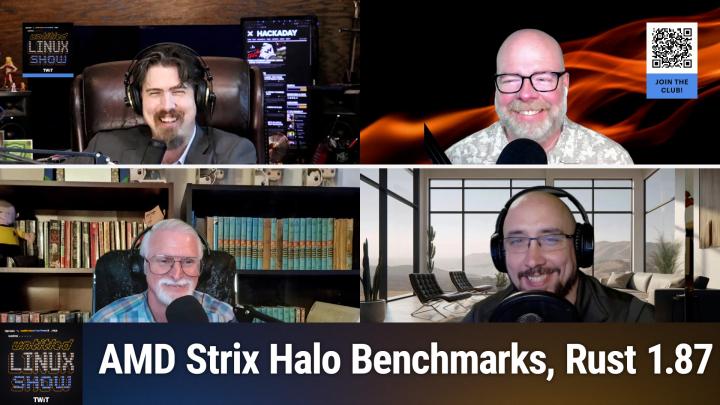
All TWiT.tv Shows (Audio)
Untitled Linux Show 203: Notorious Flatpak
01:24:57
Live Update Orchestrator, AMD Hiring, & Celebrating 10
Loading summary
Transcript258 lines
- [00:00]
Jonathan Bennett
Hey folks, this week we're talking about Canonical giving back to the community through thanks.dev. aMD is hiring if you're interested. Rust celebrates 10 years and the Linux world gets behind the end of 10 project. It's a lot of good stuff this week. You don't want to miss it, so stay tuned.
- [00:18]
Rob Campbell
So when I ask, what is Odoo, what comes to mind? Well, Odoo is a bit of everything. Odoo is a suite of business management software that some people say is like fertilizer because of the way it promotes growth. But you know, some people also say Odoo is like a magic beanstalk because it grows with your company and is also magically affordable. But then again, you could look at Odoo in terms of how its individual software programs are a lot like building blocks. I mean, whatever your business needs, manufacturing, accounting, HR programs, you can build a custom software suite that's perfect for your company. So what does Odoo? Well, I guess Odoo is a bit of everything. Odoo is a fertilizer magic beanstalk Building blocks for business. Yeah, that's it. Which means that Odoo is exactly what every business needs. Learn more and sign up now@odoo.com that's o d o o.com does it ever.
- [01:19]
Ken Starks
Feel like you're a marketing professional just.
- [01:21]
Jeff Geerling
Speaking into the void?
- [01:24]
Ken Starks
Well, with LinkedIn ads you can know you're reaching the right decision makers. You can even target buyers by job title, industry, company seniority skills.
- [01:33]
Jeff Geerling
Wait, did I say job title yet? Get started today and see how you can avoid the void and reach the.
- [01:38]
Ken Starks
Right buyers with LinkedIn ads.
- [01:40]
Jeff Geerling
We'll even give you a $100 credit.
- [01:42]
Ken Starks
On your next campaign. Get started at LinkedIn.com results, terms and conditions apply.
- [01:48]
Jeff Geerling
Ryan Reynolds here from Mint Mobile. I don't know if you knew this, but anyone can get the same Premium Wireless for $15 a month plan that I've been enjoying. It's not just for celebrities. So do like I did and one of your assistant's assistants switch you to Mint Mobile today. I'm told it's super easy to do@mintmobile.com.
- [02:06]
Ryan Seacrest
Switch upfront payment of $45 for 3.
- [02:09]
Unknown
Month plan equivalent to $15 per month.
- [02:11]
Required intro rate first 3 months only.
- [02:14]
Then full price plan options available, taxes and fees extra.
- [02:16]
See full terms@mintmobile.com podcasts you love from people you trust.
- [02:25]
Jonathan Bennett
This is twit. This is the Untitled Linux show epis 203 recorded Saturday, May 17 Notorious Flatpak hey folks, it is Saturday and you know what that means. It's time for Linux, Open source, gaming, hardware, all kinds of fun stuff. It is the Untitled Linux Show. I'm your host, Jonathan Bennett and I've got a crew of, of guys and we're going to talk about some stuff. You notice I didn't say that they were the best guys or the smartest guys. We've, we've got a crew of guys. Dang it. Oh, we have fun. And we've got.
- [03:03]
Ryan Seacrest
He's got volunteers.
- [03:05]
Jonathan Bennett
Yes, that's true. We've got some fun stuff to talk about today though, and we're going to let Rob kick it off and Rob's going to talk about Canonical, his second favorite computer company to talk about.
- [03:17]
Jeff Geerling
Yeah, so out of these group of guys here, we're going to start with the best. So Canonical, you know, you know, it's kind of one of those big names at Linux that we like to, or I like to, some of us like to razz on, put down whatever phrase you want to say, you know, so some hate it for their, for their choices they made with Ubuntu, like forcing snaps maybe. Others hate the, the big corporateness, you know, the red hat feel that they have. While some, you know, they're somewhat, they see Canonical somewhat anti open source at times, you know, with things like, like when they, they pulled lxd, you know, from, from the, into an internal project, you know, dump in the community and spurring the, the fork of Incas. Well, they're finally deciding to give back to the community. All right, I say that in just a little bit. I'm, I know they do plenty of overall good for Linux community, but they are now putting the money where their mouth is by donating 120,000 to open source projects this year or Also another put $10,000 a month in fact. You know, they have downloaded or donated, I mean to large projects before in the past, but these are large ones like Eclipse Foundation, Cloud, Native Computing foundation, gnome, you know, big ones like that. But this, this new announcement here is going to spread out the funding to many more smaller projects. So, so they are utilizing a platform called thanks.dev that analyzes canonicals GitHub code to determine external projects, libraries and tools their code relies on and splits up the features funds based on those dependencies. You know, I took a look at the site and, and it says, you know, it's trusted companies like Canonical Square and some others I have not heard of, but they're right there on the Home page and it shows canonical has over 2000 dependencies and in comparison square had 400 plus open source dependencies. So since kicking off this initiative, Canonical has donated more to more than 350 GitHub projects already. Ben Holt, Canonical software engineer, said, quote, while very few open source developers do it for the money, the feeling of being recognized, knowing that someone cared enough to show it has real meaning for an open source creator. And I could confirm that myself. I've never been a big one, but as someone who has done some open source development in the past, I did it because I was having fun, I enjoyed it. But knowing, you know, I've had some donations in the past and, and just knowing that someone appreciated what I did enough to donate, you know, even if it was a dollar, you know, or whatever they had, you know, it was appreciated, you know, same same goes with the coffee donations for this kind of thing. But you know, big projects often rely on, on many thankless small projects that often they don't get recognized the, the recognition they deserve. You know, when all said and done I, I imagine some projects may, may get nothing more than a few dollars out of this. But you know, like I said, I would feel amazingly honored to receive a few dollar donations from Canonical in recognition of, of how my work has benefited Canonical, which at this point is probably not at all. Except for maybe here. Well, maybe I need to start by not bashing on them so much. Maybe I need to start showing them a little more love and then, then they could call it a contribution though I don't know that, that they're, that dev platform is going to find me and their code to donate to. But anyway, it's kind of cool, you know, there's a, their project out there or platform out there that they're utilizing to see where their fun should go and they're spreading out to all those little guys. So it's pretty cool.
- [07:50]
Jonathan Bennett
Yeah, pretty cool. I'm always, I'm always fascinated by stuff like this because it's a fairly big problem. You've got all these little projects and even projects that start just for the love of it, you do eventually get to the point where it's like somebody's going to have to give some money for this thing to really continue or else the people that are doing it are going to have to go do something else.
- [08:12]
Jeff Geerling
Yeah, it's like I'm kind of tired of doing this. If I had some money maybe I could be incentivized to keep it up. Kind of maybe why I don't maintain anything anymore that I've had before.
- [08:24]
Jonathan Bennett
Yep. Getting, getting a paycheck for doing maintenance is a nice feeling.
- [08:29]
Unknown
Even just the recognition, like you said, you know, oh, somebody actually appreciates the work I'm doing.
- [08:35]
Ryan Seacrest
I can actually get a cup of coffee now.
- [08:37]
Jonathan Bennett
Yeah.
- [08:38]
Unknown
Yeah.
- [08:39]
Jonathan Bennett
I mean, it doesn't have to be a big paycheck. I mean, even just gas money is helpful for where a lot of us are at. Be honest. Yeah. Cool. Good for them. And I'm, I'm very intrigued by thanks.dev as well. That is, that's a place to kind of keep an eye on. It's not the only group out there doing this, but the way that they're doing it is interesting. So they, they say, hey, let us look into your GitHub. And then they go and they scan all of your like, repositories on GitHub and try to give you a breakdown based on the things that you're depending on. And that's, that's pretty cool. I'm not aware of anybody else doing quite that, so I like it.
- [09:13]
Ryan Seacrest
And they help support the people that you depend on.
- [09:16]
Jonathan Bennett
Exactly. Yeah.
- [09:18]
Jeff Geerling
And I guess as of a note, one more note to just be aware of. They do take 5% of the donations. So if you want to, that's.
- [09:27]
Jonathan Bennett
That is a smaller percentage than some other companies that I know that do similar things.
- [09:31]
Jeff Geerling
So sure, if you want to impact something more specifically, you know, always donate directly, but, you know, it's a lot.
- [09:37]
Ryan Seacrest
Smaller than some of the gatekeepers I deal with on a daily basis.
- [09:42]
Jonathan Bennett
Indeed. Indeed.
- [09:43]
Unknown
Yeah. And you got to figure there's a little bit of overhead there you got to deal with, you know, so 5%.
- [09:50]
Jonathan Bennett
5% is actually real reasonable.
- [09:52]
Jeff Geerling
That's way cheaper than the Android app store or any of those.
- [09:56]
Ryan Seacrest
What, similar to what a credit card transaction gets charged.
- [10:01]
Jonathan Bennett
Usually like 3.3.5% for a credit card transaction.
- [10:04]
Unknown
Yeah.
- [10:06]
Jonathan Bennett
All right, so let's chat quickly about one of those other things that we all are beginning to depend upon. And Ken, that's Rust. And rust is celebrating 10 years now.
- [10:18]
Ryan Seacrest
Yes, it is. Happy anniversary, Russ.
- [10:21]
Jonathan Bennett
Happy rustiversary.
- [10:25]
Ryan Seacrest
Well, this week Michael Narabelle and Bobby Borisov wrote about rust Developers celebrating 10 years of rust at of all places they went did the event at, I hope I say this correctly. Utrecht, Netherlands. Bobby's article starts off explaining Rust is an open source, modern systems programming language that combines memory safety with high performance. Its main advantage is its ownership model which eliminates entire classes of bugs such as data races and null Pointer dereferencing at compile time without needing a garbage collector. I still need a garbage collector. This makes it particularly attractive for performance critical applications like operating systems, game engines, web browsers, and the list goes on. He then recounts Rust almost legendary origin story while informing us Rust officially reached version 1.0 on May 15, 2015. Now, according to Michael, the Rust developers released Rust version 1.1.87 exactly 10 years to the day to celebrate this big milestone. Now, Speaking of Rust 1.87, some of the things that it provides. It adds anonymous pipes to the standard library safe architecture intrinsics, inline assembly via ASML exclamation, and it can now jump to labeled blocks within Rust code and a number of stabilized APIs. Rust 1.87 also removes its i586 Windows MSVC target for old processors. If you want details on this or on the history, then follow the links I have in the show notes. There's a complete list of the updated APIs that you can find through Michael's article.
- [12:40]
Jonathan Bennett
Yeah, Rust is so interesting because it got basically a complete redesign about halfway through that process when Mozilla picked it up and said, hey, we're going to use this for the browser now, it changed dramatically and then again when it entered into the kernel, it changed very dramatically to be able to work in that space. So it is a very interesting sort of evolving language because of that.
- [13:01]
Unknown
Yeah, that's like a happy ferrous oxide day.
- [13:05]
Ryan Seacrest
Had you ever heard the origin story for how Russ got created?
- [13:09]
Jonathan Bennett
It was. It was originally like a PhD or professor broken elevator.
- [13:18]
Ryan Seacrest
It involves a broken elevator?
- [13:19]
Jonathan Bennett
No. I don't know.
- [13:20]
Ryan Seacrest
PhD having to walk up 21 stairs.
- [13:24]
Unknown
Flights of stairs.
- [13:26]
Ryan Seacrest
Yeah, Bobby covers it better in his article.
- [13:29]
Jonathan Bennett
I have to go check that out. I'm not sure I could tell you exactly what the story is. All right, well, let's talk about about Live Update Orchestrator. What is this?
- [13:41]
Unknown
Yeah, this one's a little more enterprise, but so today we're going to be diving into an exciting development from Google and it's an update to their Live update Orchestrator or luo. This program is designed to apply kernel updates while the system is running, effectively greatly reducing the need for reboot. For the average user, this might not seem like a big deal, but for enterprise environments where uptime is absolutely critical, this is a major deal. Think high demand servers running enterprise workloads where downtime is simply not an option. LUO allows administrators to apply updates and patches without ever needing to take the system offline. Now, LUO is Not the first of its kind. Linux already has several live kernel updaters such as kpatch and ksplice, where you can update a running kernel. But what makes Google's LUO different is its primary focus. Not just patching an existing kernel, but moving to an entirely new kernel while keeping the system online without interruption. So this is a step beyond what previous solutions have offered. To quote Google's developers, live update is a specialized reboot process where selected kernel resources, memory file descriptors and eventually devices are kept in kept operational or their state preserved across kernel transitions. For certain resources, DMA and interrupt activity might continue with minimal interruption during the kernel reboot. So in essence, LUO enables a seamless transition where critical system functions remain uninterrupted even during a kernel update. So now when they talk kernel reboot, they mean going from one kernel to the other, not a full system reboot like most people think when you, when you hear reboot. Beyond that, LUO builds upon a foundational piece of code Google plans to upstream soon known as kernel handover. There's a possibility we, we could see this integrated into the Linux 6.16 kernel, making it available to the broader community. Basically to check it out, we'll have to wait for the pull request for 6.16, see if the code winds up in there. If the relevant code is included, LUO then would become widely accessible, allowing updates without reboots, or at least in most cases. That being said, if you're doing something like a full distribution upgrade, it's probably still going to require a reboot just to the sheer number of changes involved. But routine incremental kernel Updates, like a 0.01 version update or you go from a dot 15 to a dot 16, okay, your new kernel, you can do it without a full system reboot. It is important to note that this technology is mainly designed for enterprise servers which use error correcting memory and other high stability server grade hardware. These machines prioritize stability above all else. You know, consumer grade desktops and laptops on the other hand, benefit from an occasional reboot, you know, because we can get consumer grade stuff, can get minor hardware glitches and that can still throw things off. So it might not be totally the fault of the operating system if something goes a little awry. So just, just be known that if you're, if you're running consumer grade hardware, you might not get these super long up times maybe, but you know, your mileage will vary with the less stable and a lot of times faster running consumer grade Hardware but for mission, for, but for system administrators managing mission critical critical environments, this is a massive win. So you know the error of seamless updates where uptime is preserved without interruption is it's within reach or at least uptime is greatly improved. So to all the sysadmins out there, get ready to rejoice.
- [18:01]
Jonathan Bennett
Yeah, interesting. That's pretty cool. I know there are a couple of companies and projects that do live patching that'll let you do something similar. But swapping out the entire running kernel, that's really fascinating. I can see. I bet they have plans even for things like Android like let's do it there too. Right. It makes sense at home.
- [18:22]
Unknown
Bunch of license I think once they get it fully ironed out and the, that software I was talking the, the code that they were going to put in there, the kernel handover that was part of the kind of this base framework that will keep the status of all the, the memory, the hardware where everything was to help with the transition of the Orchestrator. So it's, they kind of work in conjunction with each other.
- [18:53]
Jeff Geerling
I, I think something like this actually finally makes you know, uptime a real bragging point. You know, over the years a lot of people, various communities, I've been like how long's your uptime? And people are like bragging like I've been up for this many days and, and then you always get all the feedback which I'm usually leaning on that, on that side is like so you're not updating then you're unpacked, out of date. It's kind of critical to update. But you know, this, this, this will be a new one, you know now, now I can get on those communities and say I have this long uptime and then when they come back. So you're not doing updates. I'm like, oh I am, I've got this.
- [19:39]
Ryan Seacrest
Yeah, I'm using live update Orchestrator.
- [19:42]
Unknown
Yeah, yeah, well and that's why if, if your system has to get rebooted, say you're doing this and you're really trying and you're running consumer grade. I just wanted people to know that there is a difference in hardware quality and server enterprise steps back from the ultimate speed and there's a lot more error checking and redundancy to make sure things keep running at the expense of speed. So like that's why like a thread ripper or something or Epic, you know, processor is not going to play games as fast as your normal consumer stuff because they of the stepping back and the slowing down.
- [20:20]
Ryan Seacrest
If Anything. They're going to underclock it.
- [20:23]
Unknown
Yeah. Just to make sure there's no errors, there's no hiccups.
- [20:28]
Jeff Geerling
Yeah. On some of my servers I use the UM2 Pro, the live patching. But even that you. You still have to update once in a while, but it maybe minimizes that a little bit. Or reboot. I mean, once in a while.
- [20:40]
Unknown
Right.
- [20:42]
Ryan Seacrest
It seems like I'm rebooting Tumbleweed every other day.
- [20:46]
Jonathan Bennett
Is that because you have to, though?
- [20:50]
Ryan Seacrest
It's because it recommends doing that after doing each distro update.
- [20:54]
Jeff Geerling
Yeah.
- [20:56]
Jonathan Bennett
I mean, it's Tumbleweed. It's a rolling release. That's not terribly. Not terrible.
- [21:01]
Unknown
Yeah, that, that would be kind of. I don't know, if you had a rolling release and then you included this, I guess maybe you could keep going.
- [21:11]
Jonathan Bennett
Kernel roll too.
- [21:13]
Ryan Seacrest
Yeah, you just have to close out certain programs occasionally.
- [21:19]
Jeff Geerling
Yeah. Because it's not only the kernel that sometimes needs that reboot, it's all the libraries and stuff that would cause problems.
- [21:27]
Ryan Seacrest
Too, that the applications have open. Like try updating Firefox without having to restart it.
- [21:38]
Unknown
Yup, that would be tough.
- [21:40]
Jonathan Bennett
Yep.
- [21:41]
Jeff Geerling
Yep.
- [21:41]
Unknown
Hey, it's Ryan Seacrest for Albertsons and Safeway this spring. Take care of your entire home, including the air you breathe. And save $5 when you buy $25 worth of participating products in store or online. Shop for items like Glade plugins, Airwick plugins, Glade Auto sprays, Airwick diffusers, and Glade refills. And save $5 when you spend $25 on participating products. Offer ends May 20th. Restrictions apply. Promotions may vary. Visit albertsons or safeway.com for more details.
- [22:10]
Here in America, work is in trouble. We've offshored our manufacturing, sent away good jobs and lost so much ability to make things. American Giant is a company that's pushing back against this tide. They make high quality clothing. Sweatshirts, jeans, dresses, jackets, and so much more right here in the USA. Visit american-giant.com and get 20% off your first order when you use code STAPLE20 at checkout. That's 20% off your first order at american-giant.com, promo code STAPLE20.
- [22:41]
Jonathan Bennett
All right, let's see up next, Rob, are you looking for a new job?
- [22:48]
Jeff Geerling
Well, you know, if you are looking, you know, if you're not looking for small donations from Canonical, but instead, you know, a full time job, you know, this story may benefit you. So AMD is again hiring more Linux engineers to work on their Ryzen client efforts under Linux with next generation hardware enablement. Enhancing feature support for existing Ryzen systems and related efforts. They have already, I mean they've already hired Linux engineers in the past. That's kind of nothing new, you know, to work on things like server side where epic market share, you know in, in the data center continues to grow significantly and you know, seeing success in things like you know, the Valve Steam Deck that's primarily AMD and, and I guess even some Tesla and vehicle systems utilize it. You know it's all growing with the AMD Linux ecosystem and, and you know I, when it comes to gpu, I'm often touting that Jeff needs to, you know, avoid that other GPU company but he has his reasons so I'll let him, I'll let him stick with that. But I like amd. But anyway, the goal of this role is to enable Ryzen APU CPU within Linux distros and work with the cross functional team for Linux os. Bring up now if you're looking at this, you may have to relocate as this position is hiring in Taiwan. Oh, Taipei, Taiwan. I had to think how to say that again. I forgot Taipei. So that's, that's where it's at. So maybe it's not for a lot of our listeners but you know, if you are interested the job posting description says you're going to have to plan, design, review and evaluate Linux OS specifications. Ability to engage with external partners and customers to enable preferred kernels and distros on Ryzen platforms. Contribute to the design and architecture of high quality quality complex systems Linux environments and compatibility among commodities. Ability to debug complex system level multi component issues that typically span across multiple layers in the system using either written or verbal skills. Collaborate in a team environment across multiple engineering disciplines making the architectural trade offs required to rapidly deliver base level solutions for the platform. Experience in C in Python skills get familiarity with at least one major Linux distro and they say in a proficient systems design engineer with a strong Linux skills take a primary role in, in between silicon engineers, firmware engineers, software engineers, platform engineers and architects. So you know, although it, you know it's in Taipei, but it's good, it's still good to see when hardware manufacturers place an emphasis on, you know, Linux functionality even if it's not the core. It's good to see that, you know, they're putting some work in the Linux functionality rather than leaving it as an afterthought for the community to figure out on their own Apple. So you know, they're hiring strong, really put a focus on Linux. So go amd yeah, very cool.
- [26:32]
Jonathan Bennett
I like it. Now I wonder if that's a position that they would consider taking remote if the right person applied for it. I would, I would not like if you were out there and you were thinking to yourself, man, I'm the perfect person to this, but I don't want to move to Taiwan. They have the conversation. The worst thing they can do is say, no, we're not going to hire you if you're not willing to move to Taiwan.
- [26:52]
Jeff Geerling
Yeah, I don't know what, what this, specifics of it if it's. They require it to be in a specific location, but.
- [27:00]
Unknown
Well, I bet you came in with a really shining resume. They would start making exceptions.
- [27:06]
Jeff Geerling
So you're gonna apply.
- [27:07]
Unknown
Jeff, I'm not a coder, I'm a hardware guy.
- [27:14]
Jeff Geerling
You've done Python, I guess you don't.
- [27:16]
Unknown
Do C, but I have done a little bit of C. But I mean it's very.
- [27:21]
Jeff Geerling
There you go.
- [27:21]
Unknown
Basic. Yeah. They're gonna look at me and go.
- [27:23]
Ryan Seacrest
Yeah, I've done Basic.
- [27:27]
Jonathan Bennett
Yeah.
- [27:27]
Unknown
They'll say, hey, we want you for the fab, you know, interface with our foundry partners and, but not, not coding. But to correct what you said, I have Team Green video cards right now. Honestly, I would not buy Team Green right now. I'm actually, I was toying with the idea of building another computer and it would be an AMD card. Team Green has just kind of run off the rails on this. This 5000 series is just terrible.
- [27:56]
Jonathan Bennett
Well, you heard it here first.
- [27:58]
Jeff Geerling
Yeah, you are, you heard it here from the Nvidia fanboy.
- [28:03]
Unknown
Yeah, well, the driver issues, the chips not having the full capability they're supposed to. The pricing, the. I mean, they're. They not sending viewer or review cards for the 50 60s, the 5060 series of cards, because they don't want the reviews coming out that are just going to tell everybody, do not buy these cards. They are a terrible value.
- [28:26]
Jeff Geerling
They're.
- [28:28]
Unknown
Yeah, we could, we can talk about it in the after show, but it's.
- [28:33]
Ryan Seacrest
Not too much to talk about now.
- [28:36]
Unknown
Yeah, yeah.
- [28:38]
Jonathan Bennett
All right, well, let's talk about something that Rob and I at least are going to have to think a lot about. And that is the end of 10. The end of 10 is coming.
- [28:51]
Ryan Seacrest
First of all, what is the end of 10? Is it something radical? And why are we discussing this event on the Untitled Linux Show? The answers to these and other questions are found in the articles Christine Hall, Liam Proven and Jack Wallen wrote about a collective of developers and others who are trying to help Windows 10 users transition their computers to Linux. Christine starts off saying, wowzy zowie. I don't know how long it's going to last, but for the time being, some of that old time we're doing something radical, important and good. Open source filling is back. It's like being part of a movement again and I'm tempted to take the advice once handed out by David Crosby and to just let my source freak flag fly. Now, according to Liam, the campaign is a noble attempt to raise public awareness. It. Excuse me, it carries.
- [30:03]
Jonathan Bennett
Lost my train of thought there carries something.
- [30:06]
Ryan Seacrest
Yep, it carries the campaign is a noble attempt to raise public awareness. It carries a simple clear message in large friendly letters When Windows 10 reaches the end of its life in five months time, you don't need to buy a new computer. Jack states with the Windows 10 end of life on the horizon, it was only a matter of time before something like this arrived on the scene. Now this is coming from the end of the 10 website is this Jim if you bought your computer after 2010, there's most likely no reason to throw it out. By just installing an up to date Linux operating system, you can keep using it for years to come. I'm proof of that. I bought mine secondhand and I'm still using it. If now by just installing an update date Linux operating system, you can keep using it for years and years. Yes, this movement has a website even hosted by no other than KDE, which was initially scheduled to go live on May 28th. What's today? Jonathan?
- [31:26]
Jonathan Bennett
Today's the 17th as we record this.
- [31:30]
Ryan Seacrest
So you may be watching this after the 28th, but it was launched actually a couple of days ago. But it's because it's a hopping place right now. Now who's behind end of 10? According to Christine, end of 10 is supported by a coalition of FOSS projects which includes well known open source projects such as GNOME and KDE, Free Software Foundation, Europe, OpenSUSE, and in fact several members of End of 10 Work or Contribute to some of these projects. The End of 10 project's mission is threefold. First, empowering users and promoting sustainability. Second, community driven support and third, distro agnostic approach. I'm glad to see it's a distro agnostic, though we do have our favorites, don't we Jeff?
- [32:36]
Unknown
Yes we do.
- [32:38]
Ryan Seacrest
Now if you are asking how do I get involved? Christine's article best answers your questions. I've got a link to hers in the Show Notes as well as Liam's article which suggests installing Chrome OS Flex or Ubuntu. And you can read Jack's article to find out more about OpenSUSE joining the initiative and transitioning its Upgrade to Freedom campaign to the end of 10 movement. Now Jack also reports on OpenSUSE dropping support for the Deepen desktop environment, which I do recommend reading if you want to find out why.
- [33:18]
Jonathan Bennett
Interesting. All right. Yeah, I've seen a couple of different places working with. I think the Fedora guys are part of end of 10 as well. It's a lot of different places. They're sort of grabbing onto this theme of, boy, that's a whole bunch of desktops out there that you're going to have to update because of some of the Things in Windows 11.
- [33:39]
Ryan Seacrest
It's like, you know who's conspicuously. Who's missing from this group?
- [33:44]
Jonathan Bennett
Who's that?
- [33:45]
Ryan Seacrest
Microsoft.
- [33:46]
Jonathan Bennett
Oh, well, I mean, that's no great surprise, right? Microsoft raised the limits sort of artificially for Windows 11. And that's what's really driving a lot of this, is that there's a bunch of machines that are otherwise quite usable. They just. You're not going to be able to officially install Windows 11 on. There are some unofficial ways to do it. Like, that's the worst thing about this. Windows 11 will run just fine on this hardware, but it is not officially supported because of one reason or another. That's. That's what's driving a lot of us crazy about it.
- [34:18]
Jeff Geerling
I'm going to defend them just a little bit and that it's not completely arbitrary in that from what I've heard, there are aspects of Outlook, I believe, I believe I heard a story somewhere about the newer Outlook using security features from the TPM2. And I don't remember what that is, but I've read some stories about that. I believe it was actually from a Linux advocate, but I could be wrong about that.
- [34:47]
Jonathan Bennett
Yeah, well, I mean, so what Microsoft is trying to do is they're trying to make all of your desktops, all of Windows 11 desktops are supposed to be disk encrypted using a TPM. And so if you don't have a, if you don't have a TPM or you don't have your firmware TPM turned on. There's just, there's nothing for Windows to talk to, to be able to get an encryption key. And so rather than.
- [35:10]
Unknown
Good, I was gonna say. But they could very easily just let it run and just say, okay, look, here's the features you're not gonna have and you're gonna be a little higher security Risk. And you're oh, it's good now. I, I, I did put a link in the show notes too for Brody Robinson video where he talks about it, about Windows 10. And I, you know, when I go see my mom in a couple months, she does not what Chromebook type. No, I'm gonna load, I'm gonna load Linux on her, on her computer. She's all for it because she hates Windows 11 that bad.
- [35:46]
Jeff Geerling
And then you're gonna use KDE and it's gonna look like Windows 11.
- [35:51]
Jonathan Bennett
It's gonna look like KDE.
- [35:53]
Unknown
It's gonna look, well, it's gonna look more like Windows. It's gonna look more like Windows 10. And you know, the start button is going to be in the corner where it belongs.
- [36:03]
Ryan Seacrest
There is one thing I would like to do is look over the list of members of end of 10 and see if there's any hardware vendors.
- [36:14]
Jeff Geerling
I do want to say, Jeff, you can put the Windows 11 logo in the corner so it looks like Windows 10 still.
- [36:20]
Unknown
But I figured it was probably. Well, I never know actually. I don't know if that was an option or not because sometimes things that I thought should be done on Windows you just can't do. I don't think it's possible.
- [36:36]
Jeff Geerling
I think at first it wasn't. Maybe, I don't know.
- [36:40]
Unknown
Yeah, but I'm, I'm gonna do that for my mom. Just get her started. You know, I'll probably put her on Ubuntu lts so it's just inside it for security updates and just pretty basic because she, most of her stuff is just surfing the web and she does play some games, but it's a lot of.
- [36:58]
Ryan Seacrest
Go ahead and set her up for Ubuntu Pro as well.
- [37:02]
Jonathan Bennett
You could.
- [37:03]
Unknown
Yeah.
- [37:04]
Jonathan Bennett
Before we do that though, I'm going to make a pitch that you should use kde. And that is because there is something very cool, very new that is coming to KDE 6.4 and that is the new HDR. You knew it had to be something with that, the new HDR calibration wizard. So this is sort of, this is addressing one of the complaints that I have about KDE 6.3. Even for the longest time, a machine behind me is stuck on 6.2 because I didn't like the changes that they made. And they are adding the calibration wizards that you can go and set your max brightness and get in there and do a little bit more tweaking with exactly how an HDR screen is going to work. It's also Adding the ability to do HDR like you could call it HDR light, perhaps on displays that have the ability to make the backlight brighter and dimmer in various regions. And there is a new feature that grants you the ability to emulate an HDR screen through that. There's now there's some work on the plasma RDP server that's definitely an interesting thing. The remote desktop built right into plasma might have to make use of that. I've had use over the years of being able to remote into my local desktop, so having it built in is pretty cool. And then of course the link here is actually to Nate Graham's blog and all kinds of stuff in here. Various bug Fixes for the Plasma 6.3series bug, a bunch of bug fixes for the 6.4 frameworks, all kinds of other stuff. But the HDR news was the one that really stuck out to me because it is a felt pain point for me. I very much want to see that get fixed.
- [38:55]
Ryan Seacrest
Especially since you've got a HDR capable monitor.
- [38:58]
Jonathan Bennett
I do. I do indeed. I enjoy my HDR capable monitor too.
- [39:03]
Unknown
And I actually did see that story and I went, I bet Jonathan wants.
- [39:06]
Jonathan Bennett
To do that one. Yes, I saw that. Nobody got it. And like I'm gonna do that one.
- [39:12]
Jeff Geerling
I've heard Ubuntu is also gearing up for hdr.
- [39:16]
Jonathan Bennett
Yes, yes.
- [39:17]
Unknown
And and for the record, I will be putting her on kde. I'm gonna have it match kind of what I have so that I easier troubleshooting.
- [39:26]
Ryan Seacrest
You didn't maintain.
- [39:28]
Unknown
Yeah, if I need to.
- [39:29]
Jonathan Bennett
But yeah. Yep.
- [39:31]
Unknown
But I'm gonna set it up very conservative of just. And just let her have it. Have at it.
- [39:36]
Ryan Seacrest
Set it up with Firefox. Is she gonna need anything else besides Firefox solitaire?
- [39:46]
Unknown
Oh, she'll. I'll set her up with Steam so she can get games. She likes to play some of the old point and click games like Mist and some puzzle games like that which are pretty easy to run. So I'll set her up with that and then she'll be happy.
- [40:02]
Jeff Geerling
I mean the most popular game I know when I worked in a PC shop when older elderly people would brought their stuff and was just to make sure their solitaire worked afterwards. And I remember when Windows 7 went to Windows 10, some of those updated Windows 10 did not have solitaire.
- [40:24]
Jonathan Bennett
It's like Microsoft really did not understand their customer base with that one. Goodness.
- [40:31]
Unknown
Yeah, yeah.
- [40:32]
Jeff Geerling
Just short where the software center is. That's what I've done. You know, in the past.
- [40:36]
Jonathan Bennett
Yeah. Yeah. The nice thing is that most anything you can get through there is going to be fairly safe. So.
- [40:41]
Unknown
Hey, it's Ryan Seacrest for Albertsons and Safeway this spring. Take care of your entire home, including the air you breathe. And save $5 when you buy $25 worth of participating products in store or online. Shop for items like Glade Plugins, Airwick Plugins, Glade Auto Sprays, Airwick Diffusers, and Glade refills. And save $5 when you spend $25 on participating products. Offer ends May 20th. Restrictions apply. Promotions may vary. Visit albertsons or safeway.com for more details.
- [41:10]
Here in America, work is in trouble. We've offshored our manufacturing, sent away good jobs and lost so much ability to make things. American Giant is a company that's pushing back against this tide. They make high quality clothing, sweatshirts, jeans, dresses, jackets, and so much more right here in the USA. Visit american-giant.com and get 20% off your first order when you use code STAPLE20 at checkout. That's 20% off your first order at american-giant.com promo code STAPLE20.
- [41:41]
Jonathan Bennett
All right, Jeff, I have been hearing about a new AMD Ryzen chip and I've heard that it's actually pretty impressive. I also am of the opinion that it's a terrible naming convention. Are you going to try to talk me out of that?
- [41:58]
Unknown
No.
- [41:58]
Jonathan Bennett
Okay.
- [41:59]
Unknown
Well, you know, I will say they missed the bar for the US USB naming. So the people that had the standards for the USB standards, they're still winning this. This is maybe second or third tier.
- [42:15]
Jonathan Bennett
Yeah.
- [42:15]
Unknown
But now we have spent a lot of time on the show discussing AMD's latest processors for desktops and, well, we haven't really focused on the mobile ones. And you know, since we do like to talk about laptops every now and then, this article from Pharonix caught my attention. Michael arable received from HP the ZBook Ultra 14 inch G1, a mobile workstation which features, and here's the name, AMD Ryzen AI Max Plus Pro395 chip. Yeah. Now it's a powerhouse. It's got 16 cores, 32 threads, and has Radeon 8060s integrated graphics. Now the laptop itself is also packed with 128 gigabytes of memory. Now let's get the obvious elephant in the room out of the way. Yes, it's very pricey coming in at approximately US$8,000. But you know, keep in mind, other 395 series processors are available at Lower prices. I looked and there were some laptops, I think more about 2000. This particular machine is a flagship high end workstation replacement designed for those, you know, you need maximum performance in a mobile form factor. So they're kind of going for a high end niche, probably company type customer here, where $8,000 is easier to swallow when you're a very large conglomerate. Now what's really fascinating is that this laptop was put through a comprehensive comparison against 21 other machines, other laptops spanning a broad range of manufacturers. I mean, there's Dell, msi, Asus, Acer Framework and more. Now these are all the laptops that can run Linux, even if they aren't always specifically marketed, saying they can, but so these, these are all benchmarks, so you know that they've got a pretty good Linux compatibility to them. The article dives deep into the tests, examining everything from computational power, AI processing, compression, media performance, the entire gamut. However, gaming benchmarks were deliberately left out as gaming performance is heavily dependent on the GPU rather than just the CPU. And some laptops include external GPUs which would skew comparisons against machines running integrated graphics. So if you have an external GPU on your laptop, it's still going to be better than a lot of integrated GPUs. Okay, now let's talk results at the high level. The AI Max Pro 395 absolutely dominates all of the laptop chips. There's no doubt this is exceptionally powerful. That being said, while it's not the cheap option, you know, some actually view it as more of a compact desktop replacement than a traditional laptop processor. And there are some very small form factor computers using this chip. So it's a lot of the computers, like maybe it gets stuck to the back of the monitor on a Vesa mount or something like that. So when you, when you're maybe doing some office things where you don't need anything real powerful and it's running apps off servers or things like that, this chip replaces a much larger desktop model. Now like I said, you can find them in other laptops cheaper, but you know, depends on your budget, what you want to get. But the, the real takeaway here and this comparison I think provides valuable insight into how various processors stack up. So if you're in the market for a new laptop, this data lets you weigh, you know, computational power versus price. So you can make the most important decision possible because I mean, there's in several AMD chips, several generations, intel chips, a few different generations, so you have a wide gamut of mobile Processors so you can look and see how, how they all compare to decide what you actually need. You know for those wondering how intel chips held up, you know AMD processors came out on top in most tests. Intel's Core Ultra 7, 256V and 258V they made a respectable showing. They landed in 8th and 10th place respectively overall. So not terrible but not you know, they 8th out of 22 so was the best. So Intel's got to come back a little more but maybe they're not in high demand and you can find a heck of a deal on a laptop. I, I didn't check prices so but maybe something to consider. So if, if you're take, if you're considering a new laptop, take definitely take a look at the article in the show notes, explore the benchmarks and find the best solution for your needs and budget.
- [47:17]
Jonathan Bennett
Yeah, I've looked at one of these before and they are quite impressive. I think Framework actually has one of these high level new AMD cards that they're about to come out with and I looked at it, I was like oh that would be so nice but I just can't, I can't justify, I don't do enough with my laptop. I don't do enough high performance stuff. I don't actually need a mobile workstation so that's mine.
- [47:42]
Unknown
And at least right now I want to say Framework, they're running the I think 370 series chips which are, which are a tear down from the AI Max chips. But I, I'm like you, I, I don't do a, I do more like oh I need, I need this in the shop for looking at these manuals. I need, you know, maybe I'm going to run a Dungeons and Dragons. Well, sorry Pathfinder session. I prefer Pathfinder. There, I said it. And you know I need, yeah I need, I need quite a bit of memory but you know the processor can be a little slower for what I, what I'm doing on them.
- [48:22]
Jeff Geerling
So yeah, that reminds me when were we going to stream that, that ULS Pathfinder game?
- [48:28]
Jonathan Bennett
We've talked about it, we could do it anyway. That's not really what we're here to talk about though.
- [48:39]
Unknown
But the subject, I bet you a lot of people who like Linux either have or are currently playing tabletop role playing game.
- [48:47]
Jonathan Bennett
I mean I've got my binders pretty much within reach. It's true.
- [48:52]
Unknown
I could pull down my gamers Nexus autographed case with my inductor polyhedral dice.
- [49:00]
Jonathan Bennett
Yes, we're all Nerds, we admit it.
- [49:02]
Jeff Geerling
You'll have to teach me. I'm not quite as big of a nerd.
- [49:05]
Ryan Seacrest
But would you run elementary OS on it?
- [49:10]
Jonathan Bennett
You could. Is there something new with elementary os?
- [49:14]
Jeff Geerling
It's elementary, my dear Jonathan. Elementary. So elementary os, it's a distro we don't really talk about much, but it is a fairly popular distro, at least. At least in a niche area. And, and one that I have had some interest in in the past for a while. Honestly I tested it quite a few years ago, I don't know, five years ago, give or take. I don't remember. And at the time it was eh, it was okay. That's kind of how I felt about it then. But I, I feel like it's looking pretty slick these days. And with a new release of eight just around the corner, I thought I'd share some of the cool things I've read about it that are coming up. Maybe I'll give a shot. I don't know, but we'll see. Maybe you want to give it a shot. So you know Project Project founder Daniel Hooray, he recently recapped some of the features that are coming up. So, so here's, here's one of the things. The first thing on top of the list is is there is a. They're adding a prevent sleep button. So you know, are there ever times when you don't want your PC to go to sleep but you know, in that case your options are to maybe run something like I know there's caffeine or stuff that a program called that that I ran on some various different computers or you can go into the power settings and, and go and change it. Also it doesn't shut off. That's a lot of work when you could just have a simple button built in a nice quality of touch, quality of life touch. So I know I would use it. There are definitely times I like to not like to keep my computer from falling asleep. There's also language settings benefits from a more responsive design Wacom settings. So it's a stylus detection and you know no no cause doesn't cause crash if none found in app purchases. Also is another thing, you know app center labels free apps with paid content inside. I know in app purchase and maybe the bane of many people's existence, especially those that's struggle with self control maybe have kids with a little too much access to it. But the truth is that you know, in app purchases have been a boon to you know, mobile app development and you know Many games across the spectrum. So having something like that on Linux, you know, it boosts these platforms and help developers also. It may may also help boost the ecosystem, the app ecosystem on Linux. You may also end up with a lot of junk games along the way, but you just need to know which ones to go for and which ones to, you know, just skip. So it really could help the development if they got that there. Then there's also, there's a new system monitor app to show, you know, things like cpu, ram, gpu. And you know, I saw the screenshot of it, it looks okay, but I think there are better ones out there that if I were doing it I would just pick one of those and put it in. We've, we've demoed or displayed a few, at least a couple on this show that were pretty slick that I think would be better than this, but whatever. And then also another nice one, you know, for those who like multiple workspaces, which I do. The fact is one of the key, one of the things that really drew me to Linux back in the old days. Now Windows, Mac all kind of have variations of it, but anyway, now access to workspaces are in the dock kind of kind of thing. You can do that other distros too, but it's new to elementary, so those, those currently using elementary os. Well, you know you're going to likely see these updates in a future 8.1 release, but if you are adventurous and want to see them sooner, you can sponsor elementary on GitHub to get early access to daily and monthly development releases for testing. So I know elementary is all. It's, it's a little bit. I felt, I used to feel like they're trying to look like Apple, like Mac os, but maybe it's just the gnomish of it. I don't even know if it's GNOME that they use, but it's interesting distribution and you know, not too far out there. It's not Hannah Montana, Lennox or anything like that. So you know, if you're hopping around, you haven't tried it yet. It'd be worth giving it a shot, I think.
- [54:05]
Jonathan Bennett
Yeah. Fun. Is it, Is it do. Is it going to become not a niche Linux distro? Is it going to become a distro that you can actually recommend to someone?
- [54:17]
Jeff Geerling
I think you can recommend it. I don't know, it just.
- [54:22]
Jonathan Bennett
You've heard my rant before. If someone new, someone's new to Linux, don't tell them to go to either Arch or one of these little niche distros and nobody's ever heard of them. Tell them to go to Fedora or Ubuntu or Debian.
- [54:35]
Jeff Geerling
I think if somebody definitely stay away.
- [54:37]
Ryan Seacrest
From Gen 2, I mean, I think.
- [54:40]
Jeff Geerling
I think if somebody new came to elementary os, I think it'd be just, it'd be just fine. It just doesn't wow me enough. Compared to like some of the others, like, it's just another distro.
- [54:53]
Ryan Seacrest
I mean, Tumbleweed.
- [54:55]
Jonathan Bennett
That's, that's kind of saying something though, right? When, when a distro has come to the point in development where it's just another distro like you, you've actually, you sort of made it at that point to some extent.
- [55:06]
Jeff Geerling
You have. But also you kind of want to differentiate yourself somewhere because there's already plenty of other major just another distro out there. But it's true.
- [55:20]
Jonathan Bennett
That's true.
- [55:21]
Jeff Geerling
I'd put there up. I put. I would put them up there in the top 10 or 20.
- [55:25]
Jonathan Bennett
Yeah.
- [55:26]
Jeff Geerling
Or somewhere in there.
- [55:27]
Jonathan Bennett
Now the question that I'm sure Ken has is can you run flat packs on it?
- [55:33]
Jeff Geerling
Absolutely. Why don't you tell us more about flat packs? Okay.
- [55:39]
Ryan Seacrest
I'll be more than happy to. And this week we've got Mario Snister and Jet Wallen both writing about the release of the popular Linux application sandboxing and distribution framework. Yes, that's the Flatpak. This time it's version 1.16.1. Both Jack and Marius talk about one of its biggest improvements. The ability to allow a child account to update existing apps by default when using parental controls to ensure that security and bug fix updates can be installed. Flatpak 1.16.1 also speeds up the Flatpak prune space dash dash dry dash run command by no longer calculating the potential freed space and avoiding operations that would need to hold a lock. It speeds up the Flatpak permission reset command by only writing entries that have actually changed and add support for looking for TLS certificates on ETC containers Certs D when interacting with OCI registries. This release addresses various bugs, including a memory leak when installing extra data, showing fatal transaction errors twice and including all options in shell completion for Flatpak search. As always, since I didn't touched on the highlights, I do recommend getting all the details for Marius and Jack's articles.
- [57:22]
Jonathan Bennett
Yeah, interesting stuff. The the the notorious Flat Pack. The infamous Flat Pack. It means it's more than famous. That's fun.
- [57:37]
Unknown
Hey, it's Ryan Seacrest for Albertsons and Safeway this spring. Take care of your entire home, including the air you breathe and SA. When you buy $25 worth of participating products in store or online, shop for items like Glade Plugins, Airwick Plugins, Glade Auto Sprays, Airwick Diffusers and Glade refills. And save $5 when you spend $25 on participating products. Offer ends May 20th. Restrictions apply. Promotions may vary. Visit albertsons or safeway.com for more details.
- [58:05]
American Giant makes great clothing sweatshirts, jeans and more right here in the U.S. visit american-giant.com and get 20% off your first order with code STAPLE20. That's 20% off your first order at american-giant.com code STAPLE20 all right, do we.
- [58:23]
Jonathan Bennett
Want to talk about the other AMD thing? The other AI Max plus thing?
- [58:30]
Unknown
Well, we're kind of going to hit the old one and some new.
- [58:35]
Ryan Seacrest
So we're going to get a halo in here.
- [58:38]
Jonathan Bennett
I think there may be a halo.
- [58:41]
Unknown
I don't know, maybe some horns. We'll see here. So I've got a couple more stories about laptops coming up. Now the first one focuses on the AMD 395 processor. Again, same HP laptop as we discussed earlier. This time Michael Arable from Pharonix compared it to Windows 11. So Windows 11 and Ubuntu 25.04 on the same hardware using a variety of benchmarks. Now this includes gaming benchmarks, so this adds an extra layer to the analysis. Now I was going to do a full deep dive into the system, but you know, the bottom line is just clear for this brand new AMD chip. They've only been out, I think a month or two months. Ubuntu completely dominated Windows. Typically when we see our comparisons like this, you know, one system edges out the other slightly. But here Ubuntu secured 80% of first place finishes and when looking at the geometric mean, it demonstrated, demonstrated 30% better performance. Yes, 3, 0%. You know, to be fair, Windows will likely improve over time, fixing drivers, optimizing support, you know, closing the gaps. But for now, at least, this early hardware, Linux simply outperforms Windows. No debate, no hesitation. Linux is faster. Period. End of story, full stop. Second story. So this ties into the first but expanding the one I just talked about. But it's expanding the comparison between multiple Linux distributions on a different laptop. So there's no Windows involved in this one. But this one is the framework laptop 13. Now this one features an AMD Ryzen AI9HX370 CPU. See that naming is so much better. 16 gigabytes of memory and a 1 terabyte SSD. So this, this is more like what people would normally get. The Linux distributions tested were Cache OS rolling Clear Linux 43280, Debian 13 testing, Fedora Workstation 42, Manjaro 25, Opensusi Tumbleweed, Ubuntu 25.04 and they were all tested as they loaded. So it was all defaults, no tuning, no custom optimization. However it installed is how it was tested. Now onto the results. Now this is where this is going to be a little interesting, so stick with me here. But Debian 13 testing took the most first place finishes, 60 in total, followed by Cash EOS with 24 and Clear Linux with 18. Manjaro had 5, Ubuntu had 2 and Opensusi Tumbleweed managed just 1. But things get even more interesting when you look at the geometric mean. Across all tests, Clear Linux emerged as the leader performing 4% faster than cache EOS with Debian just 1% behind that Fedora, Ubuntu and Manjaro respectively were followed by closely behind Debian. They're just like a couple percentage points. The biggest surprise Open opensuse Tumbleweed finished in dead last and not just slightly behind, but almost 30% slower than clear Linux. And even compared to Manjaro which was the next to the last distribution speed wise it was SUSE was tumbleweed was nearly 20% slower. I mean that's, that's a significant gap. Now a word of caution. So Tumbleweeds are rolling distribution meaning its performance can fluctuate depending on when the benchmark was run. Maybe it had a bad update or there was something misconfigured dependency or something was off, but it was really off. And another note is when Clear Linux won overall but it didn't take that many first place wins. So what that means is when it did win it won big and when it didn't win it performed consistently well and it took a lot of close second place finishes. So for those unfamiliar, Clear Linux is an intel backed distribution, but it's not really built for everyday users. It's more of a database tuned test bed distribution. Cashios is an arch based distribution and that would be the one. If you wanted a more normal, you wanted a normal desktop experience and were not a novice user, I would say that could be one that you could run. It's the one I would recommend for people that actually wanted to run one of these distributions. So you know, after today's stories, have fun picking out new hardware and maybe a new distribution to go with it because you now have a great array of laptops that have been compared and you have distributions that have been compared. So it's, it's.
- [63:58]
Jonathan Bennett
Absolutely.
- [63:58]
Jeff Geerling
Yeah. I think I want to try out that. Clear Winix.
- [64:03]
Jonathan Bennett
Clear Winix, that's a window cleaner, right?
- [64:08]
Unknown
Yes.
- [64:10]
Ryan Seacrest
You got to remember that's maintained by intel and their Open Source Technology Center.
- [64:16]
Jonathan Bennett
Clear Linux is actually pretty interesting. It's all of the cool toys intel puts into one distro. It's sort of where they show them.
- [64:23]
Ryan Seacrest
Off and then optimizes it to run on intel hardware.
- [64:29]
Jonathan Bennett
Yes and no. It's interesting how well Clear Linux is does on AMD hardware.
- [64:35]
Unknown
Yes, it, it is optimized for intel, but a lot of the optimizations do carry over to. Yeah, they do carry over. And, and I, I want to say we've benchmarked, we've seen the benchmarks before and I think intel runs just a couple percentage points faster. I mean it's, it's surprisingly close how much it actually works.
- [65:01]
Jonathan Bennett
Yeah, it's pretty impressive.
- [65:02]
Jeff Geerling
I like to see AMD make their own Linux optimized for amd.
- [65:06]
Jonathan Bennett
Yeah, that would be interesting.
- [65:08]
Ryan Seacrest
It's interesting. Tumbleweed did so well when Clear Linux or did so poorly when Clear Linux did so well since they're both following a rolling release model.
- [65:19]
Jonathan Bennett
Yeah, well, it's all of those, the tunables and the. Well, pretty much all of it's going to be tunables, I guess maybe some patches that intel has in there, various compile time options and stuff like that.
- [65:37]
Ryan Seacrest
Nothing to do with the fact that it's designed to be used by IT professionals for DevOps primarily.
- [65:44]
Jonathan Bennett
Well, I mean, so that gets reflected in some of the decisions they make for how they set the tunables. We need to go through those at some point. By the way, I thought about grabbing a few of them and using them for my command line tips today. I didn't. I went with something else. But those are really interesting to look at. Like all the different knobs and switches that the Linux kernel gives you for things like how many TCP connections should we have open at a time? How many TCP connections should we allow to be in the process of being opened at a time before we start doing SYN cookies? All kinds of crazy stuff and sometimes it matters. So yeah, stuff like that. All right, let us. Speaking of which, let's get into some command line tips. We've covered the news. We're going to let Rob go first. And Rob, is this VIP or is this VI vipe?
- [66:35]
Jeff Geerling
VIP V I V I P E.
- [66:38]
Ryan Seacrest
Vi, I think it rhymes with pipe.
- [66:41]
Jeff Geerling
Vip, I don't know. So this is another one in my series of more util. So we did do this one. I guess Ken did this one like three years ago. So I'm gonna bring it back here and show it off again. So, vipe, what that does is basically it allows you to edit an input before piping it onto something else. So if you, if you're running a command and you want to pipe it to something else, you just pipe that to something else. Now if you want to be able to edit that midstream, in between there, you use something like vipe. A small little example of that. Let me just get that so you can see it. Okay.
- [67:41]
Jonathan Bennett
Live demos.
- [67:43]
Jeff Geerling
I did not. I. That was. Oh, I know why. No, I don't know why. I don't know why. I thought I had that all sized out right on my screen so you'd see it nicely. And I don't know what happened. Anyway, so I'm going to do an example here. So in this example, I'm gonna have echo quote test piping that to Vipe and then I'm piping that to Cap. So if I do that, it's gonna open up my default editor and it piped test into Nano. Now if I just change that into testing a third line here and then I exited out with saving pipes at a cat. And you guys can see at the bottom that it edited that. You know, maybe a better real world example might be if I wanted to do if data, which is one a command that I did, oh, I don't know, a month ago or so it was. It was in the more utils. So if I do if data pa and then I do my. My interface, which is ENS 18, pipe that to Vipe and then pipe that to Cat. You know, I could pipe that anywhere, but I'm just gonna, for demonstration purposes, pipe it here and it does what my local IP is of this machine. Now maybe I want to know what, maybe I want to edit the next machine. I change that to four or something and then it's going to pass on your edit on to the next thing in your pipe stage. So that is VIPE or VI or whatever you want to call it.
- [69:22]
Unknown
So now could you use that with SED or something like that to automate on the fly?
- [69:32]
Jeff Geerling
Yes. Yeah, I mean, there's going to be interaction because it opens up an editor so you're missing that piece of the automation. But yeah, you could, you know, anywhere, you could inject that anywhere. You wanted, if you wanted to modify the data that's being piped.
- [69:49]
Jonathan Bennett
Nice. Yeah.
- [69:50]
Ryan Seacrest
Somewhere in the pipe where you needed to actually go in and massage the data before it goes on to the next point.
- [69:56]
Jeff Geerling
Yeah. Or maybe just make sure that it's formatted properly for the next thing is like, you know, maybe if I wanted like IPA and it would have had all that data and I, I, you know, because I didn't, maybe I didn't know how to just pull out what I wanted, I could delete all the other stuff and, or, you know, send on just the IP or something like that. Hopefully not something as complex as the results of ipa, because that would be a lot.
- [70:20]
Ryan Seacrest
Because the group command you keep trying keeps grabbing everything else as well.
- [70:26]
Jonathan Bennett
Yep, yep. Interesting. All right, Ken, what do you have for us?
- [70:31]
Ryan Seacrest
Well, I've got some more commands that you can use at the pipewire command line interface. This time I'm going to go over working with remotes. So let me go ahead and transition to the terminal so that we can play around with creating and connecting to and even disconnecting from remotes. Now I've got two commands. I'm going to have the create the remote in the terminal I have on the left and let me go ahead and blow that up so y' all can see that. Because I think it's a bit small, isn't it?
- [71:14]
Jonathan Bennett
Is that better? Yeah, I can see that.
- [71:20]
Ryan Seacrest
Okay. But the command I'm going to use to create a remote is, starts with an environment variable. This is going to be in all caps, pipewire underscore core followed by an equal sign. And after that's going to be the name of the pipewire instance that I want to create. And I've went ahead and called it capital U, capital L, capital S. Then in lowercase pipewire dash one. And then I'm going to follow with the pipe wire command line interface command. Then use a dash D because I want to demonize it, and then a dash R so I can give the remote name. And again I'm going to go with the ULS pipewire1. When I hit enter, it says welcome to pipewire version 1.4.2. Type help for usage and we remember what help does. And then it also says Remote Zero is named ULSpipeWire1. Now, right now you're not really able to do anything with it. I'm going to switch to the second terminal for a minute it and I've got a command that you would use to list modules from a remote. It's PwC space dash R to give you the. So I can give the remote name again. ULS pipewire1 followed by LS space module. When I hit it, nothing happens. I'm going to have to hit control C to get back to the prompt. To get anything to work, we've actually got to load a module. So we're going back to last week's command tip on how to load a module. In this case, we're going to load the access module by using load dash module space libpipewire dash module dash access. That's the module for access. When I load that, it comes back telling us that it's been confirmed that it's been loaded. Now I can come back over to the second screen, rerun the pipe wire command and it's listing the modules that are in that remote session. Okay. Now, speaking of listing, how do you list your remotes? Well, it's going to be list dash remotes. And yes, I've got the S there. Found out without the S it doesn't work. And there it lists just one remote, the one that I just created. So now we want to connect to some remotes. In this case, I'm going to use a command to connect to a special remote. It's the connect internal. And the special remote that we're connecting to is actually the instance that we're in. Yeah, the connect internal basically connects to your current remote. So we're going to run that. And here we see that it gives us a 2 equals at sign remote colon. And I'm not going to read all that, but it also comes back saying Remote 2 is named Ulspipwire 1. And it gives us an error about unsupported type pipewire colon, interface colon security context, which I think we've seen a few times as we're doing this. And now when I hit enter, I also get a prompt. If I go back to the list remotes command, we have the two remotes. Now if you look at the entries, you'll see that the at remote equals or at the at remote colon. It's slightly different for each one. I suspect that may be an address location.
- [75:50]
Jonathan Bennett
Kind of looks like.
- [75:51]
Unknown
Yep.
- [75:52]
Ryan Seacrest
Now with the connect, you could follow it with a remote name if you want, if you wanted to connect to one, or if I just want to connect to the default pipewire configuration, which is pipewire zero, I can just run connect with nothing after it. And now when I list the remotes, I've got three remotes. Okay, now that I've got three remotes, what can I do. Well, how about switching between remotes? So right now the prompt gives us the pipeway wire dash zero, and you'll see that each one has. We've got a line that begins with zero, a line that begins to two, and line that begins with three. So let's do a switch remote zero, and we'll list, and we'll see that the order that they're listed in changed. If I go to switch remote 2 again, the order is going to be changed when we do the list remotes. And you'll Notice that the PipeWire command line interface prompt has changed to indicate which one we're actually using now, which is actually the zero that I done previously, or. No, it's actually the two. But now we're going to go back to the pipewire zero by selecting remote number three, almost like doors. And there we go. And when we list it, we've got them in the same order again. And before I disconnect from the pipewire zero, I'm going to go ahead and change to one of the other two. And now I can type in Disconnect3, and when I list, I just have the UL2 versions of the ULS pipe wire1. But once you've got your remote PipeWire server set up, you can then go in and inspect the objects in it and maybe even create some. I'll be going over how to do that in the next couple of command line tips.
- [78:53]
Jonathan Bennett
All right, very cool. Very useful to be able to do if you want to manage your remote pipewire stuff. All right, Jeff, what if you want to manage tasks?
- [79:05]
Unknown
Yeah, this one's a little more niche here. This week's command is Task Set. Now, this is definitely a specialized tool, but I'm certain there's at least one person out there who's going to think, holy cow, I've been looking for this. I hope, anyway. So what does Task Set do? It allows you to control which CPU cores a task runs on. Well, why does that matter? Well, if you need absolute peak performance from your system, and if your CPU has multiple cores spread across different numa nodes, or you have multiple CPUs in your system, you may want to restrict where your task runs. Here's why. When processes jump between numa nodes or CPUs, there's a delay in the computation. So imagine something running on CPU one and suddenly it's getting routed to CPU to finish. You know, because of how things work with the. The whole system. Microcode, the scheduler, these. These things shift around. And it might, for whatever reason, Something in there decided it had to switch CPUs. Well, when that shift happens, you know, you've got data transfers or cross cpu, cross numa cache requests. You know, the additional logic to move basically is adding latency. Now, for the average user, this overhead is imperceptible. But if you're running a highly specialized computation, say you're executing hundreds of trillions of calculations, those tiny delays start piling up. So by specifying which cores your task uses, you prevent unnecessary overhead, basically ensuring your system runs your program as efficiently as possible. Now, I'm not going to dive too deep into the technical details, but the simplest way to use task set is sudo space, task set space dash C space, the cores that you want your task to run on, your program to run on space, and then the path to the task. So that's the simplest way that you can restrict what you want to run to one or multiple cores. Now, if you're interested in exploring the full depth of what tasks that can do, including C groups, integration, scheduler control, custom load balancing, I highly recommend checking out the article linked in the show notes because it, it goes way under the hood. And this is one of those programs that it, it's kind of fun, you can play with it, but to truly utilize it, if you have the load that requires it, very, very powerful, you know, but like I said, this is not something you typically use on a general purpose system. But you know, half the fun of Linux is playing, right? Yes, it's a powerful tool worth exploring. So give it a look, maybe take a start and start taking control of where your processes run.
- [82:14]
Jonathan Bennett
Yeah, absolutely. Very cool. All right, I've got a tip that hit me and some programmer buddies here recently, and it's a bit of Linux networking lore, as it were, and that is that the ports below 1024 are special. So you go to run a program and you say, hey, I want you to bind to a port, listen for incoming requests, anything under 1024, so you're 80, your 443, your 22, 23. All of those low level ports, they are, they're special. And that by being special that means that they require generally root access to be able to bind. So the quick and dirty way to make this happen is to run an application as root so that it can bind to that low level port. It's not a good idea to run your applications as root if you can avoid it. And so there is a better way to do that, and that is through the capabilities and specifically the tip that I Have here is something that you can add to a systemd service file. You can tell it ambient capabilities equals. So that's just sort of the background capabilities that you want the service to have. Capnet bind service and that gives it the capability to bind to the network on one of those low service ports. And so you don't have to run it as root and it can get port 443 or whatever port you want under 1024. So a couple of useful things there for everybody. And one is knowing that when you get weird networking errors from your applications, that is something to check. And two, this is one of the ways. One of the ways there's multiple ways. One of the ways to fix it when it comes up. Have you run into this before, Rob?
- [84:13]
Jeff Geerling
No, not particular. I'm just. I mean I'm familiar with it. Privileged ports are. But. And I think that one of the things that makes KALI Linux somewhat less secure is they, I believe at least at one point they removed privileged ports. So you could.
- [84:32]
Jonathan Bennett
For what KALI is. That makes sense.
- [84:34]
Jeff Geerling
Yeah. Use any of them.
- [84:35]
Jonathan Bennett
It does, yeah.
- [84:36]
Ryan Seacrest
And I believe some of the early Security now episodes actually go into great detail about that.
- [84:43]
Jonathan Bennett
Yeah, there's some really good stuff on those first. First couple of dozen Security now episodes are just fundamental how the. How the Internet works stuff.
- [84:50]
Jeff Geerling
Yeah. So if. I know we've talked about, I think running a tiny little web server with. Was it Python?
- [84:57]
Jonathan Bennett
I think with Python.
- [84:59]
Jeff Geerling
So. So you could use. You could run it with a non root user and use one of these privileged ports and actually make it not.
- [85:06]
Jonathan Bennett
A little more secure.
- [85:07]
Jeff Geerling
Yes, and secure.
- [85:08]
Unknown
Yeah. Yep.
- [85:09]
Jonathan Bennett
Yep, for sure.
- [85:10]
Unknown
I'll say. I was running a server one time and I had to un sandbox port because of system D. I'm sure there's. Realize it. Till I had to dig around and went, oh, okay, I had to.
- [85:24]
Jonathan Bennett
Yep, there you go. All right. That is the show. I'm gonna let the guys get the last word on what they want to or plug anything if they want to. Maybe even poetry. Jeff is up first.
- [85:36]
Unknown
Side note here. I would like to bring up that we were in a different order this episode and Rob didn't bring it up once. I think that's a record. So just, just thought I'd mention that poetry corner. So. My time is not yours. You do not know my schedule. Make a damn ticket. Have a great week, everybody.
- [85:58]
Jeff Geerling
Oh, language. Language. It's the family show.
- [86:02]
Jonathan Bennett
It is. All right, Ken.
- [86:04]
Ryan Seacrest
Well, I just wanted to remind everybody about how back in episode 201, Jeff talked about Oregon State University's Open Source Lab future being in jeopardy. Well, this week, Saurav Rudra wrote about the incredible community response and the Open Swords Lab's future plans. If you contributed, then this article is a must read for you.
- [86:31]
Jonathan Bennett
Yeah, they got it. They're not going to close after all. It's pretty cool. It's a real success story.
- [86:36]
Unknown
I'm glad I did the story.
- [86:38]
Jonathan Bennett
Yeah, we did that. All right, Rob.
- [86:45]
Jeff Geerling
Yeah. So this week we are saving the best for last, and that is me. And to come find and connect with me, you can go to robertpcampbell.com and on that page there's links to my LinkedIn, Twitter, Blue Sky, Mastodon, and a place to donate a coffee for me just to show me how much you care. And I think, you know, if you don't want to donate the whole coffee, I think you could change the increments. Maybe you can't, but, you know, even a dollar would be kind of fun. But maybe it's not even worth a dollar because they take their cut and I don't know. But donate if you want or not.
- [87:20]
Jonathan Bennett
Here, kid, here's a quarter. Get yourself a cup of coffee. All right. Fun, fun. Thank you guys for being here. It was blast, as always.
- [87:31]
Ryan Seacrest
Always a fun time here.
- [87:32]
Jonathan Bennett
Yes. All right.
- [87:34]
Ryan Seacrest
Makes it so special for us.
- [87:36]
Jeff Geerling
Yeah. Thank you. Thank you.
- [87:39]
Jonathan Bennett
All right, if you want to find more of me, there's of course, Hackaday. I've got the security column. Goes live there on Fridays and then floss weekly on. We record on Tuesday, goes live on Wednesday. Except for this last Tuesday. I was down sick for the day and our guest had to reschedule. So had kind of a twofer there, but should be back this next week with a guest and looking forward to that. Thank you all for being here and thank you for your Support. Ongoing for TWiT. If you're not a part of Club Twit, you really ought to think about it. Take a look. It's about the price of a cup of coffee per month and it's how you give back, how you support the shows and the network that you love. Again, we do appreciate everybody that here, those that watch and listen, those who get us live and on the download. And we will see you next week on the Untitled Linux show.
- [88:23]
Ken Starks
Hey, buddy, are you a geek? Are you a tech enthusiast? Then I would love to invite you to join a tech community like no other. You can gain exclusive access to our incomparable quality tech content with Club Twit as a member. You'll enjoy all TWiT TV shows ad free plus access private video feeds for insider shows like iOS today, home theater Geeks and so much more. Dive into the members only TWIT plus bonus feed for behind the scenes content, club discussions and special events. But here's the best Join our incredible Discord community to watch live show productions, chat with hosts and participate in exclusive members only activities. It's your backstory stage pass to the world of twit. Whether you're a tech enthusiast or a lifelong learner, Club Twit elevates your knowledge while entertaining your interests. Get two weeks free when you sign up now and unlock unparalleled access at Twit TV Club Twit. That's Twit TV Club Twit. And from the bottom of my heart, thank you and welcome to the club.
- [89:42]
Unknown
These days, work is in trouble. We've outsourced most of our manufacturing to other countries and with that we sent away good jobs and our capability to make things. American Giant is a clothing company that's pushing back against this tide. They make all kinds of high quality clothing and activewear like sweatshirts, jeans, dresses, jackets and so much more right here in the usa. So when you buy American Giant, you create jobs in towns and cities across the country. And jobs bring pride, purpose. They stitch people together. If all that sounds good to you, visit american-giant.com and get 20% off your first order when you use code STAPLE20 at checkout. That's 20% off your first order at american-giant.com with promo code STAPLE20.