← All TWiT.tv Shows (Audio)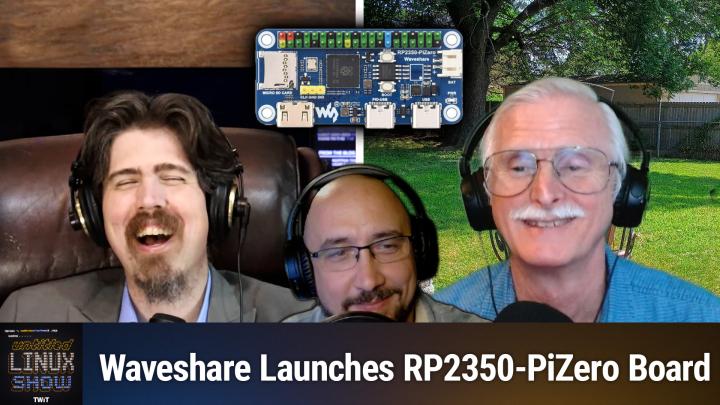
All TWiT.tv Shows (Audio)
Untitled Linux Show 210: Bash to the Future
01:18:32
New Raspberry Pi Hardware, New Rust Drivers, and Dumping Microsoft
Loading summary
Transcript227 lines
- [00:00]
Jonathan Bennett
This week we're talking about Sudo and a potentially nasty security vulnerability. And then the French City that is dumping Microsoft products. There's news about Pipewire, there's news about Raspberry PI and some new hardware. There's rust drivers to cover and a lot more. You don't want to miss it, so stay tuned.
- [00:18]
Ryan Seacrest
Today's show is brought to you by Progressive Insurance. Do you ever think about switching insurance companies to see if you could save some cash? Progressive makes it easy to see if you could save when you bundle your home and auto policies. Try it@progressive.com Progressive Casualty Insurance Company and affiliates. Potential savings will vary. Not available in all states.
- [00:42]
Ryan
So when I ask, what is Odoo, what comes to mind? Well, Odoo is a bit of everything. Odoo is a suite of business management software that some people say is like fertilizer because of the way it promotes growth. But you know, some people also say Odoo is like a magic beanstalk because it grows with your company and is also magically affordable. But then again, you could look at Odoo in terms of how its individual software programs are a lot like building blocks. I mean, whatever your business needs, manufacturing, accounting, HR programs, you can build a custom software suite that's perfect for your company. So what does Odoo? Well, I guess Odoo is a bit of everything. Odoo is a fertilizer, magic beanstalk building blocks for business. Yeah, that's it. Which means that Odoo is exactly what every business needs. Learn more and sign up now@odoo.com that's o d o o.com hey, it's Ryan.
- [01:43]
Ryan Seacrest
Seacrest for Albertsons and safeway now through July 15th. Stock up on all your favorite personal care brands and earn four times points to use on later purchases for discounts on groceries or gas. Shop in store or online for items like Pantene Shampoo, Old Spice, Total Body Deodorant, Tampax Pearl, Venus Razors, Head and Shoulder Shampoo, Olay Body Wash and Pantene conditioner and earn 4 times points. Hurry before these deals are gone. Offer ends July 15th. Restrictions apply. Offers may vary. Visit albertsons or safeway.com for more details.
- [02:14]
Rob Campbell
Podcasts you love from people you Trust. This is TWIT.
- [02:23]
Jonathan Bennett
This is the Untitled Lynette show, episode 210, recorded Saturday, July 5th. Bash to the future. Hey folks, it is Saturday and you know what that means. It's time for Linux. Get geeky with some open source news, some hardware, all kinds of fun stuff. It is not just me. I've got a couple of the guys with me today. We've got Mr. Rob Campbell and Mr. Ken MacDonald and I remembered your names again. There was that one show a few weeks ago that I couldn't. I couldn't remember it and stuff. I started singing the song about his farm and then it came to me. But anyway, we've got some fun stuff. Rob is actually going to surprise us with a security story. That's usually my beat, but Rob jumped in and got it this time. And so what's up? It's kind of a big one around the Linux and the roots and all of that. What's going on?
- [03:13]
Rob Campbell
It's a big tool in the Linux world. So a couple of new security vulnerabilities have been identified this week in sudo or sudo, whichever way you want to say that. That can allow an unprivileged user to run any command they want under the right conditions, of course. But I mean, don't panic. Most of you home Linux desktop users likely don't have much to worry about. But you know, if you're running Linux devices that do allow others to log in, like maybe not ch rooted environment or in an environment with like common sudo files among multiple Linux devices, you may want to listen up here. So the first vulnerability, Strata Scale researcher Rich Merch this vulnerability, he discovered it and this first one is only scored with a CVSS score of 2.8, which is low because it's high out of 10 we're talking about. This vulnerability is noted as CVE2025 32462. So in 2013, the Dash H feature was added to sudo that allowed users to list a user's sudo privileges for a different host. But apparently this feature makes it possible to execute any command allowed by by the remote host to be run on the local machine as well when running sudo command with the host option referencing an unrelated remote host. So I think if you have other people in your system, there's probably a way that they may be able to take advantage of that. I'd have to dig in and try to figure it out myself. But the second buck was also found by Rich and this one is CVE 2025 because that's how they all start out. CVE dash the year and that's 32463 with a CVSS score of 9.3. So that's pretty high because we're talking out of 10, I said, so this is the most. Almost as severe as they get so if you have users logging into a system in a chroot environment, you definitely want to make sure this one is patched. The vulnerability leverages the sudo's r chroot option to run arbitrary commands as root even if they are not listed in a sudoers file. Although the vulnerability involves the sudo to root feature, I mean it does not require any sudo rules to be defined for the user, so. So the default configuration options will allow for this. As a result, any local unprivileged user could potentially escalate privileges to root if a vulnerable version is installed. The bug allows a user to load an arbitrary share library by creating an etc NS or NS switch conf file configuration file under the user's specified root directory and then run commands with elevated privileges. So if you're relying on this feature, you may want to find a new option, as it has been suggested that this option will likely be removed from future releases. So these bugs, they were responsibly disclosed on April 1st and patched in sudo version 1.9.17 p1, which I think when I checked I wasn't there yet. I updated on one of my Ubuntu servers and it only updated to 1.9.15, I think, so it doesn't look like maybe it's not available everywhere yet. So find a way to not use those features if you have people on your systems, or find a way to get the updated sudo version. So time to update sudo and be on the lookout if you have shared environments for these kinds of abuses.
- [07:42]
Jonathan Bennett
Yeah, interesting stuff. I didn't get a chance ahead of time to dig into this, and I'm now pulling up the openwall.com, the open source security list. This is where you're going to find some really good information on it. I'm trying to discover right now because I've seen this worded in two different ways about the H option, and in one case it sort of seems like the local machine is using the permissions from a remote host, which would be really bad. Or the local machine is allowing someone to do something on a different remote host, which is probably not intended, but not much of a security problem.
- [08:23]
Rob Campbell
Well, it's kind of the same thing if they have access to the remote host. If you have access to both hosts, you could do it either way probably right?
- [08:34]
Jonathan Bennett
But I mean, so like, how many people actually use the host name portion of a sudoers? Very specific. Almost everybody just uses, you know, all slash all. I couldn't even Referring to the host name.
- [08:53]
Rob Campbell
Yeah, I didn't, but so I suppose.
- [08:56]
Jonathan Bennett
That is for when you have. What someone would use that for is essentially to have one pseudo or file that gets distributed over a bunch of different hosts.
- [09:04]
Rob Campbell
Yeah. One of the things says, like, if you have an environment of them and you have like ldap that, you know, it's. It's common across a bunch of hosts.
- [09:17]
Jonathan Bennett
Yeah, that makes sense.
- [09:18]
Rob Campbell
Using the same sudoers file.
- [09:21]
Jonathan Bennett
Yeah, that makes sense. All right. Interesting stuff.
- [09:24]
Ken MacDonald
It has been fixed just on an aside. If you want to check what version you have, what command would you use?
- [09:33]
Rob Campbell
V pseudo capital V. I just did.
- [09:38]
Ken MacDonald
Dash dash version and it gave me mine.
- [09:41]
Rob Campbell
Yeah, that's way too much to type. Just do a capital or a dash capital V.
- [09:47]
Ken MacDonald
I knew it wasn't lowercase veek because that does something else. Remember Jonathan.
- [09:53]
Jonathan Bennett
Verbose? Usually it's what it is. If it's not version number.
- [09:58]
Ken MacDonald
In sudo's case, it tells you sudo to prompt for the password.
- [10:04]
Jonathan Bennett
Okay, well, but that's what sudo does if you just run sudo.
- [10:09]
Ken MacDonald
Is that right?
- [10:10]
Jonathan Bennett
No, no, it's not. Okay, so what does sudo v do exactly?
- [10:22]
Rob Campbell
I mean, sudo by default does prompt for the password, depending on how the sudoers file is configured.
- [10:26]
Jonathan Bennett
But validate. The dash lowercase v is validate. It will update the user's cache credentials, authenticating the user if necessary. So you know how. You know how you can run a sudo command? And it will. It'll prompt you for your password and then you can run the first time. You can run another command sudo command, and if it's within the timeout period, it won't prompt you. You can run this and then run a sudo command and it won't prompt you because you just. You validated.
- [10:55]
Rob Campbell
Why would somebody want to do that, though, if they're already saved? Is like, I want to check if I really have permissions here again.
- [11:02]
Ken MacDonald
Maybe you've got a script that you need to prompt and then you're still doing sudo continuous through that. You do the sudo v first, then the other sudo commands.
- [11:17]
Rob Campbell
Yeah, that could be a point. But if I'm making a script and I have multiple sudos in there, if they're already putting their password in once, why would I want to make them do it over and over again?
- [11:30]
Ken MacDonald
You don't. But if you don't, otherwise it will because each is in a subshell, remember?
- [11:38]
Jonathan Bennett
I mean, it depends upon how. Oh, that's true. Interesting. All right, well, I think Ken, you've got some goodies about another command line tool or it's more than a command line tool. Now, what happened at the Pipewire Workshop 2025 this year?
- [11:57]
Ken MacDonald
Well, we can thank George. Let's see if I can remember how to say this. Kiagi Dakis. But anyways, he wrote about the Calabora hosted Pipewire workshop and Hack this, where embedded recipes attendees got to meet with pipewire developers and participate in direct discussions about the future of pipewire. According to George, the agenda includes updates on video transport, Rust efforts, TSN networking, and Bluetooth support. Now the day started with Wyn Tammons sharing his updates on video transport within pipewire. Wynn's idea is to eventually build a system that allows routing video just like audio. We're definitely looking forward to that, aren't we Jonathan? And he's wanting it with automated conversion to or from a common DSP format. He has already written a video converter that uses FFMPEG to convert between various video formats. Now there is also a Vulkan based converter available that you can use. The next step is to improve the format negotiation. Some applications, Firefox for instance, seem to have very strange format requirements and expectations, making this next step difficult. Now there was another discussion shared by Arun Raghaven's updates on the new Rust based reimplementation of SPA and LibPipeWire. Arun's new library re implements the PipeWire protocol in Rust, with its goal being to enable Rust clients to talk to the pipewire daemon over the socket natively without calling into C libraries. There was also a discussion on time sensitive networking, the TSN I'd mentioned earlier in pipewire that was led by Alexje Rimpel and I do apologize if I'm mispronouncing all these names. It talked about some issues with the current code that uses dev PTP as a clock source. I'm going to let you all read more about that instead of trying to dig into the details with that discussion. But after lunch, Martin Greer discussed various issues that he and his colleagues have been seeing over time in both pipewire and Wire plumbing. Martin made some good points about specific areas in the code base that need more attention and improvement. Now also discussed was the status of the work that WIM had started a while ago to expose multiple streams only nodes. Again, I'm going to let you read George's blog for more details about these and some of the other discussions that I didn't touch on, which includes discussions about G Streamer and Bluetooth.
- [15:03]
Jonathan Bennett
One of the one of the things reading through this that is very funny to see is that, well, two things. One, almost every time that you see someone talking about we do such and such with live video, the meme is they're using FFMPEG underneath the hood. And so you look here, even at Wire Plumber and Pipewire, and yep, they use FFMPEG underneath the hood just like everything else. And then they call out Firefox in particular for having very strange format requirements for doing video handshakes and negotiation. And I've seen that too in some cases. So interesting stuff.
- [15:43]
Ken MacDonald
Well, in my case, I'm kind of glad it does.
- [15:47]
Jonathan Bennett
And sometimes that's what makes everything work. Yeah, Ken can only do this in Firefox for whatever reason. Audio and video is hard. We forget that sometimes because there's all these tools that try really hard to make it easy, but like trying to keep audio and video synced up so people don't desync and everything just works. And it works on all the platforms. It's a really challenging problem.
- [16:08]
Ryan Seacrest
This episode brought to you by Red Canary. When cybersecurity threats hit fast, you need an MDR partner that moves faster. Red Canary delivers 24.7expert MDR support, total visibility and actionable insights. Plus it helps you detect four times more threats so you can stay ahead without burning out. Red Canary clears the noise and has your back every hour, every incident. Get the backup you deserve. Visit redcanary.com difference to learn more.
- [16:38]
Hey, it's Ryan Seacrest for Albertsons and Safeway. Now through July 15th. Stock up on all your favorite personal care brands and earn four times points to use on later purchases. For discounts on groceries or gas, shop in store or online for items like Pantene Shampoo, Old Spice, Total Body Deodorant, Tampax Pearl Venus Razors, Head and Shoulder Shampoo, Olay Body Wash, and Pantene conditioner and earn 4 times points. Hurry before these deals are gone. Offer ends July 15th. Restrictions apply. Offers may vary. Visit albertsons or safeway.com for more details.
- [17:09]
Jonathan Bennett
All right, let's see, what do we have next? Oh, yes. So one of the things that the story Ken just had was about moving Rust into pipewire. Well, I came across a story this week about writing kernel drivers in rust. Well, no, not kernel drivers. Writing USB drivers in rust. This came via Hackaday and it is a story from Crescent Rose. It's a quick little how to about how to take a new USB device. It doesn't have a driver. Use libusb, which that is sort of A libusb is a bridge, you could say, between kernel space and user space. What's really interesting about it is you can run it in Windows as well. It is possible to do libusb in Windows, but you can, you can write a driver and you can put it in user space. You don't have to recompile your kernel to use it. And so you have, you have a bunch of different devices that have driver support through this. And it's a, it's a how to of you start from scratch and in Rust, let's put together a user space driver for a USB device. And it's actually, it's really good. And the crazy thing is that, like, by the end of it, he's got something that works fairly well in about 50 lines of rust code, which is, which is really cool. You know, it handles interrupts. This is like an RGB keyboard or something. And so all it does is it's just setting the color on the RGB once a second and then reading a button. You know, I mean, it's that level of stuff, but at the same time you can make it work and within just a few lines of Rust code. So if you've got some USB device out there and you've waited and wondered, and you would love to have driver support for it, and nobody in the kernel seems to be doing it, well, maybe it's time to just roll up your sleeves and write some Rust code. It's all good.
- [19:11]
Rob Campbell
How's your Rust journey going, Jonathan?
- [19:15]
Jonathan Bennett
It got set aside, so I started learning Rust to do the. The code calendar, the Advent code calendar. And that was fun. And I got through like the first two and a half days.
- [19:29]
Ken MacDonald
And then got distracted by real life.
- [19:32]
Jonathan Bennett
Yeah, yeah. Running a lot of C code these days. Not nearly as much Rust code, but.
- [19:37]
Rob Campbell
I looked at it once and thought, this looks complicated.
- [19:41]
Jonathan Bennett
I did like the Advent calendar of code. It. It was a good way to go about doing it because they started you off with some really simple problems. There's really good documentation out there for how to do it in a whole bunch of different languages. I liked that too, because they actually used cargo for like your package management inside the code challenge. And so, you know, it was really pretty slick to learn that way. And I wish I had more time to be able to go back and do it, but.
- [20:15]
Rob Campbell
Yeah, I should do that sometime.
- [20:17]
Ken MacDonald
Yeah, you need to get back to that rusty journey.
- [20:21]
Jonathan Bennett
Yes. Yes. I don't know. I've halfway joked and been telling people that I have about five jobs right now. I'M trying to stay on top of. And it's not really that much of a joke. So we're not going to add, we're not going to add rust back into that pile yet. We're going to have to get rid of some of these first. I don't know when that's going to happen. I enjoy doing all of them too much.
- [20:43]
Ken MacDonald
When you hire somebody to help you.
- [20:45]
Jonathan Bennett
I guess I've got somebody in mind, but she is busy raising kids right now. So, you know, 15 years. Yeah, give it 15 years, then I'll get to help her.
- [20:57]
Ken MacDonald
Or four.
- [20:58]
Jonathan Bennett
Oh, well, yeah, you know, Rob, what's going on in France and why do we care?
- [21:05]
Rob Campbell
So the trend continues as more, as more European countries continues as more European countries grow wary of relying on Microsoft and other American companies for their government infrastructure. So, you know, there's a growing concern of privacy, digital sovereignty, government surveillance, or even the possibility of digital attacks. You know, just taking out a system with an, with an update or other undiscovered backdoors. I mean, even here in the US we have many of the same concerns with, with, with hardware and things like that. So it's really a concern everywhere, you know, and, you know, not that I think these things are likely to happen, but, you know, why would any government want, want their infrastructure infrastructure to rely on software or hardware controlled by another government or, you know, within another government where within another country where that government.
- [22:09]
Ken MacDonald
Could.
- [22:12]
Rob Campbell
Put some pressure and control on it whether they do well or not. Who knows, you know, you never know what, what political change could happen in the future. You know, unfortunately, some things are harder to replace than others. You know, like it'd be almost impossible for every country to move all hardware manufacturing into their own borders. But software is far more easier for anyone to take control of. I could take control and bring software into my own house if I wanted, which is why the French city of Lyon, L, Y, O, N, or however the French would pronounce it, looks like lion to me. Why? They have taken a major step towards moving away from Microsoft software, starting by replacing Microsoft Office with open source alternatives such as Only Office, which we've spoken about recently, and moving from Windows to Linux, which we speak about every week. Additionally, they have launched the. So I'm going to translate to English because I don't know how to say the French in English. It's open digital territory, but the French acronym is tno. It's like territory. Some word with the n, and that's probably means digital and then a word with o that probably means open. So anyway, the TNO integrates tools such as Jitsi for video conferencing, nextcloud, paired with the only office for document sharing and co editing, Zimbra for email. And I should check that one out. I haven't heard of that one, but French like it apparently. Cameleo for online training and Matrix for instant messaging. The project has 2 million euros in funding from the French ANCT, another acronym that I'm not going to bother to figure out. You can look that up if you want, which is close to 2.5 million USD, about 2.3 something I guess, and is already being used. So the TNO is already being used, according to them, by thousands of employees across several local governments in France. So even though this one city is moving towards it, there is this project that's really kind of getting spread out through a lot of French governments. Apparently all the news of governments moving to open source is going to make this, you know, they seem to bring this up a lot late. Pretty soon this is not going to be newsworthy very fast. You know, it's kind of like the old segments. Some, some have used out. Used to see a lot of shows and various things about when something runs on Linux. This run. Oh, look what I found. That runs on Linux. This runs Linux. Well, you know, everything runs Linux now, so kind of like how everything runs Linux. It looks like at least all the governments over in Europe at some point are just going to be using Linux and Open Source alternatives also. So, you know, whatever the reason, it's a good trend for Open Source.
- [25:30]
Jonathan Bennett
Yeah. Yeah, I like to see it. Did they, did they say what. What Linux distro that they were looking at going with? Or was it just a generic we're going to dump Microsoft Windows for Linux?
- [25:40]
Rob Campbell
Yeah, they didn't say.
- [25:41]
Jonathan Bennett
Yeah, interesting.
- [25:43]
Ken MacDonald
Yeah, I'm going to make a stab and say either Slack or OpenSuse, you would hope.
- [25:51]
Jonathan Bennett
Right.
- [25:51]
Rob Campbell
But like why Slack? Open suicide makes sense. That's, you know, a European one.
- [25:59]
Jonathan Bennett
But where's. Where's the Slack distro out of.
- [26:05]
Ken MacDonald
I'm thinking it's a European country, isn't it?
- [26:10]
Rob Campbell
I feel like. No, but.
- [26:14]
Jonathan Bennett
Slack. We talked about Slackware.
- [26:18]
Rob Campbell
Slack. We're right. I mean that's like one of the oldest distros out there and.
- [26:24]
Jonathan Bennett
Questionable whether it's still maintained given that their last blog post was 2022. I think we've talked about this, so probably not. Probably not. Slackware. Yeah. This is interesting though. Kind of along those same lines. I hope what we don't have is what we had last time that European countries tried this and they were essentially rolling their own distros or using these very weird, very niche distros. It's like, no, just use. There are so many good ones now. Use one of the standards. Go, go talk to Canonical, use Ubuntu, use Debian, even use Fedora. Although, you know, if they're trying to get away from US Influence, then Fedora might not be the one that they want to go with. But one could, one could make the same argument about using the Linux kernel as well. If US influence is really what you're trying to get away. Away from.
- [27:16]
Rob Campbell
Yeah, but you know, on the plus side, you can break away and fork at any time. Once you feel like, oh, I don't trust them anymore, I'm taking it here and forking it. And so that's something you can't do with Windows or anything else.
- [27:30]
Jonathan Bennett
Yep, that is true.
- [27:31]
Rob Campbell
You know, I can't find where Slackware is from. It was developed by Patrick Volkerding.
- [27:39]
Ken MacDonald
Slack, the communications application, was founded in Vancouver, British Columbia, Canadian.
- [27:46]
Jonathan Bennett
But that doesn't tell us anything about Slackware. I don't think they're related, are they?
- [27:50]
Rob Campbell
They are not related.
- [27:50]
Jonathan Bennett
I'm gonna say I didn't think so.
- [27:53]
Rob Campbell
Anyway, Volkerman sounds or Volkerding sounds German, but. And Open Seuss is apparently based off of it, so did not realize that. Open Suse, I guess, according to Wikipedia. So there's a. There's a lineage there that maybe makes sense.
- [28:12]
Jonathan Bennett
Yeah, well, they're, they're certainly going to get away from running on us married hardware too. So maybe they're going to go with the Raspberry PI.
- [28:23]
Ken MacDonald
That's quite possible.
- [28:25]
Jonathan Bennett
That was a segue, Ken.
- [28:27]
Ken MacDonald
Or would you rather use the RP2350PI0?
- [28:35]
Jonathan Bennett
So what is this? I saw this this week. What is this thing?
- [28:39]
Rob Campbell
Take it away, Old McDonald.
- [28:41]
Ken MacDonald
According to Giorgio Mendez, who wrote about it this week, it's waveseers embedded platform with a form factor similar to the Raspberry PI Zero. And as I said, it's called the RP2350PI Zero. It is powered by the RP2350 microcontroller and includes a DVI interface for displays and a lithium battery connector for portable hardware applications. Now, according to Giorgio, the RP2350PI0, I'm going to shorten that to PI0 for the rest of this, but it is built around the RP2350B microcontroller and uses a dual core dual architecture design. In other words, two ARM Cortex M33 cores alongside two hazard three RISC V cores. That sounds like it's be interesting to play with. They're both running at up to 150 MHz with dynamic architecture switching. Try saying that one three times fast. The product page notes that the DVI output can drive most HDMI screens and the board supports USB host or device mode via the onboard PIO USB port. Storage is available through a Micro SD card slot near the standard 40 pin GPIO header. Now Waveshare provides example demos on its wiki pages that highlight the board's capabilities. The PI Zero Development Board is available now for 999 on the Waveshare website. And I got a feeling that just calling it a PI zero may come easier.
- [30:37]
Jonathan Bennett
No, that is very confusing actually because the pi0 already exists. There is in fact. Okay, so this is not the board that you're talking about, but this is a Wave Share board. I happen to have one of these within reach. This is a Wave Share display module. It is made for the PI zero because Raspberry PI already makes a little board with that same form factor. And what Waveshare has done here, which is really intriguing, is they're taking the RP2350, which, that is one of, that's the newest, I think chip from the Raspberry PI embedded line and they're putting it on the PI 0 form factor, which is crazy. I sort of have to ask myself like, why haven't Raspberry PI done this, huh?
- [31:27]
Ken MacDonald
Well, cost.
- [31:30]
Jonathan Bennett
I can't imagine that the cost would be. I mean Raspberry PI already makes the 2350 in house. Making the board to put it on. They already make boards in house. Adding another spin board is, you know, nothing. It's just odd to me that they nobody at Raspberry PI thought of this unless it is. We don't want to confuse people by putting out another board that's so different, using that same form factor and PIN like that. So. And this thing, this 2350 board from Waveshare, you can't, you don't run Linux.
- [32:05]
Rob Campbell
On.
- [32:07]
Jonathan Bennett
Is embedded hardware. You use something like Platform IO or the Arduino environment or, you know, maybe there may be a way to run Zephyr on this, you know, real time OS rtos. That's the sort of thing that you run on this. Not a full Linux distro. A lot of these little cores like you can't. In fact there have been a couple of really crazy stories of people running Linux on boards like this by emulating a virtual cpu. And that's the only way to do it because the CPU does not actually have, you know, the right extensions to be able to run Linux as it is. So you've got to build a virtual CPU on the one that you have and then boot Linux on that. And you know, boot time is measured in days at that point because it's going to be so slow. But yeah, people have done it. It's crazy. It's fun, fun stuff.
- [32:56]
Ken MacDonald
Basically it's using micropython.
- [33:00]
Jonathan Bennett
You can run micropython on it. That's not the only thing that you can do on these.
- [33:06]
Ken MacDonald
Looks like another one's C Blink or Cblink.
- [33:10]
Jonathan Bennett
Yeah, probably. I interviewed on Floss Weekly back two weeks ago, I think guys that were taking the elixir runtime and running it directly on these. And so that's like, that's, that's airlang. That's, that's the big Ericsson. It was written for big iron telecommunication stuff. And they're like, well, let's just reimplement the virtual machine on embedded devices. That'd be fun. Oh my goodness, you guys are crazy. It's really cool what they're doing.
- [33:42]
Rob Campbell
So, so yeah. So if we're done with this topic, let's back up to the last one here. I got to finish off clean, clean the air out on this on where Slackware is from. I had to, I had to dig into this a little bit. It wasn't that hard actually. I was looking at the Wikipedia for Slackware and I couldn't find it. So I'm like, well, let's just look. Click on the developer to see where he's from. And I am proud to say he is from the United States. Well, I know about from or not, but he went to college in my state, Minnesota, at Minnesota State University Morehead. So that's like less than 250 miles away from me, which I know for you people over in England sounds like you know, all the way across the country, but that's really close here in the US so in 1993 he graduated there and then a year later he made Slackware and the, the rest is history. He's 58 years old. I don't know where he's at now. He's married to Andrea and go check out his wiki page.
- [34:56]
Jonathan Bennett
There you go.
- [34:56]
Rob Campbell
Wikipedia page. But yes. So that makes it a, a, a US Pro. I mean I have no idea if he still lives here, but that makes it a us in fact, a Minnesota product.
- [35:09]
Jonathan Bennett
It's a Minnesota project. Yeah, there you go. Azure Flash reminds me that it was, is the Erlang project that reimplements the virtual machine there and they do some very cool stuff. Sticking with Raspberry PI, there is something else new. This one is not from Waveshare though. There is something new this week from Raspberry PI themselves. And it's also not running Linux. Raspberry PI has announced the PI Radio Module 2 and it is, it is on sale for a whopping $4 apiece. And I will tell you this is super interesting. We're going to get there, but first let me tell you what this thing is actually doing and what it's for. It is a little tiny embedded radio that gives you WI Fi and Bluetooth and that's it. That is all it is. It is their little spin on the Infineon CYW 43 439. And it's just a, it's a PCB with this radio on top of it and then a can on top of that. And you know, you can build, you make a design that takes this exact footprint and then build this little pcb, drop it on there, solder it in and you get radio, right, you get, you can have WI Fi and Bluetooth on your, on your device, which is cool. Like the ability to do that is really neat. But this is really fascinating to me because they're making this thing available commercially and so you can buy it, they're releasing a data sheet for it. You can buy it from places like SparkFun it looks like, and some others. And so, you know, this is going to be a commercially available product. And I tell you why that's so interesting to me and that is because they also have the RP. Well, they have the RP1 and the RP2. I think it's. The RP1 is the one that I'm really, really. Yeah, the RP1. This is, this is something that's been intriguing to me for a very long time. This is their cpu, their, their chip. It's like an I O expander really, but it takes all the, the name of it, not NVMe, the PCI Express. It takes a PCI Express lane and breaks it out into essentially the 40 pin header on the Raspberry PI. Okay, so something that some of us that do embedded work have really wanted to see for a long time is essentially the RP1 chip on a desktop sized expansion board. Because all of our desktops have these PCI Express lanes. You could steal a PCI Express lane and then have essentially a 40 pin and they could do, you know, they could do support for it in the Linux kernel and you would have the ability to have a 40 pin Raspberry PI header on a desktop or a laptop. Like that would be very cool. So I want to see that. And to make that happen, either Raspberry PI themselves has to come out with it or they have to make the RP1 available. And this story about the WI FI chip really intrigues me because it is a step in the direction of Raspberry PI is thinking about making all of their special chips and things available for people to use in other projects. And so maybe we are, we, maybe we have a future in front of us where we get to do some of these really cool things with, you know, chips like the RP1. I would, I would love to see that. That would be very cool. It would be super cool.
- [38:41]
Ken MacDonald
Now, now with the Bluetooth and the WI Fi radios are pretty much fixed, you wouldn't be able to reprogram the frequencies they use, would you?
- [38:52]
Jonathan Bennett
I would imagine so. Here's the thing. A lot of these little chips anymore are, they're software defined radio. But a lot of them anymore also are very difficult to put firmware on. Like you can only run sign firmware. So like is it physically possible to reprogram this thing to be able to get access to a few other frequencies or, you know, other protocols? Probably technically. But is anyone going to actually be able to do it? Probably, probably not. And I don't, I don't know how this is implemented, you know, how low level it is. I don't, I don't even think that they specify, you know, what, what protocol it talks over. You know, it's probably something like mdio I think is one of the ones that's typical for these things to talk over. It could be spi, it could be I squared C, I mean, who knows? I can, I can try to find out, but.
- [39:44]
Ken MacDonald
So it probably would not be the option if you wanted to use a Raspberry PI to replace an old radio remote control.
- [39:55]
Jonathan Bennett
Probably not, no, probably can't do that.
- [39:59]
Ken MacDonald
And I don't know if I've got the patience to mess with ESP32.
- [40:04]
Jonathan Bennett
Oh, it's fun though. I very much enjoyed my trip into the embedded world and writing things in C for embedded. It's fun. You occasionally run into undocumented bugs where.
- [40:19]
Ken MacDonald
Things like standard features, undocumented features when.
- [40:24]
Jonathan Bennett
Standard sort causes crashes on embedded, but it works just fine on your Linux desktop. I wouldn't call that a feature.
- [40:30]
Rob Campbell
That's a zero day.
- [40:32]
Jonathan Bennett
Spontaneous reboots of your embedded devices is not a feature. No, not for me.
- [40:39]
Ken MacDonald
Microsoft calls those features, I guess.
- [40:42]
Jonathan Bennett
All right, Rob, there's been some Fedora.
- [40:45]
Rob Campbell
News this there has been but one more. One more clarification. Volker didn't graduate in 93 and Slackware was initially released in July of 93. I was skimming real fast and the 1994 thing was the fact that he had attended 75 Grateful Dead concerts by April of 1994. So apparently he's a big Grateful that.
- [41:08]
Jonathan Bennett
Fan that it's put it on the resume central part of his cv.
- [41:14]
Rob Campbell
Now that we're done talking about Slackware, let's talk about Fedorica. Oh wow. But I was combining words there. I was going to say Fedora on their radical move to another radical move. I said Fedora and Kai's. Yeah.
- [41:38]
Ryan Seacrest
Anyway, this episode brought to you by Red Canary when cybersecurity threats hit fast, you need an MDR partner that moves faster. Red Canary delivers 24.7expert MDR support, total visibility and actionable insights. Plus it helps you detect four times more threats so you can stay ahead without burning out. Red Canary clears the noise and has your back every hour, every incident. Get the backup you deserve. Visit redcanary.com difference to learn more.
- [42:09]
Hey, it's Ryan Seacrest for Albertsons and Safeway now through July 15th. Stock up on all your favorite personal care brands and earn four times points to use on later purchases. For discounts on groceries or gas, shop in store or online for items like Pantene Shampoo, Old Spice, Total Body Deodorant, Tampax Pearl, Venus Razors, Head and Shoulder Shampoo, Olay Body Wash and Pantene conditioner and earn 4 times points. Hurry before these deals are gone. Offer ends July 15th. Restrictions apply. Offers may vary. Visit albertsons or safeway.com for more details.
- [42:40]
Rob Campbell
As far as radical moves, you know, most people think Arch is known for being the distro on the bleeding edge. But Fedora is the distra known for pushing the limits, cutting off the old and aggressively moving into the new. You know our Arch just keeps on rolling and Fedora actually pushes things forward. This week they're stepping back from one of their radical steps forward that they were going to do and replacing it with another potentially radical idea. Fedora had planned to drop all 32 bit support in in an upcoming Fedora 44 release. But this led to a significant backlash and a lot of disapproving feedback from the community. Fedora Engineering steering committee member Fabio Valentini, after all this feedback, has withdrawn the proposal and acknowledged the backlash, stating the target for this change was it was too early and pointed out that the technical problems mentioned in the proposal are, you know, they're not going to go away, you know, and he even, he even apparently said that, you know, he didn't think it was going to go through anyway. So guess that one's going down for now. Not going to happen. So the new radical proposal this week is to drop UEFI boot support on MBR partition disks. Specifically, we're talking about the X8664 system, starting with the upcoming Fedora 43 release. They believe this will simplify the installer code and will end support for boot configuration. That is that a boot configuration that is rarely used, inconsistently implemented across firmware configs and not even officially tested by Fedora. So push now untested code. I don't know. But anyway, I guess this helps Fedora devs, but what does this do for the users? Well, apparently the setup can cause the bootloader to crash, adding to its list of problems. So that's what it does for users, make sure it's not going to crash. For you existing users, you know, those who already have it set up, it'll just keep on working if you keep updating. But what this does affect is new installations done via their Anaconda installer where GPT would be required instead of MBR for UEFI boot. That's, that's what this, where this would. Who though? Who that would affect? This also doesn't affect ARM or RISC V architectures. So apparently according to what they think, it is not going to affect many users, you know, and you know, one radical move to the next. I say we need a distro that pushes the limits. Cut out that 32 bit support, just get rid of it and you know, drop that UEFI support on, you know, GPT. MBR says, MBR systems, you know, whatever it is, it's Linux. If you don't like it, there are many other distros to hop to. But having a distro that pushes things forward will help push the entire, the entire ecosystem, entire community forward, you know, and allow us all to have nice things.
- [46:17]
Jonathan Bennett
I have a slightly different take on this in both of them. Slightly different. And then there's one other thing that Fedora talked about dropping that, adding, adding in this case that they have not added. So the installer thing, the UEFI on mbr, that is strictly at install time. So if you already have one of these systems, it's going to continue to work. It's just this slightly odd combination is now not going to be offered at install. And if you're really a wizard and you know what you're doing, you can still install it that way. I promise it's still possible in one way or the other. So nobody's really losing out on anything. I am not aware of anybody that has this killer edge use case that I've got to have UEFI and MBR on the same system.
- [47:07]
Rob Campbell
If you're radical enough to run that kind of configuration, you're radical enough to make it work.
- [47:13]
Jonathan Bennett
Yes.
- [47:14]
Ken MacDonald
And you've got limited storage space because of it.
- [47:18]
Rob Campbell
Yeah.
- [47:19]
Jonathan Bennett
And then the other thing with the 32 bit libs, 32 bit is not supported anymore by a lot of these upstream programs. So that's the kicker. This is not really Fedora pushing this. This is every other program that Fedora ships pushing back against it and saying we don't support running as 32 bit anymore. So many distros have moved away from the ability to install 32 bit like strictly and so this sort of multi Lib support where you've got the 32 bit packages installed alongside is just kind of an oddball configuration that. Yeah, it is causing problems for users and it is not supported by now. The problem with dropping it is that so many games are specifically 32 bit and it makes me wonder if we're going to see an emulation layer pop up that will let you run 32 bit binaries on a 64 bit system and not have to do all of.
- [48:23]
Ken MacDonald
These extra installs or do we already have one?
- [48:26]
Jonathan Bennett
I am not aware of one, but I would not be surprised if it was out there. I want to say I've looked for this a time or two and didn't have not found one. I know Steam. So like for example, Steam has Soldier I think is what they call it and that is their little Linux runtime and so that might be enough to give you 32 bit game support if you're running stuff in Steam.
- [48:52]
Ken MacDonald
Yeah.
- [48:53]
Rob Campbell
And in the IT FOSS or it's foss.com article they talk about, you know, Fedora based distros like Bazzite, which is specifically kind of designed for gaming. Apparently they have a higher reliance on the 32 bit.
- [49:12]
Jonathan Bennett
Yeah, I think one of the main takeaways and I can't remember where I saw this, but it was one of the Fedora guys talking about it. One of the main takeaways is this is inevitably going to happen and in fact it's also inevitably going to happen to all of your major distros. And so the fact that we're talking about it now is a good thing because it'll get some solutions going. People start thinking about it and they will then be some of those libraries.
- [49:37]
Rob Campbell
And that's why I say cut the cord, get people thinking about it faster.
- [49:40]
Jonathan Bennett
Yeah, well.
- [49:43]
Ken MacDonald
How does that affect flat packs that would include 32 bit libraries with themselves?
- [49:50]
Jonathan Bennett
Yeah, that's kind of iffy on all of this stuff. Like where is that layer going to be where you can have a 32 bit type talking to a 64 bit? How far down the stack to say? Because obviously, like at some point it works to run 32 bit stuff on a 64 bit kernel. But how much of the user space do you have to have running 64 bit or running 32 bit for a 32 bit application to be able to talk to it?
- [50:12]
Rob Campbell
I imagine a lot of that's embedded into Flatpak, but I don't know.
- [50:17]
Jonathan Bennett
Yeah, you would think so. I don't remember having to install a whole bunch of 32 bit libraries to be able to get Flatpaks right running. So apparently it sort of handles all that internally.
- [50:26]
Ken MacDonald
I could see Snap doing it easier.
- [50:29]
Jonathan Bennett
Very possibly, yeah. There was one other thing that we should quickly mention that was a fedora 44, probably not recommendation proposal that got shot down and that was xLibre, the replacement x11 fork. Someone was trying to include it and there was just an outcry of no, we are not going to do this for various reasons.
- [50:57]
Rob Campbell
Did we not talk about that last week?
- [50:59]
Jonathan Bennett
I don't think we talked about it in Fedora, no. Okay.
- [51:02]
Ken MacDonald
I thought we touched on it when we were. Somebody talked about Ex Libre itself.
- [51:10]
Jonathan Bennett
Yeah. It does not belong in Fedora. I have a reason that is different from a lot of the other people's reasons. I think just technically speaking, it doesn't belong there.
- [51:20]
Ken MacDonald
Since you're Speaking about an X11 server, is there another possibility?
- [51:27]
Jonathan Bennett
There is. Is it time for this story? It is time for Ken, let's go way back now. Yeah. Turn on the Wayback Machine. If Ken did not grab this one, I was going to. So, Ken, let's go back. Way back.
- [51:41]
Ken MacDonald
Well, I'm going to go ahead and say thank you, Liam Proven for writing about a new project that addresses one of the biggest difference between how X11 and Wayland work. Now this project is by Aradney Connell and again I apologize because I know I'm messing that sound up or name up, but one of the core out she's one of the core Alpine Linux developers. The project is called Wayback. Now according to Liam, Wayback bridges some of the gaps and the disagreements between the brave new world of Wayland and the decades old X11 based desktop environments. Now quoting from the project's README file, Wayback is an experimental X compatibility layer which allows for running full X desktop environments using Wayland components. It is essentially a stub compositor which provides just enough Wayland capabilities to host a rootful X Wayland server. Now Liam's article does a great job of giving a brief explanation and use of an X server, so I'm going to recommend that you do check that description and history out. His article also does a great job of giving about pointing out that Wayland is just a protocol and there are no separate display servers for managing Windows. Instead you have a compositor that combines the x11 functions of window management and the display server. Liam states Wayback is an effort to create a Wayland based display server X11 style which does not provide compositing. It aims to provide just enough support to run X Wayland full screen and thus provide the underpinning so that you can start a traditional X11 based window manager or desktop environment. For Liam's thoughts on why this project is coming out now, I again recommend reading his informational and entertaining article that I have linked in the show Notes. One last question for everybody. What does this project, the Internet Archive and the cartoon Rocky and Bullwinkle have in common?
- [54:10]
Jonathan Bennett
They all use the term the Wayback the Wayback Machine, but I don't remember exactly with Brock and Bullwinkle, but I think there was a way back something or other.
- [54:18]
Ken MacDonald
There was one of the other cartoon skits I guess would be the best way to put it that was part of the Walking Rocky and bull week. So Mr. Pot Mr. Peabody Ah yes, invented a way back A W a B a C and I'm gonna have to go back to the I think.
- [54:39]
Jonathan Bennett
The Internet Archive borrowed that name to name there way back.
- [54:42]
Ken MacDonald
Yeah, correct. In fact Liam points that out.
- [54:46]
Rob Campbell
Yeah what they all have in common is they take you back in time Indeed.
- [54:51]
Ken MacDonald
So the the time machine he created was called the Wormhole Activating and Bridging Automatic Computer A B A C Somebody.
- [55:05]
Jonathan Bennett
Really wanted their name to spell out way back this. This story is really interesting to me because it's not the first time that someone has done done this. And there is a blog, couple of blog posts from back in 2023 with X Wayland in rootful mode, which is essentially the same idea. I don't know if you guys remember this, but it was running rootful, so running X Wayland with root enabled. Not. I don't think that's the root user. I think that's like. As the root compositor is more what that's getting at. And it. This was progress being made towards getting an X11 desktop running underneath Wayland and I. Yeah, they're. They're both doing basically the same thing, probably going about it in slightly different ways. But yeah, it's cool to see. It's neat to see because there's a. There's some of these old desktops. It would be nice to be able to still run some of them. People really enjoy that are not ready for Wayland and having other ways of going about it. It's pretty cool.
- [56:13]
Ken MacDonald
And it may make it easier for some of them to actually transition to Wayland.
- [56:18]
Jonathan Bennett
Yep, very possible. Very possible.
- [56:21]
Rob Campbell
Or at least to get rid of X.
- [56:24]
Jonathan Bennett
Yes. All right.
- [56:25]
Ken MacDonald
Would they be getting rid of X if they did this?
- [56:28]
Jonathan Bennett
Sort of. Mostly parts of it.
- [56:30]
Rob Campbell
I mean X itself would be getting rid of it. It's. It's pretty much like what Ex Wayland is, except for a little deeper rutful.
- [56:41]
Jonathan Bennett
All right, so there. Yeah. That deep. There's a couple of interesting updates from programs that you may have thought were done. You know, there comes a point in the lifetime of something when it's done and you don't get any updates anymore. Well, here's some things that are apparently not done. Bash. We got the bash for 5.3 release. There's a couple of interesting things in here. There's a new form of command substitution which is not something I play with very often, but it's in there. It adds the reply shell variable when the command substitution is complete. That's neat. Bash 5.3 also gets updates for C23, the newest iteration of the C programming language. It has a readline as a new option for case insensitive searching glob sort a local variable that apparently will let you know how shell is going to sort results of a path name completion. Very interesting stuff. Now, there is one thing that's intentionally broken and that is that with the C23 conformance, Bash no longer compiles under the old school KNR C compilers. So you can't take Bash 5.3 and go compile it for your Univac or your PDP11 or whatever you're trying to run it on that. It will run Unix, won't run this anymore. So Bash is moving into the future. But anyway, there's some fun stuff there in bash 5.3. And then the other one that I saw, very much along the same lines is Perl 5.42 is out this week and it's got Unicode 16 support. I didn't even know Unicode was versioned. Oh my goodness, Unicode is such a pain to work with. Experimental features like any and all operators for working with lists, writer attribute for field variables, more core sub routines, various stuff that makes lots of sense to Perl programmers. But I have not done anything with Perl for a decade now. It's been a long time since I've done anything with Perl. Let's just, let's just say that when I went and did the, the code challenge, it was not Perl that I reached for.
- [59:04]
Rob Campbell
Perl was my first language that I ever learned way back, let's see, 25, six years ago. And that was basically at the time, Perl was a very common thing to do a CGI scripting on the web.
- [59:20]
Jonathan Bennett
I've written some CGI websites, very, very simple ones.
- [59:24]
Ken MacDonald
So does this mean we need a new version of a good Perl reference book?
- [59:30]
Jonathan Bennett
You know, I don't know. I'm sure there are Perl 5 reference books out there and I doubt that 5.42 is enough changes to require a whole new book.
- [59:43]
Rob Campbell
But I'm sure if you are an author of the Pearl Na Pearl series, now may be the time to release another one, make some more money.
- [59:52]
Jonathan Bennett
The authors of the Pearl series that I am aware of have all moved on to other languages. That's the thing.
- [59:58]
Ken MacDonald
I think our favorite author moved on to go and Flutter.
- [60:02]
Jonathan Bennett
Yep, Randall Schwartz is off in the Flutter Dart world doing fun stuff there.
- [60:06]
Rob Campbell
I was really only a Perl user for maybe a year or two and then I moved on to PHP pretty quick. Yeah, it's very similar Ish.
- [60:17]
Jonathan Bennett
PHP always reminded me of C. I always felt like I was writing interpreted C code when I was writing php. Didn't feel that way with Perl, but with PHP and it's the silly stuff like the way you use brackets reminded me so much of C. Not necessarily the rest of the syntax, but just there's a lot of PHP stuff, particularly doing very simple programs that are very C. Like maybe that's why I enjoyed PHP so I always like C, C and C. Good languages, fun languages. All right.
- [60:50]
Ken MacDonald
Definitely a lot different than Assembly.
- [60:53]
Jonathan Bennett
Yes. Although you could make assembly programming look and work a lot like C or like Basic. Probably not like Basic, but you can make your assembly look a lot like C. In fact, that's sort of how C started was just a whole bunch of macros on top of assembly.
- [61:09]
Ryan Seacrest
This episode brought to you by Red Canary when cybersecurity threats hit fast, you need an MDR partner that moves faster. Red Canary delivers 24.7expert MDR support, total visibility and actionable insights. Plus it helps you detect four times more threats so you can stay ahead without burning out. Red Canary clears the noise and has your back every hour, every incident. Get the backup you deserve. Visit redcanary.com difference to learn more.
- [61:39]
Hey, it's Ryan Seacrest for Albertsons and safeway. Now through July 15th. Stock up on all your favorite personal care brands and earn four times points to use on later purchases for discounts on groceries or gas. Shop in store or online for items like Pantene Shampoo, Old Spice, Total Body Deodorant, Tampax Pearl Venus Razors, Head and Shoulder Shampoo, Olay Body Wash and Pantene conditioner and earn 4 times points. Hurry before these deals are gone. Offer ends July 15th. Restrictions apply. Offers may vary. Visit albertsons or safeway.com for more details.
- [62:09]
Rob Campbell
Today we'll attempt a feat once thought impossible, overcoming high interest credit card debt. It requires merely one thing, a SoFi personal loan. With it, you could save big on interest charges by consolidating into one low fixed rate monthly payment. Defy high interest debt with a SOFI personal loan. Visit sofi.com stunt to learn more. Loans originated by SoFi Bank NA member FDIC terms and conditions apply.
- [62:37]
Jonathan Bennett
NMLS 696891 Anyway, let's move on to some command line tips and Rob is going to start us off with some Proxmox. Goodness yes.
- [62:48]
Rob Campbell
Not a command line tip. At least not today. So I'm going to do. I think I'm going to start a Proxmox series here because you know, one of the things when I do have my free time and I want to, I don't know, play around with some technology. I have a. I have some Proxmox servers sit around that I run things on. So sometimes I got some time I'm just going out looking for for new ways I can use it and new things I can do with it and new things in my home. Whatever else can improve. So one of the things that helped me monitor and see see the efficiencies and inefficiencies of certain things is a program called Pulse. So this is a pulse monitoring system. So for those watching, I have it up on my screen. This is Pulse and it's showing you I have a. Two different Proxmox servers, PvE1 and PV, or just PvE I guess, and PvE2 in my cluster. And you can't see all my servers. You can see my first PVE server. But if you, if you look there, what, you know, after I installed this on my Proxmox, it's, it's right down. Where is it? Oh yeah, it's down here in the other. It's a, it's a LXC container which you can't see it because it's on the second server way down below. But one of the things you may notice here is, and one of the things that I really noticed, I thought I always knew containers were more efficient than a whole vm. I didn't really realize how efficient. If you look down here, the, the LXC containers are using so much less memory than the VMs up here. You know, where you have gigs of use and you know, down in the, the containers we're looking at megs, 100 to 200 megs of use. So you know, utilizing this, I've been going through and, and converting a lot of my VMs into containers. Well, not a lot. You can see there's only like a few here. But, but I'm still working on that. I plan to move more and more of them into containers because so much better efficiency. But with this you could see you got the name, you got the type of VM or LXC container, got the id, you have the uptime, which I got one of my VMs, 527 days of uptime. You got your CPU usage, your memory usage, your disk Usage, and the VMs on here, it just shows how much is provisioned for it. Where the, the containers actually shows how much is provisioned and how much of that is used. So that's kind of nice. And then you can see the read write. Net in net out stuff as it cycles through. And you can filter different ways. But then you can also go over there's at the top, there's tabs. You can tab over to the storage and look at all your storage you have attached to it. You can look at your backups. I don't have a whole lot on there, just some of the important stuff and it's I got to figure something out here because I do have pbs, which is the Proxmox backup appliance. It's its own thing, more efficient than. Than the built in deduplication, all kinds of stuff like that. Those aren't showing up here and they're also not showing up under my PBS tab. So I must have something not quite right there. I've only been using. I've been using this probably several weeks, maybe a month, I don't know. But either way, on the backups tab, if you're not using pbs, it's going to show your snapshots, your PVE backups. If you are using PBS instead of working rightly, it should show that there recent failures, all that stuff there. So Pulse is just a nice simple tool. There's a script, sorry, there's a script I'm going to show you probably next week or whenever, a way to install this along with a lot of other nice easy ways to install things. So there you go. Pulse to monitor Proxmox servers.
- [67:14]
Jonathan Bennett
Nothing to do with audio in this case.
- [67:16]
Rob Campbell
No, not that kind of pulse. Nope.
- [67:20]
Jonathan Bennett
All right, very cool. Ken, you've got a GREP tip for us, right?
- [67:26]
Ken MacDonald
Oh yeah. I originally did a covered the basic use of GREP back in episode 27. So if y' all want more detailed information about the way you can use grep, I recommend going back and listening to that one. I don't think there's any video with that one, in fact. But today I wanted to demonstrate how you can use GRIP contact line control to pull out information from a long output like you may get when using PW dump or PwC Info All. In fact, let me go ahead and transition to my terminal. There's. Everybody remembers when I did PW Info all and how much memory or information came out of that about your pipe wire configuration. So much that you can't even scroll all the way back. But you can of course pipe that into grip and let's, let's make sure that's a P, not a big embrace and put in the string that you're looking for. Let's say you're looking for Elsa underscore output output. And you can do that. And there it goes. Now with just doing that, you'll notice that it's given me two lines here that are error lines that's going to your standard error so that they show up as well as the line that grips filters out of the other stuff. So the command that I've started Using uses redirection. Little benefit here. Yeah.
- [69:35]
Jonathan Bennett
Followed by grip redirect standard error into your standard output.
- [69:40]
Ken MacDonald
Correct?
- [69:40]
Jonathan Bennett
Yeah.
- [69:41]
Ken MacDonald
And then you can use a dash capital F, which tells it to just use fixed strings and grip. The man page for Grip recommends putting those within single quotes. And then you can do a dash, a capital A, that is to look after the line. So for those of y' all listening, I just did pwc info all two greater than symbol ampersand 1. Then the pipe command grip F capital A. And then in quotes I've got 15 and I'll explain why that's in double quotes in a minute followed by in single quotes. ALSA underscoreoutput the output of that had alpha output in red with the next 15 lines after that being displayed. Now, if I go in and take away the quotes, what do you think's gonna happen for that 15?
- [71:11]
Jonathan Bennett
I would think it would do the same thing.
- [71:14]
Ken MacDonald
It may or may not. Depends. Now, you can do B to get the 15 lines before. But some depending on the version of Bash you have, it may just take the 1 and drop the 5 or give an error for because of the 5. The reason being is another way you can do it is instead of putting A A or B, you can just put a dash followed by the number. And that's where it could get confusing because if you put a 1, 5, you think, what do you think is going to happen?
- [72:00]
Jonathan Bennett
It's going to see the 1 and it's going to throw an error on the 5. No, it did see it. I expected. I expected it to get confused with that one, but it did not.
- [72:09]
Ken MacDonald
I was expecting that too. I think it's because I've got a later version of bash.
- [72:16]
Jonathan Bennett
Some versions of Bash are smart enough to realize that that all goes together and others are not.
- [72:20]
Ken MacDonald
Right.
- [72:21]
Jonathan Bennett
That makes sense.
- [72:22]
Ken MacDonald
Or another way you can do that is capital C in there and then you can scroll back. Correct. It says basically put that in the center. Now, another one that I'm going to recommend using is. And I'm going to put this before these because it takes a double dash group. Get my fingers on the right keys here. Dash separator equals. And here I'm going to use double quotes without that space between the double quote and equal dash, dash separator. Make sure I spelled that right followed by two dashes. Then put a space between that last quote and the F6C. And let's go with something that's going to give me more than just a one output, like say ala dash. Now we've got input and output and you'll see it puts that separator in there so you can tell where each one is.
- [73:59]
Jonathan Bennett
Each block ends begins.
- [74:03]
Ken MacDonald
That way it makes a little bit easier.
- [74:06]
Jonathan Bennett
That's handy like that.
- [74:08]
Ken MacDonald
And with that you could then go in and say, for example, say I wanted to do ALSA input control, shift C to copy that and then I can come back down here and paste that in and I've only got the one. And then you can go in and with that 15 work out so you can find. Well, that got us the end of this.
- [74:55]
Jonathan Bennett
Oh, so you're adding 10 more lines, 10 more lines of output to the beginning and the end of it.
- [75:01]
Ken MacDonald
Right. But you still don't have the beginning of it because you're looking for the ID line for the beginning. So let's go ahead and double that to 50 and that should grab it maybe.
- [75:31]
Jonathan Bennett
Yep, yep.
- [75:32]
Ken MacDonald
Yes. And so that the. We're dealing with a node that doesn't have any input ports at the moment, has two output ports and its ID is 51. So that way you can get that information out and also look through and see what all that does.
- [75:58]
Jonathan Bennett
You can tame that crazy spew of information from the pifoyer command from the.
- [76:06]
Ken MacDonald
Unimaginable to almost manageable.
- [76:11]
Jonathan Bennett
Yeah, because that's still a lot of.
- [76:14]
Ken MacDonald
Information just for that one node, isn't it?
- [76:16]
Jonathan Bennett
It is, but, yeah, great stuff. All right, I am going to attempt a screen share as well. Let's see if we can make this work. Yeah, there we go. All right, so I've got, I've got an interesting command that I've been playing with. And it is, it's contact. And so this is actually. One of the meshtastic guys has written this. It is a command line client for meshtastic and it's kind of like being in an old school IRC chat room. You know, you can send test messages, you can chat with folks. And so there it's going to show that you hear my devices behind me dinging at me, because the live demo is actually live in this case. But one of the other really neat things that this has is support for going in and doing all of your configuration. So, you know, if you wanted to go in and configure channel one, change the password, turn on mqtt, all of that stuff. It's just a. It's a really nifty interface to be able to play around with meshtastic if that's something that you want to do. And of course that's something That I want to all of the time. And so that's why I find it pretty interesting. Go hit the button, make it shut up. It's the problem with being a developer. I'm surrounded by nodes and I send a message and they all start dinging at me at once.
- [77:47]
Rob Campbell
I was going to ask if you're just going to leave that run in the rest of the show.
- [77:50]
Jonathan Bennett
No, no, no, no, no. I would drive me nuts. Would not be able to do that. But anyway, Contact is a cool little program. You can install it with pipx. Pipx install Kontakt, I think is all it takes to do it. The cool thing about Pip, maybe I should do pipx as a command line tip at some point in the future because that sets up your, your virtual environment for you so that you can install PIP commands. You can install Python commands using PIP without breaking the rest of your system. That's always cool. Yeah, so that is a Contact.
- [78:18]
Rob Campbell
So. So that was like IRC on there. Can you actually chat with other people then?
- [78:23]
Jonathan Bennett
Yeah.
- [78:24]
Rob Campbell
You've got IRC site.
- [78:26]
Jonathan Bennett
Well, it's for meshtastic with meshtastic. Right, right, yeah, you can chat, you can chat with folks on your local mesh.
- [78:32]
Rob Campbell
So if I was closer and had a mesh task to connect to you, we could chat. That's cool.
- [78:39]
Jonathan Bennett
Yeah, it's fun. It's fun. And I really like the old school terminal interface there. It's something. The project is needed. It's great. It's a great add on.
- [78:49]
Rob Campbell
I miss irc. I'd tell you my favorite IRC client from back in the day, but the word isn't necessarily appropriate.
- [78:58]
Jonathan Bennett
I remember this. Yes, thank you. Thank you for your discretion.
- [79:03]
Ken MacDonald
Another one was, I want to say trillium.
- [79:06]
Jonathan Bennett
Oh, there's a bunch.
- [79:08]
Rob Campbell
No, mine was Command line though. Mirc is one if you want a GUI, but nah, GUIs boring.
- [79:16]
Jonathan Bennett
GUIs are boring. Yep, it's true. All right, well, we're going to let the guys plug whatever they want to. We'll start with Rob. I'm sure he's got a website and some other stuff to tell you about.
- [79:27]
Rob Campbell
Don't give away my surprise. If you all want to come and see more about me, connect with me. See what kinds of things I'm talking about on the social web. You can find me at Robert P. Campbell dot com. That's R O B E R T P, then Campbell C-A M P B E-L dash L dot com and on that page at the top you'll find links to my LinkedIn my Twitter, my blue sky mastodon and a place to donate coffees in five dollar increments if you appreciate what I do for you. That's it. Did we lose Jonathan.
- [80:17]
Jonathan Bennett
So.
- [80:17]
Ken MacDonald
Of course not.
- [80:18]
Rob Campbell
Now that I am the star of the show, as always, I don't know, I've said all the things I had to say but hey, here we go.
- [80:29]
Jonathan Bennett
I'm back. That was weird. I got a little pop up that said connection loss and I could still hear you guys and I was pushing on the button like get Rob off of full screen. We've got another Rob.
- [80:41]
Rob Campbell
Sorry.
- [80:42]
Ken MacDonald
Similar to what was happened to me last week when I was trying to start Restream.
- [80:47]
Rob Campbell
Yeah, well, I don't know if you remember that time. I think it got stuck on Jeff when Jonathan's crashed and that was for a good, I don't know, five minutes or so.
- [80:57]
Jonathan Bennett
Yeah. All right. Ken, you have anything to plug?
- [80:59]
Ken MacDonald
Yes, I do. And this week I want to go back to using Linux on a Chromebook by plugging how to Geeks Senior editors Patrick Campanell's list of nine applications he enjoys using on his Chromebook. I've got that link posted in the show notes. I found it a interesting read and I'll have to admit most of the apps he uses I like using on my Chromebook.
- [81:28]
Jonathan Bennett
Very cool. All right, appreciate you guys being here. We appreciate everyone that is here catching us live and on the download I want to let you know about two things. First off you, you should go check out Hackaday because that's the other place you can find me. My security column goes live there on Friday mornings and that's also where we do Floss weekly these days show about free libre and open source software. Record that on Tuesdays and it goes live on Hackaday on Wednesdays. You should check it out. The other thing that you should check out is Club Twit. I've got a button here to press that will hopefully give you a QR code. Let's see if it works. But Club Twit is. There's the QR code. Nope, that way. It's over that way. Over on the other side of Rob. Join the Scan the QR code. Join the club. Price of a couple of cups of coffee per month and it is definitely worth it. You should come and check it out, be part of the club. It's where the cool kids are. We appreciate everybody that is in Club Twit. It's the best way to support the network and your favorite shows. We will be back next week we hope you have a great week and we will be back to talk about more Linuxy goodness. So until then take care of hey.
- [82:37]
Ryan Seacrest
Buddy, are you a geek? Are you a tech enthusiast? Then I would love to invite you to join a tech community like no other. You can gain exclusive access to our incomparable quality tech content with Club Twit as a member. You'll Enjoy all Twitt TV shows ad free, plus access private video feeds for insider shows like iOS Today, home theater geeks and so many much more. Dive into the members only Twit plus bonus feed for behind the scenes content, club discussions and special events. But here's the best perk. Join our incredible Discord community to watch live show productions, chat with hosts and participate in exclusive members only activities. It's your backstage pass to the world of twit. Whether you're a tech enthusiast or a lifelong learner, Club Twit elevates your knowledge while entertaining your interests. Get two weeks free when you sign up now and unlock unparalleled access at Twit TV Club Twit. That's Twit TV Club Twit. And from the bottom of my heart, thank you and welcome to the.