← All TWiT.tv Shows (Audio)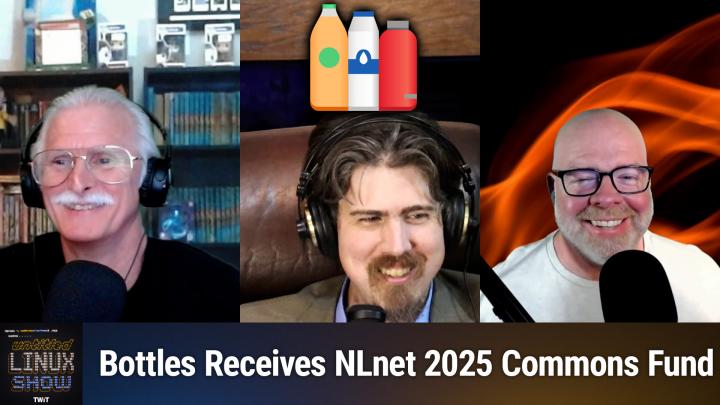
All TWiT.tv Shows (Audio)
Untitled Linux Show 215: Unencumbered by the Thought Process
01:29:19
Intel Orphans, KDE Linux, & the Big AI Lawsuit
Loading summary
Transcript239 lines
- [00:01]
Ken
Hey folks, this week we're talking about Audacity and bottles. Ubuntu Debian 13 is finally out. Things inside the kernel are complicated, but there's some neat stuff on the Horizon. The DuckStation PS1 emulator had something of a dust up with Linux this week. We get to the bottom of that. Oh yeah, and there's a really big AI lawsuit brewing that we talk about. You don't want to miss it, so stay tuned.
- [00:25]
Jeff
25 years ago, a small group of business and government leaders met in Washington, D.C. they envisioned the creation of an non profit organization with a mission to help people, businesses and government mitigate the growing threat of cyber attacks. Today, the center for Internet Security embodies that vision. For 25 years it's worked with a global community of IT and cybersecurity experts to develop the CIS benchmarks and CIS critical security controls. These proven security best practices defend against common cyber threats and streamline compliance with industry frameworks, regulations and standards. Today, CIS provides cybersecurity services, threat intelligence and critical resources to help public and private sector organizations alike strengthen their Cyber defenses. Visit cisecurity.org today. That's the letters cisecurity.org to find out how CIS can help your organization as we create confidence in the connected world.
- [01:25]
Jonathan
Let's map out this week's amazing destinations and travel tips.
- [01:30]
Jeff
Honestly Will, I didn't plan any trips, but I did switch to T Mobile with their new Family Freedom offer.
- [01:37]
Jonathan
That's not the itinerary we're following.
- [01:40]
Jeff
Well, I'm departing from AT and T and embarking on a new journey with T Mobile. They paid off my family's four phones up to $3200 and gave us four new phones on the house.
- [01:53]
Jonathan
Bon Voyage.
- [01:55]
Ryan Seacrest
Introducing Family Freedom Our lowest cost will switch our biggest family savings all on America's largest 5G network. Visit your local T Mobile location or learn more@t mobile.com FamilyFreedom up to $800 per line via virtual prepaid card typically takes 15 days. Free phones via 24 monthly bill credits with finance agreement eg Apple iPhone16128 gigabyte $8,029.99 Eligible trade in eg iPhone 11 Pro for well qualified credits end and balance due if you pay off early or cancel contact T Mobile hey it's Ryan Seacrest for Albertsons and safeway now through August 12th. Get big savings on your favorite products for the little ones in the family and earn four times points to use for discounts on groceries or on gas. Shop in store or online for items like Earth's Best Yogurt Smoothie, Gerber Pouches, Happy Baby Pouches, Huggies, Natural Baby Wipes, Pediasure Bottles, Earth's Best Crunchy Sticks and Gerber Yogurt Melts, snacks and earn 4 times points. Offer ends August 12th. Restrictions apply. Offers may vary. Visit albertsons or safeway.com for more details.
- [02:54]
Jonathan
Podcasts you love from people you trust.
- [02:58]
Marius
This is Twit.
- [03:03]
Ken
This is the Untitled Linux Show, Episode 215, recorded Saturday on August 9, unencumbered by the thought process. Hey folks, it is Saturday and you know what that means. We're going to get geeky with Linux and open source. We're going to talk hardware and software. It's going to be a lot of fun and you don't want to miss it. So it is of course not just me. I've got. I've got the guys, two of the guys. Rob's not here, but I've got Jeff and Ken and we're going to dive in and talk about some Linux stuff. And we're going to let Ken go first, and Ken is going to talk about. He's going to have the Audacity to talk about Audacity and tell us what's new there.
- [03:44]
Marius
Well, I'm always happy to talk about Audacity, especially since according to Marius, there's a new table version coming out this week. Audacity 3.7.5 was released to fix several crashes and if you are interested to add windows on ARM64 support. It fixes a crash during Wave import when the audio file is up to 7 milliseconds long, a crash when using Macro Wizard. And I want to thank you, Haley Somerville, for fixing a crash when rendering Spectrum View. Now we can also thank Dr. K.D. murray for introducing 32 bit PCM to the FLAC importer. Audacity has been available via PI apps on either an ubuntu or Debian ARM32 or ARM64OS. Now, as I'd mentioned previously, we hear it is now available for Windows own Arm or WOA. And that's WOA 11 only. We can thank Terence or Donno for providing a WOA fork of FFMPEG that is required to get audacity working on WOA 11.
- [05:09]
Ken
Wait, wait, wait, what is WOA 11?
- [05:14]
Marius
Windows own ARM version 11.
- [05:17]
Ken
Okay.
- [05:20]
Marius
And that's the only version that Audacity for Arms for Windows own ARM will run on.
- [05:26]
Ken
I see. Do you still. Do you use Audacity for stuff, Ken? I've not actually for quite A while.
- [05:35]
Marius
I haven't touched it recently, but it's part of my workflow for ripping vinyl.
- [05:43]
Ken
Yeah, it definitely.
- [05:44]
Marius
I hook up my USB vinyl record player and fire up Audacity and use it to record what I'm playing back. I'll play both sides into one long wave. Then I can go in with Audacity Mark, where each of the songs break and I can put in the names. And then Audacity allows me to convert that to a FLAC file for each individual one.
- [06:17]
Ken
I have been using Ardour for quite a while, but Audacity, there are a couple of things where it just works better. One of the problems I've had is trying to go in and automatically trim silence. So I had some audio files that were sort of a podcast format. Not exactly, but there were sort of long breaks of silence where someone was taking time to think about something. Or I think it's actually where people were taking time to look at their character sheets and then roll dice was actually what the long breaks were for. But anyway, so I had all this audio. I'm like, I don't want to have to go through there and trim all of that silence out. And so both programs, Ardor and Audacity, have tools to be able to go in and clip out silence. It just works better. At least last time I tried it, it works way better. In Audacity, it's a simple method.
- [07:05]
Marius
With Audacity, I just mark where I want the silence to start, mark where I want it to stop, and then I can just hit delete and it'll delete that section out. I actually use it to insert silence in between the songs when I'm ripping from a my vinyls instead of having that crackling noise.
- [07:30]
Ken
But that's part of the essential experience of vinyl.
- [07:36]
Jonathan
And some people actually master that in even if it's digital, just to get that analog type sound.
- [07:43]
Ken
Oh, yeah. I've spent a little bit of time working in a recording studio and it was one of the things that. For one song in particular is one of the things we did is we used one of those plugins. This has been almost two decades ago now, anyway, but we. We use one of those plugins to. To give a song that sort of crackly aspect to it. And. Yeah, super, super interesting stuff you can do. All right. Do we want to talk about intel again?
- [08:16]
Marius
Yeah, only if it's good news.
- [08:18]
Jonathan
Well, well, looks like Jonathan's up. No, it's. You know, intel was always such a company that everybody loved to kind of beat up on, you know, they were the 800 pound gorilla. They were the king of the CPUs for so long but boy, now they're really on their knees and I have a pair of stories this week and it's not good news for the Intel Linux crew. Basically it's all related to the layoffs at intel and how it's affecting the drivers and support for the hardware. So for example, the Intel CPU temperature monitoring driver is now unmaintained. This driver had a patch posted on the 8th of August that was from Intel Linux engineer Dave Hansen. It said this maintainer's email no longer works. Remove it from maintainers. Also mark the driver as orphaned for now. Basically the patch removes Fenghua you as the CorTemp hardware monitoring driver maintainer. Well, he's no longer at intel, he's now at Nvidia so he's not without a job but not with intel anymore.
- [09:32]
Ken
Maybe they'll open up more of Nvidia's drivers as a result.
- [09:37]
Jonathan
Yeah, yeah, stranger things have happened but it's going to be pretty My, my odds are not. I'm not placing that bet, you know. Also hit is the Ethernet RDMA driver While it's still supported it lost one of its co maintainers so there's still one one person now maintaining it instead of two. Tinfi Zhang is no longer at intel and that leaves the Intel FPGA DFL TOD driver which is the time of day device driver for the FPGA chip orphaned as well. M. Cheetan Kumar is no longer at intel and the WWAN IOSM driver basically WWAN is wide wireless area network. Now this one isn't a surprise because intel has exited the ww, the WWAN and modem business several years ago. So you know, this was coming anyway because whatever they're supporting is older. But if you have an Intel M2 modem and it's still in use, it could affect you down the road. Now you think the code would be fairly stable so you should get a few more, several more kernel revs out of it. But just be aware it's not maintained. So for some reason a bug comes up, it is what it is.
- [11:13]
Ken
Patches are accepted.
- [11:14]
Jonathan
Patches are accepted. There's also the Intel Keen Bay DRM driver which is also, you know, the maintainer is also not at the company. Anil S Kevin Shamurthy is no longer going to be working on kernel probes to help with the debugging and profiling. There's also other drivers that are going away but they're also in Products that Intel spun off and no longer part of the company. So like some of the others, this is kind of to be expected. Do take a look at the links in the show notes for deeper details into the drivers which so far are not going to be supported and there's some I didn't talk about but are also going to be orphaned. So I mean not maybe quite as mainstream as some of the ones I mentioned, but there's others. So definitely take a look at the articles. Now I do want to preface that this doesn't mean that someone in the future isn't going to pick them up and you know, especially for future looking products, I would guess that someone's probably going to pick them up, you know, either reassigned at intel or someone outside the company is going to get access to some of the early documentation and they'll be able to maintain and support it and add features. We'll give updates as we find out more on what's going to going on and what's going to be happening with the Linux drivers for Intel. So we'll keep you updated as we find out more. But for right now, more bad news.
- [12:45]
Ken
Yeah, it's worth pointing out that it's even possible that some of these guys will continue working on these drivers at their new positions. That's not an entirely impossible thing. That sort of thing happens sometimes. So like some of these guys, they got removed as maintainers because that email address no longer is active. So they could just email from a new address and say hey, I'm over here now, I want to continue working on this. Like this is possible.
- [13:11]
Jonathan
It is. And some of these, especially for some of the older products, the code probably doesn't get touched very much at all anymore.
- [13:17]
Ken
Indeed.
- [13:18]
Jonathan
Hopefully. So if it's pretty much on sustaining and you're not doing a lot of heavy lifting, they might just say yeah, I'll just keep my name on it with here's my new email address. You know, I'll spend the 10 minutes every, every quarter to tweak it or whatever and call it good.
- [13:41]
Marius
It does make you wonder though how much of this is related to them not maintaining clear Linux anymore.
- [13:53]
Jonathan
Go ahead, Jonathan.
- [13:54]
Ken
I think it's both repercussions from getting rid of a bunch of engineers, the layoffs that they're doing in intel to try to right the ship.
- [14:04]
Jonathan
Yeah, they're laying off thousands of people globally. They're shutting down fab projects. Every, every site is losing people. I mean a lot of people and management. I thought I heard something like they want to reduce it by 2/3 or something like that. They want to really cut out a lot of management and they're, they're like trying to get rid of about 25% of the headcount at intel to try to make, trying to right the ship because they're, they're in pretty dire straits right now.
- [14:38]
Ken
Yeah.
- [14:38]
Marius
And especially with the upcoming tax season.
- [14:42]
Jonathan
Yeah. And, and they, there's been there, they tried to, they were talking. Well, some of the board members wanted to spin off the foundries, the, the fabs and sell them to tsmc but then the CEO didn't want that and he thinks it's core and so there's some varying viewpoints in the boardroom about what should be done and, but I don't think tsc, TSMC wants them because it's it. You can't just take them over and run them.
- [15:11]
Ken
Yeah.
- [15:12]
Jonathan
There's a lot of intricacies in there to. Even if you're, even if your tool set mostly aligns, there's so many little details that things can run differently that it would be a major undertaking to take it over and make it work. Right. Especially those cutting edge geometries. And so intel is under a lot of churn and chaos right now as they try to get their legs under them again.
- [15:42]
Ken
Yeah. I'm pretty sure I saw somewhere a statistic about the percentage of drivers in the kernel that is now orphaned. I'm not seeing it though at the moment. I want to say it was something like 8%, 8% of the kernel is orphaned. Something kind of crazy like that. I don't immediately see it though. So somewhere, though somewhere there I saw that statistic. But yeah, interesting stuff. It's been fascinating to watch this question of as we sort of see economic hard times for some of these businesses. Where are they cutting and what are the things that they are cutting and where open source is in some cases taking the hit. Yeah. Interesting to see.
- [16:41]
Jonathan
Well and I could see someone going, we have all these products that we're still supporting that we spun off that division a few years earlier. Why are we still supporting it? Just cut it right now and we're done and walk away.
- [16:56]
Ken
It's a reasonable call to make. It's not unreasonable for them to do that. So I'm still sad about Clear Linux going down but. But on the flip side there is a new distro to take its place. Probably not a one for one replacement, but we now have a pre alpha of KDE Linux and I have been skeptical of this and I'M still a little skeptical of this, but Project Banana is now in pre alpha and you can go grab it and test it. There's some interesting things about it. It's not a demonstration distro. That's KDE Neon. No, KDE Linux is. It's going to be an end user distro. They're looking for it to be extremely stable and it's going to be. Well, it's built on top of Ubuntu. Lts. No, sorry, that's Neon. I knew that didn't sound right when it came out of my mouth. No, it's built on top of Arch. It's actually very similar to Val SteamOS. KDE Linux will be an immutable distro which is sort of all the rage right now for good reason. It's the easy way to get new people onto Linux and make it difficult for them to destroy it and make it no longer boot. Looks like they're going to do a dual read only butterfs root partition and yeah, some interesting stuff here. And again pre alpha. Very early days for this but you can actually go test it which is. Which is pretty cool. They're also to do. To do KDE Linux only supports recent Nvidia GPUs for which Nvidia supplies fast drivers. So at this point they are not packaging the Nvidia drivers which is going to make that kind of a non starter for some people. And because it's an immutable distro, it's going to be difficult to get those installed. You have to work really hard to be able to do that. Basically go in and break your system to be able to fix it. But yeah, KDE Linux, it's interesting stuff. I'm probably not going to run it. It's probably not for me.
- [19:21]
Jonathan
Yeah. So is the goal just to test KDE with newer hardware than Neon or I mean newer software than Neon?
- [19:30]
Ken
From what I am reading they actually want it to be a full blown end user daily driver distro. Yes, it is not just a demo.
- [19:40]
Marius
Just like Steam os.
- [19:43]
Ken
Yeah, but I mean really how is.
- [19:44]
Jonathan
That different than you know, your like cache where you can get KDE on it or you know, was it Mandre man?
- [19:57]
Ken
Yeah, I have some of the same.
- [19:59]
Jonathan
It just seems like we already have Arch distributions, several flavors that have KDE as an option already. How is this?
- [20:10]
Ken
Yeah, as I said, I have been skeptical of this. I think the KDE guys should be focusing on building the desktop and not trying to make a full blown distro. I Think that you've got multiple really good options. Like, if you want an immutable really good KDE desktop, go run one of the Fedora immutable spins. But KDE on it or one of the Ubuntu. I mean, there are, there are more options. There are a bunch of options out there.
- [20:39]
Marius
And it. And if you're adventurous, go with something arch based.
- [20:44]
Ken
Well, I mean, that's what this is. Maybe there wasn't an arch based KDE immutable distro out there. I don't know. It's strange, but it's one of those things where it's like if somebody wants to work on it, then okay, fine. Nothing wrong with that. I just, I hope the people that have been working on KDE don't go and start spending their time on this instead. That's my main concern.
- [21:10]
Jonathan
Yeah, I just, I just don't want to see kind of reinventing the wheel.
- [21:13]
Ken
When it's like, stuff's already out there. Yep, yep. That is, that is the thing that comes to mind. But it's out there. You can go test it. Go grab the ISO.
- [21:22]
Marius
Looks like the author of your article, Liam Proven, thinks that this could one day be a bulletproof system. Or it's intended to be.
- [21:33]
Ken
I mean, that's what. That's the whole point of the immutable. Yeah, it's the whole point of immutable. So it.
- [21:41]
Jonathan
But I hear that with every new distribution, it's hot.
- [21:44]
Ken
Immutable. Linux is hot. Everybody likes it.
- [21:47]
Marius
You even hear that about some of the older distributions. Yeah, I don't know that have immutable system drives.
- [22:01]
Ken
All right, do we want to talk about bottles? Are bottles immutable? It's sort of kind of the same flavor of thing. I might be stretching it just a little bit.
- [22:13]
Marius
Just a little bit.
- [22:15]
Jonathan
If you're unencumbered by the thought process, sure. Let's map out this week's amazing destinations and travel tips.
- [22:24]
Jeff
Honestly, Will, I didn't plan any trips, but I did switch to T Mobile with their new Family Freedom offer.
- [22:32]
Jonathan
That's not the itinerary we're following.
- [22:34]
Jeff
Well, I'm departing from ATT and embarking on a new journey with T Mobile. They paid off my family's four phones up to $3200 and gave us four new phones on the house.
- [22:48]
Jonathan
Bon voyage.
- [22:49]
Ryan Seacrest
Introducing Family Freedom. Our lowest cost will switch our biggest family savings all on America's largest 5G network. Visit your local T Mobile location or learn more@t mobile.com FamilyFreedom up to $800 per line via virtual prepaid card. Typically takes 15 days. Free phones via 24 monthly bill credits with finance agreement eg Apple iPhone 16128 gigabyte $8,229.99 Eligible trade in iPhone well qualified. Credits end and balance due if you pay off early or cancel. Contact T Mobile hello, it is Ryan and I was on a flight the other day playing one of my favorite social spin slot games on chumbacasino.com I looked over the person sitting next to me and you know what they were doing. They were also playing Chumba Casino. Everybody's loving having fun with it. Chumba Casino is home to hundreds of casino style games that you can play for free anytime, anywhere. So sign up now@chumbacasino.com to claim your free welcome bonus. That's chumbacasino.com and live the Chumba Life Sponsored by Chumba Casino.
- [23:41]
Ken
No purchase necessary.
- [23:42]
Ryan Seacrest
VGW Group Void where prohibited by law. 21 terms and conditions apply.
- [23:47]
Jeff
You can make a difference in someone's life, including your own with a job in home care. These jobs offer flexible schedules, healthcare retirement options and free training. They also provide paid time off and opportunities for overtime. Visit oregonhomecarejobs.com to learn more and apply. That's oregonhomecarejobs.com.
- [24:17]
Marius
But this week Bobby Borisov and Christine hall report that Bottles has funding. Both Bobby and Christine cover the Bottles project's rough financial patches impact on its development project, and I think even Rob touched on that a couple of episodes ago. In fact, Rob I think even asked people to help donate to support Bottles a little bit. Well, Bobby reports that Bob's request as well as Mirko Brahman's didn't go unheard. Quoting Christine. Hallelujah. Bad news has been followed by good news. Founder and lead developer Mirko Brambin announced in a blog that Bottles received an NL Net Commons Fund grant through the 2025 Commons Fund. Mirko said this support will help us accelerate our work on the Bottle's next project, bringing a more modern and polished experience to running Windows software on Linux. The grant recognizes our efforts to build a better future for running Windows applications on L. According to Bobby, the NL Network Net foundation support comes via the ngio, and I think I'm getting that right. Not it's not NG10, but their commons fund, which is backed by the European Commission's Next Generation Internet program along with additional funding from Switzerland's State Secretariat for Education, Research and Innovations. S E R I Siri now According to Christine, the amount of the grant hasn't been made public, but the NL Net Commons Fund typically awards grants ranging from €5,000 to €50,000. I think that probably converts to about $5,800 US, maybe up to $58,000 US per project, with some larger projects receiving as much as €150,000. Now Bobby and Christine also Pride provide more details about the 2025 Commons Fund and the Ngio Commons Fund. So I do recommend reading their articles if you want the nitty gritty details. Also, as you travel down that rabbit hole, you might even stumble over what system 76 provided to bottles next. So Jonathan, are you using Bottles?
- [27:02]
Ken
Not bottles itself, no, I use, I use Lutris for stuff like that. And it has some bottling built into it and then of course Steam has the sort of the same, you know, using wine prefixes as well built into it. So there's several different ways to kind of accomplish this.
- [27:19]
Jonathan
And codeweavers uses Bottles if you get the actual code Weavers Wine.
- [27:26]
Ken
Yeah, there's several things out there that sort of let you accomplish this, but nothing. It's neat to see the Bottles project out there and good for them for getting some funding. I mean that's always, it's always a very cool thing when you can get paid for the open source project that you enjoy doing. That's, that's one of those kind of win conditions to life.
- [27:45]
Marius
Especially when it's by a government that endorses using open source.
- [27:50]
Ken
Yes. Sometimes getting paid by governments has strings attached, just extra paperwork and all of that.
- [27:57]
Jonathan
But Europe's leaning into Linux pretty hard nowadays.
- [28:01]
Ken
It is, it is very interesting to see. Yeah.
- [28:04]
Marius
Getting away from some of those American commercial ventures.
- [28:10]
Ken
Yeah. I, you know, personally, and I say this as an American, it doesn't bother me so much that they're American ventures, but that they're proprietary and closed source ventures that, you know, I'm, I'm sort of afraid of that no matter what country a company is from. And I have very little trouble, you know, it does not bother me at all to run hardware or software from pick your country. I say that with some caveats because I'm not naive, but the quality of the code and the openness of the code is way more important than the.
- [28:43]
Marius
Country of origin and how often it phones home.
- [28:47]
Ken
I mean ideally you can audit the code and see and figure that out.
- [28:51]
Jonathan
Well, when you look at it, certain parts of Europe left Microsoft for a Linux distribution that's based in America.
- [29:02]
Ken
I mean Linux foundation is in America. I was considering that, yeah.
- [29:06]
Jonathan
And Red Hat.
- [29:07]
Ken
Red Hat is basically IBM. Yep.
- [29:09]
Jonathan
But you can tear it all apart and see what's in there, or fork it.
- [29:16]
Ken
We know people that have done that too. Yeah, indeed. All right, so speaking of trouble in paradise, what is up with DuckStation? And in fact, Jeff, what is DuckStation? And then what's the deal with it?
- [29:36]
Jonathan
So, in case you've not heard of it, DuckStation is a Sony PlayStation Gen 1 emulator, also known as a PS1 emulator. So it has a goal of being highly accurate and it's developed to run on many different platforms. Well, the problem is that the developer of DuckStation is looking at dropping Linux support totally because of an issue with Arch and the aur. AUR is Arch's set of repositories. The story behind this started when the author made a package build script, PKG Bui L D script, and this was to help resolve issues which were coming up in unofficial AUR packages. The author states that the problem is the official guidelines are being ignored and they're using broken packages which then users come back to him with complaints. So the author pulled the pk, the package build script, because of the many complaints. You know, he just, he's not happy that he's getting all this and he's not happy that he can't request removal of the packages in the aura which have been a problem, because he has to disclose a bunch of personal details to Arch to make that happen. So the author had this to say. So this is step one. Next step will be removing Linux support entirely because I'm sick of the headaches and hacks for an operating System that only comprises 2% of the user base and I don't even use myself. So he's very unthrilled with the flak he's getting over this Now. I'm sure there's a lot of people thinking, okay, we'll just fork it and continue on. Well, there's a hitch in that. Giddy up. Previously the software was released under the GPL version 3 license, but in 2024 the license changed to the CC by NC ND license. This is the Attribution non commercial, no derivatives 4.0 international deed. Well, that's a mouthful. So, attribution, you must give all appropriate credit, provide a link to the license and indicate if changes were made. You may do so in any reasonable manner, but not in any way to suggest the licenser endorses you or your use. Non commercial. Of course, you may not use this material for commercial purposes, no additional restrictions. So you may not apply any legal terms or technological measures that legally restrict others from doing anything the license permits. Here's the one that kills a fork repackage. Even if a community repackage, no derivatives. If you remix, transform or build upon the material, you may not distribute the modified material. So you can't fork it in any way basically without being in violation of this license.
- [32:41]
Ken
I think I found the problem. I think I know I got to break in here. I think I know why he was having problems. He wrote a license that says that the AUR guys can't fix anything when they find it. Of course they have to bug him about it. He holds the keys to the kingdom. Nobody can. Oh my goodness.
- [33:01]
Jonathan
Yeah, well, there still is hope though, because the author did make a statement that he expresses hope that the Linux community might become more reasonable about these issues.
- [33:12]
Ken
So he wrote a license that says that for any fixes to make it into his source code, they have to go through him. And then he complains when people bug him about problems. This is someone that does not understand how open source in the world works. This is not an open source license as well. It is a source available license. But this is somebody that just does not get how Linux works.
- [33:35]
Jonathan
Yeah, I mean, I just basically hope this all gets sorted out, but as we say a lot here, we'll keep updated, everyone. Updated as events weren't.
- [33:45]
Marius
Is the older version still under the GPL? Version 3, open source? And how far back is that going?
- [33:55]
Jonathan
Well, 2024 is when they switched over late 2024.
- [33:59]
Ken
So there's six months worth of work or so one could make the argument that depending upon how they did that switch, it may not have been legitimate. And so if there are people in there, if people hold copyright in there that did not consent to that, then there's an argument to be made that the whole thing is still available under the GPL V3. A lot of people out there don't understand how the GPL actually works. Yeah, this would be interesting to dig more into the source code and the Git history of it and all the people that are in there and how they did this transfer over to a different zany license.
- [34:40]
Marius
Whether or not it would be worth going back far enough in the history and forking at the point before the new license came out.
- [34:48]
Ken
Yeah, you could do that. You could absolutely do that. And I don't, I don't necessarily have a problem with the Creative Commons licenses. Like some of them are great. I've released Some, some text under Creative Common text and pictures under Creative Commons before, they're just not, they're not good source code licenses. That's not what they're made for. And that's, you know, source code does not belong underneath Creative Commons licensing.
- [35:08]
Marius
There more for when you're releasing documentation, isn't it?
- [35:13]
Ken
You can do it for documentation they work for. So writing like prose, poetry, documentation. A lot of pictures get released under Creative Commons. Video music gets released under Creative Commons. And because they're, they're very easy to understand. Like, you know, what do I want people to be able to do with this? What do I not want people to be able to do with this? You know, so by attribution, when somebody uses it, my name needs to go on there. No commercial, you can't make money from it. No derivative, I don't want you to remix it essentially. And, you know, it's very clear to understand. And they've got these different flavors and you can sort of mix them out. That's why it's popular. People like the Creative Commons because of that. But it's just most of those are not. They're not compatible with the definition of open source. And there are really good reasons why we have the definition of open source that we do. And this sort of highlights one of the ways that can go wrong. When you say no derivatives, it makes it very difficult for people to fix bugs. Let's take a look at bcachefs. Yes. So there's some stuff going on in the kernel and there's a couple of stories on Pharonix about this. And I basically wanted to give folks an update that we still don't know for sure what's up with bcachefs. It's just sort of stayed. Nothing has changed yet as of the last I've seen. There was a pull request made by bcachefs developer Kentover street, and it's just sort of been ignored. There was a question posted about what's going on here and nobody has answered it. Kent says it's still his kernel. If he wants to remove it, that's his choice. That's sort of where it boils down to there. So that is the story I linked to. Actually saw a second story on Pharonix. I'm just now taking a look at it. Apparently there's an ongoing discussion and an anecdote around Butterfs came up. Meta. Somebody from Meta talked about. Joseph Bachik actually talked about how the Meta infrastructure is built completely on Butterfs and its features. And he says we have saved billions with a B A Bravo billions of dollars in infrastructure costs with the features and robustness of Butterfs, which is definitely interesting to see all kinds of fascinating stuff going on around this. And I don't know what's going to happen. Torvalds has not chimed in. It's sort of beginning to look like. It's sort of beginning to look like this is just a one cycle timeout for the BCash FS project. And so, you know, there is some, some Hope that in 618 everybody will start to play nice again. But you know when you say it's not.
- [38:36]
Jonathan
When you say one cycle timeout, is that including the last timeout he had or in this is also going to the 17. 6.17 will be another timeout.
- [38:45]
Ken
My understand. So the fight happened during the 616 right after the 616 merge window.
- [38:52]
Jonathan
Right.
- [38:53]
Ken
And so I'm thinking that. And we're almost, we're almost to the end of the 617 merge window. And my guess is that just for all of 617 he's going to be timed out like just sort of ignored. And once 618 comes around, hopefully cooler heads prevail and they start accepting code again. I am, I am not good. Jeff.
- [39:17]
Jonathan
I was going to say, because 618, it was supposed to be marked stable. That was the plan. That can't be.
- [39:25]
Ken
Yeah, we'll see. We'll see what happens. I don't know if that'll happen or not. If it can. I am not a fan of the idea of not accepting code because of personnel issues. I think it's a problem because people actually depend upon this code and important stuff runs its content code in some cases. And so I don't, I don't think that's the right call. But obviously I am not the. I am not Linda Sturvals. And I do not get, you know, my, my opinion is worth about the amount of breath it takes for me to give it on this podcast. But you know, that's, that's where I come from. I think, I think the code is more important than the personal issues because when you're talking about the Linux project, the code is the project. And so, you know, that's what should come first. Obviously not everybody agrees and your opinion.
- [40:17]
Jonathan
Is worth the price of a subscription to Club Twit.
- [40:20]
Ken
Oh, is it worth that much?
- [40:23]
Jonathan
This we're all paying.
- [40:24]
Ken
I suppose that's true. That is what we're all paying. All right. If we don't have any more thoughts about that it sort of just is what it is and we're waiting to see what's going to happen.
- [40:37]
Jonathan
And so people know the it should. The merge window should close tomorrow.
- [40:42]
Ken
Yes. So all of the fun new stuff that's going to land in six, 17 has basically already landed. And then it's so we're ready to.
- [40:50]
Marius
Talk about some old stuff.
- [40:52]
Ken
We can talk about some old stuff, Some old stuff and some new stuff. Things that are old or new again, take it away.
- [41:01]
Marius
Well, last month we saw Ubuntu 24.10 reach its end of life. Now this month Marius Nestor and Michael Larabel write about an even older version that keeps improving with age. I am talking about the latest point release for the long term, supported Ubuntu 24.04 announced by Canonical. This is Ubuntu 24.0 4.3 and of course this is an LTS, so it going to be supported for a while. Now according to Michael, Ubuntu LTS point releases are predominantly for bundling up all of those security and bug fixes into Stalable. That was issue provided through stable release updates that have been shipped down already to Ubuntu LTS users. Now the new point release makes it more convenient for quickly deploying new Ubuntu LTS systems with the stable updates over the past several months already included. Now according to Marius and Michael, Ubuntu 24.3 LTS is powered by Linux kernel 6.14 and the Mesa 20 Mesa 25.0 graphics stack from the newer Ubuntu 25.04 release. Now according to Marius, we can expect the next point release in February of 2026 for Ubuntu 24.04. Now I do recommend reading Michael and Marius's articles just if you want to find out what I didn't cover.
- [42:50]
Ken
Yeah, so it is interesting that this is happening now because something else just happened and that is that Debian 13 just released Debian 13. Trixie is now officially out I believe today. I think today is the day. Today is Debian day. Today, yes. Saturday. Saturday the 9th I believe is Debian Day. So not only do we get a point release of Ubuntu, we also get Debian 13.
- [43:19]
Marius
I'll have to see if I can upgrade Linux on my chromebook to Debian 13.
- [43:24]
Ken
Are you running?
- [43:26]
Marius
Are you Debian 12?
- [43:27]
Ken
Vanilla Debian 12, not the Chrome OS thing?
- [43:34]
Marius
Well, I went from 11 to 12 on it when 12 came out.
- [43:40]
Ken
Yeah, very cool. What's interesting so Debian is becoming a little bit more popular again. They've made some changes and people are sort of looking at Debian again. But Debian is an upstream for so many different things, not just Ubuntu, but like Raspberry PI os for example, is one of the big ones. And so I don't know how long it's going to take the Raspberry PI guys to get the PI OS 13 out the door based on Trixie, but that's going to happen before too much longer. And so, you know, you may not be excited about Debian 13, but newer stuff on the Raspberry PI is. Should be exciting for anyone that's got one. And you know, so there's a lot, there's trickle down effects that will happen in various different places, even if you're not actually running Debian anywhere. Well, I don't.
- [44:27]
Marius
Go ahead Jeff, but I'm just going to say.
- [44:31]
Ken
Jeff, Jeff, you go.
- [44:33]
Jonathan
Okay, thank you. I'm not sure if it's really accurate, but a little while ago I saw a pie chart of Debian of Linux users and it was Debian and Debian based distribution. So your Ubuntu's and all that kind of stuff. It was about two thirds of the Linux market and if you, if you take out Debian, you take out Red Hat and you take out Arch, there's not a ton of distributions that aren't based off of one of those three. But, but Debian was kind of the, the juggernaut of the house.
- [45:07]
Marius
Yeah, Ken, well just going to mention that didn't we cover Debian 13 going to include a new version of APT?
- [45:19]
Ken
I know we've talked about Debian 13. I don't remember off the top of my head all of the things that are baked into it, but I know there are some interesting things in there. Would not surprise me that there's a major update for apt.
- [45:33]
Jonathan
I'm running the new app right now.
- [45:38]
Ken
So they've got some release notes here. What's new in the distribution? Official Support for RISC v64 hardening against rope and cop GOP attacks, HTTP boot support, improved manual page translations, spell checking support in QTWebEngine web browsers, 64 bit time tabi transition. They're fixing the 2038 bug. Good for them. Debbie in progress towards reproducible builds.
- [46:10]
Jonathan
Yes, Jeff, APT is 3.03. So that is the new version with the cleaner interface and it looks a lot pretty. 12 does not have it. 12 is on 2.6.1. So Trixie will be the first one where you get the clean, nicely formatted app. And it's so much better than the old wall of text that just kind of.
- [46:30]
Ken
Bleh. Not surprised. Yeah. So a couple things that stick out to me here in the rest of this list from what's new in Debian 13 progress towards reproducible builds. They're not there yet, but it's on their radar. And that's actually a fairly important thing for distros to get these days, is to be able to do reproducible builds. And then the other one is they're moving to Plasma 6 in Debian 13, so a reasonably modern desktop experience too, so pretty cool. Some good stuff in there.
- [47:01]
Jonathan
Yeah, they'll be running QT6.8.2 with that I'm looking at, and the plasma desktop will be 6.3.6. If you look at Distrowatch and you click on Debian and if you scroll down a bit, it'll give you the major packages and then if you really want to know, you can hits like see all packages and it'll just give you all sorts of information on what versions it'll have, what the latest version is and then what the version is in the current setup.
- [47:36]
Marius
Yeah, Good experiment for somebody would be to probably in a vm, put in Debian and then try to install the Cosmic desktop over it.
- [47:50]
Ken
That would be very interesting to try to get Cosmic on Debian, probably. I'm sure there's a way to do it. I don't know if it's officially packaged yet or not, but I'm sure somebody, if there someone will have a guide on how to do that shortly, inevitably.
- [48:05]
Jonathan
But Cosmic is still Alpha, I believe, Right? Have they hit Beta yet?
- [48:09]
Ken
I don't remember. If they haven't, it's coming soon.
- [48:14]
Marius
Let's see, they're waiting for a special occasion to announce it a bit.
- [48:22]
Ken
The current Alpha said. The robot says that the current Alpha 7 version is being described as pretty solid. And that is what I was remembering as well. Yeah, Alpha 7 is the latest according to system76.com and yeah, they're also calling it Epoch 1. Cosmic Epoch 1. So it sounds like they're getting very close to a beta and in fact their blurb here says only a few months out from release. So maybe Alpha 7 is sort of a sly beta in and of itself. Oh, that could be.
- [49:00]
Jonathan
Let's map out this week's amazing destinations and travel tips.
- [49:04]
Jeff
Honestly, Will, I didn't plan any trips, but I did switch to T Mobile with their new Family Freedom offer.
- [49:12]
Jonathan
That's not the itinerary we're following.
- [49:14]
Jeff
Well, I'm departing from AT&T and embarking on a new journey with T Mobile. They paid off my family's four phones up to $3200 and gave us four new phones on the house.
- [49:27]
Jonathan
Bon voyage.
- [49:29]
Ryan Seacrest
Introducing Family Freedom. Our lowest cost will switch our biggest family savings all on America's largest 5G network. Visit your local T Mobile location or learn more@t mobile.com FamilyFreedom up to $800 per line via virtual prepaid card typically takes 15 days. Free phones via 24 monthly bill credits with finance agreement eg Apple iPhone 16128 gigabyte 82999 Eligible trade in eg iPhone 11 Pro for well qualified credits end and balance due if you pay off early or cancel contact T Mobile hello, it is Ryan and I was on a flight the other day playing one of my favorite social spin slot games on jumbacasino.com I looked over the person sitting next to me and you know what they were doing. They're also playing Chumba Casino. Everybody's loving having fun with it. Chumba Casino is home to hundreds of casino style games that you can play for free anytime, anywhere. So sign up now@chumbacasino.com to claim your free welcome bonus. That's chumbacasino.com and live the Chumba Life sponsored by Chumba Casino.
- [50:21]
Ken
No purchase necessary.
- [50:21]
Ryan Seacrest
VGW Group Void where prohibited by law 21 + terms and conditions apply.
- [50:27]
Jeff
You can make a difference in someone's life, including your own, with a job in home care. These jobs offer flexible schedules, health care, retirement options, and free training. They also provide paid time off and opportunities for overtime. Visit oregonhomecarejobs.com to learn more and apply that's oregonhomecarejobs.com.
- [50:56]
Ken
So there's something interesting about Cosmic and that is that it is a Wayland, I think Wayland only desktop environment and that's sort of been a problem for some things like oh, browsers. I think Jeff has a story about that.
- [51:12]
Jonathan
I do well for Chrome. Firefox has been Wayland friendly for a while, but the next major Chrome release will auto detect which Linux display is being used and then decide which part of the Chrome software should be used, the X11 part or the Wayland part. Now the software in Chrome which will do this is called Ozone and it's the abstraction layer that handles the graphics. Currently it defaults to x11 even if the system is running wayland so now this causes things like fractional scaling in Wayland to have not such good effects. Like so it'll make your Chrome window look blurry if you have fractional scaling turned on it. It's also, it's also officially known as interpolation blur. That's because it can't, it can't x11 can't handle the fractional scaling. So now instead of defaulting to X11, the system is going to try to use Wayland if at all possible. So if you are running Wayland this is if the ozone layer is setting, Ozone is set to auto. So it can now you can still be forced to x11 if desired. So if you are running something and you get something weird, you can, you can still use the X11 and go through X Wayland and all that like like it's currently doing. But now they're going to have auto as the default setting for the next major update. So and the other, the other thing they talked about is changing the Wayland. The input should also seem snappier with less lag and because you're not forcing everything through X11. So like I said, we should see this in Chrome 140, but if you're the impatient type and want to try it now, it is possible. So you can go to Chrome Flags in a new tab, locate the Ozone platform hint flag, set it to auto in the drop down menu and then quit the browser. They said don't relaunch it, quit it. So then it'll come up fresh again when checking the setting, though it might already be set to auto and that's something that's not totally unusual. So some distributions make the change while they're packaging it and if you have a different browser based on Chromium, some of them also enable it. So while it's not the default officially from Chrome, there isn't anything totally out of the ordinary if you already find it on auto. So like I said, there are a couple cases that somebody could be switching that ahead of time. Now Google held off until 140 release because depending on how old of a version of Chrome you're running, you could have bugs they felt at version 140, all the bugs and quirks in dealing with Wayland should be ironed out. So you know, and the but the author of the article that's linked in the show notes says that they've been using it for years and there have been no issues. So depending on what you're doing, you know your distribution, probably a ton of variation on what, what versions of various files you have. You might not see the issue, so take a look at the article linked in the show notes. Give it a shot if you're the Adventures type and see if you can tell the difference. If, you know, if you're not doing anything that requires, you know, real quick Twitch and you're not doing any fractional scaling, you might not even really notice anything, you know. But if you do see issues or maybe don't, you know, let us know in the discord what you're finding. Give us thoughts on that and always happy to hear.
- [55:09]
Ken
Yeah, interesting stuff. I know when I went and did some fiddling around with trying to get various things in Chrome, working with my Fedora KDE desktop, that was one of the settings that I went in and played with to be able to force it to use that Wayland backend. The first time I did that, it was very buggy. It was not a great experience. But it has gotten better and better and I think I'm, I think I'm running on auto right now. And so it is indeed it is running on the Wayland back end and it's at the point now to where, you know, I basically don't, I don't see a difference between that and x11. Everything pretty much just works except for Windows restoring to where I left them on something like a reboot that's not there yet, but progress is being made.
- [55:56]
Marius
Does Firefox restore to where you left it?
- [55:59]
Ken
Not under Wayland. That feature just recently got added to Wayland, so it'll be another iteration of KDE and another couple of versions of the browser before all that actually starts working.
- [56:11]
Jonathan
In practice, I just checked mine and my Chrome is just on default, so I'm not on auto.
- [56:21]
Ken
Yeah, that makes sense. I think that's probably going to be what most machines are.
- [56:29]
Jonathan
But I hardly ever use Chrome other than for this restream. I use it for the restream once.
- [56:34]
Ken
A week, use it once a week to do the show because Firefox for some reason is not necessarily happy about it.
- [56:40]
Jonathan
Yeah, it won't pick up my virtual camera. It'll pick up my real camera, but it won't pick up my obs virtual camera.
- [56:45]
Ken
Yeah, I'm trying to real quick check what mine is set to on this machine. I bet it's going to be. Yeah, it's set to default. Not a huge surprise.
- [56:55]
Marius
So you're using Chrome or Chromium, Jeff Chrome. Okay, I've got both loaded up. Check them after the show, find out.
- [57:05]
Ken
What I'm sit on makes sense.
- [57:07]
Jonathan
And I'm currently at version 139 point random numbers. So next update should bring it.
- [57:16]
Ken
Yeah. All right, so I've got one more story to cover and talk about and this one is not directly Linux, but it is something that we cover on the show from time to time and that I know a lot of people are interested in. And that is the big AI lawsuit is happening or maybe is happening. And there's a couple of things here that I found very interesting. So this is a class action lawsuit and it, it is potentially going to be the largest copyright class action lawsuit that has ever been allowed to proceed. And it is, it is quite a few authors versus anthropic and anthropic AI and apparently they're trying to get up to 7 million people in claimants, the technical term in this class action lawsuit. And so you know, it's going to be anthropic AI versus these 7 million people. And the interesting thing about a class action that is that large is if it goes to trial and the trial swings in favor of the people, then the potential for losses from it is huge. There's one line here in the Ars Technical article that there's the possibility of $150,000 fine per work. I believe it is so for each book that they loaded into the Anthropic AI. So hundreds of billions of dollars in potential damages. It's a lot, it's big. So when you talk about something this big, most companies will settle if they can. What Anthropic is actually trying to do is to block this mega lawsuit and say no, no, these all need to be handled individually because when you have these individual lawsuits there's in taking one of them to trial, you know, if Anthropic loses, they pay out a much smaller amount and then they can settle the rest. Whereas if you do it all as one big block, just the numbers are ridiculously huge. It's company ending, right? It would be the end of Anthropic if they got a judgment of this side. There were a couple of other things that were really interesting here. One of them is that the judge that is overseeing this, that Anthropic essentially criticized in their, you know, their, their filings on this and some of the statements that they've made. It's Judge Alsop and those of you that have been watching sort of the Linux world might remember Judge William Allsupport. He was the guy that originally tried the Oracle v. Google case over Android. And very famously in the Middle of a court session, they were talking about the range check function. So this is in the Android case. And the judge says, I know what range check does. It makes sure that the numbers you're inputting are within a range. I'm reading from the court documents now, and if they're not, they give it some sort of exceptional treatment. It is so that witness, when he said that a high school student would do this, is absolutely right. And so this was sort of the statement that people recognized from the middle of that legal battle, that courtroom drama. Wait a second. Judge Alsop actually knows how to code. And one of the things that you heard, he taught himself Java to be able to try the case, which is sort of true, but apparently he had been programming for decades in things like BASIC and various languages. And so all that to say, Judge Allsup knows how technology works. He is one of the ideal judges to have his hands on this particular case because he has a clue about how technology works. Some judges and lawyers even do not. He seems to. So that kind of made me feel good about this. I have over on Floss Weekly, I have actually asked a lawyer about the AI question, and we sort of spitballed, well, what would happen if you had. And we described sort of a case like this where you had authors come up against an AI company and say, what you're doing training an AI off of our works is copyright infringement. And it was very interesting to me. The lawyer's comment was, you can't put the genie back in the bottle. And that's really interesting here because, like, even if, let's say, worst case scenario, even if this kills this particular company, right? Even, even if Anthropic is ruled against and goes under, people are going to want their AIs on the Internet. And there's. I have to agree with him. I think no matter what the court rules, there's no stopping LLMs and training LLMs on this data. There's going to have to be maybe a little bit more care taken. There may be going to have to be sneakier about it. I'm not sure how all of that's going to wash out, but I have to agree, no matter what the courtroom says, I do not see a future where we give up on training AIs on public data. It's just too powerful of a tool and too many people want it too badly. This is the sort of thing that you sometimes see new political parties and new political movements formed over, right? So I could see even a political party come out of this that is the AI party. And their stick is we want to redefine how copyright works so that we can have working AI it is an incredible time that we are in, and I don't know what's going to happen with this particular court case, but it is so fascinating to watch.
- [64:03]
Jonathan
Well, there's so many nuances there because, you know, they say, well, you know, I get the, okay, I wrote this, I should have rights to it, and somebody's using it. And then you hear, oh, well, AI can just spit out, you know, parts of a book. But then I've also heard, well, to get it, to do it, you got to like, pre feed it a couple, you know, paragraphs to get the exact. Which seems kind of funky. And I don't, you know, I don't know. And I agree copyright laws went too far. I mean, that was Disney that kept pushing that.
- [64:37]
Ken
Yeah.
- [64:37]
Jonathan
And they wanted it longer and longer until they realized, oh, we can trademark our stuff. And then it doesn't have a time limit. So then they quit pushing copyright out for years and years and decades. And I know there's been a lot of issues with Google trying to preserve old books where they got to try to track down who, you know, a lot of kind of orphaned books, like who owns the copyright. And there's people that don't even realize they own the copyright to a book because somebody's great, great uncle wrote it, wasn't a huge success, wasn't, you know, just kind of faded into history. Google wants to preserve it. And then they knock on your door and go, hey, can we preserve this book? You're the owner of it now through, you know, legal rights of, you know, they passed and didn't will it to anybody, but you're the surviving relative, so it's now yours. And, you know, there's, there's a lot of books that will probably could die away and other other copyrighted materials, music and whatnot, because who's the owner? We don't know. And it's on mediums that aren't going to last. And yeah, I don't know it. It's a mess.
- [65:48]
Ken
So the central question with AI here is, is training an AI on these copyrighted works, Is it a transformative act? That's sort of the legal jargon way to put it. And I guess if you were to try to boil that down, sort of what you're asking is, is training an AI similar enough to what happens when a human reads a book? Because we read these books, we remember parts of them, we sort of integrate parts of them into our thought process. Is it essentially the same thing that's happening when an AI reads a book, or is an AI just copying the book into its database? Well, I would say that in actuality, it's somewhere between those two. Right. And then, so then you have the legal question of, okay, how do you handle that in between thing. It's new and we've never had a technology do this before.
- [66:47]
Jonathan
Before.
- [66:48]
Marius
Is training an AI like training students in a school?
- [66:54]
Ken
That's the question. That's essentially the question. Yeah.
- [66:58]
Marius
Where the school, when they give them a reading assignment, say there's copies available in the school library.
- [67:06]
Ken
Yeah. Yep.
- [67:08]
Jonathan
So you could argue the school purchased the book.
- [67:11]
Ken
They did. Well, so the, so the question is then the, the, the, the act of reading the book is going to change the way that the student thinks. Is that a copyright violation? That the book is now imprinted into the student's mind? Is memorization a copyright violation?
- [67:29]
Marius
His plagiarism of it, when you're writing that book report a copyright violation?
- [67:35]
Ken
You know, it's interesting that you mentioned that because there are some really well defined rules about what makes something plagiarism. And it's not just you've lifted this many words in a row without putting in quotation marks. That's one of the ways you can plagiarize. It's also possible to plagiarize by using the same sentence structure. So you can take someone's sentence and put synonyms in for the words. That is still plagiarism. Technically speaking, it is still plagiarism. Even if you've used a synonym for all the words. If you have the same thought in the same order, it is considered plagiarism. And so I guess that it would be an interesting test case. Like our AI is plagiarizing books. Maybe that is the better question to ask. Think of it that way.
- [68:25]
Marius
Plagiarising the authors.
- [68:28]
Jonathan
So all you need to do is they just need to make their AIs talk like Yoda so it's not in the same order. And then everything's okay.
- [68:36]
Ken
It doesn't work that way.
- [68:39]
Jonathan
Or to rearrange, we will.
- [68:44]
Ken
There was a book, I think somebody the EFF published the right to read that sort of ties into this. And it was a little fiction story about sort of this dystopian future where that idea of copyright extends all the way to reading. And so for someone to read a book, they have to have a license to be able to read it. And it was, you Know, it's a dystopian future warning for what? A possible future. But I'm reminded of that in thinking about this AI question ironically.
- [69:24]
Jonathan
Well, and, you know, it gets more complicated too, because, okay, you feed. You feed a book to an AI, it takes the words and it tokenizes them. And it, you know, it's doing a lot of analysis on them. So it's not like it just, oh, I have a complete, unbiased copy. It does some kind of rearranging, I guess, digitizing.
- [69:48]
Ken
It's much, it's much more than just rearranging or digitizing, though. It's so like, if you were to pull apart the source files for an AI, like the actual binary files, and look at those tokens, they are completely incomprehensible. It looks like just noise, right? You cannot, you cannot open the files of the AI and find the book. It's not like it's a database where they have just sucked the book in, where they tokenize it. It's, it is completely incompetent because it's, it's. It's been mapped to a neural net, essentially. And so it's, it's all weights. It's not the, it's not the actual text anymore.
- [70:27]
Marius
Speaking of text, have either one of y' all studied what goes on when you do conversion from text to speech or just generating speech on a computer?
- [70:43]
Ken
Not. Not in depth. I've played with it a little bit.
- [70:46]
Marius
I played with it enough to understand that what you're getting that computer to do is just when you try to get it to site hello, for example, is combine those. Trying to think of the actual term phonemes, I want to say together, so that it sounds like you've got that computer saying, hello.
- [71:11]
Ken
I'm not sure that the modern LLM take on that is exactly that structured, though. I kind of suspect that LLMs are doing it through the neural net way instead of breaking it like structured, breaking it into phonemes. But I've not looked up deeply into that.
- [71:28]
Jonathan
It's more of like ingesting in the patterns of the words kind of. And then there's a lot of statistical analysis type stuff going on to how often it's, you know, a word like the shows up and it, it's not just. Just storing it in a different format. It kind of. It's all, you know, you could say, well, it's almost like the human mind where you're not going to get the exact same thing out. And so, so it's not just like, oh, there's a database in the book, it's just holding an exact copy. Well, they're going to have to get into like, here's how we tokenize it and all the, the manipulation that goes on. So the final product that is stored is kind of in a big pile with everything else.
- [72:16]
Marius
In other words, it's basically using its internal biases to determine how it arranges all that information internally, essentially.
- [72:31]
Ken
I saw someone describe, I watched a video a couple of days ago where someone described this, a very simple single neuron neural net. And it was the idea of you could program this thing to identify like, L's versus E's. I think it was, it was something like that. And so it was a grid of like 4 by 4 pixels that were either black or white. And then the controls, they had a grid of 4 by 4 knobs. And there was this little algorithm where it's like, okay, you go and you twist the knobs by this amount for each of these different cases and then you, you know, you change what you're looking at and you do the same twisting action again. And so you end up with the knobs moved to like these. Some of them are moved very extremes and some of them are like right in the middle. And at the end of it, they actually had a 100%. Now again, it's a very simplified case, but they had a 100% test case where this, this little single neuron neural, physical neural net could identify the difference between an L and an E or J and an E, I think it was actually. And what it did is it took those pixels and it derived weights, the settings for each of those knobs. But you couldn't look at the settings of those knobs and go, yeah, that one's an E. Or, you know, look at the pattern that the knobs made and go, yeah, I see that it didn't work that way. And that is like a vastly simplified explanation of what a modern neural net does, is it. It's literally. It's like it's translating all this stuff it ingests into these very opaque tokens and then weights that go along with them. Yeah, it's super interesting and I think we really do need some solid court rulings on this. Everybody that's been playing with LLMs and AI, like the companies making them have been in this, this weird gray area for the last few years. And I. So it's going to be very interesting to see what.
- [74:36]
Marius
So we've got some witch trials coming up.
- [74:39]
Ken
I mean, any sufficiently advanced technology is in a Signature for magic. Right. And I think we're definitely there right now with AIs and LLMs. I, I cannot look at the files and understand what it's doing, that's for sure.
- [74:52]
Jonathan
Well, maybe, maybe I can speak a little more intelligently once I read Stibble from Steve Gibson, the Stephen Roll from. What is CHAT GPT doing and why does it work? So I can at least better understand some of the concepts of AI.
- [75:08]
Ken
Yep. Interesting stuff. Yeah. All right. I'm sure that we will follow up on this story because it's, it's, it's not Linux, but it's in our wheelhouse somehow. It's definitely something I'm interested in.
- [75:20]
Jonathan
Well, and a lot of AI work is being done on Linux. Even, even before the show, we were talking about the new AI 395 processor from AMD and it's now in a desktop format. Well, one of the big things that they have in there is some, some chips to do some of the neural, the processing to run AI, so you can run AIs locally and things like that. And it's getting enabled a lot in Linux because it's such a. Linux is a hotspot for AI. We'll just put it that way.
- [75:59]
Ken
Absolutely. All right, so let's get into some command line tips. And one of the things that Ken brought to us was some. Not Wire guard.
- [76:16]
Marius
Wire plumber.
- [76:18]
Ken
Well, no, the other Wire plumber is the control program. What's the actual daemon called?
- [76:23]
Marius
Pipewire.
- [76:23]
Ken
Pipewire. Thank you. I was looking for something that started with Wire and the only other one that was coming to mind was wireguard. And that's definitely not right.
- [76:30]
Marius
Definitely not wireshark.
- [76:32]
Ken
No, not wireshark either. Anyway, you brought pipewire stuff to us and I have a decent understanding of pipewire. There is a companion program to that that I understand hardly at all. And that is what you're starting to cover now. And so I'm actually pretty excited to learn more about Wire Plumber, let's map.
- [76:51]
Jonathan
Out this week's amazing destinations and travel tips.
- [76:54]
Jeff
Honestly, Will, I didn't plan any trips, but I did switch to T Mobile with their new Family Freedom offer.
- [77:02]
Jonathan
That's not the itinerary we're following.
- [77:05]
Jeff
Well, I'm departing from AT and T and embarking on a new journey with T Mobile. They paid off my family's four phones up to $3200 and gave us four new phones on the house.
- [77:18]
Jonathan
Bon voyage.
- [77:20]
Ryan Seacrest
Introducing Family Freedom. Our lowest cost will switch our biggest family savings all on America's largest 5G network. Visit your local T Mobile location or learn more@t mobile.com FamilyFreedom up to $800 per line via virtual prepaid card typically takes 15 days. Free phones via 24 monthly bill credits with finance agreement eg Apple iPhone 16128 gigabyte $829.99 Eligible trade in eg IPH for well qualified credits end and balance due. If you pay off earlier, cancel Contact T Mobile hello, it is Ryan and I was on a flight the other day playing one of my favorite social spin slot games on chumbacasino.com I looked over the person sitting next to me and you know what they were doing? They were also playing Chumba Casino. Everybody's loving having fun with it. Chumba Casino's home to hundreds of casino style games that you can play for free, anytime, anywhere. So sign up now@chumbacasino.com to claim your free welcome bonus. That's Chumba Casino and Live the Chumba Life Sponsored by Chumba Casino.
- [78:11]
Ken
No purchase necessary.
- [78:12]
Ryan Seacrest
VGW Group Void where prohibited by law. 21 + terms and conditions apply.
- [78:18]
Jeff
You can make a difference in someone's life, including your own, with a job in home care. These jobs offer flexible schedules, healthcare, retirement options and free training. They also provide paid time off and opportunities for overtime. Visit oregonhomecarejobs.com to learn more and apply. That's oregonhomecarejobs.com.
- [78:48]
Marius
Yes, this week I'm introducing the command wpctl. I have no idea how to pronounce that as a single word, but this is a command that lets you control wire, plumber objects and settings from the command line. Let me go ahead and switch over to my terminal here so everybody can see. And as you can see, I've got WP CTL space dash dash help typed in. I'm going to hit enter and that tells you how you can use wpctl. Basically you use it along with one of the commands that it's got listed below. I want to touch on using status this week. Now as you look down it also says that you've got the options of dash h and as. I just used dash dash help to show your help options. Now you can also pass dash h after a command to see command specific options. So I'm going to go ahead and type WP ctl space status space dash h and you'll now see it gives that usage again. Then it gives the command we're asking for help with, which is status and it displays the current State of objects in pipewire and you've got the general help options, but it also gives you application options, in other words, the options you can use with status to for example, display device and node nicknames, you'd use dash k or dash dash nick and to display device and node names, instead of description, you'd use dash n or dash dash name. So I'm going to go ahead and use dash n now. And when I hit enter, it gives a whole slew of information about my pipewire setup. It tells you what your pipewire daemons called, gives you the version you notice it says 1.4.7 there, Jonathan. And then it gives you the user at localhost local domain in this case. And it also gives you a cookie colon followed by a number. I don't know if that's a file or why they haven't had a chance to dig into that. But what's really interesting is that right below that it gives you the clients that pipewire has and again it gives you the version user and a pid. So if you want to explore to see what those clients are doing, you can use that pid. That may be something we need to cover in the future is how to look at process IDs because I don't think we've actually covered it, just how to kill them. I think that was back in episode 30 by you, Jonathan.
- [81:50]
Ken
Yeah, I think so.
- [81:52]
Marius
Then going on further down, it gives information about my audio devices, sinks, sources, filters and streams as well as video devices, syncs, sources, filters and streams. And you notice it's got for those of you all listening, the streams has two streams from K Wayland to plasma shell and then also showing from plasma shell to K Waylen. One's an output to an input and the other one's an input to an output. So basically the two back to back and then it shows your defaults configured devices that are in your settings. With my Tumbleweed I've got the virtual sync that I had set up called my sync. Remember when we played with that?
- [82:46]
Ken
What was that?
- [82:46]
Marius
Over a month ago. And then it's showing the audio source which is alsainput pci. Now here's what this looks like without that dash in to give me the names of everything. And just looking at the bottom there, you'll see that the video device changed from a V4L2 virtual device to OBS virtual camera as well as the audio devices changed to built in audio, analog and stereo. What's interesting is for the audio devices it has over to the right it tells you that it's using ALSA and for the sinks and sources it gives you. It's the volume that it's set to. There's some other commands that you can use with WPCTL for controlling that volume that I want to touch on in future episodes.
- [83:45]
Ken
Very interesting. All right, Jeff, what do you have?
- [83:51]
Jonathan
So this is not quite the normal command line tip, as it isn't a command that's new, but it's using ones that we've already talked about in the past in a new way. So you can use this to clear RAM memory cache, which is where the kernel keeps a lot of its often used data so it doesn't have to load from disk. You can use it to clear buffer memory, which is a little different than the RAM memory cache in that it stores data being transferred between things like a CPU and a, and a hard drive or a ssd. So it's, you know, kind of let storage system components and things like that run at different speeds and have a smooth intake and output of data. And we're even going to talk about swap space to how you can clear out swap, which it's a section of disk that works like ram. It's for when you run out of your regular memory and it can be used on the drive. So it's kind of like virtual memory. It's. It's a lot slower, but it keeps the system from crashing. Now, to clear the memory, but not the swap. So this is just the, the memories part of it. Use the command sudo space sync so that that says flush all your drive buffers. So it writes everything in the buffers to the drive that if it hasn't already, semicolon, which says, okay, start another command echo and Then either a 1, 2 or 3 space greater than symbol to the slash proc, sys, slash, vm/drop underscore caches. So where if you put in a one, it clears only the page cache. If you put in A two there, it clears. It clears the D entries and inodes. And if you put in a three, it clears the page cache, the entries and inodes. Now, if swap space needs to be cleared, you can use sudo swap off space a and then you use sudo space swap on space a. So that will clear your swap space. Now, the article does go on to say that, you know, you really shouldn't be doing this unless you really know what you're doing. Because, for example, you could have a high machine load from, say, you have a lot of users and then you clear the cache, but it's under high load and all of the information that was being pulled from the cache because it was being frequently utilized now has to come from your drive or drives. And it could cause problems. You know, you could, you could possibly even have a crash because too much stuff is all, you know, log jammed up at once. Trying to, trying to pull all this data from a drive, which is extremely slow compared to your, your RAM cache. But you know, there are times you could have a need based on what you previously ran or something like that. You've got to free up stuff for a new workload, things like that. But you don't want to reboot the machine. Rebooting the machine will clear everything as well. But sometimes you have to keep things up and this is a way to clear that stuff out while keeping it up. Now, if you do have a need, take a look at the article in the show Notes for a lot of details on, you know, what this is doing your system, all the risks, the rewards. You know, it goes into a lot bigger detail, a lot greater detail of the, the ins and outs of this. But yeah, you, you know, I didn't know that you can use that drop underscore caches file to reset, reset some of your buffers. So. Happy cleaning.
- [87:50]
Ken
Very cool. All right, I have got a quick one. It's a command that we've never touched on before and I was sort of surprised that we had not. It's tr, which stands for translate. And this is an old, old UNIX command, one of the, one of the originals, I believe. I think it was around way back in the day. Like a lot of the commands are that we use and it just lets you translate characters in a string. And I needed this this week as a part of a, you know, a bash one liner. I was taking some hexadecimal data that was in like a 0x a B space, 0x 23 space. And like it was in uppercase. I needed it in lowercase. So I started looking around, it's like, okay, which, which of these tools is going to be able to convert from uppercase to lowercase? And I came across tr and you can just run this tr and then it's open quotes, open square brackets and colon, upper colon and then a space, Then you, you know, you colon, close your square bracket, close your quote and then a space and then another double quote, another open bracket, colon, lower colon, close your square bracket, another quote. And that will translate everything uppercase in the string to lowercase in the output. TR can do More than this. But that was what I used it for. And so the little one liner I've got in the docs in the show notes here is to echo the word test with a capital T, pipe it through TR with this invocation and it will output a lowercase test. And yeah, it'll convert it for you. You can convert it the other way just by swapping the two. And again, like I said, there's more that TR can do. Take a look at the link in the show notes if you would like to see a more that it can get up to but another under the tool to have in your bash Swiss army knife, your bash tool belts.
- [89:57]
Marius
It's a great way when you need to do a conversion from upper to lower or lower to upper.
- [90:03]
Ken
Absolutely.
- [90:06]
Marius
And Jeff put in our the Discord chat. I think it's also going out on the main chat alias that I was using back when I was on my think Lenovo ThinkCenter because it only got 4 gigabytes of memory on it. Oh, okay. I'd run that. That alias just to clear out some of the swap files and all. And memory.
- [90:40]
Ken
Yeah, absolutely. All right, it is time to get this. We're down at the end of the show. It is time to get the last word in if the guys have anything. And Ken, you've got a, you've got a little story. You've got a link here in your ending notes. What, what do you want to plug as we tell everybody? Bye.
- [90:58]
Marius
I came across this article by and I do apologize. I know I'm going to mispronounce this because it doesn't have that many vowels, psy vessel or vsr. And he wrote about repurposing old CD and DVD players in with some interesting DIY hacks. In fact, the story covers how to convert it to a laser engraver, CNC plotter, and even a robotic arm. Interesting read.
- [91:30]
Ken
Yeah, absolutely. All right, Jeff.
- [91:36]
Jonathan
I was going to talk a little bit about and I'll put a link in the show notes to a video that ran the Bonneville Salt Flats flats this last week and wound up setting a record with my motorcycle. So that was a lot of fun. I got to meet a lot of interesting people. The Salt Flats. For those that maybe don't know of them or never never been around them. The Bonneville Salt Flats are where a lot of land speed records are held. Many, many miles of flat salt. It's, it's kind of a hard surface with almost kitty litter or if it's like you had a asphalt road and you just dumped a whole lot of table salt and rock salt on it. So it's, it's traction is a lot of, a lot of problems you can have, but it, you can, you can have, you can get a lot more speed on asphalt. But we went out there, you, we ran. So it's, it's a three mile course that we run on and then you have a few miles to slow down after that and they take your average speed at mile two and mile three. Because we're on the short course, we're not fast enough to go on the long course. You do see, you know, vehicles out there doing 450, 500 miles an hour. They're on a much longer course than we are. But you take your best speed, the average over the whole mile and then if you qualify for a record, you have to come back the next day and do it again and say your best speed was at mile three. On the second day you average the speed of mile three. You can take mile two and mile two, but you cannot take mile two and mile three. But you average the speeds together and that is what your record is. Our record for 3000cc motorcycle, modified, partially streamlined is 154.506 miles an hour. So that was a lot of fun and got to meet a lot of interesting people. Had a, it's, it's a Triumph Rocket 3 which was running, met a couple from Japan that could barely speak English but they had a 1953 Triumph. So we kind of bonded over that and just through, through very broken English they described what they did to it and they asked about our motorcycle and it was really, just really a fun time. We got a couple selfies with them, met a crew from Australia, talked to them for a bit, a reporter and his friend from London doing a story on the salt flats and talk to them and of course people from all over the U.S. you know, you, you name, you know, well I should say North America, you know, Mexico, us, Canada, all over in there. So yeah, it was a great time. Link in the show notes. I will put a link to buddy of mine who did, did a bunch of videos on it and he was actually the driver of the bike. He's a lot smaller than I am. So you kind of try to get the smallest, lightest person you can on them but there's a whole video series flat cap, cafe racer on YouTube and you got a lot of videos of it out there and what it looks like to run down the salt and what we were doing and it takes a team to do it and it was a great time. So yeah, that's my plug for the week. So everybody have a wonderful week.
- [95:13]
Ken
Yep, very cool. Appreciate it. Thank you guys for being here. It's been a lot of fun. The one thing I want to plug is Hackaday. That is where you can find my other stuff. We've taken about a three week break from Floss Weekly, but we are back this Tuesday. We've got somebody lined up for next Tuesday as well and so the schedule is finally filling back up there. It's also where my security column goes live on Friday mornings if you want to check that out. And then the other thing to let you know about is Club Twit. Don't forget about that. If you love the show, you love the network and you want to support it, Club Twit is the best way to do it. It's not much more than the price of a cup of coffee per month and it gives you access to the ad free shows behind the scenes and some other bonuses. Access to the Club Twit discord as well, which is a lot of fun. So you should definitely take a look at that. Thank you everyone that's here. Both those that watched listened live and on the download. We appreciate it and we will be back. We'll see you next week on the Untitled Linux Show.
- [96:13]
Jonathan
From Silicon Valley boardrooms to tomorrow's AI breakthroughs, if you need to keep up to date with tech, you need TWiT TV.
- [96:21]
Ryan Seacrest
At TWiT, we are tech experts who.
- [96:23]
Jonathan
Understand what's happening and can keep you in the loop. And we do it in a thoughtful, informed and fun way. Start your Sundays with this Week in Tech, a roundtable of tech journalists and people in the know with a rundown of the week's most important tech news. But that's not all. All week long you can stay ahead of security threats with Steve Gibson and Security Now. Keep up on all things Apple with MacBreak Weekly. Listen to the most informed Microsoft experts in the world with Paul Thurat and Richard Campbell on Windows Weekly. Our Our flagship shows feature tech's most respected voices, giving you the insight you need to understand and benefit from the.
- [97:00]
Ryan Seacrest
Changing world of technology.
- [97:02]
Jonathan
We give you analysis you won't find anywhere else so you can make smarter business decisions and take advantage of the technologies transforming your world. Whether you're a CEO, IT professional, or simply passionate about technology, TWiT's network of shows gives you the edge you need.
- [97:19]
Ken
In today's digital landscape.
- [97:21]
Ryan Seacrest
Don't miss a minute.
- [97:22]
Jonathan
Subscribe to TWiT TV today.