← All TWiT.tv Shows (Audio)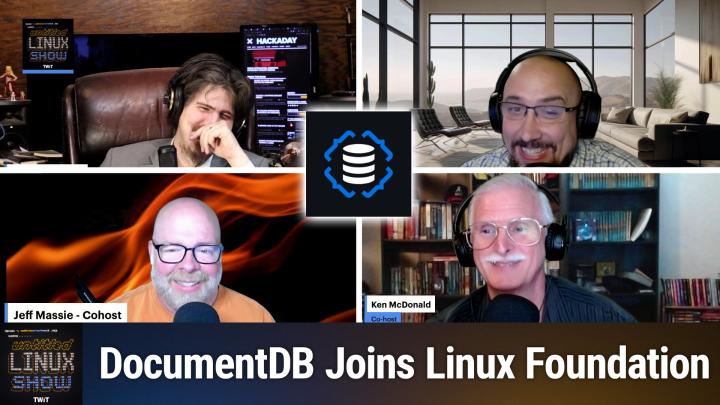
All TWiT.tv Shows (Audio)
Untitled Linux Show 218: We Want to Be Evil
01:54:13
The End of Sideloading, TWILAIN, & Python: The Documentary
Loading summary
Transcript398 lines
- [00:00]
Jonathan
Hey folks, this week we're covering the newest in AI in open source that includes the kernel and the Z editor. Microsoft's documentdb has joined the Linux Foundation. There's a new operating system and Linux Distro made for your old Linux laptops. There's news in the kernel about butterfs and bcachefs and lots more. There's the Python documentary that you might want to check out. Oh yeah, and Android is disallowing sideloading. That's kind of a big deal. All that and more. You don't want to miss it, so stay tun.
- [00:32]
Progressive Insurance Announcer
Today's show is brought to you by Progressive Insurance. Do you ever think about switching insurance companies to see if you could save some cash? Progressive makes it easy to see if you could save when you bundled your home and auto policies. Try it@progressive.com Progressive Casualty Insurance Company and affiliates. Potential savings will vary. Not available in all states, from unsolved.
- [00:57]
Jeff
Mysteries to unexplained phenomena, from comedy goal to relationship fails.
- [01:01]
Rob
Amazon Music's got the most ad free top podcasts included with prime because the.
- [01:07]
Jeff
Only thing that should interrupt your listening is, well, nothing. Download the Amazon Music app today.
- [01:19]
Ryan Seacrest
Hey, it's Ryan Seacrest for Albertsons and Safeway. Feel good and look good this summer with savings on your personal care favorites and earn four times points now through September 9th. Shop in store or online for either items like Dollar Shave Club razors, Hydro Silk Razors and Edge Shave Gel. Plus some favorite brands like Tampax, Pearl, Depend and Poise to earn four times points to use for later discounts on groceries or gas. Hurry in before these deals are gone. Offer end September 9th. Restrictions apply. Offers may vary. Visit albertsons or safeway.com for more details.
- [01:53]
Rob
Podcasts you love from people you trust. This is Twit.
- [02:01]
Jonathan
This is the untitled Link Linux Show Episode 218, recorded Saturday, August 30th. We want to be evil. Hey folks, it's Saturday and you know what that means. It's time to get geeky about Linux and open source. Some hardware, some software. It's the Untitled Linux Show. We're having a lot of fun. We've got the whole gang here together again, Rob and Jeff and Ken. And we've got some some news to cover for the week. Rob is up first and I of course get to see sort of behind the scenes. I have all of the show notes right in front of me. And Rob, is this about scanning? I am having sort of nightmarish flashbacks to making Twain work. Is Twilane anything like Twain?
- [02:47]
Rob
That's Twilane as in welcome to this week in Linux AI News. First I like to thank that's terrible. First I would like to thank our host for making this all possible. If it wasn't for our fearless leadership, I wouldn't be here talking about all this great AI in Linux news lately. So first up this week, the Linux Foundation Networking so LF Networking or lfn, which is under part of the Linux Foundation. So this is the largest set of open source networking projects in the world, formed by a broad industry coalition with the goal of fostering a commercial ready networking ecosystem that embraces open emerging and evolving technologies. And as I said, it's part of the Linux Foundation. This week at the Open source Summit Europe, LFN has released Esdom 1.0 for integrating AI into networking. You've heard of Software Defined Networking? Or maybe haven't? Well, get ready for AI Defined Networking. The project is focused on accelerating the integration of AI data models and applications for the open networking industry and this release introduces foundational platform capabilities that support secure data connectivity, pipeline creation, model management and multi platform deployment across on premises and cloud environments. So the key features of this relude release include connections so you can establish communication link between software systems to enable data exchange and integration across environments. Data sets ingest and manage data from a variety of sources including storage buckets, MySQL databases and REST APIs. Pipelines build and manage both training and inference pipelines for AI slash machine learning workloads including model fine tuning and deployment models. So access and manage AI models from configured connections across platforms including on premises servers, AWS, SageMaker, Azure, ML and GCP. Vertex AI endpoints view and manage all connected endpoints including REST APIs and model services from a centralized interface. Adapters simplify integration with external services without needing to configure host details. And finally on the list, remote executors so run pipelines or programs on remote servers or virtual machines to optimize compute intensive processes. But if you don't actually want AI in your Linux code, how about AI helping developers determine patches for backporting in the Linux kernel to prior stable LTS kernel So Linux LTS co maintainer and Nvidia employee Sasha Levin is now pushing this initiative ahead. So you know, typically kernel developers will CC stable for patches that are explicitly marked for backporting from the Linux upstream git to prior releases for patches not explicitly being marked. AI is now helping out given the demand demanding challenges of the upstream Linux LTS maintenance. So Jonathan, tell us what you hate about it.
- [06:46]
Jonathan
I'm trying to look into esdom and discover if there's actually anything there. Like I. So far I've not found any source code. I've not found anything that's not just hype. This sort of sounds like vaporware to me. Maybe another spin on doing. Oh, what's the. What do they call it? Mc. Oh, I forget now what it's called. It's the thing that makes agentic AI work. It's also the Master Control system MCS or whatever from Tron. Mcp. That's it, isn't it?
- [07:33]
Jeff
I think they're just leveraging their core competencies to have synergistic effects on their core user base.
- [07:40]
Jonathan
Yeah.
- [07:41]
Rob
Did you look at their GitHub?
- [07:43]
Jonathan
I can't find their GitHub. I would love to go look at their GitHub.
- [07:47]
Rob
If you click through, there's a link to acidum.org and right at the top, right there is a link to GitHub. It's the little. I think that's the GitHub logo. Maybe it's old logo. I don't know, some little guy up there.
- [08:00]
Jonathan
GitHub.com ESDMproject hey look, there is actually code somewhere.
- [08:07]
Rob
Yes.
- [08:08]
Jonathan
Well, glory be. They made it difficult to find.
- [08:11]
Ken
Was the term you were looking for Model Context Protocol.
- [08:15]
Jonathan
Mcp. Yeah, that is what this reminds me a lot of is it's essentially an MCP and that's where an AI can actually go out and interact with stuff.
- [08:25]
Rob
So there's actually Python code in here.
- [08:30]
Ken
The interesting thing is with this you're actually taking input, basically analyzing it and then providing a summary of it and why you should. Why it should be backported, basically.
- [08:49]
Jonathan
Oh, that's the. That's the other half. Right. So what Rob did here. So anybody that's. Anybody that didn't catch it, Rob pulled a fast one. He's got two separate stories here that he's mashing together, but they're pretty distinct. And I was going to get to my comments on the Linux guys using AI. They've done this for a while and in fact, you can go back to an interview we did over. It was. It was Floss Weekly, but it was when Floss Weekly was still a part of twit. We did an interview with Greg KH and he was telling us about some of the AI stuff that they were using even then. And so I'm not surprised that they're doing this. One of the things I really like about the way that they're doing this is when The AI sends this email, it starts with LLM generated explanation. Maybe completely bogus. Yeah, I think that's actually pretty important that when someone is using AI to do something like this, it needs to be. It needs to be made clear that that's what it is. Where you really run into problem is people use AI to build stuff or write stuff and then they don't disclose it. And so you end up, you know, wasting developer resources, you wasting people's time on looking at it and then trying to figure out is this just AI slop or is there actually something to this.
- [10:05]
Jeff
Yeah, I find AI is wrong a lot, but it. But it has kind of handy at times too.
- [10:11]
Rob
Yep, I use that as a starting point.
- [10:13]
Ken
So every time I use Grammarly I need to say that this was may. May be totally bogus.
- [10:20]
Jonathan
Did Grammarly write it from nothing or did Grammarly just fix some of your stuff?
- [10:26]
Ken
Well, actually the. They took the abbreviations ahead and expanded.
- [10:32]
Jonathan
It out so not from nothing.
- [10:35]
Jeff
Now go ahead.
- [10:37]
Jonathan
What I want to know is about using AI in something like zed. I hear that that's now possible.
- [10:45]
Ken
Yes, it is. In fact, Jonathan, we can thank Tim Anderson. He's the one who wrote about ZED Industries and Google introducing the Agent Client Protocol, or acp, as a standard way for AI agents to integrate with an integrated development environment, or as we like to say, ide, with the idea that this will prevent developers getting locked into VS code. You're not locked into VS code, are you, Jonathan?
- [11:21]
Jonathan
Nope. I can stop anytime I want to.
- [11:25]
Ken
Now, I do want to quickly explain some of the acronyms that I'll be using in addition to the ACP and ide. One of them we just mentioned, mcp, which as we've discussed was Model Context Protocol. Another one is going to be JSON rpc. It refers to a lightweight and simple remote procedure call protocol that uses JSON to transmit requests and responses between a client and a server. Now, acp, which is still under development, is a standardized protocol for Agent editor. Communications Agent process are started by the code editor and communicate using the JSON RPC over standard IO. Now, ACP reuses MCP specifications where possible while also adding its own custom types. Formatted Text is based on Markdown. The protocol is open source under the Apache license. Any agent can implement it, potentially building on Gemini's CLI implementation as a starting point. The protocol is also open for other clients to adopt. According to Zed CEO and co founder Nathan Sobo, he may be a good guest for FLOSS Weekly. Jonathan they worked with hope I'm pronouncing this right. Ali Morris of Code Companion to bring support for ACP compatible agents to neovim users, Nathan also wrote, we believe the best tools come from openness. Just as the language server protocol opened up IDEs to specialized tools, ACP creates spaces for an ecosystem of agents tailored to every developer's workflow. We appreciate Google's open approach with Gemini cli, which made this collaboration possible and committed to the same. We intend to maintain enough control over the agent client protocol to continue to push it forward quickly, while also evolving and versioning it carefully to encourage an ecosystem of agents and clients to develop. For more details or if you want to join ZED Industries, check out the links in the show notes.
- [13:56]
Jonathan
Yeah, I'm very intrigued by zed and like you said, I have been wanting to interview them, talk to them about it. I like the ability to be able to choose your own LLM, to be able to plug into your environment. I think that's pretty cool. And it's definitely sort of the thing. It's the future, right? Like, that's what people would like to see with their AI.
- [14:18]
Ken
And what's really nice is they're not just restricting it to zed, they're making sure it can be used in other editors like neovim.
- [14:28]
Jonathan
Yeah. So they've sort of written this SHIM layer that lets an editor talk to an mcp, which is pretty cool.
- [14:37]
Rob
Can't wait to plug that into nano someday.
- [14:43]
Jonathan
Sure, why not?
- [14:45]
Rob
Or Kate, I don't.
- [14:48]
Jonathan
You don't?
- [14:50]
Jeff
Oh, it's my favorite text editor.
- [14:53]
Jonathan
Yeah, Nano.
- [14:55]
Rob
That's pretty much my text editor.
- [14:56]
Jonathan
Yeah, I use Nano a lot too. All right, Jeff, I have a question for you. When are we going to see AI come to OBS Studio?
- [15:05]
Jeff
Oh, God, I hope never.
- [15:09]
Rob
Imagine what you could.
- [15:10]
Jonathan
Maybe as a plugin I could see. I could see AI switching between camera views.
- [15:18]
Rob
I could see it fixing Jeff's chroma key.
- [15:21]
Jonathan
I mean, sure, maybe that too.
- [15:24]
Rob
Automatically for him.
- [15:26]
Jeff
There are a few automatically.
- [15:28]
Jonathan
There are a few limited things where I could see AI being great for. Not a whole lot, a few things.
- [15:35]
Jeff
Well, and it would help quite a bit. I mean, I joke, but I mean, there would be a lot of stuff like, you know, it's used in other places like static reduction and where it cleans up images and it could do a lot of that stuff on the fly and be smart about it.
- [15:52]
Ken
Or like if you're in OBS and you've got this screen capture you're doing and you Just want to be able to expand to a certain section in it. Maybe just use your mouse to quickly highlight it and.
- [16:07]
Rob
You gotta type it in. I'm not sure on right corner and view this part.
- [16:15]
Jeff
You're ruining Jonathan's segue is all I'm saying.
- [16:18]
Jonathan
Yeah, it's true. Hush guys, let Jeff talk.
- [16:21]
Jeff
And just before we started, just so you guys know, before we started, Ken tried to segue before the show started. We've got Jonathan now doing segues. This segue stuff is just chaos this weekend. Enop, it's getting out of hand. Yeah, whole show's gone, Rob. But Anyway, talking about OBs, you know that software that's near and dear to our hearts here at the Untitled Linux show, which is now out with a new beta. And I know most of us use OBS to do the show and we all might be using it, though I don't know if Jonathan is since he has the mixer and command console this fingertips and so do you use obs, Jonathan?
- [17:01]
Jonathan
Not for this, not for this show.
- [17:03]
Jeff
Okay, well, but he does use it. So there you go, we all use it. So OBS32 is out for testing in beta and some of the things it brings is a VAD or a voice activation detection. Now this is for Nvidia audio effects and does little things like improve speech by suppressing a lot of background noise and you know, lets you hear the presenter better when the presenter's not in an ideal location. You know, maybe you're out in public. A lot of background noise. This will help clean some of that up. There's also an option for removing chairs in a scene in the Nvidia RTX background removal. So it'll help clean up what you're trying to present. Big news too is there's now a basic plugin manager which helps keep all the extra plugin features, which OBS supports, organized so you can have more stuff at your fingertips in an organized fashion without flipping through menus. Quite so bad. Future plans for OBS are going to include UI updates and to better get ready for that, they are adding custom OBS widgets. They don't say what the future UI stuff coming is, they just kind of make mention that there's. There's big changes coming. There is an improved format selection. Excuse me. There's an improved format selection for pipewire. Video capture and Chapter markers have improved accuracy in when in hybrid MPV or MP4 mov formats. Now AMD has some love in there too as they're getting updated default settings for AMD Encoders, which is basically getting things ready for the metal renderer that's coming. Adding to the changes OBS Studio will no longer load plugins built for newer releases of OBS to prevent future compatibility issues. So meaning if you built your plugin for version 32 of OBS and later the plugin comes out with a version for 33. If you're still on 32, it'll keep loading version the plugin version for 32, so it'll prevent issues that you could run into there. You know it there sure seems like there are a lot of changes coming in the future when you read the read the release notes. Like I said, a lot of this stuff is kind of prepping for future things and preparing, laying the foundation. So we'll have to see what they've got planned. I said they don't really mention what's coming. But also like all releases, there's a ton of crash fixes which I'm not going to go into all of them. Just know that they fixed a lot of common and some uncommon crashes, bugs and general wrong behavior. If you look at the two articles linked in the show notes, they have more details and a link to the GitHub release notes page which gives every single change which has been included with this beta. So I, you know, I don't think I have to say this, but just in case, you know, this is beta, so it might not be rock solid and could still have some issues. You know, betas for testing phases. So be warned if you're using this for any kind of production or enterprise type of environment, but take a look and maybe give it a test drive.
- [20:19]
Jonathan
Yeah, interesting stuff. I knew that there were OBS plugins. I've not gone and looked through them for the longest time. I'm now wondering if some of the annoyances that I have with OBS are just easily fixed by one of these plugins.
- [20:37]
Ken
I'm trying to think what plugins I'm.
- [20:39]
Rob
Using if they're making plugins more robust, you know that, you know the AI is going to be in there some sometime.
- [20:48]
Jonathan
Sure.
- [20:50]
Ken
Because right now you don't really have any way to look to see what plugins you do have.
- [20:56]
Jonathan
Yeah, you know, I don't have obs. I went to check, I went to Inside of Restream, I went to open up the tool menu for looking for plugins not running OBS here. But yeah, it'll be very useful to have the plugin manager, hopefully the ability to like search and download plugins right inside of OBS that would be nice.
- [21:16]
Ken
Yes.
- [21:16]
Jeff
Well, and they did say simple, so it's. It's not. They made it sound too like this. This is the foundation for more improvements coming to the plugin. Yeah.
- [21:30]
Jonathan
A lot of times with something like that, you've got to have that mvp, the minimum viable product. You've got to get that launched first and then once a version of Build comes out with that, then all of the extra stuff lands. And so I feel pretty good about this version may be very simple, but the version after that, people are going to go, oh, it'd be cool if it did this.
- [21:52]
Jeff
It'd be cool if it did that.
- [21:54]
Ken
Right now. What's the oldest QT version that OBS currently supports?
- [22:01]
Jonathan
Oh, I have no idea. Do you know yet?
- [22:03]
Ken
Sounds like. No, I don't know. I just noticed that one of the bug fixes was to remove a workaround for some of those older QT versions that prevented docs from loading correctly while OBS is maximized.
- [22:17]
Jonathan
Yeah, I bet there's a lot of old crufts like that because OBS has been around for a long time. It is definitely not new software. So it probably has left behind more QT versions than it currently supports.
- [22:31]
Ken
Yeah, let's hope so.
- [22:33]
Jeff
And you know, like I said, that's why I said there was some common and uncommon because some of them are the. You know, when you're doing this menu in this specific resolution and facing north while having a cup of coffee, this happens, you know, and. Oh, we patched that.
- [22:49]
Jonathan
Okay. Yep.
- [22:50]
Ken
Absolutely. No more getting echoes while you're talking.
- [22:53]
Jonathan
Yeah, hopefully. Hopefully.
- [22:56]
Ryan Seacrest
Hey, it's Ryan Seacrest for Albertsons and Safeway. Feel good and look good this summer with savings on your personal care favorites and earn four times points now through September 9th. Shop in store or online for items like Dollar Shave Club razors, hydro Silk razors and Edge Shave Gel. Plus some favorite brands like Tampax, Pearl, Depend and Poise to earn four times points to for later discounts on groceries or gas. Hurry in before these deals are gone. Offer end September 9th. Restrictions apply. Offers may vary. Visit albertsons or safeway.com for more details.
- [23:28]
Jonathan
All right, well, so there's some other news that we need to get onto and I'm. I'm very curious about this one. Rob has a story about something Microsoft is doing teaming up with the Linux foundation and I'm skeptical about this one too, Rob, but take it away and tell us what it is and, and we'll see what we think.
- [23:46]
Rob
As you pointed out last week, Jonathan, I Like to bring the Microsoft and Apple news into our Linux show. You know, it's what I do when I guess I can't find any other controversial stuff in the news. So let's, let's go back a little bit. Back in 2014, Microsoft announced Azure DocumentDB a NoSQL database for storing, using and maintaining data in JSON documents. Then three years later they added more data store models and rebranded it Azure Cosmos DB. Earlier this year, Microsoft announced a new documentDB not in the cloud but local and attempting to combine NoSQL flexibility with the reliability of a Postgres SQL. And I don't remember if we, I don't think we mentioned this, but I remember reading about this announcement when it came out it wasn't all that interesting yet. But this week, this week Microsoft DocumentDB finds a new home with the Linux Foundation. The project was released under the MIT license and since it's released on Git, since It's released on GitHub, it it has gained a lot of stars and apparently a lot of interest. So Microsoft loving Linux and Open source as they do, you know, and all the things that are good, stated that a central and neutral home was essential to foster collaboration under the Linux Foundation. Microsoft hopes documentdb will grow under open governance while reducing the risk of vendor lock in. So you know, they're, they're kind of worried that if this thing stays a Microsoft product, people are going to shy away because of vendor lock and I mean it didn't hurt GitHub too much. But anyway, I mean that's still a great point, especially when you have plenty of other other options. A quote from the vice president of Azure Cosmos DB at Microsoft, Kirill Gavriluk, said, quote we built documentdb with a simple goal. Give developers an open document database with the flexibility of NoSQL and the power and reliability, openness and ecosystem of Postgres. In just a few months the community has embraced the project. By joining the Linux foundation, we're deepening our commitment to transparency, open governance and developer first principles ensuring documentdb remains an open extensible document database developers can confidently build on for years to come. So I've had to dig in beyond the article I found I had to do a lot digging to find a lot of this background about what documentdb is. You know, I guess it's a like a DB more for managing documents. What's the benefit of no SQL? I don't know because you still use the SQL SQL commands. So honestly I'm not really up to all that. I You know, I've tried to figure out what the real benefits were using this over, say, MariaDB or any other SQL, and really I struggle to find anything substantial. So if anyone can clear that up for me, that'd be great.
- [27:31]
Jonathan
Yeah, it's built on top of postgres, and I know lots of people really like Postgres. It seems to scale pretty well.
- [27:38]
Ken
Well, there's a. Actually, Rob, to answer your question, an article by Saurav Rudra back in January may answer this. DocumentDB's advantage over its inspiration. One of the AWS products, since this is open source and that's proprietary.
- [28:06]
Jonathan
Yeah.
- [28:08]
Rob
You mean that the benefit of this over the Cosmos db.
- [28:15]
Ken
Well, yeah, among others.
- [28:17]
Rob
Yeah. I'm just wondering. I mean, I don't understand NoSQL really either, especially since it actually uses SQL.
- [28:26]
Jonathan
SQL style queries.
- [28:27]
Jeff
Yeah.
- [28:27]
Rob
Like what makes it no SQL? Isn't that command the query structure? What makes it a SQL? Apparently not.
- [28:36]
Jonathan
NoSQL actually stands for not only SQL.
- [28:41]
Rob
Not only SQL.
- [28:43]
Jonathan
Terrible name because it's literally the exact opposite of what you would think it means.
- [28:48]
Rob
Well, okay, I'm learning.
- [28:51]
Ken
So it's SQL Expanded.
- [28:54]
Rob
So it's not no SQL, it's SQL and more. Okay, that helps.
- [28:59]
Jonathan
Yeah. Yep.
- [29:00]
Ken
Sounds like SQL plus might be a better name.
- [29:02]
Jonathan
SQL plus plus.
- [29:03]
Jeff
Yeah.
- [29:03]
Rob
Yeah, because I was. I was under the impression there was maybe a lighter SQL or something, but apparently it's probably even the opposite of that.
- [29:15]
Jeff
It looks like it's QL.
- [29:17]
Rob
Yeah, there is that too.
- [29:20]
Ken
But with the NoSQL, it's MIT licensed.
- [29:25]
Rob
Yes, this is MIT licensed too.
- [29:29]
Jonathan
Yeah. So one other thing to dive into here that's interesting is what exactly it means for something to join the Linux Foundation. And I am, I am beginning to discover that the Linux foundation sort of works like a fiscal host. So if you're familiar with something like Open Collective or. Oh, what are some of the other ones there are. You know, GNU has one that they do as well, where if you want your project to be sort of like a nonprofit, but you don't want to go through all of the paperwork of setting that up, you go to one of these fiscal hosts, and from what I can tell, the Linux foundation sort of works like that. And so when you read that Microsoft spun DocumentDB off and it joined the Linux foundation. So, like, something to keep in mind, what that actually means is this is no longer like, legally speaking, it is no longer under the Microsoft Corporation, it is now, legally speaking, underneath the Linux foundation, that's its umbrella organization.
- [30:29]
Ken
So that Microsoft can count anything, any financial assistance, they give it as a contribution.
- [30:39]
Jonathan
I don't know if Linux foundation is actually a nonprofit in that way because it is more of a trade group than a full nonprofit. So I don't know if it counts. Being a business though. It's a little different from being an individual. Right? Because as a business, you're not looking for something to be a nonprofit necessarily to be able to write it off.
- [31:00]
Rob
It is a 501C, but not a 501C3. No, 501C6, which is not a nonprofit organization.
- [31:09]
Jonathan
It is a. I don't remember exactly what the term is, but it's not exactly the same thing.
- [31:16]
Rob
Well, I just said yes, it was established in 2000 to support Linux and.
- [31:23]
Ken
Take that with a grain of salt.
- [31:25]
Jonathan
Yeah, a 501C6, that is like a. It's like a business league, right? It's like a trade organization. I don't. It is tax exempt for itself, but I don't know that an individual would get a tax write off for giving to it. What I was going to say is it's different for a business because a business can say anything that is a valid business expense. The expense goes out the door. You don't pay taxes on your expenses as a business, so it doesn't have to be right for another business. So for Microsoft to give money to it, they could just say, oh, this is legitimate business expense and it'll come off of their taxes in the exact same way.
- [32:03]
Ken
So any work that Microsoft employees do on this, Microsoft can just write it.
- [32:12]
Jonathan
Off as they may be able to write it off. I am not a cpa. I'm definitely not a business cpa. Talk to your own CPA before you try to do this. But yeah, there's plenty of details there. So let's talk about something else. Let's talk about a distro. I don't think we've had any distros yet today. Ken, what's new in OpenSUSE?
- [32:39]
Ken
Well, with OpenSUSE, we've got a new installer coming out and we can thank Ava Caligari and Michael Larabel. They both wrote about SUSE engineers finishing up the work on their new Agama operating system installer. Now it's going to be Agama 17 and it's now available to install in SUSE Linux Enterprise installations or install those installations. It will also provide better representation of wired network connections and to correctly represent the situation in which several devices share the connection. Storage user interface improvements include reorganizing the information displayed at the Installation Devices section, so its usage is more understandable at first sight. The new user interface also offers the possibility to directly use a disk or even a pre existing RAID device without creating partitions. In addition to registering the system on the SUSE Customer center or sec, the user interface can be used to register the system on a custom instance of the Repository mirroring tool or RMT. SUSE Linux Enterprise Server 16 and OpenSUSE Leap 16 will use SELinux as a default Linux kernel security module, or LSM, but you do now have the option to adjust the software selection to install an alternative alternative LSM or even no lsm. For more details and to get Ava's opinion on how this installer impacts suse's ecosystem and what challenges may remain, I do recommend reading both of the articles linked in the show Notes yeah, interesting.
- [34:46]
Jonathan
To see OpenSUSE moving to the next the next Big thing It looks like the installer looks pretty good. The screenshots I see on Pharonix looks great. Yeah.
- [34:59]
Jeff
I like how installers now are kind of after years of kind of stagnation, it seems a lot of them are really stepping up and kind of evolving.
- [35:09]
Rob
They've been very blah for years.
- [35:11]
Jonathan
I mean it worked, but thankfully most of them, at least they've improved without removing a whole bunch of options. Right. Like you can still set up a machine on almost all of these that we talk about. You can still set up a machine with all of the flags and gizmos. You know, the normal Linux stuff where you want to go in and customize it all over the place. You don't lose any of that. They make it easier to get the sort of the default recommended installs.
- [35:39]
Jeff
Yeah, Grandma can get it loaded a lot easier.
- [35:41]
Jonathan
Yes.
- [35:42]
Ken
How many of them give you the option after you set those installation options up, save that as a batch file so you can just run that batch file on others.
- [35:55]
Rob
Is that what this does?
- [35:57]
Ken
I didn't see anything about that, but I think that's going to be a feature request I may put in for.
- [36:04]
Jonathan
I know there are ways to do that to set up. In fact, that's sort of the entire thing behind is it ansible? But that's sort of their whole game is you write your ansible scripts and then you can do this installation well.
- [36:16]
Rob
There's also quick install methods I think Ubuntu has. I think when you first boot up the installer, I think one of the options is to do a quick install and then you have to put a configuration file. I've never done anything with This. I don't know how you make that configuration file or how you get it, but I know there is a quick install feature like that.
- [36:39]
Jonathan
I mean, you think about it, most distros have the idea of spins, and that is essentially what you're talking about. A SPIN is more or less an established configuration set of packages that get.
- [36:50]
Ken
Installed to include the desktop environment and any other.
- [36:57]
Jonathan
Yeah, you default install. A lot of times the SPIN can determine what file system type, whether it's going to be butterfs or ext4, et cetera, et cetera.
- [37:06]
Rob
On your Ansible mention there, a side note, I have been playing with Ansible quite a bit this week, so maybe at some point in the future I will have some discussions on that. Right now I have it set up to be able to. Basically I run the playbook to update all my key servers. I don't have much more going right now.
- [37:28]
Jonathan
Cool.
- [37:29]
Rob
I want to have it do snapshots and other things too yet.
- [37:31]
Jonathan
But we've got a couple of developers that are looking at setting up GitHub Runners using Ansible and that looks, that looks pretty interesting. I'm not. I've not really done a deep dive yet into what they're doing there, but that'll be, that'll be cool if I can get it working. So, Jeff, we mentioned butterfs briefly and there's some news about butterfs in the. In the kernel and some other file systems.
- [37:55]
Rob
Yeah, there, there are.
- [37:57]
Jeff
And earlier in the show.
- [37:58]
Rob
Oh, and Jeff is bringing the drama here today, so.
- [38:02]
Jeff
Yeah, do it well. And you know, Rob did a couple of stories. I've got a quad set of stories. So. Rob squared equals. Jeff, just saying you get more for your value. More value here.
- [38:15]
Rob
You got robbed.
- [38:21]
Jeff
Anyway, I, you know, we got, we got four stories and these, these are kind of. I put four of them together because these are kind of shorter little tidbits here, but they all kind of have the same theme. First off, Joseph Bakik is leaving Meta and stepping back from kernel development now. He. Joseph's been employed by Meta, working on BTRFs for years now. BTRFs from Wikipedia. The official pronunciation is better fs butterfs, b tree, fs or btrfs. Take your pick on which you prefer. Now, Butterfs has been around since 2009, so this isn't a new kid on the block with a ton of development work. I mean, don't get me wrong, it's still getting supported and getting updates, and it's the default file format for Fedora and Cashios just to Name a couple. I'm just meaning that it's not going through massive changes right now, a lot more fine tuning and things like that and you know, just adding a smaller feature here and there. But Joseph did have this to say. Today is my last day at Meta. This has been the best team I've ever been on and I've been on some great teams. Next week I start a new chapter. I'll be joining Anthropic to help them scale out their infrastructure and put my decades of kernel and system experience to use. I'll be stepping back from kernel development as my primary job for the first time in my career. I'm sad to leave my colleagues, but I'm excited to try something new and see where it takes me Now Joseph was the co maintainer alongside David Sturba, so BTRFS still has a maintainer and others are still working on it. So you know opinions when you read comments and scuttlebutt around the Internet, the opinions are mixed from it's really sad to see him go to about time there was new blood on the project. Time will tell if this allows for major changes in the future or the file system or things stay, you know, steady as she goes. We'll, we'll see. But there, like I said, there's no danger of it not being supported. It's just some One of the key people is now moving on on the topic of file systems, the second story is a resolution to what Linus Torvalds was going to do with bcachefs. Now this is the one that we had all the drama about. We talked about this for the last few weeks. He didn't take patches during the last pull request window. It's kind of like what's going to happen. Well, Linus said there were several public and private discussions and for now BCACHE FS will be externally maintained. The code which is already in the kernel will remain there for now so it doesn't break any user systems who do not have time to, who haven't had time to prepare for the change. They want to make sure nobody's going to get hurt when this, when this happens. But what this does mean is that bcachefs will build an out of tree module and continue to develop there. Now ZFS has a similar status. So this isn't a kiss of death for the file system. It just means that the advanced users who would be picking up this file system would need to add a couple of steps to make sure the module's loaded for the system. For file system compatibility it's not a, it's still too new to be a default on anything. So you know, maybe in a year, a couple years we'll see it come become default on something. But at this point if you're, if you're running bcache fs, you're probably an advanced user anyway so this won't be a major roadblock. The third story is about how GNOME executive director, they have their new executive director steps down after four months. Now just a little history to recap here we had Holly Milden who stepped down after less than a year, filling Holly's shoes with Stephen Debauld who after four months is stepping down. And that's who we're talking about today, is Stephen. The board of directors says that Alan Day is going to serve as the president and acting executive director until a replacement is found. You know there's a lot of scuttlebutt on that one too. What's going on? Did it make sense? Did it not make sense?
- [42:50]
Rob
You know, they should have hired me.
- [42:53]
Jeff
Well, they've got some requirements or ideals what they would like the next person to have. So if you would like to apply Rob, the window is open now. Now the final story is about Alyssa Rosenweig wig who's leaving Asashi Linux. Alyssa led all the mesa open sourced OpenGL Vulcan driver work for enabling the Apple M1 and M2 graphics hardware under Linux. She posted and she's now going to be working at working on intel open source graphics drivers. Now it was noted that her post didn't say if she was actually working at intel or for one of the open source consulting firms. But her resume later was then updated to say she in fact is working at Intel. So a lot hate to see her step away from the Apple M series of chips and others are really excited to see what she can bring to the intel graphics stack. One of the things kind of a side note is you know, while Intel's going through some rough times now it has been mentioned many times that Intel's GPU division is very lean and mean and they are actually kind of a model for the rest of the company to go after because of their speed and flexibility. So it, it doesn't totally surprise me that she got hired on at intel when they're actually cutting back a lot of other, other positions at intel because a lot of it's in, in different divisions. But time will tell to see what, what comes out of that one. But take a look at the four articles in the show notes for more details. You know and there's a lot of interesting reading in the form of comments on the stories, you know, and just a lot of changes going on and you know, let us know on the discord, see what you think.
- [44:45]
Jonathan
Yeah, interesting stuff. All of it. The, the Gnome. The Gnome director I am particularly humored by.
- [44:53]
Jeff
Yeah, I don't have to be one year and then four months and, and it, but it was supposedly a mutual decision. They both decided it was not a good fit.
- [45:01]
Jonathan
But.
- [45:03]
Ken
Not having any health issues.
- [45:05]
Jonathan
The, the mutual decision part, that almost makes it even scarier.
- [45:09]
Jeff
They, the. If they probably had health, they would probably say personal reasons or something like that. At higher levels they get really vague on what's going on. I mean.
- [45:21]
Jonathan
Oh yeah, you don't want to air the dirty laundry, but.
- [45:25]
Jeff
Right. So, so it's, it's always going to be very. Oh, it was a mutual decision. Maybe, maybe not. You know, only, only a few people in the room know what really happened.
- [45:34]
Rob
We wanted to fire him and he didn't want to get fired, so he quit.
- [45:39]
Jeff
Yeah.
- [45:40]
Ken
Or it could be that we can't afford him and he decided that. So we both agreed that it was time to.
- [45:49]
Rob
I'm. He knew what he was getting into. So.
- [45:52]
Jonathan
Yeah, unless their finances are. Went to a free fall in the past four months.
- [45:58]
Rob
But yeah, Jeff, I don't think I'll apply. I have a history of staying at my jobs for a long time and so I don't think this will be a good fit for me.
- [46:05]
Jeff
Yeah, but you could, you could turn it around. This, this could be the thing that Gnome needs. It needs robified.
- [46:10]
Rob
Well, I know it's what they need, but it's not what I need, I don't think.
- [46:14]
Jeff
Yep.
- [46:14]
Ken
Is it what they want?
- [46:18]
Jeff
Get back to the open source community. Do it for the love of the community.
- [46:23]
Rob
Yeah. If they really want me, they can come find me. And if you're listening, just look for. I'll give you the info at the end of the show.
- [46:30]
Jeff
Robert P. Campbell dot com. Yeah, I, you know, I, I'll be honest. I've not been a fan of Gnome, but I really like having something big out there besides just kde, you know. And right now it's kind of mostly a two horse race. You know, Gnome and KDE are kind of the, the big juggernauts. I mean you got a lot of stuff, you know, Cosmic is coming. You've got some other, you know, mate and cinnamons and. But they're not, they, they don't have the, the market segment that the other two do.
- [47:08]
Jonathan
Well, I mean it's kind of the same, it's kind of the same thing as the Linux desktop as it as a whole has. Right. They're not default installed on most any distros. You got to go seek them out. And so that's always going to limit the number of people that run them.
- [47:21]
Jeff
Right. But, but I just like, you know, having a lot of options just so. Because even, even if you say, okay, I'm totally kde, but they can get a lot of good ideas from other desktop and other desktops can get a lot of good ideas from kde and it kind of everybody gets smarter together. You know, all the boats rise as the tide comes in kind of thing.
- [47:43]
Rob
I mean that's the only reason together you don't need Gnome and we have XFCE LXQ Mate, Cinnamon.
- [47:56]
Ken
Intel's hoping that Alicia can help reinvigorate their GPUs a bit more.
- [48:03]
Rob
That's assuming she's actually working for them and not is contributing.
- [48:07]
Jeff
Well, her resume says she is and I think that's what they're looking at because everything, the hardware for Intel GPUs is actually really solid. It's been drivers where they've had issues and they started off the wrong foot when they tried to take the mobile driver and use it as a desktop driver. And that philosophy.
- [48:27]
Rob
I thought she said she was working on the intel gpu, not necessarily working for intel, because you could.
- [48:34]
Jeff
Well, originally her announcement says she's working on the software and doesn't specifically mention Intel. It's her resume that got updated a little later that then came out and said, yes, she officially is working for Intel.
- [48:48]
Rob
Ah, yeah. Don't want to be helping Apple out then.
- [48:53]
Jonathan
Conflict of interest now.
- [48:56]
Jeff
Well.
- [48:59]
Ken
FS is going to actually have some advantages by being externally maintained.
- [49:05]
Jonathan
Oh yeah. To get back to that. Sure. So they can push changes whenever they want to.
- [49:14]
Jeff
Well, so to go back Asashi, she said that she feels it's still in good hands because there's still a lot of developers there and she's laid the groundwork and she kind of feels like she's ready to move on the bcash fs. Yeah, you're now developing and kind of at your own rate. You're not waiting for a lot of. Okay, now can I put this in? You're out of tree, so go nuts.
- [49:41]
Rob
Yep, we'll see. I don't think it'll be good for him though.
- [49:45]
Jonathan
It's the same deal. As I said about the desktop environment, there is a higher barrier to entry now, to run the code, there is.
- [49:54]
Jeff
But it's not at the place where normal users should be running it. I think a lot of your.
- [50:00]
Ken
At least not on production devices, sure.
- [50:03]
Rob
But at some point when it is ready, are they going to just let them back in or are they going to still be kind of stuck on the sidelines, or do they need to.
- [50:11]
Ken
Let them back in?
- [50:13]
Jeff
They don't need to, but if they don't. So, okay, once. Once it hits stable, you know, it's it. Which they supposedly are going to do, they said, with the next kernel release. But let's just say, okay, in one year they're stable and they're rock solid. If they don't get in the kernel, they're in trouble. Unless. Well, unless somebody like Debian, a fedora, you know, Art, somebody bigger says, okay, we're going to make them default, we're going to do the work and we're just going to. Yeah, or suse, whoever.
- [50:46]
Jonathan
I think there's another alternative here where it's not a distro that says we want this, but a big company, like, if Facebook comes along and says, it's great, we want to start running this on our infrastructure, then who cares if it's in the kernel or not? You've got to have 100,000 installs.
- [51:04]
Rob
It's kind of like in the Linux space. It's kind of going to be in the same spot that ZFS is right now. You know, ZFS is native on bsd, but on Linux it's not in the kernel. People like Ubuntu and they're like almost the only one who's really tried to push it ever. So it's kind of struggled in Linux because of that. People have to do it kind of manually on their own, but it's great. So people do.
- [51:30]
Jonathan
But why, why, why does zfs, zfs, why does it have that problem?
- [51:34]
Jeff
Licensing.
- [51:35]
Rob
Licensing? Yeah, I guess this one had that problem. Right, right.
- [51:40]
Jeff
So if it gets enough momentum and people say, oh, it's solid, we want it in there, they could definitely just roll it right into the kernel tree. And maybe they will after they say, okay, look, this is pretty stable now. We're not getting weird pull requests. We're not. No more panic mode.
- [51:59]
Jonathan
Yeah, so that's when you compare it to zfs. It is a valid comparison, but you do have to keep in mind ZFS has this big, huge, ugly licensing question. Right? And so that's going to keep your fedoras and your Ubuntu's from ever. From ever Shipping it even.
- [52:13]
Rob
Not Ubuntu. Not Ubuntu.
- [52:14]
Jonathan
Does Ubuntu ship it?
- [52:15]
Rob
They have.
- [52:17]
Jonathan
Really? I am surprised by that. Maybe the, maybe the licensing issue is not as bad as I thought it was, but anyway. But that's also going to keep certain businesses that are very risk averse from being willing to use it too.
- [52:30]
Rob
Yeah, but I'm just backing up to the point that if it doesn't get pulled back in to the, to the, to the kernel, that that's going to be one more barrier. Now if it has something really great that like a distro is just going to want to put that in there themselves, that could, could, could bypass that and make it work. But if they aren't don't have anything good enough for that, it's. It's not going to be really easy for most users just to say, you know what I want, I want that. Let me go find that and figure that out.
- [53:07]
Jonathan
Yeah. Yep, absolutely.
- [53:08]
Ken
Now what would be interesting that I don't see it really happening is if Joseph Basak actually started collaborating with the BCAS FS folks to help in preparing it for when it is eventually ready to merge into the kernel.
- [53:29]
Jeff
Well, he was one of them that actually, and this was brought up in the comments too, he was one of them that actually pushed against BCash FS. So he was one that was not happy with how they were putting stuff in.
- [53:42]
Jonathan
That's an interesting confabulation of events then that they both sort of left the kernel at the same time.
- [53:49]
Rob
Yeah.
- [53:49]
Jeff
And, and people said that. And they said well, but really that their kerfuffle happened like six months ago. So it sort of unrelated. You know, it's.
- [54:00]
Ken
What's really amazing is that it took this long for Linus to make that decision.
- [54:06]
Jeff
Well, I think they wanted to have a very. Because, because pulling something out like that is, is a big decision and I think they really wanted to. In. They had a lot of talks I guess privately too. So there was probably a lot going on. They were pulling in a lot of the, the core people and saying okay, what's, what does this mean? What do we do? How do we handle this? You know, is his behavior going to get better? Is it? You know, so I think they said, you know, the, the best thing to do right now, pull it out of the kernel. It's not going to hurt most people.
- [54:38]
Ken
And.
- [54:40]
Jeff
They can always pull it in at a later date. I mean nothing says that once things calm down, they can't go, okay, we'll allow you to Merge it in and put it back in a tree.
- [54:49]
Ken
Once you get it, reach the point where you can claim this as a stable and will be a long term supported version as you experiment with the others.
- [55:00]
Rob
And I like to see somebody ask Linus that question if, if there's a chance they could ever come back or if you're just not ever having anything to do with them.
- [55:12]
Jeff
Well, this is a kinder, gentler Linus now.
- [55:15]
Jonathan
I, I, I suspect from, from listening to him over the years, I suspect he's going to say, I don't know. It would depend upon, it would depend upon. What's his name?
- [55:26]
Jeff
Kent Overstreet.
- [55:27]
Jonathan
Thank you. It would depend upon Kent agreeing to play by the rules like that is what Torvalds would say. I don't know if it could happen, but he would have to play by the rules.
- [55:38]
Jeff
And I think it would be easier once they get it marked as stable and it's less about that it needs to be stable to go in there. But I think once it's stable it's going to slow down the code pulls and there's not going to be all these weird panic feature code pull requests during an rc and I think that that'll kind of, kind of help it or you know, maybe Kent kind of steps aside after a while. There's a group of people taking care of BCash FS. He kind of steps aside and they go, hey, we want to, you know, we're good citizens. We want to get what Kent's gone.
- [56:18]
Rob
Let us in.
- [56:19]
Jeff
Yeah, you know, Rob, you can take that over while you're running GNOME and you can just, you can just fix everything.
- [56:28]
Jonathan
Yep. So Rob, if you were to make your own distro, what INIT system would you run on it?
- [56:34]
Rob
Well, I would still have to use systemd. Sorry, but for all you haters of systemd that just want to see the world of INIT systems continue to move forward. A new INIT system has been released this week aimed at to be a minimalist process supervisor for Linux called Nitro. So like systemd, it acts as a supervisor managing and monitoring services to ensure they start correctly and continue running reliably. But it is designed to be lightweight, simple and efficient, making it suitable for small systems, embedded devices and containerized environments. This is, this doesn't just come out of nowhere from some complete no name developer. Nitro is being developed by Leah Neukirchen. Okay, who is that? Well, I didn't know either, but apparently she is involved in the development of Void Linux. I think we've heard of that. So I'm guessing maybe that is where we may see Nitro show up first. So Nitro organizes services in simple folders with scripts to configure, start, stop or log each service. It can handle one time tasks as well as services that need to run continuously. It keeps all runtime data in memory ram, making it suitable for systems with limited resources, sources or read only file systems. It can also run efficiently in containers, providing fast and reliable service supervision. So to keep it lightweight and easier to manage, Nitro focuses solely on starting and supervising services. You know, while systemd kind of goes a lot deeper. Managing dependencies has its own internal logging, systemd, timers, networking, and really a whole lot more that maybe it shouldn't be doing.
- [58:48]
Jonathan
I don't know.
- [58:49]
Rob
But you know, if you want to compare to other INIT systems, say like Run it. Nitro keeps runtime state in memory and allows flexible service setups. It is compact, efficient and here's to modern Linux standards while remaining easy to understand. So a little different than Run it there, you know. But for those of you who maybe still like systemd, I'm gonna show you a tip later on that that helped me out this week and that I probably should have learned many years ago, but I'm still sticking with System B D. But maybe some of you in IT guys can, in IT guys, gals, folks, whatever, can have another option to switch to.
- [59:45]
Jonathan
Yeah, you know, we had a couple of INIT systems that were based on raw scripts and there were some downsides to that. People referred to it as brittle and you know, held together by duct tape and hopes. I don't know, I've, I've not really had problems with, with systemd. It pretty much does what I needed to do.
- [60:07]
Rob
I mean, I'll admit that when IT switch switched from INIT to System D is a shock. I wasn't, I wasn't like following the news, I didn't know. All of a sudden it's different. But I was using INIT systems with the scripts that I was comfortable with. You know, I understood how to go and look at the scripts and then all of a sudden it's like where's all my rc.de or whatever they were, all those files like I, I don't know what's going on here. So, so it took me a long time to figure that out. I mean, as you can see, like I've learned a new tip that I'm still learning. There's a lot to learn.
- [60:40]
Jonathan
Yeah.
- [60:42]
Jeff
Well, it seems though that this isn't really a. It's only a partial replacement for systemd. It's kind of some of the specialized cases, at least the way I read it, with the smaller systems. And.
- [60:59]
Rob
It could fully. I mean it's an INIT system, you just have to do it. All the other things you have to do in scripts, pretty much as INIT systems are meant to be, as proper.
- [61:10]
Jonathan
INIT systems should be.
- [61:15]
Ken
So how easy would it be to put it in place of systemd on say an Ubuntu system?
- [61:24]
Rob
Well, the problem there is that snaps rely on. That's probably the biggest problem is that snaps rely on System D today. So there had to be redesigned there. But something like Antics or MX Linux may be a little easier, you know, if they want to, because they're still using by default. I think the old init 5, last I looked, I believe that's what it is. But you know, you can like MX Linux, you can optionally choose systemd, but default is. Is the old INIT system. So maybe they want to modernize on something like this.
- [61:55]
Jonathan
Yeah, that's the deal. Systemd has sort of put its tendrils into everything on the Linux desktop and so trying to get rid of it. You don't get rid of it on Ubuntu or Debian. You make your own Linux that may be partially based on those, but like that is make your own distro territory.
- [62:14]
Rob
Yeah, I think Ubuntu is also involved. Systemd is also involved in the networking and. And other things. Not just Snap, I guess, but I don't even know what else it's involved in. But I know Ubuntu is really deeply tied in, at least with their Snaps and probably the others are.
- [62:29]
Jeff
At one time when I was running a music server I had, I had to get into systemd to allow something to run in one of the VAR directories because it was by the system level it was locked out. So it's tied into a lot of the security stuff too.
- [62:48]
Jonathan
Yeah.
- [62:49]
Progressive Insurance Announcer
Today's show is brought to you by Progressive Insurance. Fiscally responsible financial geniuses, monetary magicians. These are things people say about drivers who switch their car insurance to Progressive and save hundreds. Visit progressive.com to see if you could save Progressive Casualty Insurance Company and affiliates. Potential savings will vary. Not available in all states or situations.
- [63:17]
Rob
Ever notice how ads always pop up at the worst moments? When the killer's identity is about to be revealed? During that perfect meditation flow on Amazon Music we believe in keeping you in the moment. That's why we've got millions of ad free podcast episodes so you can stay completely immersed in every story, every reveal, every breath. Download the Amazon Music app and start listening to your favorite podcasts. Ad free included with Prime.
- [63:50]
Ryan Seacrest
Hey, it's Ryan Seacrest for Albertsons and Safeway. Feel good and look good this summer with savings on your personal care favorites and earn four times points now through September 9th. Shop in store or online for items like Dollar Shave Club razors, hydro Silk Razors and Edge Shave Gel. Plus some favorite brands like Tampax, Pearl, Depend and Poise to earn four Times points to use for later discounts on groceries or gas. Hurry in before these deals are gone. Offer end September 9th. Restrictions apply. Offers may vary. Visit albertsons or safeway.com for more details.
- [64:21]
Jonathan
All right, well, let's talk about Q FOS Q4OS.
- [64:28]
Ken
I've been calling it Q4OS myself.
- [64:31]
Jonathan
QFOS sounds good though. Q Force. Yeah, that one's good too. They really should have brought us on board to help them workshop the name. We're coming up with great ideas.
- [64:50]
Ken
This week. It's Ayusha Pandang that's writing about the four reasons he believes Q4S is the best operating system to breathe some new life into an old laptop. Now it still supports the older 32 bit systems in the industrial ecosystem, especially those embedded systems, and with the X86 ISO barely occupying more than 690 megabytes. So there's another reason why he likes it. Q Force can be configured on a pre existing Windows setup and is compatible with the older versions of Microsoft's flagship os. So you can even test it out on a Windows 7 powered x86 machine. Q Force is based on Debian and incorporates most of the popular services. It is compatible with systemd so you can have systemd in it. I don't know how nitro in it would work, but A finds it a lot easier to use, especially if he wants to bring an old laptop back to life as a no nonsense everyday machine. Q Force serves as a middle ground that combines the light design of most command line integrated distros with the intuitive interface of Graphic user interface systems. Thanks to Trinity Desktop. This ultralight desktop environment lists a 350 MHz CPU and 256 megabytes of RAM as the minimum requirements and can easily fit inside a 3 gigabyte hard drive. You also have the option to switch from Trinity Desktop to KDE Plasma if you do have a somewhat capable laptop or one of those ancient ones that has a lot of power to it Now I do recommend reading Ayush Outer Core if you are interested in Q Force.
- [67:09]
Jonathan
Yeah, interesting. So it's. Is it laptop specific though? It talked about the, the laptop angle but like you could run this on a desktop too.
- [67:21]
Ken
I wonder how well it would run on an old X86 Bell based Dell system that I've got sitting behind me.
- [67:31]
Jonathan
Yeah, yeah, it'd be worth it to try. You know, we talk about the, the X86 64 like the V1, V2, V3, V4 thing and something that I'm sure most of our listeners know is like, it's not, it does not use those names but that is totally a thing on the 32 bit as well, you know, because you have the 386, 486, 586. I686 I think was the one of the last big ones that most 32 bit software gets compiled for. But like Linux was originally written for the. What was it?
- [68:05]
Ken
386?
- [68:06]
Jonathan
Was it the 386?
- [68:07]
Jeff
Yeah.
- [68:08]
Jonathan
But trying to find a distro that'll run on one of those, those are old machines. Now trying to find a new distro that will run on one of those old machines is a challenge. I don't remember the name of the one I used last time I did that. It's been years ago now.
- [68:23]
Rob
Puppy or Puppy Linux.
- [68:25]
Jonathan
I don't remember if it was Puppy or not.
- [68:26]
Jeff
You know though, a friend and I were talking at work and he's a big Linux guy too, and we were talking and you have one of those old 38646. What are you going to do on that with modern software, with the single core? You know, we kind of, we kind of both agree at least personal opinion, a lot of that old stuff, just run the old software, let it do what it's doing and just call it a day at that because it's, I.
- [68:58]
Jonathan
Mean you certainly can. But I mean part of the, part of the fun of it is trying to get a more modern kernel on. I mean that's kind of a, a goal, a project in and of itself.
- [69:08]
Rob
A thin client or SSH terminal or.
- [69:11]
Jonathan
Even a, you know, a web host for a static page that only one or two people are going to be on at a time. That's what, that's what I did back in the day. The last time I did, I think it was like a 486 install. It was just a place for me to be able to upload some pictures from a vacation live.
- [69:28]
Rob
You'd probably save money in the long run just buying a Raspberry PI just because the electricity.
- [69:35]
Jeff
Oh yeah, we actually talked about that too, you know, wow, I'm saving the environment. It's like, well, but you're using this old technology that the transistors are so inefficient compared to what we have now. And that you're burning, you know, watts instead of milliwatts.
- [69:52]
Jonathan
Yeah, I had a conversation with, I forget the name of the group, but a group that their thing was trying to get people to run Linux on their old hardware. Their opinion was that environmentally speaking, the E waste is a much bigger problem than the energy usage.
- [70:13]
Ken
How much energy would it cost to try to take that E waste and recycle it?
- [70:20]
Jonathan
Recycling is expensive. So there's a reason that companies for profit don't do a whole lot of recycling. It's because you can't do it at profit. If you could actually make money from recycling, companies would be falling all over themselves to do it.
- [70:36]
Rob
We got a place that pays us for our E recycling.
- [70:39]
Jonathan
Yes. How are they able to pay you for it? And then what do they do with it? And I will tell you, the reason that they are able to pay you for it is because they get kickbacks from governmental organizations to do it. And their E recycling is probably just shipping it off to another country and then pretending that they don't know what happens to it. That's the sad truth of most of those systems these days. Anyway, let's move on to Python. Python the documentary. Is this another B grade horror film, Jeff?
- [71:11]
Jeff
No, this is actually a really good film.
- [71:15]
Ken
Comedy.
- [71:17]
Jeff
Little bit. A little bit. You know, we're always talking about rust and how it's getting in the kernel and you know, we all know about C and C and how it's everywhere, but those do. But do those languages have a movie like Python now has? I don't know of one, so if you know, let me know. But Python's the only one I know that has a movie dedicated to it. And it's, it's a 90 minute documentary about how a little side project, you know, evolved into the most popular language, at least according to the TIOBE index, and most popular in what people are programming in now. Not by volume of code already out there, but it's, it's the number one language for, for a little while now. The movie basically starts in Amsterdam in the early 90s, well, even a little bit before that, if you want to get technical. Where Guido Van Rossum started Python as a side project. You know, he even jokes he had had no idea the success he was going to have with his side project. But technically the video starts out in the 80s where Rossum started out working on the ABC language project, which was supposed to be an easier to program language and how it continued on from there. And he used other languages to program some operating systems and issues he found with them. And you know, and I think it does a really good job of explaining things like the ABC language. When it came out, everything was on major servers and computer time was so expensive. They even talk in the documentary that programmers were nothing compared to computing costs. You know, so if a language was hard, obscure, it didn't matter. We don't care about the programmer time. The machine has to run efficiently. We need the language to really, you know, get the most out of the machine. Yeah, it takes a, you know, 50 rocket scientists to do hello World. Doesn't matter compared to the cost, the hardware. You know, in the movie they talk about where it was written partially as a basically kind of competitor to Pearl and which, if you didn't know, Python and Perl kind of have opposing views. Perl says there should be more than one way to do something and Python says there should be one way to do something and it should be obvious. So there, you know, they, they talk a little bit about the lang, the, the thoughts of the languages going on at the time as well as this is, this continues to evolve, you know, and there's a lot of little humor and you know, it's not truly a comedy, but there's some kind of chuckle bits in there and parts that'll make you smile and you know, because they do a great job of talking about the origins and, and this, like I said, the state of the computing at the time and you know, and they even talk about how when they finished the ABC language that, that he was a part of, when they went, wanted to release it, they didn't have a good way to tell users because at the time there was no Internet, most people didn't have a computer. And if you wanted that language, you wrote a letter to the university and they would send you a five and a quarter inch floppy disk. You know, so it, so they, they do a real good job of setting the stage of like, well here's what happened here. You know, maybe ABC could have been wonderful and huge, but at the time they didn't have, well there, they mentioned there's some problems with it, but you know, it, it, it goes into like what shackled these, these projects early on and now later they do talk about how when they released Python originally they did it in Usenet posts. Now, some of our older listeners might remember taking multiple messages, combining them, decoding the MIME encoding and turning it back into binary. I was, I was one of them back in the day. I remember that stuff. And overall I think the movie's excellent and captures a lot of the supporting reasons why Python took off as a language. The, you know, what was going on with the computing at the time, the evolution of the language, you know, problems they found and things they overcame. So I thought it was pretty, actually entertaining. If you take a look at the article in the show Notes, it has a link to the YouTube where you can watch the movie and learn. Learn the history of the currently most popular programming language in the world.
- [75:51]
Rob
Yeah, I have an objection.
- [75:53]
Jonathan
Objection, objection.
- [75:55]
Rob
The one thing you. So Python's stance is there should be one way to do it and it should be obvious. Okay. Requiring exact spacing for everything to be exactly correct before it works is not completely obvious. Put it in brackets. So that way if you have a space wrong here and there or extra space, not enough spaces, the spacing. I like Python otherwise, but that is just completely stupid.
- [76:27]
Jeff
I would, I would totally disagree because it makes picking up somebody else's code so easy because of how it's spaced. I originally didn't care for it, but after programming for a while in Python, it be, I think forces good programming structure.
- [76:45]
Rob
Structure.
- [76:45]
Jeff
I don't know how many times I've seen C or other languages where, oh, I'm going to mash everything in on one line and you don't see, okay, for sure.
- [76:54]
Rob
That's what standards are for. Let standards do their job. But if somebody wants to do something different, you know, if they have a different. Rob, they have a different visual. If they have a different visual style.
- [77:08]
Jonathan
Let them Rob, you realize that that is the point of Python. Whereas in Perl there's multiple different ways to do it and you are free to do it whichever way you want to. Python is a. It's a very opinionated.
- [77:21]
Ken
Yes, structured.
- [77:22]
Jonathan
Structured is a very opinion. No, opinionated is the term I was going for. It's a very opinionated language. It has opinions and you must follow the opinions.
- [77:30]
Rob
Yes, okay, but don't say obvious.
- [77:34]
Jeff
That's part of the Python tenant.
- [77:37]
Jonathan
That's their goal is for these things to have all been obvious. Maybe the white space didn't quite meet that goal.
- [77:42]
Rob
Yeah, that's all I gotta say.
- [77:44]
Jeff
Some. Somebody in Discord will probably Be able to help me. I don't remember what it is off top of my head, but if you type in Python space and then there's like something it gives you the tenants of Python.
- [77:57]
Jonathan
Oh, interesting. Did not know that.
- [77:59]
Jeff
Yeah, there's not gonna like it.
- [78:02]
Rob
You could talk all you want. I'm not going to like the spacing.
- [78:06]
Jeff
Well, you can be wrong all you want, Rob.
- [78:08]
Rob
That's okay. All right, on another topic, Revolution OS is a good documentary from 2001.
- [78:17]
Jonathan
Oh, so I was going to say the Python movie. There's a link here, but if you don't realize it's available right on YouTube, it is free to watch and I've got it queued up and I'll try to watch it at some point in the next couple of days because that does sound like a lot of fun.
- [78:31]
Jeff
And it's in the show notes if.
- [78:32]
Jonathan
You care to see it.
- [78:33]
Ken
And it's got to be a great movie for the price.
- [78:37]
Jonathan
Yeah, yeah, for sure. All right.
- [78:40]
Rob
They say if, if you're not paying for it, you're the product. So.
- [78:45]
Jonathan
Yeah, that's not always.
- [78:46]
Ken
Well, that's because the platform makes the product.
- [78:49]
Jeff
Yeah.
- [78:51]
Jonathan
All right, well there's one more new. There's one more story that we've got. I'm surprised nobody else picked this up, but I am going to because we have to talk about it and that's something new on Android. So we talk about Linux on the phone every once in a while and we've never really taken it seriously. But I'm gonna have to start thinking about running Linux on my phone because the one thing that's really kept me on Android all these years is gonna go away. It's the one complaint that I've had about Apple for years. Now an Android, Google official Android is joining the ranks and I'm a little ticked about it. So Google has announced that beginning in 2027, I think they are going to require side loaded packages to have developer verification, which means, among other things that F Droid is no longer going to work on officially verified Google device Android devices. It will also mean that if you don't have, if you don't have developer verification on your Android apps, you can't run them on your Android phone. Which of course, like, that is a huge. From like the software freedom perspective, that is a huge freedom violation because dang it, it's your phone. You should be able to run whatever software you want to on it. Now the other side of this coin is that there are a lot of people that do indeed get hit by fake applications. And it is a little too easy sometimes to install malware on Android phones because someone just sends you a apk. So I do get that as a security problem. I understand why Google wants to make this not a thing anymore. But yeah, it is the one big thing that keeps me on Android and it will now be gone if, if places like the European Union allow this to happen. Because you might remember that we have recently gotten some rulings out of the EU that says that Apple cannot do this sort of thing. Apple is required to allow third party software repositories. Now what I'm not sure with that is whether it also requires the third party repository is that Apple's required to support in the eu. I don't know if they require developer verification or not. That's not clear to me. But yeah, I understand why they're doing it. But I am still disappointed. I'm not mad Google, I'm just disappointed.
- [81:37]
Rob
I think one of the reasons why Apple's only been able to get away with and as much as they have too, and even the US and other places still is because it's on their own devices where Google Android, they're making this, you know, for the Google Pixel, but they're also licensing this to other vendors to use on their phones and I feel like that could be part of where that legal problem is.
- [82:07]
Jeff
Yeah.
- [82:07]
Jonathan
So something to keep in mind is that Google already has antitrust problems in the US I'm not sure that this is the wisest course of action given.
- [82:17]
Rob
That I don't like it all, but.
- [82:22]
Jonathan
Yeah, I don't like it either. I really enjoy being able to sideload apps.
- [82:27]
Rob
I think they at least need a way because it's one of the things that keeps Android kind of being better in some ways at least, you know, have a, a setting, you know, to disable it or something and you know, just put super strong warnings like this puts you at risk and, and let people do it if they. Yeah, I think you have, you have you already. I'm pretty sure today you have to put it into like developer mode anyway to silo.
- [82:57]
Jonathan
Yeah, I think so.
- [82:59]
Rob
So it's not like as easy as just sending somebody apk. You have to direct them like on here but into the developer mode so you know, just put stronger language there.
- [83:10]
Jonathan
Yeah. You know, Google has been sort of flirting with how to make open source Android less open for a long time now. Right. And so this is their big screen stick is, you know, is a device certified by Google and then well, if it's certified by Google, then and only then can you get the official Google binaries on it. Gmail and Chrome and all of those things, the Play Store being another one of them. And once a device is certified by Google then there's also, you know, this list of requirements that you've got to follow to keep that certification. And so they're just, they're adding this as a list of requirements. But something we've seen is like hand in hand with that is more and more of the key functionality of Android is moving out of aosp, the Android open source project, and into the Google libraries that only come that are, you know, they're inside APKs, they're not part of the core system. And yeah, it's kind of unfortunate to watch. It is sort of this slow neutering of the Android project.
- [84:24]
Rob
Linux phone makers need to step up their game. Fortunately, I mean they have a year and a half then.
- [84:30]
Jonathan
I am now very interested in the idea of a Linux phone. I think it would be very cool to be able to get one and make it happen. There are some options out there for it. We'll see.
- [84:40]
Ken
So with Android doing this, how will this impact say you've got a not a blessed device or a Google blessed Android device, but one of the ones where it's got the open Android on it.
- [84:59]
Rob
Won't affect it.
- [85:00]
Jonathan
Shouldn't affect it really.
- [85:01]
Ken
And then side loading Google Play on it.
- [85:05]
Jonathan
Well, I mean it's difficult to side load Google Play onto these in some cases and I think Google, Google is going to continue to try to make it more difficult to do so. But if you're sideloading. Well, I think if you're sideloading play onto one of these phones. That sort of implies you've got root on it so you can do whatever you want to on that.
- [85:23]
Rob
I miss their old model. Do no evil. I missed that indeed.
- [85:29]
Jonathan
We really should have known that something was up when they dropped that.
- [85:32]
Rob
Yeah, I mean why else would you drop a great model like that? Like, okay, we want to do some evil now. Let's do it.
- [85:38]
Jonathan
Don't be evil.
- [85:39]
Rob
We want to. We want to be evil now.
- [85:42]
Ryan Seacrest
Hey, it's Ryan Seacrest for Albertsons and Safeway. Feel good and look good this summer with savings on your personal care favorites and earn four times points now through September 9th. Shop in store or online for items like Dollar Shave Club razors, hydro Silk razors and Edge Shave Gel. Plus some favorite brands like Tampax, Pearl Depend and Poise to earn four times points to use for later discounts on groceries or gas. Hurry in before these deals are gone. Offer end September 9th. Restrictions apply. Offers may vary. Visit albertsons or safeway.com for more details.
- [86:15]
Jonathan
Oh, all right, let's move to some band line tips. We've got Rob at first, Rob is embracing the dark side with some system CTL tips.
- [86:25]
Rob
Yes, you are correct. I am embracing. Pretty soon I'm going to extend and then I will extinguish and go all with the the the other in IT system I talked about earlier that I can't remember because I'm old. So anyway, what I'm going to talk about today is something I should have known how to do this long time ago. I just never bothered looking into it so I really don't know systemd that much but so I had some web servers crashing just occasionally, rarely and I never really dug in. Why? Because it wasn't happening that often. So I did dig into why and I fixed that problem actually. But I'm not going to talk about that. What I'm going to talk about is, you know, it's nice to just have a watchdog there that keeps an eye on your services, at least the critical ones that you want and just restarts them for you. So I'm going to show you how to for those watching you'll get it a lot better. For those listening you can check the show notes and I will try to say what I'm doing. But so first to see if you don't know the name of the service, you can use that the TUI tool that I mentioned a week or two ago, two, three, I don't know to see your system services. Or you could type systemctl space list dash units space dash dash type equals service space dash dash state running. I do that and it's going to show me how many running services. Now the one that I want to do something with is Apache 2. So and if you already know it, you could just check the state of the service of Apache 2. So for example, if I do can you guys see that you can systemctl space status space Apache 2 and you can see the status of that service that you want to work with. So what I want to do is edit that status with systemctl Space Edit Space Apache 2 and if you go in here so I already put it up here I put this this was not here originally so I put in brackets service and then below it I have restart equals always. There are a few other options you can have only on I should have that should have that open or have in my notes, the other options you can have is so you can failure failure on on abnormal or on on a watch target to restart the service if it times out while running. So in this case I went with restart always and then I have the seconds to wait. So I put 30 seconds just so if something's going on, I didn't want to just keep causing the problem. I'd give it give you a few seconds to rest. So what this will do if, if for any reason Apache 2 stops in 30 seconds, it's going to restart it always. So also one key thing to note, this actually threw me off is if you look at the second line here, says anything between here and the comment below will become new contents of the file. And then below that says lines below this comment will be discarded. I kept putting my edits at the very bottom because I wasn't reading and I and it wasn't working. And I go back in and they're gone. I'm like, what's going on? And then I read it. So I was like, oh, so you know, read what you're doing and pay attention. So after you do that, you're going to want to reload your daemon. So systemctl space daemon dash reload and then systemctl restart your service. So restart space Apache 2 and then after that you can do systemctl space show space Apache 2 and then pipe that to grep restart to see if your changes are loaded in there. So when I do that, I see my restart always and my restart in 30 seconds. On another service, an interesting thing, I put 60 seconds, but here it actually showed 1m for one minute and I'll just. I guess I'll just show that out of. So for. I did a Maria DB spell that right? That's 100 milliseconds.
- [91:20]
Jonathan
Might not be what you thought.
- [91:22]
Rob
I thought I remembered. Maybe that was on a different server. I don't know. Anyway, that's beside the point. I was starting to go on a tangent there. Anyway, that is how you can set systemd to monitor service and restart it if it. For whatever reason, I guess if it stops, dies, fails, whatever.
- [91:42]
Jonathan
Very cool.
- [91:43]
Jeff
Maybe on that server your time is set to metric.
- [91:47]
Jonathan
Metric seconds. That must be what it is. All right, Ken, you've got WPC CTL inspect. What are we inspecting?
- [92:00]
Ken
Well, what do you think we're going to be inspecting?
- [92:02]
Jonathan
Something to do with a wire plumber?
- [92:06]
Ken
Yes, in fact, we're going to be inspecting objects. The objects in question will be dependent on The ID you provide. The basic premise is that. Let me go ahead and get in here. Here I have my VM up, hope I've got it big enough for everybody to see. In the top left terminal, I've run WPCTL status just so I can get the current ID for my audio syncs and sources. And the basic command is bwp CTL space inspect. Now, if you do dash H, that'll give you the help information. And as you can see, for this particular application, you've got two options that you can use a dash R for or dash A to look at either objects that are referenced in the object you're inspecting properties, or to show associated objects. So let's go ahead and inspect my Sink, which is ID 49 and I've typed that in, I'm just going to run that and now I'm going to expand that up so we can see. And as you can see, with that, it's giving all the information about that id. It tells you that it's a node, gives you information about the driver name, what the components of it are, and what the client ID for it is. Now I'm going to come over here and show using the DAS R, and you'll notice it's a little bit longer. Now over here where it gives you the client id. With the dash R it breaks that out and gives information about that client ID. And then here where we've got the device ID =42 without running the dash R, it goes straight to device profile description where it says analog 0, but with the dash R it breaks that out and says id 42 type pipewire interface device, and then goes in and gives you the card name, components, driver name and even its client ID and all that other information before going on to giving you the device profile description. So let's clear that out and use the dash A so we can see the associated objects. And here again, it starts off by giving you the all the information or metadata about the id 49, my pipewire or my node for my ALSA card, the output. And then it comes down here after all of that and gives you the associated objects. There's four of them, IDs 52, 53, 54 and 55, which when you look at the status, they're not showing up anywhere. But when you look into the information about them, you find that all four of those are pipe wire interface ports. And 52, for example, is an audio channel equals flow and the port direction equals N. So if you remember from when I covered using PWLink, that's going to be the input on that link device that you would create. So this would be a quick way to get the information you'd need for say, doing a link int into your Alsacard or finding where, if you've got another device running that's being sent into it, how to get that information. But you'll see that the 52 and 53 is the front and left input and output. 54 and 55 are front, right input and output. Then that's using WPCTL to inspect your different ID objects and maybe get some information you need for configuring a virtual device.
- [97:56]
Jonathan
Yeah, absolutely. All right, Jeff, you're going to talk about aptitude.
- [98:02]
Jeff
I am, and I've got a little bonus tip here. So what I was talking about earlier was the Python tenants. So if you start Python and start the interpreter and then use the command import, this, it will give you the Python tenants. So that's what I was trying to think of. But my actual command line tip this week is Aptitude. And this is basically a text based front end for the APT package manager. It's like N Curses based. So when, when you know, you just type in Aptitude and it will let you see what can be updated, what packages have installed, packages you might not need anymore. It's interactive on the console, so it allows you to preview actions you're going to take with different colors for different actions. And you know, you can retroactively retrieve and display the changelog for packages. You can even use it in a command line mode if you so desire. Though the command line mode, little bits, kind of funky, you know, it's like, well, why not just use Apt, you know, save a few keystrokes. But if you so desire, you like Aptitude, you can definitely do that. And it, there are menus to help guide what you want to do. You can easily navigate up and down levels, so it'll show you where something's going to go and what sub directory it's in. Things like that, you know, it's, it's really handy if you want, want to have a more guided tour I guess, or usage with apt. And you like menus and you want to, you want to use something a little more graphical, but it still runs in a terminal. Take a look at Aptitude. If you look at the link in the show Notes, it's for the Debian Wiki for Aptitude. And it's also good if you have a hard time remembering all the power of apt. There's a lot of things APT can do. Aptitude will help you fully take control of the packages on your system without having to remember look everything up.
- [100:10]
Jonathan
It also looks like Aptitude because it runs interactively like that. It might be more useful for trying to disentangle a system that's gotten itself into a weird state.
- [100:23]
Jeff
Yes, that too, because it and there's a whole lot of sub functions it does based on what app App does and App's got a ton of things.
- [100:36]
Ken
Is the Aptitude installed by default on most systems?
- [100:41]
Jeff
I believe so. Base systems it was on mine.
- [100:45]
Jonathan
Yeah, it looks like it depends and I'm seeing some comments here where people are saying nope, not by default. But I bet it is on some systems.
- [100:52]
Ken
Yeah, because I seem to have remembering having to install it one time after doing a fresh installation of Ubuntu on a system where another time I may have installed it long ago and forgotten found it was still there.
- [101:10]
Rob
Could it be the difference between a minimal install and a full or whatever they call it?
- [101:16]
Jonathan
It's very possible. All right, I had an interesting issue come up this week that I think will make great fodder. So it's the same system that we've talked about before. It's a backup system that's virtualized and last time we went through a whole multi stage tip about how to expand that system's hard drive, the virtual hard drive on it. Last time I did it I went up to two terabytes and I ran out of space again on this backup system because I've got multiple people pushing backups to it, realized it was out of space, I went oh okay, well we need to upgrade it again. So I went back to my notes from the show here, started going through them, got about halfway through, upgraded it to 3 TB and then went to resize the partition. And my partition editor said no can do. This is an MBR partition, maximum partition size 2 TB.
- [102:19]
Rob
Bummer.
- [102:20]
Jonathan
So I then started looking. Is there a way to convert one to the other? Interestingly, I had to do this on a Windows system to try to get someone up to Windows 11 back a few weeks ago. Microsoft provides a tool to do a Windows 10 MBR to GPT conversion and it worked. I backed the system up first, you better believe. But it did work. So I came to this. I'm like, well Microsoft has this tool, surely there's something similar in Linux. Took me a little bit of searching to find it, but I did discover that there is a tool. There's actually several tools, but gdisk is the one that really got me started. And gdisk is GPTF disk. It is literally just. It's an FDISK replacement specifically for GPT. And if you run GDISK on an MBR drive, the first thing it's going to do is it's going to tell you, hey, this is mbr. Do you want to convert this over to a GPT encoded drive? Now, there are a couple of gotchas when you do this, one of which is that you're going to have to create a BIOS boot partition and install Grub to it. So I've actually got a link to a GitHub gist where someone goes through the steps of here's how you make this work. And he's got instructions for if you're doing the old BIOS boot style or if you're doing the new UEFI style. You know, there's a couple of different ways to go about it. For what I needed, I was able to just do the simple instructions. Once I did a Grub install and reboot, everything came up and I was then working on a GPT encoded drive and I could then go in and once again follow those instructions from last time and then get to a three terabyte partition instead of just two terabytes. Wizardling asks, why do you need Grub? What is Grub for? Grub is that little tiny program that runs when you first turn your computer on. It then goes and looks at your configuration and actually loads the kernel and the initramfs. So Grub is the Linux bootloader essentially.
- [104:46]
Rob
Maybe wants to know why you're not using something like System Deboot or I.
- [104:53]
Jonathan
Don'T think System Debut.
- [104:53]
Rob
Lilo, Lilo.
- [104:55]
Jonathan
I don't think System Debut exists for the old. It's either Almalinux or Rocky Linux and it's like 8, 7 or 8. It's not new, it's not a new install. It's been around for a while.
- [105:07]
Rob
So it should be Lilo or leeloo. You remember that?
- [105:09]
Jonathan
Well, yeah, vaguely. I tell you, the thing that actually I've really thought about doing is in Libvert D you can actually do direct to kernel boot. You don't have to use Grub at all. But the problem was that doing kernel updates, it's not going to automatic, but get the new kernel picked up. You have to go in and sort of configure it each time.
- [105:31]
Rob
He says, why did you need it for this purpose though?
- [105:34]
Jonathan
Because the only real alternative was to go into Libvert D and tell it to directly boot this kernel in initrd. You got to have something in there to get your system actually running.
- [105:45]
Jeff
And Lilo has a 2 gig limit.
- [105:49]
Jonathan
Interesting. Did not realize that.
- [105:51]
Jeff
Yeah, because that was. That was a big push for Grub is because I remember back in the day you had to have your. Well, there's ways you could, like, okay, you. You jump in. If your disc was bigger, you jump into Lylo, but it's got to have that boot partition on the first part of the drive and then you can jump to another.
- [106:06]
Rob
It was like. Yeah, I just remember Lilo going and then stopping.
- [106:13]
Jonathan
Never a good day, was it? Never good.
- [106:16]
Rob
A little too often, yeah.
- [106:18]
Ken
Now, you said you were doing this with a virtual system.
- [106:24]
Jonathan
Yep.
- [106:26]
Ken
So with that. So you were actually having to go in and modify the drive that that virtual system was using after backing it up before you started.
- [106:39]
Jonathan
I didn't back it up before I started because. Well, for one thing, this is just a backups drive.
- [106:45]
Rob
Right.
- [106:45]
Jonathan
And so as soon as I got something up and working again, all those backups would just stream right back in. So, like, it wouldn't be the end of the world. I also knew that it was possible to like everything that I did, it was possible to undo it fairly easily. I knew, you know, I know where the partitions are, but yeah, I yoloed it just a little bit, I suppose, but everything came up and worked.
- [107:10]
Ken
I actually came across an alternative. I don't know how well it would work with your system, where I created a VM that booted off of a gparted ISO. Then I attached the virtual disk that I created for a Windows system to that within gpart. Had used it to do a resize after using the command you used to physically expand the file that it was in.
- [107:53]
Jonathan
Gpartet is pretty cool. I've done things like that before. You know, you can pretty easily boot from an ISO on a virtualized system. But I wanted to do it a different way this time. I thought it would be fun.
- [108:03]
Ken
Just to see if you could.
- [108:04]
Jonathan
Yeah, just to see if I could.
- [108:06]
Ken
Which is why we love Linux.
- [108:08]
Jonathan
It's part of the.
- [108:08]
Ken
We can go in and just try anything just to see if we can.
- [108:11]
Jonathan
Yep, absolutely. All right, so let's. We've hit the end of the show. We have gone over our tips. Let's let each of the guys plug whatever they want to. And Rob. Rob. Rob is up first. What do you have for us, Rob?
- [108:25]
Rob
So I'm going to start by saying I figured out My error during my tip. Now, for those watching, you can see here that I did a systemctl show MYSQL and pipe that to GREP restart. And there it shows my restart in your seconds. One minute. But if I do edit MySQL I have 60 seconds in there. Now, what my problem was, if you didn't just figure that out, is I have my SQL on the server, not MariaDB. I have MariaDB on my other newer servers because I've pretty much switched to that. But this is an older server and still has my SQL on it. So that's where my flaw was in that. Otherwise, I'm going to go on with my normal closing of the show. And that is if you, if you enjoyed watching me, want to get more of me, you can come connect at robert p.campbell.com on my website. There's all kinds of things about me, like my resume and other stuff. But the key things you're probably looking for is links to my LinkedIn, my Twitter, my blue sky, my mastodon, or I know the one you really want is a spot to donate a coffee for me. And to remind you, I did pay Jeff in advance, so he owes me a couple coffees. So if you want to donate a couple there and get him all caught up, you can do that too.
- [109:47]
Jonathan
All right. And to Jeff.
- [109:51]
Jeff
If you. If you want to find me, actually, probably the easiest way is goes to go to Rob's, like LinkedIn or something like that. I'm on there, connected to Rob, so you can find me if you so desire. I don't post a lot of stuff. I. I'm kind of not very social. Not very social. Yeah. This is my social media outlet right here, pretty much. But to finish it off, let's have a bit of a poem. Oh sweet discontent, My love's MPEG this content is not supported. Thanks, everybody. Have a great week.
- [110:25]
Jonathan
Good stuff. And Ken.
- [110:27]
Ken
Well, I just wanted to recommend everybody read an article I came across by Stevie Bonifield where he puts out why he thinks we may want to go back to using DVDs and CDs.
- [110:45]
Jonathan
I support this idea. I still buy CDs and DVDs because I actually own the thing. Not renting it from somebody.
- [110:54]
Rob
Not so sure.
- [110:56]
Ken
And you don't have to worry about a streaming services license expiring. And all of a sudden you're halfway through the season and you can't finish watching it.
- [111:05]
Rob
Yes, I like to watch faster. I watch most seasons in like one day.
- [111:09]
Jonathan
Watch faster. Yes. Thank you, Rob, for those words. Of wisdom. You need to watch faster.
- [111:15]
Ken
But I like to rewind and go back and catch. What I really like about the buying, the DVDs is the specials, the. The additional stuff they put on them.
- [111:28]
Jonathan
Yep.
- [111:29]
Rob
Let me get. You're not gonna see streamed my quick perspective on it. There are so many movies out there, so many TV shows, I could never watch them all. Because of that, I only watch a movie once and I never watch it again. So. And same goes for TV shows, except for in a few rare occurrences. So it almost doesn't make sense for me to go through all the trouble of purchasing it, ripping it, backing it up, all that stuff.
- [112:02]
Jonathan
I think what you're missing there, Rob, is that there are. Yes, there are way too many TV shows and movies, but only a small handful of those are going to persist as the classics. And having an actual ownership of one of those is something that you can't.
- [112:17]
Rob
Well, there are a few. I do own the Back the Future trilogy and intend to watch that with some, you know, future generations at some point. But there's not many. I'm not gonna. That's why I'm not gonna be purchasing a whole bunch of movies. There are some that I, you know, I especially like, like Revolution os. I do have that. Okay. A lot of these I'm listing I bought before streaming was a thing. But still. Still out of principle, I would still today.
- [112:42]
Jonathan
Yeah. You know, the vinyl. Vinyl has come back. We've seen a big resurgence of vinyl. I anticipate a few more years and you're going to see a resurgence. CDs and maybe not DVDs, but CDs and Blu Rays.
- [112:54]
Jeff
CDs and Blu Rays have started coming back more because of the streaming services and what you can, you know, and. Oh, you don't actually.
- [113:01]
Ken
Licensing agreement. So is it on this service or this service?
- [113:05]
Rob
I have a child that is kind of into what retro stuff, I guess would be the word. So they kind of. They like to buy old things and also are into cassettes, CDs, VHS. Haven't gone back to vinyl yet, but that's probably coming.
- [113:25]
Ken
And the nice thing about CDs is you may not have a CD player anymore, but I bet you your Blu Ray player will still let you listen to it.
- [113:34]
Rob
And the other thing, I like movies and shows. I do listen to music more than once.
- [113:40]
Jonathan
Good for you.
- [113:43]
Rob
There's not enough songs that I care to listen to for me not to.
- [113:47]
Jeff
So that's kind of different. Yeah. See, I never stopped buying that media. So I've got Tubs of movies and CDs. And you know, I, but what I do is I, I purchase them, I put them on my computer. I just store away the, the media in tubs so it's all carefully taken care of. And then I've got like a Netflix music type player that I can just, I'm not fiddling with the physical media. I'm just, oh, I want to watch this movie. And, and if you care about high definition, your 4K, you know, high res movies, they are better quality when you buy the disc because people are not streaming them at full fidelity.
- [114:34]
Jonathan
It's true.
- [114:36]
Jeff
And vinyl is coming back because a lot of times they sound better. And it's not because of the technology and it's analog. It's because if you're buying, it's in your head. No, it's, no, it's because if you're buying a record or the same thing applies to its 96, 192 kilobit or 24 bit, 192 kilohertz or 96 kilohertz, whichever standard song, they know you care about the audio quality so they master it much more carefully and they do a better job. Where a lot of the, especially the online streaming stuff, they, there's, you can look up bunch of articles about loudness wars. They squash the dynamic range just to make it play louder and they kind of distort it so that it gets in the radio and you, you hear it more because it's louder but it's, but if you're buying those formats, they go, oh, they care about the quality. We've got to actually do it. I mean I, I, to master this.
- [115:42]
Rob
Vinyl always has that sound that sounds kind of like Penn's air conditioner in the background though.
- [115:48]
Jonathan
No, that just means you have dust on your records.
- [115:51]
Rob
Yeah.
- [115:51]
Jonathan
All right. We are far, far away from talking about Linux. We are going to end the show here and probably continue talking about audio stuff in the after show. If you really want to get in on that, you should be a part of Club Twit and watch us live. Get the whole thing without ads. Get the after show Club Twit. It is definitely something to check out. Let's see. We don't have a QR code. There's the QR code, the QR code for Club Twit. It's right up there. Scan it with your phone. Come join the clubs.
- [116:21]
Rob
Might be in the way there.
- [116:23]
Jonathan
Nah, it's about the price of a cup of coffee per month. A little bit more and it is definitely worth it. I want to say thank you to everyone that watches and listens. If you want more of me there is plenty over at Hackaday. That's where my security column goes live on Friday morning. And that is also where Floss Weekly is at these days. Have a lot of fun over there. We appreciate everyone that's here. Those catch us live and on the download and we will be back. We'll see you next week on the Untitled Linux Show.
- [116:50]
Progressive Insurance Announcer
Hey, thanks for tuning in to twit your tech hub for intelligent, thoughtful conversations. If you want to take your experience to the next level and support what we do here at twit, say goodbye to ads and say hello to Club twit. With Club Twit, you unlock all our shows ad free. You also get exclusive Members only content. We do a lot of great programming just for the club members. You also get behind the scenes access with our TWIT plus bonus feed and live video streams while we're recording. And don't forget the fantastic Members Only discord. It's where passionate tech fans like you and me hang out, swap ideas and connect directly with all of our hosts. It's my favorite social network. I think you'll like it too. Club Twit. It's not just a subscription, it's how you support what we do and become part of the Twit family. Your membership directly supports the network, helping us stay independent and keep making the shows you love. If you're ready to upgrade your tech podcast experience, head to TWiT TV club TWiT and join us today. Thanks for being here and I'll see you in the Club.