← All TWiT.tv Shows (Audio)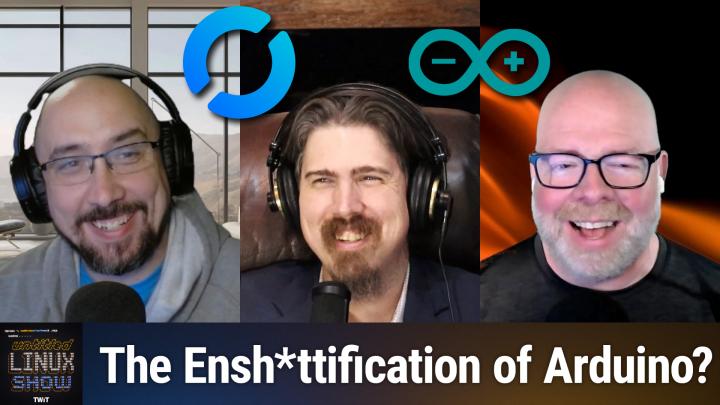
All TWiT.tv Shows (Audio)
Untitled Linux Show 230: Bake The Man a Pie
01:30:05
Qualcomm, Zork, & Blender
Loading summary
Transcript297 lines
- [00:01]
Ryan Seacrest
Resilience isn't just about bouncing back. It's about being ready. It's how you show up every single day. Because every name in your system is a person who trusts you, and every password is a door you're responsible for locking. And when the threat comes, and it always comes, you hold back the chaos. Learn more at cohesity.com/resilience.
- [00:31]
Rob Campbell
Whether you're into.
- [00:32]
T-Mobile Ad Voice
Unsolved mysteries, solved mysteries, or creating your own mysteries, Amazon Music's got millions of podcast episodes waiting. Just download the Amazon Music app and start listening to your favorite podcasts ad.
- [00:45]
Jeff Massey
Free included with Prime.
- [00:47]
Jonathan Bennett
Oh hey.
- [00:48]
Jeff Massey
Welcome to gift wrapping.
- [00:49]
Rob Campbell
Whoa.
- [00:49]
T-Mobile Ad Voice 2
So is Saldana.
- [00:50]
T-Mobile Ad Voice
Hey, can you wrap these please?
- [00:52]
Rob Campbell
Wow.
- [00:52]
Jonathan Bennett
IPhone 17s, you splurged at T Mobile.
- [00:55]
T-Mobile Ad Voice
You can get four iPhone 17s on them. The new center Stage front camera is amazing for group selfies. It's the perfect gift for everyone.
- [01:02]
Rob Campbell
I'm the worst.
- [01:02]
Micah Sargent
I only got my mom a robe.
- [01:04]
T-Mobile Ad Voice
Well, it's better than socks.
- [01:05]
Micah Sargent
So I have to trade in my old phone, right?
- [01:08]
T-Mobile Ad Voice
No @t mobile. There's no trade ins needed when you switch. Keep your old phone or give it as a gift.
- [01:13]
Jonathan Bennett
Incredible.
- [01:14]
T-Mobile Ad Voice
In fact, wrap up my old phone too for my Aunt Rosa. Forget that. Aunt Liz will be jealous.
- [01:18]
Micah Sargent
Sounds like my family drama.
- [01:20]
T-Mobile Ad Voice
Oh, I got it. I'll give it to my abuela. I'll take reindeer paper with hey, where are you going?
- [01:24]
Jonathan Bennett
To T Mobile.
- [01:25]
T-Mobile Ad Voice 2
The holidays are better. At T Mobile get four iPhone 17s on us. No trade in needed when you switch plus four lines for just 25 bucks a line. And now T Mobile is available in US cellular stores with 24 monthly bill credits and 4 eligible board ins on essentials for well qualified customers. Auto pay + taxes, fees and $35 device connection charge credits and imbalance due if you pay off earlier. Cancel contact US Finance Agreement 256 gigabytes $830 required.
- [01:46]
Jonathan Bennett
Visit T mobile.com this week we're talking about plenty of Linux on ARM news, and particularly about Qualcomm and some potential fallout from Qualcomm's purchase of Arduino. And there's plenty of news about Valve and Steam. And oh yeah, Blender 5.0 is out. You don't want to miss it, so stay tuned.
- [02:06]
Rob Campbell
Podcasts you love from people you Trust. This is TWiT.
- [02:16]
Jonathan Bennett
This is the Untitled Linux show, episode 230, recorded Saturday, November 22nd. Bake the Man a pie. Hey folks, it is Saturday and you know what that means. It's time for some Linux. We're gonna get geeky with software and hardware. Probably some gaming, all kinds of good stuff. I'm your host, Jonathan Bennett and I have got two of the regular guys with me. We've got Rob and we've got Jeff. Welcome each of you to the show.
- [02:44]
Jeff Massey
Love being here.
- [02:45]
Rob Campbell
I am the good looking one. Rob.
- [02:49]
Jonathan Bennett
You know I was thinking about it. I don't know that it's fair to call either of you regular guys. We're all a little off the beaten path in our own ways.
- [02:58]
Rob Campbell
Okay, let's not get too deep into that.
- [03:01]
Jeff Massey
No need to get pedantic.
- [03:05]
Jonathan Bennett
Indeed. All right, so there's been some things happening this week and we were talking about this a little bit before the show. Rob had a story and I stole it from him. So we're going to talk about that here shortly. But there's some interesting news with Qualcomm. Of course, Qualcomm making big moves in the open source world. Rob, what do you have that Qualcomm is up to?
- [03:27]
Rob Campbell
So there is quite a bit of Qualcomm news out this week. Some good, some bad and some ugly. For those who don't know or maybe know but are unsure, maybe you're confusing Qualcomm with Broadcom or some other comm out there. Qualcomm, they are the ones that brought us the arm based Snapdragon X1 Elite processors along with other Snapdragons before that and stuff. But the chip, this is the chip that is supposed to compete and maybe be better than than some of the Apple M series processors according to some. But. Well, it's kind of hard for me to get a good feel for it as officially there have been only been Windows based X X1 Elite devices released. I mean there is some Linux support there, but I mean nothing being sold on the market and I don't know how how ready it is so. But still that hasn't stopped me from being excited about about the opportunities in our future. So you know, with that. Last year we announced that Tuxedo Computers teased plans for releasing an X1 Elite Linux laptop. I did because I thought this was awesome. They had warned us. But then after that they warned us earlier this year that there have been some obstacles slowing them down. But even as recent as just earlier this month in November they posted the latest Linux DT patches for their ARM laptop. You know, and with things looking like, you know, looking like things were still moving forward so you know, it seemed like it's all going to be all good. But this week they announced they're discontinuing the project, noting challenges with the architecture, the, the first gen X1 not being as suitable for Linux as expected and you know, just not seeing the benefits as you know, we kind of thought with arm, you know, things like, you know, when you have arm you think long battery life and apparently that just really wasn't there for them. So I guess it's goodbye to the X1 plans but they have left open the possibility of an X2 in the near future. And you know, the fact that X2 was just announced I believe in September and coming out soon, the fact that that's already coming pretty soon was another reason like, you know, I, it's, it's just time to just discontinue this and maybe we'll try again with the next, you know, iteration. So, you know, it seems this time around, you know, they're, they're not going to make this one, maybe X2. But now Qualcomm itself seems to be off to a good start with, with their X2 maybe making the X2 a little more of a Linux contender, you know, because as already they've been upstreaming initial GPU support for the Snapdragon X2 Elite in the Linux 6.19 kernel. The pull request also brings Arduino 612 GPU support, quad pipe support in the DPU driver code for allowing higher resolution displays, displayport improvements and other changes. So, you know, that's kind of there. There's also some, some good news about. Dell is releasing a laptop this week with the mpu actually releasing this laptop with Linux on it before they're releasing the Windows version. Other than that, I didn't, I'm not going to go too deep into that story. I didn't. I was going to, but afterwards I decided it didn't seem all that as exciting as initially. But it's nice that they're bringing something to Linux before Windows. So anyway, that is the good and the bad. But I can't even talk about the ugly, so it's just too much for me. So I'm going to leave that part of the story for Jonathan.
- [07:40]
Jonathan Bennett
Yeah, we're going to talk about the ugly and how ugly it may or may not be here in just a minute. The Tuxedo computers thing with the Snapdragon X1, I gotta say this is almost directly tied to how quickly and how well the Snapdragon is supported upstream in the kernel. That's almost entirely what this is and it's just kind of a sign, hopefully this is a trend that you can't just release a device and throw some patches out there for a 10 year old kernel and expect everybody to be happy with it. It's just, it's not going to work. People want to be able to run their mainstream distros and their modern kernels and the, the, the old approach to this is just not, it doesn't work, it's not tenable, Nobody wants it. So if you.
- [08:30]
Rob Campbell
Sounds like they had problems with just getting it to work.
- [08:34]
Jonathan Bennett
Right.
- [08:36]
Jeff Massey
Yeah. They actually called themselves on it and said, you know what, this is a dead end. We can't keep going down this path and didn't, didn't try to release some subpar program product. So I mean it's maybe not happy news that it's not coming out, but it's at least, hey, we, we, we're adhering to certain standards.
- [08:55]
Rob Campbell
Yeah. Otherwise it could be like the, the, the, you know, the first round of Windows on ARM devices that totally flopped.
- [09:05]
Jonathan Bennett
That went well. Yeah. But I mean so the, the Tuxedo thing. So let's, let's look at it. What, what are they talking about? Well, long battery run. They, the batteries are not lasting long enough. Okay, well, well that's directly tied to how efficient the computer is and how well it handles sleep states. Both of those are how well the processor is supported on Linux. BIOS updates. We know that there are ways to do BIOS updates. It's just apparently missing for either this particular chip or ARM in general. Good USB4 transfer rates. Again, probably not a hardware limitation. This is probably a driver limitation or the bios.
- [09:44]
Rob Campbell
I suppose maybe Qualcomm isn't maybe providing the means to have it through Linux.
- [09:54]
Jonathan Bennett
Yeah, it may be a licensing issue there. Right. So this is not a, in my mind at least this is not a problem with Linux on ARM necessarily. This is a problem with Qualcomm support for Linux.
- [10:09]
Rob Campbell
Mm. And hopefully, you know, with their jump on the x2 stuff, maybe that means they're gonna, could try a lot harder next time.
- [10:17]
Jonathan Bennett
Could very well be a different, different story there. Yeah. All right, so let's talk about the ugly with Qualcomm. You may have seen is it got called out by Adafruit Industries, who you know, I'm a fan of. At least I like their hardware. I've done a lot of work with their hardware over the years. But this is a story from its FOSS and it is the, as we put it on the TWIT network the Inc. Certification of Arduino says. Ah. The insertification of Arduino begins, Qualcomm starts clamping down and it's all about changes to the Arduino Terms of Service and Privacy Policy. And what is changing? Well, the new policy introduces sweeping user license provisions. It broadens data collection, particularly around AI usage, and it embeds long term account data retention. Continue reading the article section 7.1 of the new Terms of Service grants Arduino a perpetual irrevocable license over anything you upload. Your code, projects, forum posts and comments all fall under this. This remains in effect even after you delete your account. Arduino retains rights to your Content indefinitely.
- [11:35]
Jeff Massey
Ah.
- [11:38]
Jonathan Bennett
If you can't, if you, if I'm not being sarcastic enough for you to point up out to pick up on it, I think we're a little overblown here. So I, I, I did something this is radical. Actually went and read parts of the Terms of Service.
- [11:54]
Rob Campbell
Nobody does that.
- [11:55]
Jonathan Bennett
I know, and it's not as bad as it sounds. Okay, so the 7.1 the actual publishing of Content, but it actually says without prejudice to any ownership rights of user of Content, which is defined below, which user publishes. So the Content which user publishes for the purpose of allowing the functioning of the platform and the Services, which includes the Forum and the Project Hub, user grants to Arduino the so here's the grant the non exclusive, royalty free, transferable, sub licensable, perpetual, irrevocable to the maximum extent allowed by applicable law for the duration of intellectual property rights and without detriment to user statutory rights Right to use the Content published and or updated on the platform, as well as to distribute, reproduce, modify, adapt, translate, publish and make publicly visible all material including software library is blah blah blah blah or other data Collectively the Content that user publishes, uploads or otherwise makes available to Arduino throughout the world using any means and for any purpose, including the use of any username or nickname specified in relation to the Content. Should the Content be software? Should the Content be software created by the user pursuant to the Contributor License Agreement? Such Content shall be subject to the terms of the Contributor License Agreement. User expressly acknowledges that Content may include users personal data, where applicable, personal data of minors for whom the user is legal guardian and if you are not familiar with actually parsing legalese. Yeah, that may sound terrifying, but this is really sort of just boilerplate for hey, we're running a cloud service. You give us data that is intended to then be publicly viewable. We want to make sure that our license says that when you give us data, you can make it, we can make it publicly visible. This pushes back against a couple of things like the right to be forgotten. I personally have opinions. I am not a fan of the right to be forgotten because that's not actually the way the world works. And it seems that the new management at Arduino is attempting to take that same stance. And then there's, there's a second part of this that people really might look at and be really, really worried about. There's a clause that says that users are not allowed to reverse engineer or attempt to understand how the platform works. Okay, now what is the place? Here's the question. If you read this, here's the question that you have to ask yourself, particularly if you actually click through and look at this. Because in the terms of service, that word platform is capitalized how the platform works. Well, in legalese, when you see a word capitalized like that, that means it is a special word that has been specifically, it has been specifically defined somewhere else in the document. All right, so if you actually go back to the beginning of the document and you ask yourself, what is this platform? Well, it will tell you. It is the Arduino Forum, the Arduino blog, the Arduino User group, the Arduino. It is their web platform. It's not talking about the platforms of the, you know, the individual pieces of hardware. It is their online services. And so the terms of service says you don't get to reverse engineer the Arduino online platform. And duh, I think that's already illegal in a lot of places. But it's also just bog standard terms of service with the publishing and the ownership rights. So here are two, here are two things to think about with that. And it comes down to licensing, open source licensing. The first thing to think about is this, at least in the United States, when you write something and you don't put a license on it, do you know what the copyright terms are? By default, all rights reserved. By default you get copyright on it. And so if someone does not put a license on it, technically, then Arduino is not going to have the rights to reproduce it. And so there has to be some sort of copyright grant. There has to be some sort of licensing that by default will allow someone to, that will allow Arduino to even publish these things that people give them to publish. The one thing in reading through this, I've took a little bit more time in reading through this one question that I have. One thing that it seems to do is if you publish something under the GPL this seems to remove some of the restrictions that the GPL would put on it. It would make that more permissive than the GPL would because it gives Arduino the rights to use it. Aside from. So essentially it's dual licensing is essentially what's happening. If some user uploads code, it's under the gpl. You upload it to Arduino, you then give them this separate license, dual license code.
- [17:21]
Jeff Massey
Arduino.
- [17:21]
Jonathan Bennett
Arduino has more writes than anyone else using the gpl. The question that I have about this is how does that work when one user uploads code written by a second user that is GPL'd? Because I do not have the right to relicense someone else's code. That's not the way copyright works, nor does Arduino have the right to relicense that code. And I can't make this grant. So a lot of this is, again, it's just legalese boilerplate that I'm sure the Qualcomm lawyers, their legal team said, oh, this does not sufficiently protect us. We need to strengthen the copyright, the licensing stuff in this. But I'm not sure how that works with the gpl, with other code. Like, I don't think it does anything. Obviously there's more in here. I've not read the entire Terms of Service and there are things in here I'm sure are not amazing, but I don't think it's quite worth the pearl clutching that we've seen so far. It seems to be a little bit blown out of proportion. As I said when discussing this with a buddy of mine before the show, I call it 50% fake news. What do you guys think?
- [18:36]
Rob Campbell
I'm glad you read that, because all I heard was blah, blah, blah.
- [18:42]
Jonathan Bennett
All right, if you, if you zoned out with the actual legalese, you can, you can come back now.
- [18:49]
Jeff Massey
I, I read through a lot of corporate contracts and yeah, there's, there's a lot of. I mean, it sounds pretty boilerplate to me and I'm not intimate with all that stuff, but it, there, there's a lot of terminology that sounds really terrible and it's like, no, no, here's what this actually means, you know, and it's, it's pretty banana. Pretty, pretty standard, you know? Yeah, protections.
- [19:14]
Jonathan Bennett
Yeah. So the, the, the way this goes is like, if you were to put it into just normal English, then a lawyer could take it to court and sort of rip it apart. Like, it, they use these particular terms on purpose because they have actually stood up in court. That is how these terms come to be.
- [19:34]
Rob Campbell
Yeah, I think they should change that. They should fix that somehow. Stuff should be readable.
- [19:39]
Jeff Massey
Good luck. Yeah, it, well it, it, it kind of is the same with audit standards. If, if I'm auditing Jonathan and I tell him, you should do this, that's totally optional. But if I say you shall, it's not. And it's, it's like a whole separate language of what words mean. And you say, oh, it's xyz and it's like, okay, this is not what it means in like the audit world or the legal world here. We say this in the real world, but it doesn't, you know, you have to kind of translate because it's a, it's a partially different language.
- [20:17]
Rob Campbell
Yeah, not, not, not a Linux pro, not a Linux problem. But I still think somebody should do something about this. I don't know what, just something. I mean, they're supposed to be smart people. They go to years and years of college. Somebody should. Well, that's what they're doing. They're protecting their years and years of college.
- [20:35]
Jonathan Bennett
Yep, yep.
- [20:36]
Jeff Massey
Wait till the AI lawyers hit, though.
- [20:39]
Jonathan Bennett
They've already hit. They have. Basically not a week goes by that there's some story about somebody, some lawyer getting rebuked from the, you know, from the bench because they, they sent in, you know, some sort of writing they sent in and it's either obviously AI or it's just straight up hallucinating court rulings like, oh, well, according to Johnson v. Capernaul in 1932, that doesn't exist. Oh, sorry.
- [21:08]
Jeff Massey
Yeah, well, but I mean that's, that's now, give it a few more years and that stuff's gonna start. And it wouldn't Surprise me, in 10, 20 years we have, you know, for, oh, I'm trying to do this basic thing. Oh, okay, here's your AI lawyer.
- [21:27]
Jonathan Bennett
There you go.
- [21:28]
Rob Campbell
Here's your 20 years. So you heard of here first. Kids don't go to school to be a lawyer.
- [21:36]
Jonathan Bennett
Oh, that's not what we said. That may be the advice to give, but for very different reasons. Oh, goodness. All right, Jeff, let's talk about something a little bit more. One, interesting and two, upbeat and happy rather than terms of services and legalese. Let's talk gaming. What's going on there?
- [21:57]
Jeff Massey
Yes. So Steam has just got a brand new legal contract. No, I'm just kidding. Steam has just released a major update and they're switching to the Debian 13 libraries for their runtime. Now, before we fully unpack what that means let's talk about how Steam works at a high level. When you look at it, Steam needs to run in a lot of different environments, from an old Ubuntu LTS to Bleeding Edge architecture. It does this by having a set of libraries it uses which are not dependent on the base distribution. The special library stack that Steam uses is the Steam runtime. Basically it's a container that games run in. Now, old games have older versions of the runtime and newer games run in newer containers with the newer libraries. Basically kind of matches when the games came out to the libraries that were in use when at the time. You know and I know some are asking how does Proton fit into all of this? The answer is Proton runs inside the latest runtime environment to translate the Windows games to Linux commands. And I'm only saying commands to keep it simple because they're low level kernel and graphic commands and API translations and you know that it all happens, but it isn't the focus of today's article. We'll just leave it commands. Now, now that we know how the pieces fit together, we can get to the story which is Steam released version four of their runtime. Now, this is a pretty big jump in library versions and this is why it caught my eye. Runtime version 3 was based on Debian 11. Now runtime 4 is based on Debian 13.2. So this means there's a four year jump in the libraries and there are several which have gone 64 bit only and you know, more and more as Debian steps away from 32 bit. So it's just the natural progression of the libraries over the years. Because of this, some libraries have a new SO name for breaking API compatibility. SO names S O N A M E is a field of data in a library which is often used to show version backwards compatibility. For instance, a version of this library 1 through 1.9 of the we'll say libx shared library provide identical interfaces. They'd all have the same so name. So it'd be like libx so1. If the application binary interface of a library changes in a backwards incompatible way, the SO name would be bumped or incremented. So our it would go from lib libx so 1 to libx so 2. So you know it there there. Because of the huge jump, there's some interface, we'll say hiccups, I won't say maybe total breakage. But there's some things they've got to. They got to iron out a bit. And when I say A lot of libraries have gone 64 bit only. The only libraries which remain 32 bit in this runtime are the ones needed by Proton or other Steam tooling. You know the article linked in the show notes actually comments they hope that this soon leads the way to 64 bit only version of Steam. And you know, personally I think it's coming as more and more libraries drop 32 bit support. I mean it's 32 bits going away now. We see this as a large Release in the GitLab release notes which are linked in the Show Notes article does say that games require this branch can't yet be released, but they do say there's a procedure which is going to be similar to the Release of version 3. I won't go into all the details, but in that GitLab they talk about how to backport. There's a guide for game developers and a lot of the under underhood documentation. So while we're not going to see games running in version four just yet, it's coming and we should see more in the coming months. So take a look at the article linked in the show notes for more details and for a link to the release notes. From there you can see the wiki with an overview of the different versions and how the entire Steam stack works and what they use native and what's in the runtime. And I just got to say, I love gaming on Linux.
- [26:30]
Jonathan Bennett
Yeah, it's great that it works as well as it does. So name or so name comes from the. So the shared object files. So it's the shared object name. That's what that stands for. A couple other interesting things. Yeah. What is going to happen with the entire back catalog of 32 bit games when Steam and all of our distros go 64 bit only?
- [26:55]
Jeff Massey
Well, the way it's working now is they just run on an older runtime, so they have that runtime frozen at certain libraries. So when you have all this old 32 bit game. Yeah, it's got to run on Steam runtime version one or two. So they should still work. Everything should be fine. It's just that it's in that container and I use the term container loosely. It's. It's probably the best way to think of it.
- [27:22]
Jonathan Bennett
It's like. It's like half of a flat pack.
- [27:25]
Jeff Massey
Yeah, yeah. And. And there are libraries that have to run native and. And I'll talk about that in my next story. But for example, one of them is anything related to the kernel like a GPU driver because it's so tied to the kernel you can't have a frozen library because then you can have incompatibility between really old driver and really new kernel. The APIs could have could have had a change in there. So certain things have to be native.
- [27:56]
Jonathan Bennett
That's part of where things like that SDL2 compat comes in. Because SDL, one of the things that SDL does is it handles some of those talking to your video card drivers, but also it handles input and output. And that's one of the things it does. It gives you this layer so the games written against that older stuff can run against newer things.
- [28:17]
Jeff Massey
Yep.
- [28:18]
Jonathan Bennett
Pretty, pretty useful. All right. Do we want to move on? Actually, no, we're going to move on here in just a second. We're going to talk about Windows, ARM and Linux, but we're going to do that right after this.
- [28:32]
Coca-Cola Ad Voice
Okay, only 10 more presents to wrap. You're almost at the finish line. But first. There, the last one. Enjoy a Coca Cola for a pause that refreshes.
- [29:02]
Ryan Seacrest
Hey, it's Ryan Seacrest for Albertsons and Safeway. As winter approaches, make sure you set aside some time for self care now through December 2nd. Get great savings on personal care essentials when you shop in store or online. Buy two participating self care items and save $3. Shop for items like Tresemme Shampoo, Dove Shampoo, Dove Men's Care Body Wash, Dove Body Wash and Axe Shower gel and save $3 when you buy two or more items. Offer ends December 2nd. Restrictions apply. Offers may vary. Visit albertsons or safeway.com for more details.
- [29:32]
Rob Campbell
Hey, Ryan Reynolds here wishing you a very happy half off holiday because right now Mint Mobile is offering you the gift of 50% off unlimited. To be clear, that's half price, not half the service. Mint is still premium unlimited wireless for a great price. So that means half day. Yeah, Give it a try@mintmobile.com Switch upfront.
- [29:56]
T-Mobile Ad Voice
Payment of $45 for three month plan equivalent to $15 per month required new customer offer for first three months only. Speed slow 135 gigabytes of networks busy taxes and fees extra.
- [30:02]
Jonathan Bennett
See mintmobile.com hi, I'm Leo Laporte, host.
- [30:04]
Micah Sargent
Of this Week in Tech and many other shows on the Twit podcast network. Can you believe it? 2026 is around the corner. So this, my friends is the best time to grow your brand with twit. Nobody understands the tech audience better than we do. We love our audience and we know how to effectively message to them. We develop genuine relationships with brands Creating authentic promotions that resonate with our highly engaged community of tech enthusiasts. You know, over 90% of Twitch audience is involved in their company's tech and IT decision making.
- [30:42]
Jeff Massey
Can you believe that?
- [30:43]
Micah Sargent
90%, 88% have actually made a purchase based on a Twit post read ad. No one comes close. We're the best at this. As one Twit fan said, I've bought from Twitt TV sponsors because I trust Leo and his team's knowledge of the latest in tech. If Twit supports it, I know I can trust it. You cannot buy buy trust like that. Well, actually you can.
- [31:07]
Rob Campbell
You can buy an ad on Twitter.
- [31:08]
Micah Sargent
All our ads are unique. They're read live by our expert hosts, Micah Sargent Me. We simulcast all during the shows on our social platforms so everybody can be watching live. You know one of our customers, Harun Meir, the founder of ThinksCanary, he's been with us since 2016. Since 2016, he said we expected Twit to work well for us because we, we were longtime listeners who over the years bought many of the products and services we learned about on various Twitch shows. And we were not disappointed. The combination of the very personal ad reads and the careful selection of products that Twit largely believes in gives the ads an authentic trusted voice that works.
- [31:49]
Rob Campbell
Really well for our products.
- [31:51]
Micah Sargent
10 out of 10 we'll use again. Thank you Harun. We love you. And it's been nine years. That's kind of. That's the proof, right? Partnerships with Twit offer valuable benefits including over delivery of impressions. You get presence on show episode pages. So there's a link right there that our audience can click on. We're in the RSS fee descriptions. A link there too. And social media promotion. Our full service team will craft compelling creative to elevate your brand and support you throughout your entire campaign. I work on the copy myself to make it authentic, to make it real. If you want to reach a passionate tech audience through a network that consistently over delivers, please contact us directly. PartnerWIT TV that's the email address. PartnerWIT TV let's talk about how we can help grow your brand. Or just go to Twit TV advertise for more information. I look forward to working with you. Thanks for listening.
- [32:52]
Rob Campbell
More Linux on ARM news this week comes from the crossover team. And in the show notes I call this what the Windows ARM of Linux or something like that. So anyway, thanks to people like Jeff, Jeff Massey here, our very own Jeff Massey on the panel. Being a paid subscriber to Crossover or contributor pay. I know how he pays. He pays him something, he says. I've heard him say that to.
- [33:19]
Jeff Massey
I'm a paid subscriber.
- [33:21]
Rob Campbell
Paid subscriber. I can't remember how their paid contributions work. But thanks to people like Jeff Matz, who is is a paid subscriber, Crossover has been able to do some amazing things with Wine. Or at least their cross over version of Wine which, which makes it a wine eventually anyway. You know, honestly I don't find much use for Wine anymore these days as there are so many good alternatives. But you know, sometimes, sometimes there isn't. Sometimes you gotta, you gotta use it to get something done. So for those moments, Wine has been there to run Windows apps on Linux. But that was only for like AMD intel users, you know, the X8664 guys. For those in the ARM world, we didn't really have a lot of options. All we could do is find alternative alternatives. And even that was a struggle sometimes if you didn't have the source and it wasn't compiled for arm. But codeweavers has been building up Wines ARM support well for quite a while now. Wine 8 laid out the groundwork. Wine 9 added support for native Windows ARM binaries and emulated 32 bit code. And early next year Wine 10 takes the next big step, emulating 64 bit x86 code. So I'm playing basic language. That means a lot more Windows software and games can be run on ARM machines under Linux. So to see what their code could really do, codeweavers tested on a beast of a machine. They tested on a system 76thale Astro with 128 core Ampere Ultra Max CPU. That is an ARM CPU with an Nvidia RTX 4060 Ti. And on that rig they saw Cyberpunk 2077 run around 120fps and and Hads 2 and Path of Exile to around 60fps and Ghosts of Tsushima around 50fps, you know. Now that doesn't mean you can, you know, take Ken's dusty old Raspberry PI and Suddenly it's a 4K gaming rig. But it does show that ARM Linux can be a serious game gaming and workload platform, you know, when paired with the right hardware. And gaming's only half the story. Codeweavers is also targeting enterprises. They want to move Windows workloads to Linux for better security and less bloat, without rewriting every app from scratch. You know, for companies buying high end ARM workstations powerful compatibility layers like this can make that transition much more realistic. And you know, hopefully someday, for those not buying these really high end machines, it can be useful for us too. You know, as we announced last week, Valve is coming out with their frames, which is an ARM device. It's going to run Steam, so there must be something good going on there. So anyway, with more capable ARM laptops and desktops arriving sometime in the future, hopefully Linux has a real chance to ride that wave. And with better ARM support of its own from, from Ubuntu's generic ARM installer to this evolving Wine crossover stack. You know, if, if you already own Crossover like Jeff and have an ARM64 Linux machine, I don't know what Jeff has, but if he has one, he could try. He could, he could sign up to test their preview build and so can you if you have these, if you fall into these conditions and help shape what Windows on ARM on Linux looks like. Next.
- [37:31]
Jonathan Bennett
Fun.
- [37:32]
Jeff Massey
I do not have ARM hardware.
- [37:34]
Rob Campbell
Not even a Raspberry PI.
- [37:36]
Jeff Massey
No.
- [37:37]
Rob Campbell
Really? Get the PI 500 and try this out.
- [37:41]
Jonathan Bennett
Yeah, we got it. We got to send Jeff a PI of some sort.
- [37:43]
Rob Campbell
That's like about the same price as your crossover subscription. Anyway.
- [37:47]
Jonathan Bennett
Bake the man a pie for Christmas.
- [37:52]
Jeff Massey
I like pecan pie.
- [37:56]
Jonathan Bennett
Yeah, I'm sure. All right, so there's a bit of related news that I've got. Why are all my stories related to Rob's stories? We did not even plan this, but Igalia. Yeah, that's where we're at. Igalia actually has a blog post up that pulls the curtain back just a little bit and lets us see the, see the man behind the curtain that Gallia has been doing a lot of work on these Valve announcements that we just got. So the new Steam controller, the Steam machine, the new Steam frame as well, that's what they call it, the goggles. Igalia has been doing some of the, some of the things for that and one in particular that caught my eye is Turnip. Turnip is the driver for that Qualcomm Aldrino gpu and they have been working on Vulkan support for that. And I think. Did we call this one. I can't remember if we talked about this back when it, back when it first happened. The guys may be able to help me remember back when we first talked about Turnip last time. Did one of us say, oh, getting support for it? Valve must be planning something that seems like a thing that we would have said.
- [39:15]
Rob Campbell
I don't remember. Turnip specifically, but I know we've said lots of times on the show that Valve must be planning something.
- [39:21]
Jonathan Bennett
Yeah, it's been pretty obvious. Well, this is another one. I don't know if we read these particular tea leaves or not, but we get a little look behind the curtain here that Igalia did the work to make Vulkan happen on these GPUs specifically because this was coming from Valve and I found it pretty interesting to read through.
- [39:41]
Jeff Massey
Well, you know, it makes a lot of sense because if you think what has Valve really gotten into? Not, I mean, yeah, they're of course the desktop computer, but they're getting a lot into like the handhelds, the glasses, the, the small, the small stuff. X86 way more powerful but it sucks a lot of juice and you just can't, it doesn't, it's not a good fit for these little handhelds. And if you think, well okay, you have, you know, 720 screen or maybe a 1080 screen, you're not needing, you know, super power. And if you say, well we don't need 300 frames per second, we can run on these little handhelds, sell a bajillion of them, which Steam loves because it opens them up to a lot more market share and it's good for Linux, you know, for getting out in the hands of more of the general public, you know.
- [40:36]
Rob Campbell
And, and you know, you say that, you know, they don't need that power soaking up because the X86 takes more. I still think today, at least most of the time, maybe we're starting to finally pull away. But I, I think most of the time when they do build an ARM system that's actually has the power of an X86, the power usage tends to go up pretty close to the same. But I, I think maybe we're starting to pull away with that a little bit finally.
- [41:06]
Jeff Massey
Yeah, I mean it, I, I see, I see a couple, couple things here because one is the, the powerful ARM systems like the one in, in your story, Rob. I mean that's a lot of cores and you have to have software specifically written to take advantage of that parallel computing, which a lot of software isn't. You know, it's designed for four cores or eight cores, maybe 64. I mean a lot of software is not designed for you know, 100 plus cores at once. And the other thing is, I know and I have mentioned this before, intel named see this problem coming where they're, they're trying to make their CPUs more efficient and we're going to have to see if the next, you know this next generation isn't. It's, it's too soon. It's already in silicon. They're testing it but you know on the roadmap three to five years are they going to start cutting things out to that's their better compete is that.
- [42:03]
Rob Campbell
They'Re these big core, little core idea.
- [42:06]
Jeff Massey
Partly well in getting rid of 32 bit code and just go you know what we're going to streamline. Then we had, we need less silicon for all these, the interpreters because a lot of Times now the CISC x86 instructions complex instruction set is interpreted down to RISC reduced instructions instruction set commands in, in the core and if you start going you know we're not going to support as much takes complexity out and then you say well you know we're not going to have hyper threading that makes them simpler. You know they, they I, I've seen, I've seen some papers saying that they could make x86 power wise efficient like some of these ARM chips and but they have to cut some things out and make it more like a.
- [43:01]
Jonathan Bennett
Well I mean in a very real way x86 hardware. It's not x86 it's emulating the x86 instruction set. That's true on a fundamental level now.
- [43:10]
Rob Campbell
Yes. Yeah AMD and Intel would have to agree on this. Right. Or one would be moving away and it'd be different and it wouldn't, they wouldn't be the same competing things anymore.
- [43:21]
Jeff Massey
Yeah they would, they would agree on it. There's actually a, and we did a story I think it was about a month ago or so two months ago. There's actually a consortium to map out the future the X86 and you know like Linus Torvalds is on it too. There's other big companies in there to go okay, we need to make changes and map out the future of this.
- [43:40]
Jonathan Bennett
I'm glad they have somebody on the board that's willing to tell them they have stupid ideas but, but one of.
- [43:44]
Rob Campbell
Them can't just one of those guys like intel can't unilaterally say we're just doing this. I mean they can but it would.
- [43:52]
Jonathan Bennett
I mean that's where x8664 came from. Or AMD came along and said man, intel, your 64 bit platform is stupid. We're just going to go make our own. And they did so well with it. Intel eventually came along so we want to make those too. Forget the titanium, we're going to make.
- [44:05]
Rob Campbell
That too but if they cut those out like the OSS would have to be made for that and then.
- [44:13]
Jeff Massey
Yep, yeah, yeah, well but I mean Linux is already going that way. We're getting rid of 32 bit anyway.
- [44:21]
Rob Campbell
Yeah, we could follow along pretty good which is I guess all we care about.
- [44:25]
Jeff Massey
Yeah, yeah. And other guys, yeah I mean they try to compile another kernel, they tried to do a Titanium but part of the problem there was it simplified the chip but the compiler was so complex and how it ran it just, it had a lot of issues, you know.
- [44:41]
Rob Campbell
I guess one of them could easily just do it and say this is our new thing, it's, it's better and you know, just come on Microsoft and whoever else just compile for it and you'll have a much better world I think.
- [44:56]
Jeff Massey
But they're too evenly split and you would just, you just bisect the market and I don't think either company wants to be on the losing side of that and try to play catch up. So I think they're going to work very hard to say, you know what, we're competitors but we have a bigger threat looming on the horizon with the, you know, the ARM and chips like that.
- [45:20]
Rob Campbell
Intel could offer both and then obviously, and then if it's really that great, ARM is going to say, or AMD is going to say well we want to do that too and then couple.
- [45:31]
Jonathan Bennett
Couple of things, couple things. One Rob, that is very, very bold of you to put intel in the leading spot.
- [45:39]
Rob Campbell
I just picked one for.
- [45:41]
Jonathan Bennett
I don't think intel is going to be the lead on that one. Intel right now is just trying to gather, trying to hold on to anything they can.
- [45:50]
Jeff Massey
But adding another chip like that, that's a whole, you, you have to have a whole complete design team doing it. All the testing, the layouts, the it, you know, it's like oh well they could just feature another one that's millions and mil, like a hundred million dollar probably.
- [46:09]
Rob Campbell
Is that different than just changing to it though? I mean why don't they have to do all that anyway? If they changed over to it they.
- [46:15]
Jeff Massey
Would but if you have the old style and the new style, every rev has got to go through all designs. They're probably shrinking things so they're doing new and different layouts and tweaking the layouts, optimizations of the layouts. Then you've got to build it, fab it and then oh wait a minute, we designed it this way but we can't actually physically build it without some TWEAKS it's, It's a big deal. And then all the testing you've got to do to find out, well, we say it can do this speed. Can it really do it? How much overhead do we have? And then you do advanced degradation testing. So I would think, let's get it.
- [46:54]
Rob Campbell
I would think if one of them, let's say amd, thought that this was just going to be better, that, you know, maybe they would want to do that because they figure if we get a jump on this, that's going to be our competitive advantage and, you know, Intel's name gonna be able to catch up.
- [47:10]
Jonathan Bennett
It's possible.
- [47:11]
Jeff Massey
Yeah.
- [47:11]
Jonathan Bennett
But then huge gamble though.
- [47:13]
Jeff Massey
Yeah. So. So they're, they're trying to do this lockstep so that they can compete against each other and while crushing the competition, you know, it's. It's kind of Pepsi and Coke going forward and saying, well, we don't always agree, but we got to make sure, like RC Cola and Shasta just don't get their time in the sun.
- [47:35]
Jonathan Bennett
Yeah. All right, so there's one more thing from this Sigalia article that's really interesting that I think maybe some more Valve tea leaves. We can read in the first paragraph here. It talks about the three new devices coming and then it says, successors to the highly successful Valve Index and Steam Deck. These devices are set to be released in the coming year. I don't think any of these three devices are successors to the Steam Deck.
- [48:05]
Rob Campbell
No.
- [48:06]
Jonathan Bennett
So I think Igalia knows something here that they are not intentionally telling us. I'm thinking about this and there was a comment from a Valve engineer that said that they've looked at doing a new Steam Deck and they've not yet found anything that gives them the leap in battery performance that they were looking for. So I suspect. Let me put it this way, I would not be surprised if. Yes, the next Steam Deck was an ARM device, probably very similar to the Snapdragon that's going to be running inside the new Steam frame. I could see a rev of that as a new Steam Deck. So there you go. You heard it here first. Only reading the tea leaves, no inside knowledge, just looking at what's out there.
- [48:57]
Rob Campbell
But that's our prediction. Episode is coming soon.
- [49:02]
Jonathan Bennett
Yeah, for sure.
- [49:04]
Rob Campbell
Don't forget that one.
- [49:06]
Jonathan Bennett
Indeed. All right, so here in just a second, Jeff is going to tell us about some next gen GPU stuff coming from yet another player. We'll get to that right after this.
- [49:19]
Jeff Massey
Oh, hey. Welcome to gift wrapping.
- [49:21]
Jonathan Bennett
Whoa.
- [49:21]
T-Mobile Ad Voice 2
So is Saldana.
- [49:22]
T-Mobile Ad Voice
Hey, can you wrap these please?
- [49:24]
Micah Sargent
Wow, iPhone 17s.
- [49:25]
Jonathan Bennett
You splurged.
- [49:26]
T-Mobile Ad Voice
At T Mobile. You can get four iPhone 17s on them. The new center stage front camera is amazing for group selfies. It's the perfect gift for everyone.
- [49:33]
Rob Campbell
I'm the worst.
- [49:34]
Micah Sargent
I only got my mom a robe.
- [49:35]
T-Mobile Ad Voice
Well, it's better than socks.
- [49:37]
Micah Sargent
So I have to trade in my old phone, right?
- [49:40]
T-Mobile Ad Voice
No AT T Mobile. There's no trade ins needed when you switch. Keep your old phone or give it as a gift.
- [49:45]
Jonathan Bennett
Incredible.
- [49:46]
T-Mobile Ad Voice
In fact, wrap up my old phone too for my aunt Rosa. Forget that. Aunt Liz will be jealous.
- [49:50]
Micah Sargent
Sounds like my family drama.
- [49:52]
T-Mobile Ad Voice
Oh, I got it. I'll give it to my abuela. I'll take reindeer paper with. Hey, where are you going?
- [49:56]
Jonathan Bennett
T Mobile.
- [49:57]
T-Mobile Ad Voice 2
The holidays are better. AT T Mobile get four iPhone 17s on us. No trade in needed when you switch. Plus four lines for just 25 bucks a line. And now T Mobile is available in US cellular stores with 24 monthly bill credits and four eligible for inside essentials for well qualified customers bought a pay + taxes fees and 35 device connection charge credits and imbalance due if you pay off earlier. Cancel Contact Contact Us Finance Agreement 256 gigabytes. $830 required.
- [50:17]
Coca-Cola Ad Voice
Visit T mobile.com okay, only 10 more presents to wrap. You're almost at the finish line. But first. There the last one. Enjoy a Coca Cola for a pause that refreshes.
- [50:49]
Ryan Seacrest
Hey, it's Ryan Seacrest for Albertsons and Safeway. As winter approaches, make sure you set aside some time for self care now through December 2nd. Get great savings on personal care essentials when you shop in store or online. Buy two participating self care items and save $3. Shop for items like Tresemme Shampoo, Dove Shampoo, Dove Men's Care Body Wash, Dove Body Wash and Axe Shower gel. And save $3 when you buy two or more items. Offer ends December 2nd. Restrictions apply. Offers may vary. Visit albertsons or safeway.com for more details.
- [51:20]
Micah Sargent
Hey everybody, Leo Laporte here and I'm going to bug you one more time to join Club twit. If you're not already a member, I want to encourage you to support what we do here at Twit. You know, 25% of our operating costs comes from membership in the club. That's a huge portion and it's growing all the time. That means we can do more. We can have more fun. You get a lot of benefits. Ad free versions of all the shows. You get access to the Club Twit Discord and special programming like the keynotes from Apple and Google and Microsoft and others that we don't stream otherwise in public. Please join the club if you haven't done it yet. We'd love to have you find out more at Twit TV Club Twit and thank you so much.
- [52:09]
Jeff Massey
So in the last story I was talking about Steam runtime versions and I mentioned some things are in the runtime container and some things are native. One of the items that are native are the GPU drivers because how they're tied to the kernel and they don't want to get a conflict with different kernel versions. This leads us to the next story where AMD is getting their driver ready for the next generation gpu, whatever that might be. Now I say whatever it might be because a while back we covered how AMD went to a block by block enablement strategy. The way this works is new features are put into the block and I mean just that in a conceptual way, like a little function or block of code. And when the driver boots the GPU says what features it supports and enables the blocks it needs. Now just because a feature block is there doesn't mean the GPU is going to use it. Part of this was done to simplify the driver stack and make it more universal and the other was to add new features well ahead of hardware release. But we don't know and more importantly their competition doesn't know what the new GPU is going to do feature wise. So now the article mentions that with the new patches going into the code, into the driver code, we don't know if this is going to be an RDNA 5/UDNA or an RDA 4 refresh. You know, no matter what it is, the code is starting to flow. So AMD is taking preparing for the next hardware. Like for example the PSP PSP block was updated, which is the platform security processor. Basically they updated the code which handles a lot of the security related tasks. The interrupt handler also had an update and this controls interrupts for the gpu. The graphics memory controller got some love along with the Graphics Hub GFX Hub where it went to 12.12.1. Now here's where it gets funny. Version 12 is for Rdna 4 GPUs. So a 0.1, it could mean, could mean a refresh for Rdna 4. You know it's only a 0.1 bump, but that's just speculation on my part.
- [54:32]
Rob Campbell
But.
- [54:33]
Jeff Massey
And the new, the new compute cards though, like AMD's AI industrial type cards they only need version 9 of the block. So maybe there's going to be a new block with more compute silicon silicon on it. And here's where my theory, or you know, what I envision kind of falls apart if we look at versioning history though rdna1 was version 10, rdna2 was version 10.3, and version 11 was rdna and version 11 was rdna3. So you can't read too much into the patches because we've had major revisions with a 0.3 and major revisions with an entire whole number increment. Now the article does go on to say because of the way the new blocks are chosen by the gpu, we really don't know what's coming. When they use the code names of the past, we could determine by which code paths were enabled, what the card would do, and have a good idea of its use case. These patches are not going to make it into the 6.19 kernel. Hardware rumors have the cards coming out in about a year, but that's Internet speculation. So take that with a big grain of salt. Though really, the timeline kind of does make sense. If we get into a release kernel in January, you know, if it makes it, then that would give AMD and their partners time to test the, the hardware and the software to find any bugs. So when it's finally released they can have a spotless launch. But you know, testing times will vary on how much of a change the hardware and software is going to have, how confident they feel in their testing, meaning that they think they need a lot of a lot or the process is slow, or they feel confident and don't need a lot of time. And in that case we'll see the hardware a lot sooner. Take a look at the article in the show notes for full details and links to the patches so you can see the header files for your sale and for yourself. I say header files because a lot of the code is auto generated and too large for the mailing list There are there paths you can go to see the full code. But it's, it's big. More and more, you know, hopefully gaming goodness coming our way in the near future.
- [56:55]
Jonathan Bennett
Yeah, interesting stuff. We have switched places. It's Rob's fault. It's Rob's fault.
- [57:03]
Jeff Massey
I don't know what happened.
- [57:04]
Rob Campbell
It just dropped for like two seconds.
- [57:06]
Jonathan Bennett
Yeah, I heard, I heard the, the. The donk that you came back.
- [57:11]
Jeff Massey
Yeah, Donk.
- [57:13]
Micah Sargent
There's a show title.
- [57:14]
Jonathan Bennett
Oh boy.
- [57:17]
Jeff Massey
Someone captured that. Please.
- [57:18]
Jonathan Bennett
Yeah. Oh, I was thinking the, the. Something about the, the code Flowing. But yes, the code must flow. That one, that one came to mind too, as a show title. Yeah, yeah. No, it's interesting to look at this and try to figure out like how far in the future each of these things are and what exactly they represent. It also made me wonder like, are the, the RX9000 cards actually available for purchase now? And it looks like some of them are. I'll have to, I'll have to look a little bit closer at these and see if any of them are worth it, but they're in stock in a few places. It's beautiful.
- [57:54]
Jeff Massey
Yeah. I mean, and, and the speculation is, you know, well, it's, it's threefold. Right. It's a refresh of Rdna 4, it's Rdna 4 with an APU in there so they can do more AI stuff. Or three, it's RDNA 5 or UDNA because they're going to the Unified. Unified Device Architecture, whatever. Whatever they're calling it. So it's, they're, they're combining their paths with the compute cards and the graphics cards into kind of one driver stack.
- [58:26]
Jonathan Bennett
Yeah, yeah. Time will definitely tell. All right, Rob, it looks like you want to talk about Wayland. Yeah, Rob always likes to talk about Wayland. It's his thing. The letter W. This show brought to you by the letter W. So yes.
- [58:48]
Rob Campbell
I have another Waylon success story. And yeah, listeners of the show will know that I am a Whalen advocate and love to bring Waylon success stories to the show, even if sometimes they can be translated into maybe whaling weaknesses. So I'll just get out front because unfortunately we remote desktop solutions like TeamViewer, AnyDesk, Rust Desk have been one of those weaknesses up until now. So, you know, Wayland's been their weakness. But Rust Desk has been carving out a space for itself as the open source answer to TeamViewer and AnyDesk. And its latest move really leans into that reputation, especially for Linux users living in the Wayland world, which is everybody, I hope, everyone should be on Wayland. So at its core, Rust Desk is a remote desktop tool written in rust under the AGPL 3.0 license. And it runs pretty much everywhere, Linux, Windows, Mac OS, Android, iOS. But the newest nightly build brings something that's been a long standing pain on Linux and that is proper support for multi monitor setups with different scaling factors on Wayland. So, you know, I guess if you've ever tried to remote into a remote machine, you know, with say a 4K display at 200% scaling and next to it is a 1080pmonitor at 100%. You've probably seen the chaos. You know, the mouse pointer doesn't line up with the, you know, where you're clicking input lands in the wrong spot. And the whole experience quickly goes from remote desktop to remote frustration. So for a lot of people, mixed scale monitor setups on Wayland have basically been unusable for serious remote work. Rust Desk developers say they've cracked that their implementation now handles these mixed scaling monitors configurations correctly. And they're claiming to be the only remote desktop solution that does this on Wayland right now. That puts them a step ahead of the big commercial players like TeamViewer, you know, a paid product at least they really try to push under for commercial use. Any desk splash stop, you know, and the rest like that have all been pretty slow to tackle. Whalen, you know, Wayland's quirks especially, you don't want you throwing like high DPI and multi monitors into the mix. So for the moment, this support lives in Rust Desk's nightly builds on GitHub, where the latest code lands every day for early testers. Once it's been, you know, hammered on, tested out and proven stable, the mixed scale multi monitor support is expected to roll out to the regular stable builds. And you'll find on Rust Desk official site making life a lot nicer for Linux users with modern Wayland desktops. And one less reason for you guys out there to say I'm not going to Wayland yet.
- [62:13]
Jonathan Bennett
One less reason. Yeah, I, you know, there, there for a little bit I was a little concerned about Rust Desk. There was some rumors about like what they might be up to, but I think it's fairly safe to say that they are, they're good players at this point. The fact that it's open source makes it at least more trustworthy than any of the closed source alternatives. You know, the team viewer and all those guys. It's like you don't know what's going on under the hood there. At least with Rust Disk you have some semblance of a guest, you can figure out if it's doing anything weird.
- [62:43]
Rob Campbell
Yeah, I mean you can use their server for the proxy or whatever and I guess in that case you don't know what's going on. But you don't have to use their server. You can put your own server.
- [62:55]
Jonathan Bennett
Absolutely, absolutely. All right, so up next we're going to talk for just a bit about, well, open source at Microsoft. A bit of unexpected open source news and we'll get to it right after this.
- [63:09]
Coca-Cola Ad Voice
Okay, only 10 more presents to wrap. You're almost at the finish line. But first, There, the last one. Enjoy a Coca Cola for a pause that refreshes.
- [63:38]
Ryan Seacrest
Hey, it's Ryan Seacrest for Albertsons and Safeway. As winter approaches, make sure you set aside some time for self care now through December 2nd. Get great savings on personal care essentials when you shop in store or online. Buy two participating self care items and save $3. Shop for items like Tresemme Shampoo, Dove Shampoo, Dove Men's Care Body Wash, Dove Body Wash, and Axe Shower gel. And save $3 when you buy two or more items. Offer ends December 2nd. Restrictions apply. Offers may vary. Visit albertsons or safeway.com for more details.
- [64:09]
Micah Sargent
Hey, everybody, it's Leo Laporte. Are you trying to keep up with the world of Microsoft? It's moving fast, but we have two of the best experts in the world, Paul Thurat and Richard Campbell. They join me every Wednesday to talk about the latest from Microsoft on Windows Weekly. It's not a lot more than just Windows. I hope you'll listen to the show every Wednesday.
- [64:28]
Jonathan Bennett
Easy enough.
- [64:29]
Micah Sargent
Just subscribe in your favorite podcast client to Windows Weekly or visit our website at Twitter TV ww. Microsoft's moving fast, but there's a way to stay ahead. That's Windows Weekly every Wednesday on Twitter.
- [64:43]
Jonathan Bennett
All right, so the news is Zork, Zork 1, Zork 2, and Zork 3 have been release as open source by Microsoft. And you may have questions. I certainly did. Like, wait a Second, I thought Zork 1, 2 and 3 were already out there and Microsoft. So here's the scoop. The source code for Zorks 1, 2 and 3 were out there, but without an official license attached. So it was in sort of that no man's land of it's available, but nobody was willing to actually package it up like officially because it doesn't have a license. It was just sort of a wink and a nod. It was released. Well, there's been work to say, let's put an official license on this. And then you have to ask the question, who would actually own the copyright to be able to assign a license? And the answer to that is because of corporate acquisitions, it's Microsoft. So Zork was written by Infocomm, and Infocomm was purchased by a couple of different studios. I'm trying to remember who was in between. Activision. Right. Activision was another one.
- [65:59]
Jeff Massey
I think Activision got them.
- [66:02]
Jonathan Bennett
Activision bought Infocom and then Microsoft Bought Activision. Yeah, that's the way that it went. And so Microsoft ended up with the ownership of the Zork source code and finally somebody, whoever it was, needed to signed off on it. And we now have Zork 1, 2 and 3 out there under the MIT license. And interestingly, this source code drop does not actually include any source code. It's just the official blessing from Microsoft that says, yes, this is available under the MIT license, which is great. Now the thing that you'll probably see as a result of this is it'll start to be available in places like Fedora as just being able to install it straight off. There's now no license questions, it's all just in the clear and open source. It's been out there before now, but for the purposes of playing it, but also just preserving these things, I'm glad to see Microsoft do this. And there's about a million other software titles that this needs to happen to because the, the, the statute of limitations, the length of time that copyright lasts for is just hilariously too long when it comes to software. It's like 70 years plus the life of the author. Which software is so ridiculously out of date after 20 years. But anyway, good, good for Microsoft for at least taking this step. And like I said, hopefully we'll see it for other titles so that these things don't disappear. That's really the danger.
- [67:42]
Rob Campbell
Refresh my memory. I'm pretty sure you've done a tip on this. This is a game, right? These are games, right?
- [67:48]
Jeff Massey
Yeah.
- [67:49]
Rob Campbell
And are they, are these the text based games or is this they.
- [67:52]
Jonathan Bennett
Are they are text based? Yes.
- [67:53]
Rob Campbell
Okay, I want to make sure that I had that right and, and everybody else who wasn't sure. So Zork is a text based game?
- [67:58]
Jonathan Bennett
Yeah, it's the original adventure.
- [68:01]
Rob Campbell
Yeah.
- [68:01]
Jonathan Bennett
This is the. You find yourself in front of a house and there's a mailbox since that.
- [68:06]
Jeff Massey
So I, I first played this on a Commodore 64 and the older people. So anybody born, you know, 2,000 later, you don't understand the impact of this. So early 80s, you're playing this game and it just has a prompt. You know, you're standing in front of this house, you could type one of multiple things. It wasn't multiple choice. It was like you were having a conversation. It was, it was like a fake AI. Now they just had specific keywords they went off of. So it wasn't like an AI, but it felt like it. Because you could say, well, I want to open the mailbox. Look up, look down, go north, you know, sing a song and it would have responses to all those things. And it was, it was amazing technology at the time, you know, just, just how you interacted with it. So there's a lot of people, you know, that are older, that played these years ago, early 80s, that these were amazing, you know, and, and this. And that was back when, you know, games were basically 2D, you know, space Invaders, Pac man, things like that. So there wasn't a lot of deep logic in them. You know, they're probably some exceptions, but for most of them they were pretty straightforward. So this one with all the possibilities and it was kind of felt open world. It was amazing.
- [69:34]
Rob Campbell
Yeah. I remember something similar like a chat base. It seemed like AI where you could chat with something and it somehow had answers for everything. So I mean similar lines has answers for everything. But I wonder, I wonder if I could go to an AI, say chat GPT and say I want to play a, a unique Zork adventure with you and, and you be my thing and just like playing in there. I wonder if you could like somehow prompt it to.
- [70:05]
Jonathan Bennett
I don't know.
- [70:06]
Rob Campbell
That's really not to even just pretend.
- [70:08]
Jonathan Bennett
AI I saw. Oh dang it. I was going to sign into my Steam and not signed in on the phone either. Oh well, that was a nice idea while it lasted. One of these Zork games, there's actually a 3D recreation of it and I am not able to immediately find it because I'm not logged into Steam on any of the devices I have in front of me.
- [70:32]
Jeff Massey
I can tell you that the Zork 1, 2 and 3 are available in the AUR and other places too. I played it before under the wink and a nod type thing. And if you want to get just an Easy on Steam, I think it's on sale now for like about $3. You get Zork 1, 2, 3, Zork 0, Planet Fall. I think there was another one in there. There's like about five or six games for like three bucks.
- [71:03]
Jonathan Bennett
Indeed. I'm trying to remember some reason.
- [71:06]
Rob Campbell
I think you brought the graphical. What? You showed us a graphical one. I think, I mean, I feel like you showed us the text based one and then like the week later showed us the graphical. Unless it was something else, I'm not sure.
- [71:19]
Jonathan Bennett
The one I'm thinking of is like Adventure, the Underground Empire or something like that. I don't know. It's a fragment of a memory and I can't bring it up at the moment. Yeah, the Underground Empire. That's what it's usually called. Huh. I don't know why I can't find it on steam. The new 3D version of it. I have it on my wish list too. I just don't have. Like I said, I'm not logged into Steam.
- [71:45]
Rob Campbell
I was wrong.
- [71:46]
Jeff Massey
It's the Zork Anthology on Steam right now for 389.
- [71:53]
Jonathan Bennett
That's not too bad.
- [71:54]
Jeff Massey
No, but you get 1, 2, 3 beyond Zork, Zork 0 and Planetfall.
- [72:01]
Rob Campbell
If.
- [72:01]
Jeff Massey
If you want the prepackaged, you don't want to go through any install, you know.
- [72:07]
Jonathan Bennett
Yep, yep, there you go. Yeah, we'll talk here in a bit about some other options to get it if you don't want to go through Steam. Coming. Coming soon.
- [72:16]
Jeff Massey
All right, Aur. Well, which I know what you're hinting at and it ties in with mine as well.
- [72:26]
Jonathan Bennett
He's trying to steal my thunder here. All right, Jeff, before we get there, there's a pretty big release that just happened. What's the new thing? Also in 3D graphics, believe it or not. What's new there, Jeff?
- [72:41]
Jeff Massey
Well, now that we have some updates to Steam to play games, we have GPU Love coming to play games. Well, maybe. And now maybe we need to make a really cool game and we can do that with Blender 5.0 which was just released. Oh, okay. Maybe you need to do some work with it as well. But it's not as fun, I don't know as Blender really needs an introduction. But just in case anybody is not familiar with Blender, it's a free and open source 3D creation suite. It supports the entirety of the 3D pipeline. So modeling, rigging, animation, simulation, rendering, composing, motion tracking, video editing and game asset creation. So it's kind of a one stop shop for 3D. Now version 5 brings support for showing HDR colors and a much wider range of colors. So it's of kind. Goes without saying, you're going to need make sure, you know, if you're going to want to do this, you're going to need a monitor which can support hdr. You know, you got to, you can output it, but if you can't see it, it doesn't do you any good. You are also going to need to be running Wayland and the Vulcan back end. So this is another switch to wayland that Blender 5 is not going to do you a lot of good on X11. There's a lot of focus on color for version 5 with a lot of different parts of the program supporting hdr, wider color palettes. And HDR is supported in both static image and in video. So no matter what you're doing, you're going to get more colors and better ways to play them. They also things like revamp the Curves drawing feature, which supports the new Curves object type. And there's. And there's a new geometry attribute constraint. There's a new cylinder option for displaying Curves, which allows for rendering thicker curves and you won't have them look like a flat ribbon. The look of the program changes as well because there's a lot of different parts of Blender that had changes, updates and overhauls and they have bumped the GPUs needed to run version 5. So if you're on Nvidia, you need 900 series or newer, and for AMD you need the Radeon 400 series or newer. Basically for AMD you need GCN version 4 or newer. You know, I'm not even going to try to cover most of the changes because there are way too many. And I really do suggest you take a look at the article in the show notes for more details. After you have read the article, look for the link to the Blender website and you will find where they have version 5 release notes. But in these notes there's a lot of graphical interaction. So these aren't your standard release notes. They have several images rendered with a feature with the. You know, with a feature on and a feature on in the old way. And a slider so you can drag an image so you can see the changes and how they affect an image. They have a lot of examples to click and drag to get a good feeling, you know, so you can really, really understand it. They have some where you, you click and you swap between static images so you can see the changes. They have a link in there in, in the release notes to free demo files. So you can have a lot of things to play with if you're just getting started. So you get a lot of objects and things like that. Included in this is a human base mesh ass Base Meshes asset bundle, which they've updated with a few fully realistic skeleton assets. So you'll have full skeletons that you can play around and you know, so you're, you're not just trying to build a square and do stuff. You have actual things you can play with. Now all the assets are public domain, so you can use them in your projects, private, shared, commercial. However, without any issues. After you've downloaded those, you can, you can play with them. Keep scrolling because that's not the end of the updates. And this release is massive. I suggest people get this update and start playing because Blender can be a lot of fun. And you know, it can even be used to benchmark your system. They have a whole benchmarking suite and places you can upload benchmarks so you can compare how your system does to others and. But most of all, just have fun creating.
- [77:04]
Jonathan Bennett
Yep, absolutely.
- [77:07]
Rob Campbell
I'd like to emphasize one key point that you kind of brushed over real quickly, and that is if you want the full suite of features, if you want to take full advantage of it, you got to be on Wayland.
- [77:24]
Jonathan Bennett
Is there. Is there new. Is there new Wayland? Only stuff there.
- [77:27]
Rob Campbell
Hdr.
- [77:29]
Jeff Massey
It's. Yeah, you have to have Wayland and which I did say in the show note. Rob was dope.
- [77:34]
Rob Campbell
Yeah, I heard you said it. But he's that age.
- [77:36]
Jeff Massey
He does awesome.
- [77:37]
Rob Campbell
I heard you say it. You just really went through the facts. You got to emphasize it. The important things like that.
- [77:43]
Jeff Massey
And you have to run the Vulcan back in. So you need Wayland and Vulcan, both of them. And to make it work. All right, well, live long and prosper. You need both of them.
- [77:56]
Jonathan Bennett
Yes. All right, here in just a second we're going to get into our command line tips. But first, a quick break. Oh, hey.
- [78:03]
Jeff Massey
Welcome to gift wrapping.
- [78:04]
Rob Campbell
Whoa.
- [78:05]
T-Mobile Ad Voice 2
So is Saldana.
- [78:06]
T-Mobile Ad Voice
Hey, can you wrap these, please?
- [78:07]
Jonathan Bennett
Wow.
- [78:08]
Micah Sargent
IPhone 17s.
- [78:09]
T-Mobile Ad Voice
You splurged at T Mobile. You can get four iPhone 17s on them. The new center stage front camera is amazing for group selfies. It's the perfect gift for everyone.
- [78:17]
Rob Campbell
I'm the worst.
- [78:18]
Micah Sargent
I only got my mom a robe.
- [78:19]
T-Mobile Ad Voice
Well, it's better than socks.
- [78:21]
Micah Sargent
So I have to trade in my old phone, right?
- [78:23]
T-Mobile Ad Voice
No AT T Mobile. There's no trade ins needed when you switch. Keep your old phone or give it as a gift.
- [78:28]
Jonathan Bennett
Incredible.
- [78:29]
T-Mobile Ad Voice
In fact, wrap up my old phone too for my aunt Rosa. Forget that. Aunt Liz will be jealous.
- [78:34]
Micah Sargent
Sounds like my family drama.
- [78:35]
T-Mobile Ad Voice
Oh, I got it. I'll give it to my abuela. I'll take reindeer paper with. Hey, where are you going?
- [78:40]
T-Mobile Ad Voice 2
The holidays are better. AT T Mobile get four iPhone 17s on us. No trade in needed when you switch plus four lines for just 25 bucks a line. And now T Mobile is available in US cellular stores with 24 month legal credits and four eligible board inside essentials for well qualified customers. Auto pay + taxes, fees and 35 device connection charge credits and imbalance due if you pay off earlier. Cancel Contact Us Finance Agreement 256 GB, $830 required.
- [79:01]
Coca-Cola Ad Voice
Visit t mobile.com okay, only 10 more presents to wrap. You're almost at the finish line. But first, There the last one. Enjoy a Coca Cola for a pause that refreshes.
- [79:33]
Ryan Seacrest
Hey, it's Ryan Seacrest for Albertsons and Safeway. As winter approaches, make sure you set aside some time for self care now through December 2nd. Get great savings on personal care essentials when you shop in store or online. Buy two participating self care items and save $3. Shop for items like Tresemme Shampoo, Dove Shampoo, Dove Men's Care Body Wash, Dove Body Wash, and Axe Shower gel, and save $3 when you buy two or more items. Offer ends December 2nd. Restrictions apply. Offers may vary. Visit albertsons or safeway.com for more details.
- [80:04]
Jonathan Bennett
All right, Rob's got our first tip. What are we looking at today? Rob?
- [80:10]
Rob Campbell
All right, so this tip is for those like Jeff. If you guys noticed, he has some Apple AirPods in his ears. So people like Jeff. Yes, let's. There you go. So for people like Jeff trying to use Apple AirPods on Linux, I've used them in the past, but at one point I was having problems basically connecting to my Bluetooth, so I just stopped using. Haven't even tried in a long time. Well, this tip doesn't specifically. I mean it may or may not fix that problem. I don't know, but maybe it will. Maybe it'll resolve that problem. But anyway, my tip is Libre Pods. So for those watching, I made a nice little background. Libre Pods, well, AI made this nice background. So Libre Pods is an open source app that basically frees Apple AirPods Pro from the Apple ecosystem and lets you use their smart features properly on Linux. So out of the box, AirPods Pro on Linux works like a play in Bluetooth earbuds. You know, you just pair it with Bluetooth or Bluetooth and you get audio but you don't get any of the extras. No active noise cancellation, no transparency mode, unreliable battery reporting, and no ear detection. But Libre Pods fixes that. So librepods is a rust based desktop app for Linux with with an Android companion that reverse engineers Apple's protocols so it could talk to AirPods the way Mac OS and iOS do with it. You could switch between ANC transparency and normal mode right from the app. See accurate battery levels for each earbud and the case. And depending on the model you get extras like ear detection, you know, so if you take one out, it'll know head gestures, conversational awareness that lowers your volume when you're when you start talking, you know and it runs in the background to handle things like auto pausing like when you take the earbud out like I mentioned and it's still, it's still under active development but AirPods Pro 2 are fully supported. The Pro 3s. I don't know which ones you have, Jeff, but the Pro 3s are, they're almost there and older models at least get a solid battery and basic, basic control support. I haven't tried this yet. I've only read up on it and it sounds like something I'm going to have to try because hopefully having a companion apps get a. Make the AirPods support all. But I don't know what kind of AirPods I have. Two or three probably. I don't know. But yeah. So for those trying to use it, this app could make things a lot nicer for you.
- [83:14]
Jonathan Bennett
Yeah, very cool. Jeff is busy now looking into it. Like.
- [83:22]
Jeff Massey
It'S pretty active development. There's a lot of stuff. I mean it's, it's not just one person hammering on it. It's, it's, it's several people.
- [83:31]
Rob Campbell
Yeah. And I guess you know, for like Asahi Linux, you can get a Asahi Linux on your Mac and then you can just have that whole ecosystem like in Linux, Mac hardware, all Linux.
- [83:43]
Jeff Massey
Is that like having a book in Chinese translating into English and then retranslating it back to Chinese or something? No, no, it's, it's pretty cool. I've. Mine, mine were. I've had them work flawlessly with Linux. But yeah, I don't have any of the other features. It's just a basic volume control and stuff like that. I can't see the battery life or anything. So this, I'm going to look into this and find out how I get it on. Get it on a cache.
- [84:11]
Rob Campbell
Yeah. Let us know next week how it works for you if I don't try it first.
- [84:17]
Jonathan Bennett
Yeah, very interesting. Now I'm, now I'm down the rabbit hole of looking at earbuds. Not Apple earbuds, not my style, but looking at earbuds. My poor budget. You guys have gotten me to look at video cards and earbuds. You know, that's like $500 that you two have almost talked me into spending.
- [84:36]
Rob Campbell
This little tip got you into looking at earbuds.
- [84:39]
Jonathan Bennett
Yes.
- [84:41]
Jeff Massey
Well, if you buy earbuds or a video card, I'm counting that as your Christmas present.
- [84:45]
Rob Campbell
So the problem is, Jonathan, all we have to do is like briefly like mention something like what I don't have that.
- [84:53]
Jonathan Bennett
No, no, no. I am the victim here. Do not put this on me.
- [84:59]
Rob Campbell
I don't have that yet.
- [85:00]
Jeff Massey
All right, Jonathan's wife in the, in the comments is saying, yes, you need to buy this, honey, I love you enough that you need to.
- [85:07]
Jonathan Bennett
No, that is not what she is saying. She is saying I love you enough. I'm not going to let you do this. That's what she is saying. All right, let's talk about Paru. I hope that's how it's pronounced. Peru. Whatever it is, I think Paru.
- [85:22]
Jeff Massey
That's what I was going with.
- [85:23]
Rob Campbell
I don't remember what it is.
- [85:24]
Jonathan Bennett
What is it? Jeff?
- [85:26]
Jeff Massey
So P A R U so I'm learning a lot by going to an Arch based Linux after years on the Debian side of the house. One of them is Paru which is basically it's a new Aur helper. So the Arch in my or Arch distribution and my distro cache us which is Arch based use Pacman to hit the official repositories but it won't hit the Arch user repository. Reason being the packages in the AUR are in the package build format pkg by L D format which is for people to be able to build the program from source code so it'll be compatible with your system. Because anything Arch is changing constantly and you can have different versions of a lot of different things and you know, because the, the. The AUR is user driven it can have a little more risk than a normal distribution repository. You know there's. It can be not terrible but little of your own risk. But sometimes though you need the latest greatest program and you need to get it from the AUR or you want it because you know building is simplified. You don't have to go through and you know, untar it and go through all the steps. It's the package build method is fairly automated now the article in the show notes shows you how to install Paru but it comes already installed in cash U S and this is how I got it because I actually used it. The simplest way to use the program is Paru space program you want. It will then search and install a program if it finds more than one it will show you the options that you can pick from and you may may need to do a little searching to make sure you get the right name and the version you want. For example, I used it to install folding at home for my system and as the normal folding at home is packaged for Debian and Red Hat so I didn't have one I could get from the normal website. So I knew what I wanted and I looked for fah, which is the normal folding at home search term. And I found versions I didn't want. I had to look for the full name. Folding at home with no spaces. That's how I got the right version. So I mean there's, there's a little bit of you kind of got to search and understand and it just comes up with a menu that says, you know, oh, here's three versions. Do you want one, two or three? And then it has information of like version and a bunch of other stuff. So you can, you know what you're getting. It's not just, I think it's this version. It, it comes with a lot of details. So, so you'll understand what you're getting. Now if you have a very specific program you want, it would be paru, P A R U space dash capital S program name. So it will just go, okay, this is exactly what he, this person wants. We're getting it. We're not going to show up the menu and give you options. You're getting this. If you have programs and you want to find updates, it's paru space dash Q capital Q lowercase ua. You can use capital S lowercase ua to upgrade your packages. So the first one, fine, you know, says, hey, you have these updates. The second one actually does update it. There are options to just download the package, not build it. You know, you can, you can have it find a package and have it only print the comments for you. So you can see if the packet when you find your package. Is there an issue with it? Because sometimes, sometimes there could be because a lot of times it's fairly cutting edge software. So take a look at the article in the show notes and you can see all the switches I gave you most of them. But it basically makes installing from the aur a lot easier and should handle all your install needs.
- [89:31]
Jonathan Bennett
Very cool. I like it. I like these little tricks and tips for the various distros.
- [89:38]
Jeff Massey
Yeah, and that's where earlier I said Zork was on there. So if you're on Arch, you can, you can use that to, to get your Zork fix.
- [89:48]
Jonathan Bennett
If, if you're on Arch, I'm not.
- [89:50]
Jeff Massey
You're on Arch.
- [89:51]
Rob Campbell
I'm so proud of you, Jeff, for using Arch based stitch for so long.
- [89:56]
Jonathan Bennett
The only problem is he's got to tell us about it every time.
- [90:01]
Rob Campbell
I use Arch, by the way.
- [90:03]
Jeff Massey
Yeah, well, I, it's so great because I get all these command line Tips and stuff where Debian, it's like, oh, we've already covered this or that. And it's like, whoa, there's some fresh.
- [90:14]
Jonathan Bennett
Ground here for stories that on Debian, everything just worked. On Arts, you got to do all.
- [90:19]
Rob Campbell
These command lines when you run out of tips. What are you going to go to next?
- [90:23]
Jeff Massey
Yeah, maybe I'll go back to Fedora or something. Suse.
- [90:28]
Jonathan Bennett
Yeah, there you go, Suse. Sounds fun. All right, I've got a command line tip that is definitely tied to the open sourcing of Zork. So I asked myself, oh, well, is this available now on Fedora and not yet is the answer, well, surely it's out there somewhere. How do I get it? And there is a C. There's a couple of ways you can run it, but there is a C conversion of the original Zork code and it's available of all places, the one that was quickest for me to get, it's available as a snap. So on my Fedora install, I just did a sudo snap, install Zork. And then snap, run Zork. And suddenly I was transformed, transported to the field in front of the house with the mailbox. And I opened the mailbox and I got a flyer out, and then I found the slightly ajar window and I climbed into the. Through the window into the house, and I got the lantern. And that's about as far as I got into Zork. It's about as far as I've ever gotten into Zork. So maybe I'll just take a few more minutes and play a bit further into it. But it's out there. And that was one of my first real interactions installing something with a snap that I was actually going to use. It just worked. No big surprise there. But yeah, if you want to get Zork and you don't want to compile it yourself and you don't want to do any of that, it is available as a snap as well.
- [91:50]
Rob Campbell
And Jonathan using Snaps, I'm the opposite of proud of you. Disappointed.
- [91:57]
Jonathan Bennett
You're not mad, you're just disappointed.
- [91:59]
Rob Campbell
Yeah, there we go.
- [92:00]
Jeff Massey
Now that I'm not talking about snaps. Jonathan had to take up the torch.
- [92:05]
Jonathan Bennett
Honestly, the way this went is I just, I Googled, like, how do I install Zork on Fedora or Linux? I don't remember which one I googled for. And the top hit was, here's the snap. Okay, fine, whatever works. You know, in reality, I am fairly laissez faire, shall we say? I'm very easygoing like, I, I don't have a whole lot of ideology about, like, which way I install a. I don't, I don't care that much. Appimage, Flatpak, Docker, container, whatever. Let's just, let's just make it work.
- [92:38]
Rob Campbell
Yeah. I don't hate Snaps as much as I pretend, but I do like to, I like to poke fun at Canonical and Ubuntu and Snaps and all the things that everybody hates. Everything that everyone loves to hate, I like to pretend I hate them too. Yep.
- [92:52]
Jeff Massey
Yeah. And to me, it's, it's. I don't really have an ideology other than they're just fine, you know, it's, it, it's. It's not the big. It's not that big some people make.
- [93:05]
Rob Campbell
It out to be.
- [93:06]
Jonathan Bennett
It's not that big a deal. Yeah. All right, well, let's. Now that we're closing the show up, let's let the guys get whatever they want to as their closing words. Get the last word on something. Plug something. Jeff, what do you have for us?
- [93:20]
Jeff Massey
Well, since Ken isn't here, I figured I better cover this. I have three links in the show, notes for humble bundles. One of them is Linux Professional. So it covers a lot of the sysadmin stuff, kubernetes, administration stuff, things like that. This is not geared to the home user, it's geared to the, the professional sysadmin. There is also a link in there for software architecture. So this is people really designing programs and going in deep to.
- [94:08]
Jonathan Bennett
For.
- [94:09]
Jeff Massey
For complex software. How, how you. Architecture stuff. And the third one, which I really liked and I'm probably actually going to get, is they also have a bundle for data engineering and science. So it goes into the tools you need for handling data.
- [94:26]
Jonathan Bennett
Cool.
- [94:27]
Jeff Massey
So the analysis part and how you can use certain languages to dissect and mathematical formulas for good data handling.
- [94:38]
Jonathan Bennett
Yeah.
- [94:39]
Jeff Massey
So now you've got some good reading and I hope everyone has a great and wonderful week.
- [94:46]
Jonathan Bennett
Absolutely. All right. Rob, you have anything?
- [94:50]
Rob Campbell
Not really. So I'm just going to go with my usual. If you want to. If you like. If you like what you. If you like what I'm doing. You want to know more about me? You want to connect with me on those social medias? You can go first. Go to my webpage. Robert P. As in Patrick or I don't know what else. Campbell.
- [95:16]
Jonathan Bennett
Wait, wait, wait, wait, wait, wait. What does, what does the P stand for?
- [95:21]
Rob Campbell
It does stand for Patrick.
- [95:22]
Jonathan Bennett
Okay.
- [95:25]
Rob Campbell
I was trying to be Lord Dropped. Robert P. Campbell Dot com. If you go there. That's my website. Even if you search Rob Campbell Linux, Robert Campbell Linux, I. I think I usually pop up, so. And you'll find my site. On my site, there are links to my LinkedIn, my Twitter, my blue sky, my master, and a place to donate a coffee, it says. But you're just donating $5. 5 US dollars for those outside. I don't know how hard it is for anyone to donate outside of the U.S. i don't know. Once you try to let me know. And since Jeff didn't have a poem for you like he's normally supposed to do, he dropped the ball on that one. I don't have one either. Have a good week, everyone.
- [96:21]
Jonathan Bennett
Let's see.
- [96:22]
Jeff Massey
I did have a poem. I. I've got poems ready that I just thought. Well, I.
- [96:27]
Rob Campbell
Next time. You already lost your turn. Yep.
- [96:31]
Jonathan Bennett
Let's see. Oh, I'm so. I'm disappointed that the AI did not try to write a limerick for me.
- [96:41]
Jeff Massey
Okay, here, I'll give you a quick one. Roses are red, my server is gray. I'm a computer nerd. Don't expect me to rhyme.
- [96:54]
Jonathan Bennett
That's great. All right, appreciate it. Thank you guys for being here. It's been a lot of fun. All right, if you want to find more of me, there's, of course, Hackaday. That is where Floss Weekly lives these days. That's also where my security column goes live every Friday morning. Except I think we're going to take a couple of weeks off around the. Around the holidays because I really don't want to have to write a column on Thanksgiving or Christmas. That just does not sound like fun. I love my readers, but not that much. But, yeah, otherwise, we'd love to have you come and check out what we're doing there at Hackaday. There's also, if you want to follow my stuff, there is the Twit DND adventure. We wrapped up the the second and for the one shot, at least, the final adventure in that. And I saw that. I saw that part one went public on the twit YouTube channel. So even those folks that are not in the club can go and check that out. It was a lot of fun. So you can go and see that. If you want to see more D and D from Twit, make sure and let folks let us know. I had a lot of fun with it. I'd be up for more. And if you want to see more, let the network know. All right. Other than that, thank you, everyone for being here. We appreciate it. Whether you watch or listen whether you're this live or on the download, we thank you very much and we will see you next time on the Untitled Linux Show.