← All TWiT.tv Shows (Audio)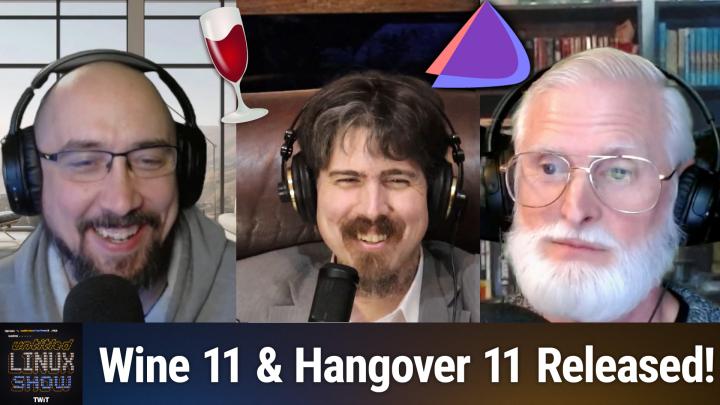
All TWiT.tv Shows (Audio)
Untitled Linux Show 238: More Time to Bake
01:12:15
Pi AI, Wine 11, & IP Certs
Loading summary
Transcript206 lines
- [00:00]
Rob Campbell
How many discounts does USAA Auto Insurance offer? Too many to say here. Multi vehicle discount, Safe driver discount, New vehicle discount. Storage discount.
- [00:09]
Advertisement Voice
How many discounts will you stack up? Tap the banner or visit usaa.com autodiscounts restrictions apply.
- [00:15]
Jonathan Bennett
Hey folks, this week we talk about the bombshell of AI in the Linux kernel world. We talk wine and get a hangover. There is a new AI hat from Raspberry PI, Pipewire, OBS and Endeavor. All have big updates and more. You don't want to miss it, so stay t. Hey everybody. Leo Laporte here with a quick reminder. There are just a few more days to take our annual survey.
- [00:38]
Rob Campbell
Your feedback guides the future of TWiT.
- [00:41]
Jonathan Bennett
You can find it on our website.
- [00:42]
Rob Campbell
TWiT TV Survey 26. Take it before the end of the month.
- [00:47]
Jonathan Bennett
Tell us what you think.
- [00:48]
Rob Campbell
We'd love to hear from you.
- [00:50]
Jonathan Bennett
Thanks in advance.
- [00:53]
Rob Campbell
Podcasts you love from people you Trust.
- [00:58]
Ken Starks
This is TWiT.
- [01:02]
Jonathan Bennett
This is the Untitled Linux Show. Episode 238. Recorded Saturday, January 17th. More time to bake. Hey folks, it is Saturday and you know what that means. We're going to talk about Linux, open source hardware and software, AI gaming, all kinds of fun stuff going on. I have with me a couple of wonderful and talented co hosts. We were talking this week on Floss Weekly. I had Randall back on the show. We were trying to remember what it is that he used to always say. We concluded that it was wonderful and beautiful or beautiful and talented. Something like that. It was a lot of fun.
- [01:36]
Ken Starks
A variation on those.
- [01:37]
Jonathan Bennett
Yeah, variation on those. Probably changed a little bit from week to week. Anyway, it was kind of a throwback episode because we'd Randall on as the.
- [01:44]
Rob Campbell
Co host and Ken is wonderful and I'm talented.
- [01:47]
Jonathan Bennett
Yeah, sure, I'll. I'll go with that.
- [01:50]
Ken Starks
And who's saying this?
- [01:53]
Jonathan Bennett
I know who's saying that. A really, really bad text to speech engine. They have so much better ones out there now. I don't know if any of them. We'll talk about that at the end of the show. I know what's coming. I know what's coming from Ken. He hasn't been able to stop hitting the button to make it say things during the pre show. Even so it's, it's obviously coming. We've got a show to do today. It's going to be fun. We're talking, we're talking AI first off. And there was some. I don't know, do we call it a bombshell? Is that bombshell? It's Almost a bombshell surprise some people.
- [02:28]
Rob Campbell
Rob's got for yourself.
- [02:30]
Jonathan Bennett
Rob's got the story. I guess it shouldn't have surprised us, but Rob's got the story. What was the AI bombshell in the open source world this week?
- [02:40]
Rob Campbell
So as the whole world talks about how to handle AI in open source commits, should we allow it? Should we block it? Should it be part of programming? Where does it even fit? Should it just not be in there at all? The leader of Linux, the open source guru himself, Linus Torvalds, is embracing it. Or at least, at the very least, you know, he's not. He's using it, not shying away too far from it. So publicly. Linus Torvalds has been pretty blunt about the bigger AI debate swirling around the Linux kernel. You know, when developers floated the idea of documenting or labeling AI slop in kernel contributions, Linus basically waved it off. You know, his argument being the people submitting lowquality patches aren't going to self identify anyway, so documentation turns into pointless posturing. Not, not a solution. And in classic Linus fashion, he summed it up with one line. There is zero point in talking about AI slope now. Here's where the story gets a little fun. You know, while that debate rages, Linus spent the winter holidays doing what he often does, which is tinkering. Last year it was, it was literally hardware, a guitar pedal, rabbit hole he once described as Lego for grownups with a soldering iron. This year he went back to his software roots, building a new open source project called Audio Noise. Audio Noise is a GPL V2 licensed set of random digital audio effects. You know, think toy effects, learning projects, the kind of repo you build for curiosity and fun. But buried in the readme is the plot twist. Torvalds admits the Python visualizer and Audio Noise was basically written in by Vibe coding. You know, he joked that he knows more about analog filters than Python and quote, that's not saying much. And that he used to do. You know, in the old days he did the classic Google it and monkey see, monkey do kind of routine. You know, he's copy and paste from, you know, all those places.
- [05:15]
Jonathan Bennett
Stack overflow, stack overflow.
- [05:17]
Rob Campbell
There we go. That's what I was trying to think of. But this time he cut out the middleman and used Google Antigravity to generate the Audio sample visualizer. He used AI in the way a lot of pragmatic developers do to, to speed up the parts. That's outside of their comfort zone, you know, in a low stakes side project. During the holidays break. Why not? And you know, I don't think we will ever see Linux or Linus doing Linux Vibe coding for the kernel anytime soon. But I take this as a sign that, you know, maybe we shouldn't be so hard against something that can be a helpful tool in the right situation. Even myself, I did a little bit of a side Vibe coding myself this week. You know, I made a little thing. Okay, I. I made is. Is loosely. I made a little thing for me to pull. Pull some warranty information from a computer asset list I had. And you know what? I could have, I could have done it. Spending hours on some little project that it wasn't worth me spending hours for, but the 10 minutes it took me to get to something functional, it's definitely worth it. So, you know, if Lightest can Vibe code a Python tool for a silly guitar pedal repo, I think the rest of us are allowed to experiment to a little.
- [06:56]
Jonathan Bennett
I will, I will tell you the difference. The difference is that Linus knows and is not trying to send in those Vibe coded patches to an existing project. Right? That's what, that's what projects are seeing. That is such a problem. That's the projects I'm in, they're saying that such a problem is that people are, you know, they have this. They have an idea and then they, they, you know, they fire up their AI agent and they say, okay, build this thing for me. And they really don't even look at the output. Just maybe check to see if it works. And so, you know, go through cycle after cycle until it finally does the thing that they asked it to do and then push that in and then walk away like, dude, I've done a great thing. It's like, no, you just pushed a 5,000 line patch and you don't know what any of it does, and half of it is dumb and we're not to wade through it all. That's the problem. That's not what Torvalds is doing here. He. He, he knows a little bit, but he knows better than that.
- [08:01]
Ken Starks
And besides, it's playing around. If he's gonna actually publish it, he's gonna take the time to go, it.
- [08:09]
Rob Campbell
Is published on GitHub. It's on GitHub. It's published.
- [08:12]
Jonathan Bennett
It's published, right? Yeah, no, it's just, it's just, it's a, it's a little tiny project that doesn't matter. It's his project, right? He's pushing out. He's pushing out the code. It's his project. And it's not like he's trying to push this into somebody else's repo. So that makes a big difference. You know, someone writing slop AI code and trying to push it into the Linux kernel, they're still going to get shot down. Guaranteed they will. It probably. I bet that the kernel has some filtering built into it so that Torvalds himself doesn't even have to look at it. I bet they have some tooling around that. If not they will need some soon.
- [08:52]
Rob Campbell
Insert your name here. Yeah, I don't disagree with that. But there are a lot of little side projects and heck, that's the way a good, probably a high majority of big projects today started as. So you may in the future see project that started as simple little AI slop that, well becomes something much bigger.
- [09:19]
Jonathan Bennett
Yeah, the, the real question with that sort of thing is what do you do for maintenance? Because like AI is great at writing the first pass on things, but so far it's not been very good at doing maintenance on these programs. Some are very good at making the difficult decisions that me honestly, sometimes us humans have difficulty making. I think that's part of the piece that's missing with a lot of this is, yeah, it's great for slinging some code, but what happens when you get a bug report from a user and it's complicated or it's.
- [09:52]
Rob Campbell
Somebody has to understand it.
- [09:54]
Jonathan Bennett
Somebody has to understand it.
- [09:55]
Rob Campbell
Yeah, I would agree, but that's also today. Who knows where we're going to be ten years from now.
- [10:01]
Jonathan Bennett
I mean it's going to get better and better.
- [10:03]
Ken Starks
Sure, you still want somebody that can understand what that AI is doing.
- [10:10]
Rob Campbell
You just need 10 years from now, you just need a second AI to understand.
- [10:14]
Jonathan Bennett
Well, it's funny you say that. I've seen several different things where it's like, add our AI to your GitHub project so that we can review incoming pull requests and tell you if they were written by AI. It's like, okay, one, yes, this is something we need. Two, this is sort of a ridiculous place that we've come to in the world.
- [10:35]
Ken Starks
And three, who's gonna pay for all of that?
- [10:41]
Jonathan Bennett
The one that I've looked at that I sort of thought about actually installing, it was free for an open source project, but if you were doing it for something closed source, you got to pay for it. That was, that was their funding model.
- [10:53]
Rob Campbell
You know, it's, it's not, not exactly programming, but I've seen discussions and memes about people writing resumes or AI writing resumes. For AI system that's gonna screen it and. Or things like that? Yeah, well, I mean it's.
- [11:09]
Jonathan Bennett
It's been for a while now. You know, one, one guy has written bullet points and told the AI to turn into pros and the AI on the other side turns it from pros back into bullet points. That's. That's happened for a while now. All right, so let's say that you're intrigued by this AI thing. Maybe you actually know what you're doing. You want to be able to run and play with AI, but you want to do it locally and you don't want to use your gpu. What is a fella to do? Well, there is a new player. Not really a new player, but a new option in town. Raspberry PI has released the AI Hat 2 and it's got some really intriguing things on it with it. It'll do. It is based on the hilo, I think, 10H neural network accelerator. It is 40 tops of int4 performance and then it has an additional, I don't remember, several tops of int8, I think is the way that went. And so it's almost like it's got two separate neural processing cores. It's also got onboard ram. It's got eight gigs of dedicated onboard memory. And the idea is that you can actually load your model into that and it will do the inference on the. On the card itself without having to use your Raspberry PI memory. Because that was one of the things that they ran into with the previous AI hat is that people were just running out of the. Running out of memory space and not able to do some of the things that they wanted to do with it. There is a group of supported models. Deepseek R1 distill, llama 3.2, quin 2, quin 2.5 instruct, quin 2.5 coder. And they say more is coming. It's an interesting little card. I don't have one. I've not played with it myself, but I imagine that for certain things this is going to be really interesting that there's a demo about running a kiosk like a self check at a grocery store. And I believe in the demo someone was just moving items across an overhead camera running on the Raspberry PI. And so it was dedicating like part of the AI chip to identifying items and then it was doing something else with the other half of the AI chip. So like some interesting, interesting capabilities here. There is also a review of this thing by Jeff Geerling. He did have one in hand. And his opinions on it was a bit mixed actually. So essentially saying that yes, it's cool that you get a couple of extra things, it'll do things that the original one wouldn't, but it's still not very useful. And I'm going to say that I think this is one of those products that's going to need a few more months to bake. The pie needs a few more months to bake before it, you know, really becomes useful for things. And you know, there will likely be some sort of breakthrough use case, whether it be, you know, a locally hosted natural language sort of add on to Home Assistant, let's say, or maybe one of the open source video recorders like Zone Minder or Frigate, I think is the other one. You know, they may write some code that will let you use this to say classify what the camera see and give you a end of day description of what it was. Maybe you can run that on something like this. So all that to say that I agree with Jeff in that it's probably not super useful right now, but it gives the community a set of tools that we didn't have previously. And I'm just really interested to see what, what open source projects do with those two. And I suppose closed source projects too. There's nothing inherently open source about the, about the PI. Like you can run whatever you want to on it obviously, but I just, I'm interested to see what happens with it. I think people will do some fascinating, fascinating things with this.
- [15:29]
Ken Starks
So you talked with Jeff about it before the show?
- [15:32]
Jonathan Bennett
I watched his YouTube video and we've got that linked in the show.
- [15:34]
Ken Starks
Oh, that Jeff.
- [15:36]
Jonathan Bennett
Yeah, Jeff Gearling. Not, not our Jeff, the other Jeff. Had you guys seen this?
- [15:45]
Rob Campbell
I didn't see that story. It was on my list. I thought I'd wait and see if one of you guys picked it up, but yeah.
- [15:54]
Ken Starks
I glanced through it and I'm going, that sounds interesting. Do I want to get that? Or an ebook reader that I've been looking at.
- [16:05]
Jonathan Bennett
We know the answer to that one. Yeah, I don't know, I may pick one up just to have it to play with it, see what I can do.
- [16:12]
Rob Campbell
Yeah, I'd be curious what along with.
- [16:15]
Ken Starks
Another Raspberry PI 5, of course, and.
- [16:19]
Jonathan Bennett
The hat to be able to run an NVME on it. Another NVME to go with it.
- [16:23]
Rob Campbell
I'd be curious the use cases of that on a PI as opposed to someone with a, a low end PC or something like that. You know, how, how the projects could compare, you know what kind of use cases they could find difference and it.
- [16:39]
Ken Starks
Probably worked better than using an old Lenovo ThinkPad from three or four years ago.
- [16:46]
Jonathan Bennett
Yeah, absolutely.
- [16:47]
Rob Campbell
But low power AI, there's one of the complaints right there. They say how much it costs electricity and all that stuff can do it.
- [16:59]
Ken Starks
How many of those would you need in a data center though?
- [17:02]
Jonathan Bennett
Oh my goodness, a bunch. But that's sort of the idea is the whole idea of the PI AI hat is it's like running AI without the data center. So this would make sense either on premises or in the home. Like on the edge or in the home would be the two places this would really make sense. It's kind of a toolkit to play.
- [17:29]
Ken Starks
With that and more likely you'd find people that got it would already be in the home.
- [17:36]
Jonathan Bennett
Yeah. All right, we have got well, we're going to let Ken talk about pipewire, but first quick announcement. We'll be right back.
- [17:46]
Ken Starks
Well Jonathan, as you said, I'm going to be talking about an article from 9to5 Linux that's about another update to my favorite open source server for handling audio and video streams and hardware on Linux systems. I am talking of course about PipeWire NIST Time version 1.4.10, the latest bug fix release in the PipeWire 1.4 series. This release backports filter graph channel support to make pipewire adopt better to the number of channels of the stream, and backports the Timer queue from Pipewire 1.5. It also limits resampler phases to avoid crashes, adds support for handling some debus errors better instead of crashing, and implement support for more channel down mix positions. Pipewire 1.4.10 also cleans up timed out stream on the pulse server, avoids a memcpy in the convolver, adds a message to force mono mix down in the pulse server and avoid scaling overflow in the clock for the GStreamer multimedia framework along with other small fixes and improvements, I'm going to recommend reading the article linked in our show notes since I have only touched on the highlights.
- [19:15]
Jonathan Bennett
Yeah, need to see things continue on in pipewire. Some of these things look pretty interesting. The ability to make a source and a sink have the same name. That seems like an obviously good idea on one hand and a terrible idea at the same time.
- [19:35]
Ken Starks
Yes or no, right?
- [19:37]
Jonathan Bennett
Exactly. Exactly this.
- [19:40]
Ken Starks
As long as you can add to it at the end a source sync.
- [19:46]
Jonathan Bennett
Now this is a maintenance release for 1.4. There's already a 1.5 out there, isn't there?
- [19:51]
Ken Starks
That's actually Think of it as an RC for 1.6.
- [19:56]
Jonathan Bennett
Okay, okay, okay. The pipewire does the even, odd numbering thing where 1.4 is the stable release, 1.5 is their dev series, and 1.6 will be stable. Yeah, that makes sense.
- [20:07]
Ken Starks
I'm looking Forward to seeing 1.6 come out.
- [20:11]
Jonathan Bennett
Yeah, sure. All kinds of neat tools.
- [20:14]
Ken Starks
Question is, will it be out in time for Ubuntu 2604? Some of the LTS releases that will be coming out this year, Hard to say.
- [20:26]
Jonathan Bennett
Hard to say. And you know, the LTS releases, they tend to be a little conservative on what all they include, so they may stick with the 1.4 anyways. All right, Rob, do you have a hangover? Did you enjoy a little too much wine over the break?
- [20:43]
Rob Campbell
A little too much wine 11 will give me a hangover 11 so wine fans got their yearly big drop and it's a good one. So Wine project leader Alexandra Juilliard said the plan was to ship wine 11 stable on January 13th and right on schedule. What day is today? Okay, well, it's a few days ago, right on schedule. Wine 11 landed on January 13th. So if you use Linux and run Windows apps or games, this release is basically a greatest hits album of things getting less painful. The headline feature is NT sync, not to be confused with that boy band NSync. It features NTSync support, but you know with the catch, it's meant to shine on newer Linux kernels 6.14 or newer, where the ntsync module can better emulate Windows NT synchronization primitives, which translates into fewer bottlenecks, less overhead, and potentially better performance in demanding games and apps. The other big milestone is the new Wow 64 windows. On Windows 64, I believe that stands for architecture being considered fully supported and feature complete, including 16 bit app support in their newer Wow64 mode. And that's a big quote. We finally finished the migration moment for the project and then it's just a bunch of other wins going on, such as exclusive full screen, a more capable Wayland driver with clipboard and input improvements, better Vulcan support, including newer APIs and Win32 oriented extensions, and even hardware H.264 decoding through D3D11 using Vulcan video, plus ongoing joystick and gamepad handling improvements. And because Wine isn't just wine, it's the foundation that eventually feeds into Valve's proton. You know, the great gaming thing that has is has been a huge part of why Linux gaming has been so successful and such a huge up upswing over the last couple years. Now the bonus of this is the hangover. You know, after you have a great, a great wine right afterwards you get the hangover. So for arm fans, Hangover 11.0 dropped right after Wine 11, right where you'd expect it. Hangover is basically wine. But for ARM64, by pairing Wine with Fexemu or Box64, Windows apps and games can run on native ARM64 Linux systems. And some of the notable things is QEMU support is gone from there because Fex and Box 64 are just simply better tools for the job. The project is leaning into the better tools and slimming down to roughly 10 patches on on top of upstream swine. It also adds more pre built packages for distros like Ubuntu 25.10 and Debian 13. So 111 keeps making Linux Windows compatibility better. And Hangover 11 is a reminder that the ARM64 future is coming. Will this be the year of Linux gate of Linux gaming on arm? Because if it just works on arm, that's, you know, that's when it really gets interesting. And you know, we already know Valve is coming out with some interesting ARM devices this year. So yeah, all this is, I think this all going to come together to be a very interesting year.
- [24:56]
Jonathan Bennett
Yeah, so the new Wow 64 is super interesting. We've talked about this in the past where Linux distros are getting rid of multilib support. So that's essentially where you have a whole bunch of 32 bit libraries installed side by side with your 64 bit. And we've asked ourselves before, it's like what happens to gaming? Well, under Wine, you now no longer need the 32 bit libraries on the Linux side. It just works. They've got the, they've got the transition layer, the, the, the smarts built into those underneath the hood libraries that come with wine.
- [25:33]
Rob Campbell
Right. That has been a major argument in the past when distros were going to drop all their 32 bit libraries and then, and then pretty much. I think Steam or at least Steam supporters made a big fuss about it when they, and they, they kind of pulled back on at the time. So now it's not going to be as much of a issue in the.
- [25:57]
Ken Starks
Future except for computers that Valve's going to be framing Wine.
- [26:04]
Jonathan Bennett
I mean they already are. It's an interesting pun. Another interesting thing about this is you've actually got a lot of old Linux releases that were 32 bit. A lot of not very old Linux releases were 32 bit only and so those would still need multi lib. It's interesting that once again Windows is the long term solution for writing a game and being able to play it on Linux. The games that were written for Windows play better now than, you know, a 10 year old or 15 year old game that was actually ported to Linux. It's, it's sort of bitterly hilarious. Yeah, I don't, I don't know how I feel about that actually.
- [26:49]
Rob Campbell
Linux is a place for legacy Windows.
- [26:51]
Ken Starks
Games, especially since I guess one way to put it is lately Windows has been putting its foot in its mouth.
- [27:00]
Jonathan Bennett
Well, I mean that's been going on for a long time lately.
- [27:03]
Rob Campbell
For the past 30 years. More.
- [27:06]
Jonathan Bennett
I don't know, something like that.
- [27:08]
Rob Campbell
40?
- [27:10]
Ken Starks
Well, at least with the, especially with the latest version.
- [27:14]
Jonathan Bennett
Yeah, well, I mean they, they, they wanted to rush and put AI into it so bad that they, they made it creepy. That's, that's the thing that I think will really get them.
- [27:23]
Rob Campbell
Many could argue, I mean many could argue that's not the worst thing they've done. I mean, do you not remember Windows 8?
- [27:31]
Ken Starks
I'm trying not to.
- [27:33]
Jonathan Bennett
No, I am. Still, we talked about this. We won't go into it in depth, but I'm still quite convinced that making a desktop making system creepy is far worse than making it buggy or broken or annoying. I think creepy is the worst thing.
- [27:46]
Ken Starks
That they could have done because look how many people have put up a buggy or broken for decades.
- [27:52]
Jonathan Bennett
Indeed, on all kinds of places. All right, so we've got an interesting story here for the again for the home labbers, for the budding sysadmins. I'm going to talk about something really cool at. Let's encrypt right after this.
- [28:09]
Rob Campbell
Good morning crust. It's a great day to be a bread brother. Mornings are not my jam or jelly. Oh come on, stop loafing around. I just woke up feeling hollow inside. Just grab one of the new morning uncrustable sandwiches like Bright Eyed Berry or up an apple filled with 12 grams of protein and tons of deliciousness crust.
- [28:31]
Jonathan Bennett
What are you eating?
- [28:33]
Rob Campbell
It's just granola.
- [28:35]
Jonathan Bennett
Not even yogurt. No crust, no fuss.
- [28:38]
Rob Campbell
Uncrust your mornings. New year, same extra value meals at McDonald's. So now get two snack wraps plus fries and a medium soft drink for just $8 for a limited time only. Prices and participation may vary. Prices may be higher in Hawaii, Alaska and California. And for delivery, well, the holidays have come and gone once again. But if you've forgotten to get that special someone in your life again gift. Well, Mint Mobile is extending their holiday offer of half off unlimited wireless. So here's the idea. You get it now, you call it an early present for next year.
- [29:09]
Jonathan Bennett
What do you have to lose?
- [29:10]
Rob Campbell
Give it a try@mintmobile.com Switch limited time.
- [29:14]
Advertisement Voice
50% off regular price for new customers. Upfront payment required $45 for three months, $90 for six month or $180 for 12 month plan taxes and fees. Extra speeds may slow after 50 gigabytes per month when network is busy. See terms.
- [29:25]
Jonathan Bennett
All right, so let's encrypt. It is the boy. It's the service that's really changed the way SSL certs works and they're changing the game once again. So ssl, I'm sure everybody knows, but it lets you take a domain name, like a DNS name and get a certificate for it. That one proves that you are indeed the owner of the domain. But it also is used to encrypt the traffic people send to and from it. It's essentially what you need to be able to have HTTPs instead HTTP connections, at least connections that a browser will validate and give you a green. I don't even think it's green anymore. I think it's just by default these days and you get like a red X. If it's HTTP only or a bad certificate, it won't even let you load it. Regardless, this has been for domain names for the longest time and I have a few times wondered, well, what if you just have an IP address? Can you do anything with that? Well, turns out that yes, you can indeed do SSL certificates, HTTPs certificates for IP addresses. And let's encrypt now supports those for six days. So there's, there's a bit of a wrinkle here. If you get one of these IP address certificates from let's encrypt. That certificate has a lifetime of six days. It is still free, but very, very rapid. Does not last long at all. Now if you have let's encrypt set up, you should have it set up to be automated run, you know, throw it in crontab, run the job once a night and it should just take care of things. So this really shouldn't be anything different. But six days is pretty fast. And of course they're doing that because IP addresses can change, particularly if you're on a dynamic IP like on your home ISP you might be, but it's very cool. January 15th. So by the time you hear the Show. In fact, by the time we're doing this show they are available and they last for 160 hours. I'm going to have to mess with this. I'm going to have to try this out. I've not yet, but I do occasionally want to be able to do something on just an IP address, be able to just throw something up and test it without having to get a domain name for it. So pretty cool. Pretty cool stuff.
- [32:02]
Rob Campbell
This is the first I heard of this, but I could definitely see some use cases. There are times when you have some little home server project or some little project that you want to be able to access anywhere in the world but. Or, or in a regional or whatever but outside of your home maybe bound a vpn. But you know, one problem is as soon as you register a domain it kind of tells the world hey, it's right here and it makes you a target, you know. So if you're just doing a little project but you want to have the HTTPs using that per the IP address, sounds like a great solution for that to help keep it private. Because I imagine it doesn't. I don't know. I mean I guess I don't know if that would get published in some system somewhere that would be publicly accessible that they could scrape or not, but I guess that's.
- [33:00]
Jonathan Bennett
I'm not sure. That's an interesting question whether there is a list of all of the let's encrypt certificates there might be out there somewhere.
- [33:09]
Rob Campbell
And I know they could still find you by scanning all the subnets, but it's still not as quick.
- [33:15]
Jonathan Bennett
Right, right. Which does happen. Happens more than you think. A couple of people out there did some work, Robert Graham being one of them, and put some software together that can actually scan the entire IPv4 Internet pretty quick.
- [33:29]
Ken Starks
So could you potentially use this for the IP address? 1 I want to say 127.0.0.1 no.
- [33:41]
Jonathan Bennett
So this is only going to be publicly routable IPs so no local IP, you know, no 192.168 no 10 dots. No 127 dots. All of those that are special.
- [33:55]
Rob Campbell
Multiple reasons because I mean one, when you do a certificate registration, you have to have communication to prove that that's your IP and you have to prove.
- [34:07]
Jonathan Bennett
To control the IP address. Yeah.
- [34:08]
Rob Campbell
It has to be unique. Which public or private IPs just aren't unique. You can't say you get a certificate and you get a certificate and then it just kind of ruins the whole point of Having a certificate.
- [34:20]
Jonathan Bennett
Yeah.
- [34:20]
Ken Starks
So. So you couldn't use it to. As a no certificate for your VMs. No.
- [34:28]
Jonathan Bennett
Well, unless. Unless you put them on the. If you gave them full public IP addresses, you could. I will tell you it's. It's an interesting question because there is a way to do that. It's kind of a pain, but it is possible and that is you can stack multiple domain names on the same IP address. So you put multiple domain names on your external ip, you let let's encrypt do the process to renew those and then on your internal network you can add that to your hosts file and remap those domain names to local IP addresses and reuse those certificates. That is about the only way I know of to do HTTPs in a way that a browser will respect it inside your network for those local only IP addresses.
- [35:12]
Rob Campbell
Yeah, I know of some places that have private resources, a server that's only internal and they open up their. They open up to the public roughly every 90 days to let. Let's encrypt renew it. Just so, just so it has the HTTPs internally.
- [35:36]
Jonathan Bennett
Yeah, yeah, that makes sense. I say that, I guess the other way that you could handle that, you could sign it, you could become your own certificate authority. You could sign them yourself and then import your. Your sort of root key into your browser. That is possible to do too.
- [35:52]
Rob Campbell
I think there is also now a way. I'm pretty sure, I think I'm actually doing it. I don't know. I set stuff up and I forget how I did it because it's so long ago. But I think one of the ways to authenticate let's encrypt is through DNS only. And I think with that setup you don't have to have that port 80 open. I'm pretty sure I have that on a server.
- [36:15]
Jonathan Bennett
Because you can push a DNS text update. Yeah, I think that's correct. Which is fairly useful to be able to do that. Yeah, Ilag points out you can. Welcome back. I like by the way, glad to have you in the audience again. You can add your company to the trusted authorities. Yes, you can. You can sign your own become essentially become your own certificate authority. I'm not sure which would be more of a pain, becoming your own certificate authority or mapping multiple domain names and then trying to use those certificates internally. Both of those sound terrible. We need an easier way to do this.
- [36:53]
Ken Starks
They probably both have the same pain.
- [36:55]
Jonathan Bennett
Level, probably just in different ways. So you want to make sure and do both of those so that you have that amount of pain evened out. All right, so what is next? Obs Ken, there's an OBS update. I got real excited about this and then they didn't do any of the things that I've been waiting for.
- [37:14]
Rob Campbell
So now I'm less excited about it.
- [37:15]
Jonathan Bennett
What is new in 32.1?
- [37:19]
Ken Starks
Well, it's actually not 32.1 yet, but 9 to 5. Linux also wrote about the release of a powerful open source cross platform and free software for video recording and live streaming which is now entering public beta testing. I am talking about OBS Studio 32 beta 1. Now it promises several new features including web RTC simulcast support, a new add source dialog and a new audio mixer. Now OBS Studio 32 beta 1 also fixed an issue with pipe wire when capturing a device that does not require a frame weight, addressed an issue where the an Nvidia blur and background blur could have banding or look splotchy and fixed an issue where video scaling could be incorrect in multi video encoder scenarios. Now as always, check out the article for more details because I just wanted to touch on the highlights.
- [38:32]
Jonathan Bennett
Yeah. And so I looked into. Let's see, there was one of these that sounded real interesting. I looked into it. It was the multicast.
- [38:43]
Ken Starks
The motive, video encoding scenarios for video scaling.
- [38:48]
Jonathan Bennett
No, not that one. Multicast RTMP I believe is another one I saw on a different WebRTC. WebRTC simulcast, that's what it's called. I looked into that and it's like what are they doing here? Is that letting you stream WebRTC to multiple endpoints? No, specifically that is you're streaming WebRTC with multiple levels of detail and so you've got like one stream that is your full quality and then you've got a second stream in there that is a lower quality and a third stream maybe that's even lower quality, lower bandwidth for each of those. And that is, that is what the WebRTC simulcast is which, you know, for certain use cases I'm sure that's useful, but not, not any of the things that I'm doing with, with obs.
- [39:36]
Rob Campbell
Multiple streams would be nice and there.
- [39:39]
Jonathan Bennett
Are people working on that. That's what that's. I was hoping it was, it was work in that realm. But no, not yet.
- [39:46]
Rob Campbell
So then it could be mixed somewhere.
- [39:48]
Jonathan Bennett
Else or, or so that you, you can run instead of doing something like a virtual camera. One of the things that people are working on is the ability to shuffle video and audio from one OBS instance directly out to another. And that's going to be very interesting for recording things like this. We could just all have OBS running and it could connect us. We'd have really low latency audio and video between ourselves. But not yet. It's not there yet.
- [40:19]
Ken Starks
And then have the OBS running on a media server. Say, that would actually record everything.
- [40:27]
Jonathan Bennett
I mean, potentially. Yeah, yeah, you could potentially do it that way. Lots of. Lots of options once all of these things finally get fully baked and working. All right, do we want to talk about Budgie?
- [40:44]
Ken Starks
No.
- [40:45]
Jonathan Bennett
No.
- [40:46]
Rob Campbell
All right, Ken, you just stay silent for this one and I'll talk about it. I'll let Jonathan respond, but you can't say anything.
- [40:53]
Jonathan Bennett
Rob and Jeff. Rob and I will talk about. Not Jeff. Jeff's not here. Jeff's not going to talk about it either. Rob and I will talk about Budgie, but we'll do it right after this.
- [41:04]
Rob Campbell
So the Budgie desktop environment just hit an important milestone, and I don't think enough people are treating it like the big deal that it is. So Budgie 10.10 is officially out, and the headline isn't a new theme or new applet. This release is Budgie's we did it moment, with an Official migration from X11 to Wayland being complete.
- [41:32]
Jonathan Bennett
I knew it. I knew it, Rob. See, we talked about this last week and my comment was Rob would want to talk about this, but he's not here, so I'm gonna do it. We helped you, man.
- [41:46]
Rob Campbell
You know, it's fine.
- [41:49]
Jonathan Bennett
Continue on. Sorry to interrupt. Don't want to.
- [41:53]
Rob Campbell
I wish I would have caught last week's to. To know what I'm overlapping on airplane. You know, it's kind of a landmark release. And, yeah, I. I'm the whaling guy here. I mean, we all love whaling, but I'm the guy who has to talk about it because it's a big deal. And, you know, this frees them up to focus on what's coming Next with Budgie 11. Did you talk about Budgie 11 at all?
- [42:17]
Jonathan Bennett
No, we did not.
- [42:18]
Rob Campbell
That one you can talk about, you know, Budgie 10.10, you may have talked about that. It was supposed to arrive back quarter Q1 of 2025, but, you know, as their first Whelen only release. But it seems. It seems to be, you know, it's. It's a little bit behind, but still years ahead of what Mint is doing with Cinnamon and Whelan. You know, the facts that are that, you know, Waylon is. Wayland is no longer the future. Guys, it's the present and you know, if a desktop environment is still stuck in, you know, someday we'll get there. That's kind of a problem for me, you know, especially when the rest of the ecosystem has moved on. Now my spicy take on this. I think Budgie should be the lightweight desktop choice for modern desktops, you know, and I think, you know, Linux Mint should seriously considering offering Budgie as a first class option. You know, maybe even instead of their Cinnamon for people who, you know, they want something lighter, cleaner and more modern and still meets that Windows look. Windows look like style that, that they're kind of aimed for right now with Cinnamon. You know, Bungie has all the things that people seem to love about Cinnamon. You know, it's lightweight like Cinnamon has that Windows look and feel like default Cinnamon, you know, not my favorite design paradigm. But some Windows users are more comfortable with that look and feel and that's fine. Really. I don't want to use that design. I'm going to edit it. But anyway, meanwhile, you know, you got Cinnamon. You know, look, I get it. People, people love, love Cinnamon. Linux bent. It's been a great, a great thing for new Linux users. It's just about a huge boom lately, you know, and it's great if you don't dig in too far under the hood. But you know, because Cinnamon is a very sleek desktop, it works extremely well, but you still have Wayland as the elephant in the room. You know, while most Main street desktops have had Wayland stable for a while and you know, already going all in on Wayland, Cinnamon is only at the beginning of, it's experimental. It's, we're working on it. Let's, we'll make, we'll get there eventually, you know, and you know, work has hinted that, that there is a much longer Runway to go still for, for Cinnamon before it's ready and stable for them. You know, I'm not predicting it's going to be this year. I don't know if I don't think I said that. Maybe I should have predicted that. But you know, for a desktop to be that far behind in Wayland in 2026, that's, that's that's an issue for me. Sure they will catch up at some point, but then the next big thing will, will be out and they will be years behind on, on, on that next big thing. Well, while the Budgie team isn't just stopping at we moved to Wayland. They're already laying out the Budgie 11 groundwork where Budgie 11 is going to be Qt 6 based desktop, which is like KDE plasma. I believe that's QT and it's going to be more modular and likely they're going to be leveraging some of the KDE frameworks for shared libraries and plumbing. So there's a bonus for KDE people who want something maybe a little lighter, you know. In other words, budget plans to keep moving towards a more modern toolkit, cleaner architecture, more flexibility for users and distro integrated integrators, while others seem to be stuck in the past. So Budgie 10.10 is the we made it to Wayland release that I guess you already talked about last week, but Budgie 11 is, we're redesigning this to last release that's coming up. And if Mint wants a lightweight desktop option that doesn't feel stuck in the past like their current DE options and still feels familiar to Windows users on day one, I'm just saying Budgie's there.
- [46:36]
Jonathan Bennett
Indeed, indeed. It's a fun. I've never run it, but it looks like a fun desktop, a fun option I've tried.
- [46:45]
Rob Campbell
Really fits that paradigm of like Cinnamon.
- [46:50]
Ken Starks
And Mate and kde.
- [46:57]
Jonathan Bennett
I mean, I mean it's in the same.
- [47:00]
Rob Campbell
It uses the same toolkits and stuff as kde, but it doesn't have a feel at all. You know, KDE is kind of like that, that full blown, here's all the awesome stuff and whatever to it where, you know, here you got. If you cut down KDE to its basic, you know, if you, you modify KDE to its most basic desktops, you could make it probably. I mean you can make them all to be just like each other.
- [47:26]
Jonathan Bennett
So for the most part, yeah. Yes, yes, indeed.
- [47:32]
Ken Starks
KE equals Gnome equals Budgie Eat equals Endeavor os.
- [47:36]
Jonathan Bennett
I don't know that I would go that far. That's a little, that's a little too far. That's a, that's a, that's a bridge too far, my friend. All right, let's talk. Let's talk about Fedora. Actually, little chat about Fedora. I was chattering in the chat room behind the scenes that my framework 16 is running Fedora and we are happy having a good time with Fedora on the framework. No particular problems there. I came across a story this week that Fedora first off has a Games Lab spin. How many knew that? And secondly, they are moving it from XFCE to KDE Plasma, maybe for exactly the reasons that Rob was just talking about. XFCE is a little behind on some things, but first off, let's talk about Fedora Games Lab. Now this is not, this is not the spin that you would choose to play AAA games. This is not the spin that you want to choose to play, you know, Crysis or Doom Eternal or any of those more modern. I know neither of those are actually really, really modern games, but you know what I mean, you know, you're not playing your modern AAA games on this is not what it's about. This is not intended to run Steam on it. That's not the sort of thing we're looking to do. This is basically the place to find and get pre installed open source games is really what it's all about. And so you know your tux cart, probably a bunch of emulators because most of those, the emulators themselves are open source. You know, there are first person shooters like Tremulous and multiple others. There's, there's some turn based strategy games like 0ad. There are actually a lot of really high quality open source games out there. And so the Fedora Games Lab is all about having a place, a distro, a spin of Fedora that pre installs a bunch of those for you and just lets you play. That's what it's all about. And the folks behind it are looking to modernize that spin. And well, the way to do that for Fedora 44 is to bake it on top of KDE Plasma. Existing users will be able to continue using the XFCE desktop environment if they want to, but with Fedora 44 the new default install of Fedora Games Lab will be on kde. And yeah, it's an interesting idea. I've never tried this spin and I think there's probably a way to do a group install. I haven't looked, but I bet there's just a group install games inside of Fedora to get all of these packages if you really want to. But maybe setting up a computer for the kids or for going away on the weekend, you know, what have you might be something interesting to look at.
- [50:43]
Ken Starks
Yep, sounds like it's going to be something that you'd want to put on a Raspberry PI.
- [50:50]
Jonathan Bennett
Yeah, I bet there is a Raspberry PI spin and Fedora. I don't know about the PI 5 but I know previous versions of the PI. Fedora has gotten to the point where it works pretty well on those. Yeah, that's probably worth thinking about. All right Ken, you've got another OS update. What is up with Endeavor?
- [51:09]
Ken Starks
Well, this week Lineax's Bobby Borisov and 9to5. Linux's Marcus Nestor wrote about the latest stable. Excuse me. Snapshot of the Arch Linux based distro Endeavor OS Ganymede Neo. It is shipping with updated core components including Linux kernel 6.18, Calomeras 26.01, Firefox 146, Mesa 25.3, Xorg server 21.1.21 and Nvidia utilities version 590.48. Now Plasma desktop specific installation improvements include the Qt 6 virtual keyboard replacing the Mallet virtual keyboard for SDDM and other improvements for other desktops. Now Endeavor OS Ganymede Neo also brings a significant change in Nvidia driver handling. In response to upstream developments, Endeavor OS has switched its proprietary Nvidia option to use Nvidia Open. For more details, check out the show notes and maybe even go play with it.
- [52:34]
Jonathan Bennett
Yeah, cool. Have any of us ever run. I've never run Endeavor os. Was that one of the ones you tried, Rob?
- [52:43]
Rob Campbell
I have tried it out before when I went to Arch. I did usually or I kind of tested it very briefly and one of my use cases so. So Endeavor OS it's, it's Arch based but very simple to set up. When I had an Nvidia card, I could not get, you know, the. What was it? Pac man install or Dash S, I guess Nvidia. Every time I try to install Nvidia on my Arch, it wouldn't boot up afterwards. So then I tried Endeavor OS and you know, they have a. A really nice, at least they did at the time, a really nice system to just check a box and install Nvidia and it worked. So I'm like, how is it doing it? Why is it working on here? So basically I dug into Endeavor OS to see how they did it and, and they were installing as a dkms. So once I figured that out, I went back to Arch, installed as a DKMS and it worked fine. And then I got rid of my Nvidia card and bought AMD and, and just never looked back after that.
- [53:45]
Jonathan Bennett
But there you go.
- [53:47]
Rob Campbell
That's my life story.
- [53:49]
Jonathan Bennett
Your life story in a nutshell.
- [53:51]
Ken Starks
When you have problems with Nvidia, change the hardware.
- [53:55]
Rob Campbell
Yeah, I mean, after I got it to work, that's why I changed the hardware. I mean, I had it working, but this is dumb. It shouldn't be like this.
- [54:06]
Jonathan Bennett
It shouldn't be like this. That's funny. All right, I think those are our stories for the week and we've got. Yeah, that's the last one. We've got some command line tips. Talk about that. We've got some fun ones to talk about. We're going to come back to some things we talked about last week and I've got some pizzazz I'm going to show off. But we're actually going to let Rob take the first command line tip right right after this.
- [54:36]
Advertisement Voice
If you used Babel, you would Babble's conversation based techniques teaches you useful words and phrases to get you speaking quickly about the things things you actually talk about in the real world. With lessons handcrafted by over 200 language experts and voiced by real native speakers, Babbel is like having a private tutor in your pocket. Start speaking with Babbel today. Get up to 55% off your Babbel subscription right now at babbel.com Spotify spelled B-A B-B-E-L.com Spotify rules and restrictions may apply.
- [55:04]
Rob Campbell
All right everybody, this week's command or this week's tip for me is a command line tip. The application I'm using is called csvi and is a command line tool to view and edit CSV files. You do need to install the golang tool. So in Ubuntu I did a sudo apt install golang before I followed the steps on the GitHub page to install this. So for those watching, so this is at GitHub.com hymkor csvi so for those watching I made a test CSV file just to play around with. So I'm going to type csvi test CSV so I'm going to do that. And this is just some demo junk stuff, not real data. In fact I had chat GPT make me some some data. So with this I can move around. I am using you can use apparently use arrows or hjkl. So it's very it's supposed to be like vi so that's why it's CSV and then I so vi is at the end. So it has a lot of buy or vim like commands. So I'm using the HJKL to navigate around the cells because I'm not sure if I found a bug. But when I navigate around with the arrows every once in a while when I push the back arrow it was deleting the whole line. So I'm going to dig into that and maybe submit a bug for that if I figure out because I don't know why it was doing that for me. So if you use this right now, use the HJKL to navigate around.
- [56:59]
Ken Starks
So.
- [56:59]
Rob Campbell
You can then you can use things like DD if you want to delete a line. And I just deleted the 1007 line. Now if I want to insert a line, you do the capital O. So shift O and it's going to insert a line. So I'll put the 107 back in there. Hit enter. And now I want to append a cell. So a will append a cell and John, enter a do enter a.
- [57:33]
Jonathan Bennett
New.
- [57:34]
Rob Campbell
Alm, enter a one enter. So there are a lot more keyboard shortcuts. You know, if you're moving around, you want to. I made a mistake. That wasn't supposed to be one. Let's say, let's say that was supposed to be something else. I press R to replace it and let's make that. I meant to have 12 enter. And there are a lot more commands. So if it's something keyboard key bindings, I guess there are a lot more key bindings. If it's something you're interested interested in. Find the project on GitHub, look at our show notes, click on the link, install it and check it out.
- [58:17]
Jonathan Bennett
All right. Very, very cool. I like it a lot. All right. In fact, I was talking before the show. I've got some CSV data that someone's going to be giving me here shortly and I might use this to look at it. It seems very useful. All right. Ken, you did a good job in not playing with your command line tip during the show. At least not very much. I imagine you're about to make up for that. What do you have for us?
- [58:44]
Ken Starks
Well, this week, Mike and Lamanline tip is the command espeak dash ng. It's a multilingual software based text to speech editor. Let me go ahead and bring up my screen here so y' all can see it. Is that big enough for everybody to read?
- [59:03]
Jonathan Bennett
That's not too bad here.
- [59:05]
Ken Starks
Okay. And as I said, it's espeak-ng. From the command line you can type dash dash help and that will give you all this information about what you can use to do it, how you can adjust the amplitude, have it go to a specified device for the audio, change the word gap or this pause between words. Have it indicate capital letters either with a sound, the word capitals or change its pitch, set the align length, adjust the pitch for the voice and set the speed in approximate words. The default is 175. I'm finding that a bit fast myself. In fact, let me go ahead and give you a simple demonstration here. That's using a English voice with a Swedish accent. I've also got some others here. And the way I've got it set up, if you look at the command line tip there, it's got a dash D and I've got it going to my Alsa underscore output USB dash Burr Brown from TI USB audio codec analog stereo output. So that's actually getting the audio and then I'm taking the monitor for that and piping it in. So it's going in alongside the my mic output to Firefox. And here we're demonstrate with a different.
- [60:52]
Rob Campbell
Hello world.
- [60:53]
Advertisement Voice
Espeak-ng is a command line tool for Linux that converts text the speech. This is a compact speech synthesizer that provides support to English and many other languages.
- [61:07]
Ken Starks
And you can change the speed that it talks at by changing that the number of words per minute. I'm going to Change that to 125, not 1250. See let's change the pitch down just a little, see how that affects it. And if that's Jonathan, is it too loud? Should I turn the amplitude down?
- [61:36]
Jonathan Bennett
It seemed about right. Maybe a tiny bit down if you want the excuse to go play with that setting.
- [61:44]
Ken Starks
But there we go and I'm going to Change it to USB 2. Now if you'll notice, this particular voice says MB MB US 2.
- [62:00]
Rob Campbell
Hello world. Espeak NG is a command line tool.
- [62:04]
Jonathan Bennett
For Linux that converts text to speech. This is a compact speech synthesizer that.
- [62:11]
Rob Campbell
Provides support to English and many other languages.
- [62:16]
Ken Starks
But if you want to see all the voices you can do espeak-ng- dash voices and there's all the voices and languages that it provides you. I can also narrow that down by saying equals EN for English language. And there's all the different voices there. Some of them are the MB or umbrella using that format. So. But it's a great tool to play with. I've actually got one of the scripts that I use on a. Or on a daily basis actually comes up saying load and the name of that function that I run.
- [63:16]
Jonathan Bennett
Yeah, so I, I'm just kind of thinking here the, the current crop of AI tools really makes. Really makes this one Espeak ng sort of show its age. I think someone in Discord was joking that it sounds like the way the things sounded back in the 80s. In fact that was Rob that was joking about that.
- [63:39]
Rob Campbell
Do you know, reminds me of my real Talk Baseball handheld gaming system I had back then.
- [63:45]
Jonathan Bennett
Yeah. I'm curious if the. If the Espeak NG guys are like looking at adding some of these more sophisticated AI based Models. Or if there is a sort of a next next generation espeak ng the next next generation.
- [63:59]
Ken Starks
Or you can use that AI AI to help with creating the language in the phonetics breakdown that you need the dictionaries to help to improve it.
- [64:11]
Jonathan Bennett
What would they call that after the next generation? Would that be in Speak Voyager?
- [64:16]
Rob Campbell
That'd be nine deep. I don't know.
- [64:22]
Jonathan Bennett
Deep Speak nine deep.
- [64:23]
Rob Campbell
Speak nine. There we go.
- [64:27]
Jonathan Bennett
Nice. All right, that's fine.
- [64:30]
Ken Starks
It's even got options, so you can go in and compile voices.
- [64:34]
Jonathan Bennett
Yeah, no, it's a cool tool set for sure. And I'm sure that there are some options out there to make it better. It's just in our current realm of AI overlords again. It's beginning to sound sort of dated. All right, so something we talked about last week was the. The death of screensavers. And I am back this week to let you know that their death was exaggerated. So let's see. Here we go. I'm sharing. I'm sharing my screen. So this isn't KDE, right? This is KDE 6.6. I think it's either 6. 5 or 6 6. I believe it's 6 6. And there. There is. There is some news to share. And the way you get to it is really weird, but it is in here. So to set up your screensavers in kde, you start with your wallpaper. You may actually want to start by installing a program called X Wayland Dash Run, which lets you run Wayland Program. Excuse me, lets you run x11 programs inside of Wayland from the command line. That one's reasonably important. And then you go to your wallpaper settings in kde. There's an option here, it's called Get New Plugins. And this is where you get to look at the wallpaper plugins that exist inside of KDE that various people have compiled. There are some really interesting ones here. One that I was just playing with is the Shader Wallpaper City Grow. There is Game of Life. I've not looked at Rain. It could be interesting, too. Live Snow, the Matrix code. Looky there. But there's one in particular that I have found that is super useful for this. And it's called Application Wallpaper. See if I can get it to come up here in this list. It is here. Application Wallpaper. I do think I already have it installed. Actually, I installed it manually instead of through this list. But this lets you run any application as your wallpaper. So just as an example here, let's say we want to use the Matrix Rain wallpaper as again our wallpaper. Let's hit apply and see what happens. Well, you can see I now have a dynamic background to my computer, which is super cool. And there are a bunch of options here if you really want to go crazy inside of Shader. There's one here. E1M1. Of course it doesn't want to work. I had some problems with Shader. It didn't want to work. Let's see if I can get it to go. Nope, it doesn't want to play. Worked earlier. I'm not sure why it's not now. Anyway, multiple options. This is all worth playing with. But then you can go to your main KDE configuration here and go down to screen locking. And there is a button here that is almost hidden and it's configure appearance. And then you can go in here and pick the wallpaper for your screen locker. And then all of those that we just installed as live desktop backgrounds we can also install as screen locker wallpapers. And then you can also go and say show the clock only on the unlocking prompt. And so once you do this, you once again have a screensaver. Now, I'm not sure what's going to happen when I hit this, but we're going to try to lock and let you take a look at it. Can you guys see the Starfield whipping by?
- [68:40]
Rob Campbell
Yep, yep.
- [68:43]
Jonathan Bennett
Indeed. I will punch my password in on the other screen. That way you can't even see how many how many characters it is because I'm security conscious anyway. So that is how under KDE at least you can get back to having a screen saver. And I've been playing around with that on this computer on the desktop behind me, and I've been having a lot of fun with it.
- [69:10]
Ken Starks
You can also do the on your wife's computer?
- [69:12]
Jonathan Bennett
Not yet, but I bet now that I've done the walkthrough on how to do it, she's probably going to set it up because she was telling me last week just after we finished the show, she goes, I too miss screensavers.
- [69:25]
Rob Campbell
So that was a good show.
- [69:27]
Jonathan Bennett
It was a good show. One of the other fun things about this, I've got some possible commands that you can run. It is actually possible to run wine and therefore run a SCR as your lock screen wallpaper. So if you really want to, you can go pull classic Windows screensavers and use them via wine.
- [69:53]
Ken Starks
Do I have any from Windows 95?
- [69:56]
Jonathan Bennett
Well, there's a couple of websites out there that appear to be replicated, repeatable, that you can go download them from. And yeah, so I spent some time with that too. Now I did run into an issue. It's probably something you could work around. But I did. I ran out of time to figure out what was causing it. WINE would not run a screensaver on two monitors at once. It would work properly on one monitor and then put an error message on the other one. So something. And I know that the way this is working is when you lock your computer and it shows that screensaver, that wallpaper, it is a separate process for each screen. And so something about asking WINE to start the same thing twice in two separate processes. It doesn't like. I'm not sure exactly why. There's probably some way to work around that. But yeah, screensavers are back on the menu. I was excited. I thought it was pretty cool. Guys, I'll have to send us in screenshots of your screensavers under Linux between now and next show. That'd be fun. I want to see what people come up with because there's some great old school screensavers out there. All right, well, that is the show and it's been a blast. It's been a lot of fun. Appreciate everybody being here. Thank you to Rob and to Ken for being here. I will let each of the guys plug whatever they want to get in the last word on something. We'll go from left to right on the radio dial. That means Rob gets to go first. What do you have for us to close the show, Rob?
- [71:26]
Rob Campbell
Did you have to bring up our names before you said them? You're slowly saying the names and then the names popped up below us and then you're able to finish. I feel like you had to think about that.
- [71:37]
Jonathan Bennett
I was trying. My mouth was trying to say Jeff and I knew Jeff was not here.
- [71:43]
Rob Campbell
All right. A listener of ours did send in a poem for me to do, but graciously, I am giving that one to Jeff or I am letting Jeff take it.
- [71:56]
Jonathan Bennett
We.
- [71:57]
Rob Campbell
We did talk about this poem earlier in the week. Jeff really wanted to do it, so I will save that for him for next week. But thank you for sending that poem to me. And additionally, if anyone else has anything, you know, they want to send a poem for, for Jeff or something for me to share or whatever, you know, contact us on social media or whatever. And how you can do that is you can find me@robertp Campbell.com and on that page near the top there's a links little buttons to my LinkedIn, Twitter, Blue Sky, Mastodon. And if you really want to give me a special message, you could put that right here in the little coffee cup. You just click that, donate a coffee to me and. And put a little message in there. It could be anonymous or it could be for the world to see.
- [72:52]
Jonathan Bennett
Very good. All right. And Ken, what do you have to close the show with?
- [72:58]
Ken Starks
Well, as y' all can see, I've kind of reached back down into my bag of command line tips to pull this one, the one I gave out tonight out. Because we've actually covered, I'm going to say, at least a thousand different command line tips since we started doing Untitled Linux show all the Way. Hard to believe it was back in May 21st we started.
- [73:21]
Jonathan Bennett
Goodness.
- [73:22]
Ken Starks
So the others may not need help, but if y' all have got any suggestions on command line tips we can cover, I'm asking for input to help with coming up with new ones every week.
- [73:35]
Jonathan Bennett
Yep, there you go. Would definitely be useful. All right. Thank you guys again for being here. If you want to find more of me, there is also Floss Weekly over on Hackaday, and we appreciate that you also. Well, let's see you come check out Mitchtastic. I guess that's the other thing I have to plug right now. But other than that, I want to say thank you to everyone that's here. Whether you watch or listen, whether you get us live or on the download, we sure appreciate it. And we'll be back next week. We'll see you then for the Untitled Linux Show.
- [74:08]
Rob Campbell
It.