← All TWiT.tv Shows (Audio)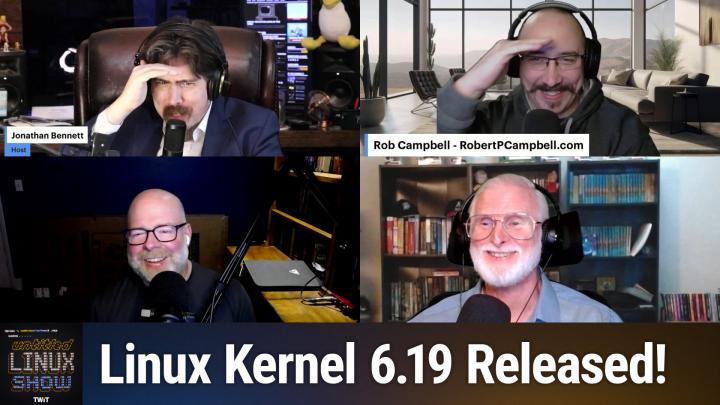
All TWiT.tv Shows (Audio)
Untitled Linux Show 242: Syntactical Sugar
01:23:45
Sustainable Distros, New Kernels, & Wayland Vim?
Loading summary
Transcript307 lines
- [00:01]
Jonathan
This week we are concerned about Linux Mint, but we're celebrating. Pair OS river is bringing modular window managers to wayland. The kernel 6.19 is out and it's time to talk about 7.0. Mesa 26 is out. Although it'll probably be a couple of months before any of us really get to play with it, and a whole lot more. You don't want to miss it, so stay tuned.
- [00:24]
Rob
Podcasts you love from people you trust.
- [00:29]
Jonathan
This is TWiT. This is the Untitled Linux show, episode 242, recorded Saturday, February 14th. Syntactical sugar. Hey folks, it is Saturday and on top of that it is Valentine's Day. At least on the day that we're recording this. So you know what that means. It's time for us geeks to not spend the day with our significant others, but instead to get geeky about Linux and open source software and hardware. I am joined by the Lonely Hearts Club Club. No, actually all of our significant others were just kind and let us come and do the show even though it is Valentine's Day.
- [01:07]
Rob
We got.
- [01:08]
Jonathan
We got Jeff and we got Ken. Welcome to each other.
- [01:11]
Rob
We're here because we love you.
- [01:12]
Ken
One of us brought their significant other along.
- [01:15]
Jonathan
Oh, really?
- [01:18]
Ken
Isn't Jonathan's wife in the audience?
- [01:21]
Jonathan
Well, she probably is, but she's still also in the other room with the kids.
- [01:24]
Rob
I thought. I thought there was announcement. I didn't.
- [01:27]
Jeff
It wasn't a purpose or something like looking.
- [01:29]
Jonathan
I'm looking for Ken's wife sitting back here on the shelf. Yeah, you ever back there? I can't see her.
- [01:40]
Jeff
I'll say we're. We are with the ones we love. We're with all of you. And Linux.
- [01:44]
Jonathan
And Linux. We got tux.
- [01:47]
Rob
It can't be with the.
- [01:48]
Ken
My wife sent me to school today.
- [01:51]
Rob
Are with got.
- [01:52]
Jonathan
Yep. All right, well, let's stop with the cheesy Valentine's Day jokes and puns because they're getting painful. We are all exceptionally good at dad jokes. Come by it naturally. Thank you.
- [02:04]
Ken
Yeah, let's just go straight to the Mint.
- [02:06]
Jonathan
Yeah, let's talk Mint. Rob's got this story and I've seen this in a couple of places, people are worried about Linux Mint. Rob, what's going on there?
- [02:17]
Rob
Yeah, so you know, as listeners of the show know, one of my common criticisms of Linux Mint is how far behind and outdated it is compared to most other mainstream stream distros. Most notably in their delay to move away from X11 on to Wayland. And I like to criticize that often. Well, they are considering moving slower today. They follow a tight release schedule, releasing a new version every six months. They're looking to slow that down a little bit, you know, slow down that release cycle. And I didn't, I, I didn't see. They didn't really say specifically what they're looking for on a time frame but you know, if they push things out too much further, that is just further away we are from eventual, our eventual Mint Wayland future. But it might not be all that bad. So Linux Mint's project lead Clement is basically saying the six month treadmill is eating the team alive when you're constantly fixing, testing, polishing and shipping. You're not building, you're releasing and you know, and as I frequently pointed out, they aren't moving forward as fast as they should be. So you know, maybe that's part of it. So, you know, the, the idea on the table is a longer development cycle, more, as they say, kind of ready when it's ready, less deadline driven. And that could mean, you know, fewer releases, maybe a little stretched out further, maybe bigger as they come, but and potentially better ones. You know, they could be better, better releases that they're actually spending more time working on it. You know, more time for ambitious features that don't fit neatly into a six month window. Also, you know, one funny little detail maybe helping the move a little bit. They've run out of alphabetical codenames after the Z release. So it's a perfect excuse to reset the cadence and get creative, try something new. Now about the Wayland future. Mint still calls Wayland support experimental. And they're clearly not promising a flip of the switch moment like some others seem to have been able to do. Okay, but they are knocking down blockers. The biggest headline is a brand new Cinnamon screensaver. The current one is an old X11 only I mean GTK app. Old, like so many things on Mint and, and that's hard. A hard, you know, stop for real Whelen readiness. I mean, or is it? I mean I haven't really seen a screensaver in years. Besides when I think Jonathan demoed one.
- [05:30]
Jonathan
Yeah, kd, he has support. So it surprised me because they're very quiet about it. You have to really go searching for it. But KDE has support for screensavers.
- [05:38]
Rob
Yeah, but these days I don't really see many people using it. So you know, is that really a big blocker? I know at least they're moving it forward. Maybe that would have been my focus, the screensaver. But anyway the replacement will work on both X11 and Wayland, and it'll be rendered by Cinnamon's compositor, meaning smooth lock animations, tighter integrations, and better security posture. They're also improving keyboard layouts for people who use logical mappings, building a new user admin tool, mini sysadmin with stuff like home directory encryption during user creation, webcam profile photos, and better high DPI handling. Even their forums got a serious upgrade after hammering or being hammered by bots and crawlers. So now they have way more cpu, more bandwidth, better filtering. So maybe the slowdown will actually speed up their development a little bit. But right now I'm still going to remain hesitant until I see, you know, see a trend of keeping up with modern technology for a while. You know, maybe once that trend's there, I won't be so hesitant. And I still think Mint should dump Cinnamon for a modern desktop environment. I think that would go a long way to speeding up their, their development. I always say kde, as someone, I think point out to me all their apps are GTK because it's based off an old Cinnamon being an old version of gnome. So I don't know, maybe, I don't know, go with modern Gnome. Really. I think just pull off the band aid and go with kde. But whatever. I guess maybe they'll get Cinnamon modernized and have more time to keep it modernized in the future. But we'll see if the slowdown speed things up. Speeds things up or what it does or what they'll even do. I mean, it's still just a, a thought at this time.
- [07:44]
Jeff
Yeah, well, yeah, when you thought.
- [07:45]
Jonathan
It seems like they, they sort of have, have come to the conclusion that something has to change. Right. And that's use. What is it they say the, the first step on the road to recovery is admitting you have a problem. Mint has admitted it has a problem.
- [08:00]
Ken
Mint has admitted recognizing that you have a problem.
- [08:03]
Jonathan
Yes.
- [08:03]
Rob
Mint's a sleek desktop. I understand why a lot of people like it. I mean, if you don't look too much, it. It's nice clean works. But yeah, I mean, there are, there are, there are.
- [08:18]
Ken
It's a good thing you don't look under the hood of Ubuntu then.
- [08:22]
Jeff
Well, it's, it's kind of one of those when, you know, when you thought Debian stable was just going too fast and reckless, then you had Mint, you.
- [08:29]
Jonathan
Know, Sad but true. My goodness. Yeah, I did it. I did a Mint install for someone years ago and turned on automatic updates and came back A couple of years later and it's like it hasn't changed any. Linux is way beyond where this is at and this Mint install is not changing. Then I went, okay, how do I upgrade a Mint install to do reinstall? That kind of soured Mint for me. Those two things.
- [08:54]
Rob
I don't think that's still the case.
- [08:55]
Jonathan
That may not still be the case, but at the time, how do you upgrade Mint?
- [08:58]
Jeff
You do reinstall and Cinnamon is based off. I think it's GTK2. It's like an older version or maybe three. It's a, an older version of GTK2 version of gnome.
- [09:11]
Rob
Yeah, it's old version of gnome, it's.
- [09:13]
Jeff
For gnome, but it's an old version of it.
- [09:17]
Jonathan
Which of course puts them at a, at a disadvantage for trying to do things like Wayland support. And they don't get to use all of the fun upstream stuff that GNOME has already worked out.
- [09:25]
Jeff
Yeah, somebody in the audience could probably tell us. But I thought it was two because it was right before GNOME went through one of their big API restructuring things and people said, no, we like it how it is. So they forked it, made Cinnamon, and then GNOME went through a huge.
- [09:41]
Rob
Yeah, yeah, yeah, it's based off GNOME two. Mate is the fork of GNOME three.
- [09:49]
Jonathan
Okay.
- [09:49]
Ken
And what's the fork of GNOME for?
- [09:52]
Rob
I don't think anyone's done that yet.
- [09:53]
Jeff
GNOME has.
- [09:55]
Rob
Has it been big enough to, to.
- [09:59]
Ken
Nobody wanted to touch GNOME for.
- [10:03]
Jeff
Well, you know, and there is, you know, as much as we laugh, there is a little bit of truth that because they, they really soured a lot of their base audience or fans because how much they kept changing everything. And it was, it was kind of almost a little too much too fast. And there, there was a lot of questions of, well, why are you doing this? You know, some of it was stylistic and some of it wasn't. I think there was some technical reasons, but there was also a lot of stylistic and it just, a lot of.
- [10:30]
Rob
It was them being opinionated.
- [10:34]
Ken
None of it had to do with going from GDK2 to GDK3 to GDK4.
- [10:41]
Jonathan
Well, they locked themselves into using an old version as a base and like I said, they didn't. There, there's the challenge that if they wanted to continue with their code base and not switched upstream gnome, they would have to basically redo all of that work to switch to a newer gtk. And so kind of, they, they stylized themselves into a corner.
- [11:02]
Rob
Yeah.
- [11:04]
Ken
And then they finally did switch, which they more Few other problems.
- [11:11]
Jonathan
Yeah.
- [11:12]
Rob
But they also future proofed themselves from that kind of lock in again.
- [11:18]
Jeff
Well, and, and, and that's, I think they learned the lesson from, probably from kde, because when they went from three to four, that was a terrible, rough transition. And that's why KDE can switch faster now is because they said, okay, we're, we're building this for future changes and instead of, you know, having some things so locked in, it's, it's much more flexible code base and it wouldn't surprise me they did the same thing. But that first lift is painful.
- [11:44]
Jonathan
Yeah. And there is no known four, by the way. That sounded weird to me. So I went and I looked and Gnome 3 was the last release of the old versioning system. And the one that followed that was Gnome 40. And now they're doing new versions every six months, I think. So we're up to what, 40, 49? Gnome 49 is now the most recent.
- [12:07]
Rob
They're talking about 50 already. So I just think of the 40 series being Gnome 4 and the upcoming 50 series is Gnome 5.
- [12:18]
Jonathan
They just removed the dot.
- [12:20]
Jeff
Yeah, sorry, I'm on the metric system. It's four to me.
- [12:27]
Jonathan
That's great. All right, so let's see what's coming up next. Speaking of Ubuntu, somebody tried to make a segue in there. We'll let Ken take it and tell us what's up.
- [12:38]
Ken
It wasn't an intentional one.
- [12:40]
Jonathan
It may not have been, but still it works. Now, Ken, surely you have a typo here, because this is all about Ubuntu 24 LTS. There's no way we're still talking about the Ubuntu 24.04 LTS.
- [12:55]
Ken
Yes, we are, because we've got.
- [12:57]
Rob
That's also a little behind.
- [13:01]
Ken
Actually, no, we're not, because this week Bobby Borisov, Michael Laravel and Marcus Nestor all wrote about Ubuntu team releasing Ubuntu 24.0 4.4 LTS. Now, this is the fourth maintenance update in the novel Numbat series Bring. And it brings Linux kernel 6.17 and focuses on cumulative fixes since the original 2404 release. Yes, that was back in April of 2024. Now, according to Marcus and Michael, this newer kernel should support more hardware, While the newer Mesa 25.2 graphics stack should improve gaming performance. According to Bobby, the main updated packages include LibreOffice 6.1.25, Mozilla, Firefox 147, and everybody's favorite snapd 2.73. Now they all remind you that Ubuntu 24.04 LTS is supported for at least 5 years and will continue to receive software updates and security patches until June 2029. Meanwhile, Ubuntu 26.04 LTS is due out this April. Who's looking forward to that release?
- [14:41]
Jonathan
I'll stick with Fedora 43. Well, I mean, by then I'll probably be running parts of Fedora 44 on my machines. Yeah, I forgot there for a moment that 25.04 is not an LTS. Ubuntu does every other year. LTS is.
- [14:58]
Ken
Yep. And everybody gets support for five years.
- [15:02]
Jonathan
Yeah.
- [15:03]
Ken
If you have subscribed to Ubuntu Pro, that extends it to 10. And if you really want to pay, you can get it to longer than that.
- [15:15]
Jonathan
Yeah, I'm sure if you need to.
- [15:17]
Ken
Keep running it that long.
- [15:19]
Rob
Yeah, 15, I think it is.
- [15:21]
Jonathan
15 years is a long time. Ubuntu 24.04 is going to be real crusty in 2039.
- [15:29]
Rob
Oh my goodness, Me too.
- [15:31]
Jonathan
Yeah. The truth. I mean, you're already kind of crusty, Rob. Let's be honest.
- [15:39]
Ken
Not as crusty as I am.
- [15:41]
Rob
I thought we were all friends here.
- [15:42]
Jonathan
We are all friends here.
- [15:44]
Ken
That's why we can say that about each other.
- [15:46]
Jeff
We're more brothers. You know, there's. There's a lot of jabs in there.
- [15:49]
Jonathan
Indeed.
- [15:51]
Ken
Oh, yeah. Don't. Don't bring up the fights me and my brother used to have.
- [15:56]
Jonathan
Yeah, yeah. Fun to see this stuff. All right, Jeff, we'll talk about kernels.
- [16:03]
Jeff
Yes. This week we have. I'm going to just move on. This week we have the release of the 6.19 kernel. Now, it did take a little longer to get out, but that was planned because of the Christmas and New Year's holidays. Linus had said that he was going to give it more time because of the holidays. And then even though in the later RC cycles he said things were looking pretty good. He kept his word though. And you know, he thought he's having an extra cycle just because the holiday, so nobody felt rushed. And as always, there are a ton of goodies and fixes, but as always, you know, we're. We're just going to hit the high points here now. Pretty normal for the releases, you know, there's. There's a ton of AMD and Intel CPU items that have been added and massaged, such as the AMD GCN 1.0 and 1.1 GPUs. They now default to the AMD GPU driver rather than using the legacy Radeon DRM driver. It lets RADV v Vulkan support, you know, work without messing. It works out of the box. You don't have to mess with it and tweak it a bunch. So it just, it'll just work now. And that will give ideally significantly better performance for those that have older Radeon GPUs. There's lots of supporting software for the upcoming, you know, I should say a lot of supporting code for the upcoming Wildcat Lake and Nova Lake CPUs, which are going to be out in the future. Wildcat should be out soon. You know, it was, it was announced the Consumer Electronics show sounded like it won't be too long, we should see it. And based on rumors, Nova Lake should be towards the end of this year if things hold. AMD was also putting in some foundational support for their Zen 6 hardware, which last rumors I heard will be about the end of this year or early start of next year. So, you know, Maybe January of 27 some somewhere in there.
- [18:14]
Jonathan
We'll see.
- [18:14]
Jeff
We'll see how, see how it goes. Support for lass lass, that's linear address space separation is now working. It's a security feature found on newer Core Ultra CPUs and Xeon 6 CPUs. The really short version is it restricts virtual address space access. So it keeps people only in the blocks of addresses and memory where they should have access and other updates. And something we've mentioned in the past, ext 4 now supports block sizes larger than the kernel page size. Now this is following the move by other file systems doing the same thing. Bottom line, it aligns with other file systems and you know, it can, it can see some performance improvements from this change. You know, you're going to be moving quite a bit of data to see a lot of improvement. But if you do, ext4 now should go a little faster for you. They also have ext4 also had a performance increase using cache in certain situations. And there's also some error code improvements and other general small cleanups in the ext4 file system. It was actually kind of a bigger code Update for the ext4 file system on, on this release on the 619 kernel, which normally file systems have a much slower progression of their code. But there was a nice little tweaking in there. Nothing. There wasn't any major errors or anything they were fixing. It was just making things go faster and improving things. Networking also got love in the form of driver improvements, enablements and speed increases for some real tech. Synopsys, Motorcom and Nvidia hardware, just to name a few. So it was basically tweaking either existing drivers or adding new hardware support, you know, adding more features to existing hardware, things like that. One of the biggest overall improvements happened by replacing a busy lock at the transfer queuing layer with a lockless list to yield a forex improvement in heavy transfer workloads. So this, this was an overall networking improvement, not just on a specific piece of hardware. The merge request said sending twice the number of packets per second for half the CPU cycles. So that's pretty exciting to see in there. I'm not going to go into any more detail on this release, but it's just a tiny fraction of the code that made it. In the kernel a lot of the hardware is better supported. A lot of overall security updates have been made in there. Even hardware which was supported before now is even better supported. More features, all sorts of stuff. Take a look at the link in the show notes for full details and that article, there's a ton of other links which go into much greater detail and each thing we touched on and the hundred other things that we didn't, you know, such as rust. There's several rust Rust improvements in there so definitely have a look and happy delving.
- [21:21]
Jonathan
Yeah, lots of, lots of interesting stuff. What, what are you most excited about in 619, Jeff? Which do you think is the coast?
- [21:29]
Jeff
I think it's the network, the. The. Some of the forex and improvement in speed. I thought that was pretty exciting when they're able, able to speed that up even more, you know, because a lot of stuff I'm to be honest on an X86, you know, I'm not seeing huge major code changes there. A lot of the hardware stuff is. My hardware is already well supported. I'm not running the latest, greatest, you know, some of the other stuff. So a lot of it for me was just the networking.
- [22:03]
Jonathan
Yeah, makes sense. There's some, there's some really cool GPU stuff in there too. Between the new driver support with the RADV compatibility and then the DRM color pipeline API, the valve stuff finally landed. Pretty cool to see that. Hopefully it'll, it'll help us all out.
- [22:21]
Ken
And there's one of the. In Michael's article there's a link that takes you to another article that has a link to another article by article Michael where he's talking about it bringing many driver core changes for rust and housekeeping CPUs being exposed. So that's an interesting read there.
- [22:45]
Jeff
Yeah. And it. And that's precisely why I said this is a whole link tree. There's a ton of link to this. To this. So whatever your heart desires, it's in there.
- [22:55]
Jonathan
Dive as deep as you want.
- [22:56]
Rob
There is a rabbit hole you can go down.
- [22:59]
Jonathan
You guys, the coolest thing about this is you can actually just go. Hit the go. Hit the Linux kernel mailing list and read the whole thing, every bit of it, if you want to. Yep, it's all out there in the open. All right. We are going to talk about Vim and something very interesting and a change log there, that caught my eye. We'll do it right after this. We heard you.
- [23:23]
Rob
Nine years of bring back the snack wrap and you've won. But maybe you should have asked for more. Say hello to the hot honey snack wrap.
- [23:32]
Jonathan
Now you've really won. Go to McDonald's and get it while you can.
- [23:37]
Jeff
We all have that dream trip we've.
- [23:39]
Jonathan
Been wishing we could go on.
- [23:40]
Jeff
But too often, life or usually price gets in the way. That's why Priceline is here to help you turn your dream trip into reality. With up to 60% off hotels and up to 50% off flights, you can.
- [23:53]
Jonathan
Book everything you need for your next adventure. Don't just dream about that next trip.
- [23:58]
Jeff
Book it with Priceline.
- [23:59]
Jonathan
Download the Priceline app or visit. Visit priceline.com and book your next trip.
- [24:03]
Ken
Today.
- [24:07]
Jonathan
With Venmo Stache. A taco in one hand and ordering a ride in the other means you're stacking cash back. Nice. Get up to 5% cash back with Venmo Stash on your favorite brands when you pay with your Venmo debit card. From takeout to ride shares, entertainment and more, pick a bundle with your go tos and start earning cash back at those brands. Earn more cash when you do more with Stash. Venmo stash terms and exclusions apply.
- [24:31]
Rob
Max $100 cash back per month.
- [24:33]
Jonathan
See terms at Venmo Me Stash terms. So Vim 9.2 is out, it's released, and I'm not a heavy, heavy vim. I'm not a heavy Vim user, but I saw the changelog and there was something here that really, really intrigued me, and that is that Vim is advertising Wayland compatibility. And I was very much taken aback by that. Wait a second. Vim is something we use in the command line. Why does it need to be able to talk to Wayland? I did a little bit of research into this and looked at some of the other things in the 9.2 release of Vim. There's some other cool stuff in there, like fuzzy matching for insert mode completion, but other UI enhancements. But the one that really got me is the modern platform support is what they call it. And this is Wayland UI and Clipboard support. I went, oh, okay, okay, Clipboard. I get that's going to be a little bit different than the old X11 clipboard. I didn't know that VIM could talk to the Clipboard, but then I discovered something called the VIM GUI or gvim. I didn't know that this existed at all. Apparently you can run VIM as a GUI instead of just as a command line program. I've never actually run this. It's something I need to check out. But that is essentially what they're talking about here. Mostly with Wayland compatibility. They've made that now in Vim 9.2. Gvim is a Wayland application. And then there was a couple of other things that were in here that was really interesting. One of the. Which was that they were Talking about the Vim 9 scripting and the fact that you can now do a lot with it. And apparently someone vibe coded a couple of games in VIM script and these are not in. From what I understand, these are not in VIM proper, but it's outside. Outside GitHub repositories where you can go grab VIM scripts to run either Battleship or one of the logic games, a number puzzle right inside vim. I thought that was super interesting, that one. The scripting was to the point where you can do that. It was close enough to Turing complete or Turing Complete that you could do that. So yeah, super duper interesting. And yes, Vim 9.2 just released and believe it or not, VIM now Wayland compatible. You didn't know you needed it.
- [27:00]
Jeff
Yeah, playing the game seems more like an Emacs trick though.
- [27:05]
Ken
Now I've got to ask, how do you exit VIM when you're done, especially the GUI version?
- [27:11]
Jonathan
The GUI version, you can probably just click on the X.
- [27:14]
Rob
That'd be great. It'd be great if you couldn't just click on the xo. That would make it the best.
- [27:21]
Jonathan
I mean, it's fairly easy to do that. I do that in my GUI applications accidentally. You just usually consider that a bug, not a feature.
- [27:28]
Rob
I think that'd be a great feature. Just for traditional humor, just to save.
- [27:34]
Jeff
Your document, you got to win a. Win a game of Tic Tac TOE or Battleship or something.
- [27:40]
Jonathan
I can't let you do that.
- [27:41]
Ken
You've got to win the number puzzle.
- [27:43]
Jeff
Yeah. Oh, you lost.
- [27:45]
Jonathan
Sorry.
- [27:45]
Jeff
You've lost everything.
- [27:48]
Jonathan
That sounds terrible.
- [27:51]
Ken
And with that Wayland support, hopefully it allows you to alt tab out of the GUI to another gui.
- [27:57]
Jonathan
Yeah, it should. It's not like. It's not like Emacs. It's not a full blown operating system. All right, Rob, Rust is over. We've talked about this before. This is not the first time we've talked about this story.
- [28:13]
Rob
Did we, Did I do a repeat again?
- [28:15]
Jonathan
Well, yeah, yes, but no. We've covered that Rust is no longer an experiment, but now Linux 7 is out. And so, like, it's more official. You take it away, you tell the story, and we'll make fun of you afterwards for repeating yourself.
- [28:28]
Rob
So Linux 7 is going to be landing soon. The merge window is open. And that comes with a headline that the Rust experiments is over. Linux 7 is officially concluding the Rust experiment, and we all knew it couldn't last. So I guess we just go back to our C roots for Linux and end the whole progress movement we're making. Because, you know, the experiment is over. In tech usually means one of two things. It didn't work and someone is quietly escorting it out the door. Or it worked and is graduated. Well, the experiment is over, but Rust is here to stay. What Linux 7.0 is doing is symbolic because of some massive Rust feature bomb, or not because of some massive Rust feature bomb dropping. But Linux 7 is mostly a version number, because Linus likes round numbers, as I think we've said before. At least sometimes he does. But in the merge window, there's a very intentional change. The kernel docs are being updated to declare that the Rust experiment is complete. Miguel Ojeda, the guy who's been one of the driving forces behind Rust and the Colonel, basically spells out the intent, calling the experiment done. And it's meant to signal commitment, not just to hobbyists or curious contributors, but the companies, maintainers, organizations that want to invest time and money without worrying that it's going to get scrapped somewhere down the road. Rust isn't in limbo anymore. It's already being used in production environments. Some distros are shaping shipping kernels with Rust code already, millions of Android devices are already running it. And at this point, it's not a science project sitting on a folding table. It's in the building now. The patch itself isn't flashy. It's not like suddenly half the kernel got rented overnight it's just documentation, plus some building tools, improvements like a new Rust helper, annotation to play nicer with the kernel LTO and some incremental crate updates. If you're paying attention, you could feel what they're trying to do. They're trying to, you know, stop treating Rust like a guest with a temporary badge to be here and start treating it like a family member. But this is only the beginning of the great things to come with Linux 7, and I know that Jeff is going to want to expand on those later on.
- [31:27]
Jonathan
Yes. So we have indeed talked about this before a couple of times. I think this is the third time we've covered this story that Rust is no longer an experiment in the kernel.
- [31:36]
Jeff
But not referencing kernel 7.
- [31:39]
Jonathan
It is different this time, for sure. It is interesting to see that Ethiolegarchs wants to know Linux kernel in Rust by 2036. I mean, I guess that's one way to solve the 2036 bug, but they.
- [31:56]
Rob
Have, they haven't actually documented in the kernel code itself that the Rust experiment is over before seven.
- [32:04]
Ken
Is that the Rust helper that Michael talks about in one of his articles?
- [32:10]
Jonathan
Yeah, the actual documentation change may be new, but this was said in the mailing list quite several weeks ago.
- [32:17]
Rob
Yeah, I think people have said it and now it's in the kernel. It's actually a comment within the kernel itself.
- [32:24]
Jonathan
Yep, there you go. And you know, there's actual live code running on. Well, depending upon what drivers you have, there's real code running with the, the, the Rust code. So yeah, it's, it's in there. It's actually a thing.
- [32:38]
Ken
It must be a thing. I've been going through a little tutorial on it myself.
- [32:44]
Jonathan
Oh, and writing. Writing what, your first Rust kernel driver? Writing.
- [32:50]
Ken
My first REST program.
- [32:54]
Jeff
Hello World.
- [32:55]
Jonathan
Yeah, the hello World.
- [32:56]
Ken
Yeah, that was my first one. My second one's a hello ULS program to convert from Fahrenheit to Celsius.
- [33:06]
Jonathan
I started the Advent of Code project a couple of years ago in Rust and got through, I think, three or four of the challenges before I absolutely ran out of time and couldn't finish it. But, you know, the, the, the very early stuff with Rust, it seemed pretty reasonable and pretty, pretty familiar. And then I started seeing syntax things that. It's like, I don't know what this does at all. And that's about the time that I bailed on it. It's got, it's got some funny syntax things in there, which I'm sure it makes sense once you Understand what it's doing. It's an. It's syntactical sugar, but it's just a.
- [33:42]
Ken
Little syntax and indentation make a difference.
- [33:48]
Jonathan
Is Rust white space sensitive? I don't think it is.
- [33:52]
Ken
With one of my mistakes when I was programming, it was. It said this close brace is in the wrong location.
- [34:06]
Rob
Wrong, wrong.
- [34:09]
Jonathan
Yeah, wrong location. But not necessarily because of white space.
- [34:12]
Rob
Yeah, it's not like Python.
- [34:15]
Jonathan
Yeah, Python is sort of the canonical example of this language cares about white.
- [34:19]
Jeff
Space or Fortran 77.
- [34:25]
Jonathan
Wow, that's from the past.
- [34:28]
Rob
Anyway, to wrap that story up. To wrap this story up, if you want to get the source code yourself, you can do that and you can look through it and you can find in there where it says rust experiment is done, it's complete, it's no longer an experiment.
- [34:44]
Jonathan
And if you really don't like Rust.
- [34:46]
Ken
Helper that's needed since C helpers cannot be in lined into Rust.
- [34:51]
Rob
If you don't like Rust, use Windows.
- [34:53]
Jonathan
Well, I was going to say actually you could download the kernel code and patch that particular line out and then recompile it.
- [34:59]
Rob
Then it's just experimental.
- [35:02]
Jonathan
Experimental in your build.
- [35:05]
Rob
Forever.
- [35:06]
Jonathan
Yes, yes. All right, Ken, what's IP fire? I recognize some of these words.
- [35:14]
Ken
Well then you're going to want to thank Bobby Borisov and Mars since they both wrote about IP Fire lancing IP Fire dbl. Now, DBL is domain block list. Now, it's a community driven system that lets administrators fine tune network filtering policies. According to Marcus, it is designed to organize millions of domains into specific threat categories based on your security and content policies. According to Bobby, the project was developed in response to long standing concerns about existing block lists. According to IP fhir, many available lists aggregate third party data without clear redistribution rights. IP FHIR DBL supports formats like DNS Response policy Zones or RPZ with the axfrixfr transfers Squidguard for proxy filtering, direct ATTPS downloads in several plain text formats and adblock plus syntax. Now, I'm going to recommend reading Bobby and Marcus's articles since I have only touched on the highlights and I don't think you want to hear me tripping over all those long words.
- [36:48]
Jonathan
So it's a. It's a domain block list. It's essentially a. This is a known malicious domain. We're going to keep you from visiting it.
- [36:55]
Ken
But you can basically use tags to identify what type of block list you want to use for certain sites.
- [37:06]
Jonathan
Yeah. You know the problem with these, particularly trying to do them open source like this is that it's so much work to stay on top of the problem because it's so easy to generate a new domain or new subdomain or take over somebody's domain and make it malicious. I wonder, is there anybody that's actually paid to keep up with this?
- [37:30]
Ken
That's a good question since it's a community driven domain blocking list.
- [37:34]
Rob
Yeah, they probably just. Do they just use public ones? Publicly available ones?
- [37:41]
Jonathan
I mean, that's possible. There are some publicly available lists like.
- [37:46]
Ken
That just block everything that's on it.
- [37:49]
Jonathan
Yeah. So like they could, they could pull from the spam house list, for example, and there's a, there's a known malicious list there.
- [37:55]
Rob
And I know like in Pihole you can select from a bunch of different sources for, for blocking, but then when.
- [38:04]
Ken
You implement it as the system administrator, you can only choose only the categories that you want to block. Like say you just want to block malware or phishing or advertising categories. Wallet and some of the others, such as gambling and names and DNS over ATTPs through.
- [38:25]
Rob
Yeah, that kind of stuff is pretty common in, like in enterprise firewalls, so.
- [38:29]
Jonathan
Right, right, right. Yeah. So this, this is, this is tuning it for something appropriate for blocking out a business versus blocking maybe at your house. It's cool that it's out there. I hope, I hope that they have funding in place to where it can actually continue to survive because, you know, without, without somebody being paid to take care of it, this sort of thing oftentimes just flounders because it's a lot of work.
- [38:53]
Ken
IP fire may be actually funding it from the money they get for selling their prescription.
- [39:04]
Jonathan
Service. Indeed, a prescription is something different.
- [39:08]
Ken
Yeah, subscription.
- [39:12]
Jonathan
Mine.
- [39:13]
Ken
Like a sieve.
- [39:14]
Jonathan
Exactly.
- [39:16]
Rob
Doctor, I'm going to write you out a prescription to this firewall. You got viruses.
- [39:24]
Jonathan
I mean, if you're running IP fhir, you might need a prescription for that. All right, we're going to let Jeff Talk about the 7.0 merge window and the stuff that has landed there right after this. Feeding the fam isn't easy, but we got you with Denny's Slammin meal deals starting at 5.99. Full meals for everyone. Like a Grand Slam burrito for grandpa and a Super Slam for Super Mom. Get to Denny's now. Ballot out participating locations for Dine in or Denny's.com limited time offer.
- [39:56]
Jeff
Additional restrictions may apply at some locations with. With the Colonel 619 out, one of the questions gripping people was what will the next Colonel be named? Well, Linus decided that this Next Colonel is now going to open the merge window for the 7.0 kernel. To paraphrase Linus, he doesn't like to max out his ability to count on his fingers and toes the number of kernel versions. So next whole number. Now before we talk about things getting pulled into the kernel, you know, and just, just as an overview. So this is kind of. I'm giving you a little overview of the process here. If you want to add something to the kernel, a person would code it up, they would have it posted in the kernel mailing list for others to look at. Review the code, you compile it into the Linux NEXT kernel and you do that to make sure it compiles it functions. You do some testing and then you can go in and have it added to the merge window and then it'll get pulled in. Now I should say give me a little leeway experts. I know this isn't exact but for the very simplified non coder view I think it works well. Something broke for the Linux Multimedia Card MMC when they asked for a pull request. The code was to see some new hardware support and revise some of the existing EMMC hardware. Well, Linus had this to say and I've edited it for brevity and to remove some of the code details which would be really boring for me to just read out. Linus said no, those changes are complete garbage and don't even compile. It has apparently never been in Linux Next or has been build tested in any way. In other words that commit and I'm just editing out all the commit details. It's just long numbers and stuff is pure unadulterated, untested garbage. I do not want to see a quote fixed pull request from you. This was entirely unacceptable and I will not be pulling anything more from you. This merge window, stop sending me untested crap that hasn't been in Linux Next and doesn't even pass the most cursory smell test. You can try again for 7.1 but only if it's actually been in Linux Next and properly tested. So now that means the estimated time for the 7.1 merge window. It's probably going to be mid April depending on how things go to the person that maintained and you know, initially had the pull request. I do want to give them some credit and say that it looks like, you know, they're. They basically said the code should have reached Linux Next but didn't and the author didn't double check to make sure it actually landed. So there was how they thought and what was supposed to happen, they didn't fully follow up on everything and, and whether they had to, or some scripts broke, I don't know. But basically they took ownership for the issue, apologized to Linus and said they're going to get it going smoothly for 7.1 by fixing the issues. And they did talk about they're going to wait for the first rc, they're going to go get it pulled into Linux next, they're going to patch it, they're going to do, do all the stuff they need to do. So I do want to give them credit for just taking ownership of the, you know, oh, this went wrong. And you know, I thought that was, that was pretty cool. But you know, enough though on how things get into the kernel and what didn't make it in. In part two, meaning my next segment, I'll go over some of the things which are probably going to make it in now. No guarantees things can get pulled out, even if they were first accepted for various technical reasons and whatnot. We, we have seen it before, we've commented on it, but stay tuned for Colonel 7.7.0 Part 2.
- [44:05]
Jonathan
Yeah, I, I like the additional context that these guys came back and said, yeah, we messed up, we'll do it right. Like that's the, that's the point. That's what Torvalds wants. They've got a system there at the kernel and obviously they have to have a pretty structured system just because there's so much that happens each cycle with the kernel, so many patches fly around. And now that you've got AI hallucinations and LLMs and all of that stuff, making it so easy to write code that at least looks reasonably decent. They've got to have sort of this black magic process to be able to get stuff looked at, because otherwise they would just be swimming in LLM contributions the whole time. One of the projects I'm involved in, we had a pull request get open the other day and we called it out and we're like, man, this probably is not. This is not a spec. We're not going to pull this. And the guy's response was, I kid you not, I didn't realize that Claude Code opened this pull request for me like this. This explains so much of what's wrong with open source right now.
- [45:11]
Rob
POD can even open the pull request for you now.
- [45:15]
Jonathan
Agentic AI, man, that's what it's all about.
- [45:17]
Ken
And close it. According to Leo.
- [45:19]
Jonathan
Well, I mean, we closed that one for him.
- [45:22]
Jeff
Well, and yeah, I really wanted to just show that it wasn't just somebody just putting out total garbage. It was, they. They weren't watching the process probably like they should have. But I, you know, I really respect people that make mistakes, but own it and go, okay, you know what? We did it. My bad, I'm sorry. Here's how we're gonna fix it. We learned it's, you know, our lesson going forward. And yeah, I think that just speaks a lot for the character of a person.
- [45:53]
Rob
It's a lot better than some of the ones we saw last summer. At least one. I can think of one that did not respond so as gracefully.
- [46:07]
Jonathan
Yeah, yeah. And you know, all of these situations are different. So I mean, that one from last year may have been. Well, no, I know it was, it was not a.
- [46:15]
Ken
Which one from last year?
- [46:16]
Jonathan
There was a couple of them last year, but both of them. It wasn't a single thing. It was frustrations mounting over multiple iterations through this.
- [46:27]
Rob
Right.
- [46:28]
Jonathan
But yeah, I agree with you, generally speaking that, yeah, it's good for someone to man up. And yes, this, this could have gone better. We'll do better next.
- [46:38]
Ken
And have the finger pointing back at themselves. Yeah.
- [46:41]
Jonathan
And, and you know, I think it's probably worth pointing out here that you can do that without groveling or, you know, making yourself look too ridiculous.
- [46:48]
Rob
But just a. I blame you, Ken.
- [46:51]
Jonathan
This could have gone better. We'll do better next time.
- [46:53]
Jeff
Yeah. And I read the kernel mailing list, the thread, and he didn't grovel, he just apologized, said, here's what happened, all that kind of stuff and said, oh, yep. If it would have made it into, I think Linux next, they would have found the problem. It would have went smoother. It was just kind of, oh, I was waiting for something to say, oh, this broke or. But it never made it that far.
- [47:18]
Jonathan
Yeah. And sometimes stuff like this is just the timing. The timing is just non ideal. You found something that needs fixed, you want to smash it in and it's just that time in the kernel. So you throw it in there and hope for the best.
- [47:31]
Ken
Get a week left.
- [47:32]
Jonathan
Ah, sky's falling.
- [47:33]
Jeff
And well, and Linus doesn't like those pull requests right at the end. He likes a lot of.
- [47:39]
Ken
He likes a lot of Runway, a.
- [47:41]
Jeff
Lot of lead time and the last minute, oh, quick, get this under the wire.
- [47:47]
Jonathan
Well, I mean, that makes sense. I mean, how many times I have multiple times in an open source project thrown something in under the wire and regretted it. Oh my goodness, I've regretted it. We had a.
- [47:58]
Ken
We had release.
- [48:00]
Jonathan
Yeah. We had One deal where there was a simple little fix. We were trying to sort a data object in memory and so we just used a standard sort and it went in right before big release. It's like it's a standard sort. You can't get this wrong, you can't break it. And we had random result from it for months afterwards. That was terrible. It took me like a year to finally realize what was going on with that too. It wasn't what I thought it was. I finally concluded that our code was multi threaded and we didn't realize it. Which, that's a long story anyway. That's a very long story to get into all of that. The fun parts of running with an embedded code project. Rob, what is up with Pair OS and why is it staying alive? Was this in question?
- [48:51]
Rob
Well, per os, it's. It's one of those names we didn't hear much about for years and you know, now we are here talking about them again. Only months after it was resurrected from the dead, essentially. I had a story I don't know, must have been a couple months ago, but it, it doesn't just look alive now. Pair os 26.2 just dropped and this update has big we're not messing around energy to it. First off, the aesthetics. Paros is leaning hard into what it calls the quote liquid gel design language. And it's aiming for that glossy, cohesive, everything feels connected vibe. They're redesigning the dock and the launchpad added an arc effect to the downloads folder, which I believe is similar to what macOS downloads folder does. For those who are familiar and focused on the little stuff that makes a desktop feel premium. Smoother animations, cleaner feedback and fewer moments where the UI feels like a bunch of separate parts stitched together to back up. For those who don't remember or don't recall, Pair OS is. It's a. It's KDE Linux desktop, but it is designed, configured to mimic Mac OS as much as possible. So to continue on, there's the big technical shift. Wayland by default. Yeah, even a little niche distro like Pair OS can do Waylon. Come on guys. So Pair OS flip is flipping. That switch tells us they're not just doing a theme pack on top of Linux. They're willing to take on core platform changes. They're also tackling the experience side in a serious way with a brand new installer. Alongside that there's a new Control Center. App wise, they added Pufari, a Safari inspired browser. Those are not familiar. Safari is the one that Comes on Mac OS and Piri P I R I as in Siri, but it's Pair os, a voice assistant that acts like an AI helper without actually running any real AI code. So more like a smart command runner. You know, launch apps, run actions, interact with your system naturally. Kind of like what Siri used to be when it was dumber. You know, all that kind of without predicting it's or pretending it's your new digital best friend like they're all doing now. Which drives me nuts. And sometimes they've had some really surprising results lately. It's, it's, it's, it's interesting. Anyway, I was going to go on a tangent. I won't. So some of the standoff features are surprisingly practical too. Using your display as a ring light during video calls. So you don't need to buy a ring light anymore. You just flip on that little thing and it'll brighten your face for you. Privacy bubbles that alert you when the mic is hot or the webcam is on or the screen is being recorded. So you know, that's the kind of built in trust signals usually see more in a polished consumer focused operating system. And finally, under the hood, impair OS 26.2 ships with Linux kernels 6.17 and KDE plasma 6.5.5 and the live ISO even calls out support for both UEFI and BIOS plus Nvidia support out of the box. So it seems like they're doing a lot of things to really polish it for those who like that Mac OS feel and look, you know, we already have a lot of them out there that, that mimic Windows perfectly fine. So it's, it's nice to see. I mean they're an old one, they kind of died off for a while. They came back. It's nice to see them going again, you know, hopefully they can keep things going. In fact, over the years I wasn't even maintained by the same person. So you know, people get burned out. Hopefully, hopefully they can find something sustainable and keep this smooth looking project going.
- [53:33]
Jonathan
Yeah, I, I, I have to question whether it's worth it. Does the world really need a Linux distro that's tuned to look like iOS or Apple?
- [53:43]
Rob
I mean, why do we have all these that look like Windows? Do we need them?
- [53:49]
Ken
That depends on who you ask.
- [53:50]
Jonathan
It does.
- [53:51]
Rob
And that's the exact same answer. I like the Mac OS interface. Some things I don't like, but I.
- [54:02]
Jonathan
Not terribly long ago got an iPad. One of the companies I work with sort of told Me, I needed to be able to test stuff and I'm.
- [54:09]
Rob
Not talking about, about the iOS interface, I'm talking about the macros interface.
- [54:13]
Jonathan
Yeah. So. Well, that's part of, that's part of where this is going, where I'm going with that. So for one thing, the iOS interface drives me nuts, but I'm used to Android so it's not terribly.
- [54:21]
Ken
And I bet I know why they're calling it Liquid Gel. Yeah, because they can't call it Liquid Glass.
- [54:28]
Jonathan
Right. So it's interesting that the guys that actually use macOS and also have the iPads and we've seen the changes to iOS we're trying to do, you know, multi application stuff and the really not very good way that they're doing it in on the iPad. And the guys have told me multiple times like, really what we would like to be able to do is just run full Mac OS on the iPad and the hardware can do it. It's like Apple just is unwilling to for whatever reason, I guess because it would cut into their sales of their, their Mac laptops. Right. Yeah, it's, it's an interesting thing. I also watched a, watch part of a, a talk given at one of the most recent Ubuntu conferences by a professional GUI designer. He almost took over the, the, the, the ux, the head. He was almost head of UX at Microsoft right before Windows 11 was released. And he's like, you know, the, the vision I had just didn't match what they wanted. And so they told me, thank you. And he goes lit. He's like, I really dodged that bullet.
- [55:37]
Jeff
I saw that talk. That was very good.
- [55:40]
Jonathan
Yeah, I can't remember what his name is, but yeah, it was super interesting. Yeah. His whole point was, by the way, we've got a really interesting opportunity working on the Linux desktop. We've got a really interesting opportunity here to go do something new and notable and actually take the next step in user interface design. And instead we're spending all of our time in some distros, at least copying what Windows and Mac are doing. And maybe that's not the thing that we ought to be doing.
- [56:11]
Rob
Well, sometimes I'm not copying the code.
- [56:14]
Jonathan
No, no, no, not copying the code, copying the experience.
- [56:18]
Rob
I mean, sometimes they copy us too because Windows 11 looked a lot like KDE before.
- [56:23]
Jonathan
And you have things like the virtual desktops that was absolutely born on Linux and I think that is to some extent come to the other O.
- [56:30]
Rob
Maybe, maybe it was too late, but maybe if he got there he could have Made it better maybe. You know, Speaking of Windows 11, I hear they have a great new feature coming that Windows 11 has not seen before.
- [56:44]
Ken
Is it where you just run everything in wsl?
- [56:48]
Rob
Well, that's great too. But no, no, they're going to let them move the taskbar to other locations.
- [56:54]
Jonathan
Oh, yeah, because no Windows has ever let you do that in the past.
- [56:58]
Jeff
Yeah.
- [57:00]
Jonathan
All right. Ken also has thoughts about window managers and Wayland. We're going to let him get to them, but right after this. Time is valuable. That's why Lowe's blueprint takeoffs turn blueprints into quotes faster. Bring us your plans and we'll generate itemized material lists to make quoting easier so you can get back to Building plus at the lowest. At Lowe's Pro Desk, you get access to thousands of building materials not sold in store. And when your order's ready, we'll deliver everything to the job site. Improving is easy at Lowe's. Marvel Television's Wonder man an eight episode series now streaming on Disney. A superhero remake.
- [57:45]
Jeff
Not exactly what we'd expect from an Oscar winning director.
- [57:48]
Jonathan
Action Simon Williams audition for Wonder Man.
- [57:52]
Ken
I'm gonna need you to sign this.
- [57:54]
Rob
Assuming you don't have superpowers.
- [57:58]
Jonathan
I'll never work again if anyone found out.
- [58:00]
Jeff
My lips are sealed.
- [58:03]
Jonathan
Marvel Television's Wonder man all eight episodes now streaming only on Disney plus.
- [58:08]
Ken
Well Jonathan, this week we're hearing from Liam proven about how River Projects is working to break a hard problem into smaller ones. Back at the Fosdem 2026, Isaac Freud's River Compositor brings a little old fashioned modularity and customizability to the brave new Rob. You're going to like this Wayland world. Now according to Liam, one of the great joys of the Fustom conference is catching program items that introduce radical ideas you had never considered might be possible. Now, almost by accident one of the he found that one of these talk a talk titled Separating the Whelan Compositor and Window Manager. An interesting talk. In it Freud introduced his river project which he describes as a non monolithic Wayland compositor. Now river brings to Wayland the idea of a window manager as a separate program. What does this do? Well, it lets you set up so that you have it already supporting a list of having the river project supporting A list of 10 different window managers that can work with it. Now currently a Wayland compositor combines three primary functions into one get access to display server manages windows and then it composites these windows together to be displayed on the screen how the river project actually splits this up. As I said, it's going to be the display server and compositor, but it doesn't do any window management. Instead, it provides a documented window management protocol so that another separate program can do the window management. Now, I'm going to recommend that everybody read Liam's article for more details into how he's doing all this. And you may find where he talks about the Q and A section at the end of the talk to be interesting.
- [60:30]
Jonathan
Yeah, this is really interesting. It's something I've noted about the way these Wayland desktop systems work. They are, for lack of a better word, they're monolithic. They're all in one. Whereas, you know, with the old X style, you had the X11, which was the server, and did some of the compositing and then you had the other parts built on top of it. And so the, the way Wayland has generally worked is it's encouraged KDE and GNOME and those to make sort of a vertical, vertically integrated, to use the business term, where, you know, the whole stack is. Is one piece of software. This is an interesting different way to go about this. And I kind of like.
- [61:10]
Ken
Gives you the option of changing out your window manager on the fly.
- [61:15]
Jonathan
Yeah. Now what'll be really fun is if you can run one of these window managers inside of KDE or inside of gnome. I think that would be. That would be particularly interesting.
- [61:25]
Ken
Oh, yes, I don't think we're there. Especially if you found one that worked better with running Steam and another one for doing like, say, video processing and just switch on the fly from one to the other, depending on what you're doing at the moment.
- [61:42]
Jonathan
Yeah, it's definitely a cool idea. Definitely. All right, Jeff, do we talk about 7.0 again, the cool stuff that's actually landed?
- [61:52]
Jeff
Yeah, part two. So now we're going to talk about what we have to look forward to. So AMD is putting more hardware blocks in for RDNA 3.5 and RDNA 4, and they're also adding blocks for GCGFX 12.1. Now, I say blocks because AMD has a pile of code blocks instead of a single monolithic driver. When a new piece of hardware comes, comes out, it's based on the. On the hardware, the driver pulls different code blocks based on what the features on. Based on the features it supports. So this help keep. Keeps things a secret because you don't fully know what blocks will be pulled into the hard, you know, based on what hardware. So there's no reverse engineering a large monolithic driver ahead of time to figure out exactly what it'll support. And it makes it more flexible. So you just pull in what it needs and it doesn't pull in what it doesn't. So it, it's, it's been something that AMD's been working on for a while and it's just in more of that. But we know the future hardware is at least going to support some of these new code blocks coming in. The Novu kernel driver is getting support for larger pages and compression which should help performance along with other code improvements. There's several things they're doing there to make the driver even better. Intel's in the game as well by supporting GPU firmware updates on their discrete GPUs. Oh, so what you say this is on non x86 platforms. So this will let people using an Intel GPU like a discrete GPU on an ARM 64 or RISC RISC V to get the updates rolling. So now you aren't gonna have to go I can't, I can't update my, my firmware. Now you, now you'll be able to. No matter what hardware platform you're on. Continuing with speed improvements, there's more caching code is being replaced with Sheaves. Very simply. Sheaves is an array based caching layer which should give an increased speed for the kernel. Now the code started, the sheaves code started in the 6.18 kernel but it, and even now it's currently opt in. But hopefully with this latest pull there's going to be enough of the code to run some performance numbers to get a true verifiable. Verifiable performance increase. It should increase, but we don't have any hard numbers yet. So it's still kind of theoretical, but it's opt in for now. So nobody needs to worry about anything, you know, breaking something. Google is putting in a revocable resource management. Not quite like it sounds, but if you have a hot pluggable device like a USB and someone removes it, the resources are removed and the memory freed, it can cause a use after free issue. So this code that Google's putting in will make sure that when someone tries to access the device it's still valid. So it hasn't been unplugged or anything hasn't happened to it. And if it's not, it fails safely. So it basically is taking care of a few issues there. A lot of hardware support is going in for things like better sensor monitoring for Asus desktop Motherboards, fan target and temperature thresholds for framework 13 laptops, the LG Gram style 14 laptops get speaker support. And there's some things going away, like for example the Hippi Hippie. It's a networking standard for supercomputers which almost went to one gig in the 90s, so it's an old deprecated standard. Also the Intel 440BX chipset, EDA driver, EDAC, it's going away. It's been broken for 19 years anyway. And the thought is people running Pentium 2 and Pentium 3 systems are not loading on the latest greatest version of Linux. The chips are from the 90s as well. The old mount API code is going away and it's being replaced by the new mount code in the entry file systems. So the file systems in the kernel have all been converted to support the new system and it should. But it should be noted this is for inside the kernel, the user space. Old API mount calls are still supported so it doesn't break anything. For users who are using software that has not been converted to the new API system, take a look at the article linked in the show Notes for all the full details and a ton of other links in there. Another link tree covering many more changes, upgrades, improvements, things like which I didn't cover and there's a lot of more technical stuff like there's IOU ring IO poll improvements and risk, risk 5 user space control flow integrity support and things like that that I didn't even touch on and get rather down deep in there. So you know, dig in, find what tickles your fancy and happy reading.
- [67:11]
Jonathan
Yeah, an example of that is he also mentions the focusrite Forte USB audio interface support. I always find those things fascinating because I've spent some time throughout my career fighting with pro level audio interfaces and trying to make them work under Linux and sometimes that's not the best experience. So it's always nice to see another one officially getting added.
- [67:32]
Ken
What I find surprising and though fascinating, is that with the Human Interface Devices subsystem merges, it's going to include support for the Rock Band four guitars that were designed for PlayStation 4 and PlayStation 5.
- [67:52]
Jonathan
Yeah, that is interesting to see too. So I wonder, is that usable like as a controller for emulation? Can you do other things with it? Can you play real music with them Now I'm sure.
- [68:04]
Rob
Can you map it to keyboard keys and just type?
- [68:09]
Ken
Does that mean you can use it as a MIDI controller to synthesizer to jam out them?
- [68:19]
Rob
If you got the software, Yeah.
- [68:22]
Jonathan
I mean if if it's, if you can capture the inputs, then sure, you can convert those into midi. There are. Yeah, there are plenty of plugins that'll do that. I want to look into that. That, that fascinates me too. Not that I ever played those games, but again, the, the music thing, then.
- [68:44]
Ken
You might want to follow the link I just posted into the discord.
- [68:49]
Jonathan
I was all. I was already climbing the link tree. Yeah. Already looking at it.
- [68:55]
Jeff
Yeah. See, I, I played, I think it's Rocksmith, where you plug in actual instruments.
- [69:02]
Rob
And.
- [69:04]
Jeff
You, you, you play real instruments and play real music.
- [69:09]
Jonathan
Yeah. That was pretty cool too. Was almost a true. Learn to play sort of game.
- [69:15]
Rob
A game where you plug in real instruments too.
- [69:18]
Jeff
Yeah. And they, they start you out real simple. And my, my son learned to play bass by doing that. And now he can just play it.
- [69:28]
Jonathan
Yeah.
- [69:28]
Ken
And who sings tenor?
- [69:33]
Jonathan
Oh, probably nobody in the household.
- [69:36]
Jeff
No.
- [69:37]
Jonathan
All right, I've got one final story that I want to chat about, and that is that Mesa 26 is out just in the last couple of days. February 11th, I believe was when it released. And Mesa 26 has some really fun stuff in it. So MESA is your video card drivers, open source video card drivers. This is the one that AMD does a lot of open source work in, Valve sponsors a lot of open source work in. This is where things like the Vulkan Ray tracer support lives. This is where the RAD v Radeon driver is at. And a lot of fun stuff got added. One of the big changes in 26.0 is that AMD ray tracing is going to be a lot better, a lot more performant, and a lot closer to what you would expect comparing the same hardware on Windows or using the AMD closed source drivers. There's a bunch of highlights in the official release list, but one of the, again, one of the big ones that I kind of keyed in on was the performance improvements, particularly around ray tracing, which is something that I fiddle with from time to time. And so I went, I got curious and I went looking on the Fedora desktop behind me because obviously it's Fedora, pretty bleeding edge. And so I did an update and I said, okay, what version of MESA am I going to get on this? And I ended up pulling down Mesa 25.3. We went from 25.2 to 25.3. And Mesa does a, I believe a three times a year release cadence. So I'm pretty sure there's not a Mesa 25.4. It does three times a year and so the one directly after 25.3 is 26.0 and 25.3 was released I think November of 25, sometime around then. So Fedora is on Fedora 43 at least about three months behind. They give it that much time for it to stabilize. This may be another case of me going and installing packages from Fedora 44 a bit early. Surely that won't break anything. It never does. I never regret doing that. Yeah, Mesa 26 is officially out, but it's going to take a little bit before it lands in our actual desktop. Unless you take a drive on the bleeding edge.
- [72:10]
Jeff
Yeah, 26 is big.
- [72:13]
Jonathan
It's got a lot of cool stuff in it.
- [72:15]
Jeff
Yeah, it's huge.
- [72:17]
Ken
Huge.
- [72:22]
Jonathan
Yeah. Okay, so those are the stories. Let's get into some command line tips. And we're going to let Rob go first, but we're going to do it right after this.
- [72:36]
Rob
So my command line tip, it's a simple one. It's called Cull C U L L. It's a go run program. It's an interactive TUI TUI disk space analyzer. It scans directories. You can find what's eating up your disk and delete it all from within this 2e terminal. So for those watching, I'm going to show you. If I just type call line here, C u l l enter and it brings me to the 2e interface, I can go through. There's not a whole lot on the system because it's. It's a fresh demo system but you know, it shows you has a nice little graph of stuff and yeah, that's all there's to it. I'm not going to show you at the bottom I could, I could select multiples with the S and I'm not going to delete anything. I suppose I could. It's just a demo system. Hit D, it's going to delete them all. Hit yes. And I just deleted those three files, which is fine because it's just a demo system. I can do that kind of thing. But yeah, at the bottom it shows you what the commands are. S to select, D to delete, F to filter, T to sort of preview.
- [73:58]
Ken
And how easy is it to undo?
- [74:04]
Rob
You're not going to use this program to undo. It's just like if you do a RM file, it's not going to be easy. You're going to need some third party thing to. That depends how good your backups are. Ken.
- [74:19]
Jonathan
So we've covered another program that does something similar. A command line.
- [74:25]
Ken
Ncdu.
- [74:27]
Jonathan
Yes, NCDU that's the one. I've used that a lot. It'll go through and it'll tell you your disk usage, and it'll let you explore down the tree and delete things. It looks like this is pretty similar. I'm going to have to run them side by side and see which one.
- [74:44]
Jeff
I like best, because they find that one monster log file that's hogging up.
- [74:49]
Jonathan
Your disk space, or that folder that's got five ISOs in it that you forgot about. Yeah, absolutely. I'll check this out because it's pretty cool. Looks like it does the same thing. I like it. All right, up next is Ken, and we're going to talk about. Looks like some systemd stuff again.
- [75:09]
Ken
Yes, we are. And it's a simple command. Let me go ahead and bring up my command line. Let me go ahead and get these up so y' all can see it a bit better. Is that one big enough for y' all to see?
- [75:27]
Jonathan
Make them a little bigger.
- [75:30]
Ken
Okay, there. How's that? And now for the other side.
- [75:38]
Jonathan
Yeah, there you go.
- [75:43]
Ken
But the command itself is systemd D dash detect dash vert. Now, have you ever wanted to determine if your script is running in a virtual environment? If you have, then this command is what you need. Now, on the left side, I'm just going to run it it and that's its response. Now, over on the right side, for those of y' all listening, I've switched to my OpenSUSE tumble read that I've got running in a virtual machine. And when I hit Enter for systemd D detect d fer, it comes back with the response kvm. With the other one, it said none because that was on the hard middle. Now it's got a man page, so you can go in and look at some of the other options that I'm not going to bother to explain because they're just minor. And it's easy enough to pull up the man page. But that's it for system dash detect dash vert.
- [76:52]
Jonathan
Also very useful to determine if you're inside the matrix or not.
- [76:57]
Rob
So, yeah, I imagine that's not something you would have a lot of use just running, because you probably know where you're at unless you have a whole bunch of tabs. I was like, which am I? Invert? But the useful thing I could see there is if you have a script running in your.
- [77:13]
Ken
If it's running on bare metal. Yeah.
- [77:16]
Jonathan
You want it to have different behavior, one or the other. The other place it seems like it could be interesting is if you rent. If you rent a server and you want to know, am I actually running on bare metal or not? A quick way to find out.
- [77:30]
Rob
You're supposed to be paying for a dedicated bare metal server. And you go around that thing. That's not, that's not dedicated.
- [77:36]
Ken
It's not dedicated.
- [77:37]
Jonathan
Yeah, I've got an OVH server I've just started renting. I need to go run that on that one and see what it's.
- [77:43]
Jeff
Hey, wait a minute.
- [77:44]
Jonathan
Yeah, exactly. Want a refund? All right, Jeff, what is, what is preload? What are we talking about here?
- [77:53]
Jeff
Well, we've kind of got two intertwined commands. They're different, but they're very close. Preloading, for those who don't know, is the action of putting and keeping target files. You put them into ram. The benefit is that preloaded applications start more quickly because you're reading them from RAM and it's always quicker than from a hard drive. Even, even NVMe, your RAM is always faster. However, part of your RAM will be dedicated to the task, but no more than if you kept the application open. Therefore, you know, preloading is best with, you know, large and often used applications. Now it's, it's interesting because the wiki gives a program example like Firefox. But for me, it wouldn't be because for my web browser, when I boot up, I open it up, I never shut it down. So it doesn't load and unload out of memory all the time. But if I had something else that I load and shut down all the time, that would give me a benefit. Now Go Preload and preload are similar programs, but works a little differently. Now Go Preload is a program where you specifically call out the program or programs you want to reside in RAM so you can load them faster. Now Preload is a program that tries to look ahead and figure out what should be preloaded by trying to predict what you're going to want by looking at your history for the programmer or predictive math savvy. It uses Markov chains for prediction. If you really want to get into the math and all your system predictability, that's, that's a nice little read. If this sounds like something you would want, that could speed things up. Take a look at the link in the show notes for a link to the Arch wiki with more details. Now, I do know that preload is widely available. You can. It's on Debian and Fedora. It's everywhere. Go Preload. I didn't check on. That is on all Arch, you can get it on Arch based and there's a few others as well, but I don't know, like the Red Hat and Debian, if, if there is widely available.
- [80:15]
Ken
But.
- [80:17]
Jeff
And they're. They're really pretty simple. Preload is just basically preload and go preload is pretty much go preload and then your program. So. But. Happy loading.
- [80:32]
Jonathan
Very cool. I've got one that really tickled me when I first heard about it. I'm going to talk very briefly about. It's a script and it's the new script script. This is actually written by Bill Schatz and I had him on Floss Weekly this past week. And Bill wrote the. The Linux command line guide which I've ordered and I will have a physical copy of probably by next time we do this show. But he described this as. So you want to write a new script and you run this script for it to. It'll do the setup for you. You tell it what the script name is, you tell it what the options need to be, the help text, the thing that you want it to do, all of that, and it generates the script for you. You. And when he said that, I started laughing. I said, so it's Vibe coding without the LLM involved? And he's like, yeah, I guess it is kind of what it is. I thought it was hilarious. But then he says, really? I would love to see more people taking a look at this, help us find bugs and ways to improve it. So I thought, I'll throw it out here. It's pretty cool. Essentially what it is, it's a template. It's a new script template where you run this and it generates a new script in the right place for you. And then you can go in, you can actually flesh the meat out and put the things in that you actually want it to do. But it does, it looks pretty interesting. It looks like it would save a lot of time putting the boilerplate stuff on the file system for you and then go in and actually do the work. So if you are a script wizard and you write lots of new scripts, give this a try. And then Bill would love some feedback on it. And this was the one thing that he said he wished people would take a look at. He thought it was pretty cool and not enough other people did. So there you go. And I just, I just love the description. I came up with Vibe coding without the LLM. I thought that was clever.
- [82:31]
Ken
Yeah, it looks interesting. I'll definitely have to take it for a spin.
- [82:35]
Jonathan
Ken was definitely the one that I thought of that would like this the most. All right. That is the show. I'm going to let each of the guys get in the last word if they want to on something or plug. Whatever they've got. Got to. We'll let Rob go first.
- [82:52]
Rob
All right. For those who like what. What? I do want to see more of this marvelous mustache that I brought to you today. I brought this to you just for the show. You can come and find me on the social webs. My website is Robert P. Campbell.com right there at the top. That's Robert P. @campbell.com and on that page you'll find links to my LinkedIn, Twitter, Blue Sky, Mastodon, and a place to donate a coffee or, you know, some. Some little mustache wax so I can get these handlebars to curl a little better for you. I'll use that. One of those coffees for that, huh?
- [83:34]
Jonathan
Yeah, do that.
- [83:38]
Jeff
He's twisting his mustache right now. If you're on audio only, it's like a.
- [83:44]
Jonathan
Like a cartoon villain.
- [83:50]
Jeff
Dastardly or something.
- [83:51]
Jonathan
Was his name Dastardly Dan? Yeah. Yeah, that's who he looks like. One of my social media Personas somewhere. I forget if it's Facebook or Twitter or GitHub. You know, one of them. I had that handlebar mustache thing going on. I went through that phase. It didn't last super long, but I did it for a little while. All right, Jeff, save us from the handlebar mustache.
- [84:16]
Jeff
Well, this week it's going to be a kind of poetry corner. So this should be. And I'm not going to do it. It should be sung to the Aerosmith song. Come together. Here come old laptop. He come booting up slowly. He got broken. Touch bad. One more update. He got no. No space on this PC. One thing I can tell you, it's got no warranty. Have a great week, everybody.
- [84:52]
Jonathan
Aerosmith is not my band. I want to have to go and look up this particular song, get what they're talking about.
- [84:59]
Rob
I want to say one more thing. Donate $5 and tell me if I should keep this or shave it, because I may just shave it off. But if you think I want. If you want me to keep it, donate and put a comment there. All right.
- [85:13]
Jonathan
There you go. All right, Ken.
- [85:15]
Ken
Well, I've got a link in the show notes that I wanted to share with everybody about what could be the death knell for CIS VI in it. So port in a lot of the independent distros. Basically, Linux from scratch is dropping it with their next release.
- [85:35]
Jonathan
There you go. All right. Thank you guys for being here. Sure appreciate it. Had a lot of fun tonight. If you want to find more of me, there is Hackaday. You can find Floss Weekly there. We we tape on Tuesdays and go live on Wednesdays and have a lot of fun with that. You're all welcome. Welcome over there as well. And other than that, just want to say thank you to everybody that's here. Whether you watch or listen, whether you get us live or on the download, we sure appreciate it. And we will be back next week on the Untitled Linux Show.