← All TWiT.tv Shows (Audio)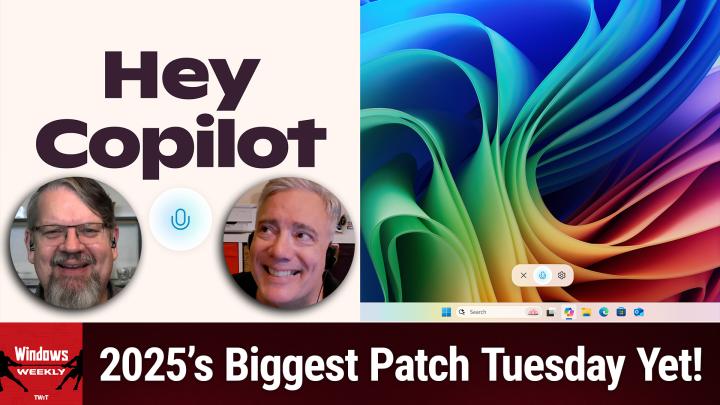
All TWiT.tv Shows (Audio)
Windows Weekly 932: The Last Australian
02:28:12
Microsoft lays off 3%, Windows 10 ESU, "Hey Copilot"
Loading summary
Transcript782 lines
- [00:01]
Leo Laporte
It's time for Windows Weekly, the biggest patch. Tuesday of 2025. We'll have the deets. We'll also talk about a new way to invoke copilot. No, you don't have to say it three times. And why, if Microsoft just made $70 billion, did they lay off 6,000 employees? All that and more coming up next on Windows Weekly. Podcasts you love from people you trust.
- [00:29]
Paul Thurot
This is.
- [00:37]
Leo Laporte
This is Windows Weekly with Paul Thurat and Richard Campbell. Episode 932, recorded Wednesday, May 14, 2025. The Last Australian. It's time for Windows Weekly get ready, winners and dozers, the show that you wait for all week long. Paul Thurat is here from Thorat.com Richard Campbell from Runisradio.com and they're both in their respective United States abodes. No, they're both in their North American abode.
- [01:08]
Paul Thurot
We'll get you yet, buddy.
- [01:09]
Leo Laporte
Paul's and makunji. Right, Sorry. Yeah, we'll get you yet. Yeah. No, no.
- [01:14]
Richard Campbell
Say that I'm in the mood to add 50 new provinces. I've got this idea.
- [01:18]
Leo Laporte
I far prefer that to the other.
- [01:21]
Paul Thurot
A few of the better ones. I'd be happy to join along in that escapade.
- [01:25]
Leo Laporte
And as. As your fine new PM said, Canada is not for sale.
- [01:30]
Richard Campbell
Oddly enough.
- [01:32]
Paul Thurot
I like that he said Trump said everything is.
- [01:34]
Richard Campbell
The owners, they're not selling it. I love that.
- [01:37]
Leo Laporte
It was so good. Richard Campbell is here. He is from British Columbia, actually. You're right. You're home, right?
- [01:43]
Richard Campbell
I'm home, yeah.
- [01:45]
Leo Laporte
He's in Madeira Park.
- [01:46]
Richard Campbell
Give you the view you want.
- [01:47]
Leo Laporte
Yeah, let's see the view. Let's see the loans, Harry. Oh, it's beautiful.
- [01:51]
Richard Campbell
You can see it's good.
- [01:52]
Paul Thurot
I want to show you my view, actually, since we're doing this, this is my view.
- [01:56]
Leo Laporte
Here's Paul's view.
- [01:57]
Paul Thurot
It's. It looks like I'm in a sewer.
- [02:00]
Leo Laporte
Are you sealed in? Did they seal you in?
- [02:03]
Paul Thurot
It's not ideal.
- [02:05]
Leo Laporte
What happened?
- [02:06]
Paul Thurot
I don't know. I'm in a cave. This is my natural habitat.
- [02:11]
Leo Laporte
It makes you want to go home, doesn't it? To Mexico City, doesn't it? It makes you want to go to.
- [02:16]
Paul Thurot
I mean, this room is bigger than that entire apartment, but, yeah, I mean.
- [02:21]
Leo Laporte
Other than that, you know, there's pros and cons. At least you're not stapled in. Is that drywall? What is it? Or it's just a curtain.
- [02:31]
Paul Thurot
No, it's stapled together or whatever you call it. Drapes over the giant window here. Otherwise it'd be. It's either too dark or too bright. Those are my choices.
- [02:42]
Leo Laporte
Right. Oh, I see. So when the show's over, you rip it open.
- [02:46]
Paul Thurot
No, I leave this as it is. What I do is I walk outside of here and then I'm usually not in this room.
- [02:54]
Leo Laporte
No.
- [02:54]
Richard Campbell
Right.
- [02:54]
Paul Thurot
This is like I'm having a timeout. This is my punishment room.
- [02:59]
Leo Laporte
Every Wednesday, Paul goes to the punishment room.
- [03:01]
Richard Campbell
Three hours of rage.
- [03:03]
Leo Laporte
Do you use Richard, your office for anything but the shows?
- [03:06]
Richard Campbell
No, absolutely. But this setup is for streaming and recording. And beside me is the writing machine. Oh, you have no pop ups or anything like that?
- [03:16]
Leo Laporte
Yeah, I have in theory. I have a desk behind over here that has my theoretical desk.
- [03:22]
Richard Campbell
Yeah.
- [03:22]
Leo Laporte
I'm rarely in this office to see up in the attic. I usually. I'm leaving it open today because we have a new kitty cat.
- [03:29]
Richard Campbell
Yep.
- [03:29]
Leo Laporte
And we replaced. Replaced the old one.
- [03:33]
Paul Thurot
We upgraded.
- [03:34]
Leo Laporte
We upgraded with a young, young model and. But we also have the house cleaners coming and we're not sure how she's going to react to the vacuum.
- [03:45]
Richard Campbell
We got a puppy now too. More chaos.
- [03:48]
Leo Laporte
That's exciting.
- [03:49]
Richard Campbell
Yeah.
- [03:50]
Leo Laporte
Lisa and her son went to the Giants game.
- [03:53]
Richard Campbell
Oh.
- [03:53]
Leo Laporte
So I got the house to the cat and I. Of the house.
- [03:56]
Paul Thurot
Do you have the house to yourself? What are you doing here?
- [03:58]
Leo Laporte
Yeah, that's a good question.
- [04:00]
Paul Thurot
What did you do? You said popcorn, like mounted on your chest. Watching some terrible movies.
- [04:05]
Leo Laporte
Sit around in your boxing shorts. Tom Cruise and Risky Business sing along to songs. Those were the days when I was young. You want to see the kitty? You want to see. I have a little picture of the kitty. I can show you. She's on the stairs. She's a little. She's watching. She's watching from a distance. She's a beautiful little cat. Rosie is her name.
- [04:31]
Paul Thurot
Yeah.
- [04:32]
Leo Laporte
Sweet little kitty. So I say all that because I. I want you to prepare your. You gird your lo. Loins, my friends, because it is the biggest. Do what to my loins?
- [04:45]
Richard Campbell
Nice.
- [04:45]
Leo Laporte
It is the biggest patch Tuesday of 2025.
- [04:49]
Paul Thurot
I mean, there's only been four before today, but still.
- [04:52]
Leo Laporte
Okay. How big is it, Paul?
- [04:55]
Paul Thurot
It's really big, Leo. Thank you for asking. Also, the name of your sex tape. I can't stop doing that.
- [05:03]
Leo Laporte
Okay.
- [05:05]
Paul Thurot
No, it's because this is when Recall in preview and click to do also in preview are actually in stable. Right. Last two weeks ago they were in stable, but in a preview update that not everyone would get. But now you're getting it. Whether you Want it or not. Assuming, of course, you have a Copilot plus PC. So this is it. So one year ago, yeah, I mean, almost to the week, right. Microsoft announced Copilot plus PC as a platform. They announced the first Surface devices and some OEM devices, and they announced Recall as the marquee feature, which a year later, by the way, hilarious.
- [05:43]
Richard Campbell
Nice. Almost done. The wire was last build.
- [05:47]
Paul Thurot
I feel comfortable saying that after several months of testing, I never need to see that feature again. And it has nothing to do with privacy or security. I just don't need it. But maybe you'll like it, which is the most condescending thing you can say to anybody. Oh, that's terrible. I mean, you might like it, but.
- [06:05]
Richard Campbell
Still requires a Copilot plus PC, which means a laptop.
- [06:10]
Paul Thurot
Nobody. Yeah, basically. Yeah. So, yeah, click to do, by the way, actually very interesting. I think the Copilot vision stuff is very interesting. The improved Windows search, which we need a better name for, which is that semantic indexing, also very interesting, potentially. And we'll see. And then other stuff, I mean, there's the integrated phone companion, that panel on the side of the Start menu, which I have to say, first time I saw that, it looked like a cancerous growth to me. But I use Phone Link all the time now, and it's because it's gotten a lot better, especially if you have an Android phone. And it's actually really handy. Like, it's nice. So you have this kind of. Instead of running the full app, you can access a lot of the key actions that you might do with Phone Link through that interface, including sharing files back and forth or looking at photos, whatever it might be. So it's nice. And then some small things, but, yeah, you know, like Microsoft saying that they changed the home screen and File Explorer is like me saying that the sky is blue. It's like, of course you did. It's like another Tuesday. Like, you just. They change this all the time. That said, one thing I have been using on laptops since I started, I've seen this since it was in the dev channel. But Windows 11 supports text scaling in modern apps in addition to the, you know, the full screen scaling effect. Right. And so when you turn on a laptop or whatever it is for the first time, whatever, you know, Windows 11 install, I think a lot of people will look at the screen and say, well, taskbar, everything's a little too small or too big or whatever it might be. And you go into settings, change the display scaling, and you kind of leave it at that.
- [07:54]
Richard Campbell
But Windows also scale the pass bar too.
- [07:57]
Paul Thurot
What's that?
- [07:58]
Richard Campbell
Does this display scaling scale the taskbar as well?
- [08:02]
Paul Thurot
So it does, but not the way you want it to. Right. In other words, in Windows 10 and previous, they had this small icons view.
- [08:11]
Richard Campbell
Yeah, small icons, large icons.
- [08:13]
Paul Thurot
Yeah. So that's actually a feature that's sort of coming in a future version of Windows 11. So that's on that tracker thing I've been working on. It's not in this update. I will say in the latest build that I've tried that in, it doesn't actually change the size of the taskbar. It changes the size of the icons only. Guys, what the frick did you think we were looking for? So whatever. Look, they're trying. I don't know. There is a registry hack you can do to get small icons, by the way. But yes, it does, but like I said, not in the way you want it to. But modern apps support text scaling in addition to the screen scaling that's separate from that. So this is good for people like me. Like you're in middle aged or whatever. You can't see the text as well or whatever. If you're in a browser, you can do the Control plus thing. But File Explorer now supports text scaling. File Explorer is technically a classic desktop app. Obviously it has a partial winui front end and I assume I probably shouldn't, but I assume that's part of the way they were able to do this. But now it respects whatever your text scaling setting is. So if you have display scaling to whatever and then you go in and change text scaling to say 120% or whatever it might be, it only impacts those apps that support this setting. And now File Explorer is one of them. And actually, I have to say, I really like it. It's very clean looking, you know, it's not like jaggy or weird. It doesn't look weird. Like it's assuming you look like it's.
- [09:40]
Richard Campbell
Supposed to be there.
- [09:41]
Paul Thurot
Yeah, it looks good. Like it looks natural enough, which is like saying they had good plastic surgery. Like, it looks sort of like a person.
- [09:50]
Richard Campbell
At the right angle.
- [09:51]
Paul Thurot
Yeah. Yeah. In the right lighting, you look like a woman or a man or whatever you are.
- [09:55]
Leo Laporte
You know, you look like your pronouns.
- [09:57]
Paul Thurot
Yeah, yeah.
- [09:58]
Leo Laporte
Steve Gibson spent some time yesterday talking about how he managed to get his Windows taskbar on the left side of the screen.
- [10:05]
Paul Thurot
Yes, he's that if you're dedicated enough.
- [10:09]
Leo Laporte
Yeah, yeah. Well, he found a actually really cool program. I don't know if you know, but I called Windhawk have you ever heard of that?
- [10:15]
Paul Thurot
Is it Windtoys? No.
- [10:17]
Leo Laporte
It's a free open source program and there's a lot of contributed tools for it, one of which. Here, I'll show you. It's Windhawk.
- [10:29]
Paul Thurot
Oh, Windhawk. I'm sorry. Yes, I have heard of this.
- [10:31]
Leo Laporte
Yeah. Yeah. So what's cool is there's mods of all kinds and some of them are for Windows 11, not all of them, but you can move the taskbar anywhere you want in Windows 11.
- [10:43]
Paul Thurot
Yeah. So what these guys are doing are taking advantage advantage of Registry features.
- [10:47]
Leo Laporte
That's what I wondered. So it was Registry.
- [10:50]
Paul Thurot
Yeah. So there are other utilities that can do this as well. So you can kind of force it if you want. The problem is you don't know if it's always going to work. You don't know when it will break. You don't know if you.
- [10:59]
Leo Laporte
That's what I always worry about.
- [11:00]
Paul Thurot
System update. It might just go back or whatever.
- [11:02]
Leo Laporte
Yeah. I'm nervous about modifying the system just for that reason alone. Also because you do it on one system and then you're disoriented when you use another.
- [11:11]
Paul Thurot
Right. So I enabled the coming new taskbar. We're going to talk. I'm sorry, the coming new Start menu.
- [11:17]
Leo Laporte
Bigger Start men, Big menu, Right.
- [11:18]
Paul Thurot
Yeah. And I also manually enabled that Phone Companion slice on a PC that just didn't have them yet for some reason. Well, no one has the Start menu yet, but. And it worked fine.
- [11:32]
Leo Laporte
Okay.
- [11:32]
Paul Thurot
And then I got an update and then my Start menu was blank and I used Vive Tool for that. That's another one of those kind of utilities. Vive Tool is a command line tool and one of the neat things about that is it actually has Command line switch where you can just reverse everything. So I had to do that reboot and it came back and everything was normal, but I lost the big Start screen, the Start menu and then the big or the Phone Companion slice. But that's okay. This is what I do. Like, I'm testing stuff. It's okay. It's not a big deal, but it.
- [11:58]
Leo Laporte
Is a caveat for people who are going to do those kinds of modifications.
- [12:03]
Paul Thurot
Yeah. And so every once in a while I'll bring up this thing that I think about but haven't worked on in months because I'm busy with other stuff. But I do want to write a utility. I'd love for someone just to make this utility for you. But what I want is not only something that will let you go through a list of things and make whatever changes, but then also monitor the system on boot and say, hey, you had this configured to this, but Microsoft changed it to this and see when and if that happens. And just based on experience, I mean, it's pretty clear when you install certain updates that this happens to certain feature changes. In the past, that was always like a feature update, like a major version upgrade, but with them doing these cumulative updates every like twice a month. Actually, if you're doing a preview update, I feel like this could happen at any time. So I kind of want to keep track of that. But I don't know of anything that does what I just said. But I am interested in that. You would notice this, that's for sure. If you had your taskbar on the left side of the screen or whatever and you came back and it was on the bottom, you're like, okay, so that changed. I mean, and maybe that broke, maybe you'd know what it was. But I just installed something keeping me.
- [13:15]
Richard Campbell
On win 10 is that I don't like wasting that vertical real estate. Right.
- [13:20]
Paul Thurot
Yeah.
- [13:20]
Richard Campbell
I want to keep it off on the side, out of the way. It doesn't need to be that big.
- [13:24]
Leo Laporte
Yeah. It's weird that they settled on the bottom of the screen because most screens are wider than they're taller. And so.
- [13:30]
Paul Thurot
Yeah, I think they're just following what most people do.
- [13:33]
Leo Laporte
Yeah.
- [13:33]
Paul Thurot
But that also follows what the default is, which is not necessarily representative of what anyone wants. I think people just don't think about it.
- [13:41]
Richard Campbell
Well, I was contemplating getting a small like 10 inch, 1080p screen and just have the taskbar on that and that's all it's for.
- [13:49]
Paul Thurot
Yeah, right. Yeah. You want the touch bar that was on the mat.
- [13:54]
Leo Laporte
It's a touch bar, but you want.
- [13:55]
Paul Thurot
It to be the. Just the taskbar. That's funny, actually. You just hide it. Right. You could hide the thing. I don't like that. Yeah.
- [14:00]
Richard Campbell
But that bugs me too, because it makes all. It makes all the Windows twitch and some of them don't twitch. Right.
- [14:05]
Leo Laporte
If you.
- [14:06]
Paul Thurot
In Ubuntu, Linux, I'm not sure how far back this goes, but if you make it not a panel so it looks like a dock, like the Mac OS X dock. One of the options is if you maximize a window or just drag it over that, it actually just hides then.
- [14:17]
Leo Laporte
Yeah.
- [14:18]
Paul Thurot
And that's smart, you know, like, and.
- [14:21]
Richard Campbell
That'S so we'll never talk about thoughtful ux.
- [14:25]
Leo Laporte
It's funny how much energy is put into this, but it is probably the most important UX feature, Right.
- [14:31]
Richard Campbell
It's something you use every day.
- [14:32]
Leo Laporte
Yeah.
- [14:32]
Paul Thurot
You know, well, okay, so we're literally gonna. We're gonna talk about that exact thing very soon because there is work happening on the start menu. Go figure. But more, I don't. You know, Microsoft ui, it's kind of glacial as it should be.
- [14:48]
Leo Laporte
You know, I hate it when they change things just for change sake. Apple's about to do that with all of their stuff. They're gonna make all the icons round.
- [14:56]
Paul Thurot
Yeah.
- [14:56]
Leo Laporte
And it's like, okay, but everybody's just going to throw everybody. And Microsoft, because of their own businesses, they don't want to have to retrain people.
- [15:08]
Richard Campbell
No, no. I used to get nuts, right?
- [15:10]
Leo Laporte
Yeah.
- [15:11]
Paul Thurot
OnePlus, the phone company, Right. I used to get every one of their devices for review. And my reviews of these devices were pretty consistent. It's mostly excellent. Camera isn't so great. They kind of went through this every time. But at one point they had round icons. Right. And at one point, now Google does this too, I guess Samsung certainly does. But at one point they added the ability to customize the shape of those icons. So you could have a square, rounded rectangle. Rounded, square, whatever squircle like we have on Samsung. Right. So I changed it. I actually really like the way those look. The squircle kind of shape. It's really nice. It just looks. I think it looks great. So I changed it to that. I wrote my review, all the pictures, and then Carl Pei was, I think, running or part of OnePlus at that time. He's at nothing now. He called it out on Twitter and he's like, come on, man. He said something like, you went with the Samsung shape. And I'm like, dude, your UI is customizable, so it could be whatever I want. I'm like, this was a compliment. I've never gotten a review unit ever since that day. So I'm not saying those two things are related, but I'm sort of saying it. I mean, I don't know. I don't know.
- [16:28]
Richard Campbell
Too funny.
- [16:30]
Paul Thurot
So anyway, hopefully what Apple will do, because Apple has come a long way with home screen customization. They really resistant to that for a long time.
- [16:37]
Leo Laporte
Oh, yeah.
- [16:38]
Paul Thurot
So switching to like a shape is whatever, but what they should do is what I just described. They should give you the ability to customize that. That should be your choice, you know.
- [16:47]
Leo Laporte
Well, Android does it right, where you can have any launcher you want and every. I mean, there's some really wild launchers out there and I think that's great. You get to choose what you want, but Apple won't do that ever.
- [16:59]
Paul Thurot
Even though this is always the problem with these default things, like most people, this is why the taskbars on the bottom of Windows, most people just won't touch it.
- [17:08]
Leo Laporte
Right.
- [17:09]
Paul Thurot
So set it to be what you want by default, but then give them the choice. And what you'll find is most people will not change anything.
- [17:16]
Leo Laporte
When did they turn off the ability to drag it to any side of the screen?
- [17:20]
Richard Campbell
Was that when 11?
- [17:22]
Leo Laporte
So when they went to 10. From 10 to 11?
- [17:24]
Paul Thurot
No. So to be fair, I'm not. No, I'm not being fair. So to. How am I defending. I'm not defending this, but Windows 11 taskbar and start Menu are basically new code. So even though the old code is still in there to some degree, the code for those two UIs is new. Yeah. So they had they created from scratch. I hate to say, I don't want to say they had to, but there are some legacy things built into those things that they were trying get by. Whatever. Yeah, I understand.
- [17:54]
Leo Laporte
Yeah, I get it.
- [17:55]
Paul Thurot
But it makes sense. But it's. But you also feel like for the 1.0 release, maybe, you know, it's like the right click thing. Like right click Menus in Windows 10 could have hundreds and hundreds of items or multiple toolbars you can put down there. They stripped away all this stuff. And of course you're going to hear from the guys who want that stuff, you know, So I don't know. I'm not defending it, I guess I'm just explaining it. But, you know, they pulled the Steven Sinofsky on this one. They were like, well, you know, based on telemetry data, no one was really using this. It's like. Yeah, except for those people that are the most vocal. Yeah.
- [18:30]
Richard Campbell
The noisy ones.
- [18:31]
Paul Thurot
Power users. That.
- [18:33]
Leo Laporte
Here's to the noisy ones. The crybabies, the whiners.
- [18:38]
Paul Thurot
Here's to the flatulators.
- [18:40]
Leo Laporte
The ones who would probably like to get something done but just never do.
- [18:44]
Paul Thurot
Yeah, yeah, exactly.
- [18:46]
Richard Campbell
Well, that was Sinofsky's thing about bookmarks in IE back in the day. And we're a bunch of us in a room, all MVPs and RDs. Like, how many of you use bookmarks? The whole room puts up his hand. It's like, look at the telemetry. It's 1/2 of 1%. The fact that you all happen to.
- [19:03]
Leo Laporte
Be in the room, that seems a little suspicious. Okay. I'm just saying.
- [19:07]
Paul Thurot
Well, but it's also a little shortsighted. Because you're weighting everyone equally when, in fact, the people who would customize these features might be more influential with others.
- [19:19]
Richard Campbell
Yeah.
- [19:19]
Paul Thurot
And are going to be the types that have blogs and Twitter accounts and whatever and complain, you know.
- [19:26]
Richard Campbell
Yeah. And it's. He's angry all the time. Well, all he did was say, we're not going to put a dev on the bookmarks. The bookmarks are going to be identical in IE9. And when they. And they were.
- [19:38]
Paul Thurot
That's fine. Just leave it alone. That's actually all we ever wanted. We just want you to leave it alone. Perfect. Yeah. No, I. I'm going to jump ahead one, just because we're talking about this now, because you guys will remember this a couple of years. Microsoft published this insipid video describing how they designed the Windows 11 Start menu as originally perceived. Right. Originally. Really?
- [20:02]
Leo Laporte
Is that the one where they had the design?
- [20:04]
Richard Campbell
She's like.
- [20:05]
Paul Thurot
She's like, yeah. You know, it's like, clearly Mac users, designers who have never seen the Start menu or like when you're designing a feature like the Start menu, it was the grossest video.
- [20:15]
Leo Laporte
Terrible.
- [20:17]
Paul Thurot
So, you know, a couple of weeks back, we got a rumor, which was true. Right. That they are working on a new version of the Start menu. So there have been all these obvious complaints about the Start menu. And they're obvious because all you have to do is use it to see what the problems are. Right. So you could do something like. Well, I don't want, you know, I don't know why you would do this, but let's say for some reason you deleted a bunch of the pinned icons at the top. That space is never recovered. It just sits there blank. It's empty. It's just taking up space. It's unbelievable. The thing doesn't do basic overflow or underflow. I guess in this case, the recommended section is this weird combination of recommended documents that they get through various means. Recently installed apps, suggested apps, suggested documents. It's like this weird Frankenstein monster of, like, terribleness. And so the initial change to this Start menu was to give you the ability to have more space for the top or the bottom without fixing any of the problems. So now they've undergone this big push to make the Start menu better. You know, like, go figure. Right? And so they still pins. They still have Recommended, but now they have all apps in the main display. You can turn any of those off. You can expand or contract them in place. And the all apps view has three views. The default one, which is like the app library, is in iOS, it's like a. I forget the term. I'm sorry, there's a word for this. Collections or whatever they are of different types of apps. Categories, I guess. Category view, probably. So you can have a grid view, which is like all the apps that start with a certain letter on the same line, if they fit. Or you can have the standard view, where it's like one app. App done though, as they go. And yeah, there you go. Between the stuff you can kind of already do, like turn off suggestions, only show apps and. Or documents and recommended, etc. They finally gave us the things that we've been asking for, which is like, turn off that section, have it be bigger or smaller on the fly. You might want a bunch of stuff in there, but only want to show a little most of the time. But then you click an expand button, go and grab the stuff out, whatever you're going for. So I'm not saying it's perfect, but in using it, it's immediately and obviously better. And it's cheap to say this is what they should have shipped the first time. But it does have that feel, which is how, you know, they kind of maybe are on the right track. Right. Because there were so many regressions in the initial version of Windows 11. So that if I remember correctly. Yeah, it was one of those new features they announced last week on the same day they announced those new Surface devices. It is not in the Insider program yet, I believe, but if, you know, if you can use Vibe Tool or something like that, you can enable it if you want to. I have. I think it looks great. So we'll see. You know, it's gonna. It will happen eventually, probably soon. And I think this is one of those features that is actually gonna be tied to 25H2, even though they're not saying that yet, you know, because God forbid, maybe they'll now set it build, he says hilariously. So there you go. Anyway, we'll see.
- [23:42]
Richard Campbell
That's next week. We. The possibilities.
- [23:44]
Paul Thurot
Yep.
- [23:45]
Richard Campbell
I just. I'm sort of resonating on the idea there might be a Vibe channel in Insiders soon.
- [23:51]
Leo Laporte
What's that?
- [23:52]
Richard Campbell
We got everything else.
- [23:53]
Leo Laporte
What's a Vibe Channel?
- [23:54]
Paul Thurot
My Vibe is depressed.
- [23:56]
Richard Campbell
Yeah.
- [23:56]
Leo Laporte
Oh, Vibe coding, you mean, or.
- [23:58]
Richard Campbell
No, we're just going to rename these.
- [24:01]
Paul Thurot
Things so they don't make any sense. Like, that's the Vibe. Like they could call the Canary Channel Chaotic Evil. You know, they just have names like that.
- [24:09]
Richard Campbell
Yep.
- [24:10]
Leo Laporte
What would the Vibe Channel be like? We don't know what you're gonna get just.
- [24:13]
Richard Campbell
Yeah, yeah. We're experimenting this weekend. Here it is.
- [24:16]
Paul Thurot
It's cool. Don't worry about it.
- [24:17]
Richard Campbell
It's all right.
- [24:18]
Paul Thurot
For those people who just don't give a crap. It's like the type of people who go to Costco and like, I think I'm gonna buy a car. You know, like, I just. Like, you just don't have any opinions about it.
- [24:27]
Leo Laporte
And instead I bought a coffin.
- [24:28]
Paul Thurot
So. Yeah. Yeah, right. It's. And they put wheels on it now. It's.
- [24:31]
Richard Campbell
Yeah, it would happen at Costco. My son won the, like, look, they sell children.
- [24:37]
Paul Thurot
Yep. I'll take two boys and a girl.
- [24:39]
Leo Laporte
Have a bigger one. Maybe a six pack, please.
- [24:42]
Paul Thurot
Six pack. You guys can carry yourself. All right. Yeah.
- [24:49]
Richard Campbell
I don't even know shrink wrap anymore.
- [24:52]
Paul Thurot
So. Yeah, this is something. This came. I had a meeting with Qualcomm recently, but. Because he just said Costco or we just talked about Costco, you know, back in the day in the United States, this is different in different places, obviously. But we had a bunch of electronic retailers for a long time. Yeah.
- [25:10]
Leo Laporte
Oh, yeah, I remember that. Radio Shack. Yeah.
- [25:12]
Paul Thurot
Yeah. We had, you know, electric. What was it called? Electronic boutique software, etc.
- [25:17]
Leo Laporte
We had the big ones, CompUSA. Remember them?
- [25:19]
Paul Thurot
CompUSA. Right. With the store, then. Store. Right. So we don't have those anymore. So we have Best Buy and then we have Costco. And Costco has become increasingly important to PC makers. So you're starting to see in both of those retailers the store in a store concept that we used to see at CompUSA. So, for example, Copilot Plus PC, by the end of this summer, will have a store in a store inside every Costco in the United States. Interesting, because there's fewer places for people to go and see something.
- [25:50]
Leo Laporte
On the radio show, when I was talking to the unwashed masses, I would tell people it's okay to buy a computer at Costco because they have such a return.
- [25:58]
Paul Thurot
Exactly. It's how you want to do it.
- [26:00]
Leo Laporte
But they used to, like, have last year's model, like you wouldn't be able to get.
- [26:05]
Paul Thurot
It's different.
- [26:06]
Leo Laporte
That's changed, hasn't it?
- [26:07]
Paul Thurot
Yeah, it is. You can. They have a little. There's a little Apple section in there. Now there's a Samsung section for phones. They have all the smart speakers.
- [26:15]
Leo Laporte
It's the same, though. You're not.
- [26:17]
Paul Thurot
Yes, and they have sales and stuff like that, too. But they. But increasing return policy is the thing. That's why you would do it. Costco is the Best.
- [26:24]
Leo Laporte
Yeah.
- [26:25]
Richard Campbell
The problem is, you know, do you really want to return a PC, you know, like, because you. Odds are you bought it because you needed to use it, right?
- [26:32]
Paul Thurot
Well, no, no. Fair enough.
- [26:36]
Leo Laporte
If it didn't work. Right. Or whatever, you want to turn it.
- [26:38]
Paul Thurot
In and maybe get a better model or something. Yeah. The thing is, like, you could probably go back much later and be like, all right, I think I'm done with this.
- [26:43]
Leo Laporte
You can. I mean, they're very liberal on. Yeah, yeah.
- [26:46]
Paul Thurot
Yep.
- [26:47]
Richard Campbell
Mostly because they stiff the vendor in the process, probably.
- [26:50]
Leo Laporte
Yeah. You buy, they have the market.
- [26:51]
Paul Thurot
That's what we want from. That's, you know, that's what we want from that company. Right.
- [26:55]
Richard Campbell
Yeah.
- [26:57]
Leo Laporte
Anyway, I'm looking forward to seeing what these big box stores look like in a couple of months when they're gonna.
- [27:05]
Paul Thurot
Look like little box stores because, you know, well, so they're big enough. They probably. I don't know how this works everywhere, but, like, they either lease or rent or whatever, or own that property. It's. I, I don't really know how that works, and I think it's going to be based on that because if it's rent, those, they're going to go out. They're eventually going to be like, yeah, we're done here. Thanks.
- [27:26]
Leo Laporte
Yeah.
- [27:26]
Paul Thurot
You know, they'll walk out. Yep.
- [27:28]
Leo Laporte
Yeah. I don't know. I, you know, I. That's interesting. And of course, the tariff went down in China, but it's still 30, which is still a pretty hefty chunk.
- [27:37]
Paul Thurot
I. So I, I described, I think. I don't know if it was on the show or that could have been privately to friends. I have no idea. Tariffs are like a roller coaster. Literally. You go up, you go down, like red light. If it's working properly, you don't know what's next. And then your head gets whipped around, you know, suddenly you're upside down, jump scares. Yep. And then when you're done, you throw up. You know, it's.
- [27:59]
Leo Laporte
It's so funny because I look, I looked at this, you know, my. I am soon going to be living on my retirement, you know, like tomorrow.
- [28:07]
Paul Thurot
How scary is that?
- [28:08]
Leo Laporte
And it's really scary. And it was down a lot. And then, then this morning, Lisa and I looked at her and it was like, wow. It just, it's back. It's so confusing. It's best I have to look.
- [28:19]
Paul Thurot
I have a friend who overreacts to everything. Right. And so, like, this is long term savings. Obviously. He actually pulls his money out of the stock market in these times. You know? Yeah, and. And I don't know that he puts it under a mattress, per se, but, like, it's.
- [28:34]
Leo Laporte
You just leave. You leave it in the IRA or the 401k. But.
- [28:36]
Paul Thurot
And my wife one time just finally said to him, you need to understand something. We left our money in during the 2008 financial crisis, during. Whatever. And because we did, we now have, like a million dollars worth.
- [28:47]
Leo Laporte
Yeah, you miss a lot.
- [28:48]
Paul Thurot
Like, you have no idea what you're doing.
- [28:50]
Leo Laporte
You have to time it just right.
- [28:51]
Paul Thurot
You're timing it, but you can't.
- [28:52]
Leo Laporte
You can't.
- [28:53]
Paul Thurot
Like, you can't.
- [28:54]
Richard Campbell
You are not.
- [28:54]
Paul Thurot
You get lucky once, maybe, but you don't do stuff like that. That's just not.
- [28:58]
Leo Laporte
No, I. That's true. As long as you aren't going to be with, you know, living on it. But then you get to a point close to my age, not yours yet, where you have no more window to get it back. You see what I'm saying?
- [29:13]
Paul Thurot
I do, but I mean, ideally, you have done things correctly, and I know you have. I mean, this.
- [29:20]
Leo Laporte
I'm not gonna be email po now.
- [29:22]
Paul Thurot
Well, that. In other words, like, this year, you know, if you're living on whatever. Not you, Leo, but if someone has, like, I'm getting 80 grand a year from retirement, but I guess this year it's only going to be 50 because the market went south or whatever it is, you need to be able to withstand that. Like, that. That needs to be. That's on you.
- [29:38]
Leo Laporte
But that's reality, though.
- [29:39]
Paul Thurot
Yeah, that's on you.
- [29:41]
Leo Laporte
Yeah, it's reality. And it's.
- [29:42]
Paul Thurot
So maybe you're not going to Europe this year, buddy, you know?
- [29:44]
Leo Laporte
Well, I'm not. We're doing one more trip. No, I'm serious. We can't afford any more big trips. That's it. We're done. We have one more that we paid for in. In 2020, and we're gonna take that one and. And then that'll be it. Because I. I can't. I don't know. Not because, I mean, I could, but I don't know if it's a smart thing to do, given what might happen in a year or two or whatever. So it's better to be prudent. And it's, by the way, one of the main reasons why I'm still working. I'm working well beyond my retirement, my Best Buy date.
- [30:19]
Paul Thurot
I mean, I didn't mean to turn this into a retirement podcast, but a couple things to. What you just said, though, is like, I feel like A lot of people's concepts of retirement are dated. No one actually wants to sit on the beach every single day with this sounds good until you do it for three days in a row or whatever it is. But the other thing is you got to go through phases and you don't know when things are going to happen to you. But at some point you are going to slow down and you're not going to spend as much during those times. God, I hope that you could make a case for traveling more early in retirement and then slowing it down later, because you're going to just naturally that.
- [30:54]
Leo Laporte
Was the case I was making, but I don't know if I can keep making it. Anyway, that's neither here nor there. Let me make a little money now though, if you don't mind pause and come back with a lot more, including.
- [31:07]
Paul Thurot
Hey copilot. Hey buddy.
- [31:10]
Leo Laporte
I guess it's safe to say hey copilot now, but at some point we're going to have to we this was.
- [31:14]
Paul Thurot
Going to be the next trigger.
- [31:16]
Leo Laporte
We have to have a phrase. So start thinking now. We call Siri Schlomo.
- [31:22]
Paul Thurot
Oh, I'm going to start thinking about how I can just keep doing it and be a real jerk about it. Hey copilot. Delete C Honey, why did my hard.
- [31:30]
Leo Laporte
Drive fill up with transcripts of Windows Weekly? All right, more to come in just a moment. You're watching Windows Weekly with Paul Thurot and Richard Campbell and our show today brought to you by 1Password do your end users always work on a company owned device or devices and IT approved apps? Of course not. So how do you keep your company's data safe when it's sitting on all those unmanaged apps and devices? 1Password has an answer to this question. Extended Access Management 1Password Extended Access Management helps you secure every sign in for every app on every device because it solves the problems traditional IAM and MDM can't touch. Imagine your company security like the quadrangle of a college campus. There are nice brick paths between the buildings. Those are the company owned devices, IT approved apps, managed employee identities. And then there are the paths people actually use as shortcuts worn through the grass that are the actual straightest line from point A to B. Those are the unmanaged devices, the shadow IT apps, the non employee identities. Like contractors, most security tools only work on the happy brick paths. Many security problems occur on the shortcuts. 1Password Extended Access Management is the first security solution that brings all these unmanaged devices and apps and identities under Your control. It ensures that every user credential is strong and protected, every device is known and healthy and Every app is visible. 1Password is ISO 27001 certified with regular third party audits. It exceeds the standards set by various authorities and is a leader in security. It's security for the way we work today. Now generally available to companies with Okta and Microsoft Entra and in beta for Google Workspace customers. Secure every app, device and identity, even the unmanaged ones. And@1Password.com Windows Weekly all lowercase, that's 1P-S-S-W-O-R-D.com WindowsWeekly back to the show and hey, did you come up with something?
- [33:45]
Richard Campbell
Hey.
- [33:46]
Leo Laporte
Hey. Jiminy Cricket. Hey.
- [33:48]
Richard Campbell
Nice.
- [33:49]
Paul Thurot
See, that's another one that should be I've always said this. My sister has a daughter named Alexa. Can we tell you how hilarious it is to use Amazon things in her house?
- [33:59]
Leo Laporte
She can't.
- [34:00]
Paul Thurot
It's terrible, right? You should be able to customize that because I would call this thing something I can't say on the air.
- [34:06]
Leo Laporte
I know. Meathead. Hey, Meathead.
- [34:08]
Paul Thurot
Idiot.
- [34:09]
Leo Laporte
Yeah, okay. You dumb, dumb.
- [34:10]
Paul Thurot
What? What now?
- [34:14]
Leo Laporte
The one I really wish you could change is Siri because there are so many words that sound like you're saying her name.
- [34:21]
Paul Thurot
Yes, I say the word seriously all the time.
- [34:24]
Leo Laporte
That's the one.
- [34:26]
Paul Thurot
All the time. We probably might be the most common word I say after the yeah, yeah.
- [34:31]
Leo Laporte
Well, good news. You could get $100 in the Lopez vs Apple settlement.
- [34:36]
Paul Thurot
You know what I say to that? Seriously, you know. All right.
- [34:41]
Leo Laporte
Anyway, what's coming next? Windows Insider program.
- [34:44]
Paul Thurot
This just happened today. Microsoft is testing across all channels a hey, copilot, wake up word, which is actually a phrase, not a word or a term. But it's opt in or the feature will be opt in. It's rolling out across all channels, like I said, via an update to the Copilot app, which I've not gotten yet. I keep checking for this. I can't wait to play with this. It's obviously a replacement for hey Cortana, that phrase we all know and love and miss.
- [35:11]
Richard Campbell
Maybe that's the phrase we should use.
- [35:13]
Paul Thurot
Yeah, exactly. I'm just going to fight progress there.
- [35:17]
Richard Campbell
It's like the one thing you know it's not going to trigger at all.
- [35:20]
Paul Thurot
Yeah, there's a lot of. I was just looking at Copilot because of this. Actually, I was looking at Copilot a couple things about Copilot app. This is the Copilot app in Windows 11. I don't know if anyone's noticed this, but if you look at this app, which is now allegedly a native app or whatever, it uses fonts that are nowhere else in Windows, like, anywhere. I've never seen these fonts. I don't even know what it is. And so it's different looking. And that makes me wonder sometimes if there isn't something happening, right? Like, Google just announced all these Android changes, and maybe Microsoft's got some kind of a UI thing coming. All right, so this is that. But when you go into settings, there's this stuff in there that might surprise you. Like you can tie Copilot to your phone and it can use your phone as the basis for some of the things it might be able to do. And that will expand, obviously, over time. It has different voices, not in Windows, but on mobile. You can change the speed at which the voices play. So you can speed them up, slow them down, you know, whatever. There's all this stuff, right? So this is going to be one of them. But it's also something you could do today, assuming you've configured it or not changed the configuration, which is. It's one of about 200 apps. So it wants to take the alt spacebar shortcut keyboard, right? And that brings it up into quick view, or whatever that little small view is called. If you hold down alt key space today, it should go into voice mode, which is what this will do, right? So this is like a voice trigger for that action, which makes sense. You want to talk to it, so you address it. Like, I do this to my wife all the time. I'm like, stephanie, Stephanie, Stephanie. She's like, what? I'm like, this is 50% of all the conversations I have with my wife. So, yeah, so we'll see. As soon as I saw this, I was like, yeah, obviously they're doing this. Like, this, to me is the most obvious thing in the world. So that's fine.
- [37:18]
Richard Campbell
The interface people expect.
- [37:20]
Paul Thurot
Yeah, yeah. And, you know, I think we've talked about this. It's weird to me how unnatural it is or was to speak to any of those assistants, whether it was Cortana, Google, Amazon, whatever. And there is something weird that goes on with these newest. These new AI assistants, these new AI companions, whatever you want to call them, chatbots, where it's getting a little too natural. Like, it surprises me because I'm naturally kind of cynical. I know it's surprising about this kind of stuff. And I just did an episode or recorded. You won't see it For a while, but for Hands on Windows about Copilot Vision. And I find myself, like, being polite to this thing, like, you know, thanking it, apologizing, you know, does it help.
- [38:10]
Richard Campbell
That Sam Altman says it's costing the millions when you do that?
- [38:12]
Paul Thurot
It does a little bit. And the fact that that guy is as robotic as a human being can be also makes it kind of ironic.
- [38:20]
Richard Campbell
Still owns that, but okay.
- [38:22]
Paul Thurot
Yeah, yeah, okay, fair enough. So, yeah, I mean, it's kind of. Okay, so there's that. I'd hoped to have this done for patch Tuesday and then for today, but I'm still trying to figure out the right way to publish this. But I'm working on this update to my Windows 11 feature tracker, the roadmap or whatever. I think I said this earlier, but my suspicion here is that Dev Channel especially, and like this new Start menu is stuff that is technically targeting 25H2, even though that distinction is kind of pointless because all the features are going to come everywhere. But if you want to, I don't know, kind of place it in a milestone release of whatever kind, that's just how I view this. But we'll see. We'll see how it actually comes down. So there have been new features released to the dev and beta channels, both of which are on 24H2 or can be in beta channels case, and they're just improvements to the stuff we already have. Right. So Microsoft announced an AI agent for settings, which seems like not a great use of AI to me, but okay, fine.
- [39:29]
Richard Campbell
That was originally trying to find a setting.
- [39:31]
Paul Thurot
Well, yeah, I mean, this is. I'm sure I use this example, but AI, like, any software can help you learn how to do something, but it could also just do it for you. Right. And so I think I must have used this example. Like Microsoft Word, all the Office, the primary Office apps got that kind of search bar thing at the top at one point. And one of the things you could go up there, you could just like, ask your questions and it would say, like, how do I make this a stupid one? Like, how do I make text bold?
- [40:00]
Richard Campbell
It would be like, okay, I was merging cells in Excel because I couldn't find it on the fricking toolbar. There I am in that text box saying, merge these cells. Like, oh, here you go.
- [40:09]
Paul Thurot
That's fascinating because the ribbon was supposed to solve every single UI problem in Office. But so. But eventually, like, what you really want is for that thing just to do it, right? And so, you know, if you ever, in the very early days of Copilot and Windows, you could say something like, hey, how do I turn on dark mode? And be like, here's how you do it, you know, but the goal here is for it to do it and do it. I get. Yeah, I guess, you know, settings. Settings is a. A box of chocolates of its own kind. I mean, a million settings in there. It's unclear where stuff is. I. One of the things I ran into just this week, for example, is I have a laptop that requires. Well, that works better with a faster or bigger or more wattage, I guess, whatever you want to call that more powerful charger than a 65 watt typical laptop charger. Right. But it works fine with a 65 watt charger. So when you plug that thing in, you get a pop up from. It says, from power and what's the battery? Or whatever it's called. And it says, hey, this is going to slow charge. This is not ideal. You should use the charger that comes with this thing. You're like, okay, but I want to turn that off. I don't want to turn off all notifications from power and battery. Right. But I do want to turn that off. I get it, I saw it, I acknowledge it. I'd like to move on, actually. I have a thing about this later in the show too. But anyway, so I looked this thing up. Of course you go to. Well, first I went to power and battery or whatever it's called. And I went through every single setting. There's nothing in there about notifications. So I'm like, okay, I'm going to say I'm going to have to Google this like a normal person. And I did. And it turns out that this thing is in a different part of Settings and not the part you would think. It's in Bluetooth and devices. And then you go to usb. And this is a desktop PC, so I don't. Oh no, it's still there. That's hilarious. It says, show a notification if this PC is charging slowly over usb. Okay. So the notification is called something, but the thing that triggers it is something else. Hilarious. Anyway, that works. You could just turn it off and then you still get your power and battery notifications. And everything we have is terrible because we use Windows anyway. Yeah, Settings is my point. There was only that settings has a lot of settings. So maybe this is okay. Like if you could talk to your computer and say, turn on dark mode, that's pretty fast, right? Assuming it just does it, I guess that's okay. I don't know. I just don't want like an Ask Jeeves type butler telling me how to find, you know, like helping like yes or you know, and talking.
- [42:40]
Richard Campbell
Well and plus it also be wrong because they keep moving things around.
- [42:43]
Paul Thurot
Yes, exactly. Yes, exactly. There's also new text actions coming to click to do so. There's summarize, create and rewrite. Those were previously available on Snapdragon X based computers. Now you get them in preview on AMD and Intel. They're US English only for now, but. But that will of course change over time too. And then some other small things related to dynamic lighting which nobody uses and whatever. And a FAQ in Settings for some reason. Have you ever looked at this thing? If you go to System settings. So settings system and then where is it? Oh about there's like a FAQ in here or there can be. It's not on this computer yet. Oh. Because it's in the Insider program. So yeah, that's what I want. I came here to read. Thank you.
- [43:35]
Richard Campbell
Yeah.
- [43:36]
Paul Thurot
So what?
- [43:37]
Richard Campbell
I love a faq. A FAQ is awesome.
- [43:39]
Paul Thurot
Yep. And then Microsoft kind of separate to the builds. Like they're not tied to builds, but they've been updating Paint and Notepad with various AI features and to date those things have used those AI credits in some cases and in others they're just free. But it's tied to your Microsoft account and they're actually starting to open us up to enter ID accounts as well. Which makes sense because those guys can have Microsoft 365 copilot accounts which I don't know that they call them credits. But I guess if you're in that system this will become part of what you get for free again or not for free for your, you know, for your paid subscription, et cetera, et cetera.
- [44:12]
Richard Campbell
Because this is also Microsoft Designer. Right. Like why not just integrate Designer into Paint?
- [44:18]
Paul Thurot
Yeah, well that's a good question. So they did integrate it into Photos actually. So maybe they will. That's good. I don't know. Yeah, I don't know. It's funny, like Notepad and Paint are two apps I actually use every single day. But I also have this thought, like does anyone else use this?
- [44:35]
Richard Campbell
I still have a reflex to pop up a notepad to jot things down.
- [44:39]
Paul Thurot
Yeah.
- [44:40]
Richard Campbell
Even though I use OneNote and Loop because I hate myself.
- [44:43]
Paul Thurot
Because you hate. I was going to say. Yep. There's some. Definitely some self loathing involved there. And then previous to this and also across all channels, that Copilot Vision feature I was talking about has added two New features in preview so we'll see us only it's a B testing so you'll get it when you get it. But one is two app support. This brings up that story like I just told last week about when they added WI fi support or multiple sorry two network connection support to Windows xp. And I asked the guy, Russian guy, why not just have an arbitrary number? And he said impossible. Now they have two apps support in Copilot Vision. So the way Copilot Vision works right now is when you enable it from Copilot in Windows 11, it will give you a menu of the available apps and then it can work off of what it sees on screen in that one app. But now it will work with two apps at the same time. But why not just have an arbitrary number of apps? It's impossible.
- [45:41]
Richard Campbell
That is impossible.
- [45:43]
Paul Thurot
And then the second feature is called Highlights and this makes sense to me and honestly we saw a really basic version of this. If you open File Explorer right Now in Windows 11, you'll see that the quick access word has like this weird rectangle around or rounded rectangle that I hate and people complain about it. But you can't turn this feature off. To my knowledge, I've never figured out how. And this is a problem with other apps. But this is the app where I see it the most. So it's an accessibility feature. It's designed to show you what's highlighted so that if you're using a non standard like keyboard mouse control system, maybe you're controlling something with your mouth or you have a different kind of controller, whatever it might be, you know what's selected immediately. Okay, I respect that, but I'd like to turn it off personally. They're going to add that type of a feature to Copilot Vision and the idea there is you'll say when you say to Copilot, show me how. Whatever it is, it will actually highlight the things on screen and go through the steps. So it's kind of a. Yeah, kind of a. It's actually a little more squiggly looking.
- [46:47]
Richard Campbell
Like it's not to be clear, the merge shells icon was in the toolbar. I just couldn't see was one of.
- [46:54]
Paul Thurot
The 2100 icons in the toolbar. I'm surprised you didn't see it, Richard. That's weird. It was also 16 pixels by 16 pixels, something like that or whatever. Yeah, and then I mentioned this last week, but Google did have that Android event I was expecting. The only thing I really expected was here like Android 16 is ready here's the schedule. And that was the one thing we did not get. So there's a bunch of stuff coming. But that material expressive design language thing, which I think looks really cool and is something I think we kind of need on Windows 11. Like a little bit of just a splash of paint, customization, make it pretty if people want that. I think it's cool.
- [47:36]
Richard Campbell
There's aesthetic to Material three and I don't know that I love it, but I recognize that it's an aesthetic.
- [47:43]
Paul Thurot
Yeah. And I guess the big feedback they've gotten from that, which actually I completely understand, it's part of the thing that I didn't really realize I was getting from Android. But then they said it and I was like, yeah, it's kind of boring. You know, it makes every app and every UI look the same.
- [48:01]
Richard Campbell
Yeah.
- [48:02]
Paul Thurot
And it's like, yeah. So now it's, you know, you're going to be able to, you know, kind of infuse it a little bit with color and animation and stuff. It looks pretty cool. They're bringing it to wear os where OS is very specifically now for round screens only. And these, you know, as you go through a list, they kind of adapt to the shape as they go by, which I think is really cool. And then they're bringing Gemini to like everything like Android Auto, Android tv, the watch, you know, everywhere. Of course they are. But anyway, I looked at this and I thought, you know, we need this. Like we, you know, Apple is about to announce next month, right. In June, the UI change that Leo just mentioned. These guys have just announced their UI thing. Windows 11 is very specifically designed to be familiar to people that primarily use mobile devices. Right. That's why everything's in the center, curved corners, et cetera. I think it's time maybe we call it, I don't know, Windows 12. Just a thought.
- [48:57]
Richard Campbell
You're crazy. There's no such thing. That's never happening.
- [49:01]
Paul Thurot
Also yeah, you gotta wait for the.
- [49:03]
Richard Campbell
Mac to come out with a new OS first.
- [49:05]
Leo Laporte
You gotta have something to copy. Really.
- [49:07]
Paul Thurot
I mean, no, Android xr, which is their. I don't know what is XR is extended reality. It's arm, you know, VR mix, real, whatever. I gotta say, the little. They did a two second demo and it looks a lot like Vision Pro. And that's interesting, right? Because this is going to come to a variety of devices at different price points. I can assure none of them are going to be $3,500. Interesting. So we'll see what that looks like. But that just the Real quick thing they did. I thought that looked pretty good.
- [49:45]
Richard Campbell
Yeah. Trying to go down the open path as well, instead of trying to do the walled garden thing.
- [49:50]
Paul Thurot
Yeah, yeah. The other thing is a lot of what Google announced is so Google or Android 16 will be finalized, whatever that means anymore next month. That vaguely. They said that Pixel devices will get it first, Samsung devices will get it eventually. Everyone else will get it, of course. But a lot of the stuff they talked about, I don't think it's coming in next month. I think this is. A lot of this stuff is further out. And the thing I put in the notes about that was like, this is what we see in Windows. Right. I just mentioned that this new start menu in some ways is going to be tied to what I think of as. And probably will be 25H2, but it's also coming to 24H2. Right. Whatever else is supported at the time. It also doesn't really matter because there's no. It's not like Windows 95 was released on August 11th, whatever or August whatever date in 1995 and then we use that thing for years. Microsoft releases these things over time. They roll out new features come every single month. It almost doesn't matter. This changes the dynamic a lot. You know, think about iOS and the way they added Android or Apple Intelligence over several releases and still are working on that. Yeah, Android is doing the. Well, you know, they're trying, man, just give, you know, just. They're cute.
- [51:16]
Richard Campbell
Almost in time for the next WWE close.
- [51:18]
Paul Thurot
But. But this is what absolutely what we see in Windows right there. You know, the notion of something being frozen in time and that being the version is not a thing anymore. It's not the way we do things now. I. I'm old enough to not be super comfortable with this like. And plus I write books about this stuff and I. I would really like to be able to say if you have this, then you have this. And it's like, nope, if you have this, you might have this, you might have this.
- [51:40]
Richard Campbell
What's the shape of your search pill?
- [51:43]
Paul Thurot
Yeah, yeah, exactly. That was a great example. I mean that thing changed. I just brought. So part of what I've been doing since I've been home now for the past. Is it two weeks, a couple weeks, whatever. Is bringing up computers and getting them back up to date. Which when they've been offline for four months or more.
- [51:58]
Richard Campbell
Oh yeah.
- [51:59]
Paul Thurot
Is surprisingly time consuming.
- [52:00]
Richard Campbell
And in the insiders program. Right. That's the greatest.
- [52:02]
Paul Thurot
Some of them. Yep. And so I have like an all in one desktop thing that the copilot button was in the far right of the taskbar. And I was like, man, when was that? I haven't seen that.
- [52:12]
Richard Campbell
It's almost like an archeological gig.
- [52:14]
Paul Thurot
Yep. And it literally prompted me to install. What the heck is that thing called? Like, when you want to Upgrade from Windows 10 to 11, you have to install this Microsoft app that make sure your system is compatible. I can't think of the name of it for some reason. Clean up something like PC. I can't remember the name of it, but it prompted me to install that. I was like, what? So I guess I don't know if I went from 22 to 24H2 in one whack or something. I have no idea.
- [52:40]
Richard Campbell
What's the real purpose for recall? The real purpose of recall could be bad decision making, archeology. You just go through all the different. You could literally see change. Give me all the UI variations over the past year on this.
- [52:53]
Paul Thurot
Yeah. Are you going to be like, hey, copilot, what am I running? What is this thing? Yeah. Okay, so that's Windows 11 mostly. There is also some Windows 10 stuff going on, interestingly. So we're less than 10, sorry, six months away from Windows 10. Leaving support.
- [53:16]
Richard Campbell
October.
- [53:17]
Paul Thurot
October. But not really. Right. So there's a three year extended support timeframe for businesses. There's a one year extended support timeframe for consumers. But you have to pay for it, right? You have to pay for it. It's $31. But it's one of the options, right? If you're like, well, what am I going to do with this computer? Something you probably haven't thought about at all. Most people right now, you're confronted by this. This is one of the choices. You can be like, I'm going to punt on this thing. I'm going to give Microsoft 30 bucks, $31 and I'm just going to get security updates for next year and then I'll figure something out later. And then you'll probably wait till the last second next year. It's fine. That's your choice. But the question all along here has been, well, okay, but will Microsoft blink as they have in the past and actually just extend it generally? Right. And they did this with xp, they did this with seven. You could make the argument today there are more people than ever using computers. This is a. This might be a. You know, it might be a thing. And they're not going to. I am positive of this now. And the reason I'm positive is there are Too many outs now. So for example, there is the extended support program which we already knew about. We've known about that since last year, but they just announced after saying Otherwise for about two years that they are now going to support Microsoft 365, the desktop apps and the services and everything tied into them on Windows 10 through October 2028. Which by the way is the exact date of the end of three years of extended support.
- [54:46]
Richard Campbell
Yes.
- [54:46]
Paul Thurot
Not coincidental, right?
- [54:48]
Richard Campbell
No.
- [54:49]
Paul Thurot
And of course they are.
- [54:50]
Richard Campbell
It's the same customers, right?
- [54:53]
Paul Thurot
Of course they are. So to me, not so much for consumers obviously, but for businesses, which is most of them, right. I mean that. Yeah, no, it definitely is most of them. I, I realize that for consumers this probably mostly zero. If you're running Windows 10 on whatever computer right now, you probably have not thought about this or thought about it enough that you just do not care. Not super interested in upgrading. We talked, I think last week about some of the options you have otherwise, but I think that's what we're looking at. I think this is it. I think this is the game, this is the plan. Right. We're going to go forward with that. I will say tied to all this. Microsoft just did a post about which surface PCs can and cannot run Windows 11. Yeah. So for the people watching the show, listening or people who are just in the tech industry or technical in nature, whatever, this is not interesting, right. In some ways this is just obvious if you have an Intel 8th gen processor or newer in general or equivalent on AMD.
- [56:00]
Richard Campbell
So you can for the most part.
- [56:03]
Paul Thurot
Yep. Just speaking generally, there are exceptions, right. But, but you know, the people running surface PCs don't really think about this stuff. They don't know that like they don't. So I think listing it out is fine. But, but in this post there's a very interesting mention which caused me to go and look at this to see what this looked like, of the fact that your PC, your existing PC doesn't have to end up in a landfill, which has been the biggest complaint about this event. Right. So you know, obviously the Linux guys are all like, oh, you can put Linux on there. You could probably put Chrome OS Flex on a lot of these PCs. You could do all kinds of things, right. You could just coast for some amount of time, et cetera, et cetera. But Microsoft and most major PC makers are actually, and I guess they do this all the time. It's not really anything new, but it's an interesting reminder they'll take this computer from you that you can Trade it in. So I checked, you know, for example, I have an 8th gen Intel Core based Surface Pro, no Surface Book 2 and it can barely run Windows 10. I mean I'm not, you know, Windows 11 like whatever it is running Windows 10. I've resisted the Windows 11 upgrade offer on this particular computer just to see how that goes. And I could trade. I'm not going to get these. This is off the top of my head. But if I just traded it in, Microsoft or whoever's Microsoft's partner is here would probably give me, I think it's 70 or $80, which is what, probably exactly what it's worth. But if I traded in toward the purchase of a new Surface PC, I think it's like 225, 230 somewhere in there.
- [57:34]
Richard Campbell
Interesting.
- [57:35]
Paul Thurot
Yeah. And that's, you know what I, that's.
- [57:38]
Richard Campbell
I just dropped a group of old laptops off and they're 11th gen. Yeah. So this local library, maybe they did four of them.
- [57:47]
Paul Thurot
Yeah. So those computers should run, they could run Windows 11. Fine. I don't know what the plan is for obsoleting those things. I mean that's going to be something we'll be dealing with in the next year or two, but we'll see what that looks like. Windows 11 was kind of a nice line in the sand in a way. No one was happy about it, but at least it was pretty clear cut. And now what? Because remember with Windows 10, it's like, well, it's supported for the lifetime of the device. Okay. What's the lifetime of the device? We'll see how it goes. Nobody knew. There was no plan for that. Right.
- [58:17]
Richard Campbell
Straight on answer. Right. Just sounds good.
- [58:19]
Paul Thurot
They were making it up as they went along. They had no idea. So I think that's really interesting. I mean, and that's, you know, it's fair. Like I do this with phones all the time. I do it with tablets. I've never traded in a, that I can think of. Yeah. I don't think I've ever traded in a laptop. But actually, why not? Right. And even if it's something that's not viable as a computer going forward or something, I mean, at least now it's not your problem. And these companies will ostensibly do the recycling part for you. Right. So it doesn't have to end up in a landslide. Landslide? A landfill or whatever. It could end up in a landslide. They have bigger problems if there's a landslide, but we'll see. So I thought that was, I'm just throwing that out there. As kind of an interesting little asterisk on that conversation. And then just because we're talking about Surface, as everyone knows, last week, early last week, Microsoft announced The new thing, 13 inch Surface Laptop and the new 12 inch Surface Pro lower end Snapdragon processors. What they didn't say was they were getting rid of the 13 point inch entry level Surface Laptop and the entry level 13 inch Surface Pro. So those product lines still exist, they're still side by side, they're still part of the same family. But the, you know, the gap between the new products and the old ones at the low end were about $100, but now they're closer to $300 because they've removed some of the lower end original.
- [59:48]
Richard Campbell
I wonder if they're actually out of them. Like they've sold.
- [59:51]
Paul Thurot
Yeah, I mean, so. And look, the word cynical has come up more than once on today's show. I am cynical. But I have to say I just don't have a problem with this. I saw a video where some guy was complaining about all the things like the new Surface laptop didn't have. And it's like, yeah, dude, that's the compromise you make to hit a price point. Like there's a market for people who might want the smaller device. Portability reasons, might not need or want or care about certain features that you think are essential, like a camera version of Windows hello. Instead of a fingerprint reader or whatever it might be the things it might not have where he's like, oh, this is a piece of garbage. You know, the other service laptop's better or whatever. And it's like, yeah, it is like.
- [60:36]
Richard Campbell
But it's also $500 more like what.
- [60:38]
Paul Thurot
You think it's like, dude, like, you know, there's a range of prices for different, you know, levels of functionality. This is the way the whole world works. What are we complaining about? So anyway, I, it's just YouTube link bait. I, oh, 100%.
- [60:53]
Leo Laporte
Any of that stuff.
- [60:54]
Paul Thurot
100%, yeah. This particular guy actually linked to my website, so I'm okay with it. But the point is it's. No, it's. I, this is like the, you know, there's so much to complain about. Why make anything up? It's kind of that kind of argument. It's like, guys, we can be cynical about stuff that's terrible, but, but there's a reality occurring here with how much things cost. It's Microsoft, they're not a big PC maker. They don't get the awesome prices that like a Lenovo or HP might get because of the volume of PCs they sell, et cetera, et cetera. So I think these devices are nice. I think the existing ones are great. I think these new ones are good. And it's hard. Again, it sounds, it's terrible, but it's like, I mean I wouldn't use one, but I think you should use one. No, I mean it's hard not to go down that route. But no, but I recognize that different people have different needs. Like I think this would be good. These are good for students, especially younger guys, younger kids or whatever.
- [61:48]
Leo Laporte
Well, remember there's going to be a bunch of people, maybe older people with old computers who are not going to be able to keep running windows 10. They're going to be on the market for an inexpensive replacement.
- [61:58]
Paul Thurot
Maybe they want something simpler and smaller and more portable and don't need all advanced features. Something that is about the same size as an iPad Pro but costs half as much.
- [62:08]
Leo Laporte
Exactly.
- [62:08]
Paul Thurot
The is an actual computer runs real apps. I mean there has to be a.
- [62:12]
Richard Campbell
Market for that product for the one weird app that they need. Whatever.
- [62:16]
Leo Laporte
As long as it runs my Print Shop Pro, I'm fine.
- [62:20]
Paul Thurot
Yep, yep. How else could I do the HOA community newsletter remote at my 55+community?
- [62:25]
Leo Laporte
Exactly. Oh, now I got us all out of order. Let me mix it up. The tiles and I can't see the screen.
- [62:33]
Paul Thurot
Is that a T or. And I.
- [62:36]
Richard Campbell
Nice.
- [62:36]
Leo Laporte
No, what made me think of it is that there was somebody in our discord who says, yeah, my parents, 10 year old computers, I'm not going to be able to upgrade. I guess I have to buy them new PCs and that's the market. And I think. How do you think Microsoft will make a big deal about the end of life? Like will they buy ads?
- [62:55]
Richard Campbell
Yeah, I don't know.
- [62:56]
Paul Thurot
Well, I don't know. I don't think they want to get stuff now with consumers. Right.
- [63:01]
Richard Campbell
It's not like Windows 10 bursts into flames November 25.
- [63:05]
Paul Thurot
Well, no, that happens in 2029. No, I think the hard thing here is that most people view computers as something they need for work. They're not usually as elegant as the phones they have, et cetera. There's a stigma kind of to it. We also have this history of upgrades have always been really hard and unreliable and we don't trust this stuff. Now it's like, oh, they want me to buy a new device. It's like, yeah, you're still using an iPhone4 dude. Of course they want you to buy a new device. Like I, you know, I Don't know, I just don't think there's a lot of excitement. We're not going to see people lining up in front of a store to do this, right? Yeah.
- [63:43]
Richard Campbell
I mean the bigger thing here is that the new gear is just not that interesting. Right. It looks like the old gear, but.
- [63:48]
Leo Laporte
I do think that this is preemptive because there will be some people who will go to an iPad. And so if you have something that's in that price point, in that form factor, it's that at least you can fend that off a little bit.
- [64:03]
Paul Thurot
Apple will absolutely have an event where they say, oh, they'll announce percent of people came to us from the PC to either Mac or iPad because of the end of life of, oh, they're of Windows 10.
- [64:16]
Leo Laporte
They're rubbing their hands, they can't wait.
- [64:19]
Paul Thurot
Yep, yep, it will happen.
- [64:24]
Leo Laporte
I want to take a little break here. There is a question kit 9000 in the Discord. If you want to take that, you.
- [64:32]
Paul Thurot
Can look at it.
- [64:33]
Leo Laporte
But we will come back and talk more about Microsoft and other things Windows wise. Plus the back of the book with our picks of the week and the Xbox and of course a little bit of brown liquor.
- [64:45]
Richard Campbell
Last of the Australians.
- [64:46]
Leo Laporte
The last of the Australians. I like the name. We'll talk about it in just a bit. You're watching Windows Weekly. We're glad you're here. Our show today, brought to you by our friends at Threadlocker. Ransomware is killing us. I mean seriously, it's harming everybody worldwide. Not just businesses, but city governments, schools, hospitals. They're getting in through phishing, emails, infected downloads, malicious websites, RDP exploits. The last thing in the world you want is to have this happen. And yet every day a dozen new companies and cities and schools are announced. Yeah, we were hit. That's why you need ThreatLocker. Zero Trust Platform. ThreatLocker takes a proactive, and this is the key here, deny by default approach. That's what zero Trust does. It blocks every action unless explicitly authorized. Denied by default. Default protects you from both known and unknown threats. Right. And it is a great solution for anybody who has to stay up and running, who can't afford to be shut down by ransomware. Like, oh, I don't know, JetBlue uses Threat Locker. The port of Vancouver uses Threat Locker. They can't afford to miss a day of a minute of work. Threat Locker shields you from zero day exploits and supply chain attacks while providing complete audit trails for compliance. That's fantastic. Threat Locker calls it their ring fencing technology. Totally Innovative ring fencing isolates critical applications from weaponizations, eliminates ransomware, stops lateral movement within your network. Bad guys just can't do anything, they say.
- [66:39]
Richard Campbell
I give up.
- [66:40]
Leo Laporte
Threat Locker works across all industries. It supports Windows of course, but Mac as well. And you're going to get 24. 7 US based support and complete comprehensive visibility and control. We got a great review the other day from Mark Tolson. He's the IT Director for the city of Champaign, Illinois. A city, right? I mean, this is infrastructure. You can't get shut down by ransomware. So Mark chose Threat Locker. Here's his quote. He says Threat Locker provides that extra key to block anomalies that nothing else can do. If bad actors got in and tried to execute something. I take comfort in knowing the Threat Locker will stop that. You bet. Stop worrying about cyber threats. Get unprecedented protection quickly, easily and cost effectively with ThreatLocker. Visit threatlocker.com twit Right now you can get a free 30 day trial. They have actually a great demo. So you can see how ThreatLocker can help mitigate both unknown and known threats and Ensure compliance. That's threatlocker.com TWIT. You really need to check this out. Thank you ThreatLocker for supporting Windows Weekly, Paul Thurot, Richard Campbell and layoffs. Today's the day, right?
- [67:59]
Richard Campbell
Yesterday.
- [68:00]
Leo Laporte
Yesterday. That hurts. I feel so bad. What was it, 6,000? How many people?
- [68:07]
Paul Thurot
Oh, sorry, I'm muted. I just wanted to. Someone asked a question about Dolby Vision and Surface Pro. So if I understand this question. If you get a Not like the standard WI Fi model of a Surface Pro 11 running a Snapdragon Trip, it supports Dolby Vision.
- [68:26]
Richard Campbell
Nice.
- [68:27]
Paul Thurot
Yes, but apparently if you get a version with 5G, it does not. So unfortunately I've not heard of this. But I also don't have that kind of device to even test that. So this is new to me. I just tried to go to the. I did find the Microsoft support or Microsoft Community thread about this, which I assume is what he's referencing. You know, someone from Microsoft answers and says look, here's where it says it's supported, but actually that's not the 5G version. So yeah, I don't know. I. I just don't know. I'm so sorry.
- [69:06]
Leo Laporte
Is it a hardware issue or is.
- [69:08]
Paul Thurot
It a. I've never heard of it. I have no idea.
- [69:09]
Leo Laporte
The error message is Dolby Vision playback isn't authorized, which sounds like copy protection.
- [69:15]
Paul Thurot
It sounds like a mistake. Microsoft does license Dolby Vision for Surface devices. Like it's Listed in the. You can see it. You can see it in.
- [69:24]
Leo Laporte
I bet you this will be fixed.
- [69:27]
Paul Thurot
Yeah. But it's been a while because that device has been out since the fall. Right. Or some. Yeah. So that's. Yeah. There's been no movement on this since late last year. Yeah. So I'm so sorry. I don't know. I've not. I've never heard of this. I'll try to figure that out. That's kind of curious.
- [69:47]
Leo Laporte
That error message sounds like a licensing issue, not a hardware issue, but who knows? Who knows.
- [69:51]
Paul Thurot
Yeah, but I think it's a. I bet it's just a mistake in the.
- [69:55]
Richard Campbell
Yeah.
- [69:55]
Paul Thurot
In the system. But it's one they have not fixed. Right. For a long, long time. So. Yeah. I don't know. I'm sorry.
- [70:01]
Leo Laporte
Okay, thank you. Thank you for the question kit.
- [70:03]
Paul Thurot
Yeah, thanks. Anything else? I can't answer. Just throw it in there and I'll.
- [70:08]
Leo Laporte
Leo makes sure to bring it up. Yes.
- [70:12]
Paul Thurot
Okay.
- [70:12]
Leo Laporte
So now let's talk about layoffs.
- [70:15]
Paul Thurot
Yeah. So Microsoft actually 70 billion is probably right. Actually, I meant to look that up.
- [70:20]
Leo Laporte
They made a lot of money.
- [70:21]
Paul Thurot
They made a lot of money.
- [70:22]
Richard Campbell
28 last quarter, but yeah.
- [70:24]
Paul Thurot
28. Okay. Well, whatever it was, it was a lot. And obviously this is something I wanted to throw by you guys because this is one thing I actually kind of struggle with. So Microsoft is going gangbusters. It is at any given time the biggest or second biggest company in the world by market value.
- [70:41]
Richard Campbell
Fourth with Apple. Right.
- [70:42]
Paul Thurot
Yep. It is arguably more successful than it's ever been. You know, plus or minus just the past couple of months. Right. I mean, like. But the Microsoft of today, you are right.
- [70:55]
Richard Campbell
It is 70.
- [70:56]
Paul Thurot
70. Okay. I just pulled that one up.
- [70:58]
Leo Laporte
You made it up. But your memory was strong last week.
- [71:01]
Paul Thurot
Yeah. Okay, so how does a company that makes so much money and is going. It's not like we're coming out of the pandemic and things are going south and okay, we overhired and we made these mistakes. How does one justify this? Right. There have been rumors that Microsoft is looking to remove layers of middle management. They have said overtly, we're trying to get to the point where everyone is high performing. Seeing the story made me go back and look at their earnings transcript because this was the first time in many years I've actually listened to that post earnings conference call live. And something that Amy Hood said stuck with me and I tried to find it and finally did. She did sort of opaquely reference this. She said, we continue to focus on Building higher performing teams, increasing our agility by reducing layers with fewer managers, which is like a little preview. I mean, well, they've been doing this a little bit over time, but. Yeah. So now they lay off what amounts to about 3,000 people. Right. Is that right, Sigs? 6,000 people. Sorry, 3%. Yeah, 6,000 employees. This is globally, across all teams, all organizations within the company. And then their headcount has risen. Well, last time they talked about it by about 2% since last year. So overall, they'll end this fiscal year down about 1% from a employee count.
- [72:36]
Richard Campbell
Including the wave they did in January as well, which were not layoffs. That was.
- [72:44]
Paul Thurot
Yeah. What was it? What do you call that? What's the term?
- [72:48]
Richard Campbell
Yeah, performance removals. You. You've not performed well over the past year, so you're done. Which they hadn't done in a long time. Like, I would argue that was the first time they've done performance removals since.
- [73:00]
Paul Thurot
Yeah, no. Like, I don't know how what Sasha Nadella looks like to people or how his leadership style appears or whatever it is, but I think the one thing that people don't understand well enough about this guy is how aggressive he is about employees and teams and product lines to kind of justifying their existence. And if you don't understand it, think about he killed Windows Phone. Right. This was one of those things where it's still controversial. There's still people like, cannot believe this.
- [73:33]
Richard Campbell
Line he used was, we're not going to chase markets anymore.
- [73:36]
Paul Thurot
Right. So to me, this is on point for him, actually. But then again, like Richard said, it's not something they've really done a lot of. And there were those periods of time where they were doing layoffs like everyone else in the gaming industry, part of the company. But as far as, like, looking at the company kind of globally and being like, all right, we're gonna. We're gonna, you know, skim some off the top here. So I guess off the bottom, actually. Right. So what do you guys say to, like, Microsoft just made $70 billion.
- [74:09]
Richard Campbell
Yeah. And this was. These were part of layoffs. So this was nothing to do with your performance. This was literally cuts across all teams.
- [74:17]
Paul Thurot
Yep.
- [74:18]
Richard Campbell
I got calls from people laid off yesterday. I also got calls from managers who had to lay good people off yesterday. Yeah, people are pretty upset.
- [74:25]
Paul Thurot
This is the first time in a while I haven't heard about from anyone directly, but that might be because most of the guys I know have now been laid off. But it's a weird situation because.
- [74:35]
Richard Campbell
And it's the week before Build.
- [74:37]
Paul Thurot
I don't know.
- [74:38]
Richard Campbell
And I know at least one that was laid off that had sessions at Build.
- [74:42]
Paul Thurot
Yes, right. Because some of this came out of Net and Maui. I think Miguel de Caza had tweeted or whatever he does now, something about this. And I don't know what to say. This is one of those ones where I just don't know what to say. Is it infrastructure costs are finally starting to catch up with them and they got to save money somewhere else?
- [75:02]
Richard Campbell
Or will they show up in the quarterlies?
- [75:04]
Paul Thurot
No, I know, but maybe they're looking ahead and they want to head it off. I don't know.
- [75:10]
Richard Campbell
There's not enough money.
- [75:12]
Paul Thurot
There's not enough money. I feel like there is enough money.
- [75:15]
Richard Campbell
Don't even think. No, the layoffs don't represent enough money. They did. Oh, 10 billion in stock buybacks. This is not 10 billion worth of wages. Right, right. This is 6,000 people and you're paying them 100 grand. Right.
- [75:30]
Paul Thurot
Like, yeah, yeah, I need that much money. Right. So what's. Okay.
- [75:34]
Richard Campbell
Not in that scale.
- [75:36]
Paul Thurot
Is it literally. Well, okay, then that. That suggests that what they're saying is correct, which is it's really about agility and efficiency and. And whatever. I mean, hopefully it's not.
- [75:46]
Richard Campbell
So you're getting agility by scaring your workforce on a routine basis with random lay.
- [75:51]
Paul Thurot
I find that loud noises help sometimes, you know. And you know, you know, this is.
- [75:55]
Richard Campbell
About a billion dollars worth of annual salary. Your pus. You've got to do. You know, they gave them, I think 60 days or 90 days. Like.
- [76:02]
Paul Thurot
Yep.
- [76:02]
Richard Campbell
It's not cheap to let that many people go. You did 10 billion stock buybacks, right, last quarter.
- [76:10]
Paul Thurot
Yep. Yeah. So I. Look, I. There's a super. Just to bring up cynical again. There's a super cynical version of this story where because of the way Wall street is terrible, that the net result from this, from a financial markets perspective will be overwhelmingly positive. This company's doing all the right things. They're saving money. They're blah, blah, blah. The stock price will go up and that whatever bump they get from the stock price will in fact pay for the changes that we just described. That's terrible.
- [76:43]
Richard Campbell
Right at this moment, they're up a half a percent.
- [76:45]
Paul Thurot
There you go.
- [76:47]
Richard Campbell
On a $3 trillion capitalization. So, okay.
- [76:50]
Paul Thurot
Yep. Meanwhile, Jeff Bezos, not at Microsoft, I know. Has bought. It was fourth or fifth private jet. This thing flies at the speed of light or whatever the hell it is. And like, what. What is happening? I don't know. I don't know what to say to people anymore. I don't know. I really don't have an answer.
- [77:06]
Richard Campbell
Do you desperately need a stock bump just before build? Is that even necessary? This. You would think you're going to get a bump out of build anyway for all the cool announcements you're about to make.
- [77:17]
Paul Thurot
Yeah, I mean, yeah, they better, right? I mean, this is one of. Unless they have a special event. I mean, this is one of two big milestones in a year for them where they're going to make AI related events. AI related announcements, rather.
- [77:35]
Richard Campbell
Yeah, this is the big one.
- [77:36]
Paul Thurot
I have a heart. I really struggle with this. I, I'm.
- [77:39]
Richard Campbell
I'm with you. It is not like there isn't, you know, underperformance within an organization that large. But that's not what just happened.
- [77:49]
Paul Thurot
Right.
- [77:50]
Richard Campbell
You know, what they did in January, arguably, was that was. Was that okay, that's not what happened this time.
- [77:55]
Paul Thurot
Yeah, yeah. I, Like I said, I don't have. I can't. I don't. I just, I, I always try to find the logic and things and I.
- [78:06]
Richard Campbell
This is why it makes me unhappy to think that the fear thing makes sense. That.
- [78:12]
Paul Thurot
Yep.
- [78:12]
Richard Campbell
Makes me unhappy.
- [78:14]
Paul Thurot
It should. Yeah. It's not good.
- [78:17]
Richard Campbell
And it's. It. And it really has been since the pandemic. I think it was just before the pandemic, they were starting to make noises in this direction. But that was also a time when you also get a sense that the employees were, you know, starting to get organized against doing work in the military. And there used to be walkouts, like. And then the pandemic hit and everybody's going to love everybody. And we all huddled down to make it go. And then there was that rush on hiring more people because we thought the growth was going to be infinite. Then we overpaid and we overhired.
- [78:45]
Paul Thurot
The thing is, though, when the pandemic hit, the big thing that they were pushing at the time was teams. Right. This was all they talked about for that entire year. This was when teams was the only thing that the Microsoft 365. Org talked about. They stopped announcing other. I mean, they had other new features, but they, you know, remember they were just getting rid of products and whatever. They were just doing teams. But AI, I think AI Richard often uses the term Dark Sacha. I think the purest expression of Dark Satya is him going to employees and saying, you need to be on board with this. And if you're not, leave. This is what we're doing. Yikes.
- [79:29]
Richard Campbell
And that's the other part. The AI people weren't protected in this either. I know folks are working on AI related technologies that were also cut. So this was a broad, random 3%.
- [79:42]
Leo Laporte
I mean, at least they're not doing stack ranking anymore. But this kind of sounds like it was related to it. Like we took the bottom, you know, 10% of performers and we just said goodbye.
- [79:54]
Richard Campbell
That was not. That was in January. That's exactly what happened in January. This was not that.
- [79:58]
Leo Laporte
This was not that.
- [79:59]
Richard Campbell
No, January was. You've understood for over a year and so.
- [80:03]
Leo Laporte
Oh, okay. But this was performance focused, wasn't it? Or no.
- [80:07]
Paul Thurot
Well, yeah, it's more. It seems to have the feel of trying to remove fat from the middle.
- [80:13]
Richard Campbell
Yeah. So they may have been selecting on the teams they cut, but I haven't been able to figure that out.
- [80:18]
Paul Thurot
Right.
- [80:20]
Richard Campbell
Because near as I can tell, every team got touched and they. And it wasn't. It wasn't a given role, it wasn't a given title. I know PMs. I knew engineers like it was all over the place. So I don't, I don't know the answer to that.
- [80:32]
Paul Thurot
Wow. Yeah.
- [80:33]
Leo Laporte
Yep. Yeah. It's just. I mean, it's hard for the people involved. No.
- [80:38]
Richard Campbell
You know, it's terrible.
- [80:39]
Leo Laporte
Yeah.
- [80:40]
Richard Campbell
And it's not a great time to be looking for a job new.
- [80:43]
Paul Thurot
No, that's for sure. Okay, after that little fun bit of news.
- [80:51]
Richard Campbell
Let'S do antitrust because that's even more fun.
- [80:54]
Paul Thurot
Okay, so. Oh, boy. Just when you thought we were never going to talk about Microsoft acquiring Activision Blizzard again, we're reminded that the FTC has broken with a grudge. I know, it's just like the worst ex girlfriend of all time, like, just broke with tradition and. Well, let's just say broke with tradition. And after they lost and lost and lost, they decided.
- [81:21]
Richard Campbell
Different leadership now, isn't it?
- [81:23]
Paul Thurot
New leadership. Yep. Completely different. They went forward with an internal proceeding investigating the Microsoft acquisition. It's not really clear. I think the goal here is to say we have internally found Microsoft, you know, violating antitrust laws by this thing after the fact and then bringing that to a court. And so what they wanted to do in the meantime, this was always a stretch, but was. They appealed the district court ruling that allowed Microsoft to consummate the acquisition with the hope of halting any work, to bring those two companies together while they could prepare this internal proceeding and then present more information. I don't know if you're following. I think the score right now is Microsoft 17 FTC 0 and they lost it.
- [82:21]
Richard Campbell
Does this come down to one angry person inside the FTC who really cares?
- [82:25]
Paul Thurot
Yeah, yeah.
- [82:26]
Richard Campbell
Needs a vacation or something that you keep going at this one even with.
- [82:30]
Paul Thurot
I don't understand this. Like I just, I. This organization is so terrible. There's so much good work you could be doing right now, you know, like what, what is that? What? Like what could we point to anti competitively with this company since this merger? Like that was of any substance. Yeah, I think there was a game that was going to come out in the PlayStation that didn't. But then they've released a half dozen or eight games to PlayStation with more to come. I mean what are we talking about here? Call of Duty by all accounts better still on PlayStation than on Xbox. Like it's going okay. Like it's, you know it's going okay. So there's that there is a, There were three weeks of remedy hearings in usv Google. This is for the search case, not the ad case that those remedy hearings are occurring. I think September, October, September. I think we heard from everybody. We heard from executives from Apple, executives from Mozilla, competitors, partners, everything. Right. I watching Apple throw Google under the bus. Beautiful, Hilarious. But the one thing I keep hearing from readers at least, and I don't believe there's a place in the law for this kind of an argument, but it's what I think of is the what about the children argument which is like, well, okay, so you're not going to let potentially Google Pay Apple 20 billion plus a year. You're not going to let them pay whatever billions, many billions they pay to Samsung, but you're also not going to let them pay Mozilla. And Mozilla's a problem because Mozilla, the CTO of Mozilla, cfo, I guess on the standard this is your lifeblood. Yeah. This is the whole company. Right?
- [84:12]
Richard Campbell
Yeah.
- [84:13]
Paul Thurot
Whatever 85% of 90% is. That's how much Mozilla revenues come from just Google paying them. And I made the argument last week. I think that they're keeping this company afloat artificially. Right. And look, I see both sides of this. I on a theoretical level, like what the Mozilla foundation is trying to do with the open Internet and standards and all this kind of stuff. I also feel like as a company, Mozilla Firefox, whatever you want to call it, but needs to be able to survive on its own as well. I think that they're wasting engineering resources and thus money creating a competing web rendering engine. I Think it's as stupidest. It's like trying to create a second form of electricity which is always behind the other form of electricity and blah, blah, blah, whatever. I think it's a mistake. This doesn't make any sense. I'm not going to try to make the full argument here for this, but it occurred to me that. But if you're going to take Chrome away from Google, what no one is talking about, especially the DOJ anyway, is Chromium. Right. Chromium is something that should be an open standard. It's something that all vested parties should have an equal say in.
- [85:27]
Richard Campbell
Yeah, nominally is. Until you get into the maintainer things.
- [85:31]
Paul Thurot
It is controlled by Google. Most of the key maintainers are Google employees. I think what needs to be taken away from Google is Chromium, you know, and I know they don't want it. I don't know what Mozilla does internally. They would be stupid not to be looking at the source code to Chromium. It is open source, but why not give it to Mozilla, Let them be the open source.
- [85:54]
Richard Campbell
They need to. They could fork it at any time. I mean, this, okay, we're getting to.
- [85:57]
Paul Thurot
This, but put it in their control. In other words, take it away from Google and put them in charge of this because they have the right ideas. They wouldn't have tried to do privacy, whatever the stupid feature was called. Privacy, whatever the thing was called. They wouldn't have tried. They wouldn't have gotten rid of Manifest. They wouldn't have done manifest V3. Yeah, right. These are things that Google is okay doing in Chrome, but that should not be happening at the chromium level. Right. Google should not be in charge of Chromium.
- [86:26]
Richard Campbell
Well, but it doesn't need. Again, if you get into this, it's like just fork it, make your own version, go where you want to go.
- [86:32]
Paul Thurot
Yeah, but you have to have the industry with you. In other words, by the way, this is not necessarily fanciful. Could you imagine a day where Microsoft, Opera, Brave, whatever the companies are, Vivaldi, all say, okay, we're forking right here and now we're going to do this thing.
- [86:49]
Richard Campbell
That's right.
- [86:50]
Paul Thurot
But now we have four browser rendering engines essentially. Right. Or whatever. I don't know, I just, I'm trying to think this through a little bit.
- [86:59]
Richard Campbell
I'm unhappy with these standards. So make it another standard.
- [87:02]
Paul Thurot
Nailed it.
- [87:02]
Richard Campbell
I'm just concerned with Richard.
- [87:04]
Paul Thurot
That sounds like strategy.
- [87:05]
Richard Campbell
Well, I'm also concerned with legal and legislative trying to do technical things, which is really what we're talking about. You're asking a legislator or a judge to make a technical assessment.
- [87:15]
Paul Thurot
Yeah. Right. Well, yeah, I guess. I mean, these things don't happen in isolation, right? I mean, obviously there are always going to be technical experts that come in from whichever party to represent whatever interests and we'll see. I don't know, but someone in the chat mentioned Safari somewhere. It's going by quick, but yeah, Safari. Look, Apple's always going to do their own thing. Who cares? Screw them. They can do whatever they want. If they were smart, they wouldn't do this either.
- [87:44]
Leo Laporte
They did have a Windows Safari, didn't they? For a while.
- [87:47]
Paul Thurot
Yeah, for two seconds. Right. The thing, I liked the idea of that at the time for a couple of reasons, but. But one of them was just more minimal, get out of your way kind of a product, which I always like. But the age of competing on the merits of a rendering engine, which made sense to Mozilla in 2001 or whatever year and maybe made sense to Apple in whatever year, kind of stops making sense when 65% of every browser used in the world is literally Chrome. And then you add in the other Chromium browsers and it's whatever the number is there. I mean, at this point we have kind of a de facto standard. And then because we're on an antitrust kick, a couple more things, one of which just happened, by the way. So Fortnite Epic has filed to get Fortnite back in the iOS app store. Hilarious. I can't wait for that to happen. But this just end. And I haven't had time to digest this, but. But Reuters is reporting exclusively that Microsoft might escape an antitrust fine in the EU for its bundling of Office and teams. I feel like this was last summer Microsoft took, which for it, I think at the time was pretty unprecedented. Debundled them, if you will, in the EU and I guess everywhere. Or just in the EU, I don't remember.
- [89:09]
Richard Campbell
Just the EU.
- [89:10]
Paul Thurot
EU. Okay. And allowing customers to buy just Office or Microsoft 365 without Teams. Right. And then they could continue using Slack or whatever they wanted, whatever competing product. And the EU did something that sadly it's done in a couple of other cases since then, which has gone back and said, yeah, that's not good enough. And they were like, okay, but you said we had to do that. So what would be good enough? Like, yeah, we don't know, we don't know.
- [89:34]
Richard Campbell
Show us something else.
- [89:35]
Paul Thurot
Keep throwing us ideas, you know, we'll see.
- [89:37]
Richard Campbell
Pray I do not Change the deal further.
- [89:39]
Paul Thurot
Exactly. Or pray I do not communicate the deal further. You know, in this case. Right. So my guess is that it was money related. The differential between Office without teams and it with teams was not big enough. Perhaps Microsoft is, according to this report, if I understand it, changing that widening. Oh, I guess they did that in February. I'm sorry. They widened the price differential. This is the proposal. And they'll put in better integration points for rivals. So in other words, you're using Microsoft 365 but you might want to use it with Slack or whatever. So sure, I guess.
- [90:20]
Richard Campbell
I don't know.
- [90:22]
Paul Thurot
I never understood why they went and took that step in the eu was like, no. Why? I don't know. I just don't like it. I don't know.
- [90:33]
Richard Campbell
Anyway, it's something.
- [90:35]
Leo Laporte
It's something, man. Something happening.
- [90:39]
Paul Thurot
I've heard your complaints. I'm not going to change anything because I can't stand you people. No, I'm just kidding. No, I'm kidding. I know there's a lot of AI news every week that's, you know, we'll.
- [90:51]
Leo Laporte
Save it for next show. How about that?
- [90:53]
Paul Thurot
There's almost nothing happening this week actually. So I can just say very quickly there are three things.
- [90:58]
Richard Campbell
Powder dry like that because everybody's making announcements next week.
- [91:02]
Paul Thurot
Oh, that's interesting. Yeah, it could be. I will say I feel like every week it's like, you got to be kidding me. I go through the week's news and I'm like, oh my God, there's so much like.
- [91:10]
Leo Laporte
I know.
- [91:11]
Richard Campbell
So that could be between Google and Microsoft. Both want to do.
- [91:15]
Paul Thurot
And OpenAI is just crazy, right? So OpenAI is opening up ChatGPT to OneDrive and SharePoint for business customers and also paid business customers. So that doesn't mean OneDrive for consumers. But. But you know that's coming, right? And that's what Microsoft's doing with Copilot. So that makes sense. Google has reported, I guess they've confirmed it. They're testing replacing the I'm feeling lucky button on google.com with an AI mode button instead. Hilarious. As I tweeted earlier, I'm like was, I'm not feeling lucky to a little too on point.
- [91:48]
Leo Laporte
I'm feeling unlucky.
- [91:50]
Richard Campbell
I'm willing to throw planning to the wind. Hurl me off the cliff of uncertainty.
- [91:56]
Paul Thurot
So I think, yeah, we must have been still in Mexico. We were somewhere in some restaurant bar or something and you know, music's playing as it does and then suddenly there was one of those really jaunty, like, hey, blah, blah, blah, you know, And I was like, what. What the heck am I listening to? And it was Spotify. Spotify has an AI dj. And it's a little bit like that, you know, Notebook LM feature where it's like. It's in. Like he talks to you.
- [92:21]
Leo Laporte
It's not just. Oh, I thought it was like AI playlist. You mean there's no.
- [92:25]
Paul Thurot
It does that, but there's actually an AI DJ.
- [92:27]
Leo Laporte
What does he say, like 53 degrees of the city on this?
- [92:31]
Paul Thurot
Exactly, exactly. We're the city of the rocks. We're the city of the never stops. You're not a city and you're not.
- [92:37]
Leo Laporte
Just around the corner. Journey.
- [92:40]
Paul Thurot
Yeah, exactly. So I. I gotta listen to this.
- [92:44]
Leo Laporte
But now this is always my greatest fear as a dj, that eventually.
- [92:47]
Paul Thurot
Exactly. The machine, like, perfect radio voice, you know. Well, listen, here's. Here's why you listen to Spotify or any service. Here's why.
- [92:56]
Leo Laporte
So there'll be no dj.
- [92:58]
Paul Thurot
Thank you. I don't. I don't. I don't even want to hear the voices in my head. I don't want to hear your voice.
- [93:03]
Leo Laporte
This is why I stopped being a dj. Because I worked for a station where it said light rock, less talk. And I was the talk.
- [93:10]
Paul Thurot
Yeah. And by the way, and you know why it said that is because no one wants. Every radio station I listened to growing up. Up, the person would talk right until the vocals started and whatever song came on next because people were recording off the radio or whatever. And God forbid, now it was less Leo.
- [93:28]
Leo Laporte
Well, we did it just because we could. But as soon as I saw that, I realized what they really want is somebody who pushed the button for the next record.
- [93:37]
Richard Campbell
There you go.
- [93:37]
Leo Laporte
And I became a talk show host because I knew that this was a limited.
- [93:41]
Paul Thurot
Yeah, yeah, right, right. Yep. I love. I always made. Look, I made mix tapes in the 80s, mix audio CDs in the 90s and whatever into the 2000s, probably. I was a part of every music service that's ever existed. And I. It every single time. It's literally about. I do not want to hear anyone talking. I'm here to listen to music.
- [94:04]
Leo Laporte
Right. You know, that's why Spotify took off. But apparently some. Some number of people use Spotify.
- [94:10]
Richard Campbell
What?
- [94:10]
Leo Laporte
Somebody talking into the.
- [94:13]
Paul Thurot
What is wrong?
- [94:13]
Leo Laporte
They don't talk up the intros, do they, though?
- [94:16]
Paul Thurot
I don't know how that I listen, I. I just heard it like, I was like, what?
- [94:19]
Leo Laporte
I don't have Spotify.
- [94:20]
Paul Thurot
You could kind of hear it. And I was like, what is that? I really want you using? And they said, Spotify. And I'm like, really?
- [94:26]
Leo Laporte
It's the Spotify dj. Fifteen minutes after the hour, traffic light on the Van Wick Expressway.
- [94:34]
Paul Thurot
You're like, I don't live in that city. What is he talking about? You know, it's like, here's the weather. You're like, I live in Phoenix. Why are you talking about rain?
- [94:42]
Leo Laporte
AI could do a DJ so easy.
- [94:44]
Paul Thurot
I mean, oh, my God, 100%.
- [94:47]
Leo Laporte
They would give. Give us little. What they call liners. It was just like. Just read this. Don't say anything else. Just read this weather every 10 minutes.
- [94:57]
Paul Thurot
Oh, I would be. I would be so subversive. I would just be throwing stuff in there. Like, I'm so lonely all the time. Anyway, tonight we're going to. You know, like, we did.
- [95:05]
Leo Laporte
I started. I mean, as it. Look, it was a bad career decision, but when I was. When I started in radio, you had what they called personality radio stations where the DJ was. You know.
- [95:17]
Paul Thurot
Yeah. Literally, they were called personalities. That was the.
- [95:21]
Leo Laporte
And the theory also was, at least for the album Rock, that they were picking good music and sewing like, it was a whole thing.
- [95:29]
Paul Thurot
Right.
- [95:29]
Leo Laporte
But as soon as I got in a radio, I realized that's a lie, because they tell you exactly what to play, and then they say, don't talk so much much.
- [95:36]
Paul Thurot
Right. I used to listen. We love your voice also. You got to stop talking.
- [95:39]
Leo Laporte
You got to stop talking. I used to subscribe because a guy named Dan o' Day was a dj. He had a weekly newsletter with jokes, anecdotes, you know, just. And they were the worst jokes. They were all dad jokes.
- [95:52]
Paul Thurot
Yeah.
- [95:53]
Leo Laporte
I guess he was just him writing them. And you would subscribe to the.
- [95:56]
Paul Thurot
Every.
- [95:56]
Leo Laporte
All the DJs did. They would subscribe to these things. They were, like, mimeographed to give you something to say, but apparently nobody wanted to hear it.
- [96:05]
Paul Thurot
Why?
- [96:06]
Leo Laporte
I don't know.
- [96:06]
Paul Thurot
I'm just so. Listen, I. It's like, I love everything about you, but could you change.
- [96:12]
Leo Laporte
Just shut up. I am gonna now have to pay for Spotify for a month. Just to hear the details.
- [96:18]
Paul Thurot
Just to hear this. Yeah. I haven't tried it myself. I. I don't know. This kind of stuff freaks me out.
- [96:24]
Leo Laporte
I thought when I saw the story, because I did. I thought, oh, they meant, like, AI created playlists.
- [96:29]
Paul Thurot
Yeah. No, I didn't think there was a humorous voice. Oh, no, this is. Yeah, this is talking.
- [96:33]
Leo Laporte
Wow.
- [96:34]
Paul Thurot
It's crazy.
- [96:35]
Richard Campbell
Wow.
- [96:36]
Leo Laporte
All Right. We'll be back with more. Paul Thurat therot.com Richard Campbell runnersradio.com We've got Xbox news, we've got picks, we've got tips, we've got liquor. We got it all. Coming up. It's 58 degrees in the city. 10 minutes to the hour and much more. Coming up on a great Wednesday afternoon. And good Wednesday afternoon to you. Leo laporte with Balthradin.
- [96:56]
Paul Thurot
You're gonna Richard Campbell. What's it called? The We Built this City. That's gonna be like the next song.
- [97:02]
Leo Laporte
Yeah, actually when I was a DJ I even ruined that song.
- [97:06]
Paul Thurot
Oh, did you do like your custom like.
- [97:08]
Leo Laporte
Yeah. The Giants. So the Giants won the pennant that year and I did a cut down of it because in the middle of We Built this City which was about San Francisco. Get it? They have a little baseball play by play, very short. I, I extended it with real highlights from the Giants winning year. It was very exciting. I wish I had a copy of it.
- [97:28]
Paul Thurot
It was great.
- [97:29]
Leo Laporte
I liked it anyway.
- [97:31]
Paul Thurot
It sounds cool.
- [97:33]
Leo Laporte
Before the YouTube strike, there was no YouTube. This was 80, 89.
- [97:39]
Paul Thurot
Yeah.
- [97:39]
Leo Laporte
This is a long time ago. 36 years ago. I never thought I'd say that in my life. Yeah, 36 years ago, you know, I did something besides and I was an.
- [97:52]
Paul Thurot
Adult then and I'm an adult now and God damn it. You know.
- [97:58]
Leo Laporte
Sam, our show today brought to you. Here's something happy. Here's some good news. Our sponsor, US Cloud, the number one Microsoft Unified support replacement. We've been talking about US Cloud for a few months now. I hope you know the name by now. They are the global leader in third party Microsoft support for enterprises. They now support 50 of the Fortune 500. And that's not an accident because switching to US cloud can save your business 30 to 50% over Microsoft unified and Premier support. But it wouldn't be any good if we're just 50% less. It's better. You pay half as much and you get faster twice as fast. Average time to resolution versus Microsoft fast. But now US Cloud is excited to tell you about something. I don't think Microsoft going to tell you about their Azure cost optimization services. Does Microsoft have. I don't think so. See, Microsoft likes it when you spend more money on Azure. But let's be honest. How often do you evaluate your Azure usage? If it's been a while, you know you're going to have. It's okay. Nothing to be ashamed of. Some Azure sprawl. A little spend creep going on but good news, saving on Azure is easier than you might think with US Cloud. US Cloud offers an eight week Azure engagement. It's powered by VBox. It identifies key opportunities to reduce costs across your entire Azure environment. And you're not doing this on your own because you're going to get the great expert guidance of US cloud senior engineers. With an average of over 16 years with Microsoft products. Another great reason to switch to US Cloud. At the end of those eight weeks, your interactive dashboard will identify, rebuild, downscale opportunities, unused resources, allowing you to reallocate your precious IT dollars towards the things you really need. But I have a way you could save even more. You could invest your savings in Azure now into US Cloud's Microsoft support. That's what a few other US Cloud customers do. And they keep the savings going, completely eliminate your unified spend. Sam he's a technical operations manager at Bead Gaming and was brave enough to admit what we, what we all know. He gave us Cloud 5 stars. He said, at Bed Gaming we found some things that have been running some, some VMs that have been running for three years. Three years, and no one was checking them. These VMs were, I don't know, 10 grand a month. Not a massive chunk in the grand scheme of how much we spend on Azure. But you know, once you get to 40 or $50,000 a month, it really starts to add up. Yeah, it's simple. Stop overpaying for Azure, identify and eliminate Azure creep and boost your performance all in eight weeks with US Cloud. Visit uscloud.com, book a call today, find out how much your team can save. That's uscloud.com book a call. They're great people. I spent some time on the phone with them. I love them. You'll get faster, better Microsoft Support for less. Uscloud.com and do, please, if they ask you, say, oh yeah, I heard all about it on Windows Weekly. That helps us. Uscloud.com all right, back we go for another 19 minute ad free break with Paul Therot and Richard Cavill.
- [101:25]
Paul Thurot
We're gonna start it off with a block of journey.
- [101:27]
Leo Laporte
Block a journey. We built this city. We built this city.
- [101:33]
Paul Thurot
The wimpiest song ever created.
- [101:35]
Leo Laporte
Oh, man. If I, if anybody listening was in the San Francisco bay area in 1989.
- [101:40]
Paul Thurot
I know someone might have it on.
- [101:41]
Leo Laporte
Tape recording the radio and, you know, it was a, it was, it was so fun because it was, you know, we built San Francisco and, and it's out of here. The Giants win the pennant. The Giant. It Was really fun stuff, but anyway, that's cool. Reliving old times. Anyway, let's talk about Windows, shall we? Or whatever it is you want. Dev. Let's talk about developers.
- [102:08]
Paul Thurot
Oh, right, I forgot about DevOps. Net 10 Preview 4 came out yesterday. Not a lot going on there, but there's not been a lot going on with net 10 that I can perceive so far.
- [102:23]
Richard Campbell
It's in its normal cadence for delivering.
- [102:27]
Paul Thurot
With the understanding that Richard can't say a lot or anything. But is there anything you could say on the record about next week? Bill, what are you expecting? Any thoughts? Any anecdotes? Any poems?
- [102:36]
Richard Campbell
Major AI announcements is all they've really said.
- [102:40]
Paul Thurot
Did I. Did I show you my AI or my Build Bingo card that was on.
- [102:44]
Richard Campbell
Twitter or whatever is the whole. It's just a five by five matrix.
- [102:48]
Paul Thurot
Of AI, just says AI, but then the middle one says co pilot. Nailed it. Yeah, I'm gonna win this one. Yep. I'm gonna run the rack. Yeah. Right. So, I mean, there is some minor window stuff. There always is, you know, and I'll pay attention to that. Like I do, like an idiot. But yeah, I'm mostly going just to see you and other people and kind of hang out and do that thing again.
- [103:13]
Leo Laporte
That's the truth about conferences, isn't it?
- [103:15]
Paul Thurot
Well, it's especially true that now that I'm paying the bills, you know, I mean, if it was like my company, like some company was just paying for me, I guess I wouldn't care as much, but man, it could be a little bit of a hassle anyway. Okay, so that's happening today. So we're recording this on Wednesday the 14th, and at 8:00pm ET tonight, my next game is going to be available broadly. It was available for people who bought like the expensive ones a couple of days ago, but. But the Dark Ages will be live across all platforms. So you can preload it. I have on a couple of PCs. I might be playing it in Seattle, I guess. We'll see.
- [103:54]
Richard Campbell
So it's preloaded but you can't play it?
- [103:56]
Paul Thurot
Yep, that's the worst. Wow.
- [103:59]
Richard Campbell
Take up your disk space, but nope.
- [104:01]
Paul Thurot
Right. So sometime today, it's getting late. But sometime today ups, I think, or whatever it is, is going to deliver my NAS that I ordered and the drives that go in the nas. But what I got two days ago was the RAM upgrade. So I have this cute little wafer card thing I can look at and do nothing with. And that's what a preload's like. You're like something's coming.
- [104:24]
Leo Laporte
It's going to be good.
- [104:26]
Paul Thurot
Probably going to be good.
- [104:27]
Leo Laporte
Happens to me every year. I order the iPhone and I get the case a week before I get the phone.
- [104:31]
Paul Thurot
Exactly.
- [104:32]
Leo Laporte
So annoying.
- [104:35]
Paul Thurot
That's a yes. Okay, so that's happening. Hopefully next week. Probably be my pick next week. Assuming it's not terrible. But it looks like it's going to be pretty good.
- [104:43]
Leo Laporte
Good.
- [104:44]
Paul Thurot
So this one's a little convoluted. It's kind of hard to know where to go with this one. But Microsoft has. Well, first of all, they have cloud gaming, right? So cloud gaming is their cloud streaming game. Streaming feature, Right. It's part of Xbox Game Pass Ultimate. It used to be called Project xCloud. It's available on multiple platforms. The games that you stream over this thing are Xbox console games. Right. So they enabled over time the ability to use like a mouse and keyboard as you would want to on a PC. They've enabled it on the Xbox console, interestingly, although not that many games support it, I'm surprised to say. I currently play Call of duty Black Ops 6 on my PC using a controller. I could play this game on my console using keyboard and mouse. That's how crazy our world has become and whatever. So, so basically to date, this thing, this feature, the ability to use mouse, keyboard has been up to the developer to support in games specifically for the console or whatever it might be. But they are now testing mouse and keyboard support for cloud enabled games on Xbox consoles. So to follow along with what I just said, what that means is you could be on an Xbox console with a keyboard and a mouse connected to it, and you could stream an Xbox console game to that console and play it with a keyboard and a mouse, which I gotta say, I just completed that sentence doesn't make any sense. But that's what they're doing, so that's okay. That's kind of fun. I assume at least some people are familiar with the backbone controllers. These are those two halves of controller. It stretches out, you put your phone in there, it clamps on. Right. So I think the original version they came up with a few years back was just lightning base for iPhones. There was eventually a USB C version works across Android and iPhone and now they have this new one which I just reviewed, which I have to say is very interesting to me. So Backbone Pro is basically that design I described. But in addition to clamping onto a phone, it's not quite wide enough for my iPad mini, by the way. I wish they would figure that out. You can connect it wirelessly using Bluetooth to any number of devices, which can be PCs, game consoles, iPads, other tablets, smart TVs, whatever. So it works with all the cloud streaming services or whatever it is you're playing. And that works really well. You can also connect a USB cable to it. Right. And then connect it wired in a wired fashion to whatever device. So I've done that with an iPad, I've done it with a PC. And I gotta say, like, the latency is not bad. Meaning it's not a lot of latency like it seems. In fact, it's not bad across all of those connection types. It's a little expensive, it's like $169. But they have, you know, game profiles you can make. So you have to use the mobile app. So you could be on, you know, I'm on my iPhone, I make a profile for Call of Duty. You can map the buttons to different things and stuff like that. Like, it's a pretty sweet controller actually. So if you, if you. I wouldn't get it unless you do play sometimes on a phone, like real games, like AAA type games. But if you do that and play on other devices like a tablet or whatever, it might be like this is kind of a neat thing. It does a nice job switching between devices. It works great in all the different modes, et cetera, et cetera. So that's out there if you're interested. And then we've heard from Nintendo and Sony on their earnings. So Nintendo is struggling because we're winding down now on the original Switch, but they are now launching the new Switch 2. They sold almost 11 million units of the previous version. And the. In the fiscal year that just ended in March, that's down 31% from the previous year, but. And also just shy of the record for them. Right. So the, the most consoles they've ever sold is I think 1:54 million for DS. So they're at 152.12. They expect to sell whatever number of millions and this, you know, they're going to go, they're going to do it eventually, so whatever. But that's taking longer than expected.
- [108:56]
Richard Campbell
He realized they probably should have had this out in Christmas last year.
- [108:59]
Paul Thurot
Year you. 100%. Yep.
- [109:02]
Richard Campbell
What you're really saying is literally we are six months late on this device. That would have carried our revenue stream across.
- [109:06]
Paul Thurot
Yeah. And these things, I mean they're probably, it's probably hard to time this correctly. It doesn't help that this thing is coming out right in the Middle of tariffs, you know, which is kind of terrible.
- [109:14]
Richard Campbell
But you really wish you'd got it done by Christmas before all the stupid stuff.
- [109:17]
Paul Thurot
Yep. Now you really do. Yeah, for sure. Yep. It's going to be, you know, and it's going to be fairly expensive. But I think they said they expected. Yeah, they expected. They expect to sell 15 million units of Switch 2 in the current fiscal year that ends next March 31st. Sony expects to sell the same number of PlayStation 5s in this fiscal year, which is kind of interesting. They sold, I know, 18.5 million, mostly in North America, by the way. 18.5 million PS5 sales consoles in the year that just ended March 31st. That's down 11%. It was almost 21 million the year before. They've now sold 77.7 million of those consoles, which is actually really good. Right. Because I had to go back and look this up. But I knew that the PS3 sold roughly 88 million. Yeah, the PS4 is 117 million and never going to hit that. The biggest one, of course is the PS2. It's 160 million, but they're going to be right up there. That's actually really good, especially given the price and the timing and all that.
- [110:21]
Richard Campbell
I know it's a five year old.
- [110:23]
Paul Thurot
Console, I know it's crazy, but what is it? The. These aren't comparable necessarily, but 128 million people playing games on the Nintendo Switch. 124 million monthly active users on the PlayStation Network. It's pretty good. Yeah.
- [110:45]
Richard Campbell
So they're making money.
- [110:47]
Paul Thurot
The bad news is if you live in the United States and you didn't buy a PS5, you might want to do that pretty quickly.
- [110:52]
Leo Laporte
Quick.
- [110:53]
Paul Thurot
Because they will be raising the price. They took a $700 million hit off the bottom line, I guess off of profits just since the beginning of this year. And they expect that to continue. They're looking at all kinds of different things, but they're going to pass the lack of savings along to you. So they already raised prices in Europe, Australia, not Japan, I'm sorry, New Zealand. And they're absolutely going to raise prices everywhere else.
- [111:21]
Leo Laporte
That's funny. So everybody around the world has to pay for our tariffs.
- [111:25]
Paul Thurot
Yeah, that was the point of it, unfortunately. Right. You know, we're going to get Mexico to pay for the wall.
- [111:31]
Leo Laporte
I apologize.
- [111:32]
Paul Thurot
I told you. I told you. But I know these guys in a restaurant. This is like last year. But I was like, it was quiet. I was like, can I ask you guys a question? I was like, when you had to pay. When you had to pay for the wall, did you pay in monthly installments or was like a one time hit and they were like, what the hell are you talking about?
- [111:51]
Leo Laporte
You notice that that's completely dropped now? It's a whole different.
- [111:55]
Paul Thurot
It's crazy.
- [111:57]
Leo Laporte
Hey, inquiring minds wish to know which I know, but they want to know which NAS you bought.
- [112:03]
Paul Thurot
It's a Synology. It's one of the lower end two bay ones for now.
- [112:06]
Leo Laporte
This is the first time you've bought a nas?
- [112:09]
Paul Thurot
No, it's not the first time, but it's the first time I bought a Synology. I have an old WD nas, which is. Okay, stopped being supported about two years ago. Yeah, it's been a while. I've been kind of dithering on this for a while and part of it I think is that the cloud storage stuff has worked well enough that it's been okay.
- [112:27]
Leo Laporte
Yeah. I wonder if local backup has much of a future, to be honest.
- [112:31]
Paul Thurot
Well, I'm thinking local primary cloud backup now, so we'll see how that goes.
- [112:37]
Leo Laporte
You're in a great situation. You have two domiciles. You could have. Have one.
- [112:41]
Paul Thurot
I'm going to do that. Yeah, absolutely. Yeah.
- [112:42]
Leo Laporte
And one. One in Pennsylvania and sync back and forth.
- [112:45]
Paul Thurot
This will be the one from Mexico. Depending on my experience with this, I might get one with either more bays or some different. We'll see how that goes.
- [112:53]
Leo Laporte
Here I have a five bay. I've always had five bays. Just because then I can have more.
- [112:57]
Paul Thurot
Redundancy and you want to do backup and whatever.
- [113:00]
Leo Laporte
Although Synology is really controversial right now. You know about the controversy?
- [113:04]
Paul Thurot
Yeah, I bought Synology Drive, so I just bypassed the controversy. What do you mean?
- [113:08]
Leo Laporte
I think you can make an argument that Synology is just saying, look, we don't want to be responsible. You go out and get some crappy western digital drive and it dies.
- [113:15]
Paul Thurot
This is another example where it's very easy to be cynical about it. And I do see that and of course I feel it as well. But I also, I looked up the price of the drives I got vs like WD red NAS drives and actually the Synology drives are cheaper, so like whatever.
- [113:32]
Leo Laporte
So there's a tempest in a teapot. I understand people don't like being told you have to put Synology drives in our Synology.
- [113:38]
Richard Campbell
NASA.
- [113:39]
Paul Thurot
No, it's understandable, especially since some people.
- [113:41]
Leo Laporte
Already have drives that they want to recycle. I've done that.
- [113:44]
Richard Campbell
Yeah, I didn't have a problem with it when it was on when they wanted that requirement on the enterprise products is they make good line enterprise products but for the consumer, come on.
- [113:51]
Paul Thurot
So in my case, like I wanted to get pretty big drives. There were always going to be new drives. I'm not recycling anything for this. Last thing I need is a drive to be clicking in Mexico when I'm here or something or whatever it is. Like I, I just wanted to get new drives and it's okay, I get it, I get the complaint, of course. But when you look at the ecosystems and stuff, you can make a case for Ugreen and the hardware, it's better, et cetera, et cetera. But ecosystem, there's nothing like Synology.
- [114:20]
Leo Laporte
It really is true. And I see all these people on Reddit saying, well now I'm going to buy.
- [114:24]
Paul Thurot
Yep. Brandex. We're so hardline about everything. It's like, oh, I've talked to. It's like, yeah, yeah, yeah, keep biting your nose, but you're fine. Yeah.
- [114:32]
Leo Laporte
You know, I'm happy I have Synology. And you're right, the software is really, really excellent. So good. And you were smart to get the little add on RAM and the. And I was going to do that. Do you have to drive to. Because that helps with.
- [114:48]
Paul Thurot
No, that one. So that one doesn't support the M2. But. Well, not as cache. I mean I could put M2 inside of it.
- [114:52]
Leo Laporte
No, but it's for cache. Yeah.
- [114:54]
Paul Thurot
Yeah. So actually that's the direction I might go for the second one is get the. It'd be AMD based. I could do cache.
- [115:01]
Leo Laporte
It helps with. If you have a lot of small files, which most of us do.
- [115:05]
Paul Thurot
Yeah. I want to see how I actually use it. So I'm going to try to like, I'm going to go to Seattle so I'm going to have this chance to do the remote stuff and see how that works and we'll.
- [115:14]
Leo Laporte
You could run a wiki on that. Actually there's a lot of collaborative software that runs on this analysis.
- [115:20]
Paul Thurot
That's right, that runs. Yeah. That's part of what I'm looking at.
- [115:23]
Richard Campbell
The one that makes me the happiest is the Azure backup that I have a copy of my M365 stuff.
- [115:28]
Leo Laporte
Yeah.
- [115:28]
Richard Campbell
Locally.
- [115:29]
Paul Thurot
Right.
- [115:29]
Richard Campbell
So, you know, if I ever got locked out for any reason and it's inaccessible, like I can go look at what it's backed up and this.
- [115:35]
Paul Thurot
So Richard was. Well, present. Well, Richard was. I don't know where. Where were you, Rich, when this happened? I don't remember exactly where you physically. But we were with you in Puerto Vallarta when my YouTube account was taken away from me and I had that sinking.
- [115:47]
Leo Laporte
That's when you say, I may not breakfast.
- [115:51]
Richard Campbell
You're like, I don't eat.
- [115:52]
Paul Thurot
I'm leaving. And I'm like, I, I. This will not happen to me again. I am not putting up with this. It doesn't like, I'm not stupid. I'm like, I'm never using Google again. I'm not, you know, whatever. I don't mean it like that, but like I'm going to make sure trust.
- [116:04]
Leo Laporte
That I have verify trust. But back up, right?
- [116:07]
Paul Thurot
Maybe, yeah, maybe move big tech to a secondary position.
- [116:10]
Leo Laporte
Well, that's why we were talking before the show about. I moved to Obsidian away from notion only because I saw somebody, you know, lost a lot of data. I thought, oh my God, that's terrible, I better have a local.
- [116:22]
Paul Thurot
This is how you get religion. You lose data in this case or, you know, something bad happens, whatever it is, and that's you get torched. This bugs me because, well, I don't know, I got cloud storage especially has been so good for so long is that I just, I think I got complacent, you know, I just stopped thinking about it.
- [116:42]
Richard Campbell
Well, and I don't have a problem with the cloud being primary, but have a backup.
- [116:47]
Paul Thurot
I mean, I have backups.
- [116:48]
Leo Laporte
Exactly, exactly.
- [116:49]
Paul Thurot
I didn't have backups on my YouTube stuff. I never saw the point of it, in fact.
- [116:52]
Leo Laporte
Well, that's the problem, right.
- [116:54]
Paul Thurot
I kind of use YouTube as a backup in some cases. Like our home videos. I've just put in YouTube on a personal account that no one is ever going to see just to have them somewhere because the videos are big. And now I'm like, yeah, you know what? I'm going to be in charge of those. I'm going to take charge of that.
- [117:13]
Leo Laporte
You got a synology. That's the reason to get it.
- [117:15]
Paul Thurot
Yeah.
- [117:16]
Leo Laporte
Let's take a little break and when we come back, we are going to go to the back of the book. Your tip of the week week, your app of the week, a run as radio pick and the last Australian.
- [117:26]
Paul Thurot
The last Australian what you call it? The last what? Australia.
- [117:30]
Richard Campbell
It's the last of my Australian collection.
- [117:32]
Paul Thurot
Oh, the last, yes.
- [117:33]
Richard Campbell
I'm just looking through the last.
- [117:35]
Paul Thurot
Is it like the sequel to Last the Mohicans?
- [117:38]
Richard Campbell
Sort of like that, only different.
- [117:42]
Leo Laporte
What was the classic novel about? The end of the world. Atomic. An atomic war and on the beach. And the Australian survives. Was it terrible?
- [117:52]
Paul Thurot
I was going to know what you were going to say next. I'm like on the road.
- [117:55]
Leo Laporte
I liked it when I read it in high school, but yeah, it's very.
- [117:58]
Richard Campbell
Completely counter to human nature. But okay, I like.
- [118:02]
Leo Laporte
You know what? For some reason I like books about the end of the world and like one person's left. I like that kind of book. I fantasize that I'll be able to.
- [118:10]
Paul Thurot
Twilight Zone fan the guy who breaks his glasses in the library where he's going to have all the books in the world and.
- [118:15]
Leo Laporte
Yeah, that's sad.
- [118:17]
Paul Thurot
Purges Meredith, right?
- [118:19]
Leo Laporte
That's a classic. Hey, we're gonna a quick break. I just wanted to tell people to join the club. You know, it's a nice little thing we got going here to keep the station, the channel alive. I don't think I'm going back to being a dj. So I think we better make this thing work. Club Twit, it's. We call it. And what do you get? You get ad free versions of all the shows. You wouldn't even get this, this pledge break. You also get a lot of cool, you know, extra stuff like access to our Club Twit Discord, which is really my favorite new favorite Social network because it's. It's really great people, smart people hanging out, talking about things geeks care about. Sure, they're talking about the shows, but. But there's sections in Club Twit for pretty much every possible hobby or geek interest. Highly recommend it. A lot of fun stuff going on in there. And then we'd also do events. We've got a bunch of events coming up. Micah's crafting Corner is tonight, 6pm Pacific, 9pm Eastern. Micah is building Lego succulents. I think John Ashley's going to stock by with a. What did he say it was? A Lego Sawgrass or something?
- [119:31]
Paul Thurot
I don't know.
- [119:31]
Leo Laporte
Anyway, a bigger Lego. But it doesn't have to be Lego. You could be needlepoint, you could be knitting, you could be coding. Just. It's a cozy, chill hangout with Micah and all the people doing some stuff. Tomorrow, our book club with Stacy Higginbotham. You literally have time still to read that book because it was a novella. Ursula K. Le Guin's the word for world is forest is fantastic. We will be talking about that tomorrow, 1pm I'm sorry, Friday, 1pm Pacific, 4pm Eastern for Stacy's book club build the Build keynote. And I think you guys are going to be busy, right? We never did settle that. But 9am Monday.
- [120:12]
Paul Thurot
We can talk about that actually.
- [120:14]
Leo Laporte
Okay. Microsoft Build Keynote. We'll be covering that. We do these now in discord only because Apple was such a grump about it. So we decided, you know what, I don't want to lose our YouTube channel. So we're just going to do all of these in the club. Same thing with Google I O the following day. That's Tuesday at 10:00am We've got a Gizwiz hangout coming coming up. Next Friday the 23rd, Dick D. Bartolo will stop by and say hi. We tape shows in there. Of course. We've got our AI user group first Friday of every month and then WWDC. The Apple keynote is June 9th and Micah and I are going to do both the big keynote at 10am and the State of the Union at 1pm Pacific time. So we will have both of the keynotes. We've never done that before, but since we're doing it in the club, I figured, figured, well, why not let's just take over the the club for the day. Lots of good stuff, lots of reasons to join. And it's Again, it's only seven bucks a month, $84 a year and that will be grandfathered in. We are, you know, we're contemplating as prices go up and revenue goes down, we're contemplating maybe we have had a club for four years, maybe it's time to increase it a little bit. But I promise if you join now, you will be grandfathered in forever at that price. $7 a month, $84 a year. Twit TV Club Twit. Thank you so much. I really appreciate the support from all of our club Twit members. Missions to Mars, driverless cars, AI chatbots.
- [121:51]
Richard Campbell
Feels like we're already living in the future. Well, Robinhood is built for the future of trading. Robinhood's intuitive design makes trading seamless spot.
- [121:59]
Leo Laporte
Opportunities and take control of your trades.
- [122:01]
Richard Campbell
With tools like screeners, simulated returns and.
- [122:04]
Leo Laporte
Strategy builder on Robinhood traders have access to hundreds of popular stocks and ETFs.
- [122:09]
Richard Campbell
24 hours a day, five days a week so you can keep up with.
- [122:13]
Leo Laporte
Today'S fast paced markets. You can now even trade stocks and crypto all in one place with the.
- [122:18]
Richard Campbell
New desktop platform Robinhood Legend.
- [122:21]
Leo Laporte
The future of trading is fast and powerful and precise.
- [122:25]
Richard Campbell
Experience it now on Robinhood Investing is risky. Robinhood Financial LLC member SIPC is a registered broker dealer.
- [122:32]
Leo Laporte
Trading during extended hours involves additional risks.
- [122:35]
Richard Campbell
Cryptocurrency services are offered through an account with Robinhood Crypto LLC, NMLS ID 1702840 Robinhood Crypto is licensed to engage in virtual currency business activity by the New.
- [122:45]
Leo Laporte
York State Department of Financial Services.
- [122:47]
Paul Thurot
Like your favorite startup's growth curve, T Mobile's coverage keeps scaling because T Mobile helps keep you connected from the heart of Portland to right where you are on America's largest 5G network switch. Now keep your phone and T Mobile will pay it off up to $800 per line via prepaid card. Visit your local T Mobile location or learn more@t mobile.com KeepAndSwitch up to four lines via virtual prepaid card. Last 15 days qualifying unlock device, credit service port in 90 days device and eligible carrier and timely redemption required card is no cash access and expires in six months.
- [123:17]
Leo Laporte
Now let's get to the back of the book and Paul Thurat Little Paulie Thurat, who has his tip of the week for us.
- [123:26]
Paul Thurot
Paul I guess I referenced this earlier. I fed this thing on the back burner for a long time about notifications and how terrible they are, and I finally wrote up the Windows 11 part of it. And I will just say, Even compared to iOS, Windows 11 notifications are uniquely terrible and my advice is to turn them off. Just turn them off.
- [123:51]
Leo Laporte
I think that's a good idea.
- [123:52]
Paul Thurot
Turn them all off or just put it in do not disturb mode, however you want to do it. I'm not sure I've ever gotten a useful Windows 11 notification. I probably have maybe once, but there's a bizarre separation of things in Windows. It's just not me necessarily unique, but I feel it most strongly in Windows where one of the examples I have is, well, I had the thing I talked about earlier with the power supply not being enough wattage or whatever, but slow charge. But the big one is I install Windows in a new computer, bring up a new computer, whatever it is, and then a couple of days go by and I get one note that says on this day it has a photo of something from my photo library. I don't want to get that on my computer, right? I don't mind it on my phone. It's not what I'm doing on my computer. I'm never going to click on a thing like yay, look at this history thing, whatever. There's nothing in that notification that will let me turn that thing off. You can configure notifications from there and you go into settings and there's nothing related to this. You have to know. Every app does it differently, so you have to know where to go to do those things. And I think a lot of people be like, screw this, I'm just turning this off. And I might want Other notifications from OneDrive in this case, but this makes me insane. Insane. So I just. I'm gonna give up. I just give up. I can't. I can't deal with this stuff anymore. And maybe something important happens. I don't know. It never has. Who cares? I don't know.
- [125:12]
Leo Laporte
Not on your PC, really. You know, phone's one thing, but not realize.
- [125:17]
Paul Thurot
Or even something like you. You set up all your. Like, we use slack, right? So we use slack. And so guy I work with, Laurent will text me or whatever, and I get a thing on my computer and I can type them back. You know, it's annoying, but I need it. But I also, you know, that thing comes on my phone. I don't, you know, if he texts me, I'm going to see it on my phone.
- [125:36]
Leo Laporte
Yeah.
- [125:37]
Paul Thurot
Plus the app still does its own stupid things and, you know, whatever. So I just give up. I don't know. I'm giving up. I'm not even sure if that's advice. It's more like what I'm doing. I'm just tired of it.
- [125:47]
Leo Laporte
You can turn on Do Not Disturb globally, right? And just leave it on and it never turns it off.
- [125:53]
Paul Thurot
That's right. Well, yeah. Right. And you can turn off notifications globally. You might want to just look at notifications and turn it off for everything except for the. The one. Or whatever.
- [126:03]
Leo Laporte
I do that on the phone. I turn off everything except for obviously things like messages.
- [126:07]
Paul Thurot
But yeah, I play this game on my every device I have where I. I let it annoy me and then I turn off the things that annoy me and eventually I turn off almost everything.
- [126:16]
Leo Laporte
It's helpful to not have notifications or.
- [126:19]
Paul Thurot
You do things like we have this. These two groups from the apartment we have in Mexico, and it's just like, are they lying? And like. Like, I put it up with it. I put up with them. Like, mute. Like, I can't say.
- [126:29]
Leo Laporte
It's like a WhatsApp group.
- [126:31]
Paul Thurot
Yeah, it's terrible. Oh, my God, stop. Do you people have jobs? Like, do something. Anyway, that stuff makes me nuts. I don't have a lot of patience. It's probably not obvious. Okay, so as part of my. The YouTube event I just referenced that started this kind of year of me re evaluating the online accounts I use and blah, blah, blah. I should have described this. I think of this as online accounts, but maybe I should have framed it as more like a shift toward what I think of as little tech or maybe littler tech. Like Notion, for example, is not a big tech company, although you just experienced or heard about a sort of big tech style insertification there. But companies like Notion, Proton, whatever, like, as alternatives and then doing your own thing, like I'm doing with Synology. Right. So I've been getting more and more into the Proton stuff. I really like this company. I like their products. And they have a. Like everyone does. Right. All these companies, they have a cloud storage solution called Proton Drive and they're finally getting. They've always done photo something, but not like super elegant. But now they have an albums feature which is going to let you curate and do favorites and do all this stuff. You know, it's exactly what you think. So if you haven't looked at this specifically, this would be a good time because they're finally. Well, not finally. They've always been pretty great, but they're kind of filling in the holes, I guess, if you will. The type of thing that most people would get from like a Google Photos or OneDrive or whatever. So that's brand new. You have to have a paid account, but the 200 gig version is nothing and it's on sale for like 50% off. So definitely take a look at that. It's. It's actually really good. So that might be part of my. My move.
- [128:19]
Richard Campbell
It's the new look.
- [128:22]
Paul Thurot
Yes. Yes. I'm gonna get a Mohawk. And.
- [128:28]
Leo Laporte
You'Ve become a Proton guy.
- [128:30]
Paul Thurot
I really like Proton. I. I mean, I really do. Yeah, that would be another good company to get on. Get chromium, come to think of it.
- [128:38]
Richard Campbell
There you go.
- [128:39]
Paul Thurot
But. Yep, yep, yep.
- [128:42]
Leo Laporte
Run as radio. Richard Campbell. You don't. You don't go on there and talk like that. Say, 56 degrees.
- [128:48]
Paul Thurot
No, I mean, you could.
- [128:50]
Leo Laporte
It is radio.
- [128:52]
Richard Campbell
I really shouldn't. They're talking to systems, for crying out loud. Yeah, they would instantly.
- [128:56]
Leo Laporte
No, they wouldn't appreciate it. Yeah.
- [128:58]
Richard Campbell
I had a great conversation with Liz Teach a few weeks ago, who had written a blog post that just. I immediately pinged her and said, we need to do the show on this. And it was, hey, Active Directory has just turned 25. Are you still managing it like it's 1999? Yep, legit. Because I migrated my PDC BDC configuration at home over to Active Directory in 2000. That's all gone now. My life is better. But. So we dove straight in and just like, listen, the big. The big message was back in 2000, if you had branch offices, your WAN bandwidth was really restricted and so you did your best to minimize the amount of authentication traffic that needed to travel over the wan. And so you organized your active directory into operational units or forests and things like this so that everybody in a given local office had all their authentication traffic local to them. This is not a good strategy anymore. We all have enough bandwidth. It's not a big problem. Managing multiple ous may makes your group policy more complicated, like it's not worth the pain. And the main issue with Active Directory today is as a lateral vector. During a breach, somebody gets successfully phished, a chunk of software gets loaded and the first thing it's going to go after is active directory. And so your main goal in Active Directory day is to make sure it is well locked down, properly secured. So it is not an effective strategy for lateral attacks by the black hats. And that means simplifying its organization and raising its functional level. And that means retiring older instances, getting things updated, you know, getting everything configured well like that's the job. And so that's the conversation we really need to get it done too. And it be by goodness sakes. Use laps, the local admin password solution so that when you need it, when you need to take administrative privileges on a given workstation, it's a different password on every machine. And in fact the process of getting that password to do that update causes that password to change so that you have to go fetch it again so that it's just again not an effective vector for attack. So there's great tools now, but if you're still acting like it's 1999 in AD, you're vulnerable and they, and you can be fixed. And none of this stuff costs money, just takes some time to get yourself patched up. And we even talked a little about Mimikats, which is a great tool for frightening people if they don't understand. Go download Mimikatz, fire it up inside your organization of unsecured ad and watch how effectively it reams through your active directory and pulls every piece of information you ever wanted.
- [131:40]
Leo Laporte
I am ready to visit with the last Australian.
- [131:46]
Richard Campbell
So this is the end of the story that started at the MVP summit in March. So in when I was at the summit I was given a number of bottles of whiskey, many of which have now shown up on the show. Going back to the hard cut, the the 12th Hawaii distillers, dark Harmony, they're all part of that, that crazy burst of whiskeys that I've gotten. But when I, and then when I got To Australia. I ended up with more, more Australian whiskey because I was down there and you saw me talk about the highwaymen. And then I received another whiskey, which is this last one that I want to talk about the lime burners, but I wanted to bring it home and I don't travel with opened bottles. So that's why we slipped the diljura in there while I was in New Zealand to avoid that problem. But this is a dip from a different region of Australia. This is from what the. The province is called Western Australia, but we're actually talking about the southwest corner of the Australian continent. So the vast majority of the population in, in Australia lives in the southeast and up the east coast, basically between Brisbane and Melbourne. That's the bulk of the population of Australia. From what is very tropical up in Brisbane down to what is much more like Los Angeles. Down in. In New South Wales, you're getting down to 33 degrees south, sort of the equivalent of the Los Angeles San Diego kind of space. But if you move over to the southwest corner, you've got this other strip of green. Like most people think about Australia as a desert, which the interior definitely is, but you have these areas that are lush, that grow well. Now Western Australia is very sparsely populated and most people only know of one city, Perth. But that was not the first place for Europeans. The first place was actually this place is now called Albany. So we're talking about this distillery called the Great Southern Distilling Company, which is in Albany in the far southwest. Now, as we mentioned when we were talking about Tasmania, Aboriginal Australians have been in this area 50 to 70,000 years, so predating the last Ice Age. And they stayed in through the Ice Age. We do know the name of the area is known, is called Kinjarling by the Minang Newgate tribes, which used to use that area summer season. They're still there, of course. Well, there were several European sightings of the area. The naming code comes from Captain George Vancouver from the HMS Discovery during a survey of 1791, where he identified the harbor as an excellent harbor called a King George III Sound, now just called King George Sound. And then within that is the Princess Royal harbor, which is actually where Albany's position positioned. And that was the became the first European settlement of Western Australia. So the Europeans, specifically the English, use it as a penal colony in the southeast. But in 1826, a Major Edmond Lockyer landed in that area with 20 troops and 20 convicts and six months worth of provision, created a place they called Fredericktown in honor of Prince Frederick The Duke of York and Albany, the second settlement on in Western Australia was called the Swan River Colony, oddly because it was positioned on the Swan river, but today, you know, it is Perth. And within a couple of years Swan river was growing quickly and so became the, the titular government head for the region. And so the convicts and soldiers of Albany left and it became a free colony down there. That's when they renamed it Albany. And it remained important for a key reason which was that the Swan river, while an excellent river with good growing areas and so forth, did not, it was exposed to the Indian Ocean and it did not have a good port. And so Albany remained the good deep water port. Now this is a time of wooden hull ships and the early steel hulls and so forth and there's no real docks or anything, you're just anchoring out and the sound and, and, and the Prince Royal harbor were way better ports. And so they're 400 kilometers apart, like 250 miles apart. So they tend to ship supplies in the little town of Albany, even though Perth was the bigger, busier area. And so very quickly in the 1850s there's a, they try and improve the road there and there's a bunch of roadside inns and so forth until finally by 1897 sufficient engineering is brought into black cast out the rocks and shoals at the mouth of the Fremantle where the Swan river is, so that Perth can build their inner harbor and make this less relevant. And so Albany remains kind of a backwater in that spence. But for 50 or 60 years it was the main harbor for Western Australia. And of course Australia becomes Australia in 1901 when Queen Victoria proclaims the Six Colonies to be the Commonwealth of Australia. So we're talking about a part of world that's what they call a Mediterranean climate. So warm, dry summers, mild wet winters. There's only Even today maybe 35,000 people in the whole area. And but it's the right conditions for making whiskey. And so Cameron Syme, who was by profession an accountant and briefly a lawyer, but always a big fan of whiskey, growing up and living in Queensland, which is where Brisbane and so forth is, is decides I want to get into whiskey. He's scouted all of Australia, decides to set up in Albany to create the Great Southern Distilling Company. They started distillation in an incubator facility in 2005, got their first release done in 2008, typical three year cycle. And in that time he'd raised enough money that he actually built, he built a second facility on the Margaret river, which is in between Albany and Perth. Very nice wine growing region. But he also created the Margaret River Distilling Company, but that's where he made gin called a Jennifer Gin. And then in 2007 they built a larger facility in Albany and then in 2015 scaled the whole thing up with the Margaret River Distillers and another facility called the Poren Gurup Distillery, which is after the Pouring Mountain range further in the interior in Western Australia. So now they have the gin distillery on the coast at Margaret River. They have the whiskey distillery down in Albany. And then Pouringorup is a mixed grain distillery. So that's where they make other kinds of whiskies. They named them Tiger snake and Dugite, which are both venomous snakes of Australia. I know you're shocked, but that's where they do mixtures of like corn and rye and wheat and barley and tritical, which is a hybrid of wheat and rye, not typically used in distilling. So what's made in Albany is specifically what the line Lime Burners line, which is their single malt line, which they've been making since 2005. You may wonder what the heck a lime burner is. A lime burner is someone who burns limestone to make lime. So a lime kiln operator. So this is when you turn calcium carbonate, which is into. Into quick lime or calcium oxide. Lime, of course is dangerous stuff. It's very caustic. Don't play with it. The normal thing you would do with lime is then you would make it into calcium hydroxide by adding water to it, which makes it explode. So do carefully. It pits and fusses. It also spits out a lot of carbon monoxide and carbon dioxide, which is a good way to get yourself killed. If you're a lime burner, why did they call this whiskey Lime Burner? Because the location where the Albany Albany Distillery is near Lime Burner Point and Lime Kilns Point, which is where they used to make lime for that part of the world. Lime is an old product. We have evidence of it being used in construction as back as far back as 6000 BC and even kilns from Mesopotamia found. But it's what you use to make concrete, so that's why the name comes from. But it is a single malt whiskey, this super local stuff. So the waters from an aquifer in the. In the immediate area in the peninsula, there's barley grown around Perth, it's malted. At Porongorup they have their own malting using a 16,000 rotating drum. They also make a peated malt using local peat which has a very different flavor. This is not peated but because it's different trees that make the peat you and the different plant life. Of course it has a different smoke flavor. So their peat is distinct. They use stainless steel fermenters to make a typical 8% wart and then tiny, tiny stills. The wash still is 1800 liters and the spirit still is a thousand liters. So a tenth the size of your large scale liters. They only make about a hundred thousand liters of whiskey a year. They do aging index bourbon primarily Heaven Hills, Four Roses, Jack Daniels and Old Forester. All relatively inexperienced barrels to acquire. And then their lime burner lines tends to have a finishing in various things. Wine, port, sherry, both Australian and European versus versions. And there's about 20 different whiskies in the lime burner line of which you will not find this one, the Albany Tawny cask. This was given to me by a fellow that I met in Melbourne, Josh, who I when I went and got that highwayman whiskey from, from the wine shop with Juan. After that day, that afternoon that we had a lot of fun together, he sent this to the hotel. And the reason you can't get it is that it is a Barrel Lane whiskey club release. So Barrel Lane is an Australian whiskey club that gets custom bottlings done. And this is one of those aged next Berman and finished in tawny port. So a port finished whiskey. So this is a 700mil bottle instead of a 7,750. But that's pretty typical in Australia. 44% about what you'd expect expect for a proper single malt if you want. The only way you would get this would be to be a member of Barrel Lane. They are out of it. So you won't. You can't get it anyway. And the way you become a member of Barrel Lane is by signing up to their club. It's $135 Australian a month. That's about 90 bucks U.S. now what have we got here? Well, we've got lots of color, very much in the amber rather than a dark red. The nose is slightly. This is a young whiskey. So you definitely smell the alcohol. Little, a little light, no punch up front. That's nice. It drinks really well. Definitely a port like you can taste that. That's a port finish whiskey. You know it right away. Oh, lots of heat. I really warm going down. I did, I did test this yesterday evening, so. So it was a good test. This is super Drinkable. It's just pricey for what it is. I mean granted it's a, it's a club whiskey, so that's hard to come by at the best of times. What's.
- [142:58]
Leo Laporte
What's that mean, a club whiskey? What does that.
- [143:00]
Richard Campbell
It means you have to be a member of the club to get an opportunity to buy the bottle. They literally did a custom bottling. Their name, the name of the club is on the label. So they ran this run. They had this run made. We finished in this tawny port. This Albany Tawny Cafe Ask was only from Barrel Lane. So if you become a member of the club, you get opportunities to get these rare whiskies. And there's probably 200 bottles of this ever made.
- [143:23]
Leo Laporte
Wow.
- [143:24]
Richard Campbell
And was never retailed. It does not have retail labeling on it.
- [143:28]
Leo Laporte
Wow.
- [143:28]
Richard Campbell
Because it was just sold directly to members of the club. But there are, like I said, there's a 20 other single malt whiskeys called Lime Burners from Great South Southern. So you can. They don't appear to normally export like they're not in regular stores. I found a few specialty shops in the US that will get you certain editions at times in the 200 to 300 range, which is an awful lot for a non age specific whiskey. Like 300 for a 25 year old bargain, 300 for a 12 year old. Real expensive.
- [144:07]
Paul Thurot
Yeah.
- [144:07]
Richard Campbell
$300 for what is probably a 3 year old. As tasty as it might be, that's pretty pricey. Look if you're in Australia and you can pick one of the variants up for 150 Aussie dollars. So maybe 100 bucks. Cool. It's a good single malt Australian whiskey from Western Australia. But you don't pay the markup unless you've got a fan like somebody who just. You want to get them something unique. This is a legit, proper, non peated spey size style whiskey, port finish whiskey that you've probably never had and that you know and you've got a friend like that where you want to never have it.
- [144:47]
Paul Thurot
Yeah.
- [144:48]
Richard Campbell
But you can't spend a lot of money on it. So you better like that guy.
- [144:53]
Leo Laporte
And that is your whiskey segment for the week. Thank you. Mr. Richard Campbell took you on a.
- [145:00]
Richard Campbell
Little run around Western Australia.
- [145:01]
Leo Laporte
I love that. Have you been to Perth? I have, I have never been, I think.
- [145:06]
Paul Thurot
Why did you go down to Margaret.
- [145:08]
Richard Campbell
River to do wine tastings and I didn't go and I.
- [145:10]
Paul Thurot
You did one since you've been on the show, right? Yeah, yeah, I did there one time.
- [145:14]
Richard Campbell
It was like one o' clock in the morning. And I'd just been to the local distillery there as well. And it was one of those ones where I asked the kind of questions where the tour guide stopped. He's like, got the owner and I got pulled out of the tour.
- [145:27]
Paul Thurot
We have a problem here.
- [145:30]
Richard Campbell
Who are you again?
- [145:32]
Paul Thurot
Security to IL3.
- [145:35]
Leo Laporte
Very nice. Well, thank you, Richard, for all of that. Richard is@runisradio.com that's where you'll find his. Run his radio and.net rocks shows. The one he does with Carl Franklin. He's available for speaking anywhere in the world. Do you have a speaker's bureau you work with or do you just do it on your own?
- [145:54]
Richard Campbell
Reach out to me. Me.
- [145:55]
Leo Laporte
I know. All right, Just go to run his radio dot com. He knows what to do. Paul Thurat has no idea what to do, but that's why we love him.
- [146:05]
Paul Thurot
Where am I? Who am I? You're now John F. Kennedy. I don't know what's happening.
- [146:11]
Leo Laporte
He says. Therot.com t h u double r o double good.com and his books are at leanpub.com including Windows Everywhere in the Field, Guide to Windows 11. If they're not on your bookshelf today, they should be on your bookshelf tomorrow. Thank you, Paul.
- [146:26]
Paul Thurot
Thank you, sir.
- [146:26]
Leo Laporte
Thank you, Richard. We do Windows Weekly every Wednesday, 11am Pacific, 2pm Eastern, 1800 UTC. You can watch us live on eight different channels. Of course, club members get that behind the velvet rope access, which actually every once in a while the sound drops out, the picture drops out. It's so cool.
- [146:45]
Paul Thurot
It couldn't be better.
- [146:49]
Richard Campbell
Listen, you're watching the sausage being made and sometimes it looks like we're making sausage.
- [146:54]
Paul Thurot
Sometimes you get a little bit in your eyes, it goes flick.
- [146:58]
Leo Laporte
Well, maybe if you find troubles there, you can go to YouTube.com because we stream there Twitch TV, we stream there, Kick X, LinkedIn, Facebook and TikTok everywhere. Really. Watch us live if you want, but you don't have to. In fact, the vast majority of people just listen when they feel like it. Because it's a podcast. You can download a copy from Twitt tv, Windows Weekly, ww. There's video and audio there. There's also a link to the YouTube channel, which is video only, but that has a nice feature. It's very easy to clip and share. And if you want to share something, maybe one of the whiskey segments or whatever with a friend, that's a good way to do it. We do have a playlist that Kevin King puts together of all the whiskey segments. I mean, it takes a while, so.
- [147:46]
Paul Thurot
I don't know, does he do like an AI DJ thing over it?
- [147:48]
Leo Laporte
He does. Hey, this is Kevin. Kevin King here. And I'm bringing you the list. Latest in brown liquor.
- [147:53]
Paul Thurot
Good.
- [147:55]
Leo Laporte
Dr. Johnny Fever here. You can find that playlist also@twit YouTube.com TWIT let's see what else. Oh, yeah, you could subscribe in your favorite podcast client. Please do that. And if you do, leave us a nice, you know, five star review saying how great the show is because we need to spread the word. We want everybody to know about Windows Weekly. Also, I forgot to mention it during our club plug, but if you are in the club and you go, when is the next book club? What is. It's all in the newsletter. In fact, everybody should subscribe. It's free Twit TV newsletter. No salesman will call. You can just subscribe to it.
- [148:34]
Paul Thurot
Every time you say what Micah's doing, I laugh out loud, but I mute myself so you don't hear it.
- [148:38]
Leo Laporte
Mike is crafting corner. He's doing a Lego succulent.
- [148:42]
Paul Thurot
That's it. That's amazing.
- [148:46]
Leo Laporte
And what did John, you say that.
- [148:48]
Paul Thurot
Like it makes makes sense.
- [148:49]
Leo Laporte
He's doing something.
- [148:50]
Paul Thurot
John Ashley, Lego succulent.
- [148:52]
Leo Laporte
A Lego saguaro.
- [148:54]
Paul Thurot
You could boil that thing forever and you're never going to be able to eat it.
- [148:56]
Leo Laporte
You're never going to eat it. They if you don't look too closely, they look like the real thing and then you see the dots and you go, oh, that's Lego.
- [149:03]
Paul Thurot
You're like, okay, this is going to be crunchy style.
- [149:08]
Leo Laporte
Look, I do not judge. That's the point of Micah's craft.
- [149:12]
Paul Thurot
I got to talk to him.
- [149:14]
Leo Laporte
No judging. No judging. All right, hey, thank you everybody. We enjoy doing the show. We're glad you enjoy it. And I hope you come back next week for all you winners and your dozers for another dose of Windows Weekly. Take care, guys.
- [149:43]
Paul Thurot
Like your favorite startup's growth curve, T Mobile's coverage keeps scaling because T Mobile helps keep you connected from the heart of Portland to right where you are on America's largest 5G network switch. Now keep your phone and T Mobile will pay it off up to $800 per line via prepaid card. Visit your local T Mobile location or learn more@t mobile.com KeepAndSwitch up to four lines via virtual prepaid card. Left 15 days qualified unlock device, credit service port in 90 plus days device and eligible carrier and timely redemption. Required card is no cash access. It expires and certified months. Marketing is hard, but I'll tell you a little secret.
- [150:16]
Leo Laporte
It doesn't have to be. Let me point something out. You're listening to a podcast right now and it's great. You love the host. You seek it out and download it. You listen to it while driving, working out, cooking, even going to the bathroom. Podcasts are a pretty close companion. And this is a podcast ad. Did I get your attention? You can reach great listeners like yourself with podcast advertising from Libsyn Ads. Choose from hundreds of top podcasts offering host endorsements, or run a pre produced ad like this one across thousands of shows. To reach your target audience in their favorite podcasts with Libsyn Ads, go to libsynads.
- [150:48]
Paul Thurot
Com.
- [150:49]
Leo Laporte
That's L, I B S Y N Ads. Com. Today.