← All TWiT.tv Shows (Audio)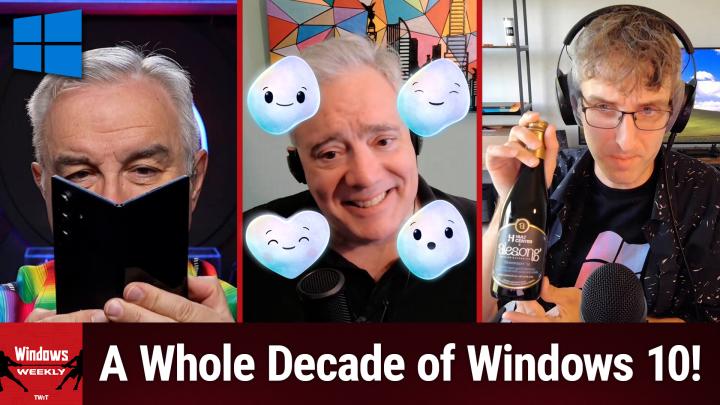
All TWiT.tv Shows (Audio)
Windows Weekly 943: Five Paperclips
02:47:42
Looking back at 10 Years of Windows 10
Loading summary
Transcript670 lines
- [00:01]
Leo Laporte
It's time for Windows Weekly. Paul Thurat's here. Richards has the week off, so we're very lucky. Crispy Hoffman is here, Paul's partner in his Windows Intelligence newsletter, former editor in chief of how to Geek. We'll talk about a very big anniversary. Windows 10 is 10 years old. We'll also talk about Windows 11 and Copilot's coming of age. All that more coming up next on Windows Weekly. Podcasts you love from people you trust.
- [00:35]
Paul Thurrott
This is twit.
- [00:42]
Leo Laporte
This is Windows Weekly with Paul Thurat and Richard Campbell. Episode 943, recorded Wednesday, July 30, 2025. Five paperclips. It's time for Windows Weekly. Hello, you winners. Good to see you. Welcome especially to our club TWIT members who make this show possible. Let's say hello to Mr. Paul Thurat from thurat.com. he's in Mexico City, Romanorta Norte.
- [01:11]
Paul Thurrott
Hello, Paul. Hello, Leo.
- [01:13]
Leo Laporte
Paul, did Richard Campbell go on a reducing diet and shave his beard?
- [01:20]
Paul Thurrott
No, he did not. Now Richard is on an Alaska cruise, which is hysterical. They.
- [01:26]
Leo Laporte
Yeah, because we went on an Alaska cruise with him.
- [01:28]
Paul Thurrott
He just. Yes, that's true.
- [01:30]
Chris Hoffman
He.
- [01:32]
Paul Thurrott
They had a tsunami potentially, remember? Right.
- [01:35]
Leo Laporte
Yes.
- [01:35]
Paul Thurrott
So he.
- [01:36]
Leo Laporte
We had one too.
- [01:38]
Paul Thurrott
Right. But I mean, he was at sea, so.
- [01:40]
Leo Laporte
So you just get. Then you get a little rocking and rolling.
- [01:42]
Paul Thurrott
No, I just chatted with him this morning and he's fine. Like, they. I guess the captain set out a deeper sea toward the. Where this could have happened and they didn't.
- [01:51]
Leo Laporte
Oh, interesting, huh?
- [01:53]
Paul Thurrott
They didn't feel anything, but there was a lot of, you know, kind of.
- [01:55]
Leo Laporte
Poseidon vibe going on the Upside down adventure.
- [01:59]
Paul Thurrott
Yeah. Yeah.
- [02:00]
Leo Laporte
I'm glad Shelley Winters is not on the trip with him.
- [02:04]
Paul Thurrott
Yes.
- [02:06]
Leo Laporte
Tell us who Chris Hoffman is.
- [02:08]
Paul Thurrott
I don't know.
- [02:08]
Chris Hoffman
I don't know.
- [02:09]
Leo Laporte
When he's at home. Who are you? Chris Hoffman.
- [02:11]
Paul Thurrott
When you're at home, explain yourself. Sir.
- [02:16]
Chris Hoffman
Yeah, I'm Chris Hoffman. So I'm. Hi. Journalist.
- [02:18]
Paul Thurrott
I've been writing.
- [02:19]
Chris Hoffman
But. Hi, great to be here, Leo.
- [02:21]
Leo Laporte
Great to have you.
- [02:21]
Chris Hoffman
And I know each other. So I've been writing about Windows for 15 years. You've probably seen some of my work at some point. I used to be editor in chief of how to Geek a few years ago.
- [02:32]
Leo Laporte
Oh, I love how to Geek. We quote them all the time.
- [02:35]
Chris Hoffman
Yeah, that's awesome. And I've been writing a newsletter called Windows Intelligence for the past few years and writing a Computer World column. And I write for a variety of publications. I review a Bunch of laptops for PC World. I got a fun laptop to show off.
- [02:52]
Paul Thurrott
Bit in, a bit exciting.
- [02:55]
Chris Hoffman
So that's who I am. And, you know, Paul and I, I've been basically Paul Thrott's newsletter partner for the past two years, and we're looking to continue that as well.
- [03:06]
Leo Laporte
Oh, that's right. I forgot, Paul, you're on that Windows Intelligencer platform, aren't you?
- [03:11]
Paul Thurrott
Yeah. So we're going to talk about this toward the end of the show again, but you have a big connection to this because when we, my wife and I took over, Thorat.com, newsletters was one of the tricky things for us because it was expensive and a lot of work. And it was your wife who recommended that I speak to JR Raphael, who I don't know. I didn't know personally, but I've been reading for many, many years and really, like. And I told Chris this story, but I. The question he was very open to this would start a Windows newsletter. And it was a matter of finding the right person. Right. And so that was always the sticky point. And I actually. I remember exactly where I was in the car with my wife when I got the message from him, and it was Chris. And I was like, yes. It was like, he's like one of the very few guys in our industry who I also really like. I like his writing. He's knowledgeable and smart. And so that was just a great. That was a great combination.
- [04:15]
Leo Laporte
Lovely, lovely. Well, yeah, because Junior was a big fan of doing a newsletter. That was like the thing he said, you really got to do that. So that's good.
- [04:26]
Paul Thurrott
So he's made up. Yeah, he's turned that into a business. So we'll talk. There are some changes coming, but we'll talk about that. And, you know, Chris and I are going to continue forward, so it's all good.
- [04:36]
Leo Laporte
Nice, nice. Well, speaking of moving forward, today is a wonderful. By the way, I apologize. I have to push a button so I can show Chris's website. I forgot to do that. Let me do that right now. So everybody has a reference point. This is where you go get the. Well, it looks just like you. I don't know what you're talking about. Oh, you don't mention Paul at all on here, huh?
- [05:03]
Paul Thurrott
No, actually it does. Right at the top. No, no.
- [05:06]
Chris Hoffman
Oh, there it is somewhere. Yeah.
- [05:08]
Leo Laporte
There's the newsletter right there. And there's free copies of Paul's Window 10 field guides just for signing up.
- [05:16]
Chris Hoffman
Absolutely. But in terms of newsletter, it's going through A bit of a transition. I guess I should talk about that now. As far as Windows Intelligence, we are ending it and winding that down. So personally I am going fully independent. JR Rayfield has been incredibly gracious and offered to, you know, hand me the list and the relationships or at least, you know, everyone that wants to come. No one is forced to come with me but basically decoupling from Android Intelligence and I'll be launching my own newsletter that's more personal and do you have.
- [05:54]
Leo Laporte
A name for it yet or you still.
- [05:56]
Chris Hoffman
I do have a name. I don't know if I want to reveal it. I have, I have a fun concept.
- [06:00]
Leo Laporte
Don't reveal it until you, I don't know, registered the domain.
- [06:03]
Chris Hoffman
Yeah, I do have the domain but we haven't. I don't know if I want to reveal it, although. Well, I think it'll come together when you see everything, when it all comes.
- [06:13]
Leo Laporte
Together, then we'll know. Yeah.
- [06:16]
Chris Hoffman
Mid to late August, the last Windows Intelligence is firing off in a few weeks in mid August.
- [06:21]
Paul Thurrott
Exciting.
- [06:22]
Chris Hoffman
That's transitioning and you know, I'm, you know, ramping up work. A variety of publications, PC World, PCMing, all great publications and you know, the newsletter I think going forward is going to be a little, a little more personal, a little smaller, just once a week and I hope to promote.com more in it and I'm really excited about the future of that actually.
- [06:49]
Leo Laporte
Nice. Well, I'm a big fan of going independent. Paul and I both give that.
- [06:55]
Paul Thurrott
Sometimes it's forced on you, but it's okay.
- [06:58]
Leo Laporte
Both of us maybe would have done something different had they not said, hey, it's been nice but I'm lazy enough.
- [07:06]
Paul Thurrott
That I would have still, I'd still be working with WUG Net right now if it made sense. Exactly.
- [07:12]
Leo Laporte
But both of us, I think it's safe to say Paul, are very happy that we've been independent. It's been a great experience.
- [07:20]
Paul Thurrott
Yeah. I don't know how everyone else handles this, but I'm sure all three of us at one point were like, you know, someday in the future. And sometimes, you know, it happens, maybe not on your schedule. You're like, you know what, maybe this was the right thing.
- [07:32]
Leo Laporte
And sometimes you have to be pushed into the pool.
- [07:35]
Paul Thurrott
Yeah, exactly.
- [07:37]
Leo Laporte
Out of the nest into the pool. Because it's not something, you know, and this is actually something everybody listening could probably be aware of because we're about to head into a, I think an era where self employment, especially in journalism is going to be the only way on Twitter on Sunday. It was just a kind of an interesting thing. But every single of one of the people on Twitter was a newsletter author and independent.
- [08:02]
Paul Thurrott
That's funny.
- [08:03]
Leo Laporte
And I think that that's the trend. You know, for years, Twit was always people who worked for a blog or a magazine. Early days it was magazines, but nowadays it's podcasts, it's newsletters, it's YouTube channels. I think that's too bad.
- [08:18]
Paul Thurrott
We're right outside of that TikTok demographic. But like, maybe. I don't know.
- [08:25]
Leo Laporte
Anyway, we're very pleased to have you. Chris, thank you for filling for Richard, who has big shoes because his feet are humongous.
- [08:35]
Paul Thurrott
Yeah, he's.
- [08:37]
Leo Laporte
We're glad to have you. It is a very happy 10th anniversary for Windows 10, which, you know, I didn't realize this, but the life expectancy for Windows operating systems is 10.
- [08:50]
Paul Thurrott
Well, historically it always was. But that's one of the many unique and kind of interesting things about Windows 10, because when it was first announced, it was not going to have a 10 year life cycle. Like especially not the classic.
- [09:03]
Leo Laporte
Didn't they say it was going to be forever?
- [09:06]
Paul Thurrott
Well, no, not, not. No. Everyone got it. It's amazing to be able to.
- [09:09]
Leo Laporte
They were misquoted. Yeah.
- [09:11]
Paul Thurrott
No. What? One employee from Microsoft did refer to it one time as the last version of Windows, but that was. He's not like a brand decision maker or whatever. Like he just kind of said that, in other words. But it was a reasonable mistake to make in the sense that there were a lot of things about Windows 10 that were very vague, including this notion of support. Right. And that was why it was before Microsoft would release a major new version of Windows every three to 10 years, you know, eight years, whatever the timeframe was. But with Windows 10, they were releasing a major new version of Windows 10 every, originally, every six months, which is. Was unprecedented. But the theory at the time was we're going to turn Windows into the service like thing. And ironically or whatever, they got there eventually, but it took a while and there were several years there where we had lots of problems from all the updating and now we are updated every day. So it's the difference. I don't know. It's a different world. Different world.
- [10:11]
Chris Hoffman
But at least they're smaller updates.
- [10:13]
Paul Thurrott
They are smaller. Yeah. So it's death by a thousand cuts instead of getting hit by a brick, I guess.
- [10:17]
Chris Hoffman
Well, they install faster. So it's not. You got the bugs faster.
- [10:21]
Paul Thurrott
Yeah, they do. Yeah, they do. I mean, they do. But I was Just thinking about this the other day because I've actually complimented Microsoft for somehow getting Windows as a service to work. Like I said, it took a long time. It's amazing to me that this legacy spaghetti code that is Windows could ever be updated in this fashion. Like, is amazing. And they've done a better job historically than Google with Android or Apple with anything. Actually getting the install of updates to be kind of seamless and quick and, you know, relatively painless. That said, I've been using the dev channel recently, a couple laptops, man, it takes a long time to install those builds. You know, I think it's because they're each sort of treated like, you know, almost like a feature update maybe. But it is kind of weird. It's been a, it's a weird regression. It's only in the Insider program, so it's not a big deal. But I notice it.
- [11:21]
Chris Hoffman
Yeah, it's weird because the whole Windows as a service thing started in Windows 10. They're like, it's a service now. It's continually updated. And that was every six months. But every six months. Initially it was like an OS level update every six months. It was a long, grinding update. I remember, I think the first big Windows 10 update it installed and then it actually uninstalled some of the programs on people's computers at the time. And it was like, oh, this has been installed because it's not supported. It's not supported. This hardware driver doesn't work. It's like, well, that's nice. But it's been, I've been using this computer for six months. It's Monday morning, I have to work and you just uninstalled my hardware driver. It's like, but Windows is a service. It's like, you know, so, so wherever they're at now is a little more stable than that.
- [11:58]
Paul Thurrott
Yeah, it's, it's. The notion that Windows is a service is ludicrous. But like I said, I mean, they kind of, they did eventually get there and not as a service, but I mean, they do. It works. I mean, it's. Again, there, there will always be mistakes. It's Microsoft, whatever, human beings are involved. But it's, it's fascinating to me that we went from this really monolithic schedule to, yeah, we're going to do a new version of Windows every six months. It's like, what? But I think that's part of the history of why Windows 10 is the way it is. Right? It's not just a reaction to what went wrong with Windows 8. Because the rapid release thing started with Windows 8.1, right? That was the first thing they talked about. They launched Windows 8 in whatever that was. September, October 2012. And then by January, they were talking rapid release. And so they, over the next couple of years, released at least three milestones for Windows 8point whatever. Bringing back the start menu, bringing back the start button, bringing back floating Windows, you know, like, I mean, or adding floating windows to modern apps. So, you know, Windows 10 in some ways was almost like a formal policy for that kind of updating, but man, what a mess. And then also, I mean, well, but. But tied to this was also, you know, the Windows rt, the Windows runtime app model, but the Metro app model, as they called it, originally carried forward as uwp, but that those were tied to every Windows release. So every six months there was a new Windows release. Every six months there were new APIs, new capabilities for developers, but you had to have that version of Windows or newer. And all of a sudden they went from, we just want everyone to be on the same version of Windows to we have seven versions of Windows out there now. And it's like, what's going on? You know, it got really complicated.
- [13:49]
Chris Hoffman
Well, I feel compelled to be Microsoft's legal department for a second and say it was never called Metro. Please don't call it that.
- [13:55]
Paul Thurrott
We never called it that.
- [13:56]
Leo Laporte
They didn't like that, did they?
- [13:57]
Paul Thurrott
Even I will refer to the multitudes of Microsoft documentation that says the word Metro, but. Okay, fair enough.
- [14:04]
Chris Hoffman
Yeah, it's a modern app or a store app.
- [14:06]
Paul Thurrott
Yeah, store app, Store app, Store app, and store app.
- [14:10]
Leo Laporte
That's kind of generic.
- [14:12]
Paul Thurrott
In the beginning, it meant something. Now it doesn't mean anything. It's just anything that's distributed through the store. Could be anything now.
- [14:18]
Leo Laporte
But, yeah, anything's in the store now, isn't it?
- [14:21]
Paul Thurrott
Pretty much, yeah. Right. So in the beginning, it was very specifically these modern apps only. And then over time, they expanded it. First they tried to expand it through what they used to call the bridges. Remember, these were ways for.
- [14:34]
Leo Laporte
I remember bridges and I remember lakes.
- [14:38]
Paul Thurrott
Yeah, Data lakes are different, but there were also islands. Let's not forget those, Samuel islands.
- [14:43]
Leo Laporte
But how can you forget them?
- [14:44]
Paul Thurrott
Eventually we arrived where we are today. So I would say through the course of Windows 10, it was a big. It's almost like a big learning process, really. Platform wise, updating wise, App store and app platform wise. And it's not perfect today for sure, but it's. It is in a much better place than it was also. I mean, remember this was the name Universal app was meant to connote the fact that these apps would run across multiple platforms. And eventually they called that one Windows. But the idea was that Windows 10 on whatever devices, small tablets, tablets, two in ones, convertibles, laptops, desktop PCs, whatever, Surface Hub, which was announced at the Windows 10 consumer event that January, HoloLens, which was also announced at that event, Xbox One, were all running the same basic platform and could run the same apps. And Phone, I'm sorry, I should say Phone. Phone was going to be for two seconds the volume part of this story, and that disappeared pretty quick.
- [15:49]
Chris Hoffman
So do you think the servicing model maybe is working better now due to. Technically, Windows 10 is still supported, but they're not really updating Windows 10 like a service in the same way. Most of it's happening in Windows 11. That's a much narrower hardware band. Windows 10 had a lot of old devices that were updated to it. And if you look at some of the posts that Microsoft made when there were problems with Windows 10 updates, they were kind of making a lot of excuses about, well, Windows 10 is on a lot of hardware, so no wonder there are bugs. And it's like, well, should we be updating it that way then? But is it working better now? Maybe because.
- [16:26]
Paul Thurrott
Yeah, I never. I never. I can't say I've ever considered that. But that makes sense, right? That. Because Windows 11 works on a more limited range of hardware and obviously more modern hardware too, which presumably is more reliable. That's not true, actually. But okay, but whatever. Yeah, okay. That definitely could be part of it. Yeah. I mean, they improve the process. Yeah, it's absolutely more secure too, but they. They improve the updating process in fits and starts and learn from mistakes, et cetera. It took a while, but, yeah, a combination of factors. Yeah, for sure. Of course, now they call this continuous innovation, which maybe is more adequate or accurately described as like continuous interruption, but yeah. And even that is something to try to address. Right. If you have an enterprise version of Windows 11 or if you're on server, you only actually have to reboot that PC for updates once a quarter. And the other interim months are those. I can't remember the term they use for that, but they slipstream those updates in without requiring a reboot. Right. And so maybe that's something that we'll get collectively right for everyone running Windows 11 someday.
- [17:40]
Chris Hoffman
Yeah. I'm hoping for a hot patching to arrive in the consumer. Maybe that's a Windows 12 thing. Maybe there will never be. Who knows?
- [17:49]
Leo Laporte
I know the Patching is. It doesn't need to reboot, it just does it in the background.
- [17:52]
Paul Thurrott
Yeah. So if every. In any quarter there are three months, two of those months you'll get hot patches and then the third of those, the quarter end, you'll get the one that requires the reboot or whatever. It's kind of a. They've been doing differential updating for 20 years actually. But.
- [18:13]
Leo Laporte
It does it.
- [18:14]
Paul Thurrott
A reboot?
- [18:16]
Leo Laporte
Yeah. What's the. I mean, I'm kind of used to. Most operating systems want to reboot if it's a significant patch. How do you do it without rebooting?
- [18:27]
Paul Thurrott
I guess in the case of a PC or whatever platform, it's also like a billion ish ones in zero. So there are going to be some mistakes in there. I don't know. Yeah, I'm not really sure. Yeah. So anyway, so yesterday was the literal 10th anniversary of the release of the original version of Windows 10. Right. So July 29th. And in my typical fashion, I completely zoned on it until that morning. And I realized it was that day. And I was like, oh man, I better got to do something about this. So if you go to my article, I actually added a link to the notes that wasn't there originally. At the bottom of this section, I'm giving away the Windows 10 field guide for free. I finally figured out a way to do that. Leanpub really wants me to charge money. But anyway, I figured it out. So now through, I think August 1st, you can go grab that for free at LeanPub if you have the right URL. So that's why the link is important. And then I was thinking back about Windows 10, because at the time, Windows 10 was so welcome and so necessary and for me personally on a couple of levels, because I really liked the Windows Phone experience. I like that team of people. They took over Windows, which I thought was kind of incredible. And they set everything or they tried to set everything right. They had what I would say is a pretty good vision for it all. And there were problems with it that, like I said, were fixed over time, like Windows as a service. But man, the more I thought about it, the more I sort of realized like this. Also, there's a lot of controversy in there as well. You know, Windows 8 was the first Windows operating system to ship with ads in it, but they were limited just to those modern apps that were bundled with the system, like news and weather and so forth. Windows 10 brought that out to the file system, to the operating system itself. And as I predicted, you know, I called the ads in Windows 8 many years ago a slippery slope. Like, you know, you don't put ads in Windows so you can put less ads in Windows next time. You're going to put more and more. That is what happened. So we got the, you know, the sponsored bundled crapware, we got advertising, we got telemetry that was forced on us. A lot of privacy concerns, although most of those were kind of made up, frankly.
- [20:49]
Chris Hoffman
Candy Crush.
- [20:51]
Paul Thurrott
Candy Crush, yeah. We had to deal with that for a little while.
- [20:53]
Chris Hoffman
Which Microsoft now owns.
- [20:55]
Paul Thurrott
That's true. And now doesn't bundle with Windows, which is a little strange. But. Yep. You know, the app platform mistakes. Right. Which they fixed in time, or I can't say they're fixed, but that situation is better. Windows 10 came at a weird time. You know, Windows 8 had crashed and burned. Windows 8 had this major launch event in New York City. It was a big deal. Windows 10, I think they launched it like a bake sale at a church somewhere in Northern California or something. Like it was like a nothing. Windows 11 was less than nothing. They announced it online and they delivered some of it, you know, six months later, and then the rest of it a year later, I don't know. And we're still kind of working through that. But, you know, the world changed, right? I mean, the world went mobile and cloud and, you know, Windows just didn't have the same kind of precedence within the company. So I don't know. But Chris was good enough to look at these notes and say, this is a little negative. Let's put in some.
- [22:00]
Leo Laporte
Chris, you're just learning, aren't you?
- [22:03]
Chris Hoffman
I was also going to say Windows 10X had a big launch event where we all were excited about the Surface neo. So.
- [22:10]
Leo Laporte
Sad. Sad.
- [22:11]
Paul Thurrott
10X had two things that were big. And by the way, I have to say, I appreciate Microsoft pushing in both these directions. Right. The first one was a simpler user interface, which is what we eventually got in Windows 11, which is controversial because to simplify something complex, you have to take things away. And the people of all this muscle memory around right click menus and whatever else instantly notice when those things are missing. And so there was that kind of outcry from our part of the world, our community. People like my wife, who I'd call like normal users or mainstream users, couldn't care less. It was fine. They didn't care. But the big innovation in Windows 10X was going to be this componentized. What's the word I'm looking for? When you have like a Docker, like A containerized architecture. Right.
- [22:59]
Leo Laporte
Where that's all the rage. Yeah, yeah.
- [23:01]
Paul Thurrott
All the modern apps would run in their own self contained containers or whatever, as they do now, but every win32 process would run an A container. And the idea there was, this is the thing that they've been trying to solve in Windows forever. S Mode was an attempt at this as well, is how do you take this thing that is inherently old fashioned legacy code. It's insecure by design and by default, and how do we make it safe, secure, reliable, et cetera. And so this was one approach. I thought it was an interesting one. I love that they tried it and it obviously didn't pan out because we don't have that.
- [23:37]
Chris Hoffman
It was also going to be designed exclusively at first for dual screen devices. It just seems like this designed by committee. Everyone gets, okay, it's going to have containers and it's also going to be only for dual screen devices. And then it's going to have a simplified interface and then we're going to do that and it's like, how do we end up with this product?
- [23:53]
Paul Thurrott
Yep. And that might just have been a matter of timing because, you know, folding displays, we knew they were coming but they weren't ready. And Microsoft wanted to get to market and this is something that would have transitioned to that. There were leaks of this thing that you could just run on a laptop or whatever on a vm and it worked fine as a single screen operating system, just as it does today in Windows 11. But yeah, that might have been just an attempt. Well, it's typical, right? It requires new hardware purchase. Microsoft loves that. The industry loves that. It lets them keep selling a traditional version of Windows on traditional form factors while having this new thing on a new form factor. They sort of tried that with a Windows RT, remember in tablets and so forth in the Windows 8 time frame. But yeah, they tried. I like that they tried. I don't really have a criticism of this. The fact that it didn't work is whatever, it just didn't work. So they tried. I mean, it's fine and Windows 11 is whatever it is, but Windows 11 today is in pretty great shape, frankly. And it felt incomplete. There were a lot of regressions when it first came up, but it's, you know, it's better. So there was something came out of it. It didn't just all get thrown away. Right. I mean, at least we have something.
- [25:17]
Leo Laporte
At least we have something. Sounds sad.
- [25:21]
Paul Thurrott
Well, there were these initiatives, you know, like Microsoft faced with the success of the iPhone and Android and then the iPad and all that is like, okay, we have to do something around mobile. And they could have done a unique thing that wasn't Windows, but they went with Windows for all the obvious reasons, maybe even the right reasons. And maybe it could have been okay with three more years of updates, but Snofsky was out. They changed directions. They went back to mostly traditional form factor interactions and so forth. You know, they tried with the app model, with the universal apps, and then eventually where we are today, where they're just back to being desktop apps, they tried with these containers. They tried. The store, like Chris said, was originally just the store and it was modern apps and that was it. And now we have very. You could probably buy a T shirt and that thing that today they will sell anything.
- [26:09]
Chris Hoffman
Well, not ebooks or all these other things are not selling anything.
- [26:11]
Paul Thurrott
Yes, okay, that's true. Although, yeah, that was also one of many scalebacks that happened over time that maybe, maybe they should never have got. I don't know. I mean, when. I don't know, Zune and then Groove and Xbox. Well, Xbox and then Groove, whatever it was at the time, maybe that made sense. But by the time that stuff disappeared, you know, maybe not. I don't know. So I don't know what to say. I don't know what to say about these, like 10 years of Windows 10. It's like the user interface was clearly designed to match what was on the phone. That user interface made tons of sense on a phone, still would today. It made no sense for Windows. The very notion of tiles, where they're on screen all the time and you see them and there's live information you get at a glance. You don't have to go into the app. Tons of sense on a phone. If something happens on your phone, you pick it up, you're like, yep, I don't need to deal with that. You're good. You don't have to dive into the app, come out like whack a mole. But in Windows, it's in a Start menu, so you don't see it, you know, and they.
- [27:10]
Chris Hoffman
And they kneecap themselves. Because it was only for modern apps, and people are making modern apps. So if you use any other, if you use Steam, if you use any desktop program and it wanted to put a live tile in your Start menu. Too bad. So sad, right? You got to be using a modern app. And I'm sure that there's like Windows geeks and people who customize their Start menu, but the average person, Start menu, if you Opened it. It was just whatever was pinned there by default. It was Candy Crush. It was viral stories, it was all that stuff. And people. I mean, it's interesting, right, because people customize their phone. Home screenshots, people.
- [27:45]
Paul Thurrott
Yeah. And Microsoft tried to do this with Windows 8 to make it the screen, and it would just be there and it would be on screen and you could see things moving around and whatever it may be. But these are different types of devices. We use them in different ways. I think there's a lot of small interactions that occur on the phone throughout the day for everyone, basically. Whereas with Windows or a desktop operating system of any kind, you basically kind of sit there and you're working an app and maybe you have two apps and they're side by side, however you do that, and you're reading and listening or reading and watching or whatever it is you're doing, but you're not doing little, little things everywhere. And so it just didn't make as much sense. But ironically, the. The app platform that exists today, if they supported Live Tiles, would allow desktop apps to do tiles. Right. Because now it works with everything. It's. They finally did that. But, yeah, you're right, it was. I don't know. They try again. They try. I don't want to criticize them for trying to. I'll just criticize them for failing.
- [28:42]
Chris Hoffman
If you go back to Windows 8 and even going into Windows 10, the point was that, yeah, we weren't really thinking about desktop PCs. We were thinking about you were going to have a Windows 8 tablet and maybe a small tablet. You have a Windows tablet. So, yeah, you're interacting it throughout the day. You turn it on, you see the home screen. And Even in Windows 10, there was a tablet mode. Right. The tablet mode had a full screen start screen, I think.
- [29:00]
Paul Thurrott
Yeah. The whole thing, it was all full screen. Yeah.
- [29:02]
Chris Hoffman
So it was all about touch and tablets, and it made sense there. It's just people didn't. I mean, Windows is a tablet operating system. And that's something I want to talk about later too, is why, you know, why do. Why does the modern Windows laptop have a touchscreen? Honestly. Honestly.
- [29:19]
Paul Thurrott
Okay, so it's weird you say this, because this just came up with me and my wife yesterday, literally. But this is something. When this started happening, Mary Jo hated it. And I used to say to her, I don't understand what your problem is. If you don't like it, just don't use it. And my attitude was, if it's there and I don't need it, it's fine. But maybe I. And you know, sometimes maybe I'd sit there and scroll and scream, whatever. But since then, I can't stand touchscreens. I would give anything not to have a touchscreen on every laptop I own. And so yesterday I wrote something. It doesn't matter what, but I asked my wife if she would come in and just take a look at something because she's also a writer. And I just wanted to get her opinion. So she laid down on the bed and she put her finger on the screen and she started flipping through it. I'm like, what are you doing? She's like, what do you mean? I'm like, you're touching my screen. She's like, I'm scrolling through it. I'm like, there's a hundred ways to scroll this document. Why did you pick that one? But she does. I guess she uses it. So, I mean, I use it. Yeah. I don't. Yeah, I don't do this anymore. But for a little while, I would disable it. You can go into device managers, disable touch. You can get rid of it. You know, I don't like it. I don't want to touch the screen. I don't want fingerprints on where I'm reading and writing and, you know, whatever else.
- [30:31]
Leo Laporte
You're in luck because there's always. Well, you know, it's harder to get a non.
- [30:36]
Paul Thurrott
Touchscreen. No, it's almost impossible. I know. That's the thing. Like, there aren't really that many of them. Like, I like when it comes without touch, you know? Yeah.
- [30:45]
Leo Laporte
Come to think of it, you're. You're in. Even Apple, the rumor is their next MacBook next year, will have touch.
- [30:50]
Paul Thurrott
So the worst thing about an iPad, when you attach a keyboard, is it you can still touch the screen. You know, it's like.
- [30:56]
Leo Laporte
I mean, it's kind of weird because I use iPads. I often accidentally touch my laptop screen expecting something to happen.
- [31:04]
Paul Thurrott
Right.
- [31:04]
Leo Laporte
So I get the worst of both worlds. I get both these fingerprints and nothing.
- [31:10]
Paul Thurrott
Well, yeah, but you also use a lot of different devices. Most people would have whatever they have, and they kind of get used to it, probably, I guess. But I. Yeah, I don't know. Look, to be fair again to Microsoft, they went to market with Windows 8 with this idea that this computer could do everything. It could be a touch device and a computer, and they didn't make it work. I mean, it works today if you want it to. The laptop I'm about to review today later is one of those convertible laptops. Screen flips around and, you know, it's a tent, it's a presentation thing, it's whatever, gigantic tablet. But it works. I mean, it does work. I mean, so if you want that it's there, you can write on it with a pen and all that. But I just, I don't. And I think most Windows users are come to it with kind of a work focus, right? You're using Word, Excel, a web browser, whatever it is, Adobe Photoshop, and you do the thing and then you, everything that's important to you in life is on your phone. You know, this is, it's more about work.
- [32:10]
Chris Hoffman
Yeah. So I, I, I, I'll give it the case, maybe for and against, because I also like, I, I actually kind of, I kind of like touch screens, and I kind of don't, and I don't really know. I do think that they're just on, too. It's just maybe it shouldn't be a standard feature, right? Like, it's basically on every laptop, like almost every laptop, and it's on the majority of them. And I don't know, you know, if we hadn't gone through Windows 8 and Windows 10, if we were just starting fresh in the days of Windows 11, now, I don't know if manufacturers would say, yes, we need to add a touchscreen to all these Windows 11 laptops, because that's what people want. But, like, you know, I, it's actually an indictment of old PCs. Like, the touchpads have gotten better now. When I had a Windows 810 PC and it didn't have precision touchpad, and it was horrible, and I just, I used the screen to scroll because I cannot be using that touchpad because it was so rough. But modern PCs have pretty good touchpads, so the scrolling works. So there's that. I do like, like if I'm signing like a document with my finger on the screen, that's really cool. Like, I don't have to put on my phone. So there's stuff. And if you have a Surface Pro and you want to draw, there's like so much stuff. But, you know, the, the attack on the touchscreen is like, well, first of all, it's, they're generally glossy, so if you want a matte screen for the sunlight, because it's a laptop for work, they use in a bright room, the touchscreen gets in the way. It uses more power. If you actually are using it, then you have the smudges on your screen. But, you know, it's just weird. I don't know.
- [33:31]
Paul Thurrott
This is an optimized for the everyday scenario. So, you know, the industry as a whole moved to touchscreen screens, which is why they're everywhere. Everyone just makes them very easy. It's just what we make now. It took a long time just to switch to 16 by 10 aspect ratio screens. Right. These things take time. But there is some tiny percentage of users who loves Desires, needs whatever these, the pen and multitouch support because, you know, maybe they flip it around or it is a tablet and they, they can write up, they take notes in school or is whatever they are and that's fine, but they're not most people. And for me, like, like I said, on some level I don't mind that it's there. Like the laptop I'm about to review is a convertible laptop that I used to exclusively as a laptop. Right. I'm not, I didn't, I mean I did just to do it, but I don't really use it that way. So yeah, for me, and I think for most people it would actually be better but you know, not to have that stuff. But then again, this is also an upgrade and I think it's human nature is you go into the store, the car, whether it's a car, a refrigerator, whatever, you have this idea, I'm gonna, you're having a sale, I'm getting the cheap one. They're like, yeah, but you know, for 100 bucks more you have all these capabilities and you're like, you know, I'm probably not going to need that. But if it's there and I need it, that's really, you know, it's worth it. And you know, and off we go. So, you know, we buy more than we need and then we don't use it. So I don't know what the numbers are. No one does, I guess, outside of the PC makers or Microsoft, but I bet a very, very small percentage of people uses that stuff.
- [35:05]
Leo Laporte
Oh look, I just got a new phone. It looks at. Oh my God, it just opened up.
- [35:12]
Paul Thurrott
That can't be a phone. It's too thin.
- [35:14]
Leo Laporte
Look how thin these are.
- [35:16]
Paul Thurrott
I know, it's easy.
- [35:17]
Leo Laporte
All right, we're gonna take a break. Going down this, by the way, this is the Samsung Galaxy Fold 7 and it doesn't have a touchscreen. I don't understand why. No, I'm kidding. It does, it does. What do you do with a phone that doesn't have a touchscreen? You have a BlackBerry.
- [35:34]
Paul Thurrott
What do you do with it? I don't know. Use it.
- [35:36]
Leo Laporte
Fingerprints on that. I don't Understand your objection, Paul. That's all I'm saying.
- [35:40]
Paul Thurrott
I'm curmudgeon.
- [35:44]
Leo Laporte
I am going to take a little break now but we will continue this trip down Memory Lane. Windows 10 we hardly knew Ye continues with our special guest. So nice to have Chris here filling in for Richard. He'll be back next week. He's off on a anniversary cruise with his.
- [36:04]
Paul Thurrott
Assuming he survives it with all the tsunamis and whatnot that are happening out there.
- [36:09]
Leo Laporte
The one foot tsunami. Yeah. Our show today, brought to you, and I mean literally brought to you by Cashfly, our content delivery network. CDN. For over 20 years, CashFly has held the track record for high performing ultra reliable content Delivery serving over 5,000 companies in over 80 countries. And we know intimately because we're company probably number 10. I mean we've been with Cashfly since the beginning, almost 18 years now. We love their lag free video loading, the hyper fast downloads, the friction free site interactions. You probably don't know anything about Cashfly or the fact that we use it. Why? Because there's never any problems. Now I think Patrick, our engineer really loves that. He doesn't have to worry. He knows the downloads must roll. Cash Fly is the only CDN built for throughput. Ultra low latency video streaming. Delivers video to over a million concurrent users with less than 1 second latency. How about that? Lightning fast gaming delivers downloads faster with zero lag glitches or outages. Mobile content optimization offers. This is so cool. Automatic and simple image optimization. You upload a big tiff or whatever and it automatically turns it into a variety of sizes so your site loads faster no matter what size screen your visitors are coming in on. Plus you get, and this was really important to us, flexible month to month billing for as long as needed. So we didn't know when we first signed up with Cash Flag, all we knew is we couldn't handle the demand. But we didn't know, you know, it was very spiky. We didn't know what was going to happen. So Cash Flow was super flexible with us. They said look, as long as it takes, you know, we'll figure it out. And then once we figured out, you know, as soon as Windows Weekly comes out on a Wednesday, we're going to get a big spike. We got discounts for fixed terms and that's, that's awesome too. The point is like, like us, we don't get anything special. You get to design your contract when.
- [38:19]
Paul Thurrott
You switch to Cash Fly.
- [38:21]
Leo Laporte
Cash Fly levers rich media content up to 158% faster than other major CDNs and allows you. And we. We've been doing this for years and now everybody can do it. Shield your site data content in their cloud so you get a hundred percent cash hit ratio. There's no misses.
- [38:39]
Paul Thurrott
That's.
- [38:39]
Leo Laporte
That's so nice. And with Cash Fly's elite managed packages, you are going to get the VIP treatment. You absolutely will. Just like we do. Your dedicated account manager will be with you from day one, ensuring smooth implementation and reliable 24. 7 Support when you need it. But here's the good news. You're not going to need it. It's super reliable. Beat your competition. Beat them. With faster content delivery anywhere in the world. It's nice to be a winner. CashFly provides reliable CDN solutions fully tailored to your business. Learn how you can get your first month's free at cash fly.com TWIT that's C A C-H-E F L Y.com/TWIT. Thank you to our wonderful partners at Cash Fly, to Matt Levine and his whole team. By the way, I was just on Cash Flies anycast podcast. Matt did a great interview. If you want to hear kind of the history of Twitt and how we got started and how we found Cashfly, it's all available at the Anycast podcast, which you can get wherever you get your podcasts. Thank you, Cash line. All right, Paul, it's back to you and Chris Hoffman.
- [39:48]
Paul Thurrott
Have you dated a girl?
- [39:50]
Leo Laporte
No, but I've never been kissed. I don't know what's happening. This happens as you get older, Paul. You'll know soon enough. Puberty hits again.
- [40:03]
Paul Thurrott
Oh, good. And it hits. That's what I. Good. I was hoping for like an acne breakout or. Yeah, exactly, something.
- [40:10]
Leo Laporte
Well, your voice starts changing, you breakout, it's just not good. Sorry, Chris, you don't need. I'm going to go back to my super thin. You know, one of the reasons I got this is because I was really. Apple is rumored to be doing this next year and I was just. This is what this, this is the state of the art.
- [40:29]
Paul Thurrott
But by all accounts, this phone is incredible, you know?
- [40:32]
Leo Laporte
Yeah, well, that was the other reason. I had Abrar Al Hedi on and she had reviewed it and she said, you're going to be blown away. And it's. Look how thin it is.
- [40:40]
Paul Thurrott
So I tried to get. My wife loves Samsung phones. This is what she. The only thing she makes this explicit decision. This one of her few tech decisions, whatever. And so I said, I made the case. I Said you should. Your phone has good trade in value right now. You could trade it in, you know, you could pay. It'd be like 50 bucks a month.
- [40:58]
Leo Laporte
Yeah, that's what I did. I traded in the flip, they sent it and I got on Google Fi. So I really got a big discount. Yeah.
- [41:03]
Paul Thurrott
Yeah. She's so cheap, man. You know.
- [41:08]
Leo Laporte
Help you with that.
- [41:09]
Paul Thurrott
I know. I'm like, okay. I was kind of hoping she'd just do it.
- [41:12]
Leo Laporte
I think she would really like it.
- [41:13]
Paul Thurrott
I think so, too.
- [41:14]
Leo Laporte
Yeah, it's pretty. The screen's amazing and it's cool to have that size, but then when you fold it down, it's really.
- [41:20]
Paul Thurrott
It's an actual phone. Here's a pixel. This is the drain.
- [41:23]
Leo Laporte
The same size as a pixel, except it's thinner.
- [41:26]
Paul Thurrott
It's thinner. You know, that's what's crazy. It's crazy. No, that's. I. Man, if it was a couple, even just a couple hundred bucks less, I'd probably do it.
- [41:33]
Leo Laporte
I know. So I traded in the flip six.
- [41:38]
Paul Thurrott
And how much did you get on trade? Sorry to interrupt.
- [41:43]
Leo Laporte
Do you remember 300. Should be more.
- [41:45]
Paul Thurrott
I'm sure it's more than that.
- [41:46]
Leo Laporte
Samsung, if you pre ordered, was going to give me 700.
- [41:48]
Paul Thurrott
Okay.
- [41:49]
Leo Laporte
So you can get it down to around 500 bucks, I think.
- [41:52]
Paul Thurrott
I think the best I could do is like 830 off, but it's still, you know, it's like 1200 bucks. It's like, it's.
- [41:57]
Leo Laporte
Oh, it's a $2,000 phone.
- [41:59]
Paul Thurrott
Yeah. Yeah, it's tough. Yeah, it's tough.
- [42:02]
Leo Laporte
I'm just, you know, I'm living the living the dream pole.
- [42:05]
Paul Thurrott
That's all I can say. Yeah, Attach that thing to a keyboard and a mouse, you'll be in pretty good.
- [42:10]
Leo Laporte
Yeah, I have to try that out because I used to use Dex, so they have a new thing, but yeah, I have to try that out. All right, back to the show. Sorry about the Samsung chatter. Although I will pair it to my Windows Phone.
- [42:21]
Paul Thurrott
Yeah. And you'll get the best possible experience. Exactly. Right. Which is nice. So, Chris, I didn't want to stomp all over this, but, I mean, are there any other positive elements of Windows 10?
- [42:33]
Leo Laporte
Paul, you're so negative. I'm. Is.
- [42:35]
Paul Thurrott
You know, before I continue crapping on it. No, I'm.
- [42:40]
Chris Hoffman
Well, yeah, I mean, like, I think there's so much that we maybe don't associate as part of Windows 10. Like, the Windows subsystem for Linux was huge and like this, we could have, you know, a Whole comedy thing where we talk about what Microsoft used to say about Linux, about the property cancer that's attaching us, it's attached itself to Windows. And in fact, Linux is still to Windows, in Windows to this day. But that was huge. I mean, and jokes aside, it was this huge embrace of the developer community. And I remember many, many years ago, the amount of people switching from Windows to Macs because they're like, well, it's Unix based, I can do stuff on it. Microsoft's like, whatever. So that was huge. Winget, I think winget is still unappreciated. It's underappreciated in Windows itself. I mean, I do understand because it doesn't make sense from business perspective, but Winget's amazing. I'm now showing my old Linux nerd credentials where I'm like, yeah, Linux and package managers, but that stuff was.
- [43:44]
Paul Thurrott
No, but you're right. I use winget extensively in the course of reviewing laptops, it's awesome just to have four blasting a bunch of apps on it automatically. It's improving in kind of interesting fits and starts. When they added that dev center, what was called the DevHome, to Windows 11, which they're now getting rid of, there was this notion of using YAML based configuration for winget and you could then use it to also configure the apps and maybe just go beyond the basics that are there today. So we're still working through that, but kind of like a one line update every app on my system kind of capability, which is awesome. Especially if you go to Windows Update, check for updates, you're all good. Go to the store, check for updates, you're all good. Then you go to Winget, you're like, no, you have 17 updates. So it's good for that. If you want to keep your system up to date, it's fantastic. I wish you could automate it, but.
- [44:39]
Chris Hoffman
Sometimes those updates are wrong because it's trying to detect what's installed per the registry and it gets it wrong. And we'll try to reinstall this, even though it's already been updated through the app itself. So it's still kind of janky.
- [44:50]
Paul Thurrott
Yep. Yeah. And there are apps that Discord is the one that hits me all the time on every PC. I don't remember off the top of my head how I install it, but I cannot update it through Winget. It just won't do it. So the app will have to install, which is fine because every time I launch it, it's updates. So it worked. That Works out fine, but. Yeah, but it's still, it's an amazing capability built on top of. Actually, I'm not 100% sure it is built. I was going to say built on top of PowerShell, but actually, is it built on top of Powershell? It probably is. It has to be. Probably. Yeah, yeah, I agree. And the less said about the Android subsystem, the better. But that was something that, that should have been awesome. And if Microsoft and Google had like an iota better relationship, maybe would have been. But we've moved on from that, sadly.
- [45:47]
Chris Hoffman
If they had had it in the Windows 8 era when tablets were a big thing, maybe, but I mean, well.
- [45:52]
Paul Thurrott
They were still pushing. You know, we have our own thing and you know, and Windows 8, because of the timing, couldn't ship with Windows Phone compatibility. But even back when that was happening, I made the case, you know, Windows 7, Windows Phone 7 has these panoramic experiences that you scroll across with the phone, but would look very natural as one thing on a tablet screen. And I kind of, you know, that's the direction they could have gone in but didn't, you know.
- [46:23]
Chris Hoffman
Well, Windows 10 is still widely blevaged to this day and many people are very intent on continuing to use it. And you know, and to some degree they should be because the Windows 11 hardware requirements are so stringent that.
- [46:37]
Paul Thurrott
Right.
- [46:38]
Chris Hoffman
You know, a lot of computers that should, could run Windows 11 fine, aren't getting offered the update officially. And so we're, I mean, we're also like, we're through the looking glass on what's happening with Windows 10 and its support period now. I mean, Microsoft has found a way to go back on its, to kind of go back and kind of not go back on its end of service plans.
- [46:59]
Paul Thurrott
Well, yeah, the original claim was that Windows 10 would be supported for the lifetime of the device, which they never explained and changed continuously. And because of intercompany battles at one point between intel and Microsoft, they started arbitrarily dropping off support for processors from intel just out of spite. But I don't know, it worked out in a sense. I think it's interesting that it did hit 10 years. It's like, okay, actually that was. Maybe this is the right time frame. Maybe this is the way it should be. It's hard to say, but I don't know. I guess you could argue it could be longer too. But I mean, compared to mobile platforms, actually 10 years is pretty good. And then just the way people use computers, I mean, people will be using Windows 10 long after it isn't supported anyway. And of course it benefited from the same thing that Windows 7 benefited from, which was that everyone hated its predecessor so much it had kind of a low bar, I mean, but did a nice job of bringing us back to what I think most people thought maybe Windows 8 should have been in the first place. So, you know, it's not all bad. I just, I don't know, I was one of the biggest Windows Phone fans in the world and if they could have pulled it off, that would have been kind of incredible. But I also look at Windows 10 today, being used to using Windows 11, which to me feels more modern and whatever, subjectively attractive or whatever. And it just feel, it feels out of date to me. Like the tiles that the squirt off everything, you know, it has kind of a. It feels a little old fashioned to me. But maybe that's a good thing in a way because that, you know, it is the old thing. Right now we are starting to move past it. So Microsoft does have a replacement that is, you know, basically the same compatibility, at least on software. And I think it looks better personally.
- [48:56]
Leo Laporte
Is it just cosmetic though, or is 11 objectively better under the hood too?
- [49:02]
Paul Thurrott
Well, actually today, to be fair, it's both. When it first launched, it was mostly just subjectively better or worse looking, depending on your opinion, I guess. But they got it there. The Windows 11 hardware requirements were literally arbitrary at the time, but they work toward this place where we're at today. And actually now there are features that are inherent to TPM 2.0. Well, that is the highest, but 2.0 versus 1 point, whatever, 1.2, whatever it was. Where we have Windows, hello, ESS and all the secure Core PC stuff, it is in much better shape today. But you have to have modern hardware obviously for that to be the case.
- [49:42]
Leo Laporte
So there are features that I know didn't technically require TPM2, but there are features that use TPM2.
- [49:49]
Paul Thurrott
It didn't originally, but now it really does. Like if you Copilot plus PC could not happen without tpm.
- [49:54]
Leo Laporte
Oh, interesting.
- [49:55]
Paul Thurrott
Yeah.
- [49:56]
Leo Laporte
Recall probably requires tpm, right?
- [49:59]
Paul Thurrott
Yeah, it requires that whole thing. It's the whole. It's not just tpm, it's the. It is actually a chain of chips and not just specific kinds of chips, but they have to be manufactured in a monitored scenario where you can assure from the beginning to the end it's never been tampered with, et cetera, et cetera. There's a whole. It's a much more stringent process than a typical PC.
- [50:20]
Leo Laporte
But. And also though I see why people say, well, you're forcing me to buy a new PC.
- [50:25]
Paul Thurrott
Yep.
- [50:26]
Leo Laporte
And that, you know, grates on some people.
- [50:29]
Paul Thurrott
There's no. Yeah, and, but there's no answer to this. Right. Because that's true of everything. You know, when, you know, people believe that their washing machines and refrigerators don't last as long today as they used to, when in fact these things are technological marvels that are superior in almost every single way to something.
- [50:46]
Leo Laporte
But you know why they break? Because they're computers.
- [50:48]
Paul Thurrott
Yeah, well, but mine plays a fun little. I know, Yeah, I get the song. My wife just goes again. It's weird, the word. Just today she's like, it amazes me that whoever designed this was like, it doesn't just play a beep, it plays an entire song and it just keeps going.
- [51:03]
Leo Laporte
It's a real song too.
- [51:04]
Paul Thurrott
It's a real tune. Super excited that the laundry's done. So, you know, whatever.
- [51:10]
Chris Hoffman
But, so here's an argument. Sorry, yes, but here's, here's an argument and I'm trying to take people aside here because obviously we can say Windows 10 had so many years of support and if you bought a computer, either you could Upgrade to Windows 11 or you bought it prior to that, so you had like six, seven, eight years of Windows support in your computer. And so, you know, what's the problem? You're going to have to update. And it's like, yeah, but on the same time, you know, companies, Microsoft and PC manufacturers don't make that clear up front. In fact, Microsoft said it will be supported for the lifetime of your device. Don't worry. Well, if some.
- [51:44]
Paul Thurrott
Not your device, Chris.
- [51:47]
Chris Hoffman
Yeah, what does that mean? But like, I don't think it's true. Like, you can't necessarily expect the company to support the laptop for 30 years with security updates. But at the same time, you know, Microsoft isn't really the piece of the industry, isn't really upfront with this about peoplefront, with people about this. Maybe that's part of the issue. I don't know.
- [52:10]
Paul Thurrott
Here's the irony, I think we all need to acknowledge, which is that the people, people complaining about this, the ones that you hear and have seen are the same enthusiasts who are by nature into the latest thing. I don't even understand the complaint. If you're technical enough that for some reason you have a 6th gen intel something, I don't care what it is, and it's good enough for what you're doing, then who are you what is this? Or, and. Or you are technical enough to know how to get by the restrictions in Windows 11 and can run Windows 11 on that computer just fine. Anyway, so what are we complaining about? You know someone. We're just talking about how I'm a curmudgeon. But the, but literally, I look at this situation and I think this is okay. I mean, I'm not saying it's perfect. There is the issue of, you know, landfill and all those things. Those are real. It's real. It's whatever. But I mean this audience, the us, us, not you people out there, us, all of us. We, we have the know how to work around it if we have to. We, we are people who by nature want the latest thing. Leo just got a brand new Samsung folding phone. He's not using a Samsung flip phone from eight years ago. Yeah, I, Why is it okay? Why is that okay? And, and you know, I, I know.
- [53:30]
Leo Laporte
I feel guilty though, Paul. Is that good?
- [53:32]
Paul Thurrott
Yeah. No, you're white and middle aged and you should feel guilty. But I, I, you know, our children.
- [53:37]
Leo Laporte
I've, you know they're going to be buried in trash because of me.
- [53:39]
Paul Thurrott
But, but yeah, but that's, they can build a world out of that. Like Ready Player one. It's going to be fine.
- [53:43]
Leo Laporte
It's.
- [53:44]
Paul Thurrott
No, I don't know. I. Look, there were, there are real problems. I'm not saying the right but it's just weird to me that the complaints, like the, the complaint isn't the dentist who doesn't care about computers and just needs something that just works and wants it to work for some amount of time and whatever. It's not the people who work at the subway where they have a, or whatever the Metro's called where you live and you have like, you know, these computerized screens and oh, there's a Windows blue screen. Ha ha ha, you know, whatever. They're still running Windows 7. Hilarious. They're not really complaining. They don't even know what's happening. They don't care. What are we complaining about? God, 10 years.
- [54:23]
Chris Hoffman
The Linux desktop is actually great nowadays. Like if you want to keep your hardware going, that's a great thing to do. Install Linux. You can install Chrome OS Flex.
- [54:33]
Paul Thurrott
And I would say to that, yep. And the very people who are smart enough and have the know enough to make that work and to try different distributions till they find the one that works great on the computer they have are the same technical people who for some reason are complaining that they can't run Windows 11 as something they don't want anyway, what are we complaining about? It's crazy. I mean, I don't mean us, I mean like just us collectively. Like what is this complaint? It's bizarre. I don't think we're going to reach a point in our lifetimes where some desktop operating system is supported for 20 years. I don't want to run a computer that's 10 years old. Could I? I mean, maybe it depends on your needs. Right.
- [55:18]
Chris Hoffman
I still have some Windows 10 era PCs that can upgrade officially to Windows 11 because I have them. I want to test stuff on Windows 10 and honestly when I use them, it's horrible.
- [55:28]
Paul Thurrott
It is horrible.
- [55:29]
Chris Hoffman
Thank you. It's so much slower. I don't enjoy it. And like these are computers that were felt fast at the time. They have SSDs, like they have hardware that was high end eight years ago, but.
- [55:42]
Paul Thurrott
Right. So my test case, my test laptop for Windows 10 is a Surface Book 2 that has an 8th gen intel processor that can in fact Upgrade to Windows 11. But I've kept it on 10 on purpose and same thing every time I use it. When this computer was new, I loved it. I loved it and I use it now and I almost hate it. It's unbearable how slow it is.
- [56:09]
Leo Laporte
On the other hand, I'm sitting in front of right now a, let's see, 2016 laptop that I. So it's nine years old. It has a GeForce GTX 980 and an i7 in it and I'm putting Linux on it and it runs back beautifully. Part of the reason your stuff doesn't run well is because you're using Windows. I know that's not a nice thing to say on this show, but there are good versions of Linux. In fact, I'm running a very modern version of Linux on it called Cache OS which optimizes for speed.
- [56:47]
Paul Thurrott
So it depends on what you need. Right. We'll talk about this, I think later in the show. But when you think about handheld gaming devices and the popularity of something like.
- [56:57]
Leo Laporte
I'm not playing Call of Duty on this thing, that's for sure.
- [57:00]
Paul Thurrott
No, right. But it is a fact that Linux is lighter weight and thus better for certain things. And when you get down to a smaller device where you're space constrained and the battery's not going to be as big, the processor is not going to be as good and Valve has done work to bring game compatibility to Linux. And yes, that works, but it's not going to run games at the same or run all of the games that Windows can run. So you have that compatibility thing. And when you just talk about just a normal PC, laptop, whatever, two years old, eight years old, whatever, we do what we do on those things. And for a lot of mainstream people, the apps that they use every day are just. No, it's not just gaming though, but it's just apps. Right. I think people who use Linux, this is what used to happen on Mac OS X, right. Back in the day. It's not as big of a deal anymore, but you would always try to find alternatives to the thing that was the mainstream thing you use. So they didn't have Photoshop, they don't have Photoshop and Linux. You use like Gimp or something. Or they don't have native app version of Microsoft Word. So it's like I can use like LibreOffice or the web version of Word and you kind of, you do these things. And then for me that would be okay, you know, depending. Again, depending on your needs. For me, one of the things I use all the time I really rely on is this Files on Demand feature that's available in OneDrive but also in Google Drive and the Synology NAS that I'm using. Right. And that's not available on Linux. Right. And so there are things that are sort of like that. They're not quite the same, you know, it's not exactly the same. Yeah, but Google Docs, which I would.
- [58:38]
Leo Laporte
Bet most people now use, is available everywhere.
- [58:41]
Paul Thurrott
Google Docs is a web app. I mean Google Drive, like the ability to synchronize some portion of the file system to the local computer and have it always sync and remain up to date. It's not a feature, it's not a thing. In Linux there are third party utilities. Again, you're always like, all right, so I want to use OneDrive, like maybe it's OneDrive. I want to use OneDrive. My files are in OneDrive. How do I do that? There are third party services, they don't offer files on demand, but they're better than nothing. And that's what you do. And so you make these kind of compromises and yeah, I guess you can still use that 8 year old computer for something. And maybe it runs Linux, maybe it just runs an older version of Windows and maybe it works for you. Maybe it does. But I mean, I don't know what we're talking about here. That's not a normal use case. I mean that's not the Main street use case.
- [59:24]
Leo Laporte
Some of it is that people don't. I think people have turned Their attitude about this disposable economy.
- [59:35]
Paul Thurrott
And then that's. Oh, you went in a different direction. I'm sorry, I thought you were gonna. No, yeah, no, that's part of it.
- [59:39]
Leo Laporte
Say, hey, look, this is a 3.6 GHz processor. When I bought it, I intentionally put 32 gigs of RAM in it, which was a lot for those days. I've got five terabytes of storage or four terabytes of storage in it. So it's a perfect in terms of specs, except for that it's an i7 6820, but in terms of specs it's fine.
- [60:02]
Paul Thurrott
So I don't remember the exact details of this. I just wrote an article where I compared the laptop I was using at the time, which has DDR5X RAM running at 8 GHz. You know, whatever the speed, 8000 MHz, whatever. Let's call it 8 GHz. The 8th gen intel chip supports RAM up to half that speed. So even though you have 32 gigs of RAM, it's still, it's still the over. That's why that laptop is. So that's part of the reason. Right. So even though it has an SSD, it's still based on older, whatever, PCIe, whatever version, whatever it is, I don't know what, I don't remember. This one is a DDR4. Yeah. DDR4 is much slower than 5x. Much slower. It's half. In fact, it can be about half as fast. So, you know, that's a thing. That's part of it too. Right. So anyway, there's a lot that goes into this. But again, just to have that conversation, you have to know what you're talking about. You have to be technical, you have to care.
- [60:56]
Leo Laporte
Yeah, but most people are not going to install Linux.
- [60:59]
Paul Thurrott
Frankly, no. My sister, normal mainstream user, gave her some laptop several years ago and her husband texted me last week, two weeks ago, whatever. And it's like, hey, you know, this thing's slower than, you know, whatever. She would never say anything, you know, do you have another laptop? I'm like, Yeah, I have 27 laptops. Of course I can give you something. But like, but that's what normal people do.
- [61:21]
Leo Laporte
But I feel like the industry, it's a little bit. The burden is on the industry to make it easier for normal users not to throw out your laptop every five.
- [61:29]
Paul Thurrott
Years or to make them easier to recycle. Right. Like, if you bought this thing knowing that, well, a, it was upgradable in some Meaningful way, like a framework laptop. Right. Most laptops you can replace the ssd. Most today you cannot even add RAM or replace ram. But there are different components obviously you can replace.
- [61:48]
Leo Laporte
But my point is that Microsoft, the manufacturers, Dell, they don't want that to be. They want it to be the geeks that do it because they want mainstream users to buy a new one.
- [61:58]
Chris Hoffman
Right, of course.
- [61:59]
Paul Thurrott
Yeah, of course.
- [62:00]
Chris Hoffman
I love to say something a little dangerous, which is, you know, there's, there's this obvious tension here where every company, including Microsoft, is saying, well, our number one priority is sustainability and reducing waste. And also buy a new computer. Why do you want to keep using that old one? You got to buy a new one. It's like, well, their number one priority.
- [62:17]
Leo Laporte
Is to their stakeholders, no matter what they say.
- [62:20]
Chris Hoffman
So the messaging is this greenwashing. It's the same thing in AI, right? Our number one priority is getting our emissions and our energy is down. Also we got to have started all this power for AI because that's also. Well, you know, so yeah, I was at CES a few years ago and, and there's a lot of this kind of greenwashing of like the company will say we have these amazing wireless keyboards and mouse made of recycled ocean plastic. So you have the built in battery and you plug it in. We're selling these to these companies that want to be more sustainable. It's like if the company wants to be sustainable, first of all, shouldn't it just keep them?
- [62:51]
Paul Thurrott
Just keep it? Well, yeah, that's the same. You say that we say that about cars too. Right?
- [62:57]
Chris Hoffman
But it wants to be sustainable. Why is it wireless? Like isn't it more sustainable to just have any keyboard that you plug in with usb? It doesn't have the built in battery. You don't have to deal with that. And it's like. But the point is about selling the product. It's selling the ocean keyboard. It's selling this idea of like. No, but.
- [63:10]
Paul Thurrott
Well, no, it's, it's marketing.
- [63:11]
Chris Hoffman
Yeah, it's marketing. Right. But it's weird that there's not really a push for recycling, which recycling is its own thing. Like if you think that a laptop you drove off to be recycled is going to be like beautifully recycled, like, you know, look into what actually happens with that. But.
- [63:25]
Paul Thurrott
Well, I feel like we're kind of getting there in a way. Right. So cars, if you think about it, are kind of the same thing. I mean, there's an argument to be made rather than buying that Prius or whatever electric vehicle to save the world, to keep driving the thing you have. That way a car doesn't have to come over and ship from China or wherever or whatever it is, right? There's all these reasons, but at some point that car is old enough where actually it does make sense to get the new thing. And the question, like, in other words, if you had like a 1970s vehicle with a Cadillac converter that actually required regular gas and you have to do something to make normal gas work in that thing, at some point it might be better for everyone if you were using a modern car. And so the question here, I guess is, is the PC there yet? Or you know, have we hit that point and is 8th gen a catalytic converter cart? Not exactly, but.
- [64:14]
Chris Hoffman
Well, but people don't necessarily trust, you know, Microsoft, the lines Microsoft draws. So it's a perfect moment to talk about copilot plus PCs and all the wonderful new AI features that definitely need an NPU. Definitely cannot be done on a desktop PC or anything with the GPU. You need to get rid of your computer right now and buy a Copilot plus PC because you know, to do this AI stuff, you're going to need the npu. It's very important. There's no way.
- [64:35]
Paul Thurrott
So we only have a couple hours, but maybe you could digest that conversation down to those feet. What are those features?
- [64:41]
Chris Hoffman
It's like recall, which everyone wants, everyone loves. Can you know the worst thing about recall is how boring it is. There's been a year Microsoft bet the company on this feature. Like, bet the company's reputation because it was this massive blow up and then recall finally arrives and I was using it for months before it released and it's so boring, it's terrible. Like, no, as, as an experience, it's bad. And I'll tell you why. Like, one of the obvious things is like, if I'm, you know, scrolling through stuff really quickly, if I'm going through emails, if I'm going through a webpage, if it is actually taking a screenshot every five seconds, it doesn't capture everything I saw. So I can't actually rely on it. If you even have the full text.
- [65:25]
Paul Thurrott
Look, I don't know if this is empathy or what the word is, but I on one level understand that some people might find this useful. I don't know if they're visual thinkers or something. I don't remember. But we all think of things or remember things in different ways. So maybe those people are out there where they're like, I was looking for green pants. I Always use the example. It might be good at finding that in your history, whereas if you searched, you don't even know what store you were at or whatever. Maybe it makes sense. I find it to be pointless for my needs, but I feel the need to point out that Google, Apple, the companies that are making platforms, all have some tool like this now and none of them have generated any controversy. It's not on by default. It's on 0.01% of computers and of those computers, probably 0.101% even use it.
- [66:18]
Chris Hoffman
Well, it goes to show the lack of trust people have in Microsoft in general and the lack of, you know, it's like, oh, it's going to be local. Oh, that's going to be local. And all these other things on my Windows PC are suddenly cloud. Like my desktop suddenly is opted into being a cloud sync. But I'm supposed to just understand that that's going to be local. Yeah, but of course, me, you have.
- [66:35]
Paul Thurrott
A green leaf icon in Windows Updates, so you know, it's fine.
- [66:39]
Chris Hoffman
And of course when they announced it, they said, hey enterprises, you're not going to be able to turn this off with policy that's up to your users. And it's like, well, we wonder why people got upset.
- [66:48]
Paul Thurrott
I, I know, I, yeah, right. I, I haven't tried this yet, but Google, I think it was Google, I lose track of this and I actually cut this out of the notes because who cares. But there, There are approximately 117 new AI features released every single week across all of these platforms. So it's hard to keep track of this. But the point of recall is that it's capturing information that's on your screen so you can go back and, and search. Because that AI capability is pretty well understood and pretty efficient and it works pretty well where it can do image recognition or text image or image to text recognition, et cetera. But that requires local AI for some reason, whereas the other solutions to do this, I don't know if it's Perplexity or Google or. I'm sure they all will do it if they don't do it right now, will work side by side with whatever's on your screen. So why do I need local AI for this? Like why, you know, it appears to just work. So I don't know. This is a cart before the horror or yeah, cart before the horror situation. I think they were trying to get that thing out quickly, but also have some compelling use cases and they came up with what they thought was one and it wasn't and I wouldn't buy a Copilot Plus PC for this feature, but I do think the click to do stuff is actually really interesting. It's going to expand. If anything, it's going to bog down. This simple Windows 11 UI with all these giant menus of actions. But that's kind of cool. I also don't understand why it requires local AI that should just be everywhere.
- [68:26]
Chris Hoffman
You need the NPU to detect when an email address appears on your screen. Because otherwise, if we don't have the npu, there's just no hope for fixing the table. There's just not possible.
- [68:36]
Paul Thurrott
Okay.
- [68:37]
Chris Hoffman
That's what they say, right? You can detect. We now have the technology with the MPU to detect what a phone number looks like.
- [68:44]
Paul Thurrott
Wow. I mean, listen, that is. I still use applications that do not accurately control a text box to reduce so that it only accepts numbers. You know, which is crazy when you think about it.
- [68:59]
Chris Hoffman
Also, even if you have the NPU and you open Notepad, the MPU can't do anything in Notepad. You're going to have to spend that credit from your account on that one. You have the Copilot PC. If you open Microsoft Word, you hit Copilot. No, you need Copilot Pro, not a Copilot plus PC. Copilot plus has nothing to do with Copilot.
- [69:17]
Paul Thurrott
Even Excel running on a 64 bit processor does not have enough cells in it to show the matrix of AI features that are in Windows 11. So you can see what you get with what. Because it's really confusing and in many cases it's not obvious looking at it, why you have it, or why you might have it on one computer but not another. So the best example of this is paint, oddly, because if you open that app, depending on your computer, you'll see some number of features under a Copilot menu. There's others that are outside of that menu too. Some of them come through your Microsoft 365 copilot license, if you subscribe or whatever. Some come through being a Copilot plus PC. Some are just there for everybody. I mean, I. I can't off the. I mean, I feel like I know a lot more about this than most people. And off the top of my head, I don't think I could rattle through an accurate list of what you get with what it's confusing. So, yeah, that's a unique Microsoft problem. They're. They're really good at that. So, you know, this is the company, remember, that had Windows Vista Home Basic, Home Premium Ultimate, Pro Enterprise. I'm probably forgetting some. I don't remember. They had all these different versions and it's like, guys, come on. So yeah, Windows 11 is simpler, but that's. You have to take that in context too.
- [70:39]
Leo Laporte
Let's take a little time. I just want to. Everybody.
- [70:43]
Paul Thurrott
I didn't intend for this to be an extended rant, but I don't know. Well, I guess I don't know.
- [70:50]
Leo Laporte
No, it's good.
- [70:51]
Paul Thurrott
No, but at least we have the copilot button, the keynote. Thank you for reminding me of that little piece of nonsense.
- [70:56]
Leo Laporte
These are important topics. These are important topics. You're watching Windows Weekly with Paul Thurat and our special guest Chris Hoffman from Windows Intelligence. Chrishoffman.com youm should go to that website.
- [71:08]
Chris Hoffman
Chrisbhoffman.com Chris B.
- [71:11]
Leo Laporte
Don't forget the B. That other Chris Hoffman, was he a hockey player? What is he something else?
- [71:15]
Paul Thurrott
Like a porn star or something? Porn star.
- [71:18]
Leo Laporte
Anyway, Chris baby, the B is silent so we call him Chris Hoffman. Anyway, ChrisBhoffman.com do bookmark that because there are changes are coming and you'll want to have the right information. So that's all I can say. This is Windows Weekly with Paul Thurot and Chris Hoffman sitting in for Richard Campbell. I'm Leo laporte. We're so glad you glad you're here.
- [71:46]
Paul Thurrott
Let's analyze this week's tech innovations and startup moves. Honestly, Elena, I didn't track the updates.
- [71:54]
Leo Laporte
But I did switch to T Mobile.
- [71:56]
Paul Thurrott
With their new Family Freedom offer.
- [71:59]
Leo Laporte
That's not the disruption we're covering. Well, I'm pivoting from AT&T and scaling up with T Mobile.
- [72:08]
Paul Thurrott
They paid off my family's four phones up to $3200 and gave us four new phones on the house unicorn status Introducing Family Freedom. Our lowest cost will switch our biggest family savings all on America's largest 5G network. Visit your local T Mobile location or learn more@t mobile.com FamilyFreedom up to $800 per line via virtual prepaid card typically takes 15 days. Free phones via 24 monthly bill credits with finance agreement eg Apple iPhone16128GB8299 Eligible trade in eg iPhone11 Pro for well qualified credits end and balance due if you pay off early or cancel contact T Mobile. Alright, quick break. Knock knock. Who's there? Amazon Music Amazon Music who? Amazon Music where prime members can listen to top comedy podcasts ad free. No awkward interruptions, just non stop laughs from your favorite shows. It's Free. It's funny. And hey, it's better than my knock knock jokes. Download the Amazon music app and let the good times roll. Or go to Amazon.com adfreecomedy that's Amazon.com adfreecomediDy to catch up on the latest episodes.
- [73:13]
Leo Laporte
Without the ads on, we go with the rant. Don't let me stop you.
- [73:18]
Paul Thurrott
No, actually, most of the stuff, most of this is pretty good.
- [73:24]
Leo Laporte
Yeah, there's some positives. This was a good version of Windows.
- [73:27]
Paul Thurrott
We'll try to balance it out a little bit. Microsoft has been a solid adopter of Rust across the span of their platforms. They're putting it all over Azure, they're putting it all over Windows and Server. The Surface team doesn't get a lot of credit for this, but they've redone all of their drivers are now written in Rust as well as the firmware. And Microsoft makes that available to anyone that wants it, meaning PC makers and of course you can imagine hp, Lenovo, Dell, whatever. Like, yeah, right, Microsoft, that's cute. But it's something to look at because there's something to Rust, obviously. So now it's starting to document how third party driver writers for other hardware devices can switch over to Rust as well, either partially or completely, whatever, over time. But that's a solid move, I think for the industry. So that's good. I like that. There's also, you know, you were just mentioning this. With the Samsung device, there's the link to Windows app which is built into Samsung devices. But other Android and iPhone users can download from the store different levels of experiences there depending on what type of device you have. But on Linux, I'm sorry, Linux on Android at least. Well, Linux, Android, well, it's based on Linux. Yeah, there's a new version. I've not seen it in person yet and it's killing me because I really want to try this out. But they're turning the link to Windows app, which is the phone part of this connection, into a kind of a simpler new app which if you're familiar with or have seen or used that kind of little sidebar thing that goes on the start menu now in Windows 11, it actually to me looks just like that. And it's more of a hub for doing things between the phone and the device because there's some level of functionality that again differs by device. But you could do things like copy and paste like Apple users can use between their devices or just share files or receive files, like a place to go and see, you know, what was in the clipboard from the Windows PC but on the phone, or what file you've shared from the Windows PC to the phone. Like, there's this. You don't have to go all over the phone to find those things. Right? So to me, this looks really nice and I'd like to see it in person. I don't have my phone here. Right. But. But yeah, I've been checking every day and it's like, I still. Maybe because I'm in Mexico, I don't know, I can't see it. Let's see a couple of builds, nothing major. Although there is one term in here I want to highlight. So dev and beta channels of the Windows Insider program are getting the same functional updates. Dev is on 25H2, beta is on 24H2. There's that settings Agent feature they're rolling out. That was on Snapdragon before. It's on x86 now. If you have a copilot plus PC, click to do improvements. Windows Search improvements. You know, that kind of Copilot plus PC type stuff. The fun one in here though is called the Skoob. So Windows user has a lot the Scoob now.
- [76:25]
Leo Laporte
Scooby Doo.
- [76:26]
Paul Thurrott
Yeah. So this one is funny to me because I've never heard this term before. And in fact, if you look it up in the Windows user interface, it is not called this. But when you. By default, if you don't change anything, you install a cumulative update, you're probably going to be prompted with that full screen experience. It looks a lot like Windows setup, where it says, hey, you should finish setting up your device. And you're like, I already. I did finish setting up my device. What are you talking about? But it will give you some options there. So that thing is. They're referring to it now as the Second Chance out of Box experience, or Scoob, as opposed to the out of box experience, which is one of the two major parts of Windows setup. In the Windows. In Windows Settings, if you go into. I think it's. Yeah, system notifications, additional settings. You'll see an option there. It says suggest. Actually, that's not the right one. Let me get the right one. This is the way to turn that off from happening. So suggest ways to get the most out of Windows and finish setting up this device. That's the Scoob.
- [77:30]
Chris Hoffman
So can I complain about that name, like, Second Chance? I've seen that thing so many times over and over on my computer. That's like the 20th chance experience.
- [77:39]
Paul Thurrott
Yeah, exactly. And it's for Me, this is one of my problems. So, because I have to see what real people see, I would turn this off. Like, I would just turn this off personally. But I need to see what it's doing. Right. So the one thing you will see over time is it actually changes. Like, they've changed the language, they've changed the layout and stuff. And so. So they don't usually call it out, but this time they're calling it out. So what they've done is put a. And I think I used. I must have used that screenshot, right? Yeah. So they have the three big options, which are. The way they describe it is if you're doing yourself a favor, but really you're doing a favor for Microsoft. Like, every one of these things could be tied into Microsoft benefits. You're going to back up your app and settings. You're going to use your recommended browser settings. Right. Bing is a search engine, Edge as the browser, and then you're going to import automatically from other browsers. And by other browsers, they mean only Google Chrome. And the idea there is that you sign into your Google account, and if you use Google Chrome on a different computer or that computer, and you're adding extensions and saving bookmarks or whatever, it will sync that back to Edge so that when you do use Edge, it looks and works a lot like Chrome. And maybe you won't notice using Edge. You know, like, this is the theory.
- [78:53]
Chris Hoffman
But.
- [78:53]
Paul Thurrott
But, yeah, look, if you're not, me or Chris strongly recommend just turning this off. It's useless. I have no idea what the point of this is. It's like an extra step before you get to the desktop. For some reason, when you reboot, sometimes it's kind of there.
- [79:07]
Chris Hoffman
I love how it comes up and says, you've got Microsoft 365. Okay, thanks.
- [79:11]
Paul Thurrott
No kidding. Thank you. Thank you for telling me. No, it's crazy. Like, it's crazy.
- [79:16]
Leo Laporte
Congratulations.
- [79:18]
Paul Thurrott
You would benefit from this. If you would just. Just click this box and give us more of your private data. You have no idea the benefit you would get from that.
- [79:26]
Leo Laporte
So cool.
- [79:27]
Paul Thurrott
Yeah, you're right. I have no idea. There is no benefit. There have been two Canary builds since we last spoke. None of them have new features, so there's not much to talk about there. But both of them are fixes and then just little things that we've seen elsewhere in other parts of the Insider program. So on this computer I'm running here, for example. Yeah, well, not for some reason. If you don't have a Copilot plus PC, they move the search box to the middle top of Settings, and now you can get that in Canary. So that's how exciting that thing is. Yeah, yeah, I know, I know. Hold on to your hats. This just happened this morning, but Adobe released beta versions of Premiere Pro, After Effects Audition and Media Coder that are Native on Windows 11 and ARM or Windows 11 Arnarm in beta.
- [80:18]
Chris Hoffman
Wow.
- [80:19]
Leo Laporte
They took their time just now.
- [80:21]
Paul Thurrott
Yeah. Well, these. They did Photoshop pretty quick.
- [80:25]
Leo Laporte
Okay.
- [80:27]
Paul Thurrott
Yeah. I don't know why this took so long, actually. You could actually run all of these apps in emulation. They would be okay if you're a heavy video editor. Obviously that's not an ideal scenario, but.
- [80:38]
Leo Laporte
I mean, I think they did it for the Mac a lot quicker than that. But maybe I'm wrong. Yeah.
- [80:43]
Paul Thurrott
But the Mac very quickly became arm, you know, like Windows. It's still a very small percentage. The fact that they're doing it all is actually a positive sign. Opera, God love them, sued Microsoft for antitrust issues in Brazil. And of course, the big question there is, why Brazil? And the truth is, it has complained to the United States and it has complained to eu. In fact, Opera was one of the companies that kicked off the complaints that turned into the Digital Market Act. But Brazil is one of those markets where Microsoft behaves even worse than usual. And Opera actually has a higher than usual market share. And they would be doing even better if Microsoft wasn't preventing users or at least hiding or doing their deceptive dark language, whatever, all this stuff they do in that country. So they're trying to get the Brazilian antitrust regulatory body, whose name I can't remember, to get Microsoft to stop that. I look at this stuff and it's all the stuff you already know. I am using Edge, but it tells me. It prompts me to use Bing. I am not using Edge, but it runs Edge even when I click Search Highlights or something in widgets or whatever. It's the same stuff. But they also have deals with PC makers in Brazil where they pay them not to bundle other browsers and to use Edge, which in other countries is actually not possible. They're doing things there. It's like riding a bike, I guess. I don't know what they're doing, but yes. What a world we live in. So that's good. And then, Chris, you should talk about this. I'm curious about your take on this, actually.
- [82:28]
Chris Hoffman
Well, it's funny, there's now just this constant drumbeat of negative recall news because it's this great. I don't want to criticize the developers, but it's just observing. Like if you're an app developer of anything privacy related on Windows, you now just can come out and say, we care so much about user privacy, we are blocking Recall. And then every few weeks there's another story like this. It was Signal and it was Brave and now I think it's adguard and there's going to be hunts and drumbeat of stories about this. And you know, some of it's true. Like, I think it seems fair that I think Signal's original point was saying, like, Microsoft doesn't give us an easy way to block this. They said they were going to. Did they? I don't remember. Maybe they did. But like, as a user, you can opt out of apps, but the developer can just say, like, you know, we're using the DRM to block this from being captured. But, you know, is there a really good developer experience? Say, hey, hey, don't, you know, capture my app, please recall. I don't know if there is, but I don't know actually, should there be? Apparently Microsoft doesn't think so, or apparently they just don't care about Reclaimer because like, whatever. But you know, it's just this weird. Recall is weird. It's just become the poster child for privacy concerns.
- [83:37]
Paul Thurrott
And yeah, I mean, well, I will say to date the three examples that you cite, which are the three examples are all in their own way privacy related. Right. Brave markets the privacy of the browser, et cetera. So you could make a case that the audience that would use Brave would want to block this thing. It's also the audience that would never enable that thing in the first place. So I'm not, you know, again, this is one of those weird discussions. It's like the audience that would care about this is like, yay, someone's blocking recalls. Awesome. That's what I want. You know, it's like, yeah, but you're not, you're not going to use recall, so what's the difference? But to me, this is fine. It's the way it should work. There should be a simple API for any app developer to just, just that would guarantee that this thing is not recorded.
- [84:30]
Chris Hoffman
It's messed up because I think signals pointing out by doing the DRM thing, we're going to break accessibility software. But Microsoft doesn't give us another way to do it. And it's like, should Windows really work like that? I don't know.
- [84:41]
Paul Thurrott
Yeah, I mean, we can kind of debate the specifics. An app should be able to have an interface that opts out of that. I don't, There was a discussion around, you know, Brave is doing it by default. And it's like, well, wait a minute, is that the right thing or should you allow the user to control that? I mean they do allow the user to control it, but their default position is it's going to be off. Like it's, we're not going to, it's not going to work with recall. And you know, again, I think for that product it's like, okay, that makes sense. But however it works, whatever the interface is, whatever the APIs are or aren't, the user should have this choice. And they do. I mean, if use recall. But again, I don't know, like recall, like the type of person who would use recall is by definition probably non technical. Thus they're probably not going to go in and go through every little interface and settings and do those things. I don't, you know, are you. Somebody emailed me over the weekend and said, and they used a really extreme kind of example which I'm not going to get into. But let's just imagine that you are an individual, you have a computer and you want to do something that you don't want other people to know about. It could be banking like something private like that. It could be porn, it could be your googling how to kill somebody. Whatever it is, doesn't matter, that's your issue. It's, it's whatever. I don't want recall recording that right? I mean you're not using recall, right, like any of those scenarios. And if in the case of, I don't know, maybe banking, definitely porn or whatever it is, you were probably using like a private window of some kind in a browser, those things are not recorded by recall by default anyway. Recall is only on copilot plus PC PCs. And so it has a stringent level of security that does not exist on normal PCs. That's also helping to protect that data. You know, for someone to get at your snapshots, they either have to physically put you in front of the camera, if that's how you're signing in, or force the pin out of you or move your hand onto the fingerprint reader, whatever it is, and you get bigger problems when that's happening, right? Like this is, this isn't a recall vulnerability. This is just a physical access common, you know, this is common. Like we've all seen the movie where you know, it's like sci fi thing and they cut the guy's hand off and use it to Go through the door or whatever. I mean like if that's the problem, the fact that your recall history is now available to that person is not the least of your problems. But man, you've got bigger problems, that's all.
- [87:12]
Chris Hoffman
Well, I'm going to make a prediction and sorry, I'm going to predict that recall is going to be going away because the only people I see talking about recall are people beating up on it and maybe technologists like us trying.
- [87:22]
Paul Thurrott
To like it's a black mark almost. Yeah.
- [87:25]
Chris Hoffman
Microsoft is not there with like one year after the launch of Recall. And now that it's live, here are some user stories of the people using recall in business to help them with their copilot PCs. Microsoft is like, no, no, no, look at click to do.
- [87:37]
Paul Thurrott
I know as soon as the words came out of use of Mehdi's mouth I was like, oh no, I haven't used it.
- [87:47]
Leo Laporte
The problem is just your device.
- [87:49]
Paul Thurrott
I wasn't worried about it. What I was worried about was that Microsoft has a certain cluelessness about how they're perceived in the world. Like Google does this all the time. Like Senator Pichai will get a message and say the world trusts us. What they're. And I'm like, I don't think you understand what the world thinks of you. That's not the case. And I feel like as he was talking about it I was like, oh, this I can see the complaints coming already. I didn't actually see the depth of the complaints that were that did come, but they could have done a much better job of communicating this. But you know, as I pointed out at that time before they started delaying this thing, like this is only going to be available on these PCs that are still windows at the time were on ARM only. Like they're not going to be very many of these. And even if someone made the explicit choice to buy that kind of computer, most of those people are not going to enable this to begin with. And you know, they were initially going to have like what was essentially a public preview, but only on those computers over the course of the second half of last year. And that just turned into a private thing and they made changes. They didn't make that many changes, but whatever they supposedly improved it, they'll just kill it.
- [88:55]
Leo Laporte
They'll just it change it.
- [88:57]
Paul Thurrott
I just, I don't think it matters. I don't think it matters that much.
- [89:00]
Chris Hoffman
I, and, and I'm sorry, I think it again, it just goes to how people feel about Microsoft, how people trust them. And this is going to be a big issue. And I think we start talking about Copilot in a bit and Microsoft's plans for co pilot and its place in your life.
- [89:20]
Leo Laporte
Does it have a place in your life?
- [89:22]
Paul Thurrott
Does it?
- [89:22]
Chris Hoffman
Oh, it hopefully will according to Microsoft.
- [89:26]
Leo Laporte
I use ChatGPT a lot and perplexity, I use even more.
- [89:30]
Paul Thurrott
Right.
- [89:31]
Leo Laporte
I use it for research. We have a friend who has a disease, an illness, symptoms that nobody's been able to figure it out and we're trying to use AI and there's lots of things people use AI for. I use it for research all the time. It makes mistakes. I know it makes mistakes.
- [89:48]
Paul Thurrott
And you know the selling of AI is tough. I sort of alluded to this earlier. Where is the AI and these features in Paint or whatever in Windows 10. Where do you get this stuff? And the inconsistency of I might have a computer and I have whatever features because whatever computer I have, I go to my wife's computer, she's like, how do I do this thing? I'm like, you don't even have this feature. I have. I don't even know. I don't like that aspect of it. This is a problem. I think today. It's been a problem for Microsoft for a long time but it's worse now with AI. Yeah, recall it now is just one of whatever a dozen or more kind of Copilot plus PC specific features. But it's the least useful of them to me. I mean I personally.
- [90:31]
Chris Hoffman
Have you tried the image generator in the Photos app? Because you might change your mind after that.
- [90:36]
Paul Thurrott
I have. So I mean this is one of those things I was saying I'm not going to remember this exactly but if you use. I'm going to get the names wrong probably. But in Paint, not Photos, but in Paint, if you use the Image Creative feature there, I think that's the one that's AI based. It uses AI credits. It's ridiculous but it will do these kind of high quality, pretty good. But then there's the co creator which I believe is the Copilot PC1. It does the same thing. You can do other things. You can draw a little sketch and it turns it into something better looking. But whatever, it doesn't matter how you do it. If you do it exactly the same way as with Image Creator what you get is a cartoon drying that in no way approaches the quality of what you can get in a normal web based AI or whatever it is Internet based. And that's one of those limitations of local AI today. It will get better but it's still not as good. So it's like, oh great, I paid all this extra money, got this extra feature and it makes garbage.
- [91:30]
Chris Hoffman
If I'm a normal human being, if I'm a normal human being sitting down in front of Windows, how am I supposed to know that? Oh, the one in Photos is bad because it's local. But the one in Paint, that's good and it's going to use AI credit. It's a lot better because using a cloud based model can paint, but not in the Photos app.
- [91:44]
Paul Thurrott
I don't know. Every one of us has done this at some point or another. We have run into some problem with Windows. We debug it or figure it out and we find a solution. We figure it, we solve it. And I always think, I don't know how a normal person would do this. I'm invested in this. This is my life. I spend more time on this than I spend on my relationship, relationship with my family. And how does someone who just. This is like a tool. I use it to get work done. I don't care. Why is the screen flickering? Why is the performance so slow? Why does the, you know, whatever. Whatever the problem is, right. Good luck, you know, so it's like finding an AI feature in a single app in Windows 11. This is beyond anything these people are capable of. It's. It's not them, it's not their fault. It should, this is stuff that should just work. I'm sure Copilot will solve all these problems. He says stupidly. Probably not. Okay, some hardware related stuff around Windows. I'm just mentioning intel earnings in here because we've been mentioning this stuff. And intel as everyone knows, it's kind of circling the drain at this point. That's going to continue. Sadly, they actually had a decent quarter if you look at it in isolation. And that was because of the coming end of Life of Windows 10. And there's been a lot of buildup of stock in these PCs that can run Windows 11. And short term benefit, that's going away. Like they said, as soon as this current quarter, that's over. But the big issue, and there's a lot of issues in there, they're cutting back everywhere. But they had eliminated, I don't remember the number of jobs in June, maybe 5,500 somewhere in there. But their plan now is to eliminate about 24, 25,000 jobs calendar year 2025, so that they will be about 25% smaller overall by headcount by the end of the year than they were a year earlier. So there's going to be more layoffs. So yay or whatever that is. And then we have.
- [93:48]
Leo Laporte
So depressing.
- [93:50]
Paul Thurrott
Well, yeah, it is. Well, it. Yeah. But again, get to remember it's important. Look, I don't want. It's not like I want intel to die or go away or whatever. I desperately do want x86 to die and go away. But I think it's important to remember how horrible this company is or was at least.
- [94:08]
Leo Laporte
Yeah, I mean it's not that they didn't earn it, but I feel bad. There's tens of thousands of employees.
- [94:12]
Paul Thurrott
They had a decade and a half of chances to do the right thing technically and do the thing that Microsoft had been bugging them and then begging them to do for so many years and make their chips more efficient and better for mobile and see the world as it was evolving at the time and address it, please. And you know, remember when Microsoft kicked off Windows 10 on ARM, you know, Terry Morrison said, he's like, I don't care if ARM wins, I just want the damn intel stickers off the laptops. You know, like, I just want to see a, like if the outcome is intel actually makes more efficient, more reliable chips. Fantastic. That's all we really want. We just want the computers to work, you know. The laptop I'm about to review, and Chris is going to talk about a couple here too, is in some ways fantastic. But it's an Intel Core Ultra Series two, whatever lunar lake. It is the most unreliable, annoying, aggravating experience because you never know when it's going to fail you. You just know that today, sometime it will. Maybe more than once. You know, it's, it's fundamentally is broken and that's the best these guys could do, you know, like, I mean up and you know, they'll do better this year, I guess, but it's, it's a nightmare. It really, really makes me sad that it's not better. Not because I have a love of Intel. But this is all they did. They ignored cloud and mobile for the most part. Could you get this right? No, I guess you can't. I don't know. It's too bad. Okay.
- [95:48]
Chris Hoffman
Yeah, obviously intel, you know, from a mobile perspective. I see comment from mobile perspective. You know, the power usage was. Battery life was bad for so long. I mean I had so. I've had so many suspend resume issues which on a laptop is just such a mess. I mean maybe, maybe it's better now, but a few years ago was so bad.
- [96:06]
Paul Thurrott
It's no, it's not better.
- [96:07]
Leo Laporte
So did Paul. He called it the hot bag thing. You think that was Intel's fault?
- [96:11]
Paul Thurrott
It was Intel's fault. Well, that was a combination of Microsoft.
- [96:14]
Leo Laporte
It was intel and the operating system not handling it right.
- [96:17]
Paul Thurrott
Well, it was a lack of experience on Microsoft's part, not understanding this is the original, that this is what happens and it's up to them to fix these problems. Like, they saw this and said, oh, you have a flaw in your chip. Right? And intel was like, yeah, we do. You're right. You're supposed to. So you're going to fix this. Right? And they're like, no, we're not fixing it. Right. I. And you know, to the other PC makers, that was just kind of cute. They're like, this happens every time. It's just that you don't really hear about it because we just do it. Yeah, yeah. That hot bag issue was very specific to Surface and Microsoft, whatever. But no, the stuff that you see on Intel PCs today is you open the lid, you just used it maybe two hours ago or last night, whatever, and you open it and what's it going to do? You know, it could be anything. Could you go through a full boot process? It could come right on. That actually does happen sometimes. It's wonderful when it does that because my Snapdragon XSpace PC does it every single time. It just works. That's reliable, it's consistent. This thing, it's like, I don't know what I'm gonna get. I'm on battery life on this thing. And the performance drops. If you run benchmarks, you'll see, like, intel trips are the worst for, like, performance drop, drop off on battery. But the numbers that you see are in no way resemble the real world problem, because this happened to me this morning. It was especially bad last Friday when I was writing this enormous article. But the performance drops to the point where the computer is literally unusable on battery. And I had to close every app. I had to plug it into the wall and eventually I just rebooted because it was never coming back. And it's just Lunar Lake in particular is just. It just has so many problems. And I was just rushed to market. And it's something that just spans. It spans. All I've reviewed was it 25, 27 laptop, whatever it was last year. The Lunar Lake ones are the worst. They're just all of them as a one, as a group or whatever.
- [98:15]
Chris Hoffman
I feel like I've had a better experience.
- [98:17]
Paul Thurrott
No, I've had better experiences too. But that's the point. It's inconsistent. It depends, you know, it's. They are the least reliable of the modern chipsets. There's no doubt about that. Anyway.
- [98:30]
Chris Hoffman
Anyway, speaking of cool hardware.
- [98:33]
Paul Thurrott
Yeah. This is a cool one.
- [98:35]
Chris Hoffman
Yeah. So I have. I'm reviewing for PC World, the Lenovo. Let me get ThinkBook Plus, Gen 6, which I don't know about names. So this is the rollable.
- [98:46]
Leo Laporte
What?
- [98:48]
Paul Thurrott
But it just looks like a normal show.
- [98:49]
Leo Laporte
It rolling.
- [98:50]
Chris Hoffman
Okay, here it is. There it goes.
- [98:53]
Paul Thurrott
I love how it does.
- [98:54]
Chris Hoffman
Oh.
- [98:54]
Leo Laporte
Oh, it's getting bigger.
- [98:56]
Chris Hoffman
Yeah, it's rolling up out of the inside.
- [98:58]
Leo Laporte
That is filthy. Filthy.
- [99:02]
Chris Hoffman
Huge.
- [99:03]
Leo Laporte
Where is it coming from?
- [99:04]
Chris Hoffman
It's inside the hinge.
- [99:08]
Paul Thurrott
I love it.
- [99:09]
Leo Laporte
So you're saying it's a grower, not a shower is what you're saying.
- [99:12]
Chris Hoffman
So how.
- [99:14]
Paul Thurrott
This is like a 14 inch.
- [99:15]
Leo Laporte
You can use that in your review if you want. I just, just.
- [99:21]
Paul Thurrott
But what's the delta, though? Like, what do you. What do you gain there? Like three or four inches or whatever. What's the.
- [99:28]
Leo Laporte
It's pretty. It's cool.
- [99:30]
Paul Thurrott
Yeah.
- [99:30]
Chris Hoffman
And it's nice to have that extra decent amount.
- [99:33]
Leo Laporte
You can see the creases. You can see the folds. Where the folds are. But that's all right.
- [99:37]
Paul Thurrott
Yeah, but that's just the reflection. It's normal.
- [99:39]
Chris Hoffman
I have that length of a. It's cool, that length. I mean. Yeah, it's like you can see the part there. So you got a chunk. Personally, I just think this is cool. This is just the kind of product that, as a reviewer, you would see at CES and you'd be like, whoa, when's that coming to market? And the company was like, that's not coming to market.
- [99:59]
Paul Thurrott
Yeah, exactly.
- [100:01]
Chris Hoffman
Lenovo's managed to release the proof of concept and anyone can go buy it, which is wild. I don't know if you should go buy it. If you think it's cool, you should go buy it. Is this the average computer of the average person? No. Well.
- [100:12]
Paul Thurrott
But this is interesting. This solves problems, right? Like, I know a lot of people, and again, these are technical people, whatever, who often travel with a second display. Right. A USB C display. And this is a way to have the same thing, in a sense, if you don't mind it being tall rather than wide. Right. And also, I don't think Lenovo gets enough credit for this kind of experimentation. The ThinkBook line, which is supposed to be for small businesses or whatever technically, but is where they do a lot of this experimentation. Right. There have been a lot of Paul.
- [100:43]
Leo Laporte
I'm demoting you to the little screen.
- [100:45]
Paul Thurrott
No, it's fine.
- [100:46]
Chris Hoffman
It's like reasonably normal looking laptop. I mean it's, it, it's hard to.
- [100:52]
Leo Laporte
Tell because the camera might be a little wide. Is it a. Nor is it really is a normal. Or it looks a little bigger.
- [100:58]
Chris Hoffman
I mean it's going to be a little thicker, but some of the thinkbooks are a little.
- [101:01]
Leo Laporte
No, but even like.
- [101:02]
Paul Thurrott
No, it's a 14 inch laptop. Right.
- [101:04]
Leo Laporte
It's a standard aspect ratio, whatever dimensions.
- [101:08]
Chris Hoffman
Pretty standard. I think it's pretty. Okay. I should have looked that up. Right. But it's like a. I think, I think that's 16 by 10. Looks pretty standard. Yeah. So, yeah, but I mean, yeah, the, the Thinkbook or, sorry, the yoga book. That was the yoga book. 9 I. They made the actual dual screen laptop.
- [101:21]
Leo Laporte
Right?
- [101:22]
Paul Thurrott
Right.
- [101:22]
Chris Hoffman
They reviewed it last year and it's wild. I say, so cool. I don't know if the average person should buy that laptop. But it's not about that. It's. It's just really cool that they're releasing stuff like that. And I was thinking about Windows 10X too because that, because I was like, man, Right. The, one of the worst things about that experience was because, Mike, it didn't really work that Windows wasn't really built for a dual display thing that constantly shifts. Like Windows isn't really built for this either. Like they have like some custom software that's doing resolution changing as you hit that. So like, you know that that's a little bit. Some of the issue with some of these experimental computers is that Windows isn't really designed for them. And yeah, like $3200. 300 is a lot. That's expensive. Right. However, again, this is not the last time for the average person. However, to be able to buy the tech demo laptop from CES for $3,300 is wild.
- [102:12]
Paul Thurrott
Like these.
- [102:13]
Chris Hoffman
How can they even produce it for that much money? It's not going to be a high margin. It's not going to sell a bunch of units. How can you even produce that in a factory at that scale for you? That little. I don't know. But it's just really cool that it's out there. Right, I agree. This isn't like praise of Lenovo. I just, I, I just like as a computer user, I just maybe I.
- [102:31]
Paul Thurrott
Think it's okay to praise Lenovo. I mean, look, someone has to. To do this kind of work. You know, HP used to do more of this than they do now. Microsoft alleged. Well, Microsoft Likes to think of itself as a form factor generator, but most of that stuff has been terrible. No, I. Look, they've had more misses than hits, for sure, but I like that they're doing it. And you know, that dual screen thing, which I reviewed last year as well, and actually, when I get back home, I have the other. Whatever. The newer ones is exactly the same, the form. Nothing has changed from hardware. You know, it's. It's cool. There's complexity to it, right? Because you've got a keyboard that doesn't have a trackpad built in, so you have a mouse, and then you have this origami thing that works as a stand, and you got to have all this together, and the pen goes in the loop and, you know, you're carrying around a lot of stuff. But if this matters to you, if that dual screen is what you want, the fact that that's available, like you said, for this thing, I think that's the important thing. I think it's really cool that you can buy that if you want it. Most people don't need it.
- [103:30]
Chris Hoffman
I used it while traveling, and I was able to set up a dual monitor system while traveling, and that was wild. I mean, yes, you can get a. You can get a portable monitor, which is one of the issues, but it's. It's just. I don't know, it's just cool. Like, I. I love just weird and interesting products like that. And that's one of the cool things about, like, shows like ces, but normally you're just reading. You're either there in person or you're reading the news about it, but the fact that you can actually buy it is.
- [103:55]
Paul Thurrott
I didn't read this, but there was some headline. I'm sure people will recognize this when I say it, but it was like, I'm upset that PCs have gotten boring. I wish it was better. And it's like you're not looking hard enough. I mean, you can buy. If you just need a standard laptop for work, whatever those are there, it's fine. But this stuff is available if you want it. There is innovation occurring. It doesn't mean that we found the future form factor that everyone will use or anything like that, but I. But I think it's great that they're doing it at all. So.
- [104:23]
Leo Laporte
Yeah, I mean, it's like the key, the yoga. It's.
- [104:27]
Paul Thurrott
You know, it was even like the touchscreen conversation we had earlier. Like, I don't like it, I don't want it, but I also don't, like, hate it. So to the point where I'm like, I don't think anyone should have it. No, it's fine. Like if you want it, it's great. I love that you have that option.
- [104:42]
Leo Laporte
Do you think Microsoft should have kept the Neo?
- [104:44]
Paul Thurrott
No, no, no. Because that was really, that was supposed to be 10x and obviously 10x didn't happen and there was no, there's no work in Windows 11 that makes that make any sense really. I don't know, I feel like companies that have maybe more experience in this area, like Lenovo, hp, Dell, et cetera, are the right place for this kind of work because they volume agreements with hardware component makers, et cetera, they can, they can go to these companies and say, hey, we're thinking about something crazy. Could you make a, you know, whatever for us? Right. Whereas Microsoft would go and they'd be like, you sold three computers last year. What are you talking about? You know, we're not doing that.
- [105:25]
Chris Hoffman
The problem though is that Microsoft needs to do the system integration. So like I have reviewed a Lenovo handheld Steam Deck competitor with Windows many months ago and it was absolutely horrendous with Windows. Just the software is horrendous experience. And like the problems with issues like this is that they're available, hacking on with, you know, manufacturer utilities, the auto resolution change and the multi screen transformation on the dual screen device. So like Microsoft needs to do more to support them really. Like at least on an Android device. Android is nominally open source and it can be customized and you know, at a low level. But Windows is like, well, you put your driver on top and it's like.
- [106:02]
Paul Thurrott
Yeah.
- [106:02]
Chris Hoffman
I mean, well, I don't know. The weirder the device gets, the more flaky and janky it can get.
- [106:06]
Paul Thurrott
Yeah. So in the Android space, Samsung is the one that was doing things like Dex is kind of comes out of that where the live notification stuff and you see those two, like I always said with Dex, like Dex should have, but that should be an OS feature like that should come from Android and now it will, I guess eventually this year or whatever. Yes. I mean Microsoft does something like create Snap for Windows and then improve it over time. So the version of Windows 11 is pretty good, but they still don't accommodate the stuff you were just showing off and the dual screen stuff very well. And Lenovo has to build on top of that. So there's also the kind of software complexity folding, what do you call it, folding laptops where the whole thing is a screen. You can put it in clamshell, put the keyboard on top. It has to recognize that the keyboard's there and all those interactions. There's a lot of complexity to it. So that's the trade off with versatility, I guess, is the complexity. But again, most people will look at that dual screen laptop, the Yoga 9i slim 109i, whatever the name of it is, and say, wow, that's, that's really cool looking. I don't want to need that, but I love that it, you know, or whatever, it's there. But one out of every 100 or something will be like, oh my God, that's what I've been waiting for, you know, like, like, I like that they can get it, you know, you're not going to get this on the Mac side, that's for sure. Right. And you see a little bit in the Chromebook space about, you know, tablets and or two in one devices. But also it's just a lot more limited from hardware choice. Most of it's just laptops, you know, so at least we have it. It's not all bad.
- [107:43]
Chris Hoffman
Flexibility is good.
- [107:44]
Paul Thurrott
Yeah.
- [107:45]
Chris Hoffman
That's the way of the PC.
- [107:47]
Paul Thurrott
Yeah.
- [107:48]
Leo Laporte
Okay. Let's take a little time out.
- [107:50]
Paul Thurrott
Yeah.
- [107:51]
Leo Laporte
Because we all are in agreement now. This is. You're watching Windows Weekly. Look at that. I know you're saying, what happened to Richard? He got thin and beautiful. No, no, that's Chris Hoffman.
- [108:06]
Paul Thurrott
They're both beautiful on the inside.
- [108:08]
Leo Laporte
They're both beautiful on the inside. Richard, thank you for. I'm sorry, Chris, thank you for filling in. Chris B. Hoffman. Don't confuse him with the action figure.
- [108:18]
Paul Thurrott
Well, the Philmore C. Hoffman, he is.
- [108:21]
Leo Laporte
Of course, the former. I didn't realize this, but this is really cool. Editor in chief of one of my favorite sites. You helped it grow quite a bit.
- [108:32]
Chris Hoffman
Yep. Took it to the acquisition and then, well, it's time to move on.
- [108:37]
Leo Laporte
Yeah.
- [108:37]
Paul Thurrott
Who acquired, who acquired Evil Corp.com.
- [108:41]
Chris Hoffman
Yeah, well, Valnet, as you know, is owner of. I don't even. I can't even.
- [108:47]
Leo Laporte
Are they private equity?
- [108:48]
Chris Hoffman
Is it one of those private equities? Polygon, Android Police make use of so many. I can, I can list outside.
- [108:58]
Paul Thurrott
They're also, you know, like. I mean, I used to work for a company that was Penton. Penton had like agricultural companies. They had, you know, the shipping and logistics. It was like, what is this company? It's just, well, how to geek so good.
- [109:10]
Leo Laporte
But it was better when you were there, let's put it that way.
- [109:12]
Paul Thurrott
How about that?
- [109:13]
Chris Hoffman
Well, anyone, anyone being under that corporate structure is going to have trouble being as. It's hard having the voice it had before, I think.
- [109:22]
Leo Laporte
Yeah, it's very hard. So it was independent up until the acquisition?
- [109:27]
Chris Hoffman
Yeah, we were independent up till the acquisition. We were one of the last few ones. So then that was.
- [109:33]
Leo Laporte
Yeah, that's what's happening in the world.
- [109:35]
Chris Hoffman
Yeah. So. And I, you know, I, I chose to leave. I had a job offer to stay on, but I like to keep saying that I didn't, I didn't want to really run it for Velnet and I wish everyone the best of luck there. I hired a lot of amazing people that are still there and best luck to them.
- [109:52]
Leo Laporte
Well, they've got great SEO, right? I mean, they keep showing up in my AI searches.
- [109:57]
Paul Thurrott
That feels inertia and vestigial based, but. Yes, but yeah, absolutely.
- [110:03]
Leo Laporte
It's also part of the new Google Zero movement where you're not getting, you're showing up in the search results, you're showing up in the AI, but you're not getting any traffic anymore.
- [110:14]
Paul Thurrott
Listen, I'm happy to be like a little asterisks and a description and you go down and it says maybe I helped. Golly, it's all I ever wanted.
- [110:22]
Leo Laporte
Oh, golly. Anyway, Windows Intelligence is the current incarnation, although that's about to change as well.
- [110:29]
Chris Hoffman
That, that, that, that's about to wind down and transition into my personal newsletter and I'm still all over the place. I do a lot of work for PC World and some other publications and I'll be reaching out to more and yeah, so I'm, I keep wanting and.
- [110:44]
Paul Thurrott
Waiting for you to blurt something out that will be like something new that I haven't heard yet.
- [110:48]
Leo Laporte
It's called my next and it's going to be no, remember that when the Verge. When they.
- [110:54]
Paul Thurrott
When, Please. I don't even.
- [110:55]
Leo Laporte
When the guys left and Gadget and they said we don't know what we're going to call it, we'll call it My Next thing or something.
- [111:02]
Paul Thurrott
Horse. Yeah, exactly.
- [111:03]
Leo Laporte
Yeah. Parkour.
- [111:05]
Paul Thurrott
Crazy.
- [111:06]
Leo Laporte
We're going to call it Parkour. Anyway, good luck with that. Chris and everybody should go to ChrisBhoffman.com to stay up to date on what Chris is up to. Paul, I don't have to explain, you.
- [111:18]
Paul Thurrott
Know, Paul, you could not explain, so don't even try. It's okay.
- [111:22]
Leo Laporte
As the kids say, IYK yk this is Windows Weekly. Glad you're here.
- [111:31]
Paul Thurrott
Let's analyze this week's tech innovations and startup moves. Honestly, Elena, I didn't track the updates.
- [111:39]
Leo Laporte
But I did Switch to T Mobile.
- [111:42]
Paul Thurrott
With their new Family Freedom offer.
- [111:45]
Leo Laporte
That's not the disruption we're covering. Well, I'm pivoting from AT&T and scaling up with T Mobile.
- [111:53]
Paul Thurrott
They paid off my family's four phones up to $3200 and gave us four new phones on the house unicorn status Introducing Family Freedom Our lowest cost will switch our biggest family savings all on America's largest 5G network. Visit your local T Mobile location or learn more@t mobile.com FamilyFreedom up to $800 per line via virtual prepaid card typically takes 15 days. Free phones via 24 monthly bill credits with finance agreement eg Apple iPhone16128 gigabyte $829.99 Eligible trade in eg iPhone 11 Pro for well qualified credits end and balance due if you pay off early or cancel contact T Mobile. You can make a difference in someone's life, including your own with a job in home care. These jobs offer flexible schedules, health care, retirement options and free training. They also provide paid time off and opportunities for overtime. Visit oregonhomecarejobs.com to learn more and apply. That's Oregon Home Care job jobs.com.
- [113:00]
Leo Laporte
On we go with this edition of Windows Weekly. Let's talk about AI. Have we talked about AI? Have you started using Comet?
- [113:11]
Paul Thurrott
Yes. So I got in. I. I joined the wait lists. I think some. Somebody told me actually they added me. They, they. You can, you know, point.
- [113:20]
Leo Laporte
Jeff Jarvis went to their PR firm and got a. A journalist version. He's been sent me an invite so that' in. Maybe he sent you one too. I don't know. What do you think?
- [113:31]
Paul Thurrott
It was someone else but I am actually really impressed with this.
- [113:36]
Leo Laporte
So this is Perplexity, which I love, but it's their version. I almost wonder why I need a browser because it's really kind of perplexity in a browser. Right?
- [113:47]
Paul Thurrott
Yeah, but that's the point of this stuff, right. In other words, months ago I had written this thing and I think it was partially based on what the browser company was going through. Like ARC had become too complex and it wasn't what they were. It wasn't the good basis for what they wanted to do. They, you know, have since switched to DIA and they're trying to make that happen. Whatever the bigger players.
- [114:09]
Leo Laporte
Isn't it?
- [114:10]
Paul Thurrott
I mean it is, but. So I can't. I don't have a full comparison to make yet. But I can tell you one way where.
- [114:18]
Leo Laporte
It'S not so obviously Chrome.
- [114:21]
Paul Thurrott
That's One thing that's, well, depends on what you're looking at. If you. Once you bring up the menu, you're like, oh, no, this is Chromium.
- [114:25]
Leo Laporte
Yeah, it's Chrome.
- [114:27]
Paul Thurrott
But here's the thing. So look, browsers are going to change. They're going to change so much that someday someone's grandchild is going to say, why do we call this thing a browser?
- [114:36]
Leo Laporte
We don't browser, Dave.
- [114:37]
Paul Thurrott
We don't browse. What is that? What is browsing?
- [114:39]
Leo Laporte
Oh, yeah. So they've changed the font and everything, but these are the same menu items as in Chrome.
- [114:46]
Paul Thurrott
It's very clearly Chromium. But whatever, that's fine. By the way, this is the point when Microsoft switched Edge to Chromium. Oh, competition, blah, blah, blah. I'm like, no, no, no, no. We need a standard at the rendering engine level where you innovate is on top of it. And this is maybe the ultimate example of that. Right? Yeah.
- [115:05]
Leo Laporte
You want a browser that works everywhere.
- [115:07]
Paul Thurrott
Well, it just works the way you're familiar with, but then can put stuff on top of it. Right. So there, you know, remember in. Well, Leo knows better than anybody, but with Arc, that was one of those things. Nine times out of 10, people like, ooh, this is too. This is too much. There's too many things going on. It's too different. But they. How did they do this? They kind of hijacked is a tough term. But the standard, like Control T, Control L controls, they remapped and did different things. And so it was a different kind of a experience. And so when you control L here and go to the address bar and you type it a thing, unless you explicitly choose it from the dropdown, it's going to go through perplexity. Right. So you still have that opportunity. See, it says ask Perplexity or Ask Google or whatever the terminology is.
- [115:52]
Leo Laporte
And then this is the search I got.
- [115:54]
Paul Thurrott
Yeah, but that search that you get, that's perplexity. Right. So it looks.
- [115:58]
Leo Laporte
This is the other Chris Hoffman, Chris Thomas Hoffman. He's a Zimbabwean actor and voice artist.
- [116:04]
Paul Thurrott
I confuse them all the time. So honestly.
- [116:06]
Leo Laporte
Or it could be the superintendent of the Elk Grove Unified School District, Chris R. Hoffman. Or it could be Chris C. Hoffman, who is the managing partner of the cnn. This is hysterical. I'm finding all the other Chris Hoffmans. But you know what?
- [116:20]
Chris Hoffman
What?
- [116:20]
Leo Laporte
You're number one, the tech journalist.
- [116:24]
Paul Thurrott
Yeah. So I have to say, until now I've been kind of on the sidelines with this type of thing because Google is adding AI Everywhere. Microsoft is adding AI everywhere, but they also have these established browsers that they don't. You know, they're not going to get too radical with these things. Right. So you have to turn to third parties. Like Opera talks about Neon, but I don't have access to that. The browser company has dia, but it's only on the Mac, so I can only use it sporadically.
- [116:53]
Leo Laporte
This is a good search result for you, I think.
- [116:57]
Paul Thurrott
Yeah, yeah.
- [116:59]
Leo Laporte
No, look at the sources. It's all your stuff. I mean, X is a little high on there, but Instagram, I'm on their own. Are you. You still use X? Okay.
- [117:07]
Paul Thurrott
Yeah. I mean, I have to. This is just a reality. Well, it's like, why not build iPhones in America? It's the same problem. I unfortunately, you know, I can't really just do that. So.
- [117:18]
Leo Laporte
Anyway, by the way, you remain influential.
- [117:21]
Paul Thurrott
In the time, despite my attempts to undermine my own credibility.
- [117:26]
Leo Laporte
Interesting little subtweet there. You remain influential.
- [117:31]
Paul Thurrott
Yeah, you know, kind of. Yeah.
- [117:32]
Leo Laporte
Now I got to see what they say about me. Now I really want to know.
- [117:36]
Paul Thurrott
Right.
- [117:37]
Leo Laporte
I barely remain influential. Leo. Who's that? Oh, look, all this stuff.
- [117:48]
Paul Thurrott
You're an accomplished author.
- [117:49]
Leo Laporte
I'm accomplished.
- [117:51]
Paul Thurrott
See, I'm a little.
- [117:52]
Leo Laporte
You're an accomplished zippity doo dah. That's what I accomplished. Oh, deep knowledge. I have a deep knowledge.
- [118:02]
Paul Thurrott
You do have a deep knowledge. This is actually the thing I think that's most impressive about you. No, I mean how much you know about how much. Like this is. No, I mean it. This is a really rare.
- [118:12]
Leo Laporte
That is a picture I wish did not show up when you searched for me.
- [118:16]
Paul Thurrott
You look like Gabe Newell there. What's going on?
- [118:18]
Leo Laporte
I know. What the hell? That must have been at my heaviest. And this guy is not me. Oh, that's the player portfolio. Okay. Must be a soccer player.
- [118:31]
Paul Thurrott
Okay, but this is just like a search result.
- [118:34]
Leo Laporte
Yeah, but it's perplexity. So I can do the same. Yeah, but if. I'm saying if I. How do I tie a shoe?
- [118:42]
Paul Thurrott
I'm not saying this. What I'm saying is.
- [118:45]
Leo Laporte
What are you saying?
- [118:47]
Paul Thurrott
What I'm trying to say is that everyone who has talked about an AI powered browser has used the phrase, this thing will do things on your behalf. Right. It will accomplish that.
- [118:58]
Leo Laporte
Oh, the MCP stuff.
- [119:00]
Paul Thurrott
This is agents and whatever else. But for that to work, either they have to manually through some kind of screen scraping or whatever you want to call it, facility, kind of force it on whatever website or whatever, or over time, things will be rearchitected. And we'll have these kind of backend services that just do this by default, like Windows software. And you can see it in the Settings app right now in Windows 11 is changing to meet this exact date, right? This is what's happening behind the covers. So as a programmer, you could write an app that changed one feature that is exposed through the Settings app, or you could even have the Settings app launch to the exact page and highlight that feature. Right? So they're making it more. I'm going to call it componentized because I don't really have the language for this. But it's happening. This is going to happen everywhere. So one of the things that's really cool in here, which does not work with dia, by the way, is you can go to Google Maps and say, give me a walking route from my current location to. And I'll just name a restaurant Mexico City somewhere. And it interacts with the page and does that. That it creates it for you. Like you actually. It doesn't move the mouse around. It's not controlling the mouse. But the box highlights, text goes in, it hits the enter, it goes. The thing happens, the map changes. Like, it actually is controlling that web app. And if you type that into same exact query into D, it's like, yeah, that sounds like it'd be a really cool feature. You have to, you know, you'll have to do that inside Google Map. There's nothing on in the page I can see that helps me do that. Like, it can't yet do that. So I'm sure it will someday. I'm sure they'll all do this someday. But like, I was kind of going through all of the examples that Perplexity provides, like the types of things you can do with Comet, and I was like, okay, yep, okay, that's pretty good. You can, without being on Google Calendar, you can say, give me a summary of my week's schedule. And it's here it goes. You know, you have to give it permission, obviously, but that's. This thing is already integrating with web, I'm going to call them web apps, web services, whatever. To a degree, that is starting to get kind of interesting, you know, and when you see that happen, when you do that for yourself, it's like, huh. Like you can see, like now you can kind of see it like they've been talking about it, but this is the first time I've experienced it anywhere where I'm like, okay. And you know, Perplexity as a search engine, I guess it seems like it's pretty good, honestly. Like, I've been.
- [121:30]
Leo Laporte
So far, I've been using it. Yeah. I mean, I use Cocky still more.
- [121:35]
Paul Thurrott
Okay.
- [121:36]
Leo Laporte
Because one of the things that happens when you use an AI search engine is frequently when you just want a site, you get a lot of extraneous stuff and it's, you know, oh, the site's up there in sources like, if I were searching for you, if I did it in Kagi, I'd get your site right away. I mean, it just feels.
- [121:51]
Paul Thurrott
Yeah, yeah. It feels a little complicated.
- [121:53]
Leo Laporte
The other thing that Perplexity has done, which is interesting, is at least in the Mac, I don't know what they're doing with the Windows, but on the Mac, they've added an MCP server.
- [122:03]
Paul Thurrott
Same with that on Windows, too.
- [122:04]
Leo Laporte
They do that on Windows, too. So I have an AppleScript MCP installed in my. So I can now type a command to Perplexity. Let me see if I can describe this without being confusing. I could type a command to Perplexity. Perplexity can turn it into AppleScript. So I could say, open my calendar and. And remind me that I have to call my dad because it's his birthday today, which it is. Happy birthday, dad. And it will use the Apple. It'll write an Apple script that will then on Apple, open up the calendar and add that. Yeah, that's pretty cool.
- [122:39]
Paul Thurrott
That's really cool.
- [122:40]
Leo Laporte
You're talking about that agentic AI. Yeah.
- [122:42]
Paul Thurrott
This is also. This reminds me of the beginning of, like, what was it called in the beginning? DDE and then Olay and then call. You know, the idea that, you know, very simply on a single computer, you could copy in one app and then paste in another app. And it has to handle the different, you know, how maybe text is formatted or if it even accepts text or if it's images or whatever it might be. And then you kind of move that to multiple computers on a network, whether it's local or the Internet. And then this is, you know, now we have this. If you have these things that are exposing interfaces, like you can control it with AI.
- [123:18]
Leo Laporte
At the time, Microsoft said, and this is Longhorn era, you don't want to work with apps. You want to work with data, you want to work with documents, and we'll figure out what app to use.
- [123:30]
Paul Thurrott
That's the dream.
- [123:31]
Leo Laporte
That was the dream. Right.
- [123:32]
Paul Thurrott
That's orchestration. You just described it. Right. I think this is the goal. The ultimate goal of this stuff is exactly what you just said, that whatever the situation is, whatever hardware you're on whatever you're asking it, it will determine if it's local or out in the cloud and whatever. And you'll ask whatever. I need to buy a plane ticket to whatever place during whatever time period and let me know as soon as this happens. And hey, this thing just went on sale and it's a hundred bucks off or whatever. Here's the. You know, and you get to go do it.
- [124:05]
Leo Laporte
It's your assistant now.
- [124:06]
Paul Thurrott
Yep.
- [124:07]
Leo Laporte
Like your personal assistant.
- [124:08]
Paul Thurrott
And then having said that, of course I write about this. And then people are like, well, I mean, are you comfortable giving perplexity access to your Google account or whatever? It's like, are we seriously having this conversation again? This is like when Cortana was added to Windows 10. It was one of the features, right. Of Windows 10. It was like, well, I went to turn this thing on, it was like it needed access to my calendar, to my contact. Like, what is this? It's your assistant. Like the point of the thing is that it works with that stuff. If you're not comfortable with that, do not use that thing. That's what it does. It has to work with your data. That's the point. So, yeah, am I comfortable? No, but I accept that this is. I want to see if it works.
- [124:47]
Leo Laporte
Chris, are you a big AI user or not?
- [124:50]
Chris Hoffman
Yeah, I've been doing a lot with it, I think. I've been. I don't have access to Comet yet, so in terms of agentic browsing. No. I did enable Copilot mode in Edge earlier and I was about to talk about how that isn't really the same thing at all. But yeah, I think like long term, the dream though, in terms of comfort, in terms of privacy, long term the dream is, you know, local AI. You have your local AI that runs on your device and that's long term dream. I mean, like that, that isn't the current copilot PC plus PC with this MPU. But yeah, maybe, you know, and maybe in five, 10 years that will just happen on your device and you won't have to say, are you comfortable with uploading that to a server?
- [125:29]
Paul Thurrott
I think so. I feel like it's going to be a combination. I don't, I'm not sure the end game is just everything is on your device because we're just going to, we're connected all the time. Right. So yeah, like some things will be better or faster, whatever the, you know, term is. But the point of AI orchestrating this is that you, you ask it to request and it's whatever. Like whatever resources you have, it will find the best way to do that. If it's local and you have an mpu, maybe that's what makes the most sense. If it's local and you have a gpu, maybe that's what makes sense. It should just do it for you. But right now we have all these kind of hard coded solutions that it's like the things we were talking about in paint, like, oh, do you have a Copilot plus PC? Then you have this stupid feature, it can only work this one way. That should work multiple ways. Right. Like that should work no matter what kind of computer you have. But yeah, it's a mess.
- [126:20]
Chris Hoffman
Companies might self host their own models in their own data center or stuff like that. Right now it's like, yeah, using perplexity. That's just what it is.
- [126:27]
Paul Thurrott
Yep. Yeah, that's funny. It's like a. Yeah, grounded AI as the new on prem server, you know, kind of. It's something to it for sure. So anyway, if you've signed up for the waitlist, you get this eventually. Whatever it is, I have to say it's not perfect, I don't mean that and whatever. Mostly it's just a browser, but there is a future here where it's like you're going to be talking to your computer, you're going to be just talking and it will pick up that you mean it to do something and it will just happen. That's part of what's going on in that browser. And then just the interaction with online services, which is the real power here. Because you think about it, when you search, you might be looking for a simple answer. It's like, what's the capital of some state? And is the answer whatever. Search engines do that. But sometimes you want something more complex. Sometimes you want something deeply personal, whether it's a relationship or health issue or whatever it is. And it will talk through this with you and maybe point you at the right thing. I think someone mentioned earlier this notion of AI helping doctors find diagnoses that they would not have come to on their own. I've learned, I've read a lot of stories about that. My own son's life was saved 27 years ago by a doctor who said, this is going to sound crazy, but this looks like bacterial meningitis, a thing we have not seen in 20 years or whatever. And it was. And if that guy, if he had got any other doctor, would have been like, he has a cold, he's fine and he would have died.
- [127:54]
Leo Laporte
So holy Cow.
- [127:55]
Paul Thurrott
Like that? Yeah. Like that stuff is. That's life changing. Like, that's amazing. I mean, so, look, it makes mistakes. We get it, but so do human beings. I mean, it's going to get better. This is fascinating to me. I think our whole world is about to change. Unless you're using Microsoft Edge. Go ahead, please.
- [128:22]
Chris Hoffman
It's so funny. I saw the news earlier. I went in, I flipped the switch and I put in copilot mode. And then I said, let's go, let's. Let's navigate Google Maps. Just like in Comet.
- [128:32]
Paul Thurrott
Yes. How does that work?
- [128:34]
Chris Hoffman
I mean, it's just the same. I don't understand how it's different. The blog post, it's saying, but I can do some tasks. It didn't say what they are. It just seems to be the same. It's like it has the copilot and it can see the browser and it's.
- [128:48]
Paul Thurrott
Fine, but you're missing the major way that it's different. And I'm surprised that you missed this because it's so obvious. They move the copilot icon from the top right. Right to the top left.
- [128:58]
Chris Hoffman
Actually, there's something I love about it, which is that when you flip that on, your new tab page becomes Copilot. So all the viral headlines are gone. And that's the. It's the best I've ever seen for now, Right?
- [129:11]
Paul Thurrott
Like, yes. I mean, you could do that work to make your new tab page simpler. You could, you know, replace it with something else, which is what I do. But yeah, same thing. I. When that thing comes up, I'm like, no, nice. The only thing I would like is the ability, like on momentum or I use Bonjour to just arbitrarily add shortcuts that are just down there all the time, you know, like, it will see what you're browsing and add some. But I would. It'd be nice if you could configure it. But yeah, that thing comes up and it's like the. It's like the cure to the normal new tab page. Yeah, for sure.
- [129:45]
Chris Hoffman
What's weird to me. And we'll talk. Maybe we'll talk about that when we get to Copilot in general. But they're saying, oh, well, Copilot is going to help you cut through the clutter in your online life. It's like Edge is the most cluttered browser I have ever used. And I used to use it in the early days when it was Project Spartan. And I just eventually had to switch because the new tab page, the menu, the shopping features, every little thing. The sidebar that comes up by default and it has the MSN game link. And it's like, I can't, I just can't use this. And they're saying, well, don't worry, it's going to cut through the clutter in your life. Don't worry, you're going to have an AI generated feed of good stuff you want to see. It's like, well, I know exactly what you think about generated feeds that I want to see Microsoft. And I'm not sure I'm on board with this.
- [130:26]
Paul Thurrott
You're describing a Microsoft service that when it's fully realized, will be a paid service that will solve a problem with a free Microsoft product that they created. And it's like when Microsoft was selling antivirus software in the early 2000s, you know, to consumers. Right. One Care. It's like, guys, you're solving a problem you created. Like the, the, the cure should be free. Like, it's, it's your fault, you know. But yeah, you're correct. Yeah. So I, I, I do find it coincidental and I'm sure it is really, but that Microsoft, the day after I got Comet, was like, oh, we have a AI browser. So I feel like they've been working on this for a little while. They, they've got a long way to go. For whatever reason, every day there are AI announcements, but they, they didn't really preview this. They, this wasn't when we heard about it build and they're like, here it comes. And then eventually it came, it just showed up out of the blue and it, like you said, it doesn't feel like it's much, but I think it's because it's the basis of where they're going. It's not there yet, but I mean.
- [131:31]
Chris Hoffman
I think they just, it, it's not ready yet. It doesn't have all the features. But launch it, launch it. We need to get the hype out there. Everyone else is launching AI browsers. This needs to be an AI browser. And if you actually go look at like the Google Play Store, iOS App Store, they call Edge and AI Browser. Like they have that in there for like the SEO Edge AI browser. They've been client AI browser for a long time.
- [131:49]
Paul Thurrott
But it's just a browser. It's just a browser.
- [131:52]
Chris Hoffman
Well, I mean they, they did beat Google in a lot. Like Google just Chrome just got Gemini integration. So.
- [131:58]
Paul Thurrott
Yeah, right.
- [131:59]
Chris Hoffman
As a value add.
- [132:00]
Paul Thurrott
No, but that's, this is what happens with these giant monopolies. These big tech companies, right, they're protecting something. They want to push forward with this thing but they also don't want to step on the thing that's working for them. That's why Microsoft and Google and Apple I suppose with Safari will be slower moving than these little companies because they're protecting empires. And if you're looking for something really innovative, it's going to be the browser company or Opera or Perplexity or whatever. And, and maybe those things are good enough that they influence these bigger companies to then do things like that. I mean Microsoft does talk about this stuff. I mean they were early on with mcp, they were early on with if anything they were too early with this stuff. Agents and they talk about it. Microsoft at Build, not this year but a year ago talked about adding local AI capabilities that developers could use in their own apps and they only delivered the first preview of that in January this year in it's still not available generally to everybody. You have to use a pre release version of that SDK like it's, you can't actually ship code with it. So you know they have like this dream, they have this idea they have, you know but the reality takes a long time to occur and part of it might just be that Microsoft's such a big company, you know.
- [133:25]
Chris Hoffman
Well, I mean honestly I'm going to maybe push back against that a little bit because I think think, you know I had that's a take I had in Computer World recently in my column is like Microsoft actually Bing Chat was the first AI search engine. Microsoft was an early investor in OpenAI and actually when Bing Chat launched it had a GPT4 model that was more powerful than what you got Chat GBT at the time. Like Microsoft was ahead of everyone in consumer AI at that point. So yeah, no, they're not trying to cannibalize this. It's like. But the funny thing, the sad thing is if they want to be ahead, they were ahead. And then they kind of just I don't know what.
- [134:00]
Paul Thurrott
So yeah, look, whatever happens, whatever the history is, Microsoft kicked this off. There's just no doubt about it. That day in February two years ago, Yusuf Mehdi and they went with the Bing brand to begin with. It was just like what? If you look at that announcement it was like advancements for Bing and Microsoft Edge and you're like what? It wasn't until March that they took the Copilot brand that they had from GitHub and applied it to Microsoft 365 copilot and then by the end of the year, they had 117. I think the number of Donna Sakara supplied me with Copilot branded products or services. Right. I mean, and this is, you know, itself kind of a unique Microsoft problem where they don't brand things very well. But when they do land on a really good brand like Windows, they tend to beat the death out of it. You know, like, they just use it and use it and use it it. And then of course, I think Microsoft knew Google OpenAI, of course. And then other companies were going to race to catch up and surpass them. So that partway explains the chaos of all of the releases of them putting Copilot into Windows before that major release of Windows to ensure everyone had it right, of changing the architecture, so to speak, of the Copilot App in Windows 11 has changed at least three times that I know of and probably more, right? Probably more. So it's sort of like Windows 10X. I have to give them a little credit for trying, a little credit for moving quickly because they don't typically move quickly. Right. I mean, it's amazing to watch this. It's sad in a way because they've created a lot of churn and uncertainty and little things. Like that situation I mentioned in Paint, which is not like a huge issue, but. But there's like features everywhere and it's like, do I have this? Do I get this with this? How do I have to pay for this? Like what? You know, like, it's hard to know what's what, but that's what happened. They're moving fast, you know, it's a mess. I don't know. I don't know. I don't know. But I did the same as you. I turned, I flipped the switch and I was like, okay, they moved the icon. Cool. That's fun. What does this thing do? I'm like, it doesn't really do that much. Right. I mean, it's cleaner. I like the new tab thing. This is a stupid thing, but I do like it. I don't know. Have you. Well, I don't know if this is available yet. So they announced a. Like, they're going to add expressions, meaning, like humans, like when I react to you saying something or whatever to Copilot, which, you know, raises the ugly specter of Clippy coming back.
- [136:38]
Chris Hoffman
Right.
- [136:38]
Paul Thurrott
You know, one of them is going to be a paperclip and, you know, people are going to choose it, you know, right now.
- [136:43]
Leo Laporte
It's good reasons.
- [136:44]
Paul Thurrott
Yeah, it's like. Yeah. I mean, it's the current design, they're showing off, it's just a prototype, but is like a blob. Because we're having trouble, I don't know, visualizing our new God here. You know, apparently it's a marshmallow with a fun little face, you know, But I. I don't know, maybe this will make it more.
- [137:06]
Leo Laporte
Oh, yeah. What was that?
- [137:07]
Paul Thurrott
Personable or something?
- [137:10]
Leo Laporte
It was Casper the Friendly Marshmallow.
- [137:13]
Paul Thurrott
Yeah, exactly. It's just so weird.
- [137:16]
Chris Hoffman
Yeah, there's like two angles. There's the new feature, which I don't have. Access. Only a few people have access to it. I don't have the appearance toggle. I haven't used it. But there's the appearance thing, which is they're going to give it a cute face in voice mode. And then there's what Microsoft AI CEO is saying on podcasts about how long term Copilot is going to be your buddy. It's going to age, it's going to live in a room, it's going to have a face, it's going to remember you over your life.
- [137:42]
Paul Thurrott
Yep.
- [137:43]
Chris Hoffman
It's going to be a continuous observant and observer and participant in creating new culture alongside you. It's going to have a lasting, stable presence with memory. It's going to be designed to be your life coach, your productivity assistant and your teacher wrapped up in one. I'm just giving quotes now.
- [137:57]
Leo Laporte
It can be a tomato with a blue mustache.
- [137:59]
Paul Thurrott
Unfortunately, it has dementia and look, I'm sure it will get there. Chris, you weren't around for this, but a week ago, maybe two weeks ago, we were talking about just the ways in which Copilot has been failing so far. I mean, things could change, obviously. But part of the problem Microsoft faces is that for whatever reason, ChatGPT, especially OpenAI, has just such a good brand. Like, people know about it, use it, they choose it over the thing that might be built into what they have already. It has achieved that magical thing where it just is like a hit with normal mainstream users for some reason. I would think that if you're a Fortune 500 company, Microsoft 365, like, you're going to use Copilot, obviously. Like it's the one that's going to integrate the best with all the stuff you're using. But there's indications then that's not happening either. I don't know. They got to be hitting. I'm not saying it's desperation moment yet, but like they're clearly just throwing stuff at the wall at this point. Like, oh, we got an AI. You have an AR browser, We have an arsenal. Oh, you, you know, like, they just like Google Announces, like the audio overview feature, basically podcasting, you know, for whatever the thing is. And Microsoft's like, we have a podcast thing too. It's like, of course you do. Like, of course you do, you know, So I don't know, maybe they'll. Maybe it will land. It's hard to say.
- [139:22]
Chris Hoffman
The bizarre thing, if you read the stories, like, yeah, because there are stories about companies, employees just want ChatGPT. They don't want Copilot, they don't want this or that. And it's like, if you read the stories, it's like, supposedly Microsoft thinks, well, people are going to want a different consumer AI at home. They're not going to. They're going to want different AI at work and a different consumer at home. So. But first of all, it isn't true because people are choosing ChatGPT in both cases, statistically speaking. Second of all, if that is true, why are you calling them both copilot? Because people will have the copilot for Microsoft 365 at work. That will be that brand. And then people have their little copilot at home, which will be their little life AI friend, which is what Microsoft is doing. And that if, if they want a different one at home, they shouldn't be called both copilot. I don't understand branding.
- [140:07]
Paul Thurrott
Yeah, this is. You've triggered so many memories here. But I, I'll just use one simple example. It's always a similar problem, which we was Microsoft on their whatever blog, Microsoft 365, whatever it was called at the time, would come up with like, hey, here are like five new features coming to OneDrive. You're like, oh, interesting. So you're reading through it and you're like, okay, what is this? And then you realize like halfway through, they're talking about OneDrive for business, not the one that consumers have. But they never really differentiate them, even though they have basically the same name. And it's like, guys, like, some features would be here, some would be there, whatever. That kind of thing's always been a problem. But you also touched on an issue I just kind of glanced by earlier today, which was Microsoft is a browser that nobody seems to want to use for the most part. It's Chromium. It's basically Chrome. It has Microsoft stuff in it instead of Google stuff. So compatibility, performance, whatever, it's going to be similar. They're doing nice work, honestly, on some of the stuff with the UI and redoing it and whatever. But okay, who cares? But literally there's an option built into Windows that it will steal data from Chrome every time you launch the browser. It will sync with this backend thing because they want you to think this thing is Chrome and they have the OpenAI stuff, they can use it. They're going with the same brand across business and consumer, and everyone's like, yeah, we don't care. I don't want the thing that's like it. Whether it's good, bad or indifferent. I don't know that anyone could honestly say ChatGPT is better at XXX than Copilot today, but if they could, tomorrow it will be different. Two weeks from it will be different. It changes all the time. So, yeah, it's the same strategy. So this came up last week. I think it's like, what do you call it when you keep doing the same thing and you expect different results? They really are in that way using the same playbook. And that playbook has not worked for them with Edge for sure. And it hasn't worked with Copilot against OpenAI either.
- [142:08]
Chris Hoffman
Yeah, that's such a good point. Like, you know, if, oh, if I use Chrome, convince me to switch to Edge, well, it's almost the same as Chrome, but like, well, what's the difference if I. Someone uses ChatGPT convinced me to switch to Copilot, it's like, well, it's basically the same thing under the hood. But it's like, well, where's the competitive advantage?
- [142:24]
Paul Thurrott
It can't be a percent better. It can't be 7% better. It can't be better at this one thing if it's 40% better or whatever. Now it's like, okay, I'm listening. What do you got? What do you got? You know, but that's the thing. It's. It's. These things are gonna. They're all going to kind of land in the same place, aren't they? I mean, you be. And because of the fast nature of this in MCP and the interoperability that all these AIs are doing, you could be this random person who's like, I do use OneDrive and I use Microsoft Word and I use. I have a Microsoft 365 subscription, but I also have Gemini, and that's what I use with word and with OneDrive. And it works fine. It will work probably the same way. And then you could mix and match in any direction you care for. I don't. I think it's just all going to kind of work. Yeah, we just live in. Sorry.
- [143:13]
Chris Hoffman
But the other problem is like if people are. Someone's really into it and they're paying for the subscription, it's like an average person is not going to Pay for the 20amonth chat GPT and the 20amonth copilot and then the 20 per month Gemini subscription. I someone say, I chose Chatbot because my friends use that. I paid for the subscription. Why am I going to use a different one?
- [143:33]
Paul Thurrott
They're also not going to launch the same query against multiple AIs to see which one's better and then keep doing that for the foreseeable future in case it changes. Most people are just going to use the thing. You don't notice it until it doesn't work or until it annoys you so much that you want to move on to the next thing. But everything's moving so fast right now. I don't know that they're all in the same place with the same workloads or whatever. I have. No, I don't know. I don't, I don't know. It's complicated. Anyway, they're trying. I God love them. It's, you know, it's like that old. It was that meme thing. It was like, you know, Safari, Firefox and Chrome. It was like we have, you know, we support PWAs, we support, you know, Web2, whatever it was. And it's like Internet Explorer at the time I think was like, yay, Internet. It's like they're trying. They'll get there. Maybe they won't. All right, what do we got here now? So long term copilot plans. This is where it's all going to come together and the future is going to make sense.
- [144:43]
Chris Hoffman
Yes, I was rambling about that already, but. Right. I mean the plan according to Microsoft AI, CEO and a podcast is. This is.
- [144:52]
Paul Thurrott
Oh, you're talking.
- [144:53]
Chris Hoffman
It's going to be your life coach and it's going to be involved in, in every part of your life. It's going to interweave fiction, your real life. It's going to. He said very soon my AI will join this conversation. My co pilot will be in my copilot. Our co pilots might be in this podcast in a few years. Right? Talking. Oh, I talking.
- [145:08]
Leo Laporte
What are you talking about? Chris B. Hoffman.
- [145:10]
Paul Thurrott
Yeah, exactly.
- [145:11]
Chris Hoffman
So that's that. But, but that's, that's this co pilot vision they have of. It's going to be your buddy, the consumer version, the work version. That's totally different thing, although it has the same name. But the consumer version is going to be your buddy. Right. And I don't know, just. Do people want the Microsoft branded AI friend? Even if, you know, let's say they do want an AI friend. Let's just agree with that. Everyone's an AI friend. Do you want the one from Microsoft?
- [145:34]
Paul Thurrott
Right.
- [145:34]
Leo Laporte
I want the one that says Scarlett Johansson is the one I want.
- [145:38]
Paul Thurrott
Yep, yep. I feel like Elon Musk.
- [145:40]
Leo Laporte
They'll be a differentiator, to be honest. What's the differentiator going to.
- [145:44]
Paul Thurrott
I think that's the problem. Right, Mike? If Mike. Look, Microsoft, Microsoft has strengths and we should just acknowledge that. And a lot of it is in full featured productivity solutions like Word and Excel and all that stuff. Right. And so if you're in that space a consumer, but more likely a business. Yeah, there might be. There either are or will be advantages to copilot, et cetera.
- [146:02]
Leo Laporte
I guess, you know, there is the tyranny of the default. If you're using Windows, it might just be copilot because you're using Windows.
- [146:09]
Paul Thurrott
Except that we've so easy to use. It's already been defeated. Chrome has broken through that with web browsers. That's the primary success of that product to me. Like they've gotten people to get off of the default and on Macs too, by the way, although not to as great of an extent. And then OpenAI I feel like they've done it already with AI same thing. Switching is either hard or perceived to be hard. It doesn't really matter. But either way, paying for it or not, most people make that choice, they use it and unless it betrays them in some major way, they're not going to be looking around. They found the thing that works, works for them, right? I don't know. I usually. Well, I mean like when do you turn off notifications on your phone? Do you install all your apps and then go into the settings interface and be like, okay, that's off, that's off. Or do you wait till you get an annoying thing and you're like, no, you get rid of it. Right. I think that's just kind of human nature. So yeah, the pop up that Microsoft will absolutely display actually, sorry already is I took some screenshots of this for Copilot where it's recommending things it could do for you is the moment where you're like, nope, you know, because what is that? Like get out of my face, I'm doing something.
- [147:31]
Chris Hoffman
You know, especially in new laptops, which all Seem to have the Copilot key. Like, that's. I'm sure that that's. The internal metrics are saying Copilot launches are going way up on these new laptops because you can just bump the key. But, you know, maybe that's not actually helping. Maybe potentially it's not actually helping your brand if you're accidentally hitting the Copilot key all day going like, ugh, closing it. I don't know, maybe just the thought.
- [148:00]
Paul Thurrott
I don't. I'm sorry, I'm trying to. This guy in discord. I'm trying to understand what he's trying to say here. Copilot is going to be the most used AI in Windows because it's the default. Like Edge is the most used browser because. Because it's being sarcastic. I'm sorry, he's being sarcastic.
- [148:14]
Chris Hoffman
Sorry.
- [148:14]
Paul Thurrott
Okay, Right. I'm like that. We've already pointed out that that's not the case. Yes. Okay, sorry. You do get it. Okay, look, I don't dislike or want Copilot to fail. All I can do is tell you what's happening so far and it's not great. So I guess we'll just see what. I don't know. We'll see. So Google, like Intel and actually, by the way, before we're done with the show today, most likely Microsoft. Microsoft will announce their earnings very soon as well. But they announced their latest earnings and I have to say, I guess anything could change. But as of now, $96.4 billion in revenue in one quarter.
- [148:56]
Leo Laporte
That's amazing. What was the profit on that?
- [148:59]
Paul Thurrott
28.2 billion.
- [149:00]
Leo Laporte
Too many Christmas.
- [149:02]
Paul Thurrott
Yep. So profits were up 19%, revenue 14%. Yep. I think the figure, yeah, 65% of the revenues came from advertising overall, you know, across all their properties. But they have honestly, a strong cloud business. They have a strong workspace business. They have pretty good. It's kind of a nebulous thing, but like subscriptions and devices and something else which is, you know, Pixel and Google one and whatever else they have for consumers. So, yeah, I mean, search, double digit revenue growth. These are a little more vague, but, you know, they have AI overviews, AI mode, et cetera. Those are performing well. They don't have numbers for that, of course. Right. Why would they? But yeah, I think Google's going to be okay, you know, for the short term. I mean, there are things that can happen to Google that will change this, of course, and including some antitrust issues that you may have heard of. So we'll see what happens. But I would say, at least so far, there's no indication yet that the rise of like whatever, chatgpt and et cetera has impacted them in any kind of negative way yet. So that's actually really interesting to me.
- [150:10]
Chris Hoffman
I think the big thing is they have to compete, right? If we were talking about this five years ago, we'd say like, what's going to replace Google? Now we say, what's going to replace Google? It's like, well, there's some plausible things if Google doesn't get stacked together, right? So, you know, they have to compete and they've been pushing hard on Gemini and they've been frantically trying to turn Google into AI search engine as well and doing all this stuff.
- [150:28]
Paul Thurrott
And they, I mean, they had a lot of this early on but didn't put it out because it was going to harm that business. Right. You know, so they, they played a major role here. I feel like by any objective measure they're up there. I think they're actually in better shape than maybe some people think with AI or whatever. But yeah, I mean, Apple infamously was good about saying, okay, we've got this one dominant product, finally an ipod, like what could replace this? And it's like, well, a phone. Okay, so we need to do that. We need to be the ones that replace the thing that we have. You know, Microsoft was not necessarily great at that, although they did find other successful businesses. Obviously that company's doing pretty good too. So there's that. But yeah, I mean, Google could. Maybe it works out that Google replaces search, you know, or changes search enough, just like browsers are changing that it becomes where we get answers. Right. Because if the Google AI stuff is in search or you go to Gemini and it's some kind of a chatbot experience, whatever, if it's the same thing, you just have your choice of how you're going to get those answers. I guess. So we'll see.
- [151:39]
Leo Laporte
But let's hustle through the. We only have about 20 minutes left in the show, so.
- [151:44]
Paul Thurrott
Oh God, how did that happen? Oh, okay, you're at the 2nfs. I'm so sorry, I didn't realize that. Okay, just real quick. Yeah, I can do some quick stuff. I'll just Quickly. Satya Nadella sent out an all employee email discussing the company and, and ostensibly the layoffs and kind of the rationale for it. There was no rationale for the layoffs in there, but Microsoft thought enough about it. They published it on their website so we could all read it. And yeah, you know, Sachin Adela doesn't really. A lot of words but not a lot of content. So I'll just leave it at that. In the Xbox gaming space. Gamerscom is coming back in August. It's annual events in Germany. Microsoft always go or Xbox goes. They will be there. The big news for me is that they're going to show off and let people use hands on the rog Xbox ally gaming handhelds for the first time. So that's going to be interesting. Just for that, there's a July Xbox update that is actually just for the PC. I think that might be the first time they've ever done that. And these are just two big bucket features that we've been talking about for months that they've been testing in the Insider program. The Xbox Insider program, the ability to stream your own games on the PC, including console games, which is. Well, that's what the game streaming is console games pretty much. And then cross device history which is just an extension of Xbox play anywhere where you can move from device device. And I think this is the Xbox Ally gaming handhelds point to this. They're clearly moving toward making Xbox just be essentially a PC platform. And then Chris has some less good news about that.
- [153:19]
Chris Hoffman
I just wanted to throw that in there because I already saw this happen with the Lenovo Legion go s that I reviewed. Is like if the big push is for Xbox gaming PCs, they're not hitting the price point of the Steam deck. So the Steam deck is. I don't know what's going to have to happen there. But if all these Xbox gaming PCs are coming in hundreds of dollars above the Steam deck, I don't really know how they're going to grow a market there.
- [153:44]
Paul Thurrott
Yeah. So the operating system that's used by these ally gaming handhelds is Windows. But it's also cut down so that it doesn't have all these background processes going. And the Xbox app is the front end ui, not the shell. Or is the shell, I should say. And so this is a way to make Windows smaller, lighter, whatever, fewer resources. So make it more competitive with Linux in that way, which is important, but while retaining the compatibility. Right. I think the reason you might spend more on a Windows based gaming handheld would be game availability. Because the Steam deck is Linux and it's whatever subset of games that they offer. But Windows is Epic and Gog and Amazon and whatever. Like wherever you get games, it's just games. Right. And Xbox of course. So that's the idea. I mean whether it's feasible or possible, we're about to find out. Right. Because I haven't used one. But we'll see if these new. What are they called? Ally gaming handhelds. If they pull it off. I don't know.
- [154:49]
Chris Hoffman
I don't know.
- [154:51]
Paul Thurrott
I don't know.
- [154:52]
Chris Hoffman
Competition's good.
- [154:53]
Paul Thurrott
Yep. Yeah. And it's good for Microsoft to be in the space. People have been clamoring for an Xbox game gaming handheld since there was an Xbox. Right. I mean. Yeah. Yeah.
- [155:02]
Leo Laporte
Well, so that's what this is the Ally.
- [155:04]
Paul Thurrott
Yeah. Yeah.
- [155:05]
Leo Laporte
But you didn't like the Legion so much.
- [155:07]
Chris Hoffman
The go just the Window. You know, they hadn't done the. They. They still haven't, I think, released the version of Windows that's going to.
- [155:15]
Leo Laporte
Oh, I see. So the OS was.
- [155:17]
Chris Hoffman
Have the Windows desktop experience and it's.
- [155:20]
Leo Laporte
That's not good. Yeah.
- [155:21]
Chris Hoffman
Not good.
- [155:21]
Paul Thurrott
That's not good. Is that what the one do they give you a choice, like you can buy it with Windows or with.
- [155:27]
Chris Hoffman
Yeah, you can now buy it with Steam os. So like literally coming, you know, it's not just, oh, do you want the Steam Deck or do you want a Windows PC? It's like, do you want the same PC with Windows or Steam os?
- [155:37]
Paul Thurrott
Right. You know, that's interesting.
- [155:41]
Leo Laporte
All right, we're going to take a little time out. When we come back, back at the book, we're going to get some tips and picks and I think we're going to do a beer pick for a change. People are saying, oh, there'll be no whiskey. Oh, no. But there will be beer. Because frankly, you can't get through this show without alcohol.
- [156:00]
Paul Thurrott
I refuse to believe anyone spends a lot of time in Windows and is not an alcoholic.
- [156:06]
Leo Laporte
This show and all the shows we do are brought to you by. Are great friends in the club. Our Club Twit members bless you and thank you. They pay 25%. Look, we didn't make $92 billion last quarter, so I'm sorry, $96.4 billion last quarter. So much as I wish we had.
- [156:30]
Paul Thurrott
We do.
- [156:30]
Leo Laporte
All right, we have advertising, but truthfully, advertising alone doesn't cover our costs. Only about 75% of our costs. For the rest, we go to you, our fabulous audience, and we're really grateful to our supporters in the club. What do you get? Well, you get. For 10 bucks a month, you get ad free versions of all the shows. I think that's a pretty good benefit. No more plugs for this or any of our products. You also get access to the Club Twit Discord, which is full of Animated gifs and other fun things. It's also a great place to hang even when there aren't any shows on. So these are people chatting about Windows Weekly right now. But there are other things going on in the club, including special events. In fact, we've got some big events coming up Friday. Our AI users group. I've invited Alex Lindsay to come and show us how he uses Mid Journey. But we'll see what we do there. We record many of the shows like Paul's Hands on Windows, that you don't see. Video. If you're not in the club, you only get audio. But in the club you get the video. You also get the live recording. Same with home theater geeks. This one coming up August 4th. I bet you Scott will want to talk about the Value Shootout. We have a new best TV in the world. King of the TVs, and Scott likes to talk about that. Our home theater geek himself. IOS today. Our Stacy Book Club's coming up a week from Friday. Very good book called this Is how youw Lose a Time or Read it if youf Can. We'll be talking about it on Friday and I'm trying to get Jason Snell to stop by because he also thinks this is one of the best books out there. Right after it's photo time with Chris Marquardt. Our assignment, the word classic. Not too late. Just take a classic picture, upload it to Flickr. We will be covering the Pixel 10 announcement August 20th. And just a little heads up, from now on, we do all the keynotes in the club, only so that we don't get takedowns. Google didn't do it. Microsoft didn't do it. Apple did it. So we just thought it'd be safer to do it in the club. I'll be sewing during Micah's crafting corner, but you could do any craft you want. August 20th. These are some of the things. Oh, and don't forget, Micah's gonna do a. He's gonna be our Dungeon Master and he's planning to run a one shot adventure in the club on Friday, July 24th.
- [158:55]
Paul Thurrott
What?
- [158:55]
Leo Laporte
That's wrong. Oh, next year. Oh, okay. He wants a lot of time to plan this adventure. In fact, he's giving you some time to take the poll about how we should do this. All of this by way of making the club be a great destination for people who care enough to support what we do. It's your reward if you're not in the club. Twit TV Club Twit. Please join. We would really Love to have you.
- [159:20]
Paul Thurrott
Let's analyze this week's tech innovations and startup moves. Honestly, Elena, I didn't track the updates.
- [159:28]
Leo Laporte
But I did switch to T Mobile.
- [159:31]
Paul Thurrott
With their new Family Freedom offer.
- [159:33]
Leo Laporte
That's not the disruption we're covering. Well, I'm pivoting from AT&T and scaling up with T Mobile.
- [159:42]
Paul Thurrott
They paid off my family's four phones up to $3200 and gave us four new phones on the house unicorn status. Introducing Family Freedom Our lowest cost will switch our biggest family savings all on America's largest 5G network. Visit your local T Mobile location or learn more@t mobile.com FamilyFreedom up to $800 per line via virtual prepaid card typically takes 15 days. Free phones via 24 monthly bill credits with finance agreement eg Apple iPhone 16128 gigabyte $829.99 Eligible trade in eg iPhone 11 Pro for well qualified credits end and balance due. If you pay off earlier, cancel contact T Mobile. You can make a difference in someone's life, including your own, with a job in home care. These jobs offer flexible schedules, health care, retirement options and free training. They also provide paid time off and opportunities for overtime. Visit oregonhomecarejobs.com to learn more and apply. That's Oregon Home Care job jobs.com.
- [160:49]
Leo Laporte
Now it's time for our tips of the week. Let's kick things off with Mr. Paul Thurat. Actually, you're both in this one.
- [160:58]
Paul Thurrott
Yeah, we, yeah, we both have a, a tip and a pick.
- [161:02]
Leo Laporte
Okay.
- [161:02]
Paul Thurrott
And then of course we're both in the. Yeah, So I, I, we've already kind of talked about this, but Chris and I are going to continue partnering on newsletters so I will support him the work he's doing. So it's going to be fun. And so I guess it won't be till mid August where this is all comes together, but we'll get together before then, figure out exactly how this is going to work. But yeah, stay tuned. So that's something to look forward to.
- [161:25]
Leo Laporte
If you subscribe to the newsletter now, will you automatically get subscribed to the new one?
- [161:30]
Chris Hoffman
Yes.
- [161:30]
Leo Laporte
Okay. So you don't have to if you're actually, you should go right now to Windows Intelligence and subscribe and then that way you'll have it and you won't have to worry about where it's going because you'll go with it.
- [161:43]
Chris Hoffman
That's right.
- [161:44]
Leo Laporte
Okay.
- [161:45]
Paul Thurrott
Yes. Yes.
- [161:48]
Chris Hoffman
Yeah. And then in terms of tip, I also wanted to mention, since we've been talking about click to do and everything, like the snipping tool on Windows 11. The OCR feature in there is so good and still almost no one knows about it. You can just hit Print Screen or Windows Shift S I think, and then just select some text and copy paste in anything. And it's funny because that's one of the key features of Click to Do if you have a copilot plus PC. But it's really useful on Windows 11 PC and also in Windows 10. You can do that with a PowerToys text extractor if you download PowerToys. So the intro at OCR is one of my favorite things, honestly. Even a Martin smartphone where you can select text and it's. I think don't miss out on that feature because that's you can also just.
- [162:36]
Paul Thurrott
Right click on an existing image and open with Snipping tool and do the same thing. It's become incredibly versatile. It's really nice. The app pick is also sort of a tip. I had gotten into Perplexity Comet right through the wait list, wrote about it and someone wrote in and said, this is going to sound strange, but if you have a Samsung device, download the Perplexity app from the Galaxy Store, sign in. However you sign in and you'll get Perplexity Pro, which is $20 a month free for a year.
- [163:08]
Leo Laporte
What?
- [163:08]
Paul Thurrott
I was like, come on, there's no way.
- [163:10]
Leo Laporte
I already paid for it.
- [163:11]
Paul Thurrott
I did. Worked. It's weird because it doesn't say. It doesn't be like, hey, congratulations, you got a year. It doesn't say anything. But the Proprexity app shows Pro and the thing. And then you get an email that says, hey, you. You sign up for a year. And I'm like, wow, my wife does it. Yeah, it's. Look, this could be limited to the United States or something, or it could be limited to whatever, I don't know. But I know of at least five people now who have done this and it's pretty silent about it. But it works fine. Like, it works great. So I wouldn't normally go to the Galaxy Store, but why not?
- [163:49]
Leo Laporte
That's wild.
- [163:50]
Paul Thurrott
Yeah, it's crazy.
- [163:52]
Chris Hoffman
And yeah, yeah, I also did that a while ago and it works. And it's a reason to use a Galaxy Store, which is. But on Windows, like, I love Auto Dark mode so much, you can grab it from the store. Like, I don't understand why this isn't integrated in Windows. It's integrated in other platforms. It's integrated with the nightlight. I think it's called Nightlight feature. But you know, I like dark mode sometimes. I don't always want it in dark mode. I usually want it in dark mode if it's night and it's dark dark. So it will just automatically, you know, work with sunset and flip back and forth. That's just the way it should work with the toggle and settings. But you know, you can do it for free.
- [164:28]
Paul Thurrott
Could not agree more. I. I think the only reason it doesn't is because it's still kind of half baked. There's still too many windows that are not, you know, modernized or whatever. But yeah, this is such an obvious feature. It's excellent that there. You can do it this way. Yeah. Woohoo. And then Chris. Okay, so has a beer pick.
- [164:48]
Leo Laporte
Oh nice.
- [164:48]
Chris Hoffman
So it's ha. It's halfway between. Well, not, maybe not halfway, but it's.
- [164:52]
Paul Thurrott
Related to a brown Mary Jo wig that you could wear.
- [164:55]
Leo Laporte
We haven't had beer in a long time.
- [164:58]
Chris Hoffman
So I used to live in Eugene, Oregon and there's a brewery out of there called Ale Song and they do a lot of Bourbon Barrel Age beers. So this is both a beer and. Well, it is a beer, but it is related to liquor. So it's partway in between. And I don't know, I just really like Bourbon Barrel Age beers in general. And this beer, you'll have to pretend it says Rhino Suit because most of them are called Rhino Suit. But I didn't have the Rhinos in my basement. But it's basically the same thing. And I wanted to talk not about the tasting notes, but about just the cool story that I think I may have heard from them when I was there. Like, why would you call it beer Rhino Suit? And you know, the story they say is when they were starting up a business, you know, they were talking to a friend who's a winemaker and he said, well, running a business is about putting the. People put walls in front of you every single day and try to stop you from doing things and what you have to do when, when someone puts a wall in front of me, I put on my rhino suit and I just break through that wall over and over and over. And they thought it was a funny story. And they called their first beer Rhino Suit because it was about, I mean, it's, it's about business and it's about honestly, anything in life about, you know, breaking down barriers and stuff like that. So I apologize to anyone who's expecting a lot of tasting notes. Although it does taste very good and it's Dark and rich and whatever. And if you are near the, you know, Pacific Northwest, Alesang is great. So I would recommend picking that up.
- [166:26]
Leo Laporte
Nice.
- [166:27]
Paul Thurrott
So I just got a Microsoft 10k email because they get an alert so that means they're probably are about to or just did release their earnings.
- [166:37]
Leo Laporte
Oh, well, we have a whole three minutes left. You could.
- [166:39]
Paul Thurrott
Yeah, I could cover this extensively, you know, if Edge would just work. Yes, they did. So Microsoft revenues of 76.4 billion, by the way. 20 billion less than Google.
- [166:51]
Leo Laporte
That's amazing.
- [166:51]
Paul Thurrott
18% net income is close though. 27.2 billion up 24% year over year. And then I can't. I'm not sure how much I could do like off the fly this, but just reading this. Yeah. Windows OEM and devices revenue up 3%. Xbox content and services re Activision up 13%. Blah, blah, blah, blah. Yeah, you get the idea. So, yeah, fundamentally productivity and business processes, which is Microsoft 365 biggest business again because remember they pulled the revenues out of Windows for that part of IT revenue. Intelligent cloud, almost 30 billion more. Personal computing is still stuck in the 13 billion range. 13.5. So yeah, I think they're going to be okay too. Yeah.
- [167:40]
Leo Laporte
Yeah. But interesting that Google has done so much.
- [167:44]
Paul Thurrott
Yeah, better.
- [167:45]
Leo Laporte
Tomorrow we get the Apple results.
- [167:48]
Paul Thurrott
So Amazon's gonna have to happen within the next couple of days too.
- [167:52]
Leo Laporte
I don't think anybody's going to approach 90. What was it?
- [167:55]
Paul Thurrott
92.696. So I think Apple. Well, Apple could be up there. Amazon will be over 100. I mean, they'll, you know, Amazon. Didn't they just have their prime day thing? That was that quarter. Right. So they'll probably be. These companies are all going to be okay, guys. Don't, don't worry. You know, I know it's concerning you're.
- [168:13]
Chris Hoffman
Worried, but it's a load off my mind.
- [168:15]
Paul Thurrott
These little American mom and pop stars, they're going to be okay. Wow.
- [168:21]
Leo Laporte
I picked a good time to invest in technology, ladies and gentlemen.
- [168:25]
Paul Thurrott
Yes. Bad time to become a Microsoft employee, but you know, other than that, you know.
- [168:31]
Leo Laporte
But that's why the stock goes up, right?
- [168:33]
Paul Thurrott
Yeah.
- [168:33]
Leo Laporte
Sadly, employees hit door, stock go up.
- [168:36]
Paul Thurrott
I know I'll never understand this world, ever.
- [168:40]
Leo Laporte
Oh, well, I hope they have options as they leave.
- [168:44]
Paul Thurrott
Yeah.
- [168:45]
Leo Laporte
Ladies and gentlemen, we have come to the conclusion of this fabulous episode of Windows Weekly. Chris Hoffman. Thank you.
- [168:51]
Paul Thurrott
You. Yes, thank you.
- [168:52]
Leo Laporte
He lives in New England.
- [168:54]
Paul Thurrott
New England. I live in old Mexico.
- [168:59]
Leo Laporte
I also live in old Mexico, but we call it California now.
- [169:03]
Paul Thurrott
Chris by the way, Leo, sorry to interrupt. They want it back, so I don't.
- [169:08]
Leo Laporte
Know, they can have it as far as I'm concerned. I would like to be a part of the proud.
- [169:12]
Paul Thurrott
It turns out there's some lingering resentment.
- [169:15]
Leo Laporte
Over that you took our state. We still have the missions. All the Spanish missions are still here.
- [169:22]
Paul Thurrott
Yeah.
- [169:23]
Leo Laporte
Chris is of course@chrisbhoffman.com don't forget the B. Otherwise you will get the Zimbabwean actor or something else. I don't know what you're going to get, but if you go there, and I would recommend you do, sign up for the Windows Intelligence newsletter, which features Chris and Paul Thurat. You'll also get free copies of Paul's Windows 11 and Windows 10 field guides just for signing up. That's a pretty good deal. Chris and Paul are migrating, but if you sign up now, you will migrate along with them. That's the good news. Are you going to change the name, Chris?
- [170:03]
Chris Hoffman
Yeah, the name is changing Chris.
- [170:05]
Paul Thurrott
What is that name?
- [170:07]
Chris Hoffman
I could say it, but it'll be so much better once it all is released at once.
- [170:11]
Paul Thurrott
I think he's chosen a good name and a good format and we'll see.
- [170:14]
Chris Hoffman
But I. I think it'll be. I think it'll be a lot of fun.
- [170:18]
Leo Laporte
I'm very excited. So, Chris, I appreciate your filling in. Richard will be back next week, but Chris Hoffman, we really appreciate it. Chris Behoffman, thanks so much. This was so much fun.com Paul Thorat is@therot.com and of course leanpub.com for his books. Everybody should go and sign up to the Windows Intelligence newsletter and then you will never lose track of these two as much as you might try.
- [170:37]
Paul Thurrott
I know, try as you might.
- [170:42]
Leo Laporte
We do Windows weekly Wednesdays right about 11am Pacific, 2pm Eastern, 1800 UTC. Watch us do it live if you wish. If you're in the club, of course you get behind the velvet rope access in the club, Twit, Discord. But you can also watch it. It's open to the public. The unwashed masses may wash, watch and wash@YouTube.com twitch tv, x.com TikTok, Facebook, LinkedIn and Kik. We're on all of the platforms and if you chat with us on those platforms, I'll see it here in my unified chat screen. So that's a good way to participate in the show after the fact. Though of course you can watch the show or listen to it at any time. Download a copy from Twitter TV WW. There's a YouTube channel dedicated to the video. Great way to share clips. But of course, the best thing to do is subscribe in your favorite podcast client. That way you'll get it automatically as soon as we're done. And if you're podcatcher allows reviews, please give us a five star, a plus thumbs up review. Give it whatever it is, five clippies, whatever it is that they, whatever they use, you give us. You give us all of them. All right. Thank you very much for your participation and we thank you for being here. We'll see you next time. Winners and dozers on Windows Weekly.
- [171:59]
Paul Thurrott
Bye Bye. Sat.