← Always Be Testing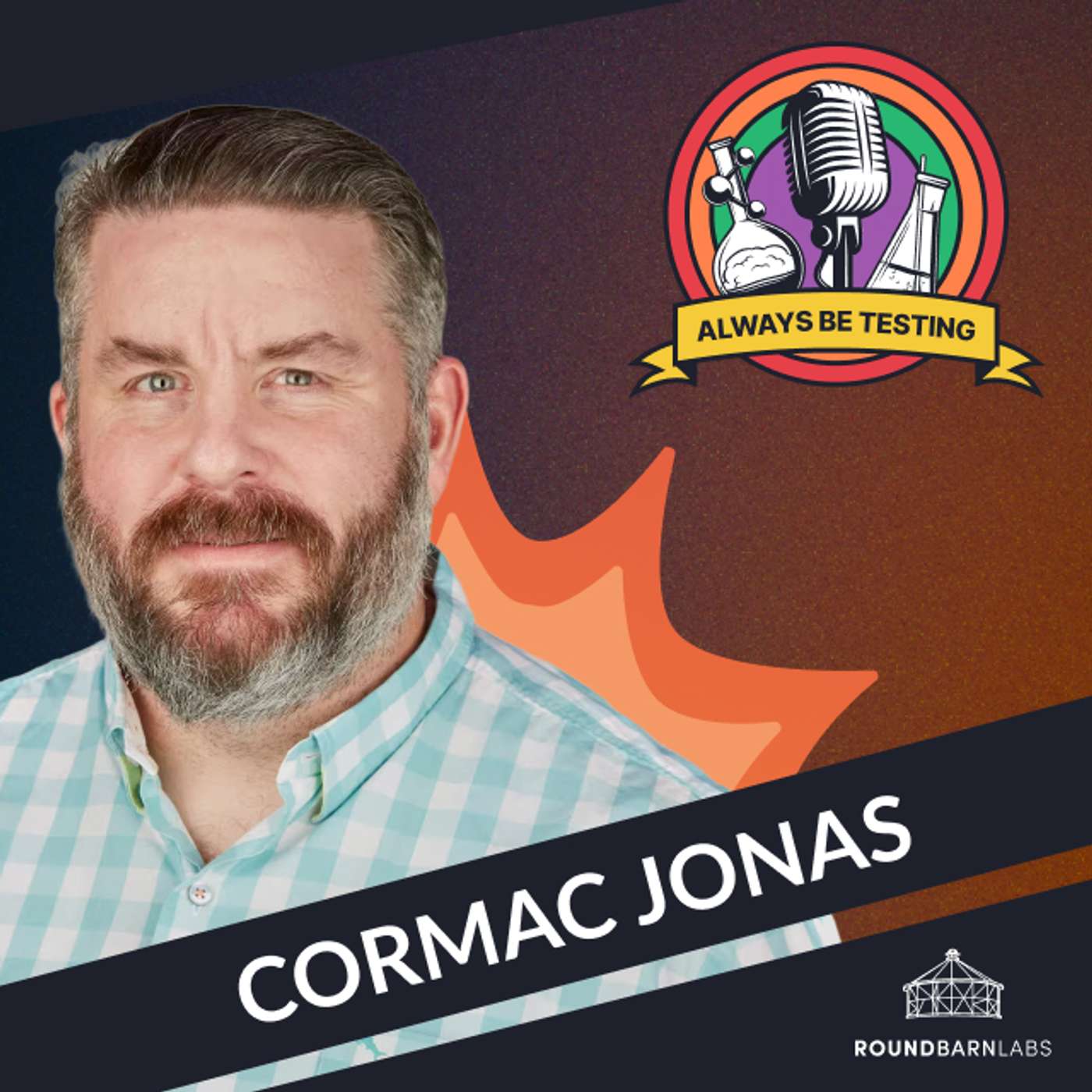
Loading summary
Transcript60 lines
- [00:00]
A
Foreign. Welcome to another episode of the Always Be Testing podcast. I'm your host, Ty degrange, and we've got Cormac Jonas today. Cormac, what's up, man?
- [00:16]
B
How's your night?
- [00:16]
A
I'm good, I'm good. I, I. Like we said, we were surviving the winter storm fern, as they call it. And so kids running around stuck at home, but otherwise I had to ruin.
- [00:28]
B
Their entire week by plow. We have the only steep hill driveway in the neighborhood, and it had become the centerpiece of our neighborhood over the last three days. And so with like two inches of ice on it and had to take that apart to get out. But outside of that, wow, tragedy for them, it's been pretty smooth sailing.
- [00:48]
A
They were hoping to ski down the hill or toboggan.
- [00:51]
B
Oh, they've been sledding on it for days. So all of the neighborhood kids had gathered and then we had to make the unfortunate announcement like, hey, we have to be able to drive out of here. You guys have eaten all the food. And so we had to take it down. But it was all in all, they, they loved it. Very rare for them to get to go sledding for a couple days in Texas.
- [01:12]
A
We're, we're, we're not brave enough yet. I've seen so many, like, people in our hood slipping and sliding around. Even with four wheel, we just said, nope, we're staying home. Got our fire going. We've got enough food till we'll be going out tomorrow for sure. Tomorrow's the day we'll be getting food because it'll be pretty much gone by then. But c' est la vie.
- [01:32]
B
Yep, absolutely.
- [01:34]
A
I love it. This is going to be a good one. Cormac is a return guest to the pod. He's the founder and CEO of Jonas Agency and he's, I mean, you've, you've seen it a lot in this game. You've gone from partnerized retailmenot TikTok to launching Savor. Through all of that, just give people the context of, like, what you're kind of problem solving and what you're bringing for brands right now so they can put it into context.
- [02:03]
B
Yeah, kind of the through line through all of them really is attribution of marketing and understanding. Right. Whether it be it's all content. Right. Whether it's a coupon back in the day being searched up or something along those lines, it's all content. And so how that content drives outcomes for a business has been the through line that's really kind of top to.
- [02:22]
A
Bottom for me, that's awesome. Near and dear to our work, to what we've helped people with and find is often there's so many misnomers in it and it's great to hear that you're there and hits on a lot of the conversations we've had. You got to lead sports entertainment media TikTok. What's something that you think got like totally flipped or maybe overturned in terms of like the actual performance data? A belief that just kind of kind of changed for you in your experience there?
- [02:54]
B
Yeah, I would say that there's two really. Number one was the volume of high intent search. And this is back in 2023. Right. It was kind of the misnomer among marketers, especially performance marketers at that point was that it was only teens and jeans. That's all you were reaching on TikTok and in reality was very different. And kind of watching the attribution blindness there caused by no utms leaving the parameter right on organic traffic really drove kind of hey, people aren't able to see this market. It's impacting them. But then you kind of have this weird paradox because that happened during the pandemic. Right. Where all the TikTok kind of exploded. All that traffic was tracked as direct for brands. And so you have this. Do I go back and say, hey, we've been misattributing this traffic for a long period. And so some brands have, some brands haven't. A number of the brands that I work with were kind of early adopters there. Not shockingly, but really understood the amount of traffic that can be driven both video formats.
- [03:59]
A
That's amazing. Yeah. And I mean imagine you got to see a lot at a critical time, which is super interesting. Now we're in this other critical time with the explosion of AI, among other things. Before we jump into your topic du jour. Our topic du jour, honey. And maybe drop some what's coming for 2026 predictions and fun stuff like that. What's like I've been doing some writing on 2025. I've got my little prediction thing dropping tomorrow. What is your take on 2025? What we saw, what happened for people to make sense of it in the world of performance marketing.
- [04:36]
B
Yeah, I think it was kind of the shift away from Google is what is what people started to see. Big one, especially in terms of text, kind of the traditional text search ads, hugely diminishing market. The one I was surprised about was the lack of Andromeda adoption on Meta in 2025. The number of people I saw still running old 322 structures paid paid media paid ads on meta specifically within Shopify paid ads on Meta your three campaigns two ad sets two creative per ad set and Meta in 20 was like hey don't do that anymore. And it took a long time for it to be adopted. I think it's kind of on both sides for a long time. There's a lot of folks who kind of feel like they have a special sauce on meta and in reality it's rigorous. Well it's rigorous adherence to best practices is really the best special sauce you can do. And with how slowly Andromeda rolled out you can see that not a lot of people are reading their actual product.
- [05:32]
A
Updates and is the for folks that are following along at home it's just kind of like give people in a sense of what it is and what the benefit was to it and just tldr and we can kind of hit some of your topics on 2025 100%.
- [05:47]
B
Meta basically switched from targeting targeting consumer with like kind of this is our retargeting group, this is our discovery group this is our conversion group and said hey really this is much more the person like Persona and their amount of desire and awareness of the product and so they switch the methodology and rather than having multiple campaigns what they want is massive amount of creative diversity in a single campaign from instead of doing super specialized siloed campaigns having one campaign and letting kind of their AI kind of do the math and figure out which ad sets should drive conversion right which is best for discovery to drive conversion the fastest or the highest value and it effectively learns that.
- [06:33]
A
Got it. No, it's good to know and I feel like there was sort of I don't know maybe a tale of two Googles for lack of a better term. I was I'll share this when my newsletter drops tomorrow but I was predicting a pullback from Google as well and we did see some of that in search queries organic traffic, the lack of traffic coming from attributable but then at the same time you see this YouTube absolutely crushing it which I'm sure you're recognizing as well. You're seeing the Gemini kind of resurgence so it's really interesting trend spotting wise from 2025 a hundred percent.
- [07:12]
B
Well a couple like YouTube has been massive and I truly believe kind of across the board that all roads lead back to YouTube. I think not just the fact that a huge volume of us during the pandemic conditioned our children on this is the good place to Go find information and entertainment. But then on top of it they have the maturity and the data from the Google side of things. The scariest part where I've. I've noticed that marketers and affiliate and otherwise haven't really reacted here is last year Google passed like cable for TV viewing. Like right. Like there are more people watching YouTube.
- [07:50]
A
On the television exceeding the other streaming platforms. Is that what you're referring to?
- [07:54]
B
Oh, not exceeding cable and streaming platforms like they are the most watched thing on televisions. And I think for a lot of you know, the gray hairs like me that isn't as appreciated. Right. They're like, oh, it's TV. People watch TV on TV. It's like no, they're watching YouTube there. And if you're not targeting, you're missing the most interactive search engine in their house.
- [08:16]
A
It's crazy. No, that's awesome. Any other things that you. That 2025 brought for you from like a learnings perspective or from like an affiliate perspective?
- [08:27]
B
I mean this will probably dovetail into our Just how much fraud there is out there. Just how much like and this independent of honey and whatever about last click overriding last click within retail media networks. Programmatic ads CTV There is just. There is so much fraud generated simply because there's an expectation that there's an unending supply of paid media to buy. Right. You can't go to any of the retail media networks and effectively like out buy their supply for a day. Right. You can't. And so there's always more which leads to somehow magically there's always more. And so but that really was. And how important it is to really attribution is becoming even more important for brands as they go forward. Knowing where actual transactions are coming from. Black Friday last year was the first time since the 2000 pre2010 that bot traffic outnumbered humans on the Internet. It used to be that way because we didn't have enough computers. Nope. They've come back and it's a lot of it is the AI searches generating huge volume of searches. But if you use ChatGPT or Claude on your personal computer, all those programmatic ads are served to you that are never seen. Right. It's simply to a bot. And so being able to effectively filter that out.
- [09:50]
A
Are you seeing on programmatic things that clients are doing specifically around that you kind of referenced it a little bit. What are some things that you suggest people look for or just be mindful of around Programmatic specifically Treat it like.
- [10:04]
B
The farmer's market, buy direct, know your source that 100 that that is it. Anybody who says they have a partner network or display network or can't I understand the walled garden, you know, well there are walled gardens in this world. There's a handful but kind of what waters them, right? Like if I look at Walmart, their website traffic is down, their footstore, their in store foot traffic is also down year over year. Has been for a couple of years kind of in decline. But the price of their ads has gone up substantially during that time. And so knowing where you're buying and what you're buying is super important and making sure that you're actually attributing it back to the sales that you're getting.
- [10:45]
A
Attributions come up a lot. What are some things that you suggest people to look for or maybe as a best practice think about from an attribution setup perspective or maybe what are some things that you come at it with when you help clients on that challenge?
- [11:03]
B
Top level is a little fun cheat code for everybody. Even if you're not buying ads on a platform, turning on your ad account, having a credit card available will help you see increases because they want you to spend money. And so you'll start seeing ad tests and ad credits and those sort of things I know within Meta and TikTok and others they'll start incentivizing you. That's really good kind of for folks who are newer to platforms to build up some there's kind of on the attribution front it's really important to get to what they call signals optimal which is conversions, API tracking. If you're in WooCommerce or Shopify doing E Commerce that's a huge one. The other one that folks don't do enough is the on platform lead forms. Number one, your website's probably not that good. Number two, Meta would rather you stay on Instagram or on Facebook in the app and so you pay a lot less if you don't make them leave. The other thing is we both know from being in lead gen and affiliate space forever, people give Instagram their real email. They give lead forms a fake email. And so using those on page lead forms gets you the real data you actually want to get from the consumer.
- [12:11]
A
Love that. I think Mike who you know on our team would love to to go deep on those those with you having ran a lot of media and we've seen a lot of those stories too, that's a really cool. Those are good call outs, just concrete takeaways for people that are thinking about some good Setup best practice for the channel and for paid media.
- [12:29]
B
A lot of it is that I mean you can only out optimize a bad. It's like exercising a bad diet, right? You can't do it and so you can optimize your campaigns as well as you want. But if you're throttling the amount of discovery you have at the top with crappy settings and you know, out of date setup, it's just not going to benefit you for sure.
- [12:51]
A
Let's get into the juicy topic du jour. Let's you came at it with some really good call outs on LinkedIn. This has been really heated, maybe much, but it's, it's an interesting topic at the very least and you don't want to see the fraud or the, or the, or the folks in violation if you will. For the industry and for a variety of reasons. It's going to be really interesting. But give people your perspective on the Honey saga that's dropped on the affiliate industry over the last few weeks.
- [13:20]
B
Yeah, it feels like. Well, first off, if you look there's a couple of folks who here, Mega Lag and Ben Edelman did the lion's share of the work here on kind of digging up and finding the hard proof to link this. But Mega lag posted a YouTube video in 2024 first kind of going over like the attribution issue, which is effectively honey would overwrite pixels for creators, influencers and other affiliates, which was against the terms of service for the networks. They weren't supposed to be doing it, but it was wink wink, the handshake style agreements. Right. Effectively what ended up coming on the back end of it was a year later they did a huge amount of research and were able to pull out what they put into the defeat device. And that's really the part that kind of shows they know that they were doing something wrong. They were looking for people basically they would not overwrite your pixel if you had affiliate cookies on your computer because everybody works at their competitors or who would be doing compliance is going to have cookies From Impact Awin, C.J. one of those. And so that's kind of a big part really. I think where it comes from is the fact that I've never seen a browser extension that's driven incremental sales and primarily because they just haven't been adopted by users at all. Affiliate marketing is where they should be used the most because for finding pixels, checking setups, things of that nature, there are very good usable browser extensions, but of the shopping ones, almost none drive Incremental clicks. I think we were talking last week and I was joking around like honey used to light up on your screen like a Vegas slot machine. Right? Like that's. You hit a checkout and it just started like lights are going off. You just won. That was solely to drive engagement. It's very different. Love them or hate them. With coupon sites like RetailMeNot, the user took a tangible action to open another browser, go to Google and look for coupons, click through and end up fine. There was enough of a speed bump that you could prove A, incrementality, and B, whenever we did holdout tests there, we found pretty accurate or pretty actively that those users spent more. They were getting a coupon to increase their buying power, not to kind of qualify for a brand they wouldn't otherwise buy.
- [15:38]
A
Are you referencing holdout tests done while you're. You tell me not to kind of measure incrementality with brands?
- [15:45]
B
We were doing it constantly because. Right. Coupon sites were never, never ever anybody's favorite Right. Source of traffic. But it kind of led to that. We got very good at proving our value and specifically doing holdout tests. Yes. They would see decreases in volume because for that cohort of coupon shoppers, they had a behavior pattern that they emulated consistently. Right. They would go to RetailMeNot, look for a coupon and go. And it worked very well for a long time. We had a browser extension too, around the same time. I don't know the exact data on how it did or anything like that. Wasn't kind of my purview. But I have not seen user engagement stats on any of them where it makes sense for kind of the cut that they're taking.
- [16:29]
A
Out of curiosity, when you get thinking about value, just of that experience you had, which is really interesting, basic structure set up. How did you get those tests? How did you experiment? Thinking about how the experiment was run. Just curious about the methodology. To learn more about how you guys.
- [16:44]
B
Saw that it would depend. We did it both on. You could do holdout tests between like a paid search URL and like an organic URL. The pages look a little bit differently. Additionally, we had. There were all kinds of holdout tests done consistently across retailmenot for years, years and years and years. It usually came because a brand didn't wanna pass. And then we had to prove why we were driving value and then they would continue to pass. Kind of looking at the honey. This is the part that really bugs me, the honey stuff. And I appreciate that now, what a year after the Fact, a handful of the networks have taken action. But the craziest part about like they. If they didn't know before 2024, they definitely knew then. But like Honey's dropped 6 million users. That's why Rakuten and Impact got brave enough to kick them off their networks. Right. Like at the end of the day that's why this is happening. It's because Honey's not driving meaningful traffic anymore. If they were driving meaningful traffic we would be finding reasons to keep them alive on all these networks. And it's why only one has kicked them off. There's two I believe that a sentinel notices saying they're suspended. Pepper Jim still has them like quoted on their website. Great look. They still have them there as like a trusted global partner. Oh honey. They have quotes from them and everything. It's a great look. But when you put the Google affiliate network out of business I guess you're not that worried about Honey. It's crazy.
- [18:05]
A
It calls into. It's concerning because talking about the timeline, right. Like there's kind of. You're kind of. There's kind of the implication that if it was useful to the. It raises the question if the partner was still commanding the volume and was still useful to the network, they would not have taken that action. Not just saying you're saying that but is that kind of what you're thinking?
- [18:28]
B
It's what they've done with other ones, right? Capital One Shopping Wikibuy. They settled in December last year with their Pixel overwrite lawsuit and it didn't get nearly as publicized. They also didn't bleed out all their users likely because they actually had price shopping. Price monitoring is a bit of a service that they offer and so it's. They have an actual audience. But there's about 10 million affected users under theirs. They're all still there, right. Nobody's looking to get rid of them all. And so but yeah it does. The networks know like they have the data to prove it, right? They have if you look like take for an impact everything works off of click IDs and so we should. They should be able to match up the user agents and the click IDs they come they that came in and see it immediately across Honey immediately just do it from a computer without any impact Pixel. But somebody doesn't block you. But no no. They could look in the data and see it immediately. But I think there's probably twofold. There's a complicity issue. Right. Nobody wants to admit they were complicit. It's much easier. The pearl clutching works way better and especially like over a year after you were informed of the problem on YouTube by major creators. But, but I think realistically what this comes down to, and I've seen it at large platforms and this is what unfortunately happens. I think if I look in the, in the grand scale, it is much easier to manage one Honey versus 500 creators. And so like, hey, they might be stealing some credit, but it's way easier to have one person manage honey as part of a large scale than it is to manage five or six hundred different creators who want payments and different things for their videos and freebies. And they asked for a lot more. And so I think that drove a lot of the reasoning. Right. Like more and more as I, as I see what, like what's going on, like, and it's not just across honey, it's across kind of the various systems that we're learning don't really work, is it? Laziness drives a huge amount of this. Like not wanting to do extra work is where a lot of these problems come out.
- [20:31]
A
It's insane how we, we see it so much in our world and you've talked about this like to run a program that's really above board, optimizing for incrementality, properly attributed, all of that stuff and regularly growing is. It's actually quite shocking how rare it is to see when we look under the hood of other programs, when we build out programs, when we take on things and improve them, and it is significantly harder. We often look at it like not even thinking about just what's in a network per se, but what, what else is out there for that brand's icp, which I know is really central to like how you think about, okay, are these segments of users, are these actual communities of interest? Are these people that would really align well with, with what we're trying to do for a brand that you're consulting with. So it's really interesting. It's, it's wild to step back and think that they. There's all kinds of, I think lessons and interesting things involved in this, but my hope is that it continues to set a higher standard and higher bar and is a bit of a wake up call for a lot of people in our industry that we all kind of need that and I think some more than others. And my hope is that continues to wake people up a bit because I don't think this is over if, if we're looking at, in some ways it is, but in a lot of ways it is not.
- [21:58]
B
Well I think funny enough like I think affiliate will be fine because this has always been the way of a like heavy attribution looking into this stuff. Like they will figure out what happened with Honey. Like there's too much tracking in affiliate for they're not like we know there's a paper trail, right. It's just going to rely on somebody like going hey, here's all the 2023 and 2024 click data. Like find it and if you have user agents you're going to be able to see it away. Right. And so somebody that'll get figured out. Most marketing orgs do not put that same level of scrutiny onto their Programmatic and their retail media side of things. And that's where they're like, like Honey was stealing from other affiliates. Right. In a lot of cases brands might have known but also they could pay Honey a way reduced rate. Right. If I'm paying Honey 1% they're just helping my margins by stealing last click. And so you end up in where brands haven't really been hungry to kind of come out and say it. And I'm sure there are brands that were able to see it in their multi touch and went hold on, it's way cheaper, right? Like I don't want to pay that creator a 20% rip when the coupon site's a nickel in that that, that drives a lot. Now where Honey kind of screwed up with users was Honey Gold was a rip off. They give you pennies compared to the commission rate, all of that stuff and really didn't do enough to incentivize users to keep coming back. They built a universal shopping cart, right? Remember the Honey app? Let's not forget the Honey app. That was really just shittier, more expensive temu. That's all it was. And nobody liked it. And so it kind of didn't go on. But I think there was knowledge within the space. Like it's too easy to prove it out. And I know we at retail, like I had submitted complaints against Honey to Impact. We went to their party at CJU because they were like right across the street from there years ago and they were pretty open about like how much data and control they had over the browsers and it is the code was all public facing. You could see it. So I think the larger areas this year that hopefully start to get some light shed on them like by far CTV and Programmatic need a healthy dose of disinfectant. There's a huge amount there that's just being shown to nothing the other one is Applovin which if you're in the mobile app space like they're way more. They're kind of the most egregious and it'll be interesting to see because nobody's really put a ton of focus on it because really it's just mobile games and who gives a shit. But they're moving quick into E commerce and into other areas because they have this kind of inflated volume and they're, they're auto downloading. Right. Like they're doing all kinds of things that are easy to see, super provable people have videos of it happening and there's really no enforcement mechanism and that's the part that's going to disappoint.
- [24:57]
A
Yeah, I think like my sentiment is like there's a lot of opportunity to democratize like better measurement and I think that's kind of what we seem to be kind of coming at it from a similar angle of Enter enter the wild fun world of AI and geo. That doesn't necessarily upend your entire measurement but it makes a significant change in how you should think about it. The shift away from click based attribution I think is something that we've talked about and it's going to continue to get talked about and I think this underscores that the shift away from last click methodology. It's just, it's shocking to me that there's not more, more brands moving beyond. I think you touched on some of the reasons why the incentive wasn't necessarily there to the juice was sort of worse for the squeeze at the macro level. $in, $out it wasn't like you were losing so it didn't really wake up call some brands but I think some certain brands in this space are, did probably have evidence to suggest they needed to shift their thinking to a more full funnel, multi touch exposure based view and then it eventually get into more mmm incrementality testing things like that for those that have the volume to justify it. So I think it's my hope is that more of these conversations can help just elevate the importance of yeah it does matter to attribute appropriately across partners regardless of where the chips fall and we've kind of got more tooling and knowledge out there to do it.
- [26:28]
B
Yeah 100% and one specifically on the toolbars like I've always. These things are like zombie marketing right. Like they really are like there was shop at home back in the day and they got nix because you couldn't uninstall it and it stole all the Last clicks too. It is, I will note, pretty funny of the ones that are in the space. Who knows what happens with Honey and Capital One Shopping, but Google updated their rules around reporting on user interaction and engagement in toolbars. And like Microsoft immediately shuttered that shit. Like her Bing Shopping went away like overnight when they were like, oh, you have to show real user engagement data. And I think that's going to be the thing that kills them is that hey user having to actually click on the puzzle piece and click on your, your go down and pick the extension. That's nobody's going to do that, at least not in a large enough scale to support a business. And so I think that'll be interesting to see, but I think there's kind of within it right there. The platforms, right. Google Web Store could have solved for this years ago, right? And so it's some of those where we need a little bit more marketplace oversight, right? In lieu of like if you don't want regulation from, from government entities which they don't understand ad products and I don't believe that they're the right ones to be able to come and regulate it, then we need the platforms to actually police what they're putting out there and ensure that these things comply. And it really is, the difficulty is that there's just no money in telling Honey to go away, right. If they show up with a giant bag of money to buy ads and downloads like it becomes one of the ethics tests that we as a society or as a species really keep failing repeatedly. We can trust them to do the right thing, right? No, literally we can never trust them to do the right thing ever. They're humans. They're not going to do the right thing.
- [28:18]
A
Do you want to see the networks taking more of that active role on you kind of alluded to platforms. Would you include the networks in that?
- [28:25]
B
I think they off, I think they're gonna, I think they're getting offed. I, I, my gut would be that they go away because the PL like the, the platforms that actually own the audiences are starting their own affiliate networks, right? YouTube now, big on, big push on affiliate. Same with, with meta, huge push on affiliate. TikTok built on creators and kind of scaling on that front and aside from whatever about the new US algorithm. But I can, that's where I see the difference going, right? Like I think it moves there.
- [28:58]
A
If you could look ahead as you think about 2026 and beyond, you're, you're seeing a world where, correct me if I'm wrong, you're saying downloadable software partners, browser extensions are really phased out possibly and then the networks themselves phased out as well.
- [29:15]
B
The start. I'm not going to say they're gone overnight like it's not going to be that sort of move. But if I am at a Nike right it is far better for me to have a YouTube like a creator team that touches on all of my social platforms internally with my media buyers because one amplifies the next. And so right. Like my top organic content should be my top paid content on those same platforms. So I think it'll be there. But the fact that the creators tend to be true Mr. Beast right. You're kind of siloed by platform. Not a ton of them have are multi platform. Having tracking on the platform where they're already comfortable makes adoption much easier. It's going to make everything work. The hard parts of working with creators is getting them to use the right links and do all of that. If we can automate that because Google just turned it on with Google with problem solved. Right. We took away a huge amount of labor out of what we had to do before and it's kind of that was that leg of the stool, that pain in the ass part. They made it hard to work with creators and that wall has come down a ton and so I think they're the brands that get in early would naturally move away from a CJ or an impact. I'd rather not pay any affiliate fees or SaaS fees or any there and work directly with a creator on YouTube or Meta or TikTok especially because they're going to give me more, they're going to give me ad credits, they're going to give me things that actually benefit my overall program.
- [30:43]
A
Is there a world in the non social might be a bit of a misnomer but for that scenario what do you see as the affiliate community angle or way to work with the Googles metas of the world TikToks. How do you see the affiliate community kind of navigating that world and being a complimentary value ad in that ecosystem or not. I'm curious to get your perspective on that.
- [31:11]
B
I think there's a lot of number one is going to be right like this is all going to be brand new learnings for a lot of the brands and so for the people who've been in the affiliate space for a long time I think there's going to be a huge amount of opportunity and growth for both in educating brands on how to do it but also in learning these new Platforms. Right. We all remember back in the day when like share sale was like the standard. Like it gets better, things change over time and they move. So. So I don't necessarily think it's bad there where I would say if I'm a publisher who doesn't own my audience, I'm scared. If I do not have an audience that I actually own and who is coming to me voluntarily, that is very scary. And those folks in the affiliate space should be very worried. Right. Like look, as soon as. I mean honey, it took one YouTube video and Honey lost 6 million users. Now granted they were doing a lot of bad stuff, but what they found was that their primary audience cared more about the creators they were following than the coupon partner. So kind of within that, like for publishers, building that kind of base where your audience cares enough about you to change their behavior is going to be key in that space. For Linus Tech Tips and other people, their programs do great. Right. They're doing a huge amount of volume on views and their engaged audiences actually buy the things that they advertise. Yeah, that's going to be.
- [32:36]
A
It's wild because they've just been getting hit. The publishers or the content creators have gotten hit twice in some ways with social. And then AI is absolutely a whole nother battleground that's being fought out actively and figured out as we speak. Right.
- [32:52]
B
And I think twofold. I think you'll Also see affiliate V3 coming up. Right. The Third Wave affiliate where there was a lot. Huge amount of coupon dependency, early days kind of in the affiliate space and then kind of email marketing I guess was kind of the first wave one and then into E commerce kind of coupon sites and others. Now with social commerce kind of springing up, I think you'll see the larger companies kind of have trouble and I think you'll see new platforms that are kind of figuring it out. I look across some of the creators and some of the even within sports and others where they're really starting to get smart and creators and I think that area you're going to see a massive explosion in 2026 because it's just too affordable for brands to kind of get in there and those live so long. The other part will be really their UGC strategies specifically around consumer reviews and other things are massively important to both their paid and organic strategies going forward. And so it'll be interesting to see. But yes, I think you'll see a de platforming more of like your large consolidated. We had that huge consolidation wave where Everybody bought all the websites together. I think those are in trouble. Websites I would have largely going away like the the kind of destination URL to then hop out and go somewhere else coming largely obsolete. And if I can do better with lead forms on platform than I can on my website then over time you'll see that start to trickle into more service based businesses as well.
- [34:22]
A
Well just stepping back I I love like some of the things we've talked about here. Getting the attribution dialed in, going right to the source for the publisher or the content creator, thinking about having that positive direct relationship with your audience. These are things that we've talked about and interacted with and dealt with. But I think a lot of people don't always understand how it's put into practice and it seems like hey, it's playing out in real time with the honey saga and you've given some amazing spicy takes as we've discussed. Cormac tip the cap. What's personally anything on tap for 2026 you want to hit on or things that you're trying to accomplish?
- [35:00]
B
So we've really done very very well kind of with with implementing video strategy for like outcome based working better and better and better. We had one. It's been. I've been super impressed by the ability for the strategy to mold across verticals. We have a plumber who started doing YouTube last year who's added 10 million in ARR to their business. We were able to we're working with like a couple national franchises and that was in like five DMAs and it was really the learnings there for businesses specifically service businesses and local there's a huge amount but even on a national scale I've started working with a handful of kind of national brands that franchise and being able to input like effectively how to get your franchises creating content in a way that drives organic outcomes on video. It changes their entire operating procedure and it's super fun to watch. And so that's been an exciting one on the e commerce front. They've a lot of cases E commerce at this point has gotten to. It's very formulaic and there is definitely a winning playbook in terms of the tracking and attribution, the play, how you set up technical side of the world but then also kind of on the content creation front in terms of how brains should be attacking it, how they should be cross posting to different platforms. Really that's going to be an exciting 1 in 26.
- [36:26]
A
I love it. You've got some really good things going Cormac with the agency, with the learnings. I think a ton of knowledge to share with clients and just the industry and folks that you're working with. So always appreciate our conversations. Not a lot of return guests on Always be testing. So you are an elite company, and we are surviving the winter storm here in Austin area.
- [36:49]
B
I mean, it's 45 today, so, like, we're, we're nature's helping us at this point.
- [36:53]
A
We're, we're we're on the tail end, dude.
- [36:56]
B
We're taking credit like honey did for, like.
- [37:00]
A
Thank you so much, man. It's a pleasure.
- [37:02]
B
No problem.
- [37:03]
A
We'll see you on the next one and we'll talk soon.
- [37:05]
B
Have a great day, Ty.
- [37:06]
A
Take care. Bye.
- [37:09]
B
I.