← Always Be Testing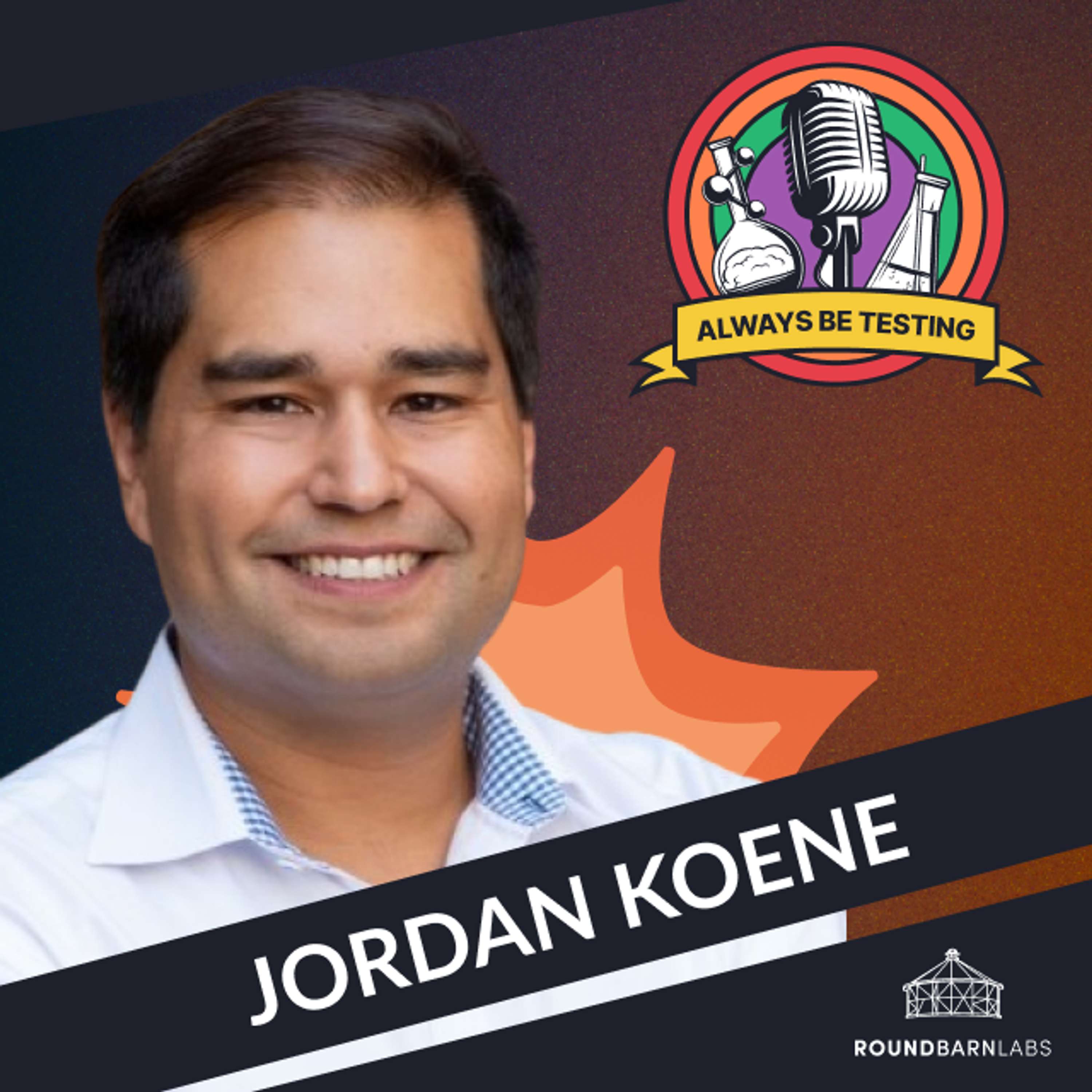
Always Be Testing
#87 AI and SEO: A Partnership, Not a Threat | Jordan Koene, CEO & Founder of Previsible.io
00:34:37
Loading summary
Transcript45 lines
- [00:00]
A
Foreign. Hello, welcome to another episode of the Always Be Testing podcast. I'm your host Tygrange and I am really excited to have Jordan Cooney on the show. What's up Jordan?
- [00:17]
B
Hey Ty. Great to be back. Super pumped to dive into our conversation.
- [00:21]
A
Absolutely. Always Jordan is on an elite list of return guests to the Always Be Testing podcast. I was also lucky enough to join him on his Voices of Search pod. So it should be another good one in our continuing conversation. Absolutely, yes. And just a little shout out we have since Jordan came on initially we have seen some great traction and excitement with the Always Be Testing pod. So we appreciate the listeners and the subscribers out there. A quick, mild plug shout out is that we actually made number two in marketing, which is kind of nuts. And we surpassed our friend Simon Sinek and the morning Brew on in business. So thanks to everyone listening and actually giving a darn a little bit about what we say out there. At least it's getting through to somebody.
- [01:10]
B
Exactly. Congratulations. It's a huge feat.
- [01:13]
A
Thank you. All too well. And you've been building in this area for forever so you understand it better than most with Voices of Search. So it's great to have you on to kind of share the news. But let's get into it because we brought Jordan on to not tout our pod, but talk about the SEO landscape. Jordan is a world renowned SEO expert, a leader of Pre Visible, runs an agency and a staffing firm. An amazing group that does a lot of great work in content marketing, content strategy and an agency. But let's jump right in. What the heck is going on with SEO in 2025? Stuff is going crazy. Google's saying traffic's down. People are talking about traffic being down with affiliates, content sites, AI chat, ChatGPT. What the heck's going on, my friend?
- [01:57]
B
Yeah, we're, we're in a period of disruption. This is a, a critical inflection in terms of how consumers are going to shift their discovery behaviors. A lot of that's going to be due to how search engines like Google change the, the serp, like the way they lay out results, the utility of AI in, in those results. So what they're calling AIO or AI overviews. This will become a critical and highly scrutinized and analyzed and researched experience. And it's not too dissimilar to changes that have happened before in the SEO landscape. Fifteen or so years ago we had the knowledge graph introduced which was highly skewed towards Wikipedia data and content and that's evolved over the last decade or so to a different experience. We expect the same to happen with AI overviews, but more of an impact in what's happening is just that consumers are shifting the way they're going to do discovery as a whole. So outside of Google, consumers are going to ChatGPT, perplexity, cloud and the like to perform their searches and to do their, to do their work in more efficient and scalable ways. And I would anticipate that that is going to have a more material, long term impact on search and what consumers do in search.
- [03:23]
A
Yeah, absolutely. We did an analysis for affiliate programs looking at content sites year over year and this I believe was, we talked about this pretty widely in the summer of last year. Coming up on almost a year ago, which is crazy as time flies, but we were seeing not a terrible decline. It was about a 10% decline and we kind of removed some major anomalies to kind of normalize the data. Worse then you have some of these SEO experts out there touting like, not touting but Talking about like 20, 30, 50%, even larger declines that are happening. I know you can't just peg a number to it, but for folks out there who are curious, what kind of declines in organic traffic are we seeing and kind of, can you maybe help quantify the shape of it a little bit for us?
- [04:12]
B
I mean, it really varies by vertical and what we're seeing is certain categories are experiencing declines much more quickly due to the fact that AI in and of itself is just a highly functional way of searching and defining your problem set where there's a compounding or complex set of requirements. So I'll give you an example. In finance we're seeing that there's a huge decline in traffic in these functional type terms. So how do I figure out what my payment is going to be on a 30 year fixed rate or variable rate mortgage? Or how am I going to better understand the investment opportunities for retirement? And I am this old and I make this much money and I have this much risk tolerance. And those types of searches used to have hundreds of searches for that user and they would lead you to everything from news article, informative type experiences, things like NerdWallet, things like Investorpedia, all the way to very functional transactional type experiences like a bank or a financial institution's solution or portfolio pages. So, so these are very, I'm giving you very different experiences within the finance vertical. Both of those experiences and types of websites are suffering from significant traffic loss because these types of searches are just far more seamless and easy to consume for the user in an AI experience you're going to get better information, quicker results, more clear defined expectations based on your personal segment situation. And that's one of the verticals where we're seeing significant traffic loss. To answer your question, Ty, it really ranges. A lot of experts out there have, have stipulated that where they're seeing traffic losses from 10 to 90%. Barry Schwarz made a comment about this. The reality is in very, very, very, very specific keyword or very very head term type topics. Yeah you'll see a 90% drop in traffic because consumers don't need to click on anything anymore. But generally speaking, website specific, you can expect to see double digit declines in a period of time of 3 to 6 months if you are targeting terms that are being addressed by AI experiences. And the interesting thing is that this is going to change fast. And I'll leave you with that because this is where we are right now. But this is likely to change quite fast in the near term.
- [06:55]
A
Yeah. And there's so much to kind of like wrap your head around and impact there. A lot of it's kind of happening rather quickly. You're seeing it in real time. A lot of the like prominent content sites in our affiliate space are, are witnessing it and kind of trying to manage and navigate it a little bit. I think we've kind of talked a little bit about like the what's happening. What do you think is some of the why behind these changes? What do you think is driving these changes just based on the data that you're seeing?
- [07:25]
B
I mean I think that the why is it's easy to say, but it's hard to materialize. But it's because consumers have found an easier, more simplified, non convoluted reduced ad experience when it comes to AI search. And this shift is happening quite fast. I think the most remarkable thing about AI is and AI adoption is that its acceleration in in in utility is exponentially faster than any other technology we've seen in the past. It's faster than the Internet, it's faster than the telephone, it's faster than electricity in the light bulb. These AI models, AI this LLM and AI based experiences are exponentially faster. We're talking months. Whereas other technologies have taken years to create adoption to a critical mass. And the reason for that is because it simplifies our life. It makes us as humans far more efficient and more effective in getting what we need to accomplish the task or the work at hand.
- [08:35]
A
You nail it. And I mean look at, look at the user behavior. You're witnessing for yourself, your friends, your family, your colleagues, what you described earlier. Like anything that's computational math based, like you're basically the deep research opportunity. There's just so many use cases the user can nail with AI via ChatGPT, via Perplexity, via other tools. It's astounding.
- [09:00]
B
It's 100% astounding. And even more so than astounding, what is more exciting is that we can now take this technology and, and make it more effective to our own use. So this whole concept of building out agents is going to create an environment where we have AI technology that really serves an intended purpose. I can build my own AI agent just to do certain types of SEO tasks or SEO work that used to take me hours, if not days to do, I can now do in minutes. And those are the types of advancements that we're going to see over the next 12 months for, which really might open a new door and a new shift to how consumers do searching and consumers find things online. Again, because we're beyond that first phase of just the rudimentary artificial intelligence, we're now moving into an agent based world where it's going to become far more specific and much more granular.
- [09:59]
A
Yeah, yeah. And I think on the positive note, while this, it's, there's some volatility in the change and the rate of change, these, these users, these customers, this opportunity has, it's shifting, it's not gone. So transitioning into okay, what do we do? What do brands do, what do businesses do? How do people compete in this new market? Excited to hear your perspective because I'm sure you're having to counsel folks on this all the time.
- [10:26]
B
Yeah, I mean the, I think the biggest shift we're going to see in the next six to 12 months is the reduction in what historically has been the biggest flaw in AI, which is hallucinations, just false or completely invaluable outputs from a prompt. And why we're going to see that reduce is because incredibly intelligent and capable organizations, companies and people are going to develop agents that are backed by solid data, that are backed by a strong infrastructure and that have the investment to scale to the use of a community or a set of users. I'll give you a hyper specific example. Going back to finance. If I'm a bank or a financial institution, I have loads of data about my existing customers, their existing trends or behaviors, where they've invested their money, how they use their money, how much money they have in savings. I also have all this structured data around rates for investments, yields and derivatives that you could use to invest your money. I also have all of these different options that you could, you could utilize, from stocks to CDs. I can take all that information and put it into the fingertips of every single human interaction that my financial institution has with a potential customer, whether that be in tools, services on my website. Internal tools.
- [11:54]
A
Internal.
- [11:54]
B
The tools that my sales and my, my, my banking consultants can utilize. And that becomes far more powerful and far more capable of a, of a, of a project that can be done in days, not years, like it used to take. And that is incredibly powerful. And I don't think that we as consumers are even aware that that's how our consumption is going to change. And I think that's what, that's, that's what's really remarkable about where the trends are going to and why. Ultimately, the big question that you're asking me here is why is this whole SEO landscape transforming? And that's one of the main reasons. Why is that we have this capability that we didn't have a few years ago?
- [12:35]
A
Well, it's almost, it's almost like you can lament, let's say it's 25% traffic loss or a traffic loss that you're seeing as a brand. But think about all the value you're going to be getting in the time to publish or to produce a significantly more powerful customer service experience or a much better user experience on particular use cases, or the ability to kind of tee up your financial consultants or your reps. I know that's sort of a fictional scenario, but that's kind of what you're alluding to, possibly.
- [13:10]
B
Yeah, that, that's absolutely the future. Everyone has been touting the concept that AI is going to take jobs. It's not going to take jobs necessarily. It's going to make jobs that used to be incredibly redundant and mundane far more practical. And it's going to make individuals who have the knowledge and the experience far more capable. And I think that the jobs are still going to be there. What's missing right now, and I think this is a bigger conversation, probably not for our show, but I'm happy to dive in if you want. Ty, we still don't know what training looks like. How do we engage and educate and inform a workforce to be more capable with the AI technologies we have today and in the future, and that, that we don't know and that we're not sure of. And I think that there's a lot of work that needs to be done.
- [13:59]
A
Around That I think anytime something like this comes along, there's a fear, there's a concern, there's always that. You've seen the articles published about calculators in school, for example. I think it's also, conversely, an exciting opportunity for people that are leveraging it, that are using it. I'm sure you guys are using the heck out of it. We are, absolutely. We're putting contests together and ideas around it and all kinds of stuff on our side. One thought that comes to mind that bubbled up earlier was, how do you kind of integrate into these models? How do you become a sighted source in AI? Is that something that clients are asking you for? And kind of. How are you counseling people to start thinking about that?
- [14:39]
B
That is a great question, and I love that you asked it. And the first thing that we're counseling everybody on is go get the data you have. So. So this is, the first thing is like, where am I visible? Where am I showing up? Where is this working at all? And most of the time today, it's very much brand specific. So look at your own brand. Look at how. Look at how Google in AI overviews is talking about your brand. Look at how ChatGPT is describing who you are and who you serve and what your products and solutions are. If you haven't done that first legwork, you've already missed out on the biggest opportunity, which is correcting or informing or directing these LLMs to be more precise, descriptive and accurate about your business and what you do. And I think that that's the first thing that a lot of us forget about, because it's like, it seems incredibly, like basic, but it's so critical because those are likely the users that are most likely to convert. Why else would they go to an LLM and ask a question about who you are and what you do? They've probably researched, heard, seen you speak, done, done some engagement with you as. So that's number one first place to start. Look at your own brand presence, brand footprint, your own messaging in LLMs and AI, both in Google and in other places. The second thing is to really start defining what are the assets that you have that distinguish your business and brand from anybody else. I mean, even looking at a small company like us at Pre Visible in utai with Round Barn Labs, we have assets, we have podcasts where we've got great guests and content and knowledge that LLMs would love to train off of, would love to learn from. That is an asset that now we can utilize in our service businesses to expand our reach. Inside of these AI models and these AI responses. So doing that stock of what you have is super critical because in the third phase is experimentation. It's how can I utilize what I have to create more exposure, more footprint, more traffic, in some cases, not always traffic. Sometimes it's just purely awareness to gain more of my audience to my product solutions, sales teams, phone calls, whatever it is that the activity is that you need for your business to continue to scale your reach and growth.
- [17:05]
A
Yeah, I love it. I mean, a huge emphasis for us, honestly, in the last two years. And it's exciting in a lot of ways, probably similar to how you see it, because we are kind of aiming to provide a solution in this crowded, crazy landscape that's changing. There's AI content, cost to do business on Meta and Google is high. So we're really trying to help clients navigate how do you get trusted voices, how do you get humans talking about you? How do you get that, that kind of personal connection of influencers and creators waving the flag to say, hey, this product or service is really valuable. I've utilized it. I'm actually a customer. So it feels like it's kind of exciting in some ways. We're kind of doing very similar things, but, but in our focus niches to help brands kind of navigate this stuff, it's just, it's wild how much brands can no longer rely on just their own messaging, which is what I'm hearing you kind of echo.
- [18:04]
B
I mean, I was talking to a friend of mine who works in the AI space and he works for one of the large models and he made this comment to me. He says, you could go to your farmer's market and I could set up a drone that could hover around the farmer's market, collect video data, analyze all the fruits and vegetables, validate whether or not, and use science to confirm that whether or not they're organic material or not. Poll questions with robots that ask consumers like, did you have a good service experience or not from the vendor in this farmer's market? I can do all that and I could create some of the most amazing responses as a consumer to help you find the best vendors in this farmer's market. Or you could just ask your neighbor, like, it's not complicated. I mean, it does come down to human interaction to some extent. No matter what you the science, you could set up all these systems, you could spend all this money, but just ask your neighbor, what's the best place to buy tomatoes at the farmer's market? And they're probably going to know. So yeah, experience matters in all of this and I do think that it's really, really unique that when you take it down to a real local level like that and you think about your own community farmers market and what's happening right there in your backyard, there's, there's a ton of value in just having that conversation with your neighbor over using some sort of AI systems and processes, elaborate data testing and questions to get to the outcome of what are the best tomatoes in my, in my farmer's market. And we're, we're all experiencing that now. Where are the efficiencies in this game of discovery and what we want to find and consume as buyers, shoppers, knowledge workers, whatever it may be, where we utilize AI versus where we just utilize common sense experience.
- [20:03]
A
Yeah, no, that's a great call out. So much of it is human and common sense based and it's not going to necessarily materially change how you make a decision or you discover. I am curious though, back to kind of where it's going with a lot of the LLMs and chat AI chat options. How is it different to ensure that your site is being crawled by Google versus making sure that it's being crawled by the LLMs like ChatGPT. So you are showing up in there. Can you speak to that a little bit for folks that are not aware?
- [20:31]
B
Yeah, I mean, there's some technical plumbing that is unique. A lot of these LLMs have their own crawlers, their own systems, and we could get into the weeds of all of that. But I don't necessarily think that that's the most important aspect of this conversation. The spirit of your question though, Ty, and the importance of being discoverable by these platforms is that none of them have the resources, the capability and the infrastructure that Google has. So if you gotten away with Google getting all of your content and all your assets and all your information and all your pages, congratulations. That's the easy job. The hard job is getting an LLM to find the right pieces of content, consume it often enough, know that there's changes on these pages because they simply don't have the same infrastructure. They simply don't have the same resource capacity and they just cannot process as much as all of these other search engines have done. Bing and Google alike, there's a reason why the OpenAI and the Bing partnership matters. Because Bing has just crawled more of the Internet than OpenAI has and they have access to more information, data, pages, all that stuff. So in a world where there's just less capacity, you have to be smart about what you're prioritizing, you have to be smart about how you use your homepage. You have to be smart about where your most recent blog posts or articles or webinars or new product launches are showing up on your website. Because these LLMs and these, these models, excuse me, they simply don't have the same capacity to go and crawl, consume, index, store, maintain, analyze all of the assets that you have on your website.
- [22:19]
A
No, it's super helpful. Are you seeing an uptick in recommendations? You think about social, the importance of social? More people are getting kind of pulled in and staying there, for lack of a better term. Like we've seen from people like Rand talk about that. Just like there's zero click, there's full on articles on LinkedIn and a lot of things happening on TikTok and YouTube. What are you kind of seeing from clients in your space? What are you kind of recommending there as it relates to these platforms that are applicable to their businesses?
- [22:52]
B
Yeah, I mean, audience matters here. And I think that's one of the interesting components to how social is going to adapt in a AI driven world. What I mean by audience is that just a few years ago, Ty, we would have been talking to our clients and we would have been saying, hey, maybe you should try Facebook, maybe you should try LinkedIn, maybe you should try this or that social platform. And even five years ago it was more of like a foot race of a McDonald's on every corner of every street. You gotta have your Instagram account, you have to have your Blue sky account, everyone, you gotta have an account for every single one of these platforms. Well, that's not gonna matter anymore.
- [23:29]
A
Anymore.
- [23:29]
B
It's just not. And here's why. You don't need to try all these social platforms. You don't need to go and sign up an account in every single one of these platforms. You have to be mindful of where your audience is and why you need that access. I actually was talking to a really prominent business owner. I mean, company has like 600 employees, very large privately held company here. And he told me that he instructed his HR team to delete their LinkedIn account. And I was like, really? I mean you, you guys hire, you guys have turnover all the time. Like, are you kidding me? Like, why would you get rid of your LinkedIn account? I mean, it just seems like a common sense place to hire people. And like a good portion of this company is knowledge workers. So like engineers, product project and product managers, folks like that. And I was really baffled by his desire to delete their profile account. And he said, the reason we did it is that we would have candidates who would come to us and be so confused about what we were because they were reading our LinkedIn page and it just was the wrong messaging and the wrong concept for them to be thinking about who we were and how we were adapting our company. We just wanted them to come to our website. If you really want to know more, come to our website. In fact, what we did at first was in our job postings, we put explicit instructions as to what to do when you applied and what to go see on our website. And what we realized is when we had the LinkedIn page, nobody followed the instructions. So we got rid of the LinkedIn page. We still submit jobs on LinkedIn. We put the instructions in there and now everyone follows the instructions and we have much better candidates, we have much better pipeline. So it's about knowing your audience. The whole point of that story. I was baffled by this whole thing. But what I realized is they have very, very, very clear workflows and very, very, very critical requirements. And it was a great vetting exercise for them to find the right type of talent for their organization and the way they do work. And so that's the whole moral of this is, is if you're gonna be, if you're gonna be thinking about how to innovate in this AI space, you have to be thinking about where your audiences are. And in social specifically, they're not in all the places. I mean, the social media platforms will tell you that. Facebook will call you up and say, yep, we've got everybody on Facebook. But in reality, that's not the active user base. There's a specific audience that uses Facebook, there's a specific audience that uses LinkedIn, there's a specific audience that uses Instagram, WhatsApp, the, like the rest of these. And you need to know where they are and then, and then focus your energy there.
- [26:04]
A
And I think that the use case you're describing is a very particular type of business. And I think that that's. If I'm hopefully not putting words in your mouth there. I think that being very specific about the brand, the business and the service and the product you're talking about is really critical to that. Because yes, you can find somebody on TikTok that's a 50 year old interested in X, Y, Z, but that's not necessarily the majority. So I think you got to think about it from a very business centric perspective to do it. And I love that example by the way, that's really good counterintuitive stuff that actually works.
- [26:40]
B
Yep, exactly.
- [26:41]
A
That's amazing. What are you. Where are you kind of seeing things head? I know there are some folks who are predicting Gardner had a bold claim of like 25% decrease in organic searches by 20 searches by 2026. That that was specific to the search engines. But like, what are you kind of giving us the how? What are we dealing with the why? How do you address it? Where do you kind of see it going without being too much of a roll the dice fortune teller? Yeah.
- [27:07]
B
The future holds a couple of key considerations. The first one is incomplete messaging and content will fail every single time. It really means that we have to be more mindful and prescriptive about what we publish, where we publish it, with whom we partner on it. Like all of those things become much more critical than the historical just sprayed out there, spaghetti on the wall. Whatever descriptor you want to use for these strategies of just get it up and see what happens, those aren't going to work as well in the near term, especially in a limited capacity world where LLMs just don't have the time to come back and reassess. Google has so much bandwidth. The infrastructure that this company has built is going to be incredibly hard to replicate. And so you hear a lot of these technology leaders talk about server capacity and building these massive infrastructures to like run all of this AI technology. It's a real problem because no one can match what Google has built. And it's going to be very time consuming and costly to do so. So to come back and answer your question specifically, Ty, where's the future going? We're going to have to become more prescriptive about our marketing. We're going to have to become more clear and deliberate about the audiences and the businesses we want to reach. We're going to have to become much more strategic when it comes to doing SEO and investing in certain campaigns and projects because we can't get it wrong like we used to and still see traffic because you won't and you won't see leads and you won't see revenue. And the reality is the traffic is still out there, but it's not going to be in the same volumes or magnitudes that we once saw as consumers are able to find their answers and, and less clicks of a keyboard. Cause that's the difference here. The reason why searches are declining is that I don't have to go back to my keyboard and type in another word, refine my search, expand My search volume set. I already got what I needed in that initial response. And in a world where that's happening, we've got to become much, much better at understanding our core audience, the behaviors that they have, and the needs that they have in order for us to attract them to our products and services. And I' leave you with this last point. It will shift. It always has. Today it seems very bleak. It doesn't seem like these AI systems are giving us enough exposure as brands should. We allow them to consume our content. They're not giving us any traffic. We're all frustrated because there's no link on the page. All those things shift and change over time. They have with knowledge graph, they have with answer boxes, they have with other providers in the market, even YouTube. Even YouTube as a channel or as a a posted video. They've evolved the way that they showcase and allow consumers to utilize video and showcase links or showcase information over the years. So the reality is this will be evolutionary. And as those changes occur, we should be very mindful of looking at our data and seeing how that's impacting our overall performance.
- [30:21]
A
Nailed it. Again, just some, some thoughts to wrap up here and we can close it out. But I enjoy a good prediction, recognize that it's a bit of a fool's errand at times and that every broken clock is right twice a day. But based on what you just shared, I'm gonna ask you a question that kind of maybe supports my theory. Is YouTube the channel of 2025? Wow.
- [30:48]
B
Dang.
- [30:49]
A
You can say no, I won't be offended.
- [30:51]
B
Video absolutely will be. Yes. YouTube will obviously play a huge role in that. There's no question in 2025, videos is at the forefront of every brand we're talking to. It's going to become a much more critical component. I'd like to just answer the question by adding one little caveat, and that is that multimedia experiences will become absolutely critical for consumers and the decisions they make. So what I mean by that is me adding a video to a page, yes, it's going to help a ton. But me adding a video to a page, that's an explainer to a slider that shows different rates for different types of financial investment options, that experience with that video is the golden egg. That's really where we need to be, because now you created something that adds value to the user that isn't just a consumption tool like a video. And I think those are the distinguishing capabilities that we need to create as marketers, as web developers, as business owners, as Leaders in organizations. Those are the elements that we need to be thinking about beyond just the media, the media format.
- [32:01]
A
And I'm just kind of putting a bow and like, I'm taking all this great stuff that you shared for the audience that I'm learning about, which I obviously love, and kind of putting my take on it. I think to be more personal and specific for the user and our marketing, to be more quality and less quantity, to be more trusted and trust is such a huge emphasis for us to be more authentic in what you're doing, how you're doing it. There's less spray and pray, there's less breadth and more depth. Just kind of hearing what you've shared today. And then I think using those AI, really owning and using those AI tools. So we are part of that crazy, wild dynamic change that's happening as opposed to, well, it's happening to me and I'm going to lose my job as opposed to like, hey, we're going to learn from it, we're going to use it as a tool and then from, from our view. And you didn't say this, but like, our diversification message I think helps here. I think you have to. You don't want to go wide, wide crazy. But having something at your arsenal that you can deploy, that you own and it's not as beholden to one platform is I think, something you probably a fan of and I think most people here would agree with. We're certainly seeing it with what we're doing and others. So that's my perception of what you've shared. I think some really good advice for people out there.
- [33:17]
B
No, thank you.
- [33:18]
A
Yeah.
- [33:18]
B
And there's so much opportunity for all of us. And I think one of the scary things is we verticalize ourselves. Ty, you're the affiliate person. The affiliate stuff, Jordan, the SEO stuff. But the amazing thing is that the convergence of all these elements is coming much and much closer to the core purpose of any business, which is who are you trying to serve, who are you trying to support and engage and connect with? And that, I think is what materially is unique about the AI opportunity we have and the discovery opportunity that's changing for consumers.
- [33:50]
A
Beautiful. Jordan, thanks so much for coming on. I really appreciate it. If folks want to hit you up, this is the best way to reach out on LinkedIn or.
- [33:58]
B
Yeah, unlike my friend, LinkedIn is definitely the best place to find me. You can also reach out to us on pre visible IO, our website. But yeah, LinkedIn. Jordan Cooney K O E N E. You can find me. I think I'm the the only one on LinkedIn. So yeah, you'll find me.
- [34:17]
A
Beautiful. Jordan, it's always a pleasure. It's always fun to chat with you and tons to learn. And thank you so much.
- [34:23]
B
Anytime time. Thank you for having me.
- [34:24]
A
Have a good rest of your day. By.