← Always Be Testing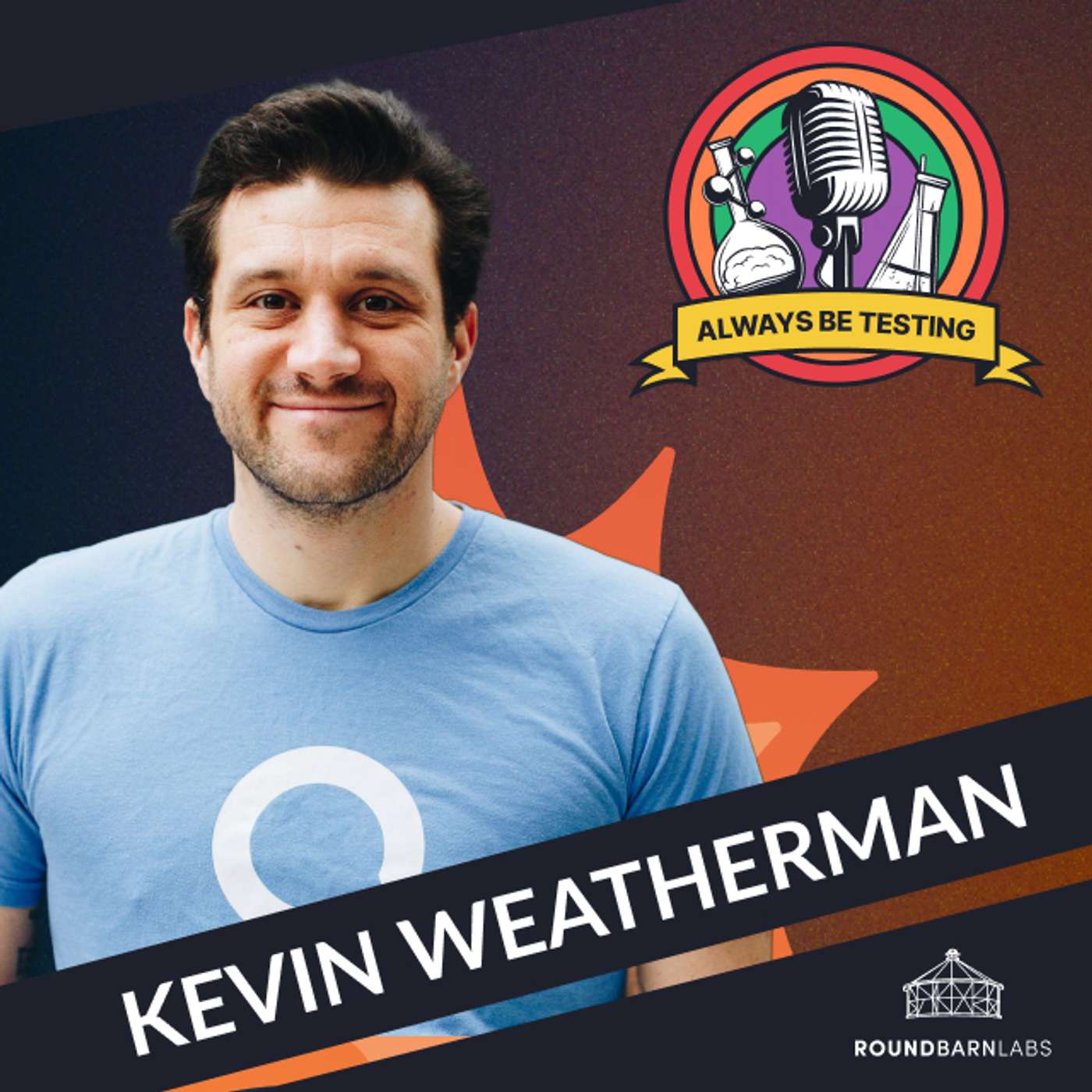
Always Be Testing
#96 From Startups to Streaming: Kevin Weatherman’s Playbook for AI-Driven Growth
00:42:37
Loading summary
Transcript97 lines
- [00:00]
Kevin Weatherman
Foreign.
- [00:08]
Ty DeGrange
Welcome to another episode of the Always Be Testing podcast. I'm your host Ty DeGrange and I am here with Kevin Weatherman. Kevin, what's up?
- [00:16]
Kevin Weatherman
It's a busy day here in New York City. Was glad to make it down to the studio here in Lower east side.
- [00:21]
Ty DeGrange
Beautiful. Love love having you on the podcast, but thank you for having me in your amazing studio.
- [00:27]
Kevin Weatherman
To be clear, it's not my amazing studio. I just know some people who are have this amazing studio and they rent it out to podcasts by the hour. So definitely check out IMI Studios down in Lower east side.
- [00:38]
Ty DeGrange
It's amazing. Now is there a little history to share? I'm picking up some of it. I didn't get the full story, but what's the story with this place?
- [00:47]
Kevin Weatherman
So there's a ton of history of like the records that were recorded here. Nas obviously just some amazing people. So it's pretty cool to see those recording artists on the wall. The way that this studio came into my life was through Pitch and Run, which is my running group. We had a pitch and runner named Yoshi who approached Nahal, my co founder of Pitch and Run and asked him, hey, we should start a podcast together. I have a studio down in Lower east side and you should start doing it. And so I was here about a month ago to do a podcast episode for Human Unicorn. And now like as you can see, like doing an in person episode is just so much better.
- [01:23]
Ty DeGrange
You pick up so many great cues and I have to say I've had the pleasure of being in some studios but this blows the others away. So this is amazing.
- [01:32]
Kevin Weatherman
We'll have to add this to the B roll at the end. This is not super interesting.
- [01:37]
Ty DeGrange
Super excited to talk to you, man. For those of you who don't know, Kevin's the co founder of Upscale AI they're running Performance Creative using AI to connect to do connected TV ads. It's kind of amazing. Tell us a little bit about what you're working on.
- [01:51]
Kevin Weatherman
Yeah, so about a year and a half ago we started the company. Since then we've raised five and a half million dollars. The original thesis was that performance streaming was a huge opportunity to go after you look at sort of the two by two of the advertising ecosystem and a sort of brand performance. And so we thought that there was an opportunity to really focus on turning streaming into a performance channel. My co founder and I, Herman, were at a company, Moloko, that was actually doing it for mobile app installs. And so we said, okay, is there an Opportunity to potentially do this for like another big industry. And we honed in on like the Shopify ecosystem of DTC brands that were scaling on Meta, but they wanted to find additional channels. And so we really started doing the research and figuring out if there was an opportunity to help with streaming for that. At the time, there was companies like Tatari and Mountain that are still very big in the space. And through that exercise, I actually got reintroduced to a fellow Adbrite colleague where Ty and I met each other, a guy named Mike Chang, who was at the time running product at Quick Frame, which got acquired by Mountain, which was focused on creative for streaming. And we honed in on the opportunity with AI to say, okay, what if we could drop the cost of creative down to zero and treat it like we do Meta, where brands are putting dozens, if not hundreds of ads into the machine learning system for streaming. And so that's sort of where we settled in on of, okay, the future of performance streaming is going to be a lot of creative. Creative that matches where the user is in their journey and then being able to both measure and drive performance outcomes, purchases specifically. So we're doing that today for Shopify brands. It's working extremely well. Scaled up, raised $4 million in January on top of the 1.5 that we raised a year and a half ago. And just scaling up the business, working with dozens of D2C brands now and trying to get to 50, 60 by this time at the end of the year.
- [03:57]
Ty DeGrange
Amazing. Yeah. And just like for context, there's a lot there to unpack. But Kevin has a wealth of knowledge, obviously. We met at a Sequoia backed startup called Adbrite, which feels like ages ago.
- [04:08]
Kevin Weatherman
Because it was ages ago. Like we're old 2025 -2007. That's a lot of years since we worked together.
- [04:19]
Ty DeGrange
Crazy. A lot has changed. But I think it's also interesting you have like stepping back and thinking about Kevin. Like you've been the first business hire at Mopub that got acquired by Twitter. You've been the first business hire at a lot of startups. You've launched your own businesses, you're an angel investor. So I think you bring a lot to the table in addition to what you're building now with upscale AI.
- [04:42]
Kevin Weatherman
Absolutely. So going all the way back, I think if you're listening to this podcast right now, one of the things that I would encourage you to think about the old saying, like, go skate to where the puck is going. When you look at each jump that I made along my career, there was that, like, moment in which I said, okay, three to five years from now, the world's going to look differently, and I want to build my next stage of my career journey to take advantage of what's going to happen three years from now. So I was working at a limo company in San Francisco, Bowers Limousine. Like, picking up the phone call, seeing if people wanted a limo to their high school prom, et cetera. And while working there, a guy named Ward called in head of operations at Google and said, I want to pay you to take all of the Google employees to work every day. So I pitched the business, went down, and met with Larry and Sergey. We had 16 buses that we brought down there. We signed a $16 million contract to take the Google employees from San Francisco to Mountain View every day on a Google shuttle. And when that bonus check cleared, I asked my banker friend, okay, what does Google actually sell? And he's like, ads. They sell ads. So Internet advertising startup San Francisco. A week later, Adbrite got funded, and I became the first hire after the Series A. So the point of that story is, like, I was seeing this company being able to afford $16 million just to take their employees to work every day. Okay, where is the world going? Online ads, fast forward. I'm at Adbrite. I'm working with publishers. They're saying, like, I need to work with more partners. I ended up almost co founding Rubicon and then going to work for Pubmatic. Fast forward, three years later, Fandango is one of my customers. They launch a mobile app. That mobile app drives 60% of sales for a new movie called Twil Light. And then that's when I got into mobile. And I think we're at a moment right now where AI is that thing where if you are not hands on keyboard, working with AI, it's just one of those moments, whether it is mobile or just the Internet in general, where you want to be seat in chair, hands on keyboard, playing with AI.
- [06:56]
Ty DeGrange
It's definitely inspiring us to think about that. It's impacting everything we do. It's a huge driver for everything. So I couldn't agree more. And I think you've done a. Obviously, you've done a really good job of being hustling, thoughtful and absorbing, learning and thinking about what is next. I think that's something that you've done really well. Speaking of that, obviously, the podcast, we talk a lot about learnings. And what did you get from this experiment? What did you get from that? Was there an moment that in Your career you feel is notable around the testing concept. In various roles you've had, you've seen all kinds of interesting things. Was there some that were aha. Moments that are kind of notable that you want to share around the like testing or campaign or marketing side of things?
- [07:46]
Kevin Weatherman
Yeah. So I would say as a business person, figuring out how to understand how tests even work is bar none like something that you have to learn. So I remember early days of Pubmatic. We would create structured 30 day tests to test PubMatic versus ADMLD. We would work with the publisher to set up a round robin on every impression so that one was going to one competitor, one was going to competitor B and figure out who would make more money. Now we ended up winning a lot of those tests and a lot of it was not only when the test got started, being able to set it up so that it was truly 5050 in terms of the traffic that was being received et ceter. But then when the test went live, there was an all hands on deck moment across the team of like, what could we be doing more in order to drive more performance? So at the time, things like changing price floors, approaching our demand partners, there was just a lot of things that we could go to a design the test to be structurally fair from the beginning and then once the test went live, syncing internally and saying what more could we be doing to drive better performance constantly. And that was 15 years ago. And to this day we are doing incrementality tests with companies like Houzz and we're doing all of this a B testing. Every time a company wants to work with us, they want to figure out if this creative performs better than that creative. So I think just like a, learning how to test is a skill that you need to learn. If you want to become a chef, you have to learn knife skills. If you want to be in performance advertising, you have to learn how to test things in general. And then I think the flavor of testing is going to change all over the place. But I think as a student of performance, just knowing what are the different ways that somebody could test something is super important.
- [09:43]
Ty DeGrange
You kind of alluded to those bake offs and those A B tests in the early days 15 years ago. How different do you think that is now for the content sites out there that are trying to monetize? I know that's not what your primary focus is with upscale, but I'm curious to know like how has that world changed from your perspective? Because we deal with it a little bit on our side. Too.
- [10:03]
Kevin Weatherman
Yeah. I would say that tactically speaking, it went from a world in which most people didn't know how to test to now people in the room have opinions on which test is a better, more accurate way to test something. Do I show all the same impressions to one user? Do I round robin between users? Even with things like CRO, what's the best way to design the test? All of those things I would bucket into the world of everyone is speaking fluent testing. And now it's a matter of what's the best designing the right test for the right goal that you're trying to achieve. So whether it is driving revenue per click or figuring out which users are the best users or which in our case, which creative is the best creative, designing the right test framework is probably like the biggest thing you have to dive into.
- [10:55]
Ty DeGrange
Yeah. And I think it's amazing that so much of this stuff has become available more readily usable from MMM solutions to the multi touch solutions to what IPscale is building with, with creative or connected TV. And I think you're spot on. It's like, how do you give it the best inputs? Because without that you're kind of in trouble. Right.
- [11:16]
Kevin Weatherman
Flying blind.
- [11:17]
Ty DeGrange
Yeah.
- [11:17]
Kevin Weatherman
Even when we started this company, people weren't doing geo incrementality. And I would say like, not only has Meta come out and say like geo incrementality is best practices, YouTube has come out and said geo incrementality is best practices. But between companies like workmagic and House and now Polar, all of these companies have come out. And the transition I would say that I've seen from multi touch to now Geo incrementality with multi touch holdout tests, you mean? Yeah. Where they're like only running on 40% of or 60% of DMAs and holding out 40. Yeah. I think that has become pretty ubiquitous among advertisers that we work with in the E commerce space. And obviously it helps that Meta is on stage at their biggest performance event saying like incrementality is the best way for you to know if this is working or it's not.
- [12:07]
Ty DeGrange
And a lot of third parties and data science folks and measurement folks who are cooperating that and the documentation and the science backs it to say we don't want, let's get to less correlation and more causality.
- [12:18]
Kevin Weatherman
I mean not to call out your name, but we went from a world of like single tests to a world of always be tested.
- [12:26]
Ty DeGrange
Well done. Well done, sir. That's going to make the sound bite, I think. No, it's Amazing. And I think that one of the things I was fascinated by is how connected TV can be so measurable. I think initially people associate TV with not measurable and it's quite the contrary. I'd love to maybe hear you expound on that since you are investing so much in connected tv.
- [12:50]
Kevin Weatherman
Yeah, I think there's the like measure twice, cut once rule that also applies here in the sense that measurement isn't about one way of measuring. If you're always testing, not only are you in a world where you are, in the case of most of our partners that work with a vendor like Houzzer WorkMagic, they'll run three simultaneous tests. Like they have a calendar of tests that are always rolling. What worked this month might not work next month. So the framework of always be testing is now like baked into these businesses. In terms of ctv, there's basically three levers that you can pull. So there's time of day, there's geo and then there's IP address. The fourth is sort of like one that is happening quite a bit, but not everyone else has access to it. Which would be like when a purchase event happens and you get a hashtag email, you can then sync back to logged in users that are logged into, let's say Hulu or any of these logged in streaming services. So that is a fourth way that people are able to measure it. But at the end of the day, like some of the least sophisticated advertisers, and this is true of like linear ten years ago, you could just run an ad for three hours a day and be able to see, okay, what happens if I run an ad nationwide for three hours and measure that impact. Yeah, the geo incrementality has been able to allow companies to say, okay, I want to run in these 25 cities. And let's see the impact in these 25 cities versus the other 25 cities where we're not running ads. So the geo incrementality gives you like long term understanding. And then where we're focused on training the machines is down to the IP address. So the television that's on your wall is connected to the router that's at your house, which is also connected to your phone and your laptop. So when you're watching Tubi or Pluto and you see a branch furniture ad, it has a coupon code on it. You then go to your phone or your laptop and you actually make the purchase of a branch furniture chair either if you don't use the coupon code most of the time when it's a single household. We're able to identify that that television four hours later or three hours later, the same router that was connected to the TV then went and made a purchase. So that's a pretty easy way to be able to connect the dots. Now, does it catch everything? No. IOS blows away IP on a lot of traffic. If it's coming inside of like a meta browser or other places, a lot of that gets. Stuff gets knocked away. So that's where, like, I can measure the direct part of it, which is very similar to an MTA sort of last click. But then I can also understand globally what's happening in the cities that I'm running those creatives in.
- [15:44]
Ty DeGrange
Yeah, that's really interesting. Sort of thinking through a related topic we like it's thrown around of like, oh, this is the best practice. You gotta do this. Especially when it comes to AI generated ads. With so much new information coming out about what's working, what's not, are they performing versus non AI, Is there like a best practice where you're like, yeah, that needs to be like kind of rethought a little bit.
- [16:07]
Kevin Weatherman
The reality is we're in a testing mode right now. At the end of the day, what didn't work a year ago works today. So I'll give you a perfect example. We were playing around with 11 labs a year ago, and most of our advertisers would actually say, I don't like the quality of this voiceover. Can we hire a voice actor? So more than half of the ads that we made 12 months ago required a voice actor. Today, zero of our creative that are actively running have a voice actor.
- [16:35]
Ty DeGrange
So it's good enough.
- [16:36]
Kevin Weatherman
The AI is better than humans.
- [16:38]
Ty DeGrange
Wow.
- [16:39]
Kevin Weatherman
Because they can enunciate great. In 11 labs, you can go in there and change inflection and tone. They're customizing the voice based on if they're selling something or not. All of this is now being incorporated. And I would say that in a lot of cases, other than maybe like the top 0.1% of like audiobook voice actors, most AI now the AI coming out of 11 labs anyways is better than what you can get out of out of voice actors. So that is sort of that exponential improvement that we're seeing.
- [17:11]
Ty DeGrange
Wow.
- [17:12]
Kevin Weatherman
A year ago, like, we were good at writing scripts in terms of the LLMs. Today, they're amazing at writing scripts. So the ability for any brand, whether it is for running ads on meta or running ads anywhere, the ability for you to create a very complex prompt about your company about your brand brand guide, feed it into any of the LLMs and say, give me 20 ad ideas. Remember that the LLMs are good at giving you average responses, like you're getting the average response of the Internet. And So you'll get 20 average creatives. And where I think the sort of human plus machine comes into play when all this AI stuff is having the human be the editor to elevate the three ideas that were good ones and then expound on those three ideas, draft up multiple versions of scripts for those three concepts and then turn them into creative. Right now at Upscale, we aren't using any video that is generated by AI. It's very close. I mean we're talking a month or two, maybe a quarter or two away from being able to take an image of a chair and turn it into a video of a chair. But we're very close. Especially if you're a brand who cares about like pixel perfect assets for a television that's 65 inches across. The ad needs to look good on that format. And so we're close, but we're not quite there yet. I mean everyone's probably seen some of the creative that have come from some of these companies, like the dentist that did the gorilla ad. Like those are, those are cute and fun. Yeah, I just, a lot of brands are going to say like, it's not at the quality bar of something that I would be excited to pay in a lot of cases, millions of dollars over the next X number of months to be running on television.
- [19:03]
Ty DeGrange
Yeah, no, that makes perfect sense. There's so much to kind of go through there. I think that the AI piece is kind of insane of just like what's happening, the learnings, the speed of it. I mean you kind of alluded to like, okay, in a month this is going to happen. Like where do you think we're going to be in a year?
- [19:21]
Kevin Weatherman
I don't know where we're going to be in a year. I think the cool thing is not about trying to predict how these models get better. The cool thing is about playing with them. I remember being one of the first people that I knew from the Adbrite crew that we know that got into mobile and I was like one of the first people who was downloading these mobile apps and getting pre release versions of draw something and things like that. And so I was playing with these apps before anyone else had access to them. And I think the same remains true for AI. Like it doesn't matter what AI is capable of. I think you as A employee, as a team member, as a founder, as an entrepreneur. Owe it to yourself to like play with all of these tools just like a kid. Like this is fun stuff. This is Oregon Trail, back when I was in elementary school. Like this is a game opportunity. And yes, we can have the, you know, what can I do to use this in a business sense framework to it, but at the end of the day we're playing with tools where we don't know what they're capable of.
- [20:24]
Ty DeGrange
Yeah.
- [20:25]
Kevin Weatherman
Do I think we'll have like fully, like I do a prompt and make a television commercial? Absolutely. Like in the next year and a half there will be, whether it's VO3 or whatever, OpenAI's version 5. There will be ads that are made that are completely devoid of original assets from the brand, that are great, high quality ads that you might not be able to tell a difference on.
- [20:50]
Ty DeGrange
Amazing. You kind of alluded to the game and like playing and play. And I think there's been a lot of conversation from investors and early stage startups about how the new great big things coming in business and in venture look like games. You're an angel investor. Give us a little bit of it about like how you think about investing. What are you looking for when you have done things that have worked or not? I just love to know more about how you think about that.
- [21:18]
Kevin Weatherman
Every nine to 12 months I'll write like a thesis on what I think, how things are going to change. Four or five years ago I wrote a thesis on Shopify. Like I thought the ecosystem was going to be huge. I had already invested in Attentive. I ended up making an additional investment in Crystal as well as Ghost. And so I think from an angel, I'm going back to the beginning. Go to where the puck is going. Where do I think the world's going to be in three to five years? And write checks today on founders who are going to be building the future versions of this world. So that gets me really excited. In the questions that you sent me, one of the things you ask was like, what are you looking for in the founder? And the easiest answer to that is, if I wasn't building upscale, would I beg that person to go work at their company or work for them? And that's a proxy for like, is this person a 10x founder? So what goes into being a 10x founder? So vision, ability to articulate a world that exists three years from now, five years from now, that they can go build two acquiring talent. So people like myself, people that are great at Their jobs, want to go work with that person. And then third, ability to fundraise. So the storytelling and the acquiring talent only makes sense if you can actually pay them and build a company around it. And I think there are some great people out there that might have two out of three, but don't have all three. And the checks that I've written into founders like D. Murthy, like Brian Long that are and having worked with Jim Payne, those are the type of founders that really do have that sort of 10x founder ethos in them and they're able to sell the vision, build a team and then fundraise against it.
- [23:11]
Ty DeGrange
Amazing. I love that. I love having that trifecta for you to actually do that. You've had some good recommendations on resources of like oh man, you got to read this or you got to check out this. What's something you can share with the audience that you would recommend to aspiring entrepreneurs or folks in the audience?
- [23:30]
Kevin Weatherman
Well, number one is just be curious. Like I, I can't really reiterate enough. You get the opportunity to play with software and, and do all of these things. So I think being curious is just one of those things that separated out me from all the other people who started the their career at the same time as me. Like what was one of the big differences? Like I was paying attention to little things because I was curious about what was going on in the world, how companies were built. When I joined Adbrite, the first All Hands, I was like how did Adbrite get funded? What's that process? And Philip Kaplan walked us through like this is what angel investing is like. So be Curious is number one in terms of just like actual day to day content. So I always go to High output Management is my like the book I go to where it's just like these lessons I have carried with me throughout my entire career. And then I think like startups are not meant to be easy. Like you're signing up for a job where 90% of the people who do this fail. So how do you become part of that 10%? And I think Ben Horowitz's Hard thing about Hard Things is just like a really good field guide for what it's like to be a founder who is trying to be part of the 10% that succeeded.
- [24:45]
Ty DeGrange
Yeah, no, it's. Those are phenomenal. I think those have made the RBL reading list. And I think Andy Groves High Alpine Management was one of the first. I think you recommended to me specifically when I was launching Round Barn Labs. So tip of the cap to you for that. Appreciate it. Of course, is there a tool that you're looking at maybe in the B2B SaaS realm, where you're just like, what is going on here we should be checking out?
- [25:07]
Kevin Weatherman
Yeah, Clay's spreadsheets on steroids. So clay.com, they recently raised an additional $100 million in funding. It's one of those tools that, as somebody who's been an sdr, who's been an accountant executive, who's been a director of sales, who's been a VP of sales, who's been a CRO, everything that I can do in each one of those jobs manually, I can then teach Clay to automate. And so whether it is like I posted on my LinkedIn or I did ICP research. So is this an ideal customer profile based on. If yes, then go and find the right CEO, founder, cmo, whatever. It may be. Like, the ability to, like, string on a series of events into what I would have had an SDR doing literally, like four years ago. If I had built this company four years ago, that is just being done automatically. When someone books a call on my calendly, it'll. Is this a Shopify store? How much money do they make? Who's the founding team? How long have they been around? What are their investors? Do they run streaming? Right now, all of those are like checks that you can either use their integrations or you can just straight call OpenAI to run a web query to answer those questions. And I think the combination of either I can use a direct integration with the vendor, whether it is built with or store leads to, like, understand what technology is being used, where it's like an API call or just calling the open web with a query to OpenAI or perplexity or Claude. The ability to now do either one of those things to me gives Clay just this infinite ability to scale into, like, anything I can imagine. Like, I wish a salesperson could do X. I wish before every meeting, I got a full dossier of the person I was meeting with. Like, every time you book a podcast guest, it can give you a full history of them. It can draft everything, like, all the things that you're manually putting into these LLMs and getting answers back inside of Clay. You can automate it.
- [27:17]
Ty DeGrange
Love it, Huge plug. Maybe they'll get a little link in the show notes, but he nailed that. It's amazing what we're starting to be able to pull from these tools. It's insane. So what's like a commonly held best practice in marketing that you think people need to reconsider and question.
- [27:34]
Kevin Weatherman
Yeah, I think there's obviously the big difference between brand and performance has always been one of those things where you kind of have to pick one or the other. And I think there's a growing sentiment that even if you're doing brand performance still has to be at the heart of it. And so what I've had conversations with big, big advertisers, we're talking hundreds of millions of dollars in ad budgets and they made one change to their creative requirements was they had to say the name of the brand three times in any commercial. Just that one chance. I mean we're talking like huge hundreds of millions of dollars in ad spend. Going from a world where you do a 28 second ad that whispers the name of the brand at the end to the exact same creative, but you say the name of the brand at the beginning, somewhere in the middle and somewhere at the end proved to work significant change in performance on a multi tens of millions of dollars of ad campaign. And so I think the world in which in order for you to run a brand campaign, you can't even like say your brand's name. You can't even have your brands involved, involved in it. You can't be trying to get someone to buy something. I think that the commonly misconho sell, the commonly misconceived notion is that in order to do brand, you can't think about performance. And I think at the end of the day, every time you're paying for media or you're making content, at the end of the day you're building a company that sells products.
- [29:06]
Ty DeGrange
Yeah.
- [29:07]
Kevin Weatherman
And at the end of the day, when you think about how do I best convey the awesomeness of my product to get consumers to buy it? Part of that is saying your brand name multiple times and so incorporating that as like a requirement in all of your creatives. It's just one of those things that I think overnight you'll start seeing an increase in performance.
- [29:31]
Ty DeGrange
I love that. I love its simplicity. How many times as a direct response marketer have we watched an ad on radio or TV or Billboard? And it's like, wait, you, why don't you tell me what that is? Or why don't you say it again? It's like it makes so much sense.
- [29:44]
Kevin Weatherman
Oftentimes you'll see a great creative and you're trying to figure out what the ad is. And by the time the 30 seconds are over, you're like, that was a great ad, but I don't know for what company.
- [29:54]
Ty DeGrange
Yeah, yeah, exactly. That's such a good learning and in spirit of the pod with the testing, it's fantastic. Obviously you guys are building something exciting with upscale AI. You've built some amazing startups, you've been part of some great startups. When you look to bring on good people, you look to bring on and hire. What are some of the things you're looking for?
- [30:17]
Kevin Weatherman
So this answer has changed actually quite a bit in the last year. And I think part of that is because there's starting to be a huge dichotomy between the people who are AI curious and the people who are Luddites is probably like the right term where they're like anti AI and they look at AI as like taking their job as opposed to AI as a force multiplier. The same type of people who in the late 90s were like, I'm never going to use email. The same people who said, I don't want to run my business off Excel, I don't want to learn how to use these tools. I think AI is becoming one of those ubiquitous things like for the job you have to know how to do email, you have to know how to use Slack, you have to know how to use Google Docs and you have to know how to use AI. It's just becoming one of those things that went from optional to required to now something that we interview for.
- [31:13]
Ty DeGrange
Yeah.
- [31:14]
Kevin Weatherman
So we ask in interviews, what's the last tool you, you used in terms of AI? How did you use it? Walk me through a project that you built using AI, leveraging these modern tools. And I think the way that someone answers that question tells me what I need to know in terms of like, is this the type of person who, when they have a problem in the day to day goings on of their job, are they going to reach out to see if AI can solve that problem for them or collaborate with AI to solve it? Or are they going to say like, I don't know how to do this, so I'm not going to work on it. And I think we're getting to the world where it's becoming one of those things that those people who are leaning in and diving into these tools and products and using them as a way to better themselves, as a way to move faster, as a way to automate the boring stuff out of their job. We're just in a world today where the people who are leaning in on AI are going to experience career growth, they're going to become the future managers, they're going to be the people that excel in their job and the people who aren't are going to be left behind. So I think the people who are leaning in on AI are the people that I'm looking for across the company when it comes to hiring. So whether it is engineering, whether it is marketing, whether it's, whether it is sales, everybody at these AI native companies is sort of expected to use the tools, play around with the tools when something new comes out, experiment with it. It's just becoming a big part of the job.
- [32:50]
Ty DeGrange
I love it. I couldn't agree more. It's just become a required tool in the arsenal that you need to have. So that's fantastic.
- [32:58]
Kevin Weatherman
Yeah. Question for you. I think as somebody who's in the sort of like affiliate space and what have you, you know, we get approached a lot by brands that are saying to us like what are best practices in terms of especially like how do I go about taking a good brand that's doing 10, 20, 30 million in revenue? And I like, I don't have a process for engaging with influencers. I don't have a process for like tracking all of them. I think for my customers in particular, Shopify based like DTC brands who are paying these influencers for content.
- [33:36]
Ty DeGrange
Yeah.
- [33:37]
Kevin Weatherman
Then transitioning them from a someone who's making ads for them to someone who's driving sales I think is one of the biggest things that a lot of our customers are struggling with.
- [33:47]
Ty DeGrange
Yeah, it's, I often tell people it's one of the most misunderstood levers. It's, it's oftentimes the most underrated lever. It's essentially a multichannel marketing lever. If you think about affiliate and influencer in similar fashion for a DTC brand because some things that people don't realize is that you've got influencer which is a huge opportunity. But then within the realm of affiliate there's like 15 different flavors of affiliate that people don't always realize and they can kind of like what you were alluding to. I'm going to talk about this tomorrow in my talk. Brand and doctor can kind of come together for those things. And so that's something to think about. I would also say that from a tracking perspective there's so many different ways to get the foundations right and there's so many ways for it to go wrong. People are not setting up basics like UTMs. People are sometimes surprising their partners by saying hey, we're going to rug pull your deal that you had that we're giving you a commission on or they come in and they think like, hey, we're just going to do a commission of 10% and think that's it, set it and forget it. You can imagine that doesn't work. You're dealing with humans, you're dealing with dynamic follower accounts and performance and network. So there's a lot to it. We aim to make it simpler. Right. We make it a little easier and help people navigate that. And so we try to boil it down to let us take this off your plate, let us get this flywheel moving for you. But it's a really fascinating challenge.
- [35:16]
Kevin Weatherman
And I would say from the brands that we're talking to, the one thing that you have to get right sounds like that measurement piece.
- [35:24]
Ty DeGrange
Yeah.
- [35:25]
Kevin Weatherman
Because these brands, they're working with a hundred influencers at least every month and they're figuring out through whitelisting which are the 5 or 10 that are driving purchases from paid. And so that opportunity to then transition them from getting a CPM based on what they're spending in terms of paid media into a percentage of revenue that they're driving for the brand is that unlock that I think a lot of brands struggle with. And it's sort of like, how do I give credit to this person who is posting a lot, talking about my brand, sending people to my website, using a specific coupon code, et cetera.
- [36:02]
Ty DeGrange
Yeah. And it's, it's fascinating because the, the percent that do it, right. It's a shockingly low percent. I mean, even connected TV is now one of the players in the affiliate ecosystem. Going back to your measurement piece, you can look at some of these tooling and get multi touch views to see where these folks are interacting. Yet the number of brands and D2C brands included that still pay on the last click only and think they're done. It's wild.
- [36:32]
Kevin Weatherman
And a big reason is it's just the easiest thing to measure. And when you go back to the framework of always be testing, it's one of those things where as a brand there's so much distraction out there in terms of how to go about measuring things. And when you start talking about multi touch, it's like, well, what percentage credit do I now give somebody who sent me a user 3 weeks ago who came to my site, didn't purchase and then I show them a different influencer yesterday, they come back and purchase. So it's really a struggle.
- [37:04]
Ty DeGrange
It is. And I think like affiliate and influencer, I'm kind of using the similar theme have come a long way. Obviously influencer has been Part of that tailwind. But there's just so much opportunity to educate and improve the entire space because it has had a bit of a checkered past. And I think that it's understandable to be like, well, it's too hard. I'm not going to do it or I'm going to do piecemeal here and there. So it's incumbent upon our industry folks like ourselves to kind of like get people what they need, keep it simple, prioritize so that, hey, focus on this part of your influencer marketing plan. Focus on this goal. Can you get up to that 10% of your revenue? Are you using coupon codes or using a tracking mechanism like Shopify provides or other providers out there? So baby step it out and kind of.
- [37:49]
Kevin Weatherman
And for us, like ideal customers, probably spending between 100 and 200k a month on Meta. Is there a number in terms of like meta spend or like overall marketing budget where it's sort of like, really makes sense? I mean, tools have a fixed cost in cases and things like that. So is there a moment in which I'm talking to these D2C brands when they hit a certain amount, like how to invest in affiliate programs, how to do all of that?
- [38:16]
Ty DeGrange
I think it's an interesting mix of you want to get to that product market fit phase, you want to see that Meta and Google, maybe some other investments working well from a payback period. So the unit economics makes sense. But ultimately being able to kind of introduce a new channel early on, enough is really important. They're getting, I think that for smaller D2C brands, looking at 20k a month, 25amonth, 35amonth is.
- [38:42]
Kevin Weatherman
Is not just on affiliate.
- [38:43]
Ty DeGrange
Yeah.
- [38:44]
Kevin Weatherman
So as a percentage of overall spend, probably somewhere between 10 and 20% of overall spend.
- [38:50]
Ty DeGrange
Yeah, exactly.
- [38:50]
Kevin Weatherman
So they're kind of in that similar. Like if I'm spending 100k a month on Meta and I put 10k to affiliate, if I'm spending 200k on Meta, I'm spending 20k on affiliate. Yeah, I think that lines up.
- [39:00]
Ty DeGrange
Yeah, absolutely. Great question. What's something that people might not know about you?
- [39:05]
Kevin Weatherman
Yeah. So I shared this on a previous podcast. But like I was asked like, what's the biggest moment in your life? That was like a sliding door moment. And you knew. You're one of the few people who knew me when I still drank.
- [39:17]
Ty DeGrange
Yeah.
- [39:17]
Kevin Weatherman
And so a lot of people don't know that I'm sober. And so that's just one thing that a lot of people don't know about. Me that at 28 years old, when I was starting a new job at Pubmatic and I got in a bar fight the night before and woke up from a blackout drunk the night before. I called a friend and said, I don't ever want to drink again. Went to AA meetings for 500 straight days in San Francisco.
- [39:43]
Ty DeGrange
Wow.
- [39:43]
Kevin Weatherman
And just committed myself to saying, okay, I don't want to drink anymore. And the version of me that exists today versus the version of me that would have existed had I kept drinking is so different. So that's something a lot of people don't know about me. And it's a big part of my story.
- [40:00]
Ty DeGrange
It's awesome, man. And then the things you've achieved. It's funny to see a lot of people, obviously, now that I'm in my mid-40s or probably not far, 43, so.
- [40:10]
Kevin Weatherman
It'S pretty close to mid.
- [40:13]
Ty DeGrange
Got a couple of years on you. But we're at that age now where a lot of our cohorts and peers are already starting to drink less. You've got this previous generation that are drinking way less. I'm, like, half joking with friends, like, hey, it's Health and Wellness Week. I'm in a marketing conference. There's booze everywhere. But, like, I'm getting my morning workouts in. I'm getting.
- [40:31]
Kevin Weatherman
My secret is nobody cares if you're not drinking.
- [40:35]
Ty DeGrange
No.
- [40:35]
Kevin Weatherman
And that was one of the really big lessons. Like, you thought that everyone cared. Oh, what are you drinking? Oh, you're not drinking today. The other thing is the options have changed. When I was getting sober, there was oduls, and that was it. And now we've got Athletic Brew. I mean, one of your questions.
- [40:50]
Ty DeGrange
I've been drinking Athletic Brew.
- [40:51]
Kevin Weatherman
Athletic Brew is amazing. I went to a hockey game a couple months ago. I had Athletic Brew at the game. I feel like I'm drinking at the game.
- [40:59]
Ty DeGrange
Yeah.
- [40:59]
Kevin Weatherman
And so, like, the options for sobriety have really changed quite a bit.
- [41:02]
Ty DeGrange
It's awesome.
- [41:03]
Kevin Weatherman
It's. It's been cool.
- [41:04]
Ty DeGrange
It's a testament, man. You get such energy and that curiosity and that drive, and it's, like, worked for you. And it's just. It's amazing all the cool stuff you've achieved. So it's a testament, and it's a good learning for people out there that are learning from other people and trying to get better. Amazing. I've got to say, this has been what we're now. Episode 96. Kevin is dropping knowledge bombs. We get to do it live, in person. It's awesome. Thank you. For folks that want to learn more about you, where do they find you? What's the deal? What do you suggest?
- [41:33]
Kevin Weatherman
Yeah. So if you're in New York, come run with me. I have run club that I co founded with Nahal from ENIAC called Pitch and Run. We run six days a week in New York. So Monday, Friday in Chelsea, Tuesday, Prospect Park, Wednesday, Williamsburg and Central park, and Thursday in Tribeca. We're also in 15 other cities, so it's become something where we've gone global. We're in London and Dublin now, as well as 13 stateside cities. Congrats. So it's a pretty cool thing. I encourage you to come run with me as you'll find out if you do. Follow me. I'm a big marathoner, so about to ramp up training for the New York City Marathon. And then I'm on LinkedIn. Kevin Weatherman. I'm on Socials as Kevin runs NYC.
- [42:15]
Ty DeGrange
Maybe I'll come join you tomorrow for a little run.
- [42:18]
Kevin Weatherman
You should.
- [42:19]
Ty DeGrange
Amazing. Kevin Weatherman, everyone. Thank you. Great episode. See you, everybody.
- [42:24]
Kevin Weatherman
Cheers.