Loading summary
Transcript98 lines
- [00:00]
Jules Boykoff
Mitt Romney said one time in a candid moment, he said the Olympics are not really a money making opportunity. And what I think he meant was for cities and for individuals in those cities, everyday people in those cities. In fact, every single Olympics going back to 1960 has had cost overruns. Every single Olympics. And that tends to fall on the backs of taxpayers.
- [00:25]
Bob Crawford
You've reached American History Hotline. You ask the questions, we get the answers. Leave a message. Hey there, American history hotliners. Bob Crawford here. Thrilled to be joining you again for another episode of American History Hotline. It's the show where you ask the questions. And the best way to get us a question is to record a video or a voice memo on your phone and email it to AmericanHistoryHotlinemail.com that's AmericanHistoryHotlinemail.com okay, today's question is about the Olympics. Here to help me answer this question today is Jules Boykoff, an author who has written numerous books on the Olympics, including Power A Political History of the Olympics. Jules, thanks for joining me today.
- [01:16]
Jules Boykoff
My pleasure, Bob.
- [01:18]
Bob Crawford
Okay, Jules, here's the question we were hoping you could help us answer. It comes from Lucy in West Virginia. She says, I remember basketball player Yao Ming saying we should try to keep politics out of sports. This was in the 2022 Winter Olympics in Beijing. But I feel like there's always been political activism wrapped in the Olympics. Have the Olympics been a successful stage for political issues? Jules, I love this question and I want to dive in. Have political acts at the Olympics led to action or change?
- [01:59]
Jules Boykoff
Wow, there's a lot going on in that. Really interesting question from your listener there. And I would start by just saying good on you for recognizing the fact that the Olympics are, in fact, political, because the group that oversees the Olympics, the International Olympic Committee, spends a lot of time telling us that, in fact, they're not. They've done this from the very beginning. There was a plucky baron by the name of Baron Pierre de Coubertin, an aristocratic Frenchman who started the Olympics in 1890. And one of his mantras was the Olympics should not be political. It started at the beginning and it's come all the way through to the modern era where recent heads of the International Olympic Committee have said, we are a neutral body that does not engage in politics. So I can see why there's a little bit of confusion out there when some people say the Olympics aren't political political. But if you look at the political history of the Olympics, you look at athlete activists who've taken political stands. You've looked at who've been excluded from the Olympics, who is included in the Olympics. Those are all political. So you know, I'm a political scientist and there's another political scientist from history named Harold Lasswell, and he said that as a sort of little way of thinking about politics. It's about who gets what, where and when. And basically, if you start thinking about the Olympics through that lens, you can see that there's a lot going on that's political.
- [03:22]
Lowe's Announcer
At Lowe's, get up to 35% off select major appliances plus members get free delivery, install and more. When you spend $2,500 on select major appliances, Lowe's we help you save valid through 225 while supplies last selection varies by location. Excludes Massachusetts, Maryland, Wisconsin, New Jersey, Florida. Loyalty programs subject to terms and conditions. Visit Lowes.com terms for details. Subject to change.
- [03:46]
Bob Crawford
Visit your nearby Lowes on Colorado street in Kennewick.
- [03:50]
Bowen Yang
I'm Bowen Yang.
- [03:52]
Matt Rogers
And I'm Matt Rogers.
- [03:53]
Bowen Yang
During this season of the Two Guys Five Rings podcast in the lead up to The Milan Cortina 2026 Winter Olympic Games, we've been joined by some of our friends.
- [04:02]
Matt Rogers
Hi Bud.
- [04:03]
Jules Boykoff
Hi Matt.
- [04:04]
Matt Rogers
Hey Elmo.
- [04:05]
Jules Boykoff
Hey Matt.
- [04:06]
Hans Charles
Hey Bowen.
- [04:07]
Jules Boykoff
Hi Cookie. Hi.
- [04:09]
Matt Rogers
Now the winner Olympic Games are underway and we are in Italy to get.
- [04:12]
Jules Boykoff
Give you experiences from our hearts to your ears.
- [04:16]
Matt Rogers
Listen to Two Guys Five Rings on the iHeartRadio app, Apple Podcasts or wherever you get your podcasts.
- [04:25]
Bowen Yang
1969 Malcolm and Martin are gone. America is in crisis and at Morehouse College the students make their move.
- [04:32]
Hans Charles
These students, including a young Samuel L. Jackson locked up. The members of the board of trustees, including Martin Luther King Sr. It's the true story of protests and rebellion in black American history that you'll never forget. I'm Hans Charles.
- [04:47]
Bowen Yang
Our menelik Lumumba.
- [04:48]
Hans Charles
Listen to the a Building on the iHeartRadio app, Apple Podcasts or wherever you get your podcasts.
- [04:55]
WSECU Announcer
WSECU isn't just one of Washington's best credit unions. We're a Forbes best in state five years running.
- [05:01]
Nyx Underwear Announcer
Why?
- [05:02]
WSECU Announcer
Because we put you first. Lower fees, early paydays, financial guidance and service status. Second to none. As a member owned cooperative, we love Washington as much as you do. From the Olympic mountains to the rolling Palouse. Join us and discover how much we care about your financial well being. Because what we really do best is invest in you. Visit wsecu.org today to learn more. Washington let's credit union.
- [05:26]
Bob Crawford
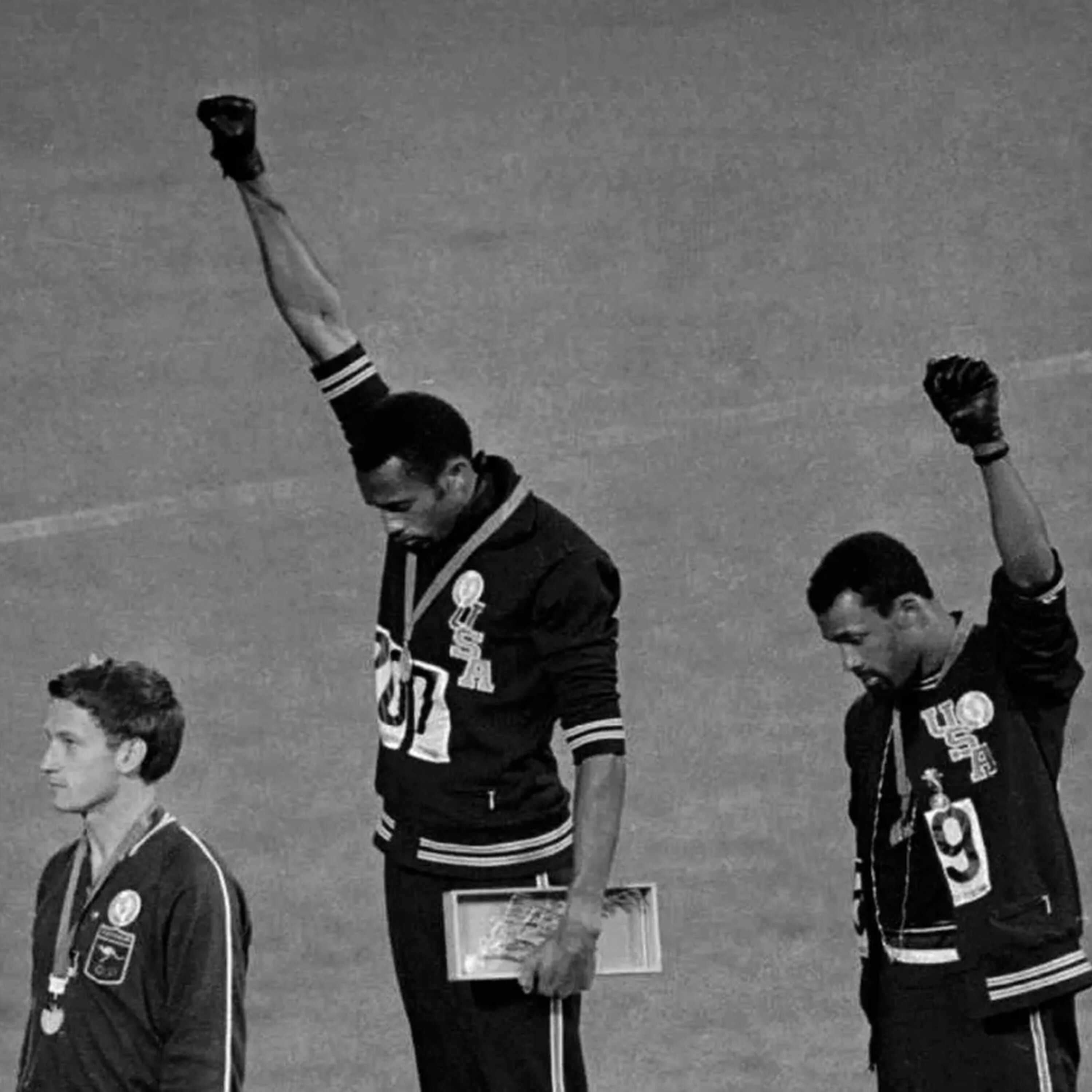
There's a lot of examples I Want to get to one that always comes to my mind is the iconic image of were they all Americans? It was at 68, with their fist raised in the air. Talk about that moment and how that could be representative of this idea of political activism in the Olympics.
- [05:49]
Jules Boykoff
So 1968 Olympics, iconic moment of political activism on the medal stand. Tommy Smith and John Carlos, who'd gotten gold and bronze in the 200, thrust their black glove fists into the Mexico City sky, and mayhem broke from there. You know, interesting story. The third person on the medal stand was a guy named Peter Norman, a white Australian sprinter who managed to get the silver medal. And he wore a button that said OPHR in solidarity. OPHR stood for Olympic Project for Human Rights. Smith and Carlos were part of this group, the Olympic Project for Human Rights, which was part of the bigger civil rights movement. And I think that actually, Bob, raises a really important point about when political activism tends to pop up at the Olympics or elsewhere. It tends to be where you have moments where you have thriving political and social movements in the streets that make space for athletes to become athlete activists. But that moment from 1968, it wasn't just sort of one of these iconic moments of sports history. It's actually an iconic moment of world history. If you poke your head into various bedrooms around the entire globe, you'll see a poster from that event up. And there were so many interesting moving parts from there. One was the fact that the US Sprinter Wiomi Taiyous, she's an incredible sprinter with her own incredible record of gold medals. She actually protested, too. She didn't wear the standard issue USA white shorts. She actually wore black shorts in protest when she ran. And when she and her Comrades won the 4x100 relay, they dedicated their medals to Smith and Carlos. So those are really important things that happen that most people don't even know about. But, I mean, the Olympic history is just rippling with examples of athletes who've been willing to stand up and demonstrate, A, they have political beliefs, they're humans that care about the world, and B, they don't necessarily care about the power brokers of sport who might like to silence them.
- [07:55]
Bob Crawford
So. So give me a few other examples.
- [07:58]
Jules Boykoff
Yeah, I mean, we can go way back in history. Might be fun. I mean, the next.
- [08:01]
Bob Crawford
Let's do that. Like, let's. Let's go a bit way back. Yeah.
- [08:04]
Jules Boykoff
One of my favorites has to be 1906, the Athens Olympics in 1906, where a guy named Peter O', Connor, he was an ardent Irishman, but Ireland was being Ruled by Westminster at the time. And so he had to participate under Great Britain's flag. As an Irish ardent guy, he was not happy about this. He actually wore this special garment that had a little shamrock on it to make it clear he was from Ireland. But it gets better, Bob. So he wins a medal. The Union Jack gets hoisted up the flagpole. What does Peter O'Connor do? He runs over to the flagpole, he shimmies up the flagpole, pulls down the Union Jack, and he's got his own flag. Erin Gobrog, Ireland forever. And. And he's got two of his buddies, also Irish guys, standing at the bottom to ward off anyone who might like to try to stop him. That's 1906. I mean, you can almost argue from the very beginning of the Olympics there was activism. But I mean, you can keep going all the way through. I mean, the Tokyo Olympics in 2020, that happened in 2021. You had Raven Saunders, the US shot putter, who stood on the medal stand and they put their hands, they crossed them over their head when they were getting their silver medal to stand for all oppressed people everywhere. And so you can go all the way from the beginning, all the way to some recent Olympics. And activism has been there. And it's really had an effect in the sense that it shows people what's possible. It shows that courage can really kind of pay benefits. It shows that you're going to stand up to the powerful people. If you really have ardent beliefs that you want to put forth, I think it's actually really important to try to support those folks because they're getting a lot of pressure, let me tell you. I mean, Smith and Carlos, to go back to 68, they had their lives essentially destroyed by people. It was hard to get work, their marriages fell apart. Life was very difficult for those guys. It wasn't till much later that they were sort of recuperated. Obama, President Obama had them in the White House and honored them. But that wasn't for many years after their act of iconic dissent.
- [10:06]
Bob Crawford
Yeah, there is a general distaste for, among many, for mixing sports and political activism in America. And I think of Colin Kaepernick, you know, and I think he was treated terribly, like the way his career was. His career was forced to end because of that. Do you think? Well, I mean, you just kind of laid out where it's not different, but, you know, do you think in general, like the general public is more accepting of political activism when it comes to the Olympics?
- [10:41]
Jules Boykoff
You know, I'm not really sure. If the general public is. I think that these athletes get a lot of pushback, especially now. I mean, with the venom flung around social media, they really get hit hard when they take a stand in the public sphere. So I don't want to ever make it seem like it's easy, because it's definitely not easy. I mean, even people who stood in solidarity with Kaepernick, and I'm thinking of like, Megan Rapinoe, the women's soccer star who took a knee, U.S. soccer said, made up a whole new rule in response to her taking a knee in solidarity with Kaepernick. And they said, you can't take a knee. So she said, okay, well, in that case, I won't put my hand over my heart or sing the anthem. So there's this perpetual back and forth historically with the power brokers of sports and athletes who are willing to speak out. They're going to get flack today. There's just no question about it. It's part of the.
- [11:30]
Bob Crawford
Part of the deal, you know, looking ahead to. To. To the upcoming Olympics. I. With everything that's going on in the country right now, I just. Something's gonna. Somebody's gonna do. You just know it's coming. And, you know, the response by the administration in power is not going to be friendly towards that. So you wrote a book about the 1936 Olympic Games in Berlin. These were famously hosted by Adolf Hitler. All eyes were on Nazi Germany. Was that, at the time, a good thing for Hitler, like, to have the Olympics? I mean, given all that was going on?
- [12:13]
Jules Boykoff
Yeah, I hate to say it, Bob, but it was a very good thing for Hitler to host the Olympics in 1936. If you read Mein Kampf, you will see that he does not mention sports at all. He really wasn't that interested. There's an offhanded reference or two to boxing, but his propaganda minister, Goebbels, said, you know what? You don't want to miss this opportunity with the Olympics. You got to get on board here. And Hitler did exactly that. In fact, the Nazis actually created the Olympic torch relay, the same one that we use today. In fact, they had the Nazi symbology right astride those iconic five Olympic rings. When the torch made its way around Europe, different places that Hitler eventually invaded. So that's one innovation, if you will, from the Nazis that has lasted all the way through today. And he attended a lot of the Olympics pretty avidly. He used it to his political advantage. And let me tell you, if you look at the coverage that he got in the United States, including at the New York Times. The New York Times hailed Hitler as like this new Caesar and said that German people are incredibly happy and they've got a great leader in Adolf Hitler. So in that case, you know, his efforts to use sports to his political advantage absolutely worked in terms of getting the rest of the world to think this was just a guy, good guy, trying to do his best for his country.
- [13:35]
Bob Crawford
So black athletes like Jesse Owens thrived during these Games. Do we know how Hitler handled that?
- [13:44]
Jules Boykoff
Well, from all indications of people who were around Hitler at that time, he was not happy that people like Jesse Owens were thrashing his idea of, of Aryan supremacy and making it look kind of goofy and stupid. So he was not happy about that at all. But he just kind of glossed over it, celebrated the athletes that he wanted to celebrate, and then moved on with his, with his show.
- [14:10]
Bob Crawford
From my. I'm 54 years old. I was born in 1971. The 1980 Olympic Games are, you know, the Winter Games. That was when the American, the Miracle on Ice happened. And, and I remember, was it Mary Lou retton perhaps in 80, and Eric Heil Biden, the speed skater. But then you get to the Summer Games and President Carter pulled out the United States. We, we boycotted the, the Games in my, in the Summer Games in Moscow. So, and I hope I got all that history correct because I'm just going on a, on an older man's memory. But, but talk about that. Those, the 1980 boycott. What, what was the. How did the rest of the world kind of take that?
- [14:59]
Jules Boykoff
I actually think it's really instructive to look at that moment because we might be entering kind of a similar moment today in terms of the intensity and possibility of a boycott. We shall see. But what happened in 1988?
- [15:14]
Bob Crawford
What do you mean? Go ahead, elaborate on that.
- [15:17]
Jules Boykoff
Well, I just mean that if you think about, you step to the side of the Olympics for a second, and the United States is hosting, along with Mexico and Canada, the men's World cup of socce. And there's already been a lot of discussion in Europe about the possibility of boycotting that World cup, you know, the biggest event of global soccer. And that could carry on to the 2028 Olympics, which is being hosted in Los Angeles. And President Trump will also be president then. So if you want to make a statement, those would be two ways to do so. In fact, Chris Hayes of MSNBC recently posted online that he thinks that potentially boycotting this summer's World cup could actually be the most powerful weapon that Europe powers have. So I'm saying I think there's going to be some boycott discussions in the air over the next year. So it does make sense to look back at that 1980 and 1984 period. And what happened was the Soviet Union invaded Afghanistan in 1979, and Carter, because of that, President Jimmy Carter decided that he was going to boycott the Olympics in Moscow. And it was a very unpopular decision, it must be said, at that time. And it's kind of interesting when you think about the current administration having essentially taken over Venezuela. And kind of in similar fashion, you could see other countries saying, hey, Carter boycotted the Olympics back then. Maybe we should consider boycotting the United States. Not to mention everything happening with Immigration and Customs Enforcement that might make it difficult, if not dangerous, for athletes and their fans and families to come to the United States for these different events. So it's a really interesting moment we're living right now. But grounding it in that history of is, I think, really important. We've been there before, but I would say right this moment we're experiencing right now has that sort of political intensity in the sports world that we haven't really seen since the 1980, 84 period. And part of that, I must say just last point, is because President Trump has embraced sports more than any president in the history of the United States. It's very much part of his brand. I mean, he had a USFL team back in the day, very happy to be good friends with Gianni Infantino, the guy who runs FIFA, the global governing body.
- [17:28]
Bob Crawford
They gave him an award.
- [17:29]
Jules Boykoff
They sure did. They gave him the, they made an award to give him. In fact, they fabricated it out of nowhere, the FIFA Peace Prize. So, so yes, I mean, he staked a lot on sports and hey, might be a good point of leverage for people who want to question some of his ideas and policies.
- [17:45]
Bob Crawford
What's your favorite fact about John Quincy Adams? Was it that he is the only former president to serve in Congress after his term as president? Or maybe it's the fact that he literally died at his desk in the Capitol of the United States. Well, you can read all about this in my new book, America's Founding John Quincy Adams From President to Political Maverick. It's hitting bookstore shelves soon, so pre order your copy today. It's called America's Founding Son. John Quincy Adams From President to Political Maverick.
- [18:22]
Nyx Underwear Announcer
For period protection, you can put on and forget about nothing. Beats nyx Leak Proof Underwear. North America's number one leak proof underwear brand. Let's Face it, life can be unpredictable. But your leak proof underwear shouldn't be. That's why millions of people choose Nick's for periods. For light leaks, for everyday freshness. Nyx undies are super comfy, super absorbent and made to handle whatever your day throws at you. Day two of your period covered your daily run. No problem. That big sneeze? You know the one? Yup. We've got you. And with styles like bikinis, boy shorts, thongs and high rise plus sizes from extra small to 4XL, NYX makes it easy to find your perfect fit. Say goodbye to stress and leaks. And say hello to undies that work just as hard as you do, no matter the leak. Find the style and level of protection you want@nyx.com and use code Flo15 for 15% off. That's K N I X.com code Flo15 for 15% off NYX for your leaks.
- [19:21]
Mind Games Podcast Narrator
For your life what if mind control is real?
- [19:25]
Jules Boykoff
If you could control the behavior of anybody around you, what kind of life would you have?
- [19:28]
Mind Games Podcast Narrator
Can you hypnotically persuade someone to buy a car?
- [19:31]
Hans Charles
When you look at your car, you're.
- [19:33]
Lowe's Announcer
Going to become overwhelmed with such good feelings.
- [19:35]
Mind Games Podcast Narrator
Can you hypnotize someone into sleeping with you?
- [19:38]
Bob Crawford
I gave her some suggestions to be sexually aroused.
- [19:42]
Mind Games Podcast Narrator
Can you get someone to join your cult?
- [19:44]
Jules Boykoff
NLP was used on me to access my subconscious.
- [19:47]
Mind Games Podcast Narrator
Nlp, AKA Neuro Linguistic Programming, is a blend of hypnosis, linguistics and psychology. Fans say it's like finally getting a user manual for your brain.
- [19:58]
Nyx Underwear Announcer
It's about you.
- [19:59]
Bob Crawford
Engineering consciousness.
- [20:00]
Mind Games Podcast Narrator
Mind Games is the story of nlp, its crazy cast of disciples and the fake doctor who invented it at a New Age commune and sold it to guys in suits. He stood trial for murder and got acquitted. The biggest mind game of all, nlp, might actually work.
- [20:18]
Bowen Yang
This is wild.
- [20:19]
Mind Games Podcast Narrator
Listen to mind Games on the iHeartRadio app, Apple Podcasts, or wherever you get your podcast.
- [20:24]
Jules Boykoff
Podcasts.
- [20:28]
Ben Higgins
What do you do when the headlines don't explain what's happening inside of you? I'm Ben Higgins, and if you can hear me is where culture meets the soul. A place for real conversation. Each episode I sit down with people from all walks of life. Celebrities, thinkers and everyday folks. And we go deeper than the polished story. We talk about what drives us, what shapes us, and what gives us hope. We get honest about the big stuff. Identity when you don't recognize yourself anymore.
- [20:58]
Jules Boykoff
Loss.
- [20:59]
Ben Higgins
That changes you purpose. When success isn't enough. Peace when your mind won't slow down. Faith when it's complicated Some guests have answers, most are still figuring it out. If you've ever felt like there has to be more to the story, this show is for you. Listen to if youf Can Hear me on the iHeartRadio app, Apple Podcasts, or wherever you get your podcasts.
- [21:25]
Bowen Yang
I'm Bowen Yang.
- [21:26]
Matt Rogers
And I'm Matt Rogers.
- [21:27]
Bowen Yang
During this season of the Two Five Rings podcast, in the lead up to the Milan Cortina 2026 Winter Olympic Games, we've been joined by some of our friends.
- [21:37]
Matt Rogers
Hi, Bowen. Hi, Matt. Hey, Elmo.
- [21:40]
Jules Boykoff
Hey, Matt. Hey, Bowen. Hi, Cookie. Hi.
- [21:44]
Matt Rogers
Now the Winter Olympic Games are underway and we are in Italy to give.
- [21:47]
Jules Boykoff
You experiences from our hearts to your ears.
- [21:51]
Matt Rogers
Listen to Two Guys Five Rings on the iHeartRadio app, Apple Podcasts, or wherever you get your podcasts.
- [22:03]
Bob Crawford
This is American History Hotline. I'm your host, Bob Crawford. Today my guest is Jules Boykoff, an author who has written numerous books on the Olympics, including Power A Political History of the Olympics. We're talking about politics at the Olympics, just in time for the Winter Games in Italy. Remember to send us your burning questions about history. Record yourself using the voice memo app on your phone and email it to americanhistoryhotlinemail.com that's americanhistoryhotlinemail. Now back to the show. You've written a lot about the impact of the Olympics on the host city. I know it's a big question, but are the Olympics good for host cities? Because it seems like it could be 50, 50 there.
- [22:53]
Jules Boykoff
I really appreciate that question. I mean, for whom do the Olympics boom? I will tell you, as somebody who has moved to different Olympic cities and nestled myself in there and lived there for extended period of time. London. I lived in Rio before and during the Rio Olympics. I was in Tokyo before the Olympics. Then of course, there was the big Covid that shut everything down. I was in Paris on the ground for those Olympics. And when I go to the Olympics, Bob, I don't necessarily attend the press conferences that the International Olympic Committee puts on. Instead, I go out and meet actual people in the Olympic city and talk to them about how the Olympics are affecting their everyday lives. So who benefits? I would say the International Olympic Committee, well connected politicos. I mean, a lot of politicians try to use the Olympics like their own private trampoline for their careers. I think of Boris Johnson, who made a splash at the London Olympics.
- [23:47]
Bob Crawford
Mitt Romney.
- [23:48]
Jules Boykoff
Mitt Romney, absolutely. You know, he actually sort of saved the Salt Lake City Olympics. But I'll use Mitt Romney as sort of a transition to what all those people I met in all these cities would definitely want me to say. Mitt Romney said one time in a candid moment, he said the Olympics are not really a money making opportunity. And what I think he meant was for cities and for individuals in those cities, everyday people in those cities. In fact, the Olympics have a pretty terrible track record of using up public money for the Olympic event and not using it for other things like education and so on. Every single Olympics going back to 1960 has had cost overruns. Every single Olympics. And that tends to fall on the backs of taxpayers. A second problem that they would definitely want me to talk about, the people that I met in these various cities, is how the Olympics basically create a license for militarizing public space. Everybody knows because of the Olympic history with Munich in 72, Atlanta 1996, that terrorism is a real threat to the Olympic Games. Everybody understands that. But local and national police forces essentially use the Olympics like their own private cash machine to get all the special weapons and sometimes special laws that they'd never be able to get during normal political times. And guess what, Bob, they don't put them back in the box afterwards and return to senator. They stay and they become part of normalized policing thereafter. A third thing that I met a lot of people that suffered from this issue, and that is displacement. You know, I met two elderly women in Tokyo in 2019 who'd been displaced by both the 1964 Olympics because venues being created and they were forced to move out of their their living conditions and also got displaced by the 2020 Olympics. And they wouldn't even let me use their actual real names because they were afraid of retribution. So displacement is incredibly common. 77,000 people were displaced by the Rio Olympics. And I talked to many of those folks when I lived there. A fourth issue that people talk about that I've met is greenwashing with the Olympics. They talk a big environmental sustainability game, but oftentimes the follow through is lacking. I mean, Rio is kind of a shining example of this. Ahead of the Olympics, we were told that they were going to have 80% of the water that flowed into Guanabara Bay be filtrated. Guanabara Bay is where they were hosting various Olympic events. It's also where people in the area recreate. They get out on their boats and so on. Well, guess what? That 80% never happened. It was more like 25, 26% by the time the Games rolled around. And so people in Olympic cities have noticed this, and that's why you've seen a trend in recent years where fewer and fewer cities are game to host the Olympic Games. And in fact, many cities have just said no to the Olympics entirely.
- [26:31]
Bob Crawford
Yeah, I was going to ask you, why do, why do cities compete for it? So, like, why is it, you know, you see some cities really go for it, they really want it. And you know why?
- [26:44]
Jules Boykoff
Well, there are winners with the Olympics. I mean, I would say construction firms have a lot to gain if there's going to be construction affiliated with the Olympics. I would say it's a prestigious moment for politicians. And some cities actually have Olympic history that they want to build from. And let's not forget, despite everything that I just said, that long list of things that are problematic about the Olympics. They are tremendously popular. I mean, globally, they're huge. They're just not that popular anymore. If they're happening in your city, if they're happening elsewhere, well then fine, let's go turn on the TV and watch.
- [27:20]
Bob Crawford
Like I think back to, well, here's two American examples, like Lake Placid, right? Like, what was the long term impact on that town? Because it's still, it's still a small, a small place, right? It's a little ski resort.
- [27:37]
Jules Boykoff
Yeah. Lake Placid actually is one of those examples that helped really enliven winter sports in that area. And it became a place where if you were serious about your winter sports, you would go train there. And so that's actually some Olympic historians point to that, that as an example where you could have something positive for that community moving forward. You know, it's interesting, as we experience climate change, fewer cities are actually even able to host the Olympics anymore. And not everybody wants to do what Beijing did, which was produce a bunch of fake snow. I mean, actually Lake Placid was the first place to produce fake snow, but they didn't do it to the degree that Beijing did. A relatively mild climate in Beijing in 2022. And so, yeah, Lake Placid is a really interesting example. And they, plus all those performances that were so iconic from that, you know, the hockey team. I grew up in Madison, Wisconsin, so I was cheering for Eric Haydn. I had my own rainbow hat that my mother made for me. She knitted for me in the style of Eric Haydn's rainbow hat from those Olympics. So I was right there as a 10 year old cheering them on at those Olympics. No question.
- [28:42]
Bob Crawford
So you mentioned the terrorism. Munich is just a dark, dark chapter in Olympic history. A dark chapter in the history of the 20th century. I would argue, talk a little bit about that.
- [28:57]
Jules Boykoff
Yeah. 1972, Munich Olympics, a group called Black September, a militant Palestinian group, entered the compound, took hostage a number of athletes from Israel. Eventually, to go to the end of the story, a lot of people get shot dead on a tarmac. So just horrible example of death at the Olympics. A strange thing happened right afterwards. The guy who was running the Olympics right then, his name was Avery Brundage. Oh, this guy was a real piece of work. He was a Chicago business tycoon that ran the Olympics from 1952 to 1972. And he just insisted on plunging ahead with the Olympics, not really slowing down very much to honor the, the dead. Of course, this was a guy who actually was against Social Security. He was actually against medicine. I've gone into his archives, a kind of harrowing experience, and found some real wild things. The man said. Basically the idea if you, if you're ill, you should just pretty much die off. So those Olympic athletes we mentioned before, John Carlos and Tommy Smith and the Olympic Project for Human Rights, they called him, quote, slavery. Avery Brundage, he was infamous for his anti black racism. He also thought women shouldn't participate in the Olympics. And like I said, this guy was head of the Olympics from 52 to 72. This isn't going back into the 1800s or something.
- [30:19]
Bob Crawford
That's just, it's just terrible. Can you, like, you know, you wrote a book titled what Are the Olympics For? And it really dives into the dark side of the Games for a minute. Let's talk about the athletes. It's a lifelong dream for them. They sacrifice everything for it. How do they, in your experience, in your interviews and your research, how do they feel afterwards?
- [30:47]
Jules Boykoff
I really appreciate that question. And Bob, if I may say, you know, I'm a former athlete myself, played professional soccer for many years. I played for the US Under 23 Men's National Soccer team, also known in soccer circles as the Olympic Team. So I mean, I care very deeply about athlete well being and health. And I was therefore very surprised when I read a study by Toronto Metropolitan University that did a very instructive comparison about the percentage of revenues that athletes from the Olympics get compared to athletes from other sports like the NBA, the NHL, the NFL, the English Premier League of Soccer. In Those other leagues, NFL, et cetera, they would get the athletes between 45 and 60% of the revenues. Strong unions makes sense. In the Olympic Sphere, they get 4.1% of the revenues. 4.1. And I'm sure the authors of the study would want me to mention 0.5% go directly to the pockets of athletes. So you could argue that the Olympics, while they're wonderful for athletes in many ways, it's also a bit of an exploitation machine. On top of that, you've heard more and more athletes speaking out about restrictions to their speech. There's a special rule in the Olympic Charter that started only a few years after Smith and Carlos did what they did in 1968 that basically says you can't engage in political speech when you're on the field of play at the Olympics or even in any areas around the world. So they get.
- [32:20]
Bob Crawford
So athletes can be banned for political activity, activism.
- [32:24]
Jules Boykoff
They can be kicked out of the Olympics if the International Olympic Committee decides that it merits that. I mean, they haven't done that lately. When athletes have stood up. I mentioned Raven Saunders In 2020 Olympics in Tokyo, putting their hands above their head. They were not dismissed from the Olympics. I think their mother was ill. So maybe the ioc, the International Olympic Committee, decided not to do anything. But, yeah.
- [32:49]
Bob Crawford
The Olympics, I've always kind of like, look at it like the Olympics were this event that brings us together. Like, it brings us together in. It could bring a family together around the. Around the TV to watch. It can bring a community together to cheer on an athlete from that town. It brings the country together, brings the world together. Do people still watch it? Is it still popular? Are the ratings good? I mean, is it. Is it still as popular as it was in 1980?
- [33:20]
Jules Boykoff
It's become difficult to know exactly because the way people consume the Olympics today is so much different than they did in 1980. Before, you could just sort of tally up the number of people that were watching on television and get your answer pretty quickly. But today, with the streaming and everything else, it's a little bit trickier. So the people running the Olympics would always point to those streaming numbers, which are higher. Fewer people are just plopping down in front of the television and just watching for, like, four hours straight. But that doesn't mean they're not consuming Olympic content. And, you know, the people running the Olympics are quite mindful of this. They've tried to bring on new sports that are going to engage the young people of today, if you will. That made me sound old, didn't it? But, like, snowboarding, for example, is something they brought on recently. They're going to bring in cricket for the Olympics as well, to try to engage and activate a different set of fans. And so they're always trying to adapt to the circumstances, to Try to stay popular. But at the same time, what you've seen is that a lot of the issues that you and I have been talking about have become quite a bit more well known across the globe. So, you know, when I think about the Olympics, the way I see it is we really don't need to devote ourselves to the death of complexity. We can cheer for those amazing athletes who just, like, show us what it means to be. To achieve athletic brilliance and at the same time ask a lot of questions about equality. In fact, in my experience, sports can be one of the best ways to jumpstart conversations with people that you actually don't share politics with. You're sitting in front of the television, you see something happen, it can crack open a little bit of a conversation. And you know, I tell you, in these moments, with intense polarization, I think we could use all the sort of subtle and actually like, civil conversation around politics that is possible.
- [35:08]
Bob Crawford
Yeah, like, what are those events that we all attend to? Right? Like that we all, no matter what our political silos are. Like, what event? Like the super bowl is a good example. It's like something that I'm not saying, like, we all watch the super bowl, but like, Statistically speaking, like 60 million viewers, like, whatever it is, it does cut across political divides. And a lot of, A lot of what's going on, like, we, we don't mingle. Right. We don't mingle anymore. We. So, so what about, like, like anti Olympic movements have there been over the, over the centuries or decades? Like, like, I'm thinking of the Workers Games or the women's games, the 1920s and 1930s, like the X Games. Like, are there alternative Olympics or anti Olympic events that we can point to historically?
- [36:07]
Jules Boykoff
Yeah, I love how you're dipping way back in history. A lot of people don't know about those events from the 1920s and 1930s because women were largely excluded from the Olympics. In the early days, there was the Women's Olympics that kind of rose up out of their exclusion. These were huge events that brought together women from around the world to compete in various sports. They were very successful. And it actually forced the International Olympic Committee to admit and realize that, you know what, women can play sports at a high level. Let's let them back into the Olympics, which is what they essentially did. The Workers Olympics were a little different. You know, if you go back to the beginning of the Olympics, you had to be an amateur. You couldn't be a professional. Like, you couldn't even be like a professional podcaster. I know that didn't exist then, but you couldn't be like a bricklayer at that time and participate in the Olympics. How convenient that was for the aristocrats of that time, because the field was wide open for them. In fact, that guy I mentioned before, Baron Pierre de Coubertin, the Frenchman, he won the prize for poetry at the 1912 Olympics in Stockholm.
- [37:10]
Bob Crawford
Wait, wait, wait, wait, wait, wait, wait. Poetry? There was a poetry competition.
- [37:16]
Jules Boykoff
There used to be poetry. Absolutely. It was a big part of the early days of the Games. I say bring that stuff back.
- [37:22]
Bob Crawford
Yeah.
- [37:23]
Jules Boykoff
But there is a Cultural Olympiad that is still sort of appended to the main sporty Olympics today. But it's not in that sort of competitive vein as before. I mean, the Baron, to be sure, he did put his poetry forth under fake names, like two fake names. I think it was a French fake name and a German fake name to sort of symbolize the unity that the Olympics can create. And then there's a little bit of a historical dispute as to whether the judges knew that it was him. But most people think, yeah, the judges knew what they were doing when they picked the two guys, these anonymous, weird name guys that no one had ever heard of, to win the prize. So I think you can go all the way back from exclusion can be born ingenuity. And that forced the hand. The Workers Olympics was massive. I mean, it was like hundreds of thousands of workers. It was largely organized by socialists and communists around Europe. But these were huge events that everybody partook in depending. Didn't matter. On your level, you could be an elite athlete. There was like a category for you there. You could be just like wanting to give the sport a try. You could, you could do that now if you shimmy forward in time. You know, you were asking about anti Olympics groups. They've become quite common in the history of the modern history of the Olympics. And some of them actually have created alternative events that are sporty. So one example that I thought was really interesting was when I was living in London, I attended this event by anti Olympics activists. It was an alternative games and you could again, you could run the hundred yard dash if you wanted to. There was like a more serious group of people that were doing it and then those that just wanted to give it a try. And between the different events, they would have political education moments. So they had a shot put and the event was called Toss a Tory. So they put like a picture of Boris Johnson's head on the shot put and you, you know, you know, throw it as far as you could. And then they'd have a little bit of a discussion around kind of, oh, by the way, did you know that these people were displaced from their homes in East London? Like the Olympics bring the athletes, but it also brings this. So you've seen that with, with anti Olympics activism. I think for your listeners, the main group to really keep an eye out for right now is a group in Los Angeles called Nolympics la. They are a formidable group and they have been fighting against the Olympics from about 2017. They are what you would call an abolitionist group. Like they oppose the Olympics no matter where they happen. They don't want to reform the Olympics. They want to get rid of them. And they have a lot of people on their side. I mean, they're in Hollywood there, so they've got a lot of talent around them. Some people on their team that have put out films for Netflix. So they have like real deal skills and they're not going away. I mean, they've been active for now almost a decade and I imagine, I can't imagine they're not going to push all the way through the 2028 Olympic Games in LA.
- [40:11]
Bob Crawford
My guest today has been Jules Boykoff. He's the author of several books about the Olympics, including, and importantly at this moment, what are the Olympics for? Jules, thank you so much for joining me today on American History Hotline.
- [40:25]
Jules Boykoff
Thank you, Bob.
- [40:30]
Bob Crawford
You've been listening listening to American History Hotline, a production of Iheart Podcasts and Scratch Track Productions. The show's executive producer is James Morrison. Our executive producers from Iheart are Jordan Runtal and Jason English. Original music composed by me, Bob Crawford. Please keep in touch. Our email is americanhistoryhotlinemail.com if you like the show, please tell your friends and leave us a review in Apple Podcasts. I'm your host, Bob Crawford. Feel free to hit me up on social media to ask a history question or to let me know what you think of the show. You can find me at bobcrawford Bass. Thanks so much for listening. See you next week.