← American History Hotline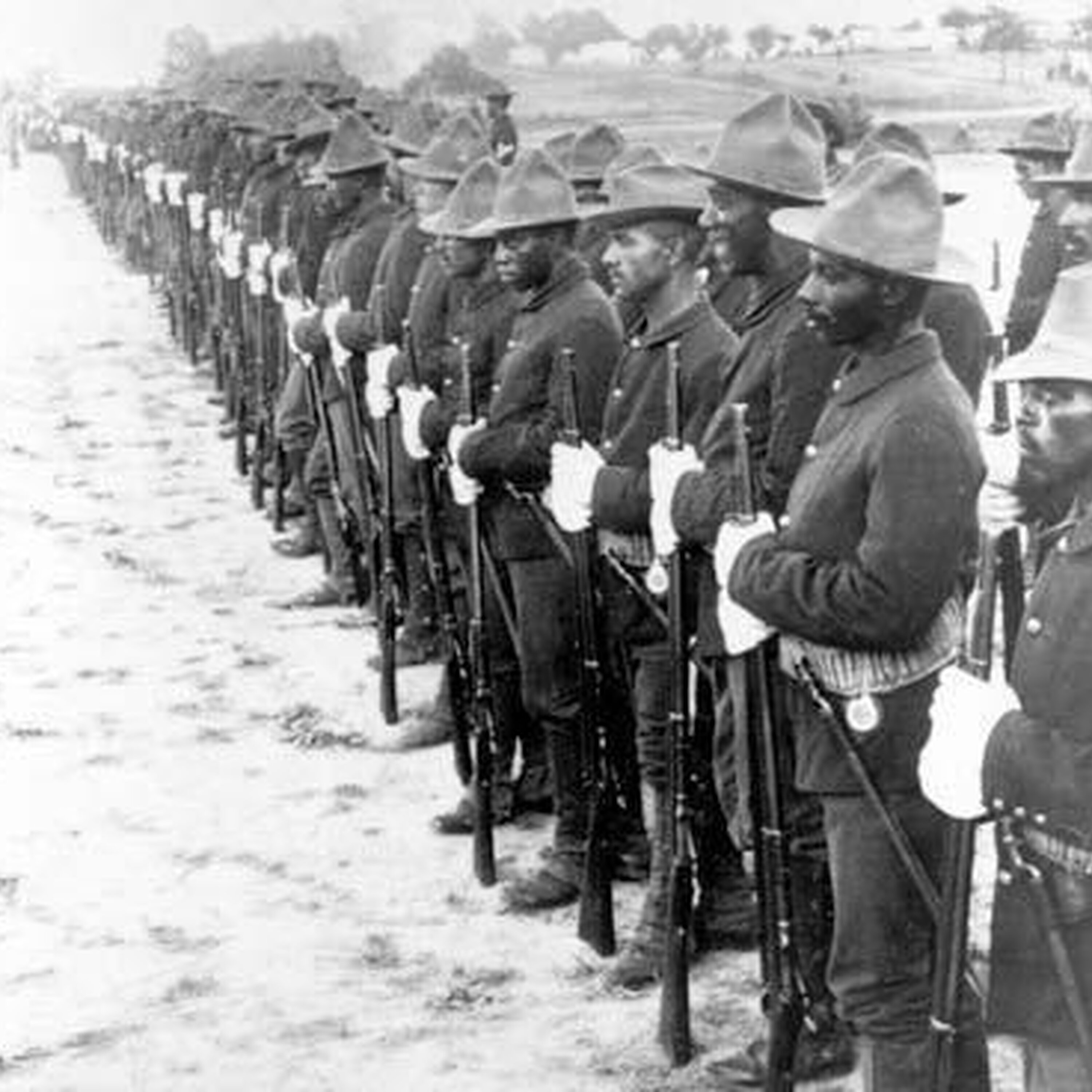
American History Hotline
Buffalo Soldiers: The History Behind Bob Marley’s Lyrics with Cale E. Carter II
00:26:37
Loading summary
Transcript87 lines
- [00:01]
Podcast Host
In sitcoms, when someone has a problem, they just blurt it out and move on.
- [00:05]
Cale E. Carter II
Well, I lost my job and my parakeet is missing. How was your day?
- [00:11]
Podcast Host
But the real world is different. Managing life's challenges can be overwhelming. So what do we do? We get support. The Huntsman Mental Health Institute and the Ad Council have mental health resources available for you at loveyourmindtoday.org that's loveyourmindtoday.org See how much further you can go when you take care of your mental health.
- [00:30]
Lauren LaRosa
Culture Eats strategy for breakfast, right?
- [00:33]
Podcast Host
On a recent episode of Culture Raises Us, I was joined by Valisha Butterfield, media founder, political strategist and tech powerhouse for a powerful conversation on storytelling impact and the intersections of culture and leadership.
- [00:46]
Lauren LaRosa
I am a free black woman.
- [00:48]
Podcast Host
From the Obama White House to Google to the Grammys, Valisha's journey is a masterclass in shifting culture and using your voice to spark changes. Listen to Culture Raises us on the iHeartRadio app, Apple Podcasts or wherever you get your podcasts. Lauren came in hot.
- [01:02]
Lauren LaRosa
From viral performances to red carpet looks that had everyone talking the podcast. The Latest with Lauren LaRosa is your go to for everything VMA's. We will be right here breaking it all down. I'm gonna be giving y' all the headlines, breaking down everything that is going down behind the scenes and getting into what the people are saying. Like what is the culture talking about? That's exactly what we'll be getting into here at the Latest with Lauren LaRosa. Everything DNA's to hear this and more. Listen to the latest with Lauren the Ro from the Black Effect Podcast Network on the iHeartRadio app, Apple Podcasts or wherever you get your podcast.
- [01:34]
Narrator (The Butterfly King)
It's 1943. A king dies under mysterious circumstances in the middle of World War II. Was it murder? After 80 years of lies and cover ups, his children need answers.
- [01:46]
Cale E. Carter II
Anne, you know, kissed us and said, I'll see you tonight. And we never saw him again.
- [01:50]
Narrator (The Butterfly King)
From exactly right. And Blanchard House. The Butterfly King is a gripping historical true crime series that dives deep into royal secrets, wartime cover ups, and a mystery that refuses to die. All episodes are available now. Listen to the Butterfly king on the iHeartRadio app, Apple Podcasts or wherever you get your podcasts.
- [02:13]
Bob Crawford
You've reached American History Hotline. You ask the questions, we get the answers. Leave a message. Hey there American History Hotliners. Your host, Bob Crawford here. Happy to be joining you again for for another episode of American History Hotline. And keep those Questions coming. The best way to get us a question is to record a video or a voice memo on your phone and email it to AmericanHistoryHotlinemail.com that's AmericanHistoryHotlinemail.com okay, today's question is a bit of a mix between reggae music and history.
- [02:52]
Cale E. Carter II
Hi, Bob, this is Sharon from Tulsa, Oklahoma. And I'm familiar with that Bob Marley song Buffalo Soldiers. But I never was sure what a Buffalo Soldier was really is. What is the story of the Buffalo Soldiers?
- [03:11]
Bob Crawford
Here to help me answer this question today is Cale E. Carter ii, director of exhibitions at the Buffalo Soldiers National Museum in Houston, Texas. Cale, thanks for joining us today.
- [03:24]
Cale E. Carter II
Thank you for having me on, Cal.
- [03:27]
Bob Crawford
I have this question as well, like Sharon, because I was recently re watching Ken Burns National Parks documentary and he talks about the Buffalo Soldiers at one point in that. So. Okay, Cale, before we get into the fuller story of the Buffalo Soldiers, let's start with a brief explanation of what the term Buffalo Soldier refers to in American history.
- [03:56]
Cale E. Carter II
So when most people tend to refer to Buffalo Soldiers, they are really referring to black American soldiers who served on, who served in the regular army on the western frontier in the aftermath of the Civil War. So they're mostly talking about black soldiers who served in the US army between 1866 to around 1898. They're most taught that time frame right there.
- [04:25]
Bob Crawford
So you're saying they began around 1866. Did a lot of these soldiers serve in the Civil War? During the Civil War?
- [04:34]
Cale E. Carter II
So when you talk about the percentage of veterans that the blessed that served in the Civil War and as well as the rich that came after, or we refer to as the Buffalo Soldiers, the numbers are kind of debated. But some, some sources say it's about roughly 10%. Some would say it's higher or lower. But normally when you talk about the Buffalo Soldier regiments, yes, there were some veterans of the Civil War that served in those regiments. But as for the exact number, at the moment, nobody can really give an exact number.
- [05:06]
Bob Crawford
Right, right. So who signed up to be a Buffalo Soldier? What, what kind of a man? What background did they they usually come from?
- [05:13]
Cale E. Carter II
There was kind of a wide variety of backgrounds. You had, of course, the Civil War veterans who wanted to continue their service. You had a mix of freedmen who came out of the north and even some freedmen who came out of the southern areas like Louisiana who said, well, I want to experience a sense of travel and adventure. Then you had others who were formerly enslaved and recently freed who said, well, I'm going to Join the army because, hey, this is a way to make. Have a stable. A state, economically stable life. Because of course, in the aftermath of the Civil War, in some areas that might have been economic opportunities, but in other areas that may not have been. And so with the army having this, creating these regiments, it's like there's a possibility for someone to say, okay, well I can at least serve, make a career out of serving in the military, receive food as well as money and stuff like that. So it was a very wide swath of people that joined and even. And you see as the units move westwards, you see other groups that join as well. So you have a few cases of what we would now consider Afro Latinos, but back then would have been like, basically people that would have African hair that might have came from Mexico and a few other places. And so, like, yeah, like when you talk about the backgrounds of people who served in these regiments, it's a very diverse background of people.
- [06:36]
Bob Crawford
Where did the name Buffalo Soldier come from?
- [06:40]
Cale E. Carter II
So the name itself is kind of widely debated in the sense that historically they would say that the name was given by the Native Americans. But when you talk to certain historians, certain historians would say that, oh, well, they would attribute to a specific tribe. Like, I know some sources. I think it was Robert Leckie who wrote a book back in the 50s, I think it was the 60s or 70s, and he would attribute it to the Cheyenne, the Cheyenne tribe. And then you had others that would attribute it to tribes pretty much on the central Plains. Some of attribute the Native American tribe that was in the lower, the southwestern frontier. But ultimately, from historical research, we really cannot say which Native American tribe gave the people these names or indigenous tribe that gave the people the name. And as for why they got the name, even that is debated. So some would say that it had to do with the naturally curly hair and the dark skin that the soldiers had. Some said it had to do with the bravery and tenacity to soldiers under fire. Some said it had to do with kind of making connections between the fact that the black soldiers who some of the Native Americans first encounter, particular in central, Central Plains in the wintertime, were wearing, in addition to having dark skin, dark eye color and hair texture, they had buffalo hide coats and muskrat skiing caps on top. And one of the more recent things I've heard, which even that can be controversial, is that some of us said that, oh, they refer to these, these men as buffalo, as buffalo soldiers of buffalo men, because they will be killed like buffalo, essentially, kind of alluding to their, their perceived employment as shock troops. So essentially, like, nobody can really pinpoint how they got the name or really why. Like, basically, which group gave him the name, why they got the name. But what's interesting in all my years of researching this is that you don't really see the black soldiers themselves really adopting the name until around War one. And so ironically, even with that, with the blessings that adopt the name is not the soldiers from the regiments per se. Because when we talk about the Buffalo Soldier regiments, we're talking about the 9th and 10th Cavalry Regiment and the later the 24th and 25th Infantry. But during, and really after World War I, the people that you see that tend to refer to the name Buffalo Soldiers, especially when it comes to black soldiers, aren't really black soldiers from those regiments per se, but rather black soldiers who were trained by soldiers from those regiments. And they're mostly taking on the name themselves in a sense to kind of pay homage to them. So case in point, the U.S. army, if you ask them what a Buffalo Soldier regiment is, they will tell you it's the 10th Calvary Regiment. And the reason why is because the 10th Calvary Regiment, they have the iconography. Some people will say that, that when it came to the name, it was attributed originally to soldiers from the 10th Calvary Regiment. And so when you talk to the army, the 10th Calvary is officially the Buffalo Soldier ones. But when you talk to most military historians or historians or even like black historians like that, they will say that the Buffalo Soldier regiments is kind of the definition I gave before, like black soldiers who served on the western frontier in the aftermath of the Civil War, but really up to the Spanish American War. So that would be the 9th and 10th Cavalry regiments and the 24th and 25th Infantry. And so the reason why I say all this is because during World War I and even during War II, you would have black regiments who refer to themselves as Buffalo Soldiers as well, like the 92nd Division and a few other units.
- [10:16]
Bob Crawford
It sounds like there's lineage, right? Like there is, like from the 9th and the 10th Cavalry to the 25th Regiment. This, this, this tradition is passed on. So when we look at the original Buffalo soldier, the 9th and 10th Calvary, what were their jobs?
- [10:34]
Cale E. Carter II
So when you talk about the, the jobs of the soldiers on the Western frontier, their job was a mixture of, particularly in the cavalry regiments, a mixture of kind of going out and acting as a rapid response force. Like, say, for example, particularly what you see in the case of Texas, like, hey, a ranch got raided and so they would go out to try to basically find out who raided the ranch and basically try to initiate contact that way. And so normally when people talk about buffalo soldiers, that's the main book they talk about. But in addition to doing the combat roles, majority of their roles out in the western frontier was mostly infrastructure, like helping build roads, stream telegraph wires, acting as an escort for like wagon trains and convoys that were making their way westward. But as time goes on, particularly in the 1890s to early 1900s, you start seeing their roles starting to switch from stuff like that to like basically acting as kind of the precursor to the park rangers. Like I remember you mentioned earlier about, about the documentary with Ken Burns, mentioned the buffalo soldiers. That's the road that you start seeing a lot of the regiments start becoming employed in at the turn of the century. So like the 1890s, 1900s, you start seeing them do that, you see them go as far north as Alaska where they're doing kind of similar roles of again, kind of helping bring a form of kind of civilization and protection to the people that were going out that way.
- [12:04]
Bob Crawford
It's really this.
- [12:06]
Narrator (Shock Incarceration)
What would you do if one bad decision forced you to choose between a maximum security prison or the most brutal boot camp designed to be hell on Earth? Unfortunately for Mark Lombardo, this was the choice he faced.
- [12:19]
Cale E. Carter II
He said, you are a number, a New York state number, and we own you.
- [12:24]
Narrator (Shock Incarceration)
Shock incarceration, also known as boot camps, are short term, highly regimented correctional programs that mimic military basic training. These programs aim to provide a shock of prison life, emphasizing strict discipline, physical training, hard labor and rehabilitation programs. Mark had one chance to complete this program and had no idea of the hell awaiting him the next six months.
- [12:50]
Cale E. Carter II
The first night was overwhelming and you don't know who's next to you and we didn't know what to expect. In the morning.
- [12:57]
Podcast Host
Nobody tells you anything.
- [12:58]
Narrator (Shock Incarceration)
Listen to shock incarceration on the iHeartRadio app, Apple Podcasts, or wherever you get your podcasts.
- [13:06]
Jacob Schick
I had this like overwhelming sensation that I had to call her right then and I just hit call, said, you know, hey, I'm Jacob Schick, I'm the CEO of One Tribe foundation and I just wanted to call and let her know there's a lot of people battling some of the very same things you're battling and there is help out there.
- [13:22]
Ashley Schick
The good stuff podcast season two takes a deep look into One Tribe Foundation, a non profit fighting suicide in the veteran community. September is national Suicide Prevention Month month. So join hosts Jacob and Ashley Schick as they bring you to the front lines of one tribe's mission.
- [13:36]
Cale E. Carter II
I was married to a combat army veteran and he actually took his own life to suicide.
- [13:41]
Lauren LaRosa
One tribe saved my life twice.
- [13:43]
Cale E. Carter II
There's a lot of love that flows.
- [13:45]
Bob Crawford
Through this place and it's sincere.
- [13:47]
Cale E. Carter II
Now it's a personal mission. Don't have to go to any more funerals, you know.
- [13:50]
Jacob Schick
I got blown up on a react mission. I ended up having amputation below the knee of my right leg and a traumatic brain injury because I landed on my head.
- [13:58]
Narrator (The Butterfly King)
Welcome to season two of the Good Stuff.
- [14:00]
Ashley Schick
Listen to the Good Stuff podcast on the iHeartRadio app, Apple Podcasts or wherever you get your podcasts.
- [14:06]
Cale E. Carter II
A foot washed up, a shoe with some bones in it. They had no idea who it was. Most everything was burned up pretty good from the fire that not a whole lot was salvageable.
- [14:17]
Narrator (America's Crime Lab)
These are the coldest of cold cases, but everything is about to change.
- [14:22]
Cale E. Carter II
Every case that is a cold case.
- [14:24]
Narrator (America's Crime Lab)
That has DNA right now in a backlog will be identified in our lifetime. A small lab in Texas is cracking the code on DNA using new scientific tools. They're finding clues in evidence so tiny you might just miss it.
- [14:39]
Cale E. Carter II
He never thought he was going to get caught and I just looked at my computer screen.
- [14:43]
Ashley Schick
I was just like, ah, gotcha.
- [14:45]
Narrator (America's Crime Lab)
On America's Crime Lab, we'll learn about victims and survivors and you'll meet the team behind the scenes at othram, the Houston lab that takes on the most hopeless cases to finally solve the unsolvable. Listen to America's Crime Lab on the iHeartRadio app, Apple Podcasts, or wherever you get your podcasts.
- [15:06]
Dr. Joy Hardin Bradford
I'm Dr. Joy Hardin Bradford, and in session 421 of Therapy for Black Girls, I sit down with Dr. Afia and Billy Shaka to explore how our hair connects to our identity, mental health, and the ways we heal.
- [15:18]
Lauren LaRosa
Guys, I think hair is a complex language system, right? In terms of it can tell how old you are, your marital status, where you're from, your spiritual belief. But I think with social media there's like a hyper fixation and observation of our hair, right? That this is sometimes the first thing someone sees when we make a post or a reel is how our hair is styled.
- [15:40]
Dr. Joy Hardin Bradford
You talk about the important role hairstylists play in our communities, the pressure to always look put together and how breaking up with perfection can actually free us. Plus, if you're someone who gets anxious about flying, don't miss session 418 with Dr. Angela Neal Barnett, where we dive into managing flight anxiety. Listen to therapy for black Girls on the iHeartRadio app, Apple Podcasts, or wherever.
- [16:04]
Cale E. Carter II
You get your podcasts.
- [16:06]
Bob Crawford
This is really fascinating. This is American History Hotline. I'm your host, Bob Crawford. Today my guest is Cal Carter ii, director of exhibitions at the Buffalo Soldiers National Museum in Houston, Texas. We're talking about Buffalo Soldiers, the people, the men, and the song. All right, Cal, now to the Sharon's big question, connecting the legend of the Buffalo Soldiers to the song, the Bob Marley song. Do you have any sense of the impact that the song by Bob Marley and the Wailers has had on people who are learning the history of the Buffalo Soldiers?
- [16:54]
Cale E. Carter II
So from what I've seen is kind of a mixed understanding and appreciation of it. And the reason why I say that is because on the one hand, with some of the historians who study the subject matter and they hear the song, at times they kind of get agitated because, like, oh, that's the only reason why people even acknowledge that this history exists. But on the other hand, with some of the younger historians and even some of the people, I would say, that have a kind of a broader understanding of the history of the Buffalo Soldiers, kind of a history of Bob Marley and then also a broader context, what you end up seeing is that a lot of the people who hear the song and they kind of think about like, what he's saying, and then kind of related back to the subject matter is mostly kind of viewing the Buffalo Soldiers as kind of like more so a representation of like, hey, these are guys that basically at a time that might have to deal with certain things, but on the other hand, that they were doing something that was significant. And dare I say, if you go into other aspects that you see, like, again, towards like World War I and War II later, where these guys go from just being seen as, oh, well, you're just black soldiers on the western frontier to in the case particularly in like certain black communities, like during the build to the Spanish American War and after being seen as kind of a form of protection for the black community as all, as well as kind of a sense of group debates they have a sense of pride in. So to kind of bring it back to kind of the core question. On the one hand, with the song, there is kind of a mix of, I wouldn't say frustration, but kind of like that, ah, here it comes again. Because that's the only thing we're associated with. But then there's also an understanding too of like, well, this kind of shows that the history of the Subject, while at least it's an intro, a way to introduce people that may not have been introduced to the subject matter. It gives them a way to start asking questions and saying, okay, well, let's learn more about this history and why, why would he made a song? Because ironically enough, from a personal perspective, like, I know the first time I heard Buffalo Soldiers mentioned in song, ironically, wasn't through Bob Marley. It was this guy named George Duke.
- [19:13]
Bob Crawford
It was George Duke, the great jazz artist.
- [19:16]
Cale E. Carter II
Exactly. So like I, I grew up, I grew up on George Dukes, I would say mid to later album. So like, like I remember the album. The reason I'm remembering the songs, because it was from an album called Illusions. And ironically, the way that he describes the Buffalo Soldiers is, I would say, fairly accurate because like I said, hey, like these guys come about. But it's mostly kind of an instrumental song. And that's how I was first introduced to the Buffalo Soldiers as a kid. And then when I started working in the field of Buffalo Soldier history and black military history, that's when I started hearing more about the Bob Marley aspect of it.
- [19:51]
Bob Crawford
Okay, so let's talk about a lyric in the Bob Marley song. And by the way, I love the George Duke reference. I'm a fan myself.
- [19:58]
Cale E. Carter II
Okay.
- [19:59]
Bob Crawford
In the song, there's a lyric trodden through San Juan in the arms of America. This is, Is this a reference to the Buffalo Soldiers role in the Spanish American War?
- [20:10]
Cale E. Carter II
That's my, from my understanding, yes. And really it actually. And it's interesting that he, that he brings that up because if you think about the Buffalo Soldiers in terms of their understanding within the American public, it wouldn't be until the Spanish American War where these units are actually kind of acknowledged and kind of spoken about highly in the American public. Because prior to on the western frontier, they're out there, but the only people that would know about them is people that are in the proximity of them. But with the Spanish American War, when they come back from the western frontier, they started heading back eastwards. That's when you start seeing like aspects of the black community, start knowing about them more broadly. But when you talk about the success in the Spanish American War, that's when you start seeing Americans start knowing about these regiments because you have, between their actions while fighting in these battles. But then you also have people like Teddy Roosevelt and others who sing the high praises of these soldiers. So with him adding that, that line in there, that does allude to the kind of not with their service in the Spanish American War, but kind of like the way that people start understanding and really start acknowledging their service in terms of kind of the American historical standpoint.
- [21:26]
Bob Crawford
Well, you're talking about the Spanish American War. This is the height of Jim Crow in the United States. So how were these soldiers treated during and after the war? How were the Buffalo soldiers treated?
- [21:40]
Cale E. Carter II
So prior to the war, when they're on the western frontier, while they are dealing with racism and systemic racism, there's this one interesting point that I want to say one of the guys I used to work with made is that while on the western frontier, people would be racist. You only could be so racist to someone who you need to protect you. Whereas when you see those. The regiments start coming back to the Deep south in preparation to stage for Cuba, this is when you start seeing a lot of the soldiers really start encountering like. Like really truly systemic Jim Crow laws. And almost immediately there's a series of clashes. So, like, you have. There was this one clash, the thing that occurred in Alabama. There was a clash that occurred in Florida.
- [22:25]
Bob Crawford
Well, when you say, what do you mean by clash?
- [22:28]
Cale E. Carter II
So by clash, it's normally where you would have these soldiers that will return to the Deep South. And again, when a lot of these soldiers might have left or made their way out, they might have made their way out during the Reconstruction period. And during that time, the south was in kind of a different flux to where, on the one hand, recently free people were gaining rights, but you still kind of had pushback from the people that were formerly in power that was in the South. So it was kind of this mixture where you could gain freedoms or gain the fruits of citizenship, but at the same time, it was pushback, but you might have had some protections. Whereas by the time they come back in the 1890s, this is where you start seeing where, again, Jim Crow is set in stone, Black codes are set in stone. And one of the things that kind of comes up with these, with the arrival of these black troops, particularly a lot of southern areas, is, like I mentioned before, on the one hand, the black communities are like, wow, these guys are. These are soldiers. They're professional soldiers. And like, they are a sense of pride. But in a lot of the smaller communities, that becomes a concern because suddenly you have a regiment. Like, you may have, like, a small black population that by and large is fairly contained, but then suddenly you may have a regiment or two that's anywhere between 600 to a thousand, in some cases 2000, that are armed, that are trained, and more importantly, that they will in many cases refuse to adhere to Jim Crow laws because they're like, okay, well, out in the west, we're treated not really as full equals, but we're treated with a level of respect, whereas here, we're not treated with that same respect. And it's like, well, if you're not going to respect me as an individual, at least respect the uniform that I'm serving with, which is the U.S. army.
- [24:13]
Bob Crawford
So you talk about this lineage of the Buffalo Soldiers. So you have the original 9th and 10th cavalries, the original Buffalo Soldiers, and then the Buffalo Soldiers who served in World War I. And then you talk about the 92nd. Was it in World War II?
- [24:32]
Cale E. Carter II
Well, 92nd history starts in World War I.
- [24:34]
Bob Crawford
Okay, okay.
- [24:36]
Cale E. Carter II
But normally the legacy component, that really starts in earnest during World War I, but it really takes off during World War II. Okay. So by the time World War I comes around in the drive to get black soldiers or black people to participate in the war effort as well as enlist, you start seeing where some people start highlighting the stories of blacks that served in the military priority. And up to that point, really prior to the Spanish American War, the main conflict that people tend to know about in the American Mexican was the American Civil War. And while there was a lot of blacks that served in the American Civil War, the Spanish American War was really that first conflict since the Civil War where you can make the argument that basically America as a country, both north and south, was united and fighting against a common enemy. And so because of that, you see where some of the black leadership and some of the black advocates start kind of highlighting, like, hey, like, these are guys that like. Like, basically be like the guys who fought and fought against the. The Spanish in Cuba and stuff like that. And then from the military side, when they start having to raise these black units. Because keep in mind, even though we. It's. It's easy for us, it's kind of difficult for us to think about this now, but back in World War I, and even at the start of World War II, America didn't really have a large military. Like, it was mostly a frontier army. And so we had to rapidly expand the army, and we rapidly expanded the army that also included the rapid expansion of black units. And so to help ease that rapid expansion, to help accelerate the training, you see where a lot of veteran soldiers from the 9th Cavalry Regiment, the 10th Calvary Regiment, the 24th and 25th Infantry Regiments, they're literally, in a sense, kind of taken from their home regiment or basically transferred from their home regiment to these new regiments. So, like in the case of the 92nd, some guys end up in the 367th Infantry Regiment or in Pioneer infantry regiments, labor battalion, stuff like that. And so because a lot of these guys that transfer to these regiments, some of these guys have been in the military from. Some have been in there for a few years, but you had some that was guys that were career Army. So some of these guys have served since the 1880s. And, like, if you imagine, like, you have, like, this is like a movie or something, that you have a gruff old sergeant that comes in, like, normally we see a gruff old song, they come in and yelling at the troops. With a lot of these guys that's coming in, some of them would have a certain degree of respect for them because, like, hey, this guy, like, he's traveled, he saw some things. And so what you end up seeing is that with some of these older sergeants and older NCOs, that that train, these guys, they start telling about, oh, we heard that we was called this, but it might have been like, we don't really know how the story got out or how they told them, but for some reason, the younger guys that was brought in for the military service during War one, they cleave to, like, oh, like, wow. Because it's kind of a scene as a sense of, like, hey, like, they're from our community. These guys have proven their metal. And also, if you want to tell us, it's kind of a cool nickname. So I was like, okay, well, certainly is. So it's like, oh, well, they're called Buffalo Soldiers. Well, how do we carry this on? Oh, well, we're the Buffaloes. And then, in fact, so the first regiment you see that takes on that moniker is the regiment I mentioned before, the 367th Infantry Regiment. And in fact, if people are curious about that, like, they can actually. The National Archive had their. The was a light regimental history booklet of the 367th in World War I. And they actually had their regimental crest, and it literally has a buffalo head. And I'm kind of paraphrasing what the. The information says, but it essentially says that, hey, we take this name to pay homage to the guys who came before us who were referred to by the Native Americans as Buffalo Soldiers. And so you see, it kind of take off a little bit in World War I, but by the time World War II comes around in 1941, that's when you see it takes off to a different level. Because on the one hand, with the actual Buffalo Soldier regiments, they're still around as surrogated units by this point. But the 9th and 10th Calvary, they're literally the last of the horse Calvary in the U.S. army. By the time World War II comes around, most of the cavalry guys, they traded their horses for tanks. And so with the 9th and 10th and later what became known as the 2nd Cavalry Division, they literally are the last horse soldiers in the US army, where these guys are trained how to ride horses, how to do horse drill, and basically kind of do comedy like true Calvary. And of course, the 24th and 25th, they fight in the Pacific during this time. But in addition, as In World War I, you had where a lot of these guys were kind of sent to other regiments to help train them. So you see guys who was in these original Buffalo Soldier regiments ending up in everything from tank battalions, tank destroyer battalions, field artillery units, field artillery battalions. And so what's interesting is that when you look through the regimental records of some of these units, like, a primary example would be the 846 Tank Destroyer Battalion out of Camp Livingston, Louisiana. Like, even though the regiment will ultimately get disbanded by 1943, when you look at the regimental crest and even the name, they have a buffalo on their regimental crest. And they literally say, like, the reason why we take this name, we have a buffalo owner, is the Payo Marsh to the guys who came before. So as you mentioned before, it's kind of a sense of like, hey, let's carry on this legacy of the guys who served before us and kind of carry it on as long as we can. Now, by the Time War II ends and when you get to 1948, the order to integrate the army comes through. And by that point, the only regiment of the original Buffalo Soldiers that's Left is the 24th infantry, because the 9th and 10th Calvary, they were deactivated in 1944. The 25th Infantry Regiment, by and large, was deactivated by 1946. Like, I know some of the research I was doing, some of the regiments, some of the battalions survived on as training units in various capacities until about 1950. But with the 24th being the last of the original regiment, you see where the legacy starts kind of going from, again, kind of the focus on the specific regiments to mostly black soldiers who served in the segregated army and kind of came under the tutelage of those men. And so when the 24th Infantry Regiment is deactivated in 1951 and they're saying, okay, well, like, that regiment's officially disbanded, that kind of marks the end of the original Buffalo Soldiers Kale, I've enjoyed.
- [31:23]
Bob Crawford
Our time together so much. Thank you so much for answering Sharon's question. I've been talking to Cale E. Carter, the second director of exhibitions at the Buffalo Soldiers National Museum in Houston, Texas. If you're down there, check it out. Say hello to Cale. I know I will. Kale, thank you for joining us today on American History Hotline.
- [31:45]
Cale E. Carter II
Thank y'. All. Hopefully I'll see y' all next time.
- [31:49]
Bob Crawford
You've been listening to American History Hotline, a production of I Heart Podcast and Scratch Track Productions. The show's executive producer is James Morrison. Our executive producers from iHeart are Jordan Runtal and Jason English. Original music composed by me, Bob Crawford. Please keep in touch. Our email is americanhistoryhotlinemail.com if you like the show, please tell your friends and leave us a review. And in Apple Podcasts, I'm your host, Bob Crawford. Feel free to hit me up on social media to ask a history question or to let me know what you think of the show. You can find me at bobcrawford Bass. Thanks so much for listening. See you next week.
- [32:47]
Cale E. Carter II
Smokey the Bear Then you know why Smokey tells you when he sees you passing through? Remember, please be careful. It's the least that you can do.
- [33:03]
Lauren LaRosa
After 80 years of learning his wildfire.
- [33:05]
Dr. Joy Hardin Bradford
Prevention tips, Smokey Bear lives within us all. Learn more@smokeybear.com and remember, only, only you.
- [33:12]
Podcast Host
Can prevent wildfires brought to you by.
- [33:14]
Lauren LaRosa
The USDA Forest Service, your state Forester and the AD Council.
- [33:17]
Cale E. Carter II
I was diagnosed with cancer on Friday and cancer free the next Friday.
- [33:21]
Bob Crawford
No chemo, no radiation.
- [33:22]
Cale E. Carter II
None of that.
- [33:23]
Podcast Host
On a recent episode of Culture Raises Us podcast, I sat down with Warren Campbell, Grammy winning producer, pastor and music executive to talk about the beats, the business and the legacy behind some of the biggest names in gospel, R and B and hip hop professionally.
- [33:36]
Cale E. Carter II
I started as Death Row Records.
- [33:38]
Podcast Host
From Mary Mary to Jennifer Hudson, we get into the soul of the music and the purpose that drives it. Listen to Culture Raises us on the iHeartRadio app, Apple Podcasts or wherever you get your podcasts. Lauren came in hot.
- [33:49]
Lauren LaRosa
From viral performances to red carpet looks that had everyone talking the podcast. The Latest with Lauren LaRosa is your go to for everything VMA's. We will be right here breaking it all down. I'm gonna be giving you all the headlines breaking down everything that is going down behind behind the scenes and getting into what the people are saying. Like what is the culture talking about? That's exactly what we'll be getting into here at the Latest with Lauren LaRosa Everything DNA's to hear this and more. Listen to the latest with Lauren the Rosa from the Black Effect Podcast Network on the iHeartRadio app, Apple Podcasts or wherever you get your podcast.
- [34:22]
Narrator (The Butterfly King)
It's 1943. A king dies under mysterious circumstances in the middle of World War II. Was it murder? After 80 years of lies and cover ups, his children need answers and kissed.
- [34:35]
Cale E. Carter II
Us and said I'll see you tonight. And we never saw him again.
- [34:38]
Narrator (The Butterfly King)
From exactly right and Blanchard House the Butterfly King is a gripping historical true crime series that dives deep into royal secrets, wartime coverups, and a mystery that refuses to die. All episodes are available now. Listen to the Butterfly king on the iHeartRadio app, Apple Podcasts or wherever you get your podcasts.