Loading summary
Transcript95 lines
- [00:00]
Robert Clara
Here's the loophole that President Trump used. There is no oversight over demolition. So he was able to bring a bulldozer, I think it was a backhoe, actually, to the East Wing and knock it down pretty much at a whim. There was nothing to stop him from doing that. It is a separate question about what he will be permitted to put up there. But, you know, now that the thing has been demolished, it's highly unlikely that they'll just plant a flower garden there.
- [00:35]
Bob Crawford
You've reached American History Hotline. You ask the questions, we get the answers. Leave a message. Hey there, American History Hotliners. Bob Crawford here. Thrilled to be joining you again for another episode of American History Hotline, the show where you ask the questions. And the best way to get us a question is to send it to americanhistoryhotlinemail.com that's americanhistoryhotlinemail.Com or you can ask it right on the Spotify app. Okay. Today's question is about the demolition of the East Wing of the White House. Here to help me answer this question today is Robert Clara. He's author of the book the Hidden White Harry Truman and the Reconstruction of America's Most Famous Residence. Robert, thanks for joining me today.
- [01:24]
Robert Clara
Bob. It's my pleasure. Thank you for having me.
- [01:27]
Bob Crawford
Okay, Robert, here is the question we got from our listener. It's from Jerry in Tennessee. He says, does the president have the power to tear down parts of the White House or does he have to ask Congress or the National Park Service for permission? Also, what sort of history did we lose in the demolition of the East Wing?
- [01:49]
Robert Clara
Okay, well, how much time do you have?
- [01:52]
Bob Crawford
Well, how about this, Robert, for the listeners who maybe aren't aware with what's going on, what is going on right now with the East Wing?
- [02:03]
Robert Clara
Well, quite a bit. The Trump administration demolished the east wing starting on October 20th of last year, and the plans are to erect a ballroom in its place that will seat around 900, maybe 1,000 people for formal events. And the ballroom that's planned is going to be 90,000 square feet, which will double the size of The White House's 55,000 square feet. If it gets built. It's a very.
- [02:41]
Bob Crawford
What do you mean, if it gets built?
- [02:43]
Robert Clara
Well, I mean, it seems like a done deal, although it isn't really done until it's done right. There are not as many regulatory hurdles to get over as people assume that there are. But there is a suit in federal court right now filed by the National Trust for Historic Preservation, and the judge just said I believe this week he had made some critical comments about the ballroom. But my feeling is that ultimately the President will not really face any serious obstacles to doing what he wishes to do. And a good part of that is the assumption that I think a lot of people have that there must be a matrix of federal laws and regulations that protect the White House is erroneous. There isn't actually very much that protects the White House, which I think comes as a surprise to people. So the White House is not subject to the National Historic Preservation act of 1966, by the way. Neither is the Supreme Court and the Capitol. The National Capital Planning Commission has the right to review plans according to a 1952 law. And technically I think that is what people are waiting to see what, you know, NCPC will do. But I can tell you right now that the 12 person board is already heavy with Trump supporters. For lack of a better way to put it, the NCPC does have oversight on construction. Here's the loophole that President Trump used. There is no oversight over demolition. So he was able to bring a bulldozer, I think it was a backhoe actually, to the east wing and knock it down pretty much at a whim. There was nothing to stop him from doing that. It is a separate question about what he will be permitted to put up there. But you know, now that the thing has been demolished, it's highly unlikely that they'll just plant a flower garden there. So I expect something will go up and I do expect that there'll be a lot of noise made about it. But I do believe that the President will probably prevail. The the National Capital Planning Commission has expressed a good deal of loyalty to the President.
- [05:23]
Public Radio Announcer
Support for the show comes from Public, the investing platform for those who take it seriously. On Public, you can build a multi asset portfolio of stocks, bonds, options, crypto and now generated assets which allow you to turn any idea into an investable index. With AI it all starts with your prompt. From renewable energy companies with high free cash flow to semiconductor suppliers growing revenue over 20% year over year, you can literally type any prompt and put the AI to work. It's it screens thousands of stocks, builds a one of a kind index and lets you back test it against the S&P 500. Then you can invest in a few clicks. Generated assets are like EFTs with infinite possibilities, completely customizable and based on your thesis, not someone else's. Go to public.com podcast and earn an uncapped 1% bonus when you transfer your portfolio. That's public.com podcast paid for by Public Investing Brokerage Services by Open to the Public Investing Inc. Member FINRA SIPC Advisory Services by Public Advisors, llc SEC Registered Advisor Generated Assets is an interactive analysis tool. Output is for informational purposes only and is not investment recommendation or advice. Complete disclosures available at public.com disclosures hey.
- [06:33]
Robert Clara
This is US Olympic gold medalist Tara.
- [06:35]
Public Radio Announcer
Davis Woodhull and I'm US Paralympic gold medalist Hunter Woodhull.
- [06:38]
Robert Clara
As athletes, our lives are about having.
- [06:40]
Public Radio Announcer
A clear path and a team that.
- [06:42]
Bob Crawford
You can absolutely trust.
- [06:43]
Robert Clara
So when it came to getting the best mortgage, we chose PennyMac. PennyMac is proud to be the official mortgage provider of Team USA and you learn more at pennymac.com PennyMac Loan Services, LLC equal housing lender NMLS ID 35953 licensed by the Department of Financial Protection.
- [06:58]
Bob Crawford
And Innovation under the California Residential Mortgage Lending Act.
- [07:00]
Robert Clara
Conditions and restrictions may apply.
- [07:02]
Mint Mobile Advertiser
Well, the holidays have come and gone once again, but if you've forgotten to get that special someone in your life a gift, well, Mint Mobile is extending their holiday offer of half off unlimited wireless. So here's the idea. You get it now, you call it an early present for next year.
- [07:17]
Robert Clara
What do you have to lose?
- [07:18]
Mint Mobile Advertiser
Give it a try@mintmobile.com Switch limited time.
- [07:22]
Wells Fargo Advertiser
50% off regular price for new customers. Upfront payment required $45 for three months, $90 for six months or $180 for 12 month plan taxes and fees. Extra speeds may slow after 50 gigabytes per month when network is busy. See Terms Picture this me, Reese Witherspoon in London ordering fish and chips so often they might start wrapping me in paper. I'm traveling with my Wells Fargo Autograph Journey card, so I earn rewards wherever I book travel five times points with hotels, four times with airlines, three times on restaurants and other travel and one point on other purchases. Imagine getting rewarded for eating a toad in the hole. Wait, what is a toad in the hole?
- [07:57]
Public Radio Announcer
Visit wells fargo.com autographjourney Terms apply.
- [08:04]
Bob Crawford
It is typical, right, to make changes when someone moves into the White House.
- [08:09]
Robert Clara
And yes, it is.
- [08:12]
Bob Crawford
So describe some typical changes that have been made.
- [08:15]
Robert Clara
Well, here's usually what has happened when a president moves into the White House, they take up residence on the second floor of the White House. That's the family quarters. And for the most part that means that they change the paint and the wallpaper and some light fixtures and paintings and what have you. Basic interior decoration. Not a lot of infrastructural changes as in moving walls. Not since Harry Truman finished his renovation. But I think the spirit of your question is, have major changes been made to the White House itself by past presidents? The answer is yes, quite a few, and I think a lot of people don't realize that. So the original White House was finished in 1800 by James Hoban, the Irish architect who was hired to do the house. And when it was reconstructed after the War of 1812, it was put back pretty much the way it was originally. But then it started to change. James Monroe added the south portico in 1824, and then Andrew Jackson put the north portico on in 1821. 9.
- [09:31]
Bob Crawford
Okay, Robert, so was there any controversy when. When that happened, either of those projects?
- [09:38]
Robert Clara
Not. Not that I've come across. My book dealt mostly with Harry Truman, so I haven't gone back in depth, but I don't believe that there was much of an uproar. Presidents, like, largely took a free hand with the house. And these, by the way, these were major changes, but they were changes that were done with architectural and aesthetic harmony, with the building itself. The porticos were not in of outsized proportion. They were of the Federal neoclassical style, and they look like they've always been there. Part of the problem, or part of the controversy with Trump's plans is that the ballroom is so outsized in comparison to the footprint of the house that it basically overshadows the house. It overtakes it in some ways.
- [10:32]
Bob Crawford
So, yeah, let's talk about the footprint of the house, because it's not palatial, right? No, it's actually, can you paint us a picture of the White House and how many floors and rooms and wings just kind of give us kind of.
- [10:48]
Robert Clara
A.
- [10:50]
Bob Crawford
An image for our mind's eye.
- [10:53]
Robert Clara
So if you were to come into the main floor of the White House, you're on the State floor, and that has the dining room, the East Room, and the public rooms, including the Red Room and the Green Room. If you're invited to the White House for an event, that is the floor that you're going to see. There's a floor beneath that, which I do believe that I've seen because I was taken on a tour of it when I was a kid, and I think they still took you down there back then. But that is what you may see if you are a diplomat who's invited to the house. The second floor of the house is the family quarters, and few people are invited up there unless you're invited to stay in the Lincoln Bedroom, of course, which, you know, is kind of like a notorious fundraising perk. So, you know, people have gone up there, and then there's a level above that which used to be the attic, but it was raised by Calvin Coolidge in 1927 to create essentially a third floor. But the house is quite small. And this is the reason why the West Wing was added, because originally the White House had both residential and administrative functions stuffed into that house. And it. As the country grew and as the government grew, the house was inadequate. And so Teddy Roosevelt moved the executive functions to the west wing in 1902, and even that.
- [12:26]
Bob Crawford
Robert, to interrupt you. I'm sorry, isn't it Teddy Roosevelt who first called it the White House?
- [12:33]
Robert Clara
Oh, that's a good one. I believe it was him, although I think informally people called it that prior to him, because technically it's the Executive Mansion. I've never once heard anybody use that term to describe the house.
- [12:49]
Bob Crawford
Yeah, I've always read the President's house.
- [12:52]
Robert Clara
And the President's House. Yes, I've seen that as well. But it's kind of like one of those names that you kind of note academically but don't really add to your vernacular, because it's the White House. And in the FDR years, when they put off. Off maintaining the place, they called it the off White House. So, you know, I feel like that's kind of like it's been known that way informally for a very, very long time.
- [13:16]
Bob Crawford
So you mentioned the Roosevelt years and how the house was in disrepair. So let's talk about like that, because there was a reason, like Truman, 1948, something happened there, and he realized it was time to call a contractor. So first talk about why it fell into such disrepair during the Roosevelt years, and then what happened to Truman that made him realize it was time to. To try to renovate.
- [13:46]
Robert Clara
Well, so the way that the White House was initially designed and built by James Hoban, and again, we're going back to 1800, it was a proper country gentleman's house, you might say. And so it had adequate foundations and footings for a house of that size and scope. It was a residence. However, over time, over the course of many presidencies, especially as the American Industrial Revolution began to introduce technologies that were then incorporated into the house. And I'm talking about indoor plumbing with lead pipes, conduits for illuminating gas, and then electricity, cast iron bathtubs, an elevator, all of these improvements to living were built into a house that was never designed to accommodate the added weight of those additions. And so what you had was an exterior foundation that was on pretty good footings. It went down several feet, it had spread footings, it could hold a lot of weight. But the inside of the house, where you had some load bearing brick walls and there would be loads resting on those walls, if you went down to the ground level, you would find a little bit of rubble work and that's it. And by the way, it was built on sand or a swamp or a sandy swamp, depending on which version you want to credit. My point is, as the years went on and as changes were made to the house and as all these things were added to the house and it began to sink, literally sink, and because the footings were inadequate in the center of the house, it began to sink from the middle. So think of like a donut basically, or a whirlpool. So everything in the middle was being pulled down while everything on the outside was pretty much holding on. And the house literally started to pull itself apart. And it's not like residents of the house were unaware that the house was in bad shape. There was, you know, there was this long, this oft told story about the White House ghosts. I don't know if you've ever heard this.
- [15:59]
Bob Crawford
Oh, but please, but tell us.
- [16:02]
Robert Clara
So presidents would joke about the White House ghosts and what they were talking about was the fact that the house would make noise on its own. You would hear cracking and snapping and other strange sounds coming from rooms that nobody was in. And curtains would billow on their own as though some spirit force were moving them. What that was was the house slowly falling apart. And the dancing curtains were drafts. So even Truman liked the ghost's idea. What happened with Truman is the house fell apart to the point where it was his on his watch, where the house essentially reached the point of no return.
- [16:46]
Bob Crawford
And wasn't there an incident where he was taking a bath?
- [16:50]
Robert Clara
There were several incidents. There was not one any. The way that I found in my research. I don't think it was any one thing that caused him to say, okay, that's it, enough. It was an accumulation of very frightening events. And one of them, and I opened the book with this. The Daughters of the American Revolution were in the blue room downstairs being received by Bess Truman. And she looked up and she saw the chandelier swinging on its own. And it wasn't swinging in the breeze, it was just swinging.
- [17:27]
Bob Crawford
And it wasn't the ghost.
- [17:28]
Robert Clara
It wasn't the ghost either. Well, we don't know, but I don't think it was. And so she sent somebody upstairs to find out what was going on and what was going on was Truman was taking a bath because there was a bathroom directly above, above the Blue Room, where the Daughters of the American Revolution were. And Truman was splashing around. And, of course, the bathtub was resting on beams that were coming apart. And another reason why the house needed to be rebuilt was not just that it was merely collapsing, but all of those improvements that I mentioned before, like conduits, right. Or ducts for heating. When the workmen came to install those things, they were under great pressure to do the job quickly. So they would pull up the floor and they would carve a notch in the beam, install the channel, close it back up, and leave. So imagine that process unfolding over decades. Eventually, A beam that's 1 foot thick suddenly is, in the aggregate, maybe only 2 inches thick or 3 inches thick. So the house was also losing its ability to bear weight because its actual structural integrity was being compromised by these improvements. And that was why, when Truman was splashing around in his bathtub, the beam was bouncing up and down. And the chandelier, which was screwed into the beam from below, was bouncing up and down as well. There were other scary incidents, like Margaret Truman's piano leg punched through the floor at one point. There was another. If you've ever seen the three chandeliers in the East Room, which are enormous tent and bowl chandeliers. There was a classical music recital being held in the East Room. And the chandelier over the piano began to swing. And Truman looked at it and realized that he had a very difficult decision to make. He could clear the room and ruin the evening or take his chances and possibly kill some of his guests. And he decided to roll the dice, and it came out okay for him. But ultimately it was so obvious that there was nothing else that could be done. They had to move, and the house had to be rebuilt. There was no way to fix it.
- [19:44]
Bob Crawford
The White House is literally falling apart on Harry Truman's watch. He realizes something has to be done. They move out of the White House. Where do they move?
- [19:57]
Robert Clara
They move to Blair House, which is now the official guest residence for the White House. And it was an even tighter squeeze over there. But Bess Truman liked it really, really well, because there was no room for company, and she didn't like company.
- [20:14]
Bob Crawford
I recently was talking to someone doing another interview, and. And they mentioned that Truman wanted to do repairs in the White House. Congress didn't want to pay for them. Yes, well, Congress wanted to build a whole new house.
- [20:32]
Robert Clara
Well, some members of Congress did, yes. There were many proposals and ideas over what to do at that time. And I think it's important to point out that our notions of historic preservation either didn't exist then or were in their infancy then. And so they faced several options. And one of them was, indeed, yes, demolishing the house completely. Clarence Cannon was the representative who was actually in favor of that. He was a budget hawk, and he felt that it would be cheaper just to build a new house. There was a proposal to somehow stabilize the White House and leave it as a kind of museum and move the President's residence to the. To the suburbs. And then there was an option to repair the house in a way that would still permit the President to live there and functions to be held there safely. And ultimately they went with that. I think if it were to be done today, they probably would not have taken measures as brutal as what they did back then, because today, if you step inside the White House, as soon as you're in the front door, everything that you're seeing and standing on dates to about 1950 and afterward. So I remember reading some comments that Hillary Clinton had made taking a guest on the second floor said it's. She said, it's so inspiring to walk where Abraham Lincoln once walked, but Lincoln never walked there because those are reinforced steel, reinforced concrete floors.
- [22:13]
Bob Crawford
So talk about how they did that. Like how they. Because you're trying to preserve a historical structure, but it just makes sense that over time, things decay.
- [22:25]
Robert Clara
Sure.
- [22:27]
Bob Crawford
And building techniques change and building materials change. So talk about how they. How they kind of kept the. The facade, I guess you would say, of the original White House, but, but, but updated it.
- [22:42]
Robert Clara
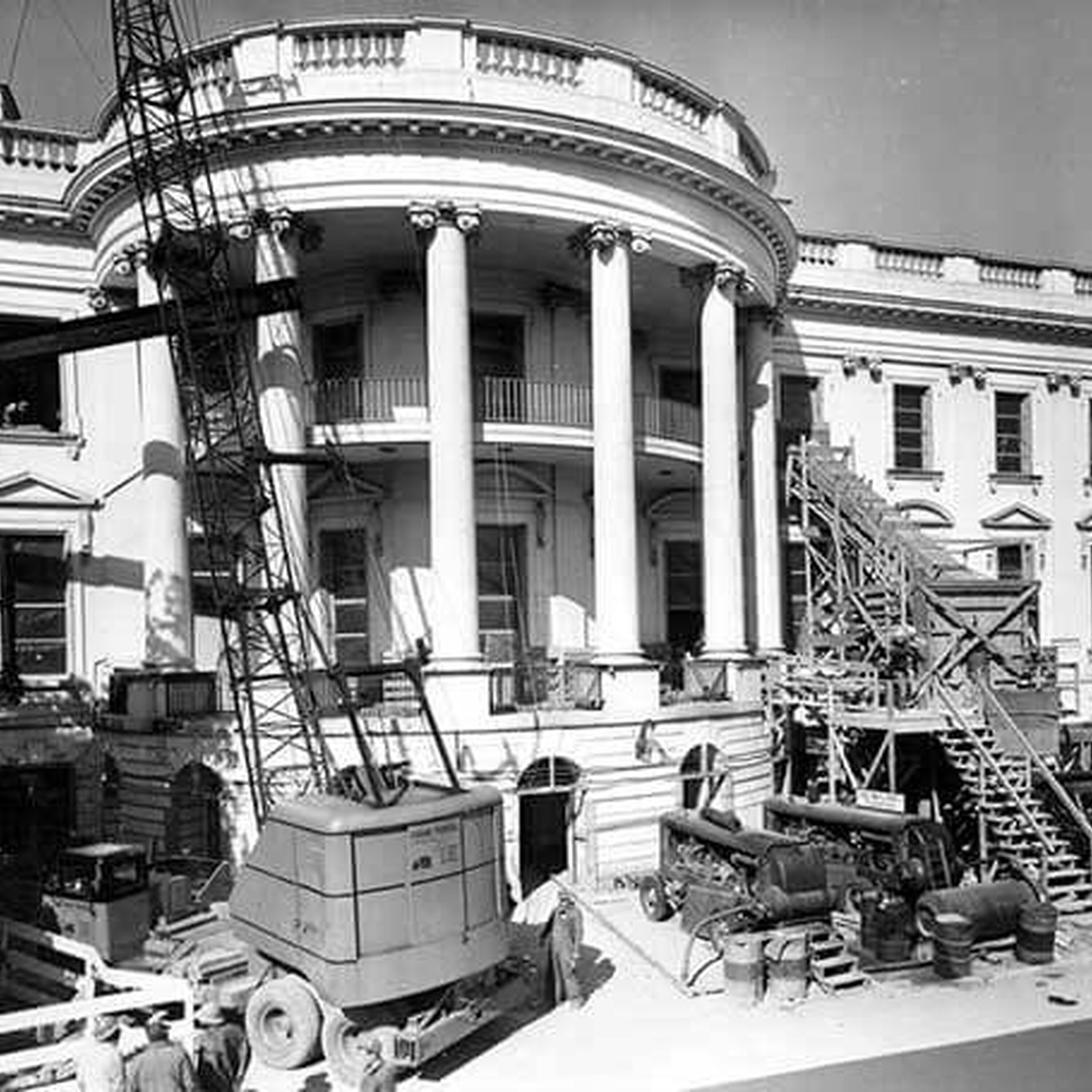
Well, ultimately, they decided that preservation in air quotes meant saving the facade, the shell of the house, the stone, and the exterior finishing. But everything on the inside was going to be gutted and removed. So they kind of did. Essentially, what they built was two different structures. They deepened the foundations to hold up the outside of the house. They dug down an extra floor and a half or so and put that on very, very solid footings. And then they built a steel frame on the inside of the house and poured cement over the steel. So you basically have not. Well, it isn't technically steel reinforced concrete. It's steel and concrete. But it's a steel framework building with poured concrete floors and that rises from inside those historic walls. And then when they were done with that, they basically tied the two structures together. And so the interior matrix of steel was tied to the external walls, the original stone, and made it into a single integral structure.
- [24:03]
Bob Crawford
So essentially, they gutted it.
- [24:05]
Robert Clara
Oh, that's not even. Essentially, they literally gutted it. Yes. There's pictures in my book. There's pictures on the Internet, of course, of a gentleman driving a bulldozer around inside the house because there was nothing left.
- [24:22]
Bob Crawford
Okay. So what were people saying at the time? Like, you know, I'm just thinking about. You talked about the decay it was in while the Roosevelts lived there for decades. It was during World War II. And so we're not going to pay to renovate the White House during a time of, like, national sacrifice. Right.
- [24:45]
Robert Clara
Yeah. I mean, in fairness to Roosevelt, who I'm, you know, I grew up very close to Hyde park, and I've always admired FDR greatly. And in fairness to him, the maintenance for the house was deferred. Yes. Largely because of World War II, but it started prior to then, too, because it was also a function of the Great Depression.
- [25:08]
Bob Crawford
Right.
- [25:09]
Robert Clara
And Roosevelt wanted to express a certain kind of frugality in the President's family. And he understood that politically it was not the right time to be doing showy things. He was very sensitive to that. He was very astute political animal, as we know.
- [25:25]
Bob Crawford
Yeah. So I can't help but think, like, when the image of Truman, you know, taking a bath and the bath almost falling through the ceiling. I'm thinking about Winston Churchill when he stayed at the White House. And he would. He was. He would. He took many baths. Right. He was famous for.
- [25:43]
Robert Clara
He was very fond of baths. Yes.
- [25:45]
Bob Crawford
Very fond of his baths. And at the. When he was at the White House as well as probably just always. But that could have happened to him easily.
- [25:53]
Robert Clara
The funny thing is when Truman was told that he almost came down through the floor in the bathtub, he thought that was very funny. And he said, wouldn't it be great if the band were playing Hail to the Chief as I came through the floor in the tub? So. And I agree with him, that would have been a spectacular moment. But, yes, I mean, I guess you could say that, you know, in the, in the pre war years, almost anybody who stayed in the White House was taking his or her life into their hands. But anyway, so the reconstruction of the house, I'll try to make this digestible. They removed all of the interior finishings of the house, and, I mean, the carved wood paneling. Right. And the moldings, and they took the plaster out, and they weren't going to put the plaster back, but they were going to take molds of the plaster and replace it. The window sashes, the doors, the parquet flooring, all of that Stuff was going to be restored and returned to the house. That was the plan. And the White House architect, gentleman by the name of Lorenzo Winslow, had made extensive plans to have this done. The problem was that, getting back to a comment you made earlier, Congress did not budget a great deal of money for this project, certainly not enough. And there are many figures, so I can't spit them out off the top of my head. But they underfunded it, shockingly enough. And it turned out that they didn't really have the money to do that interior finish work, because that comes at the very end, and they had already spent most of the budget on the structural stuff. And the other problem, ironically, was Harry Truman himself. So he was a force for the house's preservation, at least as far as the exterior walls went. But because he viewed that as his project, he wanted that work to be done in time to let him spend. His plan was to spend the last year of his presidency in the House. He didn't get a full year, but he got close to it. And so there was a great deal of pressure that was applied to the workmen, to the renovation committee, to just keep things moving. And it turns out that renovating parquet floors actually takes a long time to take every one of those little strips of wood and plane it down and refinish it and put it back where it belonged in the first place. And ultimately, what they did was they opted for new materials that approximated the old ones. So you had a bit of an issue of even the things inside the house that look historic aren't. Unless you want to say that 1950 is historic. And we are at the point now where we can say that.
- [28:47]
Bob Crawford
Right.
- [28:48]
Robert Clara
I would even argue that even something that in the house that dates to the last administration has some historic merit simply because it was there for that administration. Right, of course. But the original materials, and I should even qualify that, because when I say original, we're really talking about material that Teddy Roosevelt had put in when he did his extensive renovation of the mansion. They're just. By Truman's time, there was very, very little of the house inside that really dated back to the early 1800s. And so it all becomes this question of what is preservation, what is worth preserving, what is history? These are still very slippery questions. But the thrust of it is they didn't have the money and they didn't have the time. And so they reproduced pieces, interior finishes that looked very nice, but it hadn't originally come from the house. And all those materials that were taken out, well, they they wound up in, well, one of three places. Some of them were chopped up and sold as souvenirs to the public. I have some of them here in the apartment. Some of them were redistributed to federal properties, like prisons, for example. You know, like some White House doors have gone to various federal properties. And a lot of it was simply buried, it was dumped. And so it's hard to imagine something like that happening today. But in 1950, attitudes being what they were, American post war optimism coming to the fore, there wasn't as much of an appreciation for the past in a country that had just won a world war and was looking forward to a great optimistic suburban future. So Truman's notion of historical preservation is much at variance with what we would think today. But in his day, I do give him credit for at least protecting the exterior walls of the house, because that was not guaranteed.
- [30:56]
Bob Crawford
There were, there have been other renovations over the years, right? The White House press briefing room, press offices, a bowling alley. Was there a swimming pool at one point?
- [31:10]
Robert Clara
Yeah, swimming pool for FDR in. Well, it's gone now because it was in the east terrace, which is the thin neck portion of the east wing. That's gone. And I think what's interesting here is the weight of tradition is something that presidents have felt to varying degrees, and it has restrained them, at least to some degree, from making super dramatic changes to the house. Because I think there's an appreciation of precedence and an awareness that they're only temporary residents of that house, that the people came their presidents before and after, and that continuity is important. The idea that our current president doesn't seem to either know that or care about it is, I think part of what has a lot of people upset.
- [32:12]
Public Radio Announcer
Support for the show comes from Public, the investing platform for those who take it seriously. On Public, you can build a multi asset portfolio of stocks, bonds, options, crypto and now generated assets which allow you to turn any idea into an investable index. With AI, it all starts with your prompt. From renewable energy companies with high free cash flow to semiconductor suppliers growing revenue over 20% year over year, you can literally type any prompt and put the AI to work. It screens thousands of stocks, builds a one of a kind index and lets you back test it against the S&P 500. Then you can invest in a few clicks. Generated assets are like EFTs with infinite possibilities, completely customizable and based on your thesis, not someone else's. Go to public.com podcast and earn an uncapped 1% bonus when you transact your portfolio. That's public.com podcast paid for by Public Investing Brokerage Services by Open to the Public Investing Inc. Member FINRA SIPC Advisory Services by Public Advisors, llc SEC Registered Advisor Generated Assets is an interactive analysis tool. Output is for informational purposes only and is not investment recommendation or advice. Complete disclosures available at public.com disclosures@tj maxx.
- [33:23]
TJ Maxx Advertiser
Feel more you than ever without compromise. Because we never make you choose the quality you want, the styles you crave and the prices you love. It's all at TJ Maxx so you can focus on just being you. With so many finds arriving daily, that means so many ways to show your unique style. Shop in store and online@tjmaxx.com and Max what makes you you? You lather, rinse, moisturize, repeat and repeat. But it never feels like enough. It's not your products, it's your water. Hard water leaves a mineral residue that clogs pores and dries out hair. Culligan Water softeners remove damaging minerals, revitalizing brittle hair and dry skin. Upgrade your shower and skincare routine with Culligan Water you love the New Year.
- [34:22]
LifeLock Advertiser
Means new health goals not just for your body, but for your finances too. But did you know financial health is directly related to identity protection? You need Lifelock because your personal info is in endless places that are outside of your control. It only takes one mistake, and not even your mistake to expose you to identity theft and lost funds. LifeLock monitors hundreds of millions of data points per second and alerts you to threats you could miss on your own. If your identity is stolen, LifeLock's US based restoration specialists will fix it, backed by the million dollar protection package. In fact, restoration is guaranteed or your subscription money back. Don't face drained accounts, fraudulent loans or other financial losses from identity theft alone. Resolve to make identity, health and wealth part of your New year's goals with LifeLock. Visit lifelock.com iheart and save up to 40% your first year. That's 40% off@lifelock.com iheart terms apply.
- [35:23]
Bob Crawford
Thinking about the way that Truman gutted, had the White House gutted and necessarily so right. It had to happen that way.
- [35:31]
Robert Clara
It had to happen.
- [35:32]
Bob Crawford
It had to happen that way. So now when someone says President Trump is making so either people are outraged by what President Trump has done.
- [35:42]
Robert Clara
Yeah.
- [35:42]
Bob Crawford
Or, or, or someone says, hey, well, President Trump is just making renovations like Truman did. Like. So what do you say to each of those charges?
- [35:54]
Robert Clara
Well, I would agree that Truman took a very heavy hand with the House and that he could have been more sensitive to historic preservation. But I would also argue that what he did was essential to keep the White House from collapsing on and killing the first family and their guests. The East Room, the East Wing, forgive me, never had that problem. It was not in danger of collapse. And I don't have the quote in front of me, but I believe that the President or a statement from the White House has referred to the East Wing as a historically insignificant structure. I, I don't happen to agree with that. And I believe that they were also a little selective with their dates because I, I think the, the announcement dated the sec. The east wing to 1942. Well, the second story was added in 1942, but the beginnings of the East Wing go back to 1902. But this is hair splitting. There was nothing wrong with the East Wing. It did not have to be replaced. And, and sure, there's an argument to be made that there has to be more room in the House for certain functions. Okay. And I even appreciate President Trump's argument that if an event or two has been too large, they've had to set up a tent on the South Lawn and guests get their feet in the mud. And yes, that's a problem. The East Room is actually not the very big. But Truman's renovations had to happen or they would have lost the entire house. The East Wing action that's being taken now is not structurally necessary. And I also think that it's largely at variance with both the tradition of maintaining the property and it's also wildly out of proportion to the mass and scale of the house.
- [38:00]
Bob Crawford
So we've established that when Truman renovated, gutted the White House, the Congress or the American people paid for that, right?
- [38:08]
Robert Clara
Yes, yes.
- [38:10]
Bob Crawford
President Trump says that his renovation is going to come from private or is coming from private owners.
- [38:18]
Robert Clara
Yeah, yeah. And I mean, that is a really. There's nothing. Well, it remains to be seen if this is entire, if this holds water legally. But Trump at least understands that going to Congress for funding for something this controversial is probably a non starter. And he doesn't seem to have had a lot of problems coming up with the. Depending on the figure you believe 300 million or 400 million required to build what he wants to build, that is actually not a new trick, because Truman played a trick similar to that, not quite with private funding, but when Truman wanted to add the balcony to the South Portico, he knew that he would not get support in Congress, either politically or financially, to do that. And he actually found some this is not his quote, but extra money in the appropriations for the House. And he, you know, broke the piggy bank and moved some numbers around and was able to pay for it with money that had already been given to the House. And so, you know, you could say that he violated the spirit in which that funding was granted, but, you know, he wasn't breaking the law and he found an alternate way to fund it. And I think you could argue that President Trump has done something analogous to that. He has realized that Congress is not going to be a help with this one, and so he's gone to the private sector.
- [40:02]
Bob Crawford
I am convinced that although in my opinion, President Trump has done a lot of outrageous things, that even when he does his, his, his personalization of everything makes us skeptical of everything he does, makes some of us skeptical of everything he does or attempts to do because of, just because of his bombast, because of, of the way he, he lies so, so often. And even, you know, he could, he could have probably proposed a ballroom and went through more traditional channels and got something pretty close to what he's going to get.
- [40:46]
Robert Clara
Yeah, I agree with you, legally and.
- [40:48]
Bob Crawford
With, with less, less freaking out from a lot of people. So, so it's like he's, he kind of does. He just, he does this time and again where the aim or the goal and I'm not talking about everything, but I'm talking about often or sometimes the aim and the goal is it really not. Is really not ridiculous on some things, but because of the way he personalizes everything and because of his attitude and his behavior, yes, his personal behavior, it repels people from even listening to anything he wants to do.
- [41:25]
Robert Clara
So I think that's fair because he has, you know, he's expressed a range of emotions from impatience to disgust with the various groups of preservationists in Washington that would like to have seen these plans, that would like to have been consulted, he's been very public about, you know, basically pulling an end run around them. The thing, to your point, the thing that, and I'm speaking just from my own perspective here, I do have a lot of beefs with this project. And one of them relates to something that you just said. It feels a little like a bait and switch to me. And by that I mean the ballroom is being packaged as an idea that will benefit the White House for generations to come. And there's no doubt that increased floor space is going to benefit the White House for generations to come. But I don't think that that's why he's proposing that it be done. I think that he is building a monument to his own presidency.
- [42:31]
Bob Crawford
Yeah, that and 900 people at, I don't know, $5,000 ahead or $10,000 ahead or $20,000 ahead or a million dollars ahead is. Will go into his pocket or the pockets of somebody that he's in business with, Most likely.
- [42:47]
Robert Clara
Yeah, There's. And, you know, you remember going back to the first Trump administration, there's always been this kind of, you know, controversy, murmuring about various conflicts of interest, you know, his business. His business interests overlapping with his executive duties. And, you know, going to the private sector isn't necessarily a bad idea, but there is something that feels a little oily about it in this case, because there is procedure and there is protocol, and he has not really wanted to go that route. And there's another thing here that I think is really important, because if you look at the renderings of the ballroom, I'm sure you've seen models of them from the architects. The original architectural firm has been replaced, but the design is, I think, pretty much the same. Yes, it does harmonize with the design of the house in terms of its neoclassical elements. You know, it's columns and capitals and entablatures and. And all the rest. But it is so wildly out of proportion with the house itself that it's this kind of classical gigantism that's going on. And the bombast, I think that was the term that you used and I think is quite apt. It's sort of like this sort of muscle flexing. It's like totalitarian classicism that I feel when I look at these plans and the interior, now that I'm really gonna get myself in trouble. The interior looks like something that you'd see at the Bellagio and not the White House. And so, you know, to each his own. But even though it's kind of harmonizing to some degree with the aesthetics of the house, I think it's also so out of proportion to them as to disagree with the aesthetics of the house.
- [44:47]
Bob Crawford
Robert, you need a gigantic structure if you want to put a UFC ring inside. Okay. So if the next president comes along, comes into office, if. If. If a next president comes along and wants to demolish the ballroom and rebuild the East Wing, is that possible?
- [45:09]
Robert Clara
I mean, sure, because if you look at the various groups that have historically weighed in on changes to the house or weighed in on the design of the house or what's sitting in the house. Right. This is a long tradition, to a great degree, that started with Jackie Kennedy, but There's the White House Historical association, which Jackie Created in 1961, the Commission on Fine Arts, the Committee for Preservation of the White House. You know, these are groups that they don't really have a great deal of legal bite, but it is the courtly, traditional thing to do to consult the people in these groups to say, what do you think? And I think that to your point, if our president, our current president had, had followed that protocol and perhaps proposed a ballroom that was just not quite as airplane hangar like as what he's proposing, I think he would have won more popular support, support for it. I don't think that his argument is unreasonable that the East Room is too small for a lot of events. It is just like the West Wing is too small for a lot of administrative functions. But as I'm sure you know, they moved a lot of those over to the Eisenhower Office Building across the street. Right. So they didn't say, you know what, the West Wing needs to be a 15 story building so we can fit all the people that we need. There was an understanding that the massing of the complex itself, the high center house and the two wings protruding from either side is important to retain. And there's many ways to solve the problem that the President purports to be solving. And this is a proverbial, you know, using a hammer to swat a fly or you know, have whatever, pick your cliche. But that's why I said I feel like that there, there, there is a core to his argument that I think is, is, is credible and, and, and would win popular support. But what he's proposing and the way that he's gone about doing it, I believe is very polarizing and very alienating. And I can't help but think that he also derives a degree of enjoyment from doing things that way.
- [47:32]
Bob Crawford
Well said. I've been talking to Robert Clara, author of the book the Hidden White House, Harry Truman and the Reconstruction of America's Most Famous Residence. Robert, thank you for joining us today on American History Hotline.
- [47:46]
Robert Clara
My pleasure. Thanks for having me. Again.
- [47:52]
Bob Crawford
You'Ve been listening to American History Hotline, a production of iHeart podcasts and Scratch Track Productions. The show's executive producer is James Morrison. Our executive producers from iHeart are Jordan Runtal and Jason English. Original music composed by me, Bob Crawford. Please keep in touch. Our email is americanhistoryhotlinemail.com if you like the show, please tell your friends and leave us a review in Apple Podcasts. I'm your host, Bob Crawford. Feel free to hit me up on social media to ask a history question or to let me know what you think of the show, you can find me. Bobcrawford Bass thanks so much for listening. See you next week.
- [48:45]
Venmo Stash Advertiser
With Venmo Stash A taco in one hand and ordering a ride in the other means you're stacking cash back. Nice. Get up to 5% cash back with Venmo Stash on your favorite brands when you pay with your Venmo debit card. From takeout to ride shares, entertainment and more, Pick a bundle with your go tos and start earning cash back at those brands. Earn more cash when you do more with Stash. Venmo Stash terms and exclusions apply. Max $100 cash back per month. See terms at Venmo Me Terms.
- [49:15]
Grainger Advertiser
If you're an H Vac technician and a call comes in, Grainger knows that you need a partner that helps you find the right product fast and hassle free. And you know that when the first problem of the day is a clanking blower motor, there's no need to break a sweat. With Grainger's easy to use website and product details, you're confident you'll soon have everything everything humming right along. Call 1-800-GRAINGER clickgrainger.com or just stop by Granger for the ones who get it done.
- [49:45]
Bob Crawford
It's football season and now you can get anything you need for game day delivered with Uber Eats. Well, almost almost anything. You can't get a running back but baby back ribs. Yes, Uber Eats official on demand food delivery partner of the NFL.
- [50:00]
UFC Announcer
The new era of UFC on Paramount plus comes out swinging Highlight machine Justin Gaethje collides with Pat Baddie Pimblet in a must see high octane main event. Plus Sean Suga o' Malley faces off against Song Yedong in a stand up war filled with high level striking. Pay per view just got knocked out stream UFC 324 live on January 24th only on Paramount. Visit paramountplus.com UFC to get started.