Loading summary
Transcript94 lines
- [00:00]
Chris DeRose
I mean, this is the O.J. case of the 19th century. But in D.C. and with political people, this was the most covered event in human history to this point. And it's a story that Americans are experiencing almost as one for the first time in American history. And so I think this really creates this impression on people that, you know what, what Sickles did was right. The jury was right to acquit him. We should stop punishing people for this. And then it's off to the races as far as the unwritten law goes.
- [00:32]
Bob Crawford
You've reached American History Hotline. You ask the questions, we get the answers. Leave a message.
- [00:41]
Malcolm Gladwell
Malcolm Gladwell here. This season on Revisionist History. We're going back to the spring of 1988 to a town in northwest Alabama where a man committed a crime that would spiral out of control.
- [00:52]
Kyle McLaughlin
And he said, I've been in prison 24, 25 years. That's probably not long enough.
- [00:57]
Chris DeRose
I didn't kill him.
- [00:58]
Malcolm Gladwell
From Revisionist History, this is the Alabama Murders. Listen to Revisionist History, the Alabama murders on the iHeartRadio app, Apple Podcasts, or wherever you get your podcasts.
- [01:11]
Kyle McLaughlin
Hey, I'm Kyle McLaughlin. You might know me as that guy from Twin Peaks, Sex and the City, or just the Internet stand. I have a new podcast called what Are We Even Doing? Where I embark on a noble quest to understand the brilliant chaos of youth culture. Each I invite someone fascinating to join me to talk about navigating this high speed rollercoaster we call reality. Join me and my delightful guests every Thursday and let's get weird together in a good way. Listen to what Are We Even doing on the iHeartRadio app, Apple Podcasts, or wherever you get your podcasts.
- [01:49]
Norah Jones
Hey, I'm Nora Jones and I love playing music with people so much that my podcast called Playing along is back. I sit down with musicians from all musical styles to play songs together in an intimate setting. Over the past two seasons, I've had special guests like Dave Grohl, Levy, Rufus Wainwright, Mavis Staples. Really too many to name. And there's still so much more to come in this new season. Listen to Norah Jones is playing along on the iHeartRadio app, Apple Podcasts or wherever you get your podcasts.
- [02:19]
Ed Helms
Hey, it's Ed Helms, host of Snafu, my podcast about history's greatest screw ups. On our new season, we're bringing you a new Snafu Every single episode.
- [02:29]
Narrator/Promoter
32 lost nuclear weapons. You're like, wait, stop.
- [02:33]
Chris DeRose
What?
- [02:33]
Ed Helms
Yeah, it's going to be a whole lot of history. A whole lot of funny and a whole lot of fabulous guests. Paul Scheer, Angela and Jenna, Nick Kroll, Jordan Klepper. Listen to season four of SNAFU with Ed Helms on the iHeartRadio app, Apple Podcasts, or wherever you get your podcasts.
- [02:53]
Narrator/Promoter
The murder of an 18 year old girl in Graves County, Kentucky went unsolved for years until a local housewife, a journalist and a handful of girls came forward with a story.
- [03:06]
Bob Crawford
America, y' all better wake the hell up. Bad things happens to good people in small towns.
- [03:18]
Narrator/Promoter
Listen to Graves county on the iHeartRadio app, Apple podcast or wherever you get your podcasts. And to binge the entire season ad free, subscribe to Lava for Good plus on Apple Podcasts.
- [03:34]
Bob Crawford
Hey there, American history hotliners. Bob Crawford here. Thrilled to be joining you again for another episode of American History Hotline, the show where you ask the questions. I'm just your humble, obedient servant trying to get you some answers. The best way to get us a question is to record a video or a voice memo on your phone and email it to AmericanHistoryHotlinEmail.com that's AmericanHistoryHotlinEmail.com look, many of you have direct messaged me on Instagram with questions. That's great. I always reply to you though. Go back, record yourself asking that question and post it to americanhistoryhotlinemail.com okay, today's question is a spicy one. Here to help me answer it is author of the book Star Spangled Scandal, Sex Murder, and the Trial that Changed America. He's also an old dad like me.
- [04:33]
Chris DeRose
I am Chris Rose, and I am an old dad like Bob.
- [04:36]
Bob Crawford
Okay, Chris, here's the question we got from a listener. It's from Jason in Chicago. I heard it used to be legal to kill a man for sleeping with your wife, and it wasn't that long ago either. Is that true?
- [04:49]
Chris DeRose
That is substantially true. So starting about the mid 19th century and going until the 1950s, it was, to varying degrees, almost impossible to hold someone legally accountable for the murder of someone who had dishonored their household in the words of Time.
- [05:10]
Bob Crawford
So we need to let our listeners know why you are the expert to answer this question. Because you wrote a book called Star Spangled Scandal, and it's about a murder from 1859 committed by a congressman, Dan Sickles. Tell us a little bit about the Sickles story and then we'll get into how this plays with something called the Unwritten Law.
- [05:38]
Chris DeRose
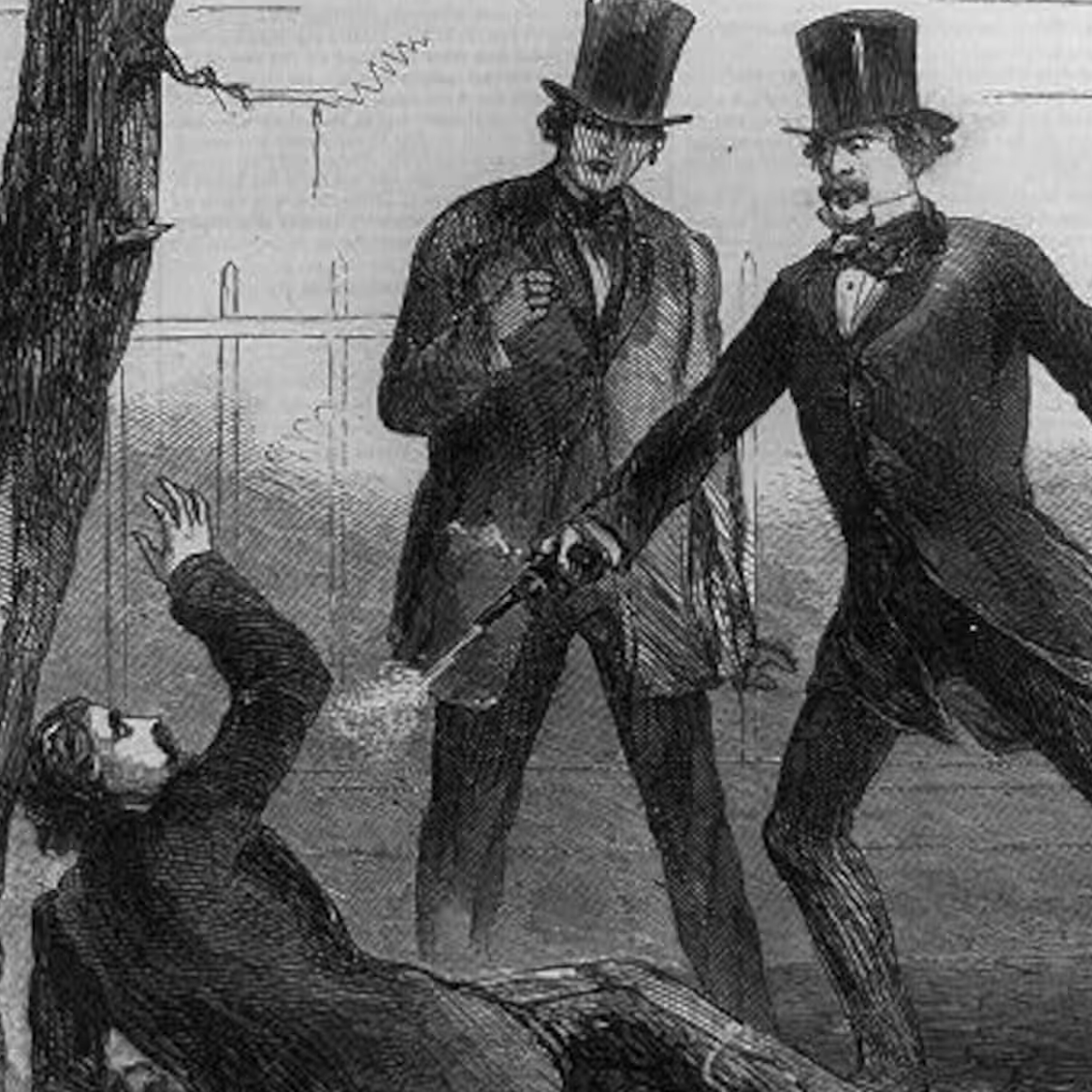
Sure. So Daniel Sickles is on top of the world. He's been elected to Congress from New York City. His beautiful wife is quickly rising in the ranks in Washington society. She puts on the most sought after parties. And prominent members of both political parties will be in attendance. The ambassadors from other country, these business leaders and people think, wow, sky's the limit for Daniel Sickles. He was a protege of then President James Buchanan. He had served as Buchanan's aide when Buchanan was minister to the Court of St. James. So what we would know today as the ambassador to the United Kingdom. And so as far as Daniel Sickles knows, he's on top of the world and the sky's the limit. And someday he's going to be living across the street from his Lafayette Square mansion in the White House. Then one day after a party, he pulls out a letter that had been handed to him earlier that day by a messenger. And he reads it. And the letter tells him it's a pseudonymous letter. It's, it's, it's signed rpg. And it tells him in great specificity that his wife, Theresa Sickles, is meeting Philip Barton Key, the U.S. attorney for the District of Columbia, so the chief federal prosecutor for our nation's capital and American royalty, the son of Francis Scott Key, the author of our national anthem. And the letter explains that Barton Key, as he is known, is meeting Teresa Sickles in a house on 15th Street. And that as the letter writer says, he has as much the use of your wife as you do. And so Sickles would ordinarily have ignored something like that, except for the details, which made it both hard to ignore and easy to substantiate. And so Sickles goes into the map room of the House of Representatives, and he finds what I'll describe as his henchman, a guy that he had brought with from Tammany hall in New York, got him a job in D.C. and kind of his eyes and ears in the Capitol. He tells him what happened, shows him the letter, and they are able to verify the truth of the letter. And Sickles confronts his wife, who admits her guilt, who signs a confession. And then Sickles is beside himself. What do I do? What do I do about my marriage? What do I do about my wife and my daughter and my political career? And what do I do about Key? And so while Sickles is sort of talking this through with his henchmen and a guy named Butterworth, who is a friend of his from New York who was visiting dc, they're sitting in the parlor of the Sickles house on Lafayette Square, and they watch Barton Key enter Lafayette Square and start waving his handkerchief at the house, which was the signal for Sickles wife to go meet him at their rendezvous house. And so, while Sickles is trying to figure out what to do, and bursting with anger and rage and frustration, he sees this guy out there in Lafayette Square on a Sunday, unseasonably warm Sunday in 1859. He heads out there in a trench coat with at least three firearms, and he sends Mr. Key to his fate.
- [09:13]
Bob Crawford
So he murders him in broad daylight.
- [09:18]
Chris DeRose
In broad daylight. There are plenty of witnesses, everyone from treasury clerks to Cyrus McCormick, the inventor of the mechanical reaper, is an eyewitness who testifies at the trial. And interestingly enough, there is a young man who was an aide to James Buchanan. He runs into the White House to tell James Buchanan what had happened. And the President, actually, this is one instance we know for sure in American history where a president committed the crime of obstruction of justice. So this young aide says, Daniel Sickles has murdered Barton Key in front of the White House. And of course, as we mentioned, Sickles is Buchanan's close friend. He's his former aide. He's kind of a protege. He tells his aide, he goes, well, you know, as a material witness, you might be held in jail until the trial, which of course was not true. And he says, here, I'm going to give you some money. I'm going to give you a souvenir of your time here in the White House. And he hands him a shaving razor that he had bought while he was ambassador in the United Kingdom. And he says, here's the shaving razor, which I just assume it's not a great souvenir. It was either a better gift at the time than it seems today, or it was just what he had around him, hands him that and some money and says, you better get back to North Carolina. And so that story made it into the North Carolina newspapers later in that young man's life. And I actually was able to get in touch with his grandson and track down the razor. So the family donated that razor to the. To Wheatland, to the James Buchanan Homestead and Museum. And so I actually helped find that razor, find the family, and got that where people can go view it as a tangible proof of how the President helped a witness get out of town.
- [11:05]
Bob Crawford
That's amazing, Chris. So here I'm sure Sickles is arrested, right?
- [11:11]
Chris DeRose
Sickles actually goes and turns himself in. And of course, Sickles is a guy who always does things with style. Where do you turn yourself in after you've murdered the U.S. attorney? You go to the home of the Attorney General in Franklin Square. And so he went and turned himself in at the home of the U.S. attorney General. And he was held in a notorious prison called the Blue jug in Washington D.C. and when he complained about his accommodations, the jailer said, these are the finest accommodations you members of Congress have afforded us.
- [11:41]
Bob Crawford
And so what happens at the trial? How does the trial go? Because this plays into our, you know, the undergirding of what is the unwritten law.
- [11:53]
Chris DeRose
Absolutely. So one interesting aspect of this trial, among many, is that Sickles is represented by the first legal dream team in American history. And it kind of happens by accident. You know, news of his arrest gets out. His friends in New York start sending lawyers, people in D.C. start finding lawyers for him. So he has this extensive legal team drawn of friends of his who were the most prominent lawyers in New York City. Edwin Stanton, who is on the verge of eternal fame, about to join Buchanan's cabinet as Attorney General, and of course, in short order, Abraham Lincoln's cabinet as our Civil War Secretary of War. But before that, he's Daniel Sickles lawyer. He's a prominent member of Sickles defense team. And so you have these incredible lawyers lined up to represent Sickles. You have a new U.S. attorney who had to be appointed by James Buchanan before the trial could commence. At first, you know, there's a lot of popular feeling in the country that maybe Sickles did what was necessary or what was right. As time passed, everyone seemed to agree that the further they could prolong the trial, the likelier it was that Sickles would hang. And so the defense makes a series of arguments, kind of a half hearted self defense argument. Well, none of you people saw whether Key had a gun in his hand. Maybe Kee had a gun, maybe Kee threatened him. You know, you don't really know. You know, maybe they did this sort of half. I'm not sure that they believed it, but they were trying to just kick up dust every way they could. They argued that the affair itself was provocation for the murder and that the murder was justified on those grounds alone. Which was kind of a remarkable argument to make in a court of law, as the U.S. attorney pointed out. Because the most you'd really seen before that was if you caught a man in bed with your wife, there might be mitigating circumstances, you might get away with manslaughter, you know, some kind of heat of the moment defense. But it was never seen as a complete defense that would lead to an acquittal.
- [13:54]
Bob Crawford
So how did temporary insanity Play into this.
- [13:59]
Chris DeRose
Well, so you have witnesses who encountered Sickles before the shooting. And you have witnesses including the Attorney General of the United States and a US Senator from Pennsylvania who saw him right after the killing. And he appeared pretty composed. And so you couldn't make the argument that Sickles was just insane, but the argument they made was that it was suffering under temporary insanity. So he puts on a trench coat to conceal three firearms and walks across Lafayette Square. And I've paced it out. It's a few minute walk. You know, Lafayette Square in front of the White House is pretty big.
- [14:39]
Bob Crawford
It's plenty of time to realize that you're about to make a big mistake.
- [14:43]
Chris DeRose
Well, I don't know if he ever saw it as a mistake, but he certainly was cognizant of what he was doing. But his defense argued to the jury that during the time that he shot Key, and maybe not a minute before, maybe not a minute after this all transpired, but certainly during that time he was laboring under a mental distress that excused his conduct as a matter of law.
- [15:09]
Bob Crawford
So this becomes something that is known as the unwritten law. And you know, I was reading your book, there's a whole chapter on this in your book which I recommend everybody go by immediately. It's, it's Star Spangled Scandal by our great guest today, Chris derose. But it wasn't always like this, right? It wasn't always like you create a, you commit a crime of passion and you're going to be, you know, found temporarily insane and you get off. What were the societal changes in the mid 19th century that made this okay, that made juries say, you know, I don't think we should hold this man responsible for his actions.
- [15:55]
Chris DeRose
Yes. So I think one of them actually is the rise of mass media. So if we think about this celebrity obsessed, scandal obsessed, breaking news obsessed culture that we live in today, it all has its roots in this event from 1859. So in the beginning of American history, you really had two kinds of newspapers. You had political newspapers that parties would subsidize and try to get out to as many people as possible to promote their ideas and their candidates. And then you had sort of what you think of as like the shipping news, you know, commercial business intelligence, big broadsheets with lots of information about which, which ship docked here and how much did they sell their cotton for and what cargo did they buy in port and things like that that people had to pay a premium to buy. As printing presses got more efficient, you could now print newspapers that you could sell at a profit to the average person. And so news coverage changed and became more sensational to sort of fulfill this demand of the average person for news about crime and fires and animal stories and the kind of things you see written about, talked about today in the news. So more popular subjects. And so, you know, sort of called the penny press, where the average person now had access to daily newspapers, perhaps less edifying information than may have preceded it. But so you have these newspapers and then the invention of the telegraph and the scaling of the telegraph. So now, you know, I write about in the book about how it took two weeks to find out in the state capital of Missouri that William Henry Harrison had died. You know, and when the telegraph is introduced, people wondered what was the use in finding out information right away when you could wait a few days and find out about it through the mail? Because newspapers were being exchanged throughout the country. You know, it was free to post newspapers. And so newspapers would exchange copies of their editions with each other and then print each other's news all across the country. But that would take some time. So with the scaling of the telegraph, you had almost instantaneous information all across the country. And so Sickles really lit the match with this incredible story, right? The prominent congressman, the beautiful wife, the handsome son of American royalty, and this horrific crime that happened in front of the White House. I mean, this is the OJ case of the 19th century, but in D.C. and with political people, but. But. So people were looking for turn of the screw coverage from this trial, everything they could find out about the people involved. And really, if you looked prior to that, you think about the murder of Helen Jewett, for instance, in New York, that was probably the most covered crime. Prior to that, you're talking about a few paragraphs in a newspaper. And in this case, many newspapers are printing verbatim coverage of that day's proceedings in trial. So this is really. This was the most covered event in human history to this point. And it's a story that Americans are experiencing almost as one for the first time in American history. And so I think this really creates this impression on people that, you know, what, what Sickles did was right. The jury was right to acquit him. We should stop punishing people for this. And then it's off to the races as far as the unwritten law goes.
- [19:22]
Bob Crawford
And it gets to the point where. Where you have governors giving pardons for these crimes in the cases when men are convicted. Talk about a few of those, because there's one interesting one I recall from South Carolina?
- [19:37]
Chris DeRose
Yes. Well, if it even got that far. There's been some research into just how many thousands of cases where the unwritten law spared someone what would otherwise be the legal ramifications of murder. And many cases were just never charged. If the cases were charged, often you would find the grand jury would refuse to indict. If the grand jury indicted, the judge may well dismiss the case. And if the judge didn't dismiss the case, the jury would likely acquit. And in the rare instances where you could get somebody to verdict on an unwritten law case and the jury found them guilty, the judge would often hand down a nominal fine or a minor slap on the wrist. However, in the unusual cases during the era of the unwritten law where you could get someone all the way to verdict and the judge handed down a meaningful sentence, the governor would be expected to use their executive clemency to let the person go. And there was one instance in Kentucky that was remarkable that a man catches his wife in bed with another man. He shoots the man, kills him, and the governor announces preemptively that if there are any criminal proceedings, I'm going to pardon him, so don't even bother. And what was really unusual about that is that the victim was the governor's son. But even a governor would be expected to pardon the killer of his own son in order to vindicate the public expectation and public support for the unwritten law. Now in South Carolina, I think this is the most incredible. You know, we as historians, Bob, we tell stories to illustrate phenomenon and I think this is the best example. So in South Carolina, the bosom of the Confederacy after Reconstruction, a black man catches a white man in bed with his wife and kills him and the governor pardons him. So the unwritten law was stronger and more widely supported than racism and unequal treatment of the law in post reconstruction South Carolina shortly after the Civil War.
- [21:50]
Dexter Thomas
Are there any pictures of you online? I'm not just talking about Google, I'm talking anywhere.
- [21:54]
Malcolm Gladwell
Clearview scrapes together images from Facebook, from LinkedIn, from Venmo accounts.
- [22:01]
Dexter Thomas
That data begins is now being used by police departments all across the country to match criminal suspect photos. And sometimes it makes mistakes.
- [22:08]
Malcolm Gladwell
So in this one case, two of their search results that I think were in the top 10 of the search results were Michael Jordan, just a picture of Michael Jordan.
- [22:16]
Dexter Thomas
But cops are still using it to make arrests.
- [22:18]
Malcolm Gladwell
Police, they are trusting the software to lead them to the right suspect. But you're not even being told that it was used, let alone given any of the details, details about how it works.
- [22:28]
Dexter Thomas
This is not Minority Report. This is happening right now. People are getting arrested and doing actual time in jail after being picked out by a computer. I'm Dexter Thomas, host of Kill Switch, where every Wednesday we explain the right now of living in the future. You can turn off the computer, but do not let the computer turn you off. Listen to Kill Switch in the iHeartRadio app, Apple Podcasts or wherever you get your podcasts.
- [22:54]
Chris DeRose
All I know is what I've been told and that's a half truth is a whole lie.
- [22:59]
Narrator/Promoter
For almost a decade, the murder of an 18 year old girl from a small town in Graves County, Kentucky went unsolved until a local homemaker, a journalist and a handful of girls came forward with a story.
- [23:15]
Chris DeRose
I'm telling you, we know Quincy killed her.
- [23:18]
Narrator/Promoter
We know a story that law enforcement used to convict six people and that got the citizen investigator on national tv.
- [23:26]
Kyle McLaughlin
Through sheer persistence and nerve, this Kentucky housewife helped give justice to Jessica Curran.
- [23:33]
Narrator/Promoter
My name is Maggie Freeling. I'm a Pulitzer Prize winning journalist producer and I wouldn't be here if the truth were that easy to find.
- [23:44]
Kyle McLaughlin
I did not know her and I.
- [23:45]
Malcolm Gladwell
Did not kill her or rape or burn or any of that other stuff.
- [23:48]
Chris DeRose
That y' all said. They literally made me say that I took a match and struck and threw it on her.
- [23:53]
Narrator/Promoter
They made me say that I poured.
- [23:54]
Chris DeRose
Gas on her.
- [23:57]
Narrator/Promoter
From Lava for good. This is Graves County, a show about just how far our legal system will go in order to find someone to blame.
- [24:07]
Chris DeRose
America, y' all better wake the hell up.
- [24:09]
Bob Crawford
Bad things happens to good people and small towns.
- [24:16]
Narrator/Promoter
Listen to Graves county in the Bone Valley, feed on the iHeartRadio app, Apple Podcasts or wherever you get your podcasts. And to binge the entire season ad free, subscribe to Lava for Good plus on Apple Podcasts.
- [24:38]
Danny Trejo
Welcome fellow seekers of the dark. I'm Danny Trejo. Won't you join me in Nocturnal Tales from the Shadows, an ethology of modern day horror stories inspired by the legends and lore of Latin America. Take a trip from ghastly encounters with evil spirits to bone chilling brushes with supernatural creatures and experience the horrors that have haunted Latin America since the beginning of time. You should probably keep your lights on for Nocturnal Tales from the Shadows. Listen to Nocturnal Tales from the Shadows as part of my Kaltura Podcast network, available on the iHeartRadio app, Apple Podcast or wherever you get your podcast.
- [25:38]
Dr. Elizabeth Poynter
Welcome to Decoding Women's Health. I'm Dr. Elizabeth Poynter, Chair of Women's health and gynecology at the Adria Health Institute in New York City. On this show, I'll be talking to top researchers and top clinicians, asking them your burning questions and bringing that information about women's health and midlife directly to you.
- [25:57]
Chris DeRose
100% of women go through menopause.
- [26:00]
Narrator/Promoter
It can be such a struggle for.
- [26:02]
Chris DeRose
Our quality of life life. But even if it's natural, why should we suffer through it?
- [26:07]
Narrator/Promoter
The types of symptoms that people talk about is forgetting everything. I never used to forget things. They're concerned that one, they have dementia and the other one is do I have adhd?
- [26:17]
Dr. Elizabeth Poynter
There is unprecedented promise with regard to cannabis and cannabinoids to sleep better, to have less pain, to have better mood, and also to have better day to day life. Listen to Decoding Women's Health with Dr. Elizabeth Poynter on the iHeartRadio app, Apple Podcasts or wherever you're listening now. You know the shade is always shadiest right here. Season six of the podcast Reasonably Shady with Gisele Bryant and Robyn Dixon is here dropping every Monday as two of the founding members of the Real Housewives Potomac. We're giving you all the laughs, drama and reality news you can handle. And you know, we don't hold back. So come be reasonable or shady with us each and every Monday. I was going through a walk in my neighborhood. Out of the blue, I see this huge sign next to somebody's house. The sign says, my neighbor is a Karen.
- [27:20]
Chris DeRose
No way.
- [27:21]
Dr. Elizabeth Poynter
I died laughing. I'm like, I have to know. You are lying. Humongous, y'. All. They had some time on their hands. Listen to Reasonably Shady from the Black Effect Podcast Network on the iHeartRadio app, Apple Podcasts or wherever you get your podcasts.
- [27:46]
Bob Crawford
This is American History Hotline. I'm your host, Bob Crawford. Today my guest is Chris DeRose, author of Star Spangled Scandal, Sex, Murder and the Trial that Changed America. We're talking about, well, sex and murder. Remember to send us your burning hot sexy questions about American history. Record yourself using the voice memo app on your phone and email it to AmericanHistoryHotlinemail.com that's AmericanHistoryHotlinemail.com now back to the show. So, Chris, the unwritten law, and this is the part that I kind of find most fascinating about this, is that it's never codified.
- [28:31]
Chris DeRose
Never codified. In fact, the American Bar association speculated that maybe it should be codified because it was undermining actual laws, laws that had been passed by legislatures and common Law that had been handed down by judges because probably the most closely adhered to law in the country at this point in American history was a law that nobody ever wrote down.
- [28:52]
Bob Crawford
So, Chris, you spent a lot of time studying this case and all the consequences of it, from temporary insanity to the unwritten law. What does this tell you about human nature? What thoughts did this kind of bring to mind or ponderings for yourself personally? Because you're a lawyer as well, right? You're trained in law.
- [29:16]
Chris DeRose
So. Yeah. And as a former attorney, as both a prosecutor and former criminal defense lawyer, you understand that, like, the civilization is a thin veneer, and that when people experience something traumatic like this, there is a natural human impulse for revenge, and there is an understanding among people why you did what you did, and understanding that you're probably not a menace to society, you're just a threat to people who would violate your home in words that were used at the time. And so I think that's what we learn about human nature, right? That everything we see that appears to be a bulwark against anarchy and against people just reacting and acting on their natural impulses. I don't know. I said civilization's a thin veneer.
- [30:07]
Bob Crawford
So this is a cultural moment, right? The period, which was about 100 years.
- [30:13]
Chris DeRose
If not a little more, it goes into the 1950s. So plenty of your listeners.
- [30:18]
Bob Crawford
So how does it change? How does it change back? How do people. How does it get to the point where someone says, no, this guy.
- [30:27]
Chris DeRose
Should.
- [30:27]
Bob Crawford
Be penalized for this?
- [30:29]
Chris DeRose
Right? So I think it all revolves around our perception of women and women's rights. If you look at the news coverage around the Sickles trial, you know, Teresa Sickles and her virtue was almost seen as Daniel Sickles, his property, in a way, right? He is the man of the family. She is his wife. Barton Key had taken something from him. And it's really interesting to see how Teresa Sickles really got it coming and going, because she both gets both blamed for the affair and ostracized from society, but also KE is treated as someone who seduced her, this poor, innocent woman who had no agency in this situation. So she was treated at once as having no agency, but also as being to blame and paid for with the price of her place in society. Her friends never called on her again, and she never went out in society following this incident for the rest of her life. So I think, as you know, with World War II, more women were entering the workforce with so many men under arms, women entering the workforce and new roles and new responsibilities. Having their own money, having a measure of independence they didn't enjoy attaining new status in society. And so I think as we enter the 1950s, we're really starting to say, you know, what a woman's honor was or a daughter's honor, it's really not a man's to vindicate anymore. Women can make their own decisions and be responsible for those decisions, and it's really not so. I think it's that changing perception of women and their role in society that leads to both the beginning and end of the unwritten law.
- [32:07]
Bob Crawford
Wow, Chris, that is crazy. Like we think that we live in crazy times now, and we do live in crazy times. But I think through your book and through talking about the unwritten law, all times are crazy.
- [32:21]
Chris DeRose
Do you think as a historian, I don't share the panic that some people do at various points in history, we are very lucky to have been born and to live in America and at this time in history in America and things were always crazy. And every generation has had significant problems and some far greater than ours.
- [32:41]
Bob Crawford
In the chaos there is optimism. Chris DeRose, thank you so much.
- [32:46]
Chris DeRose
A pleasure.
- [32:52]
Bob Crawford
You've been listening to American History Hotline, a production of iHeart podcasts and Scratch Track Productions. The show's executive producer is James Morrison. Our executive producers from iHeart are Jordan Runtal and Jason English. Original music composed by me. Please Bob Crawford. Please keep in touch. Our email is americanhistoryhotlinemail.com if you like the show, please tell your friends and leave us a review in Apple Podcasts. I'm your host, Bob Crawford. Feel free to hit me up on social media to ask a history question or to let me know what you think of the show. You can find me at bobcrawford Bass thanks so much for listening. See you next week.
- [33:45]
Narrator/Promoter
In the heat of battle, your squad relies on you. Don't let them down. Unlock elite gaming tech@lenovo.com Dominate every match with next level speed, seamless streaming and performance that won't quit. Push your gameplay beyond performance with Intel Core Ultra processors for the next era of gaming. Upgrade to smooth high quality streaming with Intel Wi Fi 6e and maximize game performance with enhanced overclocking. Win the tech search power up@lenovo.com.
- [34:15]
Malcolm Gladwell
Malcolm Gladwell here. This season on Revisionist History. We're going back to the spring of 1988 to a town in northwest Alabama where a man committed a crime that would spiral out of control.
- [34:26]
Kyle McLaughlin
And he said, I've been in prison.
- [34:27]
Chris DeRose
24 times, 25 years.
- [34:29]
Kyle McLaughlin
That's probably not long enough.
- [34:31]
Chris DeRose
I didn't kill him.
- [34:32]
Malcolm Gladwell
From Revisionist History, this is the Alabama Murders. Listen to Revisionist History, the Alabama murders on the iHeartRadio app, Apple Podcasts, or wherever you get your podcasts.
- [34:45]
Kyle McLaughlin
Hey, I'm Kyle McLaughlin. You might know me as that guy from Twin Peaks, Sex and the City, or just the Internet stand. I have a new podcast called called what Are We Even Doing? Where I embark on a noble quest to understand the brilliant chaos of youth culture. Each week I invite someone fascinating to join me to talk about navigating this high speed rollercoaster we call reality. Join me and my delightful guests every Thursday and let's get weird together in a good way. Listen to what are we even doing on the iHeartRadio app, Apple Podcasts, or wherever you get your podcasts.
- [35:22]
Ed Helms
Hey, it's Ed Helms, host of Snafu, my podcast about history's greatest screw ups. On our new season, we're bringing you a new snafu Every single episode.
- [35:32]
Narrator/Promoter
32 lost nuclear weapons. Wait, stop.
- [35:36]
Dr. Elizabeth Poynter
What?
- [35:36]
Ed Helms
Yeah, it's gonna be a whole lot of history, a whole lot of funny, and a whole lot of fabulous guests. Paul Scheer, Angela and Jenna, Nick Kroll, Jordan Klepper. Listen to season four of SNAFU with Ed Helms on the iHeartRadio app, Apple Podcasts, or wherever you get your podcasts.
- [35:54]
Norah Jones
Hey, I'm Nora Jones and I love playing music with people so much that my podcast called Playing along is Back. I sit down with musicians from all musical styles to play songs together in an intimate setting. Over the past two seasons, I've had special guests like Dave Grohl, Levy, Rufus Wainwright, Mavis Staples. Really too many to name. And there's many. So still so much more to come in this new season. Listen to Norah Jones is Playing along on the iHeartRadio app, Apple Podcasts, or wherever you get your podcasts.