Loading summary
Transcript127 lines
- [00:00]
David Fleming
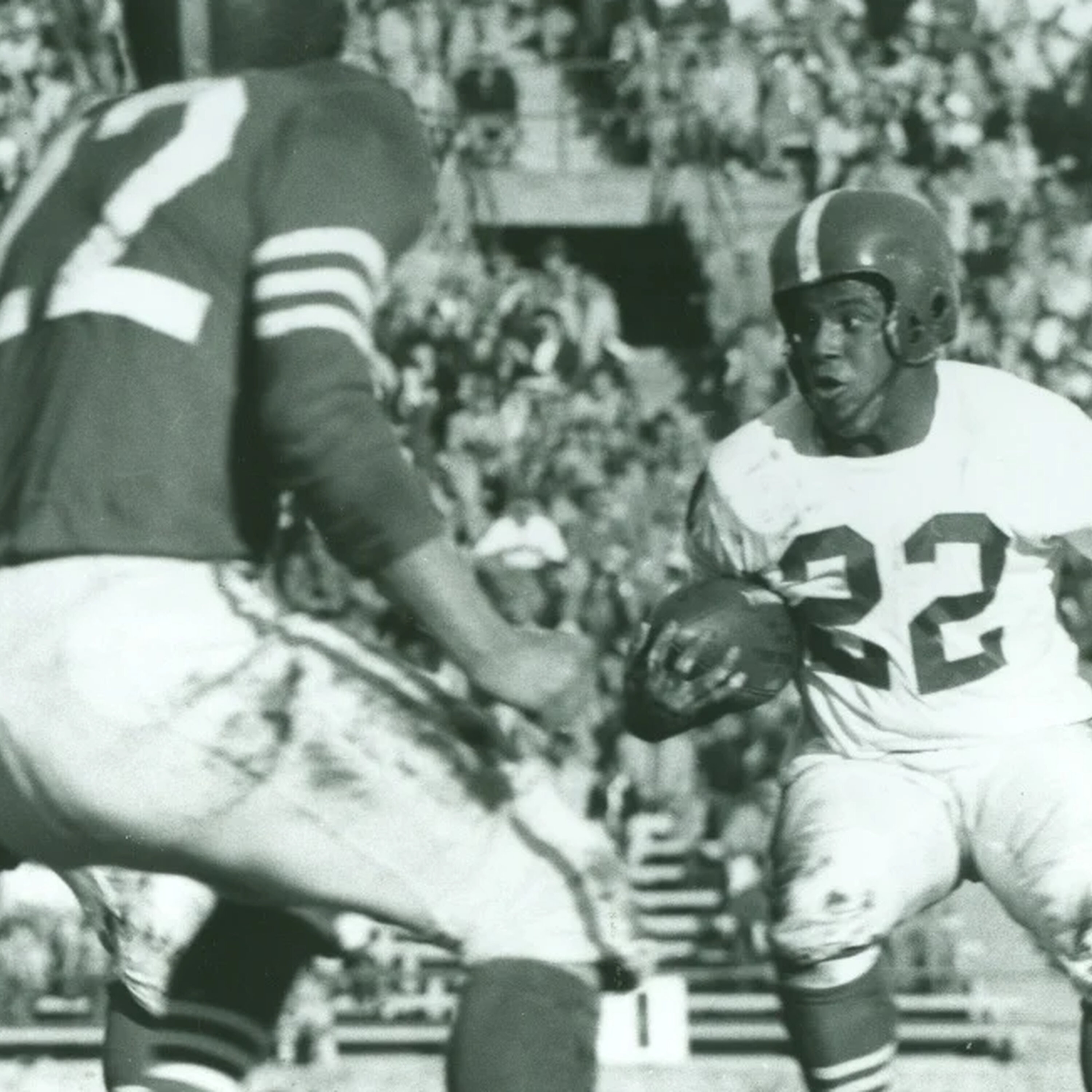
George Talfero and Buddy Young were not allowed to live with the rest of the players. They had to live in a section of Dallas that there were still 12 unsolved house bombings for black families that had dared to move just a little bit closer to white Dallas. And those bombings were no one was ever convicted of those bombings. And that's the atmosphere they have to move into while playing professional football.
- [00:35]
Bob Crawford
You've reached American History Hotline. You ask the questions, we get the answers. Leave a message. Hey there, American History Hotliners. Bob Crawford here. Thrilled to be joining you again for another episode of American History Hotline, the show where you ask the questions. And the best way to get us a question is to record a video or a voice memo on your phone and, and email it to American History hotlinemail.com that's americanhistoryhotlinemail.com okay. Today's question is about one of my favorite topics in the whole world, football. And just in time for the Super Bowl. Here to help me answer this question today is David Fleming, author of the book A Big Mess in Texas. Let me hold it up for the video. Author of the book A Big Mess in Texas, the miraculous disastrous 1952 Dallas Texans and the craziest untold story in NFL history. David, thank you for joining me today.
- [01:40]
David Fleming
Oh, my pleasure, Bob. Thanks for having me. I can see I am in the right place because of your sweatshirt. So I like it.
- [01:49]
Bob Crawford
I like it. Yes, I am wearing a throwback Los Angeles Rams sweatshirt. Okay. So here's the question we're hoping you can help us answer. It comes from Kathy in Troy, New York. She says, I feel like we all know the story of Jackie Robinson breaking the color barrier in baseball, but what about integration of other sports like football? How did that happen? So, David, I want to talk about the role of the Dallas Texans in integration, but let's start with some context first. How did we even stumble across this NFL team that's been called one of the worst of all time? Speaking of the Los Angeles Rams, don't.
- [02:34]
David Fleming
Be that hard on yourself.
- [02:36]
Bob Crawford
Yeah, we're doing better than, like, Cleveland.
- [02:38]
David Fleming
Yeah, exactly. Well, that you, that is, that's my answer. So I have, I grew up outside of Detroit and, and my father's side of the family is from Cleveland. And so I have these poor for the longest time, I have these poor, sorry, NFL fans, Detroit Lions fans and Cleveland Browns fans. And it was right after the Browns went, oh, they became the second team in history after the Lions to go winless throughout an entire season I'm pretty sure it was 2017 and trying to be a good son, a good cousin, a good nephew, I started researching if the Browns or the Lions truly were the worst team to ever play in the NFL. And that is when I stumbled upon this incredible story of this team that even though I'd covered the NFL for on a national level for 30 years, I had no idea that they existed. And it was the 1952 Dallas Texans, the last NFL team to go bankrupt. It's a crazy story.
- [03:45]
Frog Fuel Advertiser
Every year people make the same fitness goal Train Harder. But most fail because recovery gets ignored, especially connective tissue that muscles depend on to grow. Frog Fuel was developed by Navy SEALs and perfected by a Stanford trained scientist, delivering 15 grams of nano hydrolyzed collagen protein that digests in just 15 minutes. It's science backed and ready to drink. No mixing, no sugar, no junk. This year, don't just train harder, recover smarter. Go to frogfuel.com that's frogfuel.com, stay unbreakable.
- [04:15]
Bowen Yang and Matt Rogers
Seems like just yesterday that the Two Guys Five Rings podcast was in Paris for the Olympics, and now we're heading to Milan for the 2026 Milan Cortina Olympic Winter Games. I'm Bowen Yang. And I'm Matt Rogers and we'll join athletes from 93 countries as Two Guys Five Rings hits the Italian Alps for the 2026 Milan Cortina Olympic Winter Games. Open your free iHeartRadio app. Did we mention it's free? Search Two Guys Five Rings and listen now.
- [04:45]
Jay Shetty
Hey, I'm Jay Shetty, host of the On Purpose podcast. On a recent episode, I sat down with Nick Jonas, singer, songwriter, actor, and global superstar.
- [04:55]
Nick Jonas
I went blank. I hit a bad note, and then I couldn't kind of recover. And I built up this idea that music and being a musician was my whole identity. I had to sort of relearn who I was. If you took this thing away, who am I?
- [05:08]
Jay Shetty
Listen to On Purpose with Jay Shetty on the iHeartRadio app, Apple Podcasts, or wherever you get your podcasts.
- [05:15]
Podcast Narrator (Black History Month segment)
Black history lives in our stories, our culture, and the conversations we still having today, this Black History Month. The podcast I didn't know. Maybe you didn't either. Digs into the moments, perspectives and experiences that don't always make the textbook. Let me tell you about Garrett Morgan Bruh had to pretend he didn't even exist just to sell his own invention. Listen to I didn't know. Maybe you didn't either. From the Black Effect Podcast Network on the iHeartRadio app, Apple Podcasts, or simply wherever you get your podcast.
- [05:52]
Bob Crawford
So you focused on the Texans and this 1952 season. Can you paint a picture of this era, the players, the fans, what's happening historically at this time?
- [06:04]
David Fleming
Oh, yeah. I mean, for people who are. It's going to be hard for like modern day fans to put this, this team in this era in context. But to me, it was sort of the, the television money that changed the NFL and, and grew it into sort of this national pastime and this sort of like buttoned down, mega billion dollar corporation. That money kicked in in the late 50s and there's a whole great story behind that. But before that television revenue kicked in. Most people don't know that the NFL was this chaotic, colorful, violent league that, that people literally didn't know from week to week, month to month, if it would survive as, as a, as a, as a athletic, as a, as a, as a pro professional sports.
- [07:05]
Bob Crawford
League.
- [07:05]
David Fleming
And I know it's hard for people to understand that, but 31 of the first 43 NFL franchises went bankrupt and the last of them was the 1952 Dallas Texans, who did it in, you know, did it in short order and with a lot of drinking and part. And fun along the way.
- [07:28]
Bob Crawford
It's like the Animal House. Reading your book, it's like very much like the Animal House of football or animal. Or football was Animal House, which you mentioned. This is professional sports at the time. Did I read correctly in your book, am I recalling this right, that the NFL was kind of the understudy to college football? College football was legitimate and the NFL was kind of like this other thing.
- [07:59]
David Fleming
Oh, exactly. I don't even think I. The NFL was, I think Art Donovan, one of the players on this team and a iconic character in NFL history, he said something like, you know, in the 50s, the NFL was like they were behind college football, baseball, boxing, horse racing, and I think Art even threw in synchronized swimming. So it was just, it just. People just didn't take it seriously. And people didn't. They thought it was dis. They didn't. They thought it was not dignified to play for money. And they, people definitely did not like that. The games were on Sunday too.
- [08:36]
Bob Crawford
All right, so you mentioned Art Donovan, who is one of the most colorful characters in all of NFL, maybe all of sports history. Tell us about Art Donovan.
- [08:49]
David Fleming
Yeah, so he's one of the many forgotten characters who were actually on this team. And I think everyone remembers Art Donovan. He was sort of like later in life he became almost like the football version of Bob Uecker. Right. He was on David Letterman. He was part of that tastes great, less filling Miller Light commercials. And, you know, he was sort of this, he was a truth teller about this era of the NFL, and people loved him for it because he just didn't, didn't hold back. But at the same time, he was a. I think he may have been the first interior defensive lineman voted into the hall of Fame. And people know him because he went on to sort of anchor those great Baltimore Colts teams with Johnny Unitis and Gino Marchetti. But, yeah, he got his start in Dallas in 1952. And Art said even with all the other accomplishments and all the other crazy things he had done, his most fame, his favorite season ever was in Dallas. He said he wouldn't trade, trade it for a million bucks.
- [09:57]
Bob Crawford
So we. You. You name checked him. We need to talk about him. Gina Marquette.
- [10:01]
David Fleming
Oh, man. Yeah. I mean, imagine doing a.
- [10:05]
Bob Crawford
You, you.
- [10:05]
David Fleming
I uncovered this story. I'm like, oh, I wonder who's on this team? And you look through it and you're going, I don't know if anybody's going to care about this team. And then one of the rookie, the top rookie on the Dallas Texans was Gino Marchetti, arguably the greatest defensive player in NFL history. His rookie season was with the Dallas Texans, and it was such a wild, crazy season. And he, he, he writes. And one of the last interviews he gave, it wasn't to me, but was on his rookie season in Dallas. And he was so disappointed by how disorganized it was and how the checks bounced and how nobody knew who he was or even who the team was, that he thought for a while about Quitt and going back to San Francisco, but thank goodness he didn't.
- [10:58]
Bob Crawford
So, you know, we're talking about how this team was so bad, this 1952 Dallas Texans, but they, they had just become the Dallas Texans. They were the New York Yanks just a year before professional football franchise, Right? Hemorrhaging money, right? Yep, yep. And the. There's a colorful commissioner of the NFL, Burt Bell. Right? Let's start there.
- [11:23]
David Fleming
Right. Okay. So Bert Bell was he, he was this Philadelphia blue blood through and through. He came from a really wealthy family. I think one of his family members was the Attorney General for the state of Pennsylvania. But Bert Bell was sort of like the family's wild child. He played for Penn and was a degenerate gambler at Penn, and in fact, once bet everything he had, plus a car that his dad had just bought him. On a pen game that he was playing in as quarterback and lost, lost it all. So he goes on. But his one great true love throughout his entire life was football. Just committed his entire life to it and eventually becomes an owner. You know, he was a player. He was then an owner and then he became commissioner. And we talk about him because he is such a colorful character. But every NFL fan today should know who he is because he really. During this era that we were talking about where it's chaotic and teams are going bankrupt and, and nobody knows who's going to survive from week to week. It was Burt Bell, the commissioner who really kept, kept the league. Sorry. Kept the league connected and, and helped it survive from literally single handedly. He invented the sort of the, the reverse draft order. He invented the scheduling that helped with parody. He fought off all these different mergers. So anybody who enjoys the game today owes a debt of gratitude to Bert Bell. But he really was this larger than life, bombastic, just bulldog of a guy who just really just kind of like he just ruled the league just through his own sort of like strength and cult of, of personality. And one of the big things that he, the problems that he had was. Okay, here's the second part of your answer. Kate Smith was essentially the Taylor Swift of her time.
- [13:35]
Bob Crawford
Right. Just. And for sports fans in the NHL, Philadelphia Flyers. I'm from South Jersey, so I know this history very well. Flyers fan. So Kate Smith would later become famous for singing God Bless America before the Flyers games, home games. Right. There is a statue of her or there was outside the spectrum. The old Spectrum. I haven't been to the new spectrum, but very revered. So. Yes. So she is this famous singer. Yeah. How does she get involved in professional football? In the night in 1951, 1952.
- [14:13]
David Fleming
So before that she's so popular with. She's got like radio shows and television shows and she. I'm not exaggerating. I mean she really was sort of the Madonna or the, or the Taylor Swift over time. And she is. I think she was so popular she helped raise. I think it was in. This is in the 1940s, she raised a half a billion dollars for the war effort. So that gives you an idea of like sort of her power and reach. But she's making so much money along with her business associate Ted Collins that they don't know what to do. They need tax shelters. And at the time, we've already talked about this. If you wanted to buy a business that was going to lose piles of money so that you could write it off. You would invest in the NFL.
- [15:01]
Bob Crawford
It's like the producers.
- [15:03]
David Fleming
Exactly, exactly. And so Kate Smith's business associate and manager, Ted Collins, buys the New York Yanks, and they proceed to lose, I think even more than he had hoped or. Or could afford. Over like five to eight years. They lose more, I think close to $2 million. And in 1951, Ted. Ted finally gives up and turns the team back over to Burt Bell and the NFL. And that then creates this vacuum where for competitive and scheduling balance, the. Burt Bell needs a 12th team. And so in his rush to fill that 12th spot, he looks around and goes, oh, I think there are some investors slash suckers in Dallas who would buy this team, who would buy the worst team ever and take them to Dallas. And that's when he found Giles Miller.
- [16:05]
Bob Crawford
And at this point, the NFL is not in the South. There. There is not a professional franchise in the South. And we need to mentally take ourselves back to the south. And in the late forties, early fifties. Enter Giles Miller. Who was Giles Miller.
- [16:23]
David Fleming
Yeah. So Giles Miller is the son of Clarence Miller, who at the time was known as the textile king of the. Of the Southwest. I think he owned the largest textile manufacturing west of the Mississippi. So it was really Clarence Miller's money, but his son Giles was really his kind of like, just think of this sort of classic 1950s dreamer schemer, constantly sort of failing upward, just constantly, like investing in oil wells. And they're running dry. And they're running dry. But it's Giles Miller and his deep love of college football, high school football, Texas football. He's Cotton bowl, right? The Cotton bowl is like, right, you know, right in Dallas. He's watched his high school teams play there, SMU play there, and he's the one who is like, had the idea to bring the NFL to Dallas. And again, in context, it sounds like a great idea. It's Texas. It's Dallas. What could possibly go wrong, right? I mean, who could go bankrupt selling football in Texas? But Giles. Giles managed to do it and did it in record time.
- [17:43]
Bob Crawford
What's your favorite fact about John Quincy Adams? Was it that he is the only former president to serve in Congress after his term as president? Or maybe it's the fact that he literally died at his desk in the Capitol of the United States. Well, you can read all about this in my new book, America's Founding Son, John Quincy Adams From President to Political Maverick. It's hitting bookstore shelves soon, so pre order your copy today.
- [18:13]
Frog Fuel Advertiser
Every year, people make the same fitness goal train harder but most fail because recovery gets ignored. Especially connective tissue that muscles depend on to grow. Frog fuel was developed by Navy Seals and perfected by a Stanford trained scientist. Delivering 15 grams of nano hydrolyzed collagen protein that digests in just 15 minutes. It's science backed and ready to drink. No mixing, no sugar, no junk this year, don't just train harder, recover smarter. Go to frogfuel.com that's frogfuel.com stay unbreakable.
- [18:44]
Bowen Yang and Matt Rogers
Seems like just yesterday that the Two Guys Five Rings podcast was in Paris for the Olympics. And now we're heading to Milan for the 2026 Milan Cortina Olympic Winter Games. I'm Bowen Yang. And I'm Matt Rogers and will join athletes from 93 countries as tourists. 2 guys 5 rings hits the Italian Alps for the 2026 Milan Cortina Olympic Winter Games. Open your free I Heart radio app. Did we mention it's free? Search Two Guys five Rings and listen now.
- [19:14]
Jay Shetty
Hey, I'm Jay Shetty, host of the On Purpose podcast. On a recent episode, I sat down with Nick Jonas, singer, songwriter, actor, and global superstar.
- [19:24]
Nick Jonas
The thing I would say to my younger self is, congratulations. You get to marry Priyanka Chopra Jonas. And also, you know, your daughter is incredible.
- [19:32]
Jay Shetty
That's beautiful, man. Yeah, thank you. It's so beautiful. I can see that got you a little.
- [19:38]
Nick Jonas
Yeah, for sure. Our daughter, she came to the world under sort of very intense circumstances, which I've not really talked about ever.
- [19:49]
Jay Shetty
Growing up on Disney in front of Million, how did that shape your sense of self?
- [19:54]
Nick Jonas
I went blank. I hit a bad note. Then I couldn't kind of recover. And I built up this idea that music and being a musician was my whole identity. I had to sort of relearn who I was. If you took this thing away, who.
- [20:06]
Jay Shetty
Am I Listen to? On Purpose with Jay Shetty on the iHeartRadio app, Apple Podcasts, or wherever you get your podcasts.
- [20:14]
Hans Charles and Armenalek Lumumba
Welcome to the A building. I'm Hans Charles.
- [20:16]
Podcast Narrator (Black History Month segment)
I'm in Lumumba. It's 1969. Malcolm X and Martin Luther King Jr have both been assassinated, and black America was at a breaking point. Rioting and protest broke out on an.
- [20:27]
Hans Charles and Armenalek Lumumba
Unprecedented scale in Atlanta, Georgia. At Martin's alma mater, Morehouse College, the students had their own protest. It featured two prominent figures in black history, Martin Luther King Sr. And a young student, Samuel L. Jackson.
- [20:44]
Podcast Narrator (Black History Month segment)
To be in what we really thought was a revolution. I mean, people were dying.
- [20:48]
Hans Charles and Armenalek Lumumba
1960, the murder of Dr. King, which traumatized everyone.
- [20:53]
Bob Crawford
The FBI had a role in the murder of a Black Panther leader in Chicago.
- [20:59]
Podcast Narrator (Black History Month segment)
This story is about protests. It echoes in today's world far more than it should and it will blow your mind.
- [21:07]
Hans Charles and Armenalek Lumumba
Listen to the a building on the iHeartRadio app, Apple Podcasts, or wherever you get your podcasts.
- [21:17]
Bob Crawford
This is American History Hotline. I'm your host, Bob Craw. Today my guest is David Fleming, author of the book A Big Mess in Texas, the miraculous disastrous 1952 Dallas Texans and the craziest untold story in NFL history. We're talking about some wild times in football history and we're talking about integration of the league. Remember to send us your burning questions about American history. Record yourself using your voice memo app on your phone and email it to AmericanHistoryHotlinemail.com that's AmericanHistoryHotlinemail.com now back to the show to get to our listener's question. Who were the two black stars on the team and was either of them like the Jackie Robinson of football?
- [22:10]
David Fleming
Yes. I mean that is the perfect way, that's the perfect way to just to describe these guys. And in fact, men like Tony Duny, hall of Fame coach Tony Duny has described them as the Jackie Robinson's of the NFL. And not to pat myself on the back, but we really, Bob, we really got from, we got from Kate Smith to Burt Bell to Giles Miller and not right into, I mean, you're a pro. I got to say, look, I drew.
- [22:36]
Bob Crawford
Up the play and you know, yeah, executed it.
- [22:40]
David Fleming
Look at that. Look at that. It's see film, film, study. Film study. So Giles Miller again, we talked about him as a dreamer and a schemer and sort of a guy who just constantly sort of failed upward. Well, he buys the New York Yanks and immediately the newspapers, everything. The big issue is the New York Yanks have, they have three, their three best players are black and over the summer one of them gets traded. But there is still plans are moving ahead. And Giles Miller says to his credit, even despite the atmosphere and what it was like in Dallas, which in the 30s was essentially the epicenter of the Ku Klux Klan and was the Jim Crow laws in Dallas and throughout the south just draconian and just awful to even imagine which that not being that long ago, but Giles Miller, to his credit, because I should say this is kind of a really interesting side note to the story. Giles Miller, because he was a rich, grew up rich and wealthy on the north side of Dallas. Those families, it was very common, those families. He was raised essentially by his family's black butler and Giles Miller, not uncommon.
- [24:00]
Bob Crawford
For that, for that time period.
- [24:02]
David Fleming
Exactly. And you see, you see how this, these little sort of accidents of culture create big change. Because Giles Miller said, I've got these great black players. How can I look that man who is my, essentially my father? How can I look him in the eye if I were to trade them or cut them just because they were black? So Giles Miller says from the very beginning, I don't care what the atmosphere is like in Dallas. Our team is going to be, the roster of our team is going to be filled with players, the best players, regardless of race, creed, religion, etc. And it was a beautiful sentiment and a courageous sentiment, but it was also incredibly naive for Giles not to understand what that meant, not just to the players, but to the team, to his own sort of bank account. And that's why I'm so glad you brought up this part. And I think one of the reasons why this team has been forgotten and sort of erased from NFL history is that people do tend to sort of nostalgically whitewash the reason why the last NFL team went bankrupt. And it's essentially because the Dallas Texans two best players were Buddy Young and George Talfaro. And Dallas and Texas as a whole simply would not support a team with an integrated roster.
- [25:28]
Bob Crawford
What sort of pushback did these men face while they were in Dallas, living in Dallas, playing for this team.
- [25:36]
David Fleming
So George Talafaro, who was, by the way, great timing because he was really the first iconic star at Indiana and he led Indiana in 19 in the mid-1940s to before recently their only sort of undefeated, undisputed Big Ten championship. George Talafaro then was also the first black player to be drafted by the NFL. And if, depending on the semantics of what you call a quarterback, I still, I think George Talfaro was also one of the first black quarterbacks in modern NFL history. So he really does sort of live up to this, this Jackie Robinson, he.
- [26:21]
Bob Crawford
Also helped and he's been forgotten.
- [26:23]
David Fleming
Yes. Yeah.
- [26:24]
Bob Crawford
And he's not, is he, Is he represented in the hall of Fame anywhere? I hate to admit that I've not been to Canton. I mean, is he, to your knowledge?
- [26:35]
David Fleming
No, he's not in Canton. He's in the College Football hall of Fame. But I don't understand how, you know, the. All that he accomplished that he couldn't be in Canton. It's another sort of blemish on the hall of Fame's credentials. But he also, by the way, single handedly helped integrate Bloomington. He Used his football stardom to, to sort of gain access to all the places that black people couldn't go, at restaurants and movie theaters and, and whatnot. So he really was, he was a hero. He was a, he was a courageous pioneer. And his quotes about, about knowing that he would have to be careful in Dallas because he could get lynched are maybe the most chilling moments in an otherwise pretty, pretty sort of like laid back book. But you understand, the first thing he had to realize was he, the George Talfero and Buddy Young were not allowed to live with the rest of the players. They had to live in a section of Dallas that there were still 12 unsolved house bombings for black families that had dared to move just a little bit closer to white Dallas. And those bombings were. No one was ever convicted of those bombings. And that's the atmosphere they have to move into while playing professional football.
- [28:09]
Bob Crawford
Were blacks at the time allowed to attend the games? Were they allowed to attend NFL games in Dallas?
- [28:16]
David Fleming
They were. It was just hyper segregated. So in the Cotton Bowl. The Cotton bowl was essentially in the 1950s Jim Crow Dallas, the Cotton bowl and the state fair, they were monuments to segregation, to the sort of racist policies and the white supremacy that was going on. And the Cotton bowl, black fans were allowed to stand in this roped off section of the Cotton Boll that was in the sun. And another thing that, that Giles Miller promised was, you know, we've got, we've got an integrated roster. We're going to welcome the black community as, as our fans. It's going to be, you know, this is going to be, this team is for everyone. And again, great sentiment and it was a lovely promise, but he was too naive to sort of do. To understand that that was never going to happen. And so Giles makes all these promises and this part of the community in Dallas is very excited to be included and represented. They show up for the first game and not only are they not welcome, the restrictions are even greater. And basically after that first game, the black community then boycotted the Dallas Texans.
- [29:37]
Bob Crawford
The first game, if I recall from the book, correct me if I'm wrong. Against the Giants.
- [29:42]
David Fleming
Yes, yes.
- [29:44]
Bob Crawford
And the Giants had a player on that team that, you know, I'm 54, you know, men of my age will remember Tom Landry as the coach, as the buttoned up coach, fine, finely dressed coach of the, of the Dallas cowboys of the 1970s. But at this point, he's on the Giants. Yeah, they're playing the Texans.
- [30:08]
David Fleming
Yeah. And it's, it is one of the Aspects. The Tom Landry stuff is one of the aspects of this story that I love, and I think all NFL fans will love, is that this team seems to be connected. They're connected to your Rams. They're connected to. I think it was something like a dozen eventual hall of Famers, whether it's in the NFL hall of Fame, the College Football hall of Fame, or the, the Professional Wrestling hall of Fame. They've got World War I and World War II veterans. They, they've got all these crazy stories. And, and one of the connections that sort of makes them the Forrest Gump of the NFL is this Tom Landry story. And that Tom Landry. So that would be eight years before he took over as the iconic Cowboys coach. He helped the Dallas Texans score their first touchdown, and it was in the season opener in the Cotton Bowl. Tom Landry drops back to catch a punt. He fumbles it, and the Dallas Texans collect the ball. And that's how they score the first touchdown in Dallas Texans history is because of the butterfingered Tom Landry.
- [31:20]
Bob Crawford
I'll be thinking about special teams until September of next year.
- [31:24]
David Fleming
It's too soon.
- [31:25]
Podcast Narrator (Black History Month segment)
It's too soon.
- [31:26]
David Fleming
I'm sorry very much.
- [31:29]
Bob Crawford
Tell me about this Thanksgiving Day game against the Chicago Bears. I mean, first of all, were the Bears as iconic then as they are now?
- [31:37]
David Fleming
Yes, I would say even more so. Right. Because. So the, the Texans. The Texans, despite the fact that they're loaded and they've got a lot of talent, just things just. I think they're so distracted by worrying about checks bouncing and drinking and sort of just. They end up, I think they lose their first nine games in a row. The league then takes the franchise back and places them in, of all places, Hershey, Pennsylvania. And so the Texans, to sort of get back at the league, they go on a month long bender in Hershey, Pennsylvania that people in Hershey, Pennsylvania are still talking about to this day. It would make Jimmy Johnson's Dallas Cowboys blush what was going on. Wow. In Hershey, Pennsylvania. But they, they are. They're supposed to play the Bears. The George Hallis Chicago Bears, who are in contention for the NFL title in 1952. They're supposed to play the Bears in Dallas on Thanksgiving. Well, they can't because the team is no longer in Dallas. So Bert Bell comes up with this great idea that they're going to have the Bears and the Texans are going to play each other on Thanksgiving in Akron, Ohio, as the second part of a double header. And the first game of the day is going to be a high school football game. So the Bears and the Texans show up to the Rubber bowl in Akron, Ohio, and there's 30,000 fans there. And at the end of the high school football game, 28,500 of those fans get up and leave. And so the Bears and the Texans are now inside what is essentially an empty football stadium. And they have to play their Thanksgiving game. And everybody's mad, everybody's angry. Nobody wants to play this game. And as a, as a gesture of goodwill, George Hallis puts his backups on the field to start the game. And Bob, this is like this, this is honestly like a classic, like sports movie moment. George Hallis meant it as a nice gesture. The Texans took it as the final last insult. And it was this moment where they were like, we're not taking this anymore. And they rally, they get so angry, they sort of. Everything comes together. All the talent gels. And they end up beating the Chicago Bears basically in front of 500 fans in Akron, Ohio, in a game that basically nobody watched or paid attention to. But the Chicago Tribune called it the greatest upset in NFL history.
- [34:33]
Bob Crawford
What happens after the game?
- [34:35]
David Fleming
So George Hallis is so mad because he understands, right, that they are now connected. They're. He, George Hallis himself is connected to this, the worst upset in NFL history. He is. As his players are walking back to the locker room, he's kicking them all in the backside. And then again, because the players were away from their families, they serve them all like turkey dinners on trays. Well, George Hallis is so mad, he goes up and down the aisles and he's smacking the trays of Thanksgiving dinner out of his players laps. And he's saying, you bums don't deserve Thanksgiving this year.
- [35:19]
Bob Crawford
So just, just, I mean, everything about, like I was telling you before, that if you. I rewatched the intro to NFL Today, which was like the, you know, it was the, you know, like people watch Fox, you watch the, the pregame, you know, NFL show. Anyway, it was the one, as I recall, of my youth. It was on cbs. It was like Brent Musburger and Phyllis George, Jimmy the Greek, Irv Cross. Anyway, every, every football play that is featured in the montage of the introduction is now a penalty if you go, go on YouTube. And I mean, seriously, there's nothing is legal that is, that is in this montage of clips. It's just incredible. So what happens to the Texans at the end of, at the end of that 1952 season?
- [36:14]
David Fleming
Well, so they, they go on this epic bender in hershey and by Bender.
- [36:20]
Bob Crawford
You mean we're talking Animal House here.
- [36:23]
David Fleming
Oh, full on, yes. One of their. They have a. They have a defensive lineman named Chubby Grigg, and he was basically around 350 pounds. And that was 70 years ago, right? Or 70, you know, so he was.
- [36:38]
Bob Crawford
The John Belushi of this. Of the.
- [36:41]
David Fleming
Yes, he would, he would. He was famous for eating four hot dogs during every. The halftime of every game. And he would put like his parka over his head and thinking no one could see him. And then he would eat his four hot dogs and then go back out on the field. But he. Art Donovan described him as a sort of West Texas psychopath. And. And he really was. And in Hershey, he was famous for. He would line up 17 grasshopper shots, which is like cream to mint and cream to cocoa and. Yeah, both. We're both cringing right now.
- [37:18]
Bob Crawford
I'm sorry that I know this.
- [37:19]
David Fleming
Yeah, me too. It was like the, the. The espresso martini of the 1950s. Right?
- [37:27]
Bob Crawford
That's right. It had its moment. It had.
- [37:29]
David Fleming
Everyone has a bad story associated with an espresso martini, but. So he would line up 17 shots and then he would pick a teammate and everybody was so afraid of him, they wouldn't. Nobody would say no. And they. The. The game was. You had to race Chubby to the middle of the row of these shots and whoever got, whoever drank the ninth shot, the odd number shot one. And there's this great story of Chubby doing that and the players staying in this bar in Hershey for so long that they had essentially been snowed in. And Chubby does his grasshopper game. He. He vomits and passes out and the players have to borrow a kid's sled and put Chubby's passed out body on the sled and they have to pull him through the streets of Hershey to get back to the team hotel by curfew.
- [38:29]
Bob Crawford
So we talked about that. That Buddy Young and George Talafaro have been forgotten. What happens to them immediately after. After the Texans, what becomes of them?
- [38:42]
David Fleming
Yes. Sorry. And I got, I got carried away with Chubby stories and not.
- [38:46]
Bob Crawford
You can't get too carried away.
- [38:49]
David Fleming
And that is a big part of this story. And my. One of my favorites is so the Texans out of this mess, out of this just embarrassing, bankrupt disaster the Texans eventually become. And this is another reason why they've been erased. They become the NFL.
- [39:07]
Bob Crawford
The, the.
- [39:08]
David Fleming
The button down business. Like All American, Johnny Unitis, Baltimore Colts, the team that essentially saves the NFL. And so I Don't think the NFL really wants people to know. They think it. Maybe it tarnishes the Baltimore Colts their place in history, but the Colts were born out of this disaster that we've been talking about. It's my favorite part of the whole story. But Buddy Young and George Talfaro and Art Donovan and Gino Marchetti, they all then move on and essentially become the foundation of this really important and incredible Baltimore Colts franchise.
- [39:53]
Bob Crawford
We can't neglect to tell the audience that the 1952 championship was played between the Detroit Lions and the Cleveland Browns. And Detroit won that game.
- [40:07]
David Fleming
Yes. Yes.
- [40:08]
Bob Crawford
Yep. So history, all kinds of things. If you fall in love with history, you learn all kinds of things that are mind blowing and unbelievable because if that, if that pairing ever pops up again in a Super bowl, that would be, at this point, from where we stand now, would be incredible. Okay, so who you got for the big game?
- [40:28]
David Fleming
Oh, man. So I, you know, I think I love what the Patriots are doing, but I feel like the, I feel like the NFC is much stronger this year, and I feel like the Seahawks, I think, I hope it's close. I don't even think it's going to be close. I think the Seahawks win in a walkover.
- [40:47]
Bob Crawford
Do you have that great defense to, to. To compliment what Sam Darnold is doing there? As a Rams fan, I would love to see Cooper cup win another Super Bowl. That'd be a great, A great ending story for him if you, if you follow what happened to him on the Rams. So, yeah, I have to agree with you. It's hard for me to pull for Seattle, but I'm going to do it.
- [41:09]
David Fleming
Yeah.
- [41:10]
Bob Crawford
Although we do. We have. We're in North Carolina. We've got the Drake May connection.
- [41:14]
David Fleming
Right. And that's why I'm almost, I'm nervous about what that Seahawks defense on the biggest stage. And I've talked to quarterbacks who were very young when they played in the super bowl, and it.
- [41:27]
Jay Shetty
You.
- [41:28]
David Fleming
What you'll see is it's so overwhelming, the whole thing. Right.
- [41:33]
Bob Crawford
The.
- [41:33]
David Fleming
The two weeks leading up to it and all the, all the, all the hype and all the stuff that the, Especially the younger quarterbacks, they fall off a cliff in the third quarter because they're exhausted. Right.
- [41:47]
Hans Charles and Armenalek Lumumba
They.
- [41:47]
David Fleming
It's like everything catches up with them in the third quarter. So, yeah, I'm rooting for Drake May. Gosh, his family lives just down the road from, from where I'm at, but he'll get back. And, but, boy, that Seahawks defense, I would not want to be. I would not want to be Drake May, I'll tell you that much.
- [42:06]
Bob Crawford
Yeah. I'd be interested to know how Mike. Mike Rabel's preparing him for this game.
- [42:12]
David Fleming
Yeah.
- [42:14]
Bob Crawford
A man who's experienced at the big game.
- [42:17]
David Fleming
Yeah. And I think even. And I think that's the thing. Even if you. If you. If you're. If you stay on them and you're like, you know, do as little as you can and. And get your sleep and try not to sort of, you know, get taken away by all the hype. It doesn't matter. It's still. The game day itself is so long and so protracted and so over the top that that's. You know, what's funny is you. It's the players that. Yeah, it's the players that I always knew Tom Brady when he was younger. Tom Brady. There's this great story about when Tom Brady was a young quarterback at the Super Bowl. They couldn't find him pregame because he had gone somewhere and fallen asleep and taking this incredible nap before the Super Bowl. And it was. People were like. That's when we knew he. Tom Brady was different.
- [43:08]
Bob Crawford
Yeah. Well. And of course, that super bowl was against the Rams, and I'm hitting.
- [43:13]
David Fleming
I'm sorry. I'm sorry. You're gonna hang up on me.
- [43:15]
Bob Crawford
And if I'm not mistaken, that's the one where the Patriots filmed the Rams practice the day before.
- [43:22]
Podcast Narrator (Black History Month segment)
So.
- [43:22]
Bob Crawford
Yep. Yeah. Okay.
- [43:24]
David Fleming
Boy, I'm hitting. I'm hitting. Are there any other terrible Rams.
- [43:27]
Bob Crawford
You know what? I. I may have. I. I just want to make this point ways. I may have drawn up the play and you may have executed it to perfection, but the general manager of this show is James Morrison, and we need to give producer James Morrison all the credit he deserves here. I've been talking to David Fleming, author of the book A Big Mess in Texas, the miraculous disastrous 1952 Dallas Texans, and the craziest untold story in NFL history. I cannot recommend this book enough. It is just with everything going on in the world, do yourself a favor and read this book and just take a deep breath and just feel good for a little while. David, thank you for joining us on American History Hotline today. Thank you.
- [44:16]
David Fleming
Oh, my pleasure. Thanks, Bob.
- [44:22]
Bob Crawford
You've been listening to American History Hotline, a production of Iheart podcasts and Scratch Track Productions. The show's executive producer is James Morrison. Our executive producers from Iheart are Jordan Runtal and Jason English. Original music composed by me, Bob Crawford. Please keep in touch. Our email is americanhistoryhotlinemail.com if you like the show, please please tell your friends and leave us a review in Apple Podcasts. I'm your host, Bob Crawford. Feel free to hit me up on social media to ask a history question or to let me know what you think of the show. You can find me at bobcrawford Bass. Thanks so much for listening. See you next week.
- [45:16]
Frog Fuel Advertiser
Every year, people make the same fitness goal Train harder. But most fail because recovery gets ignored, especially connective tissue that muscles depend on to grow. Frog Fuel was developed by Navy Seals and perfected by a Stanford trained scientist, delivering 15 grams of nanohydrolyzed collagen protein that digests in just 15 minutes. It's science backed and ready to drink. No mixing, no sugar, no junk. This year, don't just train harder, recover smarter. Go to frogfuel.com that's frogfuel.com, stay unbreakable.
- [45:46]
Bowen Yang and Matt Rogers
Seems like just yesterday that the Two Guys Five Rings podcast was in Paris for the Olympics. And now we're heading to Milan for the 2026 Milan Cortina Olympic Winter Games. I'm Bowen Yang. And I'm Matt Rogers and we'll join athletes from 93 countries as Two Guys Five Rings hits the Italian Alps for the 2026 Milan Cortina Olympic Winter Games. Open your free iHeartRadio app. Did we mention it's free? Search Two Guys Five Rings and listen now.
- [46:16]
Jay Shetty
Hey, I'm Jay Shetty, host of the On Purpose podcast. On a recent episode, I sat down with Nick Jonas, singer, songwriter, actor and global superstar.
- [46:26]
Nick Jonas
I went blank. I hit a bad note. Then I couldn't kind of recover, and I built up this idea that that music and being a musician was my whole identity. I had to sort of relearn who I was. If you took this thing away, who am I?
- [46:39]
Jay Shetty
Listen to? On Purpose with Jay Shetty on the iHeartRadio app, Apple Podcasts or wherever you get your podcasts.
- [46:46]
Podcast Narrator (Black History Month segment)
1969 Malcolm and Martin are gone, America is in crisis, and at Morehouse College, the students make their move.
- [46:54]
Hans Charles and Armenalek Lumumba
These students, including a young Samuel L. Jackson, locked up the members of the board of trustees, including Martin Luther King Sr. It's the true story of protest and rebellion in black American history that you'll never forget. I'm Hans Charles Armenalek Lumumba. Listen to the A Building on the iHeartRadio app, Apple Podcasts or wherever you get your podcasts.