← American Thought Leaders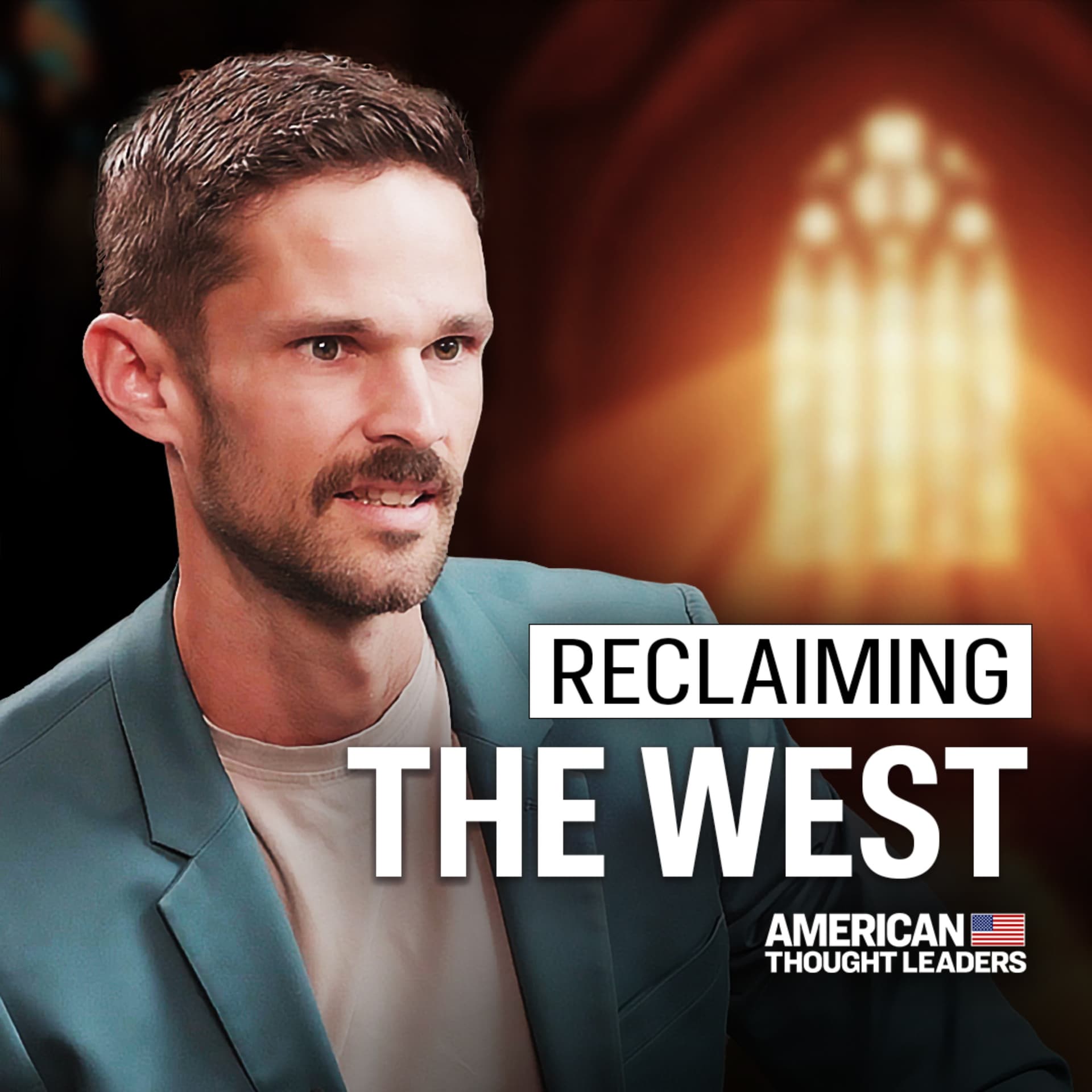
American Thought Leaders
From Cultural Revolution to Cultural Revival: Spencer Klavan on ‘How to Save the West’
01:03:12
Loading summary
Transcript84 lines
- [00:00]
A
People are starting to realize that you can only scream and yell and tear down statues and set things on fire for so long before things start to get really bad. And now the energy seems to be in the direction of recovering and rebuilding some of our most profound traditions, these wisdom traditions of Athens and Jerusalem. You're starting to see a return to, if not traditional religion, to sort of spiritual ideas, of something other than just the raw materialism that has dominated for so long.
- [00:33]
B
Spencer Clavin is an associate editor of the Claremont Review of Books, host of the Young Heretics Podcast, and author of several books, including how to Save the West.
- [00:43]
A
Trump's order to restore classical architecture. I think that speaks to a certain instinct he has for people's hunger for them. These are forms that have endured and survived for a reason and that maintain their beauty because they connect with the eternal. I mean, there's a reason why brutalism goes out of date and those classical buildings still look as beautiful as ever.
- [01:05]
B
This is American Thought Leaders, and I'm Jania Kellogg. Spencer Clavin, Such a pleasure to have you on American Thought Leaders.
- [01:13]
A
Oh, yeah, it's a delight. Thank you for having me.
- [01:16]
B
Well, so what really has happened to Western culture?
- [01:21]
A
It's a big question. I think, broadly speaking, we are living at a turning point right now, and for most of my life, if not all of my life, we have been in a period of really serious crisis and decline. I think 2020 and the ensuing events were kind of the most dramatic form of this. But in many ways, as other people have pointed out, the riots of 2020 and the disasters of the COVID pandemic and its aftermath were just final kind of explosion that had been building and boiling for decades and decades and decades. I mean, in my particular domain, which is Western culture, Western arts and literature and philosophy, you really can trace that back at least to the cultural revolution of the 60s and 70s. Hey, hey, ho, ho. Western Civ has got to go. This really dedicated rejection of our wisdom traditions, especially in schools especially, conspiring directly to kind of miseducate and uneducate young kids and college kids. And I think you saw the fruits of that when America went through one of its biggest crisis, perhaps crises in our history with this kind of outpouring of partisan rage and iconoclasm and what Roger Scruton might have called oikophobia, the fear of everything local and native. And what's really remarkable about that to me, is not that it happened. In fact, it seemed pretty predictable that it would go happen at some point, given Anything gone on. But what's remarkable is that we seem to have now come out of it and passed through into something quite different. It's typically referred to in casual speeches, the vibe shift. We've seen this real kind of shifting of momentum, shifting of weight away from this kind of oikophobia, this revolutionary jacobinite spirit, and into a kind of brighter and perhaps more optimistic period where people, even if they're not aggressively right wing, even if they're not even Trump voters, people are starting to realize that you can only scream and yell and tear down statues and set things on fire for so long before things start to get really bad. And at a certain point, you have to actually be constructive and you have to build. And now the energy seems to be in the direction of kind of recovering and rebuilding some of our most profound traditions, these wisdom traditions of Athens and Jerusalem. You're starting to see return to, if not traditional religion, to sort of spiritual ideas. Something other than just the raw materialism that has dominated for so long is coming back, I think, into popularity, starting to see young men in particular, returning to church and to traditional religious services. And you're starting to see a kind of political energy in the direction of pro Americanism. It's no longer cool to be detached and critical of everything that went before. Now there's a renewed interest in kind of some degree of cultural stability and clarity. And all of this is very much in its infancy, very early days. But I do think that we're passing now into some kind of new era for rebuilding, which is very exciting for. For me, as somebody who's really never lived through a period like this, like this before.
- [05:07]
B
That's fascinating. Just very briefly, for the benefit of those in our audience who might not be familiar, what you mean by Athens and Jerusalem as being the foundation, just very briefly.
- [05:19]
A
Absolutely. Well, this is a concept that we use to understand what we mean when we talk about the West. We throw around this idea of Western civilization so much that sometimes you have to stop and think, well, what actually do I mean by that? We have a vague, I think, kind of sense of classical columns, and maybe the founding fathers are involved and people kind of know Western civ when they see it. But when pressed to define it, I like to refer to this idea of Athens and Jerusalem. And these are two great cities of the ancient world, each of them standing in for a major tradition. And when I say Athens, I'm talking about pagan philosophy and classical ideals, questions of virtue and logos, that is reason. What can be best known, using merely human Reason. But one thing I think that is clearly true is that human reason alone can't get us all the way. And so that's what Jerusalem stands in for. The scriptural traditions, first of all the Jews in the ancient Israelites and then of the Christians who come emerge out of Judaism. And that's what Jerusalem stands in for is. Is that idea of revelation. So with that kind of twin pairing of reason and revelation, you get Western civilization, which then flowers and grows in a million different directions, but those are. Those are its sources.
- [06:42]
B
So you referenced Roger Scruton earlier, and it made me think. I believe he said something like, as for the definition of Western civilization, we make symphonies. Is it ring a bell?
- [06:54]
A
I love that.
- [06:55]
B
Yeah. Yeah. And that's very interesting. It fits very well into your area of interest, which is beauty. I mean, there's something unbelievable. I'm thinking right now of the Mozart's Jupiter Symphony, which is my favorite, which is just this unbelievable thing. Right. And how did someone even conceive of that?
- [07:17]
A
We're sitting in Nashville and we have this great orchestra here. They just had their concert, an annual concert that is a sort of suggested donation, but it's mainly for the community. And they did Gustav Mahler's second Symphony, which is called his Resurrection Symphony, which I never heard before. Mahler was, in many ways a tortured and difficult artist. He was sort of a transitional figure between these big kind of Germanic composers like Wagner and some of the modernism that would. Would come later. And the Resurrection Symphony grew out of a reaction to his friend's death. He first composed this smaller piece, which was the first movement of the symphony, although he didn't know it at the time. And it is this funeral march that kind of alternates between triumph and lament, and the kind of soaring movements of it start to break down and be troubled by chaos. And he builds this ultimately into this musical interrogation of chaos and order. And is there life after death? That is, is there some meaning beyond everything that we now see and experience? Or do we just have to ultimately go down to the dust and be abandoned in chaos? And in the hinge of this. Of this symphony, in the fourth movement, there is a solo, an alto solo, which is unusual for the time. And it's a poem, a traditional folk song from the kind of German repertoire of folk music. And effectively, the message of the piece is we are in such here in our deepest pain. God will give us a light that will lead us out to a new dawn. And then the last and final movement of this grand choral resurrection and I was sitting there thinking exactly as you say. You know, not just this piece of music, which is so beautiful, but the centuries and centuries of thought and emotion and feeling and struggle that had to go into creating the culture in which Mahler could produce this work of art and in which it could have meaning. I think that culture is so rich and so ubiquitous, we've all kind of moved through it our whole lives that we think it just fell out of the sky. We think that everyone has always had these ideas, believed in absolute truth, believed in the good and the beautiful, or that all men are created equal. I mean, all these things that we cite now as if they were kind of common sense. And one thing that studying history really shows you is most people in most times and places haven't believed in these things. In fact, the history of the world generally is quite bleak and full of savagery and barbarism and pain. And it's in the midst of that that we have this thing that we call Western civilization, which consists in these two great sources of reason and revelation. And so one thing that happened, I think, when we had. We sort of started out by talking about the summer of 2020 and the disaster that sort of afflicted our culture is people destroyed so much and that we saw so much destruction that we actually came up against what the world looks like without Western Civ. If you. If Western Civ has got to go, what are you going to replace it with? And it turned out the answer was basically revolution. Infinite revolution and savagery.
- [10:57]
B
If I may. You know, on the one hand, there was this, you know, yeah, this kind of movement of destroying history and so forth, but at the same time, there was this, you know, movement to destroy the global economy. I mean, it's interesting. This is. These things were happening simultaneously, and I hadn't really thought about that until this moment. There's a whole lot of destruction going on in the name of some kind of progress. In all cases, I think, well, the.
- [11:26]
A
Economy is a good example of another thing we think just kind of exists. It's just there in the universe. Most people, and I certainly speak for myself when I say I'm by no means an economist. And so it would be easy for me to go about my day to walk into the supermarket and choose among, you know, riches that would have made King Ashurbanipal of Assyria blush. I mean, his jaw would have dropped. The great kings of old would have been assaulted, astonished to see a modern supermarket. And it would be easy for me to just walk in and take that for granted and think, great, this is just how the world works. Things come from who knows where. And as you say, that's actually a wonder of the world, very carefully built up over many, many decades and even centuries. And there was this heedless just, you know, well, we can afford to kind of throw money at people. We can afford to shut this all down for a bit so that Covid doesn't spread, and we'll just give people stimulus checks and we'll just incur yet more debt to add to our already towering number. And I think that people, again, if you do that long enough, you actually start to hit rock bottom and you realize, oh, these things aren't just kind of guaranteed. We actually have to work to maintain them. And that's another thing people are rediscovering.
- [12:48]
B
I think there's a central theme of human dignity. Thinking about this has been plaguing me for years, years now, and how easy it is with some sort of possibly lofty ideal to almost forget about the dignity of every individual human life, which is kind of a centerpiece of this tradition.
- [13:15]
A
Yes.
- [13:16]
B
That you've been describing. And if I may deviate slightly, I don't think it's just the Western tradition. And this is, you know, we were chatting a bit earlier about the abolition of man and CS Lewis and the concept of the Tao and this kind of universal morality that he discussed. That always resonated me because I saw that not just in the Western tradition.
- [13:43]
A
Yes. Well, that is interesting. I mean, one accusation that is typically made against people like me when we start talking about Western civ and Athens and Jerusalem is, well, do you just think that everyone else in the world is backwards? You know, are you a Western chauvinist or supremacist in the sense that you think only these nations? And usually the insinuation is that there's a racial component to this as well, that basically it's code for you just only like white people or white nations or anything like that. And my answer to this includes exactly what you just said to. To affirm the beauty, the uniqueness, the preciousness of Western civilization does not imply that nobody anywhere else ever has had a good civilization. In fact, I'm fascinated by Japanese culture. So that's a civilization that just happens to have a great deal of respect and interest for me. But as you say, human dignity or the worth of human life is, I think, very central to any rightly understood dao. That is, any reason tradition that is worth the name. And I think you do find this Also in Confucianism, for instance, I'm not all that familiar with the intricacies of that particular philosophy, but. But I gather that this is a central aspect of Confucian thought as well. And everyone. It's interesting as they get to thinking, once people think deeply, they begin to see that this is a necessity of our. Of any moral system. It's certainly crucial in. In Christian ethics because of what we call the imago dei, which is the image of God. You get this in Genesis 1. Crucially, when St. Paul goes to the Areopagus, which is the hill where he preaches to the Greek philosophers, when he goes to Greece to evangelize in pagan Europe, he quotes the Stoic poet Aratus. And this is in Acts 17, when he's giving this sermon, he says, we are his offspring. That is God's offspring, as some of your own poets have said. And he's referring there to the fact that completely separate from the Christian tradition, outside of this religious, very culturally specific religious tradition, the Greek philosophers had also worked their way to something like this idea of human dignity, of mankind, the image of God. You find this in, for instance, in Seneca's letters when he's saying, you should treat your slaves well. Why should you treat your slaves well? Because they're humans just like you, even though they're so much lower in the social hierarchy. And so, yeah, some of these principles are not universal in the sense that everyone has always known or believed them, because there are many, many societies where the human dignity is not respected even today. And in fact, that's a major danger. But it's also the case that around the world there are a variety of different traditions where people have thought carefully, struggled, worked hard to figure out kind of what are the core principles of a good, of a good ethics. And they all end up with this core idea of human dignity. Which is one reason why when somebody tells you as the French, as the Jacobins in the French Revolution did, as Lenin before Stalin and then Stalin did in the Soviet Union, when somebody says to you, I've got the perfect system for humanity. Everything is going to work great, the economy is going to be great, we're going to have money, we're going to have. Well, one thing we have to do is we have to just get rid of this idea of human dignity. You see this a lot. And Trotsky wrote this that we need to dispense with. He called it the Quaker papist notion of the dignity of human life. When that happens, that's a little red warning Sign that goes on to tell you that you've deviated from the dao. That is the. The moment when, you know, no matter how good this system seems, it's going to end in disaster when you get rid of that.
- [17:52]
B
Well, I think Stalin famously verbalized that in. In order to make an omelet, you have to break a few eggs. Right.
- [18:01]
A
And the eggs are people. Right.
- [18:02]
B
Right. Ultimately, and this is, again, exactly what you're talking about. The moment that you benevolently, however benevolently, decide it's okay to sacrifice the few for the benefit of the many. That's really what we're talking about. Right. It doesn't. You know, you're not. You don't have to be thinking about it in the sense that. Oh, yeah, it's okay to actively kill people.
- [18:26]
A
Right.
- [18:27]
B
It might be, you know, just to know. Yeah. There might be a few that, you know, kind of fall out in the margins.
- [18:33]
A
There's. There's a wonderful story by Ursula Le Guin. It's called the Ones who Walk Away From Omelas. And the notion is very simple. Omelas is paradise. It's perfect. Their scientists have the most advanced technology in the world. The philosophers reason exquisitely. Their artists are unfathomably talented. And in Omelas, there is one child who is being hideously tortured. And at some point in every citizen's development, he comes to realize that this is the case. And everyone in Omelas of a certain age knows that all that these people enjoy, all the prosperity of this city, is dependent upon the suffering of this. Of this one child. Nobody can quite say how, but we all realize this is the case. And so, of course, it's called the Ones who Walk Away From Omelas because it's about the few. Most people are happy to go on sort of ignoring this child, but some people walk away. And I think that's kind of the. In some ways, correct me if I'm wrong, that is kind of the distinction that you're. That you're drawing on here. It's the ones who walk away.
- [19:48]
B
Well, I'm thinking about the Hippocratic oath and how in pursuit of, I don't know, a better approach to medicine, our medical system seems to have, you know, not forgotten about it, but certainly been moving away from medicine based on. On the Hippocratic oath, on do no harm.
- [20:13]
A
I. I think there's a huge dimension of this that is about the replacement of. Of virtue ethics with utilitarian ethics. I mean, once you take a metaphysical perspective out of the equation, that Is it once you stop including abstract ideals and divine truth in your calculations, you can only reason on the basis of numbers. Basically, you can only add up, well, I can save 10 people by killing one person. I mean, it's the classic trolley problem, right, that we're always confronted with. And the classical answer to these sorts of questions is to refer to non negotiable absolutes, which include things like the dignity of humanity. That this is just not something. Even if you can get all sorts of riches out of killing one in some in person, it's still wrong and you must not do it. The modern way of reasoning is to kind of reject all that because it depends on this source of absolute non negotiable truth. And usually, however you reason it out, that source has to be higher than this material plane. You're going to end up with something like the good or the ideal or God, or all these scary words that we don't like to refer to anymore. And so instead people try to construct systems of ethics out of this merely material plane. Those are always numerical weighted systems of ethics, because that's what this world presents us with, is all these sort of quantities and tallies. And then very, very quickly you do start to say things like, well, you know, we can get five more utils of happy, we can get five more ounces of the good if we sacrifice one guy over here.
- [22:14]
B
It's interesting that you say that we're shifting away from materialism and I'd like you to kind of qualify that for me. Explain to me how you really see that, because I'm not entirely sure I see it in its entirety. There's certainly been a political shift in America, but there hasn't been as much political shift in Canada, for example, which is my country.
- [22:36]
A
Right.
- [22:36]
B
I'm curious if this shift in materialism that you're seeing is also reflected somehow in this shift in, you know, perception of the value of the human being.
- [22:46]
A
Absolutely. Well, let me put it this way. For my entire life, religion has been in decline on the wane, and it's been generally understood that this was bound to continue, that this was the way that intelligent people were moving. Especially when I was quite a bit younger, in high school, or even before this was the high noon of the new atheism. This is when guys like Christopher Hitchens and Richard Dawkins were all over the press and they were lauded as sort of the gold standard standard of intellectual excellence. And my friends and I, who were all aspiring intellectuals, one stripe or another, we also accepted this. We thought yeah, well, smart people generally don't believe. And once you learn enough about the world and the way it works, it becomes very, very difficult to sustain belief in an immaterial plane, in anything other than atoms in motion. And that assumption, that climate of opinion is what I think has completely transformed in the last, say, five to 10 years. I've been shocked at how quickly it's changed. You're right that it doesn't mean people are now flocking back to church en masse. There is some evidence in the latest Pew study of America that we're getting at least a leveling off of the decline in church attendance. But there's still, relative to older generations, young generations are still pretty spotty in their church attendance and that sort of thing. But on the other hand, you're starting to see more and more people in more and more domains. So saying, you know what, this sort of secular materialism, it's just not going to hold together. It's just not going to make sense. Ayaan Hirsi Ali was a big turning point here when she published this article saying, it's just not going to work. If we want all the lovely things that we've inherited from the Western tradition like liberal democracy and freedom of the press and so on and so forth, we're not going to be able to, to sustain them without some kind of grounding in our, our Christian heritage.
- [25:19]
B
And by the way, I'm a Christian.
- [25:20]
A
Now, and I personally am a Christian. That's a key step because, yeah, many people said all of that and then did not themselves convert or became what's called cultural Christian. I mean, Richard Dawkins himself called himself cultural Christian recently, by which he basically means, I don't want my civilization to be overrun by woke maniacs and jihadists, and therefore I want sort of the cultural benefits of, of Christianity, because I can't think of any other way to stop this from, from happening. But that's very different from what Ali said, which was, you know, okay, well, then I'm going to become a Christian. My most recent book, Light of the Mind, Light of the World, is about sort of the way that this has happened in the sciences that for a while it looked very plausible that you could explain everything in the physical world with reference to these little kind of chunks of matter bopping around. And about 100 years ago, 125 years or so ago, it became apparent that whatever it is that's going on in this physical world around us, it ain't just chunks of matter bouncing and colliding against each other. There's something, something much more mysterious to do with the meeting between mind and matter. And as scientists have become aware of that, you'll starting to see more and more of them. Say what it's often attributed to Werner Heisenberg that once you take one sip from the cup of science, you become an atheist. But when you drain it to the dregs, God is waiting for you there at the bottom. And so you're seeing a lot of people basically starting to say that. Fred Hoyle, a great astrophysicist and cosmologist, said it looks as if a super intellect is monkeyed around with the universe. And that kind of suspicion has been dawning on people for some time. And so I think that these things are all interrelated to one another. I think the renewed interest in traditional faith among young men that we've discussed, I think the slowing off of the decline in church attendance and the flowering of kind of respectable intellectual Christianity. Matthew Crawford is another name I haven't mentioned yet. But you know, Ross Douthit, these guys that have really sort of put their names on the line for a high, arguing that intelligent people can and should believe. This is connected in turn to the movement away from materialism in the sciences. And if you think about how the timescale of these sorts of things, you realize that we should expect them to move very, very slowly. If you think about Isaac Newton at the end of the 17th century, he himself was by no means a materialist or an atheist, but it was he who created the system that others would then take, take and use in defense of this kind of general materialism that then took hold in, in the 19th century and afterward. And so that's, you know, almost 500 years of cultural life from the, from the genesis of an idea. And you can take it back even further and say that that that idea begins really with Copernicus and sort of the earlier scientific revolution 500 years before. That just becomes the atmosphere of acceptable opinion that we grew up in. It produces this kind of world where we all grew up thinking that materialism and atheism were the smart thing. And so if you then say, well, it was 125 years ago that the quantum revolution kind of upended all of the material assumptions that were underneath that climate of opinion, you realize that we're only 125 years into what might be our next 500 year long shift and it might be away from that kind of materialist scientistic view and toward something more spiritual. That's my hope.
- [29:16]
B
Anyway, I, I do think you see that also there's the youngest. The sort of. The newest generation seems to be more interested and curiously in religiosity, which is not something that I. That I expected.
- [29:29]
A
Exactly. Yes, yes, it has all those dimensions. It has the. I think young people are unlike the young people of the 60s and 70s who were just getting the first flush of excitement of casting off sexual morality and letting a thousand flowers bloom. The young people of today have only gotten the hangover. They've grown up in a culture that was already hollowed out. And that's actually not so much fun. That's.
- [29:58]
B
That's.
- [29:58]
A
That's very disorienting and painful and confusing. And so there's a desire for cultural cohesion among young people. And then there's also, yes, these sort of more intellectual or spiritual questions of what should I believe?
- [30:11]
B
You know, you have this recent essay. I'm thinking about, you know, people trying to kind of shortcut into the spiritual experience, so to speak. So tell me about your. Your musings on this. I thought I found it quite, quite fun.
- [30:24]
A
Well, this is the other side of what we're talking about, I think, is that when the spiritual world comes back into people's consciousness, there's no guarantee that's going to be a good or a smooth transition. In fact, it might. You could get all sorts of things that. That might come out of that, including a revival of paganism. I think we're seeing a lot of interest in things like astrology and crystal therapy and all of these kind of slightly more New Age spiritualities as well. And so that's one reason not to. Even if there is more interest in. In the spiritual now, there's no reason to be complacent. I mean, that. That actually means we have to exert more effort into thinking about what a healthy spirituality looks like. And one place where this seems clearly true to me is in this renewed interest in psychotropic drugs as a way of accessing spiritual healing or spiritual nirvana or even just as a spiritual practice unto itself. I got interested in this for a really pedestrian reason, which is that all the guys at my gym started talking to me about it. We're not all of them, but there was a significant contingent of guys at my gym that would say, you gotta look into this, you know, and they know what I do for a living and they know I'm interested in this sort of thing. And. And so some of them will say, yeah, we're seeing this, these amazing results. And there are, you know, some Remarkable cases where you get a guy who's come back from the, from a war and he's trapped in a kind of PTSD spiral. And he'll have one trip with MDMA or LSD or whatever, and then suddenly he. His neural pathways are unlocked and he can go and be free of, of this trauma or what have you. Joe Rogan talks about this all the time. I mean, he's practically an evangelist for this stuff. And on top of that, there is some evidence to suggest that, in fact, psilocybin, lsd, mdma, these sort of psychotropic drugs do create a condition of what's called neuroplasticity, which is where your brain is much more flexible and can create new pathways much more easily. And they create that condition so that you basically go back to your childlike state when you were a kid. We all know it's easier to learn things as kids. Kids learn a lot more, a lot faster. And so you can, hypothetically, at least, you can jog the brain out of its normal pathways or unhealthy pathways. And that might give you access, some people will say, to a sort of spiritual plane or to this, this new healthier healing. This idea has been around for a very long time. This was part of hippie culture. Ram Dass, who was a big guru in the 60s and 70s and even thereafter, kind of would deal with some of this. He got his start really experimenting on people. People would take drugs and go to church and report on whether or not they've had a religious experience. And there's a wonderful story that Ram Dass told that I think really answers a huge amount of this with kind of. Kind of devastatingly, because all of this, right, seems very promising. But Ram Dass told a story that he went to his guru, whom he called Maharaj Neem Karoli Baba, I think was. Was his name. And Maharaj asked Ram Dass for some LSD because he knew that Ram Dass at the time was using LSD as a spiritual practice. And Maharaj ji takes this big dose of LSD that would. Das said it would have knocked out anybody else. And he's completely unfazed. But he's having this trip and Maharaj says, oh, I see. He says, this is only a kind of temporary stimulation of the true path. But the true path is loving kindness. Love is a much stronger medicine. And this is almost identical to a story that Plato tells about Socrates. In the symposium, they weren't taking lsd, they were drinking wine. But in ancient Greece, it was very typical to kind of have these parties and drink wine and just let the wine carry you into a sort of fugue state. And everyone in the Symposium says about Socrates, you can drink, he can drink. He cannot drink. He can get absolutely, he can seem to get hammered. He can just chug big vats of wine, he'll never get drunk. And in fact, at one point in the Symposium, Socrates does drink this big pitcher of wine and carries on in the same way talking about love and beauty and the divine. And the reason for this, for both Socrates and Maharaj, is that they are already in the state that the drugs are supposed to induce, but they're in.
- [35:16]
B
That state sustainably and within a framework. Exactly right.
- [35:21]
A
And in a way that maintains the integrity of their individuality and their will. Right. Because they got there on purpose. They didn't have it done to them, they did it as a, as a practice. And this was lately confirmed, fascinatingly for me by a psychologist friend of mine who told me she had just gone to this talk all about the use of LSD and MDMA and all these drugs. And the, the lecturer said, yes, I've, I've seen various successes and we have this research and we, we know that there's a lot of success. And at the very end of the lecture, as a kind of footnote, very sheepishly, the lecturer said, and of course we, we know that you can also produce all these same effects through self denial. Fasting, fasting and prayer can also produce these, these same effects. That seems important, that seems like something that is almost never mentioned, that all these things which are advertised on behalf of the drugs are also capable of, you can, you can get those same results with traditional spiritual practices, things like fasting. And so then you start to ask, well, okay, what's the difference between these two things? And immediately it becomes clear that the difference is in the inner state of the practitioner. It's not that you might not see some of the same things that a religious person would see if you take these drugs. It's that you yourself are not the same person that a religious person is. And so you are completely at the mercy of whatever the drugs happen to do. You might have a kind of bolt of insight, you might get completely brain scrambled by a bad trip. And whatever happens at the end of it, you're going to be plunked right back down where you were before because you yourself won't have changed. Whereas if you do prayer, alms and fasting the way most religious traditions throughout most of history have recommended, by the time you get out into the desert. By the time you get to that point where your senses are heightened and you're capable of engaging at this spiritual level, you will be oriented toward a definite aim, which is the good, the true and the beautiful. And so you won't be just at the mercy of the drugs or of whoever is helping you out or who your spirit guide or whatever. You will yourself be in a fitting position to engage with these spiritual ideas. And so I think these sorts of things are going to become really important as people get more awake to spirituality, because they're going to be tempted, we are all going to be tempted to use kind of material hacks for the spiritual world.
- [38:09]
B
Right? No, I mean, this. This makes such perfect sense to me. Again, going back to what I had said earlier, having, you know, a robust framework and for which to deal with the transcendental experience, which happens. I mean, we have, you know, millennia of records explaining, you know, that communion with God or what, however you want to, however people want to conceive it. That's. That's an extensive human experience. Right. Happens. And we're kind of in this. The materialist society. We're kind of into, I don't know, the quick fix maybe, or trying to accomplish this without earning the. The ability, I guess, to do it or something.
- [38:56]
A
Yeah, well, I think we have our causes and effects backwards, and I think we've had them backwards for a very, very long time. You say, oh, electricity flows through the brain in the amygdala, and then you feel fear. And we. We say that now or we say, I got a dopamine hit rush. Yeah, I got. I got a serotonin. There's a John Mayer song I'll be dreaming of the next time we can go into another serotonin over overflow or I had an adrenaline rush, right. And we don't even think about the assumptions that are behind that kind of language. But the assumption is that the physical thing happens and then this. That causes the spiritual experience. But that's just an assumption. Nobody ever proved that or argued for it. All the studies purporting to show it are based on the assumption itself, rather than proving the assumption. It could just as easily be. In fact, it seems much more plausible in many ways that it goes the other direction. It's your fear or your delight or your anxiety or your thrill or whatever that is being expressed materially in your body in this or that way. But the fear is the cause, and the body is the. The soul is the cause and the body is the effect. And flipping that on its head changes everything. Right? Because if you think that the body is the cause and the soul is the effect, then why shouldn't you take a drug? Why shouldn't you shortcut the spiritual practice with some sort of physical stimulus? And the answer is because, in fact, it's the other way around. Because this physical stimulus might produce something, some extreme sort of experience this analogous, but without the same spiritual reality behind it.
- [40:51]
B
Well, it seems to me like this comes from the idea that humans are just a kind of animal. Yeah, yeah, right. And that's. So that's where this, the, the logic would, would stem from. Right. Because an animal. Yeah, there's fear and there, there's fear and there's a reaction or there's, there's certain, certain stimuli which cause the fear. Right. Which can cause a metabolic response.
- [41:13]
A
And by the way, that animals are just complicated meat computers. Right? This idea that an animal is just a box, that stimulus goes in and screams come out. And this is an ancient idea. I mean, Epicurus talks about animals this way. And certainly animals are more like that than we are. Right. We have clearly a much more nuanced and subtle kind of degree of choice and reasoning than animals have. But it's also completely. There's no reason to, for us to believe that animals don't have some degree of consciousness and choice and sentiment and sensibility, even souls, perhaps. And so even the idea that an animal is just a kind of, of physical object that produces the impression of sentience is already buying into this assumption. And then. Yeah, then the next thing that you say is, well, we are just very advanced animals and animals are just basically computers or machines. And this, I think, leads directly into the kind of thinking we're now seeing about artificial intelligence. Right. That artificial intelligence is going to replace us, that it's become sentient already or will soon.
- [42:33]
B
Well, so this is what tells. This is. We, remember we were talking earlier. I'm saying I'm not quite sure this materialism is going away. Well, this is exactly the area that I'm thinking about. Or are people impugning some. I suppose there's people out there who believe that this general intelligence is going to be the God that we create or something like that. But that's still very materialist in view. Right. And.
- [43:00]
A
Well, it's interesting. Right. Yeah. I actually think what you said about AGI as a God, artificial intelligence as a God is, is really important. It's. People are not saying, oh, look at this great tool. It's going to take all of Our jobs. They're saying, oh, look at this soul made of code. It's going to become our savior. Right. There's a religious element to what's going on, even in our programming and programming itself. Interestingly, it's susceptible to scientism, that is, it's susceptible to this idea that science can kind of answer all of our problems, but it's not that susceptible to materialism, which is the idea that the only thing which exists is a kind of physical. Is. Is a physical. Because the code is not in essence, physical. I mean, it's located in. In physical. In some sort of physical medium. But it is a language. It is.
- [43:57]
B
But it is ultimately ones and zeros coded somewhere, right?
- [44:01]
A
Yeah, but what's a one? Yeah. Right. What's a zero? And the. These are some of the most ancient abstract ideals. Numbers are famously kind of the. One of the things that materialism can't really account for. And so if you're building a consciousness, if you think you're building a consciousness out of ones and zeros, that's a much more mystical kind of proposition than if you think you're building a robot that can pour your tea or whatever. So, no, I would say that the kind of AI maximalism might rank much more in the sort of unhealthy spirituality for me than in the materialist side of things.
- [44:45]
B
Interesting. And here, unhealthy spirituality. Well, there's certainly a lot. I'm sure there's certainly a lot of that.
- [44:52]
A
Plenty. I mean, I think we're also seeing it in the return of nature worship. Right. The idea that. That Earth is more important than. Than man, which is, again, an ancient concept.
- [45:05]
B
Well, let's talk about this, because every single liberal democracy. I was going to say developed country liberal democracy has a birth rate that's below replacement. And I've thought about this. This is something I've thought about for a while, and maybe this is one of the few things Elon Musk and I have in common, is that. That is obviously in my mind, something terrible how a society can't believe it's in itself and have a birth rate below replacement. That doesn't make any sense. Right. It sort of means that you're. You just don't believe in your future.
- [45:42]
A
Yeah.
- [45:42]
B
There's a kind of nihilism inherent to it.
- [45:45]
A
Yeah.
- [45:45]
B
Right.
- [45:46]
A
So it's everywhere. I mean, it's across the world that this problem is emerging. And talk about things that aren't limited to the west or to. Even to developed nations, this decrease in birth rates is Clearly a global and epochal situation because there's.
- [46:05]
B
There's, you know, suggestions that there's chemicals involved. There's. There's sort of physiological reasons. But it seems to me from everything that I've understood that people are making that choice.
- [46:17]
A
Yeah, Even. I mean, even if there are, There's a material component, those. That must be downstream of the spiritual component in the same way we were talking about earlier. Right. That even if. I mean, I have no way of knowing whether there are chemicals in the water that cause some of these problems or what have you. But if there are, then we accepted those chemicals because we had already decided to value certain things over others. So even if there's a physical component, it comes first from values and from the spiritual. And it seems pretty clear that whatever else is going on, the loss of the eternal and the loss of the spiritual is. Is behind a lot of this. I know that you've talked to a mutual friend of ours, Catherine Pakaluk, whose book Hannah's Children is all about this exact issue, that it's in religious communities, specifically really coherent religious communities, that people seem to be beating this problem, getting beyond the decline in birth rates. Everywhere else, people seem to be coming to the conclusion that it's simply not worth it for one reason or another. And this was something. Edmund Burke says this in the Reflections on the Revolution in France when he's trying to kind of justify the ancient regime. He's saying, yeah, there were problems with the monarchy and there's all sorts of excesses, but no regime can really be all that bad where the population is steadily increasing. And he said, he basically sets this up as a marker for baseline.
- [47:55]
B
That's fascinating. I wasn't aware of that, but that makes a ton of sense to me.
- [48:01]
A
Yeah, I think it's very much in line with what you were just saying. Whatever else is going on, if you're not reproducing as a civilization, you're clearly sick in some way afflicted with something. And I think it is to do with this idea that we don't know what the point is of our existence. If we're not divinely ordained beings with a. With an eternal destiny, then we're just a stain on the earth or kind of drain on its resources.
- [48:31]
B
Well, so this fits perfectly into the other thing I wanted to talk to you about, which is just where art has gone over the last however many centuries. Because my sense is that a big part of artistry had to do with. I mean, look at these incredible symphonies and various musical compositions. That were made. A lot of it had to do with celebrating the divine. When you're making art that way, you get something very, very different than you're making, if you're making it to shock or for its own sake or some. I don't know, for some other reason.
- [49:10]
A
Yeah, right, right. I mean, again, most of the art which we'll be familiar with from the Western classical tradition is going to be specifically Christian. And so it will have these particular scriptural things, themes. But that's actually secondary to what you're talking about, which is just the idea that the body and matter and the physical world is imbued with more than itself, that it has meaning beyond itself. And that's common also to, say, the classical Greek artistic tradition, which even, you know, before, long before modernity, the Greeks were certainly sculpting these phenomenal works of art that pay tribute to the dignity and the beauty of the human form. Those famous sculptures and the meticulous attention to realist detail. What were they doing? What's that about? Right, and what's art about, just generally? Well, when we make art, fundamentally what we're doing is we're taking some physical stuff, some medium, and we're investing it with some sort of form or meaning so that it can represent something beyond itself. And you do that by chiseling in stone, or you do it by scratching on the cave wall, or you do it by making vibrations in the air, or you do it any number of ways. But it's all a translation of this material substrate, this stuff that we have kind of all around us. It's all translating that into some kind of idea or depiction or picture of something. What are you going to depict? Right. What kinds of things are there in that higher plane? The only answer that produces beautiful art is that beyond this material world, there is a soul. There is something, some set of beautiful and ideal good things that we have access to by virtue of our humanity. If you don't believe in any of that, you're just molding clay. You're just moving gunk around. And I think that the developments in art that followed on from the great secularization of the, say, 19th century and thereabouts testify to this. You instantly, the minute that happens, you start to get the dissolution of form, the form of the classical ideal, the representationalism that had been sort of part of the artistic tradition for its entire existence starts to break down. You start to get, you know, woman Descending a Staircase and the. And, you know, some of these artists, by the way, whom I actually Quite appreciate, like Picasso, but who are nevertheless clearly involved in deconstructing. Right. Taking apart. And after that, all that's left to do is to take apart more. And you end up with Jackson Pollock. Right. And you end up with these kind of. And these sort of very sophisticated scribblings and squishings and Dada. And Dadaism is another great example. Yeah, I think, again, that is another thing that I think has just played itself out. I just think that that's sort of exhausted and people will continue to do it. It's not like there won't still be these artistic movements and there won't still be people making materialist arguments, but the resources of that are completely exhausted. There's nothing left for that movement to say.
- [52:46]
B
Does that translate into the types of art that's being made right now? I don't even know. I don't follow this. Like, is that. Are we seeing a resurgence in. Yeah, I don't know, Connecting with God in the arts or.
- [53:02]
A
I certainly think you are seeing a return to form. Yes, there have been. I mean, Dana Joya is a poet who's been writing about this for a very, very long time. He just came out with a book of essays about it. And I think, you know, it's. It's difficult. It's difficult to recover form, especially after all of this. After we've been through this kind of great dissolving.
- [53:27]
B
Just. If I may comment, you know, living in Washington, D.C. you can see it. I mean, there's. There's these, you know, beautiful buildings which are, you know, looking back into the. To the classical tradition, right? And then you have these, you know, literally brutalist buildings, right.
- [53:42]
A
Which you.
- [53:43]
B
And you wonder, how did someone thought this was a good idea? Well, they're difficult to work in.
- [53:48]
A
Right.
- [53:48]
B
They're kind of. They're oppressive in their own. I mean, any. You'll talk to anybody working in one of them, and they'll be like, I don't know about this.
- [53:55]
A
Right. And there was a philosophy that went into. I mean, people. Brutalism is such an apt name because it sort of sounds the way it looks, but it comes from a French term meaning raw concrete. It's actually not brutal in our original sense, although it's related to that. It's raw, kind of unshaped, unmolded. And there were economic reasons for it, but there were also philosophical justifications for it that basically had to do with what we're talking about, that all of our forms are kind of arbitrary. They're not derived from Any absolute reality beyond this world. They're kind of imposed by us at random or at will on nature. And so we can just decide that, that this building is going to be a big brick, a brick, big square. And that won't go against anything inherent in our nature. We'll just adapt. And that turned out to be profoundly wrong. So, you know, it's funny, we haven't talked about Donald Trump almost at all in this. In this conversation. We've had lots of other interesting things to talk about, but Trump's order, or I think it's an executive order to restore classical architecture. You know, I think that speaks to a certain instinct he has for people's hunger for. I mean, these are forms that have endured and survived for a reason and that maintain their beauty because they connect with the eternal. I mean, there's a reason why brutalism goes out of date instantaneously. Right. It now looks so shabby and kind of old. And those classical buildings still look as beautiful as ever. You know, hopefully we won't just copy and repeat what went before us. But, you know, if in fact, Trump is able to get some of these building commissions in place, you might well see a kind of rebirth of the new classicism. Certainly you're seeing it in writing. I think if you go on substack and you read the most interesting fiction, a lot of it is kind of based on this idea that we've got to recover form, because otherwise, what is there to do?
- [55:55]
B
So how is it that you became a. Is it a professional philosopher?
- [56:02]
A
I would never volunteer for that job title because most people who take it end up either getting killed or exiled. But, no, I. I am. Yeah. I've always. As a kid, I aspire to be a public intellectual is sort of what you would call it. I was very, very lucky that I grew up in a house just filled with books, you know, and so I had. Even though when I was a kid there, there wasn't really a clear canon that was set out before you to learn. I had my own kind of private canon. And the books that I was able to pull down off the shelves and that led sort of through college and into grad school to the discipline of classics, which is what. What I got my PhD in. And this is. Now, it used to be Greek, Hebrew and Latin. Now it's just Greek and Latin because it's been sort of secularized. But so I did my. My PhD in, in ancient Greek music and, and went through the kind of academic track. And it was at that point that I Sort of pivoted away from what would have been the normal thing to do in take a teaching job, something like that. I kind of wanted to speak into the culture a little bit more directly, and I ended up working for the Claremont Institute, which is where I'm an editor at the. At the Claremont Review of Books. And, yeah, it's been a really interesting kind of journey. Not one that I would have predicted that I would. That I would take, but because the world is in such kind of. Of realignment and disarray, it can be a bit challenging, but also very exciting, I think, to kind of build something new. And that's one thing I love about Claremont, is I really think that they're very much involved in that, in the creation of new intellectual centers.
- [57:54]
B
And you also have a substack, and where can people find your work?
- [57:57]
A
Oh, thank you for asking. Yes, I have a substack called Rejoice Evermore, based on a quote from a letter, St. Paul's rejoicevermore.substack.com and that's probably the easiest place to find everything I do. I write regular essays on many of the topics we've been talking about. In fact, the LSD psilocybin discussion we had was based on a piece there. But I do also have two books, how to Save the west and Light of the Light of the World, which are on Amazon and Audible, and where we get your books. And finally, I have a podcast of my own, Young Heretics, which is sort of a weekly introduction to the classics and the great works of the West. I call it the Classical Education you didn't know you were missing. So that's wherever podcasts are available.
- [58:44]
B
Well, so let's go back to the title of your first book, for a moment. Is the west somehow being saved?
- [58:54]
A
Now?
- [58:55]
B
Is it is or is this early, early stages? We don't know yet. It's.
- [59:01]
A
It's much, much too early to say it's being saved. Yeah, I don't think that we are necessarily out of the woods by any means, and there's definitely still a lot of transition that I think we have to face. I think the. The technological changes we are going through are going to reshape our world, are going to continue to reshape our world. And one reason I wrote the book how to Save the west is because it's about the things that I hope will endure through all of these material changes. There are five crises which I talk about in the book, and each one is sort of answered by classical ideal or idea so just to give an example, in the body crisis, I talk about all of the different ways that people are becoming comfortable in their own skin. Transgenderism is a big. A big part of that section. But so is transhumanism, the notion that we're going to upload our consciousness to the cloud or kind of become cyborgs or whatever. And so I answer that with the idea of what's called hylomorphism, which is this fusion of body and soul that has always been kind, kind of central to the Western understanding of what. What human beings are. We are form and matter, body and soul. And so I think, you know, we've talked about all sorts of ways in which the soul is kind of coming back into people's consciousness, but I don't think that's enough to, as it were, save the West. I think that what now has to happen is in this kind of brave, strange new world, we have to figure out the ways that the human soul can retain its integrity as things like neuralink and artificial wombs and all sorts of new developments that are coming down the line. As those start to emerge, we've really got to install at the center of our ethics these principles that have sort of stood the west in good stead for a very long time. So I hope and think that that first book still is. It still retains some of its urgency, although I'm more hopeful than I was when I wrote it about the prospects.
- [61:15]
B
Wonderful final thought as we finish up.
- [61:18]
A
Oh, boy. Well, this has been such a wonderful conversation and thank you for having me. I would say that one great thing about reading old books, which has been the work of my life and also the thing that I am always trying to convince other people to do. One great thing about reading old books is you very quickly discover you're not alone. And we. Another thing that we've lived with is this idea that we have to go with whatever just comes out of the news. In the last five minutes, we're in this constant stream of new crisis, new information, new post on social media. And technology has unsettled us in so many ways. It's easy to feel as if we're facing challenges that nobody's ever faced before. In fact, what's happened is that in the wake of our new technologies, we've been confronted with questions that have been confronted by every generation, ever deep, profound, universal, eternal human level questions. And the Western canon and the inheritance of the Western civilization exists to maintain and retain the best of what has been thought and said on these very subjects. So if, in fact, you are feeling disoriented, if you are feeling uncertain, if there's kind of this generalized sense of anxiety, that is a great time, a great moment to turn your phone off, turn your TV off, pick up some of the great books of the past and realize you're not alone.
- [62:52]
B
Well, Spencer Clavin, it's such a pleasure to have had you on.
- [62:54]
A
Thank you, Jan. It's been a delight.
- [62:56]
B
Thank you all for joining Spencer Clavin and me on this episode of American Thought Leaders. I'm your host, Jan Kellick.