← American Thought Leaders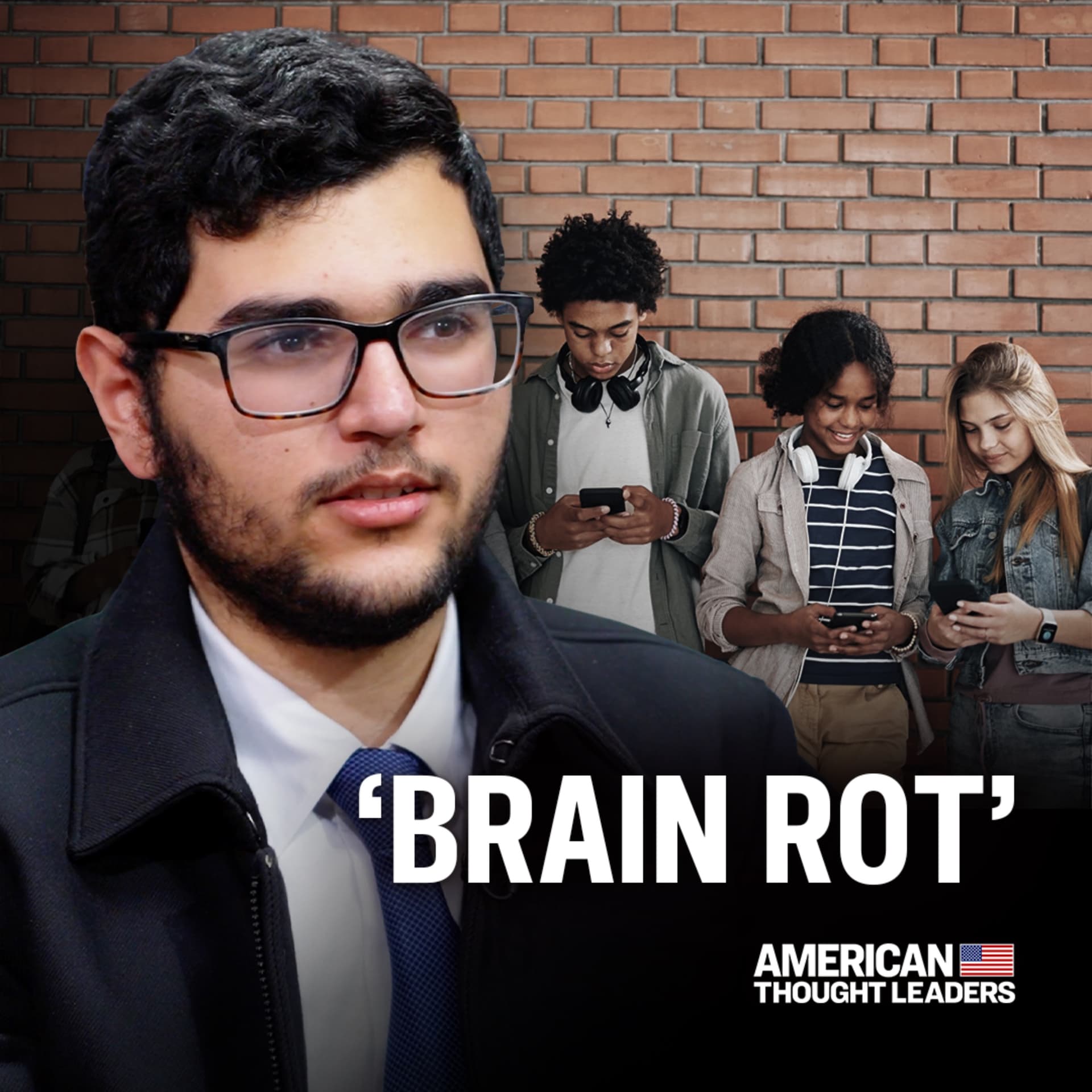
American Thought Leaders
How ‘Brain Rot’ and the Escapist Virtual World Is Harming Our Youth | Adnan Alkhalili
00:52:26
Loading summary
Transcript111 lines
- [00:00]
Adnan Al Khalili
The generic Gen Z experience is you wake up probably in a dark room, you reach for your phone and you just start scrolling or texting your friends and communicating. You don't leave your room, you don't go outside and take walks.
- [00:11]
Jania Kellogg
It's bad for many young people. This is not an exception. It's the norm. Today I sit down with Adnan Akalili, a 20 year old founder and CEO of Touchgrass Collective, a national student led movement focused on tackling Gen Z's growing health challenges.
- [00:28]
Adnan Al Khalili
I would go to sleep late on my phone or on games, I would eat. Really unhealthy. All of these things caused my metabolic health to completely drain. Ultimately it led me to have a panic attack and anxiety and all of these things.
- [00:38]
Jania Kellogg
Al Khalili is pushing for a return to something simple. Reconnecting with the real world. Sunlight, movement, connection, nourishment, what he calls touch grass.
- [00:48]
Adnan Al Khalili
It is actually probably one of the most famous Gen Z phrases, which is touch grass because there's only one phrase related to health. Why don't we use that to be the way we get people offline?
- [00:58]
Jania Kellogg
But he's not arguing we should abandon technology altogether. Instead he's asking what if we could redesign it with technology where we're able
- [01:06]
Adnan Al Khalili
to seed into technology healthy rituals and healthy habits.
- [01:09]
Jania Kellogg
This is American Thought Leaders and I'm Jania Kellogg.
- [01:14]
Interviewer
Adnan Al Khalili, Such a pleasure to
- [01:17]
Jania Kellogg
have you on American Thought Leaders.
- [01:18]
Adnan Al Khalili
Thank you for having me.
- [01:20]
Interviewer
So a lot of people I think that are watching this show, including me, do not fully grasp because we didn't grow up in the virtual world, we grew up in a physical world that sort of transitioned over time into a somewhat virtual world. A lot of us don't really understand what's it like as a Gen Z or newer to be growing up. So tell me about that.
- [01:49]
Adnan Al Khalili
Oh, I like to start off with a comparison. Right. So I think what most people are used to is the first things when you were first born, right. You have interactions with a lot of people near you, Right. So you have interactions with your family, you have interactions with your, you know, some people that come over to your house, right. The baby is exposed to so many different things and learn so many words. Right. Now, for someone like me when I grew up, and especially Gen Alpha now growing up, what they first see is they learn all of the words that they know in their vocabulary from just an iPad. Right? Right. So they learn everything they know from a device. They learn everything that all of the communication skills that they have come from the Virtual world, right? From online contexts. So instead of learning, your parent teaching you to a child, right? A parent teaching their son or daughter some kind of new context and language, they're learning that from the virtual world because language is forming on the virtual world.
- [02:38]
Interviewer
Is it really that extreme, though? I mean, like, you're in a family and you're communicating with people and so forth. It sounds a little bit.
- [02:44]
Adnan Al Khalili
It's more extreme than that because unfortunately the reality is a lot of people, although they're used to obviously communicating with their parents, they hear some, some form of language from their parents. They are consuming most of their content now from YouTube videos, right? Parents often now give their children just YouTube videos to watch. So like, for example, Cocomelon, right? I'm sure you've heard of that, right? These are like these online, like songs. And I mean, in the past they had TV shows, right? They had like, you know, I mean, this is, this is even recent. We had spongebob, right? Now nobody really watches spongebob even. They watch just basically online influencers speaking directly to the child. And so this is when they're a baby, as they grow up, though, I mean, they're going to school, right? They're spending time with their teachers, but their content is coming from a smart board, right? And then they're having a phone at a really early age. And even the schools that like, avoid phones, they still give like iPads and Chromebooks, right? So now the kids are communicating on iPads and Chromebooks. And so now they're having all of their communication on the virtual world. And so in contrast to somebody that never had that, all of their communication skills and now their relationship skills are transforming and being created online so versus, you know, when a person might be growing up and they might see, you know, they might make their friends in the community, you know, sit on the sidewalk and play with the mud, right? This is like the typical non Gen Z experience. But nowadays we don't. We don't really sit in the mud outside because we stay mostly indoors. And so the generic Gen Z experience is you wake up probably in a dark room, you wake up in a very, very closed environment. You reach for your phone and you just start scrolling or texting your friends and communicating and you don't leave your room, you don't go outside and take walks. It's bad.
- [04:21]
Interviewer
And part of this story is also that these things are addictive. They've been designed to be addictive. So now your story is beginning to sound me listening to you say all this feels almost Unbelievable. But I kind of am believing you as I. As we add the kind of addiction aspect here.
- [04:39]
Adnan Al Khalili
Yeah, no, so these are addicting things. Obviously. We know that companies like Facebook and Meta are obviously creating algorithms that are basically getting the young people to continue scrolling. Right? They're made to appeal to the person's for you. Right. Like their for you page. And so obviously it makes sense that these people would be online. But the other thing is like beside the algorithms and the addiction aspects, the fact that these things are so readily available to young people are why they're able to participate. Right. The entire. At this point we've kind of reached past the stage where it's like, yes, it's addicting to young people. And now it's just so widely available to young people. This is the new medium of how people communicate. So we're kind of past the addiction because that's in the past. People are already addicted. Like that's, that's already the case. And we've reached so much addiction to the point where now all of the conversation is happening online. And this is for good and for bad. Right. You know, we obviously have people using X for good reasons, but young people are using Discord, which I'm not sure if you're even aware of. Discord is like the most used platform for young people to communicate on. Especially in the gaming world where people literally just have only friends they've never met in real life, friends they've only met online. And their entire community is online in these servers on Discord. And it's the same thing that's just
- [05:48]
Interviewer
like audio communication while everyone watches the same game being played or something. That's basically what it is.
- [05:56]
Adnan Al Khalili
I mean, it's just people spending all day texting random people.
- [05:58]
Interviewer
But that Discord server is like just a way that a whole bunch of people can talk online.
- [06:04]
Adnan Al Khalili
It's like a WhatsApp group chat.
- [06:05]
Interviewer
Right?
- [06:05]
Adnan Al Khalili
But just imagine a WhatsApp group chat that people spend all day on 24, 7 and instead of, you know, those people being people they know in real life, these are people they've never met before. In fact, they don't even know their names. They don't know where they live. And they basically just make a caricature of their best selves and then put them on that platform.
- [06:22]
Jania Kellogg
Hey everyone, I'm going to be trying to get some more sponsors for American thought leaders. And, and the reason is I want to try to get it on more of the non paywall platforms where we'll use the sponsors to kind of support the show and one of the sponsors that I really appreciate is American Hartford Gold. You know, these are pretty chaotic times. We're not sure where things are going to go. There has been this, you know, massive liquidity, $6 trillion put into the system. We don't actually know how all that is going to play out. And I like to put my money in a very stable place that also tends to go up and gold is really the perfect place for that. Now, gold has had a correction recently and that's absolutely true. But again, if you look at the long term trend on gold, this is the reason I invest in gold. I'm not like a stock market trader. I like to put my money in a place that's stable and growing and I actually think this is the exact right time time to buy gold because it has gone down a little bit, it's a little bit cheaper. But the price in my belief is only going to continue to go up
- [07:27]
Interviewer
and that's what I'm actually doing.
- [07:29]
Jania Kellogg
So American Hartford Gold really is the place to do it. We've worked with them for years. We've had a great experience working with them. They're Better business bureau certified and frankly really easy to work with. Okay, so you can call them at 855-8623. You can text American to 65532 or as always, click the link in the description below.
- [08:01]
Interviewer
So you lived in this world but you somehow pulled yourself out and you felt the need to do so. Just tell me what happened.
- [08:08]
Adnan Al Khalili
Yeah, so I grew up very natively online, scarily so as well. I mean I grew up on the Discord world. I grew up on the gaming world as well. I played games all my life. I grew up when I was young. This is something I talk about often. I remember just like in my youngest, youngest years maybe When I was 8 years old, 7 years old, I would wake up, open my computer and I would play like an online platforms. This is like the oldest stuff. This is before we even had the current games. There was a game, it was called Vantage and it was this online virtual world where people would talk to each other. They would have friends and families. It was really weird stuff. But like that was a very famous game at the time and I would just wake up, play that all day. And even the friends I had in real life, we would end up not even spending time together. We would spend all of our time online. So they'd be in their house, I'd be in my house, we would call each other and we would just Play. And it got worse over the years because I started to have entire relationships my parents never even knew about. And I mean, my parents were very good parents, but they had no idea that I had like, the access to so much online that they never were aware of. So even if they tried their best, like, you know, make sure that my real world was, was, was maintained, the virtual world was not maintained. They had no idea who I was talking to. And there was always like the age old adage, like, don't talk to strangers, right? So don't give the address to random people, don't tell people where you live, et cetera, et cetera. But even then, like, if you don't give people your address and you're, you're staying safe online, you're still living completely online. And I lived in that world where I was completely online all the time. However, I mean, the thing is, once you reach a stage where you realize how sick you feel, and this was, again, we can talk about this whenever you want. But when I started to feel really, really sick and unhealthy, I started to tear apart all of these layers. And that eventually made me realize that I don't want to be online anymore.
- [09:52]
Interviewer
What kind of sick are we talking about?
- [09:55]
Adnan Al Khalili
A lot of variations. I think this is something that I'm happy I can describe, but most young people, I think are living in this and they don't. They're not able to articulate it and describe it. It's the feeling of you wake up and you're tired, right? You wake up and you've had eight hours of sleep and you. And yet you still feel sluggish the entire day. Now, the solution most people think is they take energy drinks, right? I know all of my friends and everybody that I work with and anybody I talk to, they're like, energy drinks are the way to go. Even though they're always tired after taking the energy drinks. And so you had a full night of sleep. Why are you still tired? And then after that, obviously gaining weight, feeling sluggish all of the time, not really wanting to play sports anymore, not wanting to go outside. And the worst symptom is like, you don't even want to participate in anything healthy because you're just so used to being sluggish and tired. And that's the feelings I had. And this is before I actually experienced mental health issues, which was the tipping point for me.
- [10:51]
Interviewer
And this is, of course, all within the context of staying in this virtual world. So just before we, I want to get more details about what happened to you? But, like, what percentage of people do you think actually live like this way? Because again, it sounds like a kind of extreme life, right?
- [11:11]
Adnan Al Khalili
I don't think I've ever met a young person in my life who has not been integrated into this world. When I say young, I mean people that I've grown up with in Gen Z and Gen Alpha. I would say that. I mean, I can't give you an exact statistic on this because again, even if we, like, I don't even think that you can create an authentic statistic on this kind of thing. But I would say in my experience, where I work with hundreds of young people, right? Like our organization, we work with hundreds of hundreds of hundreds of young people on college campuses and in younger years. And I don't think I've ever met a single person who hasn't experienced this where they know what this virtual world is like. A really a good story of this is I was in a policy room and they were discussing getting phones out of schools, right? They were discussing getting phones out of schools. And I was the only person in the room that was Gen Z. I was the youngest person in the room. Everybody else was like, maybe 40 or 50 years old and older. And they were discussing like, okay, we need to get the phones out of schools. One person said it was a national security issue, which I was very happy about. But for the most part, it was like, you know, phones are like tobacco. That was the main thing that they said. And I was really, really upset about this because I realized not a single person in the room even understood how it actually looks like. It's not that phones are like tobacco or the virtual world is like tobacco, because tobacco was something that was just addicting and cool, right? No, this is an entire world. Like, this is literally an entire planet that people live on. And it's. It's. I know you're saying, like, it sounds extreme. And this is the problem that if you literally talk to any Gen Z and have them explain it to somebody that's not Gen Z, the person who's not Gen Z, maybe a later millennial and older, will actually have no idea what they're talking about. Like, it sounds like another language. And for us, it's very hard because while we're trying to create solutions, we have to talk to people that never lived in that world. And they. They actually don't recognize how scarily important it is that we do look at it, because this is real. And it sounds to you like maybe that's like some Kids. Some kids are online all the time. No, even the most, like, wellness based kids are still online. Right. Like, look at the best influencers that we know who are young, right. That are talking about health. And, you know, all of these, like, health initiatives, they're still plugged in 24 7. Right. And I know, like the best people that are working on stuff like I'm working on. I can still go on social media and find them anytime I want. Right. And so this is, this is something that.
- [13:17]
Interviewer
It's just like a massive sea change in how society is constructed. I mean, this is what you're talking about here.
- [13:22]
Adnan Al Khalili
It's a different society than anyone's ever experienced. And this is completely different, I would say, from hundreds of thousands of years of how humans lived.
- [13:30]
Interviewer
Okay, before we go further, you know, you had a kind of a transformation. You had an aha moment. Explain to me what happened.
- [13:37]
Adnan Al Khalili
Yeah, so I was entering high school, and for most young people going into high school, it's a very scary time, right? You know, you're meeting new people, meeting new friends. And for me, I was, I was very happy. I was, like, excited. I was running forward. And although I was always online, I was still excited for high school. And this was also near the beginning of COVID as well. So it was a time where we were getting even more virtual. And, you know, I was just sitting around and suddenly I had an anxiety attack. Now, anxiety attacks is. This is not a unique experience for me. It's not like I had something that nobody else had. It's just at the time I was very insulated, so I thought I was the only one having it. And having an anxiety attack where you feel like, you know, nothing physically is wrong with you. Right. I went to the doctor in the hospital and they were like, you're completely fine. But my entire world was broken. I literally felt like I couldn't breathe every single day of the week. And I was 14 years old, you know, as a 14 year old, feeling like you can't even breathe every single day. Like, I was constantly aware of my breath. You know when someone like tells you, like, think of your breath, then you start thinking of your breath and you're like thinking of it, and now you have to control your own breath. Have you ever thought of that?
- [14:39]
Interviewer
I don't think I have.
- [14:40]
Adnan Al Khalili
But if you had to think of your own breath, right. You.
- [14:44]
Jania Kellogg
I mean, I. I've done this.
- [14:46]
Adnan Al Khalili
You'd realize that you can control it. Right?
- [14:47]
Interviewer
Right.
- [14:48]
Adnan Al Khalili
Now imagine you think that every single hour of the day since you Wake up till you sleep. It's terrifying, right? Where you have to control your own breathing because you know you've turned off your body's involuntary ability to do that just by being conscious of it 24 7. And so this was my experience where that was my. How I basically experienced anxiety. And I had OCD as well, which is another experience. But I'm happy I had these experiences because I'm not the only one. Like, if I go into a high school, I can guarantee you that majority of the kids are experiencing some form of this. And the mental health epidemic in our country is just. It's absolutely.
- [15:19]
Interviewer
Where did the. So where did this come from? Like, do you have a sense of that now?
- [15:25]
Adnan Al Khalili
100%?
- [15:25]
Interviewer
Yeah.
- [15:26]
Adnan Al Khalili
Yeah. Well, I mean, my entire. And again, I'm a big fan of the fact that metabolic health is one of the core drivers of mental illness. And if you think about my metabolic health, it was destroyed, right? What was I doing when it comes to my circadian rhythm? I was waking up in a dark room. I was not even wanting to. And I had a very big light sensitivity. Like, I didn't want lights open all the time because I was just not. The more unhealthy you are, the more you have light sensitivity where you don't even want to see light because it just, you know, it triggers your body. And so I didn't want light. So I would wake up in a dark room, I would go to sleep late on my phone or on games, I would eat. Really unhealthy. All of these things caused my metabolic health to completely drain. And so, of course, my brain function was terrible. And ultimately it led me to have a panic attack and anxiety and all of these things. And I mean, also, I mean, just the fact of having negative health outcomes, I mean, having so many bad circumstances when it comes to my health. I was also extremely stressed all the time. My cortisol was 100% up, and I was always stressed. So even though, again, I felt very happy, right? I'm not saying that I had anxiety because I was experiencing, like, mental trauma in my life. I was very happy. But even then, beneath the emotional surface, there were so many physical things happening. And all of those drained my metabolic health, which ultimately drained my mental health. And it was just these kind of things that when I. When I realized that, like, And. And for me, I didn't enter this from a scientific perspective. I just lived the experience. But then I luckily lost weight, right? And that was something big for me, right? I started a journey on losing weight this was unrelated to my mental health issues. I just decided, like, I don't want to be overweight anymore. And so I just started to lose as much weight as I could, mostly through a keto diet, which I know you're familiar with. And this was like, by chance. This wasn't like I was. I wasn't familiar with, like, the science behind it. I kind of just fell into a loop. I think I'd seen like a Dr. Berg or Mark Hyman video, and I was like, you know, I might as well try it. I tried the calorie stuff before. You know, calorie restricting all that never worked for me. So I just tried something. And when I lost the weight, literally every single issue I ever had, when it comes to being drained all the time, when it comes to my health issues, when it came to any. Any aspect of men's health issues, they disappeared. And this was maybe like a month transformation, right? Lost £60 in one month. Lost all my mental health issues.
- [17:36]
Interviewer
£60 in a month?
- [17:37]
Adnan Al Khalili
In a month.
- [17:38]
Interviewer
You must have been doing a little more than keto.
- [17:40]
Adnan Al Khalili
No, I was doing keto. And. And now this is another thing, right? I remember in my school, my, my. My guidance counselor would come up to me and ask, are you okay? Which is funny because I was actually more than okay. This is. I wasn't okay before that, but when I lost so much weight in such a small amount of time, everybody was asking if I was okay. And that's because it's not healthy to lose weight in such a short amount of time. But for me, it was because. And this is an experience I've seen with a lot of young people and other people in general and a lot of people in the metabolic health world, which is like, if you are living dysregulated and you fix the things that are causing you to be dysregulated, your body goes back into homeostasis. And so my body's homeostasis was, you know what it was. And the funny thing is people were like, oh, he just has a fast metabolism. But everyone else my entire life was telling me I had a really bad metabolism until this point. So ultimately fixing my metabolic health ended up fixing that. And it was from that same thing where I, when I, once I reached a point of feeling healthy is when I also started to look at my screen time. Before that, I didn't care about my screen time. Before that, I didn't even look at the virtual world as an issue. But because I started to understand how it feels to be human, I I also was able to then kind of feel the relationship between myself and just staring at a phone all day. And the problem is, if you are a young person, you're either really addicted to your phone or you're eating really unhealthy food. And if you fix one of those, you can get out of the other, but if you don't fix one of them, you can't get out of the other.
- [19:00]
Interviewer
You know, I was reading that, you know, young people are actually even aware of the fact that they're not eating well, but they somehow keep doing it. Explain this to me.
- [19:10]
Adnan Al Khalili
Yeah, so young people are aware that they're not eating well, and they're also aware that they're in colleges, especially, where they're aware that they're not eating well, but they're also aware that when they do eat well, they feel slightly better, and yet they're still not eating well. And this comes from a really, really difficult aspect of the virtual world, right? Or at least what I call the escapist reality, right? Where they're constantly on devices to escape from the real world, right? They're living online anyways. They grew up online anyways, and they grew up in this escapist world where anytime they wanted to feel, not feel anything, they could just eat something unhealthy or they could go online, right? And so if they're doing that 24 7, why wouldn't they, you know, just not want to be healthy, Right? Why wouldn't they? Why would they care about how being healthy? Because ultimately, yes, it feels good to, like, all. All of the time to be doing something like, you know, walking. It feels good to, you know, run. It feels good to eat something healthy. And they know that. But at the same time, it feels even better when you're really, really sad or you're not feeling well, to quickly feel this big spike of dopamine, which comes from going on their phone. That. That feeling of being online is just such a beautiful, ethereal feeling that is completely unrelated to how you feel if you're just sitting in your room, twiddling your thumbs, thinking of the actual thoughts that you might have. Because it's a lot better to escape your thoughts. I mean, what time in history have you been able to just avoid anything you want, anything that's hard and difficult by just going online, right? There is no. And this is like the biggest thing when it comes to the escapist reality when you are online or you're on this virtual world, and it's not even just the virtual world.
- [20:39]
Interviewer
Right.
- [20:40]
Adnan Al Khalili
I. I consider it like a third world, right? Where it's. You're in your thoughts and you're kind of like over here, right? You're not, you're not necessarily like. Like, for example, when you're online, right, you're texting someone, you're communicating with someone. You're basically detached from your body, right? You're not inside of your own body. And so it's the same thing when you're online, right? When you're online, you, you're, you're texting somebody, you're communicating with somebody, you're in a community with somebody, you're having conversations with them, you're having jokes with them, you're basically creating an entire identity with them that is not your normal world, right? So when I wake up, I go to school and I eat lunch and I talk to my mom and I'm really annoyed and stressed from my mom. So I just like, I go ahead and, you know, I go to school and I almost failed the test at school. All of these things are the real world, right? This is the typical young person experience. But then I go online and my friend from, you know, Connecticut, who I've never even, like, met in real life, doesn't know anything about my real world. And so I can just escape with them and I can act like none of the real stuff matters. I could do the same when it comes to my health. Yeah, I don't feel great. I feel disgusting. But if I'm online and I'm talking to somebody else, they don't know about how I'm feeling. So I can just dissociate basically from my body. It's like a really scary dissociation.
- [21:45]
Interviewer
And I mean, I'm really kind of getting a sense of what you're talking about here because this is just this reality. Being able to exist in the kind of reality you're just describing didn't exist until very recently.
- [21:58]
Adnan Al Khalili
So this is something we talk about a lot, right? I kinda wanna talk about this. So think of what it really means to be a human, right? Like, this is a very, very scary thing. But think about what it really means to be a human. We had rituals for most of humanity. Anytime you've heard of, like, ancestral living, you see people talking about, like, like the keto diet. You hear someone talking about the carnivore diet. I know you guys had Sean Baker think about what, what it meant really to experience, to be an ancestral living, right? To. To live like that. It was these rituals. The rituals were basically, you'd Wake up because the sun, like, the sun came out. So you would wake up. Everybody would wake up every single day because the sun came out. Everybody would go to bed because the sun went down, right? People would gather at night because, you know, there's a community gatherings, right? They have communal gatherings at a set time every single day. All of these things that are rituals, these are things that we just do because that's just how we are as humans. We don't have those rituals anymore. I wake up and it's a dark room, so I'm not really waking up from the sun anymore. I wake up from an alarm. I. I go to bed at night, and it's not because of an alarm. It's just because I close my shades. I can't even see the sun. That's not why I'm going to sleep. So all of these things, all of these rituals don't exist. So I'm creating artificial rituals now. And so what does it look like to be a human? And you don't even have those rituals anymore. You're basically not living like a human anymore. You're living completely out of what humans have lived for hundreds of thousands of years. There's never been a time in history for hundreds of thousands of years, ever. I mean, we've had a big conversation. People have. Is like, everyone. Every time, every century, people are like, oh, this is the scariest time to live, right? No, this is literally the scariest time to live because this is the first time we're not being human. And having rituals like these rituals are just the core basis of what humans are.
- [23:34]
Interviewer
You know, you're making me think of. I don't know how much Hannah Arendt you have read, but you're making me think of an atomized society, which is the type of society that's rife for a totalitarian rule, in fact. So you're disturbing me more than you think by telling me what you're telling me.
- [23:57]
Adnan Al Khalili
Well, I think people are aware of that, and I think that obviously those in control of the algorithms are aware of that. And I think that it's being done on purpose as well. I mean, you can control society a lot better that way. I know you talk a lot about China, right? For example, think about, you know, ByteDance before, you know, they recently bought it in America. And something that is really curious is what they actually have in China when it comes to algorithms. What do they give the people in China? Do they give them what we have today, which is like, brain rot, people scrolling and seeing, like, AI Videos of, like, cats talking in America versus in China, where they scroll and they see, like, an airplane taking off or they see, like, a physics problem. It's very scary.
- [24:35]
Interviewer
It's very. It's very different. And very deliberate. Absolutely. So you lost weight, you got clear, you decided that the real world, there's something there after all, and you somehow got motivated to try to pull other people out. So this is your. Do you remember the Matrix film? See, this is my generation, okay? I don't know if everyone. This generation is watching the Matrix, but this is making me think of the Matrix. You're wanting to unplug people, right, from. From the Matrix here.
- [25:10]
Adnan Al Khalili
Well, the. The scary thing is people, the. The main. Like the Matrix as a movie has been out for a while now, and it's been used as a metaphor all the time. I mean, they use Neo in the Matrix for literally any issue going on where they. They're like, this is the Matrix, right? Like, for example, most famous one, Andrew Tate, is making a bunch of young people talk about the Matrix, right? Where it's like, you know, the. The billionaires are, like, forcing us to live in, like, a fraction in society. That's the Matrix to. The reality is that's not the Matrix. The Matrix we're actually living in is that we are living basically what they were living in the Matrix, where they were plugged in. They were plugged in to alternate lives that were not even the real lives that the people that were plugged in were living. How are we different than that? Aren't we also. I mean, maybe not you, but most young people, aren't they also living the experience of being plugged into this virtual world with fake friends that they've never met, people that they think are real but maybe aren't even real, all of these different things, and they're just meeting these people online. Isn't that the same thing as the Matrix? So I think ultimately we've actually reached the actual Matrix, where we're all living on our devices with communities that we've never met. And we think that that's the real world. And a lot of us. And the scary thing is, like, you're saying, yes, I figured that out, and I talk about it, but most young people don't even care, right? Like, they know that that's an issue. They don't really care. And so it is something that, because I'm so familiar with D.C. and I've been in a lot of these rooms with a lot of important people, I've realized that there's Literally no other young people in these rooms talking about this. And it scares me a lot. And it's something that, like my co founder Sam and I talk about because we have the same, you know, relationships in D.C. and we talk to the people making the change and we realize that even the people, I mean, even in, like right now in Secretary Kennedy's cabinet, you know, for example, when it comes to screen time, we just really think that nobody's really doing anything about this. And it's. It's terrifying. And so how can we be in these rooms and see so many people doing things, but no one's doing anything for this. And how can we just sit there and be like, well, I mean, someone will figure it out. Who's gonna figure it out, Right? That's the scary thing.
- [27:09]
Interviewer
I want to touch on that more what you just said. But before we go there, I'm still thinking of another film as you've been talking. And that's Ready Player One. Steven Spielberg's one of more recent films of his. And I mean, it's kind of exactly the world you're describing, except that there's one specific world that all those people are a part of. And their solution at the end of the film is to take a day off. If I remember the film well. Right. Like, but it, but. But it's actually great in there. Just take a day off and that'll do it.
- [27:40]
Adnan Al Khalili
Yeah. I mean, there's also another movie, I think it was called her, the AI Movie.
- [27:45]
Interviewer
I haven't seen that one.
- [27:46]
Adnan Al Khalili
I mean, both of these movies touch on a point where it's like, I think. And these are. These are like kind of like sci fi movies. Not sci fi, but I mean, like, you know, futuristic movies of what could end up happening. And it's like, we live in that world already. Like, we are. We do need to take a day to plug off. We certainly haven't yet and we'll talk about it. But we figure it. I think. I think we've created the way to do that. I think we've created the way to get people to plug Elf for a day. But it's just scary that so many movies have kind of hit the nail on this. And at the time, I remember watching these movies and thinking like, oh, this is like, stupid and it's never going to happen.
- [28:18]
Interviewer
Except you were in it.
- [28:19]
Adnan Al Khalili
Except I was in it at the same time, already experiencing that. And so it's like I never attached myself to the fact that we are literally living in that world and it's even scarier because the film about, I think it was called her or she or something like that, which is literally like, you know, someone talking to an AI woman 24 7, and like, their entire relationship with this AI woman. Now, AI is an even additional thing to this, right? AI is even scarier. It also came when I was in high school for us. So, like, I saw how young people were interacting with it and I see how people interact with it today. Now we have a relationship with the thing that's not even a real person. So when it comes to not even being human anymore, I think it was better when we had virtual worlds with only people. Now we have virtual worlds with non people. And it's getting worse. The movies are becoming real.
- [29:02]
Interviewer
So, okay, so how does touching grass fit into all this?
- [29:07]
Adnan Al Khalili
So, you know, funny thing about touch grass is that when I talk to people in politics or like dc, right, And I tell them, touch grass. They think that we're like some, like, we're some like, niche organization. And they're like, oh, you guys are just like, you have funny name. It's related to grass. Like it's some niche idea, right? And the crazy thing is it's not niche at all. It is actually probably one of the most famous Gen Z phrases, which is touch grass. Because everybody living in the virtual world, when it comes to health, they never. They never talk about health ever. It's not something that's communicated. They don't talk about health because ultimately, if you bring up something related to real life on the virtual world, you kind of get crushed. And because they don't want to talk about the real world, but the one phrase that is used out of any phrase when it comes to health, it's only one phrase, and it's such grass. Because that's. That's basically people telling each other online. You've literally been online all day, and it's usually an insult, but it's like you've been online all day, Go touch the earth, right? Go touch grass. And so it's become like the only phrase related to health online. And so ultimately we. We were realizing that and we said, I mean, there's only one phrase related to health. Why don't we use it? Why don't we use that to be the way we get people offline? Because if everybody's already aware, maybe they're not aware to the extent that we talk about right now, right? But the fact that young people are telling each other every single day, go touch grass. Doesn't that inherently mean that somewhere within their mind, they know that they're literally not touching the earth anymore. And so ultimately we're trying to use that now as a way to culturally create a solution to this problem.
- [30:31]
Interviewer
So, but. Except that you're using like leaf piles.
- [30:35]
Adnan Al Khalili
Oh, that's an example. Yeah. So what basically we've come up with is a framework called the touchcraft moment. And ultimately we're trying, like we talked about rituals, right? We're trying to recreate human ritual. So instead of getting people to just, you know, telling everybody on the podcast, go wake up at sunlight and go to sleep at the Sunlight. Young people don't care. They're not going to talk about health. They're not going to talk about physiology either. I mean, there's some people that will. I'll talk about it, but I'm really talking about, you know, statistical anomalies, right? So for the most part, people will not talk about health in order to get them to go do healthy things. Um, but they will talk about the really silly Gen Z trends. And so if you tell them, come to this specific place, let's do something really silly and stupid, because nobody likes serious things, let's do something really silly and stupid. Ultimately you're resulting in them doing a touch grass moment, which is them coming out into the real world and they're doing one of four things. They're getting in the light, right? So they're regulating their circadian rhythm. They're moving, right? So which is great and important for their health and a normal thing of being a human, right? Because nowadays everybody's just staying sedentary all day, but which has never existed before, no humans have just stayed inside all day, which is even scary if you think about it. But we're getting them moving, right? We're getting them connecting. That's another aspect. So there's this three, right? They're connecting with each other, speaking to other human beings. And. And the fourth thing is we're nourishing them. So we're also including nutrition, like intermittent fasting, things like that. And so all four of those things are used to create what we call a touch grass moment. And one of those things, like recently, like you mentioned, you know, we had an event where a bunch of kids came and just, just jumped in a pile of leaves, right? And ultimately we also, I mean, literally, like two days ago, our Penn State University chapter just had a snowball fight. And then they dug a big hole and they touched grass in the snow. But I mean, that was a group of students that otherwise would have been Inside, you know, with the heat on and not outside. Right? And our students have found ways to get outside. Even though it's freezing outside, there's no reason to go outside. Instead, it would be better for them to just stay inside in the escapist reality, right? But now we're actually having people go outside again, right? Hanging out with each other. And the only way we're able to do this is not by like just putting up a poster saying, come do this funny thing. It's the fact that we're using the same mediums that they know how to use. So we're using social media, right? All of our university chapters have pages that they create videos on. They basically use the online virtual world as a way to recruit people back into the real world. And so they're using, you know, they're using Discord, they're using Instagram, they're using social media in every way. And they're basically using the same rotting forms and they're getting people to go outside and do healthy things. And this is the kind of thing that if we scale this, right, if we make this something really big institutionally, that is the way we can get everybody to plug off.
- [33:11]
Interviewer
You know, I can't help but think
- [33:13]
Jania Kellogg
you decided, you know, that you're actually going to go.
- [33:16]
Interviewer
You're studying metabolic health, right? Right now. So you're, you're, you're, you're kind of applying, you're studying what you're applying as part of this whole touch grass thing.
- [33:29]
Adnan Al Khalili
It came from that, it came from when I, when I was experiencing all of the health issues that I experienced, I had no motivation whatsoever to really, really do anything. There was, there was no motivation for a career. I mean, my parents wanted me to do a bunch of things and like every parent does, but I had no motivation to do anything. I remember I used to feel like, like I felt like when I was in my senior year of high school or my junior year of high school, I felt like my life was over. Like, I genuinely felt like I was so tired of life that I felt like I felt like I was in my 70s or 80s and I had no motivation to continue. I was like, I felt like I was done. I was like, I lived a long life. What else is there to do, right? And when I solved my health issues, I had so much motivation and goals that I had so much interest in metabolic health. Metabolic health is, is right now, I think getting there, I think people are starting to talk about it, especially with the current administration, right? They're talking about metabolic health, but I don't think we realize how significant it is, right? Like how, how can you not consider the fact that if your cells are dead, you're going to be dead, right? Like literally the energy of your cell. How is that not the most important thing? Like, I can't imagine studying anything else. I think that's right now, I think every doctor should be studying metabolic health. I think that should be the main thing you study in medical school, which is how do you keep people's cells alive? And, and I think if young people get their metabolic health good as well, I mean, they're going to be perfect. And that's why touch grass are for the four components I told you about. Light, you know, movement and nourishment and connection. Those are literally just the drivers of metabolic health. And we've just basically took the word metabolic health off of it and we put touch grass moment on top of it, right? So basically make them do physiologically healthy things for the metabolic health, but don't use the word metabolic health whatsoever. Don't use the word physiology. And because ultimately they're going to fix their metabolic health and that's really what we want.
- [35:10]
Interviewer
We're just going to keep it this a secret for only the people that are watching this show, right? That's what you're saying.
- [35:16]
Adnan Al Khalili
If young people want to participate in the science aspect, they can. But I think it's just so fun already as it is. Like, we know how young people are, and especially the people in touch Grass together, they love just the silly aspect of it. And as they get into the silly aspect of it and they just, they start to integrate and they start to feel how it feels to really be outside and do these things, then they actually gain the interest of like, okay, now I actually want to learn why am I feeling these things? Like, what are, what is the actual science behind it? And we've had that experience.
- [35:44]
Interviewer
Fascinating. You know, so one of the things you talk about, you were on with Dr. Phil a little while ago and you're what the. This term brain rot is something that featured pretty heavily in there and everything you've been describing is this, this brain rot that you're talking about.
- [36:02]
Adnan Al Khalili
Brain rot is so there is the entire virtual world in escapist reality. I think brain rot is just one of the mediums of that, and it is probably the worst one. We've arrived at a point now where people are scrolling on their phone and looking at videos that have no meaning whatsoever. And it's worse than anything I've talked about already. It's just like layer on top of the fact that people are sedentary indoors and just on communities and now add the fact that they're consuming things that have no meaning whatsoever. That's what brain rot is. And it's also deliberate. I mean, Dr. Phil mentioned that as well, that they, they literally fund entire companies to just produce mass brain route for people. And it's scary. I mean, even for touch grass we use brain rot like we employ brain rot into our own content because we know that brain rot reaches people. And I mean if we can reach people, we can get them to do healthy things.
- [36:46]
Interviewer
So brain rot is a type of content and it's a state of being.
- [36:50]
Adnan Al Khalili
It's a lot of things. Okay. Brain rot content is just content that rots your brain. Like literally. Like I mentioned earlier, imagine like a video of like an AI cat just talking to you. It's not funny. I wouldn't find it funny. You wouldn't find it funny, but it's funny.
- [37:02]
Interviewer
But it just looks intriguing and it kind of. And then you scroll to the next one.
- [37:06]
Adnan Al Khalili
I don't know. Do you watch the Dr. Phillips? Because there I actually showed him a whole page of brain rot and he was so confused. But like ultimately that's just, that's how brain rot is. It's like the most confusing thing ever. It's like a bird that looks really weird and you say like it's intriguing. Yes, they find it really intriguing. In fact, they laugh when they see it. There's something called Italian brain rot, which is even worse. It's like a shark wearing Nikes. It's not funny, but it's really funny to Gen Z. And it's ultimately deteriorating because now Gen Alpha, I mean Gen Z doesn't really see this as like a, as like a real thing. We kind of just like mess around with it. But Gen Alpha now the younger kids who are like five, six, seven years old, right? These kids, they love brain rot. This is like just normal for them. It's not even a joke, it's just, it's reality.
- [37:50]
Interviewer
You're describing a transformation of, you know, essentially how people think at a mass scale without us fully realizing what has happened.
- [38:02]
Adnan Al Khalili
I think basically, yeah, I think it's happening really, really quickly to the point where a lot of research institutions are just used to doing research the way they've always done, right? Where it's like, you know, you survey a thousand people and then you see like what they're feeling. And, and I think that's why we haven't caught up to how scary this is. And that's why like with Touchgrass together, like we have employed polls, but we're really just talking to young people every single day. We hear the latest things every single day. And I think that's what everybody needs to do. But it's hard to do. I mean, the Trump Admin recently had like the Council on Fitness and Nutrition. I don't know if you. With Catherine Granito. And they also had the MAHA report come out. And one of, one of like the most important things that they talked about in it, there was screen time and establishing councils in each state to reach young people. And it's been months now and they haven't done that. And I think it's because they don't know how to do that. I don't think they realize how to reach young people, how to actually get to young people. And we've done that. I mean, we did it actually we did it in like a matter of one or two months of just reaching so many young people and learning every single day. Now what is the actual experience on the ground? And this is something that, I mean we can scale really, really big to so many institutions, to literally communities to find out what are young people thinking. And that's because, you know, the Internet moves so quickly and things change every single day. And just how bad this is getting is just changing every single day. Something that really scares me is I see all the research being done on nutrition and also the education on nutrition, but I ultimately think that no matter how much we do when it comes to research, when it comes to investigating the what's happening, I think that technology is going to get stronger anyways because we don't have nutrition billionaires, we have technology billionaires, right? And trillionaires actually. So we have trillions in, in, in technology. But we only have, you know, people investing in nutrition, but they're not, they're not creating solutions and tools to really get healthy people living. There's no, there's no billionaires in the health world, right? There's billionaires in the tech world. So you know, when it comes to the films you talked about, I think that what it really looks like and I don't think this is far fetched, I think that in the next 20 years we're going to have people walking in the street, right? They're going to have AI everywhere. You're going to be able to talk to the street itself. You're going to have technology almost everywhere. I mean, we have the metaverse Right. Where, where Mark Zuckerberg really wanted that really badly. Where it's like you can literally interact with the, with the virtual world while you're in the real world. Or Apple came out with Apple vision where it's like you would just wear something and like you see the, the world around you, but you're interacting with it. And I think that we're going to live in that reality very soon. And I think it's scary because we're already suffering from this device on our phones. How is it going to be when we actually now integrate the phones to everybody? And you can't avoid it because it's just there. You walk in the street, you walk outside. The only places that we can escape these phones from are literally now infiltrated by technology. And that's why touchgrass moments are so important because we're not trying to get rid of technology. In fact, we endorse technology use. It's just how can we now make that AI bot that's in the street make sure that I'm not just going to stare at the AI bot. I'm actually going to still spend time outside. I'm going to sit down, I'm going to touch grass, I'm going to live healthily. Something a really long term goal of ours is we want to basically create value points in technology. For example, I've talked about this before. Do you know Pokemon Go?
- [41:12]
Interviewer
Yeah, yeah. This is actually something I was thinking about as you're describing this situation where you're communicating with the street and so forth. Because that's, you know, you're looking for these, I remember this from years ago. You're looking for these token that are associated with a physical place.
- [41:30]
Adnan Al Khalili
Yes.
- [41:30]
Interviewer
Right.
- [41:32]
Adnan Al Khalili
I have asked a lot of young people this question, which is when is the last time that you remember being outside and really enjoying it, but you were still on your phone and it was Pokemon Go. And Pokemon Go just did so well. Where it was a time where there were so many people outside and they were still using their devices, but they were outside and there was so much community happening in the real world and they were barely using their phones. I mean, they were just using it for a map. Right. And that is ultimately the only solution we can ever have. There's no other solution to this problem because technology is not going away. It's going to stay. I mean, unless we have like a, I don't know, nuclear fallout and now we have nothing anymore.
- [42:04]
Interviewer
I imagine, you know, as this goes, they're going to have more and more Communities, you know, kind of like perhaps the Amish, some of these traditional living communities that we already have. I expect a lot of people will not want to have the level of integration and engagement with technology 247 that you're describing because they will realize, they realize the damage of it. Right.
- [42:25]
Adnan Al Khalili
I think the scary thing though with that idea is that that's assuming that these technologies are not also addicting and also pulling in people at a faster pace than they can pull out. Right. So, you know, the Amish, I mean, they never had it to begin with, but now if you take an average young person who's addicted to their phone, I mean, they're not going to go and live in an Amish community. They're not going to live offline. I mean, they're not even going to consider going outside right now. So it's very hard to do that. So I think technology is just going to move really fast and it's going to create even better algorithms because, I mean, the algorithms today are advanced. I mean, you talk about something and automatically it appears on your phone, right? So now imagine in 20 years from now, if we're having AI outside, how are we not going to have even scarier, better science? Science and psychology driven algorithms that basically trump anything we've ever had. And again, that's why I really feel that the only solution we can have is one where technology is not basically being like thrown out the window. Because again, I mean, maybe what you're saying is true and it happens, but I don't think that's. I think that's very optimistic. I want that to be the case, but I think that technology is staying. So how can we make sure that while technology's here, people are still at least doing the bare minimum, which is they're getting sunlight, right? They're moving, they're communicating with people and they're eating nourishing foods. And the only way to do that is if we can make a relationship with technology where the technology, like Pokemon Go rewards us while we're doing healthy habits. That's ultimately where we're going.
- [43:42]
Interviewer
Yeah, that still is the technology kind of, you know, guide being your master, isn't it?
- [43:51]
Adnan Al Khalili
Yeah, and I, I mean, I personally prefer technology being my master, but I'm alive and I have sunlight and I can breathe because ultimately, I mean, I'm really like the, the alternative to this, in my opinion is, you know, we continue being sluggish, we continue being sleepy, we die really early, and we don't really get to live our full lives. Maybe in the next few hundred years we have a better solution. But I think that, like, ultimately we can't get rid of technology. I mean, it's just this is. This is something that's here to stay. It's not going anywhere. And I think it's easy for somebody that's not continuously online to just think you could just get off of it. And that's why I think a lot of, like I said, policy rooms, they just say, like, let's get the phones out of schools. And I just don't think it's going away. I think even if we get the phones out of schools, kids are gonna. They're not gonna just let go of technology forever, though, because ultimately they can let go of it. It's gonna come back somewhere in their life. I mean, we're spending billions in technology,
- [44:44]
Interviewer
and it's incredibly difficult to imagine. I mean, this is something that I really appreciate in our conversation. It's very difficult to imagine what it's like to be one of these digital natives. From the beginning, it's really. For me, I've seen the progression all the way from the first PCs, right when I was very into them. But it's a completely different world if that's all you've ever seen.
- [45:10]
Adnan Al Khalili
Yeah, it's. It's just. I don't know. I don't know if there's ever been something as.
- [45:16]
Interviewer
As esoteric in a way and, well, and disruptive. I mean, this is. I guess. I guess the printing press, the Gutenberg press was, you know, suddenly I think
- [45:27]
Adnan Al Khalili
it's like, imagine explaining an iPhone to someone in the caveman times, right? Like, you can't explain it. It's the same thing. Not that you guys are cavemen. I'm just saying a little bit. I mean, it's like you can't describe a technology or. I mean, it's. It's hard to understand. I mean, even. This is a really scary thing with parents, right, where, like, the parents don't understand what their kids are doing, and it's complete. Like, you can't think of the fact that you can live virtually online that often. And it's just sad.
- [45:54]
Interviewer
I mean, that so much of your life and your identity and your thoughts and your preoccupations are in that virtual world, really, and not in the normal world. I think that's the part that's hard to conceive.
- [46:06]
Adnan Al Khalili
And I think. I mean, I think there's benefits as well, though. And I. And the reason I say there's benefits is because when it comes to like global communication, right? I mean, a kid in America now can talk to a kid in Germany and they can have something to connect on, right? They have nothing. Like the politics doesn't really divide them as much anymore. And maybe long term that's better because people can communicate devoid of politics and maybe find better solutions to problems we wouldn't have been able to do in the past. But at the same time, when we're not even alive to have that experience, I mean, I don't think that matters.
- [46:36]
Interviewer
So you're giving me kind of two messages here. One is that this is here to stay. You know, we're stuck with it. And frankly, you know, the highly manipulative environment that we touched on a bit that it engenders, right, with all these people vying for our attention, which probably was part of the OCD you experienced and so forth. So that's just all a reality. On the other hand, you really think that there's a way to mitigate this in a meaningful way? And I'm not convinced you can do it outside of just unplugging from the system entirely. So, like, realistically, right, what is your, what, what are, what are the realistic solutions here?
- [47:29]
Adnan Al Khalili
Yeah, I mean, so this is, I mean, on a very small scale, it's what we talked about, right? Like jumping into leaves. That's, that's a small community based thing when it comes to larger communities, right? Instead of like, for example, telling people not to take phones out of schools, right now we're investing most of our time into, you know, new legislation on this, trying to just solve it by basically axing it out. I think what we need to do is we need to start investing in legislation and also just partnerships with technology where we're able to seed into technology, healthy rituals and healthy habits. So this is, for example, what we're doing with Touchgrass, where it's like we can work with a technology company and with that technology company that's otherwise, you know, they don't want their users, their user base to end up dying, right? They don't want their user base to be so sick because otherwise who's going to use their devices when it comes to 30, 40 years from now, right? So what we ultimately need is we need that these people are using the technology, but we're able to create rituals online that get them ultimately outside. So like, I'll give an example of this. Imagine on Instagram, right? Something that people really enjoy are like badges, right? If they get like a badge on Instagram that says, like, it's very meaningless. But it's just a badge, right? If they get a badge because they went outside and they did a real world thing, right, A touch grass moment, ultimately they're going to go outside and at the end of the day they're going to be healthy. So instead of going into the schools, taking out the phones, throwing them outside, what we actually need to do is invest in initiatives and projects that are getting people to use the technology, but use it in a way that the technology itself is also going outside. So we need to push partnership and ultimately that kind of partnership is required because if the technology companies don't allow a partnership like that to happen, then we really have no solution. But I think the technology companies are kind of driven and incentivized to do that. Hmm.
- [49:09]
Interviewer
Why?
- [49:11]
Adnan Al Khalili
Again, like I said, I mean, it's the same with like insurance companies, right? You know, insurance companies don't want everybody to die, otherwise who's going to pay their premiums, right? And it's the same with technology companies. Like right now, I think that we've reached a point where they've been able to just basically get everybody out doing the same thing 24 7, which is using their devices. But we've reached a point where if we don't now create a way for them to still go outside and still live like a human being, they're going to just now have no user base, they're not going to have anybody to scroll, they're not going to have anybody to use. And it's a lot better for technology companies to be part of that solution instead of the technology company also then being like axed and yelled at by legislators and having to limit social media in certain locations. So they're kind of forced to by the environment. But this is important on the side of the government as well, where they're not really putting emphasis on ideas and solutions that can get people to work with technology for the better. They're really working on solutions that are just anti technology. So I think instead of like what you're saying, where it's like, you know, you're kind of hopeless about the fact that you're kind of hopeful that people will just get off technology, I think we need to be in the opposite where we need to actually now push more and more for pro technology initiatives that still get people doing metabolically healthy things like touch grass moments.
- [50:20]
Interviewer
Or both.
- [50:21]
Adnan Al Khalili
Yeah, or both. But I mean, ultimately we really need to focus on the fact that technology is advancing really fast. And it is the new. It's the new Thing. It's the way people communicate. It's the way everything, everything operates in society. And so we might as well really invest in initiatives and projects. And I don't think that people in policy rooms really appreciate that Gen Z knows this best. I think they're really focusing on just what usually works, which is create laws that limit the thing or create laws that moderate the thing. And I think we should really focus on how can we use the thing itself. And that's why like very technology native things like touch grass moments work to
- [50:57]
Interviewer
foster the positive outcomes or the positive elements of the experience as well. Okay, this is, It's a. We're heading into a brave new world one way or the other. A final thought as we finish up.
- [51:11]
Adnan Al Khalili
I think that this is very imminent. I think if we don't solve this, we really won't have much more time. And this is why I think in 20, 30 years, if we reach the reality that we talked about where, you know, AI is everywhere and people are walking the street and they're communicating with technology 24 7. If we've reached that point and we've not created infrastructure today, especially when it comes to higher government, we've not created infrastructure and we just focused on policies and legislation. I think if we reach that point, then we really have no other way of getting out of it. But if we start today, we can avoid the point. Maybe in 20, 30 years we can already have been in that technology. We can already have the infrastructure so that when that comes, we're prepared and we're part of it already. Right? We're part of the technology that's in the streets that gets people to still do healthy habits, which is really, if
- [51:56]
Interviewer
I may paraphrase, I mean, maintain our humanity is really what you're talking about. Right.
- [52:01]
Adnan Al Khalili
And we need to use technology to do that though. I mean, that has to be part of the technology. And it's very doable. I mean, it's possible. We've seen it with hundreds of students.
- [52:10]
Interviewer
Well, Adnan Al Khalili, such a pleasure to have had you on.
- [52:13]
Adnan Al Khalili
It was a pleasure to be here. Thank you so much.
- [52:15]
Jania Kellogg
Thank you all for joining Adnan Al Khalili and me on this episode of American Thought Leaders. I'm your host, Jania Kelek.