← American Thought Leaders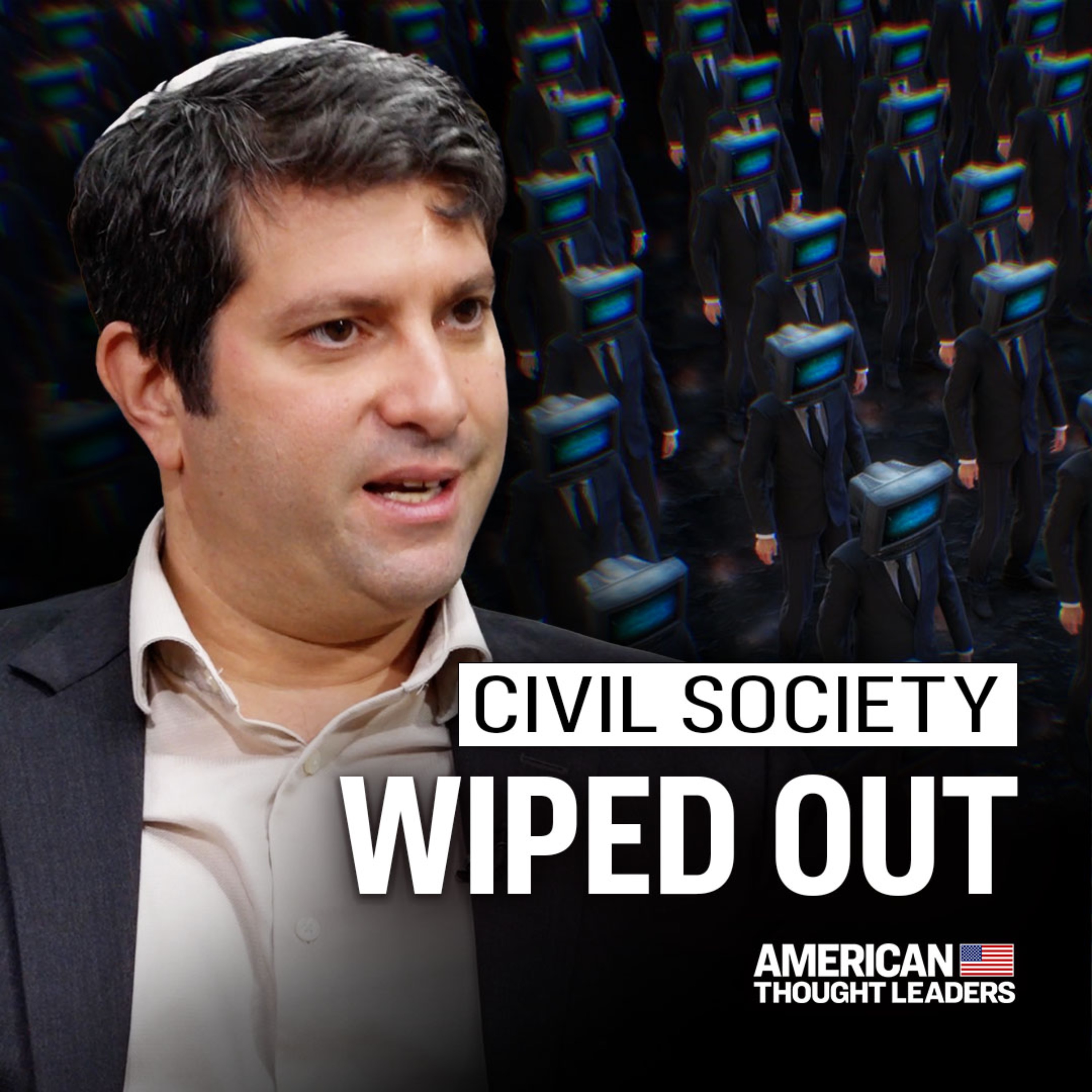
American Thought Leaders
How Constitutional Liberties Moved Into Hidden Algorithms | Jacob Siegel
01:25:14
Loading summary
Transcript451 lines
- [00:00]
Jacob Siegel
What does it mean to ensure that people get the right information other than to be the one who dictates what information it is that they receive?
- [00:09]
Janja Kellogg
There are few people who understand the machinery behind disinformation and modern censorship better than Jacob Siegel. He's the special features editor at Tablet magazine.
- [00:20]
Jacob Siegel
People need to understand that the birth
- [00:23]
of the digital age is going to be a. A unbelievably volatile and disruptive event that
- [00:32]
could last for another century and perhaps even longer.
- [00:36]
Janja Kellogg
His recent book is titled the Information Politics in the Age of Total Control.
- [00:42]
Jacob Siegel
The problem with these organizations is that while they have the appearance of neutral civic organizations, they're actually highly partisan and integral to this ruling party coordination.
- [00:55]
Interviewer
This is really astonishing.
- [00:56]
Jacob Siegel
The more freedom people are incentivized to
- [01:01]
give away by the promise of convenience,
- [01:04]
optimization, automation of wealth, the more likely they are to see the remaining freedom as diminished in value.
- [01:14]
Janja Kellogg
This is American Thought Leaders, and I'm Janik Yellick.
- [01:19]
Interviewer
Jacob Siegel. Such a pleasure to have you on American Thought Leaders.
- [01:22]
Jacob Siegel
Jan, it's great to be back with you.
- [01:24]
Janja Kellogg
Let's start here. So you describe a whole of society approach that fused government, tech platforms, NGOs,
- [01:34]
Interviewer
academia, into a permanent, well, quasi, permanent disinformation fighting apparatus. How did something that started as essentially counterterrorism efforts, you argue, turn into something like this?
- [01:52]
Jacob Siegel
So this concept of the whole of society actually begins in the world of developmental organizations like the United nations, where it's used to refer to kind of breakneck modernization programs. So if you're going into a country that doesn't have civil infrastructure, doesn't have water filtration systems, and you're trying to modernize it through this kind of international NGO approach. The idea was that instead of appealing to the public or to civil society, which presumably doesn't exist, instead you coordinate through whole of society, which is really a euphemism for the most powerful actors, the banks, the universities, the kind of ruling class institutions. And then it jumps this concept whole of society, from the developmental world to counterinsurgency warfare, particularly in Afghanistan, where it has almost the same meaning, but now with military backing. So whole of society is how the primitive rural Afghan countryside is going to be transformed into a modern approximation of a society that works according to rules recognizable to the democratic west. And then the final jump is into the American domestic political system. And this happens in 2009? Approximately. It happens in the first Obama administration. And why exactly? The Obama administration believed that the best approach to governance of American citizens in the United States was a model borrowed from Counterinsurgency warfare and developmental programs in essentially pre modern societies, I think speaks to the underlying beliefs of the people who were running that administration, who looked at the American political system and believed that rather than seeing a system in which local stakeholders needed to be respected and their own political legitimacy was based on their ability to appeal to a broad constituency and build popular support, instead
- [04:13]
they saw kind of vast opportunity for
- [04:18]
large scale governmental and social engineering projects. And that's why they began to speak explicitly. This was in the internal language of the Obama administration. Starting in the first term and accelerating during the second term, you began to hear more and more about the need
- [04:37]
for first it was called whole of
- [04:38]
government and then it was whole of government and whole of society efforts. And what they meant by that again was largely the same thing that had been meant in Afghanistan, which was that if you were trying to push through some kind of new policy, let's say Obamacare, a sweeping new health care regime, rather than necessarily needing to build, build up popular support by appealing to not only the general population, but also to local political parties, instead what you could
- [05:12]
do is you could coordinate support of
- [05:15]
the most powerful institutions, what were called the stakeholder institutions. And by doing that, by getting the media, the universities, the banking institutions, the large medical organizations, the insurance companies, by getting all of them on board, you could then impose this kind of top down policy.
- [05:38]
Interviewer
So this is the censorship industrial complex that you're describing.
- [05:42]
Jacob Siegel
Basically I would say this is the
- [05:45]
pre phase, this is the governmental infrastructure that makes the censorship possible. This is what builds this kind of top down coordination. That means that when there is a subject that you want to censor now you have all of the most powerful institutions already aligned, already formed into a kind of organizational network.
- [06:13]
So the censorship isn't the first order
- [06:17]
of business with the whole of society necessarily, but it's kind of baked into the approach and, and it follows very soon. So if the peak year for the pre censorship whole of society approach is 2014, let's say by 2015, that apparatus is already beginning to look at the necessity of not only censorship in the overt sense, but also more subtle forms of informational control, like the establishment of a new fact checking apparatus, the development of these seemingly innocuous civil society appearing programs like fact checkers and who possibly could object to facts.
- [07:02]
Right.
- [07:03]
The problem of course is that the so called fact checking organizations, like a very influential one called the International Fact Checking Network, which would later become the kind of in house fact checker for Facebook, the problem with these organizations is that What? While they have the appearance of neutral civic organizations, they're actually highly partisan and integral to this whole of society. Coordination of effectively ruling party coordination.
- [07:33]
Interviewer
The thing that's difficult to understand in what you're describing, I think, is how this becomes so coordinated and intertwined. How do all these elements become so connected with each other?
- [07:50]
Jacob Siegel
I think the answer to that is more technological than it is political. The reason why the whole of society could be applied in the United States was not simply about the ideological preconceptions of people. In the Obama administration, there was an even more fundamental change, and that is the sweeping away of previously existing local organizations, civic organizations. This is the kind of grand process of the last half century. It's been documented by people writing on the left, people writing in the center, people on the right, like Charles Murray.
- [08:32]
You know, this is the process by which the local church, the community board,
- [08:39]
the school board, the labor union, the trade association, all of these interwoven structures that had made up American civil society, were beginning to come apart, in Murray's phrase. And this coming apart of the local organizations initially left the individual and the state. And this is the great expansion of the welfare state, in part, is a response to this elimination of the kind of middle layer of American civic organizations. But then a great change occurs, and it happens to coincide with Barack Obama being elected president for the first time, and that is the rise of the social media platforms and the rise of the smartphone.
- [09:26]
So what happens is that with the
- [09:29]
elimination of the kind of local, civic texture of American life, the social media platforms propose that they can reintroduce something like this. And Mark Zuckerberg, the CEO of Facebook, says this very explicitly. You know, we've lost all of these things in America. The community board has gone away. But Facebook is going to recreate this.
- [09:53]
Interviewer
It's going to be the public square.
- [09:55]
Jacob Siegel
I remember that.
- [09:55]
It's going to be the public square.
- [09:57]
And it won't give you back the
- [09:59]
old kind of community board. It'll give you something even better.
- [10:02]
But in fact, as we all know,
- [10:04]
as is very evident from the experiment having been run now for quite a while, Facebook doesn't recreate the texture of civic organizations. And it turns out that Facebook is
- [10:16]
far more effective than the physical world
- [10:20]
that we used to inhabit.
- [10:22]
I mean, if you think about how
- [10:24]
Facebook or Twitter, or Google for that matter, works, there is no real middle layer of sovereign participation. There's billions of users across the globe. And then there are the masters of the data who are in control of what we see and how we see it and when we see it, and that's the precondition first for the whole of society formula and then for the mass censorship that follows.
- [10:55]
Interviewer
Well, and just as a quick example of sort of the power of these systems, I remember there was a campaign years ago to bring out the Hispanic vote on Facebook. Right. I don't know if you remember this, but it just, it was fascinating. And it was sort of touted as this huge success because Facebook managed to bring out some incredibly significant portion of the Hispanic vote or an increased portion of the Hispanic vote compared to what had happened before, what they were expecting. So this was touted as this public success, but it took a while for people to realize, hey, wait a second, this is like highly political mobilization that's happening here. Right, Right.
- [11:39]
Jacob Siegel
And that's what. It's very effective at Facebook. Obama's first campaign was called the Facebook Campaign. He launched his first presidential campaign from Google headquarters. So, you know, it was the Google presidency, the Facebook campaign. This was seen as both the future and the kind of heart of the political sphere, beginning in the late 2000s and into the 2010s, and this was viewed as a very good thing. You know, Obama running a Facebook campaign was seen as a sign that technology and political progress were proceeding hand in hand.
- [12:18]
It was. It wasn't until Trump ran his own
- [12:21]
version of a Facebook campaign that the moral, political valence in the kind of elite imagination flipped. And all of a sudden, the Facebook campaign went from being a very good thing, a sign of technological progress, to being a horrible nightmare.
- [12:40]
Janja Kellogg
America's education system is broken.
- [12:43]
Interviewer
You've actually heard about it here on
- [12:45]
Janja Kellogg
American Thought Leaders from a lot of experts. But many busy parents also struggle with finding good alternatives. That's where Freedom Project Academy comes in. For 16 years, FPA has offered a fully accredited classical online education grounded in Judeo Christian values for students from pre K all the way through to high school. If you need structure, you can go live with real teachers every day. If you need flexibility, you can choose anytime. Classes, right?
- [13:14]
Interviewer
Ready? 24. 7. Want more control?
- [13:17]
Janja Kellogg
The homeschool track lets you guide your child's education while the academy provides the curriculum and support. However you learn. Every student at Freedom Project Academy learns with purpose and grows at a pace
- [13:30]
Interviewer
that fits their calling.
- [13:31]
Janja Kellogg
In a world where schools are drifting from faith and those timeless values that many of us deeply cherish, Freedom Project Academy is offering an alternative. No common core, no political agendas, just rigorous academics rooted in truth and tradition. Education Insider named them the 2026 Christian School of the Year, visit freedomfirstschool.com and save 10% on tuition. When you use the code EPOCH10 again, that's freedomforschool.com where families can rediscover what education was always meant to be.
- [14:09]
Interviewer
I've been doing a lot of interviews recently where we reference what in China is called the United Front. It's an entire department or ministry committed to, and one of the best, funded, by the way, committed to destroying precisely all civil society or subverting all civil society. That's this kind of, you know, I've been studying the United Front for a long time, but it didn't sort of dawn on me until recently how that that's actually its entire. If you can summarize its entire purpose in a sentence, that's it. I'm wondering if there's some sort of equivalent emergence structure that has appeared in the West.
- [14:54]
Jacob Siegel
Yeah, I mean, I think the phenomenon you're describing is essential to understanding the political moment where living through in America, it didn't require a heavy handed governmental role in the same way as occurred in China initially. But in the American context, what you see is the vast acceleration of the erasure of the kind of core remnants of civil society. And this takes place through a number of different mechanisms. Some of it is through outsourcing our manufacturing base to China. Some of this is through people deciding for sort of, you know, cultural reasons that they no longer want to be associated with these old sort of civil society institutions that they now consider oppressive. But through all of this you have this sort of gradual winnowing down of the, the bedrock of civil society. And then the Internet hits, and it's the introduction of the Internet initially and then even more powerfully the advent of smartphones and social media apps in particular, which really lead to a kind of catastrophic, what I would describe as a catastrophic loss of the last remnants of civil society. And, and so you don't necessarily need in America the same kind of active government effort to shut down civil society, though that does obviously happen. There are legal cases against churches being able to continue to operate independently. There are any number of things you could point to, and I don't mean to downplay political dimension, but the, the other thing that happens that's really crucial, as you mentioned, is that you get a new tranche of organizations that appear to be part of civil society, the Nonprofit organizations, the NGOs, that sort of imitate the appearances of civil society. So instead of voluntary associations being built up gradually in this kind of nested patchwork of People's free self identification and self expression. You get the replacement of that free association with these new organizations that are holding deposit accounts for billionaires to put money to avoid taxes and also to exert political influence and simultaneously for the government to exert political influence and enforce policies that it can't do legally due to constitutional restrictions. So now it has this whole kind of additional branch of government, which is the non governmental organization and the nonprofit, which appears to be acting on behalf of the interests of the public, as it were, for various social causes, but is really a kind of paragovernmental force that can enact and enforce policies without being restricted by law.
- [18:15]
Interviewer
Well, and impact government and work together with government and is just has a similar maybe mentality in some ways.
- [18:24]
Jacob Siegel
Absolutely. It's a kind of shadow government and it has a similar mentality for. I think you could look at it at one level as simply being about self interest. If you're in the nonprofit sector, your existence relies on the largesse of the federal government in a way that, you know, somebody who's selling auto parts doesn't necessarily.
- [18:47]
The person selling auto parts is impacted
- [18:50]
by trade policy, et cetera, but their budget doesn't come directly from the federal government. They have to get out and create a market and sell things. If you're working in the nonprofit sector, you depend on this sort of confluence of philanthropic money very much impacted by the federal government and the federal government itself, which is
- [19:18]
probably going to be
- [19:19]
funding your nonprofit to one degree or another. So of course you're going to see yourself as aligned with the government because
- [19:29]
in a way, you're acting as an
- [19:32]
extension of the government in a way that's not particularly subtle or hard to grasp.
- [19:37]
Interviewer
Well, or an extension of a very powerful special interest or a few. Right. I love your big picture thinking in the information state. Something that is very difficult for people to grasp, which Marshall McLuhan wrote about, difficult for me to grasp when I first started reading him, is that,
- [20:03]
Jacob Siegel
well,
- [20:04]
Interviewer
we'll use the example of the Gutenberg Press. You know, talk about the Gutenberg Galaxy. This, you know, the book you wrote. But the idea essentially is that not only the Gutenberg Press, that technology, the change in media changed society and culture in fundamental ways. So it's all, you know, you say politics is downstream from culture, culture is downstream from media. Really. I just, I think this is difficult for people to understand. This is exactly what's been happening you're arguing here.
- [20:38]
Jacob Siegel
Yes. The simplest and I think the most eloquent formulation of this is McLuhan's famous line that the medium is the message.
- [20:47]
Interviewer
But I think people hear that and are like, what does that mean? Right. I don't know if it's clear.
- [20:53]
Jacob Siegel
It's kind of cryptic. It's kind of cryptic. And he could be a somewhat oracular writer, McLuhan. So clarity was not necessarily his strong suit, though he was brilliant.
- [21:04]
But while the phrase itself is not
- [21:07]
always clear, people immediately grasp it in their own lives. So the clearest example is if I give you precisely the same message, exactly the same words, and you receive those words in a televisual medium, you watch somebody say those words on television, or you read those words for yourself, the effect on you, how you receive the information, the affective experience of it, how it feels emotionally, what it triggers in you, just the experience of it is totally different. And if you magnify that by, you know, millions of times that effect, tens of millions, trillions of times, what you're
- [21:53]
talking about is not simply the difference
- [21:56]
in how an individual feels or perceives something. You're talking about an entirely new domain of experience created by the media through which you are receiving the information. And so when McLuhan talks about the Gutenberg galaxy, what he's saying is that the printing press, this form of media, the printed word, the mass printed word at scale, expanded into an entirely new cosmology. The way we as human beings, as individuals, understood our relationship to the entire cosmos, to God, to each other, in our social arrangements. All of this was affected by the dominant media of the time. And in historical terms, we can see what followed from the invention of the printing press.
- [22:53]
Many good things, many fairly horrific things.
- [22:56]
The thirty Years War, the bloodiest war in Europe in a millennia, but also after that, the Peace of Westphalia, the liberal nation state, modern nationalism, in effect,
- [23:10]
all of the kind of relationship that
- [23:13]
we have to one another in social.
- [23:16]
Interviewer
Arguably, liberal democracy.
- [23:18]
Jacob Siegel
Absolutely, absolutely liberal democracy. The American constitutional order, the very idea of self government that we've been talking about, the kind of Tocquevillean idea, the idea that individuals are capable of reasoned self government requires that they be able to absorb and understand certain kind of
- [23:42]
foundational political principles which they receive through
- [23:45]
documents like the Constitution, the Bill of Rights.
- [23:49]
And so it's a whole world that's
- [23:53]
created by this kind of media. And what I'm arguing in the information state is that that old print based order has effectively begun to be supplanted by a new digital informational order which is not constitutive, it doesn't generate the same values. It doesn't generate the same cosmos. It's not the Gutenberg galaxy. It's a new kind of digital universe. And for the moment, the two worlds coexist. They overlap. So we still have the constitutional order, we still have the liberal nation state, but the principles of the constitutional order, the principles of the liberal nation state have begun to be profoundly eroded by this new kind of information based political regime.
- [24:47]
In the constitutional order that was, there were prescribed rights.
- [24:52]
All of us as citizens had certain rights that were inalienable in principle and protected in practice by written documents like the Constitution.
- [25:04]
But in an informational order, those rights which are supposed to be inalienable are
- [25:11]
relocated, they're moved, transplanted out of these written documents, out of physical institutions. So out of the Constitution, out of Congress. And those rights are relocated into the digital code.
- [25:26]
So the question of who can speak,
- [25:29]
who can express their ideas, is no longer clearly defined and delimited by these print era documents. Now it becomes a question of who controls the digital code that not only has the capacity to exercise mass censorship powers over the public, but in an even more subtle and pervasive level, determines
- [25:52]
whose speech is going to be heard.
- [25:55]
You know, you can tweet something, but will it be visible to anyone? You can write something on Facebook, but
- [26:01]
will anyone actually be able to see it?
- [26:04]
And that's an example of how a
- [26:05]
constitutional right is migrated outside of its
- [26:11]
previous setting and into a new kind of digital informational context.
- [26:17]
Interviewer
Well, this makes me think of malinformation. Let me get you to tell me about malinformation and how it's relevant to what you just said.
- [26:28]
Jacob Siegel
Truly a word for our times. It's an extraordinary neologism that comes out of a 2017 Harvard paper by two academics who coin a new tripartite scheme for understanding disinformation. So this comes out, the Harvard paper comes out in 2017, and everyone's talking at that point about disinformation.
- [26:54]
To a lesser extent, misinformation, which is
- [26:57]
starting to rise in popularity. And now the Harvard academics introduce a third term, malinformation. So in this scheme, disinformation refers to deliberately false information intended to cause harm. And we'll come back to that, the criteria of harm, because it's crucial here. But that's disinformation. It has to be intentional. Misinformation is unintentionally false information that causes harm as a consequence of it being false, even though the intent isn't there. And then malinformation, which is the newest and also the most elusive and sinister of the three terms refers to factually true information which is perceived to cause harm. So something is mal information. If it is true, it's a correct, factually accurate statement.
- [28:00]
And yet the authorities who make such
- [28:02]
determinations have decided that it causes harm.
- [28:06]
So this criteria of harm becoming the
- [28:10]
basis on which information is judged does a couple of things.
- [28:15]
First of all, it relocates the question
- [28:17]
of truth and accuracy outside of the plane of the philosophical or epistemological criteria of does something accord with reality, which is perhaps how most of us understand truth.
- [28:33]
And it now shifts the kind of crux of the definition onto whether or
- [28:40]
not something causes harm, which is a
- [28:43]
term that's borrowed from therapeutic medical literature and is obviously highly subjective. So by the time you get to
- [28:52]
malinformation in the original 2017 paper, they're
- [28:58]
already applying malinformation potentially to subjects like
- [29:02]
climate change skepticism that could be an example of mal information. And so it's unbelievably broad.
- [29:10]
It's intrinsically not only susceptible to political
- [29:14]
abuse, it's designed to be a political term. So this comes out of the academic world.
- [29:22]
But by 2022, the US federal government
- [29:27]
has adopted this framework. So mal information becomes part of the
- [29:33]
scheme for regulating information for the cybersecurity
- [29:37]
and Infrastructure Security Agency cisa, which is
- [29:41]
under the Department of Homeland Security and
- [29:43]
is one of the central nodes not only of disinformation policing, but of the
- [29:48]
larger information regulation regime and of the
- [29:52]
very information state that I describe in my book. So the government adopts this framework of
- [30:00]
policing information that it acknowledges is true, but that it alleges to cause harm. And just quickly to. To give examples of the kind of
- [30:10]
information that it was potentially going to apply this to. And we know this because there was a leaked Department of Homeland Security drafted document. There are various other documents that go into even more detail that came out through the Subcommittee on the Weaponization of the Federal Government that was led by Jim Jordan. Examples include, again, climate change skepticism, vaccine skepticism, the war in Ukraine, the US Withdrawal from Afghanistan. All of these were potentially subjects that could be policed for allegedly harmful malinformation.
- [30:49]
Interviewer
This is really astonishing, what you're describing. We've kind of lived through some of. You will have lived through some of this. Explain to me. So you argue that this information state, you know, really kind of germinated at the end of the last Obama administration. And given what we know now, when we interviewed three years ago, I think we didn't know. There are many things we didn't know that we know today. Can you kind of explain to me what happened, how that happened?
- [31:18]
Jacob Siegel
Let me go back a bit farther, actually. A bit further, if you don't mind. The origins of this in the kind of greater historical context of American politics. It really begins in the Woodrow Wilson administration and the First World War. And it's Wilson who creates the first American propaganda office, which he calls the Committee on Public Information. So the CPI is a official propaganda organ that Wilson creates weeks after he makes the decision to enter the US into World War I, which was a
- [31:55]
very unpopular decision, a contentious decision that
- [31:59]
went against his own campaign promise. He had campaigned for reelection in 1912 on the slogan he kept us out of the war. That was his campaign slogan.
- [32:10]
Then he brought the US into the
- [32:12]
war and rather than entering into kind of bruising political debates where he would have to justify that decision to, you
- [32:20]
know, hostile politicians to the general public,
- [32:23]
instead he creates this government propaganda office called the cpi, headed by a progressive journalist named George Creel. So the CPI is also sometimes known as the Creel Committee. And this invention of an information regulation office by Wilson, on the one hand, it's something he does kind of out of desperation as this emergency measure to deal with the backlash for his decision to bring the US into the war.
- [32:52]
But on the other hand, it reflects
- [32:54]
the deepest premises, the deepest philosophical premises of progressivism, of American progressivism.
- [33:03]
And what I mean by that is
- [33:05]
that progressive ideology in America, which begins in the late 19th century.
- [33:11]
And Wilson is one of the central
- [33:13]
figures in articulating the political philosophy of progressivism through his work on administration. Progressivism is the idea that modern society has become too complex for self government to still apply. So the original principles on which America
- [33:33]
was founded, that people could reason their
- [33:35]
way to understanding the world, that they should be entrusted with governing themselves, is
- [33:42]
really, you know, it's a kind of fairy tale.
- [33:44]
Wilson and other progressives are arguing in the late 19th century because industrialization, the
- [33:50]
industrial revolution, has introduced a level of
- [33:53]
complexity that the average person simply isn't capable of understanding.
- [33:58]
And so the Constitution is a nice
- [34:00]
kind of folk tale that we might tell ourselves, but it doesn't really apply any longer. And what's going to replace this kind of folk system of democratic self government, Wilson and others of his ilk argue, is expert administration. So government is going to become the province of technical experts. And these technical experts will control this intricate and complex machinery of modern society.
- [34:31]
And the Constitution is something that we'll
- [34:34]
have to kind of work around. And Wilson is openly hostile to The
- [34:38]
Constitution and for that matter to the
- [34:40]
idea of separation of powers which he views as an impediment to expert led technocratic administration. But there's a problem, and the problem
- [34:48]
is what do you do with the people, the public, who have been raised in the American tradition to think of
- [34:55]
themselves as the ultimate authority, to think that the government serves at their behest and that their principal political duty is to prevent the formation of a tyrannical government. And the answer that Wilson and other progressives come up with is propaganda.
- [35:15]
So because the people still believe they
- [35:17]
have the right to rule but are no longer capable of ruling and are only going to get in the way of these expert technocrats who really need to run society, propaganda will become the means by which you can convince the
- [35:32]
people to go along with decisions that
- [35:35]
the experts have already made. This really becomes the kind of essential ruling philosophy of the Wilson administration through both of his terms, the first and second term. And it reaches this sort of height with the creation of the Committee on Public Information. And the idea is that if you can control the information, you can control the society. And this is how you can mold people's beliefs. You can bring them in line with the war effort.
- [36:06]
And the war is really lending for
- [36:08]
obvious reasons, a kind of existential urgency to all of this.
- [36:13]
And the US isn't the only country
- [36:15]
with a propaganda office. Basically every belligerent in the First World War, England, Germany, they all have propaganda offices.
- [36:23]
And propaganda is seen both as the
- [36:26]
key to winning the war by marshaling the support of the public and increasingly as the key to ruling domestically. So there's this convergence between the techniques of warfare and the techniques of domestic
- [36:41]
governance inherent to the sort of informational approach and also inherent, I would argue
- [36:49]
in progressivism to some degree. So that's all at the beginning of the century, beginning of the 20th century.
- [36:55]
Interviewer
And indeed this is sort of argued in the original book Propaganda that benevolent propagandizing of the population is a great thing.
- [37:03]
Jacob Siegel
In Bernays book. Yes, exactly, yes, yes, Bernays is absolutely advocating for all of this and he
- [37:10]
calls it the invisible government.
- [37:13]
So Edward Bernays, nephew of Sigmund Freud, who also happened to work for the
- [37:19]
War Department during the first World War
- [37:21]
doing what he described as psychological operations.
- [37:24]
Bernays, who sort of writes the first
- [37:27]
and most influential book on propaganda, argues for all of this explicitly and in
- [37:34]
essentially sort of progressive terms as this
- [37:40]
is a good thing, we need propaganda. This is how society is running.
- [37:44]
And it's basically like an advertising department for the government. So then you Fast forward a century
- [37:49]
and you get to the administration of Barack Obama and what you have is this sort of revitalization of these core ideas of progressivism, about the necessity of propaganda, about the power of informational control,
- [38:08]
but supercharged, because now, rather than working
- [38:12]
through the printing press, through the radio, through telegraph, now they're working through a global communications infrastructure which has the ability not only to deliver information to anyone, anywhere on the globe at any moment, but to receive information from all of those people too. And I'm talking, of course, about the Internet and Obama. In his first memoir, his first book, he describes a 2004 visit to Google headquarters in Silicon Valley where he's taken in to see this three dimensional rotating globe that Google has.
- [38:53]
And the globe shows all of the Google searches going on across the world at that moment with different colored lights to indicate the different languages in which
- [39:07]
the Google searches are happening.
- [39:09]
And there's this moment Obama describes in his book where he has a kind of religious reverie. It's like a moment really of a
- [39:18]
kind of ecstatic revelation where he sees
- [39:23]
this harmonious global village in this world
- [39:28]
order where everyone is brought together through this new informational network.
- [39:33]
And he later gives a speech at Google where he, he kind of builds
- [39:38]
on this idea and he says, you
- [39:40]
know, what we're going to do together, meaning his administration and Silicon Valley, is
- [39:46]
we're going to give people good information.
- [39:49]
You know, people are basically good, and when they get the right information, they
- [39:54]
make the right decisions. So what we're going to do is
- [39:57]
we're going to ensure that people get the right information.
- [40:01]
And there's thunderous applause from the Google employees and there's this sort of shared
- [40:06]
vision that by giving people the right
- [40:09]
information, by controlling the information they receive,
- [40:12]
in other words, because what does it mean to ensure that people get the right information, other than to be the one who dictates what information it is that they receive? And Obama says, you know, what we want is more facts, more reason.
- [40:28]
And there's this applause line when he says this.
- [40:31]
And so this is deeply embedded in Obama's political philosophy and in the political
- [40:38]
philosophy of Silicon Valley at the time of the big tech companies, of Google, of Facebook.
- [40:44]
They see themselves as being partners in this new mission to sculpt the global information environment in a way that is
- [40:55]
going to bring people closer together, that's
- [40:58]
going to increase peace, fraternity between nations, between brother and brother, sister and sister. And that, of course, is going to
- [41:09]
help get the key initiatives of Obama
- [41:12]
policy passed through Obamacare.
- [41:16]
Later, the Obama's Iran deal. All of this will depend on controlling and sculpting this information environment.
- [41:24]
But it's really, it's deep in the kind of governing philosophy of progressivism and
- [41:32]
of technological progressivism that comes out of Silicon Valley.
- [41:38]
Interviewer
You describe this moment where the modern information state really comes into being. Tell me about that.
- [41:47]
Jacob Siegel
You know, it's a bit like how the liberal nation state comes into being after the invention of the printing press,
- [41:53]
which is to say that it happens
- [41:55]
through a series of events, not in a single moment. But the first thing that happens, I think, is this major technological advance, which
- [42:04]
is the social media app and the smartphone.
- [42:09]
And the reason why I describe those as major is that they fundamentally change the relationship between individuals and the Internet.
- [42:17]
So if you think back to the
- [42:18]
kind of AOL era, those of us who can remember back that far, the Internet in those days was this kind
- [42:25]
of passive, remote place that you had to sort of cross some bridges to get to.
- [42:31]
You had a dial up Internet connection. You know, your modem sort of rang
- [42:37]
you into the Internet. You went there, it was kind of slow.
- [42:39]
You visited websites, that was what you did.
- [42:43]
You sort of visited this place.
- [42:44]
Maybe you bought some things on Amazon, you read some news, you chatted with
- [42:48]
some people, but essentially it was a
- [42:52]
remote location that you visited. Well, by the time Obama is coming into office, there's a radical change taking
- [43:00]
place because the Internet in the era
- [43:02]
of, of the smartphone and the social
- [43:04]
media app, is no longer a remote environment that you visit. It becomes the environment of your moment
- [43:12]
to moment daily life.
- [43:14]
It becomes a kind of all encompassing immersive environment. And so the information state begins in the Obama administration. It begins in this recognition of the power of this new environment, which is seen in positive terms. And then the kind of powers of the information state begin to evolve by degrees. Social media, for instance, makes it possible for campaigns to reach voters in a way that hadn't existed before.
- [43:50]
And this is the idea of Obama's Facebook campaign.
- [43:53]
So you can gather information on voters
- [43:56]
that makes it possible to target them. This sort of micro targeting becomes possible in ways that hadn't been dreamt of before.
- [44:04]
And it's also possible to speak to
- [44:06]
voters in ways that hadn't been possible
- [44:10]
before and to form new kinds of
- [44:13]
political communities online that enforce ideological and
- [44:18]
political conformity in new ways. And you know, there's another part of this that has to do with how the Internet evolved after the war on
- [44:28]
terror that led to this.
- [44:31]
But it doesn't really come into view as a kind of domestic political instrument until the Obama administration and really the second Obama administration, where you see the White House attempting to impose its policies principally through its control of the information environment and, and through these kind of big data approaches to cutting up the population into different demographic segments that it's going to reach with different messages and
- [45:03]
then targeting them through the social media apps.
- [45:07]
Interviewer
How do Russiagate and the suppression of the Hunter Biden laptop fit in here?
- [45:13]
Jacob Siegel
So that you have this pre existing
- [45:16]
formation the whole of society framework for governance and the new controls of the information state, these digital control nodes, through social media platforms and other kinds of big data harvesting and data analytics approaches,
- [45:37]
you have those already existing and you
- [45:40]
have a few kind of preliminary attempts to apply them in very dramatic political schemes.
- [45:47]
Maybe the most significant prior to Russiagate is the Iran deal. So when the Obama administration wants to push through its Iran deal, which is the signature policy according to Obama himself and all of his top aides of the second Obama term, is this grand alliance, effectively, that Obama is going to make with Iran through the mechanism of
- [46:13]
this nuclear deal known as the jcpoa,
- [46:16]
and the mechanism through which it tries
- [46:19]
to sell this to the public.
- [46:21]
In a direct echo of Woodrow Wilson and the Committee on Public Information, the mechanism the Obama administration uses is what Obama's, one of his top aides and speechwriter Ben Rhodes describes as the echo chamber. And the echo chamber refers to using the kind of nonprofit institutions we had been talking about earlier, which are nominally neutral, but are really quite partisan, in coordination with ideologically sympathetic media outlets to create the appearance of a consensus where
- [46:58]
no organic political consensus exists.
- [47:01]
This is. Rhodes talks about this explicitly. This is the echo chamber. And by creating this kind of consensus, which is largely formed on Twitter through social media, it effectively communicates to the public go along with this, because the whole of society has already determined that
- [47:24]
it's right and good.
- [47:25]
And this is applied directly to the
- [47:28]
Iran deal, which is seen as the centerpiece of Obama's second term.
- [47:34]
So it's been tested out. This whole of society approach, this information
- [47:39]
state propagandistic apparatus is tested out through the Iran deal.
- [47:45]
And then Donald Trump comes along. And when Trump comes along, the system
- [47:50]
goes into a kind of shock.
- [47:52]
You know, it's a cataclysmic event. And Trump is viewed as an existential threat to the American ruling party.
- [48:00]
Interviewer
And if I just may add, like he uses those same tools to do that. Right, right.
- [48:07]
Jacob Siegel
And this is part of why Trump is such a shock and a threat, because Trump runs the second Facebook campaign. And whereas Obama's Facebook campaign was seen as, you know, a glorious thing that reflected very well on Facebook. When Trump is seen to have won in 2016, largely through his appeal to his voters on Facebook, he finds this way of routing around the party gatekeepers, routing around both the media and the Republican Party gatekeepers, by appealing directly on
- [48:41]
Facebook, all of a sudden, Facebook is
- [48:43]
seen as a detriment to democracy, a threat to democracy, a terrible, dangerous wasteland overrun by foreign disinformation and fake news.
- [48:54]
So there's this complete 180 reversal of the attitude, the kind of moral, political, ideological attitude, towards what it means for a politician to use Facebook to reach voters.
- [49:09]
It's a grand thing. In 2008 and 2012, when Obama uses it, it's on the side of moral and historical Progress.
- [49:18]
And in 2016, when Trump does it, it's a sign of the apocalypse. And this is a major part of the perceived threat. And so the kind of. The rulers of the information state, as it were, but the architects and the former controllers of the information state feel
- [49:37]
that they're losing their grip.
- [49:39]
They're losing their grip over the Internet.
- [49:41]
It's slipping away and into dangerous hands.
- [49:46]
And Russiagate, which we can summarize briefly as the confected fraudulent claim that there was a collusion between the Russian government and Donald Trump, which led to Donald Trump's election in 2016, or slightly more, in the slightly more modest version, that Russian disinformation campaigns swung the 2016 election and significantly helped put Donald Trump in office.
- [50:19]
Interviewer
Well, and that he was an asset, I think. Right, right.
- [50:22]
Jacob Siegel
I think the maximal claim was that Trump was an asset, that there was collusion between the Trump campaign and Vladimir Putin. And then the slightly more modest campaign
- [50:32]
claim, rather, is that because many of the people who made the maximal claim, once it was definitively disproved, once, you
- [50:40]
know, even the Mueller report said he
- [50:42]
wasn't an asset, then they fell back
- [50:44]
in this kind of Mott Bailey thing. They fell back from the maximal claim
- [50:48]
to the slightly more modest claim that,
- [50:51]
okay, maybe he wasn't an asset, but clearly Russian disinformation is what put him in office. He wouldn't have won without the Facebook, the infamous Facebook ad purchases and the Russian disinformation.
- [51:04]
So those were the two claims that
- [51:06]
I would say collectively made up the kind of grand Russiagate conspiracy. So Russiagate introduced a state of exception
- [51:15]
into American politics, because, after all, if
- [51:17]
you believe that there's a Russian agent
- [51:20]
in the White House, you can permit
- [51:22]
yourself to take all available means by any means necessary to deal with that threat.
- [51:29]
So forget about constitutional prohibitions, forget about congressional procedure, forget about the will of the voting public.
- [51:38]
We can sweep all of that aside
- [51:41]
to deal with this threat and the way that the anti Trump forces used Russiagate to deal with what they perceived as an existential threat, which was what
- [51:52]
was really effectively just a threat to their own monopoly on power. It was a threat to one party
- [51:58]
rule in the US and maybe some of them even perceived Trump to be
- [52:04]
an existential threat beyond that.
- [52:06]
But in either event, they granted themselves extraordinary unconstitutional powers. They made themselves the kind of executors
- [52:15]
of the American political system and just glibly discarded the will of the voting public.
- [52:22]
And part of the way they did
- [52:23]
this was through seizing control over the
- [52:26]
Internet because they thought that it was, or they claimed at least that it was disinformation on the Internet that had
- [52:37]
put this nefarious Russian agent in the White House.
- [52:40]
Therefore, the way to deal with the threat was to reassert top down, party
- [52:45]
driven control over the Internet.
- [52:48]
And they did this through a number of mechanisms, primarily through the launch of
- [52:54]
a campaign to eradicate disinformation.
- [52:57]
Interviewer
If I may jump in. Right. I also think that Russian disinformation has been incredibly effective. The active measures and demoralizing America, right? Believing it, believing in itself and its kind of unique features and so forth, imagining itself to be bad and horrible and colonialist, all sorts of stuff.
- [53:18]
Jacob Siegel
Well, there are two things we can tease out. The first is what did Russian disinformation do? And the claim in 2016 was not that Russian disinformation demoralized the American public. The claim was that it put Donald Trump in the White House. And so I think it's true that Russian disinformation has been effective in some ways in demoralizing the American public. But that wasn't the claim made. And it's specifically the claim that Russian disinformation put Trump in the White House.
- [53:47]
That was used to create a unconstitutional new form of government surveillance, speech monitoring
- [53:57]
and speech regulation that existed outside of the Constitution, operated in secret and constituted what I would say was the most overt censorious and overtly authoritarian version of the information state.
- [54:15]
And there's a second point I think
- [54:17]
that's crucial here about Russian disinformation in
- [54:19]
particular, which is that the utter partisanship of the initial counter disinformation effort has
- [54:29]
now convinced, unfortunately, tragically, in my view,
- [54:33]
has convinced a segment of the American
- [54:35]
right that there is no such thing as Russian disinformation.
- [54:39]
People Are they were so, let's say
- [54:43]
disenchanted, disillusioned by the ways in which claims about disinformation were used to delegitimize
- [54:53]
the election of Donald Trump, that there is a segment of the American right in particular that has decided the whole thing's a myth, there is no foreign disinformation. And so the utter partisanship of those
- [55:06]
counter disinformation efforts that began with the GEC and led to other agencies like
- [55:13]
CISA was actually, actually undermined legitimate counter disinformation needs.
- [55:21]
It undermined the fight against Russian disinformation.
- [55:25]
And that's part of the tragedy of this. But there's also one further element to add here, and that is that the claims about Russian disinformation, which created this new form of information regime, which were used to empower these new agencies and cutouts and initiatives that embedded federal agents
- [55:53]
into Twitter, that placed these kind of
- [55:56]
pervasive speech surveillance and monitoring operations into the back end of Google and Facebook and all of the major social media platforms. All of, all of that was predicated
- [56:09]
on a foreign threat.
- [56:11]
And yet, as we know now, it was almost immediately wheeled around and used
- [56:19]
as a mechanism to police the domestic political arena.
- [56:24]
So when you're talking about the need to combat foreign disinformation, real foreign disinformation, I'm with you. And I think that's fairly uncontroversial from the perspective of anyone who recognizes that a sovereign state has legitimate security needs. However, the thing that was called the counter disinformation establishment, you know, the so called counter disinformation campaign in the US
- [56:53]
which claimed to be operating to protect Americans from foreign disinformation, was inherently designed
- [57:01]
and almost immediately began to implement a
- [57:05]
program that was actually focused on domestic political speech.
- [57:09]
Interviewer
Yeah, maybe give me a few pieces of key evidence of how this evolved.
- [57:15]
Jacob Siegel
That came to light on January 7, 2017.
- [57:21]
The outgoing head of the Department of Homeland Security, the Obama appointee, Jed Johnson, declares that the federal government is going
- [57:30]
to take control over all 8,000 pieces of electoral infrastructure in the country.
- [57:37]
Now, this is something that Johnson, by
- [57:39]
his own admission, had been attempting to
- [57:41]
do for a year prior. And he wasn't able to do it because he kept running into resistance from local electoral officials, local election officials, state officials, who said, hey, that's a usurpatious act. You can't do this. This is something we control at the local level. He's not able to do it through normal means. So in his literally final days in office, he just does it by executive fiat. And now the entire national electoral infrastructure
- [58:12]
is under the control of the federal government. Well, the next thing that happens is
- [58:17]
that the government agency CISA declares that it not only will ensure the physical safety of the electoral infrastructure to include, you know, Internet fiber optic cables that are necessary to elections in a, you know, a modern state, it's also going to police the speech online that's taking place within the medium of the Internet itself. So there's this extraordinary leap in unilateral seizures of power over the electoral infrastructure itself. First Judd Johnson says the physical pieces are under the control of the federal government. Then CISA says those physical pieces include the Internet itself because we're the cybersecurity and infrastructure security agency. And then finally it says it not only includes, you know, the server stacks
- [59:20]
that the Internet runs on, it includes the speech taking place on the Internet.
- [59:26]
CISA later will adopt the MDM framework, which means that CISA adopts mal information as the criteria it's using to monitor speech taking place on the Internet, supposedly in the name of protecting the American infrastructure from attack and sabotage. So that's one very clear example of the way that something that might seem seemingly reasonable in its initial application we have to protect election infrastructure becomes a kind of opening through which this far more ambitious, far more partisan effort takes place. And these efforts become so pervasive that by the time you get to the Biden administration, the Post Office is monitoring political speech on social media for evidence of extremism, that it's then reporting to other government agencies who aren't allowed to do that monitoring themselves. So they've now outsourced this work to the Post Office. So this is the whole of society in practice. Agencies that can't do the work themselves outsource it to other federal agencies. CISA outsources it to these large scale nonprofit and allegedly academic initiatives like the Election Integrity Partnership that operate kind of
- [60:57]
between the seams of the law, as
- [61:00]
the head of the Election Integrity Partnership admits in the run up to the 2020 election. So there's this large scale network of institutions that's built that connects the Post Office to the Department of Homeland Security, to university research departments, to nonprofit election integrity initiatives. And all of them working together are in effect trying to reassert top down
- [61:26]
control over the Internet.
- [61:28]
They're not simply trying to screen what's taking place on the Internet to ensure that hostile foreign actors are not penetrating into domestic political speech. They are explicitly trying to police narratives, political ideological content on the Internet for what they view as harmful speech.
- [61:54]
Interviewer
And then Covid comes, and Covid just
- [61:58]
Jacob Siegel
dumps jet fuel into all of this. And what we now know through these disclosures that came out, both through the
- [62:05]
Twitter files and through congressional investigations, is that the focus of the Biden administration was on increasing social media censorship, literally
- [62:17]
from its first days in office.
- [62:19]
So we now have this trail of emails from. From top Biden administration officials calling for RFK Jr. To be censored, for his social media posts to be censored. This is happening as soon as the
- [62:33]
Biden administration takes office.
- [62:35]
They're sending out, quote, unquote requests, but really orders to the social media companies telling them, here are the people and the kinds of speech that we want censored in the name of the COVID campaign. And the volume is so high that we have these emails from social media executives saying, we're overwhelmed. We can't keep up with the volume
- [63:03]
of these censorship requests coming from the Biden White House.
- [63:08]
But there's another effect, a kind of reverse effect, which is that the Biden administration's Covid censorship becomes so extreme, so
- [63:18]
overt, and so absurd in some ways,
- [63:21]
as the declarations about what constitutes official science change from day to day. As you know, people are not allowed to criticize decisions like the shutting down of grade schools, children being barred from playing in playgrounds. It becomes so immediate that it really hits people where they live. You know, you can't go to a loved one's funeral, you can't attend the wedding of your sister, and yet you're not even allowed to speak openly about these things or to investigate the origins of this disease. And so this begins to generate a backlash, a backlash that I think is far more significant than the backlash to Russiagate, because whereas Russiagate was a kind of political crime, you know, Covid is. It's personal. It's about people's children. It's about their loved ones. It's about the care that they'll receive in the final years of their life. And the Biden administration is so draconian that it makes the censorship efforts impossible to deny. And this begins the process that leads to, you know, this sort of temporary or a partial undoing of the information state.
- [64:46]
Interviewer
The one thing that does concern me a lot is I look at certain narratives which were, let's say, massively pushed through the system. There's significant, maybe not huge portions of the population, but there's significant portions of the population that believed them. I mean, one of my lessons to me, of the COVID years is just that propaganda Works not for everybody, but for some group of people. It really does. And further, you know, I'm concerned that there's this kind of maybe self brainwashing effect or something like that when this propaganda is pushed out and people, I mean, I've been asking myself, is this how societies implode? Is this how you get, you know, the Aztecs, for example, the idea that, you know, pulling hearts out of people is going to solve the problems of the society? I don't know. I mean, I find this whole realm extremely disturbing and lacking a way to deal with.
- [65:50]
Jacob Siegel
Yeah, I want to be clear that I don't think that the reelection of Donald Trump defeats the information state or that the kinds of political challenges, profound political challenges I describe in this book
- [66:06]
Interviewer
have gone away, but there has been some dismantling of it, very overt. Would you agree with that?
- [66:13]
Jacob Siegel
I would agree with that. But there's a deeper, more profound crisis, transformative period that we're living through.
- [66:22]
People need to understand that the birth
- [66:25]
of the digital age is going to
- [66:30]
be a unbelievably volatile and disruptive event that could last for another century and
- [66:39]
perhaps even longer, and that it's going
- [66:42]
to have moments of really intense crisis
- [66:46]
and then moments where that intense crisis subsides.
- [66:50]
But the Internet, the global digital network that we now live inside, the development of artificial intelligences that are beyond the capacity of even their own programmers to understand AIs that render decisions, that make judgments that are inscrutable to the people that built them. So we are building intelligences that we cannot understand, that we can't inspect. And therefore there will be a tendency to worship them. There will be idolatry of these things because they will represent a kind of supernatural power that is inevitably going to create cults of idolatry and of AI worship. And there will be wars driven by AI, probably multiple wars driven by AI. And all of this is part of
- [67:46]
what I'm describing in this book.
- [67:48]
And all of this is part of
- [67:50]
the birth of a new kind of political regime.
- [67:54]
And what I think Americans in particular have to understand is the challenges that this new political regime presents to the American system of government, to the American
- [68:05]
way of life, to the American conception of liberty.
- [68:08]
And these are very direct challenges in the American context. We have voluntary association and private property as the very heart of our conception of liberty. And both of these have been not totally dismantled, but very seriously threatened and pushed back by the Internet, by the reconfiguration of society online. Now think about what you own online. What is your Property online, your data is not your property. So the very thing that drives the entire digital economy, the very thing that has amassed the greatest concentrations of wealth
- [68:56]
in human history for Google, for Amazon,
- [69:00]
which is the data that comes from users, from people using the Internet, is worth nothing in your own possession. So when the data is yours, you
- [69:11]
know, it's the kind of exhaust that you produce.
- [69:15]
Just as a user of the Internet, it has no monetary value, but it acquires tremendous monetary value in the digital economy. And what is your private property in
- [69:26]
relation to your data?
- [69:27]
It's not your money, apparently. Since we now know that you can
- [69:31]
be debanked under a state of exception,
- [69:34]
your money can be simply transferred out of your bank account so that you can no longer access it. It's not your social capital. You don't own that. You can be shut out of these social media platforms, shut out of dating sites, right? So that you can't find a romantic partner, you can't find a spouse, you can be shut out of LinkedIn for alleged political crimes. All of these things we now know are possible. Which means that not only do we
- [69:59]
not own anything online necessarily, but we
- [70:03]
can think of our political rights in the same context. If your money can suddenly be transferred out of your bank account so that
- [70:11]
you can no longer access it, you
- [70:13]
know, your constitutional rights can. In much the same way, insofar as we live our lives online through these institutions that we're totally dependent on, your political liberties can be transferred out of your control in much the same way. And that's a profound crisis that, that is a. A challenge that we're going to have to think through very deeply.
- [70:41]
We're going to have to think, we're
- [70:42]
going to have to return to first principles. What does political liberty mean?
- [70:46]
What does it mean now, today?
- [70:49]
What will it mean in the future when AIs are mediating many of the, you know, the really crucial decisions that impact our lives, about medical policies, about legal questions that are going to be submitted to these AIs to determine. That's at the very essence of this
- [71:11]
political regime that is emerging now that
- [71:15]
I describe as the information state, which
- [71:18]
we have witnessed the early stages of.
- [71:21]
And in a sense, we owe Biden a debt of gratitude for revealing it so clearly. A more subtle form of the information state would not have presented the crisis as clearly. And Donald Trump has rolled back in significant ways some of the most overt mechanisms of censorship and of speech control from agencies like CISA and the Gecko, but the underlying infrastructure of mass surveillance, mass manipulation, of the public. It exists in the Internet itself. And until we address that, this crisis of our political liberty will persist.
- [72:05]
Interviewer
You know, the Information State is a profound book and I mean huge congratulations for writing this. I think it should really be required reading for anybody who is concerned about how our society is going through this massive transformation. Something that struck me in the vein of this idolatry you predict, this idolatry of AI. I think it's already here, frankly. We can talk about prosperity coming from division of labor, we can talk about prosperity coming from innovation. It seems to me like this vision for the future from some of the most pronounced and important tech entrepreneurs is that AI is going to actually provide that engine for innovation. Is free thought even important in this type of a context? I'm wondering if they're people have thought this through entirely, because maybe we don't. Maybe in this future vision, maybe this is the new technocratic view or the new progressive view that free thought is something that's going to, that actually we don't need that anymore.
- [73:24]
Jacob Siegel
Well, first of all, thank you for that about the book.
- [73:27]
I think you're exactly right. I think that's a profound insight.
- [73:31]
And unfortunately that is how many of the people in Silicon Valley see it. I believe, not that they would put it in exactly those terms, that they're looking to eliminate free thought, but they
- [73:45]
think that the human capacity for reason
- [73:47]
is puny and insubstantial compared to what the AIs can do.
- [73:54]
I think this is a total fallacy
- [73:56]
and that AIs cannot reason at all.
- [73:59]
AIs can calculate, they can compute, they
- [74:02]
can imitate certain processes of the mind they cannot imagine.
- [74:09]
And so I think what we're looking at in this sort of idolatrous AI mediated future is let's take the more dire outlook for a moment. It's a scenario in which AIs become so powerful that they generate a kind of worshipful obedience from the general public, who is then given an ever smaller range of options in which to exercise its freedom. So it's not that everything becomes compulsory, it's that the most important decisions are stripped away one by one. And the more of those decisions are stripped away, the less resistance there is
- [74:57]
to the next decision being stripped away.
- [75:00]
In other words, the more freedom people are incentivized to give away by the
- [75:08]
promise of convenience, optimization, automation of wealth, comfort.
- [75:15]
The more they are incentivized to give away, the more likely they are to see the rest, their remaining freedom, as diminished in value and therefore as something that they could also Trade away for more comfort, for more security.
- [75:32]
But China can also design super AIs
- [75:38]
of control and social automation that the Chinese can do. What they can't do is innovate. What they can't do is imagine in ways that are more often than not playful, where the human being can go next. I mean, this is a real driver of innovation, is play and the whole human experience. The German philosopher Friedrich Scheller has a brilliant essay on how central play is to what it is to be a human being. And if you're organizing society based on, you know, super AIs that are supposed
- [76:21]
to be calculating for our needs, for
- [76:23]
our security concerns, for the optimization of the economy, you are destroying an essential field of the human experience. Something that is about what it means to be human.
- [76:36]
But there's a final element of this
- [76:37]
which is who stands behind the AIs. You know, for the vast majority of people, perhaps, freedoms are being gradually eroded
- [76:47]
and degraded and diminished as the AIs gain supremacy.
- [76:52]
But behind the AIs there will be
- [76:54]
a group of human beings who are making decisions.
- [76:56]
The AIs will not run themselves.
- [76:59]
They will never run themselves.
- [77:00]
There will not be a moment of singularity where a moment, general consciousness emerges whereby the AI does not have a
- [77:10]
human standing behind it.
- [77:12]
There will always be a human standing behind it. And those people will be able to operate, you know, as in the wizard of Oz, behind a kind of screen, a contrivance of technological super mastery that will conceal their own power. But they'll be there like pharaohs. They will be there seeming to lord over nature itself. But nevertheless, there will be human beings in control. There always are.
- [77:43]
Interviewer
Why are you so sure that AGI? I did notice that AGI doesn't appear in your book. Why do you believe that this is a pipe dream?
- [77:53]
Jacob Siegel
I think it depends on how you define AGI. But AGI, often in conversation, becomes a metaphysical proposition.
- [78:00]
Much of the discussion of AI is really metaphysics. And when you get to AGI, it's almost always metaphysics. If we're talking about what AIs can do and what they can't do, then there's a conversation that can be delimited and bounded and that doesn't rely on metaphysics. The reason why I'm skeptical of what's typically meant by artificial general intelligence is that it's often used interchangeably with the development of kind of conscious AI.
- [78:36]
Interviewer
Absolutely. That's what I mean when I, when
- [78:38]
Jacob Siegel
I say it, capable of generating its own goals, that is teleologically self sufficient. But Human teleology is based on two things. Our createdness that we are created beings, and our needs that we have physical and emotional and spiritual needs. That's what generates teleology. That's how we understand it. That's how we understand consciousness itself. I think what's likely to happen with machine intelligence is that it will reach levels of speed and simulation of human speech patterns and thinking abilities that may be indistinguishable from a kind of, you know, independent thinking feeling agent, but they will still never be capable of self generating a teleological framework in which consciousness is self sufficient.
- [79:43]
Interviewer
That it'll be. You're describing an unbelievably powerful simulacra that. I mean, that in a way is more disturbing.
- [79:52]
Jacob Siegel
Yes.
- [79:53]
Interviewer
Like a soulless.
- [79:54]
Jacob Siegel
Yes, I agree, it's more disturbing. I agree.
- [79:58]
It's more disturbing because it's real, because it will happen. Whereas the AGI doesn't disturb me. I mean, the metaphysical AGI doesn't disturb.
- [80:08]
Interviewer
But for all intents and purposes, I mean, we're talking about, you know, digital demigods. Yes, demigods, yes.
- [80:18]
Jacob Siegel
Right. So that it's useful to revisit the Bible's prohibition on idolatry. So this is a good moment to. It's actually, in a way exactly what we need. You know, in a sense, by pushing automated intelligence systems, by pushing informational intelligence to its demigod like extremes where it appears to absorb the powers of the cosmos itself, we can appreciate the strict
- [80:57]
unbreakable limits of information itself.
- [81:01]
What information is and isn't so is information understanding, is information perception. Well, actually what we know from, you know, this is being developed and proved and reified all the time in sort of neurophysiological research is that perception is embodied information does not perceive. A purely informational agent cannot perceive that. Human perception is a much a physical structure as it is a informational structure that can be exported from the human brain into a digital machine of some kind. Actually, our eyes regulate our perception. Our ears regulate our perception. Our sensory faculties in general are part of our perception. Understanding requires silence, reflection, boredom. This is where human ingenuity comes from. It's where human understanding comes from. It's where human wisdom comes from. Can you program that into information processing machines? I don't believe that it's possible. Now we can attempt to replicate, we can attempt to become gods and create a new form of life, and we'll see how that turns out for us. But there are other directions.
- [82:26]
We can take this.
- [82:27]
And we can also recognize these limits. And we can harness the awesome power
- [82:32]
of these machines to human ends.
- [82:35]
We can choose not to be idolaters. We can say these technologies can serve human purposes. They can even serve, you know, divine purposes if we make them serve those purposes.
- [82:48]
Interviewer
And, you know, indeed, this is, I believe, Max Tegmark's argument, who I've had on the show. I'll encourage people to watch that interview after we finish this one in a moment. But this is precisely his argument that basically AI should be built, sure, with great power, but with very clear lanes and purposes to serve the human need. Not trying to create this sort of everything in the kitchen sink that can solve all our problems.
- [83:20]
Jacob Siegel
Couldn't agree more. But we have to know our needs. And that's the problem.
- [83:25]
There's a crisis of the human. There's a crisis now, a sense of not knowing exactly what the human is,
- [83:33]
what the human is intended for.
- [83:36]
Is a human, a biological specimen? Are you defined by your biological sexual, by your gender identity? What's your purpose? Are you supposed to have children? Are you supposed to pursue the highest social status and career goals? Are you supposed to be a pleasure maximizing creature? This is, I think, at the heart of the difficulty in regulating AI. I couldn't agree more. That we have to set limitations on AIs that accord with human values and human values that may in many cases be understood in light of values above the human values that come from God, but that ultimately we will be the ones to set those limitations on the machines. But that requires that we understand those values and that we have political mechanisms in place and political leaders in place
- [84:48]
who are capable of identifying them and acting on them.
- [84:51]
And that's on us. No machine is capable of doing that for us.
- [84:56]
Interviewer
Well, Jacob Siegel, it's such a pleasure to have had you on.
- [84:59]
Jacob Siegel
Yeah.
- [85:00]
On an honor. Thank you.
- [85:02]
Interviewer
Thank you all for joining Jacob Siegel
- [85:03]
Janja Kellogg
and me on this episode of American Thought Leaders. I'm your host, Janja Kellogg.