← American Thought Leaders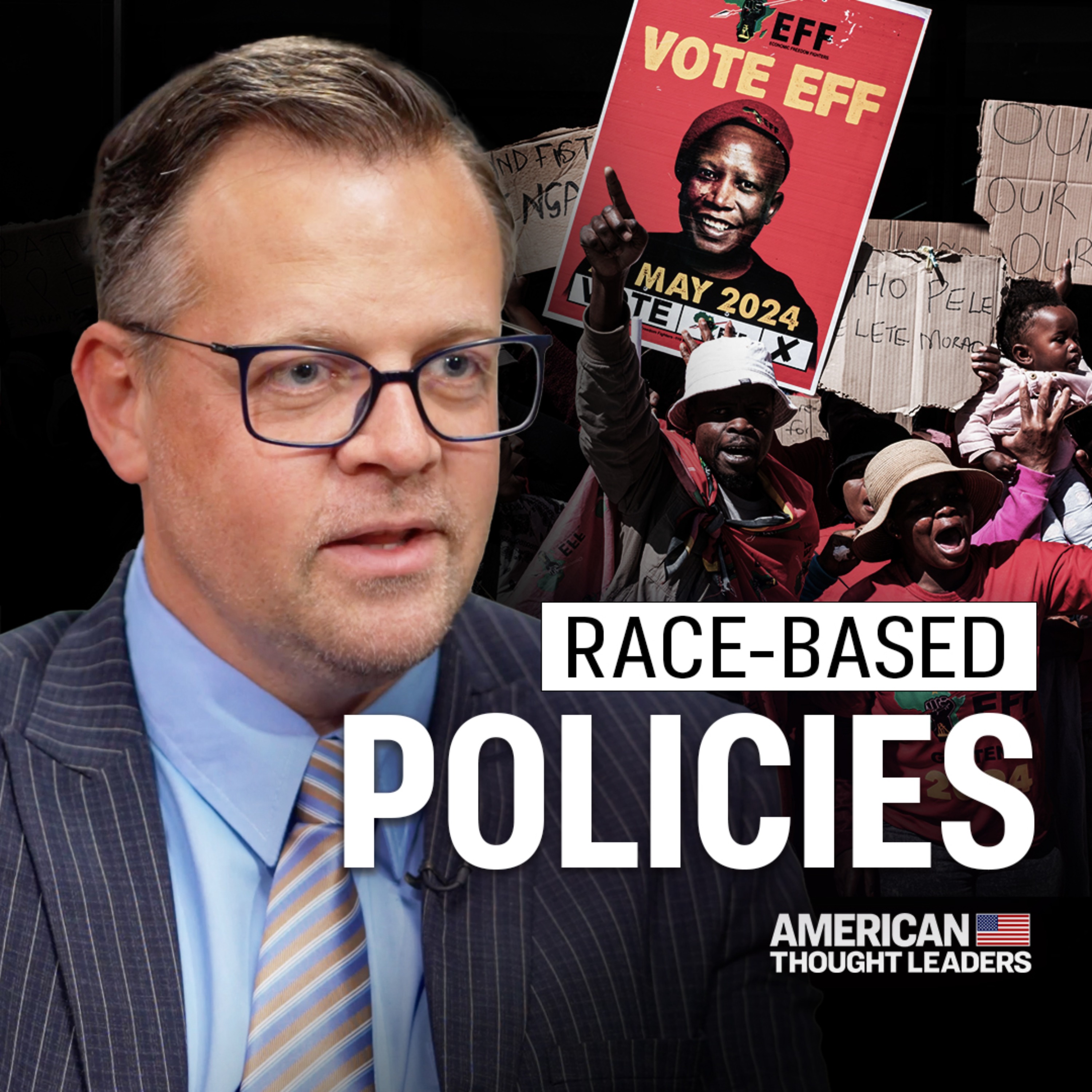
Loading summary
Transcript74 lines
- [00:00]
A
South Africa moved from one race based system to another race based system. We need to move away from race based systems.
- [00:06]
B
Ernst Roots is the founder and executive director of Lex Libertas, an organization that advocates for constitutional reform and decentralization in South Africa.
- [00:16]
A
The deeper rooted problem is that the political system is not sustainable. The solution, we would say, is to rethink the political system in South Africa.
- [00:24]
B
Roots argues that South Africa, with its growing political, social and economic crises, is on the verge of becoming a failed state.
- [00:33]
A
Any country that is antagonistic towards the west is regarded as a friend of the South African government. The extent to which China is strengthening its grip on the African continent, but also especially in South Africa, China is playing the long game.
- [00:47]
B
This is American Thought Leaders and I'm Janje Kelik. Ernst Roots. Such a pleasure to have you on American Thought Leaders.
- [00:57]
A
Thank you very much. I'm very happy to be here. Thank you for speaking with me.
- [01:01]
B
So what's happening in South Africa?
- [01:03]
A
Well, there's a lot happening in South Africa. I would say the most important thing to be said about South Africa is that it's failing. And it's failing on a variety of levels. And we've just published a report on this, which is why I'm here in Washington speaking to you. But I would say, and according to our report as well, the failure is evident in three areas. The one is the very disastrous policy framework that we have in South Africa, including a bunch of laws and legislation aimed at race based redistribution of property and then proclaiming that that would lead to prosperity. So it's socialism and saying that you will become wealthy and affluent as a result of these policies. So destructive policy framework is the first. The second is just general state failure. It's not able to keep people safe. We have the murder rate in South Africa is 45 per 100,000 per year. The global average is 6. In America, I think it's 4 or 5 per 100,000. More than 27,000 murders every year in South Africa. It's an extremely violent country. But also when we talk about government failing, the government isn't able to fulfil its most basic responsibilities, such as providing electricity or water. 40% of water in South Africa is lost due to leaks from 46% of water is contaminated. And two thirds of water treatment facilities in South Africa are on the verge of breakdown. So it's very serious, the extent of state failure. And then the third is the persecution of minorities. And we see that with this vast network of more than 140 race laws in South Africa aimed at targeting the white minority in particular also the Africanas as sort of an ethnic community in South Africa. We also see this with the threats to property rights, the threats by the government. Not just threats, they're actually following up on these threats to confiscate private property, especially belonging to white people and to farmers, and redistribute this again with the promise that that would lead to prosperity. And we also see the persecution in terms of the hate speech. And it's not just when we say hate speech, it's not just hate speech, it's actual incitement of violence against minorities with chants such as kill the Boer, kill the farmer. Which isn't just metaphorical because the farmers are actually being attacked and killed while these politicians chant this. And not only are they chanting this, but they are protected by the justice system. So with that said, our argument is that these things I've mentioned are actually symptoms of a deeper rooted problem. The deeper rooted problem is that the political system is not sustainable. And the solution, we would say, is to rethink the political system in South Africa.
- [03:44]
B
And just one comment, I remember fairly recently this, the kill the boar, kill the farmer chant that was assessed as not being hate speech by the top court in the country, if I understand that correctly.
- [03:56]
A
Yes, it's very alarming the extent to which the persecution of minorities, the targeting of minorities and the double standards and all of this is being entrenched by, by the justice system in South Africa. So Julius Malema from the Economic Freedom Fighters, who used to be with the ANC, but ideologically is very much aligned with the anc, a few years ago made a comment, he said that he's not calling for the slaughtering of white people, but he might do so in future. And he was then taken to the Human Rights Commission in South Africa, which is this guard dog institution which is supposed to ensure that human rights are protected. The Human Rights Commission then found in a ruling in 2019 that this comment is acceptable. It's not hate speech, it's defendable, it's acceptable speech. And the reason why it is is because he is black. And because when someone is accused of something, you need to consider the race of the person. And so if it would have been a white person, by implication that person would have been targeted or prosecuted or whatever. But because he's black, he's protected and because he's targeting white people. So that is extremely alarming that the Human Rights Commission in South Africa is taking that stance. But then furthermore, as you mentioned just this year, this kill the buer chant ended up in the Constitutional Court, which is the Supreme Court in South Africa, the highest court, which found that it's perfectly acceptable speech. In fact, they went as far as saying they're not even going to hear the matter. They're not even going to hear arguments because they can already say that it is acceptable speech. And again, it's not just a metaphor. That's the argument. No, it's a metaphor. It's a celebration of the struggle against apartheid and so forth. But the fact is that farmers are literally being attacked and killed. The fact is that there is evidence that chants like these, and this chant in particular, has led to murders. And the fact is that at many of these attacks, we see the perpetrators making political statements, saying things like viva Malema, Making racial, Derogatory racial statements. So there is a political dimension to these crimes, but the court isn't interested in that. The court just says that's acceptable.
- [06:04]
B
Yeah. I mean, this is obviously incredibly disturbing to hear. I mean, you know, chants about killing. When it comes to minorities being targeted, you're not just talking about whites.
- [06:16]
A
Yeah. So firstly, South Africa is very big in terms of size comparison. You can pretty much compare South Africa to Western Europe. If you take out Spain and England, the rest is more or less the size of South Africa. It's twice the size of Texas. But it's one of the most ethnically diverse regions in the world. With the constitution recognizing 12 official languages. One of the 12 is sign language, but the others are all different cultural communities, different nations. So the appropriate way to think about South Africa is not simply to think of it as a country with a nation, but as a region. So North Africa is a region with several countries. East Africa is a region with several countries, West Africa, Central Africa. But then you have. South Africa is just one country, one big country, which ironically became this big country during this process of colonization after the Anglo Boer War. Before that, it was a variety of Boer republics, British colonies, African kingdoms and so forth. So it's very big. It's exceptionally diverse, not just in terms of cultures, but also different civilizations living in South Africa. So we have Asian communities, we have Jewish community, we have, you could say, Westerners. The Afrikaner people are Westerners. We have a white Anglo community in South Africa that are also Western Westerners in terms of our sort of outlook on life. And then we have a wide network of African nations living. The Zulus, the Xhosas, the Sutus, the Vendas, the Tsongas and so forth. So that's important to understand. And unfortunately, with regard to South Africa, this narrative became established that it's simply a matter of black and white. And the apartheid government is partly to blame for this, even though the apartheid arguments. The apartheid argument was that there should be homelands for the different nations. But the current government and the ANC especially, because it's incentivized for them. The ANC is the ruling party in South Africa. It's incentivized for them to simply say it's just a country of white people and black people, because then they could get the black communities and nations to sort of unite under the banner of being black and target white people under the banner of being white. But the truth of the matter is that it's much more nuanced than that. And I think it's a disservice to everyone that lives in South Africa, especially from a cultural perspective, to simply look at the country from a racial lens and without recognizing the vast cultural diversity that we have in South Africa.
- [08:49]
B
But I guess what I understood just from some of my cursory work and actually a recent interview I did with Rob Hersoff is that there's. It's, you know, there's blacks being persecuted. There's, you know, I think what you call colored people being persecuted, and that's people who are mixed, kind of a mix of different cult, different races.
- [09:11]
A
Yeah, absolutely. So just. We have. We still have a serious problem in South Africa with political assassinations. It's happening all the time. Just. I think yesterday I saw a news report about some politician who was murdered. And historically also, and that's also in terms of the lesser known part of South African history of the 1980s especially, was the extent to which there was rival warfare among different black groups in black townships in South Africa in the struggle against the apartheid system, which wasn't really a struggle against the apartheid system. There was no war between white and black people in South Africa, but there was a war between the ANC and Nkata, the ruling party, and the Inkata movement of Mangasutu Butelese. And so we have the targeting of people based on their political affiliation, especially if they are against the ANC and especially if they are black. That is a dimension to the crisis in South Africa. But another dimension that I think is fundamentally important, that isn't spoken of enough is black African nations living in South Africa who have a particular affinity for protecting their culture, preserving their way of life, who are completely being marginalized or you could even say targeted by the South African government. It's that old communist trope of seeing any issue with regard to which people have a degree of authority that is not the state to regard that as a threat. You know, we know the story of how communist aligned countries targeted religion, targeted culture and so forth. And so we have this in South Africa. Black nations, black communities who have traditional leaders, who have kings or queens who live in a particular area, who have their own cultures and so forth. But the South African government doesn't like that. In theory, if you read the constitution, it's protected, but in practice, they're not recognized at all. They don't get any recognition, they don't get any assistance. And there's a lot of pressure put on them to disband this because the argument is that, that if you have an affinity for your culture, that's a backwards way of thinking, you need to. It's a globalist thing. So it's getting rid of culture, getting rid of tradition, getting rid of who you are naturally, and saying that we need to adopt this new identity and then that would lead to some utopia.
- [11:32]
B
Fascinating. I remember celebrating the end of apartheid. That itself was a highly race based system.
- [11:40]
A
Yes, yes.
- [11:41]
B
And I mean, because a couple of times you talked, you offered some nuance to what apartheid was. And I just want to kind of get you to comment on that.
- [11:51]
A
There is this false dichotomy in South Africa that there's only two political options. There's apartheid and there's the current political system. And if you criticize what's happening in South Africa now, that by definition means you want to return to the apartheid system, which of course is ludicrous because there are many political systems to choose from and the apartheid system was just a disaster in many ways. Our concern is that there is this narrative in South Africa at the moment that you can say absolutely anything you want that is derogatory towards white people. Doesn't matter if it's true or not. You can say apartheid was a genocide and then people would celebrate you for saying that. But it wasn't that you should criticize it for what it actually was. The correct criticism of the apartheid system is that it was. It still had a highly centralized government. It was paternalistic. It was white people saying to black people to a large degree how they should govern themselves, how they should organize their own affairs, and then presenting that as good neighborliness. And also the way it became implemented was just so, so unjustifiable. When they started putting up benches saying here's a bench for white people and here's a bench for black people, or this is a beach for white people and this is a beach for black people. There's just no way that something like that could work. And it just, the more they went down that route of trying to implement that system, the worse and worse it got up to the point. And I think this is also a fact that isn't recognized sufficiently. The Afrikaner people and white people in South Africa agreed that this isn't working. It has to change. And the metaphor that was used at the time was it's like getting off the back of a tiger. You want to get, you know, I need to get off this tiger. But the question is, how do you get off without getting eaten? And so I don't think we should ever return to that system. It was, it was highly, philosophically speaking, you could say it was very rationalistic. It was some philosopher or some thinker sitting in his study room writing plans how the country should be governed. Very theoretical. But it's not, it wasn't connected to realities and grassroots. So. So we need a solution in South Africa that is not the apartheid system, but that is also not the current, you could say, globalist system that we have.
- [14:06]
B
But I mean, but basically you're saying it was a race based system. You're saying you don't want a race based system.
- [14:12]
A
Exactly. It was a race based system. So South Africa moved from one race based system to another race based system. And the point is that we need to move away from race based systems. And that doesn't mean pretending that there are no differences between people. So recognizing culture is a good thing and recognizing that people have an affinity for protection of their culture, preserving their languages and so forth, that's good. But, but simply saying that we need to categorize people as white people and black people is destructive for a variety of reasons. And it hasn't worked. The English tried that in South Africa, it failed. The Afrikaners tried that in South Africa, it failed. And now the ANC is trying that and it failed again. And so we need to move away from that.
- [14:56]
B
The thing that a lot of the people in our audience will be most familiar with in terms of the news cycle in South Africa is these discussions of the farm murders and this increased murder rate. And can you just briefly explain the reality of that?
- [15:12]
A
Yeah. So the farm murders is a very serious problem in South Africa. The response to that is to say, well, there are many problems in South Africa, so why are you pointing to this one? But the fact of the matter is that it's a Very unique problem. And it's a problem that could only be prevented or combated by a unique counter strategy. And there are a few things that make the farm murders unique. One is the extreme frequency at which it's happening, just the sheer numbers. Thousands of people having been murdered on farms, many of them tortured. In many of those cases, nothing is stolen. They just come in, they torture the farmers for several hours, and then they leave. They would steal a cell phone and a car, and then they would. But they steal the cell phone so that people can't call the police, and then they would leave the car by the wayside when they leave. So the numbers, just the numbers is very alarming. The second is the brutality, the high levels of torture that we see. And it's any torture method you can imagine has been employed in these farm attacks. And it's the most grotesque tortures you could think of in many of these cases, and like I said, many of oftentimes for hours. The third is the unique economic impact because farmers are skilled people, they are employers. They provide food for the country. So it would have disastrous consequences for the. The nation at large, and it already has. The fourth is just the fact that farmers live in unique circumstances. They live far away from police stations, far away from their neighbors. Oftentimes it's dirt roads. Oftentimes it's bad cell phone signal. So that alone says that you need a unique counter strategy to fix this, even though the South African government doesn't want to recognize this. But then on top of this, what makes the farm murders exceptionally unique is that it's a very serious crime phenomenon that is also actively encouraged by politicians. So we have a problem in South Africa with violence against women and children. But you would never hear politicians, you know, saying, you know, we need to go out and beat women and we need to go, you know, you know, if you see a child, you should kick the child or something. You know, we have a serious problem in terms of poaching. You don't hear politicians encouraging poaching. We have a serious problem in terms of copper cable theft. You don't hear politicians encouraging that. But when it comes to farm murders, we continuously hear politicians and very senior politicians actively chanting about killing the farmers and so forth. And so this has become a very. It has become a metaphor for the crisis in South Africa. And I think it's important to take note of this.
- [17:52]
B
And that's. And that's. Even though it's not. It's not a major part of this giant murder rate, frankly.
- [17:59]
A
Yeah. So the murder. Exactly. South Africa has a very high murder rate because it has a very big problem in terms of violent crime in general. It especially has a problem with gang related violence. So there are some parts of the country that are so dangerous, if you're not a member of a gang, you don't go there. And that also increases the murder rate. There are some areas of the country that are fairly safe. I mean, I live in South Africa, I live in Pretoria. You can have a pretty normal life in Pretoria, except for all the legislation and the bureaucracy and so forth. If you, you know, it's not a good idea to drive at night. And there are some areas that you shouldn't avoid, but the murder rate is pushed up by the extreme frequency of murders, for example, happening in certain areas. And again, there are other problems as well. But I would say gang related violence is a very serious problem that partly overlaps with the farm murders problem. And then farm murders is also a very serious problem.
- [19:00]
B
Okay, listen, so tell me a little bit about your background and how you've come to be doing this, actually. And I understand that you have a. Your emphasis always has been on the value of culture.
- [19:14]
A
So I was born in Pretoria, but I was very young when the transition happened, the political transition happened in South Africa. And around that time we moved up to a town called Zenin in the north of South Africa. It's an agricultural community. It's a beautiful town, beautiful area. And there I grew up in a family that wasn't very political but very cultural. So we would participate in cultural activities, we would talk about culture and so forth and talk about history. And I was always very. I gravitated towards the cultural side of things just from a very young age. But also. And that to me was the beauty of my childhood, I would say the dark part of my childhood. It's from a very young age being exposed to the dark realities of South Africa that the world didn't want to talk about. I started being exposed to, for example, the farm murders in South Africa because the area where I grew up was an area with many farm murders and not just people being murdered, but people being tortured in some of the most grotesque ways imaginable. And so I grew up with that reality. And I also grew up with learning what has happened across the border in Zimbabwe, because that was happening while I was in high school and seeing just how disastrous those policies are. And then this increased pressure that was put on the Afrikaner people. Not just the Afrikaner people, but as an Afrikaner that Was my perspective that you cannot be an Afrikaner anymore. The new South Africa means that you have to abandon your cultural identity, or you could say your nationality, your natural nationality. Just who you are is not acceptable anymore. Your language and so forth. And that all has to change. You have to leave behind who you are and adopt this new sort of more globalist identity. And. And I experienced that as a threat, which is why when I became a student at the University of Pretoria, I immediately became involved with, you know, activist student movements and things like that. And I studied law. I never became. Well, I became a lawyer, but I never practiced as an attorney. I'm an attorney in terms of the legislation in South Africa, but I became involved with what I'm doing now from immediately after finishing university.
- [21:41]
B
And so now, I mean, you're with Lex Libertas. I'm going to get you to tell me what that is. But before that, you're with a group called Afriforum.
- [21:51]
A
Yes.
- [21:52]
B
And just explain to me the work you did there.
- [21:54]
A
So. So when I was at university, I founded Afriforum Youth. Afriforum is a. That's where I became involved, let me just say that, sort of as a volunteer through the youth movement. And I was eventually became an employee. Afriforum is a civil rights organization in South Africa, especially aimed at at ensuring that there's a future for the Afrikaner community in South Africa. It also works on, especially court cases, litigation in South Africa, for example, getting communities organized in terms of public safety initiatives and so forth. And it's an incredibly important organization. It still is. I was involved there for quite some time. I'm still a member of Afriforum, although I'm not an employee anymore. I started this new initiative, which is a combination of a think tank and an advocacy group. And it's a much more narrow focus. And the focus is to say that the political system in South Africa is not sustainable and we need to work towards a more viable political system. So you could say my focus now is very much on a macro political solution as opposed to the very important work that other institutions in South Africa are doing with regard to particular policy issues and getting people to look after their own safety on a more practical level.
- [23:13]
B
Fascinating. And in the past, you also worked on looking at Chinese Communist Party, Chinese encroachment into Africa and South Africa.
- [23:24]
A
Yes, that is a very important thing. I think also from an American perspective, just this belt and road initiative of China. China is playing the long game when it's coming to Africa. And the extent to which China is strengthening its grip on the African continent, but also especially in South Africa, I'm not sure how noble or genuine their relationship with these African nations are. It seems to be much more opportunistic than real friendship. But I think from the African perspective, they are very open to this. There was this scandal in the African Union headquarters a few years ago with which was built largely by China. And it came out that early in the mornings, after midnight, all the information was downloaded from the databases and it was sent to a. A server in Shangai, I believe, and this was revealed. And everyone was angry about this, but nothing really happened after that because I think they were just so grateful for. For. For the financial support from China. And it's also happening with South Africa. And I think part of the reason is the access to mineral resources. And it is very clear from what is happening that China is very interested in that, very interested in Africa's mineral resources. And what is particularly alarming and I think also important from a Western and American perspective, is that many of these leaders in African countries, especially in South Africa, they see China as a sort of a net that would help them, that would catch them if everything comes crashing down. Some of them publicly say this. They would say, well, if the economy crashes, China will come in, China will pick up the bill. And they sort of gloat about that. But that would lead to a significant international strengthening of China from a geopolitical perspective, which is certainly not in the interest of the West. That's why. And we can talk about that. This refugee program by the US is. Even though it's good, if people want to leave the country and they have the opportunity to do so, that's fine, that's good. But I think the US must be careful not to do only that in a way that would actually facilitate more destabilization in South Africa, which would lead to destabilization not just for South Africa, but for the southern African region and eventually for Africa, which of course would lead to waves of immigration, illegal immigration to Europe and North America, Western countries. But that's one part of it. The other part is the extent to which it would open the door for China to come in and strengthen its grip on the Africa.
- [26:05]
B
If I'm extrapolating here a little bit, I think you're saying you're worried about the brain drain from South Africa to America through this program or something like that.
- [26:15]
A
So the brain drain is a very serious thing. There's no clear data in terms of how many people have left South Africa. Some sources say more than a million people. And South Africa is a very big country, very poor, very high levels of unemployment, very few people, proportionally who actually pay tax. If you just consider how many people pay income tax and what percentage of income tax is paid by what percentage of the population, it's extremely skewed. But those are the people who are leaving the country because of the extent to which they are targeted. It's sort of a more extreme version of what we're seeing in the US with people leaving certain states and moving to. To other states. So it means that from a revenue perspective, it's bad for South Africa, but not just that. From an employment and an economic perspective, it's the employers who are leaving the country. And so that would certainly lead to higher levels of instability. And we need to find a solution that would enable good people who love Africa, who have been in Africa for 10 generations, whose identity was forged in Africa, to be able to have a future in Africa as their past is in Africa, and to be able to start businesses, to employ people and so forth. And we don't have that. And we need to get to that.
- [27:34]
B
Well, you know, something that the Chinese communist regime employs is what you call debt trap diplomacy. You hear that term very often. Right. And so that's happened in many a number of African countries where it's kind of set up in a place where you know it's going to fail because you can see how it's structurally working. And then you have a hook where basically you have a level of control of the nature that you just described, where there's this outrageous security breach. But it doesn't seem to have that much of an impact because of the. Well, the huge level of influence and the huge level of money that's coming in. Right. Basically.
- [28:18]
A
So in South Africa, it's China, but it's also Iran to a large extent, and Middle Eastern countries, you can put it differently. You could say it's any country that is antagonistic towards the west is regarded as a friend of the South African government. And even though the South African government is a small player in the international arena, it tries very hard to punch above its weight and it tries very hard to position itself as a leading factor or a leading role player in what you might describe as sort of a radical anti Western alliance, which is part of the reason why it took on this genocide case against Israel at the International Court of Justice. Why? And in this report we're publishing this week, we also reference the relationship between the South African government and Hamas, for example, but groups all over the world. Anyone who's into Cuba and many others, Zimbabwe, many of these African countries, any country that is openly against the west, you would find that they are supported by the South African government and they would form this block at the United nations and international forums, including BRICS and many of these international forums.
- [29:30]
B
Iran's power has been significantly degraded and. And so are you seeing an impact of that, or would you believe the impact of that would be because of this, I guess, significant influence it's had?
- [29:43]
A
We haven't seen much of an impact in South Africa yet, although I'm sure things like oil prices and all of that, we'll have that side of the impact. But the impact that we are seeing more or the activities that we see more is the involvement of South Africa through the BRICS alliance, where, for example, the President recently at this BRICS summit openly lashed out against the American government and so forth, because they see this alliance as some form of a defense mechanism or protection. It provides them protection to be much more open about their antagonism because they find themselves among friends who agree with him. And the problem, of course, is, as I mentioned, it's a big country, it's very diverse, and there are a lot of people who live in South Africa, millions of people in South Africa who are culturally Western, who are very pro America, who are very pro the west, who descend from Athens, Rome and Jerusalem and so forth. But we live in a country with a government that is very aggressively anti Western. And we see that in terms of their foreign policy, but we also see that in terms of domestic policy and the extent to which they are targeting people based on their Western identity.
- [30:58]
B
You know, you see the problem as being systemic.
- [31:01]
A
Yes.
- [31:01]
B
Not necessarily a specific manifestation of the leaders and power or the particular political party, but something deeper.
- [31:10]
A
Yep. So firstly, I mentioned this earlier. There's a vast network of destructive laws and policies in South Africa. The race laws, the threats to property rights, the, what they call the Expropriation Act. And I mean, we can go down the list. There's just so many examples. But it's easy to make the mistake to think that we should change some of these policies and that would provide a solution to South Africa, or we should just get someone else to be the president of South Africa and then the country would be fixed or we should vote in one of the opposition parties and then all of this would be over. When, if you think about it for just a moment, you would recognize that these problems would still be there. Because it's a structural problem. And the structural problem could be summarized by saying that it's a very big country, it's a very diverse country, but it has an extremely centralized political system. A political system that is, some people call it an oligarchy that is very disconnected from realities. On ground level, it's an ideological experiment. It's an experiment that says that we need to get all these nations living in South Africa to abandon their, what used to be their national identities or cultural identities and take up this new identity. And then we would reach some form of utopia. And they literally say we would reach the Garden of Eden and we would reach the ultimate paradise. Those are the words of the President. I think from a European perspective, the comparison would be Europe as a region with a variety of nations and the European Union. And our concern with the South African government is very comparable to the concerns with many nations in Europe in terms of the European Union. The difference is that the South African government has a much firmer grip on the South African region than the European Union has on Europe. Even though it has quite a significant grip. The different nations in South Africa don't have the autonomy that European nations have.
- [33:08]
B
And also, this is, I was going to say, I mean, I think the French are pretty happy being French. Of course, the European Union is a strong bureaucratic entity and exerts a lot of power, but the cultural identities are pretty strong in many cases and people are maintaining them very seriously.
- [33:30]
A
Yeah, exactly. So if we were to take Europe and make it more like South Africa, what that would mean is to do that. Firstly, they would have the European Union or the European Parliament would have to be the only real authority in Europe. Other authorities, even though they might be recognized in theory, they would like local governments and so forth, they would virtually be non existent. And then once that has happened, there would be this, this, you could say aggressive pressure being applied on the nations of Europe to say that you cannot be French anymore, you cannot be German or Dutch or Hungarian or whatever. You have to be European, your identity is now European. So that would have to happen. And then the, the European Parliament or the European Union would have to start implementing overtly aggressive laws and legislation discriminating against people on the basis of their ethnicity and framing race based socialist redistribution as the path to prosperity. So that's the extent to which the South African government is in some ways comparable to Europe, but in some ways much worse.
- [34:42]
B
Well, I mean, in a way you could also apply the same description to the U.S. right?
- [34:47]
A
Yeah, absolutely.
- [34:48]
B
Federalist system.
- [34:50]
A
Yes. And that's, I think, part of the solution when we talk about the decentralization of the political system in South Africa is to look at federalism, for example. And we are very inspired by the works of Alexis de tocqueville from the 1830s and his observations about democracy and what a good and healthy democracy is like and what it should be. And also his cautions as the founding fathers who are on this picture. The cautions about the risk of democracy becoming tyranny of the majority and explicitly defending democracy as saying that it's not the tyranny of the majority. Democracy is about more than that. Democracy is about freedom, essentially, or that's what it's supposed to be. The caution was that democracy can become tyrannical. And we see some of that in South Africa. But the Tocqueville line was. I mean, a lot of things can be said about Tocqueville, but basically that America is working and it will continue to work and it will flourish because it's a very decentralized system, because people have very strong affinity for their communities. There's a very communal, a communitarian approach just de facto in America. And people solve their own problems. If they want a school, they build a school. They don't call the central government and say, we need a school, come and give us one. And, you know, we can argue about whether America is losing that, but South Africa certainly doesn't have that. That's not the type of democracy that we have in South Africa.
- [36:22]
B
Reading your. Reading your report, I was kind of. I actually wasn't sure, right, whether you were saying it needs to be more decentralized and have kind of actual individual countries develop out of this, and this is obviously a major challenge to existing sovereignty, or whether you were saying it should be more of a federalist system, basically like what America ultimately ended up doing with giving all sorts of concessions to the different founding states and even currently with sort of minimizing the powers of the federal to the things that are just critical at the place. Subsidiarity. Right. I guess this original idea was this principle of subsidiarity.
- [37:12]
A
So there's a saying among some Afrikaners that we want a future within South Africa, if possible, outside South Africa, if needs be. And that means not necessarily leaving the country, but in a completely different, difficult, different. In a completely different political system altogether. And so what the report does and what we do at Lex Libertas is to have clarity and provide clarity in terms of where we are at the moment. The crisis in South Africa Understanding it for what it is. And that's the point about the symptoms and the actual root problem. And in terms of where we need to go and we can get there by different paths. So where we need to go is to have higher levels of self governance and a decentralized political system that could take different forms. One way is simply to say that the policy framework in South Africa needs to change to get rid of the race laws and so forth. And if these things weren't there, there would be much higher levels of freedom. The question is if that's sustainable, considering that the political system is not quite connected to realities in South Africa. But there are different ways in which you could promote, you could decentralize the system and there are different ways in which you could promote self governance. And that could include federalism, a system more comparable to what the US has, or the Swiss canton system. It could include territorial autonomy, something comparable to what the Tyroleans have in Italy, where they have an autonomous province. Even though they are part of Italy, they have a significant degree of a say in terms of how their province is governed.
- [38:55]
B
Or Quebec in my country.
- [38:57]
A
Yeah, yeah. Quebec is also an example. Yes, yes. It could also be cultural autonomy, which says that even though their cultural communities might be spread out over the country, they don't just live in one spot. They can. These cultural communities should have a say over how they own over their own cultural affairs, like what is taught in their schools and so forth, not just be instructed by the national government what they should be taught and so forth. And then of course there's secession. Secession is just to say that we need to take the Yugoslavia route and say that maybe we should just give the people living in this country their own states. And so different avenues could be taken. And we need to explore these different avenues seriously. But I think what's important for now is to recognize that it's not working. It needs to change and we need to promote self governance and we need to decentralize the system.
- [39:53]
B
Basically what I'm hearing you saying is you're an advocate for the cultural rights and some level of sovereignty for the Afrikaner people, but you believe that that model should also be available to other groups.
- [40:08]
A
Yes, that's fundamentally important. Firstly, we don't believe in utopian solutions. There's no solution. That we just create, you know, this socialist utopia or whichever utopia where there's just no problems. There will always be problems, but we can make things better or we can make things worse through our conduct and through what we do. And currently Even though the South African state is failing, the burden is on the South African state to provide to ensure that people become affluent or that people prosper. It's not able to do this for very obvious reasons, but people have become trapped in state dependency in South Africa, especially black African communities with 40% of the country on social grants having to keep vote them into power so that they can keep getting social grants from the government. And also threats that if you don't vote for us, your social grants are going to fall away. And this, it's 28 million people who are now getting social grants from the government and it's growing. So the burden needs to shift from the state to the communities. For people to become prosperous or to become successful, you need to be able to do that within the context of your community and to personal responsibility. Obviously, and obviously there will always be people who do not take up that personal responsibility. But we believe things can be better if we actively encourage cooperation between different communities living in South Africa. So our argument is by no means an antagonistic argument towards other communities or an argument to protect one at the expense of the other, because that's not sustainable. It's not. Just not moral, but it's not a solution. I think the right approach to diversity is not to try to pretend that diversity doesn't exist or to try to squash it, but to recognize it and to celebrate it and to say let's cooperate on this basis, let's work together, let's be involved with projects, mutual projects and so forth. But if the fundamental approach at the moment is we need to do a way, we need to pretend that it's not a diverse country when it is an extremely diverse country. I'm an Afrikaner and so I want self governance for the Afrikaner community. But self governance for the Afrikaner community at the expense of others would not be a solution.
- [42:33]
B
So presumably you're actively working with other communities to foster with people who have a similar vision.
- [42:40]
A
Yes. So Leix Libertas is a new institution. It was founded just a few months ago. But our approach is based on a variety of things that we need to do. And part of this is actively doing research and publishing research like this report on what is happening in South Africa. It's talking about this, it's reaching out to different communities, getting more people on board for the this path that needs to be taken, strengthening cooperation, strengthening support within South Africa. And then what we're doing right now is also getting support internationally, going to other countries and getting recognition for the problem as it is. And getting increased recognition for this pursuit of self determination or self governance or higher levels of autonomy in South Africa, however you want to call it.
- [43:36]
B
Are there people like you or groups like Lex Libertas with other communities in South Africa that you're working with or maybe are just planning to work with?
- [43:47]
A
Yes, there are not enough yet, but it's certainly growing. So there's already a strong movement in the Western Cape calling for Western Cape independence, which also could take different forms, but expressing concern that the Western Cape as a province, which is somewhat unique.
- [44:06]
B
That'S Cape Town and surrounding area.
- [44:09]
A
Yes, yes. That that province needs higher levels of autonomy. And that movement is, is gaining traction. There's the Urania movement in the Northern Cape, which is an Africana project to develop Urania into a city and Africana a cultural city. And then there's also in eastern parts of the country, especially among Zulu communities, for example, growing voices for higher levels of autonomy, higher levels of recognition that is needed for, for traditional authorities, for the authority of, for example, the Zulu king. And in terms of the Zulu people. So, so this is certainly. And then we have some form of the same thing happening in the south also with, with the. What we in South Africa call the colored community, who are very dissatisfied with, with the state of affairs. So the recognition that is not working is very well established. But the shift from the notion that the government needs to fix it to the government is the problem. The government won't be able to fix it and we need to find alternative solutions is very rapidly happening at the moment in South Africa.
- [45:17]
B
And the term colored is not a derogatory term in South Africa. Just for the benefit of the audience.
- [45:24]
A
Yeah, yeah, yeah, yeah. So it's interesting. I'm aware that in other countries the term Coloured is regarded as derogatory. In South Africa, the term Coloured is the more politically correct term. The term mixed race is not something that people appreciate in South Africa. The colored community in South Africa, some people say the brown community has in many ways it's not just people with mixed ancestors or parents. It has to a large degree become a unique cultural community. They speak Afrikaans, the same language as I do as a mother tongue. But they have a unique culture, they have a unique way of life. They live especially in the south, in South Africa. But no, it's not a derogatory term in the South African context.
- [46:09]
B
Just something that struck me as you're talking about this movement for Cape independent Cape independence or Western Cape independence, I would guess. I don't know this for sure. But I would guess there's a significant part of the economic engine of the country is there. And so this is the challenge when there's almost no scenario where you would accept losing a major part of your economic engine. You do have some recommendations of some significant pressure from for example, the US or presumably you're also going to other countries to do this. But this is could very reasonably be seen as undermining sovereignty.
- [46:50]
A
Some of the concerns from a Western Cape perspective, even though I don't live there, but some of the concerns is that they need high levels of autonomy in terms of how to manage their own police service and higher levels of autonomy in terms of their own railway network and ports and so forth. So it's really practical things that is being dictated from Pretoria, which is thousand kilometers away, and they need to manage these affairs. Yes, economically speaking, the Western Cape is a hub in South Africa, as is the Gauteng area, which is where Pretoria and Johannesburg are where I live. And so certainly the South African government would see this as a threat. And that's the age old question. And now which is a bit more difficult with the more recent phenomenon of the modern territorial state, is how do you realign a political system if it's failing, if it's not working, when the way to do that is to get the approval of those who are in power, who are the reason why it's failing. And part of the answer is that usually you don't get that approval. And South Africa is a good example of that. The apartheid system came crashing down and there was a time when people said that there's no way that you would ever convince the National Party government that the apartheid system has to change. So how do you do that? And one part of it is increased international pressure. One part of it is a growing movement within the country that things have to change. And in the South African context, it's important for it not to be a white movement or, or only within one community, that the peoples of South Africa should take a firmer stance that this isn't working, it needs to change. And eventually I would say you get to the point where those in power have too much to lose or they don't have much room left to maneuver. And eventually the apartheid system, partly because of economic pressure, with Chase Manhattan, for example, announcing that they would not extend loans to the South African government and so forth. And then there was also international development such as the fall of the Berlin Wall. And all these things eventually came together with the president at the time, President F.W. de Klerk saying, okay, we need change, and we need change in South Africa. And our argument is not for a hostile takeover. It's not for an illegal movement rising up or something to that effect. We are arguing for constitutional change, but we are arguing for this to happen through legal means and through constitutional means. And we believe that. And again, the ANC who's currently in power of South Africa has proven this through their campaigns against the apartheid system, that in that sense, international pressure is fundamentally important. But we need international pressure as a force for good to get change that will lead to more stability, more higher levels of freedom and autonomy in South Africa as opposed to destroying the country and so forth. But yes, we are not naive to think that those in power at the moment, those who are benefiting from corruption and who are benefiting from these policies personally, would suddenly turn around and say, oh, yes, we agree, this is a good idea. They probably would never agree.
- [50:22]
B
Right now, there is a kind of a pressure being exerted on South Africa. It's a 30% tariff from the U.S. what is the impact of that?
- [50:33]
A
So there's some. Concern in South Africa or alarm or friction at the moment among, I would say the government, but also the peoples who live in South Africa about recent developments and how it's going to impact us. The tariffs would have a very significant economic impact. But I also think the tariffs could be an opportunity from a South African perspective in terms of facilitating change to a more sustainable system. In the sense that, and that's part of what we argue in this report, is tariffs could be a very good measure of diplomatic pressure. And one thing that we are arguing that we will be discussing with people in Washington this week especially, is to say that the US can do certain things with the tariffs. They could say, for example, that companies that do not comply with what we call bee, which is the South African equivalent of dei. It's called black Economic empowerment, but it doesn't empower black people. It's a process that facilitates largely corruption in terms of politically connected people who benefit from that. But that companies who do not comply with this, regardless of whether it's white or black companies, if they haven't gone through the process of certification, they should be exempted from tariffs. That's one thing that would have a big positive impact in South Africa. Another is to say American companies should be exempted from tariffs. Other forms of pressure could be applied as well. Diplomatic pressure, preconditions to trade agreements, preconditions to the extension of loans to the South African government. And I think what needs to happen also with regard to South Africa is an international conversation about the future of the country. And the reason why I say an international conversation is because the early 1990s was very much an international conversation. And the Western world, and the US in particular, was especially involved in setting up the political system that we have in South Africa. And you could certainly say that the intentions were good. And if you read the South African constitution, it was a highly celebrated constitution, it was argued to be the best constitution in the world, a lot of people said, and the most modern, the most liberal and all of these things, and that's fine. But at the end of the day, it's not about the intention, it's about the reality and it's not working. And so the international community was largely, you could say, responsible for the political system that we have in South Africa. And now with the beauty of hindsight, we can look at how it's failing and why it's failing and say, well, let's try to fix this problem. And again, the way to fix it is to get higher levels of autonomy, higher levels of freedom, not less.
- [53:29]
B
And you're not worried that again, sort of this external influence which maybe with the best intentions you are arguing ultimately had a, probably initially a positive outcome, but in the long term a negative outcome. You're not worried that same scenario may happen again?
- [53:49]
A
Well, it could, which is why we have to emphasize that there are no utopian solutions. There are no silver bullets, there's not a button that you can push and then the problem is fixed, but it can be made better or it can be made worse. And generally speaking, the way to make things better is to give people higher levels of autonomy and to give people higher levels of freedom to govern their own affairs and decide for themselves. And it's especially important in a country like South Africa that is so big and so far from homogenous, where it's, you know that old metaphor of democracy as two wolves and a lamb voting on what's for dinner. And then the wolves would think it's a good idea, but, but the lamb wouldn't think it's a good idea. But that's not what democracy is supposed to be. Democracy is supposed to emphasize self governance and, and personal responsibility and communal responsibility, but we don't have that in South Africa. So our argument is that South Africa is not a democracy in theory. You could read the constitution and say, oh well, this looks very democratic, but in terms of the realities on ground level, it's very far from that. And that needs to be recognized. And I think an easy first step to take by the international community is recognition is simply to say that we recognize that it's not working, and we recognize that the pursuit to change things is a legitimate pursuit. And from there on, we can move further towards things like diplomatic pressure and so forth.
- [55:18]
B
I see a lot of vehement criticism of your work, the work that you're doing, and it seemed disproportionate, given what we've been discussing about today. Are you concerned at all about your own safety?
- [55:35]
A
So, theoretically, I'm not concerned, but practically I am. And I keep making this difference because South Africa is a good example of the difference between de jure and de facto. So legally speaking, there's nothing. We're not doing anything illegal. It's not illegal to call for constitutional change through legal means. Through constitutional means. It's illegal to organize an armed uprising or something to that effect, or a hostile takeover. We're not interested in anything to that effect. But practically, we are concerned that there are voices in South Africa, politicians, members of parliament and so forth, who have come up with this new thing that if you criticize the South African government, then it's treason, and you should be prosecuted for treason. And of course, treason is the most serious crime you can be prosecuted for. We don't have the death penalty in South Africa, but that. And then just targeting in general. The political climate is so tense that when you start speaking out, and it goes for me personally, it goes for the institution that I represent, but it goes for many others as well. You start getting threats, you start getting people, you know, really threatening to come out and do some really bad things to you and your family and so forth. And so we are concerned about that. We are concerned about the fact that, as I mentioned, political assassinations is a real problem in South Africa. It's one that isn't properly recognized for the extent of the problem. And so, yes, there are some threats, but we believe, and it's not as if I'm the only one or the institution that I'm involved with is the only ones talking about this, that this needs to happen. South Africa needs change. It needs what we call a constitutional realignment to get a system that is more in touch with reality. And the risk of not pursuing that, we would argue, is bigger than the risk of pursuing that.
- [57:35]
B
Well, Ernst Roots, it's such a pleasure to have had you on.
- [57:38]
A
Thank you very much. It's a pleasure to be here. Thank you for speaking with me.
- [57:42]
B
Thank you all for joining Ernst roots and me. On this episode of American Thought Leaders. I'm your host, Jan Kellek.