Loading summary
Transcript41 lines
- [00:00]
A
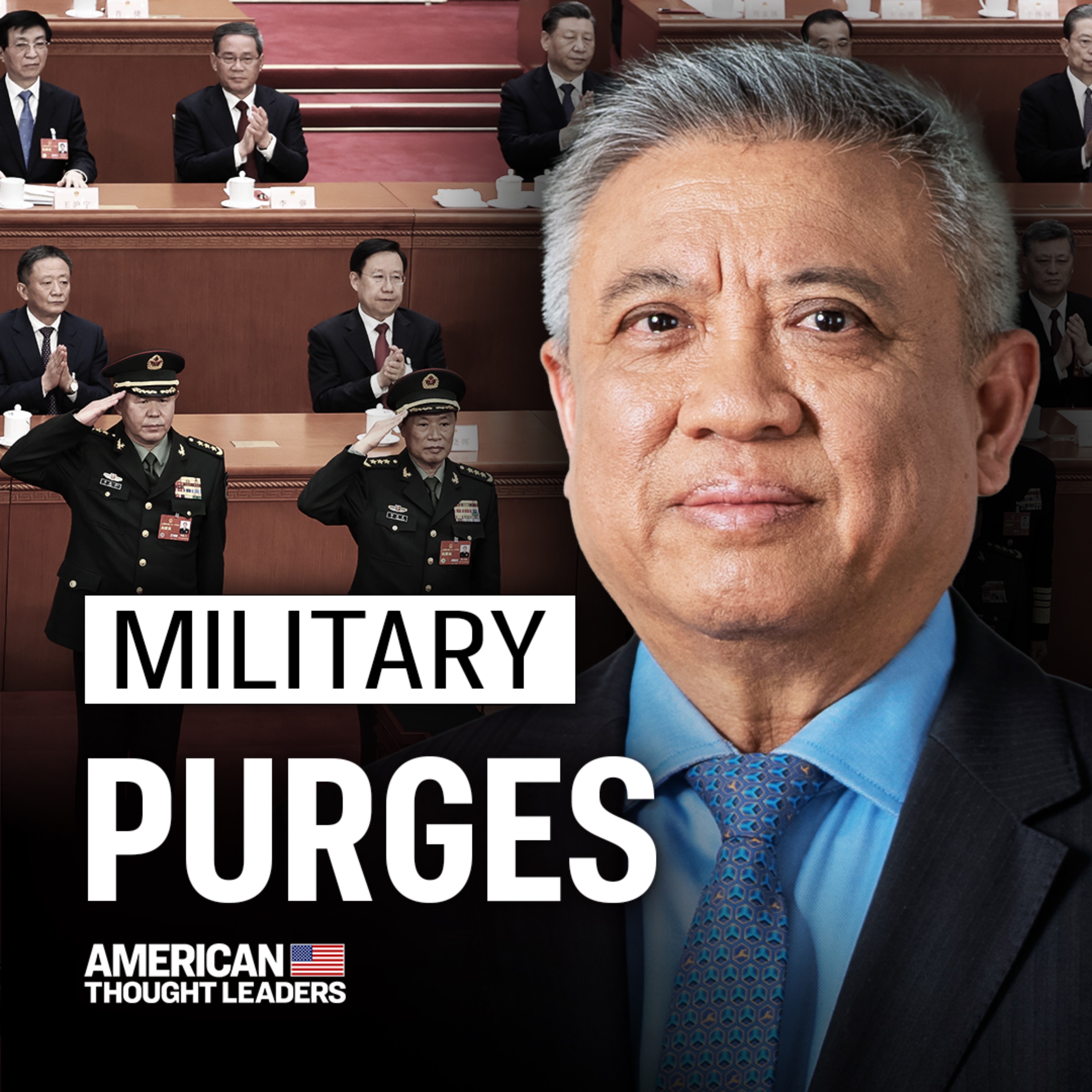
There's been an unprecedented purge of top Chinese military leaders, including most recently top general Zhang Yusha, a longtime ally of Xi Jinping.
- [00:11]
B
This never happened in history of the communist rule.
- [00:15]
A
Of the seven members of China's Central Military Commission, five have effectively been purged or removed. Only two remain. One of them is Xi Jinping himself.
- [00:26]
B
Even during the Cultural Revolution, Mao Zedong didn't really purge the high rank officials in the military.
- [00:33]
A
What's really going on behind the scenes and what does this turmoil mean for the Chinese Communist Party's plans to invade Taiwan? In this episode, I'm sitting down with veteran China analyst Hung He, a longtime columnist with the Epoch Times, to unpack all of this.
- [00:50]
B
Soviet Union collapsed is not because they don't have strong military. It's because the system collapsed. Now Xi Jinping faces the same situation.
- [01:01]
A
This is American Thought Leaders and I'm Janje Kelik. Heng He. Such a pleasure to have you back on American Thought Leaders.
- [01:14]
B
Yeah, the pleasure is mine. Thanks for having me.
- [01:18]
A
So there is something absolutely astonishing happening among the top leadership of the Chinese Communist Party with profound implications for the country, perhaps for the world. What's going on?
- [01:32]
B
Yeah, I think what happened last week, it's very rare to find such thing. So I would say we are witness the turning point of the Chinese Communist Party rule. There's three, you know, at most three events can be compared in Chinese Communist Party history after they took over the China. One is in 1962, you know, when the Great Leap Forward failed and tens of millions people died. And then there's a power switch and Liu Shaoqi, the second hand of Mao Zedong who took over the power but kept Mao Zedong in a symbolic figure that's in 1962. And second event can be compared is during the Cultural Revolution, Ling Biao, the second hand of Mao Zedong was purged and escaped to Mongolia and died there. That was, I would say it's the turning point of Mao Zedong's legacy. You know, from that day, Mao Zedong's legacy is almost gone. Yeah. The Chinese people rethink about what is real nature of Cultural Revolution. And that, you know, leads to the end of the Cultural Revolution. And the third one is, I think is at the end of Cultural Revolution they purged Gang of Four. The gang of four is Mao Zedong's wife and three others promoted by Mao Zedong's Cultural Revolution. So it's kind of like a gang of Cultural Revolution. They arrest the four of them and that marked the end of the Cultural Revolution. So I think the fourth one is the purge of Zhao Ziyang in 1989 during the Tiananmen Suppress massacre they got rid of the head of the Communist Party General Secretary Zhao Ziyang. I think this event can be, you know, deserve to compare with those big events. It's like once a decade.
- [04:06]
A
So what exactly happened? I mean, we're seeing basically a profound shift in the power structure. This is something we talked a while ago, perhaps a year ago about big shifts within the Communist Party, big power changes, but here we see another shift. And so just kind of lay out exactly what happened for me just shortly and then we'll kind of dig into it a little bit.
- [04:30]
B
Yeah, basically last time we talked about the power switch is basically somebody in the party top leadership, all the retired old leaders work with the military pretty much took over the power from Xi Jinping especially in the military and some economic field. But not totally. It's a little bit similar to in 1962, you know, Miu Sochi took some of the power from Mao Zedong and this time it was the probably retired, you know, old leaders with this Zhang youh who was purged at this time, you know, took over the part of the power not full of power. And this time I think after some preparation Xi Jinping fought back I think and you know, purged this head of the military. Basically it's like the power switch back. I would say this is what happened.
- [05:51]
A
So now. Okay, let's get the dimensions of this Exactly. Now you're talking about the vice chairman Zhang Yusha. You're saying he was the head of basically the military and now this is Xi Jinping purging. This is Xi Jinping reasserting power.
- [06:07]
B
Yes, and I believe because Xi Jinping is not military person so the head of the military was this person, you know, purged Zhang Yixia. And I'm pretty sure I can consider what Xi Jinping did is a coup.
- [06:27]
A
Okay, explain that to me because you know, coup is a very strong word and there's been kind of accusations of coups over the years happening with different leaders. But why would you, why does this reach the level of being called a coup?
- [06:45]
B
We can see from the public information and Xi Jinping purged Zhang Youxia has not followed a procedure. It's totally against CCP's rules and even hidden rules. You know, they have open rules and they have hidden rules. But what Xi Jinping did was against every single rule, even the hidden rule. For example, when they announced the purge this statement is the CCP Central, you know, CCP Central. Didn't see Central. What CCP Central, you know, like investigate this person. Actually, two generals in the military, it's top one and the top two. Top one and the second one. So purged two. I would say the top leader of the military. Usually they will say who purged them, you know, you know, the power, where the power come from, and didn't say it's a CCP Central. Well, CCP Central is a very, you know, confused name. Usually it would mean CCP Central Committee or CCP Central Committee, Political Bureau or the, you know, Standing Committee of the Political Bureau. So three levels, they all can be called the CCP Central. But the CCP Central is very abnormal. You cannot say that. You have to have a meeting. You know, procedure, have a meeting. If you don't have the meeting, you don't have the decision. That's illegal. So if it's illegal, that's coup. And this is one reason. Another reason is, you know, the chairman or vice chairman of a CCP Central Military Commission, you know, should be decided by the CCP Central Committee. And the Central Committee didn't have a meeting. So they didn't authorize the purge. You know, they must authorize the promotion and the purge. But there's no such procedure. And second is in the Central Military Commission, cmc, you know, they have to have a meeting to decide who is in what position. And they also need to make the decision to purge somebody inside the Military Commission. The problem is they already purged three of the members of the Military Commission, so only four left. And this time, four were purged. That means if they have a meeting to vote, and then it should be two to two. Right. So two agree to purge, another two. That was impossible. None of the procedure written in the rules was carried out. That's why I said this is a coup. It's very illegal.
- [10:22]
A
I mean, this is absolutely fascinating because this is in every system, say in the Mafia, there's certain rules that have to be followed. Right. And when you don't typically break those, when people break them, they get in big. They get in huge trouble. Why? Because otherwise you have utter chaos. Right. So this is. You're saying that these core rules, the core basics of what's been happening in the Chinese Communist Party, of how it's worked in the upper echelons, have been completely compromised now. And Xi just kind of went in and said, here's how it's going to be.
- [10:56]
B
Yeah. You remember several months ago, they confirmed nine top military leaders were purged Right? But now two top leaders were purged. So this will be the big issue. I think the first thing is the chain of commander in the military is totally broken. It's totally broken. It's not like partially or half. This never happened in history of the communist rule. Even during the starting time, you know, in Soviet Union, of course they purged a lot of military personnel, officials. But I think in the top leader, five of the top military leaders only purged three, you know, two left. But now they have seven in the Central Military Commission and only two left, five purged. So this is like more serious than in starting time. I would say that was the big influence of the whole Chinese communist rule. Because, you know, it's not in the military. The purges also happened in the civilian, in the government system, even though it's not so dramatic. And everybody will think this is not right. Why? Because usually the rule will tell people who is in charge and what to do. In China, you have to follow the right person. If you follow the wrong person in the government system or in the bureaucracy, then you will be purged, right? But now people don't know what is the right person to follow. Because even if you follow Xi Jinping, you still will be purged. So the hidden rule is broken. I think that will be the end of the whole system. Because the system need to put people together, you know, the official together you should make, you know, able to make the system work. But now nobody knows who to trust and who is the one you should follow. That's a big problem. And also chain of command of the military has been broken. That means the military cannot fight. Another thing is Chinese military is different from the rest of the world. They belong to the party, not belong to the people or the state or the government or any state. So they belong to the party. It's a party ruled military. So the military design the way is totally different. It designed to protect the CCP's rule, you know, protected the regime, not five fight overseas wars. So the military basically, basically designed that way. They don't have even the soldiers and the, the guns has no bullet in it. Because they are afraid that they will turn the gun to the wrong side, you know, turn back their guns. So that's the design. But you know, people always afraid that Xi Jinping would take over Taiwan. But once they decided to have foreign war or against Taiwan, they have to put the generals in full control. Xi Jinping cannot fight himself, right? He has to give the power, you know, the command to the military leaders. You Know that means the military has the power to turn the gun backwards. For now, it's impossible against him. But since everybody is afraid, their position and their safety, even in the military, that's never happened before. Because even during the Cultural Revolution, Mao Zedong didn't really purge the high rank officials in the military. Military is relatively stable. But now military is in a mess.
- [15:53]
A
I mean, this is an astonishing development, right? And I mean, as you said, we've got five out of seven of the top military leadership gone. And obviously it had to do with the fact that Xi felt threatened. He was consolidating his power from what I understand you're saying. But at the moment, I mean, there is all these questions about what the strength of the Chinese military is, right? They've been building a huge navy, they've been building in space. They've been expanding their nuclear capabilities dramatically. I mean, way beyond anything that's official. From what we know, this is a potent military force in the world, right? And you're saying it's without leadership right now. I mean, this sounds concerning.
- [16:50]
B
Well, maybe it's a good news for the world, not good news for Xi Jinping. Because Xi Jinping is different. I think his conflict with the military. Part of the reason is Xi Jinping want to be a great leader, you know, can be the same as Mao Zedong and Deng Xiaoping. As we talked the last time, you know, he wants to be. He said Mao Zedong is the one to make China stand up. And you know, Deng Xiaoping makes China rich and he will make China strong, you know. But that strong has no standard. You cannot say this is strong, right? So he has to do something to make his claim, you know, convincing Taiwan is the. I think it's the best target for him. But the military has, the whole military has different idea. Two major points. One is the military is totally corrupted. I'm not saying Zhang Yushai is not corrupted, you know, is corrupted. But the reason to purge him is not corruption. The reason to purge him is one is Zhang Yuxia helped others to took some of the power from him. Another reason is Zhang Wexia has totally different idea about taking over Taiwan. I think these two military leaders were purged. They were the only one who had real battle, you know, field battle experience. Others doesn't have one. And they are very professional. You know, those two persons, Zhang Yusha and Liu Tsengli, they are very professional. Even American military recognize, you know, they are very good professional military person and they are very good at communication. Communicate with Americans. Maybe that's one of the reason to purge them. So they have different idea. They thought this is a bad idea because Chinese military is not ready to fight the war in the Taiwan Strait. So I think that means Xi Jinping's ambition is conflict with the professional opinion about the war. I think that's another reason Xi Jinping cannot get along with those two purging military personnel.
- [19:38]
A
I want to jump into that in a moment. Basically this idea that in a way this could be creating a more dangerous situation because Xi, who doesn't. I mean I'll get you to qualify this for me. But from what I understand, she has no military experience and now is kind of, I guess through this coup as you describe it, as kind of trying to take control of the military. And he may make decisions that his professional leadership would never have made because of the cost perhaps. Before we jump into that, I just have one quick question. So you don't think that Zhang Yusha actually did something with nuclear secrets and the Americans?
- [20:19]
B
No, no, no, not at all. The Wall Street Journal published an article get some, you know, internal source. But you have to know that in the PLA Daily is the military newspaper, official newspaper. They accused Zhang Yuechia like five crimes. And the five crimes, the most serious one is broken the system of the CMC Central Military Commission chairman's sole responsibility. That means the chairman, that means Xi Jinping. Xi Jinping is in full charge of the military. Nobody else should have the power shared power. So that means broken the rule means challenges Xi Jinping's authority in the military. That's a political crime. It's not corruption acquisition the official. This is a half official statement has nothing to do with the nuclear secret, nothing to do with corruption. It's all political. It's fully power struggle. And in the last two days there was a lot of western media ask a question in the military press conference and the answer is no. They denied any accusation about nuclear secret. So I think if somebody on Xi Jinping's side tried to make the coup looks legal, you know, so they release intentionally to western media. And I don't think western media can create this story. You know, the story is from inside. But the Li king has the purpose. The purpose is frame Zhang Yuxia, you know, make him look like a traitor. That's why. But officially they won't be able to prove that. So they don't do it officially but do it, you know, by leaking the information to western media.
- [22:52]
A
So you think they're basically just using the western media to create narratives?
- [22:59]
B
Yeah, but not official narrative. Because there's no way Zhang Yixia would leak the nuclear secret to United States. The reason is he is already in the top position. There's no way American can offer better position. Right? And for the money side, as long as he is willing to take the money, he must be already rich. And sometimes rich in a small country, very rich American cannot bribe him. He cannot pay more than he already have. If he is not so corrupted, that means he doesn't really need money. Then you cannot by him. So there's no reason. By the way, he is not a nuclear expert. I don't think he knows a lot of ccp. You know China's nuclear weapon secret? I don't think so. In his position, he doesn't need to know the detail. If you don't know the detail, then you don't have the secret.
- [24:15]
A
I mean, that's absolutely fascinating. Let's just jump back to this idea that Xi Jinping may have consolidated his actual power over the military. He has this interest, you're saying, in Taiwan as a way to show that he has made China strong. His generals, you've been saying. I've been saying. Wait a sec. This isn't going to go well for us, so let's hold off. Does this mean that, you know, we might have created a more dangerous situation because of his ambition?
- [24:49]
B
It could be. But you know, since the military is not willing to fight, that's how do you know that? So it will be. There's no wing issue for Xi Jinping. But of course it's more dangerous. You know the whole story from the beginning, you know, like in 2023 started with purging the rocket army, right? And the the military equipment and development Department. That's Zhang Yusha's territory. So purge those is because Xi Jinping want to take over Taiwan and he wants to the military, you know, design he designed in 19 in 2015, you know, to switch the military from the inside to the outside fight. But looks like it's failed, you know, because the corruption, the military cannot fulfill his needs. That's why he started to purge and purged Zhang Yusha's territory. That's why Zhang Yusha tried to fight back. And last year, all the military top leaders purged were all belongs to the Xi Jinping faction. So there's another reason. We believe that the power switch last year happened and now Xi Jinping took over the power and got rid of only two reasonable military top leaders. Another one left. We said two left in the military Central Committee. Xi Jinping is the one another was promoted last October, last year. October is Zhang Shengming. But Zhang Shengming is a political leader of the military. He doesn't know anything about the military, doesn't know anything about war. So he was a commissar person, people called commissar person. And that means now amateur replaced professional. So it's more dangerous. I believe it's more dangerous. But also the military power, you know, the power for the war is much, much weak than before. So they have no way to win a war. The control the conflict is less possible, you know, with a professional, you know, they can control the conflict. But you know, without the professionals now it's amateurs in charge. There will be more chance to have uncontrolled conflict. But not necessarily they have a strong military power to win the war. No, I don't think so.
- [28:03]
A
You're saying that the military power is dramatically reduced because of the lack of professional leadership. What about kind of overall for Xi? So Xi has consolidated power. He's had this coup, as you've described it. What does this kind of mean for the CCP's power on the external stage, on the world stage?
- [28:27]
B
So far they claim the military claim that the communication with the foreign military will be continued and won't stop. That was one way they tried to make things like nothing happened or nothing, nothing serious happened. But actually there will be a lot of changes in CCP's international policies, but I don't think they will because CCP doesn't really have a good strategy, international global strategy. Basically they. Their strategy is against the United states, even since 1949, when CCP took over China. And their strategy is against the United States because CCP has the basic theory of Marxism communism, and their theory is overtaken the whole world. They have never changed. The. The reform and openness is just one exception during Deng Xiaoping time. And I think Xi Jinping is back to the CCP basic ideology and they won't change. So I don't think in the international level, I would see. I don't expect to see many changes. That's my thought.
- [30:03]
A
I know that it's very difficult to predict what will happen, but this is a profound shift. And you say there's a kind of a more chaotic situation and there's some kind of. I mean, would it be fair to say there's sort of an overall reduction in power for the system?
- [30:26]
B
Yeah. The thing is, which actually we can predict some of the future in CCP's rule because, you know, for the past one or several years there was saying that the officials in the government, in the party system, in the government system had a trend to tamping as a lay down, you know, don't do anything because they don't know what to do as right can be promoted or keep their position or even keep them safe. They don't know what to do. So doing nothing is the safest choice they have. So that's a very popular trend that the officials in the government system, you know, lay down doing nothing. Now this extended to the military now. So it means Xi Jinping has the superpower. You know, all the power came to himself. But the whole bureaucracy becomes less power and less efficiency. And everybody knows Xi Jinping are the soul dictator cannot do everything right. You have to depend on the system. Now the system was destroyed by Xi Jinping and that will be the big problem. You know, Soviet Union collapse is not because they don't have strong military, it's because the system collapsed. Now Xi Jinping faced the same situation. He wants to have a full power, but you know, in the same time, you know, by doing, you know, destroying the system, of course, I think this is maybe it's not a bad thing because, you know, the Chinese Communist Party is the one who create all the, you know, the trouble in the world or in China. And you know, Xi Jinping is in another way to destroy the party, destroy the system. It's a little bit like Mao Zedong in the early stage of the Cultural Revolution, you know, destroyed the whole system he built. But of course, in several months, you know, in early 1967, Mao Zedong rebuilt the system. That's his system. But Xi Jinping, I don't think he had the chance or the ability to rebuild anything he destroyed. Hmm.
- [33:17]
A
Well, so it's very interesting, the analogy now to the Soviet Union, because there were kind of a few things happening. One was like you said, the sort of the system of power sharing and kind of being able to affect policy, kind of make things happen was kind of crumbled internally. Right. The other side was the economic difficulty. I mean, this is part of the American plan was to kind of outspend and get them to basically kind of economically hurt themselves. And the CCP is indeed in a very difficult economic situation right now, especially with these, you know, tariff regimes that are coming from the US Can I get you to comment on that a little bit?
- [34:04]
B
I think the basic problem is inside China, you know, because even if, you know, even there's no help of United States, if they have a policy, they have the biggest Market in. In the world, right? So when United States to do some thing like tariff, something like that, it shouldn't be damaged. You know, this totally destroys China's economy. The problem is when Chinese Communist Party, during Deng Xiaoping time to start the free market or some reform, it was crippled reform. You know, it has only economic reform without the political system reform. So you cannot, like, everything is listen. You have to follow the party. You have to listen to the party. You have to have socialist planned economy. And the same time you have full free market. That's impossible. So that's why the conflict is already there. But with the Western investment, you know, lots of money pour in. That. That problem is not so obviously it was covered, you know, by the Western investment. But the problem is still there. You know, after years of accumulation, the problem becomes worse and worse. Of course, CCP is afraid of the economy, freedom, you know, will have those, you know, who get rich from the free market and demand more political power, you know, share political power. So that's why, you know, Xi Jinping is the resolution. When Xi Jinping took over the power, he tried to promote the, you know, state economy, you know, plan the economy and suppress the private section of the economy. And that's what Xi Jinping, you know, this is the Communist Party's reaction to the, you know, free market. That's, I think the problem is there. Deng Xiaoping knew that, but he doesn't want to, you know, destroy Communist Party. So that's why he said, we leave the problem to the next generation. So now it's next generation's problem. That's current generation.
- [36:44]
A
Well, so what would be your recommendations in terms of how, for example, U.S. administration might kind of approach this, I guess, somewhat new reality? You know, let me kind of summarize what I'm. What I'm seeing, right? You're saying basically Xi has once again consolidated power among himself, but his bureaucracy is not as eager to follow anymore because he's sort of torn apart some of the fabric of the system that kind of kept everything functioning well. At the same time, he has these Taiwan ambitions. Right. Of course, you know, you know, the US has reiterated its support to protect Taiwan. It has its own challenges, but there is this aspect of instability and ambition, perhaps beyond the ability of the military to affect. Okay, and here we are. We have, you know, American and other Western leaders wondering, okay, well, how do we deal with this? What do you say to them?
- [37:50]
B
I would say the current American policy towards China is, I think, is on the correct track. Because no matter what you say the important thing is what you do. I think it's on the correct track. So I don't have many suggestions. But I think the most important thing is realize that Communist Party won't change. This is a major point. You cannot expect Communist Party, CCP or Xi Jinping as a normal leader or a normal regime. Even regime is not normal, you know, it's normal, not normal government. So you cannot take it as normal opponent or another party of the negotiation or anything. So I think this is important to realize that CCP cannot cooperate with United States. It cannot. They use the international organizations like United nations or something like that. So I think now the current US government realize that that's why they quit some international organizations, because those international organizations are not fully controlled by ccp. So I think just don't expect they are normal. That's most important. Once you know they are the troublemaker of the world, you know, you see all the terrorists or all the, you know, troublemaking countries, you know, always the ccp, the Chinese Communist Party is behind. So I think that, you know, once you recognize, I think the politicians has their, you know, they know what to do. So I don't have any suggestion. It's just you just know exactly who you are dealing with.
- [40:10]
A
So something that I've written about in my upcoming book, Kill to Order, about the forced organ harvesting industry in China and how that system works is something that's not necessarily very obvious to people in the West. Because in the communist system, the supremacy of the Communist Party is really the absolute top priority of the system. Even beyond the basics of human life and dignity and things of this nature. We kind of assume that it's a normal system, but it's not.
- [40:41]
B
Right. The Chinese Communist Party when established it was the branch of the international communist movement until in 1930s or 1940s when Stalin dissolved this organization. And they still part of the movement of the international communist movement. And they never changed their course, you know, since the communist is not fit with the human nature. See, we all know that all the communist experiment in every countries failed except in China. But in China, the economic development is against the other odds, right? Right. So because they give up a little bit communist ideology, you know, give some space to the free market. That's why they look successful. But it's not a communist movement successful, it's the free market. So CCP never give up their power. It's always in the society. It's the number one power and never gave up. Now it's more concentrate. Even though Xi Jinping destroyed the system, you know, broke the system but still he is in the name of the Communist Party, you know, to protection. So I think that's exactly what happened in China is you expect every time, you know, when the history in the turning point, every time it turns to the worst, you know, there's nothing turns to the, you know, better it always turns to the worst. Except Deng Xiaoping's reform. But Deng Xiaoping's reform is the whole system. The whole country is in the lowest point and you go any direction will be up. So that's the only exception. And now we can see the things turned worse and worse. So all because the CCP's ideology is against human nature, is against any, you know, international rules and against any normal country, normal rule. So I think that means in China there's no other power so far can be considered as the balance. Even the purged military leaders, they are not balance of the two side. It's like one side who is more extreme. That's the party nature. I think you are absolutely right.
- [43:41]
A
Yeah, I mean it's this zero sum thinking. It's always sort of a battle to the to the death. Right. Like who comes out on top. Hong K. This has been an absolutely fascinating conversation. I mean we're living in profound times and I myself have no idea how it's all going to play out. Exactly. Do you have a final thought as we finish today?
- [44:07]
B
Yeah. When Ling Biu was purged by Mao Zedong actually it hit Mao Zedong so hard and he becomes. His health becomes a big problem and you know, four years later Mao Zedong died and the revolution ends. I think this is not the success of Xi Jinping, you know, when he purged the most important, you know, considered as his partner. Of course he doesn't consider they are as partner but you know, the outside was surprised to see that, you know, he purged Zhang Youxia and Liu Zhengli and this is not successful of Xi Jinping, not at all. It's a failure because if you cannot, you know, you purge everybody you promoted that means it's your failure. And I think he realized that just like Mao Zedong realized perjury was a mistake or was his own failure and Xi Jinping also recognized that it should be. I think we are witness the turning point of the history maybe not immediately but you know, consider in a couple of years probably. So I think the somebody in America mentioned 10 years ago that we should prepare for China without communist rule. So I think this is a better way for the preparation to ready for the big change in China.
- [45:57]
A
Well, Henghe, it's such a pleasure to have had you on.
- [46:01]
B
Thank you for having me.
- [46:02]
A
Thank you all for joining Hung, he and me on this episode of American Thought Leaders. I'm your host, Janje Kelik.