← American Thought Leaders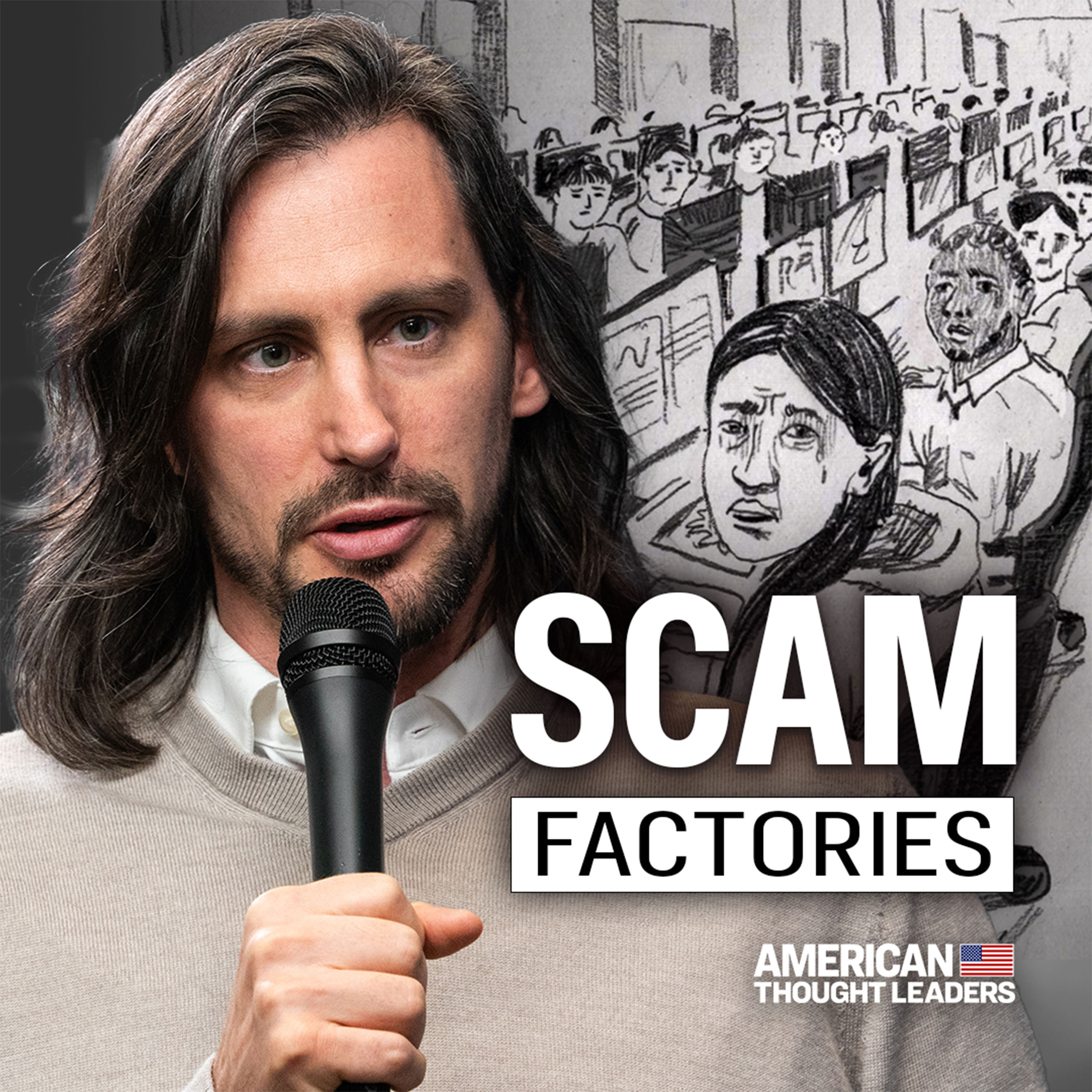
American Thought Leaders
The Multi-Billion Dollar Industry Using Trafficked Slaves to Scam Americans | Timothy Blackwood
00:39:46
Loading summary
Transcript101 lines
- [00:00]
Jania Kellogg
Each year, tens of thousands of Americans lose money to pig butchering scams.
- [00:06]
Timothy Blackwood
You don't have to be 65, 70 to be scammed though they will get you at any age.
- [00:10]
Jania Kellogg
But what many people don't realize is that in most cases the scammers are actually trafficked slaves. Across Southeast Asia, vast scamming compounds, often run by Chinese mafia networks, are filled
- [00:22]
Timothy Blackwood
with unwilling people you don't want to scam. You get thrown out a window or you get put in what's called a dark room or a red room and you're hung up by your wrists for days at a time.
- [00:33]
Jania Kellogg
Timothy Blackwood is the award winning director of the new film Scam From Hell to Home. In it, he tells the story of a young Ugandan man, Gideon, who sold everything he owned for a data entry job in Thailand. However, little did he know Gideon was being tricked into slavery in a Myanmar based scamming center.
- [00:54]
Timothy Blackwood
This is a massive, massive failure of our national security.
- [01:01]
Jania Kellogg
This is American Thought Leaders and I'm Jania Kellogg. Timothy Blackwood, such a pleasure to have you on American Thought Leaders.
- [01:13]
Timothy Blackwood
It's a pleasure to be here. Pleasure and honor to be here to speak with you today.
- [01:16]
Jania Kellogg
So there are a great many scam centers in countries like Laos, Cambodia and Myanmar or Burma. And people there are often shockingly enslaved doing these scams against Americans. Tell me about what's going on here.
- [01:35]
Timothy Blackwood
Well, what I'd like to do is pull it back for a second and talk about the film and the specific focus that we take in this film. So many, many Americans have either had a family member, a friend scammed in some type of generally online scam operation, but they don't know that behind these scams the people that are running them. And what I wanted to do was to pull back the veil on that because I heard that these people are actually trafficked. People on the other end of the line have actually been trafficked and enslaved to do this in many cases. So what my film does, scam Slave From Hell to Home is it follows the journey of a young Ugandan man named Gideon. And Gideon belongs to a village. He's from a small village outside of Kampala. He's an entrepreneur. He's running a Internet cafe and using the Internet cafe to support his family. And a client comes in and says, hey, you're good at English, you're great at computers, I can get you a job for twelve hundred dollars a month doing data entry in Thailand, Bangkok. And for Gideon, this sounds like a dream come true. That's a huge Sum of money, and he's going to be able to help his family. So he gets his tourist visa, he goes over to Thailand, has to sell his Internet cafe, everything that he's worked towards to get this data entry job. Goes over to Bangkok and a driver picks him up. And instead of driving him to the company, he's effectively abducted and driven across into Myanmar and to what is a scamming center where he's enslaved to scam Americans.
- [03:37]
Gideon
I come from a family with almost 11 children. This customer introduced me to an opportunity for a job in Thailand. I'm the hope in my family right now. And he told me, you are in Myanmar. You are here to scam.
- [03:59]
Jania Kellogg
And this is, you know, basically like a prison with a lot of computer terminals, 100%.
- [04:06]
Timothy Blackwood
And what happened was during COVID these casinos along the border between Myanmar and Thailand, they were empty because of the travel ban. So the operators of these casinos figured out that they could fill these hotels with individuals and essentially scam people, put them at computers and have them reach out to Americans and. And people around the globe and scam them for their money. So what happens to Gideon is he ends up in this scamming center surrounded by people from dozens of other countries, thousands of people. This is a huge operation, Massive. And if you don't scam, you know, after work, you know, you're working 17 hour days, you're catatonic, you. You're not getting sleep, you start to doze, they'll electrocute you. And if you refuse to scam, they'll torture you.
- [05:07]
Jania Kellogg
So the electric batons, you know, and by the way, congratulations on an incredible film. Right?
- [05:13]
Timothy Blackwood
Thank you.
- [05:14]
Jania Kellogg
Engaging, like, deeply and deeply human. I absolutely loved it. Those electric batons that you're talking about, you know, cattle prods sometimes, sometimes designed specifically for people, are what's used to torture people in concentration camps and black jails and prisons in China. I'm very familiar with the technology. It's a horrible, horrible thing to experience. And so when he comes in, actually, he doesn't want to participate.
- [05:47]
Timothy Blackwood
He doesn't want to participate. He doesn't know exactly what they're asking him to do, but he knows that it's wrong. He knows that whatever it is they want him to do, he says, I'm a Christian. Listen, this isn't what I came here to do. Where's the grocery store? I'm supposed to do data entry in. And they said, no, you're here to scam. And you are. If you don't do this, I'm gonna Call my supervisor and you're not gonna like what's gonna happen to you. He refuses. Supervisor comes in and effectively electrocutes him, drags him back and throws him at the desk where he's supposed to work. That's the beginning. That's the beginning of his first, you know, 24 hours in Myanmar.
- [06:28]
Gideon
Everyone was looking at me. And then this Chinese guy full of tattoos on his body came in this room, kicked me in the chest, grabbed an electric taser, and he electrocuted me.
- [06:48]
Jania Kellogg
Give me the bigger picture on these scam centers, because one of the things I remember we met each other at your screening, screening of the film, part of this incubator program that you're part of. And I mentioned, I know as a fact that the FBI has been working on trying to break some of these. In fact, we're going to be running a story sometime in the next few weeks. I don't know when we're going to run this interview, but about this. Of course, it's very hard to do that from the US because they're outside jurisdictions and so forth, but they are doing it, and they've had some successes. Explain to me the bigger picture of how this all looks of these, like these whole operations.
- [07:31]
Timothy Blackwood
Well, look, I've had the honor, the unique opportunity to be in active conversation with Ambassador Betty Bigombe, who is the Ugandan ambassador to Malaysia. And she plays a very important role in helping to free Gideon and a couple other Ugandans that are enslaved in this compound. And so we talk a lot, actually. And it's a massive, ongoing obstacle to be able to get individuals out of these scamming compounds. Once they've been trafficked, you know, they've been tricked. Most of these people have been tricked into coming there, and they're driven across the border both to Myanmar and also Cambodia. And so once they're there, you know, this very difficult to get people out. So, you know, she's a. She's a government. If you're from Uganda, there's no embassy in Myanmar. There's no embassy in Cambodia. In fact, she's handling this whole region and very, very under resourced. And it doesn't appear that there's a huge amount of, you know, national resources dedicated to help these people get out. So what happens is even once they're released from the compound, you can get them over to Thailand. You have to prove that they're, you know, they don't have their passports anymore. They've often been taken taken away, and they're now in Thailand illegally. You have to prove that they were not scamming willfully. Many some of these scamming compounds have been closed down. Like the biggest notorious compound, KK park, was shut down. And I think this is an effort by the government to say we're cutting down on the scamming centers. It had hundreds of buildings. So you want to talk about the scale of it? There's hundreds and hundreds of buildings in these compounds. Thousands of thousands of people enslaved. There's all different types of scams going on there. There's villas, there's strip clubs, there's clinics to support the staff that are managing and running these compounds.
- [09:40]
Jania Kellogg
So who are these people, people that
- [09:42]
Timothy Blackwood
are running these things? You know, Gideon talks a lot about that in the film, and in Gideon's case, in a massive scamming compound, this is run by Chinese, a Chinese crime syndicate. They're all. All the higher level people are Chinese. Chinese crime bosses, right? And in fact, many of them don't speak English. They actually have translators, many of whom are trafficked to communicate to the people that have been enslaved. So they're also the ones that are torturing the individuals that are scamming. And, you know, you don't want to scam. You get thrown out a window, or you get put in what's called a dark room or a red room, and you're hung up by your wrists for days at a time, deprived of water, given urine to drink. In Gideon's case, he ordered the soldiers
- [10:32]
Gideon
to put me on handcuffs. For over 30 minutes. I felt electricity all over my body. I reached a point where I couldn't feel any pain. It just kept kicking me, punching me, and yelling at me in Chinese. I shouted, I cried, I begged for mercy. But he wouldn't stop.
- [11:12]
Timothy Blackwood
Right? So people are, you know, the victims that I've spoken with are extremely traumatized. I spoke with other victims. They're not featured in the film largely because the trauma that comes with this, that comes with the torture and this just absolutely grotesque form of enslavement is just so traumatizing psychologically, mentally, and emotionally that it's very hard for them to want to go on and recount these stories on camera. But there's also one other really important fact, and that is they are. They're terrified of their former captors. The torture that they undergo in these scamming centers leaves such an impression that they don't want to speak out about the crime bosses that are running them. They're terrified. I spoke with one individual who said, listen, I was called a Year ago, and I was threatened not to say anything. Most of them will not come forward to speak up because they're so traumatized.
- [12:23]
Jania Kellogg
Even these rare ones that actually make it out.
- [12:27]
Timothy Blackwood
Yeah, the rare ones that make it out.
- [12:29]
Jania Kellogg
It's very rare. Like, tell me a bit about that. I mean, do you have any more insight? In the film, you kind of say that you couldn't explain how they actually got out. I'm guessing they paid some sort of big ransom or something like this. But can you give us a little more color about how that escape operation was actually managed?
- [12:50]
Timothy Blackwood
Yes. So Ambassador Betty Begombe meets with local military who are in charge of the area of this particular scamming compound. And she speaks with them and makes some type of negotiation to get the Ugandans out. She's a skilled negotiator, and she doesn't, you know, we didn't. Doesn't want to talk about the very specific details. Makes. It. Makes a. Makes an agreement that she would not disclose exactly what the agreement was. It gets. Gets them out, but the important thing is she gets them out. She subsequently got in out, you know, around 400 some enslaved people from Myanmar and Cambodia. And she's working extremely hard to get more out. But it's a big uphill battle.
- [13:46]
Jania Kellogg
And so in these situations, really, it's just that. So it's just the Ugandans that are being released. Right. Because the others don't have these advocates for them, like the ambassador.
- [13:56]
Timothy Blackwood
Some don't have any. I mean, sometimes what they initially do is they want ransom. But in the case of Gideon and Uganda's use with, there was no reassurance that if they paid the ransom, families paid the ransom, which they're too poor to do, that the people running the scamming combo would actually let them out. These are professional scammers. They're running a whole global crime syndicate to scam people. So at every level, they're making money off these enslaved victims. Every single level. Right. And they can be sold from one. What they call them, companies. So one company is doing a certain type of scam, and they will. The people they have enslaved aren't working out, or they're underproductive. They'll sell the slaves to another company and they'll get sent to another scamming compound. And it's an extremely. Like, you have no access to the outside world to advocate you for help. And if you're from a developing country with families that have no money and resources and a government that's not behind freeing you or interested in the human rights of its own citizens that have been enslaved. How do you get out? How do you find freedom again? Right? And what's so devastating for these victims is they go abroad to get work to support their families. They want to. Most these people, they're looking for honest work. Right? And there's a report that came out that said, you know, 30 some percent of these people are tricked or scammed by someone they know. Another 30% by a trusted individual. Only 20 some percent, according to the report, says it's by something they found online. So within these countries, within the developing world, where economies are extremely fragile and weak and where people are starving and trying to get a meal, these governments, they're not doing what they need to do to help get their own citizens out, let alone provide a context. Right. Within their own economy for people to be able to flourish. There's huge amounts of corruption. Right? Huge amounts. And just because we don't have Americans getting kidnapped and put in these scamming centers and tortured on a daily basis doesn't mean that we don't have an obligation to defend the individuals that this is happening to. Right? We're being scammed. Americans being scammed, you know, in the billions of dollars annually through these schemes. Right? Billions. That's a huge, huge sum of money. People's entire 401ks, their savings disappearing. Right. So we have an obligation at a national security level to, to do something about this. But we also, at a human rights, at the level of human rights, at the level of the fact that each human being, if we truly believe is entitled to respect and dignity and some kind of inalienable rights, we have a responsibility to do something about this. Right.
- [17:12]
Jania Kellogg
You know, it's even in the collective consciousness very much so. The scams are so common. There's a whole film called the Beekeeper. I don't know if you.
- [17:21]
Timothy Blackwood
I've seen, I've seen the Beekeeper.
- [17:23]
Jania Kellogg
Yes.
- [17:24]
Timothy Blackwood
You know, the beginning of that, how her mother is scammed, I think is very well done. And she's so ashamed, she commits suicide.
- [17:32]
Jania Kellogg
That's right.
- [17:32]
Timothy Blackwood
You know, so if you.
- [17:33]
Jania Kellogg
Activating Jason. Jason Stratham.
- [17:36]
Timothy Blackwood
Yeah, activating Jason. And then, you know where, where I think that film really fails is it, it goes up to the level the White House and makes these kind of posh guys who are dressed in suits. And it really is highly inaccurate who the villains are in the real life scenario.
- [17:54]
Jania Kellogg
Right. It's fascinating.
- [17:55]
Timothy Blackwood
It wants to make.
- [17:58]
Jania Kellogg
Yeah.
- [17:58]
Timothy Blackwood
That it's all being done within America when these scam operations are Happening within the Golden Triangle and now beyond. I want to talk about one particular scam, one particular kind of scam which is people pig butchering. And people have started to learn about this because it's an extremely lucrative form of scamming, right? And we go into this in the film. This is the kind of scam that Gideon is involved with and other people in the within the compound that he's enslaved in. And that's. You get a text message from a random number. Hey, I didn't see at the pool the other day, it's Lisa. You know, and you've just lost your wife and you're feeling lonely and you know, let's say you're a retiree and you're looking for connection and you know, you think, well, no, Lisa, Lisa, I'm sorry, you got the wrong number, Lisa, I wasn't at the pool. Oh, oh, oh, well, what's your name? And there a conversation ensues with the person who reveals themselves to be a pretty, you know, 26 year old Thai girl. And a relationship begins. And you know, down the line she says, listen, I'm making. And she's sending you photos and videos of herself so you think she's real. And she says, listen, I'm, I'm making a lot of money in crypto. Investing in crypto. Like if you invest money, you are literally gonna get like five times as much back. Let me show you my wallet. And what ensues is tricking the person to invest in what is a fake cryptocurrency wallet. And what they end up doing is having to invest more and more and more and more. And the money keeps growing. It looks like they're making a lot of money on their investment. And then when they go to withdraw the funds, they say, well, there's these fees associated. If you want to get the money out, you're going to have to put like another 50,000. Well, I put, I've already put everything I own into it. I just want to get the money out. No, sorry, can't do it. So you borrow the money from your son, your brother, whoever, and you've now borrowed that money and you go to withdrawal and then, then they cut you off and they've taken all the money and you realize that this whole thing was a scam. And so it's pig butchering you, you fat in the, you fat in the pig as much as you can and then you, you butcher it. So used to be to, for something to be stolen from you, right? People case out your House. We're gonna see when he comes and goes. We're gonna work our way in there, find where he keeps his mother's jewels or jewelry, and we're gonna get the stuff now. It's happening digitally, and they can take everything that you own.
- [20:44]
Jania Kellogg
Wow. So how, you know, you got some really remarkable footage from inside these centers, or at least one or a few of them. Tell me a bit about that. Where did this footage come from? How did you get it?
- [20:56]
Timothy Blackwood
You know, I appreciate that you. You noticed that. I can't say how that came about. I can say I'm just very grateful that we have it to show audiences and very grateful for, you know, there are many, you know, unnamed angels on the ground that are doing what, everything they can to help people that escape from these centers or help people escape. And so I can't. I can't go into the details of how I got the footage, but I'm very grateful to the fact. I'm very grateful the fact that we got it so people can see it, but also for the work that people are doing that will not be recognized publicly due to the security of. Due to the fact that they need. They need to remain anonymous for their own security because it's a very dangerous, very dangerous endeavor.
- [21:55]
Jania Kellogg
So you've just described this pig butchering scam. What are some of these telltale signs of scams that people should watch out for?
- [22:05]
Timothy Blackwood
I mean, look, I've gotten.
- [22:07]
Jania Kellogg
Let me put it this way. I've gotten those texts.
- [22:11]
Timothy Blackwood
Yeah.
- [22:11]
Jania Kellogg
Like, you know, just someone says, hi.
- [22:13]
Timothy Blackwood
Yeah.
- [22:13]
Jania Kellogg
And the odd time, like I sometimes say, hey, I don't have you in my contacts. And then I see what, what the next. And the next step is. As long if it's not like, hey, it's this and this person that I actually know, then I just ban it. But so that. That's a hint, right? If the person is not actually known to you, you should not engage. Right.
- [22:34]
Timothy Blackwood
You shouldn't engage.
- [22:35]
Jania Kellogg
But what are some other telltale signs?
- [22:38]
Timothy Blackwood
Well, if you've been engaging with someone and they seem like they're a beautiful model from the other side of the world and they want to marry you, you know, and you're, you're. You're 70 years old and you're a widower, and this woman wants to come cook for you and do everything for you, she's probably not real. Or she's someone that's been trafficked and is working as a slave to, to convince you into a pig butchering scam that could be very, very Likely. So you have to be extremely careful with who you communicate with online that you've never met in person and do not. If it seems too good to be true, it probably is too good to actually be true. Right. You've got to use your common sense. What I would encourage people, whether the. And these people at these people. Aaron west, who runs Operation Shamrock, she's really at the forefront of this, this endeavor of trying to, trying to help people and is having a good deal of success. I'd encourage people to check out her website and, and podcast. But what she says and what we. A clip that we use in our film. And she says, this is there. These, these individuals are extremely sophisticated. You don't have to be 65, 70 to be scammed, though they will get you. This is happening to people across the board. And we feature one of those individuals, a young woman in her, you know, probably, you know, mid-20s, that this happens to. And it happens. She meets a guy on Hinge who connects with her. He was born in the same town that she's from, also in China, and really, really connects with her. And he gets her into a pig butchering scam of which she loses all of the money that her mother who died left her. Right. And he's telling her, well, think of all the good you can do for your family through this crypto investment. It's a sure deal.
- [24:40]
Jania Kellogg
So crypto seems to be one another one of the sort of features of
- [24:45]
Timothy Blackwood
these scams, of course, 100% because you can't trace it. Right. You can create a fake wallet. People can deposit money into that fake wallet, into a, into a, do a kind of fake exchange.
- [24:56]
Jania Kellogg
Right. And that allows you to elude the law enforcement later. Yeah, I see.
- [25:00]
Timothy Blackwood
Yeah. Aaron west is working with local law enforcement agencies on this. But this is really not a massive security, massive. This is not like a national security, true national security crisis that we've recognized it to be that it actually is.
- [25:22]
Jania Kellogg
It strikes me, right, that AI would probably make these scams a lot easier to run because you could even create fake videos.
- [25:32]
Timothy Blackwood
They're doing that. Deep fakes, extremely sophisticated. One of the executive producers on the project, Matthew Friedman, a colleague of mine, you know what he's shared with me as he said, look, from the research we've done, the scammers are years ahead of the industry. Like before the private sector had come up with these deep fakes. They were mastering it. They can hire the most brilliant programmers and work on these things at the most sophisticated level before the private sector touches it. And they're always ahead, they're always steps ahead of us.
- [26:07]
Jania Kellogg
Like, they're ahead of like Google.
- [26:11]
Timothy Blackwood
Yes, that's what Matthew has explained to me. They're extremely sophisticated. There's a, we have to understand that the scale of this is just so huge, the amount of money that is being made. I mean, if you're making billions of dollars a year with relatively low overhead, the ability to reinvest that into more sophisticated scams and technology is, it's kind of endless. You don't have to. And there's no, of course, there's no regulation for how you, how you do that or you have to go through any type of legal process. You hire great minds and you fly them in and, and you have every level of, of technology available to you to be able to, to improve on these, these techniques. So the deep fakes is a big one. Yeah.
- [27:07]
Jania Kellogg
It's interesting because as we're talking here, right. We're here at Freedom Fest and you know, a lot of people here are very concerned about their privacy, about, you know, basically programmable money, not really being money. Right. But a lot of the technologies used to allow governments and law enforcement to track transactions. Right. Are precisely things that a lot of people here would not want to see being implemented. Right. But these, they also, these things, these scams are the something that's being used for a good reason for why to implement these technologies that allows very close government, let's say, surveillance control.
- [27:55]
Timothy Blackwood
We have to be extremely careful of that. You know, listen, the government has. This is a massive, massive failure of our national security. It's huge. So to be apprehensive of the government that has failed to protect its own citizens of these scams. You know, the fact that me as an independent filmmaker, I'm out here sharing this short, you know, an inspiring and powerful short documentary made on a very low budget in an effort to help educate people. The fact that I'm having to do that, there's no national campaign like what we have with fentanyl or we have going on with some good things with making America healthy again, so on and so forth. No one's talking about it. No one's talking about it. We're talking about immigration every day, border security, tightening our borders because of foreign actors that come in and whatever else have you. Why, why if, why is it, if that's a priority, this is not. What, what's going on. There is a 401k that gets stolen from a working class woman by a scammer. Is that, does that not matter. We're talking about hardworking Americans that have worked their entire lives, worked on honest living, to save this money and for it to be stolen overnight in these sophisticated scams. What are we doing? What's our government doing?
- [29:38]
Jania Kellogg
Well, I'm excited to report that at least there are the beginnings of a response to this. And that's with the FBI. Good.
- [29:46]
Timothy Blackwood
Good.
- [29:47]
Jania Kellogg
Yes, Good.
- [29:48]
Timothy Blackwood
Well, they should, they should get going with you.
- [29:50]
Jania Kellogg
That, that this has not really been on the radar very much at all. But, but I do know it's at least on the radar of the FBI right now.
- [29:58]
Timothy Blackwood
Yeah, I know. President Trump signed, from what I read, he's trying to sign an executive order in March to, To prioritize this.
- [30:04]
Jania Kellogg
Correct.
- [30:04]
Timothy Blackwood
Right. And that's a, that's a positive, very positive development. This is coming, you know, about five years late, and the sophistication of these enterprises has grown and they've enriched in themselves so much that this is going to be a very, very, very challenging fight. And I think that this is where we, as just everyday Americans, we have to step up and be proactive about our Internet usage. We, we have to step up and take the reins, so to speak, on our own digital footprints. Right. We can't. It's clear that we can't as much as the government.
- [30:51]
Jania Kellogg
Yeah. And we shouldn't. Right. Like, we shouldn't rely. This is, I mean, this, again, this is sort of a key message, right. At Freedom Fest. We shouldn't be reliant this way. We have to figure out that we have some responsibility for ourselves in figuring these things out. Yeah.
- [31:05]
Timothy Blackwood
And if we're not conscious of it, you know, what happens with our data and our information. Right. Here's the point that I'm, I'm really curious about. Right. And we don't, we don't delve into this in the movie, but after having spent a year on telling Gideon's story, it's really provoked this question for me, and that is there is, as you well know, and pretty much every American that turns on the TV or the news knows about the massive push for artificial intelligence and kind of owning that movement, that America needs to own that movement. That's, that's the effort. Right. And we see the data centers springing up. We see massive, massive, massive amounts of investment going into AI. Right. Well, how on earth if AI functions based on having access to huge amounts of information? Right. Huge databases, it does really well with having access to information, analyzing it. Right. So if, how, how are we going to become the leader in AI and Also protect the privacy of American citizens. The privacy and the financial integrity and bank accounts of hardworking Americans. How can we do that? So every single day we hear about how aggressive we're being with AI and leading the world in AI. Why isn't there any ounce of that effort being made to protect Americans from being scammed? Right. How can we possibly accomplish those two things at the same time? It's an interesting question, isn't it? Because the people that are leading the AI revolution are extremely smart people. Right.
- [32:57]
Jania Kellogg
There's. There's a way to do it. There's a. There's. Let's just say there's a bad way. Yeah. And, you know, and there's a good way. I've had a number of people on the show about these types of questions. How do you develop an AI? How do you develop AI in a way that it doesn't grow to want to kill us?
- [33:14]
Timothy Blackwood
All right, well, that's a big overarching question, but why is it that the people that are. That are leading the AI firms now, why are they not at the forefront of the cybersecurity question of what's happening to Americans? Being scammed? Why not?
- [33:32]
Jania Kellogg
Well, why not?
- [33:34]
Timothy Blackwood
It's a question. I don't have the precise answer to it.
- [33:38]
Jania Kellogg
Maybe you can encourage them with your film.
- [33:43]
Timothy Blackwood
I would hope so, because I think the way to really break this down for individuals is it's not simply in the horrific statistics of how many billions of dollars are being scammed for Americans annually, but the human cost to people's lives when they're scammed, the human cost to people's lives when they're scammed, and the human cost to the slaves of people from over 65 different countries that are working to scam up Americans and people from around the globe.
- [34:20]
Jania Kellogg
Tell me about the hand drawings that are in your film. I find them to be incredibly compelling,
- [34:26]
Timothy Blackwood
the hand drawings in the film. So what was really important for this movie was. For this film was to showcase the narrative of someone that goes through the process of being trafficked.
- [34:38]
Jania Kellogg
And they're also. A lot of them are wearing military fatigues. It looks.
- [34:41]
Timothy Blackwood
Well, the local kind of militias. There's a civil war going on, as you know, in Myanmar. And so the. The local, different military groups are involved in protecting these compounds. So they're very, very involved. There's a lot of money flowing. Right. And so the military, local military are the ones that are protecting a lot of these compounds or have. Have different. Different territories.
- [35:06]
Jania Kellogg
So who. Who drew them?
- [35:08]
Timothy Blackwood
So who dressed. Sorry.
- [35:10]
Jania Kellogg
Well, Back.
- [35:10]
Timothy Blackwood
Sorry. So in the film, we have drawings because we can't show Gideon's experience of being tortured once he gets into Thailand. It's all. It's in retrospect, but we want to make it present for the audience his experience of being enslaved in the scamming center. And so what we do is we've got hand drawn illustrations from an extremely talented artist, Sophia, a colleague of mine, and she just did a phenomenal job of showcasing what Gideon goes through inside the scamming center through her hand drawn illustrations in pencil.
- [35:47]
Jania Kellogg
What's happening with Gideon now?
- [35:49]
Timothy Blackwood
You know, it's a tough. It's a tough road. You know, you come back from being enslaved in one in the Golden Triangle in one of these scamming centers. You come back home and you'd left with a promise to your family that you were gonna be sending them money and they'd no longer be living in poverty. They'd have food to eat, they'd have money to send their kids to school. And now you come back home and all the money that you borrowed to go do that trip, you now still owe people. You come back worse off than when you left. So he's in the process now of getting on his feet. He's also a musician and hip hop artist. He's an. He's a very talented young man and he's pursuing his career in music. And in fact, we actually have the closing song in the film. He sings in our closing credits. And he's also doing activism.
- [36:43]
Gideon
He's.
- [36:43]
Timothy Blackwood
He's being proactive in the ways that he can to help other people that get in touch with him, not get
- [36:49]
Jania Kellogg
escaped, not get scammed.
- [36:52]
Timothy Blackwood
He works on two fronts as an activist. So he goes around to schools and tells his story, schools and different groups to younger kids, and explains the trap that you can get in to be scammed, like what happened to him? So he's doing that, but then also he's helping as an activist. When people hear his story from podcasts and so on and so forth, they get in touch with them to say, oh, I have a sister who's disappeared, or someone from inside. Maybe a scamming compound learns, you know, gets access to his number, and then he can kind of do what he can to try to help them escape.
- [37:31]
Jania Kellogg
How did you get in touch with him? I mean, I saw that you actually went to his village.
- [37:36]
Timothy Blackwood
Yeah, we filmed in Uganda, which was a very powerful experience. And I'm deeply honored to have met his family, to have been welcomed into his father's church. In the village. His father's a pastor and farmer, and I got access to him through a journalist who's working on a book on the topic who's done a lot of great work in this space. And I'm super grateful to him making that introduction. And we really want people to learn about Gideon's story because Gideon's story is really reflective of what thousands of other people have gone through.
- [38:14]
Jania Kellogg
Well, it's an incredible film, made a huge impression on me. I've already shared it with some people that, you know, might be able to use it to affect some change. We'll see. Do you have any final thought, anything else you would like people to know about the film where they can watch it and any final thoughts you might have?
- [38:36]
Timothy Blackwood
We're screening at film festivals right now, so you can, you can look out on social media for Scam Slave From Hell to Home. We'll be screening at Flickrs in Rhode Island, Flickers Film Fest in Rhode island in early August. So anyone on the east coast that wants to come up to Rhode island, it's a fabulous film festival. Then we'll be rolling out to festivals around the globe and also looking for online, a really strong online apartment that could do a wonderful digital release of the film. So we have some individuals and groups that we've approached, hoping that they'll want to distribute the film online.
- [39:19]
Jania Kellogg
Well, Timothy Blackwood, it's such a pleasure to have had you on.
- [39:22]
Timothy Blackwood
It's an honor and pleasure to be here. Thank you so much for the work you do and for taking the time to speak with me about Scam Slave From Hell to Home. Thank you.
- [39:32]
Jania Kellogg
Thank you all for joining Timothy Blackwood and me on this episode of American Thought Leaders. I'm your host, Jan.