← American Thought Leaders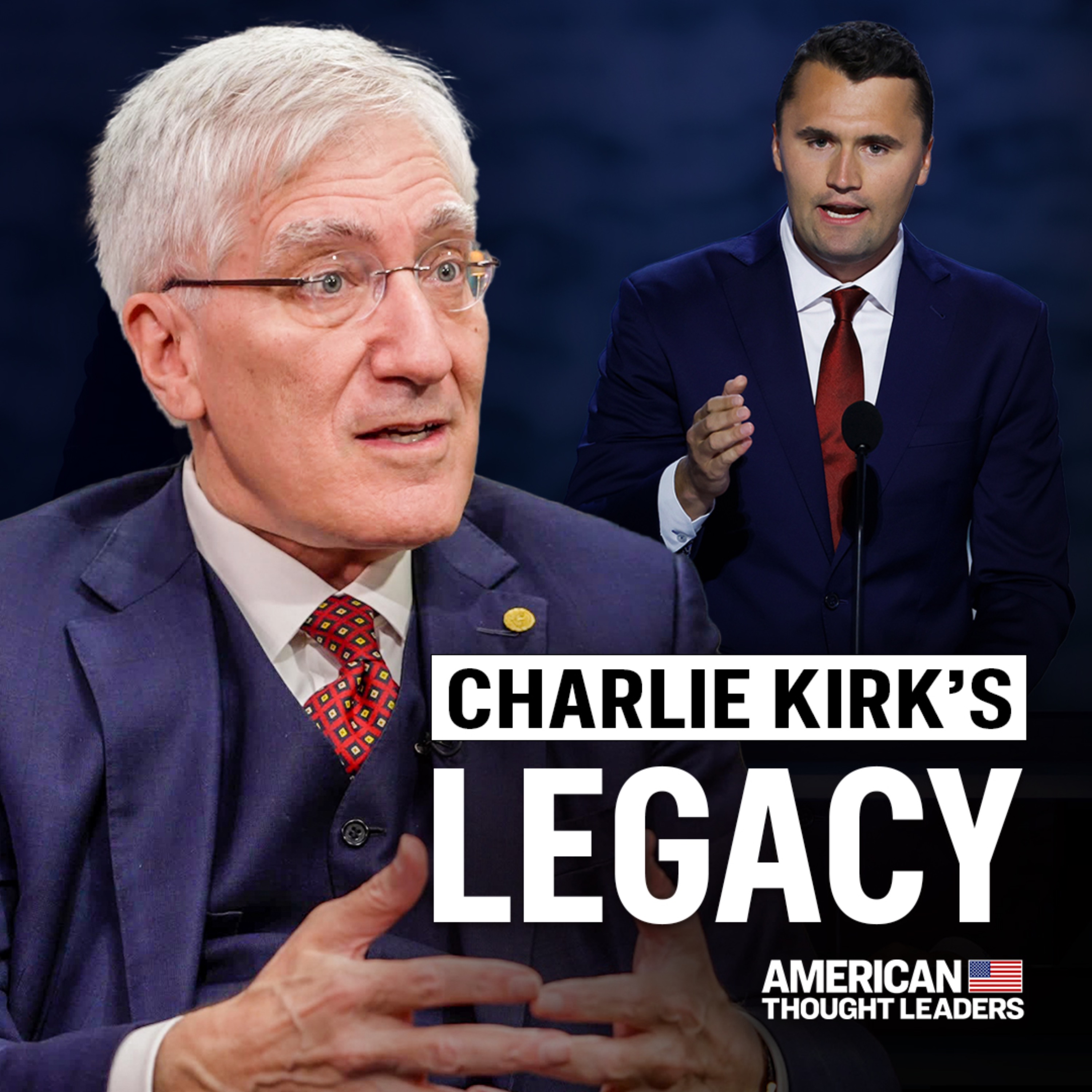
American Thought Leaders
‘We’re at an Inflection Point’: What’s Next for America? | Robert George
00:57:20
Loading summary
Transcript60 lines
- [00:00]
A
We're at an inflection point, and it's very worrying, very dangerous. We've got to overcome this extreme polarization. We have to persuade our people that their fellow citizens who disagree with them are not their enemies.
- [00:15]
B
As America reels from the assassination of Charlie Kirk, I sat down with legal scholar, political philosopher, and Princeton University professor Robert George. To understand our current political moment, then.
- [00:29]
A
We could easily fall into a cycle of revenge, and then what becomes of us?
- [00:36]
B
For years, he's been contemplating how the age of faith and the age of reason have been succeeded by what he describes as the age of feelings and moral relativism. His new book is titled Seeking Truth and Speaking Law and Morality.
- [00:52]
A
In our Cultural Moment, our true enemies are people who want to sow division among our people. They benefit if we treat each other as enemies.
- [01:03]
B
This is American Thought Leaders, and I'm Jania Kellogg. Professor Robert George, such a pleasure to have you on American Thought Leaders.
- [01:12]
A
Thank you. It's a great joy to be here. It's a difficult day.
- [01:18]
B
You know, this is the aftermath of. Of Charlie Kirk's assassination. And, you know, I've been dwelling in this, as have so many Americans and even people outside of the country, and I've been asked to talk about it on various programs. And I keep thinking about the fact that actually, everything you're talking about in this book that we'd planned to do an interview on for months now is kind of central to what's happened. What do you think?
- [01:50]
A
Well, we're speaking with each other the day after this horrible murder, this assassination. I knew Charlie, didn't know him well. We weren't close friends, but we had had lunch once together a couple of years ago, had a very, very good conversation. And then Cornel west and I were guests on his podcast just a few months ago, and he treated us both with enormous respect and gratitude and dignity and kindness. So it hit me personally. But of course, there's a larger significance to it. We don't know all the facts yet, but everything is pointing to this being a political murder, a political assassination. And that's chilling, far from the first that we've had in this country. But we hate to see this. And the suspicion that all of us had. I think I'm speaking for everybody who's hearing us. The suspicion that all of us had right off the bat, is one we hoped would prove not to be true, and that is that this was, in fact, a political assassination. Reflecting the increasing strain, the increasing polarization of our country, we've now reached a circumstance in which citizens who disagree with each other in so many cases don't simply regard each other as civic friends, despite our disagreement or fellow citizens with whom we happen to disagree. Rather, so many regard themselves as enemies of those with whom they disagree. And enemies are not to be reasoned with. Enemies are not to be argued with, enemies are to be destroyed. And it really looks like somebody, perhaps more than one, somebody who knows, who regarded Charlie Kirk as an enemy because of his beliefs, decided to eliminate him, leaving a widow with two small children who will grow up without a father. This is a personal tragedy, but one that seems to have a much larger public significance.
- [04:07]
B
Your book is called Seeking Truth and Speaking Truth. I think that's something Charlie actually was trying his best to do in both cases, actually on both counts.
- [04:19]
A
Well, what I call for in the book and what Cornel west and I, in our work together, our teaching, our lecturing, our writing together, have tried to do, is to persuade people that the way forward is not with animosity and acrimony, and certainly not with hatred and violence, but rather with civil discourse and a spirit of civic friendship, acknowledging that our disagreements are serious over serious matters, very profound issues in our politics and in our culture, but that they can be worked out by words, by engagement, by listening to the other guy. Beginning with recognizing that we're all fallible. We all know we aren't right about everything.
- [05:04]
B
Right?
- [05:04]
A
I mean, do you know any human being on the face of this earth who only has true beliefs in his head and no false beliefs? Can anybody claim every belief in my head right now is true and none are false? Not a single human being on the face of the earth can claim that. We all know that we hold some false beliefs. And we also know if, if we're serious, we'll admit that we're capable of having false beliefs, not only about the minor, trivial, superficial things of life, the things that don't matter that much, the things we don't really care all that much about. We frail, fallen, fallible human beings are capable of having false beliefs, being wrong about the profound, important things, about the great issues, the issues of human nature, the human good, human dignity, human rights, human destiny. We can be wrong about the things that really matter to us. And that is a knockdown argument, a knockdown reason for treating people who disagree with us, even about things we really care about, even about things that are critically important to us as friends from whom we can learn, despite our disagreement. Friends that we should engage in a truth seeking spirit willing to listen, not just hear, but to Listen, that's the message of my book. That's the message of seeking truth and speaking truth, which is why I want especially young people to read the book. Now, I want people my age and people your age to read the book as well. But I care even more that they give it to their children, or in my case, to their grandchildren. Because if this generation rising today does not adopt a spirit of civic friendship, if they don't value civil discourse, then I promise you something. This grand experiment in Republican government and ordered liberty bequeathed to us by our great Founding fathers will be lost. It depends on citizens treating each other when they disagree, not as enemies to be destroyed, but as friends to be reasonably disagreed with, argued with, engaged, perhaps passionately, but peacefully and in a spirit of friendship.
- [07:14]
B
Something I've been saying on a number of these shows that I've been on today talking about this whole horrible situation is this term. It just came to my mind. It was words are violence, okay? This idea that words are violence. And I find it. I mean, maybe it's in the spirit of what happened here. I realize this is one of the most pernicious, terrible concepts because, I mean, and this is. I'd love it if you could kind of, you know, dig, dig into this and show me where I'm wrong or whatnot. But it feels, it seems to me, like human beings figure it out somehow. As human beings, we have the ability to communicate and solve our problems without, let's say, clubbing each other or hurting or resorting to those methods. Without that communication, if we actually stop that communication, if that polarization that you're talking about actually happens, then we lose all of it, right? And so just this concept, I've heard this idea voiced many times, but I didn't fully grasp until now. I think, and please weigh in on this, how terrible a concept it is.
- [08:28]
A
Well, let's explore the arguments on the two sides of that question. I actually come down where you come down rejecting the idea that speech is violence or words violence. And like you, I worry about that idea because I do think it's a pernicious idea. But let's give it its due. Let's explore the argument for the idea that words are violence, because if we do that, we're going to find there's a kernel of truth, but more falsehood than truth. All right? So words can incite violence. There's no question about that. You know, if. If we've got a starving crowd in front of the home of a farmer who they believe to be hoarding corn, when they and their children are starving. And I get up in front of the crowd and say, he is starving us. He's the one who is responsible for our plight. Let's kill him and take his corn. That is inciting violence. So words can incite violence. And less directly, calling somebody Hitler or calling somebody a monster or accusing somebody falsely of horrible things like racism and all the various phobias can lead people to think that a monster like that should be taken out, a monster like that should be destroyed. A monster like that should be killed. You probably heard this line that transgender activists sometimes say. It's a horrid line. They say, punch a terf Terf, meaning someone, a feminist who rejects transgender ideology that's calling for violence. So there's the kernel of truth, but it's mostly falsehood. For this reason, words are words. They are not violence. Speech is speech. Speech is not violence, and violence is not speech. And violence can never be defended as a form of expression. If we fall into the error of believing that speech is violence or speech can be violence, then we are inviting a justification for violence on the other side as a response to the so called violence that is really just somebody exercising his or her right to freedom of speech. I can't help being a professor, I always want to give you the argument on the two sides.
- [11:04]
B
Well, but this is exactly what I was looking for. And indeed, I mean, I think there's a compelling argument to be made that the demonization of, say, the President and many others, Charlie Kirk certainly, and many others as these very extreme things that you mentioned. Right. For example, Hitler, Nazi, whatever, that some crazy person who imagines they're going to do good. And actually in this situation, I mean, what would you do if you knew that this person was going to be Hitler? Maybe you would feel justified in throwing out your moral boundaries. Right?
- [11:42]
A
Well, look at what we're seeing right now. There are people, in one case that I noticed, it was a person who claimed to be a Christian, who was celebrating the murder of Charlie Kirk on the ground that a Nazi had been taken out. A Nazi had been given his just deserts. This is outrageous. And of course, the consequences of that, if it would become a widespread view for our democracy, for a republic, would be absolutely horrific. And my real worry is violence begets violence. Political violence doesn't solve anything. I hate to quote Stephen Colbert, because I am not a Stephen Colbert fan, but he was right when he said, in response to the murder of Charlie Kirk, political violence doesn't solve anything. It only leads to more violence. Violence on the one side provokes violence in return on the other side. And we could easily fall into a cycle of revenge and then what becomes of us? It's got to stop now. People on both sides, the right and the left, have to say it stops now. We will police the crazies on our side. And we need you on the other side of this political or ideological divide to police the crazies on your side. You need to make it clear to everybody that violence is an unacceptable way to deal with disagreement.
- [13:17]
B
You know, and this is this, maybe, I don't know, I use the word irony or some people say, you know, this is probably the reason why he was actually assassinated because Charlie Kirk's kind of weapon was words and very convincing arguments and having the desire to go into places where there was vociferous opposition to him. Right. And have those arguments and maybe change a few minds. And I think this is critical because I believe even I spoke with this about him once, not viewing the other side as the enemy, as you pointed out, like not actually seeing the other person as just another flawed human being and in one's heart. Right. I think that's the. It seems like to me to be the key.
- [14:09]
A
Yeah, that is absolutely the key. When we view each other as enemies, we separate ourselves. I mean, we've gotten into a crazy situation in this country with extreme polarization in which sometimes Thanksgiving holiday becomes a battlefield, or if it doesn't become a battlefield, sometimes it's not a battlefield because people choose not to come together for Thanksgiving despite being members of the same family. You know, brothers and sisters, uncles and aunts and nephews and nieces, moms and dads, grandparents can't sit down together for a Thanksgiving dinner, a common celebration giving thanks to God for his bounty, for all the goodness, all the blessings that we enjoy. They can't sit down together because they have political distribution disagreements. Now, that is not to belittle the importance of political disagreements. We have profoundly important, morally deeply significant disagreements in this country. Think of our disagreements over the sanctity of human life, issues like abortion and euthanasia, important issues of religious freedom, freedom of speech. There are very, very important issues in this country. And the division is not anything that should be just considered trivial. It's far from trivial. But nevertheless, citizens of a democratic republic have to be able to engage each other even on those issues, not only peacefully, but in a truth seeking spirit, in a humble spirit, in a spirit of willingness to listen and not just to preach. We're not going to get anything Anywhere in our relationship. If I think my job is to preach to you, call you names if you disagree. And you're not going to get anywhere if you think your job is to preach to me and call me names. My job is to give you my reasons for thinking the way I do. And then listen, not just hear, not just sit politely while you talk, listen to your reasons for thinking something different, your reasons for believing that I'm wrong about the thing that I'm defending and you're criticizing, and then our roles are reversed. Then you give your reasons, and I might find those reasons persuasive. But if I don't, then I give you my reasons for thinking. No, you don't have that one quite right.
- [16:33]
B
One thing that strikes me here is, and this is, you know, my interest for years has been in understanding communist China, understanding how communist systems seek to influence us, how they view us as almost an existential threat. In every instance, I'm going to say us, I'm talking about America specifically, but the west, you know, free societies in a broader way. Their interest and I think the greatest weapons they've always had, whether it was the Soviet Union or now communist China, is their information warfare operations, is their ability to push ideas societies. I mean, I read in a few places in your book you talking about how it became, for example, I don't know, cool to view yourself as a kind of an enlightened communist. There's kind of an equivalency between the Soviet Union that was something that was actively pushed by the Soviets. Right. And it was an insane proposition from the beginning. As Solzahitsyn, you have an amazing chapter about him in your book put to rest finally. Right. I think. Right. But they're so powerful in this way and their goal is not to convert everybody into being communists. Their goal is to create that polarization and have the two sides fight each other. And this is to be the biggest challenge because it's like there's someone always fueling that fire, even some people here. And I don't think that's. I think it's a small group of people that want to see it all burn.
- [18:10]
A
Our true enemies, whether it was the leadership of the old Soviet Union or whether it's the contemporary leaders of China or North Korea or Venezuela, our true enemies are people who want to sow division among our people. They benefit if we treat each other as enemies rather than civic friends who happen to disagree with each other. I think totalitarian regimes, whether they are Nazi or fascist regimes on the one side or Communist regimes on the other side always like to depict themselves as idealists. And they try to appeal to young people by portraying themselves as idealist regimes. And then they try to explain away their sins and offenses, their horrible atrocities that they commit. And all totalitarian regimes commit massive atrocities. The death count from Nazism, the death count from communism is off the charts, almost unimaginable. What they do is they try to depict those evil things that they do as excesses of zeal in their idealism. But the reality is it's about power for certain people who have control. Whether it's the communist leadership in China, whether it's Joseph Stalin in the Soviet Union, whether it's Adolf Hitler in Germany or Mussolini in Italy, it's all about control. And it's important for them in controlling the people over whom they rule, that those people see the state that they lead, and in some ways that they embody as the ultimate thing. The real threat from the west, and especially from America, when we're at our best, to every totalitarian regime, is that it's central to the American understanding. It's central to the American idea that no mere human power is ultimate. The state is not ultimate, the President is not ultimate, the Supreme Court is not ultimate. There's something over them to which they are answerable and, and under whom they are accountable. And of course, that is Almighty God. The very founding document, our Declaration of Independence, states the proposition. Clearly we hold these truths to be self evident, that all men are created equal, that they are endowed by their Creator with certain unalienable rights, and among these are life, liberty and the pursuit of happiness. What do we see there? We see the view being expressed, the proposition that our rights don't come from presidents, kings, parliaments, congresses, supreme courts. They don't come from the state. They come from no merely human power. They come from the hand of God himself. And because no merely human power gave us our basic rights, no merely human power, no communist dictator, no fascist.
- [21:18]
B
No.
- [21:18]
A
President, no king can legitimately take those rights away. That's the real threat to every form of totalitarianism. If we ourselves, Solzhenitsyn warned about this, if we ourselves abandon our belief that there is some higher power, that there's a God above the state to whom the state is answerable, then we will be defenseless against these totalitarian regimes. And the grave danger is that we will become one ourselves.
- [21:52]
B
You know, you have this amazing chapter with Heinrich Heine, you know, prophecy around exactly what you're talking about. I want to jump on that in A moment before we go there, I just, you know, why do you think that this is such a profound cultural moment? Because it is. We all feel it. I mean, you know, Butler, when Butler happened, when there was the assassination attempt on President Trump, everyone was shocked. It was, you know, it was a big thing. But there's something different and unbelievably profound in what's happening right now. And I find it even hard to verbalize entirely what's going on.
- [22:35]
A
Well, I mean, it's very worrying what's happening right now. Our extreme polarization seems to be now cashing out in violence, political violence. We have the school shootings, some of which seem to be driven by some sort of ideological rage. We have, a few years ago, the shooting of Representative Steve Scalise happened to be a Republican. There was a politically motivated shooting of a Democratic politician and I believe her husband in Minnesota. Just a few months ago. There was some sort of a plot to kidnap the Democratic governor of Michigan. There were two assassination attempts on President Trump. Thank God neither was successful. Now, the shooting the other day of Catholic school children while they were attending Mass. And now we have the assassination of a political activist who was all about the business, even when he was shot, of engaging people who disagreed with him in rational discourse rather than pulling out knives and guns and fighting. So, yeah, there's something going on. It's something very big. We're at an inflection point, and it's very worrying, very dangerous. We've got to overcome this extreme polarization. We have to persuade our people that their fellow citizens who disagree with them are not their enemies. We need to restore civic friendship.
- [24:14]
B
So one thing that seemed very positive to me was that people that I've noticed that often use very extreme rhetoric, I'm not going to name names, seem to. A number of them seem to mention what you said, that violence is never the solution. Like that. It's almost like that was a kind of common refrain among many people, even whom one might associate strong, extreme rhetoric with, so that it seems like a positive development. But is this something that will last? Is it something performative? I don't have the answer.
- [24:54]
A
Yeah, I mean, I think it's probably mixed, actually, to tell you the truth. I think there's some people for whom now, in view of the horrible atrocity that was committed yesterday, there are some people who think, well, the safe thing for me to say to preserve my standing, to preserve my career, is to say violence never solves anything. But they don't, in their hearts, believe it. And then There are other people who genuinely do believe it, some of whom themselves perhaps have in moments of passion, said some rather extreme things. I mean, Charlie himself, especially when he was younger, sometimes in moments of passion, said some rather hyperbolic things. He'd grown quite a lot from the Charlie Kirk of 18, the 18 year old Charlie Kirk, to the 31. Charlie Kirkheed experienced an enormous kind of spiritual awakening and spiritual growth and development. His attitude toward civil discourse had grown much friendlier and he had made civil discourse an actual cause of his. That didn't start when he was 18 years old. He was much more confrontational when he was younger. So we all grow and we all learn. But I hope that even the people who for now are merely engaged in performative statements like, well, violence never solves anything will reflect and think, is this the kind of world I want for my children, for my grandchildren? Is this the kind of legacy I want our generation to leave to future generations? The answer to that is clearly no. Any sane person knows that the answer to that is clearly no. So we've got to get beyond the merely performative stuff and embrace in our hearts the truth about the importance of civic friendship and civil discourse.
- [26:58]
B
One author, James Lindsay, framed this in a very interesting way. He said, we're heading toward. We kind of have to choose. I mean, I'm paraphrasing here. It's a really well done short essay, catharsis or Civilization? And it's very interesting. Like when I was reading Heinrich Heines, you know, again, remarkable, remarkable prophecy in your book.
- [27:23]
A
Really, it's a prediction of the rise of Nazis right now. He doesn't say, oh, there'll be a guy, his name is Hitler, he'll have a funny little mustache. He doesn't predict those details, but he foresees that developments, trends in German culture will lead to a catastrophe that will involve murders and bloodbaths.
- [27:47]
B
And the central piece of the argument, I mean, I think maybe you already made it actually, as we've been talking, is that the removal of the higher power that we are accountable to precipitates this.
- [28:01]
A
Heinrich Heine is a German Jewish Christian poet and essayist writing in the early part of the 19th century. And about 1830, 1831, 1832, he's publishing some essays on religion and culture in Germany. And he looks out and what does he see? He sees the German people losing their Christian faith. He sees the substance of the faith collapsing. Now the old forms are still there, but the substance is being lost. What he's seeing is the development of secularization and he looks at that and he says, this is not going to turn out well for Germany or for the world. And he uses. He's a poet. He uses wonderful metaphors and similes. He says, the restraint on the ancient German love of war, the love of war of the ancient Teutonic pagan peoples. The restraint is the result of Christianity, the bringing of the. Of the Jewish ideas, of man made in the image and likeness of God, of care for the widow and the orphan, the vulnerable, the weak. Christianity brings these Hebraic ideas to Germany, and it tames the Teutonic love of war and conquest and domination. But he says Christianity is now failing in Europe. He says, when that great talisman, the cross falls, then he says, thor, the German Teutonic God, Thor, with his giant hammer, will rise up, rub the dust of a thousand years from his eyes, and smash the great cathedrals, destroy Christianity. And when he does, Heine says, then what will follow? Just as thunder follows lightning, what will follow is a play enacted in Germany that will make the bloodshed and carnage of the French Revolution look like an innocent idyll, like an innocent walk in the park. The French Revolution was the bloodiest, most dreadful thing Europeans had ever experienced. It was a complete nightmare. The terror, the guillotine. And yet here's Heine predicting that it will seem like nothing, an ideal, an innocent walk in the park compared to what comes when Teutonic pagan ideology is essentially restored with the collapse of Christianity. And he had an explanation for how this happens, and I think he's right on the mark here. He says, what happens in the visible world, the world of human affairs, doesn't just happen all of a sudden. It's preceded by thought, by what goes on in the invisible domain of the. Of the mind, or to use the German word geist, sometimes translated as spirit. It's what happens in the invisible domain of thought that will determine in the end what happens in the visible domain of action. Precisely because action follows thought, just as thunder follows lightning. When you see the lightning, you know you're going to hear the thunder. Wohena saw the rise of a horrible, murderous ideology in Germany because he already saw the premises of it in the thought, the culture, the invisible realm of the German. Now, there's a lesson in that for us, and there's a lesson for all mankind in this. It's sometimes captured in the expression from Richard Weaver, ideas have consequences. They sure do. Good ideas have good consequences, so we should do our best to get good ideas. But bad ideas have consequences too. And really Bad ideas, really bad ideologies have dreadful, horrific, murderous consequences. So we need to care about whether our people are genuinely truth seeking people. We need to form our young people, those of us who are, who are teachers, but also parents and grandparents and aunties and uncles and pastors and coaches. We need to form our young people to be determined truth seekers and then courageous truth speakers. That's our real hope, is if we can form our young people to care about the truth, to seek the truth, and then to be willing to speak the truth not only when it's popular, but when it's unpopular.
- [33:02]
B
You know, you've taught a great many idealistic young people and so, you know, what would you say directly to them at this moment, how to handle this? I mean, some people are still grieving somehow. And this is, again, I'm talking about this moment. There's just something I see all these messages of people saying, I didn't really know Charlie very much, but this is profound for me. I've seen this. It's personal, right? Or, you know, I mean, the gamut, this, Charlie's, you know, assassination. Somehow, I don't know, is it catalyzing this inflection point? I can't quite make sense of exactly what's happening, but I don't. I feel like everything after today somehow is going to be different.
- [34:00]
A
Well, first let's say what the cause for concern is or worry is beyond the dreadful, horrific murder of a young father. You know, leaving a grieving widow with two small children who will be fatherless. I mean, the incalculable evil of that. What's the big worry going forward? Well, Charlie influenced a lot of people, a lot of young people, and especially a lot of young men. That's just a fact. Everybody should be. Whether you're left or right or whatever your beliefs are, you got to acknowledge that's a fact. He influenced them. You might not like it, you might like it, but he influenced them. And among the things he influenced them to believe was that we can win in advocating for our beliefs and our policy, the policies we favor, by making the best arguments, by making rational arguments, by engaging the people who disagree with us and winning them over, convincing them, not wrestling them to the ground, not destroying them, not shooting them, but by arguing with them, by trying to win them over. That was his message. There will be some young people, and I fear that it will be especially some young men. This is the biggest worry. Who will say, Charlie trotted. I looked up to him. But you know, what we learned on September 10, 2025. Charlie was wrong about one thing. We can't win with arguments, with reasons, with civil discourse, with trying to persuade people, trying to win them over. The only way you win at the end of the day is with force.
- [35:45]
B
And I've seen the intimations of this nature as well. And I'm also find it deeply concerning. And I don't know if it's just in Greek, because people need a little bit of time to process these things, right?
- [36:00]
A
Well, that's certainly true. But I hope that especially young men, but young people generally, or anybody who looked up to Charlie or came under his influence will recognize that if Charlie were here, if this happened to some other major influencer and Charlie were here, he would not be drawing the conclusion that let's turn to force, let's fight fire with fire, let's avenge this murder. The reason he wouldn't is that Charlie was a serious believing Christian, wasn't always a serious believing Christian. When he was younger, he was a more secular, libertarian sort of guy, much more interested in confrontation. But he experienced a great kind of spiritual awakening and spiritual growth to the point where the Charlie now we remember is one who did believe in the power of ideas and the power of arguments and the power of reason and of reasoning with each other. And he would say, violence is not the answer here. We're not going to answer evil with evil. We're going to answer evil with good. That's the Christian, that's the Judeo Christian way. That's the religious way, and I think that's Charlie's way.
- [37:20]
B
Would it be fair to say it's the natural law way?
- [37:24]
A
Absolutely would be fair. It's fair to say it's the natural law way. Yeah, that's right.
- [37:29]
B
This is something, you know, a little.
- [37:30]
A
Bit about natural law is all about. Natural law theory is all about trying to identify the reasons that are accessible to our unaided reason for understanding this or that to be the right thing to do, and the other thing to be the wrong thing to do, and then mustering the strength of character to do it. A natural law theory is a theory about right and wrong insofar as right and wrong can be known by the activity of deliberation, judgment, inquiry, rational exploration. So a natural law theory does not appeal to revelation. It's compatible with the idea that there are also things we can know by revelation, and that revelation reinforces much that we can know by reason, and that revelation tells us some things that are not accessible to reason. But a natural law theory holds this much, that there Are things about moral truth, about justice, about right and wrong that we can know by reason and we're accountable for knowing it and for living in accord with it. And we should. And we should do that. That's what a natural law theory is. And my own academic work, a very significant portion of my own academic work has been on natural law theory, which is not a distinctively Christian theory, although the Christian church did embr and continues to embrace natural law thinking. It actually begins in the pre Christian period with the great pagan thinkers of antiquity, Figures like Plato and Aristotle, especially Aristotle and Cicero.
- [39:19]
B
One of the things I've just been reflecting on a bit more generally, but this is somehow I didn't know Charlie very well myself. We were friendly, we knew each other a little bit. I interviewed him a number of times and always very gracious. And also I learned a lot from him about the conservative movement as I was discovering it. But we were talking about our enemies, and you have a quote that I actually pulled because I thought it was very interesting. You say our own worst selves are our own worst enemy. That's beyond even talking about some of these communist, totalitarian and so forth regimes that seek to subvert us. You believe that?
- [40:07]
A
Oh, absolutely.
- [40:08]
B
I think this is something that Charlie would agree with.
- [40:12]
A
Yeah. I mean, we all know at some level that the real divide, I'm quoting here, of course, you know, the real fundamental divide between good and evil runs right through every human heart. We struggle with ourselves and we struggle with ourselves because we're not purely rational creatures. We have the divine power of reason, the wonderful power to actually understand things in a way that, as far as we can tell, the brood animals cannot, especially moral things. But in addition to our rationale faculties, we are emotions. We have emotions, we have passions, we have desires. And as long as our desires are under the management of our reason, we're going to be okay. But of course, our desires can be wayward. Our passions can be wayward. Our emotions can be wayward. They can tempt us to do things that are contrary to what reason requires or contrary to what fear faith requires. And they can sometimes overwhelm our reason and overwhelm our faith. Religious people have a name for that. It's called sin. But the whole project of a human life, really, when you think about it, the whole project from womb to tomb of a human life, is constructing a character in which our wayward passions do not lead us astray, but are constrained by our judgments founded in faith and reason as to what is good and true and right. And just.
- [41:56]
B
I mean, this is exactly it, isn't it? Because this is the question, actually, you know, I love how you describe the epochs. Our name here. Right. In somewhat even recent history, you know, being the epoch of faith leading to an epoch of reason, and now the epoch of feelings. I like it with the S, by the way. You do both. But. And we're kind of in this place now, and I feel like almost like this is. Maybe this is why this is inflection, because we're kind of thinking, am I going to let myself be taken away by my lesser angels by those emotions which are enshrined in some of the, you know, now fairly deeply ingrained ways of thinking that exist in our society? Or are we going to go back to reason and faith? Yeah, because I know that. I also remember that you're kind of. You're in the school of, you know, pulling from both of the. Of the previous two epochs.
- [42:58]
A
Yeah. I myself believe that faith and reason are complementary. They're not in opposition or even in tension, for that matter. I quote the great opening line of the encyclical by Pope John Paul ii, the late pontiff, on faith and reason, in which he says, faith and reason are like the two wings on which the human spirit ascends to contemplation of the truth. I grew up in the hills of West Virginia, in Appalachia, the heart of Appalachia. And, you know, people hunted. And among the things people hunted were birds, rough grouse, ducks, pheasants, things like that. And if you were out hunting and you winged a bird, that is, you didn't kill the bird, but you hit one wing, you disabled one wing, and it fell to the ground. That bird would flap with all its might, the one good wing trying to get back up off the ground into the sky for safety. But it wouldn't actually get off the ground. It would just keep going around in a circle on the ground, because it takes both wings for the bird to ascend. That's why it's such a beautiful metaphor when the Pope uses it. The faith and reason are not enemies. They are the two wings on which the human spirit ascends to contemplation of the truth. But you brought up that business about the epochs. I open my book seeking truth and speaking truth by just observing, pointing out that the historians are fond of breaking up the eras, the epochs, into the age of this and the age of that. And so they say that the medieval period was the age of faith. Now, what do they mean by that, well, they mean for the great medieval thinkers, whether they are in the Christian tradition, St. Thomas Aquinas, St. Anselm, the Jewish tradition, people like Maimonides, the Islamic tradition, people like Averroes. For them, the ultimate touchstone of what's good, true right just is conformity with the teachings of scripture, the teachings of religion. Now, that's a little bit of an oversimplification, but there's a strong element of truth in it. Now, that's not to say that the medievals, especially those great medieval thinkers like the ones I mentioned, deprecated faith in any way. I'm sorry, Reason in any way. They didn't. They believed, as I believe, in the complementary nature of faith and reason. Still, there's truth in the proposition that they saw the ultimate touchstone of truth in conformity with religion. And then these same historians tell us, well, the Enlightenment era in Europe, in Germany, in France, in Scotland, in England, the Enlightenment period was the age of reason, or sometimes they say the age of science. And what they have in mind there is that for the great Enlightenment thinkers, the touchstone of truth, of goodness, of justice, of right, was conformity with rational findings, with the findings of rational inquiry, especially in the sciences. Now, that too, is an oversimplification. There's more to the story, but there's a kernel of truth in it. Now, we also have to recognize that it's a mistake to believe that the great Enlightenment thinkers were all atheists or secularists. There were some atheists and secularists, especially in the French Enlightenment thinkers, but there were also many devout believers. You can begin that list with Sir Isaac Newton, for example. So, you know, you don't want to be misled into thinking that they were, in the pejorative sense, rationalists, but they certainly did believe in the importance and power of reason. Well, the. I ask the question then, in the book In Seeking Truth. Well, if the medieval period is the age of faith and the Enlightenment period is the age of reason, in what period do we live? In what era, what epoch do we live? Well, people today, many people today, especially many young people today, certainly don't treat faith as the touchstone of truth, nor do they treat reason as the touchstone of truth. So many treat feeling, or feelings, our feelings, our emotions, as the touchstone of truth. So people will say, you've probably heard young people say this. You have your truth and I have my truth, but there's no such thing as the truth. You only have your truth and I have my truth. Well, that's a deeply false and pernicious proposition. It also happens to be a self contradictory, self refuting proposition. I could lead you through the argument to demonstrate that you probably don't need me to do so. But the point is that it's a really poor way of thinking. It's at the end of the day indefensible and yet many people hold it. And so they identify truth with their feelings and are impervious to even hearing an argument against, quote, their truth because their truth remains their truth, no matter how effective your argument, your rational argument is, is at refuting it or defeating.
- [47:57]
B
It, you know, and I think this is really the question and even I think we're actually going to have to finish up shortly, although I'd love to talk to you for another several hours. But this is really the question because I think that many of us have come to believe and this is this, in this polarized and we have some, there's definitely kernels of truth, is that it's impossible to communicate with the person, quote unquote, on the other side for precisely the reason that you just described. So what do we do? Right. So what do we do if we've come to believe that if we even have evidence that supports it now of course we could have that evidence, we could be being kind of set up with that kind of evidence by foreign powers that seek to seek our demise or, or even people among us who would like to see it all get destroyed so they can build something upon the ashes, so to speak. Right. I find this a difficult question, especially with the powerful technologies that exist that kind of exacerbate this effect, certainly.
- [49:07]
A
True. Well, with students, that's my job. I'm a teacher. My whole vocation is to try to form the young people entrusted to my charge to be, as I said before, determined truth seekers and courageous truth speakers. So my method as a professor is the old fashioned one. I ask questions and I think that's what we should do when we're faced with these bad ideologies, these bad ways of thinking which as Heine reminded us, will cash out at the end of the day in very bad actions unless we rebut and refute them now. So I'll ask such questions as this. Well, you tell me that you have your truth and I have my truth and there's no such thing as objective truth. You're just your truth. And my truth, tell me, is that proposition. You have your truth and I have my truth. There's no such thing as objective truth. Is that just your truth or is that actually thetrus. And if I don't believe it, should I believe it? Well, you can see that there's no answer to that question that would be consistent with their holding the position that there's just your truth and my truth and there's no such thing as the truth. They're actually proposing the proposition that there's no objective truth, there's only your truth and my truth as an objective truth. And when you get them to see that, they can begin working their way out of this straitjacket that they've managed to put themselves into with this emotivist, as it's called in philosophy, this emotivist belief that all we have are emotions, we can have no actual knowledge based on our rational inquiry into important questions, including moral questions. So we need to get our young people thinking, we need to ask questions, and our young people need to see role models. If we want them to be determined truth seekers and courageous truth speakers, then they're going to have to see it in the way we live and lead our lives. Are we willing to seek the truth in a serious way? Are we willing to speak the truth even when it's unpopular and will get us into trouble with other people? If we're not willing to do it, our young people are going to draw the lesson from that. These people aren't serious. They're not serious about it. They're just windbags.
- [51:32]
B
I just can't help but think, as you're telling me this, I also have seen the idea from multiple people that Charlie Kirk, in effect, is kind of almost playing a martyr role, which is interesting. That is that. And I don't. The reason I mention this, just to qualify what I'm saying here. Right. Is that, you know, a role model. Right, A role model. Someone that people can look up to and learn from. And that would indeed be, I think, accomplish what you're saying.
- [52:13]
A
Yeah, we do need role models.
- [52:15]
B
That.
- [52:15]
A
I mean, that's why great religious traditions have saints and heroes and these things. Charlie would be the first to say.
- [52:25]
B
Don'T treat me as a martyr 100%. Just for the record. Right. I rewatched an interview with him recently, twice. I asked him some questions. He had been very successful at mobilizing some young people. He said, well, I'm not taking the credit for this. Right. So. Absolutely right, absolutely.
- [52:45]
A
But on the other side, this has to be said, anybody who goes out into the public square under the polarized conditions we find ourselves in today and who develops a reputation and who speaks very bluntly as Charlie did, and who advocates causes that many other people believe are not only wrong but pernicious, knows that there's always a chance, knows that he's vulnerable to somebody just being so upset with what he is willing to say in the public square that some violent action will be taken against him. And that's true whether you're on the left, like my friend Cornel west, or whether on the right, like Charlie Kirk, you know at some level that you're taking a chance every time you go out in public and make controversial statements. So Charlie knew he was taking a chance, and I'm sure that was something of a weight on him. He knew he was the father of two very small children. Those children are now orphaned. They're going to grow up without a father. He left a young, lovely, grieving widow. So I'm sure Charlie wouldn't want us to call him a martyr or call him a hero. But I think we have to say he did what he thought was right, what he thought he was called to do. You can disagree with him, but he did what he thought was right, what he thought he was called to do, knowing that it came with risks. Not only risks of vilification, but even risks that he would be violently attacked, as, alas, he was, and killed.
- [54:43]
B
Well, and this, I think, as we actually finish, as we finish up, I think this speaks to something which is it figures incredibly prominently in your book and your call for courage among us.
- [54:58]
A
There's no substitute for it, and we can't do without it. We needed it from the very beginning to found a republic. Our Founding Fathers needed to have the courage to put their own lives at risk. They pledged their lives, their fortunes, and their sacred honor when they signed the Declaration of Independence. No previous republic had ever succeeded, by the way. They'd all failed and fallen, oftentimes falling into the worst forms of despotism. So they were taking a risk right there in opting for a republic rather than making George Washington the new king or something like that. But they also knew that when they signed the Declaration, when they decided to break the ties with the Crown and with Parliament and with the mother country, that they were putting their heads in a noose. That if the Revolution failed, and the odds were highly against it succeeding, if the Revolution failed, as most people thought it eventually would, they would be hanged for treason. So these were men of courage. Now, they had their faults. Jefferson and Washington owned slaves. Jefferson never manumitted his slaves, despite saying, and knowing slavery was wrong. You know, they had their foibles. They had their faults, but they certainly exemplified courage in the very act of breaking with Britain and then founding. So there are some heroes for you, whatever you think of their faults and flaws. There are some heroes for you. There are some people whose courage could be emulated.
- [56:48]
B
And many of them were quite young men, I might add, as I've been learning more as I study American history.
- [56:54]
A
They certainly were. That's absolutely right.
- [56:58]
B
Well, Professor Robert George, it's such a pleasure to have had you on.
- [57:01]
A
Oh, it's my pleasure. Thank you very much for having me.
- [57:04]
B
Thank you all for joining Professor Robert George and me on this episode of American Thought Leaders. I'm your host, Janje Kellick.