← American Thought Leaders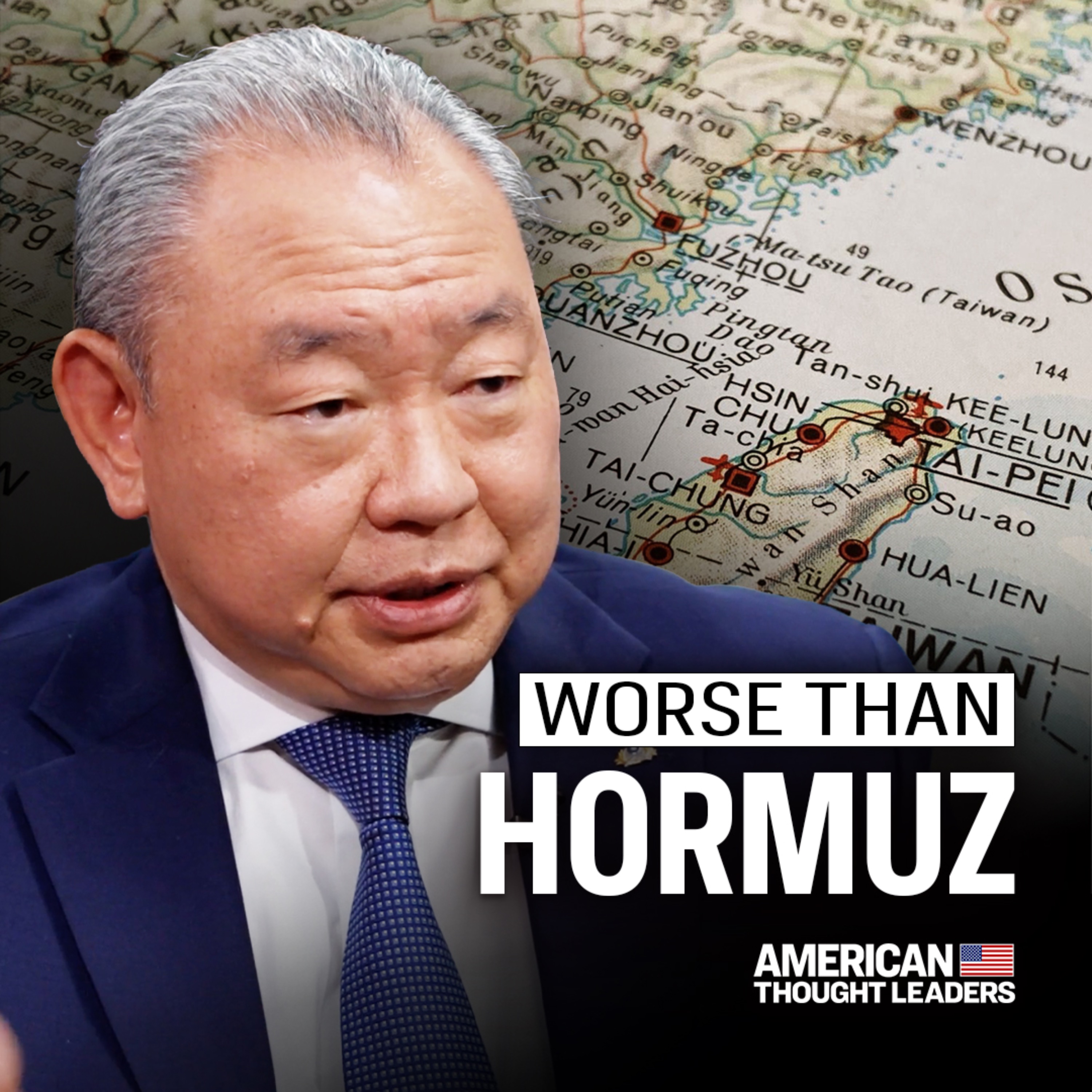
American Thought Leaders
Why a Taiwan Invasion Would Trigger Trillions in Global Losses | Amb. Alexander Yui
00:43:04
Loading summary
Transcript63 lines
- [00:00]
Jan Ye Kelek
Taiwan. It's an island nation, one third of the size of Virginia, yet it produces over 90% of the world's most advanced chips and more than 90% of the servers powering the AI revolution. And last year, it became America's fourth
- [00:16]
largest trading partner, the Taiwan Straits itself.
- [00:19]
Ambassador Alexander Yi
Any conflict in that straits, it will cause a crisis much larger than what is happening on Iran in the Strait of Hormuz. It's in the trillions and trillions of dollars.
- [00:28]
Jan Ye Kelek
In this episode, I'm sitting down with Taiwan's representative to the United States, Ambassador Alexander Yi, to understand why Taiwan matters and what's at stake as the Chinese Communist Party ramps up its campaign to isolate, intimidate and encircle Taiwan.
- [00:43]
Ambassador Alexander Yi
That's only the part that you see, which is a military part. But PRC has been also using other means, gray zone tactics, using disinformation, cyber attacks and other means to try to destabilize Taiwan from within. That's just an example of what we face. But they do that to other parties, including the United States.
- [01:02]
Jan Ye Kelek
This is American Thought Leaders, and I'm Jan Ye Kelleg.
- [01:08]
Ambassador Alexander Yi, such a pleasure to have you on American Thought Leaders.
- [01:11]
Ambassador Alexander Yi
Thank you, Yann, for having me on your show.
- [01:14]
Jan Ye Kelek
Xi Jinping, the leader of Communist China, has said that he wants the People's Liberation army to be ready to invade Taiwan in 2027. There have been recent actions by the United States in Venezuela, very significant in Iran. There's still an Iran war happening. It's in a ceasefire at the moment. But the question here is, have there been any recalculations in your mind in the prc? What is Xi Jinping thinking? How is this affecting things? Are there any changes?
- [01:50]
Ambassador Alexander Yi
Well, of course there are. And I want to point out that as China has mentioned to the United States that Taiwan is the greatest risk factor between the relations between China and the United States. Actually, I believe that it's the other way, that the people of Republic of China is the greatest risk factor for peace and stability in the Taiwan Straits and, and in the Pacific region. They're the ones who are the aggressors. They're the ones who are, as you mentioned, militarily preparing for conflict. And people, Republic of China has engaged in the largest peacetime military preparedness in human history. And I think that's unfounded because their borders are not under threat. But yet with all the things that are occurring around the world, you mentioned Venezuela, Iran and others. I think it shows a resolve from the United States to use the necessary tools to fix problems or achieve its objectives. And obviously there will be a relevance or reference to that on the Indo Pacific, in particular to the Taiwan Straits.
- [03:00]
Jan Ye Kelek
There's a lot of debate in America about how much security should the US Actually be providing to Taiwan and how important US Security is to Taiwan and how important Taiwan is to America.
- [03:17]
Ambassador Alexander Yi
Sure.
- [03:18]
Jan Ye Kelek
Can you extrapolate on this question from the Taiwanese perspective?
- [03:23]
Ambassador Alexander Yi
Taiwan is relevant for many reasons. And first of all, Taiwan is facing a lot of challenges, aggressions from the people of China, constantly, militarily, but also cautions from many other aspects, you know, internal gray zone tactics, economic coercion, et cetera. So we do. There is an actual threat to the existence of Taiwan, to the people of Taiwan as a democracy. The threat that we face is not only ours alone, it's other countries, Japan, the Philippines and others. So you ask any country that region, you know, what is the biggest threat that they're facing? It is the People's Republic of China. So. But why does it matter to American people? Well, first of all, we're part of the first island chain, the line of democracies that are facing and contending this aggression from mainland China. And it's not only about Taiwan, north Japan, but going beyond that. And NATO Secretary General, he said it very well recently when he was in Washington, D.C. that just as NATO is keeping the Atlantic alliance safe and sound on that part, but also us on the Pacific, we're also holding the line. So United States borders are safe, and I think that matters to the United States for that. But also Taiwan has become an important partner to the United States in terms of technology, in terms of investment, in terms of education, and all sorts of things that we're engaging in the United States for the last few years. So we've become a reliable but also a trusted and important partner with the United States, especially in the age of AI advancements. United States is intending on preserving the AI supremacy in the United States and asking partners, including Taiwan, to reach that. So to achieve that, Taiwan is a key partner in that we not only make most of the advanced chips in Taiwan, 95% of the chips, but also Taiwanese companies make 90 plus percent of the data servers and the AI servers that runs the AI realm. So we not only do the hardware, but also we are much into this alliance with the United States. And, and we subscribed with the United States this Paxilica declaration along with the United States earlier in January, but also we signed a memorandum with the United States on economic security on rare earth collaboration, et cetera, and also Importance of maintaining a safe supply chain, meaning a non red supply chain in specialty technological field. So all that matters to what the United States is. And also we're well aware that the well being of Taiwan is ours to care. So we've been told that the United States should not care more about Taiwan security than the people of Taiwan. And we do. So we're increasing our defense expenditures. We're trying to pass a $40 billion additional budget to procure more arms and be more up to date with the way we have asymmetric warfare against a larger contender. And those are the things that we're doing. And that's why United States, we appreciate United States long standing support of Taiwan based on the Terms Relations Acts and the six Assurances. And this gives some stability to Taiwan. And we subscribe to the peace through strength theory. And we are doing whatever we can to do that. Not only on the military side, but also on the whole society. Resiliency on the military reserves, et cetera. So we are doing our best to preserve our democracy, but we also appreciate friends such as the United States and others who are helping us maintain our freedom.
- [07:36]
Jan Ye Kelek
So you mentioned peace through strength. How important is that?
- [07:40]
Ambassador Alexander Yi
Peace to strength is the mantra that is being said in the United States. But also we follow that very closely and we believe in peace to strength as we want to achieve peace. And we love to negotiate, willing to negotiate with the PRC about the peace sensibility of the Taiwan Strait. But you negotiate from a position of strength, not of weakness. So having a strong defense is the best way forward and also the best way to divide itself facing a larger aggressor or enemy. So for Taiwan, we've been for the last few years doing a lot of expenditure on improving our self defense capabilities. We've actually almost doubled our defense expenditure for the last 10 years to be better modernizing our equipments, the local production of more missiles and arms and even airplanes and submarines. All that to show to all friends that we are ready to do whatever it takes for ourselves to defend ourselves better. But at the same time, again, as I mentioned at the beginning, the threat is not only for Taiwan, but also countries in the region. So for us to be able to be during peacetime to better know ourselves and what to do during crisis, the interoperability of our forces or the interconnection of our intercommunication of our forces is important. Well, I think in United States national security strategy that was announced late last year, it was very clear on United States focus obviously on the Western Hemisphere, which is their priority, but also made several mentions about this peace stability of the Indo Pacific in particular, but also about Taiwan where the United States mentioned that it does not support a change of status quo from either side. You know, and especially not through military or economic coercion. People, Republic of China is trying to internalize the waters between Taiwan and in mainland China, the Taiwan Straits.
- [10:01]
Jan Ye Kelek
Actually, I just got word that they're starting to build on another reef.
- [10:05]
Ambassador Alexander Yi
Yeah, well that's not an accident. They said that before when they were building these huge bases now in the South China Seas, that they were, we shouldn't worry because it was for humanitarian reasons. It was a place to house fishermen in times of storms or house planes for search and rescue and that we shouldn't be concerned. But now they're full fledged military bases with missiles and fighters and bombers, et cetera. So yeah, we should be worried. And other countries should also warn China that they should be responsible and prevent unnecessary aggression against us. But the region itself, the Taiwan Straits itself, any conflict in that straits, it will cause a crisis much larger than what is happening on Iran in the Strait of Hormuz. There's been several studies about what would happen is in the trillions and trillions of dollars, it's not only Taiwan's ports which will be affected or Taiwan's trade will be affected, it will affect China's trade ports, Japan, Korea, et cetera. So it's something that's almost unimaginable if a crisis happen. So there's a lot of stake not only for us, the countries in the region, but also for the United States, which is obviously a main commercial partner with us and the region. Also Europe again, NATO Secretary General mentioned that NATO cannot overlook what happens in the Indo Pacific because it has direct stakes to European countries as well.
- [11:48]
Jan Ye Kelek
Hey everyone, I'm going to be trying to get some more sponsors for American thought leaders and the reason is I want to try to get it on more of the non payable wallet platforms where we'll use the sponsors to kind
- [12:00]
of support the show.
- [12:02]
And one of the sponsors that I really appreciate is American Hartford Gold. You know, these are pretty chaotic times. We're not sure where things are going to go. There has been this, you know, massive liquidity, $6 trillion put into the system. We don't actually know how all that is going to play out. And I like to put my money in a very stable place that also tends to go up and Gold is really the perfect place place for that. Now Gold has had a correction recently and that's Absolutely true. But again, if you look at the long term trend on gold, this is the reason I invest in gold. I'm not like a stock market trader. I like to put my money in a place that's stable and growing. And I actually think this is the exact right time to buy gold because it has gone down a little bit, it's a little bit cheaper, but the price in my belief is only going
- [12:52]
to continue to go, go up.
- [12:53]
And that's what I'm actually doing. So American Hartford Gold really is the place to do it. We've worked with them for years. We've had a great experience working with them. They're Better Business Bureau certified and frankly, really easy to work with. Okay, so you can call them at 855-862-3377. You can text American to 65532 or as always, click the link in the description below.
- [13:26]
So the Chinese Communist Party for years now and kind of in an accelerating fashion has been sort of violating Taiwanese airspace with its fighter jets and so forth to the point where I've, I've had people call me from Taiwan saying I'm seeing the things, right? Like it happens often and it's loud and it's significant. And so maybe just explain that because I don't think a lot of people understand what this is, how it's interpreted by the Taiwanese government.
- [13:57]
Ambassador Alexander Yi
Well, you know, well, first of all, I want to go to the basics. The People's Republic of China, led by the Chinese communist regime that was formed in October 1st of 1949. Since their conception, they never had control or rule over Taiwan, which is where the seat of the government, the Republic of China is. So their claims on Taiwan is a, is a fictitious claim because they never really control, they never control Taiwan. And they're trying to say, well, Taiwan is ours because historically it's in part of China and we're China, so it's ours. Well, if you, if you use historical facts to claim something, then again Mongolia can claim China because it's part of the Malloyan Empire. And then what about all the lands that China lost to Russia, you know, et cetera. So this, it's a never ending story.
- [14:48]
Jan Ye Kelek
Even the bottom line, you're saying the people's China has never had Taiwan under
- [14:54]
Ambassador Alexander Yi
its auspices, so never. And then now they're making these claims and trying to have the international community say that, yes, you have to recognize that we own Taiwan and through, you know, if not I'll conquer it militarily or they're using this also Misuse of United States resolutions 275A, which has nothing to do with Taiwan. But he said that article means that we own it. It's trying to create this international legal basis to claim Taiwan, which again, you look at the article and doesn't mention Taiwan at all. It also only makes reference to who represents China in the United Nations. But as the Chinese military has grown stronger and they obviously spend a lot of money to strengthen their military, they've grown, becoming bolder. And they used the visit of Speaker Pelosi to Taiwan as an excuse. They say, well, you cross the line, we're going to start, you know, pressing you. There used to be a medium line between, in the Taiwan Straits between Taiwan and mainland China that both sides respected. You know, their planes, militaries will basically not cross each other's median line, but after that they've crossed the line. It's been harassing Taiwanese surrounding airspace in naval. They haven't really reached Taiwan's airspace yet, nor naval or territorial waters. They've been on the identification zones nearby, but on a constant basis, depending on the date, sometimes more, sometimes less. We're constantly harassing our naval and air surroundings, trying to coerce Taiwan to create panic and, and uneasiness within the Taiwanese society. But that's only the part that you see, which is the military part. But PRC has been also using that other means to create dissension or create distability or nervousness within Taiwan, trying to, but not really working through, again, this gray zone tactics, cutting of our cables that communicates with the outside world, trying to drive wedges between our different political parties, or using disinformation, cyber attacks and other means to try to destabilize Taiwan from within. And that's something that we're already facing and that's part of the aggression that China is using to us. But that's just an example of what we face. But they do that to other, other parties, including the United States.
- [17:24]
Jan Ye Kelek
I want to dig into that a little bit because. And there was recently, you know, the Taiwanese president was actually unable to travel to an important event because presumably China coerced a number of African countries to deny airspace access. I want to talk about that. But explain to me a little more about how are we to understand the leader of the major opposition, single major opposition party in Taiwan traveling to Beijing, meeting with Xi Jinping, and ostensibly incredibly warm, incredibly warm relations. How do you read? How are we supposed to read that here?
- [18:05]
Ambassador Alexander Yi
Well, I mean, again, the fact that they talk to each other, talking is good. It Reduces misunderstandings. For example, even in prison, Trump's pending trip to Beijing to meet President Xi or the chairwoman from the Kuomintang Party visiting Beijing and meeting Chairman Xi. I think these are positive in the way that it creates communication, reduces miscommunication or misunderstandings, and will be hopefully conducive to peace, instability. But what people in placard China should be aware of that the Taiwan Republic of China and Taiwan is a sovereign, democratic and independent country, and we are a democracy that has an elected government. So while he's talking to one party in Taiwan, we also urge them to also talk to all parties in Taiwan, including the party who is in government, which is the DPP government, you know, the ruling party. And. But I think they've been not wanting to do so because somehow they still think that the China Taiwan debacle is something of a historical CCP KMT struggle and therefore they're not willing to talk to the other parties. But again, they should recognize the fact that we are a democracy and people in Taiwan choose their leaders, choose their governments every four years. And currently the party who is in government is the Democratic Progressive Party, and they should also talk to them.
- [19:46]
Jan Ye Kelek
Yeah, and it's just, I'll elucidate this a little bit because. So it's in fact the party that basically landed in Taiwan and set up government in Taiwan, the KMT that is now the party that is developing those relations with the mainland.
- [20:05]
Ambassador Alexander Yi
Well, I mean, the fact that they approach each other and talk to each other, again, as long as it's conducive peace, it's okay.
- [20:14]
Jan Ye Kelek
Well, except that they're denying the same people that are having these conversations are denying your president having access to going to a conference in an African country.
- [20:25]
Ambassador Alexander Yi
That's the problem because you cannot pretend that things are rosy when they're talking to each other as if between the Taiwanese and Chinese in mainland China, things are okay, but what happens outside of it, then they still treat us as rebels, you know, and therefore not recognize who we are. And our president's recent, you know, had to cancel in the last moment his trip to Eswatini. This is the reality that we face. You know, Taiwan nowadays is a very relevant economy in the world. As a matter of fact, last year, 2025, we became United States fourth largest trading partner. So while the King and Queen of England is visiting the United States now, but must be aware that we do more trade with the United States than UK United Kingdom does trade with the United States. But while the King of England is Traveling to the United States and other places, my president has been prevented because of PRC's coercion to other countries and try to isolate Taiwan politically and internationally. And that's something that we think is unjustified and unfair. But also it relates the fact that the caveat of working with or investing or doing business with people of China because they will weaponize things according to their interests. For example, my president intended flight to Africa was stopped because they coerced a few countries in Africa to cancel the already permitted passages through their flight information region. But at the same time, there are similar events that people of China are doing. For example, on Panama, there was a court ruling on ports regarding who controls the ports in Panama. And because PRC didn't like it, they started coercing Panamanian flagships in China by introducing undue inspections and harassing of Panamanian ships which, including United States and other countries, they also voiced their opposition of weaponizing maritime safety for their own needs. And that's the danger of doing business with China. And that's the same reason why Taiwan, which used to be heavily invested in China, we have been decoupling Chinese presence. Our presence. For example, 12 years ago, over almost 85% of our foreign direct investment was going to mainland China because that's where our factories were. That's 12 years ago. Two years ago, our direct investment in China came down to less than 7%. Last year it was less than 4% of our FDI going to China. Because why? China is an unreliable partner. They're willing to weaponize, coerce us if they think sin fit. And you know, that's not a healthy environment to do in business. But it's not only Taiwan who's diminishing their investment. It's United States, Japan and other countries who are also having the same feelings. They're leaving China, but where is Taiwan's investments going? Two years ago, 40% of FDI was coming to the United States. And that's. So we have a bustling commercial investment relationship in the United States based on our common values.
- [23:56]
Jan Ye Kelek
I'm trying to figure out who the other countries are because you said the top four. One of them is Canada. I know. And another one is Taiwan.
- [24:05]
Ambassador Alexander Yi
No. The only countries who do more trade with the United States than Taiwan is your neighbors Canada and Mexico and China. And we were fourth. And also last year, for the first time in I don't know when, many, many, many decades, Taiwanese exports to United States were larger than Chinese exports to the United States. It's a little Taiwan, you know, exporting more, but partly because Taiwanese factories who were in China exporting to the United States and now they've left, and now they're exporting from elsewhere, from United States, from Canada, producing United States, exporting from Mexico and other regions. And one other fact to highlight Taiwan's relevance in economy and into the world. Last week we replaced UK as the seventh largest stock market. And this week we also overcome Canada as the sixth largest stock market. So Taiwan economically is relevant to the world, but yet politically, internationally, we've been facing this blockage from people who become China for us to be able to act normally in an international scene. And that's something that we've been appealing to the world to, that Taiwan deserves to have a space, international arena. You know,
- [25:38]
Jan Ye Kelek
another thing that always impresses me about Taiwan is the kind of robust democracy, you know, that votes counted instantly public. It's like a public phenomenon. It's like a party basically right to vote counting on the day of election. It's just, it's something to behold. Maybe we'll cut in a little clip of what that looks like because I think that it's kind of inspiring, actually.
- [26:02]
Ambassador Alexander Yi
Well, you know, it's low tech, but it works. And also people get to, you know, look at it personally. We have obviously, you know, inspectors from each party when they do the balloting, you know, counting. And it's a very low key, just, you know, show up, show ballot count, and then you put a little scratch window and then. But it's very effective. And you know, by the same night we already know who have won and most elections that's the case. But yeah, that's democracy at work and it works.
- [26:30]
Jan Ye Kelek
I'll just add one more thing, which is that the GDP per capita in Taiwan is three times that of China. And a lot of people, I, I like to mention this fact because every time I mention it, almost every time, people.
- [26:45]
Ambassador Alexander Yi
Really?
- [26:46]
Jan Ye Kelek
How's that possible?
- [26:47]
Ambassador Alexander Yi
Oh, right, yeah.
- [26:49]
Jan Ye Kelek
Well, I mean, I mean, I'm, I'm, I'm, I'm unabashedly a fan of Taiwan here. Okay. So I, I don't want to, I, I'll add one more thing here. Okay. This is just something that struck me. One of the sort of criticisms leveled against the US and other, you know, countries that have been democracies for a very long time, much longer than Taiwan, is that they've gotten too comfortable.
- [27:13]
Ambassador Alexander Yi
Okay. Yeah.
- [27:14]
Jan Ye Kelek
And so I'm wondering how much you think just this very fact that, that, that Taiwan's freedom is always a bit of a question mark given this totalitarian dictatorship on the edge saying we're going to take you over when we feel like it. How much do you think that might actually contribute to this kind of robustness around democracy, about economy, all these areas?
- [27:40]
Ambassador Alexander Yi
Well, it is a hard struggle. Since I was born in Taiwan many, many decades ago, we were already confronting this situation which is a menace from the other side, mainland China, towards the survival of the people in Taiwan. And so facing this threat, we've learned to be self reliant. And as we had to leave, we were founding members of the United nations, mind you. But then things changed and eventually we had to be forced to leave the United Nations. Many countries cut relations with Taiwan. So at one point there was a really sad situation in a grim and dim situation in Taiwan, feeling like the world was leaving Taiwan being cast aside with being orphans of the world. So we never gave up and being self reliant and working on things that we think is correct. And at the same time we were developing our democracy to be. As a matter of fact, as a matter of fact, as the United States celebrates 250 years of, you know, being a democratic Republic, we're celebrating 30 years of direct presidential elections. We had our first universal suffrage for the citizens to be able to elect its own president in the year 2000. So we are very proud of our achievements. But at the same time, you know, we developed our economy, we tried to link with the world in terms of economy and we've been fairly successful. This evolution from an authoritarian government in the past evolving to a full democracy in Taiwan, sort of a fairly peaceful transition. There were some struggles, but generally speaking the peaceful transition. At the same time we're developing our economy. Our per capita income in 1949 was probably less than $100, but now we're doing pretty well. And in certain cases our per capita has surpassed that of Korea even. But again, we're not sitting on our laurels but we know that it's a constant struggle and we'll continue to do so. But at the same time, many countries which, although they don't have the, you know, formal relations with Taiwan, such as United States and Japan and many countries, but it's not the same as, you know, heeding to people Republic of China's claim of this one China principle which, which includes like Taiwan is mined and you know, this, this one big China, including Taiwan, which is in mind and they want every single other country to recognize their principle. Actually many countries have its own One China policy that differs greatly from PRC's One China principle. And in each country's one China policy, they can assert their own way of dealing with China. At the same time with Taiwan, as I mentioned earlier, United States case, they have a one China policy, but at the same time they have this Taiwan Relationships act and six insurances in which, based on those groundworks, there's a thriving partnership and interaction with the United States.
- [30:54]
Jan Ye Kelek
And that does, and that law does reflect, I guess, the United States support
- [31:02]
Ambassador Alexander Yi
for Taiwan, which is very strong. It's the law of the land. And also, although China constantly says, well, you know, you agree that you are going to diminish the sale of arms to Taiwan, but United States has mentioned also that the sale of arms to Taiwan is commensurate with the threat that Taiwan is receiving. And as you, as anyone can attest to nowadays, is that the threat level of Taiwan being threatened is very, very high. So for us to acquire necessary defensive weapons is more than just so again, we appreciate the fact that the United States is based on the tra, is selling arms to Taiwan also helping Taiwan know to defend itself better. Again, it is our responsibility and we'll do so. We appreciate our friends helping us do that better. And we're more than happy to be working with our friends and allies.
- [32:03]
Jan Ye Kelek
So I recently had Peter Mattis, who runs the Jamestown foundation, on the show and we talked a lot about one of his areas of particular expertise, the front work department. So just again, for the benefit of our audience who might not know, they can watch that episode, but this is a whole kind of department or ministry committed to subverting civil society both within and other places like for example, Taiwan or the United States. And it's very active, incredibly well funded, one of the highest funded sort of ministries or departments in China. What can America learn from how Taiwan has been dealing with this? You mentioned asymmetrical warfare. This is one of their tools of asymmetrical warfare, probably maybe even the most potent one. We could debate that. What can America learn about those United Front tactics and how they affect Taiwan?
- [32:57]
Ambassador Alexander Yi
Well, you know, as I mentioned, PRC spends a lot of money on defense, war defense or military strength, you know, procurement. It has one of the largest armies in the world, certainly the largest navy in the world. They have lottery so large that obviously goes beyond the need for territorial defense. And PRC has engaged in the largest peacetime military procurement and strengthening while their borders are not under threat. So the biggest threat comes from people of China militarily. But the thing is the PRC spends more money on internal control than on its military. So including you know, the united front. And the united front, what it does is basically a political warfare, a propaganda or trying to dissuade you through different means to acknowledge how the world looks according to their view. You know, for example, and then you have TikTok, you know, which again, I'm very happy that United States has arranged some. Made some arrangements to prevent the effect of Chinese TikTok being done on the United States. Because TikTok, I've said it's a cyber Fentanyl. You know, TikTok is, you know, videos, you know, they're harmless, they're funny, they're, you know, but inside of all that, they spread disinformation in those, you know, airtime, which is, you know, people are very easily swallows because it's, you know, irrelevant. It's funny. And. And then you start swallowing. But in the midst of that, they start putting these messages to try to form your view according to theirs. And again, through media, through talk show, and through infiltration of government officials or key people in government and society, they try to transform the. The mentality. For example, they've been trying to nurture this notion that United States is an unreliable partner. And they have this messaging on the Internet, on airwaves, et cetera. United States will not be there to help you when things get bad because they only want to earn money from you. They're capitalists. All they care is about money, et cetera. And they continuously try to brainwash us that this is the case and that they're the good guys. You know, we're with them all things really good. But you have to be subjected to us. And then you believe, like the people in Hong Kong. Well, people in Hong Kong are not happy, although they try to say through TikTok, they hope Hong Kong is great, the Uyghurs are happy, everything is good. And even that China is a democracy. Like, who in the world thinks China is democracy? But that's the way they're trying to portray themselves as B, which is a fictitious world that they're trying to. To have a swallow. Which is not true.
- [36:06]
Jan Ye Kelek
Right. I mean, you mentioned talk shows and influencers, all sorts of influencers. Right. That's a big thing today.
- [36:15]
Ambassador Alexander Yi
And not only Chinese, but they use foreigners to try to do that. So that the words coming from a foreigner must be true and try to say, well, this is. He's one of us, so what he said must be true. And that's part of the messaging, the false messaging. They're trying to reach to the audience outside of China.
- [36:36]
Jan Ye Kelek
Yeah, I'm just thinking. And that's a very powerful vector. It is, right? It is. And it's only one of the united front.
- [36:42]
Ambassador Alexander Yi
There's so many more. Yeah, there's so many.
- [36:46]
Jan Ye Kelek
Mr. Ambassador, you mentioned that Taiwan, US trade is on the rise. CCP, US trade is on the decline. Where are these areas of growth? And I'll add a caveat to that. Clearly you've invested a huge amount of money in TSMC in Arizona and building these top chip plants in the United States. And how does that explain to me how that factors into this?
- [37:19]
Ambassador Alexander Yi
I mean, the thriving and ever growing trade relationship between Taiwan and United States is happening partly because of decoupling from China, but also of the common values that we have in terms of investment, in terms of what we do together. I mentioned the AI development. You want to make sure that the AI realm, which is a new industrial revolution that's happening all around us and AI will be part of our lives that make sure that this AI is AI that works for good, that helps the human beings and not restrict human behavior or human. So we want to make sure that we maintain this supremacy in AI in working together with the United States. So in that sense, Taiwanese investments in the United States has continued to grow mainly in technology, semiconductors mainly. You mentioned the tsmc. They're building six labs in Phoenix, two packaging and one research center. And it's a bustling. You go to Phoenix, you see this growth, just empty land.
- [38:25]
Jan Ye Kelek
And now it's quite unbelievable.
- [38:27]
Ambassador Alexander Yi
I saw it recently and it's really encouraging to see the fruit of the labor between Taiwanese and American workforce to do that. But also in January and February of this year, we signed a memorandum on investments between Taiwan and United States. Also an agreement on reciprocal trade, which basically after 10 months of negotiations, United States and Taiwan will reach an agreement that basically deals with most, most of the details on bilateral trade. Some of the items that for many, many years, even decades were not able to solve will be done in that. And we'll have a set tariff like the ones with Japan and others. But that brings us Taiwanese pledge that we will be investing 250 billion from Taiwanese companies into United States in the places and the items that Taiwanese companies see fit. Also, the government of Taiwan will make available $250 billion worth of credit guarantees to our companies who want to invest in manufacturing in the United States. So all that is happening and the upcoming USA select which is happening in early May, we will have as the previous year, probably one of the, or the largest foreign delegation coming to USA and very possibly we'll have some good news to announce. Then I'll leave it to the delegation to make the announcements. But at the same time, there's one piece of puzzle still left that will encourage further interaction and investment to the United States and that's the avoidance of double taxation bill that passed the House of representatives last year 423 to 1. And now it's in the Senate pending approval. I hope that the Senate will approve that because we're the only major trading partner of the United States that still does not enjoy. Avoidance of double taxation means that because of that Taiwanese companies in the United States have to pay double taxes. Their employees have to pay double taxes to US and Taiwanese agencies. And likewise American companies going to Taiwan have to do the same, but not so in Japan, Korea, Vietnam, etc. So it is unjustified or unjust and we hope that this will remediate and with the passage of adta you can certainly see more encouragement for Taiwanese companies to be in the United States. So hopefully that will be built to accomplish in the very short future.
- [41:14]
Jan Ye Kelek
Well, Mr. Ambassador, a quick final thought as we
- [41:18]
Ambassador Alexander Yi
finish no US time relations we've gone through again. 1979 diplomatic relations ended and it was a low point of our relations. But luckily because of Congress passage of Taiwan Relations act it gave us a legal basis to how to interact with each other. And since then actually our relations have grown steadily and bustling. And now we say that it's a rock solid partnership between Taiwan and the United States. So we are all in to make United States objective of remanufacturing or having manufacture renaissance in the United States. It fits our purpose to do so and we work very closely with the United States in making this a reality of manufacturing technology and also fits Taiwan's strategy to be here expanding our footprint of manufacturing United States. It fits the purposes but at the same time highlighting the achievements and celebration of democracy. 250th anniversary of United States as a democracy and so as Taiwan's 30th anniversary of presidential election so many things that are value likewise in terms of technology, in terms of values, in terms of what we want to do together. And I think this is one of the highlights, one of the best moments between Taiwan and U.S. relations.
- [42:47]
Jan Ye Kelek
Well, Ambassador Alexander Yu, it's such a pleasure to have had you on.
- [42:51]
Ambassador Alexander Yi
Thank you Yang. Thank you for having me.
- [42:53]
Jan Ye Kelek
Thank you all for joining Ambassador Alexander
- [42:55]
Rhee of Taiwan and me on this episode of American Thought Leaders. I'm your host Jan Ye Kelek.