← American Thought Leaders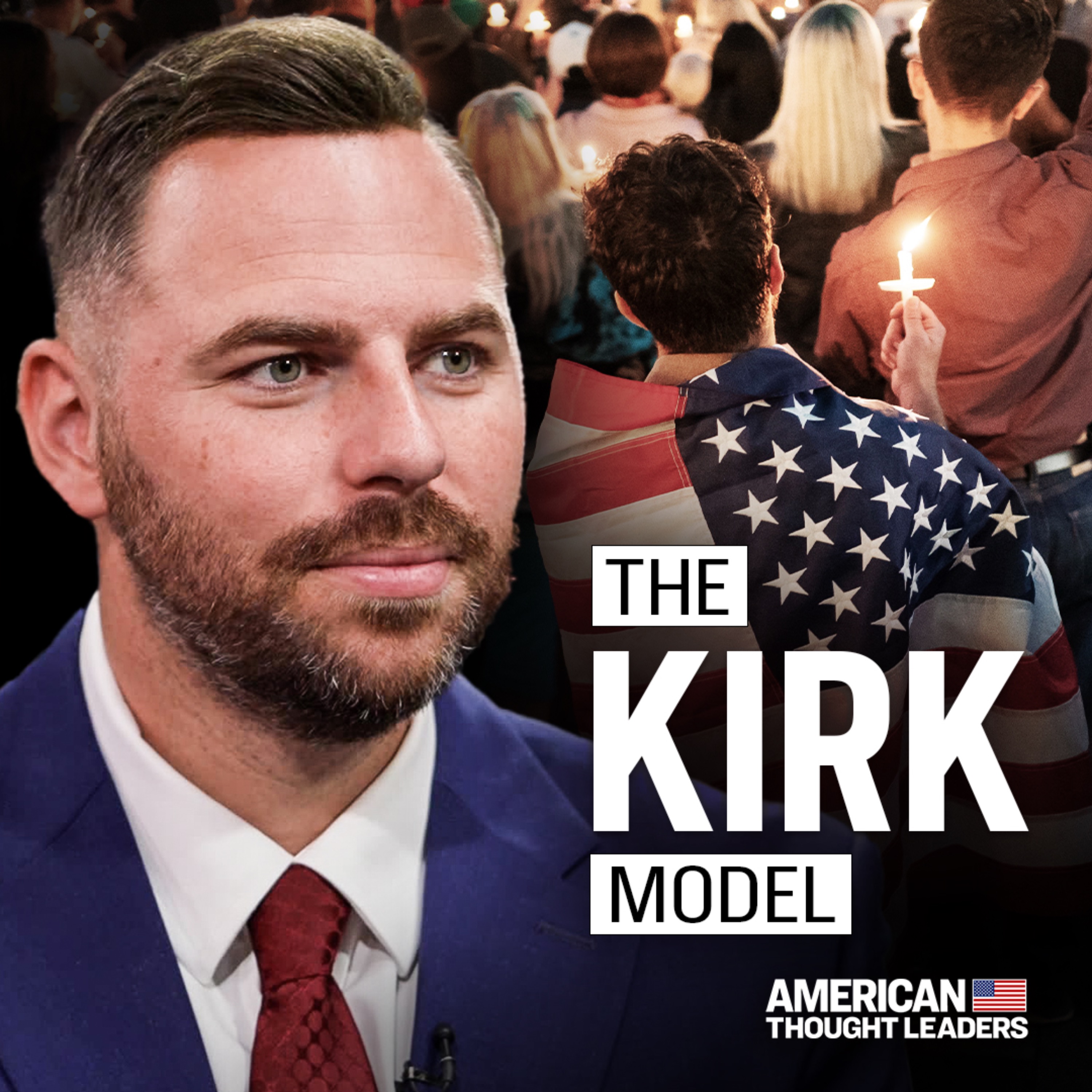
American Thought Leaders
Why Charlie Kirk’s Approach Matters Now More Than Ever | Pastor Jackson Lahmeyer
00:43:07
Loading summary
Transcript83 lines
- [00:00]
A
The response by so many fellow Americans who are celebrating his death, who are mocking his death. Our culture is in desperate need of healing and restoration.
- [00:14]
B
What happens when a nation loses one of its most influential voices? And what can we learn from the legacy he leaves behind?
- [00:21]
A
The idea might have been the enemy, but the person was not the enemy. We have a lot to learn from Charlie's methodology.
- [00:29]
B
What is the role of faith in shaping America's future? And how should we move forward?
- [00:35]
A
If we want to make America great again, we have to make America godly again. There's a natural law that most people recognize.
- [00:44]
B
In this episode, I sit down with Pastor Jackson Lohmire to reflect on the assassination of Charlie Kirk and the work of the Trump administration to strengthen religious liberty in America. He's the author of Chasing after the why Nobody Is Catching what Everybody Is Chasing. This is American Thought Leaders, and I'm Jania Kellick. Pastor Jackson Lahmire. Such a pleasure to have you on American Thought Leaders.
- [01:11]
A
Thank you so much for having me. It's an honor.
- [01:13]
B
Our plan was to speak about how faith in America has been under attack and what this administration is doing to try to deal with that. And then Charlie Kirk was assassinated. Tell me what you're thinking, man.
- [01:29]
A
It's tough because Charlie was a friend of mine, and it's one of those things, you know, it can happen. You don't think it ever will happen. But then it did happen, and America lost a legend. The body of Christ lost an ambassador to an entire generation. I called him America's youth pastor. A wife lost a husband, two kids lost their father. And many of us, we lost a friend. But at the same time, I recognize that Charlie Kirk gained his eternal reward. And he heard the words that I want to hear. Well done, my good and faithful servant. And Charlie's more alive today than you and I are right here. And so we rejoice with him, but obviously mourn for his family. The turning point, USA family. And then we have to ask the question, you know, how now shall we live in the aftermath of what just took place? Because it's awful. Not just the assassination, but the response by so many fellow Americans who are celebrating his death, who are mocking his death. And so it goes to show you that our culture is in desperate need of healing and restoration. And this is a. What you could call faith being under fire. This is faith under attack. Charlie Kirk was so vocal about his faith, and he was so effective. You know, people say he was full of hate speech, right? I don't think so. I think they just hated his speech because he was so good at what he did. He would allow people to express their opinions, and then he would give an argument that was in a gentle manner, but. But was in a convincing manner. And so we lost the legend. But I believe many more voices will begin to speak up in the aftermath of this.
- [03:19]
B
I'd interviewed him a number of times. We were friendly. I didn't know him very well, but one thing that I found to be, maybe not unique, but he was, I guess, entirely unusual in this, that he was transparently not viewing the people that he was talking to, who some of whom were really against him in quite extreme ways. He didn't really view them as his enemy. I note that because that's how I try to treat people in a similar vein, but it's hard. I don't want to speak to that at all.
- [03:55]
A
I think that's why Charlie was so effective. Charlie would reach you in your mind, but also he'd reach you in your heart, because Charlie cared about people. It wasn't the person was not the enemy. The idea might have been the enemy, but the person was not the enemy. And so that resonated with people, because here was a person that I think they understood. He doesn't hate me. He actually cares about me. He's listening to me. He just disagrees with the ideas that maybe I have. And so I think if more of us had that approach, that the enemy is not the person. The enemy may be an idea that the person holds to, but the person is not the enemy. And it is the only way to probably convince people of your argument. If you come across hateful and mean and spiteful, you may have the perfect argument, but no one's going to receive it because of the tone and the measure and the demeanor that it was spoken. And so I think we have a lot to learn from Charlie's methodology, which is why I believe he was so effective.
- [05:03]
B
Tell me a little bit more about how you knew him.
- [05:07]
A
We were babies, it looks like. When I look back at this picture, the first time we met, we were on the Reawaken America tour. This is many years ago, and we were both young. I'm only two years older than Charlie. We just kind of connected over that. We were both young. Everyone was much older, and I was just getting my feet wet into kind of the political world. And I was running for the United States Senate in Oklahoma, and I was running against an incumbent U.S. senator. And so there was a lot of pressure on President Trump to endorse the sitting U.S. senator in Oklahoma, because, you know, he's a sitting U.S. senator and I'm a 29 year old kid running against him. And Charlie Kirk was the guy that made the pitch to President Trump not to endorse the sitting US Senator, but to give me a shot in the race. And so Charlie actually introduced me to the Trump family. That's what opened the door to lead pastors for Trump. And so I think back, you know, Charlie really opened a door for me that I would have never been able to open for myself. So I owe Charlie Kirk quite a bit because without his taking a gamble and a risk on me, introducing me to the President, to his family, I wouldn't have led pastors for Trump, which was like one of the greatest honors of my life.
- [06:33]
B
I want to ask you more about that and how that actually works, but is there some particular, I don't know, moment that you remember in your interaction or something that, you know, kind of personifies him for you?
- [06:48]
A
Oh, that's easy. The thing that Charlie Kirk was most proud of was not Turning Point usa, although he was proud of it. And it was an incredible machine and still is an incredible machine. He was by far most proud that he had a wife that he loved and that he had two children that he adored. That was Charlie's entire world. He was living out his faith, he was living out what he was preaching. You know, his message was pretty simple to the young men, get married, have kids, love God, love your country. It was a very simple message and Charlie was living it out. And so that's the thing. He was a genuinely good person. And to see people mock and ridicule him in his death is just so heartbreaking because none of them actually knew Charlie Kirk.
- [07:39]
B
You know, there's been all sorts of reactions that I've followed. You know, some of it has been this, you know, kind of an increase in interest in Christianity. I see. I've seen all sorts of social media posts saying, you know, I'm picking up my first Bible, you know, I'm inspired, and things like that. Then of course, there's the type of reactions that you described. Then there's also other category of reactions, and this is something that Dni Tulsi Gabbard spoke about at this D.C. vigil a few days ago where someone said to her, and this just represents a significant number of people that even I've talked to. You know, it's like Charlie's approach failed and there's no way to talk of talking with these people. I don't think talking works anymore. Maybe we need to go to some extreme measures. I mean, how do you react to this? Just this got a whole thought set that I just offered here.
- [08:37]
A
Well, I would say talking obviously works. That's why Charlie was taken out, because he was so good at reasoning with people and talking with people and he was so effective and that was why he was so dangerous in the sense of he was able to dismantle ideas and arguments in a way without being violent, without being mean or spiteful, anything like that. And so no, Charlie Kirk's approach did not fail. It was extremely successful. And it's the model that we need to adopt moving forward if we're going to bring healing and restoration to the country. It's the only way. And to your point though, there's the Charlie Kirk effect. Churches were jam packed this previous Sunday. Like my church was standing room only. It was filled 20 minutes before service. We had a line of people trying to get into the auditorium. Bible sells among first time Bible buyers is at an all time high. So these are people who have never owned a Bible. They're going and buying Bibles. So there's the Charlie Kirk effect. His voice is more powerful in his death than what it was when he was going from campus to campus to campus. And so that's the good side. The bad side is obviously the social media silos because the algorithms know what keeps you engaged is rage, anger. And that's what keeps you scrolling through TikTok or Instagram or YouTube, whatever it is that you're going through. And so it's feeding and poisoning our minds. Especially children. Especially children when they're seeing violence, rage, hatred, it's becoming a part of who they are. And so, you know, parents are going to have to really monitor what their kids are viewing through social media.
- [10:29]
B
FBI Director Kash Patel actually spoke to this as being one of the biggest challenges, people becoming radicalized in these silos just in these couple set of very active hearings, let's say we call that intense fellowship. Now what I'm hearing you saying about Charlie Kirk is, you know, that he provided a kind of a model for how to, I don't know, help America get back to its roots or getting some kind of unity. I don't know, that word is a little bit fraught for me because you know, there's like the Maoist way of unity, right, which is you eliminate the people that don't that have different views. Right. We're talking about a different kind of the good kind, the different kind of Unity where we realize that we're not each other's enemies, even though we have very different viewpoints.
- [11:27]
A
Unity can be a bad word. Unity can be a good word. And we, we do have to have a sense of unity. Now, unity doesn't mean conformity, meaning that in order for you and I to be united together, you have to conform to me or I have to conform to you. I think we have to be able to recognize that we are free agents, meaning we have the ability to form our own thoughts, opinions. And you know, the beautiful thing about the freedom of speech is it gives you the right to be wrong. You can say things that you believe and it can be wrong, but you have the right to say that thing. That's the beauty of America. And so Charlie's method of reaching across, I mean, he's going into hostile territory onto these college campuses of people that were not big fans of him, that would do anything to prove him wrong in a debate or an argument. I mean, I think back to watching Charlie at Oxford just the way that he was. You know, here you have a non college educated individual schooling the most educated people at Oxford. And so his method though was so good. And if I think if we could adopt that into the way that we have conversations with people who differ from us politically, religiously, whatever it may be, I think the intensity would come down a few notches to where it is. Okay, you're not my enemy. I may not ever agree with you and you may not ever agree with me. But we are both Americans and we want what's best for the United States of America.
- [13:02]
B
So I've voiced this kind of an idea and I've had a guest on Robert George, Mr. Professor Robert George, talking about, let's say, this realm of ideas. One of the common responses that I've seen, I look at how people respond was just something to the tune of, yeah, go along, get along. That clearly doesn't work. What about justice?
- [13:26]
A
Oh yeah, justice is for the government to issue, not for individuals. Vigilante justice is not real justice. And so the proper role of government is to punish wrongdoers and to protect good citizens. Unfortunately, that hasn't been necessarily the case recently in the US government, but we're getting there with people like Patel and who's in the Department of Justice. So justice is absolutely necessary. Justice is something all of us long for when an evil is done. But you know, I kind of lean on a Bible verse which says, seek justice, love mercy, and walk humbly before the Lord. And I think that's the approach all of us have to lean upon.
- [14:13]
B
And that's one of the big challenges. Right. I feel like so many of the things that we took for granted, like what you said, right, that when laws are broken, that will be punished, and when people are good citizens and are trying to affect positive change or something like that, that won't be punished. Right.
- [14:34]
A
We've kind of reversed that, haven't we? We've criminalized the good people and we've, you know, let the criminals go. It's been an inverse of what justice.
- [14:43]
B
Should be, or at least a road down that path. And I think that's made a lot of us very cynical and in some ways rightfully so.
- [14:50]
A
Sure.
- [14:51]
B
But maybe cynical is never right. But how do we deal with this kind of mess? It's a kind of a information chaos, and we don't trust our institutions. You can see this. It doesn't matter even who's in office. The level of trust is way down and again, justified. How do you deal? How do you. Presumably you talk with your congregation, your family about all these sorts of things often, right?
- [15:18]
A
Well, it's difficult because I don't trust many of the institutions that, you know, we should be able to trust. You should be able to trust the Department of Justice, or you should be able to trust, you know, churches and schools and just the whole thing. Right. But there's been so much corruption in our country and so much misinformation that, you know, what I tell my church is you have to know the truth so well that you immediately pick up when something is not the truth. So if we know our Bibles as well as we ought to, we'll be able to know when there's a false teaching. It's not that we go and study false teaching. We study the truth so well that whenever a false teaching appears, we instantly know that doesn't line up. We need good people to step up and start engaging politically. I know it's tough because politics is nasty, it's dirty, and good people, I don't want anything to do with that. But we've got to start filling in these lower roles. We always focus on the presidency, which is vital, but we need to fill in school boards, city councils, mayoral offices with good people because local government has a major impact on our lives. And, you know, local action produces a national impact. And so I would encourage people to really consider, yes, these institutions have been corrupted, taken advantage of. So we need good people to get into these institutions so trust can be built because we can trust people that Are good, that are decent, that are honest. And I think that's really what we need right now, is a changing out of the guard. Those who have been in positions that have caused us to distrust these institutions need to be removed via elections. This is the process of our system via elections and replaced with people that we can trust.
- [17:21]
B
You know, and this really rings true to me. Few people, let's say, that are in significant roles today. I was one of the people that came to us, said, hey, do you think I should, you know, run? Or do I. Do you think I should, you know, go for this office or it's going to be a nightmare. I mean, okay, I'm being a little bit glib here. And I said, you know, yeah, it's terrible and I don't think. I don't see myself as ever doing anything like this. But we absolutely need good, moral, decent people. And I know you are one, so I'm for it.
- [17:59]
A
Well, I'll tell you something. Benjamin Franklin was asked, what form of government did you give us? And he responded, a republic if you can keep it. And our founding fathers understood something. Our form of government only works if you have, according to their words, a just and moral people. So you have to have a just and moral people for this form of government to work. And when you don't have a just and a moral people, all of a sudden you have what we have. We don't trust any institution. And so people have to get back to our roots of what made America great in the first place. And if we will get back to our roots, more people will run. And so, you know, my phrase when I was really out on the campaign trail was if we want to make America great again, we have to make America godly again. People that are pursuing their relationship with God, people that know that there is a standard that God himself has put out for how humans are to behave. There's a natural law that most people recognize. And so to me, you know, that's obviously biased in this. That's the answer I see as people coming back to knowing God and, and living for God will produce a change in the culture. I'm a firm believer. All of us are capable of much greater than what we believe we can achieve. But all of us are also capable of much worse than what we think we would ever do. And so we gotta guard our hearts, guard our minds. That's why I bring up the social media thing consistently, is because if you're feeding yourself this rage, this anger, this hatred, you're going to become Rageful, you're going to become hateful and you're going to become very angry. And sometimes people act on those things and we see the devastation because of that. And so we've got to be just over the top on guard of what we see and what we hear and what our hearts begin to think.
- [20:08]
B
I find myself quoting Solzahitzen often lately, especially this line that the line between good and evil cuts through every human heart. Exactly, exactly what you were speaking to here. And I don't know if this is whose line this is, maybe it's mine. But we are what we consume and that's certainly what I've learned over the years. And I try to be very judicious in what I put in myself because that grows in you where there's no, you have to face that. And I think it's a profound import, what you just said, actually.
- [20:48]
A
Well, you know, they say it in physical training. You are what you eat.
- [20:52]
B
I was thinking that too, you know, and this is coming out in the sort of HHS oriented policies, trying to deal with chronic illness, getting rid of dyes and all sorts of things right out of diet.
- [21:03]
A
You are what you are, right? And you are what you consume in your mind, you know, and your mind is so important to guard because there is an enemy out there that wants to corrupt your mind to do things that you should never, ever do. And that's why social media, it's a great tool, but it's also a great liability.
- [21:27]
B
I want to talk about Pastors for Trump. And so because for some people it might be, you know, it obviously is a very political organization, right. And some people might believe that there seems that there's some kind of, well, that that could create a problem for you as a Christian or as a pastor or something like that. But explain to me how this works.
- [21:56]
A
Well, you know, Pastors for Trump was a coalition, over 10,000 pastors, all 50 states, but was primarily focused on the question, how do we mobilize the largest voting block in America, which is the evangelical voting block? But evangelicals don't really turn out to vote too well. So the thought, what if we mobilized evangelical Christians by mobilizing their pastors? Because if a pastor gets up to his church and he says, go vote and vote your values, that's a big significant push because people listen to their pastors and a pastor can represent 60 people or 6,000 people, depending on the size of the church. And that was the idea. Let's mobilize pastors to help get President Trump back into the White House because there's never been a more pro Christian president in my lifetime, at least someone who moved the needle on issues that matter to me as a Christian. And President Trump kept his word on those issues.
- [22:58]
B
What would be some examples?
- [22:59]
A
Oh, my goodness. Well, just the biggest one by far is the Supreme Court justices that he appointed in his first term. He's directly responsible for Roe versus Wade being overturned and sent back to the states, which was something, you know, we all fought for, but I don't know if we actually thought that would ever happen. And then it did happen. President Trump striking the Abraham Accords during his first term. And then obviously, he made the promise in his next term that he would start the faith office, that there would be a standalone office in the White House that is directed at protecting religious liberty and things like that. And so, you know, there's never been a more pro Christian president in my lifetime. And so we did it. It was successful. Evangelicals turned out in Mass, 9 out of 10 voted for Donald Trump, which was just astounding. Helped get him back into the White House. And now he's doing tremendous things, especially for people of faith. You know, he's launched the Anti Christian Bias Task Force, which is looking into how the irs, the doj, the atf, and the FBI were targeting people of faith, specifically Christians. You know, the thing I love about President Trump is he doesn't make a lot of promises on the campaign trail and then doesn't follow through when he makes a promise on the campaign trail. He made a promise to us pastors. He said there would be a faith office just for you guys. He followed through with that. And that was early on in the administration. And so, yeah, pastors for Trump, it was a blast getting to travel the country. I was doing an interview once like this, and the journalist was very sincere, and she said, do you really believe that as flawed as Donald Trump is, that God can use somebody that flawed to accomplish his perfect will? And my response was, God only uses people as flawed as Donald Trump to accomplish his perfect will. And so God's using Trump right now.
- [25:01]
B
Strong statement.
- [25:04]
A
True statement.
- [25:08]
B
You mentioned something earlier that somehow, like somehow in his death, Charlie Kirk's vision is somehow, I don't know, growing beyond and quicker. And it's hard. You have no idea how things would have happened otherwise. People have described him once in a generation, or even several generations, talent, you know, likely future president and all these things. But on the other hand, you're saying that there's this growing movement that has come out of this horrible tragedy?
- [25:49]
A
Well, I mean, you can look at a few things. Since Charlie's death, his social media following has increased by the millions. By the millions. Turning Point USA has received somewhere around 50,000 new requests for different chapters throughout the country. I mean, you just look at the spark and now you have people that they're going back and re watching his clips, his messages, and people who were maybe not even that familiar with Charlie Kirk. They are very, very familiar now. And so it will inspire others. There will be others with unique gifts, talents and abilities. There will never be another Charlie Kirk, but there will be people just like there was only one Rush Limbaugh and there's only one Charlie. But other people with their gifts, their talents, their skills, they step up. And Charlie's life has inspired so many. So we will see many new leaders. Will there be another Charlie Kirk? No, but there will be other leaders that will rise up because of this. And you know, I'm a big believer in Romans chapter 8, verse 28, which says God makes all things work together for good because we love him and are called according to his purpose. And all things means even the bad things. Somehow God is able to weave the good, the bad, the ugly into this beautiful story that we're living out right now. And so I don't know how it all will shake down. I have no idea we're seeing good fruit right now. But I believe God will make this work together for good.
- [27:31]
B
And so you mentioned at the beginning some of these kind of extreme negative reactions. One of the things that strikes me, I looked at some of the things that the people who are vitriolic believe. I mean, I can't even imagine how or why someone would celebrate someone's death like that. They must think that literally they're like a Hitler or something like that. That's rhetoric that's been used, of course, but there's a lot of things that these people believe that just aren't true. Like about what he said, you know, what he stood for and how do we deal with that?
- [28:14]
A
That's tough, right, because a lot of people are basing their assumption of Charlie Kirk on a 10 second clip that was taken out of context or whatever the case may be. And so I think, but also like.
- [28:26]
B
And people are pushing those things deliberately. And this is what these social, this is going back to these social media silos. You can do that. And people might think this is just, this is, this is what he said. And look, the evidence is right here. They just didn't think to watch the Whole thing, there might be another. Or they don't need to because they're friends and everyone else agrees.
- [28:45]
A
Yeah, that's the tough thing, isn't it? Because social media has presented a new challenge of misinformation, disinformation. Because once you view something and if you watch it, the algorithm begins to feed you what you're staying on, so you're going to get more. I think the best thing that we can do is what we're doing right here. We're talking about who Charlie really was. We are talking about how important and significant he was, what he stood for. We fight disinformation and misinformation with true information. What did he believe? What was his impact? And if we do that, I believe it'll help fight the misinformation that is out there about him.
- [29:34]
B
And there's always some people, like, I think whenever these things happen, these situations, and there's a vitriolic reaction, extreme reaction and so forth, I mean, this has happened multiple times. I know. I mean, I even know you have received all sorts of vitriolic reactions just simply for playing the role that you've played. Actually, maybe, just maybe. Just tell me about that briefly.
- [29:56]
A
Oh, the death threats are consistent.
- [30:00]
B
Death threats.
- [30:01]
A
Oh, it's incredible. Our church has to have extreme security. We have people who will visit our church and they'll say, I've never been to a church with this much law enforcement and security. Is that because something bad has happened here? And our response is, no, it's because we have this much law enforcement and security. Nothing bad has ever happened here. But the hatred of what we do is so real because, you know, being a pastor and taking a step into the political arena of, you know, leading pastors for Trump kind of put a target on me a little bit. Our church got reported to the IRS thousands of times for violating the Johnson Amendment, which we never did, and we were never charged or prosecuted or anything like that.
- [30:47]
B
Just very quickly, for the benefit of the audience, what is the Johnson Amendment?
- [30:50]
A
Well, the Johnson Amendment says that a nonprofit 501C3, cannot contribute to a political campaign or candidate financially or endorse a political candidate or political party. And so we've never done anything like that. Johnson Amendment has never been utilized either. It's a lot of bark, no bite. And President Trump wants to completely eradicate that as well. The IRS recently came out and said that a church can endorse political candidates from behind the pulpit, and there will be no usage of the Johnson Amendment. So it's a big Victory. We just had a big victory. But, you know, when you stand up and you take a stand, not everybody likes it. Some people do, but not everybody does.
- [31:36]
B
So your position is that faith leaders should be able to make these endorsements?
- [31:42]
A
Oh, absolutely. Just because I'm a pastor doesn't mean I lose my right to engage in our political realm. So, yeah, and I believe there's a responsibility. I'm a shepherd of the flock, of the congregation that I pastor. And a shepherd guides and a shepherd warns and a shepherd advises. And so, yeah, we should. And unfortunately, our politics has become very theological lately. If you think about the issues that are hot topic political issues, marriage, gender, life, those are Bible issues. You can't open up the first page of the Bible and not recognize marriage, life and gender. So these have been theological issues that have been hijacked into the political realm. And so we have to talk about those things as pastors, otherwise we're being dishonest to the scriptures that we say we love and we believe, because our politicians have taken theological issues and they politicized them. And so, yeah, I think faith leaders, not only should they, they have to.
- [32:53]
B
You know, Charlie Kirk was assassinated essentially doing a kind of ministry. Right. As you point out, like, he was America's youth minister, I think, like you said. And you get death threats. How should people who play prominent roles in the Christian faith and put themselves in kind of the line of fire literally be treating this? How are you treating this?
- [33:27]
A
Well, it became more real because for five years, I have been getting death threats. And then to see it actually happen, it becomes much more like we upped our security even more than what it already was. But that's our reality. And I want our people to be safe when they come to church, not have to worry about those type of things happening. And so with Charlie's assassination became, like, more real to me and my wife. And we're just struggling, you know, walking, struggling through that together, but also recognizing, you know, when you do put yourself out there and when you take a stand and you are bold, you do develop enemies, unfortunately.
- [34:15]
B
So tell me more about this faith office. Now you're involved with both the White House Faith Office and also this Faith Advisory Council, which are separate institutions doing separate things. There's some, frankly, a bit of confusion among people about exactly what the different institutions do. Can you give us a picture? Because you're involved in both.
- [34:36]
A
Yeah, yeah. So there's the National Faith Advisory Board, there's the White House Faith Office. President Trump signed the executive order to establish that. And it's being led by Pastor Paula White, who's doing a phenomenal job, and Jenny Korn there as well. And, you know, the Faith Office, what they're doing specifically is they're making sure that religious liberty is being protected because it had come under attack. A lot of people don't realize that, but it really come under attack through the irs, FBI, doj, atf. And so they're making sure that those agencies are not persecuting people of faith or that there's just even cultural persecution of faith happening. They're making sure that those things don't happen. Like church attacks. Church attacks have risen over 700% since 2018. So that's the role of the faith office.
- [35:27]
B
And is that specifically focused on Christians or broader?
- [35:31]
A
No. Religious liberty means all people of faith. However, in this country, there is a major spike of attacks upon people who are Christians. Major, major spike. But religious liberty extends to every person, obviously.
- [35:48]
B
I'm just curious to.
- [35:49]
A
Oh, yeah, yeah. I mean, because.
- [35:50]
B
So there'd be more. There'd be more Christians involved, obviously. There's also a lot of Christianity is the dominant faith as well, so it's not surprising. But not exclusively.
- [36:01]
A
No, no, not at all. Not at all. It's all faiths. All people of faith are to be protected. You know, the saying is, nobody should get in between a patient and their doctor. Well, nobody should get in between a person and God, especially the federal government. So that's the faith off primary role. But then obviously, you have the National Faith Advisory Board, which is an organization that is meant to help shape policy and to advance policy efforts that, you know, are going to be beneficial to people of faith. And so the two work hand in hand together. One is in the White House, obviously, one is a separate organization. And so it's fun to get to be a part of, you know, both. And it's been a wild journey to, you know, go from pastoring a church, staying open during the lockdowns, to getting to go to the White House to have dinner with the President of the United States. I mean, it's been a journey that I never saw coming, but I am so glad I'm on it.
- [37:05]
B
And just very quickly, what would be an example of something that the Faith Advisory Board. I said counsel earlier. You're hearing about too many things. But, yes, the Faith Advisory Board has accomplished thus far.
- [37:18]
A
Well, it played a major factor in getting President Trump elected. The National Faith Advisory Board did. It was out of the National Faith Advisory Board that the idea was birthed of the White House Faith Office. So that was probably the greatest accomplishment of the National Faith Advisory Board is the birth of the faith Office, a standalone faith office in the West Wing of the White House with a report to the President of the United States. And so I would say that's probably its greatest accomplishment.
- [37:48]
B
Just. Can you clarify this for me? So this. The Faith Advisory Board existed prior to this election. Can you explain? Yeah.
- [37:55]
A
So the Faith Advisory Board existed during the first administration, and it served as a. Like a council of faith leaders to pray for the president, to advise the president on issues that mattered to pastors and people of faith. And so fast forward to the 2024 campaign. It was the National Faith Advisory Board that put forth the idea to President Trump about establishing an official White House faith office to go beyond just an outside council, that is the National Faith Advisory Board. So it's two separate things, but they. They flow very well together.
- [38:33]
B
I see. And your job has really been to bring pastors here, as I. Yeah, I've.
- [38:39]
A
Been somebody that has taken that role on of saying, I think this pastor should go up to the White House. This pastor should have involvement. You know, it's been a really, really good journey of seeing how all this comes together, from political to policy to people. That's the thing, you know, getting back to should pastors be involved in politics? Should pastors be going up to the White House? Right. Well, the answer is yes, and that's because people matter. And if we believe that people matter, then we have to realize something. Policy impacts people for better or for worse. But policy is determined, and it's fought out in the political arena. So politics determines policy, but policy impacts people. And so, yeah, pastors need to be coming up and talking about different policies that will benefit people in their communities. And that is part of the role of the faith office.
- [39:41]
B
I see. Okay. Well, thank you for explaining. Now I truly have a much better picture of what's going on. And so you've actually written a book recently, and I just want to get you to tell us a little bit about it.
- [39:56]
A
Yeah, the book's called Chasing after the why Nobody Is Catching what Everybody Is Chasing. And the great baseball player Darrell Strawberry wrote the foreword to the book for me. And really what it's all about is the one thing all of us are chasing. Whether we're Republicans, Democrats, young, old, we're all chasing happiness. We all want to be happy. That's why we do what we do. And sometimes that chasing of happiness can cause us to do things we shouldn't do. Why does somebody get addicted to drugs? It's because there's the promise of a euphoria state of being and happiness. Or my case, why do I eat Oreos late at night? Is it because they're good for me? No, it's because they make me feel good. They make me happy.
- [40:44]
B
At least temporarily.
- [40:45]
A
It's a moment that's everything in this world.
- [40:48]
B
World.
- [40:48]
A
It's a moment we'll be happy and then it's gone. And it's like chasing the wind. Happiness is the wind. It's elusive. You never actually catch it. You think, well, if I just had this, then I would be happy. And then you get it and come to find out you're not fully happy. You chase something else. And so the book is all about how can you find true joy, true happiness and peace in a crazy world? Because if you look at the world around us, it's lacking peace, it's lacking joy, it's lacking contentment. And so how can you find those things? And we're getting great reviews. People saying it's just been a life changing experience. And the book is out chasing after the wind. It's on Amazon and Barnes and Noble and books a million. But someone goes to my website, they can get a signed copy. I'll sit there and sign. No auto pin either. It's the real signature.
- [41:44]
B
Well, congratulations and I've enjoyed reading the book. I have to tell you as well, I think there are some great lessons contained therein.
- [41:53]
A
Thank you.
- [41:54]
B
This has been a wonderful conversation. Greatly appreciative of you visiting me here. A final thought as we finish.
- [42:03]
A
Well, I just want to thank you so much for what you're doing. And I think this right here is what will help solve many of our nation's problems. Being able to sit down, have a conversation, to think things through, maybe not even agree on everything. We're different free agents, however, recognizing we both want what's best for America, for our families. We may have different ideas of how we get there, but you're not my enemy. I'm not your enemy. We. We're Americans and we're in this together. And if we could just honor Charlie Kirk by practicing his methodology, I think we could see a real turning point in the United States of America.
- [42:46]
B
Well, Jackson Lauemire, it's such a pleasure to have had you on.
- [42:49]
A
Thank you so much.
- [42:51]
B
Thank you all for joining Pastor Jackson Lohmire and me on this episode of American Thought Leaders. I'm your host, Janje Kellogg.
- [43:01]
A
It.