← Anabaptist Perspectives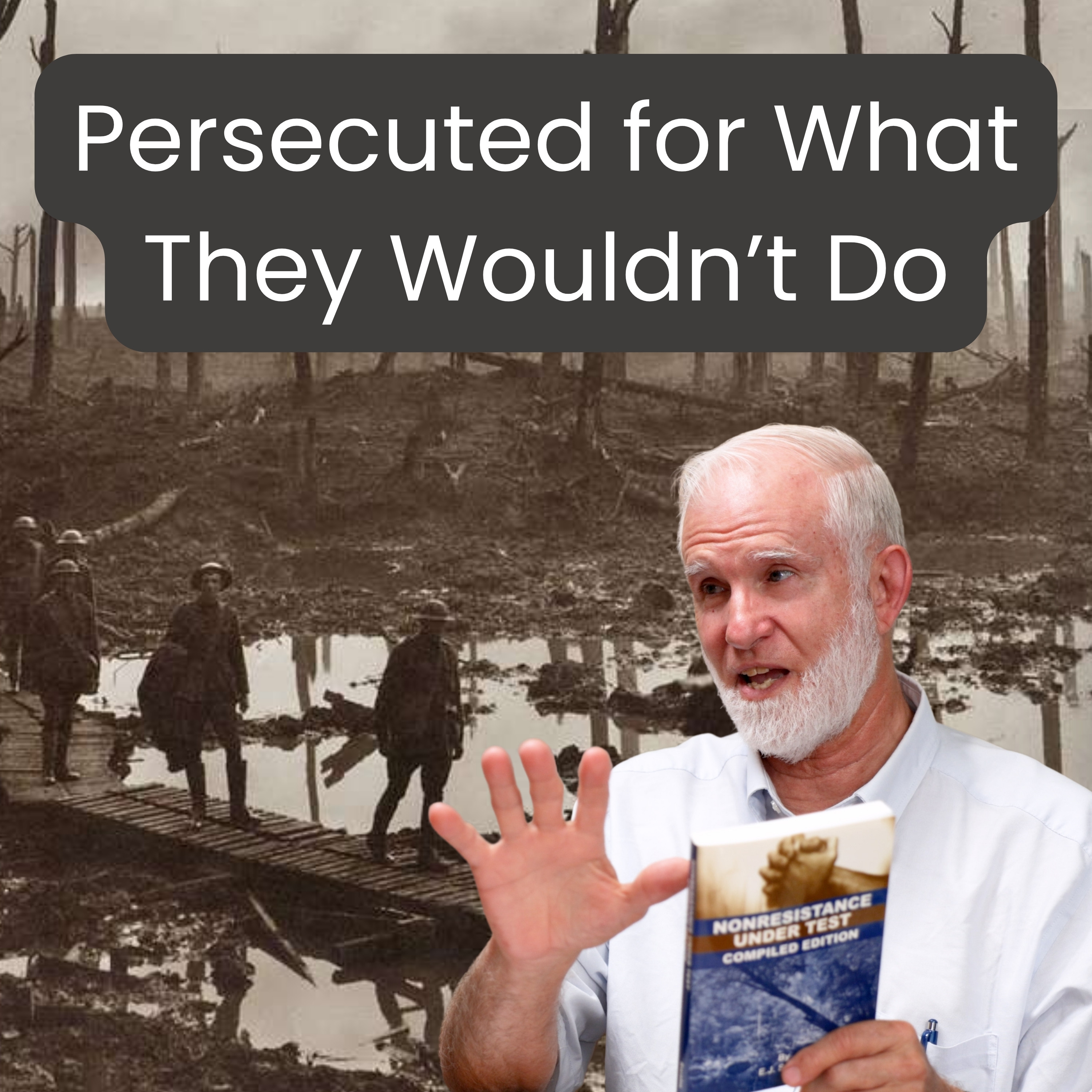
Anabaptist Perspectives
What Happened to Nonresistant People During World War I? - Chester Weaver
00:49:07
Loading summary
Transcript136 lines
- [00:01]
A
Court martial, prison abuse. And the last two Anabaptist martyrs happened over this time. These pacifists in chains, the two Hofer brothers. There's four Hutterites in the story, but two of them died. It's the last Anabaptist martyrs we've had. And then when they got close to Fort Leavenworth, they had to get out of the train and run at bayonet point to the place they were going. And by the time they got there, they were sweating, overheated. And then the commanders told them to take their clothes off and they had to stand in freezing temperatures for a while.
- [00:42]
B
So there is a hugely significant world event that happened like 115 years ago, something like that, and that's World War I. And it's kind of shocking when you start trying to process the scale of that. Something like 37 to 40 million casualties or something crazy. I mean, that's including civilians as well. And it encompassed so much of the Western world, really, including America. But there's a part of that story that I don't know very well, and that's how it affected the Mennonites. And so I'd want to have you on today, Chester, to talk about that. The American Mennonite story during World War I, particularly all those Mennonite young men that were drafted into the US Military over that time and what their response was, what that experience was like for them. This is a big topic. We're not going to cover it in thorough detail. I mean, there's all these books written about it and things, but at least want to touch on that today. So are there some groundwork, foundational pieces that you want us to start us off with as we get into the topic?
- [01:42]
A
Yes. The Revolutionary War in America and the Civil War were different kinds of Wars. And the 50 years that separated the Civil War with the First World War, things had shifted in America quite a bit because the Industrial Revolution had brought in all these new inventions, improved railroads. We have the telephone, we have the telegraph, we have air with the Wright brothers. And so there's this huge optimism in the United States that we are really progressing here. And eschatologically, postmillennialism was in focus. If things are getting so good, we expect Christ to break into this after a while and really just take things over.
- [02:27]
B
Oh, post millennialism being the millennium happens after the return, or how does that go? Even I'm not quite sure. All the difference.
- [02:34]
A
It's just going to step in to where men had brought it and take it from there.
- [02:37]
B
Oh. Because Humans are doing such a good job, basically. Interesting. People don't really believe that anymore.
- [02:44]
A
No. Because World War I destroyed it, and it has not really resurrected since.
- [02:50]
B
That's interesting if you think in the context of the war. So it's 1914 to 1918. From 1914, basically up through 1917, America is not in the war. They get kind of pulled in, or however you want to look at it historically, towards the end. And this is a huge shift from for the American, for. For the country of America, because they hadn't fought foreign. On foreign soil, really. I guess to this scale.
- [03:18]
A
I guess there was a Mexican War, but that was only short. I mean, Spanish American war.
- [03:23]
B
I mean, okay, Spanish American and not to the scale. That's right. Was about to happen with World War I. So get into that. The. The draft, the how does this affect the Mennonite churches again? Again, we'll start broad, and then as we go, we'll narrow it in on some specific stories.
- [03:41]
A
Okay. So there's never been a war so vast that it started out with all volunteers, because the people who fought this war were fighting it at first, not because they had to, but because they believed in America. It's like, this is going to be the war to end all wars. This is going to be the war that makes the world safe for democracy.
- [04:04]
B
The.
- [04:04]
A
There's this huge reform movement that goes along with post millennialism. It's like anybody who is opposed to this is just kind of out of it. And so the war was almost like an effort to force the extension of human progress. And so if you were not willing to get involved with human progress, there's something wrong with you. And so, of course, this clashed hugely with Anabaptist people in this country. I don't know if you want to go there right now or if you want to talk about the bigger picture as a whole. So Woodrow Wilson, he was a progressivist, and he just believed that his ideas, including the League of Nations, just need to be in place.
- [04:51]
B
And he's on character. Like, he kind of looks at himself as almost like this Jesus messianic figure or something.
- [04:58]
A
He believed in himself so much that partway through his administration, he had a nervous breakdown and his wife had take over.
- [05:04]
B
This is the President of the United States.
- [05:07]
A
And then we had Theodore Roosevelt, who's also very much of a progressivist. I mean, the world is really making huge leaps forward, and Theodore Roosevelt has zero tolerance for anybody who won't fight, because this progress that we're doing is worth being fought for. And Theodore Roosevelt's wife died, and it was a shock of his life. He had to go west to his cattle country to even recover from that. But by his own bootstraps, he pulled himself up and eventually he was elected president. And that's a whole bit in its own. The point being here, that there was never a time in American history where everybody was so upbeat, led by the national government, the president, or more than one president. And the mood, the zeitgeist for the country was so upbeat that anybody who was not in step had a problem. Well, the war with Germany was against the Germans. They called them the Huns, the barbarians. See, these are the benighted people, the Kaisers, the Prussian absolutists, the oppression dictators, in contrast to American democracy and constitutional. The rule of law and benevolent reform. All this contrasted sharply with what was going on in Prussia and Germany.
- [06:40]
B
I hadn't really thought about that. Okay. And then that puts the Mennonites and the Amish at the time in a difficult spot. Because they're speaking German. They're speaking a German dialect.
- [06:49]
A
Exactly. And that's one of the main reasons
- [06:51]
B
that
- [06:53]
A
public turned on them, because these people, Mennonites, Anabaptist people, were German speakers. You guys must be sympathizing with the ignorant. You folks are not even educated. You are ignorant too, just like those Germans over there. And we need to do something about that.
- [07:11]
B
So the U.S. government joins the war, declares war, joins World War I. They initiate 1917. April 1917. Okay. So they initiate a draft at some point in there because. Need a lot of guys to get on boats and go over there and fight in the trenches of World War I. Yes, basically, yes. Which I. I don't even know the numbers, but the amount of people called up in that draft was enormous in America.
- [07:37]
A
Yes.
- [07:37]
B
I don't. You would. You know the numbers all the time.
- [07:39]
A
You had numbers right in front of me, so I better not venture.
- [07:42]
B
Yeah, I mean, hundreds of thousands, I'm sure, but yes. So what happens to the Mennonites in that process?
- [07:48]
A
Okay, so when the Mennonites began to be called, there. There was a conscription act. And all the Mennonites who were of a certain age, I think 18 to. There were two drafts. One of them was from 18 to 26. The next was 18 to 36 or something like that. All the boys at that age were just waiting for their letter. And this book here, Non Resistance Under Test, is the story of a young man and his father. And his father. And he had talked about the fact that he'll probably be called. And so when he got his letter, you know, the father and the son met and the father asks the son, are you ready? And it was an emotional time. He gives. It's an autobiography here. It's really touching. And he didn't know those boys when they got called. There was no alternate service, no conscientious object, your status. The government recognized the peace churches that they didn't have to go fight, they had to go to camp, but they didn't have to go fight. Okay, but the exemptions they had were only for the war machine combatant and non combatant. You had to do those. And the absolutist position that this boy took, this is brethren in Christ, by the way. They didn't know what they're going to face. And my hat is off to all these boys who were left for these camps not knowing what they would face. And these are horrendous stories of what they faced when they were there. Court martial, prison. Court martial, prison abuse. And the last two Anabaptist martyrs happened over this time. These pacifists in chains. The two Hofer brothers. There's four Hutterites to the story, but two of them died. It's the last Anabaptist martyrs we've had.
- [09:41]
B
Now let's get into that story specifically. So if they're. You're calling them martyrs. So they were what, court martialed and
- [09:50]
A
executed for not going to war.
- [09:52]
B
Like what happened to them.
- [09:53]
A
They were Hutterites. And when they were called, you'd have to read this. This is an entire book about this story. So I'm going to just give it in brief here. Somehow they had to go to prison in Fort Lewis in the state of washing. On the way out to this prison in the train car, the boys who were traveling with them were abusing them, cutting their beards off and just abusing them on the way to the prison. Well, after they were at the prison, they refused to sign work orders because the work orders basically said, you are under detention by the US government and you cannot refuse lawful commands. And they refused that. Okay, so long story short, they got sent to Alcatraz island, which is this picture right here.
- [10:43]
B
They got sent out.
- [10:43]
A
Alcatraz, right.
- [10:45]
B
No way.
- [10:45]
A
All four of them. And so they were chained up in Alcatraz for a while. And while they're there, they're chains, their hands crossed like this and their feet barely touched the floor. And so they couldn't do anything. And within five days they got boils over them and insect bites that he Couldn't do anything. And so finally they were released. They were released and they had to go back to Fort Leavenworth in Kansas, which is a military prison. And Alcatraz didn't break them. And so on the way back from California to Kansas, a long way, and they got overheated in the train car with other people. And then when they got close to Fort Leavenworth, they had to get out of the train and run at bayonet point to the place they were going. And by the time they got there, they were sweating, overheated. And then the commanders told them to take their clothes off and they had to stand in freezing temperatures for a while. And two of these boys got sick and the other two made out a little bit better. And the two that were sick were put into the hospital and they weren't doing too well. And so one of the other boys, there are three brothers and one brother in law. And the brother in law called the boys as wives, all four. Three of the both brothers were married. The brother in law was not married. So the ladies, the wives of these three men got on the train and somehow got to the wrong prison. They got to Fort Riley instead of Fort Leavenworth until they got to Fort Leavenworth. One of these boys, I think it was Joseph, was on his deathbed. And she got there either right after he died or right before he died. And whenever he died, they put him in the box in military uniform, which was just a slap in the Hutterite's face. The other boy survived until his wife got there and he died in the arms of his brother, who did not die. And these three boys also had children. And of course, these two boys, the way it looks, died at the hands of mistreatment by the military people who were in charge. Of course, the government does not want to admit that.
- [13:06]
B
What would the file say? Like the official military record?
- [13:10]
A
You'd have to. This book probably details it, but I forget what it all says, but it's pretty obvious. Pretty obvious. They died at the hands of their persecutors. But the other Hutterite brother survived. And this other boy, who was a kipper. Jacob. I'm sorry. Jacob Whip. It's incredible. They abused this other Hutterite brother. They pulled him around by his feet in a barracks in and his bare back. And he had splinters that went up into his body as a result of all this. And somehow he survived. The other two boys, I guess the shock of being sweated and the standing in the cold was just too much. Well, these other boys, I don't know if they had a little stronger constitution, but they survived it. So I just bless Dwayne Stolzfus for writing the story. It's the persecution of Hutterites during the Great War and everybody needs to read that story.
- [14:13]
B
That's literally the subtitle.
- [14:14]
A
Which.
- [14:17]
B
And this. Which. Which is, interestingly enough, published by a major. Yes, University of John Hopkins in Baltimore published this book. I mean, I'm going to say it wasn't even that long ago.
- [14:27]
A
No, that's right. It's a recent publication.
- [14:29]
B
Yeah, 20.
- [14:30]
A
20.
- [14:31]
B
2013. So I mean, that's almost a hundred years after the event itself happens. So you can imagine something like this was like. Well, maybe it was known to like their church and their family. But a lot, in a lot of ways that story is kind. Someone like this, a historian, digs.
- [14:45]
A
Okay, so one of the things that I find is really unique is their gravestones are. Look, look like that. And they don't have gravestones. They're just simply markers to say these Hofers martyr. That is their gravestone.
- [14:58]
B
I don't know. You're right.
- [14:59]
A
Right.
- [14:59]
B
There's the name. Dash Martyr.
- [15:01]
A
Yeah, I don't know if there's more than that there today or not.
- [15:05]
B
Yeah, both 1918. Wow. You know, and that's just in, you know, a few stories out of thousands of Mennonite and Amish young men that endured things like this.
- [15:20]
A
So somehow it seemed like the US government picked out on the Hutterites to, I don't know what you say make them a special target. I wonder why. Okay, so may I read just a little bit in here? I can't explain why except that they defied Hutterites are Christian communism. It's the only Christian communism that's ever worked. And my guess is the US government is capitalist and they didn't like that.
- [15:49]
B
It probably sounded a little too much like the Bolsheviks in Russia or something. Yeah, I got it.
- [15:53]
A
Okay. So being that I think this is particularly interesting, by the summer of 1918, feelings between some 108 colonies and their neighbors had become quite, quite tense. In August 1918, attorney Wyman of Yankton, South Dakota complained about the Hutterite's lack of patriotism and disinterest in public affairs. To Wyman, these non conformist, non resistant communitarians were undesirable citizens and a menace to the community. Surely, yes, surely. Wiseman spoke for many of his fellow citizens. And I think that illustrates the reason why they were a special target. They were a Menace to America. So the Hutterites finally offered $10,000 toward war relief if the money would go for humanitarian purposes. But the South Dakota Council of Defense demanded 5% of the proceeds of possible future land sales, an amount to be invested in Liberty Bonds and contributed to the Red Cross. See, the Liberty Bonds were all free. You and I could buy Liberty Bonds. Well, the Liberty Bonds is a loan to the American government to wage the war. And that's how the US Government financed this war, through Liberty Bonds. The sale of Liberty Bonds, it wasn't through taxes.
- [17:14]
B
It's the same with World War II. You had a lot of the war bonds. And, yeah, the Hutterites agreed.
- [17:19]
A
They contributed some $25,000 to the purchase of bonds, $4,000 to the Red Cross, $1,000 to the state Council of Defense. But the Yankton county of Defense wanted more and assessed the Bonhomme colony for 12,000. The colony refused on the grounds that it already purchased some $5,000 in Liberty bonds and contributed $512.85 to Red Cross. So in early May, 1918, the Yankton County Council of Defense dispatched a squad of good citizens. Now get that. A squad of good citizens to Hutterite pastures. There they seized 1000 sheep and 100 head of cattle. On May 15, the local Liberty Loan Committee sold the animals at public auction for $16,000, although the Hutterites put the value at $40,000 or more. With the proceeds, the committee tried to buy Liberty Bonds. But local federal officials, perhaps having done some, having some qualms about the ethics of the legality of the plan, refused to accept the proceeds. So the money was placed in the Yankton bank in the colony's name. At first, the Hutterites also refused to accept the money. But later, having had enough of South Dakota, the colony used it to help buy land in Canada. And so all the colonies, all the Hutterites, decide they're going to move to Canada. We cannot even live with the American government. And so they all moved to Canada, except the Bonhomme Colony. And they probably would have followed suit if the war had not ended. So let me finish here. But the story did not end with Bonhomme either. Shortly before or after that colony's troubles, a number of patriots invaded the Elm Spring Colony near Alexander, South Dakota, and badly beat up two of its members. And back at Bonhomme, someone broke into the grist mill and tried to adulterate the flour by placing glass in flour sacks. In June 1918, someone stole 82 gallons of wine from the Jamesville Colony. The thief was found, but no charges were filed. Later, using the Prohibition act, local officials raided the Bonhomme colony and confiscated its wine. Despite the law, on Armistice Day, some celebrants distributed the wine at the county seat. In the meantime, in May 1918, the State Council of Defense brought suit against the Hutterite colonies of Bonham county, asking for their dissolution. Get rid of these Hutterites. The council argued that the colonies had transacted business while complaining to be a religious corporation, that the leaders had undue inflows over the members, and that they had refused to supply men and money for defense. The case reached the South Dakota supreme court, and in 1919, the court ruled against the Hutterites.
- [20:20]
B
This is at the state Supreme Court level.
- [20:24]
A
However, already before that ruling, the first Hutterites had left South Dakota in hopes of finding a more hospitable environment in Canada. And so there's the rest of the story.
- [20:34]
B
I didn't realize that's how at least some of the Hutterites ended up in Canada, actually, because of persecution during World War I.
- [20:41]
A
But after the war was over, a bunch of them moved back into the US Again.
- [20:46]
B
Yeah, that's. That's kind of bizarre, though.
- [20:48]
A
Like, it is bizarre. This is the land of the free, except you can't be free. You have to agree with the government, with this progressivism.
- [20:57]
B
Yeah. And I can see that where this was perceived as a threat, like in. In times of war, if you're a defeatist, as they say.
- [21:05]
A
Yes.
- [21:06]
B
That's a problem. Yes. Yeah. Like, you saw that especially during World War II. Whatever. Like there were consequences for these things.
- [21:12]
A
Yes.
- [21:13]
B
And so I can see that. Like, I can see the American government saying, well, you guys are defeatist. You're not fitting into. Yes. What the expectation is at the current time. And this is how things are going to go.
- [21:24]
A
Yes.
- [21:25]
B
Oh, boy. So let's. Let's look again at those guys that got drafted. Right. So you've got. I was doing some reading and maybe you would have other numbers, which. A lot of the records from World War I have been lost because of a fire through the. Through the archive back in 1973, which is a bit of a shame. But from what we know of what's left.
- [21:43]
A
Yes.
- [21:44]
B
Is around 2000 or so that had been drafted. And then we're like, no, we're not going to fight, or something like that of the meta. Like, what about those 2000? I mean, a lot more were drafted, but those are the ones who ended up having to go through the non Combatants.
- [21:57]
A
Two stories of that relates to this. So the Garley Clinch story is in Coals of Fire. This is a classic. This was written by Elizabeth H. Bauman. It was published in 1954 by Herald Press. This book influenced me as a boy. The pictures are still with me to this day. This book was written at the request of the Peace Problems Committee. This is an anthology of 17 stories with pictures. And there's a story in here that, that's also a story in here. Okay. And I want to tell that story. So this Garley Clinch, these boys were put into prison because they're not going to cooperate with what's going on. They won't put on the uniforms and so on. They get put in prison. Well, this Garley Clinch is 70 year old guard and he does not like these boys. He adopts the whole progressivist mentality. These guys are no good. And so here he has these no good guys under his control. And so he lets them know that he is not happy with them. But the boys would not be mean to him. In fact, to encourage themselves, they sang to themselves and he would listen to this. And finally one day when a new boy from camp was put into the guardhouse, he says, okay boys, I brought you another one of yours. You do me a favor, would you sing for me? Because he had begun to soften and so the ask for a song is a further indication of his softening. So the boys gladly sang the song to him and he appreciated that. And eventually they sang more songs to him. And finally most of the boys were, were released sometime later, after the war was over and these boys were out, released from prison. This swan was having meetings someplace and he saw one of his prison mates in the audience and he went to him, his name is Morrison. And they even got to talking about this Garley Clinch. And this Morrison said, well, did you know the end? Do you know the end of that story? And he said eventually, before everybody left, Garley came to one of these boys and they were able to lead him to Christ. Yes, okay, but didn't stop with that. Before they were actually released, Garlie Clinch came to one of these boys and says, look, my family, I have a Bible, but my family does not value it. I want to give one of the this Bible to you. You folks value this more than my family. My things are going to go to my family, but my family are not going to value this. And they ended up giving garlic. Clinch gave his bible to this. I don't know who it was and I just think that is such a neat story. This boys operated so well under test that the prison guard was converted. And he didn't make just an intellectual decision. He felt so strongly about it, he gave them his own Bible. All right, that's one story. The other story is in this book, Pastor John. It's also in this book. Now, this is a pastor. This is not a boy in prison. This is an extensive story. So I'm going to have to try to tell you this the best I can remember. But this story about Pastor John happened in the state of Montana. These are General Conference Mennonites who were still not wanting to fight, and they were also German. And Pastor John was taken, was going to a school meeting in their community. And he had gotten his mail before he went into the meeting. But when he got there, he noticed there were two cars, strange cars, parked out by the road. And after he got into the meeting, it was about the time they started because they walked in and it started soon thereafter. And a man came up to Pastor John, Pastor Franz, and said, would you come with me? And so he went out and outside, there was a bunch of other men that hustled him and wanted him to get into a car. Well, Pastor John wasn't interested, but they forced him to get into the car. Well, inside the meeting, the schoolhouse, the wife noticed, what's the scuffle's going on outside? So she went out and said, where are you going to take my husband? And they said, it's none of your business. And they knocked her down, knocked her unconscious to the ground and put her husband in the car and took off. Well, after they got to a place, they went up a hill. Well, in the car, Pastor John noticed that there were shovels, a gun and a rope in the car. And so when they got to this place, they took him on the arm and the picture's in the book. This is what sticks in my little brain. And they brought him up to this tree where they're going to hang him. And the sheriff was in this crowd, and the prosecuting attorney was in this crowd. And Pastor John said, do you really want a murder on the hands of this area? He says, my father is an American citizen, born here. My Sorry. I'm a legal American citizen. My father was, too, and my grandfather was a naturalized citizen. Are you really want to do kill Americans? Well, I said, well, the reason we need to kill you is you have a German newspaper. You know, he was carrying. He got this out of the mailbox. You have a German newspaper here is like the worst Thing you could do is speak German. So the sheriff said, okay, guys, instead of killing him, why don't we just put him in prison for a while? So they didn't kill him. And they evidently were drunk, and the sheriff was less than drunk. And so he was able to convince them. So they put him in prison, and his wife and children came to visit with him. And finally there was a bail raised quite a bit of money that the local people didn't think the locals could raise, but they promptly did, and Pastor John was released. Okay, so that's not quite the end of the story. Years later, one of these men came back and apologized Pastor John for being involved in that. So a number of people in the hysteria, the anti German hysteria, did things that they knew better, and a few of them were brave enough to come back and apologize for the things that they did.
- [28:50]
B
So speaking of these things, this has a bit of a family connection for myself. I remember my grandfather who just passed away a few years ago, telling stories
- [29:00]
A
about how
- [29:02]
B
his dad had been drafted during World War I. And when Grandpa passed away, we got those old papers, and I was looking at them with my mom this week, and I was like, I have to bring these to the interview. So you haven't seen these yet?
- [29:13]
A
No, I have.
- [29:13]
B
You okay, So I feel like it kind of makes the point, right, of what we're talking about.
- [29:17]
A
Yes.
- [29:17]
B
But my great grandfather, Emory Hosteller is his name, was called up in the draft, and we have all the papers here. So I think I'm going to read these or some of these, and we can look at these.
- [29:29]
A
This is priceless. Your family was very wise in preserving this.
- [29:32]
B
This. I'm so glad Grandpa kept this. All right, so here we go. Order of induction into military service of the United States, the President of the United States. To Emry John Hosteller, order number 98, serial number 61. Greeting. Having submitted yourself to a local board composed of your neighbors for the purpose of determining the place and time in which you are best served, you can best serve the United States. And in the present emergency, you are hereby notified that you have now been selected for immediate military service. Just imagine getting this in the mail. You know, thousands, thousands of Mennonite young men getting this in the mail in 1918. You will therefore report the local board named below at New Philadelphia, Ohio, at 4pm on the 18th day of August, 1918, for military duty from. And after the day and hour just named, you will be a soldier in the military service of the United States. Signed LH I. I Can't quite read the signature. Orton, I think member of. Of local board of number one. And it says, the county of Ohio report to local board of date stamped again at the bottom, August 19, 1918. And then. And in that process, he's actually getting these. And you might find these really interesting. These are the different notification cards he was getting throughout. And I'm amazed he kept all this stuff.
- [30:59]
A
Right.
- [31:00]
B
So here's the registration certificate. So this is to register you before he's actually selected. This one is from June. So this was a process. I mean, he. Yes, you know, this is a process going on. It's a registration certificate sign for Emory John Hosteller. So there's that one. And I think I have these in the correct date here. Yes, I do. So I want to go through each of these, like, postcard notifications he's getting in the mail. Yes. So order number, you know, blah, blah, serial number six one signed for Selective Service regulations. This is in July. And then here's the next one a few days later. You are hereby directed to appear. And this is all before he gets the actual. You know, you are now inducted into services. All building up to that a few days later, July 31st. You are hereby directed to appear before this local board for physical examination on Tuesday, August 6th. Then here's one for that exact day, August 6th. You are hereby notified that as a result of your physical examination, you have been found by the local board qualified for military service. Which leaves you in class one, subject to call. Subject to call. And then a couple days later is when he gets this letter. Now here's the one that's really interesting. Two days after he gets that physical, like, you are qualified for military service. You're going to get called up, probably is this one. This one's very special to me. August 18th, or, sorry, August 8th, 1918. This is to certify that Emory J. Hostetler, order number 98, serial number 61, has been found to be exempt from combatant service and is eligible only to such military service as may be declared non combatant by the President of the United States.
- [32:41]
A
Yes.
- [32:41]
B
Somewhere in there, and I wish we had letters or records, but somewhere in there he makes that appeal like, I will not serve in a combat position. And they granted him that. Now, we don't know any details of, like, what did he do? Like, what was that process? Like, did he just hang around a random military camp for a few months? Because then I have his discharge papers. Um, he was private in battery 13, second field artillery um, he was discharged then the next spring. So he wasn't even in inducted in for that long, but like some kind of non combatant role. I don't know, you cook potatoes in the kitchen, like who knows? He never talked about it, Grandpa said.
- [33:20]
A
But okay, so if you recall, there was no alternate service.
- [33:23]
B
Right.
- [33:24]
A
You had to serve. So if you were absolutist, you refused to put even on a uniform, you refused to serve the military machine in any way. But in this case he's at least saying he's willing to cooperate with it. And so the absolutists, which were mostly the old Mennonites versus the non combatant people, which is general conference and a number of other people who took this, but these people were still considered military.
- [33:50]
B
Okay, okay. Even though he's a, he's claiming non combatant status but he's not able to get like In World War II you had options, get alternative service.
- [33:58]
A
That's right.
- [33:58]
B
This guy, you never had that.
- [34:00]
A
That's right.
- [34:01]
B
So I just, I wish, I wish I could have met this man and been like, what, what did you do? Like, what was that like? Because clearly he's like, I can't fight.
- [34:07]
A
But then he will serve the cause. And many. Aaron Laux was, let me show you a picture here. Aaron Laux was the person who represented the absolutists. And Henry Krieble was a man who represented the non combatant side, the general conference people. And so here's a picture of Clarence Stutzman who was a non combatant. So your grandpa probably had to dress like that.
- [34:34]
B
Great grandfather, but yeah, great grandfather. So a non combat, you'd still have to wear a uniform. You still have to. Okay. Yeah.
- [34:40]
A
Okay.
- [34:41]
B
So, and to be clear, there were a lot of Mennonites who did choose that path. They said we won't fight, we'll be non combatants.
- [34:48]
A
You got it.
- [34:49]
B
But then like you're saying, there were those 2,000 or so to the two
- [34:53]
A
guys, Henry Crevel, who represented the non combatant side. And this is the absolutist side. And so it turns out, long story short, a number of people who took this side wish that they would have taken this because these people started to cooperate and got themselves into extra hot water. If they'd have taken the absolutist stand to start with, then they'd have been clear. But Theodore Roosevelt showed up in one of these camps, I don't know which one it was anymore, and got these young absolutists and berated them and just did his thing. Expended his wrath against these cowards, these yellow bellies. And what can you say, you know,
- [35:34]
B
and, and I hear that and I just kind of, I'm just kind of like, okay, like, whatever. Like, you know, oh, you cowards, because you won't fight. And I look at those Hutterite guys who, who died for that. I'm like, now who's the coward?
- [35:45]
A
That's right. And that's what Aaron Laux would say.
- [35:47]
B
Yeah. Who is actually more courageous.
- [35:49]
A
That's right.
- [35:50]
B
And now in light of history, I think most people like, oh, those guys were courageous, even if you disagree with them. And I'm sure there's people listening to this, they're like, okay, whoa. I majorly disagree with all this. But even if you disagree, you can't really look at those guys who are willing to stand for what they believed literally died for it. You can't say that they were cowards. Like, there's no way you can say they were cowards. No, again, even if you don't agree with their position. See, and that's, and this is where I wish, you know, I wish we could have gotten these details from great grandpa. He, he, he was a, you know, a good, you know, upstanding member in his church. You know, a Mennonite. His, his whole life. You didn't want to set a particular denomination. It was, Grandpa would have known. I, I don't know. Unfortunately, this was Ohio. We could maybe dig into it more. But, but you know, here's again here I have the discharge papers, you know, and I've thought about actually trying to pull his military records. Maybe we could get some, some, some clues. You know, I don't know if that'd be possible. Private in Battery 13, 2nd Field Artillery. I don't know what that means. I mean, again, it was non combatant. But I found this interesting. When they discharge you, right here's his, I believe his commanding officer is writing notes about him and things like this. Was he non commissioned officer? No. Was he marksman? Gun qualification or rating? None. So I guess he never touched a weapon. Did. Was he in any battles, engagement, skirmishes, expeditions? None. And then it lists his vocation as just labor. So again, who knows? Wounds? No. Physical condition. Good. And then at the end it says character and he writes in big bold letters more than all the other points. Excellent.
- [37:34]
A
There you go.
- [37:34]
B
And I think I like that. If you look, it's in a much stronger penmanship of like excellent character. And then remarks, honorably discharged, terminating the emergency that caused the draft and that Was that. And again, he never talked about it. But I think of like the thousands and thousands of Mennonite young men who went through this process. And what would it be like getting these notification cards, getting this letter that says, you are hereby now indict, you know, inducted into like that would be terrifying. And you're a young guy. I mean he was 21 at the time.
- [38:03]
A
So some of the stories, these young men who got these papers didn't enroll. There's a story in here of a young man who went against his parents wishes, brought out of bed at night and went off someplace and enrolled and went to war and got killed.
- [38:17]
B
Wow.
- [38:18]
A
So there are.
- [38:18]
B
Some did change their. Or didn't go, I guess with the non resistant position.
- [38:24]
A
No, they did not. Some of them took that, some of them took the non combatant and some of them took the absolutist non resistant position. So. But some of the non, the non conformists, the absolutist are the ones that got the worst treatment. So one of the worst treatments I know of, they took a young man and they just wanted. His fellow soldiers wanted to abuse him, so they took him to a cesspool and took a hold of his feet and dunked him into the cesspool head first down in. And that's the kind of stuff that they would do to harass these boys. And another thing that the communities would do is that they would just dump yellow paint on a church or paint a circle around the church yellow. They're just saying one church says cowards, cowards are here. Not allowed to come to church and paint it yellow. It's like a public statement.
- [39:18]
B
And again I just think of like, who's the coward? Right. You know, and the point being like really standing for what you believe, if you actually really believe it, you know, do you really stand on that? Truly? Yeah. And that was the test for thousands of these young men. And like you said, some of them kind of failed the test. And they were like, yeah, sure, I'll go fight or whatever. Yeah, I'll change my belief. You know, I mean, we have to be honest about that. Right? It's not all perfect stories or even in the case of like my great grandfather, I don't know, there's nebulousness there. He didn't take apparently the absolutist position. He didn't go to prison according to these discharge papers.
- [39:51]
A
Yeah.
- [39:51]
B
For example.
- [39:52]
A
But we're just. There are 75 stories in this. If I'd have had time, I read all 75 stories. In here. But this book, okay, it's just full of stories.
- [40:02]
B
And last night when we were prepping this interview, because, like, this book is out of print now, right? And it's an excellent book. And then we looked it up and here it's free on archive.com and or.org and googlebooks.com which is great. That apparently is public domain now, so anybody can look this stuff up, see the pictures, read the stories yourself, print it off, whatever. It's free.
- [40:19]
A
Yes.
- [40:20]
B
And I'm like, that's excellent because a lot of these books are either out of print or very hard to find. And that's sad because, you know, it was 100 years ago, 115 years ago, so people kind of forget this Coals
- [40:32]
A
of Fire is under a different cover now. It's not.
- [40:34]
B
So it's still in print.
- [40:35]
A
It's still in print as far as I know. If it is out of print, it's still easy to find Coals of Fire.
- [40:42]
B
And I think the piece there is like, the stories do matter because every generation goes through their challenges that they face and we have to decide how are we going to respond to them, you know, and that was the. I'm sure the defining moment for this generation.
- [40:56]
A
Yes.
- [40:57]
B
Was World War I.
- [40:58]
A
So we ought to talk about Leo Tolstoy somewhere along this line.
- [41:02]
B
Yeah, sure. Bring that in. So just for context, I mean, Lewis Holstoy wrote like War and Peace, one of the great novels of all time, and, you know, etc. Very famous Russian.
- [41:11]
A
Yeah. He was his. His wife didn't even understand or hold his position, but he read the words of Jesus and took them. He was. He did not want. He was a noble, a Russian noble, and he did not want people to work for him. And his wife did.
- [41:26]
B
Interesting.
- [41:27]
A
And so there's a long story on this, but in his development, he didn't want to. He wanted to. He thought if other people read the words of Jesus, there must be other people like this in the world. And so he went on to a worldwide search to find other people. And of course, he found the Quakers. And it may be the Quakers who pointed him to Daniel Musser, who wrote the book. Non Resistance asserted the kingdom of Christ and the kingdom of this world separated. And when he sent and got this book, he was just really blessed. And he wrote a book on his own called Two Kingdoms. I forget what his title was.
- [42:07]
B
But anyway, he was banned by the Russian government, if I remember right, because it was on this document, Two Kingdom thing.
- [42:13]
A
But he quoted from Daniel Musser extensively And he held a correspondence, an active correspondence, with this Daniel Musser. So Daniel Musser was giving an apologetic for the whole thing. So the Mennonites have often done devotional things. You know, how do we work this out among ourselves? But nobody had written an apologetic. And that's what Leo Tolstoy appreciated about Daniel Musser's work. It was a defense, a rationale for this two kingdom understanding. And Leo Tolstoy just bought into it. And we studied Leo Tolstoy in a literature class. Different places, different stories we have in our literature book by Leo Tolstoy.
- [42:51]
B
And that's interesting. This caught his attention. Yes, how about that? So where from here again, this is a huge topic. It affected tens of thousands of Mennonites, I'm sure, across America over that time. So, again, we'll not tell at all. I mean, go read the books, et cetera. But if you could distill it down into one thing you'd want to leave people with on this topic, what would you say?
- [43:14]
A
Okay, thank you for asking a question. This is a deep burden on my heart. The Schleitheim Confession sets it out. This is the first time that I know of in more recent history, and this was 1527 by Michael Sattler, who actually took the words of Christ and articulated the two kingdoms. You know, the Catholics have their version of two kingdoms. The Lutherans have their two version of the two kingdoms, but there's nobody who has articulated the way Christ talked about the two kingdoms except the Anabaptists. And the Schleitheim is the best statement of that. Okay, If Christ is to be believed, there's a kingdom of Christ, there's a kingdom of God, and there's a kingdom of this world, and they are not compatible. You cannot serve Christ by serving in the other kingdom. You cannot do that. Jesus requires strict loyalty. You either love Christ or you don't. You either obey Christ or you don't. You either take the words of Christ literally or you don't. And so the call to Christ is a call to leave the kingdom of the other kingdom, and it's a call to leave using force to make people behave. This is all voluntary. This is genius. And it's been in existence for 500 years. And now, once again, Reagan, we are under test. Some of us are losing the two kingdom doctrine, and we're reverting back to the easier way, which is harder in the long run. And so the last thing I would have to say is that anybody who is Anabaptist owes themselves the Schleitheim Confession. I think it's Article three or Article four where we have the two kingdoms so well set out. And the Swiss story, since this is part of their lineage, have done a better job of maintaining the two kingdoms than the Dutch story. Menno Simons would have understood the two kingdoms too, and he writes about it, but in a less articulate way or less direct way. And the Dutch, Russia, Prussia, people have lost that early. And so it still lingers with the Swiss people. And we need to do all we can to help people understand. And this is a voluntary thing where Jesus says, come, take up the cross and follow me. If you don't follow Christ in life, you don't follow him. You're serving yourself, you're serving the world. And so the call to the Anabaptism was always follow Christ in life. Nach folgum, obey Christ Gelassenheit. And Gelassenheit is the exact opposite of forcing anybody to do what's right. This is a call to love Christ so supremely. I delight to do thy will, O God. Show me what you want me to do, Christ and I will do it. And that's what these boys got a hold of. And they rejoiced in to follow Christ even though it was tough. And this is just 100 years ago. If they can do it 100 years ago, certainly we can do it today.
- [46:28]
B
That's a good one to end it with. If they can stand for what they believed 100 years ago, we can too.
- [46:33]
A
So may I introduce one other book here we didn't talk about? This is a first class fighting man. This is German Baptist story. See, there are a number of different groups here. It's not just Mennonites who took this stand. There was all kinds of different groups, including German Baptist. This couple was married in 1915, and then the war eventually separated them. And this is their diary of writing back and forth, husband and wife to each other. And there's also a list in the back of this particular book of other sources to read. So it's valuable for more than one reason. And by the way, these are not the only books. I mean, there's some other books that I have at home that's still in the same story because this was like a watershed in Mennonite history, this World War I story. And it's what brought on the World War II Alternative Service Program, which it makes me wonder which was better because so many Mennonites lost out in the alternate service program. Was the persecution actually helpful? Only Christ understands the answer to that question. Nobody wants persecution. I understand why the church went to great efforts to have the 1W program, voluntary service program. And I think young people do well if they give part of their lives in voluntary service. If you're not going to go into the military, you need to serve your country in some way. Why not do it in a helpful, upbuilding, constructive way? That's what CASPA is about, and that's what the voluntary service programs are about. And young people just don't make a mistake when they make that choice.
- [48:06]
B
Yeah. Well, thank you for peeling back some of the layers of this story and bringing it to us as these are real people who had difficult decisions to make. And maybe the piece to end it with is who was actually the real the, the, the. The. The truly courageous person. It's easy to call someone a coward, but who's actually the coward? Something to think about. Thank you, Chester. Thank you for sharing with us today. In this episode, we talked about what it would be like to be called up for military service and what would we do in that situation. And I interviewed Tanya Taylor about that topic and how she had to process through that for herself and ultimately go through the process of becoming a conscientious objector and leaving the United States Army. You can find that story linked in the description down below. Thank you so much for listening and we'll catch you in the next episode.