Podcast
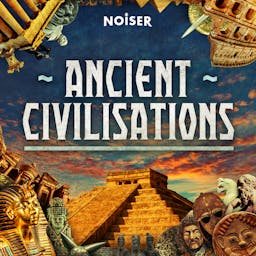
Ancient Civilisations
Hosted by NOISER · EN
The ancient world was full of wonders.
Engineering marvels like the Great Wall of China and Stonehenge. Remarkable peoples like the Aztecs, the Romans and the Mongols. Infamous leaders such as Cleopatra, Julius Caesar and Herod the Great. Inventors, explorers, builders, pioneers and philosophers who shaped the world we live in today.
Welcome to Ancient Civilisations - the podcast that takes you back in time to discover the ancient world, one story at a time.
A Noiser production, narrated by Paul McGann and John Hopkins.
As featured on Short History Of... and Real Dictators.
Noiser+ members get ad-free listening, exclusive content, and early access to new episodes across the Noiser podcast network. Click the subscription banner at the top of the feed to get started. Or go to noiser.com/subscriptions.
No part of this podcast may be used or reproduced in any manner for the purpose of training artificial intelligence technologies or systems. In accordance with Article 4(3) of the DSM Directive 2019/790, Noiser Ltd expressly reserves this work from the text and data mining exception.
38episodes
Episodes
Newest firstAll episodes
Chichen Itza
Mar 1300:56:10Tap to summarizeNestled in the heart of Mexico’s Yucatan Peninsula, the ancient city of Chichén Itza stands as a majestic testament to the architectural ingenuity and cultural richness of the ancient Maya civilization. It’s long been regarded as a shining example of Maya influence, yet today, many experts agree it’s not typically Maya at all, but rather a reflection of a shifting, adapting civilisation. So how did the city become such an important hub to a dominant Mesoamerican superpower? What were the cultural and political dynamics that shaped its unique evolution? And why was it so suddenly abandoned, and left to be reclaimed by the jungle? This is a Short History Of Chichen Itza. A Noiser Production. Written by Sean Coleman. With thanks to Annabeth Headrick, Director of the School of Art and Art History at the University of Denver, and a specialist in Ancient American Cultures. For ad-free listening, exclusive content, and early access to new episodes across the Noiser network, join Noiser+. Now available for Apple and Android users. Click the subscription banner at the top of the feed to get started. Or go to noiser.com/subscriptions. Learn more about your ad choices. Visit podcastchoices.com/adchoices
Transcribe →The Trojan War
Mar 600:53:56Tap to summarizeThe Trojan War was a time of heroes. From the swift-footed Achilles, and the hot-headed Prince Paris, to the beautiful Queen Helen, and the all-powerful gods, Zeus, Athena, and Aphrodite. In these early days of what we now call Ancient Greece, the story of Troy was already a saga from a bygone age, re-imagined by Homer, and told around the world ever since. But was any of it true? Did those legendary heroes ever exist? How did Helen’s beauty launch a thousand ships? And could the Greeks really have breached the city walls by hiding inside a giant wooden horse? This is a Short History Of The Trojan War. A Noiser Production, written by Jo Furniss. With thanks to Professor Armand D’Angour, a classical scholar at Jesus College, Oxford, and presenter of the podcast It’s All Greek (And Latin) To Me. For ad-free listening, exclusive content, and early access to new episodes across the Noiser network, join Noiser+. Now available for Apple and Android users. Click the subscription banner at the top of the feed to get started. Or go to noiser.com/subscriptions. Learn more about your ad choices. Visit podcastchoices.com/adchoices
Transcribe →Constantinople
Feb 2700:56:54Tap to summarizeFrom humble beginnings as a modest Greek colony, through its later grandeur as part of the Roman and Ottoman Empire, the city of Constantinople has witnessed centuries of transformation. A melting pot of cultures and religions, it was the bridge between the East and West, where ideas, trade, and people converged. How then, did Mehmed II succeed where so many others had failed? What did the fall of the city in 1453 mean for the next stage of its history? And what other highs, lows, and ruthless ambition did it witness for more than a millennium? This is a Short History Of….Constantinople. A Noiser production, written by Nicola Rayner. With thanks to Bryan Ward-Perkins, Emeritus Professor of Late Antique History at the University of Oxford, and the author of The Fall of Rome and the End of Civilization. And, Geoffrey Greatrex, professor of Classics at the University of Ottawa. For ad-free listening, exclusive content, and early access to new episodes across the Noiser network, join Noiser+. Now available for Apple and Android users. Click the subscription banner at the top of the feed to get started. Or go to noiser.com/subscriptions. Learn more about your ad choices. Visit podcastchoices.com/adchoices
Transcribe →The Ancient Olympics
Feb 2000:54:36Tap to summarizeFor nearly 12 centuries, the Ancient Greeks honoured their gods with one of the most famous sporting contests in the world: The Olympic Games. Athletes represented their city states to compete for the glory of the gods, knowing that winning or losing could change the course of their lives. From dangerous martial arts and the perilous chariot race, to sprints and the pentathlon, the Games showcased strength, skill, and stamina. But why did the Olympic Games first begin? What did the earliest competitions look like? What was it like to take part in a competition with no second place and, in some cases, no rules. And why did the Ancient Games die out for over a thousand years? This is a Short History Of….The Ancient Olympics. A Noiser production, written by Lindsay Galvin. With thanks to Dr Nigel Spivey, a senior lecturer in Classics, at the University of Cambridge. For ad-free listening, exclusive content, and early access to new episodes across the Noiser network, join Noiser+. Now available for Apple and Android users. Click the subscription banner at the top of the feed to get started. Or go to noiser.com/subscriptions. Learn more about your ad choices. Visit podcastchoices.com/adchoices
Transcribe →Polynesian Exploration
Feb 1300:50:49Tap to summarizeModern genetics tells us that the residents of the far-flung Polynesian islands are one of the most closely related people in the world. But, thanks to the exploration of their ancestors, they’re also the most widely dispersed. Polynesian exploration of the Pacific has been compared to humankind’s missions into space, and has led to a unique and vibrant culture for these islanders. So what do these people scattered across 1,000 islands have in common? How did the earliest pioneers survive epic journeys at sea? And what enables sailors to navigate such treacherous waters without any form of writing or physical map-making? This is a Short History Of Polynesian Exploration. A Noiser production, written by Jo Furniss. With thanks to Dr Christina Thompson, editor of the Harvard Review, and author of the book Sea People, The Puzzle of Polynesia. For ad-free listening, exclusive content, and early access to new episodes across the Noiser network, join Noiser+. Now available for Apple and Android users. Click the subscription banner at the top of the feed to get started. Or go to noiser.com/subscriptions. Learn more about your ad choices. Visit podcastchoices.com/adchoices
Transcribe →The River Nile
Feb 600:51:51Tap to summarizeSnaking across 4,000 miles and 11 African countries, the River Nile is perhaps the most famous river on planet earth. The 80 billion gallons of water that flow through its banks each day give life to countless animals and ecosystems - from crocodiles and hippos, to rare species of fish, plants, and people. But who has tried to harness the power of this river, and why have so many failed? What cultures have grown from the Nile’s waters? And why are emperors, prophets, writers, Kings and Queens, drawn to its famous banks? This is a Short History Of the River Nile. Written by Paul Kerensa. With thanks to Robert Twigger, author of Red Nile: A Biography of the World’s Greatest River. For ad-free listening, exclusive content, and early access to new episodes across the Noiser network, join Noiser+. Now available for Apple and Android users. Click the subscription banner at the top of the feed to get started. Or go to noiser.com/subscriptions. Learn more about your ad choices. Visit podcastchoices.com/adchoices
Transcribe →Petra
Jan 2300:50:46Tap to summarizeThe ancient city of Petra, in south-west Jordan, is one of the world’s most famous archaeological sites. Founded over two millennia ago, it was a key location for trade between Arabia, Egypt and the Mediterranean Sea. But as the centuries passed, Petra’s glory faded and it was eventually forgotten by the world. That was, until its rediscovery over 1,000 years later by a Swiss explorer. But what led to the sudden surge of interest in the city of Petra? Why was a permanent settlement built in the middle of the desert? And what lessons can modern society learn from an ancient tribe that most westerners have never heard of? This is a Short History Of Petra. Written by Emma Christie. With thanks to Jodi Magness, archaeologist, author, and distinguished professor at the University of North Carolina. For ad-free listening, exclusive content, and early access to new episodes across the Noiser network, join Noiser+. Now available for Apple and Android users. Click the subscription banner at the top of the feed to get started. Or go to noiser.com/subscriptions. Learn more about your ad choices. Visit podcastchoices.com/adchoices
Transcribe →Boudica
Jan 1600:50:20Tap to summarizeThe legend of Boudica has survived for two millennia, although much of her life still remains a mystery - some historians dispute whether she existed at all. For those who do believe in her, she personifies liberty, defiance, and female power, while for others, she was a barbaric, blood-thirsty warrior. But what is her real story? How does modern archaeology support Boudica’s folklore? Can we really call her a feminist icon when she slaughtered women and children? And how did her actions alter the course of English and Roman history? This is a Short History Of Boudica. A Noiser production, written by Jo Furniss. With thanks to Miranda Aldhouse-Green, a professor of archaeology at Cardiff University, and author of ‘Boudica Britannia’. For ad-free listening, exclusive content, and early access to new episodes across the Noiser network, join Noiser+. Now available for Apple and Android users. Click the subscription banner at the top of the feed to get started. Or go to noiser.com/subscriptions. Learn more about your ad choices. Visit podcastchoices.com/adchoices
Transcribe →Angkor
Jan 900:52:28Tap to summarizeBuilt by the Khmer kings centuries ago, Angkor in modern Cambodia had a footprint bigger than present-day New York. But after it fell into ruin, much of its unique architecture and intricate carvings were swallowed by the jungle. So, who raised this vast city, and why? What caused their civilisation to fall? And how were parts of it maintained, right up to the present day? This is a Short History Of Angkor. Written by Jo Furniss. With thanks to Michael Falser, architectural historian and author of Angkor Wat, a Transcultural History of Heritage. For ad-free listening, exclusive content, and early access to new episodes across the Noiser network, join Noiser+. Now available for Apple and Android users. Click the subscription banner at the top of the feed to get started. Or go to noiser.com/subscriptions. Learn more about your ad choices. Visit podcastchoices.com/adchoices
Transcribe →Easter Island
Jan 200:54:13Tap to summarizeFirst inhabited by the Rapa Nui people a thousand years ago, Easter Island is best known for its hundreds of giant stone statues. But what inspired a group of ancient Polynesian explorers to settle in such a remote spot in the South Pacific? How did they almost bring their own community to the point of collapse? And as ancient traditions meet with modern tourism, what is the future for the Rapa Nui people? This is a Short History of Easter Island. Written by Emma Christie. With thanks to Dr. Jo Anne Van Tilburg is an American archaeologist and the Director of the Easter Island Statue Project. She’s spent three decades working on Rapa Nui. For ad-free listening, exclusive content, and early access to new episodes across the Noiser network, join Noiser+. Now available for Apple and Android users. Click the subscription banner at the top of the feed to get started. Or go to noiser.com/subscriptions. Learn more about your ad choices. Visit podcastchoices.com/adchoices
Transcribe →