← Flagrant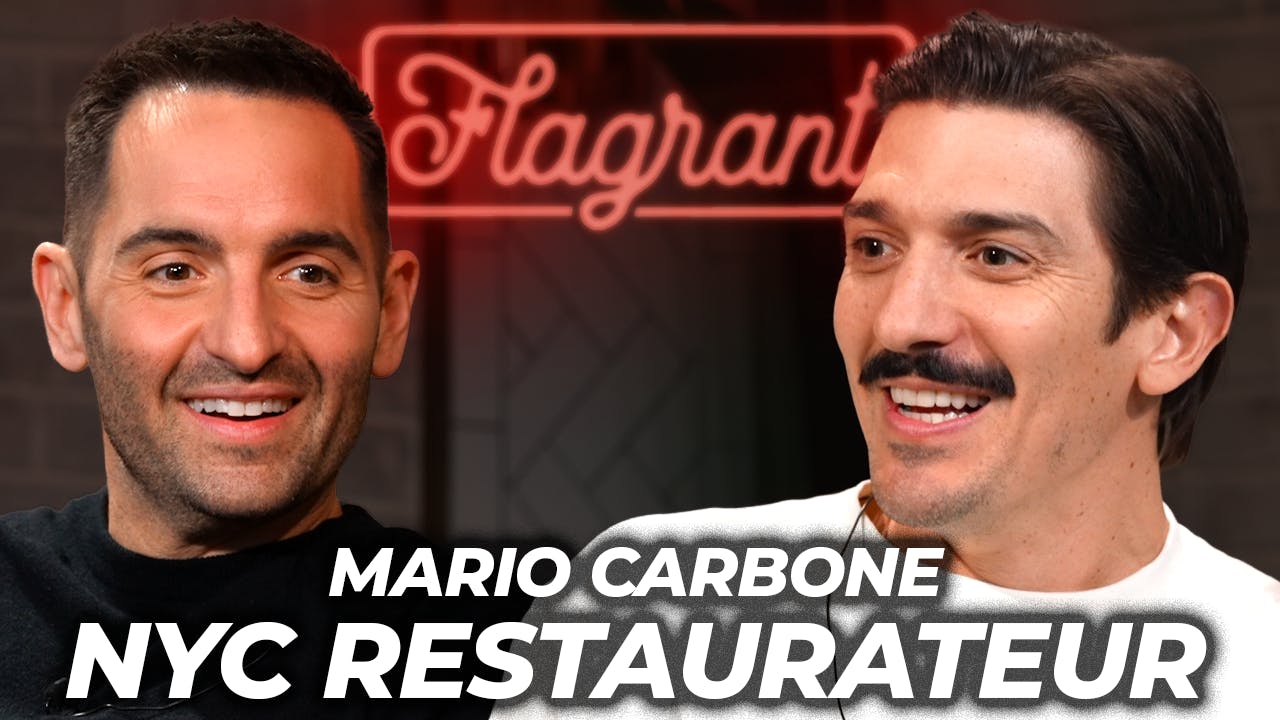
Flagrant
How to Get Into ANY Restaurant, Why Michelin Stars Are Nonsense & Building a Billion Dollar Business
02:40:04
Loading summary
Transcript1,556 lines
- [00:00]
Andrew Schultz
What's up guys? Today we are joined by one of the most famous chefs in history. His restaurants have been frequented by everyone from half white rappers to half white presidents. His spot, Carbon is harder to get into than a menopausal mothership. Jeff, I don't blame you, okay? We all get excited when a brown box gets delivered. Anyway, today he is going to tell us the number one trick to get into any restaurant in the world. Why Michelin stars are nonsense, and how to bet on yourself and build a business even in a recession. Give it up for New York City's own Mario Carbone. Thank you. I'm very excited for this. There's so many questions that I have to ask you. I want to learn about it all, but first of all, I want to know how, how does someone get a reservation at Carbone?
- [00:49]
Mario Carbone
Someone? Are we asking for, for you?
- [00:51]
Andrew Schultz
No, I just want to know someone already. I just want to know someone. Not even me. How does, how does just a regular guy who doesn't have a podcast society?
- [00:59]
Mario Carbone
I mean, it's a policy that's just one month out.
- [01:01]
Andrew Schultz
You just gonna lie to the people immediately at the beginning of restaurants, let's.
- [01:08]
Mario Carbone
Imagine you have 200 seats to fill for a night to make your money.
- [01:11]
Andrew Schultz
Yeah.
- [01:12]
Mario Carbone
You can alleges any like you can't, you can't leave it to chance like that these two people are going to come in, they're going to fill those seats and they're going to spend good money tonight. So like of course we keep information on everybody, like who's coming in, who are our regulars, take care of those people, what's their spend? So that I know these 200 people tonight are coming in, not just a random set of people because that's drastically going to change what we do tonight as a business.
- [01:35]
Andrew Schultz
So it's almost never random.
- [01:37]
Mario Carbone
It's not never. Like we like when was the last.
- [01:40]
Andrew Schultz
Time you had a walk up?
- [01:41]
Mario Carbone
It happens. But it's at Carbone. It's rare because it's so, it's in such demand. I mean, so we do put out reservations. Generally what we do is we put out the sort of the, the shoulders. Right.
- [01:52]
Andrew Schultz
We put out early 10pm yeah.
- [01:54]
Mario Carbone
Because we have the internal demand to fill it with regulars.
- [01:59]
Andrew Schultz
Okay. Can somebody like grease a host you can get into.
- [02:05]
Mario Carbone
I mean it's not about necessarily greasing a host. Thank you. I would say like you came in.
- [02:11]
Andrew Schultz
Here, you greased me, right? You gave me Cuban cigars. These are real Cuban cigars. Supposedly real.
- [02:16]
Mario Carbone
I got a connection at the airport.
- [02:17]
Andrew Schultz
You got at the airport. We snitching already? Duty free. So hold on. So these are real Cubans? Once we get a little lighter in here, we'll probably light these. Oh, you're not going to smoke, right?
- [02:29]
Akash Singh
No.
- [02:30]
Andrew Schultz
Will you have one?
- [02:30]
Akash Singh
Too much asthma.
- [02:31]
Andrew Schultz
And then we need a little ashtray, too. Okay, so you come in here, you grease me. I don't even know what this greasing gets, right?
- [02:37]
Mario Carbone
You want to grease a kitchen? How about you? You already want to grease my kitchen one night?
- [02:40]
Andrew Schultz
Yeah.
- [02:40]
Mario Carbone
You would. Take the 5:00, 5:30 reservation, okay? Bring in two cases of beer, go straight back into the kitchen, drop it in the pass, be like, hey, it's for you guys. Tonight, chefs from me, Schultz. Reservation at 2, 5 o'clock. Wow. It costs you 30 bucks.
- [02:58]
Andrew Schultz
And then what? And what happens after that?
- [03:00]
Mario Carbone
They're going to be like. Then one of the chefs be like, yo, someone just dropped two cases of beer. Like, who's that? I don't know. Let's go find out. Look it up. Like, oh, Andrew Schultz. Two top at five o'clock. Has he been here before? No, first time. Wow, you did do the right thing. Send him out a little something from us, and then all of a sudden, your name starts to populate in our system. Then maybe you order a nice bottle of wine, treat the staff nicely. Now all of a sudden, the next time you call to make a reservation, you give us your phone number immediately your name is going to pop up and be like, Andrew Schultz. Wow.
- [03:29]
Andrew Schultz
Oh, so there's a database that rewards the type of customer you are?
- [03:33]
Mario Carbone
Well, it's more that we keep information on everybody, tons of notes on everybody. And it can go from allergies, the table they like, the table they don't like, preferential amount of time when they want to dine, et cetera, et cetera. So we keep notes on everybody because that's, that's the. That's the crux of the business. Who's coming in tonight, right? That' we can't just open the door to random.
- [03:52]
Mark Gagnon
Does that go for every nice, exclusive restaurant?
- [03:55]
Mario Carbone
Is this like, everyone keeps notes and they all do it their own way, but everyone keeps notes on their customers. And there's, you know, there's softwares for this that help you track all this information. How many times have they been there? Was the last time they were there.
- [04:07]
Mark Gagnon
But the beer move, that would work in most places.
- [04:09]
Mario Carbone
The beer move works in. In most places, it works great.
- [04:13]
Andrew Schultz
Appreciate it. Guys, this is Ricky, everybody.
- [04:17]
Mario Carbone
Face looking Sharks.
- [04:20]
Ricky
I'M delivering drinks all day. Anything you guys need?
- [04:23]
Andrew Schultz
All right. Yeah. Let's get something cooking, man.
- [04:25]
Mario Carbone
You're an apparel spritz guy.
- [04:27]
Andrew Schultz
I like a spritz. I'm not gonna lie.
- [04:28]
Ricky
Apparel spritz on the way.
- [04:29]
Andrew Schultz
Thank you.
- [04:30]
Akash Singh
I need a nice mocktail.
- [04:32]
Ricky
He's shaking it right now for you.
- [04:35]
Mario Carbone
I'm gonna have a spritz as well, Rick.
- [04:36]
Ricky
Two spritzes.
- [04:37]
Mario Carbone
Absolutely.
- [04:37]
Unknown
Let's go.
- [04:38]
Mark Gagnon
Spritz would be great.
- [04:39]
Mario Carbone
Three spritzes. Thank you. All around. Smart move, guys. All the way around.
- [04:44]
Andrew Schultz
Okay. Oh, this is. They make a little vagina out of it. This is cool.
- [04:47]
Mario Carbone
Little V cut.
- [04:48]
Mark Gagnon
Okay, so we thought we called a V cut. Oh, this is the normal thing.
- [04:54]
Andrew Schultz
I thought this is like some crazy.
- [04:55]
Mario Carbone
Cigar cutter that we got here.
- [04:57]
Mark Gagnon
It helps to not canoe a little, you know?
- [04:58]
Andrew Schultz
Okay, so. So there is a way. So back in the day, I would think you just tip well, and all of a sudden, then maybe it helps.
- [05:06]
Akash Singh
I mean, what's well, though? Like 100, 200. What's well?
- [05:09]
Mario Carbone
I mean, 100% of the bill.
- [05:11]
Andrew Schultz
That's insanity, right?
- [05:12]
Mario Carbone
Insanity. It happens.
- [05:13]
Unknown
You're talking tariffs now.
- [05:17]
Mario Carbone
We've got one guy who comes in every now and again and will spend a great deal of money, and regardless of what the bill is, leaves 100% tip.
- [05:25]
Andrew Schultz
So Rogan, I guess it's a. Every time I go out to eat with Rogan, he tips 100% every single time. Which I tell him every single time is insane. But I want the, you know, the waiters and the staff at the restaurant to make some money. I never even considered the idea of walking into the kitchen with alcohol when the restaurant already has alcohol. And then hand. How do I even get into the kitchen?
- [05:47]
Mario Carbone
The kitchen's not getting the restaurant's alcohol. So at the end of the night, they're going to have your two cases of beer to crack open after a long service. They're hot, they're sweaty. It's been a long night.
- [05:57]
Andrew Schultz
But the kitchen still has agency, meaning they can send out some dishes. Send out a little.
- [06:02]
Mario Carbone
They're guaranteed you're going to get a little something.
- [06:04]
Andrew Schultz
So when I had my. My daughter, somebody told me they were like, listen, you gotta take care of the staff at the hospital. If you go out and get food, get pizza for everybody. You go out and get bagels, get bagels for everybody. And they did nothing different than I. Tea.
- [06:21]
Mario Carbone
You didn't get any of that.
- [06:23]
Andrew Schultz
Maybe we did. I'm not even sure. Actually. I think they delayed the pregnancy as much as they possibly could to keep on getting free food. My wife was in labor for 24 hours. If I got them, like some Snickers or whatever, maybe we would have that baby in six. Yeah.
- [06:35]
Akash Singh
Why wait?
- [06:36]
Mario Carbone
I'm incentivizing them backfired. Well, this is a traditional. I mean, if you're at a sushi bar, that's a classic move. It's like, hey, you get a round of beers for all the sushi chefs. That's a classic move.
- [06:46]
Mark Gagnon
Really?
- [06:46]
Mario Carbone
So first thing you do when you sit in a nice sushi bar, buy a round of beers for all the chefs.
- [06:50]
Andrew Schultz
This is one of the reasons. One of the reasons we're so excited to sit down with you is learning restaurant etiquette from the inside. I feel like it is so. And I want to get into your history. I want to get into how you built this thing and how you put those other two guys that don't do much on your back. You know what I mean? I really. What are those guys, names of Zaznik or something like that, in what is. In Torino. Something. Yeah.
- [07:15]
Akash Singh
Toronto.
- [07:15]
Mario Carbone
Toronto, down the block. Yeah, yeah, yeah, yeah.
- [07:18]
Andrew Schultz
No, no, great guys. Great guys. Lucky. No, no, no. But in all seriousness, understanding, understanding this kind of stuff offers crazy value to the average consumer. So. So you're bringing a couple cases of beer. Now, what happens if a waiter goes, why are you going into the kitchen, like, with two cases of beer?
- [07:35]
Mario Carbone
No, no, Commonplace. Or you give it to the waiter and say, hey, I brought a couple cases of beer for the. For the kitchen.
- [07:39]
Mark Gagnon
Does the type of beer matter?
- [07:41]
Mario Carbone
I mean, chefs drink, you know, simple, cold, easy drinking. It doesn't matter. Throw a bag of bone. Yeah, I don't bring them any, like, weird hazy IPAs. Like, they don't want that.
- [07:51]
Andrew Schultz
Yeah.
- [07:52]
Unknown
From what I think the chefs are Corona.
- [07:54]
Mark Gagnon
Yeah.
- [07:57]
Mario Carbone
For the boys. Not mad at a model.
- [08:01]
Andrew Schultz
Okay, there's a good question, actually. No, no, I want to stay on these. I want to stay on these hacks. Okay, I got it.
- [08:08]
Mario Carbone
Going for it.
- [08:08]
Andrew Schultz
Yes.
- [08:09]
Mario Carbone
You order a nice. So this is a front of the house. You're going to get some appreciation. You order a bottle of champagne, whether you're talking to the waiter or the sommelier. You order the bottle of champagne, and right before they leave, you kind of grab them, give them a little whisper and say, I don't want the. I don't want the champagne flutes. Bring me wine glasses. A real wine drinker never, ever drinks champagne out of champagne flutes.
- [08:34]
Andrew Schultz
Wow. This is boss. Keep going. Wait, why?
- [08:37]
Mario Carbone
Second. You tell them I Want if you, if you say AP glasses, which is all purpose, or you say bring me white wine glasses for the champagne, that immediately says, you know what the you're talking about.
- [08:46]
Akash Singh
And that helps.
- [08:47]
Mario Carbone
I don't know, it's better for the champagne. The whole, like, no one, no one likes drinking out of these skinny little things. It's actually not great for the champagne.
- [08:55]
Akash Singh
Okay.
- [08:56]
Mario Carbone
You want a real wine glass for your champagne.
- [08:59]
Akash Singh
Okay.
- [08:59]
Mario Carbone
No one ever does that.
- [09:00]
Akash Singh
Yeah.
- [09:01]
Mario Carbone
So the second you tell them that, that immediately puts them on that you know what you're talking about and you.
- [09:05]
Akash Singh
Get a little more respect.
- [09:06]
Mario Carbone
You get, you get immediate. You get, you're going to get immediate respect.
- [09:09]
Akash Singh
Okay.
- [09:10]
Andrew Schultz
And I know, honestly, and it makes sense that it is this way, but I never consider that it was similar to like the nightclub in that the more that you spend, the more data you're giving the restaurant and the more they're going to prioritize you in the future. I never even consider.
- [09:25]
Mario Carbone
It's all, it's all digital. So as soon as you know, once you call for the second time, immediately the person that's on my team that's picking up the phone or looking at the email has side by side, your information, the back of your baseball card. Here's what you do, here's who you are here, your likes, dislikes, here's what you spent, et cetera, et cetera. Not that it's always about spending. We just want to curate a room so that it's not random.
- [09:49]
Andrew Schultz
So what we're trying to figure out is what the cheapest way to get currency in the restaurant is. So bringing the beers.
- [09:56]
Mario Carbone
Great one to the staff.
- [09:57]
Mark Gagnon
This is already assuming you got the res. I'm curious, when you walk up to the door, the maitre d, which I have a long lasting beef with, maitre d's in New York City.
- [10:06]
Mario Carbone
You want to get into it?
- [10:07]
Mark Gagnon
I'm curious. I just get frustrated sometimes, you know, because you get this girl, she graduated college like a year and a half ago. She holds power over this entire restaurant. Every person that comes in. Is there anything you can do or say to a maitre d that might kind of tilt the, the scales in your favor?
- [10:20]
Andrew Schultz
Thank you.
- [10:21]
Mark Gagnon
Saying, oh, my mom's in town and she's having a birthday. Anything that would kind of, I mean, those are those.
- [10:26]
Mario Carbone
They're going to, they're going to see through those. Yeah, yeah. I mean, walk up reservations because at that point you're at their mercy.
- [10:33]
Akash Singh
Thank you so much, Ricky.
- [10:34]
Mario Carbone
I think try to kill them with kindness. You'll take anything. Listen, I'll take, I'll take your worst two seats. I'll take the bar stools. I'll take whatever you got, you know.
- [10:43]
Andrew Schultz
So instead of trying to. Big shot.
- [10:44]
Mario Carbone
Yeah. Humbling yourself because that's all they've got. Right. All they've got is this, this little bit of power that they've been given at this front desk. To your point, I would, I would go with, listen, I'll take whatever it is. Give me your worst two seats. I'll be happy tonight. I'll be in and out quick.
- [10:58]
Andrew Schultz
That's.
- [10:58]
Mark Gagnon
Yeah, I got a thing at 8 o'clock.
- [11:01]
Mario Carbone
They have to worry about what's been plotted for the night. Right. Like, so at Carbone, it's a two and a half. It's about a two and a half hour meal. So we're plotting these reservations. Right. It's a very tricky little dance that we are assuming the 5:30 reservation is going to be done at 8:00. Right. But it may not happen that way. So the fact that if they've got an extra table, they might give it to you if you're like, I'm going to be in and out quick.
- [11:24]
Mark Gagnon
Does how you dress for the walk up make any difference?
- [11:27]
Mario Carbone
It depends on the restaurant.
- [11:28]
Unknown
If you look like this look, I'll trim.
- [11:31]
Mark Gagnon
I would trim it a little.
- [11:32]
Mario Carbone
I think it depends on the restaurant a little bit. But really, I would say kill them with kindness. Try to get in and out quick. I'll take any. I'll take any seat you got.
- [11:41]
Unknown
What about the friendly handshake with a little cash in it?
- [11:43]
Mario Carbone
I mean, that's as old as time.
- [11:45]
Unknown
But does that work?
- [11:47]
Mario Carbone
I think it works. I'm not advocating for it because my team is very well paid, but I mean, I'm sure.
- [11:52]
Mark Gagnon
Would that be offensive? Obviously not in your establishments, but another restaurant. Like if you were to be like, hey, there's a little 20 bucks, you think a Matri D would be like.
- [11:58]
Andrew Schultz
Oh, like it could be beneath.
- [11:59]
Mark Gagnon
Who the am I like, are you? You're trying to pay me 20 bucks to get you a table.
- [12:02]
Mario Carbone
If you, if it turns out you're like talking to the general manager and not just like, you know, a well paid general manager and you try to give him a 20 spot, he's going like, what. What are you doing here?
- [12:13]
Andrew Schultz
Yeah, yeah.
- [12:13]
Mario Carbone
What's going on here, bro?
- [12:14]
Andrew Schultz
I tried to pull the I know the owner thing once at Carbon.
- [12:17]
Mario Carbone
Carbon. No.
- [12:21]
Andrew Schultz
That'S this week. No, at Emilio's. And I'm Talking to this big guy up front. I'm like, yeah. You know, Emilio told me to come by because, you know, just a table for two, whatever. Like that. And he's like, oh, did he? And I was like, yeah. He said, what time did he tell you to come? And I'm like, around, like, 7:30, whatever. Like that. And I'm like, I'm a little bit early. He goes, okay, cool.
- [12:41]
Mario Carbone
All right.
- [12:41]
Andrew Schultz
Yeah, well, we'll figure it out. And I'm like, okay. I walk away and thank you. Next person that walks up to him goes, Emilio. No, I'm not. I'm not thinking he's gonna be sitting outside of his restaurant on a bar stool, like, deciding who gets in.
- [13:06]
Mario Carbone
There's two of them. There's a junior.
- [13:08]
Andrew Schultz
Well, there's the kid. And then there's the dad, 100%, anyhow.
- [13:12]
Mark Gagnon
I mean, that's so funny.
- [13:13]
Unknown
Should have been like, hey, I'm a comedian.
- [13:15]
Andrew Schultz
I was just with you.
- [13:16]
Mario Carbone
I knew it was you.
- [13:19]
Akash Singh
Okay, so you got a lot of good restaurants under your umbrella. Andrew and I argue. A lot of times he's become this, like, real foodie type. And that was really derogatory. It was. And I meant it in a derogatory way. Very pretentious about it.
- [13:32]
Mario Carbone
Yeah.
- [13:32]
Akash Singh
What I love. I was just saying this. I went to Turici. It was the best restaurant experience I've had in the city because it didn't. It was elevated but didn't feel pretentious. A lot of times I'll go to Michelin star places, and I end up being underwhelmed. Not a lot of times. A few times. How do you feel about that? Is that like a general, hey, Michelin star, you know, this is going to be a solid restaurant experience or not.
- [13:51]
Mario Carbone
There's a lot to unpack with Michelin. There's a lot.
- [13:54]
Akash Singh
A lot to unroll.
- [13:55]
Mario Carbone
There's a. There's a.
- [13:56]
Akash Singh
Get it.
- [13:57]
Mario Carbone
I see. I see what you do.
- [13:58]
Akash Singh
It's a tire.
- [14:02]
Mario Carbone
Michelin started as a subsidy for the tire company. Now it's no longer. So now it's a. It's a business. So I think you got to take that with a grain of salt. They're in their own business of selling books. Michelin's tricky for a lot of reasons. If you're. If you're. To the restaurant that. The kind of restaurant you're talking about, they're. They're going for that accolade. There's this sort of assumption that you have to do it in a really tight way. A really? You know, library style, hush environment. Very sort of. The chef is right. He wants you to eat this from the left to the right sort of environment because they're. They're coveting these. These stars. Yeah. I don't know if that's a good business model. We are the opposite, Right? Yes. I think that chefs, well trained, high level chefs, fall in one of two categories, and we're firmly on one side than the other. There's two categories. Not that there's anything wrong with the two categories, but there's two firm categories. One category is the chef that spends all their training, all their work, their life, their life's journey to make something that you've never had before. That's a very dangerous proposition. Yeah. But if you have whatever this thing is and you don't like it, the chef can at least fall back on the ego and say, you don't get it. You didn't get what I was going to say.
- [15:20]
Andrew Schultz
This is the pretentiousness. Yeah.
- [15:21]
Akash Singh
And that you didn't get it infuriates me because it's like, no, I get what tastes good and what doesn't. Dude. I get it.
- [15:25]
Mario Carbone
And I preach to my team and my chefs. We're on the other side of that. We are equally dangerous. We are trying to make for you the thing that you've had thousands of times before. And I want to make one of the best ones you've ever had. But you know exactly what it's like, so I can't be like, oh, he didn't get that meatball.
- [15:43]
Andrew Schultz
You're competing with their grandma.
- [15:45]
Mario Carbone
Yeah. Like you know what a meatball is.
- [15:47]
Andrew Schultz
Right.
- [15:47]
Mario Carbone
You may not know what that chef was trying to go for, but, like, if you didn't like it, it's probably not good.
- [15:52]
Akash Singh
Yeah. You don't have that fog.
- [15:53]
Mario Carbone
But if I, if I. If I win, I've got a customer for life. I've got someone who's coming multiple times a week. If that chef wins, you may go once a year. You may actually never go back again. Even if it's great.
- [16:05]
Andrew Schultz
I never go back to those places. Even if it's the really abstract ones. It's a fun, cool experience. But it's like, I recently went to places called. It's a Chicago chef. He had throat cancer or something like that. Alinea just did a pop up in Brooklyn.
- [16:21]
Mario Carbone
Yeah.
- [16:21]
Andrew Schultz
And my wife and I went, and the food was great. And we got into a nice argument, which was uncomfortable for all the other people during our seating.
- [16:28]
Akash Singh
That's fun, though.
- [16:29]
Andrew Schultz
That's love.
- [16:29]
Akash Singh
That's communal, honest.
- [16:31]
Mario Carbone
No, no, no, no.
- [16:32]
Andrew Schultz
Not only at a communal table. You change tables, like, four or five times. So they had to deal with that fight four or five times, and it was new people sitting next to us.
- [16:40]
Mario Carbone
So you wouldn't let it go. No.
- [16:43]
Andrew Schultz
Not letting this go. Just because you put the dessert all over the table, I'm gonna let the fight go.
- [16:48]
Mark Gagnon
Everyone in the restaurant loves that.
- [16:50]
Mario Carbone
Okay.
- [16:50]
Mark Gagnon
Going to dinner with my wife, seeing a couple organ. I'm like, yes.
- [16:53]
Mario Carbone
Theater.
- [16:55]
Mark Gagnon
It's just fun to listen. You're like, at dinner and a show, bro.
- [16:58]
Andrew Schultz
It was. I mean, because the lad at the end of the dessert, they, like. It's all deconstructed or whatever, you know, and they're like.
- [17:04]
Mario Carbone
And that's three Michelin star. That's the highest award. At one point, he was the highest rated American restaurant we had.
- [17:10]
Akash Singh
I literally pay you to construct the food. I know. I never paid anybody to take some shit apart from me. I can do that. Believe me, I can do that. I could take a part of lasagna.
- [17:18]
Andrew Schultz
Yeah. But I will say the food was.
- [17:19]
Mario Carbone
Good, but you would hate it. You definitely would hate it. It's important that they exist, which is not my mind. I'm in a business. We're at the corner of art and commerce. Like, I'm in a business model.
- [17:31]
Andrew Schultz
Right.
- [17:32]
Mario Carbone
Like, there's nothing wrong with preaching the art and teaching the art of business.
- [17:37]
Andrew Schultz
Yeah.
- [17:38]
Mario Carbone
That's a. That is also a craft. And we need to keep the lights on, and we keep. Need to keep people paid.
- [17:42]
Akash Singh
Yeah.
- [17:42]
Andrew Schultz
Do you know how much money. Sorry. You know, much money your wait staff makes?
- [17:46]
Mario Carbone
I mean, depending on the restaurant, a substantial.
- [17:48]
Andrew Schultz
Like, what is a waiter at Carbone.
- [17:50]
Mario Carbone
In Miami make, like, on average, over 150,000 a year.
- [17:55]
Andrew Schultz
So if they are guaranteed 150,000 a year, and that's what's on the books, that's not even, like people throwing them a little shit on the side.
- [18:03]
Mario Carbone
Yeah. But there's very little cash these days. Everything's cards, you know, no one carries cash anymore. No one.
- [18:08]
Andrew Schultz
So I always wondered, like, to some of your staff that was in, like, cash tip positions get upset about that. Like, the people that are doing valet, these, like, how do they manage that? Their whole life was cash tips.
- [18:21]
Mario Carbone
I guess valet is still. I'm trying to think of where when I carry cash at this point, valet is one of the few ones that you still want to have that feel. But the wait staff, it's all. It's all in. All in credit. Cards, which is good because it actually used to be really dangerous because you have these restaurants have all this cash at the end of the week. Some employees got to take, like, comical bags of cash and might as well have a dollar sign on it to a bank. They're just waiting to get robbed.
- [18:47]
Andrew Schultz
Because you were putting it all in the bank. Yeah. You were giving it to Ricky to face to go put under a mattress. Since COVID But, yo, it is a crazy thing because, like, restaurants in the city, any, like, small mom and pop business in the city that dealt with cash was given, like, if you want to be generous, 50% of it to. And that business completely changed now that everything goes digital. So you got to adjust to.
- [19:15]
Unknown
Yeah, for that same reason.
- [19:17]
Andrew Schultz
Wasn't Carbone only cash initially?
- [19:19]
Mario Carbone
No, never.
- [19:20]
Andrew Schultz
Just with me.
- [19:22]
Mario Carbone
That was strictly your policy.
- [19:25]
Andrew Schultz
Because the card kept bouncing.
- [19:27]
Mario Carbone
That. Yeah, because we didn't take that card. You had.
- [19:29]
Andrew Schultz
Oh, yeah. What was that?
- [19:30]
Mario Carbone
I think that was a capital one Diner's card.
- [19:34]
Andrew Schultz
Uncle Rush card.
- [19:36]
Mario Carbone
He's like, I take gift cards when.
- [19:39]
Unknown
I go to, like, some of my favorite, like, bars or lounges, I bring cash just so I can tip with the cash. Because I know for that particular reason, they appreciate that way more than if you just put all the tips on the credit card receipt.
- [19:50]
Andrew Schultz
That makes sense.
- [19:51]
Akash Singh
Also, guys, this weekend, I'm going to be in the best comedy clubs in the country. No disrespect to any other club, but comedy works the best clubs in the country. I know. We sold out two shows. We still got tickets left. There's some tickets left for the Sunday show. The other two are going quickly, so hurry up and buy those. May 9th and 10th, Virginia Beach. I'm letting y'all know I might have to reschedule. I will know for sure very soon, but I think I might be in India working on some things that you guys should keep an eye out for. June 19th through 21st, I'm gonna be in Salt Lake City, guys. Those dates and a bunch more@akash singh.com. thank y'all so much for coming out to these shows. We did nine in Tampa Bay. That was amazing. I love y'all. Peace.
- [20:25]
Mark Gagnon
What's up, people? World's fastest ad read. Bangor, Maine. Portland, Maine. Charleston, South Carolina. Atlanta, Georgia, and Stroudsburg, Penn. A bunch of other cities, all on my website, markagnonlive.com come see me on the road. We're gonna hang out after the show. We can say what's up. We're not really gonna hang out.
- [20:39]
Akash Singh
Say what's up with your mouth.
- [20:40]
Mark Gagnon
No, just take a picture and come.
- [20:42]
Akash Singh
To the show with words like more.
- [20:43]
Mark Gagnon
Like a just only talking and have fun.
- [20:46]
Akash Singh
Hard to talk with Mark's dick in your mouth.
- [20:48]
Mark Gagnon
See you guys at the show.
- [20:49]
Andrew Schultz
Guys, this is incredibly important, maybe the most important thing that I tell you on this episode. Our dear brother, okay, this is family, okay? This is not like casual work acquaintance. This is literal family. Derek Poston, you saw him open up on the Life tour. You saw him open up on Infamous. Absolutely hysterical. And he's putting out his first piece, his first comedy piece with the great Don't Tell comedy brand. You've definitely seen Don't Tell comedy specials all over the Internet, all over TikTok, Tock over Instagram. This piece, how to end Racism, is absolutely hilarious and is on YouTube right now. Derek Poston, how to end racism, Don't Tell comedy. You go look it up right now. Okay? You could finish the episode. You come back to the episode. You do whatever you want, but you make sure you watch that. You leave some comments, you share with friends. We support family over here. Derek is flagrant family. So get after it. Go watch it. Let's run these numbers up. Create another superstar out there. He's absolutely hilarious. Hilarious. Leave a bunch of comments, share it. Show the love. Show that flagrant family love right now to our boy, Derek Poston. We're very proud of you, Derek.
- [21:57]
Akash Singh
Love you, Derek.
- [21:58]
Mario Carbone
Love you, Derek.
- [21:58]
Andrew Schultz
Let's get back to the show, I'm.
- [21:59]
Mark Gagnon
Sure back to the Michelin thing. Like, the politics of the Michelin. Like, I have a friend that has a restaurant in Brooklyn, plays Barmadonna. It's awesome. But he talks to me about, like, getting on, like, the list. Like, you want to be on the best bars list. Like, there's all this politics you have to play, not only having a great experience with your consumers, but playing the game of the restaurant. So as far as getting a Michelin star or playing in that world, how important is it to be in the graces of the critics, being on blogs, things like that, to promote the brand of the restaurant?
- [22:26]
Mario Carbone
If you're going for that, if that's a goal of yours, then it's important. Michelin can't possibly be what they say they are or what they have been. So, like Michelin in the past, started in France, 50s and 60s, there'd be a anonymous inspector that would come every year and check on your restaurant and grade it. Basically, for that to still happen today in the number of restaurants and numbers of cities that Michelin is in is virtually impossible. Right. There's no way they're checking on these restaurants. So it's my belief that it's simply an aggregate. They're just aggregating where they need to sell books and what the reviews of the rest of the world are of these places and figuring out who to give stars to. I think there's a handful of people that are actually going to some of these restaurants, like the top couple brass of Michelin are going to the important ones, but there's no way they're going to all of them. So it's really just some sort of aggregate system they're using to give out these stars. It's no longer like, like the movie Ratatouille kind of like projects this. Like that's a Michelin inspector, basically. Right. At least at the New York Times, which is. Which is for me the most important review in New York. Right. The New York Times criticism. You know who it is? It's a. It's a single person's opinion, whether you like it or not. It's a real person. It's not some sort of computer generated aggregate. And take this for a grain of salt, we only have one Michelin star. They took a couple away from me a couple years ago. It is what it is. But like, you know, I could easily be seen as someone who's just kind of grumpy about it. But I just think as a system, and it's not something that we necessarily covet, but as a system, I just don't think they're being honest with, with who they are as a. As a criteria.
- [24:10]
Andrew Schultz
So you're saying there's other motives here at play. There's a financial motive.
- [24:13]
Mario Carbone
They used to be a subsidy of this tire company. Right. And the whole idea was that they created this map of restaurants so that you in your car, on your Michelin tires would drive from restaurant to restaurant. And it was a fun way to promote it. It became really big and then it became. It spawned into its own business. So you have to look at it and say, this is its own business. It has to make its own dollars. So as a business, there's just no way, given what they do in revenue and book sales, that they could pay enough people to go to all these restaurants. So if that's the case, then how are they coming up with fugazi? So then in that case, a fugazi.
- [24:48]
Mark Gagnon
What'S more important if you're going to a city and you want to know what the good restaurants are.
- [24:51]
Akash Singh
Yeah. How do you know and you don't.
- [24:52]
Mark Gagnon
Use a Michelin star. Is there another review system? Is there an app? Is there a website? Like, how else can I be informed about the best restaurant in the city?
- [24:59]
Mario Carbone
I mean, social media is going to tell you. I mean, if you punch in best restaurant, pick your city, you're going to get 10 at least.
- [25:06]
Andrew Schultz
But it's a paid flow. Infatuation. Have you heard of that one?
- [25:08]
Mario Carbone
Yeah, Infatuation. I mean, they don't speak kindly of me in Miami, but they do in New York. Two totally different groups of people in the same publication. But they. They're. They're definitely gonna pop up. You're gonna get CNN Traveler. You're gonna get all these things that are gonna pop up. But. But the biggest thing that's changed in the restaurant business is that the power of these critics has been basically completely taken away and put in the customer's hands. Everyone has it now. Yeah, everyone's an editor in chief of their own thing. Right. No matter how big their Facebook is or their Instagram page, they're gonna tell you all about their meal. And if you follow them, you're gonna go that they're the critic.
- [25:45]
Andrew Schultz
There's a. There's a. People always say, a lot of times comics compare ourselves to boxers for some reason. I don't know why. And whoever does that has never boxed at all. But I always say the closest comparison for comedians is chefs.
- [25:58]
Akash Singh
My chef friend says it's the closest.
- [26:00]
Andrew Schultz
Comparison to comedians just in terms of speaking to them. It's a couple different things. One kind of natural people pleasers. We're doing this thing. We're creating this thing for other people to consume. And hopefully they like it. And we're kind of waiting for them to tell us that they like it. The hours also and just degenerates, really. Kind of bad people at our core.
- [26:18]
Mario Carbone
Dredge of society.
- [26:19]
Andrew Schultz
Dredge of society that somehow managed to make money doing this, like, weird thing.
- [26:23]
Mario Carbone
It's a circus.
- [26:24]
Andrew Schultz
It is a circus. 100. You're in these restaurants and you ha. You're managing the staff. They're all each other. How do you stop that?
- [26:35]
Mario Carbone
I don't know anything about that.
- [26:38]
Andrew Schultz
I worked in restaurants for years.
- [26:40]
Mario Carbone
Listen, I think.
- [26:42]
Andrew Schultz
What do you do?
- [26:43]
Mario Carbone
How do you. The team going out after work and. And having drinks and letting some steam off of a long night is totally normal. And we're not going to get in the way of that. I think certainly we have rules that management and hourly staff can't cope mingle. That's just rule number One. And as soon as that happens, there's zero tolerance there. But the staff, they become family. I have the same team at Carbone, the original Carbone. Since basically day one, no one's left. It's all the same team. Wow. Starting with Ricky.
- [27:18]
Andrew Schultz
Wow. Really?
- [27:19]
Mario Carbone
Yeah.
- [27:19]
Andrew Schultz
How do you know Ricky?
- [27:20]
Mario Carbone
Ricky was a day one, Day One guy who answered an ad for captains. The head waiters are captains for a captain position and love them immediately. And he grew into being the fate. I call him the Face because everyone knows him. Everyone knows him as Ricky of Carbon.
- [27:38]
Akash Singh
Really?
- [27:38]
Unknown
Before we get too far away, two things. Do you think a Michelin star can be bought?
- [27:45]
Mario Carbone
I think. I think you gotta. You gotta play the game a little bit. If that's something you're going after, if that's a really important metric for your restaurant and for success and for getting people in there, then you have to play a game to a certain degree. And that being buying it could manifest itself in the things you buy for the restaurant. All of the extra money you spend towards the things that you think you need to get that star. I don't think you can pay Michelin for a star. Gotcha. Cities pay Michelin, which is commonplace. Cities pay it to bring them to that city to create a Michelin. Whatever.
- [28:26]
Akash Singh
Makes sense.
- [28:27]
Mario Carbone
Yeah, but that's just like the Michelin guide. Yeah, the Michelin guide.
- [28:31]
Andrew Schultz
So the Michelin guide is paid for.
- [28:33]
Mario Carbone
It's paid for by the cities to bring them there, which makes sense if.
- [28:37]
Akash Singh
You'Re a tourist in Miami. Michelin guide.
- [28:39]
Andrew Schultz
No, it makes perfect sense. I thought Michelin guide was the achievement right before Michelin star. Because sometimes the way people speak about it, they're like, oh, it's not Michelin star, but it's guide.
- [28:49]
Mario Carbone
You can be included in the book without having a star where they're like, sort of recommend you, especially if you're at a lower price point. If you had a really low price point, usually you're not even up for a star. This is really just kind of the world of find outing, more or less.
- [29:01]
Unknown
And then the second question, because you said, now the power's in the customer's hand. But I feel like restaurants are just paying influencers. Hey, here's some money. Come here, eat for free, Do a review on us. So it's like, I don't trust a lot of the TikTok, because they'll do it on the same restaurants over and over. And I'm like, yes, I'm a little suspect about this.
- [29:21]
Akash Singh
That's a great point.
- [29:22]
Mario Carbone
That is Marketing these days, I mean, it's not that much different than paying some agency to tell you how great this restaurant is, bro.
- [29:31]
Andrew Schultz
It's more effective.
- [29:32]
Mario Carbone
Yeah.
- [29:32]
Akash Singh
So then how do we find it?
- [29:34]
Mario Carbone
No, no, I understand.
- [29:35]
Andrew Schultz
Like, but like when, when Kendall Jenner wears a bag, all of a sudden all these girls want to wear the bag. When they eat at this restaurant, all of a sudden all these girls want to go check it out. So to Alex's point, if some of them are being paid to go to restaurants, how can we trust them as an influencer? Because the whole game is to assume that they really, truly are inspired by this restaurant and they love the cuisine.
- [29:59]
Mario Carbone
I mean, they're selling. If you're a big influencer, you're so you're selling all sorts of products, right? I mean, like, oh, they're getting huge amounts of money and they're getting money.
- [30:08]
Andrew Schultz
To even go to restaurants.
- [30:10]
Mario Carbone
I mean, we don't pay anyone to go to restaurants, but I'm sure that that's a business, right? That's got to be a line item in advertising somewhere. That in this local town, so and so is a huge influencer. Yeah, they're definitely going to move the needle. They're definitely going to move the needle.
- [30:22]
Andrew Schultz
I thought, I thought you guys were making great headlines the opposite way. So instead of who comes to the restaurant.
- [30:31]
Akash Singh
Oh, yeah.
- [30:31]
Andrew Schultz
It was who gets kicked out of or gets rejected. Every time a famous person would get rejected at Carbon, it was like, can happen that often, dude. But you heard that it happened every now and again.
- [30:43]
Mario Carbone
And sometimes it was a mistake.
- [30:44]
Andrew Schultz
Who is it? But it was like Justin Bieber.
- [30:46]
Mario Carbone
That was a mistake. Justin. Yeah, that was a mistake.
- [30:52]
Akash Singh
But is it.
- [30:52]
Mario Carbone
I would not have kicked Justin out.
- [30:53]
Akash Singh
A serendipitous mistake or whatever the word is. Like, you're like, oh, this is a mistake. But no, because I didn't want to.
- [30:58]
Mario Carbone
Deal with that press. I didn't, I didn't. It didn't look good. It wasn't like, it didn't. To me, it didn't look good. Like, that's not hospitable. We try to take care of it. It was just like a last minute thing that, that scenario was just like a super last minute try to make a reservation and they were already showing up and we just didn't have the table at that moment.
- [31:14]
Akash Singh
But to Andrew's point, there's a human psychology when you read this person couldn't get into this restaurant. It must be insane. So could you see a world? I'm not saying you did it could. You see a world where somebody might reject that person and then leak it to the person press.
- [31:26]
Mario Carbone
I think it's too risky. Okay. I can't. I can't see somebody trying that.
- [31:30]
Andrew Schultz
What's the scummiest thing you've seen a restaurant do for pr?
- [31:35]
Mario Carbone
Scummiest thing to do for pr. There's only so many things that you can really do. I mean, I'm trying to think of, like, creative, scummy things. You. You know, planting paparazzi, so making the.
- [31:54]
Andrew Schultz
Calls of the pr.
- [31:55]
Mario Carbone
Someone's there. Yeah. And then you call, like, a Page Six type guy, and all of a sudden they get blown up.
- [32:02]
Akash Singh
I've heard some clothing, like, wardrobe people will do that, where they'll, like, go to some company, hey, you have these designer clothes. Pay me. I'll make sure he wears it. And then when he wears it, I'll call the paparazzi and say, hey, Justin Bieber's at this restaurant.
- [32:13]
Mario Carbone
That's a thing. That's a thing.
- [32:15]
Akash Singh
Yeah.
- [32:16]
Andrew Schultz
And how do you make sure your staff doesn't do that and then get hit?
- [32:19]
Mario Carbone
Well, I mean, our staff, that's something we talk about more than probably most is sort of anonymity. Like one. Of course we say nothing, but also, like, we. We are. We're the. We're the protective layer of a celebrity or an athlete or someone that's in the restaurant, because you don't know who might be, like, secretly filming them or who might just come up and try to get, like, an autograph or a selfie, like. So my team is that last line of defense to make sure that they have a really private moment.
- [32:49]
Akash Singh
Do they have a special seating area, a special entrance, all of that?
- [32:52]
Mario Carbone
It depends on the restaurant. Some places just have, like, there's nowhere else to go. It depends on how much notice we have. But, like most places, there's like, wow.
- [33:02]
Andrew Schultz
Okay, take me through early days.
- [33:03]
Mario Carbone
Yeah.
- [33:04]
Andrew Schultz
Was there a point in Carbone where you were like, we're not going to make it. We're going to close?
- [33:07]
Mario Carbone
Well, early days was just a couple hundred feet away from here. It was original. Theresi.
- [33:10]
Andrew Schultz
This is on Mulberry, right?
- [33:11]
Mario Carbone
Yeah, that's the first. That's the very first restaurant. Mulberry and Prince.
- [33:15]
Andrew Schultz
I'm sorry, if we're going to go early days, let's go really far back. You go work at Ballud, right?
- [33:21]
Mario Carbone
I worked at Boulud before. My first, like, real New York chef was Bobbo, right?
- [33:26]
Andrew Schultz
Yeah. So you start with Batali, then you go to Italy If I'm not mistaken, you come back and you work for Daniel Boulud, and you're working at Daniel.
- [33:35]
Mario Carbone
I went to Daniel to try to get a job. Well, the story of Danielle was, I really wanted to work there. My dad was turning 50 years old, and I said, pops, I saved up some money. I'm going to take you to a nice restaurant tonight. And me and my dad went to Danielle. I know that Daniel kind of works the dining room. He walks around the whole dining room. And I really wanted to meet him. I wanted to get a restaurant. So I have my resume, my jacket pocket, and he comes over, he introduces himself, he talks for a second, and he asked me what I did. I said, listen, I'm a cook in New York, but I'd love to work here. And I gave my resume right on the dining room floor. And he told me, listen, I don't know if we have anything, but here, call my assistant tomorrow. And I called this assistant every day for a month, until finally she was like, just show up on Saturday. Saturday I show up. No one knows I'm supposed to be there. No one has any idea I'm there. I get there, they're like, who are you? They give me, like. They just throw a uniform at me, and they're just like, go find something to do. So I like. I find one cook. I do one thing all day. I dice leaks. I did that really bad for a while, and they kept yelling at me, and I finally did it, okay. I dice leaks all day. No one says anything to me. The day ends, and everyone's going home, and I'm like, all right. So I throw my uniform in the bin, and I'm. I'm like, I guess no one's gonna talk to me today. The next day, I show up, I find the guy, I get the leaks again, and I do it again. No one really talks to me. This goes on for, like, three or four days. And then the executive chef at the time, a terrifying man named Alex Lee, one night during dinner service, kind of looks over, and he's like. And he, like, points at me, and I'm like, me? He's like, yeah. He goes, come here. I walk up to the pass, and he's like, who the fuck are you? And I'm like, my name is Mario Carbon. I've been here for five days. No one's talked to me. I've been cutting leaks for four days. I just need a job. And he's like, there's no work here for you. There's no Jobs here. I'm totally full. He's like, go, go, go to one of the other restaurants in the company tomorrow and see if there's a job there. So I spent a week at Danielle without really talking to me. I wound up getting a job at one of the other restaurants and I worked there. For which one? Cafe Boulud. So it was at that time, it was. I was like 22. Me, David Chang, who owns Momofugu.
- [35:33]
Andrew Schultz
That's what I was about to say. This is a really.
- [35:34]
Mario Carbone
And then also Teresa, my partner, Rich, we were like in a row, like the this.
- [35:39]
Andrew Schultz
So think about this. Within Boulud, it's called Cafe where was it?
- [35:43]
Mario Carbone
76Th in Madison.
- [35:45]
Andrew Schultz
Okay. So within Cafe Boulud, three of like the four. Four restaurant tours in New York City would sprout.
- [35:53]
Mario Carbone
Yeah. 22, 23 years old each.
- [35:55]
Andrew Schultz
21, 23. You know, mamafuku.
- [35:57]
Mario Carbone
Yeah.
- [35:58]
Akash Singh
It's fire.
- [35:58]
Andrew Schultz
And wow, this is just like so crazy. So you. I'm doing a little research on you and like you thought that you would open something with David. It.
- [36:06]
Mario Carbone
Originally we were going to do something together with Dave.
- [36:09]
Andrew Schultz
With Rich as well?
- [36:10]
Mario Carbone
No, just me and. Me and him, but Rich was my roommate. So we would like after work, we would, we would. We would spend like before, like before we'd crash, we'd spend time like talking about ideas, talking about like how we were going to get. How we were going to get started, what his place was going to be like, what my place was going to be like. And then in 2008, there was a financial crisis and like all money dries up, all investors dry up. Everyone's done and. But we were ready. It was like, this is our time. So instead of trying these separate ideas individually, we were like, the only way, if we want to be our own boss, like next year, the only way we're going to do this is if we do it together. Wow. And we pooled our resources, our money, and we took a space a couple hundred feet away that was like 450 square foot Jean shop. And it was on Mulberry and Prince. But we just, we thought that that was it. We thought that was the energy, that was the spot. And that was to be 2000.
- [37:08]
Andrew Schultz
What was it called?
- [37:09]
Mario Carbone
Theresa Time Specialties.
- [37:10]
Andrew Schultz
Yeah, Theresa Time Specialties. So he got his name first.
- [37:14]
Mario Carbone
Yeah.
- [37:15]
Andrew Schultz
Egomaniac. It's unbelievable.
- [37:18]
Mario Carbone
Foosball. Two out of three.
- [37:20]
Akash Singh
Really? That's awesome. Okay, so that's the most diplomatic way to do it.
- [37:27]
Mario Carbone
Wait, really? How else would you do.
- [37:28]
Akash Singh
Dude, Rock, paper, scissors. But that's too much to chance.
- [37:30]
Mario Carbone
Not. Not two Italian kids. You play football. Fair enough.
- [37:33]
Andrew Schultz
So. So Rich gets his name. Is it successful?
- [37:37]
Mario Carbone
At first. At first it was mixed. We were. We. We opened it as a sandwich shop that did well, but our goal was to open it at night and do like. Like kind of a serious dinner. It was one set menu on a chalkboard. And when we. When we started opening at night, no one really came. And if they did come, they were like, oh, I heard you sell sandwiches. And we're like, yeah, but in the daytime, like, yeah, but there's nobody here making a sandwich. You're like, no, that's not the thing.
- [38:06]
Andrew Schultz
That's not what we're doing.
- [38:08]
Mario Carbone
We're doing this menu thing. That took a while.
- [38:12]
Andrew Schultz
Yeah, they got a point with that. You want the money or not?
- [38:15]
Mario Carbone
I see what you're saying. I'm gonna die on my morals here. It took a while for people to figure out what was going on there.
- [38:24]
Andrew Schultz
What do you think it was?
- [38:25]
Mario Carbone
Eventually, we got a great review from New York Magazine, and that started a bit of a line outside. People waiting for reservations. The shit that we had never seen before. Almost overnight.
- [38:36]
Akash Singh
Were you just waiting on the reservation? Were you calling them, trying to get them down? Because I think, you know, this could change fortunes. Anybody reviewing us. How do you get them to review you?
- [38:44]
Mario Carbone
You don't, right? You don't. And at first, when they came, the first time, they were alone in the dining room. We knew them, so we cooked for them. We talked to them. We're friendly. They left. They came back next week, and I was like, rich, man. They must really like it. They're here again. And he's like, yeah, cool. You know, third time they come, and I'm like, oh, they're making sure. Oh, they're writing a review on this restaurant.
- [39:09]
Andrew Schultz
So do you spice it up on that last one?
- [39:11]
Mario Carbone
I mean, we gave it all we had, but it wasn't. I mean, we threw everything we had at it, but it wasn't much at the time. We only had this one little menu.
- [39:17]
Akash Singh
Yeah. No sandwiches.
- [39:18]
Mario Carbone
We had no sandwiches. Just enough money to kind of make. Make a chalkboard.
- [39:24]
Mark Gagnon
Were you both in the kitchen at that time?
- [39:26]
Mario Carbone
Yeah. It's only five employees total. You know, there's like, me, him, a dishwasher, one. One waitress. I mean, that's everybody, right? So we were open. We're open six days a week. On the seventh day we were closed.
- [39:36]
Andrew Schultz
We would do prep and everything.
- [39:37]
Mario Carbone
He and I would go in, lock the door. We go in, we'd crank. We'd crank the radio, and we would prep all day just to get ready. So we're working seven days, but we were the only employees. But we were living the dream.
- [39:49]
Andrew Schultz
There's a. There's an interesting thing with restaurants, specifically about the review, and this has changed in almost every other form of media. The review is really for important with TV shows, or not even TV shows, but, like, movies, anything. The comedy that you had to leave the house for. Right. Because you got to get a babysitter, you gotta get dressed, you can get an Uber. There's, like, a lot of things you have to do. Right. Once everything went streaming, the review doesn't really matter.
- [40:15]
Mario Carbone
Are you sweating reviews when the special comes out?
- [40:17]
Andrew Schultz
No, because all you got to do is turn it on and people make their own.
- [40:21]
Mario Carbone
That's what I'm saying about. About. About social media as well.
- [40:24]
Andrew Schultz
But what. What specifically for restaurants is. You're not ordering a delivery. I gotta go. So if I'm gonna commit that I have one date night a week with my wife, I'm gonna commit Tuesday night to someplace my wife has already vetted 10 different websites and made sure it's a thing that she really wants to do, because that's our one night out a week. Week. Right. So the review does still hold. Whether the review is from an influencer, some social media from Yelp. The review does still hold a lot of weight within the restaurant community. It's. We still need that, like, word of mouth. We still need someone to validate the experience before we go. Whereas just, like, turning on a special is. I don't need you to tell me if it's good or not. Give it ten minutes. Ah, it sucks. I'm done. Oh, I really like it. I'll keep watching it. So it's interesting to see that one single review. Flip.
- [41:09]
Mario Carbone
I mean, I used to hear that back in, like, the 70s and 80s, if you got a great New York Times review that the owners would literally tear it out of the newspaper, walk into the bank, and get a loan.
- [41:20]
Andrew Schultz
Wow.
- [41:20]
Mario Carbone
Be like, here. Wow.
- [41:22]
Mark Gagnon
That's all you need.
- [41:23]
Mario Carbone
The old, old New York Times critics used to tell me that.
- [41:26]
Akash Singh
Wow.
- [41:26]
Mario Carbone
Yeah.
- [41:27]
Andrew Schultz
So were they drunk off that?
- [41:29]
Mario Carbone
I mean, that was the. That was the top. I mean, there was no Michelin in America back then. Rick Abramson. A little strong.
- [41:35]
Andrew Schultz
Yes, chef. What?
- [41:36]
Mario Carbone
A little, like a little dirty martini.
- [41:38]
Andrew Schultz
Martini. Wait a minute.
- [41:39]
Mario Carbone
Gin or vodka?
- [41:41]
Andrew Schultz
Right away. I'll do that as well.
- [41:43]
Mario Carbone
2.
- [41:43]
Akash Singh
This guy just brought you a spritzy dick.
- [41:45]
Andrew Schultz
Well, I'm gonna Have that, too.
- [41:46]
Ricky
Empty glasses make me nervous. That's why I broke automatically.
- [41:49]
Mario Carbone
Bring it.
- [41:49]
Ricky
You know what I mean? Two vodka martini.
- [41:51]
Andrew Schultz
Right away. Hey, in all of your experience, who's the worst tipper? Oh, this is a good question.
- [41:56]
Ricky
Everyone tips wonderfully.
- [42:01]
Mario Carbone
You're not gonna get him. Come on, knock.
- [42:04]
Andrew Schultz
Who's the biggest. Biggest scumbag that walked in there?
- [42:07]
Ricky
Everyone that walks in the door, we thank them very much.
- [42:10]
Akash Singh
Let me ask you a question.
- [42:11]
Ricky
Everyone's great.
- [42:11]
Andrew Schultz
When you were letting Epstein dine at your section specifically, what was that like? Was he a big temper? I don't know nothing. Yeah, I don't know nothing.
- [42:18]
Ricky
No, I wasn't there that night.
- [42:19]
Andrew Schultz
I was off.
- [42:20]
Akash Singh
Mr. F. If I may ask you to settle the debate between Alex. Alex and me. Your life depends on your answer here. Alex and I walk into a restaurant, who do you think is going to tip better? You don't know anything about us. You're just looking at us.
- [42:34]
Ricky
You know what? We just deliver the best service. As long as you're happy at the end of the day, that's all.
- [42:38]
Mario Carbone
I'm not.
- [42:39]
Ricky
We don't think about things.
- [42:41]
Mario Carbone
We're not going to get them.
- [42:42]
Andrew Schultz
Not at all.
- [42:42]
Unknown
He's looking at you a lot.
- [42:43]
Akash Singh
You don't.
- [42:43]
Andrew Schultz
You don't go, oh, we got a cup.
- [42:46]
Mario Carbone
He is.
- [42:47]
Andrew Schultz
I'm just saying.
- [42:49]
Mario Carbone
Three martinis.
- [42:52]
Andrew Schultz
Do you call them Canadians?
- [42:57]
Ricky
Three martinis on the way.
- [42:58]
Andrew Schultz
Nah, make it four.
- [42:58]
Mario Carbone
Make it four.
- [42:59]
Andrew Schultz
Four.
- [42:59]
Unknown
You got it.
- [43:00]
Akash Singh
See how demanding they are?
- [43:02]
Mark Gagnon
Italians count.
- [43:03]
Mario Carbone
You can't.
- [43:04]
Mark Gagnon
They can't even help the Italian, bro. He said three.
- [43:06]
Mario Carbone
Three.
- [43:06]
Mark Gagnon
Like I said, I love it.
- [43:09]
Andrew Schultz
Okay, so, all right. So the review changes everything, but it's still a small restaurant. Like, you're not getting.
- [43:15]
Unknown
Can you answer that question?
- [43:17]
Andrew Schultz
Wait.
- [43:18]
Akash Singh
Tips the horse.
- [43:18]
Andrew Schultz
Who does tip the horse? Indians or black people?
- [43:23]
Mario Carbone
That's not fair.
- [43:24]
Andrew Schultz
That's not fair.
- [43:24]
Mark Gagnon
But he does have an answer.
- [43:25]
Akash Singh
Chinese?
- [43:26]
Andrew Schultz
No, but they Chinese tip, diner boy.
- [43:28]
Unknown
In New York City.
- [43:29]
Mario Carbone
I'm a diner boy.
- [43:30]
Andrew Schultz
I'm a d. I was talk.
- [43:32]
Mario Carbone
I didn't want to tell you.
- [43:33]
Andrew Schultz
My dad told me. My dad told me you didn't need a tip when you sat at the bar.
- [43:41]
Mark Gagnon
See?
- [43:41]
Unknown
And I over compensate. I over tip because of the.
- [43:44]
Mario Carbone
Because that's a great scene. In My Blue Heaven. Yeah. With Steve Martin goes over over tipping. Fantastic movie.
- [43:52]
Andrew Schultz
But wait. Yeah. Is there a version where over tipping makes you look a little flat?
- [43:56]
Mario Carbone
Funny?
- [43:57]
Andrew Schultz
No, never at all.
- [43:59]
Mario Carbone
No.
- [43:59]
Andrew Schultz
But do you think if you saw him over tip or him over tip, they would be overcompensating? For a cultural stereotype. If I over tip, I'm generous. If they over tip, they're trying to make up for what their people have done to the restaurant industry for decades.
- [44:10]
Mario Carbone
Jeez. Simply taking care of the staff. I actually think that.
- [44:14]
Akash Singh
Yeah.
- [44:17]
Mario Carbone
Push back.
- [44:18]
Andrew Schultz
Been around Ricky for a while also.
- [44:20]
Mark Gagnon
20% is fine, right?
- [44:21]
Mario Carbone
Yeah, I know. 20% is generous.
- [44:23]
Mark Gagnon
15% now, this is me.
- [44:25]
Andrew Schultz
20% generous.
- [44:26]
Mario Carbone
15.
- [44:26]
Andrew Schultz
I can't.
- [44:27]
Mario Carbone
Were you unhappy with your service?
- [44:28]
Andrew Schultz
Oh, my God, no.
- [44:29]
Mark Gagnon
I thought it was great.
- [44:30]
Unknown
I mean, yeah. Yeah.
- [44:31]
Akash Singh
So, yeah. What should you tip?
- [44:33]
Andrew Schultz
20%.
- [44:34]
Akash Singh
20%.
- [44:34]
Mario Carbone
20%.
- [44:35]
Akash Singh
20% is good. You're good at 20.
- [44:37]
Mario Carbone
20. 20. 20 is right.
- [44:38]
Unknown
25 starting.
- [44:39]
Mario Carbone
Yeah, I would. I would only go under 20 if I was unhappy with myself.
- [44:42]
Andrew Schultz
Okay. That's fair.
- [44:42]
Akash Singh
That's typically what I do.
- [44:43]
Mark Gagnon
Yeah, but if. If you are unhappy.
- [44:46]
Mario Carbone
He's always unhappy.
- [44:49]
Andrew Schultz
Never happened.
- [44:50]
Mario Carbone
I want to start staying home. No.
- [44:54]
Akash Singh
I started tipping better when I started making money. When I didn't have money, I would look for any excuse that you gave me bad service so I could go 15.
- [45:01]
Andrew Schultz
Hey. Yeah.
- [45:02]
Akash Singh
I didn't like his attitude, and I didn't like his vibe.
- [45:04]
Mario Carbone
Now it's, like, hard to calculate. What are you doing? You need to get in your phone.
- [45:06]
Akash Singh
I'm Indian.
- [45:08]
Andrew Schultz
You know what is my dad taught me is double the tax. Back in the day, doubling the tax.
- [45:11]
Akash Singh
Now at 16, you got to go a little lower than that.
- [45:14]
Mario Carbone
He doubles, and it takes a little while. I'm 41.
- [45:17]
Andrew Schultz
Back in the day, doubling the tax was a fine tip. 20% is like a newer thing.
- [45:21]
Unknown
When we were younger.
- [45:22]
Mario Carbone
15 used to inflation.
- [45:23]
Akash Singh
15 used to be.
- [45:24]
Unknown
That used to be the tip.
- [45:26]
Mario Carbone
It for all sorts of things that don't warrant any sort of tips. Like, what are we talking about here?
- [45:29]
Andrew Schultz
Like what?
- [45:30]
Mario Carbone
I mean, if you're just. You're going to the coffee shop, you're getting a cup of coffee, all of a sudden the screen spins around.
- [45:34]
Akash Singh
He makes me tip.
- [45:36]
Andrew Schultz
I got a water.
- [45:37]
Akash Singh
15.
- [45:37]
Mario Carbone
20 or 20.
- [45:38]
Andrew Schultz
I got a water at a cafe today. Just the water. I brought the water.
- [45:40]
Mario Carbone
She made me spin that screen around.
- [45:42]
Andrew Schultz
She made me beep it and then turn the thing around. And then the thing said 20%. And I'm like, why? What did you do in this whole process?
- [45:50]
Mario Carbone
Like, the screen is going to prompt you to a couple of questions, buddy.
- [45:52]
Akash Singh
Self checkout at the airport. Airport. They ask if you want to leave a tip. No one is here.
- [45:56]
Mario Carbone
I still confuse the airport because people are working those. They're just making sure they understand that you're you're going to have trouble with this. And there's people that are helping you check out, which is no longer the whole purpose of this.
- [46:08]
Akash Singh
They don't help me check out. And I have issues. I just walk out with the water and I know I'm brown and I do it anyway. Yeah, yeah, yeah. I do it anyway.
- [46:15]
Mark Gagnon
It's a 20 water. I get it.
- [46:17]
Akash Singh
Yeah.
- [46:20]
Andrew Schultz
For real, for real. It's. It's a good point.
- [46:23]
Mario Carbone
And leave the water on the way out.
- [46:24]
Andrew Schultz
Hey, can I ask you. This is a restaurant, deep cut.
- [46:27]
Akash Singh
What do you think I've been to. What are you going to do in this?
- [46:29]
Andrew Schultz
No, no, for real. No, no. But no, no, this is. I've noticed some restaurants, okay, they. It's is almost. If they made a decision to not have Latino bus boys, and they go, Indian, Bangladeshi, I think, or Bangladeshi, I'm going to. I'm going to say it, and then we'll bleep it out so that you're safe. But not your restaurant. There are no Latinos that work there. It's Bangladeshi. You think it is Bangladesh, but they're looking. Is that like a strategic move?
- [47:01]
Mario Carbone
So the strategy that's implemented there is if you have, like, one main guy who's like the head porter, right? He's doing the hiring. There's constantly infighting amongst communities. If you start blending communities, there's gonna be all sorts of stupid, stupid drama that's going to happen between. Because they're. They're fighting with each other. And it's best to sort of hire one community of people.
- [47:28]
Mark Gagnon
That's fascinating.
- [47:29]
Andrew Schultz
America tried to do that way a long time.
- [47:31]
Mark Gagnon
No, no, that's different.
- [47:34]
Mario Carbone
Slavery.
- [47:36]
Mark Gagnon
You can't. They weren't paid. That was the problem. If we got a bunch of different ones, there'd be no infighting.
- [47:52]
Andrew Schultz
That is. So it's delegation of responsibility. I never thought about, like, that. If your head guy is from this.
- [47:57]
Mario Carbone
Community, they're going to hire all his people. And it's a happy. It's just a happier house, right? Everyone gets along. It's all one community. The staff meals all the same. Right. You don't deal with, like, Mexicans making pork for the Muslims, and they're fighting about it like, it's just a happier house.
- [48:14]
Andrew Schultz
Is that how it works with nursing, too? Like, when you see, like, some areas are specifically Filipino, some areas specifically Caribbean. Like, I know that happens with nannying. Like, if you tap into, like, the Caribbean nanny community, they're gonna recommend the other people that are often, like, part.
- [48:28]
Mario Carbone
Of Their church makes sense.
- [48:30]
Mark Gagnon
Word of mouth, though, for that. That's what I always assumed it was. I could just be like, yeah, I have someone that can fill in. I know someone that can for sure pop in.
- [48:37]
Mario Carbone
But it's all good. They're gonna stay within their own.
- [48:39]
Mark Gagnon
Yeah, of course. People they know.
- [48:40]
Mario Carbone
Yeah.
- [48:41]
Unknown
Why does it seem like in New York, the best chefs of Italian, the best chefs of Thai and every other cuisine are all Mexican?
- [48:49]
Andrew Schultz
It's teeny tiny.
- [48:50]
Mark Gagnon
Every.
- [48:51]
Unknown
Every kitchen I go to, it looks like it's Hispanics back in the back.
- [48:56]
Andrew Schultz
Oh, you gave me a little twist.
- [49:00]
Mario Carbone
He's calling you a. I think he.
- [49:01]
Andrew Schultz
Called me a. Oh, yeah. So wait, you were saying?
- [49:07]
Unknown
No, just wire all the chefs.
- [49:08]
Andrew Schultz
What he's trying to say is wire.
- [49:09]
Mario Carbone
The best incredible chefs. I mean, Mexican cuisine is arguably the most complex food there is. Period talk that. Period, period. Starting with like the Aztecs into the Spanish into the regional Mexican cuisine.
- [49:24]
Unknown
Oh, thank you.
- [49:25]
Mario Carbone
It's an incredibly difficult.
- [49:26]
Andrew Schultz
So if they can cook mole, they can cook whatever else the. You want.
- [49:30]
Unknown
So then why.
- [49:31]
Mario Carbone
And they. And they would work hard. No one asked them about them. Periods, pyramids.
- [49:35]
Andrew Schultz
Yeah, he knows. He knows.
- [49:37]
Mario Carbone
No one questioned him.
- [49:39]
Unknown
So with all like the immigration that's going on now, is that affecting the restaurant business at all?
- [49:44]
Mario Carbone
I mean, I'm sure it is. It doesn't affect ours.
- [49:46]
Unknown
Okay.
- [49:47]
Mario Carbone
I mean, we just don't allow, like, illegal immigrants to work in the restaurants. Right. I mean, you have to have proper paperwork. You know, we don't. We don't with that. Like, it's not worth bringing the house down.
- [49:58]
Andrew Schultz
Why you laughing?
- [49:59]
Mario Carbone
It's not. I've got 5,000 employees.
- [50:02]
Unknown
So then how do you get. How do other restaurants get around that? Cuz I see it looks like you go to.
- [50:07]
Mario Carbone
You go to Roosevelt Avenue and you get paperwork made.
- [50:11]
Andrew Schultz
Oh, so you can get fake paperwork, I hear.
- [50:15]
Akash Singh
All right, guys, we're going to take a break real quick because Morgan. And Morgan is looking out for the little guy, as always. I don't know if you know this, but insurance companies make a big profit by holding on to your money for as long as possible. It's what these big guys do. The longer they can keep it, they can make interest on it. All these little micro interest payments or whatever, the. It's. It's above my intelligence level, but I know they make a lot of money doing it. And after an accident. Accident. For that reason, they will do whatever they can to deny. Deny. Not just deny, but also delay paying your claim so that profits can keep Growing. But Morgan and Morgan fights hard for their clients and make sure you get every dollar you deserve. So if you're in court for an accident, someone else's fault, what the insurance company will do is try to make the jurors think that the guy who made the mistake is the one paying. It's actually the insurance company. But here's how fucking savvy they are. They know a jury is less likely to award or a judge is less likely to award a huge salary settlement to an individual guy who probably can't pay the money back instead of the insurance company. Basically, they think of every way to nickel and dime and all of us out of our money. And that's why Morgan and Morgan's taking on these cases. When Morgan and Morgan takes on a case, they are going to go after the big insurance companies, not the individuals at fault. They fight hard for their companies. A guy in Pennsylvania just won 29 million. The insurance best option was 500,000. 500,000 to 29 million. That's 28.5 million they just did. So there's a reason why Morgan and Morgan is America's largest injury law firm. It's because hir the wrong law firm can be disastrous. And hiring the right law firm could substantially increase your settlement. With Morgan and Morgan, it's easy to get started and their fee is free. Unless you win. I'm always going to say how important that is. That guy who got the extra 28.5 million, he is going to pay out Morgan and Morgan. But you know what he would have got without Morgan and Morgan? $500,000. So the fee is free unless they win. If you want more information, Visit for the people.com flagrant or Dal pound pound law. That's pound 529. Again, that is four F O R the people.com flagrant or dial pound law. That's pound 529 dot this is a paid advertisement.
- [52:12]
Andrew Schultz
All right, guys, let's take a break for a second. You see the lighting? You already know what time it is. Hard dick season, okay? There are four very important seasons in the year if you live in a real place. And all those seasons require hard dick for the women and men that you love. Okay? And there's one way to guarantee that. It's with Blue chew. Same active ingredients inside. Cialis or Viagra. But this is the chew. This is the one we rock with. You're not going to rock with that old antiquated desk top that has 14 different PL. That's what those other brands are this is the Chew. Okay? This is sleek. This is sexy. This is chewed up and then all over that girl's back within. I mean, honestly, I don't even know how fast you want to do. You want to do some jumping jacks after you take it? Maybe it's in your bloodstream within minutes. I don't know how your body metabolizes things. The point I'm trying to make is if you want to make sure that that girl has the best night of her life and she deserves it, and you want to get your first month free, all you got to DO is pay five dollar shipping when you go to bluetooth.com and use the promo code flagrant. That's really it. That's all I have to tell you. You have all the information you need, okay? If you want to make that girl's life life, you do that. If you want to disappoint her, then you don't. It's really up to you. Now, let's get back to the show. This episode is brought to you by Lifelock. It's tax season, and we're all a bit tired of numbers, but here's one you need to hear. $16.5 billion. That's how much the IRS flagged for possible identity fraud last year. Now, here's a good number. 100 million. That's how many data points LifeLock monitors every second. Second. If your identity is stolen, they'll fix it, guaranteed. Save up to 40% your first year@lifelock.com. podcast terms apply.
- [54:00]
Mark Gagnon
So how do we go from the restaurant being the. A sandwich shop in the daytime, getting a little bit of traction with New York mag, to then becoming a staple in the neighborhood?
- [54:07]
Akash Singh
Oh, yeah, sir.
- [54:08]
Andrew Schultz
Because it's not even that restaurant that becomes carbon.
- [54:10]
Mark Gagnon
That's what I'm saying.
- [54:12]
Andrew Schultz
You and Teresi are there these two Italian guys that understand art. You understand food, right? At what point do you're like, we need a Jew to pay for shit?
- [54:21]
Mario Carbone
Well, we were pretty frugal early on, but we knew.
- [54:24]
Andrew Schultz
How did you bring that up?
- [54:28]
Mario Carbone
We knew we needed help. There were just two chefs who were trying to figure out how many tables.
- [54:32]
Akash Singh
Is that first restaurant. Sorry, I'm a second.
- [54:34]
Mario Carbone
Like, six tiny little tables. Oh, wow. And when we got somebody that was, like, noteworthy coming in, it was. It was heavy because the room's this big. You know, like, stout would bring hoven, and he'd sit in the corner, and you're like, wow, this is nuts.
- [54:48]
Akash Singh
Yeah, that's crazy.
- [54:50]
Mario Carbone
So early days were kind of crazy. When we were getting momentum, because that was. That was the room that was everything. But when we. When we met Jeff, Jeff was one of the, you know, kind of early customers. We knew him. He was like. We had, like, similar. Similar friends in the same business. And he came in and he quickly kind of identified like, that we were. We had a chance of, like, being something much bigger than we are right now. And he thought he could. He could, you know, he could bring the rest of it to the table, which we would have learned, like, I believe we would have learned, but it would have taken a while.
- [55:18]
Andrew Schultz
It expedites the process.
- [55:19]
Mario Carbone
Yeah, for sure.
- [55:20]
Andrew Schultz
Okay, so you go, you both are together, and you decide to open up another restaurant. Because he won the first game, you get to get your name. The location is phenomenal. Yeah, like, absolutely phenomenal. Pure luck. Coincidence. Incredibly expensive. Like, for everybody who doesn't know it's in, what would you. It's like a few boxes, part of.
- [55:44]
Mario Carbone
Greenwich Village, Thompson between Bleecker and Houston.
- [55:47]
Andrew Schultz
It's. You're blocks away from Soho, blocks away from Nieceville.
- [55:50]
Mario Carbone
It was an Italian restaurant.
- [55:52]
Andrew Schultz
Rocco's.
- [55:53]
Mario Carbone
Yeah, Rocco from the 20s. Yeah. I think it was a Genovese family, kind of like Stallworth restaurant.
- [56:00]
Akash Singh
Oh, wow.
- [56:00]
Mario Carbone
There's, like, there were a couple of questionable doors in there that were, for them, back courtyards and shit. And it finally kind of fell in disrepair, and we found out about it through the guy who owns the space, knew Jeff somehow. And. And we wind up getting it. You know, it was. It was at the time crazy expensive. Now it's a great deal, but at the time it was crazy expensive.
- [56:21]
Andrew Schultz
What was the rent?
- [56:22]
Mario Carbone
It was like 18,000. A month.
- [56:23]
Akash Singh
A month?
- [56:24]
Mario Carbone
In 2012, 2013.
- [56:26]
Andrew Schultz
Keep in mind, this is a first floor retail space with, like, three windows facing the street.
- [56:33]
Mario Carbone
Yeah, Max.
- [56:34]
Andrew Schultz
So the majority of it is behind Cavernous. Yeah, I mean, 18 grand is an absolutely absurd. No offense here, but, like, what are we talking about? Square footage? This is like.
- [56:44]
Mario Carbone
I mean, we were paying top dollar back then.
- [56:46]
Akash Singh
How many square feet is this space?
- [56:48]
Mario Carbone
I have no idea. Okay, it is. It's 85 seats. 80, 80.
- [56:52]
Andrew Schultz
It's smaller than this. This whole studio that we have here.
- [56:55]
Mario Carbone
And.
- [56:55]
Andrew Schultz
Okay, so you guys start it. There's big overhead, but you have somebody that's willing to invest in you guys. At what point is it immediate success? Is there a review? Are there. Is there people of, you know, fame that are.
- [57:07]
Mario Carbone
When we first opened, there was a big push of. Of. Who do you think you are? Sentiment from sort of the community at large. Because we had gone from these kind of lovable guys charging a small amount of money in New York to tuxedos, you know, expensive dishes tableside. You know, there was a, there was a sentiment of like, don't, you know, Emolino's down the block. What are you doing? What are you trying to do here? You know, there was that, especially from the older generation. So we had to kind of push through that.
- [57:39]
Andrew Schultz
So you had immediate, almost rejection.
- [57:41]
Mario Carbone
We had, we had, we had a bit of rejection from the, from like the, the, the food community, not, not necessarily the patrons, but the journalists, certainly the ones that had been around a while and seen a lot of shit.
- [57:53]
Andrew Schultz
And you were their darling.
- [57:54]
Mario Carbone
Because we were acting older. Yeah, we, we were, we had these. We had guys like him in tuxedos. We were, you know, we would put fake ads in newspapers and like Craigslist list to hire old school waiters because I didn't want kids, I wanted old. So I would, I, I create. We created a fake steakhouse for them to respond to, because those are the style of restaurants that they want to take jobs in. And so I got old school guys to come in and, and respond to those ads. And then I told them what we were doing and put them in tuxedos, play the old music, do the old vibe, you know, instead. Because everything in 2013, everything was this big. All the food was this big. The trend was 20 course tasting menus. And we, and we were, we were going completely against that grant. And to do that in our, in our 30 years old didn't make any sense to anyone for a minute.
- [58:43]
Akash Singh
Yeah.
- [58:44]
Mario Carbone
And it took, it took a little bit of time. And then we got to the New York Times review. We got an incredible New York Times review.
- [58:50]
Andrew Schultz
And before that, before that, it was the price point that they were frustrated by.
- [58:54]
Mario Carbone
It was the price. It was that we made such a big leap that it caught people off guard.
- [58:59]
Andrew Schultz
They're like, who are you guys to charge this much money?
- [59:02]
Mario Carbone
The same person that was applauding me.
- [59:04]
Andrew Schultz
Yes.
- [59:04]
Mario Carbone
A couple months ago down the block in that little place was like, wait a minute, what'd you just do?
- [59:10]
Akash Singh
Was that hard for you to deal with? Or do you just not care?
- [59:12]
Andrew Schultz
I understand it, bro. This is human nature. It's like when you're on the way up, you remind everybody of what their dreams are. And then when you believe, maybe you get to the top, you remind them of what they might never achieve. And it's very hard for humans to support you in that endeavor. And yeah, you see this happen in, like, every single industry. You see this happen with athletes. You see, it's like, this guy's the next Jordan, then he starts playing really well, and he ain't Jordan. Yeah. I thought you said he's the next Jordan.
- [59:37]
Mario Carbone
It.
- [59:37]
Andrew Schultz
Yeah, right. Okay. So you guys are living your dream, and all of a sudden you get turned on by the community that had really kind of. I don't want to say inflated your egos, but really, like, pumped the confidence to.
- [59:49]
Mario Carbone
To try this.
- [59:50]
Andrew Schultz
So was it heartbreaking because. Because you must believe their reviews of your other restaurant because you're like, wow, finally someone recognizes our talent. Then you see the criticism and you're like, well, do I have to believe that as well? Those are the same people I believed when they were complimenting me.
- [60:04]
Mario Carbone
It's very sensitive reviews, right? I mean, you put yourself out there. You make this thing. So whenever a review doesn't go your way, it's. It's. It's impossible to not take it personal.
- [60:15]
Andrew Schultz
It's impossible 100.
- [60:16]
Mario Carbone
So to know that we were putting ourselves out there in that way and to have that be the initial response again. We were. We were getting traction on the ground. People were enjoying themselves. The vibe in the restaurant was good. I was just worried a little bit at, like, the community at large. And it took a kind of a flag being planted by the New York Times to say, no, this is accredited. This belongs.
- [60:40]
Andrew Schultz
So the New York Times comes in and thwarts all the other criticism.
- [60:44]
Mario Carbone
They basically wait to be the last one. So in a big review like that, the New York Times will take that position, and they'll wait for New York magazine and the Post and all the other publications to weigh in. In, and then they'll go last.
- [60:59]
Akash Singh
And then initially, are those other guys saying, who the are they?
- [61:02]
Mario Carbone
Those were a mixed bag, okay? They were all over the place.
- [61:05]
Andrew Schultz
Do you remember those people? Have you, like, hung out with them since? Seen them since? Have they tried to cozy up to you now that you're successful?
- [61:11]
Mario Carbone
Well, I famously threw one out, and that was a thing.
- [61:14]
Andrew Schultz
What happened?
- [61:15]
Mario Carbone
Because no one's ever really thrown a critic out.
- [61:16]
Andrew Schultz
Wait, what happened?
- [61:18]
Mario Carbone
I wasn't, again, young and. And a little spicy at the time, but the. The critic at the time for New York magazine had come in, and he wrote a really poor review. And I just didn't like the way he went about it. And I was also young and sensitive, and I didn't like the review. I didn't like the way he went about it.
- [61:37]
Akash Singh
What do you Mean, you didn't like the way he went about it.
- [61:39]
Mario Carbone
He brought. I remember he brought in, like, other chefs to sit with him. And I didn't think that was cool.
- [61:44]
Akash Singh
Yeah, it seems to review it.
- [61:46]
Mario Carbone
Yeah. And I thought he had an agenda. I thought he didn't like it from. From before he even sat down. He never gave us a chance. So he wrote this pretty terrible review. And then we had a little bar down the block, and he tried to go to that bar a couple weeks later. And he's supposed to be anonymous, but I know who he is. And he shows up and we threw him out, and that became a whole thing. Because, like, no one's ever done that. And in hindsight, probably I wouldn't have done it again, but that's how I felt at the time.
- [62:16]
Andrew Schultz
I wonder if the people that review or react to things, I wonder if they understand, like, the lack of respect for their. We're appreciative when their opinions are complimentary, but, like, the lack of respect comes from the fact that, like, a lot of them have never put something out in the world to be criticized.
- [62:35]
Mario Carbone
Yeah, man. In the arena, it's.
- [62:37]
Andrew Schultz
Yeah, it's a Teddy Roosevelt thing.
- [62:38]
Mario Carbone
Yeah.
- [62:39]
Andrew Schultz
And it's like. It is a different thing when you. When you create something and you put work into it and then you place it out in the world to be criticized or, you know, loved. Doesn't matter. There is a vulnerability to that. So, like, even the people I don't even like, and I don't even like their stuff, I still admire that they have the courage to put it out. And I wonder if critics. If they did that initially in their own life, if they had submitted something for public hazing or public scrutiny or support, if they would have a different energy towards their criticisms.
- [63:11]
Mario Carbone
We should get one of them on here.
- [63:13]
Andrew Schultz
That'd be cool.
- [63:13]
Mario Carbone
Yeah.
- [63:14]
Andrew Schultz
I mean that. Like, I wonder if they ever think about that.
- [63:17]
Mario Carbone
I appreciate the ones that. That do real homework, that come with real, like, either they've been in the business a really long time, but you can tell that the way they go about it, the way that they research it, whether they like it or not, it comes from a real place of understanding. And at that point, you can't. You can't. You can only say so much.
- [63:36]
Andrew Schultz
But the ones that have their opinions made up beforehand, have you.
- [63:39]
Mark Gagnon
Have you ever got a negative review that you respected?
- [63:41]
Mario Carbone
Yeah, yeah. Yeah, I have.
- [63:44]
Mark Gagnon
And what does that look like?
- [63:47]
Mario Carbone
There's a couple of critics. There's one named Ryan Sutton, who is a really really bright journalist who knows his shit inside and out. And sometimes he's written really beautiful reviews for us, and sometimes he hasn't. And if I look back at the ones that he was more critical of, they are some of the things that. There are some of the projects that I think needed more work than others. I think he was probably right about them.
- [64:15]
Andrew Schultz
Respect.
- [64:15]
Mario Carbone
Yeah.
- [64:16]
Andrew Schultz
That simple. I had a guy criticize a joke that he criticized writing as lazy, and then he referenced a joke that he didn't get. So in his criticism, he missed the cleverness of the joke, but he had such confidence to criticize me that he. He showcased the joke as an. As evidence for, like, laziness while the joke went over his head. And I'm like, I don't even know what to do in that. You know what I mean?
- [64:47]
Mario Carbone
What do you do with that? I mean, like, how do you come. How do you compartmentalize that?
- [64:50]
Andrew Schultz
I'm at this point, I'm just like, yeah, I have to give more. I have to give more energy to the people that really praise and really appreciate and, like, more aligned with, like, what I think the creative vision is.
- [65:00]
Mario Carbone
Comics are dope because just like chefs, they get instant gratification. You tell a joke and you. You know, if. You know right away, like, I. I delivered the plate and it's gone.
- [65:08]
Akash Singh
Like, yeah.
- [65:08]
Mario Carbone
Did you like it or not and you ate it or. No, like, it's. It's instant gratification. Yeah. Which is just beautiful. Right. And, like, it disappears. You make something. It's a. It's a disappearing art. It goes on a plate, and it's consumed and it's gone.
- [65:20]
Andrew Schultz
You know, I'm curious.
- [65:22]
Mark Gagnon
When you create carbone and you go for, like, these, you know, old school, you know, servers, captains, faces, all these guys, where does that vision come from? Are you trying to replicate something that, you know, you went to as a kid, or were you just trying to deviate from the trend that was happening presently? Where did that conviction happen?
- [65:38]
Mario Carbone
Carbon was a very intentional sort of celebration. It's an Italian American restaurant. Right. So it immediately doesn't exist in the country of Italy. It's born and raised in America, like I am. So if you start to look at it and you're telling a story, and for me, restaurants are most closely associates, most closely similar to theater. You build a stage, you're telling a story, You're. You're in costume, you're trying to make this believable play that starts at the exact same time every day with the same cast in Same uniform for a different audience. It's theater. And you're trying to. You're trying to. You're trying to create something that's transportive. I want to take you somewhere. And in Carbone's position, in carbon perspective, it's first generation Italian Americans. So I say it's Michael. It's not Vito. Right. It's Michael. He struggles with Italian. Right. In the movie. Right. He can speak it a little bit, but it's not his native tongue. He's born in New York. Right. This is a thing that's born in New York. It's really not recognized. It's not understood by Italians. It's our thing. So when did that take place? If you think about the Godfather movie, the first reference is Louis Italian American restaurant where he kills salon. That's the 40s and 50s. So that's where I wanted to set the restaurant to that period. So then I started thinking about, okay, if It's. If it's 1950 New York, what's the music? What's the uniform? What's the menu look like? What's the server look like? What's. What is. What is this? Because I want you, the customer, to walk into it and teleport and be in my play.
- [67:14]
Akash Singh
I always appreciate thoughtfulness. Whether I. Whatever. If I know you were being very thoughtful in what you did, I just really appreciate. Appreciate that, and I love that. And my question kind of piggyback on when Marcus said you had a vision, Rich had a vision, y'all were gonna do separate things. But then you came together.
- [67:29]
Mario Carbone
Yeah.
- [67:30]
Akash Singh
What elements did you take from each of yourselves to create Carbone, Teresi, whatever it was.
- [67:34]
Mario Carbone
He's crazy talented. He's a better chef than I am. Right. We're both chefs, but he's better foosball player. He is better foosball player. Super talented, militant about how he goes about things. Things. I'm much more. I live in the. I live in the margins. Right. I tell these sort of stories. They don't necessarily. There's a. There's a. There's a perfection to the imperfection. For me, while he's more like a Swiss watch, he's been trained by the best chefs in the world. He's an incredible. So I've taken a little bit from him, and I think he's taken a little bit from me of how we go about making something. Something, and. And that's proven really, really, really special for us and how the end result gets there, because I think without either one of us, it's a really different product. But. But we approach it really differently. And I didn't, you know, if there's like a chef competition, like, he wipes the floor with me. Right.
- [68:31]
Andrew Schultz
Do you have to say that because your restaurant is so much more successful?
- [68:41]
Mario Carbone
We love you, Rich. Rich, we love you.
- [68:44]
Andrew Schultz
We need a reservation at 8, not 5:30. Okay. Not 10pm and not at the bar and not at that new seating that you put in front of the kitchen.
- [68:55]
Mario Carbone
No, no.
- [68:56]
Andrew Schultz
Okay. So obviously, Carbone, it becomes super successful. How much do. How much is the game nurturing relationships with famous people because of what they bring to the success of the rest restaurant, I. E. Jay Z coming into the restaurant, Justin Bieber getting rejected, humiliated outside of it. But how much is it, like, you nurturing those relationships?
- [69:20]
Mario Carbone
I always say that it's really flattering when they. When they come because they can call anybody. Right. Like, there's no door that's not going to take Jay. Right. So the fact that he came tonight means that he's like, he's selected there. He's chosen to go there. So I think it's really flattering when. When we do get these sort of big celebrities and act athletes. And as far as taking care of them, I think the most important thing is making sure that you do everything you can as a restaurant, as a team, to protect their privacy. You know, they're not there to be on display. You want to try to make an environment that's really nurturing for that and make sure that they're protected. The team knows that their anonymity is everything to me, and I think if you do that, then they respect it, put out a good product, make something they want to come back for, and, you know, hopefully they'll be part of the regular.
- [70:07]
Unknown
How does the public find out that all these celebs are going there? If you're.
- [70:11]
Andrew Schultz
I think you. I think that everyone's mouth.
- [70:12]
Mario Carbone
Everyone's got a phone, too.
- [70:13]
Andrew Schultz
I think it's like, yo, Jay Z was at the restaurant while we were there.
- [70:16]
Mark Gagnon
Have you ever had to throw a patron out because they didn't know how to act around a famous person?
- [70:23]
Mario Carbone
I don't think we've ever thrown anybody out. I think. I think we've definitely, like, gotten in the way of photos. Hey, I'm sorry, but Mr. And Mrs. So and so's, you know, they're having dinner. Please respect that. I don't think we've ever thrown anybody out.
- [70:35]
Andrew Schultz
Anybody. You is. That's banned.
- [70:37]
Mario Carbone
We have a few banned.
- [70:38]
Andrew Schultz
Who's banned?
- [70:39]
Mario Carbone
I know who's banned to get. One of the only ways. One of the only ways to get banned in this company.
- [70:45]
Mark Gagnon
You think he's a rat? You think he's a rat?
- [70:47]
Mario Carbone
One of the only ways to get banned in the company is to treat the staff poorly.
- [70:51]
Andrew Schultz
So who treats him the worst?
- [70:52]
Mario Carbone
You're a dick. Give us some.
- [70:53]
Andrew Schultz
Rich would tell us.
- [70:54]
Mario Carbone
Rich.
- [70:55]
Andrew Schultz
Rich would totally tell us. So would Zalaz.
- [70:58]
Mario Carbone
Snitches get stitched.
- [70:59]
Andrew Schultz
So would Zinski. Who's the guy that.
- [71:05]
Mario Carbone
Say, thank you, Ukrainian.
- [71:08]
Andrew Schultz
No, no, Zelaznyk.
- [71:10]
Mario Carbone
Yes, yes.
- [71:11]
Andrew Schultz
So they would tell us. Give us. Give us a little dirt. Who's a piece of shit to the staff? Who should we go out?
- [71:16]
Akash Singh
That person deserves to be outed.
- [71:18]
Andrew Schultz
They deserve to be outed. Jeff Bezos.
- [71:21]
Mario Carbone
No, Bezos is a good guy.
- [71:22]
Andrew Schultz
I heard that he offered to put you in the spaceship with all the girls.
- [71:26]
Mario Carbone
Was that true? Yo, I would get so claustrophobic in the spaceship. Yeah, I had to do. I did the Today show last week. That's your concern from a cruise ship?
- [71:36]
Akash Singh
I'm bothering with you. I'm like, severely claustrophobic.
- [71:38]
Mario Carbone
Yo, I can't get this thing.
- [71:39]
Akash Singh
If I was ever trapped in the elevator with any of them for 30 seconds, they would never respect me as. Yeah, yeah, that.
- [71:46]
Andrew Schultz
Okay, so you're not going to give us any. You're not going to give us.
- [71:49]
Mark Gagnon
Wait, but why would someone get banned? They're addicts.
- [71:51]
Mario Carbone
If you're. If you. If you like, treat the staff poorly, you, you know, you cuss at them, you get drunk, you yell at them. God forbid you put your hands on them. Like you got. You got it.
- [72:00]
Andrew Schultz
You know, you're.
- [72:01]
Mario Carbone
You're never. Yeah, you're never coming back. And we have, you know, we have door guys and we have security around. I mean, the restaurants are too busy and too high profile to not. But the. The fastest way to never come back here is to mistreat the staff.
- [72:15]
Akash Singh
And that's part of. I assume this. I was thinking the service at your restaurant is really good and I really appreciate. I'm a Southern boy, so, like, manners mean a lot. Is that part of your 50s aesthetic? Like every waiter going out of their way to do such a. It seems like there's like a show involved.
- [72:26]
Mario Carbone
I mean, I like that they go out of the way because they, you know, that's their home too, right? Like you're disrespecting their home. This is where they make their money. This is their family too. Do. The staff doesn't really turn over they're really close as a. They're a really close knit group.
- [72:39]
Akash Singh
Do you train them to do any? Like. Like, it's kind of a show. When I went to Carbon, I was.
- [72:43]
Mario Carbone
Like, there's a certain amount of, like, there's a cadence to how I want look, like. And. And. And we do kind of put it in the book, too. A cadence to how we talk to tables and how we take an order. That there's a way that we do it. Like, Ricky's voice is basically in this book, as is, like, how we take an order. Yeah, because they're captains, they're not there to take orders. Right. They're there to. They're there to guide your experience. They're there to guide your experience.
- [73:10]
Mark Gagnon
When was the first time Carbone was mentioned in a rap song?
- [73:15]
Mario Carbone
First rap song, I think, was Drake.
- [73:20]
Unknown
I think the first one.
- [73:21]
Mario Carbone
I think Drake was the first one to do it. I. I think so.
- [73:26]
Mark Gagnon
And did that blow your mind? Like, how do you find out of it about it?
- [73:28]
Akash Singh
That's a great question.
- [73:29]
Mario Carbone
Yeah, people just started texting it to me. We didn't know it was happening, of course. And it's crazy. Yeah, it's crazy. Like, I'll be working out in the gym and like, some song will come on the mention Carbon. It's. It's absolutely bananas.
- [73:41]
Mark Gagnon
Did he hit you up before?
- [73:42]
Mario Carbone
No, no, no. No one's told it before. I mean, it's been, you know, it's happened a couple times. It was just like the COVID of someone's album, someone that's on Roc Nation. Like, they just took a. They just took an iPhone photo in front of Carbone and that was the COVID of their album. Wow.
- [73:55]
Mark Gagnon
Did you talk to him since, like, did you hit Drag up? Like, yo, thank you for. For the. Thank you for the shout out.
- [74:00]
Mario Carbone
I've never. I've never thanked him for.
- [74:01]
Unknown
Really?
- [74:02]
Mario Carbone
No.
- [74:02]
Akash Singh
Oh, hey, real quick. Can we send our flowers? Take a break from this episode. We got to send our flowers to Volk. Alexander Volkanovsky, 46 years old.
- [74:10]
Andrew Schultz
Alexander the Great. 46. You need 46. 36.
- [74:14]
Mark Gagnon
Why are you aging him like that? That's up.
- [74:16]
Akash Singh
I thought he was 46. He had a whole rugby career.
- [74:19]
Andrew Schultz
That's actually decent logic.
- [74:20]
Akash Singh
I see that.
- [74:22]
Mario Carbone
46.
- [74:22]
Akash Singh
And I was like, oh, that makes sense.
- [74:23]
Unknown
You are bad at math.
- [74:25]
Andrew Schultz
Yeah, it's really embarrassing.
- [74:26]
Akash Singh
It's really embarrassing.
- [74:27]
Mario Carbone
But no, for real.
- [74:28]
Andrew Schultz
Shout out to Volk. Man, that was unbelievable. Fight. Because that guy, Diego Lopez, less impressive.
- [74:32]
Akash Singh
Now that I know he's not 46.
- [74:34]
Andrew Schultz
But it was still really impressive.
- [74:35]
Akash Singh
Really impressive.
- [74:36]
Andrew Schultz
Nah, he's a beast, man. Yeah.
- [74:38]
Akash Singh
That guy Lopez was scary as also.
- [74:40]
Andrew Schultz
Coming off of, I think three straight losses and two of them are knockout losses. Like you're, you're out completely.
- [74:46]
Akash Singh
Yeah.
- [74:46]
Andrew Schultz
And to come back after that was awesome. To get clipped during the fight and literally be blind in one eye.
- [74:52]
Akash Singh
Yeah. Yeah.
- [74:53]
Andrew Schultz
I mean, I don't know if you guys watched the fight, but it was phenomenal.
- [74:56]
Akash Singh
It was fantastic. Like, he was just, he was like unbelievable.
- [74:59]
Andrew Schultz
Doesn't stop moving the entire fight. Fight constantly making Lopez and Lopez give credit to, you know, him too. Like, he just kept coming forward, dog.
- [75:06]
Akash Singh
His chin is nuts.
- [75:08]
Andrew Schultz
That is a beast. He's going to be around for a while. It's. Yeah, it was just awesome to see.
- [75:13]
Akash Singh
But it was awesome. That's very much a casual. I'm watching this fight and I'm like, dude, I don't know how vul. I don't know how our boy wins this. Cuz Diego Lopez is big and he seems like he hits crazy hard. And even though the, the reach difference apparently wasn't that big, that wasn't that much. He looks so much bigger.
- [75:29]
Andrew Schultz
I think Volk is small, but he's got, got a 72 inch reach. So you, your reach is usually kind of your height.
- [75:35]
Akash Singh
Yeah.
- [75:35]
Andrew Schultz
So he's a guy. Volk is probably 5, 5, 5, 6, something like that.
- [75:40]
Akash Singh
Like 70. I think it's 70 inches and that's a guy 5, 10.
- [75:43]
Andrew Schultz
Normally he has a six foot reach. Wow. Like, that's insane.
- [75:47]
Akash Singh
Yeah.
- [75:48]
Andrew Schultz
So a lot of these guys, he has that advantage and I think that's why he's able to like. Did you see him peppering him with jazz?
- [75:53]
Akash Singh
Yeah.
- [75:54]
Andrew Schultz
So you're, you're standing at distance with this guy who's much smaller than you, and you're like, there's no way he's in punching distance. And then boom, boom, catches you. But there are these. And this is the thing that's like, about fighting, especially mma, you got basically nothing on your hands. So whoever connects, the other person goes down. And there are these exchanges where they would both sit down, bite the mouthpiece. I don't know if you saw it like, Volk would come in with a one or slip and then come over the top with a two, and then he'd add three more punches to it.
- [76:22]
Akash Singh
Yeah.
- [76:23]
Andrew Schultz
And in that exchange, they're both throwing.
- [76:25]
Akash Singh
Yeah.
- [76:25]
Andrew Schultz
And it's not like they had their eyes closed, but you're really just throwing.
- [76:29]
Akash Singh
Yeah.
- [76:30]
Andrew Schultz
You're not even. You're assuming the other guy's going to throw, and you're like, I hope I land fly first.
- [76:34]
Akash Singh
Yeah.
- [76:34]
Andrew Schultz
And we got to watch that for five rounds. Yeah.
- [76:36]
Akash Singh
It was a great.
- [76:36]
Andrew Schultz
It's an insane thing to witness. Anyway. I'm just so happy for him. Even if he wants to retire right now, he doesn't have to. He has so many more. But, like, he's a legend. I mean, what an accomplishment. You did it.
- [76:48]
Akash Singh
Insane.
- [76:48]
Andrew Schultz
You know, also to do it in Miami. Same place where Izzy came back and took out Pretta. I mean, they're part of the same camp. Like, there's a lot of cool. There's a lot of cool vibes there.
- [76:57]
Akash Singh
Yeah, man. Shout so. Hey, we love you, Vul. Yeah.
- [77:00]
Mark Gagnon
Never bet against Vul. That's what I said.
- [77:02]
Mario Carbone
Yeah, he did call that last episode.
- [77:04]
Andrew Schultz
He did call that.
- [77:05]
Mark Gagnon
That's what I said. Vulcan's by decision.
- [77:07]
Andrew Schultz
Yeah.
- [77:07]
Akash Singh
Oh, wow. You were absolutely right.
- [77:09]
Andrew Schultz
What round?
- [77:09]
Mark Gagnon
Don't check it, but okay. Decision in the first round.
- [77:12]
Mario Carbone
That's what I said.
- [77:12]
Andrew Schultz
I think he's a second. Anyway, what else we got? We got NBA playoffs.
- [77:17]
Mario Carbone
Yeah.
- [77:17]
Akash Singh
This is your time to shine. I hope the Mavs lose. Oh, Luca came back. It was crazy. Luca coming back to Dallas's first.
- [77:23]
Andrew Schultz
Oh, did you watch it?
- [77:24]
Akash Singh
No, I couldn't watch it. I'm too sad. I'm too actually broken. I'm broken. Like, I'm like. I saw the video that they played after you trade a fucking guy and then play him and he doesn't want to leave. Lucas starts crying before the game, watching the video. This guy did not want to leave Dallas. It's the most obvious thing in the world. The only thing that made me happy is my friend went to the game and sent me. I have it on my phone. I could probably pull it up. But the Fire Nico chant in the arena. Crazy Nico's the GM of the Mavericks. Fire Nick. So loud. And I'm glad at least. And I think he knows anyway. But I'm glad Luca got to see that. Like nobody's. He got a crazy ovation. People are cheering to the Lakers. There's still a lot of people cheering for the Mavs, like, no matter.
- [78:02]
Andrew Schultz
Matter what.
- [78:02]
Akash Singh
But apparently they're going to lose, like, a hundred million dollars in revenue, they think, from this trade.
- [78:06]
Andrew Schultz
And how is that ticket pricing.
- [78:08]
Akash Singh
And people aren't they. Well, they raised ticket prices twice since the trade, which is insane. Season ticket prices. People aren't renewing. I think people aren't buying as much merch. Now who's I mean, I love Kyrie, but you're not. You're not that inclined to buy a Kyrie jersey. Also, he's injured, and he's injured A.D. you're probably not. Even though he's actually good, he is always hurt, and you're always going to look at him as the guy who they traded Luca for. So they're never going to really.
- [78:29]
Andrew Schultz
Oh, wow.
- [78:30]
Akash Singh
So it's just the stupidest trade I've ever seen in my life. And then Luca went out for 45 on, like, 60 shooting. Like, he just went nuts. And I'm really. This is the first time in my life I'm, like, rooting for the Lakers. If they won, I'd be so happy for him.
- [78:46]
Andrew Schultz
Poor Akash. Yeah, you had some good wins early in your life. I'm not even worried about you.
- [78:51]
Akash Singh
Yeah, since age 10, it's been pretty rough.
- [78:53]
Andrew Schultz
All right, so who do we think wins? Like, what do you. What's happening right here in the NBA playoff pitch?
- [78:58]
Akash Singh
The west is super tight. It's like the Lakers and Wolves, I think, are the 6, 3 matchup.
- [79:03]
Andrew Schultz
Can anybody beat the Celtics? Celtics.
- [79:05]
Mario Carbone
Ah.
- [79:06]
Andrew Schultz
My understanding is that just from speaking of people around the league, it's like. And this is fucked up to even put out there, but the conversation is essentially, if everybody's healthy on the Celtics, they're winning it. So they're almost hoping. And this is fucked up.
- [79:22]
Akash Singh
Yeah.
- [79:22]
Andrew Schultz
But they're hoping for an injury.
- [79:24]
Akash Singh
Yeah.
- [79:25]
Andrew Schultz
Because that's the only way it happens.
- [79:26]
Unknown
That sucks.
- [79:27]
Andrew Schultz
That sucks. But that's. That's how dominant they believe it is. Oh, shit. Did the warriors not make it in?
- [79:33]
Akash Singh
No, they won their play.
- [79:34]
Andrew Schultz
They did win their play.
- [79:35]
Akash Singh
Yeah. So they're seventh. I think that's inaccurate. They. They beat. They barely beat the. The Wolves. It was a comeback. They won by, like, five in the end. Steph. Dude, you know what? I watched Steph in the Olympics the first time. I rooted for him. Everything I say about Golden State fans, I've taken back. It's the most fun thing.
- [79:52]
Andrew Schultz
It's incredible.
- [79:52]
Akash Singh
It's so fun getting to root for Steph. And I was like, oh, I love this guy. I take back every negative thing I've ever said about him.
- [79:58]
Mario Carbone
He's awesome.
- [79:58]
Andrew Schultz
Because your team was in the Western Conference, it was hard.
- [80:02]
Akash Singh
Yeah, yeah, yeah. I hated him.
- [80:03]
Andrew Schultz
The fact that, like, we are Knicks fans, you can kind of root. I don't want to say root for west coast teams, but, like, you're not really tripping off them that much until you reach the finals. And the Knicks never reach the finals. I'm not really that worried.
- [80:15]
Akash Singh
Also, if you're a big LeBron fan, that's the guy that was always in the way. That team was always in the way. So LeBron has eight rings if it's not for stiff and. And the Warriors. But I was like, if him and Jimmy Butler went to the finals, that'd be the greatest thing. And I think they'd give his Celtics a hard time.
- [80:30]
Andrew Schultz
This is the thing. Jimmy is a different player in the playoffs.
- [80:34]
Akash Singh
Like, he went off last night in.
- [80:35]
Andrew Schultz
The play in admittedly so.
- [80:36]
Akash Singh
Yeah.
- [80:37]
Andrew Schultz
Like, I think I told you this. Like, he straight up told me. I was like, how many guys can actually step it up to another level in the playoffs? And he was like, there's five. And he named him. And I was like, what's the difference? He's like, yeah, during the regular season, it is what it is. And then the playoffs is like, we, we start to really lock in, and there's like five guys that can lock in. One of those guys he said was Joel Embiid, which I didn't even consider. And I was like, really? He goes, oh. He goes, that man is not to be play with. Wow. And I, I, I don't know. Like, I've seen him be effective, but maybe because he's kind of slow and plotting, I guess I didn't. Yeah, I don't see that view him in that way. But Jimmy's not one to about that. Like, he's, you know, he see kd, he's like, yeah, KD is crazy. Like, anyway. But Jimmy's the type of guy that's going to win you a playoff game by himself.
- [81:19]
Akash Singh
Yeah.
- [81:20]
Andrew Schultz
So one of those games, he will win you by himself.
- [81:23]
Akash Singh
I mean, he took them to the Heat, to the finals by himself.
- [81:25]
Andrew Schultz
By himself. So now you get some staff action. Let's say Draymond steps it up. I'm not saying he's going to be scoring, but there's a different level of intensity that Draymond's going to bring to the game in the playoffs. Yeah, I, I think it's very hard to count the warriors out.
- [81:38]
Akash Singh
And that'd be an awesome story. Lakers and warriors would both be so fun.
- [81:41]
Andrew Schultz
Yo, the NBA is fine this year. If the Western Conference finals. What can it, can it even look like that in the, in the.
- [81:48]
Mario Carbone
I think it even go Lakers or are they going to play each other before that?
- [81:51]
Akash Singh
I think they can, because I think the Lakers are the three seed. So they play the winner of the two Seed. Yeah, they play the. Yeah, they play them in second. Second round, right? Yeah, yeah.
- [82:02]
Mario Carbone
Whatever. It's fine.
- [82:03]
Akash Singh
I think though, I don't, I don't know why I don't believe in the Rockets. Maybe I just haven't watched enough this year, especially post trade, but I don't, I think that's a very winnable series for Golden State, I think.
- [82:12]
Andrew Schultz
Yeah, I think, I think Golden State, I think. I'll tell you one thing, I think the Rockets are scared shitless.
- [82:16]
Akash Singh
Oh, yeah. This is because it's all new to them.
- [82:18]
Andrew Schultz
I mean, not it's like you know who you're going up against and you know these can hoop, especially in the playoffs. So it don't matter what happened during the regular season because you got half ass played in the regular season.
- [82:27]
Akash Singh
Yeah, yeah, absolutely.
- [82:29]
Andrew Schultz
So you let them, not you, but like somehow they inch into the playoffs and now the season starts over.
- [82:37]
Akash Singh
Yeah.
- [82:37]
Andrew Schultz
And that's the other thing that like, say what you want about the Lakers, like there were times during the season where LeBron at 40 is just carrying the team.
- [82:43]
Akash Singh
Yeah.
- [82:44]
Andrew Schultz
That's going to happen for the next few weeks. You'll get used to it.
- [82:47]
Akash Singh
Yeah, he took a few nights off so he could carry the team.
- [82:49]
Andrew Schultz
Yeah.
- [82:50]
Akash Singh
And now you got Luca too. And Luca can carry a team.
- [82:52]
Andrew Schultz
And, and that's the reason why the Lakers now defensively, I don't know what happens. And obviously in the playoffs, like, you need to lock.
- [82:57]
Akash Singh
Yeah.
- [82:58]
Andrew Schultz
But has LeBron been on a team. And I'm sure the answer is yes, but has LeBron been on a team where there was another ball handler that could also do the things he can do? Score from three, get a bucket whenever he wants and get other people involved? Has he played with another Kyrie, but.
- [83:15]
Akash Singh
I don't know about the getting other people involved.
- [83:16]
Andrew Schultz
Yeah, yo, Kyrie is a really good example. And then look how well that went.
- [83:20]
Akash Singh
Yeah, yeah, yeah.
- [83:21]
Unknown
But maybe D. Wade a little bit.
- [83:22]
Andrew Schultz
On the heat and look how well that went. It's like, it's almost like, I mean, this is so stupid to say. Like, obviously LeBron plays really well when another top five player in the league is on his team. But like specifically like AD he's not taking the ball up, putting himself in position and scoring? Yeah, he kind of needs you to set him up a little bit. Luka is like, you either get out the way and I get a bucket or you set a screen and I'm on some bum and I get a bucket. Yeah. And LeBron is the exact same.
- [83:44]
Akash Singh
Yeah.
- [83:45]
Andrew Schultz
So I'm like, I haven't even given a fuck during the regular season.
- [83:49]
Akash Singh
Yeah.
- [83:49]
Andrew Schultz
But I'm kind of into this.
- [83:50]
Akash Singh
Yeah. It's going to be brutal for me to watch, but yeah.
- [83:52]
Mark Gagnon
What about East? What happens in the East?
- [83:54]
Andrew Schultz
Ain't nobody getting a Knicks. All the way to Knicks, obviously.
- [83:56]
Akash Singh
Alex has been to so many games this year. I trust his judgment. How many games you've been to again? 40. 41.
- [84:02]
Unknown
Shut up.
- [84:04]
Mario Carbone
One.
- [84:04]
Akash Singh
You've been to one.
- [84:05]
Mark Gagnon
Shut up.
- [84:05]
Akash Singh
Okay.
- [84:06]
Mario Carbone
Just curious. I was just checking. I was just checking.
- [84:07]
Andrew Schultz
Anyway, listen, if you're gonna gamble, if you're gonna put all your money on the Knicks, as you should, stake is the leader in global betting and US social casinos bet all top sports and political events. Use the promo code flagrant for your welcome bonus. Now let's get back to the show. What are the rules to sending food back?
- [84:23]
Akash Singh
Oh, yeah, yeah, yeah.
- [84:25]
Mario Carbone
I think if you order something that's has a specific in it, it's cooked to this temperature. I want it without pistachios, you know, I think. And, and it didn't. Didn't happen that way. You order an expensive steak, you want it rare, and it comes out well done. Like, send that shit back like that. Like, that's. That. That should be sent back. That was completely mismanaged. What about. I don't care. I would send it back, but I mean, like, that's, that's, that's disgusting. Should be sent back. It should be taken off the bill. It should be made right.
- [84:54]
Unknown
I kind of just. If it's not on the food, I.
- [84:56]
Andrew Schultz
I take that to the side.
- [84:57]
Mark Gagnon
It depends how long it is. The length of the hair makes a huge difference.
- [85:00]
Andrew Schultz
You're saying if it's like a full, like your length hair.
- [85:03]
Akash Singh
Yeah, yeah.
- [85:03]
Mark Gagnon
If it's a whole strand, like you.
- [85:05]
Andrew Schultz
If I found out you got women cooking, maybe a little pu.
- [85:09]
Mario Carbone
Let find out.
- [85:10]
Andrew Schultz
Dude, what is this? Teresi. Rich, we love you. Okay. Is the Italian food in New York City better than the Italian food in Italy?
- [85:21]
Mario Carbone
It's completely different. They don't even, they, they, they don't look anything alike.
- [85:25]
Andrew Schultz
Can you get better Italian food in New York than you can in Italy?
- [85:29]
Unknown
Oh, wow.
- [85:30]
Andrew Schultz
This is, this is my take. But I'm really glad that you are supportive of this and you.
- [85:34]
Mario Carbone
I think, I think the highest level Italian food in New York beats the highest level in Italy all day. Now, my, all day.
- [85:41]
Andrew Schultz
My take is that the mom and pop Italian in Italy is going to beat the mom and pop Italian on average, accurate New York I agree with you. But the highest level. And I would go not just Italian, I'd go the highest level. Whatever food in New York is going to beat any other country.
- [85:56]
Unknown
You trying to get.
- [85:58]
Andrew Schultz
The only thing.
- [85:58]
Mark Gagnon
I was like, Japan.
- [86:00]
Andrew Schultz
Japan is like such a. Like a. There's such an outlier, you can't even count them.
- [86:04]
Mark Gagnon
Okay.
- [86:05]
Andrew Schultz
It's AI.
- [86:05]
Akash Singh
They're AI.
- [86:06]
Mark Gagnon
They're AI, Asian intelligence. So it happens.
- [86:10]
Andrew Schultz
Thoughts on that?
- [86:11]
Mario Carbone
I think. I don't think that that's totally inaccurate. I think New York is the greatest food city in the world. And. And at the highest level, it is often better than the best in that country. Because it has to be.
- [86:23]
Andrew Schultz
Wait, why does it have to be.
- [86:24]
Mario Carbone
To survive.
- [86:24]
Andrew Schultz
Yeah. Because there's so much compound.
- [86:26]
Mario Carbone
Yeah. You're in New York. If you're going to have the best Indian restaurant in New York, it better be one of the best restaurants in the world.
- [86:32]
Akash Singh
Jersey kind of beats out, but he.
- [86:34]
Andrew Schultz
Likes the mom and pop Indian shit.
- [86:36]
Mario Carbone
What is Jersey beating?
- [86:36]
Andrew Schultz
Look at his face.
- [86:38]
Mario Carbone
Look at his face.
- [86:39]
Andrew Schultz
I love that he's fighting right now.
- [86:41]
Mario Carbone
Look at that fucking forehead working all crack. Olive oil and pasta. Ste.
- [86:52]
Andrew Schultz
Wait, wait.
- [86:53]
Mario Carbone
Go, go.
- [86:53]
Akash Singh
Indian food. The best Indian food is in Edison, Daisy, Galaxy. You and I go one time, you're going to Galaxy Stewed with a foot.
- [87:02]
Andrew Schultz
Like. It's a different type of.
- [87:04]
Akash Singh
It does taste authentic, but it's also better.
- [87:08]
Mario Carbone
Next time you're going to bring us some.
- [87:11]
Akash Singh
Don't. Indian food don't carry well, but if.
- [87:13]
Mario Carbone
You want to come, carry is great.
- [87:14]
Andrew Schultz
It's amazing.
- [87:15]
Unknown
Yeah, I know.
- [87:15]
Mario Carbone
It's probably the single biggest food in the world.
- [87:18]
Akash Singh
Carry well.
- [87:19]
Mario Carbone
Pizza carries like it's the biggest delivery food in the world.
- [87:22]
Akash Singh
Dosa. Have you ever had dosa? Carry out just doesn't hit the same.
- [87:25]
Unknown
I don't know.
- [87:26]
Mark Gagnon
A curry in a bag. I mean, that's curry in a bag.
- [87:28]
Akash Singh
Butter chicken and all. That's fine. But. Yeah, we can get that, too.
- [87:30]
Mario Carbone
It's just getting better.
- [87:31]
Andrew Schultz
Yeah. With the.
- [87:33]
Akash Singh
Oh, yeah, I see what you're saying. Yeah. But not veg food, which a lot of Indian food is.
- [87:37]
Mario Carbone
It's.
- [87:37]
Akash Singh
It's better there. We'll go there.
- [87:39]
Mario Carbone
Keep.
- [87:39]
Andrew Schultz
Keep bullying him on this because he's about to.
- [87:41]
Mario Carbone
We're not going to go. But I would do takeout.
- [87:45]
Akash Singh
It's not going to be as good, but I'll take it.
- [87:47]
Mario Carbone
We'll do it.
- [87:48]
Akash Singh
Let me get a carbone takeout.
- [87:50]
Mario Carbone
But that's just not happening.
- [87:51]
Akash Singh
Oh, why is that?
- [87:52]
Mario Carbone
I mean, we're too.
- [87:53]
Akash Singh
It's not as good.
- [87:54]
Mario Carbone
We're too busy.
- [87:56]
Andrew Schultz
Thinking it.
- [87:57]
Mark Gagnon
Takeout in the 50.
- [87:58]
Mario Carbone
Did you take out dollars?
- [88:02]
Akash Singh
Disney Galaxy don't need your takeout dollars.
- [88:04]
Andrew Schultz
Carbon does not need takeout.
- [88:06]
Unknown
I did get carbon takeout during the pandemic.
- [88:08]
Mario Carbone
Yeah, that's right. We kept the lights on with that one. Yeah, we got shut down by the cops.
- [88:12]
Unknown
First time a black person ate a carbon in one slaughter.
- [88:17]
Andrew Schultz
Dude, how have you accomplished that? It's so refreshing.
- [88:20]
Mario Carbone
Lots of black people are going, well.
- [88:22]
Unknown
That'S not a celebrity.
- [88:25]
Mario Carbone
It's not my fault you're not famous. Yeah, step it up.
- [88:31]
Unknown
I'm just saying he doesn't deny.
- [88:34]
Andrew Schultz
Okay. Be a hedge fund manager or something. I know you now.
- [88:38]
Unknown
So we.
- [88:39]
Andrew Schultz
Okay, here. This is, this is an important, this is a very important question.
- [88:43]
Mario Carbone
Okay.
- [88:44]
Andrew Schultz
All right. How do you communicate, Communicate to somebody at a table that it's time to leave because you have another reservation without telling them it's time to leave.
- [88:56]
Mario Carbone
You start taking things off the table. So slowly, one item at a time. Yeah. Taking things off the table.
- [89:02]
Akash Singh
Yeah.
- [89:03]
Mario Carbone
So the first, the first thing is you start taking things off the table, you've dropped the bill, Right? That's the first move. Drop the bill. If they, if they, the bill's on the table and they haven't paid it yet, then you're going to slowly start taking things off the table until they realize, potentially subliminally, oh, we probably should go. They're removing things. They may not. The next round would be like to offer them an after dinner drink somewhere else in the restaurant, at the bar, another location.
- [89:30]
Andrew Schultz
That's the emergency.
- [89:31]
Mario Carbone
That's like, could I, can I buy you guys a drink at the bar? I need you off this table.
- [89:36]
Andrew Schultz
If you have to go there, you offer.
- [89:38]
Mario Carbone
That's, that's, that's class.
- [89:39]
Andrew Schultz
I'm going to pay you to leave.
- [89:41]
Mario Carbone
Yeah, yeah, yeah. Cuz you're guessing, right? You're guessing the amount of time people are going to stay and you built this book off of that.
- [89:48]
Akash Singh
Yeah.
- [89:48]
Mario Carbone
So if they're staying far too long, then it's going to start screwing up the next round.
- [89:52]
Akash Singh
Yeah, yeah.
- [89:52]
Andrew Schultz
That's why it's, it's so just to go back to that earlier question, saying to someone, I have to leave in 45 minutes is very valuable to a restaurant.
- [90:00]
Mario Carbone
Incredibly valuable.
- [90:01]
Andrew Schultz
It's, it's funny, like, I would do that, especially now that we have a kid. Like, if we just pop into some place and we're just like, hey, it's two enough. I would, I, I'll start Out being we have 40 minutes with this baby before it's time. And you'd be surprised.
- [90:17]
Mario Carbone
Your chances are going to go through.
- [90:18]
Andrew Schultz
The roof because in that early, like before, when is the rush? Maybe like 7:00 reservation.
- [90:23]
Mario Carbone
Yeah. Starts. Starts around 7.
- [90:24]
Andrew Schultz
So if you're in that like 6:00 range, they're scared that you could push back. I imagine the set.
- [90:29]
Mario Carbone
Yeah, I can't even if that table is available, it's not really because it's about to get sat.
- [90:33]
Andrew Schultz
Yeah.
- [90:34]
Mario Carbone
But you could potentially get in and get out. Yeah. And the restaurant just won a whole nother seat. That's pretty much funny. Yeah.
- [90:39]
Mark Gagnon
Do people bring their kids to Carbone?
- [90:41]
Mario Carbone
Very rarely.
- [90:42]
Andrew Schultz
Yeah, I don't feel like a kid.
- [90:44]
Mark Gagnon
But like a 5 o'clock seating, we frown on that.
- [90:46]
Akash Singh
He's trying to bring his kids.
- [90:50]
Andrew Schultz
So there's restaurants that. There's different. Okay.
- [90:52]
Mark Gagnon
What's more Italian American bringing her kid to a restaurant?
- [90:55]
Andrew Schultz
Well, actually, it's. What's more Italian? I don't know Italian American. I'm curious. How do you communicate to people that it's not kid friendly without saying it directly? I've seen some.
- [91:06]
Mario Carbone
Well, I think it's actually part of our reservation protocol. Like you make a reservation, the email confirmation probably says at some of the restaurants that like children under a certain age. So there's along with like shorts and sandals like that there's.
- [91:21]
Andrew Schultz
Yeah, some restaurants just won't have baby chairs. That's a great way of doing it.
- [91:25]
Mario Carbone
I mean, if you're like a brunch restaurant, then that's obviously a kid friendly environment.
- [91:28]
Andrew Schultz
Yeah.
- [91:29]
Mario Carbone
If you're going for like a really nice, nice dinner, probably not the place for an infant.
- [91:35]
Mark Gagnon
How do you talk to someone that shows up in sandals?
- [91:38]
Mario Carbone
That's why we built it into. That's why we have like a backup and says, hey, listen, it's actually on your reservation it says, you know, like.
- [91:45]
Unknown
Properly asking questions for him.
- [91:47]
Mario Carbone
So in Miami, you'll wind up sitting outside.
- [91:51]
Akash Singh
Oh, really?
- [91:51]
Mario Carbone
Yeah.
- [91:52]
Mark Gagnon
Oh, that's interesting.
- [91:53]
Andrew Schultz
This is how you enforce the sandal requirement. There's another way of enforcing it, which my dad taught me. Not about restaurants, but it was like the way that the people that work there are dressed defines how the people that attend dress. So if you have everybody that works there in tuxedos, it's hard to show up in shorts. But if everybody that works there is in shorts, then the people that show are going to be in shorts and they'll.
- [92:19]
Mario Carbone
Can I call out somebody that refuses to wear Pants.
- [92:22]
Andrew Schultz
Yes.
- [92:22]
Mario Carbone
Noriega.
- [92:24]
Andrew Schultz
Nori wears shorts everywhere.
- [92:25]
Mario Carbone
Fucking refuses to put pants on. I don't know if he owns pants. Joey, go grab me the Drink Champs Heavyweight championship belt that's out there. Uses to wear pants. Like, not to the restaurant in life.
- [92:39]
Andrew Schultz
Because he's on the run eating. You can't be. You can't be on the run if you're not in shorts.
- [92:47]
Unknown
Oh, you enforce the shorts rule even in the Miami.
- [92:51]
Mario Carbone
You. You sit outside if you're in shorts.
- [92:53]
Andrew Schultz
Can I ask a question based on that? Do you miss the outside dining at your new New York?
- [92:58]
Mario Carbone
Not at all.
- [92:58]
Andrew Schultz
I was just wondering.
- [92:59]
Mario Carbone
Not at all. I mean, listen, it was revenue for us. It was good revenue for us, but for the city, it had to go. Yeah, it had to go.
- [93:06]
Andrew Schultz
Why?
- [93:07]
Mario Carbone
Because there was no rules around it.
- [93:09]
Akash Singh
Yeah.
- [93:10]
Mario Carbone
These restaurants don't really have extra money to do it. Right. But they need to capitalize on it. So they're building up these shanty towns in front of their restaurants. It's a horrendous look for the city. Then it breathes.
- [93:23]
Andrew Schultz
Thank you, Ricky.
- [93:24]
Mario Carbone
It breeds you. What's going on here?
- [93:26]
Andrew Schultz
So this is. I just did Drink champs and I got the belt.
- [93:30]
Mario Carbone
Did you win something or you just get a.
- [93:31]
Andrew Schultz
No, I just put it on. He's like, nobody's ever done this. All the episodes we've ever had, he goes, I want you to take this with you. Oh, that's fine.
- [93:38]
Mario Carbone
That's awesome.
- [93:39]
Andrew Schultz
So you are the Drink Champs heavyweight belt. But, you know, listen, this can be with you right here.
- [93:43]
Mario Carbone
This is nice. Oh, yeah.
- [93:44]
Unknown
Oh.
- [93:44]
Andrew Schultz
Oh, dude. Come on.
- [93:47]
Mario Carbone
Okay, that's nice. Nice piece.
- [93:49]
Akash Singh
Here's a question. You got car bones all over the world now, or at least the country. I'm pretty sure the world. How do you. How do you maintain quality, consistency?
- [93:58]
Mario Carbone
It's the. It's the number one thing that I spend the most of my time on. And the most difficult thing, I think, is consistency. Trying to build protocols and, like, you know, WhatsApp chats and video zooming and digital recipes and all sorts of, like, processes so that the chefs can communicate all over the world, because they're all making virtually the same thing. We're spending more money and more time every year to try to get better at it. It's really hard. It's really the hardest thing. It's harder than everyone assumes it's staffing, which is hard. But once you get. Once you get good people, I think they stay because they want to be part of a good team, and they want to make good money.
- [94:41]
Andrew Schultz
Right.
- [94:41]
Mario Carbone
It's. It's the consistency that is number one by far for me. And the thing that, that will keep me up most at night.
- [94:47]
Andrew Schultz
Yeah. Consistency is, I think, or inconsistency is the one thing that would make me stop going to a restaurant.
- [94:54]
Mario Carbone
Like, how many chances are you going to give a restaurant? How many?
- [94:57]
Andrew Schultz
One.
- [94:58]
Mario Carbone
One?
- [94:58]
Akash Singh
Yeah, one.
- [94:59]
Andrew Schultz
And if it up, I hesitate the next time. Cuz there's. Think about, there's like, especially when you're in New York City, there's hundreds of restaurants you haven't even tried yet. So if I keep going to the same restaurant, I'm making a choice to not go to all the. Those other ones. And if you up the meal that I'm expecting and excited to have one time, I. The next time about to go, I'm like, it might get up again. It's not only.
- [95:20]
Mario Carbone
Not only did I lose that customer, how many people did he tell?
- [95:22]
Andrew Schultz
Yeah.
- [95:23]
Mark Gagnon
Oh, and it's not just the meal. It's the service, it's the music, it's the table you get.
- [95:27]
Andrew Schultz
Okay. Okay. So you can't have the chef there seven days a week.
- [95:29]
Mario Carbone
No.
- [95:30]
Andrew Schultz
Is your A chef as good as your B chef?
- [95:33]
Mario Carbone
No, otherwise he'd be the A chef.
- [95:35]
Andrew Schultz
So then how do you maintain consistency and C, or maybe a better question is what days is your A shift there?
- [95:41]
Mario Carbone
It's tough with Carbone because we're blessed to kind of have the same business almost every night. Usually what you do is you put your B chef on your B nights. Right. Which is like Monday, Tuesday, Wednesday, Sunday maybe. Depending on. Depending on the location.
- [95:53]
Andrew Schultz
Like, I feel like New York, Sunday is a big Sunday.
- [95:55]
Mario Carbone
Can be big. It depends if you're uptown or you're midtown. The weekends are quiet because Midtown's Monday to Friday, Saturday, Sunday quiet. Usually Sunday closed. Yeah. Midtown quiet. Downtown, you have a good Sunday. So you're looking at Monday, Tuesday best. The best nights for us in the company are Wednesday, Thursday usually.
- [96:13]
Andrew Schultz
Oh, because what the week.
- [96:14]
Mario Carbone
Thursday's Thursday is like the biggest night of the week for sales. Wow.
- [96:19]
Andrew Schultz
Why is that?
- [96:19]
Mario Carbone
I don't know. It's always. It's. It's been like that for a while now. Thursday, I mean. Yeah, you get a Friday, Saturday. Is that kind of like bridge and tunnel thing? That's a real thing. Yeah. And it's a lower check average. It's more customers, they eat for less period of time. They spend less money, they spend less time there. So we do more reservations. It takes more customers to do the same Number of revenue they have to.
- [96:42]
Akash Singh
Leave because they got to go to Desi Galaxy and they gotta go back.
- [96:45]
Mario Carbone
They gotta go back to the kids, the nanny, whatever.
- [96:47]
Mark Gagnon
That's interesting. How do you preserve the brand? So not only is the restaurant and all the particulars of actually dealing with the day to day, but the. The brand of Carbone, like this global entity, how do you make sure that doesn't get diluted as you spread and more markets?
- [97:02]
Mario Carbone
It's a great question. I think you have to, one, be okay with a certain amount of dilution. Right. You have to understand that it's no longer as potent as it was when there was one.
- [97:11]
Mark Gagnon
Sure.
- [97:12]
Akash Singh
Wow.
- [97:13]
Mario Carbone
There. You have to make peace with that.
- [97:15]
Akash Singh
Yeah.
- [97:15]
Mario Carbone
You're now on an entrepreneurial journey, and it's no longer about. I'm in. I'm the chef of this one restaurant. I'm here every night. I'm going to cook for you, which is a beautiful thing. But when you've made that choice to take on a more entrepreneurial memorial venture, you have to make peace with that to a certain degree. And now that we're growing further and further beyond that one location, it becomes consistency. You know, can somebody on the other side of the world tonight have a very similar pasta than they will in New York? That's the. That for me, that's all the brand. That's the brand right there. Right. I can. I can. I can set the playlist. I can make the uniforms the same. I can do all of those. Those moves. But what's going to happen when the waiter delivers that plate of food?
- [98:01]
Andrew Schultz
Is there ever a moment where you're like, this dish is too difficult to replicate the same way?
- [98:07]
Mario Carbone
Okay, yeah.
- [98:08]
Andrew Schultz
And then in that circumstance, do you just reduce the level of difficulty of.
- [98:12]
Akash Singh
The dish and what dish?
- [98:15]
Mario Carbone
Yeah, I think we've done that a lot over the last few years, is trying to make things that are. I call them big bullseye. You know, like, they have a big bullseye. They're. They're. They're much more easily replicated, replicable, for whatever reason than a dish that takes a lot of, in the moment talent. Like, the ticket comes in. I ordered this thing, and it takes a great deal of talent to make this from scratch versus something that is predetermined to be in a big strike zone. And I have a pretty good confidence that it's going to land somewhere here and it's going to be pretty tasty.
- [98:54]
Akash Singh
Can you give us examples of big.
- [98:56]
Mario Carbone
Bullseye and maybe even small, like rigatoni vodka, which. Which I sell, you know, probably the most of. Of all the restaurants. Right.
- [99:02]
Andrew Schultz
You call it rigatoni vodka. That's what you call your dishon. That everybody calls the Spicy Rig.
- [99:07]
Mario Carbone
Spicy. Spicy.
- [99:08]
Andrew Schultz
You don't know that? That's what everybody calls it. The Spicy Rig.
- [99:11]
Mario Carbone
The Spicy Rig.
- [99:14]
Andrew Schultz
You don't know this about you.
- [99:15]
Mario Carbone
The Spicy Rig.
- [99:16]
Akash Singh
You don't know this about you?
- [99:18]
Mario Carbone
Tell me about it.
- [99:19]
Andrew Schultz
It's like I'm finding out Hulk Hogan doesn't know about ripping his shirt off. Like you don't know. It's called the Spicy Rig with a.
- [99:26]
Mario Carbone
The.
- [99:27]
Andrew Schultz
It's so profound. It's called the Spicy Rig.
- [99:30]
Akash Singh
Go to Carbone. Get the Spicy Rig.
- [99:32]
Andrew Schultz
Get the Spicy rig. Yeah. You're not aware that that's how people speak about it?
- [99:37]
Mario Carbone
I didn't really think that it was like it had a title like that.
- [99:40]
Mark Gagnon
He's doing market research.
- [99:45]
Andrew Schultz
You get the. Okay. I would like to enter this discussion.
- [99:48]
Mario Carbone
Yeah, go ahead.
- [99:49]
Andrew Schultz
I'm sure you're aware of, like, the dish from different restaurants. I name a restaurant, you know exactly what's the dish? Polar Bar.
- [99:56]
Mario Carbone
The burger.
- [99:57]
Andrew Schultz
That's interesting. You went with burger.
- [99:59]
Mario Carbone
We're gonna go with the pastrami. Yeah, I mean, I. I feel like it's iconic for that burger.
- [100:06]
Andrew Schultz
I think the specialty burgers they do are better than the burger that's on the menu.
- [100:12]
Mario Carbone
Okay, but it doesn't matter.
- [100:13]
Andrew Schultz
But. But the pastrami sandwich maybe okay for you guys? Spicy Rick.
- [100:18]
Mario Carbone
Yep.
- [100:19]
Andrew Schultz
I also think there's another thing for you guys, which is, like, it's experiential. I think the Polo bar is in that version too, where it's. You're walking into a world. It's immersive, as you described it earlier. Like the play is. I think that's. I haven't heard it described that way, but I think that's perfect.
- [100:34]
Mario Carbone
Yeah.
- [100:34]
Andrew Schultz
Because you're getting experience. The second you're not, it's actually like all the heavy lifting isn't the food the lifting has done. The second you walk in, imagine.
- [100:43]
Mario Carbone
Imagine you can be Henry Hill walking in the back of Copa.
- [100:46]
Andrew Schultz
Exactly.
- [100:47]
Mario Carbone
If I can deliver that.
- [100:49]
Andrew Schultz
Yeah, that's.
- [100:49]
Akash Singh
That's.
- [100:50]
Andrew Schultz
Yeah, yeah.
- [100:51]
Mario Carbone
But that's a perfect shot, right? That's a perfect shot that Scorsese set up to have all that happening that I have to have running for six hours. Right. I have to have a six hour Fellini movie happening at all times where there's a guy lighting something on fire, there's a hot girl in the corner, there's something. There's an athlete over there. And then. Then you walk in.
- [101:11]
Akash Singh
Yeah, yeah.
- [101:11]
Mario Carbone
And you're having that Henry Hill moment. Yeah, I've got to have that going for six hours.
- [101:17]
Akash Singh
Yeah, yeah. That's a great.
- [101:18]
Andrew Schultz
Okay, so. So ter. Okay, so Teresi, for example, what would you go with? What is the. The dish. What is the thing that speaks to you or just stands out?
- [101:28]
Mario Carbone
The dish there for me is. There's a couple. There's the Jamaican.
- [101:33]
Andrew Schultz
Yeah.
- [101:34]
Mario Carbone
The Jamaican beef patty cavatelli, which we've been doing since the original. Because when we. When we built Teresi Rich, did you.
- [101:41]
Andrew Schultz
See it just took credit for your dish.
- [101:48]
Mario Carbone
That restaurantoro, the Tolin, is probably the one we wanted to make Italian food that was new. We called the New York case crazy. Yeah, right? It was like, because there isn't really Italian food in Italy. It's. There's regional Italian food, and they don't. With the other regions. Right. Like, Tuscany doesn't care about Sicily. Right. There's no.
- [102:08]
Andrew Schultz
Like, they just became Italy before that. They're these individuals.
- [102:11]
Mario Carbone
Italy. Way less years than we've been. America. Yeah. And so we. We were like, what if we make our own region of Italian food? That is New York?
- [102:20]
Andrew Schultz
That's great.
- [102:21]
Mario Carbone
So we pulled from the Jewish. We. The Jewish Lower east side, we pulled from Jamaican beef patties. Being in pizzerias randomly, we pulled from.
- [102:29]
Andrew Schultz
Yeah.
- [102:29]
Mario Carbone
All the German. German. Loki. You know, we pulled from all of that. That was New York. To make this food. That was our New York food.
- [102:37]
Akash Singh
Yeah, yeah.
- [102:37]
Mario Carbone
You know, we. We believe that we were doing the most Italian thing possible by not making Italian food.
- [102:44]
Andrew Schultz
So what do you think the dish is for? For. For carbon rigatoni. It's the spicy ring. Right.
- [102:52]
Akash Singh
And that's the one that you think is.
- [102:55]
Andrew Schultz
Oh, yeah, it's the. Yeah. Okay. So what I think is it's spicy rig, and then the Caesar, and then I think the. Not the sleeper, but the one that actually knocks your socks off is the vealparm. So it's like the spicy rig everybody knows about. It's, like, obviously synonymous with the brand, but not everybody gets the veal parm. And then when you get it, it's like, why the fuck did anybody tell me about this one? Because I don't think I got veal parm until maybe a few times that I went there. But also the. It's the experience with the Caesar salad that's really fun. Like, having them make it in front of you. That goes back to the theater.
- [103:33]
Mario Carbone
Yeah.
- [103:34]
Mark Gagnon
Have you ever introduced a Dish to any of the restaurants that didn't work all the time. Like, what's an example?
- [103:39]
Andrew Schultz
Give me the biggest bomb. Well, this is. We're comedians. We love bomb stories.
- [103:42]
Mario Carbone
Bombs are more like no one orders it, right. Like, less they order it and they don't like it. More like, you put all this effort into something and zero. And for. For chefs, usually it's like, really, Chef?
- [103:56]
Andrew Schultz
Yeah.
- [103:57]
Mario Carbone
Right. Like, you wanna. You wanna get. You wanna get away from the mainstream ingredients because something's in season or something's. You know, some farmer drops something off and you're really excited about it. And you. You. And particularly at Carbone, because you're being bulldozed with the number one menu, right?
- [104:12]
Andrew Schultz
Yeah.
- [104:13]
Mario Carbone
Everyone's now ordering through social media and, like, the thing you have to order to be there. Right. It's so hard to sell them something else at this point because they need the. They need the. The. The. The verification of being there.
- [104:27]
Akash Singh
It's like bird crusher.
- [104:28]
Mario Carbone
So I came for, like, no, no, no. This thing's a. Sure, get the rigatoni, but I promise you, this is great.
- [104:34]
Akash Singh
So do you try? Because you always hear something like, the specials are, oh, these are older ingredients that the chef is trying to get rid of or whatever is sometimes the special, this dish that the chef really wants to add to the menu, maybe. And it's in the way. We would try a joke at an open mic. Is that what it is? Or specials just something that you generally shouldn't mess with?
- [104:53]
Mario Carbone
No, I think specials this day and age are something that they're actually trying to work. Work on. And it's new. I rather reprint the menu and not verbal a special. And so that when, like, Ricky verbals things at your table, that's part of a script. Like, kind of a script. Yeah, because there. I want there to be a back and forth between you and the waiter. I don't want to just drop menus and then you come back and you tell me what you ordered. There's no. There's nothing. There's nothing there for me. I think I want a conversation.
- [105:21]
Akash Singh
Yeah, you want the.
- [105:22]
Mario Carbone
So I force these things. I force conversational moments during. During the order taking. Like, Like. Like, meatballs are not on the menu at Carbone. That's. That's an intentional thing because. Because as soon as you order pasta, that's a trigger for the waiter to say, you want meatballs? Yeah, you want to put some meatballs on the.
- [105:39]
Akash Singh
Automatically, the service feels better for me because we're having a conversation where you're having a.
- [105:43]
Mario Carbone
You're having a dialogue. There's. There's a. There's a back and forth happening, and. And you're now, all of a sudden, you're. You're. You're now trusting this person. You're putting the rest of your experience in their hands later on. You're not, hey, just choose some desserts for me. Right? You trust them. They're captaining your experience. And it's kind of a script that we, like, we laid out in the book, because I wanted to memorialize, like, the Language of Carbone, because that's how we take an order there.
- [106:09]
Mark Gagnon
Are there any other secret menu items, like, you have the meatballs, obviously, that are kind of off menu, but anything else that someone could order?
- [106:15]
Mario Carbone
Yeah, there's. I mean, there's all sorts of, like, little. We call them pocket. Pocket moves. Right. Like, things that you can do. Um, well, I hate when the waiter has to ask the chef. Like, when the waiter says that, oh, let me ask the chef. Oh, yeah, I really don't like that. I hate it in my restaurants. So I try to make sure that the waiter. The waiters, the captains, they know all the things that are possible so that when they're at a table and they're talking to you and you're like, yeah, no, I don't. I don't. I don't. I don't want the prosciutto. I don't. I don't eat pork. Oh, I can do. I can do roasted peppers with the mozzarella for you. That's not on the menu, but he knows he's going. Go ask the chef. Smart, smart, smart. I know what I can do for you. I can do this. This. Right, V. I'm not in the mood for a parm tonight. You want to do a little Milanese? We'll put. We'll put a ruga salad, some tomatoes on a little lemon. Yeah, let's do that. Great. We'll do Milanese. That. These are real waiters. These are lifelong waiters. These are not professional, transient people that are on their way. They're not on their way to another thing. This is what. This is how they feed their family, right? So, like, give them all the tools to take care of this table and let us cook. You know, That's. That's. That's the model.
- [107:19]
Andrew Schultz
What are your other pet peeves for restaurants.
- [107:24]
Mario Carbone
Maya? Might be my own.
- [107:26]
Andrew Schultz
Not your own restaurants, but just pet peeves in general.
- [107:29]
Mark Gagnon
Like, you go to a place.
- [107:30]
Mario Carbone
Yeah, I'm really sensitive to lighting and Music. In restaurants at this point, if the lighting is really harsh or the music is just, just off. Too loud. Off Theme abrasive. I'm not feeling it. I'm immediately putting a weird, A weird, like, place. I'm not, I'm not comfortable. I'm not cozy. I want warm lighting. I want. Whatever the music is, I want it to be the vibe of what I think this place is. And then those are my two biggest ones because that, I think that sets the tone. You know, how do I, how do I put people in their position to just kind of succumb to my thing tonight? And if you're, if you're not feeling it, you're uncomfortable, you're immediately, you're, you're in a, you're in a defensive place. And I, I don't, I don't want that. I want you to, I want you to give in. I want you to be part of my movie. I want you to be an extra in this thing. And to give in, you have to be totally comfortable. And. But you, you've mentally bought into this thing. As soon as that guy walks up to your, to your table with giant menus, you. You're giving in. You're. This is, it's in your. Yeah, yeah, yeah.
- [108:33]
Andrew Schultz
So the menus being huge is the thing. Cartoonishly huge. Huge is a thing. What purpose does it serve? It's.
- [108:40]
Mario Carbone
I mean, it, it felt like to me at the time when we did it again, we were going against the.
- [108:45]
Andrew Schultz
To people that don't know, can you just, with your hands, show how big a menu is from Carbo?
- [108:50]
Mario Carbone
I mean, it's probably, you know, it's not exaggerating. Two, three feet by two feet.
- [108:57]
Andrew Schultz
It's a small flat screen tv.
- [108:59]
Mario Carbone
Yes, yes. It's gigantic. At the time we were going against the micro tasting menu, there was like.
- [109:05]
Mark Gagnon
A little index card.
- [109:06]
Mario Carbone
You're here all, all night. It's the chef's way.
- [109:09]
Andrew Schultz
There's no substitution, no autonomy, no agency.
- [109:12]
Mario Carbone
You mean you, you matter nothing.
- [109:14]
Andrew Schultz
Yeah.
- [109:14]
Akash Singh
Yeah.
- [109:15]
Mario Carbone
You matter nothing.
- [109:16]
Akash Singh
Wow.
- [109:16]
Mario Carbone
And here, you know, I remember writing in Italian, like, have it kind of have it your way. Like it says a, like the way you want it. If you don't see anything on this menu, tell me what you want. Yeah, we, we want it to be a yes restaurant because that's, to me, that's what Italian restaurants are like. Italian restaurants by nature, especially in Italy, is a night off for mom and dad. It's an. Because you eat so well at home. That's a. Wow.
- [109:43]
Andrew Schultz
This is so Fascinating. I never even considered that you eat.
- [109:46]
Mario Carbone
So well at home that to go out, it's a night off for them.
- [109:50]
Andrew Schultz
Yeah, yeah, yeah.
- [109:51]
Mario Carbone
So you're just using this restaurant as a conduit to eat well.
- [109:55]
Andrew Schultz
I hopefully I never considered yet. In a eat in culture like Italy, it is not surprising. Surprising that both parents know how to cook extremely well. Extremely well in America, maybe one is proficient at cooking. In my family, neither. We ordered in every single night. Growing up in New York City and we had the luxury to do that. But like, it was only like most family. Maybe one knows how to do it in Italy. Both probably. If not them, close relatives, grandparents are ready to rock. So to choose to go out, of course the mom and pop restaurants are going to have high level cuisine because at home you're competing with some serious.
- [110:34]
Akash Singh
You'll see. Legit grandma.
- [110:35]
Andrew Schultz
I never considered that. So a night off. So the only reason you would go out, it's not to have better food. We would go out to have better food because my parents were proficient. You're going out to have a break from cooking and cleaning and if.
- [110:49]
Mario Carbone
And you're hoping it's as good as what's at home.
- [110:51]
Andrew Schultz
Exactly. You're hoping. But bare minimum, what you can do is not bust my butt balls.
- [110:55]
Mario Carbone
Yeah.
- [110:56]
Akash Singh
And that's why probably the experience.
- [110:57]
Mario Carbone
I know what I'm talking about. I'm a customer that's highly edgy. I know what I want.
- [111:00]
Andrew Schultz
This is.
- [111:01]
Mario Carbone
Give me this.
- [111:02]
Andrew Schultz
I never considered the competition. The greatest competition for restaurants in Italy is not other restaurants. It's how you cook in your own house.
- [111:10]
Mario Carbone
That's why, by and large, super fine dining in Italy is. Is not great, you know, in my opinion, because they're competing with phenomenal base food of their mom and their grand grandma. And so they're trying to make this thing that's nouvelle, this new take on it when the base product is fantastic.
- [111:29]
Andrew Schultz
And anytime that I've gone to one of those places and my wife and I have gone Italy, and you're like.
- [111:33]
Mario Carbone
Why did I go?
- [111:34]
Andrew Schultz
It's not it. It's not it, dude. It's.
- [111:37]
Mark Gagnon
You need to find a. No, no somewhere.
- [111:38]
Andrew Schultz
Yeah. Or just go to that mom and pop restaurant that people talk about.
- [111:41]
Akash Singh
Yeah.
- [111:41]
Mark Gagnon
I've been.
- [111:42]
Akash Singh
Yeah. In Florence, we had legit grandma's cooking the food. And it was like, this is incredible.
- [111:46]
Andrew Schultz
All right, guys, let's take a break for a second because I just saved your traveling experience. Okay. And by me, I. I mean extra.
- [111:51]
Mario Carbone
Okay.
- [111:52]
Andrew Schultz
You know, the wallets obviously has consolidated all the things that you need, a wallet that's made for the digital economy, a wallet that's not going to be. Well, I can't say if it's going to be stolen or not. But what I can say is that if they do steal it, you can track them, you can go right to their house, you can rob them back double. And it's completely legal, I'm pretty sure in most countries. Definitely the United States of America. Don't quote me on that. But listen, there's this bag that's in front of me right now. What is this bag? You for clothing. It has a vacuum seal option right here for your clothes.
- [112:26]
Mark Gagnon
Like your gym clothes. If they smell.
- [112:27]
Andrew Schultz
Yeah, it's your gym clothes. Or also if you just want to travel, right, and you just want to make sure that you can fit as many shirts as possible, you can look at them. Look at, I'm vacuum sealing this right now. They got this vacuum seal thing right here. Okay, what is that going to do? It's going to put 15 shirts into a tiny little part of your bag. You're going to pack everything you possibly need because you would definitely be using it to pack shirts. 100%. Nothing else. No other materials, no other, you know, incredibly profitable illegal things that you could use this for. This is for clothing and that's what extra wants you to use it for. And they are not responsible if you use it for anything else. You can take that information and do what the hell you want with it. But for me, clothing, because my wife and my baby are going to take up pretty much all the storage in any of our bags, I have been relegated to finding clever way ways to pack the clothes that I want to wear whenever I go places. And exter has my bag also. Having a bag within your bag, Incredible. By the way, organize all the things you need, stuff it, contain it, you never have to go, oh, we don't have room for that. We always have room. You give me this amount of room, I'm going to pack my whole weekend. Extra has got your back. If you want to get this for your wife, great gift girlfriend, great gift, mother, father, maybe if they're tech savvy and they know how to push a button. My parents are in their 80s. They'll have no fucking clue how to do that. Point is Extra spring sale is here. You get up to 30% off site wide on all their sleek smart wallets, the travel pack vacuum bags. But here's the real kicker. You can get up to 40% off with the promo code flagrant at checkout. All you got to do is head to partner.extra.com flagrant. That's partner.extra.com flagrant dot shout outs to Extra. Now let's get back to the show, guys.
- [114:06]
Akash Singh
One of the most underrated movies to come out in the last like 20 years is get a sequel. If you have not seen the Accountant, you need to go do that right now. It's fantastic. It's got Ben Affleck. It's not about accountant, all right?
- [114:16]
Mario Carbone
He's.
- [114:17]
Akash Singh
This guy's killing people. It's awesome. Christian Wolf, end Of the account 2 is dragged into a murder investigation when an old acquaintance is killed. It involves crypting messages and Christian, with the help of his estranged brother, played by one of the best actors on earth, John Berenthal. If you don't know who he is, you know who he is. Look him up. This guy's awesome. And this movie has the same writer as the first movie. So it's not going to be one of those sequels that's completely different and a kind of sucks. And this is the kind of movie you gotta go see in theaters. There's gonna be guns, there's gonna be shooting. It's gonna be fun. You don't wanna watch it on 35 inch TV at home. Go watch it in theaters. It's the Accountant 2. It comes out April 25th. Go watch it right now.
- [114:52]
Unknown
Great days start with great underwear.
- [114:54]
Mario Carbone
And Tommy John makes the greatest. With Tommy John you make each day better than the last.
- [115:00]
Unknown
And with over 20 million pairs sold.
- [115:02]
Mario Carbone
And thousands of five star reviews, guys everywhere love their Tommy John. Plus you're fully covered with Tommy John's best pair you'll ever wear or it's free, guaranteed.
- [115:12]
Unknown
Grab 25% off your first order now.
- [115:14]
Mario Carbone
At tommyjohn.com Spotify Save 25% at tommyjohn.com Spotify See cypher details. I was 20 and I just moved to Italy and I moved to the middle of nowhere. Where Northwestern Tuscany. Italy. Italian. English wasn't even really spoken. Modena. No, this is like north of Pisa in a. In. In like near. You're trying to like choose a town that maybe you've heard of that. It's near. Like near Luca. It's middle of nowhere. And I moved there to live with a family that ran just like exactly the kind of restaurant you hope to run into when you're on vacation. The most amazing mom and pop restaurant. They, the family lived above the restaurant. The restaurant was the ground floor. Their apartment was above it. I lived with the Family in the extra room.
- [116:00]
Akash Singh
How'd you find these guys? Did you seek them out specifically?
- [116:02]
Mario Carbone
Mario Bali helped me. Helped me set it up.
- [116:04]
Andrew Schultz
So you're working at Babo.
- [116:06]
Mario Carbone
And I said, talk to Mario.
- [116:07]
Andrew Schultz
You asked to say, I really want to learn.
- [116:08]
Mario Carbone
I said, I'm from New York. I only know this food. I. I want to learn the origin of this whole thing. I need to train in Italy. I need to learn this. Can you help me set up? He connected me to an author who lived in Rome, who knew this family, and I lived with them for, like, almost two years.
- [116:23]
Andrew Schultz
He saw talent in you early, though, Mario.
- [116:25]
Mario Carbone
I think he saw an aptitude for work. I don't know if I had talent back then. I know I wanted. I know I had a very high threshold for work.
- [116:36]
Andrew Schultz
He saw ambition.
- [116:37]
Mario Carbone
Yeah.
- [116:37]
Akash Singh
Okay, and what was that experience like with the mom and pop?
- [116:40]
Mario Carbone
Were there crazy. Like, life changing. Like, there's only one phone number for the whole building. So even. Even if you're upstairs, like, watching the soccer match, you have to answer the phone as if it's a reservation, right? It's your day off. Off, and you're upstairs, and you're like. Like, you have to take a reservation. Like, it's as mom and Pop as it gets. And that was, like, that total.
- [117:00]
Akash Singh
How was your Italian at the time, and how much better did it get?
- [117:02]
Mario Carbone
It was not good at all. But I. I had a. You know, this is before, like, technology in your pocket. This is 2000. I had a little book in my. Like, a little translator in my back pocket, a little thesaurus. And I would learn what I needed for the day. And by the time I was done, I. I spoke the language.
- [117:20]
Mark Gagnon
What did they think of you? I was like, an Italian American.
- [117:23]
Mario Carbone
They thought I was, like. They thought I was crazy. Like, a crazy American who works too much. Like, exactly what you would think a European thinks of an American. Why do you work so hard? Can't you just take the afternoon off? It's not all about the paycheck. Like, you need to, like, you instill, like, the. The beauty of the process, you know, And. And a lot of it was, you know, going to the field to find the thing or visiting the farm farmer. Like, exactly what you would think the quintessential food experience would be in Tuscany. I got to live that. You know, a certain mushroom would come in, and the chef would be like, hey, go up that road right there. You see those bushes over there? Like, yeah. He, like, there's an herb that grows over there. Pick a bunch of it and bring it over. It goes for this mushroom.
- [118:11]
Mark Gagnon
Oh, that's cool.
- [118:12]
Mario Carbone
You know, like, like that, that would happen to me. That's just like as a kid from Queens is like as life changing as it gets. The Italian food that I knew was the Italian food I make to today. Like Italian, real Italian, greasy Italian, American food that was like, wow, this is the, this is where it comes from. This is, this is Veto Corleone.
- [118:28]
Mark Gagnon
Oh, that's.
- [118:28]
Unknown
How do you feel about pop up restaurants with like, they're curated like night. There's a story to the night. You know, they have like the tables, the. What's it called? The tables that we all share.
- [118:41]
Andrew Schultz
Communal tables.
- [118:42]
Unknown
Communal tables. Like how do you feel about those? Because I feel like those are becoming way more popular and then they try to infuse like Nigerian and Italian, like crazy mixes that you wouldn't necessarily see. But I think if you think it's more of a gimmick or is it.
- [118:56]
Mario Carbone
Like it depends on who's doing it. But like I think if it's great, it's great, right? Like if you believe it, if you're about it, if you've put the work into it, like, why can't that be your transport of experience? It doesn't have to be mine. Mine's mine. If that's yours, then, then great, I'm all for it. I want to experience it.
- [119:13]
Andrew Schultz
Okay, so you're in Italy. You're learning about the connectivity between, you.
- [119:18]
Mario Carbone
Know, the land, the people. Yeah.
- [119:21]
Andrew Schultz
And I'm sure they're teaching you some. What's that saying? Dolce Fernete.
- [119:26]
Mario Carbone
Yeah.
- [119:26]
Andrew Schultz
Is that it?
- [119:27]
Mario Carbone
Yeah, yeah. The sweetness of nothing.
- [119:29]
Andrew Schultz
The sweetness of nothing.
- [119:31]
Mario Carbone
Yeah.
- [119:31]
Andrew Schultz
And you're this ambitious American. Is there any point in time where you're there that you get caught up in their appreciation of life and you're able to of relax? Does some of your ambitions subside?
- [119:44]
Mario Carbone
I think I, I learned a great appreciation for how they live. I think at, at 20 years old, as someone who wanted to like tackle the world, probably not. I think I, I was just as bullish coming back to the States after that trip about wanting to, to, to be this chef entrepreneur who conquers to New York more than, than ever. I don't think I, I didn't really fall. I mean I loved my like afternoons playing soccer, you know, like getting four hours off between lunch and dinner. But I knew that that wasn't my life. I knew that I was coming back to Manhattan to be in the jungle and to conquer it.
- [120:22]
Andrew Schultz
I, I lived in Barcelona while I was in College, from 20 to 21. And. But I had a similar experience. And there was this moment where I was like, wow, this is really enjoyable. Like, hanging out with my friends, playing basketball together. Together. Going out, living on €10 a day. €5 of the 10 was spent to get into a bar, and I got a free drink with the entrance. Like, I saw this version of a life for me, and it kind of scared me. I was like, this is too comfortable. I could enjoy this and I could do this. But there's this other part of me that was compelled to go do something, quote, unquote, great. As if that's not great, that's also great. It is interesting that, like, despite learning all those things, you still felt like the pull whole. Yeah, it. I think that's an American. American cultural trait that we don't communicate to each other enough. Europeans seem to know it about us. Like, they. But I almost think that, like, it's expected of us and we're unaware of it. We're an ambitious people, man.
- [121:21]
Mario Carbone
Like, laugh all the time.
- [121:24]
Andrew Schultz
Yeah, yeah, yeah. Like, to eat, to experience that, like, cooking at the highest level. Let's call that the highest level for. Or I mean, I imagine you really respected the cuisine.
- [121:33]
Mario Carbone
It was incredible.
- [121:34]
Andrew Schultz
So. And it's a different type of it, but you still felt like that, that eagerness, that urge.
- [121:40]
Mario Carbone
Because I. For me, it was like I knew that that was just part of my journey to get to this end goal of make it in New York. That was the. That was the only goal for me.
- [121:50]
Andrew Schultz
Is that the pinnacle for, like, what.
- [121:51]
Mario Carbone
Is the pinnacle for a chef as a new. As a New York kid training in Manhattan? My ultimate goal, which. Which I far exceeded, which is incredible, was just like, make a name for myself in New York City, which seemed impossible, but I was going to give it my best shot. The best chefs in the world, the best restaurants in the world. There's. There's so many of them. There's so much noise. There's so much talent. Can I make a name for myself in this city that I. I've always called home? So to get that recognition from, like, the New York Times, from the. From the biggest publications of New York, from. From your culture colleagues, from your peers, was. Was. I couldn't have thought of anything higher. And now we're like, we've expanded far beyond New York. But for me, it's. It's always. That was always the goal.
- [122:37]
Andrew Schultz
What. What is felt better? Achieving that for yourself or giving back to charity and let letting rich have an opportunity to do it.
- [122:47]
Mario Carbone
Love you, Rich.
- [122:50]
Andrew Schultz
That's actually.
- [122:50]
Mark Gagnon
I'm curious about that.
- [122:51]
Andrew Schultz
Rich, we love you.
- [122:52]
Mario Carbone
Love you, Rich. We love you, Rich.
- [122:54]
Mark Gagnon
Remind me the name the. The restaurant you and Rich worked at. Cafe.
- [122:57]
Andrew Schultz
No, no, no. With the original one of the one that they built that you all met.
- [123:01]
Mario Carbone
Cafe Ballouud.
- [123:01]
Mark Gagnon
Cafe Ballouud. So in the way Caffeine Ballouud curated you, Rich. David, has Carbone curated any new restaurateurs that have gone off and made a name for themselves?
- [123:11]
Mario Carbone
There's a. There's a great chef named Luciana who is in Miami. She was originally from Miami. She opened Carbone with us in New York, who's opened a handful of restaurants in Miami, who's been really successful. But by and large, I'm really proud. Proud that most of the great talent in the company has risen within the company. So. So the. The people that run this company, like the top 10 people in this company, have been there since almost the beginning. They're partners in the company. They have ownership in it, and they've been there forever. So I. I'm. I'm really proud that they've. They haven't had to leave. And we've. We've. We've grown fast enough to where. Where even their ambitions were met within the walls of the company.
- [123:58]
Andrew Schultz
This with the twist right here. Reggae is really good.
- [124:04]
Mark Gagnon
Have you been overserved?
- [124:05]
Andrew Schultz
Yeah, I've never had a martini with a twist.
- [124:07]
Unknown
Do you have any more, like, restaurant tips that you gave? Like with the champagne, with the wine glass, or maybe even.
- [124:15]
Andrew Schultz
How can we seem classy?
- [124:17]
Ricky
Yeah, I heard my name.
- [124:18]
Andrew Schultz
Ricky, this is not dirty. The one with the twist. So what's in it? Just tell me. Break that down for me. I've never had a martini with a twist.
- [124:25]
Ricky
Martini with a twist. Nice. He just does a little stir.
- [124:28]
Andrew Schultz
Yeah.
- [124:29]
Ricky
Makes it nice. A little vermouth, and it gives you a little nice spritz with the lemon twist. Simple simplicity is the ultimate sophistication.
- [124:41]
Andrew Schultz
Are you married?
- [124:42]
Ricky
Yes, I am married.
- [124:43]
Mario Carbone
Oh, really?
- [124:43]
Akash Singh
You see the ring, dude?
- [124:44]
Andrew Schultz
For how long? Oh, I didn't see it.
- [124:46]
Ricky
10 years.
- [124:46]
Mario Carbone
Wow.
- [124:47]
Andrew Schultz
What's his name?
- [124:50]
Ricky
My man.
- [124:51]
Andrew Schultz
Let me check.
- [124:52]
Ricky
Let me go check.
- [124:53]
Andrew Schultz
Okay.
- [124:53]
Ricky
Anybody else? Something else?
- [124:55]
Andrew Schultz
Little something.
- [124:56]
Mario Carbone
A little something.
- [124:57]
Andrew Schultz
We need a little something.
- [124:59]
Mario Carbone
Makes me some Galdis.
- [125:01]
Andrew Schultz
Galdi. Right away.
- [125:02]
Mario Carbone
JPI Garibaldi. The patron saint of the Italian Americans.
- [125:05]
Akash Singh
So, yeah, I think you guys. You guys had a question. Let me ask one real quick. If you're a tourist coming to New York, you. Let's say you Try to go to Carbon. You can't Sedel, Tracy. You can't. Where else can you go if you're like, yo, this is what I would tell any tourist. This is the best places to eat in New York to experience the city.
- [125:22]
Mario Carbone
I would send them the Katz's call. It's very hard to find a restaurant that embodies New York quite like Katz's.
- [125:30]
Akash Singh
Okay.
- [125:30]
Mario Carbone
I would send them to Katz's, Maybe Peter Luger's.
- [125:32]
Andrew Schultz
My dad's 84 years old and his family would go to Katz's.
- [125:36]
Mario Carbone
I mean, it's. And it's still great.
- [125:39]
Unknown
Yeah.
- [125:40]
Mario Carbone
Like, complain all you want for what I cost. It's incredible.
- [125:44]
Mark Gagnon
Yeah.
- [125:44]
Akash Singh
Yeah.
- [125:45]
Mario Carbone
It's one of the few old school places that are still around that are putting out product as. As good as they have since day one. It's incredible.
- [125:55]
Andrew Schultz
Let's go through it. Best pizza in New York City. Let's break some hearts right now.
- [126:00]
Mario Carbone
So I. I'm gonna put Lucali up there because my cousin. That's your cousin, basically.
- [126:06]
Andrew Schultz
He's been shot so many times. I didn't realize that he shot so many times.
- [126:11]
Mario Carbone
50.
- [126:11]
Andrew Schultz
Yeah, it's. We were hanging out at. Do you know. You know Wayne? Wayne boy?
- [126:15]
Mario Carbone
Yeah, I do.
- [126:16]
Andrew Schultz
Yeah. We're at Wayne's house. We're for this paddle thing. We got to get you on paddle. You're on tennis. I don't know why you're playing tennis.
- [126:21]
Unknown
Oh, a real sport.
- [126:22]
Andrew Schultz
It's like using a typewriter. You got to go with what's.
- [126:24]
Mark Gagnon
It's like the 1950s.
- [126:26]
Andrew Schultz
Yeah. Oh, that's right. You're trying to have, like an immersive experience when you're doing sports.
- [126:29]
Mario Carbone
Ping pong for adults. But sure, yeah.
- [126:31]
Andrew Schultz
People like ping pong. China's taking over. So.
- [126:35]
Mario Carbone
So with.
- [126:36]
Andrew Schultz
With. And we're. We're hanging out there and he's. And we're talking. He starts telling me the story about. About he got shot up.
- [126:41]
Mario Carbone
Stabbed, Stabbed, stabbed.
- [126:44]
Andrew Schultz
You know, it's funny that he would lie and make it a gun.
- [126:46]
Mario Carbone
Well, I mean, he got stabbed like 20 times. Jeez. Yeah, he'll story.
- [126:52]
Andrew Schultz
He'll tell the story. We gotta get him one. So that's your cousin?
- [126:56]
Mario Carbone
I. I told him that I was gonna tell him to come see today. It would have been funny.
- [127:00]
Andrew Schultz
I mean, it would have been great. So, like, what type of cousins are you? Are you cousins? Like, how are you cousins?
- [127:07]
Mario Carbone
Cousins? Like cousins? Like, we're cousins. I dated his cousin for a short period of time, too.
- [127:13]
Andrew Schultz
Isn't that your cousin? Not my cousin.
- [127:14]
Mario Carbone
That's his cousin.
- [127:16]
Mark Gagnon
They're cousins. But that's his cousin.
- [127:17]
Mario Carbone
We're like cousins cousins.
- [127:19]
Andrew Schultz
All right. We're not going to ask anymore.
- [127:21]
Mario Carbone
I also love lindustry. Linda.
- [127:25]
Andrew Schultz
Okay, okay. Best burger.
- [127:27]
Mario Carbone
Best burger. I love the. I love the Age Burger. Minetta Tavern. I still love that burger. And I'm going to throw it in hometown. I'm going to Redo Tavern.
- [127:40]
Andrew Schultz
It's unbelievable. It's the best burger I've ever had.
- [127:42]
Mario Carbone
Billy. Dy. Shout out, Billy.
- [127:43]
Andrew Schultz
Shout out, Billy. Billy's the incredible Sushi. Incredible sushi.
- [127:48]
Mario Carbone
Sushi Nas incredible.
- [127:51]
Andrew Schultz
That's on the Upper East.
- [127:52]
Mario Carbone
Yep.
- [127:52]
Andrew Schultz
I did not like it.
- [127:53]
Mario Carbone
Really?
- [127:54]
Andrew Schultz
You know, it's interesting. When I was doing some research for you, I. When Carbone got its first review, I think it was from either New Yorker or Timeout, you were like, second best restaurant. Not the first review, but one of your reviews. Second best best restaurant. And your second best restaurant to sushi Nakazawa. And I confused it with Nas at first and I was like, I couldn't believe I told my wife. I'm like, are you kidding me? What the. I will say sushi. Nakazawa was fantastic.
- [128:21]
Mario Carbone
Nakazawa was great.
- [128:22]
Andrew Schultz
It is fantastic. I did not like sushi. N. I like, I preferred carbon to sushi Nakazawa. But I will say that I thought sushi knock and I'll tell you what, why. The waiter there had this encyclopedic knowledge of the saki and he was this Korean guy. Like he wasn't even Japanese. He was telling me the different ways each of this. He could have been making it up, dude. Probably was. But it was phenomenal and it was like transporting me. There was an experience there that was. That was really good. So that place was good. Okay, so best sushi, you say Nas? Really? I didn't not like nas at all.
- [128:56]
Mario Carbone
Not cuz that was a great call. I'll take Nakazawa.
- [128:59]
Andrew Schultz
Okay. H. Chinese cafe.
- [129:05]
Mario Carbone
China. S spicy as Indian food. I love, I love. I love Szechuan cafe. China.
- [129:12]
Andrew Schultz
Indian food.
- [129:13]
Mario Carbone
Indian food. Well, we're about to get Jimkana from London, which is my favorite Indian food in the world. Have you been to Jimkana?
- [129:20]
Akash Singh
You're the whitest person.
- [129:23]
Mario Carbone
That's not. That's made by brown people.
- [129:28]
Akash Singh
I mean, it's. Listen, they were so kind when I went there, but it was not made for. The price level was non existent. Thank goodness.
- [129:36]
Andrew Schultz
How was the quality of the meal?
- [129:37]
Akash Singh
It was cool, but it's like venison biryani. And like, that's cool, but, like, just give me the. Give me this good stuff, you know, street stuff. Jersey, I'm telling you.
- [129:51]
Andrew Schultz
He also doesn't like anything popular. Like, he immediately rejects it because it's popular. It's Drake. Yeah.
- [129:56]
Akash Singh
I just said Teresa's best dining experience I had in New York City.
- [129:59]
Andrew Schultz
So how do you feel about that? How do you feel about that, Rich? Did you hear that, Rich?
- [130:04]
Mario Carbone
It's not boating. Well.
- [130:08]
Andrew Schultz
Thank you.
- [130:09]
Ricky
Garibaldi for chef.
- [130:10]
Mario Carbone
This is a Garibaldi.
- [130:11]
Andrew Schultz
Oh, what is that?
- [130:11]
Ricky
This is orange juice, Campari and a little bit of apple.
- [130:15]
Mario Carbone
Oh, you. One of these.
- [130:17]
Andrew Schultz
Really? Could I try one of those? Absolutely.
- [130:18]
Ricky
On the way.
- [130:19]
Andrew Schultz
Thank you.
- [130:20]
Mark Gagnon
Drinks.
- [130:22]
Andrew Schultz
Consider drinking if you're trying.
- [130:23]
Mario Carbone
He's doing a flight.
- [130:24]
Andrew Schultz
He's going to get me one. He's going to get me one. He's going to get me one.
- [130:27]
Mark Gagnon
What about Mexican?
- [130:28]
Mario Carbone
Mexican. I just opened a great Mexican restaurant.
- [130:31]
Andrew Schultz
Where?
- [130:31]
Mario Carbone
In Miami. What is it? It's called Chateau. It's an old French chateau that we made this like, really dope Mexican restaurant out of. Because I've, I, I actually got a chance to spend a bunch of time in Mexico City. Mexico City. But traveling around a little bit to other regions as well. My favorite Mexican in here. I mean, Cosme is amazing. Amazing. I mean, I heard that the Jim Con. Yeah, the Jim Con of Italian from India, Enrique.
- [130:58]
Andrew Schultz
I thought Enrique is like a legit, really respected chef.
- [131:01]
Mario Carbone
Legit. Legit.
- [131:02]
Akash Singh
Yeah.
- [131:03]
Andrew Schultz
I thought, I thought. I think Cosme is. I think they got one of the best desserts in the city.
- [131:07]
Mario Carbone
Oh, the corn, the horn corn.
- [131:08]
Andrew Schultz
Hus.
- [131:08]
Mario Carbone
Mering.
- [131:08]
Andrew Schultz
It's, it's, it's incredible.
- [131:10]
Mario Carbone
That's one of the best dishes in the world. Really? That's one of the. I, I mean, I'd put that in like one of the 10 best dishes in the world, bro.
- [131:17]
Andrew Schultz
That's another thing. Like Mexico City, specifically, as just a world. I always say this. It's a world class city. Like, you can't think of it any differently. Think of New York, Paris, Rome, like, especially when it comes to dining.
- [131:29]
Mario Carbone
Like Pujol.
- [131:29]
Andrew Schultz
Did you go to Pujol?
- [131:30]
Mario Carbone
Yeah. Incredible. Even like their old breakfast spots, like old Carnegie Cardinal, like the old school Mexican breakfast spots, like, like the Sedels of Mexico City. They're incredible.
- [131:44]
Andrew Schultz
Yeah. Okay. Best chocolate chip cookie in the city.
- [131:49]
Mario Carbone
I don't know if I have an answer for that. I don't know if I've done a lot of chocolate chip cookie research.
- [131:54]
Mark Gagnon
Are you a sweets guy?
- [131:55]
Mario Carbone
I am. A sweets guy. I'm a sucker. Italians are suckers for, like, sweet breakfasts. I don't know why. It's like, they're a big pastry coffee culture. So I think I'm a sucker for that stuff too. Like all things from donuts to, like, all things croissant. I love all that shit. That's basically bakery then best bakery.
- [132:15]
Akash Singh
Now you're talking my fat ass.
- [132:16]
Mario Carbone
Language, bakeries.
- [132:19]
Andrew Schultz
Is this hard since you know all these people? Like, is it like asking us who the best comedians are?
- [132:24]
Mario Carbone
No. There's a bakery in Brooklyn called apartment 4F. That's great.
- [132:27]
Akash Singh
I've heard of this place.
- [132:29]
Mario Carbone
They make some really incredible pastries and breads.
- [132:32]
Akash Singh
Yeah.
- [132:32]
Mario Carbone
Balthazar's Bakery. I've always loved.
- [132:34]
Andrew Schultz
Yeah, it's fine.
- [132:35]
Mario Carbone
Always love that. I love the old school donut shops, like Peter Pan.
- [132:38]
Akash Singh
Oh, Peter Pan's great.
- [132:40]
Mario Carbone
I love donuts. I love donuts.
- [132:41]
Akash Singh
Yeah, yeah.
- [132:42]
Mark Gagnon
If you were to go to an Italian restaurant, you needed to judge the quality of the food with one dish.
- [132:47]
Akash Singh
Oh, great.
- [132:47]
Mark Gagnon
What would you order?
- [132:48]
Akash Singh
Great question.
- [132:48]
Mario Carbone
I would order, like, a dry pasta. Not a fresh pasta. Dry pasta. It's. It's. It's trickier to make. So something like a spaghetti or penne rigatoni. A dry pasta cooked perfectly, cooked from scratch. Al dente sauce. Right. It's trickier than. It takes a certain touch of someone that really knows what they're doing.
- [133:10]
Mark Gagnon
Oh, interesting.
- [133:11]
Mario Carbone
Fresh pasta is easier. It's more forgiving. It's. It's. It's soft. It's. It's luxurious. It only cooks in a few seconds. It's good with just plain butter. It's. It's harder with a dry pasta. It's trickier.
- [133:25]
Mark Gagnon
That's interesting.
- [133:26]
Andrew Schultz
What is the thing on the menu at Carbone that you think people should order? Like, the thing you're most proud. Proud of, that people aren't ordering as much much as the spicy rig.
- [133:40]
Mario Carbone
Our pork chops. We serve great pork chops, but because.
- [133:46]
Akash Singh
I don't need beef. So that's what I'll do.
- [133:48]
Mario Carbone
We serve a fantastic big, thick cut pork chop with vinegar peppers, like, which is a classic Italian American dish that I order a lot when I'm there as a customer, which is really important to be a customer. Like to sit in the seat of a customer. Yeah, I get. I get a whole different set of notes than I do when I'm in the kitchen, but pork chop with vinegar peppers, great dish.
- [134:14]
Andrew Schultz
That's the one. All right.
- [134:15]
Mario Carbone
What about at Teresi, a dish that doesn't get ordered that often. His menu is smaller. He sells a lot of everything. The duck, the duck and Teresi. I've heard he's a duck master. We used to have, we should probably shouldn't say this, but we used to have. So when, when we first opened Dirty French on the Lower east side.
- [134:41]
Andrew Schultz
Thank you, sir.
- [134:41]
Mario Carbone
Rich had developed a technique for cooking duck where the duck had to age for 30 days like beef. And what would happen was the skin got super dry and crispy when you cooked it. But also the, it tenderizes the meat just like it does with beef. We were selling a lot of duck. We couldn't hold all the ducks we needed in the restaurant to age them for 30 days. So we, we, we rented an apartment across the street.
- [135:06]
Mark Gagnon
No way.
- [135:07]
Mario Carbone
On Ludlow, across the street from the restaurant. And the landlord didn't care at all. Like I, the land had no idea what we were doing. We, we one, we just moved refrigerators. We. There's no furniture. It was just refrigerators in an apartment across the street on Ludlow street and, and ducks hanging.
- [135:24]
Andrew Schultz
Wow.
- [135:25]
Mario Carbone
Throughout the apartment. Aging in this apartment. And then every day at 4 o'clock you'd see a cook come out with just a tray of ducks from this apartment into the restaurant.
- [135:35]
Andrew Schultz
And it just sounds like a racist conspiracy. These Chinese people are hiding ducks in apartments downtown. Don't say that.
- [135:43]
Mario Carbone
Meanwhile, meanwhile there's Rich Theresi.
- [135:45]
Mark Gagnon
How often are restaurants hacking the margins where you try to take an item that's going to sell well, but it's also the cheapest to make, but you price it the highest. Or like they'll do this with wine sometimes, sometimes they'll make like the cheapest wine or one of the cheaper wines, more expensive to try to like create psychological effect.
- [136:00]
Andrew Schultz
Have you heard about this? It's like what movie theaters used to do where they charge a certain amount for the, the small Coke and then the medium and the large.
- [136:09]
Mario Carbone
Right.
- [136:10]
Andrew Schultz
Are you guys doing that with wine?
- [136:12]
Mario Carbone
I mean. No, we're trying to apply pretty. You don't apply like for us, for example, we don't apply the same price structure to an expensive bottle of wine as you do to a less expensive bottle. So you're generally, you're looking at like a three time markup on a, on a less expensive bottle of wine, $100 or less. And then as it gets more and more expensive, the markup becomes smaller. So like if it costs US$500, we're not charging $1,500. We're probably charging closer to $1,000 on it, while a bottle that costs US 30 might, we might charge 90. Right. So there's a, there's a greater threshold on a less expensive bottle than there is on a more expensive bottle. Those margins are critical to the survival of a restaurant because at the end of the day, the, the final number at the bottom is generally a really small. Like everyone, like, if you know anything about restaurants, you know that it's. They're generally going to close and that you don't make a ton of money. So that money that's made in alcohol is critical to the life of a restaurant. Also, it's. As opposed to food, it's non perishable. Right. Like if you up and you ordered 40 ducks this week and only 20 people ordered the duck, like you're gambling on something that's very perishable right now you're eating it for staff meal and you lost money. So it's a very fine dance with food and perishable items to get the number right so that they don't come to the table and like, sorry, we're out of the duck tonight. Or we eat it for staff, a half meal. What's in between those two is like really knowing how to run this business. And it's a fine dance.
- [137:42]
Mark Gagnon
If you're on a date with a girl, like, let's say you've gone on a couple dates, you get a reservation of carbon. You really want to impress her. Is there anything you can do internally to send like a message to, to really like blow her mind? Like something with like dessert, but not like corny.
- [137:55]
Mario Carbone
You want to send a message to her?
- [137:57]
Mark Gagnon
Yeah, like if you want to, like, you know, have a good experience. I'm sure there's some people listening.
- [138:01]
Andrew Schultz
Mark's never been on a. I'm sure.
- [138:03]
Mario Carbone
There'S some people on a Sunday.
- [138:04]
Andrew Schultz
The first, first girl he met, he met.
- [138:07]
Mark Gagnon
I'm taking a car bone.
- [138:08]
Mario Carbone
I would go back to the implementing the bring a beer rule. Like you're going out on a date and you, you, you carry like this gift for the kitchen and then. And she, she wants them like, what are you doing? Why you got like a 12 pack Coors Light? Like. Oh, no, it's. I just, It's a thing that we.
- [138:23]
Mark Gagnon
Do for the guys.
- [138:23]
Mario Carbone
For the guys. And like that's going to put you in a position of like this. Who is this guy? He's a regular. He's a regular. He got a carbon reservation and he knows his place so well that he brought beers for the kitchen. And then all Of a sudden, they're going to start sending extras out, compliments months of the chef. Now you look pretty great, right? So I would go back to that. That strategy.
- [138:42]
Andrew Schultz
Tell me about this F1 thing.
- [138:45]
Mario Carbone
F1 is our fourth year of doing it. I mean, obviously, you know, Miami is at its, like, capacity that weekend. The city's crazy. So the first year, we were sort of like, okay, well, if the restaurant's so full, maybe we can do something else. Like, there's. There's such a. There's such a demand for this weekend. What can we do that's, like, over the top to meet the weekend? So we kind of devised this idea of, like, throwing this, like, really elaborate supper club dinner party where there's a performance, there's house bands. Ricky sings. He's.
- [139:17]
Andrew Schultz
Ricky can sing?
- [139:18]
Mario Carbone
Oh, yeah. He's a. He's Sinatra.
- [139:20]
Andrew Schultz
No way.
- [139:21]
Mario Carbone
Ricky, what's your favorite Sinatra song?
- [139:24]
Mark Gagnon
Oh, My Way. Gotta Go Without a Doubt.
- [139:26]
Mario Carbone
Yeah.
- [139:27]
Andrew Schultz
I mean, but he could also Fly Me to the Moon.
- [139:30]
Mario Carbone
He'll give you.
- [139:30]
Andrew Schultz
I mean, but keep going.
- [139:32]
Mario Carbone
He loves a good saloon song. He loves a good set.
- [139:34]
Andrew Schultz
Like, what?
- [139:35]
Mario Carbone
You got to bring them out.
- [139:36]
Mark Gagnon
That's like.
- [139:37]
Andrew Schultz
Oh, he can bust that one up. Yeah, we got three. We got three good ones. Okay, but tell me, do we have any sashitas? But go on.
- [139:47]
Mario Carbone
So there's, like, about four or five hundred people that come. We build this giant, amazing tent on the sand of Miami Beach. There's a headlining performer every year. The very first one we ever got was Andrea Bocelli, which was crazy.
- [140:00]
Andrew Schultz
Wait, what? Where in Miami Beach?
- [140:02]
Mario Carbone
It's on basically 21st and Collins. On the beach.
- [140:05]
Andrew Schultz
What is that close to what?
- [140:06]
Mario Carbone
It's like, right where all the hotels are. So, like, right behind the Satai.
- [140:10]
Andrew Schultz
Okay.
- [140:11]
Mario Carbone
On the actual sand, we build the kitchen, the whole thing. Friday, Saturday, Sunday night, in conjunction with F1. And it's. It's pretty great. I mean, it's like. It's a carbon meal, but, like, plus, plus, plus. It's like Carbone meets form of the 12 Caesars. It's like really over. Over the top. And add all the live music, a giant, you know, ice sculpture, raw bar, and we throw everything at it.
- [140:35]
Andrew Schultz
How does the average person go to something like this? Impossible.
- [140:38]
Mario Carbone
No, I mean, you first. Amex sells their tickets through, you know, you can buy tickets through them. You can buy tickets through us. You can get them, you know, at, you know, majorfoodgroup.com you can get them through all the individual restaurants. We sell them on Instagram. You know, Saturday I think Saturday sold out, but we still have tickets for Friday.
- [140:56]
Unknown
I went to F1 Miami, I think two years ago. That was the place to be.
- [141:01]
Andrew Schultz
Really?
- [141:01]
Mario Carbone
Yeah. Like, the last performance last year was Lauryn Hill, and it was one of. We got. Lauren was one of the great ones we've ever had, but we've had some amazing ones, but Lauren brought the house down.
- [141:12]
Akash Singh
She's one of my favorites ever.
- [141:13]
Mario Carbone
Brought the house down?
- [141:14]
Akash Singh
Yeah.
- [141:15]
Mark Gagnon
Oh, that's awesome.
- [141:16]
Akash Singh
Yeah.
- [141:16]
Andrew Schultz
What do you. What's next? What you want? You've achieved all the dreams.
- [141:20]
Mario Carbone
I don't. I. I don't have a lot of wants. It's. It's amazing. I mean, like, things are amazing. I mean, I've. I've far exceeded my own expectations.
- [141:29]
Andrew Schultz
Thank you, sir.
- [141:30]
Mario Carbone
He's got the orange. He's got the orange. Handkerchief for Frank.
- [141:33]
Andrew Schultz
Wait a minute. Wait, wait, wait, wait, wait, wait.
- [141:35]
Mario Carbone
We got a little light.
- [141:35]
Andrew Schultz
We got a little light. I've heard that you have a phenomenal voice.
- [141:40]
Ricky
I sing a little bit. That's very kind of you to say, but I'm a huge fan of the American popular songbook.
- [141:45]
Andrew Schultz
Oh, really?
- [141:46]
Ricky
And, you know, music has been a big part of my life and my family, and we used to sing around the house growing up, so I figured I might as well give it a shot.
- [141:53]
Andrew Schultz
Yeah, whatever.
- [141:54]
Mario Carbone
Whatever you love.
- [141:54]
Andrew Schultz
I mean, we would love to hear something. Where are you from?
- [141:57]
Ricky
I'm from Yonkers, New York.
- [141:59]
Andrew Schultz
Oh, no way. Okay.
- [142:00]
Mario Carbone
What is.
- [142:01]
Andrew Schultz
What is your. What is the song. The song that you would go to, the song that lights up the house?
- [142:07]
Ricky
Well, there's many, but just to give you. You might hear a little something now.
- [142:10]
Akash Singh
Yes.
- [142:11]
Ricky
Fly me to the moon hey, let me play among the stars Let me see what life is like on Jupiter and Mars. You know, something like that.
- [142:26]
Mario Carbone
In other words.
- [142:27]
Ricky
In other words hold my hand, my man in other words Baby, kiss me. You know, we do something like.
- [142:34]
Andrew Schultz
What about. What about. What about. That's Life.
- [142:37]
Mario Carbone
Oh, yeah.
- [142:37]
Ricky
That's one of my favorite.
- [142:38]
Andrew Schultz
Oh, give us some of that, dude.
- [142:40]
Ricky
Yeah, that's life. That's what all the people say. Wow, you're riding high in April, Shut down in May But I know I'm gonna change that tune when I'm back on top. On top in June. Oh, I could keep going but don't let me know.
- [142:59]
Mark Gagnon
Thank you so much.
- [143:00]
Andrew Schultz
It was my pleasure. Thank you so much.
- [143:03]
Ricky
Thing, you know what I mean?
- [143:05]
Andrew Schultz
Legend, dude. He's great.
- [143:07]
Mark Gagnon
Oh, he's awesome. Have you had any princes come to you, Prince. But like, royalty or like a. Like a shake.
- [143:12]
Andrew Schultz
What's the weirdest request there's.
- [143:16]
Mario Carbone
We had. We had, you know, Obama, when he was still sitting president, come in, which was as.
- [143:21]
Andrew Schultz
New York, New York, New York.
- [143:22]
Mario Carbone
Yeah. To have him as the sitting president, eat at the restaurant. And the protocol that goes around that is bananas.
- [143:29]
Andrew Schultz
Okay, what's the protocol?
- [143:30]
Mario Carbone
Well, I was the only. I was one of the only people that knew about it, so I was pretty convinced that they were watching my phone. So I didn't tell anybody because it was an. On it. So that night, it was unannounced. So no one knew that he was supposed to be there. So at that point, Secret Service deems anyone that's in the restaurant to be safe because they don't know it's happening. So they don't. They don't. They don't need to check that.
- [143:53]
Andrew Schultz
Right, interesting.
- [143:54]
Mario Carbone
So the second that he shows up, then. Then. Then they go full. They shut down all communication. All phones stopped working. They set up a metal detector outside. Someone. Someone goes to every exit downstairs throughout. There's someone in the kitchen with me. And immediately, the second he walks in, then things sort of shut down. But it was amazing. He walked in the place, went absolutely bananas. And so to have him there as the sitting president United States. And he's been back since, but like, to have him there that night was pretty unbelievable.
- [144:27]
Andrew Schultz
Does he. He order or does he say, give me your best hits?
- [144:32]
Mario Carbone
We. They ordered for the. Someone at the table ordered for everybody. And he ordered his drink, which was a dirty show. Dirty. I think he's a dirty gin martini. So all the. The only thing he ordered was his cocktail, but everything else just came out.
- [144:47]
Andrew Schultz
So you, You. Does he speak on any of the dishes?
- [144:51]
Mario Carbone
I went to the table, I said how to him? He's unreasonably cool for president United States. He got up at the end of the night. He kind of addressed everybody in the crowd, which was amazing.
- [145:02]
Andrew Schultz
Where do you seat him in the restaurant?
- [145:04]
Mario Carbone
We have one table in the back that's like top to the left. Yeah. Talked all the way up so that you, you know, the most unbothered of all the locations.
- [145:14]
Andrew Schultz
And. But when he stands up, he knows that everybody's looking at him.
- [145:18]
Mario Carbone
Yeah, I know. It was like standing ovation, like every night for dinner.
- [145:22]
Andrew Schultz
So here's the thing. I was at. I was at the comedy Cell. Like, Madonna was upstairs. She actually went on stage and did some comedy. I didn't watch, but she was upstairs. And it was like a very weird experience because the gravitational Pull to her. Like, any conversation you and I would be having was a pretend conversation as we, like, through the side of our eye, watched Madonna. And the fact that he would get up and just acknowledge that, I think is quite honorable. It's the most authentic thing you can do because, you know, everybody's fucking staring at you the entire time you finish, like, everybody.
- [145:55]
Mark Gagnon
Everyone can have a look, then I'll leave.
- [145:57]
Andrew Schultz
Does someone taste Obama's food? Yeah, that's.
- [146:00]
Mario Carbone
There was a person in the kitchen that all they. You know, they have, like, a whole, like, kit with them, a giant briefcase. And all that they asked of me that night was to let them know when we were preparing his food. And he got real close to kind of the preparation of it. But I don't remember them, like, tasting it ahead of time. I thought they were going to.
- [146:18]
Andrew Schultz
That briefcase is doing something.
- [146:20]
Mario Carbone
There's, like, a whole. Yeah, there's a whole kit of something in that briefcase that never came out.
- [146:25]
Andrew Schultz
Did Daniel Ballud ever congratulate you, validate you, give you your flowers? Is. Was there ever a moment that he had with you that was really important to you?
- [146:38]
Mario Carbone
Well, we're. We're very close now still, which is great. With Danielle and John Georges.
- [146:43]
Andrew Schultz
Danielle, Sorry.
- [146:46]
Mario Carbone
You know, it's important for Rich and I that we're. We're close with that generation because they were our heroes, and they're still operating at a really high level, which is amazing. Rich was even closer to Daniel because he had worked there for. For, like, far more years than I had. So that relationship's really important to him, but it's important to me as well. He definitely gives us our flowers, as does JG Jean Georges. And I think that. That. That relationship means the world to us because those coming up, reading the review every Wednesday, Wednesday in the New York Times as kids, to see who got reviewed and to see their names and to eventually work with them, and now to be their kind of colleagues and peers is everything.
- [147:28]
Andrew Schultz
Have you ever had a personal moment with him where he's like, hey, I'm really proud of you, or even Mario, any of these people? You really want to.
- [147:35]
Mario Carbone
I mean, I've had. I've had. I've had a lot of moments in Mario. I spent a lot of years with Mario. I've had moments with, you know, Danielle telling him that story about, like, the resume and having that moment with him where I get to tell him that story.
- [147:47]
Andrew Schultz
What did he say?
- [147:48]
Mario Carbone
You know, he doesn't remember it, but he loves that. That that happened. He loves that we're alumni. That means a lot to him. So to see the pride that we came from his kitchen, that we made it is the greatest possible reward for us. That. That goes back to that we made it in New York, and that was the biggest thing we could have ever imagined.
- [148:09]
Akash Singh
Yeah.
- [148:10]
Mario Carbone
I never thought about a restaurant in Hong Kong. I just wanted to be. I wanted to be big here. Yeah.
- [148:14]
Andrew Schultz
Big.
- [148:14]
Mark Gagnon
Yeah.
- [148:15]
Andrew Schultz
Have you been asked real quick. And then with Rich specifically in. You have to have an ego to be a chef. But you and Rich seemingly have navigated the fact that you both have a lot of ambition and egos and have built this, like, incredible company. Maybe with the Zelensky. He did a little bit or whatever. But. We love you, Jeff. Jeff. But. But I don't. Like, a lot of times bands break up.
- [148:41]
Mario Carbone
Yeah.
- [148:42]
Andrew Schultz
You guys have done this thing. Like, I imagine there's been difficult times, but has ever been any reflection where you both look back and you're like, holy shit. We both got big egos. We're, like, really ambitious. We were really confident, but we managed to kind of stick together and build out this amazing company. Do you talk about that ever?
- [148:57]
Mario Carbone
We talk about it from time to time, for sure. I mean, there's definitely moments, especially because you're creating something so you're sensitive to it. So when there's. When we're criticizing each other for the betterment of whatever that thing is, you can't help but get emotional about it. I made that, so I'm sensitive to it. That's still happening. Happens today. I think the confidence that we have in that whole, like, the band's not going to break up thing is that especially with Rich. I've known him. I know him my whole life. Right. I've known since I was a kid, since we're teenagers. So we know that if we're. If we're fighting about something or we're not agreeing, we're butting heads about something. That it's. It's just like when you're doing that with your actual brother, like, you don't.
- [149:37]
Andrew Schultz
Build your friendship before the business.
- [149:38]
Mario Carbone
You're not gonna break up with your brother.
- [149:40]
Andrew Schultz
Right.
- [149:40]
Mario Carbone
Like, you're gonna fight with him, you're gonna call him a dick, and something's gonna to happen. And then tomorrow is going to be tomorrow, because that's your brother, and he's going to be there, and, like, you're not going to break up with your sibling. So I think that that's what we have, and there's never. It's never going to get so blown out of proportion that this whole thing is going to be a house of cards.
- [149:57]
Andrew Schultz
I will say one thing on the menu we were talking about, like the sneak things on that Teresa menu. The zeppel Zeppelin ham. Holy.
- [150:05]
Mark Gagnon
Yeah.
- [150:05]
Andrew Schultz
And it's like a pine.
- [150:07]
Mario Carbone
Pineapple. Yeah.
- [150:08]
Andrew Schultz
Hmm. Have you had the avogado? Yeah, yeah, yeah, yeah. I like an avocado. I like the shaved part of it.
- [150:13]
Mario Carbone
Yeah.
- [150:14]
Andrew Schultz
As much as we get from that.
- [150:16]
Mario Carbone
Zeppelin thing, I. I get it every time I go.
- [150:18]
Andrew Schultz
It's. It's fun. That I think that's really cool. I think it's easy when people get successful to kind of rupture, break up or whatever. I think it's something that, like not saying that we've achieved your guys success, but like, it's something that is important to us to like maintain, like the friendship comes first. Something that Aakash always reminds us every single time that there's any kind of confrontations. Like, why do we do this? Because we're friends.
- [150:40]
Mario Carbone
The confrontation's good. Yeah.
- [150:41]
Andrew Schultz
We should bump heads.
- [150:42]
Mario Carbone
The confrontation's good.
- [150:43]
Andrew Schultz
Yeah.
- [150:44]
Mario Carbone
If you guys just agree with each other all the time, then like, what are we doing here? What are you doing?
- [150:48]
Andrew Schultz
Right.
- [150:48]
Mario Carbone
Like, you want to have people that are challenging you and, and you're going to be sensitive about it. You like made this, you made this thing. You wrote that. That was my joke or I. That was my idea. Like, you got to just acknowledge that, that you're all creatives and we're sensitive artists and you know, at our core. But it's not going to break us. The whole point is that we're going to make each other better with some of our parts are going to be greater than us as an individual.
- [151:15]
Andrew Schultz
Okay, before we get out of here, why is New York City the greatest city in the world?
- [151:19]
Mario Carbone
I mean, there's just not another city that looks like this, Right? There's not another city that looks like New York. I think for those, those that. For those that sort of complain about the classic New York isn't what it was. I think you're misunderstanding the point of New York. New York's job is to change exactly what he said.
- [151:44]
Andrew Schultz
I say this all the time.
- [151:45]
Mario Carbone
New York's job so annoying that you.
- [151:47]
Akash Singh
Say the exact same thing. I can't tell you how annoyed I am.
- [151:50]
Mario Carbone
There's a generation of 18, 19, 20 year olds that are getting their first taste of New York. Yeah, it's. It's the, the great. It's the great tournament of New York. Like, how long are you Going to be here how long. How many rounds are you going to make? It's. It's here. It's. It's here to be the great editor. There's so much to learn from this place. New York is not the one that our parents remember. It's not the one from my grandparents when they came, not the one from our child. It's not the one from our childhood. That's what makes. Makes New York great. It's malleable. It's here for the next generation. It's going to challenge the next one. And for those that are still here. Right. It's. It's the great tournament of life that is Manhattan or New York City.
- [152:34]
Andrew Schultz
Yeah.
- [152:34]
Akash Singh
Yeah.
- [152:35]
Andrew Schultz
Do you still look here?
- [152:36]
Mario Carbone
I do not still.
- [152:37]
Akash Singh
There you go.
- [152:39]
Mario Carbone
Okay. Before we.
- [152:40]
Andrew Schultz
Before we go. Before. Before we go.
- [152:42]
Akash Singh
That's my camera.
- [152:43]
Andrew Schultz
It's. It's as. As you were. I don't want to say given opportunities, but earned opportunities from these, you know, grand, great chefs. Are there any young, creative chefs that you're seeing right now in New York City that we can shine a light on? I think it's important us definitely, as New Yorkers to, like, shine a light on young comedians that are coming up in New York. But also any industry for some of that we bring on the podcast. Are there any young restaurateurs out here that you really believe in, like people you're seeing with promise?
- [153:07]
Mario Carbone
Yeah, it's. It's hard when. When the financial world is in a questionable place, Right? It's hard for. It's hard for young aspiring restaurateurs or any inspirational industry to get the backing in a shaky financial moment to do something. So in times like this, you're going to see less creativity because it's too. It's too. It's too risky. You're going to see more status quo. You're going to see more safe plays. You're going to see people taking chances when it's safer to take chances, when the economy's healthy and money is cheap and there's investors out there looking to take chances. Chances on you. So it's a tough time for that generation like it was for us, you know, coming out of 08. It. There's not a lot of us that are going to get that break, and we had to do crazy to get. To get those six tables. So I'm here for those who are. Who are out there who are challenging guys like Kwame, Tatiana, who are doing incredible work right now. It's a tough time, man. It's tough Tough time to. To.
- [154:13]
Andrew Schultz
To take any of the little guys. It could be the tiny. It could be six tables, like anybody that you've seen, I mean, tasted recently.
- [154:19]
Mario Carbone
Industry. I remember when industry was just starting, Right. These two guys who looked. Who looked and felt a lot like me and Rich when we first got to that pizzeria. But you see it in their eyes. It's like. It's like Tony Montana, man.
- [154:30]
Andrew Schultz
Like, you.
- [154:30]
Mario Carbone
It's the eyes, man. Like, you can see, like, that guy. They're gonna. That they're gonna make it, man. I don't care.
- [154:37]
Akash Singh
Like, there was that guy that was making pizza, I think Chrissy's Pizza or something in the oven in his apartment, like.
- [154:42]
Mario Carbone
Oh, in Brooklyn.
- [154:42]
Akash Singh
Yeah, in Brooklyn, I think. Chrissy's Pizza. Yeah. Similar vibe, I assume.
- [154:46]
Mario Carbone
Like, you're not going to. You're not going to tell them? No. Like, they're. They're going to.
- [154:48]
Andrew Schultz
They're going to figure out.
- [154:49]
Mario Carbone
They're going to get. They're going to figure it out, you know, they're going to make it through it.
- [154:51]
Unknown
Are tariffs affecting the restaurant industry at all?
- [154:53]
Mario Carbone
They're going to. Yeah. I mean, we're just starting to see it, but it's going to. And I think that its greatest effect is going to be in cost of the customer. Yeah, it's going to get. It's going to get passed on. Right, right. I think certainly for us, like, we're. If my options are choose a lesser ingredient than what I'm accustomed to bringing in because it's too expensive, or bring that ingredient in at the additional cost and pass it on to the customer, we're going to choose that one. Right. Because I feel like I've made a promise to my customers to give them the best ingredients in the world. And if I'm saying that I need. Need that, I'm not going to choose something else. So it's. It's going to get passed on to them, unfortunately. Right. I think that's where it's going to manifest itself. Isn't. Isn't rising costs to customers.
- [155:45]
Andrew Schultz
Okay, last one.
- [155:46]
Mario Carbone
Yeah.
- [155:46]
Andrew Schultz
Italian American. You put a spotlight on Italian American cuisine. As you said, it becomes one of the most successful restaurants in the world. And I'm not even talking about financially, but in terms of notoriety. Is there, like, a moment where you kind of, like, look back and you feel this sense of pride in. In your culture? You know, this is. You're doing, like, a sa. This is a sauce joint that now is being mentioned in Drake songs.
- [156:14]
Mario Carbone
Yeah.
- [156:14]
Andrew Schultz
What does that kind of feel like. Do you feel the community? Are they supportive of it? They're happy of it.
- [156:21]
Mario Carbone
I feel like it is a function. I feel like carbon is a functioning museum. Right. I think that it's Italian Americans, not dissimilar to any sort of other immigrant path. Right. The whole point of this journey, if you follow it back to your ancestors, My ancestors from southern Italy leaving a place to come to the United States for the betterment of the next generation. The entire point of the experiment was for us to assimilate into just becoming Americans and to eventually become less and less Italian. As each generation passes, you become just Americans. That was the whole point of this assimilation to me, for community, for what we're doing, what I'm leaving behind. I have great pride in that. Carbone stands as a nightly functioning museum that you can go to, you can visit, you can consume what was the woolly mammoth that is the Italian American in New York in 1950s? Because my children will be less Italian than I am, as I am less Italian than my parents are. And that's the point. When you lament the fact that there are no Italians in Little Italy, you are also proving the point of what the purpose of that was. They weren't supposed to stay here. They were supposed to just become Americans. That's why they left their country. So when it was at its most potent. And I chose that period, the first generation of Italian Americans in 1950, to make this thing, to make this play that's thankfully had a very long run. We're fucking cats over here. We're 10 years in, and we're still going. You get to experience this museum because over time, the Italian American will just become the American. So I get to do this thing and I get back.
- [158:09]
Andrew Schultz
Maintain your culture while at the same time embracing this new identity, which was the point of it all, I believe.
- [158:15]
Mario Carbone
The point of it all.
- [158:16]
Akash Singh
That's beautiful.
- [158:17]
Andrew Schultz
Mario Carbone, everybody.