← Apologetics Profile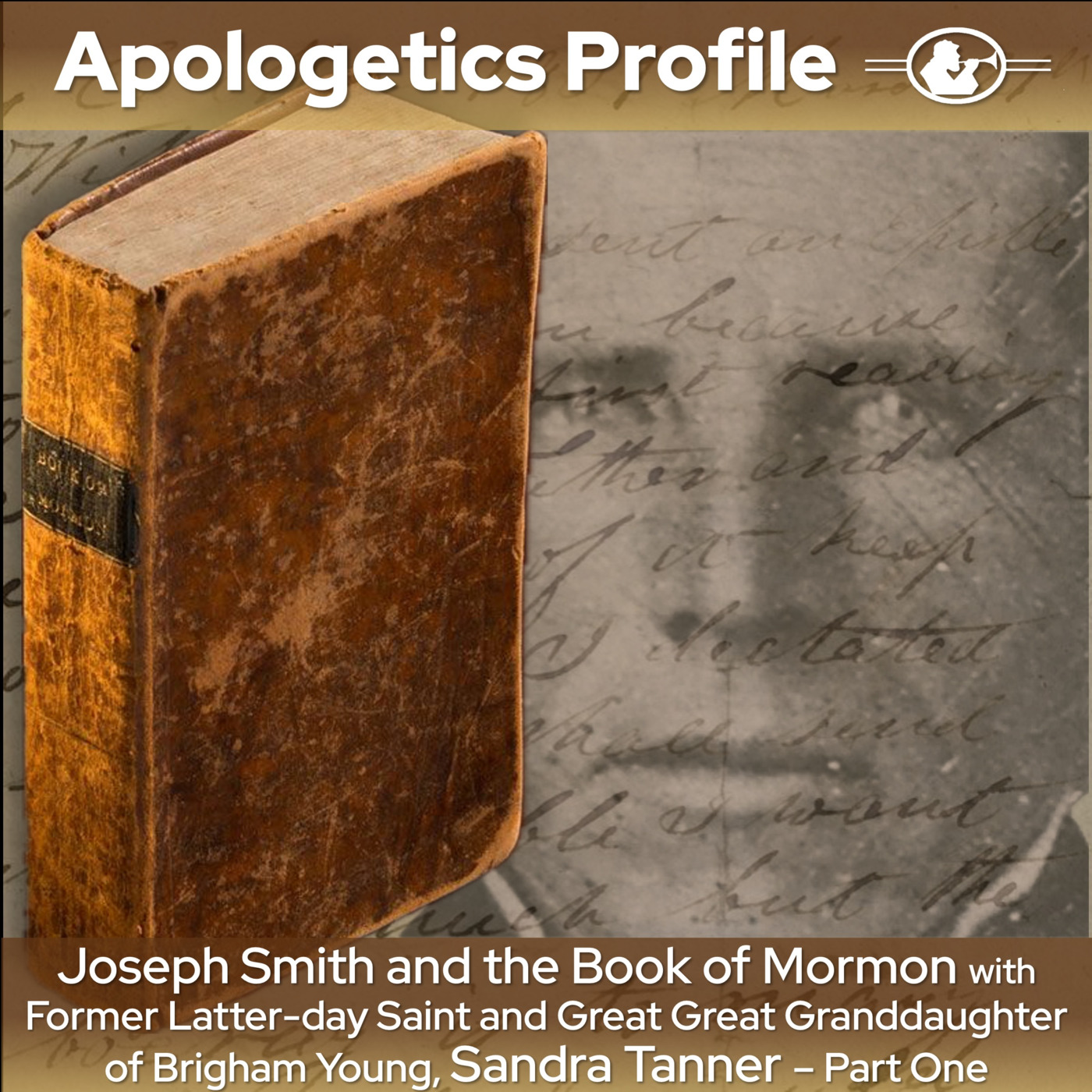
Apologetics Profile
Episode 294: Sandra Tanner Discusses Joseph Smith and the Book of Mormon - Part One
00:50:16
How could a young, relatively uneducated farm boy from upstate New York in the late 1820s have wr...
Loading summary
Transcript131 lines
- [00:10]
A
You're listening to Apologetics Profile. The further you divorce yourself from the restraints of the Bible, you more and more are free to go into whatever your natural man heart would lead you into.
- [00:38]
B
The first time the word church is used in the New Testament is in Matthew 16:18, where Jesus tells Peter, you are Peter and upon this rock I will build my church, and the gates of hell shall not prevail against it. The Greek word translated in English as church is ekklesia, which means assembly or congregation. This simple fact presents a historical problem for the language found in the Book of Mormon, the sacred scripture of the Church of Jesus Christ of Latter Day Saints. The word church first appears in 1 Nephi chapter 14, where we read and he said unto me, behold, there are save two churches only the one is the church of the Lamb of God, and the other is the church of the Devil. Wherefore whoso belongeth not to the Church of the Lamb of God belongeth to that great church which is the mother of abominations and she is the whore of all the earth. The events in First Nephi are said to have taken place somewhere around 600 B.C. 600 years before Jesus uses the term for the first time in the Gospels. Here is another problem. The English text of the Book of Mormon is said to have been translated by Joseph Smith from a set of gold plates inscribed in a language that Smith called Reformed Egyptian. There is not, however, any evidence that such a language ever existed. The Nephites were supposedly a lost tribe of Israel who had recently migrated somewhere to north or South America at the time thousands of miles away from both Israel and Egypt. So, putting it all together, here is the lost tribe of Israel who would have allegedly spoken Hebrew, living somewhere in ancient Mesoamerica in 600 BC, engraving their history onto plates of gold in characters of a language that would have been completely foreign to their own, and for which there is no evidence of it anywhere in the world today. And when Smith allegedly translated the reformed Egyptian from the ancient gold plates into English. Oddly, the final copy of the Book of Mormon sounds much in every way like it came directly from the pages of the King James Bible. It is helpful here to understand some background about Joseph Smith prior to his allegedly finding and translating the Book of Mormon. As a teenager, Smith often worked as a treasure seeker, using a special kind of stone called a peep stone or a seer stone to locate buried treasure. Part of the process of finding and then recovering treasure included occult like ceremonies to ward off evil spirits which allegedly guarded the cache. Smith, however, never actually found any treasure and was even taken to court in Bainbridge, New York in March of 1826 for disorderly conduct related to his fraudulent endeavors of glass looking, as treasure seeking was sometimes called. But it is noteworthy that just over a year later, in 1827, Smith allegedly comes into possession of the plates of gold. Smith tells the story that the plates and their location were first revealed to him in 1823 by a human being turned angel named Moroni, who allegedly was the last Nephite prophet and the Son of Mormon. It was not until 1827, however, that Smith was finally permitted by Moroni to excavate the plates. Smith convinced his family and friends of the story without ever initially showing anyone the plates. Smith then later hand picked some friends and family and arranged a specific time for them to see the plates, and there are indeed several eyewitness testimonies of individuals who said they had seen the plates, but Smith remains the only individual to have translated them. During the translation process, Smith often worked from behind a blanket or sheet, dictating the words to a scribe. Two of his early scribes, Martin Harris and Oliver Cowdery, according to the late LDS historian Fawn Brody, were caught in a spell of one of the most enigmatic characters of the century. Brody also notes that Cowdery years later described Smith as having some kind of mysterious power, which even now I fail to fathom. Historian and former LDS Dan Vogel, in his 2004 book Joseph the Making of a Prophet, notes that Smith's oral dictation to his scribes had the fluency and tone of a gifted spirit filled preacher, delivering his sermon impromptu and unrehearsed. Where Smith had previously relied heavily on his personal charisma, he felt diminished when expressing himself in writing. In short, Smith had a talent for oral storytelling. He was an enigmatic and captivating person and was quite familiar actually with the theological, political, historical and cultural discussions of his day. In 1832, just two years after the first publication of the Book of Mormon, Alexander Campbell authored a short pamphlet critique of the Book of Mormon titled An Analysis of the Book of Mormon. Campbell observed that just about everything discussed in northern New York at the time somehow found its way into the Book of Mormon. Campbell says, quote, this prophet Smith, through his stone spectacles, wrote on the plates of Nephi his Book of Mormon every error and almost every truth discussed in north New York for the last 10 years. He decides all the great controversies, Infant baptism, ordination, the Trinity, regeneration, repentance, justification, the fall of man, the atonement, transubstantiation, fasting, penance, church government, religious experience, the call to ministry, the general resurrection, eternal punishment, who may baptize, and even the question of Freemasonry, Republican government, and the rights of man. All these topics are repeatedly alluded to, End quote. One of Smith's first scribal secretaries, Martin Harris, gave George Reynolds and Samuel Spaulding an account of what he saw Smith do during the translation process. Reynolds and Spaulding tell us that Harris said that the prophet possessed a Seer stone by which he was enabled to translate as well as from the Urim and Thummim, and for convenience he then used the Seer Stone. Martin explained the translation as by aid of the Seer stone sentences would appear and were read by the prophet and written by Martin, and when finished he would say written, and if correctly written that sentence would disappear and another appear in its place. But if not written correctly, it remained until corrected so that the translation was just as it was engraven on the plates, precisely in the language then used. The difficulty Harris testimony creates for the Book of Mormon is that there have been some 4,000 changes to the text since its first publication in 1830. If what Smith was reading from the stone to Harris was coming directly from God and was quoted correct, then why make so many changes? Alexander Campbell did not mince words when he opined, the book professes to be written at intervals and by different persons during the long period of 10, 20 years. And yet for uniformity of style there never was a book more evidently written by one set of fingers nor more certainly conceived in one cranium. So since the book first appeared in human language than this same book, if I could swear to any man's voice, face or person assuming different names, I could swear that this book was written by one man. It is crucial to understand, though, that most Latter Day Saints believe the Book of Mormon to be true in spite of these and other difficulties, because they have prayed about it and believe they have received confirmation from God that it is true. Here is Ezra Taft Benson, who would go on to become the 13th president of the LDS Church in 1985, speaking at the LDS General Conference in 1975 on the issue of how he knows the Book of Mormon is true.
- [10:36]
C
As Joseph Smith, the Prophet, the instrument whom God used to translate this record, testified that the Book of Mormon was the most correct of any book on earth and the keystone of our religion, and a man would get nearer to God by abiding by its precepts than any other book. The Book of Mormon was written for us today. God is the author of the book. It is a record of a fallen people, compiled by inspired men for our blessing today as to whether this book is the work of God or of an unlearned youth. And when we are finished reading the things in the book, Moroni exhorts us to put it to the test in these and when ye shall receive these things, I would exhort you that ye would ask God, the Eternal Father, in the name of Christ, if these things are not true. And if ye shall ask with a sincere heart, with real intent, having faith in Christ, he will manifest the truth of it unto you. By the power of the Holy Ghost, I have done as Moroni exhorts, and I can testify to you that this book is from God.
- [12:22]
B
This week and next on Apologetics Profile, we will be talking with renowned former Latter Day Saint and great great granddaughter of Brigham Young, the second President of the LDS Church, Sandra Tanner. Sandra and her late husband Gerald both came out of the LDS church in the 1960s. The Tanners spent decades long before the Internet and Google, visiting libraries and universities, thumbing through card catalogs, searching the historical archives of the LDS Church, researching and compiling information pertaining to many of the problems with the history, doctrine and practices of the LDS Church. Their conclusion was, and still is, that the Book of Mormon is not finally from God. Their landmark publication, Shadow or Reality, is now accessible for free in PDF form. Be sure to see the link to the book in the notes of this episode to get your free copy. During this past April's LDS General Conference weekend in Salt Lake City, I recently had the honor and privilege of meeting up with Sandra to chat more about Smith and the Book of Mormon as we begin Part one. I asked Sandra what she thought about how the Book of Mormon really came together. Could Joseph Smith have possibly pulled off such an accomplishment by himself? Here is Sandra Tanner.
- [13:50]
A
Well, you have to begin with a very storytelling teenager. He loved to entertain his family in the evenings. His mother tells how he used to talk about the American Indian and their religion. Habit of dress, modes of travel, all these things. So he was fascinated by Indian lore. He was also fascinated with religion. He was going to revival meetings as a teen. He was in the local teenage debate club. It shows an active mind. And the Mormons, I think, lds excuse me people. I grew up being Mormon and speaking Mormon until we got Brother Nelson and it's a little hard to break the habit. In Joseph's teenage years. I see him interested in all that's going on in his environment and to me he's like a mental sponge. Things he hears that he's interested in, he retains. And so if you think of someone like you would see on a game show host situation where you ask him questions on everything under the sun, and you wonder, how do these people ever remember all this material from all these different odd situations and words and places and all kind of things. I think Joseph Smith had a talent like that. He absorbed things he heard, what he observed around him. In his community. There was much discussion about where the Indians came from. Were they part of the lost tribes of Israel? Was there a higher civilization before the Indians that were encountered by Columbus who built the mounds in the New England area? Was that the Indians that Joseph would have known in his day, or was it some prior higher civilization? A lot of people speculated that they didn't think the Native Americans of Columbus day were advanced in their technology enough for the different artifacts, things that would be found. And so there were a lot of books written already in Joseph Smith's day of whether the American Indians were from the lost tribes of Israel. I mean, there were dozens of books that speculated on all these kinds of areas. Doesn't mean Joseph had to read them. It just means the discussion has to be in the public air. And in the newspaper of his day, there would be articles on speculations about the Indians. So, and we know, by the way, we know that the Smiths subscribed to the newspaper, the local paper, because they were on the delinquent subscription list one time in the newspaper. So they have access to information around them. There's been a lot of study lately on Joseph Smith's dependence and interaction with Clark's commentary, which was the Methodist commentary of his day, very popular. We know Joseph had a favorite feeling towards the Methodists as opposed to the Presbyterians that his mother would go into. And so all these things have an influence on his thinking, on his theology, on his view of the world as a teenager. His home was not a family that was going to a particular church regularly. When his older brother Alvin dies of a bowel obstruction, the minister at the funeral implies that Alvin went to hell because he wasn't a baptized member of the local congregation. And we know this turned the father off to where he didn't want to go to any of the revival meetings that Joseph and his mother and brothers and sisters were going to. So there was dissension in the home. His grandfather had read Thomas Paine. There was interaction in the home on different religious topics. So I see a very inquisitive young man sopping up all kind of discussions and things around him so that when he's as teenager, he gets involved in this magic money digging phenomena that was going big in the New England area at the time. Many farmers using witch hazel sticks to find water, but they also used it to find minerals and hoping to find gold or treasure or whatnot. There were legends that Captain Kidd at one time had hid treasures.
- [19:05]
D
Yeah.
- [19:06]
A
Somewhere along the areas there. So there was a lot of attention given to seer stones. This would be like crystal ball gazing. And we know that the Smith family got involved in this. And Joseph Smith and his father were digging a well for a neighbor. And Joseph came across a very unusual little brown oval shaped stone, kind of like an egg.
- [19:36]
D
Yeah.
- [19:37]
A
That had stripes through it. And he felt this was sort of like a crystal ball, that it had certain powers, that if he put it in his hat and stared at it, that he could look into the stone and see where buried treasures were at. So this is working very much like a crystal ball kind of an idea. He does this as a teenager and there's a lot of documentation for this. And Mormon hearing this says, oh, you know that's not true. Well, I think you'd find even on the Mormon gospel topics, they are conceding a lot of these things at this point.
- [20:14]
D
It's in the museum in downtown Salt Lake too, isn't it? Or at least the facsimile of the stone.
- [20:18]
E
Right?
- [20:19]
A
Yeah. Right. Yes. The church owns the stone. They've always owned the stone. They just didn't talk about it. When I was a teen, I never heard anything about a seer stone being used for the Book of Mormon.
- [20:28]
D
So the church knew about it for decades, always knew or for since the beginning of time, and hid the idea of the stone.
- [20:35]
A
But Joseph first used this stone to find, to try to find buried treasure. And you would pay him a certain fee. And maybe you'd go out at midnight, draw magic circles, do magic incantations. And then supposedly you, through these spells, you would bind the spirit that guarded the treasure. And if you did it right, you could dig up the treasure. But if you made a mistake in the process, the treasure was slipping the ground and you wouldn't be able to get it. So as far as we know, we do not have an account of anyone that said they found a treasure. And when he was digging for Mr. Stoll down in Pennsylvania, he was hauled into court for illegal representation of having this power to find buried treasure.
- [21:29]
B
A glass look.
- [21:30]
A
A glass looker. Yeah, because this was the same as being A gypsy with a crystal ball that would come through the neighborhood. It was seen as some sort of fraud being perpetuated on the public. And so when he's charged with being a glance looker, this is like saying you're like the gypsies with these con games of telling people you can find something by looking in your crystal ball. Only Joseph looked at his stone well after this hearing, and he's evidently let go. He's 20, he's not 21 yet. And the court at that time would have been a circuit court. It only met like every three to six months with a traveling court from community to community because they didn't have enough population to have a sitting judge in every little hamlet. And so they don't want to have him bound over in jail for six months till the next court. So they just let him evidently go at the county line. That's somewhat of a supposition. But we know he was arrested. We have the papers for that and the charges that were that he was charged with being a glass liquor. So he gives up doing money digging, but he switches to a new claim at this point. And so now instead of using a stone to find buried treasure, he now claims this stone will help him translate this record that an angel has told him about that's hidden a hill down the street from their house. And this record of these ancient inhabitants would have all this knowledge about God that had been lost through the great apostasy.
- [23:07]
D
Now he's still a teenager when this angel appears, correct?
- [23:11]
A
Yes.
- [23:11]
D
Yeah, according to his accounts, yes.
- [23:13]
A
He's looking back at telling us a past event. We don't have a current document to support any of this. We have to accept his word on this.
- [23:24]
D
Yeah.
- [23:25]
A
Anyways, so if you move the time up to 1827, well, the. When he's hauled into court on the money digging, that's in 1826. So in 27 he's telling people about this new record that an angel has told him about, but he can't get the record for a few years because he has to prove himself worthy to the angel to get the plates. Well, anyways, he finally gets the plates in 1827, but he's now going to use that same rock, that same stone that he used for money taking is going to be the rock he's going to use to translate. Now, one of the problems with this is that the Book of Mormon record itself says that God preserved a special set of some sort of spectacles with the plates so that in future generations, whoever translated the plates would be able to read this unknown language by looking through these spectacles at the plates.
- [24:24]
D
And this is in addition to the seer stone. Yes.
- [24:27]
A
Right. So he doesn't end up using the spectacles because evidently hurts his eyes. So he's using the stone in his hat. And it's more convenient. You can carry the stone around with you all the time.
- [24:42]
D
And President Nelson recently was on video created by the church where he's explaining this process to someone who is being interviewed. And he goes for a hat and tries and he's using it as a prop. And he's about to tell the lady, well, this is how Joseph. And he stops. He doesn't put his face completely in the hat, almost as if he realizes what that's going to look like on a camera. But this is what the Church is conceding now is that Joseph translated the Book of Mormon by this specific means. A stone in the hat. Correct.
- [25:13]
A
Right. And when I was growing up in Mormonism in the 50s, I went to seminary, went to institute, attended the dedication of the LA Temple, fully active. So I knew what the rhetoric was of the time. I never heard of that stone.
- [25:30]
D
Wow.
- [25:30]
A
I never heard of this process. All I was ever told about was the Urim and Urim and Thummim or the spectacles. That was the only way I ever heard that he worked on the plates. But when you look at the statement by the people that were in the room, like Hamilton's show in those that were in the room when it happened.
- [25:54]
D
Yeah.
- [25:55]
A
They say they watched him put a stone in his hat.
- [26:00]
D
Martin Harris, Oliver Cowdery.
- [26:02]
A
Yeah. So that the stone in the hat, he. He's reading the words off the stone. And the church leaders are endorsing this today because you have different ones of the church leaders that have gone on record of demonstrating this by holding up their cell phone and saying, that's amazing. That's amazing that this is how the technology would have worked on the stone. That it would be just like reading a text message off your phone for him to look at the stone in the hat and read the message off.
- [26:37]
B
You're about to hear two clips from Latter Day Saint officials describing the Seer Stone. Smith used to translate the Book of Mormon like it was a 19th century version of a cell phone. The first clip here is from Brad Wilcox, who is presently the first counselor in the Young Men General Presidency in the Church of Jesus Christ of Latter Day Saints when he was teaching a class on the Book of Mormon at Brigham Young University in Provo. Here's Brad.
- [27:05]
E
I'm Brad Wilcox, and I'm starting a new semester teaching Book of Mormon at byu. And I thought I'd share with you some of the visual aids that I use with my students. This is a replica of the seer stone or one of the seer stones that Joseph Smith had. This was the stone that he found in a well when digging a well when he was a young man. And then when he would look into the stone, he would be able to see things that other people could not see. And part of the translation of the Book of Mormon was done with the Urim and Thummim, but part of the translation was also done with a seer stone or several seer stones. Now, people often get confused because they hear that Joseph Smith put a seer stone inside of a hat and then would look into the hat to see the seer stone, and they think it sounds weird. But when I compare for my students the seer stone to a cell phone and I say, hey, a smooth surface on which words appear that can be read, then it makes more sense to them. I also say, hey, when you're out on a sunny day and you're trying to look at your cell phone, you wish it were darker. We often go like this to try to see the words better. Well, no wonder Joseph Smith put his cell phone or his seer stone in the hat so that he could block out light and he could see what was being written, what was given to him on the seer stone a little clearer. So maybe with these visuals in mind, then help you understand a little better. Just like I hope it helps my students understand a little bit better about the translation process of the Book of Mormon.
- [28:50]
B
The next clip is from the current president of the LDS Church, Russell M. Nelson, describing the exact same process.
- [28:59]
C
Quite miraculous, really. Through the gift and power of God. We have a lot of suggestions about how it was done. We know that they had a table like this. We know they had the golden plates covered usually. And Joseph used these Durham and Thummim seer stones in the hat. And it was easier for him to see the light when he take that position. To me, it's like having my mobile phone in my hand and I can get messages on it that you can't see.
- [29:38]
B
That's true.
- [29:40]
C
And they had nothing like that. So it's just the gift and power of God.
- [29:46]
A
But when you say that you are committing yourself to a very literal translation, word for word, and that if God is giving this translation word for word on the stone and Joseph is simply reading it, then you cannot say Joseph brought in any of his own thoughts or his own words, his own concepts, or anything into the translation if it comes word for word.
- [30:18]
D
You and Gerald worked tirelessly on compiling. What's the title of it? 3913. Is that what it is?
- [30:25]
A
Yes.
- [30:25]
D
3913 corrections from the 1830 to the second edition. 1835, is that correct?
- [30:33]
A
No, not to the 1830, not to the second edition. We compared the 1830 edition to the 1965.
- [30:41]
D
Okay, okay.
- [30:42]
A
Book of Mormon, the. The current Book of Mormon of the day when we did the comparison.
- [30:46]
D
Gotcha. So, but your point changes made in between. But this point is amazing because if that came off the stone verbatim like you would see words on your cell phone, there's no room for any kind of mistake.
- [30:59]
A
Right?
- [31:00]
D
And in fact, the church held that position, didn't it? The several presidents held that position.
- [31:04]
B
There's no error right there.
- [31:06]
A
That's what I was told.
- [31:07]
B
That's what you were told.
- [31:08]
D
And now they have completely backed away from Book of Mormon infallibility, haven't they?
- [31:13]
A
Yes. Yes. In fact, now, when different researchers have studied the literature of Joseph Smith's day, what was available to him, we are more and more seeing influences of his day that come into the Book of Mormon. And as the church scholars try to grapple with this, they have to change the narrative from this text, read off a stone to Joseph Smith, giving some sort of inspired personal wording to the concepts of the Book of Mormon text so that it allows for him to bring in current theological arguments of his day, that it allows for him to bring in items that would have been influenced by Clark's commentary, where Clark would talk in his commentary on the Bible about a passage that was translated wrong or a phrase that should have been in or shouldn't have been in. And Joseph Smith seems to be following different things that Clark talks about.
- [32:19]
B
Adam Clark was a Methodist theologian in London who published an enormous six volume commentary on the Bible between 1810 and 1825. The commentaries became widely popular and were available in the United states sometime between 1824 and 1825. Joseph Smith had shown some sympathy toward Methodism in his younger days and is believed to have had access to Clark's commentaries. There are indeed several significant parallels between Adam Clarke's commentaries and several of Smith's editorial rewritings of the King James version found in the Joseph Smith translation of the Bible. Some of the exact parallels between Clark and Smith include grammatical changes in Colossians 2 verses 20 through 22, a complete omission of Luke 19:25, changing the word unicorn in Isaiah 34, 7 to a Hebrew transliteration, the use of the word covenant six times in Hebrews chapter 9, and a complete denial of the Song of Solomon as an inspired book of the canon. All of these specific annotations and more are found in Clark's commentary on these passages, which strongly suggest them to be more than merely coincidental with Smith's translation. This information comes from the 2020 book Producing Ancient Joseph Smith's Translation Projects in the Development of Mormon Christianity and edited by Michael McKay, Mark Ashurst McGee and Brian M. Hoglit. It is found in Chapter 11, titled A Recovered. The Use of Adam Clark's Bible Commentary in Joseph Smith's Bible Translation by Thomas A. Wayment and Haley Wilson Lemon.
- [34:05]
A
We see in the theological arguments, the arguments of Joseph Smith's day infant baptism. These are the kinds of Masonry Freemasonry.
- [34:19]
D
Alexander Campbell's famous quote in his first booklet that was against Mormonism has that. I can't quote it verbatim. That wonderful paragraph where he's like, everything that has been discussed in Palmyra, New York in the last decade is right here in the Book of Mormon.
- [34:32]
A
Right?
- [34:32]
D
Yeah.
- [34:32]
A
Right. So you can see these reflections. And the Mormon scholars are more and more realizing they've got to have some way to account for that. So you have to go to some sort of paraphrased translation. But the witnesses don't give room for this.
- [34:51]
D
Right.
- [34:52]
A
And the church leaders seem to be hanging on to the old story. I grew up on that. Every word came from God. Otherwise, it's not like your text message on your cell phone.
- [35:05]
D
It's not. It's Joseph sees a word on the stones. Now, Sandra, he was, as far as the witnesses go, anybody involved with the translation process early on when they were doing this, he's the only one that ever stuck his face in the hat and saw words. Correct.
- [35:18]
A
Right.
- [35:19]
D
Okay. So this what we're talking about. Whatever words appeared on the stone have absolutely no parallel corroboration with any other human being. Right.
- [35:28]
A
Well, and the witnesses wouldn't even have seen it either. All they would have seen was him put his face in the hat.
- [35:34]
D
Yeah.
- [35:34]
A
They don't know. They wouldn't have known whether it was working.
- [35:37]
D
Correct.
- [35:37]
A
They're just going on his word that he's seeing stuff on that rock.
- [35:42]
D
I know recently in the news, speaking of Joseph Smith's, couple of other issues surrounding Mr. Smith's translation skills or abilities or prophetic giftings. Or however you want to word it. The church, the LDS Church has come into possession of the copyrights for the Joseph Smith translation of the Bible. Is that correct? And this has been from. In recent.
- [36:02]
A
They've come into possession of the manuscripts.
- [36:06]
D
Okay.
- [36:06]
A
Copyright was never an issue.
- [36:08]
D
Okay. It was the manuscripts themselves that were in.
- [36:10]
A
Yeah, copyrights expired on everything. Anything before 1920 is out of copyright.
- [36:15]
D
Gotcha. But they now have in possession the manuscript of Joseph Smith's translation of the Bible. And what's interesting about that. Sandra, a couple of questions for you about that. One, if this, I mean, it looks like from. From a. Of a non Mormon position, he just took the 1611 King James and it was basically like Joseph Smith's commentary where he'd line out words and add word, add some phrases and, and that sort of thing. Why hasn't that featured or has that featured in your time featured prominently in. You know, if you want to validate Smith's translational skills and abilities, why not make the JST your translation for the LDS Church? Why do they sort of hesitate in that regard? Is that because they just didn't have the manuscripts or that is the translations that Smith made a little bit sketchy? Why put this in the back burner, in other words?
- [37:10]
A
Well, you have to look at when he did the inspired revision. He did that in the early 1830s. He hasn't developed his unique theologies that are a part of Mormonism today.
- [37:23]
D
Okay.
- [37:24]
A
So that in the early 1830s, he doesn't have the idea of plural gods, the father and son being separate deities that we pre existed, that there's temple work, work for the dead, sealing of families for all eternity, evolution to godhood. These concepts weren't in Joseph Smith's thinking yet. So when he does his revision, it even makes changes that would lock down the Godhead tighter to one God than it would go the other way.
- [38:02]
D
Wow. So what we're looking at in the Joseph Smith translation is a very early development of Smith's theology. And I think maybe even. Do you think that the growth of the church initially after the Book of Mormon was published in 1830, 5,000 copies went out. That Smith was caught off guard by the growth of what we now call Mormonism or the LDS Church. I mean, you have the numbers added to the congregation in Kirtland and it seems like there's this exponential growth either catches Smith off guard or he's like, well, I got to do something about this. Why is his theology changing from this, what seems to be early on compatible monotheism to this radical idea of polytheistic becoming gods. Was it the growth of the church or was it just Smith's popularity was like, wow, my storytelling is taking off. I got some power here. I can do this. Why do you think his theology evolved from 1830s to the time he died?
- [38:59]
A
Well, once he is established as God's prophet, seer, revelator, and translator, I think he gets thinking of bigger things once he starts having a following and he's got. It jumps from a dozen or two people in Palmyra to hundreds of people, and suddenly he's got a whole movement looking to him that he gets bigger and bigger ideas of what this could be. You see Joseph Smith evolving as. As his power grows. And one of the things. If you're going to start a new religious movement and aspire to be a prophet, one of the things that you run into is you have to keep getting new, bigger ideas to keep your following. And if you have any competitors, you have to outdo them in new revelation to prove you're the prophet and you have the direct conduit to God and you have the big ideas. And so in. In religious movements, you see this growth of a man, the further you divorce yourself from the restraints of the Bible, you more and more are free to go into whatever your natural man heart would lead you into. And so he gets bigger and bigger ideas about himself and what the universe could hold. I mean, there's no limit.
- [40:42]
D
Well, there's one particular example which is really fascinating for me that I didn't know until I started looking into the background of this historically and theologically. It's not until a funeral sermon that Smith gives in 1840, Colonel Brunson, where it seems like out of thin air, Smith just comes up with baptisms for the dead. And then a couple of months later, he circulated a letter to people either in England or somewhere. Apparently, brethren, you've heard me say something about baptisms for the dead. But the remarkable thing is it seems that's the first time he's ever mentioned it. There's nothing in the texts of the Book of Mormon at this point. This seems like a novel theological development that he's unscrupulously basing on First Corinthians 15:29. Well, look, this is in the Bible. So now we're going to do it because this widow's son wasn't baptized and this poor lady, and she doesn't want to be without her son. So we're going to invoke this practice. And then, and now Smith's got Something to accommodate this idea that upset his father, which is, you know, well, my brother couldn't have died.
- [41:51]
A
Well, Joseph had an earlier revelation where he tried to solve the Alvin problem.
- [41:56]
D
Okay, okay.
- [41:57]
A
Where he had a vision where he saw Alvin and his family in heaven.
- [42:04]
D
Wow.
- [42:04]
A
And so his first way of solving Alvin isn't in hell is that he has a vision where he sees Alvin with God.
- [42:12]
D
Okay, okay.
- [42:13]
A
Because he's got to some way take care of this problem. Well, I assume at the back of his mind, someone's still working. If you're going to preach that you have to have baptism to join our church, that you need. Correct. Priesthood of power and all that. Alvin didn't have that right.
- [42:29]
D
We got to retrograde, add him into that somehow.
- [42:33]
A
So I see him through the years in the back of his mind, still carrying this weight of will. This save Alvin. So. Well, he wasn't baptized. Maybe I need to do more than just have a vision of seeing him in heaven. Maybe something more needs to be done. And so finally he comes up with baptism for the dead. Oh, well, we could take care of it now. Everyone will be happy for this because we can just do this right for people that are.
- [42:58]
B
And it's in the Bible.
- [42:59]
D
Look, Paul says it in 1 Corinthians 15:29. Which brings up a point, Sandra, that when you talk to, when you engage LDs, whether it's the missionaries at your door or somebody you meet in person, they'll kind of walk the line where it says, well, we believe in the Bible just like you do, or this verse is in the Bible, or they use these point verses in Scripture to bolster their doctrine. How is it that they legitimize the practice of the baptism for the dead on one verse that Paul mentions? And we know, historically, we're not even sure what Paul's talking about, but. But that verse in 1 Corinthians 15:29 is not an endorsement of a practice for the early church or any Christian to be baptizing for the dead, Correct?
- [43:40]
A
Well, that's right. But this is the problem with all false prophets because they find some obscure verse that they can pull in a meaning to. And the average person hasn't thought about these different obscure verses the false prophets tie into. And it throws you off, off guard when you're talking with him. What? Say what? What?
- [43:59]
D
It's in the Bible.
- [44:00]
A
I never heard this, you know.
- [44:01]
B
Right, right.
- [44:02]
D
Oh, it's in the Bible. I can show you right here.
- [44:03]
A
Right.
- [44:04]
D
I've been reading Dan Vogel's book that came out about 25 years ago, Joseph Smith. I forgot what the title is. It's big.
- [44:13]
A
The Making of a Prophet.
- [44:14]
D
The Making of a Prophet. Right. He has an interesting thesis where he goes through a little, in a little bit more detail than I've ever seen or heard, ascribing things, certain events to the Book of Mormon that are happening or had happened in Joseph Smith's day, like the War of 1812. And I was reading this morning, Vogel suggests that Moroni is a baptized Christian version of Andrew Jackson in the latter chapters of Alma. But the biggest. I think a lot of Christians are unaware of this, but the biggest historical anachronism in the Book of Mormon, I think, or at least one of the biggest ones, Sandra, is you see Christians and churches and Jesus all mentioned in BC time in North America. This is even before Jesus is physically brought into the world through Mary and the Christmas story that we have in the traditional Christian sense. No, we have Jesus appearing in BC time, giving prophecies and whatnot. And so there's the Nephites and the Lamanites. There's a Christian church in the BC area somewhere on the North American continent.
- [45:20]
B
How do LDS today.
- [45:22]
D
How does the LDS Church today explain this? This seems like a really weird. I mean, outside of the bounds of any orthodox Christianity, how can you have this language before Christ?
- [45:34]
A
Well, Mormons are taught that the Gospel was fully revealed to Adam and then civilization has gone through periods of flux, of losing the knowledge, restoring the knowledge. And so they would not see it as out of place. They would see it as part of this flow from Adam's time to ours, of having the full knowledge and losing it and restoring the full knowledge and losing it in this ebb and flow. Except there's nothing else that shows there was ever this kind of understanding in a civilization of all about Christ and the church, the atonement.
- [46:17]
D
Yes, and.
- [46:18]
A
And in the Book of Mormon, I mean, right at the start, you get prophecies of Mary, who would be the mother of God.
- [46:25]
E
Yes.
- [46:26]
A
So that you have. Well, when Gerald and I first left Mormonism, we still believed the Book of Mormon. We thought everything else was wrong. We'll throw all that out. But we could still believe the Book of Mormon. But the more we read the Bible and the Book of Mormon together as young believers and trying to follow Jesus but still hanging on to the Book of Mormon. Gerald was more and more struck with the problem of New Testament theology in the Old Testament portion of the Book of Mormon with the quoting, it would seem, of Pauline phrases in the Old Testament portion of the Book of Mormon.
- [47:07]
D
Yeah.
- [47:08]
A
How can these 600 BC to 1 BC how can they all be so familiar with the King James New Testament? And Gerald really struggled with this. And so when he still believes in Book of Mormon, his solution. This shows you how desperate you could be when you're trying to hold on to something. He finally concluded God had to reveal to the Nephites the King James Bible so that they could understand it in English. There was no other way you could account for the verbiage.
- [47:49]
B
Wow.
- [47:50]
A
But it doesn't really solve anything because what did they do, write it down in English in their plates?
- [47:58]
B
That's the problem.
- [47:59]
D
Because, Sandra, the plates, this allegedly the whole Book of Mormon, as you know, came out of plates. And when Smith was translating, he didn't even really look at the plates.
- [48:11]
B
But if.
- [48:12]
D
Let's. Let's just grant the plates are what the LDS Church says they are, reformed Egyptian characters. I wanted to read something from Alma because this struck me. I read this this morning in preparation for our talk, and it was Alma 46. And it says, this is Moroni and the death of Amalickiah, the wicked king. And this is Moroni. And he tears off a piece of his clothing and creates basically the Moroni version of the American flag. And then he says, this. This is Alma4614.
- [48:51]
B
For thus were all the true believers.
- [48:53]
D
Of Christ who belonged to the Church of God, called by those who did not belong to the church. Now, this is 73 BC or 76 BC or something like this. And I'm wondering to myself, what does this language look like in reformed Egyptian? You are thousands of miles away from Egypt, from Israel. You're on a new continent.
- [49:14]
B
You're in a new world.
- [49:16]
D
Why are you writing this phrasing in reformed Egyptian? And what would that even look like? It just stretches the imagination beyond what seems even miraculously possible, Right?
- [49:28]
A
Well, it wouldn't be possible linguistically.
- [49:31]
B
No.
- [49:33]
A
If everything's in reformed Egyptian, you could not possibly translate that into English and have it exactly mirror King James language and phrasing.
- [49:47]
B
It just.
- [49:48]
D
It doesn't line up.
- [49:49]
A
It just doesn't work that way.
- [49:56]
D
You've been listening to Apologetics Profile, a.
- [49:59]
A
Podcast ministry of Watchmen Fellowship Incorporated.
- [50:02]
B
For more information about our ministry and.
- [50:04]
A
Resources, visit our website@watchman.org.