← Apologetics Profile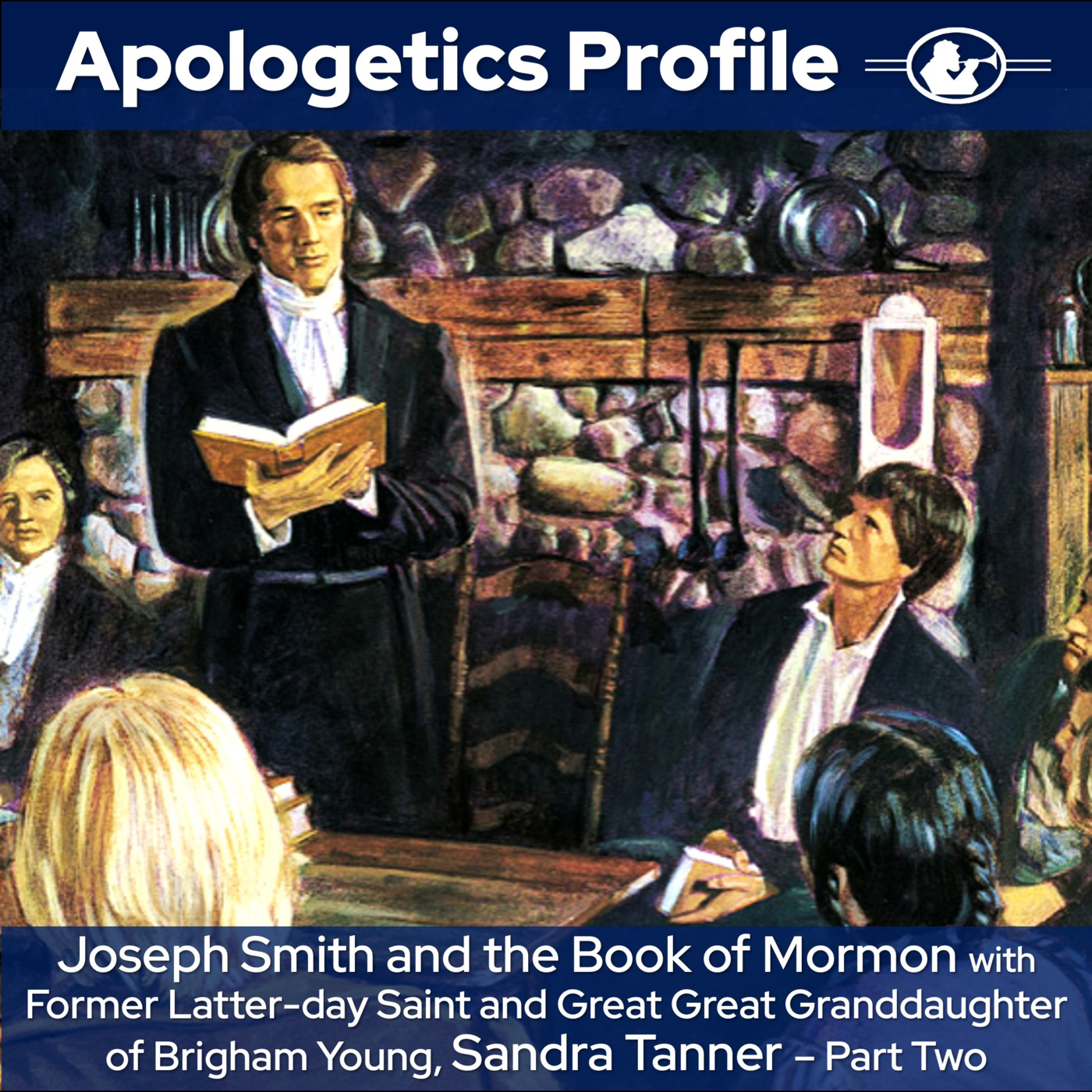
Apologetics Profile
Episode 295: Sandra Tanner Discusses Joseph Smith and the Book of Mormon - Part Two
00:47:33
The 15th president of the LDS Church Gordon B. Hinkley said in 1961 that "this cause is either tr...
Loading summary
Transcript141 lines
- [00:09]
Podcast Host
You're listening to Apologetics Profile.
- [00:16]
Sandra Tanner
When I was in the eighth grade, a Christian girl came up to me and she said, sandra, I understand you're a Mormon. And I said, yes. And she said, well, what do the Mormons believe about God? Now this is back in the 1950s when the Mormons used Lorenzo Snow's couplet all the time. So what do the Mormons believe about God? And I say to her, this little couplet, as man is God once was, as God is man may become. And she looked at me, horrified, evidently understanding what that couplet would mean, and said, sandra, that's blasphemy. That started my thought process. Why would the outsiders think the Mormon's view of God was blasphemy?
- [01:16]
Narrator/Researcher
Just prior to his death in 1844, Smith proclaimed in a funerary oration for his friend King Folletti that we can actually become gods ourselves. God himself was once as we are now, and is an exalted man and sits in yonder heavens. That is a great secret. We have imagined and supposed that God was God from all eternity. I will refute that idea and take away the veil that you may see. God was once a man like us. Yea, that God himself, the Father of us all, dwelt on an earth the same as Jesus Christ himself did. If you have read or studied anything about Joseph Smith and or the Book of Mormon, you are likely familiar with the fact that from the time of the publication of the Book of Mormon in 1830 up until his death in 1844, Smith's theology underwent a dramatic shift from basic monotheism to a radical polytheism. Much of the change can be attributed to Smith coming into possession of some authentic ancient Egyptian papyri in 1835 in Kirtland, Ohio, Papyri he received from a traveling Egyptian artifacts dealer. As Smith himself writes in his history of the church. Sunday, July, 1835, the 5th. I, Joseph Smith, commenced the translation of some of the characters or hieroglyphics, and much to our joy, found that one of the rolls contained the writings of Abraham, or another the writings of Joseph of Egypt, etc. A more full account of which will appear in its place as I proceed to examine or unfold them. Truly, we can say the Lord is beginning to reveal the abundance of peace and truth. The remainder of this month I was continually engaged in translating an Alphabet to the Book of Abraham and arranging a grammar of the Egyptian language as practiced by the ancients. And as the opening of the Book of Abraham says, which can be found in the Pearl of Great Price, a translation of some ancient records that have fallen into our hands from the catacombs of Egypt. The writings of Abraham while he was in Egypt called the Book of Abraham, written by his own hand upon papyrus. Note that Smith believed the papyri in his possession were the writings of Abraham himself while he was in Egypt. But By July of 2014, the LDS Church could no longer hide or disguise the problem with Smith's alleged translation. The Church published a confession in their Gospel Topic essays that year, stating that nothing in Smith's translation actually accords with the material on the papyri. Even the dating of the papyri comes centuries after Abraham's time. None of the characters on the papyrus fragments mentioned Abraham's name or any of the events recorded in the Book of Abraham. Latter Day Saint and non Latter Day Saint Egyptologists agree that the characters on the fragments do not match the translation given in the Book of Abraham, though there is not unanimity even among Latter Day Saint scholars about the proper interpretation of the vignettes on these fragments. Scholars have identified the papyrus fragments as part of standard funerary texts that were deposited with mummified bodies. These fragments date between the 3rd century BCE and the 1st century CE, long after Abraham lived. It is in the Book of Abraham where you will find a nearly identical creation account to that of Genesis, though reworded by Smith with a significant alteration. Smith changes God to Gods this stands in stark contrast to the otherwise monotheistic overtones in the original Book of Mormon. Consider, for example, Alma 1126 through 31 and Zeezrum said unto him, thou sayest there is a true and living God. And Amulek said, yes, there is a true and living God. Now Zeezrom said, is there more than one God? And he answered, no. Now Zeezrum said unto him, again, how knowest thou these things? And he said, an angel hath made them known unto me. This angel turns out to be none other than the Son of God. As quoted in Alma 11:32. The late Egyptologist from the University of Chicago, Dr. Robert Rittner, spent a great deal of time researching and accurately translating the extant papyri used by Smith for the Book of Abraham. Rittner notes here that just given the dating of this papyri, it is impossible that this could have been written by Abraham himself. It would be like claiming that someone found an original manuscript written by Aristotle that anachronistically contain words and phrasings found in Isaac Newton's Principia.
- [06:53]
Dr. Robert Rittner
There is not a chance whatsoever that that text could. That lang that script it's written in did not even exist at the time of the Hyksos. They didn't even have those shapes of squiggles. So we can be 100% certain that it could not under any circumstances have been written at the time of whenever you want to make Abraham. Because, as I said, it's a late derivation of the Book of the Dead. All these things say late, late, late, late, late. I mean, there is no wiggle room. Zero. None.
- [07:37]
Narrator/Researcher
Not any.
- [07:38]
Dr. Robert Rittner
Not even a tiny iota. Impossible.
- [07:51]
Narrator/Researcher
Latter Day Saints actually believe they are literal spirit children of a heavenly mother and a heavenly father. They believe that they have literally inherited divine characteristics and qualities and that they will one day themselves become gods, just as Smith proclaimed in his King Follet Discourse. But this idea that God has little godlike offspring who will one day become gods in their own universe or world is precisely the same sort of false doctrine taught within the prosperity Gospel movement. In the following clips, you'll hear a Latter Day Saint, Jacob Hansen, explaining the doctrine of becoming gods and then comparing Jacob's words to the Prosperity Preacher Creflo$, making the exact same preacher point. If animals procreate and have offspring after their kinds, then when God makes man in his image or has relations with heavenly mother, then he too is creating or procreating after his kind, namely divine nature.
- [08:57]
Jacob Hansen
We believe that we are children of God, and a child grows up to be like his father, like a puppy. What does a puppy grow up to be? Grows up to be a dog. A kitten grows up to be a cat.
- [09:07]
Sandra Tanner
Right?
- [09:07]
Creflo$
We now see God producing man. And if God now produces man and everything produces after his own kind. If horses get together, they produce what? And if dogs get together, they produce what? If cats get together, they produce what? But if the Godhead gets together and say let us make man, then what are they producing? They're producing gods.
- [09:58]
Jacob Hansen
We believe that we are children of God, as the Bible teaches, and we don't believe that's some metaphor. We believe we were literally created in the image of God and we are not different in kind from Him. Where you guys only say that you can share in the attributes of God, where we say no, we actually are connected to God as His literal spirit children.
- [10:42]
Narrator/Researcher
Such a doctrine, however, eliminates Latter Day Saints from orthodox Christianity. God by definition has incommunicable attributes. That is he is self existent. He exists completely independently from his creation. His existence is not in any way contingent upon anything he has made, including us as The Apostle Paul told the Athenians on Mars, the God who made the world and everything in it, being Lord of heaven and earth, does not live in shrines made by man, nor is he served by human hands as though he needed anything, since he Himself gives to all men life and breath and everything. End quote that comes from Acts 17, verses 24 and 25. So God's self existing eternality is incommunicable. That is, God does not simply pass along his divine attributes or his divine nature to any created thing, including human beings. We do not inherit, earn or receive God's self existing eternality. In addition, unlike God, we as human beings undergo change. A lot of changes. God is, in other words, immutable. As theologian Wayne Grudem defines, God is unchanging in his being, perfections, purposes and promises. Yet God does act and feel emotions, and he acts and feels differently in response to different situations. We as human beings, however, are immutable. We are born, we age, we die, and over time our character and beliefs undergo changes. We constantly change our minds and sometimes we can't even ever seem to make up our minds. We lie, we deceive, we cheat and steal and fall resplendently short of God's glory. God, however, is not like that at all. As God declares in Psalm 50, these things you have done and I kept silent, you thought that I was just like you. I will rebuke you and present the case before your eyes. And as Numbers 23:19 says, God is not a man that he should lie, nor a son of man that he should repent. Has he said, and will he not do it? Or has he spoken and will he not make it good? God's ways are far beyond our own ways too. As the Lord declares through the Prophet for my thoughts are not your thoughts, nor are your ways my ways, declares the Lord. For as the heavens are higher than the earth, so are my ways higher than your ways and my thoughts higher than your thoughts. That comes from Isaiah 55, 8, 9 and elsewhere in Isaiah from the 43rd chapter, the Lord declares this before me there was no God formed, and there will be none after me.
- [13:37]
Podcast Host
End quote.
- [13:47]
Narrator/Researcher
This week on the Profile, we wrap up our conversation with former Latter Day Saint and great great granddaughter of Brigham Young, Sandra Tanner. Here on Part two, Sandra and I talk more about the controversies and problems surrounding the Book of Mormon. And I asked Sandra here to explain why Smith would claim that the gold plates were written in reformed Egyptian. Here's Sandra Tanner.
- [14:13]
Sandra Tanner
The current thought of Joseph Smith's day was that Egyptian was a very condensed language and that's why in the start of the Book of Mormon it says that they aren't going to write in Hebrew, they're going to write in reformed Egyptian because it didn't take as much space.
- [14:29]
Podcast Host
Save space. Yeah.
- [14:31]
Sandra Tanner
So that was the current thought of the day. So when he does the Book of Abraham, people aren't aware of the translation of Egyptian characters being done in France. And so that was still the prevailing view that a character would carry a large text in translation. So Joseph Smith gives like a very simple backward E character and gives a whole paragraph to its meaning. So with the Book of Abraham manuscripts and Joseph Smith's working papers, we can see what he's claiming to do with the papyri, which characters he's taking to claim to translate for the Book of Abraham. None of it makes sense. All Egyptologists outside of Mormonism concede that there is nothing in Joseph Smith's work on Egyptian that is credible, holds any water. Translation doesn't work that way. Egyptian isn't condensed that way. You cannot have a character that's simply a backward looking E and get a paragraph of text with proper names and everything in it. You have to go to the Mormon Egyptologists and they do have a couple of qualified Egyptologists. But what they say about the Book of Abraham, they say in the Mormon community about Book of Abraham. They are not publishing papers out for peer review by non Mormon Egyptologists for their claims of Joseph Smith's work. When they publish in peer review articles, they are doing straight Egyptian translation work that everyone would say, yeah, that's right, but it gives them credibility to the membership. So that when they turn around and deal with Joseph Smith, if they say, oh, his work has validity, then the members feel at ease. Oh, isn't it wonderful? Etologists have said it's all right, but.
- [16:28]
Podcast Host
There hasn't been any peer review about reformed Egyptian given to non Mormon Egyptologists by the Mormon community.
- [16:36]
Sandra Tanner
Right. But you have Dr. Rittner, Robert Rittner recently died. He was the head of the Egyptology department at University of Chicago. He went through the whole Book of Abraham material and was familiar with the papyri and all of those things and very firmly has come out publicly stating the Joseph Smith was wrong on everything. It doesn't work that way and it's not a valid translation. We know what the Egyptian papyri were, we know what the characters are, we can read the material. None of it has anything to do with Abraham. It's standard Book of the Dead, Book of Breathing's text. And it's just wishful thinking on the Mormons behalf to try to hang on to Joseph Smith's work.
- [17:21]
Podcast Host
Dr. Rittner, I think, told John de Lin that he would grant that Smith got the word, the correct Sandra. I know one of the things that I see in my Christian apologetic circles is that people are eager, Christians maybe, to point out all the. What they think are the failures, like what we've been talking about, the problems, the failures, the translation, the host of problems we could spend hours talking about. And they rush headlong into a discussion with missionaries or something and they just throw these facts at them. And there's no. It seems like it's very easy because you and Gerald went through this. I know reading your biography of how you engage with the wisdom of engaging the human beings behind these beliefs, because as you said, when Gerald was still hanging on to the Book of Mormon, he went to great lengths to think about intellectually, how can this still be true? So it seems like we need to, as Christians to think about the people behind these beliefs. And so Sandra, what is some wisdom that you've gleaned in presenting these difficulties to believing Latter Day Saint Mormon people?
- [18:37]
Sandra Tanner
Well, for one thing, we have to be careful not to dump the whole load at once. You don't rush in and just throw all kind of facts at them and expect them to immediately turn around and say, oh, well, I guess I was wrong.
- [18:49]
Podcast Host
Oh yeah, yeah, right.
- [18:52]
Sandra Tanner
When you have been committed for years to not just an ideology, but to a people group, to a story of your ancestry, to your history, to your own past, you just don't throw that over in a minute. It takes time to think those issues through. I needed time to process. Now Gerald and I processed it quicker and harder than most people confront all that stuff. And partly that's because we were younger. Had we been older and more committed into Mormonism, temple going, raising our kids in it, I'm sure it would have taken us longer to think through all these things and to deal with it. It still took time. It took us several years to work through the Book of Mormon to finally say, I don't believe it's scripture and I'm going to set it aside and just go with the Bible. And we met Christians along the way that couldn't understand, well, if you want to follow Jesus, why are you still hanging onto the Book of Mormon? And we would say, well, because it helps me in following Jesus. It takes time to work those things. We have to think in terms of seed planting. When I was in the eighth grade, a Christian girl came up to me. This is down in Southern California where I was raised. Christian girl came up to me and she said, sandra, I understand you're a Mormon. And I said, yes. And she said, well, what do the Mormons believe about God? Now, this is back in the 1950s, when the Mormons used Lorenzo Snow's couplet all the time. It's not used as much today, but it was very common. I was raised with this as just part of my working vocabulary.
- [20:47]
Narrator/Researcher
Sure, sure.
- [20:48]
Sandra Tanner
So what do the Mormons believe about God? And I say to her, this little couplet, as man is God once was, as God is man may become. And she looked at me, horrified, evidently understanding what that couplet would mean, and said, sand blasphemy. And walked away.
- [21:08]
Podcast Host
Wow.
- [21:09]
Sandra Tanner
Ooh. Hurt. Yeah.
- [21:11]
Narrator/Researcher
How old were you?
- [21:12]
Sandra Tanner
Eighth grade.
- [21:13]
Narrator/Researcher
Eighth grade?
- [21:14]
Sandra Tanner
Yeah.
- [21:14]
Narrator/Researcher
Wow.
- [21:16]
Sandra Tanner
And it took me years to figure out why she was offended because I would say the phrase over to me, and I think, well, that makes sense. You know, what's her problem?
- [21:28]
Narrator/Researcher
But that. That really got you processing.
- [21:30]
Sandra Tanner
That started my thought process. Why would the outsiders think the Mormon's view of God was blasphemy?
- [21:38]
Podcast Host
Wow.
- [21:39]
Sandra Tanner
Now, I will give her credit for understanding it was blasphemy because most people hearing the phrase don't realize what the Mormon means. That they're saying man can become a God, that God was once a man like us, and we can become a God just like him. But it took time for me to figure that out. Now they don't use that phrase so much anymore because they know it offends all the Christians, kind of taking that one out of circulation.
- [22:07]
Podcast Host
Right, right.
- [22:08]
Sandra Tanner
But there are those points along the way in my life when I see God putting pebbles in my shoe.
- [22:16]
Podcast Host
Yeah, yeah.
- [22:17]
Sandra Tanner
When I was in high school, my mother read Fawn Brody's biography of Joseph.
- [22:23]
Podcast Host
Smith, no man knows my history.
- [22:24]
Sandra Tanner
Yes. And she started bringing up things to me that had troubled her. I mean, I went to the church all the time. I was active and everything. And my mom, not so much. My folks had quit wearing their garments and would rather go to the beach on Sunday, but I went to church all the time. So Mom's throwing out little tidbits of problems that would come up in Fawn Brody's book. I would go to seminary, Mormon's high school, religious classes, and ask questions there, but not getting any answers. And they kept saying, well, when you're older, you'll understand. When you go through the temple, you'll understand, you know, and putting it off but then when I got into Institute of Religion, which was their college level classes, I started asking questions on my own. Things that would come up in the lesson that I think, well, wait a minute, I have a question about that. It'd be something my mom had brought up in the last few years. And the teacher finally one day asked me to stay after class. And he said, sandra, if you've got to quit asking questions in class, you're disturbing a girl that's thinking of joining the church. And well, that put me back because I thought, wow. I waited from asking questions in seminary now at a college level. This is a BYU trained teacher teaching institute. And, and he's telling me not to ask any meaningful questions in class.
- [23:55]
Podcast Host
Wow.
- [23:56]
Sandra Tanner
So that was disturbing. But see, these were all part of God's process. And then my grandma introduced me to Gerald, and Gerald was on his journey, on his way out of Mormonism when I meet him. So. And the fact that he was cute helped a lot because, I mean, you know, who listens to their mother when you're 18, you know, but, but a 20 year old, good looking guy, he's certainly got more sports than mother.
- [24:23]
Narrator/Researcher
There you go.
- [24:24]
Podcast Host
So that's funny.
- [24:26]
Sandra Tanner
And Gerald starts telling me about, he says, well, you know, the Joseph's changed his revelations. They don't read the same as they did originally. And I said, what? So I went down to the bookstore.
- [24:39]
Podcast Host
Did Gerald. Let me quick aside. Did Gerald know you were related to Brigham Young?
- [24:42]
Sandra Tanner
Not yet.
- [24:43]
Podcast Host
Not yet. Okay.
- [24:44]
Sandra Tanner
Oh, well, at this meeting, yeah. When the first couple times we got together, I proudly announced to him that, did you know I'm a great great granddaughter of Brigham Young?
- [24:57]
Podcast Host
I am LDS royalty.
- [24:59]
Sandra Tanner
And he says, oh yeah, interesting. Well, have you read any of Brigham Young's sermons? Yeah.
- [25:05]
Podcast Host
That shocked you. I remember hearing you tell that story.
- [25:07]
Sandra Tanner
He says, well, no. And he says, well, would you read a couple if I bring them over? And so that threw me into all kind of disarray when I'm reading Brigham Young sermons that the Civil War won't free the slave, polygamy will never be given up, they'll never give it up for statehood, all these things that obviously never were fulfilled. And then I read Brigham Young's sermon on blood atonement.
- [25:31]
Podcast Host
That was it. That was it.
- [25:32]
Sandra Tanner
Certain sins you could commit, the blood of Christ wouldn't cover, and your own blood would need to be shed. And that was it. I says, okay, I'm ready to listen to anything you got to say because obviously Brigham Young is not a prophet of God. Well, Then Darrell's telling me about changes in the Revelations. So I went down to the bookstore and bought an 1830 copy of the 1830 Book of Commandments. 33. 1833 Book of Commandments. And I bought a current Doctrine of Covenants, so this would be one in the 1960 time period. And went back to my grandma's house and my grandma and I read the Book of Commandments against the current Doctrine and Covenants. And that accomplished a couple of things. Number one, I had never read through the Doctrine and Covenants. And so reading the Book of Commandments and seeing the changes that were made in Joseph's revelations that were meaningful, paragraphs added and taken out, it took a real blow to my confidence that Joseph Smith's revelations were reliable.
- [26:38]
Podcast Host
Now, doctrine and Covenants did not come through by means of seer stone, or some of them did, did they? Or is it right?
- [26:43]
Sandra Tanner
No, they're just a couple of them.
- [26:45]
Podcast Host
Just a couple of came through the.
- [26:46]
Sandra Tanner
Stone, but most of them are just directly revelatory. And so I thought, well, what kind of revelatory process is it that two years later you have to go back and change the meaning.
- [26:58]
Narrator/Researcher
Yeah.
- [26:59]
Sandra Tanner
And take stuff out, put stuff in. This doesn't look like a very sure process to me.
- [27:03]
Podcast Host
Right, right.
- [27:04]
Sandra Tanner
And so Gerald's telling me all the problems of mormonism and after 1830, his concept at that time was that God called Joseph to bring out the Book of Mormon to use with the Bible to bring you to faith in Christ. But that we needed to throw out everything when after the Book of Mormon's.
- [27:25]
Podcast Host
Printed world, great price doctrine, covenants, gone.
- [27:28]
Sandra Tanner
All of it, temple work, work for the dead, pre existence, Melchizedek priesthood, everything's gone. All we're going to do is the Bible and Book of Mormon. Well, then we start studying the Book of Mormon to see what it teaches.
- [27:40]
Podcast Host
And red flags start flying.
- [27:42]
Sandra Tanner
Oh, wait a minute. It just teaches there's one God. It teaches heaven and hell.
- [27:47]
Podcast Host
Yeah.
- [27:48]
Sandra Tanner
There's no pre existence, there's no work for the dead, no temple marriage, no eternal progression, no three levels of heaven.
- [27:54]
Podcast Host
Alma 11 I think with the conversation with Zizrom, is there one God?
- [27:59]
Narrator/Researcher
Yes.
- [27:59]
Podcast Host
Is there more than one God?
- [28:00]
Narrator/Researcher
No.
- [28:01]
Podcast Host
How much more clear can you get? But by the time you get to.
- [28:04]
Narrator/Researcher
Pearl of great price and the Abraham.
- [28:06]
Podcast Host
Chapter four, in the beginning the gods. In the beginning the gods, the gods.
- [28:09]
Narrator/Researcher
Did this, the gods did that.
- [28:10]
Podcast Host
So is it one God or many gods? You know, and that's.
- [28:13]
Narrator/Researcher
You're right.
- [28:14]
Podcast Host
The original 1830 Book of Mormon is Very monotheistic. Right.
- [28:18]
Sandra Tanner
So sometimes when I had the bookstore, Mormons would come in and talk with me and they would say, oh, well, you need to read the Book of Mormon and pray about it. And depending on the situation, sometimes I say to them, well, I'm curious what you think it would accomplish if I believed the Book of Mormon. Because if I believed the Book of Mormon, I don't think I would believe what I think you would believe. But I think you're making an assumption that if I believed the Book of Mormon, I would believe LDS Church theology. And my challenge to you would be, if you really believed the Book of Mormon, you wouldn't believe LDS theology because Joseph changed his doctrine through the years. And where you're at today is not what it started out with.
- [28:58]
Podcast Host
Right. I don't want to reveal her name or anything, but I had a conversation with a young lady who was LDS last night. I went to the. I got a tour of the missionary training center, and I spoke with a vibrant young LDs, and I asked her, and she was very candid, and I really appreciated it. She's at UV studying, and she told me that I had asked her what she struggled with the most, as you know, being LDS in terms of the Book of Mormon. She said the Book of Mormon itself, she had to work through a process of accepting it. But as you hear so often, Sandra, what finally led her to accept it, she said, was just praying about it, just exactly what you said. But she's come to the conclusion through that prayer that the Book of Mormon is true. Not because of the texts per se, but just what she has perceived to be the answer to the prayer. But so when you start bringing up problems in the Book of Mormon, they revert to the prayer or the peace or the burning in the bosom. That is, that's the conflict, the conviction that shows them that they're true. But when you start doing textual evidence and historical looking at historical things and the theology of it, they don't want to look at that. Correct. Is that they're hesitant to look at that in a critical way.
- [30:14]
Sandra Tanner
Right, Right. But I point out to them, do you realize all of the polygamous groups are full of people with testimonies like yours where they prayed very sincerely? Some of them even claim to have actual angelic visitations to prove to them that their prophet is true and the current LDS prophet is false? So how do we discern who gets real revelation and who is being subject to their own imagination, their own desires, or a false spirit? And that's why we have the Bible, because we have the New Testament to give us that course correction of what is the base of Christianity? And the question is, are you sure that it's New Testament based what you're believing, or are you going with a modern man who is bringing in his own ideas? And the way to test that is you have to go back to original Christianity.
- [31:12]
Podcast Host
Right. Paul says in Galatians, he warns us, if an angel of light I or an angel of light preach anything to you that is contrary to what I've preached, let him be anathema or accursed. LDs don't particularly care for that verse sender because they will just tell you there was an apostasy, a great apostasy, many, many years ago in the early first centuries of the Church. And I was on the Fair Latter Day Saint website recently looking at the defense for this argument that there was an original apostasy in the early centuries. And it seems like sort of a collection of church father quotes from the second century talking about the corruption in the early church. But there's nothing definitive that I ever have run across in Mormon defense showing what was lost. When did the apostasy take place and how is what was lost in the first or second centuries anything even remotely close to what you see in Latter Day Saint practice today? I don't see any congruity between 2nd century and 21st century. Right. Is that. How do we.
- [32:10]
Narrator/Researcher
How would, how would you advise that.
- [32:12]
Podcast Host
We respond to someone who would advocate that there was a great apostasy in the early Christian centuries?
- [32:18]
Sandra Tanner
Well, you have to have some sort of documentation. You can't just assert things. And it is not enough to quote later writings. Where is the evidence that the New Testament ever contained Mormon theology?
- [32:31]
Podcast Host
Right.
- [32:31]
Sandra Tanner
The oldest manuscripts we have all have the same theology in them. There is no evidence that they that the early Christians ever understood temple ritual as a Mormon would understand it. The early Christians did not have control of the Jewish temple. No one was getting married in them. No one was doing work for the dead. So at what point was this knowledge lost? And if we're going to argue those things were lost out of the New Testament, why are they lost out of the Book of Mormon? The Book of Mormon supposedly claims the fullness of the everlasting gospel.
- [33:08]
Podcast Host
Yeah, good point.
- [33:09]
Sandra Tanner
Why doesn't it have those doctrines in it?
- [33:11]
Podcast Host
Right. Why do we not see baptisms for the dead until 1840? No mention of it in 1830 when the book was written? Final thoughts here as we're wrapping up. I know you and Gerald's work, you tirelessly worked in the age before the Internet, having to go to libraries, take pictures of microfiche, film, bother the librarians and get archives and get access to things. And now, Sandra, a lot of what you guys have done over the last several decades has now been published. Some people don't even know this. 2013, I believe the church started coming out with what we call gospel topic essays. And a lot of what the church was concealing, for lack of a better word, as you and Gerald were making your efforts is now, I mean, it's not exactly how you would necessarily think that they should have come full circle, clean, honest. But they're now on the website, they're now at least acknowledging some of the historical like the stone 12 years now out of the gospel topic essays coming out on the website, coming out publicly, what do you think is the greatest impact and then a challenge for the church. Now that these are out there publicly, what do you think?
- [34:21]
Sandra Tanner
Well, the challenge for the Mormons is to convince people that they don't need to read anything. If you pray and get a good feeling about it, you don't need to waste all this time.
- [34:35]
Podcast Host
You don't need gospel topic essays, you.
- [34:37]
Sandra Tanner
Don'T need to read all these things on the Internet. Just pray and get a testimony. And that's what you'll get from many Mormons today. As I don't need to read those things because I prayed about it and God showed me it was true. But the counter to that is there are millions of other people that have prayed about other things that also have said they received some sort of miraculous manifestation of what they have is true. But if we're going to claim to be Christian and that's what the Mormons are saying, we restored Christians original true Christianity, then the burden of proof is there. They have to show that their Christianity ever existed in the first century.
- [35:15]
Podcast Host
Right.
- [35:16]
Sandra Tanner
And there's no evidence for that.
- [35:18]
Podcast Host
Right. It's. So it seems like the whole. If the chronology, if I'm correct, is the, the, the temple rituals that we know today have their historical foundation in Mason Mason ritual. And, but, but it's interesting because prior to that the church was, or the early Mormons were anti Masons, at least publicly.
- [35:42]
Narrator/Researcher
Right.
- [35:42]
Sandra Tanner
Is that, oh yeah, the Book of Mormon seems to be anti secret society, those that would swear on an oath, which I think is curious because the Book of Mormon is being written during the very time of the William Morgan Masonic expose and a great uproar in America about Masonry and whether the Freemasons had done away with Captain Morgan.
- [36:04]
Podcast Host
Well, Andrew Jackson, people thought the world was going to end because Jackson was a Mason and how could he become president? You know, so but it's interesting. Now we have the switch. Smith joins the Mason and suddenly we've discovered ancient temple rights from 1st century. And somehow this is, this is the Mason's ritual. Is somehow Smith gets in his head that this is the idea that this is what we lost and I need to reincorporate this into the church. Sandra, why, if you want to bring people into the LDS Church, why do you need. I'll just call it Gnostic or secret ritual because that's the difference between Mormons and Christianity is that there's nothing secret about what we do in church. It's wide open.
- [36:44]
Narrator/Researcher
But you can't just go to these temples.
- [36:47]
Podcast Host
There's a great deal of secrecy and it seems like why the secrecy? Why do you think?
- [36:54]
Sandra Tanner
Well, the secrecy originally was to hide his polygamy. He could bring his followers into Masonry and then into his temple ritual where they swore an oath to keep one another's with the secrets, with blood oaths.
- [37:08]
Podcast Host
Blood oaths.
- [37:09]
Sandra Tanner
And that was a way of getting everyone bound on secret oaths not to reveal what any other brother is doing.
- [37:16]
Narrator/Researcher
Joseph Smith eventually changed his mind about secret societies and joined the Masonic lodge in Nauvoo, Illinois in March of 1842. In Gerald and Sandra Tanner's Mormonism Shadow or Reality, their landmark in depth research into the history, doctrine and practice of the LDS Church, they outline 27 individual latter day Saint Temple rituals that are strikingly similar to Masonic Temple rituals. Just a few of them here include such things as five points of fellowship, first degree oaths in the Masonic Temple resembling the LDS first token of the Aaronic Priesthood, and the thumb being drawn across the throat to symbolize the penalty for revealing temple secrets. The LDS Church, however, dropped this thumb practice in 1990. Both LDS and Masons use a distinctive apron in their ceremonies. Both LDS and Masons issue a new name to members participating in the rites. And even symbols on the LDS undergarments are very similar to Masonry symbolism. You can find out much more detail by downloading a completely free copy of Shadow or Reality by following the link in the notes of this episode. The following is a quote from a public sermon given by the second President of the LDS Church, Brigham Young on August 9, 1866 in Salt Lake City, Utah. It is titled Never give up polygamy for statehood. I heard the revelation on polygamy and I believed it with all my heart and I know it is from God. I know that he revealed it from heaven. I know that it is true and understand the bearings of it and why it is. Do you think that we shall ever be admitted as a state into the union without denying the principle of polygamy? If we are not admitted until then, we shall never be admitted.
- [39:16]
Podcast Host
End quote.
- [39:17]
Narrator/Researcher
And this comes from a Gospel Topics essay put out by the LDS Church on the official church website. It reads, quote, Between 1850 and 1896, Utah was a territory of the U.S. government, which meant that federal officials in Washington, D.C. exercised great control over local matters. In 1882, the U.S. congress passed the Edmonds act, which made unlawful cohabitation interpreted as a man living with more than one wife, punishable by six months of imprisonment and a $300 fine. In 1887, Congress passed the Edmunds Tucker act to punish the church itself, not just its members. The act dissolved the corporation of the church and directed that all church property over $50,000 be forfeited to the government, end quote. Latter Day Saints in Utah fought this until a revelation was given to the then fourth president, Wilford Woodruff, who issued what is known today as the 1890 Manifesto. Woodruff says, we are not teaching polygamy or plural marriage, nor permitting any person to enter into its practice. And I deny that either 40 or any other number of plural marriages have during that period been solemnized in our temples or in any other place in our territory. The Lord showed me by vision and revelation exactly what would take place if we did not stop this practice. If we had not stopped it, you would have no use for any of the men in this temple at Logan, for all ordinances would be stopped throughout the land of Zion, confusion would reign throughout Israel, and many men would be made prisoners. This trouble would have come upon the whole church, and we should have been compelled to stop the practice, end quote.
- [41:11]
Sandra Tanner
Well, I see the original point of the secret temple ritual was a way of training everyone to have a secret life of polygamy and tell a different story publicly. Yeah, but as far as generally, in today's world, everybody wants to feel special. And Mormonism offers you an inside track to special knowledge. And you have something better than what the Christians have. You have an inside track to higher truths that a Mormon will say to you sometimes, well, we're not saying you're totally wrong. We're saying you have half a cup of water and we just want to fill your cup up with the rest of the truth. You just have half of it and we have the other half. And they. And it gives you this feeling of special personal power as you go up through the ranks of Mormonism, go up through the ranks of the temple ritual things. Feeling special. That was part of the process of patriarchal blessings, was to give us all this special feeling. We're true Israel, we are God's true children, and we have this divine future ahead of us as we stay faithful for this inside track.
- [42:32]
Podcast Host
Some that have come out of the LDS Church have said patriarchal blessings to them, looking back on their experience seem more like psychic readings to some degree.
- [42:42]
Sandra Tanner
Yeah. The patriarch sat and talked with me for a while before he gave me my blessing to get a feel for me and my interests and hobbies and things. And so my patriarchal blessing has the usual stuff about being from Ephraim. And.
- [42:58]
Podcast Host
Why does everybody get Ephraim?
- [43:01]
Sandra Tanner
Well, because.
- [43:05]
Podcast Host
That'S a long story.
- [43:06]
Sandra Tanner
Yeah. The Indians were from Manasseh, and the. The rest of us are from Ephraim. Unless. Unless they know you're Jewish and then they might say you're from Judah or Benjamin or something.
- [43:18]
Podcast Host
Okay.
- [43:19]
Sandra Tanner
But it was another way of making you feel special.
- [43:21]
Podcast Host
Okay.
- [43:21]
Sandra Tanner
But one. Getting back to talking to a Mormon, one of the things that a lot of them are saying today is, well, why would you come after us? Because we accept you as a Christian. Why don't you accept us? And I point out to them, but you don't really accept us as Christian.
- [43:38]
Podcast Host
Not really. If we really get boiled down the potatoes and get down to the nitty gritty, there's tremendous differences between.
- [43:43]
Sandra Tanner
Well, it's not just the differences. It's that they don't accept you truly as a Christian.
- [43:47]
Podcast Host
They don't.
- [43:48]
Sandra Tanner
And then they want to say, oh, oh, yes, we do. And I said, well, then why would you want to be baptized for me after I die? By saying that I need your temple ritual, you are saying, my faith in Christ isn't enough for me to be accepted as a genuine Christian in God's sight.
- [44:06]
Podcast Host
Right.
- [44:07]
Sandra Tanner
I'm just half a Christian.
- [44:08]
Podcast Host
It is finished. What Jesus says from the cross in LDS theology is. It's not quite finished. No, you need temple ritual.
- [44:16]
Sandra Tanner
You have to have temple ritual. So I point out to them you're adding to the gospel of. Because they want to say, we believe in works. We believe. I mean, we don't believe it. It's all works. We believe in grace. And many of them will say, now, we believe we're saved by grace. But what their meaning is, they're saying, we accept you as Having done the first step towards being fully right with God, but you haven't completed the process because beyond grace, there's temple ritual.
- [44:43]
Podcast Host
Right. Because that phrase, I think it's a Nephi, saved by grace. We are grace, after all, we can do. And that's a very difficult burden that no one can bear. I was thinking of doctrine and covenants 82, 7. Thus says the Lord that to the soul that sinneth, the former sins return. And that's just an incredible burden, Sandra. And you're constantly having to do temple ritual. I think it's the fifth principle of Latter Day Saint soteriology, that you have to be willing to endure or willing to commit and to continue. So literally, on the LDS website, I was reading the other day, salvation, they.
- [45:23]
Narrator/Researcher
Said this is their words.
- [45:24]
Podcast Host
Salvation is contingent upon you and you contribute. So it's literally a blasphemous doctrine that says you have to contribute to your own salvation. And I think there's nothing more anti gospel.
- [45:41]
Sandra Tanner
Right. It's grace plus grace plus works. And if you have to have a plus after grace, you haven't quite understood what the New Testament's about.
- [45:50]
Podcast Host
Right, Right. Well, Sandra, thank you so much for your time. It is General Conference Weekend 2025 here in Utah. A quick bit of advice for Christians going to General Conference to engage with lds. What would you say?
- [46:04]
Sandra Tanner
Show them love and respect. You would not want someone out in front of your building shouting at you. We have to understand these are very heartfelt belief systems. They aren't knowingly out preaching falsehood. And we have to show them that we care. If they're ever going to talk to us, they have to feel we're someone they can trust with their emotions to sit down and have a conversation and not be run over like a truck coming after them. So love is the name of the game. We have something beautiful to offer them in full forgiveness through the atonement. Not a treadmill of perfection in temple ritual, but it takes time for the Mormon to process that and to come to Faith.
- [46:55]
Podcast Host
Yeah. Ephesians 4:15. Speak the truth in love, Right?
- [46:59]
Sandra Tanner
Right. So my advice would be, whatever you say or do with your Mormon friend, make sure it's done in love.
- [47:12]
Podcast Host
You've been listening to Apologetics Profile, a podcast ministry of Watchmen Fellowship Incorporated. For more information about our ministry and.
- [47:21]
Sandra Tanner
Resources, visit our website@watchmen.org.