← Apologetics Profile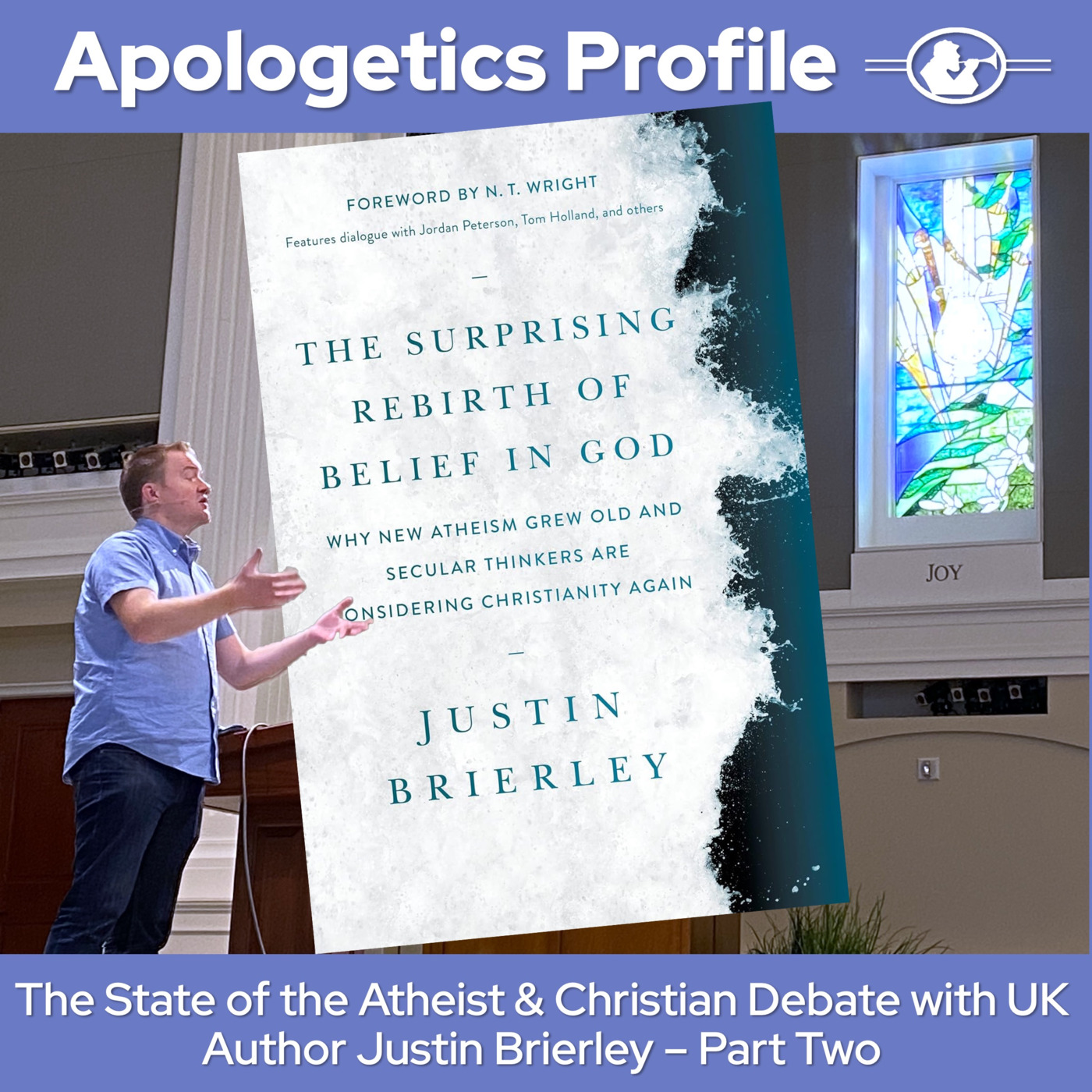
Apologetics Profile
Episode 299: The State of the Atheist & Christian Debate with Author Justin Brierley Part Two
00:24:56
Is science really a barrier to belief in the Bible and Christianity? Why does science remain one ...
Loading summary
Transcript39 lines
- [00:02]
Podcast Host
You are listening to Watchman Fellowship's Apologetics Profile podcast.
- [00:16]
Justin Brierly
Does the Neo Darwinian paradigm have any cogent, empirically based, scientific answer for the origin of our speech and language? The simplest answer is no. I am not kidding, nor am I exaggerating. I was shocked to discover this myself several years ago, thanks to the late author Tom Wolfe, as you'll see here.
- [00:37]
Interviewer/Co-host
In just a minute.
- [00:38]
Justin Brierly
Now, to be fair, there have been a number of attempts to explain the origin of language, but here, a quarter of a century into the 21st century, there is no concrete scientific, empirical data about where or how our linguistic prowess originated. Tom Wolfe, as you may recall, is the author of the popular 1979 book the Right Stuff. In Stuff, Wolfe tells the stories of the first brave souls who were selected to sit high atop some of the first rockets being designed and built for the burgeoning new space program of the 1960s. Wolf wondered why these fellows would even do such a thing and called them combat warriors. Wolf published the Kingdom of Speech, his last book, in 2016, and it was this book where I discovered, much to my surprise, that there was no current explanation for the evolutionary development of human language. Wolf is no biologist, but an author. He knows how to string words together, a skill which I think qualifies him to be able to talk about human speech despite not having a science degree. Wolf opens the Kingdom of Speech by citing a scholarly article published in Frontiers in Psychology on May 7, 2014, and you can still find that article online. Wolf describes that he was just surfing the web one night when he came across the mystery of Language evolution. It arrested his attention, so he clicked on it and started reading. He too was quite shocked by the conclusion of the study, which is this. The most fundamental questions about the origins and evolution of our linguistic capacity remain as mysterious as ever in the Kingdom of Speech. Wolf goes on to note, 150 years since the theory of evolution was announced and they had nothing. In that same century and a half, Einstein discovered the speed of light and the relativity of speed, time and distance. Pasteur discovered that microorganisms, notably bacteria, caused an ungodly number of diseases. Watson and Crick discovered DNA, the so called building blocks genes are made of, and 150 years worth of linguists, biologists, anthropologists and people from every other discipline discovered nothing about language. Over the last few decades there has been a growing body of intellectuals like the late Tom Wolfe who have become skeptical of the concept of evolution by natural selection. It's not just the absence of any tangible evidence for how Language and speech came about that has stirred people's skin. Skepticism about Natural Selection Today there are a number of problems with the modern Neo Darwinian synthesis, most notably one of specified, complex information. Within the burgeoning field of molecular genetics, it has become increasingly clear just how fantastically complex a living cell actually is. Cells require specified, complex information in order to transform into the staggering and wondrous varieties of parts of living things. How does a cell know whether to become part of the eye or a heart or a lung? In 2012, one atheist philosopher, Thomas Nagel, published his own thoughts on the matter with the provocative book title Mind and why the Materialist Neo Darwinian Conception of Nature Is Almost Certainly False. Nagel admits that he doesn't want God to be the solution to the problem, but he nonetheless remains convinced that Neo Darwinism is bereft of any robust explanatory power for the way we understand life today. Hegel, for example, opines on page 11 of Mind and Cosmos, quote, whatever one may think about the possibility of a designer, the prevailing doctrine that the appearance of life from dead matter and its evolution through accidental mutation and natural selection to its present forms has evolved nothing but the operation of physical law cannot be regarded as unassailable. It is an assumption governing the scientific project rather than a well confirmed scientific hypothesis. But when it comes to reasons for why people reject Christianity today, high atop that list is the belief that modern science is incompatible with Christianity and the Bible. But this is merely a shallow caricature of the complex and often fruitful relationship between traditional Christian theology and the careful investigation of the physical cosmos and life within it. This warfare thesis is simply a myth of our time, or one that affords little or no substance about just how foundational Christianity has been for our conceptualization of science in Western culture. As H. Wayne House has noted, the empirical method of investigating nature arose in an unexpected time with the emergence of early Christianity beginning in the third and fourth centuries, and due to an unexpected reason. As early Christian theologians sought to understand how God and nature related, they developed the theological doctrine of divine voluntarism. That is, God is a free and transcendent being. He governs the universe as he sees fit. This caused them to study nature more, to understand God. Later, medieval theologians continued this quest and developed scientific views of the world long before the time of the early scientist Isaac Newton. In reality, Christian theology spawned modern science, and the Middle Ages were not dark times of superstition but served as the basis of later science. That comes from page 135 of the comprehensive Guide to Science and Faith, Exploring the Ultimate Questions About Life and the Cosmos, edited by William A. Dembsky, Casey Luskin and Joseph M. Holden. We have recently featured interviews with both William Dembsky and Casey Luskin on Apologetics Profile. Be sure to check out the notes of this episode for links to those conversations as we jump in here. In part two of our conversation with author, speaker and podcaster Justin Brierly, I asked Justin about the prevalence of modern science being a barrier for many people today for believing in the truth of Christianity. Here again is Justin Brierly.
- [07:16]
It still is, surprisingly to me, I suppose, because I, I've, I've encountered all the arguments for why that doesn't make sense, but it's kind of, I think the New Atheists were so successful even, even as their movement has waned somewhat, they've left behind a residue of, of this kind of assumption in culture that there is this science versus faith thing. So the way I often get it, you know, I, I was in a school recently doing some talks on God and hosting some conversations, and the way some of the students put it was, I, I can't believe in God because I believe in science. You know, and it's that sort of, that stark, is it? They genuinely see this as a, as a, you either believe in science or you believe in God. And it's very sad, you know, and obviously there are some aspects of Christianity in some churches that have played into that. So it's not that the church has nothing to do with it, but it's sad that that narrative, which was essentially so manufactured really by certain skeptics and New Atheist stuff has, has come to dominate this idea that science is somehow opposed to God and that science is the only way of own understanding the universe when, you know, it does. I mean, it sounds ridiculous, but sometimes a very simple analogy can help someone who's sort of wedded to that idea to kind of start to question it. And one of the, you know, simple illustrations I've given to some of those young people who I've encountered who are like that. I created in fact a tick tock video a while ago that did quite well on this was I just said, well look, I've got a cake here. And I did have a cake that had been baked by my wife and I said, you know, I can give you a really good scientific explanation for this cake, okay? I could, you know, and I sort of was dressed up in scientific gear, you know, measure the chemistry, you know, give you the ratio of flour to sugar to Eggs tell you exactly what happens when I eat a piece. And the, the chemicals and the, the brain synapses that fire to make it taste so lovely. I said, I can give you, you know, really interesting scientific explanation for this cake, but if you ask me, why is there a cake? Why is the cake here? The science won't tell you that. The science won't tell you the, the why question. It'll tell you the what you know of the, the ingredients and everything else, but it won't tell you the why question. To discover why there is a cake, you'd have to ask the person who made it. Okay. And that's my wife, Lucy. And science is not going. So science is great for some things, but it's not going to answer those why questions. It's sort of simple analogy. But the, the point is, you know, it's the same with our universe. You know, we can find out an awful lot about it through science. But if you want to know why it's here, why you're here within the universe, you're going to have to go beyond science. It's the kind of question that you have to ask the maker. And for me, that's, you know, even that has been a light bulb moment for some people because they've never really considered the idea that there are different types of explanation. You know, they've been fed this line that science, there is only a scientific explanation. Whereas in life, when you think about it, we constantly engage with different types of explanations for things. The why is the water in the kettle boiling? Well, the scientific explanation, the heating fillet that, you know, the filament is heating the water to 100 degrees Celsius until the atoms, you know, escape the, you know, into liquid, into steam or whatever, or another explanation. Because I want to have a cup of tea. You know, these are two different types of explanation for the same phenomena, but they're not competing, they're not contradicting. They're just, it's just you can explain things at different levels. And for me, you know, that's, that alone is, is sometimes helpful for people to understand before you even get to the fine tuning of the universe and the fact that science itself might be pointing to God, you just want to say science is not the only way we understand things ever. So, so why would you kind of assume that there's a sort of science is the only explanatory filter you can ever turn to, you know.
- [11:22]
Interviewer/Co-host
Right. Which is not itself a concept that is derived from material science.
- [11:28]
Justin Brierly
Yeah, exactly.
- [11:29]
Interviewer/Co-host
The assumption itself shows that there is something beyond the science. Because as Sean Carroll even takes the position, or he did at least a few years ago, that the why question, he called it metaphysical baggage that we just need to discard. He says it's not the right question to ask about the universe. And I wanted to ask Sean, I said, well, how about, how do you know, what kind of metaphysics does the universe prefer? I mean, to, To.
- [11:54]
Justin Brierly
To cordon off certain kinds of questions.
- [11:56]
Interviewer/Co-host
About the universe is. Is a presupposition that does not finally come from the universe.
- [12:01]
Justin Brierly
Exactly. Yeah.
- [12:02]
Interviewer/Co-host
As you know.
- [12:02]
Justin Brierly
Yeah, yeah. It's kind of like the science can explain a lot, but it can't explain itself, you know?
- [12:08]
That's right. That's right.
- [12:09]
And that's. That's the problem. You're kind of running to this vicious circularity with, With. With the scientistic way of looking at.
- [12:15]
Interviewer/Co-host
Right, right. I don't know if you've ever been, when you're here in the States, if you've ever been through New Mexico when they have the hot air balloon festival.
- [12:23]
Justin Brierly
No, I haven't.
- [12:24]
Interviewer/Co-host
Oh, it's fantastic. When you drive through the interstate through Albuquerque, Santa Fe, you'll see balloons, hot air balloons in the sky. And you drive those. And I remember the first time I saw them a couple of years ago in person, it's like, what is that? And they're like, well, they're hot air balloons. And you could say, well, why are they there? Well, when you heat air, you can do the science, like you said with the cake. But the fact that there are human beings in this little gondola dangling below this gigantic balloon, you're like, why would people do that? Or why would you know, why is.
- [12:59]
Justin Brierly
There people down there in the bottom of the Grand Canyon? Why are there people on the moon?
- [13:05]
Interviewer/Co-host
Why did we go to the moon? And that was sort of what Tom Wolf was asking the question in 1979 with the right stuff.
- [13:10]
Justin Brierly
Why are these guys doing this?
- [13:13]
Interviewer/Co-host
Why are we going to the moon? Why are we launching space telescopes? Why are we doing all this stuff?
- [13:18]
Justin Brierly
Those, I mean, our.
- [13:20]
Interviewer/Co-host
The why questions are facing us at every turn. I think, Justin, that you can say, and you talk about suffering in this book, and I know you talk a lot about that with non believers, and it seems like no matter how raw the objection to suffering is, the people that are most vociferous about this objection, nevertheless, to me, and this is what kind of undermines the argument against God's existence from suffering, is because the advocates for this argument nevertheless seem to enjoy the goodness of the world, that it's. They paint the bleakest picture they can possibly paint, and yet they want to continue to exist in the world and enjoy it as much as they can. And I think that's a powerful undercurrent that undermines the idea of suffering as an objection to God's existence.
- [14:12]
Justin Brierly
I, you know, I always want to ask someone who is objecting to God bringing us into a world of pain and suffering if they are, if they happen to be a parent. I want to say, well, why did you do that? You know, you, you have effectively done the same thing. If you have had children, you've consciously, knowingly brought them into a world in which they will suffer and they will die one day.
- [14:35]
Right?
- [14:35]
And yet you did it. And I, and I think that sometimes helps people to kind of realize, yeah, why, why did I do that if I knew now, obviously, that they're in different positions to God. Their claim is that God could have created it to be a world where that his children would never suffer or whatever. But nonetheless it still, I still think it presents quite a powerful objection sort of just to the person who, who realizes they were willing to do that. They had the power not to bring, bring someone into the world knowing that they would suffer pain and suffering death. And usually the answer I think they would give is because, well, it's because I. There's also the possibility of love and the good things in life and the, the, the, the, the possibility that they, they may experience that and what it means for me to love a child, all of that outweighs all the bad stuff. And I think that there is a way in which. I think you can paint an analogy. It's not perfect. No, no analogy is. But to the fact that, well, God might have similar reasons for why he would bring people into a world even of pain and suffering, because they have, they will have the capacity to experience love. And that even in a world where there is so much pain and suffering and hate might just be worth it. So that's sort of one, one way in which I found it helpful to kind of begin that kind of a conversation sometimes before you get to the sort of theodicies about, you know, why God would allow this or that or the other. I think there's just this, that, that there's just that sort of intuition that, that people actually, it turns out even when they find life really difficult, they tend to want to try and keep going because of the hope of finding something that, that does make sense in life and right. And, and, and that hopefully kind of gives you a little sense of why God, what, what the Christian life is actually about. It is ultimately about finding that there is a sort of, that there is a way to experience love and meaning even in a world where there is so much, so much pain and sometimes it's almost only because of the pain that we get to the good of, of suffering. And that's not something I say lightly. It's sure it doesn't. It's not the kind of thing I would say to someone who's necessarily going through pain and suffering. But nonetheless, there you can trace so many instances of people for whom they only really became the person they are and were able to experience the good that they experienced because they went through something that was, was absolutely tragic, you know.
- [17:13]
Interviewer/Co-host
Yeah, it's been on that note. My, my dad, When I was 17, my dad committed suicide. And I wasn't a Christian. We weren't in it. We weren't in a Christian, raised in a Christian home. And I became a Christian at 25. And one of the things that I've had a difficulty with over the years is God's love as a father. It's like, I don't even like the word father. And I, you know, I didn't have necessarily a terrible relationship with my dad, but basically my dad gave up on me. And so it's been very difficult, very challenging to accept paternal love or to even understand it. Because when I, some people say, well, you just wanted a dad, it's like, no, that's the farthest thing from my mind. When I became a Christian, I had wanted nothing to do with fathers, but it is, I think I've seen over the years God's, the Hebrew word is kassed, his incredible long suffering and patience with me through suffering, whether it's depression or just personal maladies or rejection or loss or whatever, the faithfulness and the regularity of God, as he says in Jeremiah, he compares the fixed order of the heavens to his chesed, to his love and mercy, to his loving kindness, long suffering. And so it's taken me 30 plus years to look back and to see God's patience through suffering. But, but like you, you have to approach those questions. I understand you're not going to just go up to somebody who just experienced loss and give them a sermon about, you know, you know, sometimes silence is a good way to do it.
- [18:52]
Justin Brierly
But yeah, and for a lot of people, the only, you know, so many times you can only see these things in retrospect. You know, you have right. Gone through it. Right. It's very hard to, to probably convince someone who's in the middle of the pain and suffering that this is somehow gonna. Yeah, yeah, gonna make sense one day.
- [19:12]
Let's wrap up with this.
- [19:13]
Interviewer/Co-host
I know it's something that you've often talked about, and it came up in your conversation with Beth El and James, and I thought it'd be a good way to end. Justin, we're talking to atheists, Christians, non believers, people on the fence a little bit. Who is this Jesus person? I know one of the Hollywood actors here in the United States, Paul Rudd, about a year ago was being interviewed for a movie and he was asked if he could go back in time and visit a person from history, who would it be? And Rudd said, jesus. And his co stars laughed and he said, no. Think about it. It's like you go back in time, he existed. I mean, Rudd was just like, of course he existed.
- [19:53]
Justin Brierly
But don't you want to go back in time and say, jesus, what's the deal?
- [19:56]
Interviewer/Co-host
You know, And I thought it was fascinating. It's got TikTok sound bites, his clip is all over the YouTube and stuff. But I think it's a relevant question and I'd like to have you comment about C.S. lewis's trilemma with the BART the plus one Bart Ehrman edition of Legacy. But how can we apply Louis's thinking on the trilemma here to who Jesus is as we wrap up here?
- [20:24]
Justin Brierly
Well, absolutely, I, I think you, you know, as H.G. wells put it, he said, as an historian, I can say that Jesus Christ is irrevocably the center of history. And, and so you don't have to be a Christian or a believer to recognize the extraordinary impact of Jesus Christ.
- [20:44]
Sometimes our discussions with non believers seem futile, like they're not moved by anything we say, that the conversations don't seem to have any impact whatsoever. Maybe even some atheists we talk to know more about the arguments for and against Christianity than we do. So as we wrapped up our conversation, I asked Justin about this.
- [21:03]
I'm sure it can often feel like you're, you know, working away with, with little result. But you, I, I've, you know, having kind of put my, sort of put myself in that position, you know, the best part of, you know, nearly 20 years with the unbelievable show. It's interesting to see what seeds do actually get planted and often take years and years before they come to fruition.
- [21:24]
Sharing your faith is akin to planting seeds, just as Jesus said in his parables. And we may plant a seed or two. But seeds require time to come to fruition. As Justin said, we are not going to immediately see the results of the seeds we've planted. So then, as Galatians exhorts us, let us not grow weary in well doing, for in due season we will reap a harvest if we do not lose heart.
- [21:56]
Podcast Host
Apologetics Profile is a production of Watchman Fellowship Incorporated, Arlington, Texas. For more information about the Ministry of Watchmen Fellowship, visit our website@watchman.org that's watchmen with an a.org you can be reminded of new weekly episodes of Apologetics Profile right on your tablet, smartphone or computer. Just text the word podcast to the number 817-204-5066. Again, just text the word PODCAST to the number 817-204,5066 and you will receive weekly reminders of new episodes every Monday.
- [23:06]
Unidentified Speaker
Sam. Sa. Sam sa.