← Apologetics Profile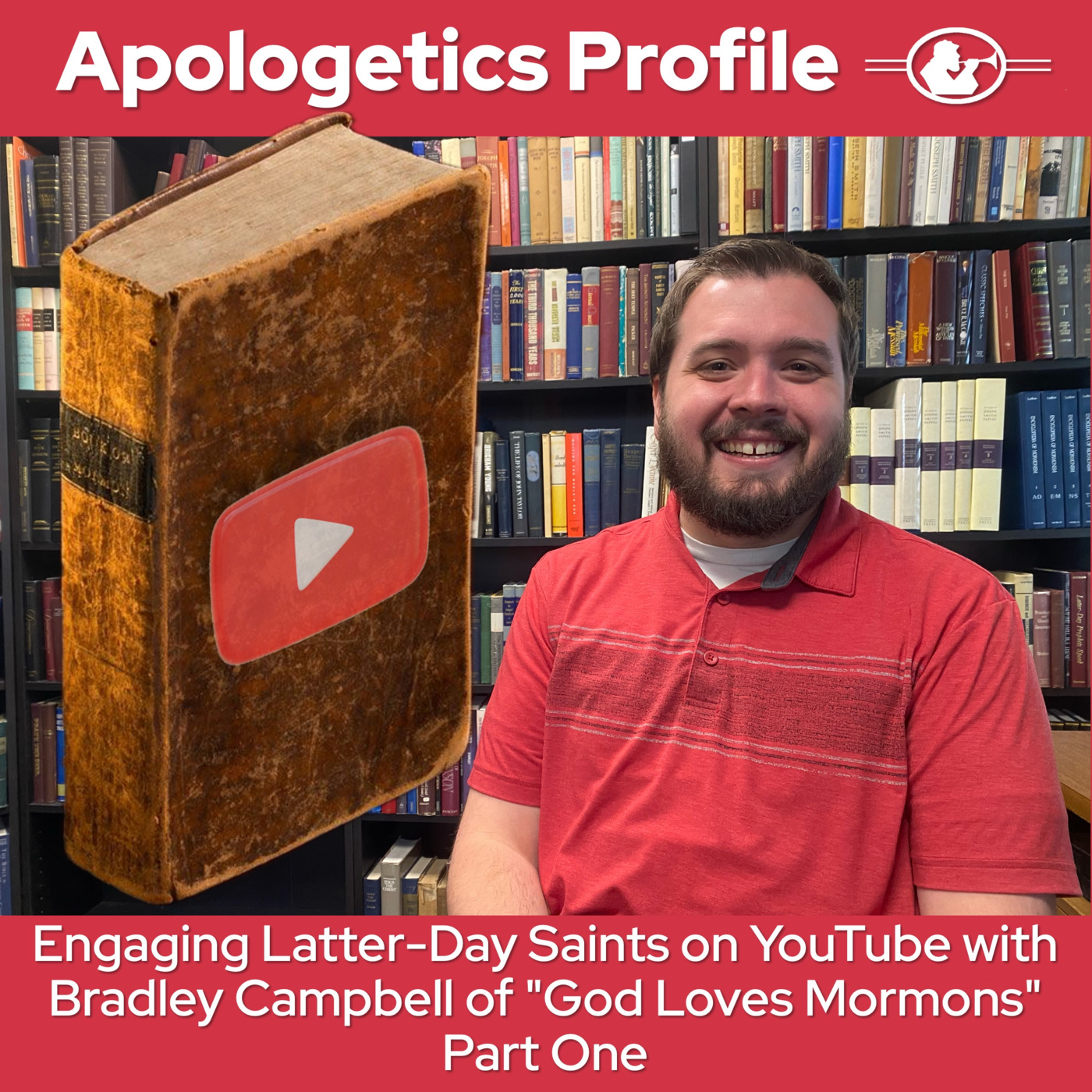
Apologetics Profile
Episode 300: God Loves Mormons with YouTube Host Bradley Campbell Part One
01:00:43
This is our special 300th episode of Apologetics Profile!We have been offering our podcast comple...
Loading summary
Transcript116 lines
- [00:04]
Podcast Host
You are listening to Watchman Fellowship's Apologetics profile podcast.
- [00:17]
Bradley Campbell
In one sense, Mormonism is built on the idea that we as Christians are false. In essence, the entire hope of Mormonism is for men to become gods. And I would argue that is the exact antithesis of what Christianity is. Our message is that God became a man.
- [00:44]
Narrator
On the hot and humid Midwest morning of August 9, 1831, Joseph Smith and 10 elders from what would eventually become the Church of Jesus Christ of Latter Day Saints set out from Independence, Missouri in canoes down the winding Missouri river towards St. Louis. The party had spent some time in Independence scouting out a site that was supposedly selected by God Himself for the establishment of a future Mormon Temple. Just a few weeks before leaving independence on July 20, Joseph Smith had a revelation that Independence, Missouri would be home to the new Zion and the location of a new temple for the Mormon people. This revelation is recorded in Doctrine and Covenants, Section 57 and is today considered by the Church of Jesus Christ of Latter Day Saints to be sacred Scripture. Hearken ye, O elders of my church, saith the Lord your God, who have assembled yourselves together according to my commandments in this land which is the land of Missouri, which is the land which I have appointed and consecrated for the gathering of the Saints. Wherefore this is the land of promise and the place for the city of Zion. And thus saith the Lord your God, if you will receive the wisdom. Here is wisdom. Behold, the place which is now called Independence is the center place, and a spot for the temple is lying westward upon a lot which is not far from the courthouse. It is worth noting here that Smith's trip from independence to St. Louis was also given as a revelation on August 8, the day before they departed. It can be found in Doctrine and Covenants, Section 60. The following are verses 5 through 7. But verily I will speak unto you concerning your journey unto the land from whence you came. Let there be a craft made or bought, as seemeth you. Good, it mattereth not unto me. And take your journey speedily for the place which is called St. Louis. And from thence let my servants, Sidney rigdon, Joseph Smith Jr. And Oliver Cowdery take their journey from Cincinnati. And in this place let them lift up their voice and declare my word with loud voices, without wrath or doubting, lifting up holy hands upon them. For I am able to make you holy, and your sins are forgiven you.
- [03:36]
Daniel Ray
End quote.
- [04:03]
Narrator
Among Smith's crew of elders that summer was a former Methodist preacher by the name of Ezra Booth, who soon grew suspicious of Smith and his many alleged divine revelations. A few incidents from this trip in particular triggered Booth's doubts. One occurred a few days after their August 9 departure from independence. According to Booth, a large pile of floating debris snagged Smith's canoe and nearly capsized. Smith, not a little shaken by the ordeal, ordered the entire team to go ashore. It was there, on the banks of the Missouri river, where Smith had yet another revelation from the Lord commanding that he, along with Sidney Rignon and Oliver Cowdery, were no longer to travel on the river. This revelation can be found in Doctrine and Covenants, Section 61, Verse 23. And now concerning my servants Sidney Rigdon, Joseph Smith Jr. And Oliver Cowdery, let them not come again upon the waters, save it be the canal, while journeying unto their homes. Or in other words, they shall not come upon the waters to journey, save upon the canal. Booth recalled that this did not sit well with the group. Most of the men criticized Smith for what they perceived to be his extensive cowardice. Smith, according to Booth, started to rebuke them in his allegedly prophetic voice. When someone in the group told Smith, none of your threats, Smith backed down. But Booth's doubts about Smith only grew. Booth recalled how Smith demanded money from the rest of the group in order to continue on to St. Louis and later Cincinnati by stagecoach. Booth later found out that when Smith and his group reached Cincinnati, however, they had run out of money and had to pawn a trunk to continue home to Ohio. They also left Cincinnati without preaching to anyone. Booth learned that allegedly the Lord made it known to them that they should go on. So Smith, Rigdon, and Cowdery did not preach or lift up their voices in Cincinnati as previously commanded in the revelation given in section 60 of doctrine and Covenants. This omission further exacerbated Booth's doubts about Smith. And Booth concluded that they can at any time obtain a commandment suited to their desires. And as their desires fluctuate and become reversed, they get a new one to supersede the other. And hence the contradictions which abound in this species of revelation. And perhaps one of the biggest of those contradictions remains today. Except for a white building on the northeast corner owned by a breakaway Latter Day Saint splinter group, the lot consecrated for Smith's temple in Independence, Missouri, remains empty. Yet in Doctrine and Covenants, Section 84, given in September of 1823 by Smith in Kirtland, Ohio, the building of the temple in Independence was supposedly consecrated by Jesus himself. A revelation of Jesus Christ unto his servant Joseph Smith Jr. And six elders as they united their hearts and lifted their voices on high, yea, the word of the Lord concerning his church established in the last days for the restoration of his people, as he has spoken by the mouth of his prophets for the gathering of his saints to stand upon Mount Zion, which shall be the city of New Jerusalem, which shall be built beginning at the Temple lot, which is appointed by the finger of the Lord in the western boundaries of the state of Missouri, and dedicated by the hand of Joseph Smith Jr. And others with whom the Lord was well pleased.
- [08:11]
Daniel Ray
End quote.
- [08:13]
Narrator
The Temple was never built. This weekend, next on Apollo Apologetics Profile, we will be revisiting some of the problematic doctrines and practices of the Church of Jesus Christ of Latter Day Saints with Bradley Campbell, who hosts a thoughtful and engaging documentary style YouTube channel called God Loves Mormons. Bradley runs his channel out of the offices of the Utah Christian Research center in Central Utah, founded by Bill McKeever and Eric Johnson, who are from Friends of Watchmen Fellowship. We have featured several interviews with Bill and Eric here on the profile and you can find links to some of those conversations. Discover more about Bradley's channel and the Utah Christian Research center in the notes of this episode. On his channel, Bradley doesn't simply offer critiques of LDS doctrines, but proactively promotes the truth about the Bible and Christianity, offering clear and solid gospel truth to literally the LDS community. In addition to his YouTube channel, Bradley regularly engages Latter Day Saints in person through street evangelism outreach, and he meets with LDs who reach out to him with their questions. There is today a growing community of younger YouTube LDS apologists defending their faith and doctrines, but YouTube has also become an increasingly popular source for a lot of Latter Day Saints who are seeking answers to many of their questions and doubts they have about their faith and the LDS Church. Bradley's channel is an oasis of truth and civility within this often vitriolic and.
- [09:52]
Daniel Ray
Confusing virtual public Square.
- [09:55]
Narrator
We call YouTube One, which is often quite hostile toward civil discourse. So if you have any friends or family who are LDS who are questioning their beliefs, Bradley's channel is a great resource.
- [10:07]
Daniel Ray
We highly recommend you share with them.
- [10:10]
Narrator
As we pick up here. In Part one, I asked Bradley how his interest in ministering to Latter Day Saints began. Here's Bradley Campbell.
- [10:18]
Bradley Campbell
I grew up in the western suburbs of Chicago, having no business being involved in any outreach to Latter Day Saints at all. I think I knew one Latter Day Saint in high school, but that's it. It just was not on my radar. It was not something that people really talked About. And I went to Moody Bible Institute in downtown Chicago, and I was a church planting major. And part of that program meant I had to do a residency internship at a church plant, which, to be honest, I didn't know about when I signed up for that major. Otherwise, I probably wouldn't have done it because it meant I had to leave my senior year from being on campus and go be a part of a church plant. That means leaving my friends behind and not. Yeah, doing all four years there, but nonetheless, I had to do it. So I started calling around to different churches, and I just could not get anyone who would work with the requirements of the internship program. So nothing was really working. And I had a previous friend of mine who he had been my youth pastor. Actually, years earlier, he had moved to Utah to plant a church in South Jordan, which was the first city in the world with two LDS temples in it. And so it's one of the most LDS parts of Salt Lake county proper.
- [11:37]
Daniel Ray
Wow.
- [11:37]
Bradley Campbell
So I called him up, and I was like, hey, do you happen to know of any church planters that I could do this internship with? And he was like, yeah, come out here and do it with us. And so I did. And I came out to Utah originally in 2017, knowing virtually nothing about the LDS Church. And very quickly, I met a guy by the name of Aaron Shafalwalef who had been doing street evangelism down outside of Temple Square for a couple decades, or maybe not that long, maybe a little bit less, but for a good number of years, and very quickly got pulled into doing street evangelism, which was something I had done a little bit of. Kind of a very different style of it, honestly, back in Illinois, but never too much success. People weren't really interested in talking. Honestly in Chicago, people aren't often thinking about spiritual things. And that kind of thing is very odd. I think, culturally now, when Utah, a lot of people have gone on missions, they're used to talking about religious things. It's very religious culture, which means that I think there's greater success in things like stranger evangelism, street evangelism, than perhaps in other parts of the U.S. yeah. And so I started going down outside Temple Square, which is like the heart of Mormonism. It's where the Salt Lake Temple is, the General Conference Center. They have the church history museum. They used to have some visitor centers there. And we would go out on Thursday nights because the Tabernacle Choir, if you ever go on Spotify or YouTube and you look up, like, a cappella hymn, something a Lot of times, you're going to end up finding recordings from the Mormon Tabernacle Choir. I think they're now called the Tabernacle Choir at Temple Square. Yes, they changed their name. But in any case, they would practice on Thursday nights, and it was an open practice. So you'd get tons of visitors. You'd get people from out of town. They would come to go to the General Conference center to listen to the choir. So we would stand at the crosswalk in between where the Salt Lake Temple was and the General Conference center, and we would talk with people and hand out tracts. And, I mean, I had not been in Utah for very long, and I started running into people on the street who said they had never interacted with broader Christian anything. They had never interacted with evangelicals. They had no idea what we thought or believed. They just were totally ignorant to it.
- [13:59]
Daniel Ray
And this is, again, to set the chronological context here.
- [14:03]
Narrator
This is in 2017, 2017, and you're.
- [14:06]
Daniel Ray
Talking to people in the heart of Utah who have never at all ever interacted with evangelicals.
- [14:13]
Bradley Campbell
Now, I think in hindsight, the Lord had, in his Providence provided me with those kinds of conversations up front. Yeah, I do still find that, but not as commonly as I did Right. Initially when I moved.
- [14:25]
Daniel Ray
Okay.
- [14:26]
Bradley Campbell
And when I kept interacting with these folks, I was like, wow, this is incredible. I didn't know Utah was like this. You know, And Utah, in my mind, is just another state. It's just a very typical kind of American religious culture. But here I am meeting people who said they've never. They have no idea what the gospel is. They've never heard it. And so I was sitting down with a brother who pastors up north, and he said, listen, you. You want to finish Bible college and go to seminary so that you can go somewhere that needs a stronger Christian presence, where people need to hear the gospel. He's like, well, hello, you're in a place that needs more of a Christian presence, where people need to hear the gospel. And I was like, that's. That's a great point. So I called up my then girlfriend, now wife, and I said, hey, what if you just didn't finish your whole school thing that you've been doing? And what if we got married and moved to Utah? And she was like, what are you talking about? And that's what happened. And so I went back to Chicago where she was, and proposed and spent the rest of 2017 out in Utah helping out with the church plant that I was a part of at that time, and just doing Evangelism and whatnot. And one of the pastors of that church plant he had actually started God Loves Mormons. He had some background in doing video stuff. He has a good eye for design things. So he had started doing these mostly because at that time there were no videos on YouTube dealing with LDS doctrine from an evangelical Christian perspective. They just didn't exist. There were tons of articles and there were longer form podcasts, but there weren't 10 minute videos dealing with hey, here's why we don't think biblically, we need modern temples or here's why biblically we don't think we pre existed prior to this life. So he started working on just short, simple scripts explaining our position on these issues. When I came out, I also had a background in video production, so I started taking over a lot of the video stuff. Eventually I took over scripting, eventually I just took it over. And so I, I think it was in 20, late 2018 or early 2019 when I kind of took it over myself. But in any case, at the end of 2017, sorry, I got ahead of myself. I went back to Illinois, got married, I did some support raising, fundraising, and then my wife and I moved out here permanently at the beginning of 2018. Has supported missionaries out here.
- [16:50]
Daniel Ray
Fantastic.
- [16:51]
Bradley Campbell
And that's kind of what I've been doing ever since.
- [16:53]
Daniel Ray
That's awesome. You'd mentioned earlier and I've run into this myself, I work for Watchman. I've been kind of like yourself. I've started incrementally with my boss who's former lds. My background is engaging with atheists and the questions of Christianity and science have been my specialty prior to coming to Watchman. But like yourself, I found that unless you're waist deep in the Latter Day Saint evangelical dialogue, a lot of evangelicals and non evangelicals, scholarly people think that I think to some degree people make so much fun of Mormonism, unfortunately that there's a lot of scholarship that just doesn't feel like it's not even worth the time.
- [17:35]
Bradley Campbell
Not worth engaging?
- [17:35]
Daniel Ray
Not worth engaging. Because this is just so off the charts, even for non religious people who don't accept Christianity. LDS just seems even stranger. And what I kept encountering this weekend and as I've encountered over the years, is to try to say, hey, I'm an evangelical and I don't want to mock your faith, I don't want to misrepresent your faith, I want to not ignore our differences, but I certainly want to start a dialogue that is respectful and engaging and thoughtful and I think that's what impressed me about your channel is the compassionate engagement. You're not just smoothing this over, glossing over the theological differences. You're forward about them, you're upfront about them, but you're compassionate about them. So I think there's a lot of LDs who are interested in what Christians have to say, but they're not going to tell their especially here in Utah, you're not going to tell your friends and family that you're thinking about your questioning, right, your Latter Day Saint faith. So where do you go?
- [18:35]
Narrator
Where do you go?
- [18:35]
Daniel Ray
You go online, which is, you know, that's where cults and everything else goes to die or grow. But in your since 2017, in your engagement with LDS, what do you find is one of the biggest issues that is continually coming up, whether it's on YouTube or culturally here in Utah. What do you find that people are Latter Day Saints are most put off by, by evangelical engagement?
- [19:04]
Bradley Campbell
Now, that's a good question. And it does feel like it's even shifted in the short amount of time that I've been out here. I don't know that that answer in 2017 would be the same answer as today. But as a general thing, I'd say, you know, a lot of Latter Day Saints get pretty frustrated at the idea that we are substantially different from there, from what they believe and how they think about things. They like this, at least in today's world. They like this general idea that they're also Christians, that they might have more information, but we're not fundamentally opposed. Whereas from our perspective, I do believe we're fundamentally opposed on virtually every doctrine. I think that there's not one area on which both Latter Day Saints and Christians substantially agree. We might use the same words, but we're different dictionaries. And so I think that's one thing that for them is really offensive, because in order to engage with their doctrine or their history or the teachings of their prophets, you really have to start by saying, hey, we're different. We're substantially different. We don't believe the same thing, and we need to talk about that. Those differences matter. Now, Mormonism is so broad, you're going to have people in different kind of segments, different circles. So not all Latter Day Saints are the same. But generally speaking, I'd say a lot of people get pretty offended by that, pretty upset. They want to be seen, at least today, as kind of another denomination of Christianity. Now that historically is very distinct from what Mormonism has been really up until the 80s, 90s, that's when it really started shifting.
- [20:41]
Daniel Ray
President Hinckley had said, and we've quoted him at Watchmen. I don't have the verbatim quote in front of me, but acknowledging that the LDS Jesus is a different Jesus than evangelical Christianity.
- [20:53]
Bradley Campbell
Right, right.
- [20:54]
Daniel Ray
So a lot of presidents and prophets in the history of the church, even, as you say, in the last several decades, even have acknowledged the significant theological differences.
- [21:01]
Bradley Campbell
I mean, in one sense, Mormonism is built on the idea that we as Christians are false. I mean, the first vision, which is the story that Latter Day Saints tell about Joseph Smith, you know, during a revival, wanting to know which denomination was true, he goes into some woods, he prays and asks God for wisdom to know which church is true. The Father and the Son show up and the Son says essentially none of them are. The creeds are abominations, their professors are corrupt, they don't know the Lord, they're far from him. The doctrines are all corrupt. There needs to be a big change, a restoration. That's the origin story of Mormonism. It's the restoration of what was lost shortly after the time of the apostles. So you're exactly right. From the time of Joseph Smith up until until very, very recently, the narrative has been Christianity has lost some major things. Whether that be doctrine, whether that be authority, whether that be reliable scriptures. There's things missing in Christianity. And Joseph Smith and the modern prophets are here to restore it. And yet they really downplay that these days.
- [22:05]
Daniel Ray
And when you get into that discussion of the restoration, because a lot of people unfamiliar with the context of early Mormonism, Smith's ideas are developing during right in the middle of the Stone Campbell movement and the Restoration movement. And there are all kinds of Christian sects. We get the Churches of Christ out of this. Alexander and Thomas and Alexander Campbell. So you have. And even where Smith's family lived in Palmyra, New York, that was considered the burned over district because how many people came racing through there, evangelists, preachers at trying to say, this is the only way, this is the only way, this is the only way.
- [22:44]
Bradley Campbell
I just read a book a couple months ago on, it's called Revival and Revivalism. And it was tracing the history between the First Great Awakening, like the 1740s and the Second Great Awakening in the early 1800s, and what seems like genuine revival, genuine work of God in drawing mass numbers of people to himself suddenly without much explanation. And then revivalism, which this desire to almost mimic the effects of that, but in a very human way, kind of the poster child of that Is Finney, Charles Finney, the anxious bench. Yeah, exactly. Yeah, yeah, all of that.
- [23:24]
Daniel Ray
And then you have the Wesleys at Aldersgate. Was it Charles or John who was talking that famous testimony where he felt himself strangely warmed by listening to the commentary on Romans written by Martin Luther? I think it was. I don't know. I always remember the strangely warmed quote, but I don't remember if it's Charles or John. But anyway, 1738 at Aldersgate Street. One of the Wesley brothers describes it being strangely warmed. And this is just about 100 years prior to Moroni 104 and the strange burning in the bosom of the Book of Mormon. And so you have a very experiential religion. And I would say in the history, in the early 1830s and 20s and 30s, what you have with the Smith family, with Emma and Joseph's father, Joseph's mom and Joseph's dad not really ever being. I mean, Lucy accepted Presbyterianism. I think Smith dabbled a little bit with Methodism, but really their family never found a solid footing in the midst of all that. And so you can see the angst of the first vision where Smith wants to establish once and for all, cut through the noise of the preaching and the revivalistic and the sects and get down to this is the deal. And I think that had a lot of appeal for people who did not fit in to these sects. There was a great deal of people left on the peripheral wondering, well, I didn't have that experience. Well, I didn't have that experience. Well, where do I fit in? Well, this pastor doesn't think I'm saved. This pastor thinks. I think it was one either Methodist or Church of Christ. I'm not sure which preacher, Joseph Smith's brother Alvin, who died, the pastor who gave the funeral sermon thought that Alvin might be in hell. Well, that didn't sit very well with Joseph, as you can imagine. But I think Mormonism begins and appeals to people who were outcast during this time.
- [25:20]
Bradley Campbell
Yeah, it's like the early 1800s. Religious culture Pressure cooked for a couple hundred years. And that's modern Mormonism. When you look at what Latter Day Saints are saying and what Joseph Smith was saying, and then you start reading what's going on in that era. Joseph Smith was totally a product of his day.
- [25:40]
Podcast Host
You can listen to all of our past episodes of Apologetics Profile for free. And if you are enjoying Apologetics Profile, be sure to leave a rating or review on Apple podcasts.
- [25:54]
Narrator
If you happen to listen to the two most recent episodes I did with former LDS Sandra Tanner. You'll recall that I mentioned that in 1832, just two years after the first publication of the Book of Mormon, Alexander Campbell authored a short critique of the Book of Mormon titled An Analysis of.
- [26:12]
Daniel Ray
The Book of Mormon.
- [26:14]
Narrator
Campbell observed that just about everything discussed in northern New York at the time somehow found its way into the Book of Mormon. Campbell says, quote, this prophet Smith, through his stone spectacles, wrote on the plates of Nephi his Book of Mormon. Every error and almost every truth discussed in north New York for the last 10 years. He decides all the great controversies. Infant baptism, ordination, the Trinity, regeneration, repentance, justification, the fall of man, the atonement, transubstantiation, fasting, penance, church government, religious experience, the call to ministry, the general resurrection, eternal punishment, who may baptize, and even the question of freemasonry, Republican government, and the rights of man. All these topics are repeatedly alluded to, end quote.
- [27:11]
Bradley Campbell
He's saying the same kinds of things other people were saying. Tons of other groups were saying, oh, the apostolic Christianity has been lost. It needs to be restored. The purity of Christianity needs to be restored. It was very experiential. They're very curious about spiritual gifts and supernatural encounters, angelic encounters. I mean, all sorts of groups are having this, and it's this first great awakening to second great awakening kind of dynamic.
- [27:36]
Narrator
Here's a local boy, just like Jesus.
- [27:39]
Bradley Campbell
Exactly. Yeah. Yeah.
- [27:40]
Daniel Ray
Isn't this Joseph? You know, don't we know his parents? Local boy, uneducated, not from. He's from here and he's got a golden Bible. And this is stirring up all kinds of fascination and things. But I think when you read. I've been trying to read through the 1830 Book of Mormon. It's tough, but you can see it's kind of like, with all due respect to our Latter Day Saint friends, it reads like if you treat it like early 19th century Americana religious fiction. Yep. I mean, it's totally that.
- [28:13]
Bradley Campbell
I mean, they're talking about things like incarnational sonship in the Book of Mormon. They're talking about things like baptism, nature.
- [28:19]
Daniel Ray
Of baptism, hundreds of years before Jesus.
- [28:21]
Bradley Campbell
Hundreds of years before Jesus. And that's just really bizarre. That's not the way the Bible speaks. One of the things for me, that was really shocking when I first was going through the Book of Mormon. I was really prepared for it to be very compelling because of the way I've heard my Latter Day Saint friends talk about it. They kind of swoon over how wonderful it is, how impressive it is, how Authentic, it feels. So I was preparing myself, like, okay, the Book of Mormon is something to really contend with. I'm going to have to deal with some of these things. When I read it, I was struck by how different it felt than the Bible. When you read the Bible, there's a way in which God communicates through the prophets. There's a way in which the epistles are written. There's a way in which doctrine is handled, even things. I think perhaps the greatest example of this, most overt example is look at the way prophecy works in the Bible. You go to the Old Testament and you have types and shadows and prophecies of Christ. And they're veiled and they're confusing, honestly. And it's like, I've heard it described as, like, shadows in a room lit by moonlight. And you can kind of see where things are in the room. You can kind of see the shape of the furniture, but there's shadows. It's difficult to see the outlines of stuff. You just get the general idea of things. And then when Christ comes, you know, Hebrews one talks about long ago, at many times, in many ways, God spoke to our fathers by the prophets. But in these last days, or latter days, if you will, he has spoken to us by his Son. And so when Christ comes, he's like the. I like to say he's the mic drop of God. He's.
- [29:52]
Daniel Ray
That's a good YouTube.
- [29:53]
Bradley Campbell
Yeah, there you go, colloquialism. There you go, the mic drop. The fullness of the revelation that we were to have comes through Christ. And it's like turning on the lights in the shadowy room suddenly. Oh, when we look back to the Old Testament, we see the outlines, we see the contours, we see where the furniture was. The shadows give way to substance. And so the New Testament shines a light on the shadowy prophecies of the Old Testament. But when you go to the Book of Mormon, we're reading about explicitly Christian things way before Christ. We're getting the pentecost kind of events before Christ. We're getting baptism and the organization of the church before Christ. We're getting prophecies using Mary's name and Jesus name way before Christ. You never see prophecies like that in the Bible. It's like the way that it speaks is different. The way that God speaks in the Bible is different from the way that I think Joseph wrote in the Book of Mormon. And to me, that's very evident if you're very familiar with the way that the Bible speaks.
- [30:53]
Daniel Ray
Correct? Yeah. I think that's a good way to put it, Bradley, because when you talk to Latter Day Saints about this, I asked this very question this weekend to some missionaries I was talking to on the train on the way up to Temple Square. How come you have Jesus, literally the Christ Jesus, the church baptism, all of these New Testament beliefs and ideas, names of Jesus. We don't get the name of Jesus specifically as it is in the New Testament until Gabriel announces it to Mary. That's right, you get the Messiah, the suffering servant of Isaiah, but you don't get the Lord Jesus Christ until he's born, until the annunciation, the fulfillment, as you say, the furniture of the Old Testament prophecies comes clear. Smith's so when a Latter Day Saints says, well, it's all prophetic, and I think to your point, your excellent point there, that what it looks like when you read the Book of Mormon is that Joseph was well aware of Christianity and was reading Christianity back into his narratives.
- [31:52]
Bradley Campbell
It was his culture. You know, a lot of times Joseph is portrayed as illiterate kind of farm boy that knew nothing about religion. And then suddenly, you know, the first vision happens, Moroni appears and he's learning all these things. But Joseph was steeped in a culture that knew the Bible, steeped in a culture that was using phrases from what God had revealed. I mean, when you read the Book of Mormon, one of the things that to me is so telling is it'll use phrases from the New Testament in the Book of Mormon. You never see the Old Testament doing things like that. That is just not the way that the Bible functioned. And I think it's very evident that Joseph was using the religious language of the day, which was steeped in King James English Bibles. He was using that religious language in crafting the Book of Mormon.
- [32:37]
Daniel Ray
To put it kind of crudely, the Bible in Joseph Smith's day, especially in the Palmyra burned out district, was kind of the Netflix of the time. This is what people were talking about, I mean, before social media, before computers. I just interviewed Sandra this weekend and Sandra said, because I asked her the same question, I said, you get this narrative that Smith was an uneducated, he had a very limited education vocabulary. And Sandra said the LDS Church has to kind of keep Smith under a kind of a lock and key of ignorance in order to make the revelation that is the Book of Mormon seem all the more impressive because this guy didn't have a vocabulary, didn't have a education. But Sanders said, oh no, oh no, no. Smith was a sponge and was a.
- [33:24]
Narrator
Storyteller long before the visions, long before.
- [33:27]
Daniel Ray
He could keep his family spellbound with stories and tales. And Sandra said that when he heard something, he didn't even have to read it. He could hear it audibly, and it would stick. And one thing that I've learned in studying Smith and being so fascinated by this, because at first you're like, yeah, how does this Book of Mormon, all these ideas and concepts and words and quotes come together? If the man doesn't have a stack of books in front of him, what's he doing? And Sandra said he had a vivid imagination. And we also don't understand Bradley. This is lost on us today, where back in the day when you didn't have television and you this you memorized, you could keep in your mind a lot of these concepts that we just find difficult. We'd have to look stuff up because we have Google. Right. But Smith seemed to have this mental capacity. He was a lot smarter, more clever, we might say, than what the church portrays him to be.
- [34:20]
Narrator
Right?
- [34:20]
Bradley Campbell
Right. And, you know, I think it comes out really evidently when you see what Smith does with his doctrine and his ideas. I'm doing a whole study right now on the King Follett sermon. The King Follett discourse.
- [34:30]
Daniel Ray
Yes.
- [34:31]
Bradley Campbell
It was Joseph Smith's last general conference sermon. I'm gonna release a video here, Lord willing, in the next week on it. And you look at the ideas that Smith is putting forward. You look at the theology that he's espousing. It's complicated, it's complex, it's thoughtful. It's absolutely blasphemous. Totally contrary to what the Bible says, I would argue. But there's a logic to it. I understand what he's saying, and I think when you read things like that, I just can't walk away from that saying that Joseph was just this dumb farm boy who was just kind of being pulled along by revelation. I think Joseph was brilliant. I think it's evident that he was brilliant.
- [35:06]
Daniel Ray
If we look at him differently, as though he was intellectually far more intellectually sophisticated. He just didn't have the degree, but he was verbally sophisticated, that human creativity and genius alone could explain the Book of Mormon.
- [35:21]
Bradley Campbell
I think so. I mean, okay, look at his letters to Emma, or look at when he's presumably dictating journals to some scribes. And the language he's using, it's sophisticated. It's not. I mean, sure, there's spelling issues, but I guarantee you, my spelling would be worse. I mean, I don't think that the spelling issues are indicative of someone who's, who's not sharp, who's not intellectually all there. And not that people say he's not intellectually all there, just that he was untrained and whatnot. Yeah, I think when you look at his other writings, it's clear he was good, he was bright, he was an intelligent dude. And so I think when it comes to the Book of Mormon, yes, I think that naturally you can explain that, but honestly, I would love Latter Day Saints to understand that as a Christian, I could say, let's just say for the sake of argument, he did encounter an angel or a heavenly being. I'll say, let's just say there really were gold plates and there really was a seer stone and there really was this whole process of translation and the Book of Mormon really was a supernatural event. That doesn't make it true. It could be a supernatural event and still false. First John 4 says, Beloved, test the spirits. Test the spirits. Test the spirits. Which assumes that there are going to be spirits that are false and spirits that are true. 1st Thessalonians 5. Paul says, do not despise prophecy, but test everything and hold fast to what is good. So for me, I am in one sense, I mean, I think it's valuable to consider the historical nature of the Book of Mormon, how it came about, especially because Latter Day Saints are very interested in talking about those things. But for me, the content of not just the Book of Mormon but Mormonism as a whole is far more relevant because, I mean, take the Quran, take Islam for example. I mean, Muhammad's story is in one sense way more impressive. He was actually illiterate. And you have the Quran, so how do you account for that? I just think maybe it was supernatural. I tend to not think so, but maybe it was. That doesn't change my position that Mormonism is ultimately, to use the language of Paul, the doctrine of demons, that it is contrary to what the Bible says. And I say that not with a hostile attitude, but an attitude of concern. I think that so many, I mean, millions, 17 and a half million people, as announced in General Conference a couple days ago, 17 and a half million people are ensnared by what I would consider to be satanic false teaching and false doctrine. And so out of compassion, I want my Latter Day Saint friends to realize that the Bible does substantially teach a different doctrine from what they've been taught.
- [38:02]
Daniel Ray
We're recording this on April 7th. It's 2025. Yesterday was April 6th. It was the 195th assembly of the General Conference of the Church of Jesus Christ of Latter Day Saints. Bradley, you know, April 6, 1830, is a huge date in the history of Latter Day Saint Church. It is the founding of the Latter Day Saint Church. And I want to read something from Doctrine and Covenants, Section 21, where this revelation comes to Smith on this date, April 6, 1830, and it says, this is Doctrine and Covenant, Section 21.
- [38:34]
Narrator
Behold, there shall be a record kept.
- [38:36]
Daniel Ray
Among you, and in it thou shalt be called a seer, a translator, a prophet and apostle of Jesus Christ, an elder of the church, through the will of God the Father and the grace of your Lord Jesus Christ, being inspired of the Holy Ghost to lay the foundation thereof, and to build it up unto the most holy faith. Which church was organized and established in the year of your Lord, 1830, in the fourth month, on the sixth day of the month, which is called April. Now, that's powerful words for Latter Day Saints, but if it's true, if it's false, it's utter blasphemy.
- [39:17]
Bradley Campbell
Right?
- [39:18]
Daniel Ray
But this is the foundational texts that establish Smith as the authoritative. The authoritative founding prophet. And I heard this word at conference this weekend. I sat through session one of Saturday morning. I heard the word seer mentioned several times. So, Bradley, when we talk to Latter Day Saints and this comes up, how do we address the question about Joseph Smith as a prophet? Because everything seems to hang or fall on that.
- [39:49]
Bradley Campbell
Absolutely. I think, okay. Kind of a silly little thing I do on the street with people when I'm trying to explain this Jesus, Matthew 7. He says, Beware of false prophets. They're wolves in sheep's clothing. You'll know them by their fruits. So I like to ask people, what is the fruit of an apple tree? Kind of being silly. An apple, okay. What's the fruit of an orange tree? An orange. What's the fruit of a prophet? People will kind of look at me and blink a couple times. They're like, his works. I'm like, well, in part, but his prophecy. The fruit of a prophet is what he's saying. So when Jesus is saying, test them by their fruits, part of that command is not only to evaluate their moral character, which I do think is relevant, but evaluate what they are saying. I don't think that often people have this idea, a correct idea of what Jesus is talking about here. It's not a wolf in wolf's clothing. Okay? A wolf in wolf's clothing is one that from 10 miles away, you're like, that's a wolf. Okay, 10 miles might be a little. But you know, from a long way.
- [40:53]
Daniel Ray
You have a hunting scope on your.
- [40:55]
Bradley Campbell
Rifle, but from a long distance you can say that's a wolf. The idea of a wolf in sheep's clothing is it looks from a distance to be legit. The prophet's gonna look legit. If a prophet's going around murdering people left and right, that's not very compelling. But if a prophet looks like, hey, there's some supernatural things going on here, look at all the moral things. I always hear Latter Day Saints reference all of their generosity in the ways in which they help.
- [41:20]
Daniel Ray
Look what the church is doing today.
- [41:22]
Bradley Campbell
Which, those are good things. I don't want to disparage that.
- [41:24]
Narrator
That's good.
- [41:24]
Bradley Campbell
I'm glad that they do that. I think that's an expression of God's common grace, but that doesn't make it true. And so to evaluate the teachings and prophecies of Smith, I think is a command we're given by Jesus. You're exactly right. Things hinge on Joseph Smith. If Joseph Smith wasn't a prophet, Mormonism can't be true. And if Mormonism isn't true, then Latter Day Saints should become Christians.
- [41:52]
Daniel Ray
That's what I would argue. Well, I noticed that when evangelicals bring up. There's a list that common to evangelicals who are engaged in this dialogue of prophecies that Smith got wrong. One of them being sending, I'm not sure it was Whitmer, Cowdery or a couple of his leaders to Canada to sell the rights to the Book of Mormon. Yeah. And that completely failed the Civil War.
- [42:17]
Bradley Campbell
Starting in South Carolina and spreading to all nations of the earth and things like that.
- [42:23]
Daniel Ray
Finding treasure in Pennsylvania, Everything was Zion. Tons of stuff with Zion. Zion, the Temple, Independence, Missouri Temple. It's not there yet. But the fair Latter Day Saints. And the response that I hear often is those aren't prophecies.
- [42:37]
Bradley Campbell
Sure.
- [42:38]
Daniel Ray
Yeah.
- [42:38]
Bradley Campbell
I honestly, I think that sometimes we hyper focus on just prophecies. I think we can broaden it. We can just talk about teachings. In Deuteronomy 13:18, there are tests of prophets given, and they're kind of different. In those two tests, one of the texts says, hey, if a prophet comes and gives a prophecy and the prophecy doesn't come to pass, that that prophet is a false prophet. The other one says, if a prophet comes and gives some sort of sign and the sign does come to pass, but they're leading you after a different God, that's a false prophet. Now that's really Fascinating, because that gives us at least two categories to think of when we're considering false prophets. One has to do with failed prophecies. The other has to do with false doctrine, specifically about the nature of God. And so I think what's on the table for discussion when considering a false prophet, whether or not Smith is a false prophet, is not only these prophecies, but also his teaching. And the fruit of his teaching, which is, I think the LDS Church, you could argue, even some of the fundamentalist groups, we should evaluate some of their teach, what they teach as well, because they're going back to Smith. Also, when we look at this whole corpus of information, do we see false prophecies? Do we see false doctrines? Are we going after other gods? I would argue fundamentally, yes, that the teaching about the nature of God in the LDS Church is a different God fundamentally. And so on both counts, I think Smith fails.
- [44:09]
Daniel Ray
You have the David patent in Doctrine and Covenants 1:14, where in 1838 he said Patton would join him. Let me see if I got the quote. Yes, verily, thus saith the Lord. This is doctrine and Covenants 114. It is wisdom in my servant David W. Patent that he settle up all his business as soon as he possibly can and make a disposition of his merchandise that he may be able to perform a mission, or that he may perform a mission unto me next spring in the company with others even 12, including himself, to testify of my name and bear glad tidings into the world. Unfortunately, Patton died in October of 1838. That year, latter Day Saints will say that's not a prophecy. But. But you're saying contextually. Well, let's look at that. He got that wrong. Patton died. But let's look at also the doctrine. Talking to some Latter Day Saints missionaries this weekend brought up First Corinthians 5, 8. Paul acknowledges, where it seems that Paul acknowledges there are many gods.
- [45:07]
Bradley Campbell
Gods, many lords.
- [45:08]
Daniel Ray
Many lords. Right. And so they were proof, texting this as an affirmation of the multiplicity of gods that they want to. And they affirmed the King Follet. You were working on the King Follet as man is now. I never get that correct. But that we can become gods. They affirm this. And so they're using 1 Corinthians 5, 8 as an affirmation that there are many gods. But if you take the full context of what Paul's doing, if you go to Acts 17, Paul's walking through Athens. He's not happy about the multiplicity of gods. He's Grieved.
- [45:40]
Narrator
So why would you aspire after something?
- [45:42]
Daniel Ray
Let's just grant that there are a multiplicity of gods. But I think what Paul, the larger context of Paul's references is that these gods, if they are existing, they're demons, doctrines of demons. So it's not like, hey, your apostle, your chief apostle, is affirming the multiplicity of gods. No, the full context is, yes, he.
- [45:59]
Narrator
Is, but he's not happy about it.
- [46:01]
Daniel Ray
This isn't something that he's telling Christians to aspire to. And we can't yank that out of context and try to proof text it. But there's another problem, right? There is the multiplicity of gods, right?
- [46:10]
Bradley Campbell
I would argue that that's probably the foremost problem and that the other doctrinal issues stem from an errant view of God. You know, in the King Follett sermon, Smith says that the first principles of the Gospel is to know for certain the character of God. I think Smith is right about that. What you think about God trickles down to every other area of theology. And you know, what's really tricky about this is that Latter Day Saints are very varied in their beliefs about God. And it's actually one thing that I think is surprising for Christians who haven't really interacted much with Latter Day Saints. They'll read an article, they'll see a YouTube video, they'll even maybe see one of our videos, and they'll say, oh, well, Latter Day Saints believe in plurality of gods. They're polytheists. And then they'll sit down with missionaries and be like, you guys are polytheists. And the missionaries will be like, we don't believe that. We've never believed that. And then people are like, I'm so wait a minute, I thought that you did believe that. And it is true that there's a variance of LDS beliefs, there's shades of gray and all of their doctrines here. But at least historically and authoritatively, their prophets and apostles have taught that there is a regress of gods, that God has a God above himself, that our God was once a man who became a God. And we and his entire goal is to give us the opportunity to become gods who can create worlds and populate those worlds and be, I think the very last chapter of one of their Sunday school manuals called Gospel Principles, when talking about what we can have, says they will receive everything, that Heavenly Father and Jesus Christ have all glory, power, dominion, and authority.
- [47:58]
Narrator
The King Follett discourse is a funeral oration given by Joseph Smith on April 7, 1840. 4. Just a few months before Smith's own death in June, King Follett was a member of the LDS Church, and it was Follett's friends and family who requested that Smith speak about the state of the dead. Smith's message was clear. Man could become a God. In fact, God was once a man himself. Some of Smith's followers, however, knew Smith had gone too far with this doctrine and left the Church. These dissenters created the Nauvoo Expositor, a newspaper intended to expose Smith and his false teaching. On June 7, 1844, they published their first and only edition with the desire to explode the vicious principles of Joseph Smith and those who practiced the same abominations and whoredoms which we verily know are not accordant and consonant with the principles of Jesus Christ and the Apostles. The Expositor went on to note, among the many items of false doctrine that are taught the Church is the doctrine of many Gods, one of the most direful in its effects that has characterized the world for many centuries. We know not what to call it other than blasphemy, for it is most unquestionably speaking of God. In an impious and irreverent manner. Several Church members loyal to Smith. Smith, under the orders of Smith himself, attacked and destroyed the Nauvoo expositor office on June 10. Smith was subsequently held for trial in a small jailhouse in Carthage, Illinois. But the trial never came to pass. On June 27, a local mob stormed the Carthage jail looking for Smith. A gun battle between Smith and the mob broke out and Smith and his brother Hyrum were both killed. Today, the Church of Jesus Christ of Latter Day Saints endorses the polytheistic theology of the King Follett sermon. The Church notes on their official website. Since 1844, the church has continued to teach the core doctrines that Joseph presented in the King Follet discourse and to view the plan of salvation in light of the truths Joseph Smith taught about humankind's premortal existence, mortal experience, and divine eternal potential. These doctrines are simply anathema to core historical Christian doctrine.
- [50:50]
Bradley Campbell
The idea there is really significant. God has not always been God. We can become gods. I mean, in essence, the entire hope of Mormonism is for men to become gods. And I would argue that is the exact antithesis of what Christianity is. Our message is that God became a man, not that men become gods.
- [51:09]
Daniel Ray
The exact inverse.
- [51:10]
Bradley Campbell
It's the exact inverse. And no, I want to be careful because there are Latter Day Saints who would deny regressive Gods. They're going to deny that we can be exalted in the same way that Heavenly Father and Jesus are. But still, historically, their prophets have taught that and their doctrine still has to maintain that there are multiple gods. Because let's say, even if we're rejecting as a Latter Day Saint a regress of gods, Heavenly Father is one God. You have Jesus, who is another God. The Holy Ghost is another God. And since they deny the Trinity, that's at minimum three gods. And most Latter Day Saints hold two. The existence of Heavenly Mother. Well, that's four right there. And so even if you're not holding to a regress of Gods, you're having multiple gods. And I think when you read the Bible, I mean, Deuteronomy 6, 4, the shema is one of the most foundational, if not the most foundational claim for Old Testament Judaism. Hear, O Israel, the Lord our God, the Lord is one. It's the idea of the uniqueness of God, the singular nature of God. There only ever has been and only ever will be one God. You read through Isaiah, especially Isaiah 40, 48, there's like a slew of verses that talk about the uniqueness of God.
- [52:24]
Narrator
He is utterly I'm the Lord and.
- [52:26]
Daniel Ray
There is no other.
- [52:27]
Bradley Campbell
There is no other. He says he doesn't know of any other gods. He doesn't know of any other gods. I like to ask people when I'm talking with them on the street sometimes I'll say, if you one day were exalted to godhood and you were giving scripture to your spirit children, could you tell them, I don't know of any other gods. Could you tell them that? No, you couldn't tell them that because it's not true. You do know of other gods. I think recently I've been really loving the end of Romans 11. It's like this doxological praise.
- [52:57]
Daniel Ray
Yeah. Oh, the wisdom and the knowledge of. Yeah.
- [53:00]
Bradley Campbell
He says, for who has known the mind of the Lord or who has been his counselor, or who has given a gift to him that he should be repaid for from him and through him and to him are all things. Okay, well that's really crazy here because Paul is saying no one's ever counseled God. No one's ever given him a gift. Well, that is crushing right there. The idea that our God had a God. Because if our God had to receive exaltation, if he had to receive the gift of becoming a God, he's received a gift, he's been counseled, someone has known his mind. And Paul ends with What I call prepositional theology. From him, through him and to him are all things. Well, if God is just one of the gods, then that is a fundamentally false.
- [53:47]
Daniel Ray
Yeah, you can't have all things going to a multitude of different gods. But it's interesting because one thing I've learned over the years in studying Latter Day Saint theology is that Smith was very monotheistic in the early stages of.
- [54:03]
Bradley Campbell
Mormon Book of Mormon lectures on faith.
- [54:05]
Daniel Ray
Yeah. One specifically striking monotheistic passage is in Doctrine and Covenants Section 2017. By these things that we know that there is a God in heaven who is infinite and eternal, from everlasting to everlasting, the same unchangeable God, the framer.
- [54:24]
Narrator
Of heaven and earth and all things.
- [54:26]
Daniel Ray
Which are in them. And that's about as monotheistic as you can probably get. But then you have Book of Abraham, Book of Abraham.
- [54:34]
Narrator
In the beginning the gods.
- [54:36]
Daniel Ray
In the beginning the gods. The gods, the gods, the gods, the gods. And then there's that conversation. I think it's in Alma 11 Zizrum. Is there one God? Yea, there is one God. Are there more than one God? No. So there's monotheism all throughout the Book of Mormon. But as Smith's doctrines develop, especially in King Follet, which seems to be the pinnacle of Smith's what I call gnostic polytheistic blasphemy.
- [55:03]
Bradley Campbell
Yeah, he actually has a follow up sermon called the Sermon in the Grove. I don't know if you've ever.
- [55:08]
Daniel Ray
I've heard the title, I need to read that.
- [55:09]
Bradley Campbell
But it's like a doubling down of King Follet. So in it he says, he talks about, he says that this is a botched quote. This is more of a paraphrase that he, what he wants to do is talk about the Father of the Father. He says, how can someone be a father without first being a son? And every son has a father. And so he's walking through this logic of a regress of gods, of God having a God. So I mean, yeah, even in King Follet he does this really weird dealing with Hebrew, the first word in the Bible, Beresheet. And he says that that word is actually when the heads of the head of the gods brought forth the gods. And you're like, what in the world? That is not what that word means.
- [55:52]
Daniel Ray
In Hebrew for the Hebrew.
- [55:53]
Bradley Campbell
Yeah, that's not what that word means. But he extracts this whole kind of theology around this.
- [55:57]
Daniel Ray
That's exactly how he translates the Book of Abraham where these characters mean sentences and things like that, where he's extracting, just pulling things out of the air. I want to read the quote from Follett that had struck me the most, since we're on that topic, about this transition from monotheism to polytheism. These are Smith's words. This is 1844, a couple months before he dies, right?
- [56:19]
Bradley Campbell
Yeah, very. It's April of 1844.
- [56:23]
Daniel Ray
Yeah. And he says, God himself was once as we are now and is an exalted man and sits in yonder heavens. This, that is a great secret we.
- [56:34]
Narrator
Have imagined and supposed that God was from God from all eternity. I will refute that idea and take.
- [56:42]
Daniel Ray
Away the veil that you may see.
- [56:45]
Narrator
God was once a man like us. Yea, that God himself, the Father of.
- [56:50]
Daniel Ray
All of us, dwelt on an earth the same as Jesus Christ himself did. So there Smith is stepping on his own toes and he says, almost, well, Book of Mormon, not quite. I'm paraphrasing, but the monotheism in the Book of Mormon, forget all that. I'm going to pull the veil back and look, Gods, you can become like that.
- [57:09]
Bradley Campbell
And he uses a couple illustrations in that sermon. He says it's kind of like a ladder, and we're all on different rungs of the ladder moving upward. He says we follow in the tracks of God. So there's this idea of what God is experiencing, we will experience. And he even says there, when the Son becomes exalted to where the Father is, the Father's dominion will grow and expand. So the idea here is like an everlasting progression where as more and more time goes on and more and more people are exalted, the Father's dominion will grow in scope as the gods under him reign as kind of vice regents under his domain and whatnot. And we're all moving upward with our own domains growing from one degree to another to another. And so it absolutely has this idea of what God is we are going to be, but exactly like we are. God once was. There's different views about this. Like, some people have viewed that that meant that God was once a sinless savior like Jesus, and that before that he was actually a sinful mortal like us. Some people believe he was sinful mortal and he was exalted to where he was. There's different views on this. And then there's a whole camp of more philosophically minded, mostly younger Latter Day Saints who believe that all what Smith is saying is that this is a minority view, but it's becoming more popular. What Smith is saying there is that God has for eternity past been God, but that for a time he created an earth and he took on a body on that earth, temporarily died and was resurrected and is now exalted. So in that view, there is no regress of God. Heavenly Father is the first God, but he did a stint on earth as a human. For some reason. It's not exactly clear to me why. But, you know, that's another view. So there's different views about that. But that statement, you know, we have imagined and supposed God is God from all eternity. Smith is speaking like an authoritative prophet. He actually says in that sermon that he's speaking as one with authority, not like the scribes do, which, if you're familiar with that, is what Jesus said of Jesus. Of Jesus, it said, this is a man who speaks like he has authority, not like the scribes. And Joseph is attributing that to himself. He also says in that sermon that if the truth of this is not impressed on the hearts of the hearers, then he is a false prophet. So Joseph's going hard in the sermon. He's like doubling down. Like, this is absolutely true. I'm staking my prophetic claim on these things. So when you talk about Mormonism hinging on Smith, the testing of Joseph Smith, things like this are fair game. He's boldly putting it out there that there are these other things true about God. So then it's our job to obey what we're told in the New Testament, not despise prophecy, but to test everything. So is that true? Are these statements true? Are they in accordance with what we read in the Bible? And no, absolutely they're not. They are utterly contrary to everything we read and understand about God in the entirety of the Bible, from Genesis to Revelation.
- [60:09]
Podcast Host
Apollox Profile is a production of Watchman Fellowship Incorporated, Arlington, Texas. For more information about the ministry of Watchmen Fellowship, visit our website@watchman.org that's watchman with an A dot org. You can also email Daniel Ray, the host of apologetics profile, at drayatchman.org that's-r a yatchman.org he would love to hear from you.