← Apologetics Profile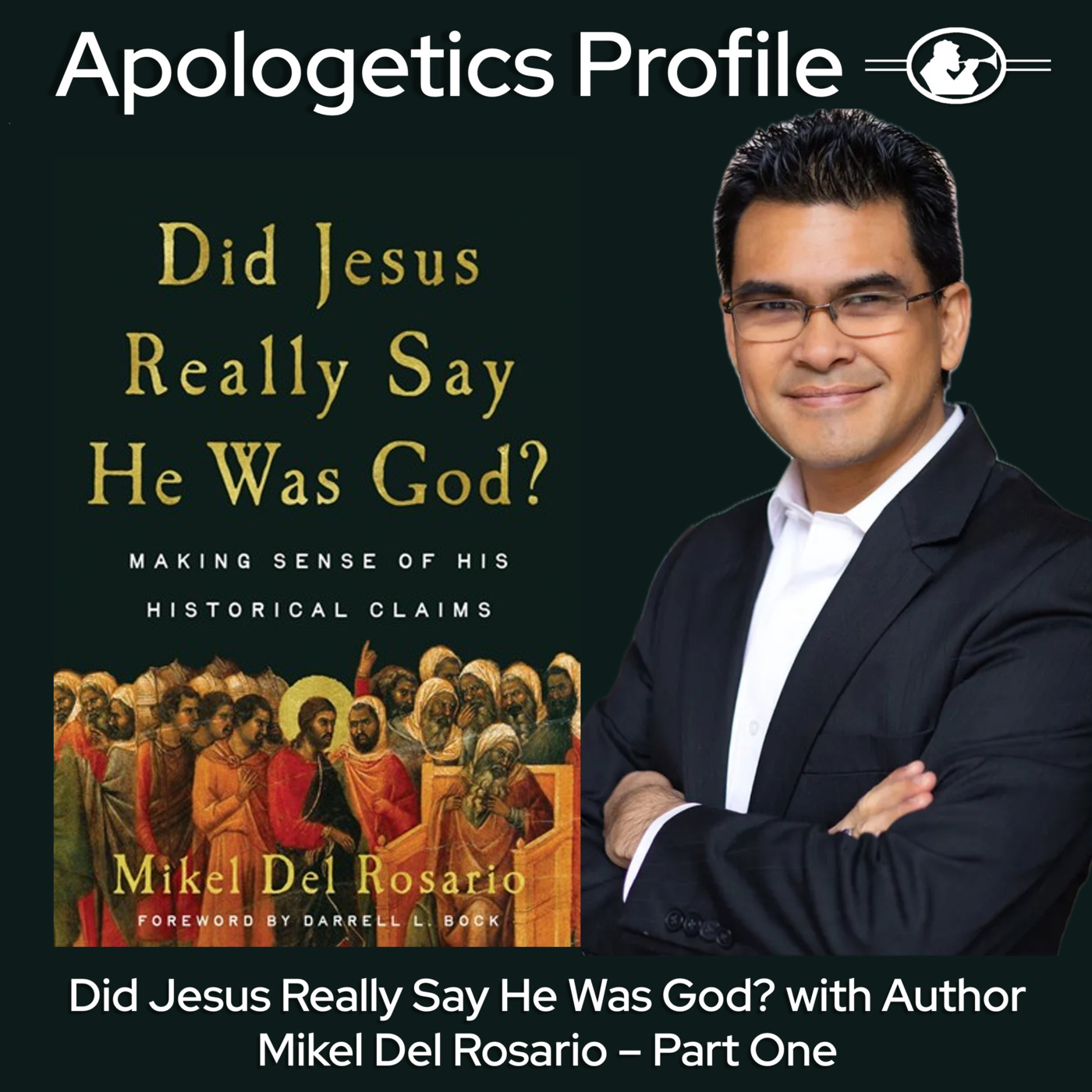
Apologetics Profile
Episode 323: Did Jesus Really Say He Was God? with Apologist and Author Dr. Mikel Del Rosario - Part One
00:44:01
Did Jesus really say He was God? The Scribes, Pharisees, and the High Priest Caiaphas sure unders...
Loading summary
Transcript34 lines
- [00:10]
Narrator
He heals the brokenhearted and binds up their wounds. He counts the number of the stars. He gives names to all of them. Great is our Lord and abundant in strength. His understanding is infinite. This, this is apologetics profile.
- [00:38]
Dr. Michael Del Rosario
When he heals the man, you know, when they, they believe he's a blasphemer. Jesus says verse 10 so that you may know that the Son of Man has authority on earth to forgive sins. He tells the paralytic, get up and walk. Take your mat, go home. And when he gets up and walks, what it does is it tells everybody who's now watching because of this disturbance. Everyone's curious, they're looking on. It tells them all that Jesus as the Son of man does have authority on earth to forgive sins. And so now they're confronted with, okay, who is this guy? Because if he really was just a blasphemer, why would Jesus be able to heal this man?
- [01:24]
Host
If God really existed and wanted to communicate with us, why would he choose to reveal Himself through human languages that have been out of common everyday use for millennia, ancient languages that are written on fragmentary and very fragile papyri and parchment, it all just seems rather, well, man made, at least according to skeptics and critics. If God were God, the critics say, he could just show up and settle the matter rather quickly. There would be no need to learn ancient Hebrew, Aramaic or Koine Greek. No need to argue endlessly with fellow believers and non believers about what the text really says. No need to get into complicated historical arguments, no need to rely on scholars to tell us what it all means. No endless apologetic and counter apologetic YouTube videos about textual criticism or who Jesus really is, or if he even existed. And if the biblical texts are so plain and clear in their meaning, we surely would not have had such an unfathomable translational sea of just English versions of the Bible alone. Nor would there be so many different Christian denominations which are largely based on particular interpretations of the Bible. If you have non believing friends, family members or co workers, and you have had conversations about the nature and meaning of the Bible with them, you have probably heard at some point one or more of these objections. So what do you say? Before you even begin to talk about the actual texts of the Bible in their original languages or in any English translation, the first thing to do when addressing such objections is to point out to your skeptic friends that their objections seem to presuppose what God is like. To put it simply, you can ask your friends how they define God, and you can ask them for the sources from which they've received their definition of God. It is likely they've received their information the same way you have from historians, philosophers, theologians, teachers, all using the ancient means of the spoken and written word. So at the outset of these objections, there is something of a tacit double standard here. The skeptics claim it is questionable at best that God would reveal himself to us through oral and written traditions. Yet it is nevertheless through oral and written traditions that the skeptic has acquired his own knowledge about God. So why would the skeptics, oral and written traditions upon which they depend, be more reliable than what we have in the pages of Scripture? So the real question then isn't why did God choose to reveal himself this way? Rather, the question is why? What is the most reliable historical method of inquiry regarding the texts of the Bible? That is a question we will be addressing this week.
- [04:41]
Interviewer
And next on Apologetics Profile.
- [04:44]
Host
Morality and writing. After all, though two very ancient means of human communication remain the primary way by which we communicate with one another to this day. So despite the biblical text's humble origins and their delicate food physical condition, they have not only been preserved for us to study and understand the central message of the Bible, the Gospel of our Lord and Savior, Jesus Christ, who is God with us, has gone around the world, having been translated into a multitude of different languages. So God's choice of revealing himself to mankind through the pages of a collection of writings authored in different times and different places by a variety of different writers has proven astonishingly successful. Statistically speaking, the Bible is the runaway best selling book of all time. And that is no small accomplishment considering there were no publishing companies back then, no mass communications technologies, no social media, not to mention people back then had to make their own paper out of leather or marsh grasses, had to make their own pens and their own ink and words traveled slowly by foot or by pack animal. Now, all of this, of course, does not make the Bible true, but it does address head on the objection that God's method of revelation to us through the spoken and written word is questionable. Let's stop for just a second and consider how evolutionary biologists and anthropologists and paleontologists write their histories of life on Earth. They tell us in a few very confident broad strokes of their pen what happened millions, even billions of years ago. Yet there are no written accounts of the history of life on Earth or accounts of the first appearance of human beings upon which modern scientists make their claims. Scientists today instead formulate the ancient cultural and social history of mankind from Fossils from bone fragments, from assumptions and interpretations about DNA, from presuppositional, philosophical and chronological assumptions that cannot be empirically demonstrated. From a handful of cave paintings, maybe some pottery shards, arrowheads, maybe some primitive dwellings, but not from any written texts yet. In evolutionary textbooks and popular literature, we are often given a detailed picture of our ancient prehistorical past, as though the earliest human beings had left us with a detailed written record not only of their origins and subsequent daily lives, but of the appearance and development of life itself. Consider the famed evolutionary naturalist Charles Darwin's pithy statement in his 1871 publication the Descent of Man, about the alleged ancestors of human beings. Darwin says, we thus learn that man is descended from a hairy quadruped, furnished with a tail and pointed ears, probably arboreal in its habits, and an inhabitant of the old World. In short, the species from which we as human beings have allegedly descended were hairy, had pointed ears and generally lived in trees in Africa somewhere. And according to modern biological timescales, these proto humans lived roughly 3 million years ago. The late science popularizer and planetary astronomer Dr. Carl Sagan affirms Darwin's history of these tree dwellers in his 1977 book Dragons of Speculations on the Evolution of Human Intelligence. Sagan writes, our arboreal ancestors had to pay attention. Any error in brachiating from branch to branch could be fatal. Every leap was an opportunity for evolution. Powerful selective forces were at work to evolve organisms with grace and agility, accurate binocular vision, versatile manipulative abilities, superb eye hand coordination and an intuitive grasp of Newtonian gravitation.
- [09:14]
Interviewer
End quote.
- [09:22]
Host
Our primate ancestors, swinging from tree branches, guided by powerful selective forces of evolution, became intuitively acquainted with Newtonian gravitation millions of years before Newton. Sagan says yes, human intelligence is fundamentally indebted to the millions of years our ancestors spent aloft in trees. If there are any historical accounts that are imaginatively man made, they are the speculative evolutionary histories of our alleged pre human tree dwelling ancestors. There are finally no written records of our pre human ancestors living in trees for millions of years. Such accounts reside solely in the imaginations of scientists. It is a kind of paleontological parallelomania. Scientists seek out human like characteristics in lower primates and conclude that we must have evolved from them. Evolution by means of natural selection was nothing more than Darwin's formal attempt to explain the existence and variety of life on Earth. Apart from the biblical account of creation found in Genesis. If there is any history about which we ought to be critically skeptical, it is the often repeated stories of mankind which allegedly tell us what happened in the tops of trees hundreds of thousands, even millions of years ago. And yet we actually have written historical accounts of one man who died on a tree. See Deuteronomy 21:22, 23, Matthew 27:40, Luke 23:26, John 19:19 and Acts 5.
- [11:15]
Interviewer
30.
- [11:16]
Host
While many non believers generally accept Jesus was put to death on a cross by Roman authorities as a fact of history, many nonetheless refuse to believe Jesus rose bodily from the grave. Skeptical critics have no qualms at all about criticizing the resurrection as a hallucination, hallucinatory vision, or as an embellished myth. But to question the neo Darwinian paradigm today is virtually akin to religious blasphemy. Chinese paleontologist J.Y. chen, an expert in Cambrian fossils at a 1999 paleontology conference in China, told the late Discovery Institute fellow Jonathan Wells that in China we can criticize Darwin but not the government. In America you can criticize the government but not Darwin. We might take Chen's comments a step further and say it's okay to criticize God but not Darwin. So why did the biblical authors put pen to paper? Were they just writing the ancient equivalent of historical fiction? Were the authors actually just members of various educated elite communities of anonymous editors and redactors making up legends for profit or religious or political power? In terms of the record of the Old Testament, old Testament scholar Dr. John Oswald notes in his book the Bible among the Myths, when we ask the Israelites where they came up with these fantastic concepts, they tell us that they did not come up with with them. They tell us that God broke in upon their lives and dragged them kicking and screaming into these understandings. They tell us that they did their best to get away from him, but that he would not let them go. He kept obtruding himself into their lives in the most uncomfortable ways. If that report is not true, we are at a loss to explain where the fundamentally different understandings of life in the Old Testament came from. Such disquieting astonishment could likewise be applied to Jesus disciples and to the apostle Paul when he first encountered the risen Jesus on the road to Damascus. In the opening of Luke's account, God breaks into our world as a human infant and dwells among his people as the Son of Man, as the second person of the Trinity, Jesus, Emmanuel, the Messiah. And years later, during his public ministry, even his chosen disciples would struggle with understanding who he really was or what he was doing. Recall in Mark, chapter two, when Jesus heals the paralytic whose friends had dug through the roof of the home where Jesus was teaching the Son of Man, seeing their faith, declares that the paralytic sins were forgiven. But this declaration of the forgiveness of the paralytic sins caused offense to the scribes who were present in the home that day. They reasoned secretly within themselves that Jesus had just committed blasphemy. Who can forgive sins but God alone? Yet Jesus discerned their secret thoughts, which must have surprised them just as much as Jesus. Declaration of forgiveness the charge of blasphemy here is critical. The scribes reaction indicated they understood Jesus as acting and speaking as though he were God himself. On the next two first episodes of Apologetics Profile for 2026, we will be talking with apologist, author and professor of Bible and theology at Moody Bible institute in Chicago, Dr. Michael Del Rosario. We'll be discussing his new book, Did Jesus really say He Was God? Making sense of his historical claims as we pick up here in part one, I asked Michel what inspired him to write the book. Here is Mikel Del Rosario.
- [15:34]
Dr. Michael Del Rosario
One day I was at this church event, and then later on after the event, there was a woman who cornered me and wanted to raise this whole idea of where we even got the idea that Jesus is God. And in this conversation, I had my Bible out on the table, and first time this ever happened to me. Actually, the only time this ever happened to me, this lady in the middle of our conversation, in the middle of our conversation, she grabs my Bible and she holds it up like a visual aid and says, according to this, Jesus never said he was God.
- [16:02]
Interviewer
Wow.
- [16:03]
Dr. Michael Del Rosario
I was pretty surprised because this woman was someone who went to church regularly, and yet she was saying some of the same kinds of things that you might hear from people who read, skeptical scholars who will try to pit the Gospels against each other, who will say things like, if Jesus really said, I and the Father are one in the Gospel of John, then why don't we see any hint of a divine claim like that in the earlier gospels, especially in Mark? And so, you know, we talked about Jesus sayings in John, but she switched from a literary challenge to a historical challenge. So at first it was just like where in the Bible, you know, Jesus didn't say he's God anywhere in the Bible, we begin to talk about some of the things that Jesus is recorded as saying in the Scripture. Then she switches to a literary challenge. Yeah, but. Or rather, she switches to a historical challenge from a literary one. Like maybe the Bible says, but how do we know the Bible's really giving us history? And so that's kind of got me thinking about, you know, we need to help people be equipped to answer these kinds of challenges. Because I've often spoken at apologetics conferences where you go through a classical model talking about the existence of God and some arguments, theistic arguments, and then maybe the problem of evil might be discussed and then you jump straight to the resurrection. But it leaves people ill equipped to actually dialogue with people about who Jesus is, the things that Jesus said about himself. Because it is the claims of Jesus that fill the resurrection with theological meaning. And so that I feel really burdened to equip people to be able to engage with people on Jesus divine claim. And then I saw this stat. There's statistic from Lifeway and Ligonier Ministries, which came out in 2022. They pulled 3,000 people who were self professed evangelical Christians who say that the Bible is very important to them, that they go to church regularly. 43% of them agreed that Jesus is a great teacher, but he was not God.
- [17:58]
Host
Wow.
- [17:59]
Dr. Michael Del Rosario
And that was just shocking to me. That 43%, the same study said you could increase that to 53% if you consider people who didn't call themselves evangelicals but still went to church regularly. So I was thinking this really is something that we need to equip the church to deal with, to engage with those who are skeptical about the Bible, whether they have literary challenges or historical challenges, maybe even some theological misunderstandings. But the impetus for this was. Yeah, all those, those personal things. But a lot of the research behind this came from my doctoral dissertation. And I thought, you know, I already did a lot of this research, so I don't want it to just be a file sitting on my computer. I want it to be able to bless people and to equip the church. So I reworked that whole thing into a much more popular presentation. It is still an academic book. It's a challenging book in places. But I had my college students in mind, I had seminary students in mind. So I really made it to the point where a motivated Christian could really, really learn from it and be introduced to how do we do historical Jesus studies? How do you talk to people who don't see the Bible as an authority, but might be interested in the answers of history?
- [19:12]
Interviewer
That's fantastic. But you know, as you know, we live in a culture that is. The questions are different, Mikael, that people are saying, well, how do I know that? How can I trust this is historical? How can I trust this is reliable? We have just come out of a couple of decades of new Atheist thinking that has influenced our thinking about God and the Bible. But it seems like people are, I mean just basic facts like the historical nature of the texts themselves. I mean, as you know and swim in the historical Jesus studies that the actual advent of higher Criticism in the 19th century and later on through all the scholars that had come in the early 20th century demythologizing the Bible, as Bultman has said, that the idea that this historical critical approach to the Bible really is sort of an acid or on the discipline of history itself, that we have provided a plausibility structure to where we can doubt history if we want to without really taking a conceptual step back and looking at well, what is history? And I like how you outlined in the book, you kind of give us a kind of a 30,000ft overview of a historical process about how we assess the past. But you know, just stuff like the manuscript tradition. I mean the earliest copy of Aristotle's works we have is 1100 years removed from whatever originals may have been written or Pliny the elder. There's like 750 years between our earliest manuscripts and Pliny's original. But with the Gospels you only have a couple of centuries between the earliest copies and the originals. And this is absolutely historical gold. But people aren't familiar with the, the historical process. I mean, if you're going to cast doubt upon the Bible, as you know, you're basically throwing out history. Talk a little bit about the, the mechanics and the tools of history and how we know what we know about the past.
- [21:17]
Dr. Michael Del Rosario
Yeah, this is a great place to start for those who are skeptical of the Bible or at least are hesitant to start with the Bible because they, they have this stereotype or this false impression that somehow the Bible was written by one person in the back room somewhere and it was written in Latin in the medieval times or something. And we just have to be patient. Actually I remind my students in Bible Intro, God was so patient with us, we should be patient with other people as well. They might come across with a lot of pride, like how could you believe this ridiculous thing? But they themselves have been misinformed about what the Bible actually is. And so just to be patient with people, to explain to them, there is an Old Testament and a New Testament, there are the Gospels and there are accounts of Jesus, there's eyewitness testimony and things like that. So one thing I talk about when I train people is how do we engage with people who don't see the Bible as a spiritual authority, but they might be interested in the answers of history. So there was an Uber driver once who said to me, I'm not religious, but I like history. So I love those conversations because I tell them, I study Jesus as a figure in ancient history. And that kind of sets, you know, some people get really interested that that kind of gives them pause. Like, I haven't heard a Christian say the words Jesus as a figure in ancient history before. So we can study surviving traces of past events. So what is history? History is a narrative, it's a story that historians tell that best explains these surviving traces of past events. So when someone writes a history they're trying to explain, well, we have all these facts. What's the best explanation? And so there's an inference to the best explanation that we say, here's a story that best makes sense of all of this data. And if someone has a different theory, here's why. This theory maybe has more going for it in terms of it explains more data versus this. One can't account for some of our bedrock data. So we introduce people to what's called the criteria of authenticity. And these are the rules of evidence in court that lawyers use, like relevance, things like that. But in historical Jesus studies, corroboration is really the name of the game. So it's better if we have more than just one source telling us about something, if we have two or three. So because of this, the Gospel of John is oftentimes the first one that Christians run to to cite some of Jesus explicit claims like I and the father are 1, John 10, John 8, before Abraham was I am. And yet in historical Jesus studies, sometimes Christians are surprised to know that John is often put to the side. Because 88% of John is unique material and historical historians want to focus on. Let's look first at the ones where there's corroboration, where there's more than one source telling us the same thing happened. And so just multiple attestation is one. Another is dissimilarity. If something is not quite like Judaism, not quite like Christianity, historians will pay careful attention to that. So something like Jesus calling himself the Son of man. In Judaism, you have one like a son of man. And we have this Aramaic self reference. But Jesus always makes it definite. So it's not exactly like a son of man, it's the Son of man. But then in the Christian church, you don't see Jesus being worshiped as the Son of man. We don't have a lot of worship songs worshiping Jesus as the Son of man or the son of the blessed. These Kinds of things. So Jesus probably really did call himself the Son of Man. And we see it 81 times throughout the Gospels, 69 times just in the Synoptics, always on the lips of Jesus, except one time where the crowds are quoting Jesus calling himself the Son of Man. And so those are the kinds of things that historians will look for even if they don't consider the Bible, the Word of God or even reliable. Rather than saying, well, the whole Gospel of Mark that's historical, they'll look at certain sayings and certain events. And what it does in the mind of historians is when these things apply, it increases the probability that this really does go back to Jesus. And so that's a good place to start some of these bedrock facts that are multiply attested and sayings that are dissimilar. So those are just a couple.
- [25:24]
Interviewer
Now today, obviously we have the advantage of 2000 years of church tradition and history and people have examining and preserving the Scriptures and looking at the scriptures and we have countless millions of people who have lived the Christian life. Mikhail, what would you say in light of all this that, you know, somebody says that, well, in the first century we didn't have all this scholarship, we didn't have all these historical critical scholars. We didn't have the criterion of embarrassment or the criterion of dissimilarity, or the enemy attestation. We didn't have all these artifices of history. How did the message of the Gospel go forth in that time where you didn't have the Internet or anything to verify? You didn't have what we have today, the apparatus that we have today of googling things, of looking things up in books and encyclopedias and citing scholars and things like this, it is amazing to me that if the claims of skeptics are true, the kind of story that they would need to create in order to explain why we have the Gospels in the first place. And oftentimes there's far less evidence for the stories that skeptics make about how they think the Gospels came together than about what the Gospels actually say about why Jesus exists and what happened. So what was it like in the first century as Christianity began? How did the news spread in a day and age where there's no mass communication and mail was on donkeys and by foot and you had to copy things and there was no mass communication like we have today? How did it spread? What happened?
- [26:58]
Dr. Michael Del Rosario
Well, that's a very, very big question.
- [26:59]
Interviewer
It is, I'm sorry, I guess we
- [27:02]
Dr. Michael Del Rosario
have the eyewitness testimony of the people who Saw Jesus who heard him claim to be more than a man to claim to be divine. And not just his followers, but even his enemies heard these things, right? So we know that on the day of Pentecost, for example, this is after Jesus resurrection, there are 3,000 people who were saved on the day of Pentecost. Peter is saying of these things, we are all witnesses that Jesus rose from the dead. And because the resurrection and ascension vindicated Jesus claim to be divine. Let, let all of Israel know for certain, right? God has made Jesus Lord and Messiah. And so there's the proclamation of the apostles of their own eyewitness testimony. There's even the eyewitness testimony of Jesus enemies that was being propagated. And we know, just think about all the times that Peter says Jesus, who is innocent by the way, and you guys had him crucified every time he says he was innocent. It's kind of a reminder to me that like, yeah, there was a public debate that was going on because it wasn't just the disciples of Jesus who were telling the story. The enemies of Jesus were telling the story as well. Like, here's why he's a blasphemer. You know what he said to Caiaphas? He said that he was going to judge, judge the whole council. He was going to judge the sins of Caiaphas. Like, who is this guy? And so there was this debate going on between even the house of Annas. And we find all the way Josephus knew about this because In Antiquities, Book 20 talks about James being put on trial and he's the brother of the one called Christ. So even this idea that Jesus was called the Messiah, and here's why they didn't believe in him, because he was actually a blasphemer. The Talmud calls him a sorcerer. So there were, besides the eyewitness testimony of his disciples, also the eyewitness testimony of his enemies in that tradition. Now, when it comes to the resurrection preaching, this goes so early. Like we. We can get into a big discussion of when the Gospels were written, how long, you know, when they were dated, and how long since the event. We can also go to First Corinthians, though, and talk about how in first Corinthians, Paul has the creed that's cited that was formulated even before any New Testament book was written. So there are these creeds and hymns in the ancient church. And First Corinthians 15 says, Paul says that I delivered to you what I also received, that Christ one died for our sins according to the scriptures that he was buried. He was raised on the third day, and he appeared to all these people. And so we have these creeds in the church as well. And DG Dunn says the formulation of that creed goes back to basically the foot of the cross, like, could have been the same year. DG Dunn says, but even without, even without appealing to that, think about just the mere conversion of the Apostle Paul. Paul is kind of a central figure in historical Jesus scholarship, even though people don't normally think about, well, why are we going to Paul's writings? Why are we talking about Paul instead of Jesus and the Gospels? But Paul really does a lot for us in terms of he's an enemy of the Christian faith. He actually becomes transformed and becomes one of the great missionaries of the church. But what was he persecuting? Most scholars believe that he became a Christian. He saw Jesus on the Damascus road two years, within two years after the cross. And so we get that from Galatians and just putting some of the dates together. But if you think about this, what was he persecuting? It was the Christian message that Jesus is the Messiah and he rose from the dead. So he had to know that even before his conversion in order to persecute that message and say, you know what? That's wrong. We're going to persecute that message. But then he also had to know that to understand what he was seeing on the Damascus road when he saw Jesus. So this pushes it way back to within two years of the cross. Paul is converting. So even before that, he knows the resurrection preaching, he's fighting against it. And before that, we have this creed that goes virtually to the foot of the cross, the formulation of that creed. And so it traveled by eyewitness testimony through the traditions of Jesus and his Jesus disciples and Jesus enemies, through creeds and hymns like the hymn in Philippians 2 that talks about Jesus taking on a human nature and the humility of Jesus even submitting to death on a cross, and then through Jesus appearing to Paul. So these are just some examples.
- [31:22]
Interviewer
Yeah, it's. To put it very colloquially as we're talking, I think tonight is the last or it's game six of the World Series. And as you may know, the Los Angeles Dodgers and the Toronto Blue Jays are battling it out for baseball supremacy. But what you're saying kind of is like Blue Jays, people on the Blue Jays, fans of the Blue Jays, attesting to the athletic prowess of Shohei Ohtane, who is a dodger. So in other words, what happened to Jesus, who. Jesus was a Lot of the attestation we have, as you said, comes from
- [31:54]
Host
the other side,
- [31:57]
Interviewer
the Jewish cultural milieu of first century temple Judaism. This is the backdrop in which all of this is happening. And so it seems that that is a, to me, the absence of early century people accusing Jesus or accusing the disciples or accusing the early church of just making stuff up. If that really was the case, Mikhail, then we would certainly have some, some credible documentation in like a Josephus or somebody else that would have clearly pointed out that this was just a fabrication of a small zealous band of end times radical Jewish disciples who were following around this rabbi. Because it seems like at the time too there were also itinerant preachers and people stirring things up. And Jesus was just one of, seemed to me, to other people, Jesus was just one of these other messianic type of figures. And that's an objection you hear today that Jesus was just a failed messianic prophet. But in that time period, it seems that we have a sort of a reluctant confirmation from the Jews and from the enemies like Paul. A perfect example, a reluctant confirmation of people who were not necessarily supportive of Jewish religion or necessarily supportive of Christianity, but attesting to this idea that there was this Jesus who died and whose followers believed he rose again. So that's a really strong, to me that for me as a Christian, that's always been a really strong case for this actually really happening. There were plenty of opportunities for people to have stated very clearly that this was all a fabrication.
- [33:39]
Dr. Michael Del Rosario
Yeah. In fact, the enemies of Jesus to discredit him would have to try to explain away things. So even in the Bible we see people saying he's doing these miracles by Beelzebul. Right. No one's saying he's faking his miracles. They're saying now where did the power come from? He's either from above or he's from below. Only two options in the ancient world after the Bible. Someone like Celsus, for example, would say that Jesus was using Egyptian magic. You know, he's writing. Around 100 AD, Jesus went out to Egypt. He was hired to do some stone masonry work or some carpentry or something. He learned Egyptian magic, came back, and that's where he got his supernatural power. So it's interesting to see these alternate theories of like, who is Jesus? And they're just trying to explain what makes him this wonder, wonder worker. Kind of like Josephus says, the doer of wonderful deeds. Right. Where we get the Greek word, we use the Greek word paradox on there where we get our word paradox, these unexplainable, miraculous things. Right? And so, yeah, you don't have anyone saying Jesus never existed. You don't have anyone saying that he didn't really do miracles. They're just trying to explain away is he from. From God or is he from below? They're trying to explain away his miracles as being things from the devil.
- [34:53]
Interviewer
Yeah. And you even have the. One of the other fascinating things to me has always been the Alexamenos graffito, the caricature of something like what looks like the head of a donkey on a cross, and it says Alexamenos worships his God. Kind of the first kind of attestation, another kind of enemy attestation that like Celsus, isn't denying Jesus existence, isn't denying he had some kind of power. But they're coming up with these alternative explanations because even Celsus, who was so passionately against Christianity, could not help but affirm Jesus was real, he had some kind of power, he did these things, he really existed. So there's a lot of that. And I think just a surface level investigation of these things would. Would assuage a lot of people's doubts if they're really wanting to find reasons for why we believe in these things. Now, I wanted to talk specifically about the two examples that you use to answer the question of the title of your book. Did Jesus really say he was God and they come from Mark? And I think the second part that you use about Jesus tearing his robes is also in Matthew's account, but you focus on Mark because a lot of people say that, you know, in the tradition of higher critical scholarship, the Gospels take on a sort of evolutionary course, just kind of like Darwinian evolution, that the deity of Jesus is really nascent in a kind of cellular form in Mark, and then it just kind of grows and grows until we have this high Christology in John. But really that's just kind of a fabrication of. Of critical scholarship, because as you point out in your book, there's high Christology in Mark, especially with Mark 2. Right off the bat, Jesus does three things in that passage about the passage, the passage about the paralytic. He discerns the secret thoughts of the scribes, then he forgives the sins of the paralytic, and then he tells the guy to walk, and everybody's like, whoa, who is this? Right? They're all amazed. So why don't we talk a little bit about the setting of Mark 2, and then we can go into the Caiaphas situation.
- [37:10]
Dr. Michael Del Rosario
Sure. Yeah, Jesus is in a house, he's teaching, and his teaching is interrupted because this little bits of thatched roof are falling from the ceiling. And then there are four friends who lower one of their friends on a mat. The guy's paralyzed. And I'm just thinking about, first of all when I talk about this, because I always want to talk about the beauty and the. Just the attractiveness of Christ. Before we just get into the scholarly part, is the compassion that Jesus had for this man. If someone's teaching is interrupted in a church, more times than not, they're looking for the security to kick this guy out or to stop this disturbance. But Jesus stops the whole thing. And everybody's looking on like, what's Jesus going to say now? And seemingly out of nowhere, Mark chapter two, verse five. Jesus says, son, your sins are forgiven. Even though the man was clearly there for healing, Right? Jesus prioritized his spiritual state. He was concerned about his sins and pronounced the forgiveness of sins. But historically, I like to talk about this as a place to start because one, it is the earliest miracle story in the earliest gospel to be written. And the bedrock fact here is Jesus reputation as a miracle worker, which even the critics who say that miracles aren't even possible will at least say that Jesus was known as a miracle worker is a fact of history. So I say, okay, well, let's start there. Here's a piece of data that tells us Jesus was known as a miracle worker because there are all these stories of Jesus doing miracles. Jesus also multiple attestation shows us that he healed lame people. So there's. He has a reputation for healing not only the, the sick miraculously, but healing lame people. So we have here in Mark chapter two, also think about when John's disciples came, came to Jesus in Matthew 11. They said, Are you the one who is to come? One of the things Jesus said to them is, go back and tell John what you've seen and heard. That the lame walk was one of the things he mentioned. These. That's one of the signs of the Messianic era. And so, okay, there are more and more handles here that scholars can say, let's take this story a little more seriously now. Dissimilarity we have applying to Jesus responds to the scribal blasphemy. So the scribal response to this was, why is this guy talking like that? He's blaspheming. Who can forgive sins but God alone. That's a rhetorical question.
- [39:31]
Interviewer
Let me ask you really quickly. I noticed something today as I was reading that, and I want to get your thoughts on it quick before we go on to talk about this. But it's in with what you're talking about in that passage. It seems to be the case that the scribes, when they're thinking about, who is this man he's blaspheming, only God can forgive sins, that they didn't actually say that out loud to the people there. It seems the Bible goes out of its way to say that Jesus discerned
- [40:01]
Host
the secret thoughts in their heart.
- [40:03]
Interviewer
They didn't actually say that out loud for everybody to hear, but Jesus articulated out loud what their secret thoughts were. And that maybe, I mean, to me, I was thinking, wow, well, that's the first thing that got my attention or gets your attention, right? It's like your pastor calling out your secret thoughts as you're sitting there in the pew on Sunday. Hey, is that. Or did they say something? It seems like they didn't say anything. And Jesus discerned their thoughts just like the disciples sometimes. Is that accurate?
- [40:34]
Host
Can we say that?
- [40:36]
Dr. Michael Del Rosario
You know, I think I am. I suppose I'm a little bit more hesitant to assert that Jesus used his supernatural power to know that, because there are some commentators who say, no doubt their faces expressed it or something like that. Like, it was so clear. That would be quite a very specific thing for your face to express. So, but because it's not literally there in the text that Jesus, how Jesus knew, I don't want to assert that that's exactly what that's saying. But it's very possible that Jesus, knowing their thoughts, went ahead and answered them. Right. And then they would be like, oh my gosh, he knows what we're thinking. But it's kind of like, you know, that Jesus may not always have to be. We don't have to always punt to Jesus using supernatural knowledge or prophecy. But in this case, it could very well be, yeah. So, I mean, I would put that out there as certainly something to consider. If in fact he is who he claims to be, then this would be no problem for him.
- [41:37]
Interviewer
And just more curiosity on this fact, because I was thinking about this whole passage. I'm like, why didn't Jesus just go outside so the roof didn't happen? As soon as the stuff starts falling from the roof, you're like, hey, what's going on? You go outside, you see what's going on, you just heal the guy out there. I wonder if. Because obviously Jesus being omniscient as God, would know what's going on up there. Why didn't he stop the digging through the roof? Why let the whole. Why let all that happen? I mean, we don't know what happened. Mark doesn't tell us. These are details that we want to know, but we don't get the answer to. But to me, the answer that I have for myself there is that, well, Jesus allowing these men, these four men, to dig through the roof is a demonstration of the kind of faith that they had in Jesus to be able to. To do what he was about to do.
- [42:28]
Dr. Michael Del Rosario
Yeah, And Jesus is trying to make an example of this. It's kind of an illustration because when he heals the man, you know, when they. They believe he's a blasphemer, Jesus says verse 10 so that you may know that the Son of Man has authority on earth to forgive sins. He tells the paralytic, get up and walk. Take your mat and go home. And. And when he gets up and walks, what it does is it tells everybody who's now watching because of this disturbance. Everyone's curious. They're looking on. It tells them all that Jesus as the Son of Man, does have authority on earth to forgive sins. And so now they're confronted with, okay, who is this guy? Because if he really was just a blasphemer, why would Jesus be able to heal this man? Why would God allow this person to be vindicated, this claim to be vindicated? So I think he's making a point about his authority here, and he's using this as an illustration to show people to give them something that they can see so that they could believe in something that they can't see, that Jesus forgiveness is efficacious because you can't see the sins being forgiven, but you can see the man getting up and walk.
- [43:37]
Narrator
Apologetics Profile is a production of Watchmen Fellowship Incorporated, Arlington, Texas. For more information about our ministry and resources and our sister podcast, Good Heavens, visit our website today@watchman.org that's watchman with an A dot org.