← Apologetics Profile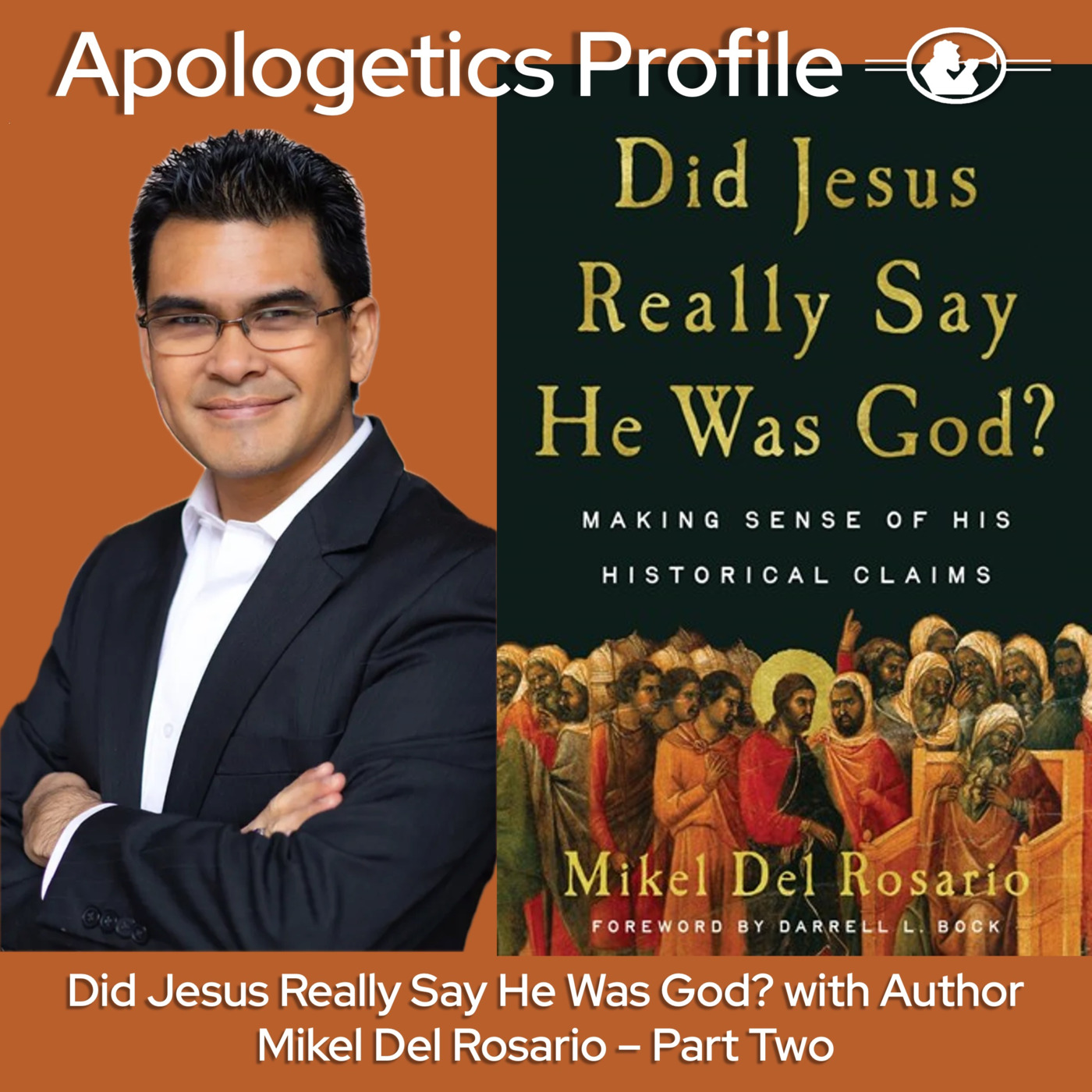
Apologetics Profile
Episode 324: Did Jesus Really Say He Was God? with Apologist and Author Dr. Mikel Del Rosario - Part Two
00:34:22
What do charges of blasphemy against Jesus teach us about who Jesus really is? Clearly the Jews, ...
Loading summary
Transcript35 lines
- [00:04]
Podcast Host / Narrator
Well, since the wisdom of God, the world, through its wisdom, did not come to know God. God was well pleased through the foolishness of the message preached to save those who believe. This is Apologetics Profile, a podcast dedicated to equipping the body of Christ to engage the world with the wisdom and knowledge of God.
- [00:27]
Dr. Mikhail Del Rosario
I think what Caiaphas is thinking is, wait a second. We are God's representatives on planet Earth, and who are you? You're going to judge us? How dare you. Hence the blasphemy when he tore his robes.
- [00:50]
Podcast Host / Narrator
Skeptics of the New Testament, as well as Jehovah's Witnesses and Latter Day Saints have often tried to explain away Jesus healing the paraly in Mark Chapter two as evidence of his divinity. Usually the objection is that Mark's account only tells us that Jesus had the authority to forgive sins, not that he was God. Theologian Michael F. Byrd, however, in his co authored 2014 book How Jesus Became God, poignantly takes this general objection to task. He writes, the scribes do not complain. Who can forgive sins but a priest alone? Nor does Jesus explain his action by saying, I want you to know that I've recently purchased a Galilean franchise on the priesthood, licensing me to forgive sins, preside at weddings, and officiate at bar mitzvahs. No, instead, he says, but I want you to know that the Son of Man has authority to forgive sins, which turns out to be a divine authority. He commands the paralytic man to stand, pick up his mat and and go home. Even more astounding, the man does so. A miraculous healing takes place. Jesus claims for himself an unmediated divine authority that, to those steeped in Jewish monotheism, looks absolutely blasphemous. The New Testament portrays Jesus as both a fully human person person and as Yahweh, the Lord and God of the Old Testament. Jesus, however, is not the Father. Jesus is the second Person of the Trinity, the Son. When Jesus the Son prays, he is not praying to Himself, as many skeptics routinely claim, but to the Father. John tells us several times that the Father has sent the Son. See sections of John, chapter 5, chapter 6, chapter 8, chapter 10, and chapter 17. For example, as Robert M. Bowman and J. Ed Komoshevsky note in their comprehensive 2024 book the Incarnate Christ and His A Biblical Defense, jesus prayed because he was human, but he was still Jesus the Son incarnate, praying to someone distinct from himself, namely the Father. The Father and the Son are both deity by nature, coexisting eternally with the same unique and infinite power, knowledge and glory, their eternal unity and likeness are uniquely perfect in such a way that we can legitimately speak of them as one God. In other words, there is one transcendent eternal Creator revealed to Israel as Yahweh, who made and rules all things. And this Creator has revealed himself to exist eternally in the persons of the Father and the Son, as well as a third person called the Holy Spirit. In Christian theology, this idea, which brings together everything the Bible teaches about God, is called the doctrine of the Trinity. Bowman and Komoshevsky what Christianity teaches about Jesus, then, is not simply that he is God, and not even simply that he is the Son, but that he is God the Son incarnate. If this seems difficult to understand, that shows you are paying attention. Jesus was a puzzling person during his earthly lifetime. Throughout the Gospels we find people asking, who is this? Why does he speak this way? How is he able to do these things? Of course, we cannot possibly cover all the theological complexities of the nature of Jesus as revealed in the pages of Scripture in just a few podcasts. As the Apostle John himself confessed at the end of his and there are also many other things which Jesus did, which if they were written in detail, I suppose that even the world itself could not contain the books that would be written. And perhaps the vastness of the universe itself reminds us of Jesus inexhaustible wisdom and power. As the Apostle Paul says at the conclusion of the 11th chapter of Romans oh, the depth of the riches, both of the wisdom and knowledge of God. How unsearchable are his judgments, and unfathomable his ways. For who has known the mind of the Lord, or who became his counselor, or who has first given to him that it might be paid back to him again from him and through him, and to him are all things to him be the glory forever.
- [05:38]
Podcast Co-host / Interviewer
Amen.
- [05:41]
Podcast Host / Narrator
Here on Part two of our conversation with apologist, author and professor of Bible and theology at Moody Bible institute in Chicago, Dr. Michele del Rosario, we will continue discussing his new book Did Jesus really say He Was God? Making sense of his historical claims, we will also briefly touch on the authorial anonymity question pertaining to the four Gospel accounts and the reliability of eyewitness testimony pertaining to Jesus life and ministry as we begin Part two, Michel here addresses why the scribes objection to Jesus forgiving the sins of the paralytic in Mark 2 is solid evidence that they understood Jesus to be equating himself with God. Here once again is Mikhail Del Rosario
- [06:29]
Dr. Mikhail Del Rosario
so it seemed pretty Clear to the scribes that he was making himself too close to God. He was acting like God does and speaking like God does. So either he's a blasphemer or he really does have legitimate heavenly authority to act like God does and speak like God does. Sometimes it's said, well, if it was Jesus really forgiving his sins, he would have just said it directly like, I forgive your sins. Why does he say, your sins are forgiven in the passive? Huh? Maybe that's a divine passive quote, unquote, which is not really. Technically, it's not a grammatical category, but that's a whole other story. But what's really interesting, and I do this in my book, and I can't articulate all the texts right now, but there are a number of places in the Old Testament where God actually speaks just like that, where God says their sin will not be forgiven or it will be forgiven. Like God himself is speaking in the passive. And so I think Jesus is speaking like God does. And then here he's acting like God does by healing. And Psalm 103 says that God heals and forgives both. And Jesus is doing this. What other way can human beings be involved in the whole forgiveness process? There's actually some rules. There are some stipulations. For example, a priest could do something like on the day of atonement, the priest could do the atonement rituals. They could do the sacrifices. Right? They could pray for you. But ultimately, Jewish people knew that forgiveness comes from God. One objection here is that the scribes wouldn't have said, this guy's blaspheming. So Mark must have just made that whole thing up. And why? Well, that's based on this idea that Jewish priests. This is something that Bart Ehrman wrote about in how Jesus became God, that Jesus was only claiming to have a kind of priestly authority here, not divine authority. But think about this. They were not in the temple. It's not the day of atonement. Jesus did not pray. He didn't even mention God. There's no sacrifice. And this is a partially dismantled house right now. This is not at all the way that human beings could be involved in the whole forgiveness of sins thing. And so, yeah, an unclean guy, an
- [08:34]
Podcast Co-host / Interviewer
unclean man comes through the roof. The house is polluted. There's no ceremonial cleansing. There's no washing. There's, as you say, there's no temple ritual going on here. So if this was priestly, he's doing a poor job of acting as a priest of the Old Testament.
- [08:50]
Dr. Mikhail Del Rosario
Yeah. And so when the scribes actually were the theologians in the audience and they understood and exactly what was going on here. So he's making himself too close to God. This is a cultural definition of blasphemy, which is important to understand because some people think that based on later Mishnaic law, that it's just you have to pronounce the divine name in a disrespectful way for it to be considered legally blasphemy. But what they don't understand is there's actually a cultural definition of blasphemy. Speaking against God's leaders, as an example, making yourself too close to God, taking God's prerogatives for yourself, which is what Jesus is perceived to be doing here. So if he isn't God as he claimed to be, he would in fact be a blasphemer. So the scribes knew what they were seeing, they understood what he was doing, and it's just that they didn't believe that he actually is divine as he claimed to be.
- [09:38]
Podcast Co-host / Interviewer
Right. I'm thinking of the passage in Jeremiah. I think it's Jeremiah 31 in Hebrews 8, where literally in Hebrews 8 is quoting Jeremiah 31, I will remember their sins no more. And this is Yahweh speaking. Right. And so here we have Jesus, as you said, talking and acting like God in, like God did in the Old Testament. This is Yahweh, the way Yahweh talked to us through the prophets and through his pre incarnate manifestations to some of the patriarchs. So let's get back to our original question. So all this sounds wonderful, using Scripture and Hebrew tradition and the development of the Christian tradition and the manuscript tradition and all of this. But how can we finally know that, like some critics will claim that there isn't, you know, the famous C.S. lewis Trilemma, lunatic, liar or Lord? How do we know that this doesn't have some legendary embellishment in the text? Because, as you know, people will say, well, you know, mark was writing 30, 40 years after the events in question, and a lot of telephone game could have been played in 30 or 40 years. How can we know that these texts have not been embellished to make it look pro Christian decades later? How do we respond to that?
- [11:03]
Dr. Mikhail Del Rosario
Well, we can go back to our criteria of authenticity. So one thing that the criteria is often maligned as just, well, if these criteria really work, why do we have so many different views of Jesus in the scholarly literature? Well, if we just throw them all out, we have no. We have no rules. We have nothing that can bring people together from a Jewish background or an atheist background or a Christian background. So we can come to the table and talk about the things Jesus really said about himself. Someone could just say, I don't think that's authentic. Okay, why? I don't like it right now. So, well, think about, okay, so you can't just say, I don't like it. We have to have some reasons why you think this is inauthentic. So we go back to the criteria. Jesus is known as a miracle worker. He's known to heal lame people. He is known to actually forgive sins is not just something he does. Here we have multiple attestation of theme. Because there's a whole other situation where in Luke 7, the woman who anointed his feet, the lady with the alabaster jar, what did he say to her? Your sins are forgiven. Huh? So historians will say, you know, that really does have the ring of truth to it in terms of it's not just one time. And this story is in the triple tradition as well. That's what we call Matthew, Mark and Luke. When it's in the synoptics, we say it's in the tribal tradition. Even though Mark might be the source. You don't have it verbatim in exactly the same words in Matthew and Luke. And so it's actually good. Historians like it. Christians sometimes are nervous when it's not verbatim the same. But historians love that because they're like, okay, this is not all just exactly copied off of Mark. There's some. Some differences in the details here. And so dissimilarity when Jesus calls himself the Son of man. Why would you doubt Jesus saying so that the Son of man has authority on earth to forgive sins? This is the way Jesus talks again, 81 times throughout the Gospels. And here's something very interesting. There's actually no justification for why this is. I don't know why this is. But when the Jesus Seminar, the highly skeptical Jesus Seminar group, put out their book called the Five Gospels, where Jesus says, your sins are forgiven, they left that in red as the words of Jesus. So, like, okay, it's kind of arbitrary, actually, when they say, isn't Jesus and what is Jesus? But that one didn't touch. So, okay, so he said this. And now the core scene actually has more credibility in the eyes of historians, because why would you preserve a saying without a context, Son, your sins are forgiven doesn't really make much sense without a context. You want to crochet that on a kid's blanket. Right. It came from somewhere. It's like a very important line from a movie or something. It's because of the, the, the context that that line was preserved. And so it also fits the scribal response. This rejection and execution is another criteria. So if we have a story that helps us understand how it is Jesus clashed with the Jewish leadership, historians say, well, here's another thing that has the air of credibility to it, because if we can explain how Jesus ended up on the cross, how he got the Jewish leadership, handed him over to Pilate, that's going to be another piece of data that we can adopt into our category of authentic things in Jesus life. So the scribal response fits the culture when you understand that cultural blasphemy. So those are some things that I would talk about.
- [14:31]
Podcast Co-host / Interviewer
Excellent. Good summary. I think that's a lot to look into if you're unfamiliar with these topics, but a lot of multiple angles that you can take in looking at the, the veracity and the authenticity and the historical reliability of what we're looking at. One thing quickly, before we move on to the Caiaphas issue, is the idea of authorship. A lot of times this is discussed. And you've seen them. I've seen them. The YouTube videos that continuously say that, well, we don't know who wrote the Gospels. The names were affixed. Our earliest manuscripts with the names of the alleged authors are two centuries removed or something like that. So the idea is, as you know, Mikhail, the idea is that for maybe two and a half centuries or so, the Gospel accounts were anonymous. And then sometime in the early third century, maybe somebody decided to stamp all the Gospel accounts with the names that we have today? And so that would mean that for two centuries, the Gospels were literally anonymous without names attached to them. And then suddenly, a couple hundred years later, we've stamped all the names on all the right gospels. Somehow somebody made that decision, and all the manuscripts got all the right names. There's no blank manuscripts. And it's also interesting too, that if the argument is true that the early church was just trying to authenticate the Gospels and give them more authoritative weight, why did they pick two names that were not apostles?
- [16:00]
Podcast Host / Narrator
Why Mark? Why Luke?
- [16:02]
Podcast Co-host / Interviewer
I mean, if you're trying to add some credibility to your new fledgling religion,
- [16:07]
Podcast Host / Narrator
why don't stamp the names of the
- [16:09]
Podcast Co-host / Interviewer
apostles on these things and not Mark, who was a trouble for the Apostle Paul and Peter to some degree? What do we say to the skeptics who say that Mark didn't write Mark, John didn't write John, Luke didn't write Luke, and we don't know who wrote Matthew. How do we respond to that?
- [16:25]
Dr. Mikhail Del Rosario
Yeah, well, I think you're on the right track there with talking about if you were just going to put any old name on there, why not call it the Gospel of Peter? If in fact Eusebius tells us that Mark is Peter's translator or that Mark actually got most of his information from Peter and you can trace that to Peter historically, why not just call it the Gospel of Peter? And in fact there is an apocryphal work called the Gospel of Peter which is a gnostic 2nd century text which is never accepted into the church for use. So that's a great answer actually is if you could just slap any name on there. Why Mark? The church is actually being very careful, the tradition is careful to say who really wrote this book. Even though they could trace it to Peter and in some ways give the book a little more authority. Mark just is really the one who wrote it. So that's why it's called the Gospel According to Mark. But let me comment on two more things we could talk about here.
- [17:16]
Podcast Co-host / Interviewer
Sure.
- [17:17]
Dr. Mikhail Del Rosario
The word anonymous. It depends what you mean. Because if someone asks me, are the Gospels anonymous? It could be yes or no, depending on what you mean. If by anonymous you mean that the name isn't written in the book, kind of like you have Paul, a slave of Christ Jesus, okay, you don't have that in I Mark, I'm writing this Gospel. And so in that sense, if that's what you mean by anonymous, then okay, his name's not in the book. But what tends to be conflated with that is this other definition of anonymous that nobody knows who wrote it and
- [17:48]
Podcast Co-host / Interviewer
we can't know who wrote it.
- [17:49]
Dr. Mikhail Del Rosario
Yeah. And that's just not true because we do have the tradition that Mark wrote it. Eusebius tells us that, that he was Peter's translator and no other name was ever suggested for that book. Here's another forensic thing though. Find any manuscript, any Greek manuscript of the Gospel of Mark and where you expect to find a title, it always says the Gospel According to Mark. There is no manuscript anywhere that has the Gospel According to blank or somebody else's name or doesn't have a title where you expect to find a title.
- [18:23]
Podcast Co-host / Interviewer
Right.
- [18:24]
Dr. Mikhail Del Rosario
So could it have been added in the second century? Maybe. But we, those are the earliest. Basically the earliest manuscripts we have have Mark on there as a title. So the onus would be on the person who says yeah, that was added later. Okay, well, show me a manuscript that didn't have it, you know, and then, you know, maybe that might raise some questions.
- [18:42]
Podcast Co-host / Interviewer
Right. Well, again, that argument is. It's an argument from silence, really, because as you said, the earliest manuscripts we have with names are two centuries removed. But that's because we don't have any manuscripts prior to that with names. But that doesn't mean there weren't names. That just means there's a space of manuscripts that are inaccessible to us. One more thing on this, and then we'll move to the Caiaphas thing really quickly as we wrap up eyewitness testimony. You had made a couple of mentions of this, and we just had an atheist guest on our atheist and Christian book club this month, and we got to talking about this very issue where, you know, what. What can we say about. And he was a lawyer, a practicing lawyer, and he had. He wasn't too keen on the idea of eyewitness testimony being reliable. And I didn't say this on the book club, but through private correspondence, I had asked him. So you're telling me that you are
- [19:42]
Podcast Host / Narrator
an eyewitness to the unreliability of.
- [19:45]
Podcast Co-host / Interviewer
Of eyewitness testimony? I hear it all the time, Mikhail, where people are denigrating how we can't trust eyewitness testimony in order to discredit the actual accounts that we have in the Gospels. What is your common response to people who say that eyewitness testimony is unreliable or that what we have in the Gospel accounts are not eyewitness account?
- [20:10]
Dr. Mikhail Del Rosario
Couple of things I'd say to that. One is sometimes people have this. This stereotype of it's just one person who remembers something, and that's all we have. And people's memories are not very good. And, you know, but it's not just one person's memory that we are relying on. The tradition actually relies on a corporate memory of people who heard Jesus and heard Jesus speak and do miracles and things like that. And it's not just one person, but we have the apostles and the elders of the churches guarding the story so that if somebody strays too far away from the core of the story, they can be corrected. There's a missionary named Kenneth Bailey who worked with Bedouins, and he uncovered a third kind of oral tradition that oftentimes we don't think about because we think it's just like the telephone game. Certainly the telephone game is one way that oral tradition can work where anybody can tell the story any way, anytime they want to. And. And there's no oversight. That's called informal and uncontrolled. But then there's the rabbi way, which is very strict. It's very. Only certain people can tell the story. And there's lots of oversight. But there's kind of a hybrid because Kenneth Bailey's found this is how oral tradition was working in the Bedouin tribes he was doing missions with, where they had informal but controlled. Informal in the sense that anyone could tell the story, but yet there were elders there who could correct them if these highly cherished stories were in any way changed. And that's kind of like what he says, you see in scripture, where, sure, anybody could tell the story. People could walk around and say, Jesus healed me. Jesus healed my mother in law. I saw Jesus heal this person. But when they were contemplating the most important stories, they were in the churches, in the church settings. And that's where you have elders and apostles who are able to guard the story, to be the guardians of the story. And we see this in scripture because where you have a particular scene in three different gospels, let's say in the synoptics. And the core is the same, but there's gist and variation. That's actually what historians like to see. And you talk to your lawyer friend today, you talk to a police officer when you're getting testimony from somebody, if three witnesses say verbatim the same thing, they know there's some collusion there. They know that's a false story. There's got to be gist and variation if it's going to be an organic way that people tell the same story. And that's why we have things like Peter's confession at Caesarea Philippi. Jesus says, who do people say I am? Who do people say, who do the crowd say I am? Who do the. Who do people say the Son of man is? Right. Well, there's some gist and variation. It all means the same thing. Or Peter's response. You are the Christ. You are the Christ of God. You're the Christ, the Son of the living God. The highly skeptical people will say, well, see, somebody changed it. Matthew didn't like it, so he changed it. Luke didn't like it, so he changed it. But really, I think these are just making more explicit or adding more detail. So you're, you're the Messiah. That's the core confession. Well, the Christ of God. Well, who sends the Messiah?
- [23:13]
Podcast Co-host / Interviewer
God.
- [23:13]
Dr. Mikhail Del Rosario
Okay, the Son of the living God made a little bit more grand, but it still has the same idea. He is in fact the Messiah that God Sent. And so historians actually like to see that kind of thing. And it can make Christians nervous a little bit that we don't have these things exactly verbatim. But that's how history works. And historians actually like to find that kind of thing.
- [23:33]
Podcast Co-host / Interviewer
Yeah, there's a preservation of a core set of truths, despite the variety of human beings and their ways of speaking and writing about them, that through all of the centuries we have this core body of doctrine that has been preserved despite all the textual variants and despite all the different centuries and times and epochs that have. Have gone on before us, that we still have this core message. As we wrap up here, let's talk briefly about what is so striking about the Caiaphas, the high priest, tearing his robes at Jesus confession about you will see the Son of Man coming in clouds with power and great glory. What's going on there?
- [24:17]
Dr. Mikhail Del Rosario
Yeah, this is the part where Jesus is being very explicit. At the end here, you hear this. This is right after the triumphal entry. And now he's in front of Caiaphas. The false witnesses can't make any sense. And so Caiaphas just ask him straight, are you the Christ, the Son of the Blessed? It's a very Jewish kind of way of asking. It's another sign of authenticity. Jesus answers with the same kind of respect for the divine name. He doesn't. He calls God the power here. So it's another Jewish way of speaking. But he answers him. He could have just said, I am. Yes, but he ups the ante and actually gives more. More testimony to who he is talking about his authority when he says, and you will see the Son of Man seated at the right hand of the power and coming with the clouds of heaven. He's putting two things together here. And Caiaphas knows what he's doing. He's putting Daniel 7 together where there is a vision that Daniel has this night vision of one like a son of man. One like a son of man. Jesus always makes it definite for him. He calls himself the Son of Man. But one like a Son of man in this night vision is someone who rides the clouds like a deity. He's ushered into God's presence and he's given all glory, and all the world's nations will worship him. His kingdom will be unstoppable. Who is this guy? So there's already that in the Jewish contemplation. And he's pairing that with Psalm 110, verse 1, which is a coronation psalm which came to be associated with the ultimate eschatological King and he is God's vice regent. He rules with God's authority. And so when he says those, he puts those two things together. There's another thing that's in the background here that most people don't talk about in first Enoch. There's a part where this is of course outside the Bible, but it's in the Jewish tradition and contemplation. In 1 Enoch, the son of man, okay, he's coming. And those who see him are the ones who are judged. The leaders who see are the ones who are judged. You put these two things together plus the first Enoch, I think what Caiaphas is thinking is, wait a second, we are God's representatives on planet Earth and who are you? You're going to judge us? How dare you? And so like, wow, we are the ones who are going to see like the leaders in first Enoch and then they're the ones who are judged. So hence the blasphemy when he tore his robes. Because it's blasphemy on two counts. One, speaking against God's chosen leaders, like you have more authority than them, people who represent God on earth. And then two, claiming to have divine authority in heaven to judge sins. Again, this is not a priestly kind of authority. This is who can judge God's representatives on earth. There was a debate. Maybe Adam, maybe Moses, maybe Enoch. Some of these luminaries could potentially sit with God in heaven. Maybe Adam could be contemplated as even ruling and judging if God allowed him to have a role in the judgment. But you know what? None of these people in their lifetimes went around telling other people, one day I'm going to judge the sins of the whole world. One day I'm going to judge your sins. This is highly unusual. So hence the blasphemy. Jesus again is talking like God does because it's a divine prerogative to judge sins. You know, forgiveness and judgment are just two sides of the same coin. Ultimately, as God is the moral lawgiver, ultimately all sin is an offense against God and ultimately only God can forgive. There's no third party forgiveness in Judaism or Greco Roman religion. So by that I mean I could ask you to forgive me if I did something to you, but I can't ask you to forgive me for something I did to my son. Right? And we don't see that in Greco Roman religion or in the Jewish tradition at all. So he's claiming to have. I put these two things together in the book. He's claiming to have authority in heaven to judge sins and authority on earth to forgive sins. This is in fact a merism for all of reality, authority in heaven and on earth. And you see Mark showing us how this looks literarily in the opening chapters, chapter one through five. Jesus has authority over nature, over demons, over disease and death. Who does that in all these different areas? This is what a glimpse of authority in heaven and on earth looks like.
- [28:32]
Podcast Co-host / Interviewer
Truly humbling. When you really contemplate the compactness of the Messiah being revealed to the Jewish people in the person of Christ, really truly remarkable. When you pause and lay aside all the academics and you look at the mercy and also the righteousness and the holiness of God, our response is repentance, really. Right. I mean, when you really see the truth of this and you really look inwardly at your own sin, and then you look outwardly and you see who God is, who can stand, right? So there in Caiaphas you have God not forgiving but judging the sin of Caiaphas. But then in Mark you have God forgiving the sins of a paralytic and exalting the faith of the people that brought the man to him. And so that is a truly remarkable thing. And I was thinking, I know this may not go together exegetically, my hermeneutics were probably really awful here, but it reminded me of the roof being torn off. I know that, you know, probably Pliny the Elder, who wrote his Natural History around the time that Mark was probably writing his account, sometime in the 60s or 70s AD perhaps. But Pliny the Elder's account of Natural History in book two begins with the cosmos. And he talks about the vault, the vaulted ceiling of the heavens. Pliny explains it as a God itself. The cosmos has always existed, always has existed. There's no pre existence.
- [30:11]
Podcast Host / Narrator
And we can't know.
- [30:12]
Podcast Co-host / Interviewer
It's really interesting, he says we can't know what's beyond the universe. But he does make this reference to the idea of a universe being a cosmic, the cosmos being a vaulted ceiling. And I was thinking of the passage in 1st Peter 3:10 where Peter says that when Jesus returns, the elements will burn up like a fervent heat, that God will dig through the ceiling of the cosmos and come back and, you know, all of us in the house are going to see that those of us that are there at this time. But I thought it was really fascinating. You have a Roman historian writing about the universe as though it was a God, saying there's nothing beyond it and the very God that he's rejecting is there in a mud thatched house in Capernaum you know, that's just remarkable to me. So a lot of thoughts that your book stirred up for me. So thank you. Final thoughts on where we can go for people that are hearing these things for the first time. Maybe there are some atheists listening, some Christians struggling with their faith, or getting hard questions from their friends or family or neighbors. Mikhail, I know that's a lot to throw in two minutes, but what would be some good advice for some people that are wrestling with these issues?
- [31:27]
Dr. Mikhail Del Rosario
Well, in terms of sources, my book really is meant to help people to get oriented to the sources, get oriented to the study of the historical Jesus. So please get my book Did Jesus really say he was God? And you'll see how Jesus claimed to be God through a combination of his words and his deeds, and why we can actually have confidence in what the Scriptures say about him. My, my mentor, Darrell Bock, wrote the Forward. He also has a book called Studying the Historical Jesus, which is a really good guide to the sources. That's all the book is about, is just the sources. So if you want to get oriented to how do professional historians really do their work, that goes way deeper than I do in my book, just on the sources only. So that's really good. And I would say, you know, Mike Lycona from Houston Christian University, his book the Resurrection of Jesus, a New Historiographical Approach that actually inspired the method that I used for minimal facts. He was on my dissertation committee. That's a great book as well. If you really want to dive into the Resurrection just in one volume. Habermas, of course, has four whole volumes on this now. But if you're really willing to look at the historical side of this, I would really recommend that. And this claim that Jesus is Lord, Jesus is either Lord of all or he's not Lord at all. And so for Christians, it's a humbling thing to think about. What do we still have to give over to the lordship of Jesus in our lives? What areas of our lives still aren't given fully over to the lordship of Jesus? Because every single one of us has to answer the question that Jesus once asked, Peter, who do you say that I am? And if Jesus really is who he claimed to be, then that's going to change your whole life to make him the Lord of your life. And around Christmas time, we sing these very familiar hymns like, oh, come let us adore him, Christ the Lord. Let's not miss the profundity of what that means. Jesus Christ the Messiah is Yahweh is the Lord. And that is how the Septuagint translates the Old Testament divine name. Yahweh is Kyrios Lord in the Greek, and that's what Peter is using on the day of Pentecost. He quotes Joel everyone who calls upon the name of the Lord will be saved. And he calls Jesus Lord. Jesus is the Lord that you need to call to.
- [33:58]
Podcast Host / Narrator
Apologetics Profile is a production of Watchmen Fellowship Incorporated, Arlington, Texas. For more information about our ministry and resources and our sister podcast Good Heavens, visit our website today@watchman.org that's watchman with an A dot org.