← Apologetics Profile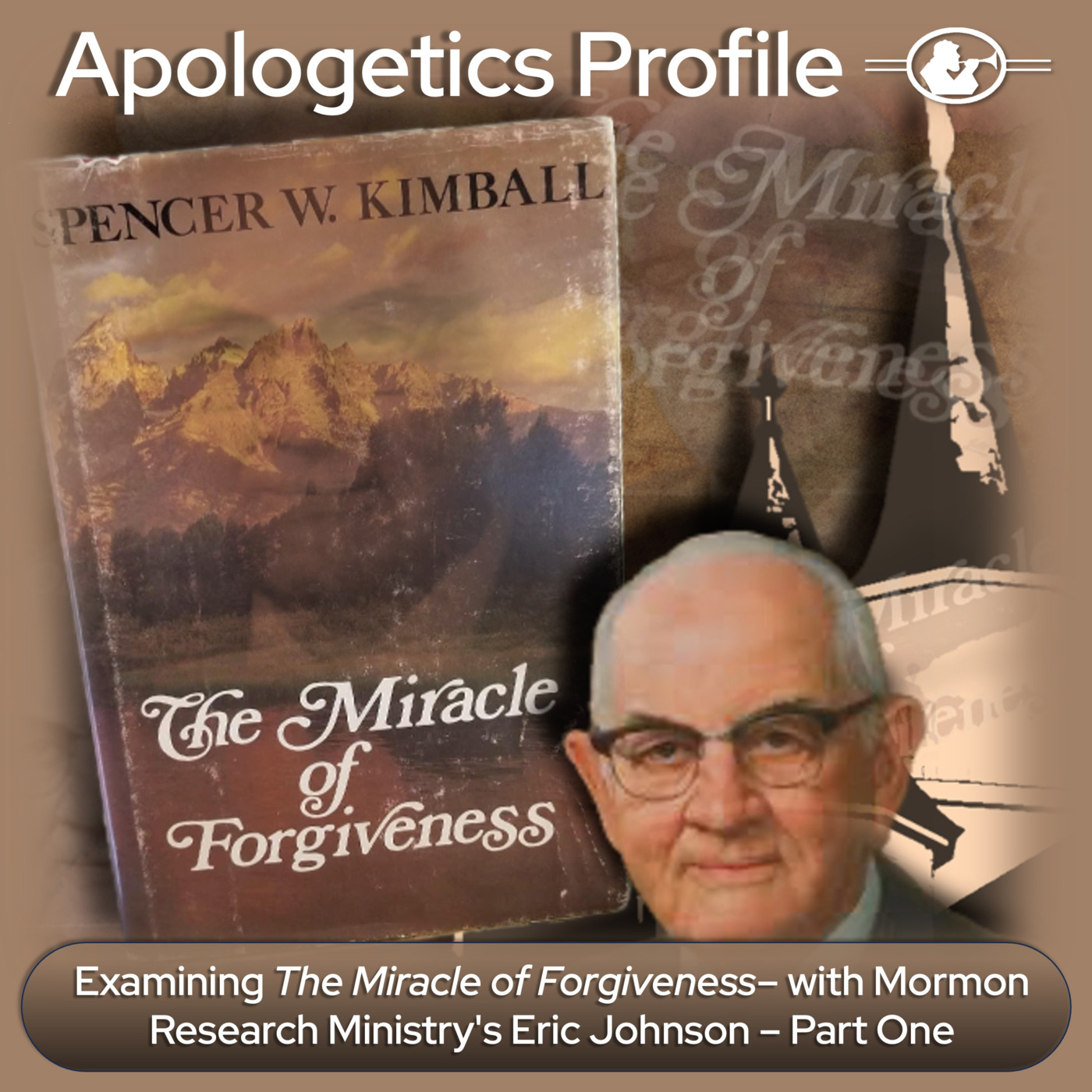
Apologetics Profile
Episode 331: Examining The Miracle of Forgiveness with Mormon Research Ministry's Eric Johnson - Part One
00:47:54
What might you say to a Latter-day Saint who asks you to define how you understand the concept of...
Loading summary
Transcript49 lines
- [00:07]
Host/Moderator
You're listening to Apologetics profile. What is the Biblical definition of forgiveness? If a Latter Day Saint posed that question to you, how might you respond? We could point to Romans chapter 3, verse 23, where we read that all have sinned and fallen short of the glory of God. But what is meant by the glory of God, and how have we fallen short of it? Part of what the glory of God includes is God's perfect moral law. God is moral goodness and righteousness Himself. He did not simply make up rules for us to follow. He made us in his image, in his likeness. The law is thus a reflection of God's glory of who God is, revealing his goodness and righteousness, declaring to us not to worship other gods, to honor our parents, to love God with all of our heart, mind and strength, to forsake lying, stealing, murdering, etc. In fact, the starry heavens give us a stunning visual picture of the glory of God. The heavens are telling of the glory of God, writes King David in the 19th Psalm, and the expanse shows forth his handiwork. The first six verses of Psalm 19 talk about the wonders and the grandeur of the heavens with the sun and stars in mind. David then extols the wonders of God's law in the next eight verses. The law, the testimonies, the precepts, the commandments, the judgments, and even the fear of the Lord are perfect for righteous, clean, enlightening, and desirable. By the end of the psalm, it is as though you've been staring at the sun a little too long. Maybe you quietly close your Bible and sigh to yourself and think, ah, that's just all way too bright for my infirm and sinful eyes to behold. I am not perfect at all. Yet if you've ever had those kind of thoughts, this is but one example of what it means to fall short of the law, to fall short of the glory of God. Our sinful eyes, our sinful souls encountering the pure goodness of God's moral law should indeed unsettle us. But it should also not end there. Even though the wages of sin is death, there is still. How then, can we be saved from sin's fatal curse? Physical and spiritual death have already entered the human race as a result of Adam and Eve's disobedience. If we have been quickened by the Holy Spirit, however, we know the heft and pall of what it feels like to be dead in our trespasses and sins. According to Ephesians, chapter 2, verse 1, we know we don't do what we should. We groan inwardly. We know we inhabit a body of death and we know we can do nothing to save ourselves. Though physical life remains in our mortal bodies, we have all died a spiritual death. Sin has separated us from God. We are morally incapacitated, unable to resuscitate ourselves, spiritually speaking, any more than we could physically perform CPR on ourselves when we are unconscious. What we need is rescue and resources, resuscitation from the outside, wretched creatures such as we who will save us from our bodies of death. This is exactly what Paul asks and then marvels at the answer. See Romans 7 and 8. Thanks be to God through Jesus Christ our Lord. This is where biblical forgiveness begins. Jesus says in John 6:63, for example, that it is the Spirit who gives life. When the Holy Spirit comes, He also convicts us of sin, bringing to mind how we have indeed fallen short of the law, fallen short of the glory of God. The Spirit also reminds us of God's righteousness and of his judgment. Apart from the initial work of the Spirit, however, sinful human beings will insist that they are generally morally good people. But such self made goodness apart from Christ is but filthy rags. By the quickening agency of the Holy Spirit, however, we are turned from sin and death in repentance. By confessing to God, we agree with the testimony of the Spirit that we are sinful. We become an entirely new creation through Christ Jesus. God remembers our sin no more. See Hebrews 8:12. The Holy Spirit will also glorify Jesus, bringing to mind what Jesus taught and what he has done for us. See John 16, verses 5 through 15. Though death entered the world through the first Adam, it is by the obedience of one man, the second Adam, our Lord and Savior, Jesus Christ, that many are made righteous. But it is not by our obedience that we are saved from sin and death. It is not by anything we have done. Again we were dead in trespasses and sin. It is solely by the grace and mercy of Jesus imparting to us, crediting us with his perfect obedience to the law, and taking the penalty of death for our sin upon himself on the cross. We do nothing to earn any of that faith. Repentance, salvation, they are all unearned, freely given gifts we neither desired nor deserved. As Ephesians chapter 2, verses 5 through 10 tell us God was doing a work in us even while we were yet sinners. God quote even when we were dead in our transgressions, made us alive together with Christ. By grace you have been saved and raised us up with him and seated us with him in heavenly places in Christ Jesus, in order that in the ages to come he might show the surpassing riches of his grace in kindness towards us in Christ Jesus. For by grace you have been saved through faith and that not of yourselves. It is the gift of God, not as a result of works that no one should boast. For we are his workmanship, created in Christ Jesus for good works which God prepared beforehand that we should walk in them. So before deep diving into conversations about forgiveness and questions pertaining to salvation with your Latter Day Saint friends or missionaries at your front door, we here at Watchman Fellowship encourage you to be solidly familiar with the basics of the Gospel. Mormons will use familiar sounding terms grace, salvation, forgiveness, repentance. But their understanding and definitions of these terms are usually quite different from traditional orthodox Christian doctrine. So it is essential to know what you believe and why. Forgiveness in Latter Day Saint theology is not finally by grace alone, but by grace only after you have found first renounced all ungodliness and have done all you can do. From the Book of Mormon this is Moroni, chapter 10, verse 32 Yea, come unto Christ and be perfected in him, and deny yourselves of all ungodliness and if ye shall deny yourselves of all ungodliness and love God with all your might, mind and strength, then if you is his grace sufficient for you that by his grace ye may be perfect in Christ and if by the grace of God ye are perfect in Christ, ye can in no wise deny the power of God. But did you catch the not so subtle twist? Grace comes only after you have one denied yourself of all ungodliness and two only after you have loved God with all your might, mind and strength. The very fact of the matter is that according to the biblical understanding of the law, there is no human being apart from Christ himself who has or will ever love God with all their might, mind and strength. This side of heaven. We have all fallen short of that requirement. We cannot earn God's grace by first trying to do something the Bible explicitly says we cannot do. A second verse also comes from the Book of Mormon. It is found in 2 Nephi chapter 25, verse 23. It reads, for we labor diligently to write, to persuade our children and also our brethren to believe in Christ and to be reconciled to God. For we know that it is by grace that we are saved after all we can do. Note when grace comes only after all we can do. But how much do we do? How do Latter Day Saints know that they have done enough in order that they may obtain grace. Grace that requires you to do something first is not finally grace at all. And does the God of Mormonism wipe away the sins of Latter Day Saints once and for all? Actually, he does not. In fact, according to doctrine and covenants 82, 7, when a Mormon sins, God returns to them all of their former sins. And now verily I say unto you, I the Lord will not lay any sin to your charge. Go your ways and sin no more, but unto that soul who sinneth shall the former sins return, saith the Lord your God. This is utterly anathema to biblical forgiveness and creates impossible burdens for Latter Day Saints. The Church of Jesus Christ of Latter Day Saints has made forgiveness utterly unobtainable, inaccessible and impossible. No amount of work or temple ritual will ever lay hold of that which Jesus has already laid hold of for us on our behalf. This weekend, next on the Profile, we will be talking with Mormon Research Ministry Fellow Eric Johnson as we explore the LDS concept of forgiveness. Eric will take us through a once widely popular book written by an LDS apostle, Spencer W. Kimball, in 1969 called the Miracle of Forgiveness. Spencer W. Kimball went on to become the 12th president of the Church of Jesus Christ of Latter day Saints in 1973. Here on part one, Eric will explain some of the challenges facing the LDS Church today, including the ongoing problem of how doctrines of the Church continually change over time.
- [12:03]
Eric Johnson
In Mormonism, it's always in a state of flux, depending on the political situation, perhaps depending on the whims of the leaders, where the members hope it would go, and the individual Latter Day Saint, him or herself. So, you know, so to try to determine what is a the Church even has a hard time determining that if one of those leaders writes a book, they will have a little paragraph in there and basically say, you know what I'm telling you is true. However, this is not official doctrine.
- [12:43]
Host/Moderator
That small insert that Eric mentioned is often found in the first few pages of books published published by the Church's official publishing house, Deseret Books. The following is an example from the title page of a book written by a BYU professor and published by the Deseret Book. This work is not an official publication of the Church of Jesus Christ of Latter Day Saints. The views expressed herein are the responsibility of the author and do not necessarily represent the position of the Church of Brigham Young University or of Deseret Book Company. The curious issue is that the Church itself owns and operates both Brigham Young University and the Deseret Book Company. So why then the disclaimer it boils down to what you heard Eric just mention. Due to the history of the Church's ever changing doctrines and practices, such as polygamy, blacks in the priesthood, alterations to undergarments, the use of the nickname Mormon, adjustments to Word of Wisdom prohibitions, infallible prophets, and the Adam God doctrine, just to name a few, the church today has to find some way of leaving themselves with an exemption clause in virtually anything that is published through BYU or Deseret Book Company. For what is official doctrine today might become false teaching in the future, including even when a new president takes office. As we begin Part one, Eric here outlines for us the basic hierarchical leadership structure of the LDS Church today, and we recorded this interview in Utah back in October of last year during one of Watchmen Fellowship's mission trips to the Beehive State. During our visit, the 17th President of the Church, Russell M. Nelson, passed away at the age of 101 on September 27, just a few days prior to
- [14:49]
Co-host/Interviewer
my talk with Eric.
- [14:50]
Host/Moderator
Since then, Russell M. Ballard, the president of the Quorum of the Twelve Apostles at the time, also died in November at the age of 19. Here is Eric Johnson of Mormon Research Ministry.
- [15:06]
Eric Johnson
You have a president or prophet. Just recently we had the 17th President of the church, Russell M. Nelson, die. So the next person in line is the man with the most seniority, which will be Dallin H. Oaks, who's 93 years old. So he'll be the 18th president of the church. And there are two counselors. In fact, Dallin H. Oaks was the first counselor and Henry B. Eyring was the second. When the president dies, then the first presidency is dissolved, so they go back to the apostles. So Henry B. Eyring is now the 13th apostle, if you will, and Dallin H. Oaks will be taking over. So Oaks is going to be responsible to name two of the counselors. And there's speculation as to who those two will be. He's very deliberate. He was a lawyer, belong to the Utah Supreme Court. So he will probably be very deliberate as to who he picks for his two might not be the same guy, Henry B. Eyon. Very easily he could put in two other people. Underneath that are the Quorum of the Twelve Apostles. Jeffrey R. Holland currently is the senior apostle. He's the president of the quorum of the 12, it's called. Those 12 are supposed to be in the same line as Jesus, 12 apostles. And then you have the 70s. The 70s, there's the first quorum of the 70s, for instance. And these men have responsibilities throughout the world. And they're all considered to be general authorities. But the most important general authorities are the top 15, the three in the first presidency, and the 12 apostles. In fact, with the apostles, they're going to have to name a new apostle. And so they're speculating as to who that could be. Could it be a guy like Edward Dube, who is a black man? And they're talking about the possibility of that. Very unlikely they would ever put a female in there because she does not have priesthood authority. But typically they've gone with somebody. I think six of the last eight apostle pickings came from the quorum, excuse me, from the presidency of the 70, and Edward Dube is part of that. So there's speculation maybe they're going to put a black man in because they do like to make inroads in places like Africa and other places that would be revolutionary. And a lot of Latter Day Saints would probably applaud such a move. But those leaders, when they speak at General Conference twice a year in April and October, speak authoritatively for God. It's almost as if they're adding to what's called the Doctrine and Covenants. Because in Mormonism, they have four scriptures, or they call it the standard works. The Bible, which is the King James Version, the Book of Mormon, a story about ancient Israelites who came to America and Jesus appeared to them. They also have the Doctrine and Covenants, Revelations given to Joseph Smith, and they also have the pearl of great price. So those four are scripture to Latter Day Saints.
- [17:59]
Co-host/Interviewer
And the apostles are often in the position of, as you said, speaking at general conferences and then writing throughout the year. Some of them produce books. But today, if you were, when you were in dialogue with Latter Day Saints,
- [18:13]
Host/Moderator
and you quote from someone who was
- [18:15]
Co-host/Interviewer
writing as an apostle or as one of the 70, and you're saying, well, this is what your doctrine believes, a lot of Latter Day Saints will push back and say, well, it's not as authoritative as you're making it out to be. They seem to say, on the one hand, these are spokespeople for God as the first 12 apostles, but if they say something contrary to something that has been said in the past, or if they say something controversial that nobody wants to focus on, it seems the out is, well, that's not really official church teaching. That's just the imperfections of a human being in the office of an apostle.
- [18:54]
Eric Johnson
And that's the issue. You're hitting the nail on the head there as far as authority, who can determine official teaching. Now, the leaders themselves have said they are capable of doing that. And they want people to emphasize the living prophets especially, which is interesting because you have a guy named Nelson who just passed away and, and he did a lot of teaching on things. For instance, he took away the use of the word Mormon. You're not allowed to use Mormon or Mormonism because he was told by Jesus in 2018 that he would be offended if you took out the name of the church, which is officially called the Church of Jesus Christ Latter Day Saints. So the church went to such extremes. They took away the name of the choir as the Mormon Tabernacle Choir. Choir, and they call it the Tabernacle Choir at Temple Square. They also took away their websites, lds.org and mormon.org and made it churchofjesuschrist.org so they took it very seriously. Now, that was under his administration. He's the one that supposedly was told by Jesus. Is Oaks going to keep that or not? I mean, we're going to have to wait and see what the future is. I think Oaks will, because he and Nelson were on the same page, and they're very traditional Latter Day Saint leaders. But it'll be interesting as we go a little further down the line, what some of the other leaders will say. But yes, they'll oftentimes say, well, that's what a dead prophet said. In fact, the. The 13th President of the church, Ezra Hap Benson, said that you can't pit the words of a dead prophet against a living prophet. Okay, so then the question becomes, when that person was giving that doctrine, was that official at that time or not? And is this church really a postmodern church that allows for truth to change as time moves on? And people are wondering, I mean, they made changes with polygamy in 1890 officially, but really kept doing it until 1904. The blacks did not get the priesthood until 1978. Before then, they were not given the ability to go the top of the three parts of the celestial kingdom. And that changed. And so right now, there are a lot of progressives, if you will, who are trying to change the way the church operates. I mean, we're talking polygamy. There are some who would like to see polygamy reinstated. There are some who would like to, with feminists. They want to see women get the priesthood. There are some who would like to
- [21:22]
Co-host/Interviewer
see
- [21:24]
Eric Johnson
homosexuality allowed, homosexual marriage. That's a big thing. Over at byu, the official, the official school of the LDS Church in Provo, Utah, a lot of students. In fact, they even have a club there that's a LBGT. I can't even say it. TQ plus Club. I mean. I mean, so, so, so then you talk to Latter Day Saints. You do not want to assume what they believe. You ask them what they believe, and then as far as the official goes, they can believe whatever they want, I guess. But to say that they are true followers and then disagree with the teachings of these living prophets seems disingenuous in my mind. Why do you call yourself a member of the Church of Jesus Christ of Latter Day Saints if you're not believing the things that you're being told you're supposed to believe? Or even the traditional. There are Latter Day Saints out there who don't believe there was really a first vision or that the Book of Mormon is true scripture and yet they call themselves a Latter Day Saint. So who's to determine that? I guess each individual says he's going to determine it, but then I'll have to deal with that individual, where they're at, and then I'll say, okay. It's interesting you disagree with your prophets and apostles. Let me just ask this question. When this dead apostle taught this, was he teaching false doctrine? I like to ask that question because I will often get the response, yeah, that was wrong. We don't believe that anymore. That's false doctrine. I said, then by definition, if somebody is teaching false doctrine, then they are a false prophet. And it says in 1 John 4:1 that we're supposed to test the spirits to see if they are from God. Why? Because many false prophets go out into the world. So I guess I shouldn't listen to him. But how do I know that Nelson or Oakes, when he dies, once they're dead, their teachings all of a sudden get put into the corner and no longer considered to be authoritative.
- [23:21]
Co-host/Interviewer
I know as an example of what you were talking about, going all the way back to the first prophet. Joseph Smith had uttered a lot of things, prophecies. In one sense, he considered one of them was a prophecy. And he says this to the United States government, that if you do not read, redress or address the wrongs done to Mormons in our little community, the government of the United States shall be decimated not long from now. And not only did the government not redress the grievances of Joseph Smith and the Mormon community, the government is still here today. The temple in Independence, Missouri that Joseph predicted would come about in his generation. The treasure in Missouri that was supposed to come about. And then when Joseph was asked, when one of the. I forget which one it is. And you can fill this in. But when Joseph was confronted about the fact that this was an alleged prophecy and it didn't come to pass, his response was, well, some revelations are from God, some are from men, and some are from the devil.
- [24:19]
Eric Johnson
And that's reported by David Whitmer, one of the three main witnesses. And that's in his book, an address to all believer in Christ. And that was actually specifically referring to the copyright that was supposed to be sold in Toronto. And that's what he says. I mean, that's a great point. I mean, they either are from God, from man, or the devil. Well, it wasn't from God. If it doesn't come true, then the question is, is this for man or is this of the devil?
- [24:49]
Co-host/Interviewer
Right. And this is to this day, this is the intellectual difficulty that you have in engaging with specificities within Mormon doctrine. The other bigger one that I can think of is Brigham Young's Adam God doctrine, which gets mixed bag reviews from people. When Brigham taught this, he sure thought it was from God. But now the Latter Day Saint Church repudiates that doctrine, Correct?
- [25:15]
Eric Johnson
Yes. And they'll call it a theory, the Adam God theory, when he said it was doctrine. Journal Discourses, Volume 1, pages 50 and 51. Here's the point. I mean, leaders have taught a lot of interesting things. Bill McKeever, the guy that founded Mormonism Research Ministry in 1979, put together a book called In Their Own Words. And you go through, it's like an index of all these quotes from the different leaders, most of them dead. And it's just amazing to see the things that they said that Mormons don't believe today. And the question is if, if Isaiah said something about God, let's say in Isaiah 40 through 48, and we said, oh, that was what he said back in 700 BC, 2700 years ago. It doesn't go today. I mean, if he says that Adam is God, which he didn't, but if he did, we as Christians would believe it because we believe the word of God and we believe it's timeless and it's eternal truths that we're given. In Mormonism, it's always in a state of flux, depending on the political situation, perhaps depending on the whims of the leaders, where the members hope it would go, and the individual Latter Day Saint, him or herself. So, you know, so to try to determine what is official, the church even has a hard time determining that. However, if one of those leaders writes a book, they will have a little paragraph in there and basically say, you know, What I'm telling you is true. However, this is not official doctrine. They'll do that with any of their books, but they won't do that for their manuals. Yeah, it says printed by the Church. It's official teaching. The church has said whatever's in their manuals goes. Whatever is at General Conference. Whatever said there goes. And what it said at General Conference one year, it might be contradicted 50 years later. And I guess we're supposed to go with the latest. That's troublesome for me. Who is a person of the Book. Right. A person who says this is what the Bible says. And I don't like this idea of postmodern. Well, it's true today, but it might not be true tomorrow.
- [27:24]
Co-host/Interviewer
Right. One of the things that often comes up, and I know sometimes Christians not entirely familiar with Mormonism may know at least this about the Latter Day Saint faith, that at one time Latter Day Saints in the beginning practiced polygamy. This wasn't widely known. This was among Joseph's closest confidants before he died in 1844. But in Doctrine and Covenants 132, Eric, which I know you're most familiar with, Joseph calls this a new and everlasting covenant. But apparently that's not even the case. But this is still codified in Doctrine and covenants, which is LDS scripture. But it's no longer by 1890, the declaration. And as you said, they practiced it until 1904.
- [28:12]
Host/Moderator
This is no longer a doctrine. But yet their first founding prophet and
- [28:16]
Co-host/Interviewer
president said it was a new and everlasting covenant. This is exactly what we're talking about, the changes at one point it seems solid and true and from the Lord and settled for all time. And 60 years later, it's no longer a doctrine.
- [28:31]
Eric Johnson
Right. And the Church came out in 1833 in the book of commandments DNC 100 and basically said that they don't believe in polygamy. And that was reprinted all the way into the 1870s. But then D&C 132, as you mentioned, talking about celestial marriage, a lot of people read that and think it's just talking about people getting married today. They can live forever in eternity. But that was not talking about just that. It was talking about a plural marriage. That again, doesn't end until 1890.
- [29:08]
Host/Moderator
The Mormon concept of celestial marriage compared to completely disregards what Jesus himself says about marriage in the afterlife. Jesus words are found in the 22nd chapter of Matthew, verse 30. For in the resurrection they neither marry nor are given in marriage. But are like angels in heaven. Jesus is not saying that in the resurrection we will become angels, but that we will be like them in the fact that angels do not marry or procreate. The bottom line is that this one verse does in fact contravene LDS teaching about celestial marriage. And celestial marriage is a key component to LDS belief in a third tier celestial exaltation. Now you might hear some Latter Day Saints counter by saying Jesus is only talking about wedding ceremonies. Now some Latter Day Saints may counter by saying that Jesus is only here talking about wedding ceremonies. They might argue that yes, they agree there are no marriages ceremonial taking place in eternity, as marriages have all taken place here in this life. They would argue that Jesus words say nothing of marriages being discontinued in eternity. But we have to consider the entire context in which Jesus words appear, for they come from a question proposed by the Pharisees about a woman who has been married seven times to seven different men. They ask Jesus whose wife she will be in eternity. So Jesus answer does directly address the question. There simply won't be any husband wife relationships in eternity. As Jesus says, you are mistaken not understanding the Scriptures or the power of God. In other words, any idea or belief of having multiple wives in the highest celestial kingdom in LDS theology is completely anathema.
- [30:59]
Eric Johnson
The problem with this is you have this doctrine still in vogue though, and the Latter Day Saint will point out that polygamy will be reinstated and Russell M. Nelson had two wives, one who died, and then he marries a second one for time and eternity in LDS temple. He's expecting that he's going to see both wives. Dallin H. Oaks Same situation. His first wife dies, he has a second wife and polygamy continues in their lives and in everybody's lives. And there will be lots of for a man, there will be lots of women who will need a husband to be able to take them to the celestial kingdom so they can procreate. What's called celestial kingdom exaltation, eternal life. It's called eternal increase. And they believe they will continue to have children in the next life to be able to populate this new world just as Heavenly Father did who has a body of flesh and bones according to D and C section 130 22. That he once lived as a man in another realm could have very well been a sinner. We've interviewed lots of Latter Day Saints and about 70% have no problem saying that God the Father could have been a sinner because he's just like me and that somehow he worshiped a God before him and that God worshiped a God before him. It's not talked about or explained well by leaders. They do believe, though, that God was not always God. He's not eternally God, Even though Psalm 92 says from everlasting, everlasting, thou art God. Moroni 8, 18 says that God is an unchangeable God. And there's many other verses from the standard works to show that. However, there are also in the Doctrine and Covenants verses to show that there's a plurality of gods and that we have the potential. And Joseph Smith to, to his dying day, preached that he would teach us what God is like, that he has not always been God and he actually is like us. So this is a big difference. And this is part of the problem when Latter Day Saints call themselves Christian, that they don't define their terms. And that's one of the things that we need to do as Christians. When you're not sure when they say God the Father or salvation by grace or Jesus, ask them, what do you mean when you say God the Father? What do you mean when you say eternal life? And get them to explain grace. According to Mormonism, grace is the possibility of keeping the commandments. And actually on the website it says God's enabling power. Well, that's a completely different definition than what Christians have to say when, when grace is a gift given as part of justification, that that's not something that we do to earn it, not by works. Ephesians 2, 8, 9 says, Otherwise we're going to boast about what we did, but rather it's given to us as a gift. Well, Mormonism, grace is just merely a possibility of you keeping the commandments through the power that God has given to you. So keeping the commandments D and C 25:15, keep the commandments of God continually. That is the work that must be done if you hope to get the very best this religion has to offer. Which again is much different than the Christian view of heaven. It's called the Celestial Kingdom, where families can be together forever.
- [34:19]
Co-host/Interviewer
Well, let's talk about. Before we jump into President Kimball's book that we're going to be talking about in a minute here, let's do a little refresher course in terms of the good news of what we believe as Christians, what we call the Gospel, because Latter Day Saints will say, I was just talking to a missionary. I went down to St. George while I was here, visited the Temple museum down there and talked to a very wonderful young lady missionary, Sister missionary. We got into the conversation about grace and works. And I went to Ephesians 2, 8, 9, 10, and I asked her, I said, sister Miranda, do you believe that you can earn grace? And she said, yes, I do believe that's possible. Completely in keeping in line with what you had just explained about the Mormon Gospel, that they believe that there is an attainment that is based on our performance here on earth that merits favor with Heavenly Father as we do these things. But let's talk about the Christian gospel to refresh ourselves of the good news, to preach to ourselves and help our listeners define these terms, because you're going to hear them when you talk to a Latter Day Saint. You're going to hear gospel, you're going to hear Jesus, you're going to hear the Bible, and you're going to hear words like works. And so Eric, what are the basics that we need to know for as Christians when we enter into a gospel conversation with Latter Day Saint friends, We've
- [35:35]
Eric Johnson
got to keep it short. And I would say if you should be able to give the basics of the Christian gospel in three minutes or less, because you only have a short time perhaps. So I like to start off with the bad news first. I think the Gospels, even though it's good news, that's what the word means, there's bad news. And Romans 3:23 says, all have sinned and fall short of God's glory. We are unable to do what God requires because we are sinful. We're born into sin and we sin on our own basis. And so you have that problem. And then Romans 6:23 says, the wages of sin is death. So this is a big problem. I like the fact that there's a comma, wages of sin is death, comma. But the gift of God is eternal life through Christ Jesus our Lord. What does that mean, eternal life? This means to be with Jesus forever. How does that take place? The Bible all the way through is talking about faith. We're not saved by the works of the law, but we're saved by faith. Romans 5:1. You can go to Acts 16:31. And Paul said to the Philippian jailer, believe on the Lord Jesus and you will be saved. Romans 10, 9, 10 are good verses that talk about we must believe in our heart and confess with our mouth. It's based on what Jesus has done for us. It's a big term called imputation. Imputation means that we get credit for righteousness that's not our own. Somebody has deposited 20 million into our bank account and there's no way Most of us will ever make 20 million in an entire lifetime. We can't pay that back. It gets placed into our bank account. Not based on work that we did or are doing or will do, but it's based on what Jesus did. So when Jesus is on the cross and he said it is finished, and his works were credited to the believer based on faith and not by works, as you mentioned in Ephesians 2, 8, 9. Here's the thing about all religions, and I used to teach world religions at the seminary level. Every religion asked the question, what must we do for God? And Christianity asks a much different question, what did God do for me? So we are not Christians based on what we do, but rather based on who we are. And then who we are has an effect on what we do. And you mentioned verse 10. Not all Christians will. They'll say Ephesians 2, 8, 9. But verse 10, right after it gets done, saying, not by works, lest any man should boast, it goes on and says, for we are God's workmanship created by Christ Jesus to do good works, which he prepared in advance for us to do. That goes right in line with, with James 2:20, which the latter Day Saint has memorized. Yes, faith without works is that we had a nickel for every time we were told that we'd be retired. But I'm telling you that I like to say, well, I believe, I believe, James, you can't just have a work Christian and a faith Christian. It's a faith work Christian. And that's what James is talking about to the audience. He's talking about. And Paul is talking to a group that is trying to do everything. Well, we are created to do good works, but we're not saved by those good works.
- [38:51]
Co-host/Interviewer
Right, Right. And I'm thinking of the contrast between the LDS Gospel and the Christian Gospel. One of my passages that I quote from the Book of Mormon in conversations, and I did this with my missionary sister down south a little bit, is Romans 5, 8. While we were sinners, Christ did the necessary work. Paraphrasing, of course, did the work that
- [39:16]
Host/Moderator
we needed to do while we were sinners.
- [39:18]
Co-host/Interviewer
Saves us from our sin while we were sinners.
- [39:21]
Host/Moderator
But if you contrast that with Alma
- [39:23]
Co-host/Interviewer
11:37, where we read that God cannot save them in their sins, that the God of Mormonism is incapable of saving
- [39:32]
Host/Moderator
you in your sin, you have to get on the treadmill of religious works
- [39:38]
Co-host/Interviewer
in order to start the process so that God will forgive you once you've done. What's the verse 1 Nephi 25, 20 or 2nd Nephi 25, 23.
- [39:47]
Eric Johnson
Right.
- [39:48]
Co-host/Interviewer
Grace.
- [39:49]
Eric Johnson
You're saved by grace. After all you can do they know that verse like we would know Ephesians 2:8.
- [39:54]
Co-host/Interviewer
That's right. That's right.
- [39:55]
Eric Johnson
And I'm going to tell you this. A lot of people will bring up the bicycle parable told by a BYU professor named Stephen E. Robinson in his book Believing Christ. And the story goes, I Forget how much.67 cents. She puts up on the counter and she says, there you go. For this bike that she wants to buy at the bike shop. Well, the dad is waving a credit card in the back saying, I got the rest of this. And so she somehow thinks that she's done that and then he'll pay the rest. Well, let me tell you, that's not a true gift if you pay one penny of it. But they like to say you do your best, Jesus does the rest. Certainly an apostle and then later a prophet, Spencer W. Kimball would disagree with that idea.
- [40:41]
Co-host/Interviewer
Well, that's the meat and potatoes of the difference, as we at Watchmen often tell people. As you said, in addition to what must I do? The question of other religions, other religions seem to also have something to say about Jesus. And when you're talking to your Latter Day Saint friends, it is imperative, I think you would agree, Eric, that we have to talk about the differences between their Jesus and our Jesus. It's the same with Islam, right. Isa of the Quran is not Jesus of the New Testament. Likewise, Jesus of the Mormon scriptures is not the Jesus of the Bible.
- [41:17]
Eric Johnson
Right.
- [41:18]
Co-host/Interviewer
And that is because we. It's right on the COVID another testament of Jesus Christ. But Paul says in Galatians, if I or an angel or an angel from heaven preaches to you another gospel contrary to the one that we have proclaimed to you, let him be accursed. This is a strange and different gospel that it's night and day when you really start getting into the meat and potatoes of things. So I wanted to, Eric, talk about this book that you brought to my attention this week while I was here. I'd heard about it, but I was fascinated to hear how you use this in general conference outreach. It's Spencer W. Kimball's the Miracle of forgiveness, written in 1969 when Kimball was a part of the Twelve Apostles.
- [42:05]
Eric Johnson
Same position Paul and Peter were.
- [42:07]
Co-host/Interviewer
Same position with Paul and Peter and this book today. I was reading up on this a little bit. Apparently his son or grandson, I'm not sure which, in one of his biographies had said that their father, that Spencer had regretted He. He wished he could have been a little softer in the tone. But I was reading. I've been reading through this based on your suggestions, looking at some of the passages this week and was just struck by how law oriented this is and how perfect you have to be. First you have to perfect yourself by your own power and then maybe, maybe God will forgive you. But he can't forgive you, Eric, until you do these things. So let's talk about Kimball a little bit in this book. Why is this book so controversial in Latter Day Saints circles today?
- [42:59]
Eric Johnson
Because it's teaching a gospel that Latter Day Saints realize they cannot accomplish. The things that he was saying you had to do. I call him Nike. Before there was a Nike. Nike wasn't around in 1969. Nike says, Just do it. And he agreed. He quoted out of the Doctrine and Covenants, section 84, verse 41. He quotes from First Nephi 3. 7, which says that God doesn't give you commandments you cannot do. He wouldn't be a good God otherwise. And I asked Latter Day Saints, are you capable of doing everything? And generally they will agree. And yet when they look at the requirements that he gives, it's really disheartening. And, and another problem with the book is that it was given away for many years by bishops to wayward members of their ward. They went into sin, and so they were told to read it and then come back and tell me all about what you learned.
- [43:56]
Co-host/Interviewer
So if you walked out of your bishop's office with a copy of this book in your hand, people could pretty much know what you confessed.
- [44:02]
Eric Johnson
I have talked to a number of people who were required to read that if they wanted to stay in the church, adultery or whatever it was that they did, they had to read this and repent. And there's no hope in this book. I mean, basically, first off, in chapter one, I like the way he titles his chapters because they're great. He tells you exactly what it is. This life is the time. What is he trying to say? This life is a time. He quotes accurately on almost every page from the unique standard works, the dnc, Pearly, Great Price, and the Book of Mormon. So he quotes out of the Book of Mormon Ammo, Chapter 34. For behold, this life is a time for men to prepare to meet God. Throughout the book, he is telling people, you have to do this now. You can't wait until the next life. And so that is very important.
- [44:54]
Co-host/Interviewer
I wanted to. I was shocked this morning. I was shocked this morning. I mean, you told me what to Expect and what this book was about. But still going in and reading this, I was utterly shocked. Now, I know among evangelical scholars there's some questions about the woman caught in adultery in John 8. But that aside, the claim that Kimball makes on page 68 about this passage, he says, note that the Lord did not forgive the woman of her serious sin. He commanded quietly but forcefully, go and sin no more. And then he says, even Christ cannot forgive one in sin.
- [45:39]
Eric Johnson
Isn't that something? I mean, I mean, now this passage is John 7, 53, 8, 11, and it's not in the earliest, most accurate manuscript, so it's a passage we need to be careful with anyway. But on the 20 year anniversary edition, there's a picture of Jesus riding in on the stone there, and there's a woman crying and it's a picture of John. That's not the only reference he makes to that passage. I'll read to you a portion out of page 164. And he says that, did the Lord forgive the woman? Could he forgive her? Now you and I would say, what? Of course he did forgive.
- [46:19]
Co-host/Interviewer
He did forgive her and then go
- [46:20]
Eric Johnson
and sin no more. Yeah, but there seems to be no evidence of forgiveness. And this is how he justifies that. He told her, go and sin no more. He was directing the sinful woman to go her way, abandon her evil life, commit no more sin, transform her life. He was saying, go, woman, and start your repentance. And he was indicating to her the beginning step to abandon her transgressions. That's step number one. Okay, great. I'm glad that that's true. But you can't be forgiven until you go through the rest of your lives. And here's why. The true repentance happens when you abandon the sin, when you cease the sin. Doctrine and Covenants, section 58, verses 42 and 43, which he quotes in this book, says that you cannot return, that you need to cease and you cannot return. And then Doctrine And Covenants, section 82, verse 7, says that if you do return to that sin, your former sins come back back to you. So here's the idea. You think you're forgiven, but you do that same sin again, you obviously did not mean it. And so therefore God is storing up those sins not to not as far as the east is from the west, but he just has those in storage in us in a safety deposit box. And when you do that, well, he's going to return the sin to you. That's a damning verse.
- [47:42]
Host/Moderator
You've been listening to Apologetics Profile, a podcast Ministry of Watchmen Fellowship Incorporated. For more information about our ministry and resources, visit our website@watchman.org.