← Apologetics Profile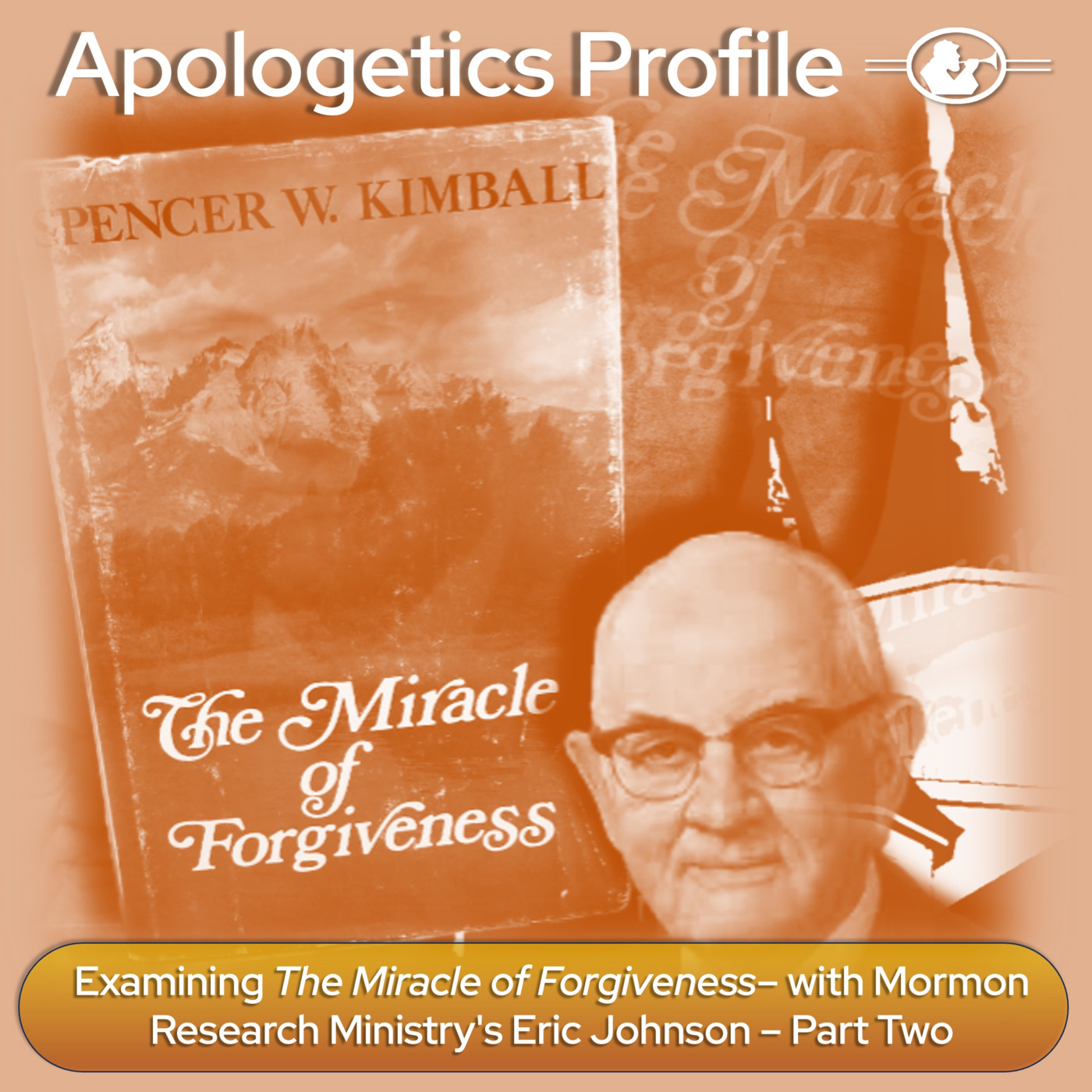
Apologetics Profile
Episode 332: Examining The Miracle of Forgiveness with Mormon Research Ministry's Eric Johnson - Part Two
00:38:15
In Latter-day Saint scriptures, Doctrine & Covenants section 82, verse 7 states"And now, veri...
Loading summary
Transcript110 lines
- [00:09]
Podcast Host
Equipping you to understand and engage your non Christian neighbours. This is Apologetics Profile
- [00:17]
Eric Johnson
he takes Ephesians 2:8:9. He quotes it and this is what he says. One of the most fallacious doctrines originated by Satan and propounded by man is
- [00:28]
Guest Speaker
that man is saved alone by the grace of God.
- [00:36]
Narrator/Moderator
That is our guest again this week on Apologetics Profile. Eric Johnson, author and longtime fellow of Mormon Research Ministry in Draper, Utah Reading A short quote from Mormon Apostle and later the 12th President and Prophet of the Church of Jesus Christ of Latter Day Saints, Spencer W. Kimball. It comes from his widely popular 1969 publication, the Miracle of Forgiveness. And just to reiterate for emphasis, Spencer W. Kimball called the words of the Apostle Paul in Ephesians 2:8 9 one of the most fallacious doctrines originated by Satan. On the Next page, page 207, Kimball emphasizes a verse from 2 Nephi we heard in the introduction to last week's broadcast. Second Nephi 25:23 says that it is by grace that we are saved, but only after all we can do. Kimball asserts that this verse shows how the Mormon concept of salvation is only offered on condition of obedience. In other words, one must somehow figure out how to be obedient before one can even begin to hope to receive grace and or salvation from God. This is not only antithetical to traditional Christian doctrine, it is simply impossible. If one could be obedient to the law apart from God's grace, then there really is no need for God's grace or salvation to begin with. If one cannot obey the law, however, then according to Kimball, grace can never be imparted to any sinful human being. But what if you break your covenant of obedience after having committed yourself to it? Doctrine and Covenants 8441, Kimball reminds his readers, has a sober and terrifying but whoso breaketh this covenant after he hath received it, and altogether turneth therefrom shall not have forgiveness of sins in this world, nor in the world to come. No forgiveness in this life or the next. There is no hope of returning. In Latter Day Saint doctrine there is no room for the prodigal Son. There is no glad Father longing to welcome his son back home. The Son is doomed to perdition and outer darkness. But in the event that there might be some way to attain forgiveness, to Kimball, it really is all up to the individual. As Kimball says on page 84 of the Miracle of forgiveness and recovery are dependent upon the offender's repentance, which begins with the recognition of the sin and acceptance of personal responsibility for it, Biblically speaking, a recognition of sin begins with a conviction wrought about by the quickening of the Holy Spirit, not by our own intellect or effort. If receiving forgiveness for sin was dependent upon our level of contrition or quality of turning away from sin, then no one would ever receive forgiveness. As Jeremiah lamented, our hearts are desperately wicked and unknowable. It is not within a man with legs to direct his own steps. Our motives, our sincerity, our contrition, our sorrow are always going to be tainted with selfishness and sin. We cannot finally trust our feelings, our emotions or our own sincerity. We must wholly trust in Christ alone for salvation, for there is no other name under heaven by which we must be saved. Kimball goes on to make the startling claim on page 83 that man is the master of his destiny. Be it good or bad, man has the inherent capacity to heal himself physically. A healing process in the spirit and mind must come from within, from self will. End quote. The stark contrast to biblical teaching here goes without saying. No one is capable of healing themselves spiritually. No one has the inner self willed capacity to make themselves acceptable before God. There is no one who does good
- [04:59]
Co-host/Interviewer
according to the Scriptures.
- [05:00]
Narrator/Moderator
There is no one who seeks God. No one can obey the commandments, for we have all fallen short of the glory of God. The demands Mr. Kimball puts on his readers are not nothing but impossible burdens. Grace and forgiveness under such an impossible system would never come to anyone. By contrast, as but one example, consider the good News of Romans 4, verses 1 through 5. Abraham did not earn God's favor. He simply believed what God told him. What shall we say was gained by Abraham, our forefather, according to the flesh? For if Abraham was justified by works, he has something to boast about, but not before God. For what does the scripture say? Abraham believed God and it was counted to him as righteousness. Now to the one who works, his wages are not counted as a gift but as his due. And to the one who does not work but believes in him who justifies the ungodly, his faith is counted as righteousness. Now it is a truth that works should follow our salvation. We should bear fruit that shows the reality of our confession of faith in Christ, fruits of the Spirit and other good works. But these works do not justify us. They are part of the sanctification process that begins after our justification. In Eric's 2022 book introducing Christianity to Mormons, he quotes the late Pastor Tim Keller regarding the impossibility of attaining assurance of our salvation by means of our own works. If our salvation is finally dependent upon us, then we are never going to know for sure if we've ever done enough to maintain it. Keller notes, quote, assurance of our salvation is not possible if we think we must earn or even maintain our salvation by our efforts. If we keep ourselves saved by good living, how could we ever be sure we were being good enough to retain God's favor? Yet the Bible often says that we Christians can know that we are safe and saved. See First John 2, 3. In other words, we didn't earn our salvation by our behavior and we can't unearn it by our behavior. The Apostle Paul tells us in Philippians that he who began a good work in you will be faithful to complete it. Our justification and our sanctification are all of grace. Apart from Jesus, we can do nothing. Yet if somehow you could perfectly obey the Commandments and somehow rid yourself of all ungodliness on your own power, then you would really have no need to be saved. You could do it all on your own. As Kimball noted, you are the master
- [07:54]
Co-host/Interviewer
of your own destiny.
- [07:55]
Narrator/Moderator
As we begin part two of our conversation with Eric Johnson of Mormon Research Ministry, we talk more about the burdensome reality of doctrine and Covenants 827, which states that if anyone sins, all of their former sins return. Yet, as Eric will tell us here in just a moment, this verse actually was a catalyst that eventually led a friend of his out of Mormonism to Christ. Here again is Eric Johnson.
- [08:24]
Guest Speaker
I know that's a verse that my friend Dave became a Christian. He was a Mormon missionary and he was told that by a friend of mine in California. He's shown that verse and that caused him to leave Mormonism. It was so destructive.
- [08:36]
Eric Johnson
He says I can't do this.
- [08:38]
Guest Speaker
If I can't do this, then why
- [08:40]
Eric Johnson
am I even going to try?
- [08:42]
Co-host/Interviewer
Yeah, well I bring up every time I've had a conversation with a Latter Day Saint that has extended into where I feel like I can share some of their own scriptures. I bring up 82. 7 DNC 8207 and Eric Every and I'm not exaggerating or for emphasis every Latter Day Saint that I've shown that to did not even know that that verse was in their book.
- [09:02]
Guest Speaker
It's a damning it was not unknown eyebrow raising.
- [09:05]
Co-host/Interviewer
They're like, well that can't possibly mean what it means. They'll take my app if I'm looking at the library app or they'll take the book that I have and they'll look at it and they'll go well. Well, I don't think that's what it really means, but they're trying to said it was.
- [09:18]
Narrator/Moderator
Yeah, yeah.
- [09:19]
Co-host/Interviewer
And so it's like I was talking to the missionary in St. George and I said, look, if you're speeding down I15, all your sins have just come right back in your lap. But the Bible says, Isaiah says that the Lord will remember your sins no more. So how can it be that your former sins keep coming back to you? But then the God of the Bible is telling us that he does not remember our sins anymore as far as the east is from the West. He removes our sins from us through what Christ has done. So this brings us to a point, Eric, when you're talking about what the Bible says, even though the Latter Day Saints accept the new King James Version or the King James Version of the Bible, they will by default. If there's something in the Bible that conflicts with the Book of Mormon or Joseph Smith or a prophet or even something Kimball says, they're going to go with their Latter Day Saint authorities over and against the Bible. Right?
- [10:05]
Guest Speaker
Yeah. I mean, there's no doubt about it, the Bible is true as far as it's translated correctly. And you ask the Latter Day Saint, that's the eighth article of faith, by the way. That was by Joseph Smith. You asked the Latter Day Saint, Saint, what does that mean to them? And they say, well, there are many scribes who took out plain and precious truths is how they put it. And you can't really fully trust the Bible. So then when they do that, I like to say, oh, okay, well, isn't the whole first vision event taking place because of James 1, 2, 3, where Joseph Smith reads that we're supposed to pray and he took it to pray about a particular religion, which of all the churches were true? He based that on James chapter 1 or 1 Corinthians 15, which talks about what they believe is the impetus for baptism for the dead.
- [11:04]
Eric Johnson
What about that verse?
- [11:05]
Guest Speaker
So here's the thing they want to pick and choose. Oh, that's authoritative, they would say. And yet this verse that you're showing me, I'm not sure that actually is true, especially since this verse over here contradicts it. I'll give you an example. In John 4, Jesus says that God is Spirit and must be worshiped in spirit and truth. And yet Doctrine and covenants section 130, 22 says God has a body of flesh and bone. Well, that contradicts. So what are you going to go with? Well, we'll go with doctrine and covenants, because it is the current revelation, if you will, living prophets and then their scriptures, unique scriptures, will take precedence over the Bible.
- [11:46]
Co-host/Interviewer
Yeah. In Kimball's book, on page is kind of the heart of it, I think. On page 26 he says, in our journey toward eternal life, purity must be our constant aim. To walk and talk with God, to serve with God, to follow his example and become as a God, we must attain perfection. And that seems to be the gist of the book, that Kimball is not saying that God makes us perfect through his sacrifice. God imputes his perfect righteousness to us. The gist of the book, Eric, it seems to be that Kimball is saying
- [12:21]
Narrator/Moderator
we can be self perfected.
- [12:25]
Co-host/Interviewer
Perfection is the aim, the progress toward becoming a God, that we must aim toward moral and spiritual perfection in this life. As you say, now is the day, today is the day, this is the time.
- [12:35]
Guest Speaker
Perfection is an achievable goal according to Spencer W. Kimball. And I'll point that out. And Latter Day Saints will differ on this. Sometimes they'll agree, sometimes they won't agree. They'll ask, do you think you're perfect? And I always like to say, yes, I am perfect. Forensically, Jesus has cleansed me of my sin, not based on what I did, let me make that straight, but based on what he did. Now am I perfect? As far as sanctification goes, I struggle. Paul struggled with sin according to Romans 7. So this is a process, living as a Christian. But we have the Holy Spirit in us. If we've been baptized by the Holy Spirit, we have the Holy Spirit who's telling us to be filled with him. And we have the fruit of the Spirit according to Galatians 5. These are the things that we're not supposed to do. The acts of the sinful nature, sexual immorality, debauchery, drunkenness, and we're supposed to have love, joy, peace, patience. But this is what Spencer Kimball says on pages 208, 209 on this topic. He says in his subheading, repentant life seeks perfection. And he says the gospel is a program of action, of doing things. Eternal life hangs in the balance, awaiting the works of men. And then this is what he says,
- [13:51]
Eric Johnson
this is just troubling. This progress toward eternal life is a
- [13:55]
Guest Speaker
matter of achieving perfection.
- [13:57]
Eric Johnson
Well, how do you get perfection, you might ask.
- [13:59]
Guest Speaker
He'll tell you living all the commandments guarantees total forgiveness of sins and assures one of exaltation. And remember, exaltation and Mormonism is equated with eternal life. It is life in the celestial kingdom where only obedient Latter Day Saints get to go. So it assures one of exaltation by living all the commandments through that perfection which comes by complying with the formula the Lord gave us.
- [14:24]
Eric Johnson
And then he quotes Matthew 5, 48. How many times have we heard that?
- [14:28]
Guest Speaker
Be therefore perfect, even as your Father, which is in heaven, is perfect.
- [14:32]
Eric Johnson
When that verse is quoted to you, you say, okay, so are you perfect? They'll say, no. So why did you quote the verse? And this is what he says, Being perfect means a triumph over sin. What I like about Kimball, he tells you exactly what you got to do. You just got to triumph over sin. Oh, okay. This is a mandate from the Lord. He is just and wise and kind. He would never require anything from his which was not for their benefit and
- [14:58]
Guest Speaker
which was not attainable.
- [15:01]
Eric Johnson
Perfection, therefore, is an achievable goal. That is a really hard passage for
- [15:06]
Guest Speaker
Latter Day Saints when I read that
- [15:08]
Eric Johnson
to them, because they realize they're not perfect, but someday they hope to be. I always like to say, well, could you find the oldest guy in your ward, bring him out here, and let me ask if he repents every Sunday at the sacrament service. And so I've had people bring somebody, and this guy, he's like 80 years old, and I say, do you repent, sir? Every Sunday I say, so you're not. You haven't reached perfection. So why did you bring this guy over if he hasn't done what you're commanded to do? And again, I told you, this life is the time. Throughout the book, he's saying, there's no next life to do this. Amma 34 disregards that entire concept. And so if that's the case and you're capable of keeping the commandments, because that's what he says in that passage. He says. He said that it's a mandate from the Lord. He would never require anything from his children which was not for their benefit and which was not attainable. Latter Day Saints say, well, nobody's perfect. Oh, okay. So are you saying perfection is not an achievable goal in this lifetime? Oh, yeah. Okay, so then he was teaching wrongly.
- [16:13]
Co-host/Interviewer
Yeah.
- [16:14]
Eric Johnson
That's false doctrine, isn't it? Yeah, he's.
- [16:17]
Guest Speaker
He's wrong.
- [16:17]
Eric Johnson
The same guy who brought blacks the priesthood in 1978, you're saying is a false prophet. Well, I'm not saying it's a. Well, yeah, because somebody who teaches false doctrine, even one false teaching, Deuteronomy 13 and 18, said that the person ought to be stoned for such a false teaching about important doctrine like what must you do to be saved?
- [16:39]
Co-host/Interviewer
Yeah, well, Eric, really quick, because that is a. It's probably the top, if not the top five, it's the top first, top three verses that a Mormon will quote to you. Matthew 5:48. I mean, Christians should be knowledgeable about what this means in context. But what is the most effective response that we can give to a Latter Day Saint that quotes that verse at us? If we're bringing up their standard of perfection, how should we as Christians respond to Matthew 5:48? What does it mean for God to command us to be perfect or Jesus to command us to be perfect?
- [17:10]
Guest Speaker
Well, we have to be renewed. We have to be regenerated. And it's an act, as I've been saying before, that I can't do on my own effort. I'm going to have to have somebody come and clean the board for me. He's going to have to impute that $20 million into my bank account that I could never have earned and not to think that somehow I did anything or will be able to do anything to repay that. And so I do believe perfection is something that we're required, but that comes through the new life. That when you become a Christian, all things become old and all or all things become new. All things. How's it go? All things pass away and all things become new. The idea that as a creation, I become a new creation in Christ. And that is what is required. It's not just a cosmetic surgery. It's a radical transformation. And that radical transformation is only done by the Master, Creator Himself, who can do that based on the cross. And that's where we go to Jesus is our faith is all based on what Jesus did for us. Jesus was sent by the Father to come and live his perfect life. And then as the high priest, according to Hebrews chapters nine and ten, he laid his blood on the mercy seat. What was being done temporarily by the priests, he did as the priest in the order of Melchizedek. He lays it all out. And that is once for all. We don't need to have a repeat of that sacrifice. And that was made for those who would receive him. And there's two resurrections. There's a resurrection on the life and there's a resurrection on a damnation. Acts chapter 24 talks about that. And so a lot of people think that there's somehow a universalism or pluralism. All people are going to end up in some kind of a good place Even Mormonism has that, because as long as you are here with a body, that meant that you chose well. In a previous life called the pre existence, when Jesus and Lucifer were vying to be the Savior of the world, one third of our brothers and sisters did not choose Jesus and were cast out of heaven without bodies. But we have a body. And so based on the atonement, based on grace, they can say Jesus died for all people. But not all people get to go to the celestial kingdom, where marriage will be, where families will be, and that's the goal. But the only way for our view of heaven, the only way you can go there, is if your sins are forgiven. And that means that you're perfect.
- [19:42]
Co-host/Interviewer
With Kimball's directives, it's God gives us the command. There's this quasi idea that somehow we'll be equipped to do this. But yet Latter Day Saints find they're completely always falling short. If I have this power, why can't I not attain this? They don't have eric a Romans 7 In their gospel, Paul's confession there is explicitly it's wonderful. It's life giving. It's all of our struggles. Because as you said, it's the imputation, it's that moment of declaration where the judge declares you not guilty. But Mormons think, well, I got to leave the courtroom and go out and do community service to make sure that I earn that not guilty verdict. And that's completely backwards. I wanted to this was something that hit home to me too, because my father I wasn't raised religious, but my father took his own life. So I'm central to sensitive to the idea of suicide. But this a lot of I was reading some Reddit threads about former LDs who were struggling with this book in their youth and there was a discussion in the thread about some people that had known that others had committed suicide because of this book and even Kimball. I want to read this on page 106 he said that he's talking about a minister acquaintance of mine whom I knew rather well, was found by his wife hanging in the attic from the rafters he had hung himself. His thoughts had taken his life. He had become morose and despondent for two or more years. Certainly he had not come to suicide in a moment, for he had been a happy, pleasant person as I had known him. And I wondered at this point I made a little note in my book I wonder how much Kimball really knew his friend. He says he must have been a long decline, even steeper, controllable by him at first and perhaps out of hand as he neared the end of the trail, no one in his right mind, and especially if he had an understanding of the gospel, would permit himself to arrive at this point of no return. And I think just from that little paragraph, Eric, I think this man, if he was a minister and understood what Mormon theology taught, he probably saw the desperation of the false gospel that was being promoted and his inability to live up to it. But we're not just talking about an intellectual argument here, Eric. We're talking about, as you said just a minute ago, life and death, a resurrection to life, a resurrection to damnation. And in this life there's sorrow. This kind of gospel, which is not another gospel, really, it's not a gospel at all, is a heavy burden. I mean, Jesus words in 11 Matthew 11 Come to me, all you are weaker and are heavy laden, and I will give you rest. This is not rest. This is an impossible yoke that's causing a lot of sorrow and insecurities. And I wonder, Eric, in your experience, how many Mormons that you talk to who are just dying literally under this burden of trying to attain perfection and they don't tell anybody.
- [22:37]
Guest Speaker
People in Utah have garages. They open up the garage, they drive their car in, they close the garage. They might have the best manicured house in the on the neighborhood. In fact, I find a lot of Latter Day Saints are very big on to doing the gardening and making their houses look so good. But on the inside there, they are hurting because they know that they're not doing all they're supposed to do, and that's depressing. Here in Utah, recent statistics show that
- [23:04]
Eric Johnson
we have the highest per capita use of Prozac.
- [23:07]
Guest Speaker
Depression is huge.
- [23:08]
Eric Johnson
Now, a lot of people can blame
- [23:09]
Guest Speaker
the mountains, the Wasatch Mountains and the
- [23:11]
Eric Johnson
Rocky Mountain range, but I think it's more than that. I think this religion kind of breeds that. And this is why, when you're talking to a Latter Day Saint, they might not. They're not going to resonate so much with Kimball, but they're going to say,
- [23:25]
Guest Speaker
well, I like the idea of that I'm saved by grace. And they'll use the word grace again. You got to find out what do
- [23:31]
Eric Johnson
they mean by that. But they seem to be coming more our way than ever, going the opposite way, closer to what the earlier and even the modern leaders have taught, that obedience is fully required. But this passage on page 206 is damning against the Christian message. If you're going to say that this guy was a prophet, he takes Ephesians 2, 8 and 9, he quotes it and this is what he says. One of the most fallacious doctrines originated by Satan and propounded by man is
- [24:04]
Guest Speaker
that man is saved alone by the grace of God.
- [24:09]
Eric Johnson
That belief in Jesus Christ alone is
- [24:11]
Guest Speaker
all that is needed for salvation.
- [24:12]
Eric Johnson
Let me ask you, is that what you believe? That's what I believe. All you need is belief and faith. And then he goes on and he says, well, you know, if you are saved by grace, then what purpose is there doing good works? People are going to go out and do whatever they want. Paul said, shall I sin that grace may abound?
- [24:32]
Co-host/Interviewer
By no means.
- [24:33]
Eric Johnson
God forbid it. Later on page 207, he says this. He says, however good a person's works, he could not be saved had Jesus not died for his and everyone else's sins. And however powerful the saving grace of Christ, it brings exaltation or godhood to no man who does not comply with the works of the gospel. So we have to understand, when a Latter Day Saint says salvation, ask them what they mean. I'll tell you. There's two views of salvation according to Joseph Fielding Smith, the 10th president. There is what's called general salvation. Everyone gets it because you got a body, because you obeyed Jesus as a savior of the world, you rejected Lucifer, so you got a body. So grace and atonement qualify you to go to one of three kingdoms of glory, which has been, you know, that's the restored Gospel from Joseph Smith. So you, you have this general idea of salvation. But then there's the individual view of salvation, which again I call exaltation, eternal life, celestial glory. And it's based on obedience. And that's what he's talking about. Everybody gets the first part. That's a no brainer. But only those who do everything they're supposed to, they, they got baptized and confirmed. They, they go to church weekly, they have a calling, they obey the Sabbath, they don't drink hot drinks, they go to the temple, they get married for time and eternity. These are all the requirements of this religion. And still if you ask a Latter Day Saint, if you were to die right now, do you go to the celestial kingdom? Rarely have I ever heard anybody say yes. Typically they say, I hope so. I'm trying, I'm doing my best. What I love about Kimball, he talks about this. He says on page 164 he says trying to is not sufficient, nor is repentance complete when one merely tries to abandon sin. Page 165, he goes on and says to try is weak. To do the best we can is not strong. We must always do better than we can. This is true in every walk of life. So this depression you're talking about, a lot of Latter Day Saints, suicidal, they're trying to do more than they can. That's what he says you have to do. And, and that is inbred in this religion. Whether or not they know anything about kimball, they know what is required. And half baked efforts are not going to qualify you for that. A lot of Latter Day Saints, when I ask them if they were to die right now, where would you head? I've had a number of them say, probably the terrestrial kingdom, the last one, the middle one.
- [27:06]
Co-host/Interviewer
The middle one, yeah.
- [27:07]
Eric Johnson
Telestial is the bottom one and the terrestrial kingdom, the middle, where good people go. And then I say, well, where will I go? If you're right on this thing. And they'll usually say, well, you seem like a nice person, you're a good person, you probably go the terrestrial too. I'll say, wait a minute, we're both going to end up in the terrestrial according to what you think we're both qualified to have. And I can drink coffee, I don't have to tie to your church 10%. I don't have to go to temple.
- [27:33]
Co-host/Interviewer
You don't need an endowment ceremony.
- [27:35]
Eric Johnson
I don't need any of those things. And that really hits them because what I just did is I gave them a little taste of what's called Pascal's Wager. Yeah, Pascal's Wager was used for atheists. And it's not possible. We're both right and I'll get a Latter Day Saint to agree with me. We both can't be right, we both could be wrong. Buddhism is true or atheism is true. But let's just talk about if you're right and I'm wrong, what's the consequences? It doesn't sound like there's a huge consequence for me. If you're right, and it doesn't sound like you really think you're going to get the very best your religion has
- [28:06]
Co-host/Interviewer
to offer, hard as you might be trying.
- [28:08]
Eric Johnson
Exactly. And trying is not sufficient. So. Because what is trying but an admission you didn't do what you were capable of doing. If I said to somebody I tried to climb Mount Tipanogos, then the assumption is I didn't do what you're capable of doing. If you're in shape, you should be able to climb Mount Tippanogos here in Utah. And no, if I climbed it, I'm Capable of doing it. I would say I climbed Mount Tippanogos. But Latter Day Saints are very much. When I'm handing this book out on the street and I've handed out over 1200 copies, I buy them and I highlight them and I hand them out. And I have a website, themiracleofforgiveness.com people can go there and see kind of more of what I'm talking about.
- [28:51]
Guest Speaker
But as I'm handing these out, I'll ask Latter Day Saints, every Latter Day Saint ought to read this book. Have you read it yet? And they'll say, yeah, I've read it. In fact, I'll have people tell me they have two copies.
- [29:02]
Eric Johnson
Did you read both copies?
- [29:03]
Narrator/Moderator
Yeah.
- [29:03]
Eric Johnson
I said, oh, you're doing everything you can.
- [29:05]
Guest Speaker
Then I guess I said, how are you doing everything that Spencer Kimball said you have to do? Because on page 25, he lists 88
- [29:13]
Eric Johnson
different things that you.
- [29:15]
Co-host/Interviewer
I saw that list. What a remarkable list.
- [29:17]
Eric Johnson
Adultery, theft.
- [29:18]
Guest Speaker
Those are easy ones. Except Jesus said, if you hate somebody, you've committed murder.
- [29:22]
Eric Johnson
Or if you lust in your heart you've committed adultery.
- [29:25]
Guest Speaker
But have you ever stolen anything? Ray Comforts tactic of, you know, the Ten Commandments? Well, yeah. What does that make you with thief? But he goes through, and I like to go to the middle. Quarrelsomeness, unthankfulness, inhospitality, deceitfulness, irreverence, boasting, arrogance, pride. Which Latter Day Saint doesn't have a problem with those? I mean, I have problems with those too. You know, I struggle with those issues. But he goes through, and then I love what he does. At the end of that section, after
- [29:54]
Eric Johnson
he lists these 88 things, he says,
- [29:56]
Guest Speaker
these are transgressions the Lord has condemned through his servants. Let no one rationalize his sins on the excuse that a particular sin of his is not mentioned nor forbidden in Scripture. Which is interesting, because if you know number 89 that you're doing and you don't find a place for it on the list, he said, go ahead and add that one in there.
- [30:14]
Co-host/Interviewer
That's right.
- [30:15]
Eric Johnson
Okay, so now you're your own judge.
- [30:17]
Guest Speaker
Not just. I mean, Latter Day Saints do like having. What do I have to do? When I was a teacher, students on
- [30:23]
Eric Johnson
the first day of class would say,
- [30:24]
Guest Speaker
what do I have to do to get an A? What's the minimum I have to do? That's what Latter Day Saints want to know. What is it that I have to do? I have to serve a mission.
- [30:32]
Eric Johnson
Tell me so that I can go out and do those things.
- [30:35]
Co-host/Interviewer
Like the Rich young ruler. Lord, what must I do in order to inherit eternal life? You lack one thing. Go and sell your possessions and then come follow me. And then he went away. Sorrowful. So you had mentioned page 164 and 165 in Kimball's book. And I wanted to mention. Ask you about this. He says. Well, to point this out, he says, the connection. This connection between the. Between effort and the repentance. This is amazing. Which attracts the Lord's forgiveness. So, Eric, there it is in a sentence. Your work is making God want to forgive you. Yes.
- [31:14]
Narrator/Moderator
That's incredible. But that's the distinction right there.
- [31:17]
Guest Speaker
He's rooting you on.
- [31:18]
Eric Johnson
Yeah.
- [31:18]
Narrator/Moderator
He's cheering for you. Hey, that's looking. You're looking good, Eric. Come on, keep going.
- [31:21]
Guest Speaker
You're the coach and your football quarterback is just, you know, 16 for 16.
- [31:27]
Co-host/Interviewer
Yeah. Yes.
- [31:28]
Eric Johnson
You're doing everything great.
- [31:29]
Guest Speaker
Your quarterback rating is this. And. And then he misses on a pass.
- [31:33]
Eric Johnson
Oh, man. And that cost us a game.
- [31:35]
Guest Speaker
Maybe you're 16 for 17 with four touchdowns, and yet you lose by five because you didn't throw that last touchdown. And that's perfection. And that's what's required. It's not just doing your best. It's not. It's not a 89%. Yeah, that's just a. That's a failure. Anything less than 100% is not worthy.
- [31:56]
Co-host/Interviewer
So you can. You can make. I've made a lot of good inroads and conversations with LDs who. Who concede they're not perfect. Who concede they're not perfect. But as we train people in Watchmen, and I'm sure you've had the same result where you. You kind of press that gently. Well, your. Your theology requires perfection, right? You. You need to do and go above and beyond. And speaking of this, Eric, I was just. As you're driving up and down Interstate 15 highway that splits the state in half, there are billboards, many billboards of cosmic advertising for cosmetic surgery. And I'm like, this.
- [32:31]
Narrator/Moderator
This.
- [32:33]
Co-host/Interviewer
What's going on here. But.
- [32:35]
Narrator/Moderator
But that.
- [32:35]
Co-host/Interviewer
If you see that, you understand, if you understand Latter Day Saint doctrine and why. That's why these are up there on i15.
- [32:42]
Guest Speaker
Appearances are very important in the state of Utah, where officially over 50% in this state are members of this church. Whether or not they're active, whether or not they really believe it or not, that's a whole. And like I mentioned, with Prozac usage, we have one of the highest per capita state usages of cosmetic surgery. Why?
- [33:03]
Eric Johnson
Because they're having a hard time with
- [33:05]
Guest Speaker
the inside, but at least I can
- [33:07]
Eric Johnson
look good on the outside.
- [33:09]
Guest Speaker
And so there's a big image in front of their friends, in front of their neighbors, in front of their co workers that I've made it, I've arrived and down deep they know they haven't. Whereas the Christian when we're asked if you died right now, where are you going? Well, we go to 1 John, chapter 5, verse 13, which says we may know we have eternal life. We can have what the Bible talks about, the peace that passes all understanding. And I so desperately want that for my Latter Day Saint friends who I'm talking to. I want them to have what I think I have. Now, I might be deluded. I can agree that maybe I'm wrong on this, but if the Bible is true and I'm interpreting it the way it's meant to be, Jesus came to give us a life that's full and abundant and free. He did not want us to be slaves to our sins and the desire to try to reach perfection in an impossible way.
- [34:01]
Co-host/Interviewer
Yeah, and I think one of the whether or not the Kimball book is fresh on people's minds or if they just read it, the thing that this brings to mind, Eric, and I think it's probably the most critical thing for a lot of people that don't really engage in this dialogue with Latter Day Saints is understanding and having compassion with these people. Because whether they're 19, 20 year old missionaries at your front door or mom and dad Latter Day Saint with kids at the mtc, at some level they're all struggling with this silently of this idea of obtaining perfection. And so it's necessary to be, I mean, how important is it to be sympathetic and compassionate in these conversations? Oftentimes we get the Mormon facts about their theology and we want to go hammer our LDS friends and tell them why they're wrong and how dumb it was that Smith did polygamy. We want to just come hard at them, but really most of these people, if not all of them, are at some level struggling with this idea that Kimball brought about in 69 about attaining perfection.
- [34:56]
Guest Speaker
If somebody is listening and we talked about the Gospel in the beginning, but they're wondering what's the solution? And we say it's having a relationship with Jesus and it's easy to do. You just ask Jesus into your life, say Jesus, I repent of my sins. I want to live for you. Holy Spirit, come into me and he will make your life not perfect and not trouble free. In fact, you might have more troubles. I should probably say that. But we're having a revival right now in this country and I don't want anybody to think it's easy. But at the same time, it's the solution to life's problems of sin and how to have forgiveness and how to be right with the One who created you and not try to follow what LDS apostle turned prophet said. Just do it.
- [35:47]
Co-host/Interviewer
Yeah, yeah, good words. Final thought.
- [35:49]
Guest Speaker
Eric, thank you for having me on. And again, if people would like to hear more about what I do with this tactic since I've been using it since 2014, they can go to themericaloforgiveness.com a website one word. Also, I have written about that in Sharing the Good News With Mormons, a book that I co edited with Sean McDowell. I have a chapter on this and also in my newest book from a few years ago. It's called Introducing Christianity to Mormons. And in chapter nine I use this to explain the differences between Mormonism and Christianity when it comes to the issue of salvation and forgiveness.
- [36:30]
Co-host/Interviewer
And a quick plug about your Mormon Research Ministry and Utah Christian Research center
- [36:34]
Guest Speaker
yeah, we have a Center that since 2023 in Draper, Utah, 77% of the entire state is within an hour's drive here. It's open door Wednesday through Saturday. We have every Saturday morning we have seminars that happen. And we have a Bible museum. We have a bookstore, largest selection of Bibles in the entire state. We have also Mormon history exhibits in the back room. We love being here. We love having people come in. Mormonism Research Ministry has a website mrm.org we have a podcast we've been doing since 2011, close to 4,000 podcasts that we have done in the 15 years since. We've been doing that five days a week. It's on six different radio stations, but mrm.org Mormonism Research Ministry was founded in 1979 by Bill McKeever to reach out to Latter Day Saints as well as to inform Christ Christians as to what Mormonism is all about and prepare them to be able to share the Gospel in an adequate way.
- [37:37]
Podcast Host
You've been listening to Apologetics Profile, a podcast ministry of Watchmen Fellowship Incorporated. For more information about our ministry and resources, visit our website@watchman.org
- [37:53]
Guest Speaker
Sam.