← Apologetics Profile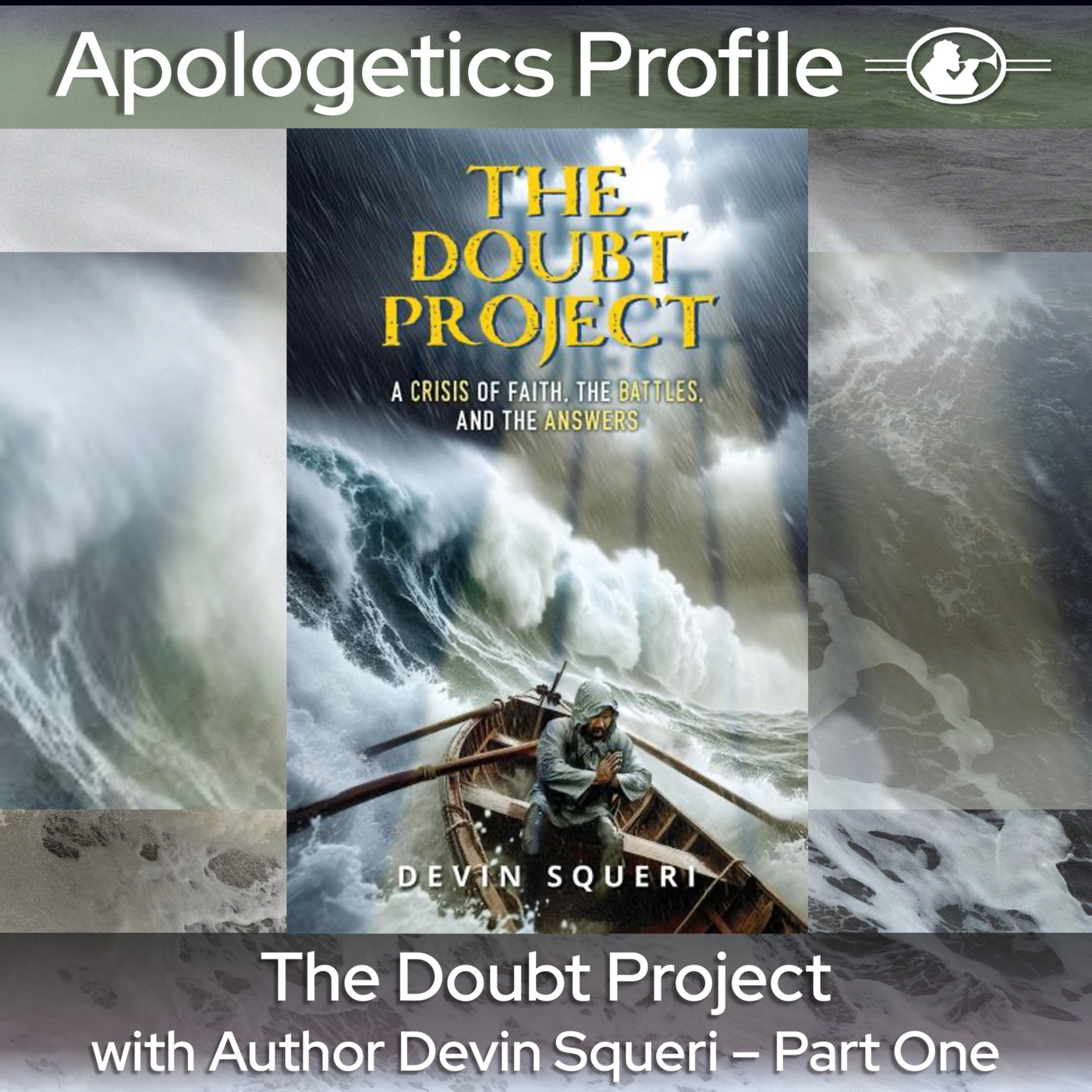
Apologetics Profile
Episode 338: The Doubt Project with Author Devin Squeri - Part One
00:34:19
For the last several weeks, we have been discussing how to navigate through periods of doubt, des...
Loading summary
Transcript120 lines
- [00:06]
Podcast Host
Jesus said to him, I am the way, the truth and the life. No one comes to the Father but through me. This is Apologetics Profile, a weekly podcast examining the ideas of our time through the truth of Scripture.
- [00:26]
Devin Squery
Probably considered myself just about an atheist, probably agnostic, leaning towards atheism. I was actively looking at like, you know, what Sam Harris would say and you know, all these popular atheists on like, how do you find meaning? Because if we just go X number of years and disappear, then what's the point? I mean, really, what's the point?
- [00:56]
Daniel Ray
On the last few weeks of the Profile, we've been discussing the ups and downs of trying to navigate your way through sea seasons of doubt, depression and despair. There are times in our Christian pilgrimage here on Earth that seem like we're alone, walking through an inhospitable desert wilderness, or that we're being tossed about in a hurricane with no land in sight. Well, this week and next we will be talking with someone who worked through his doubts and despair and by the grace of God, was led back to Jesus. Devin Squery, author of the Doubt Project, joins us to talk about his journey back to Christ. It is a remarkable story, one that hits close to home here for me personally and for our ministry Watchman Fellowship. Devin shared with me how God used our ministry's atheist and Christian book club and remarkably, our book, the Story of the how the Heavens Declared the Glory of God to begin his pilgrimage back to the foot of the cross. Devin's real difficulty began when he had a sudden, terrifying emotional realization that one day, sooner than later, he was going to die. Then began a flood of questions. What did life really mean? Is there any underlying meaning or point to the universe and his existence within it? Is it all just vanity and grasping after the wind? As Devin stared into this existential void in horror, though, he felt an inner conviction that he needed to find out the truth about everything, wherever the evidence might lead him. Devin was especially drawn to questions about the intersection of Christianity and contemporary science, especially in the areas of cosmology and biology. On the evening of our book club when Devin visited, we just so happened to be talking about the fine tuning of the universe. That is when Devin met Alan Hainlein, one of the co authors of the Story of the Cosmos, Devin and Alan struck up a friendship which eventually became one of the main factors in Devin's return to Christ. And for the next couple of years, Devin had lots of questions for Alan. How could materialism, he wondered, account for the existence of the universe? How could materialism account for the origin and complexity of life or the specified complex information found within our DNA. And if everything just came from matter and energy without any rhyme or reason or ultimate purpose, then even our very existence is virtually meaningless. Devin reasoned these conclusions were neither logically nor emotionally satisfying for him. So here on part one, Devin is going to share with us the initial experiences of this horrific existential crisis. On part two, next week, we'll hear how he finally came to the realization that Christianity is in fact, true. As we begin part one. Here, Devin shared with me when and why his doubt process began. Here is Devin's query.
- [04:29]
Devin Squery
My doubt process probably began when I was 12.
- [04:31]
Dan Blevins
Okay.
- [04:31]
Devin Squery
Right, okay. That's when, when, when, when the erosion, the erosion of my, my belief system started decades and decades and decades ago.
- [04:40]
Dan Blevins
But you were just kind of hanging on superficially in a sense, outwardly, maybe.
- [04:44]
Devin Squery
Well, you know, what I was doing is I was just taking all of these doubts and saying the reality is the spiritual side can't possibly really be true. So let's just take these questions. You know, I'm 15, I'm 23, I'm 31. I'm not even close to death. This is, I don't need to, I don't need to deal with any of this stuff now. So I just kicked the can down the road to use a, you know,
- [05:12]
Dan Blevins
kick the coffin down the road.
- [05:14]
Devin Squery
Kick the coffin down the road. Right. And it was just like, I don't need to deal with it. And since I don't need to deal with it and I know in my heart of hearts what, what the result is going to be, and that is not something that I'm going to find pleasant and want to face. I'll just ignore it for now. And so, you know, I grew up in New York, which is very secular environment.
- [05:35]
Daniel Ray
Did you find when you were the
- [05:36]
Dan Blevins
younger part, just really quickly, when you were 12, 15, 20, whatever, did you, were you asking people questions and not getting answers or were you just, you just felt like you had the answers in your head or kind of a both?
- [05:48]
Devin Squery
Well, it's actually kind of a neither. I didn't ask anybody. So a little bit of the recap of the early life is that, you know, raised in New York, we were a Catholic household, but we were what I call CNE Christians. So we went Christmas. Yeah, exactly. Right. You know, and then, you know, we'd all, we'd all complain because it was still a standing room only in the church, even though we'd never go any other times. But I did all the Regular stuff. I did, you know, the Sunday school and the catechism went through all of that. I, I was in the Boy Scouts when I was young. I actually did the Catholic medal with the adultery day. I taught Sunday school to third graders when I was a senior in high school. So at least in my mind, I looked at it and said, man, I'm checking all the boxes. I'm like, like, I'm not engaged like a priest, but I'm, you know, I
- [06:42]
Dan Blevins
mean, you were born into a Catholic family. You said your dad was Minimally.
- [06:45]
Devin Squery
Yes.
- [06:45]
Daniel Ray
Practicing.
- [06:46]
Dan Blevins
So this was something that you had grown up with.
- [06:49]
Devin Squery
Something I had grown up with, absolutely. But there was, there was really nothing in my house. There was no grace at meals. There was no Bible. No, we didn't. Nobody did Bible study up in New York. That's just not, that's what the, you know, the, you know, the backwoods people did. Yeah, because, you know, it was just, it was so. There was never an overt thing. It was never anything actually said blatantly, but it was the, the underlying feeling
- [07:21]
Dan Blevins
in that large, urban, secular Catholicism.
- [07:25]
Devin Squery
Yeah. I mean, big time, you know, and, and, and so when I. So to your point, I didn't ask. I didn't really ask anything simply because I felt like I should. I would have heard about it if there was some, any, any, any evidence.
- [07:41]
Dan Blevins
So in your mind, your questions weren't even valid enough to ask anyone about?
- [07:45]
Devin Squery
Well, it was, it was. Yeah. I mean, it was like it. Nobody mentioned that, that there was any evidence for this at all from any area from, you know, philosophy or history or, I mean, anything. And so it was just something like, you need to believe this. This is what you do. And so, you know, when you go through this. And like I said, you know, I did all this Sunday school, and by the way, I, I do not blame the Catholic Church. The one thing I will say, and this is not directed at any specific church, I will say that we as a Christian community need to do a radically better job of at least letting the youth know that you may not be interested in the reasons and arguments and everything around apologetics right now. And we get it. But, but know that it's there. That's what they got to know. They've got to know that it's there. So when these questions do come up that somebody remembers back and says, okay, well, they weren't going to, you know, take me down the column, cosmic cosmological argument right now, but there's, there's material
- [08:55]
Dan Blevins
out there, and I think to Your point, Devin? That. The idea. I was just at a. I just did a con, a youth conference a couple of weeks ago, And I had 250 kids, two different sessions, 125 kids each. And my attitude with. I used to teach middle high school anyway, and my attitude with youth is don't. Don't try to be like them. They're hungry for you to be an adult in front of them. Teach me how to adult. Show me something that will attract me out of my. What I know to be my juvenile. Take. Take me out of this and show me something that I can strive for. And so I always treat my youthful audience as though they're capable of understanding what I'm saying. It does show you that you are taking them seriously and that you're saying to them, you can understand this. You didn't really have any kind of adults in your life telling you, yeah, there's more to this than just going, okay. You were just kind of like, this is what I have to believe. But you were never really encouraged to pursue it.
- [09:55]
Devin Squery
Right. And then there was the, There was the war, which I. Which we are all in. No matter where you live and no matter what your upbringing in is, is that a secular society is pushing you away from God. And hopefully you've got some beacons of light that are directing you towards God. And we've got to remember that, that. That there's a vast quantity of. Of our youth as well as our adults that don't have any of those beacons. They haven't been immersed in Christology through their life. And so when we're engaging with them, like, we, We've got to meet people where they are. So, you know, it's like, and, And I, I cannot, I cannot express enough how growing up, especially in New York, I mean, it was so secular that the unspoken, well, mostly unspoken idea was that, you know, something like either you believe in Darwinian evolution or you are a inbred backwoods rube in a false dichotomy. Yeah, I mean, that's. And that's it. Right? And. And those were your two choices. And basically the, The Christian wasn't really even to be engaged with. They were just to be politely scorned. And we need to provide a loving, important word, loving counterbalance to, to that loving and thoughtful. Yes, absolutely. Absolutely.
- [11:20]
Dan Blevins
Yeah. I know you mentioned in the book you had some moment where you're like, I'm gonna die. Yeah, you, you, you came to the precipice of your finite existence, and that just terrified you so what, what, what was happening in your life at that time? What led you to that, that cliff?
- [11:38]
Devin Squery
You know, it was like walking in the dark and everything was fine. It really was. But I am a, I like to claim to be a math guy. I don't know if my math teachers would ever agree with that. But I like, I like to think of myself as a math guy and you know, I was basically looking at it that you know, my dad unfortunately died at 73. In my mind I was doing the calculations on how close I was. I realized I was firmly in the back nine and suddenly it was, it was really that quick. It was like, like within a one day period. The idea that, you know, we all know we're going to die but there's a difference between intellectually knowing it and emotionally knowing it. And I suddenly emotionally knew that I was mortal and I was going to die. I mean I fell apart emotionally. It was like, you know, it was, it was severe depression because it was the push pull of I need to know what's going to happen, what I believe. And the other side is, you know, when you ask these questions you have open Pandora's box and there's no going back and you're going to have to face the facts that we truly live in a material world which I'd been taught my whole, been told my whole life. And you know I've degrees in physics and mathematics so you know, most of the stuff I do is all logic based and you know, it's all experimental and you know, and so there was all of that and it was just this battle of like I need to look under the covers with don't do that because there's a monster under there and you are the rest of your life is going to be, is, is going to be hell trying to, trying to just get through this. I was at the, the point that I was, you know, I was actually through this. I, I if you had to, if I was being honest and I had to grade myself I was probably would have probably considered myself just about an atheist, probably agnostic, leaning towards atheism. I was, I was actively looking at like you know, what Sam Harris would say and all, you know, all these popular atheists on like how do you find meaning? Because if we just go X number of years and disappear then what's the point? I mean really what's the point? You know, I mean yout know, when you really went and that's the thing is when you start really thinking about it there, there's really no point to anything. There's no point to raising your kids. There's no point to, you know, because it just doesn't matter. Nothing matters. And that is. That is the demon in, in nihilism is that, is that nothing, absolutely nothing matters. And it's terrifying. So.
- [14:24]
Dan Blevins
Well, from a completely secular, scientific evolutionary standpoint, if there were to be any purpose, it would be simply to pass along your genes. Yeah, that seems to be like the best you could say about any finite purpose that you could derive or squeeze out of.
- [14:39]
Devin Squery
Yeah, but even what's the purpose of that?
- [14:41]
Dan Blevins
There is. I mean, ultimately there's no end of it. That's just the brutal, brutal reality for materialism.
- [14:46]
Devin Squery
You know, I mean, the universe is heading for a couple trillion years. We're heading for a heat death where it's all just going to be, you
- [14:52]
Dan Blevins
know, and tropically dead.
- [14:53]
Devin Squery
Yeah, I mean, just, I mean, just, you know, I mean, just cold, dark space spinning out to nothing. So, you know, we can, we can keep propagating our species for a billion years. It doesn't matter. I mean, it doesn't matter. It doesn't matter what we make, doesn't matter what we do. It doesn't matter what we think. Doesn't matter if you love your kids, you don't love your kids. You know, you could be the worst SOB in the entire planet. It doesn't really matter.
- [15:15]
Dan Blevins
So it seemed that the shadow or the specter of, of death came over your house and just wouldn't let you go for a while. Just kind of terrified you.
- [15:25]
Devin Squery
Yeah, I mean, and, and, and I'll. I'll refine that a tiny bit. The, the shadow of nothingness because, you know, complete.
- [15:35]
Dan Blevins
A real nihilism.
- [15:36]
Devin Squery
Yeah, yeah, just, just absolutely disappearing like, like, like you die and you know, the computer program is deleted. It's like what you remember from before you were born, which is absolutely not.
- [15:51]
Podcast Host
Watchman Fellowship. Speak at your church for a Defend the Faith Sunday. Just email Brady blevinsatchman.org that's bblevinsatchman.org for more information about Watchman's Defend the Faith Sunday programs and topics you can have live at your church.
- [16:17]
Dan Blevins
I interviewed an mit, I think he was a mathematician or a physicist several years ago. He was on our atheist and Christian book club, Alan Lightman. He, he. He was very gracious man. And I, I think he was telling
- [16:33]
Daniel Ray
us the story, or I had read
- [16:35]
Dan Blevins
it in his book where he had gone back to visit his childhood home and drove down the street or whatever. And the house, I think it was where he grew up. And it could be misunderstanding it, but I remember the impact that his story made on me. He's like, it's. When I was there, it's all gone.
- [16:49]
Daniel Ray
Everything.
- [16:50]
Dan Blevins
I grew up at the house, mom and dad, everything is gone. Now. Alan's not. There's no. He doesn't profess any particular spirituality, but it was a. A moment where you're just like, yeah, if I was. If I was a materialist, that kind of thing. And it seemed to. To really trouble him, you know, that
- [17:07]
Daniel Ray
he'd really pondered this, like, my whole
- [17:10]
Dan Blevins
childhood is completely gone. My home, my parents, everything. What. I'm on that same treadmill.
- [17:17]
Devin Squery
Yeah.
- [17:18]
Dan Blevins
You know, and he didn't really have an answer for it, but it was.
- [17:21]
Daniel Ray
You could tell.
- [17:22]
Dan Blevins
I could tell. At least. At least it seemed there was a great deal of existential angst in this is all disappearing. There are a lot of people listening right now who are probably staring into that same maw of nothingness, you know, so what. How did you start to have a little desire or hope to navigate your way through that? Devin?
- [17:41]
Devin Squery
Yeah, and by the way, to your point that I think if you're honest and you really look at it, it's impossible to be. It's impossible to not be absolutely terrified if you really look at what that whole thing means. But. So it was a couple of weeks where I couldn't get out of bed and fighting with this nihilism, like, what's the point?
- [18:06]
Dan Blevins
And you have a wife and kids, and you're struggling with that. You're struggling to be Superman, Dad.
- [18:10]
Devin Squery
Well, you know, I mean, it's like, I. Most days when I would. I would marshal myself so that I could put on a good face when the kids were coming home because I didn't want them to see any of this. I tried to do my best for my wife, but, man, she is. She is just an incredible person. I could go on for days about how wonderful she is.
- [18:31]
Dan Blevins
That's great.
- [18:32]
Devin Squery
And it's like. And, And I will say, if anybody's going through this, I'm gonna jump ahead for two seconds because this is super important point. I was stupid and I kept things to myself because I'm the man. And, you know, we can't show weakness and don't want my wife to. To, you know, look down on me. And she's someone with great faith, and I don't want her worrying and all that. Don't be stupid. Go out and find somebody to talk to. Talk to your. To your. To your spouse. Talk to, to find somebody. And if you don't have somebody in your life, there are plenty of resources online. I do ministry with Talkabout doubts dot com. You can, you can find somebody that will walk with you on this journey. Sorry, I just wanted to.
- [19:15]
Dan Blevins
Perfectly fine. We know what talk about doubts is all about.
- [19:17]
Devin Squery
Yeah. I mean, it's just so important that people don't try and do this alone because it's unnecessary.
- [19:22]
Dan Blevins
Yeah.
- [19:23]
Devin Squery
Anyway, so that's part of the experience
- [19:25]
Dan Blevins
though, Devin, is that the, to the mental trick that that darkness brings is to, to convince you that you're isolated.
- [19:33]
Devin Squery
Yes.
- [19:33]
Dan Blevins
To shut you off, to fence you in and convince you that there's nobody that can understand, there's nobody that wants to listen to you. That's a, that's a big hurdle in processing through this is recognizing it.
- [19:45]
Devin Squery
Yeah, yeah. I mean, and it's a.
- [19:47]
Dan Blevins
You, you.
- [19:48]
Devin Squery
It's a self induced isolation where, you know, you feel like you're the heretic and nobody, you know, and if you, if you confess these things that nobody want to talk to you anymore and all kind. You know, it's funny, we all create these, the, these horrible realities for ourselves all the time and, and it's just, it's just unnecessary. So, so back to your original question is that I was in my. I was changing my clothes one day, like two to three weeks in, and I remember I was in there and I just had this overwhelming dread of the nihilism. And so I started exploring it and looking into it and I kind of like outline the book. I kind of envision it like looking into a black vortex. And as I was looking in, I really kind of felt like I was getting sucked into this whole trying to understand nihilism and nothingness. And I was. I kind of ripped myself away from it. I was like, oh, I'm gonna, I'm gonna lose myself here a little bit. And I made the decision that I just finally had to go and find the truth. And whatever that means is whatever that means. And I'm just going to have to learn to deal with it.
- [21:02]
Dan Blevins
That's interesting because you're, you're spiraling in a, in a mental and emotional darkness that's terrifying you and paralyzing you and preventing you from getting out of bed sometimes. And yet along comes this. I don't know, what would you want to call it? A conviction or a sense or a purpose? A mission, Something purposeful. I'm gonna go on this quest. I'm gonna go see. So it's interesting to hear you Talk about that parallel, because when you hear people that are in, struggling, in mental, emotional volitional doubt or anguish or depression, usually the result, there's no, there's no way that you can self generate resolve. It sounds like from what you're saying that this, this idea to pursue truth came from outside of yourself. Would you say that, that kind of, or how did that seem like when you, when that happened, when you said, I'm gonna go look at this, come what may, how did that, It's a great thought.
- [21:54]
Devin Squery
I, I gotta be honest with you. I'm gonna have to think about that. I never really considered that that happened.
- [21:59]
Dan Blevins
That, that, that, that was one mental thing that I would say now looking back, that God kicked me in the pants with like you. And, and I learned this from being atheists, making fun of my depression. When I was candid about it, they're like, no, Dan, you did it. You did it. You did it. You, you helped yourself. You, you didn't, you didn't go through with it. You made the decision. I was like, dude, I can't tell you how. So done with life. I was, I had no volitional intent to talk to anybody, to go through with anything, to resolve, to pursue anything. And then the idea that to, to not do it, I cannot articulate it any clearer than that came from outside of myself because there was absolutely no way. I had no power, no built, no ability, no hope, no desire. How could I suddenly walk away from that and go call somebody? Which is what I did. And so the idea of the pursuit of truth, to me, as you're, as you're saying, that reminds me of my own situation where something came from the outside, something reached down, gave you a hand and said, come with me. In a way,
- [23:13]
Devin Squery
I am. I'm gonna have to do some thinking on that because, wow, I, I never, you know, I, I, I do know that, that, you know, I, I, you
- [23:24]
Dan Blevins
were like Lazarus did. Jesus issued a command to a dead man and he came forth.
- [23:30]
Devin Squery
I was like Peter, when he's sinking under the waves.
- [23:34]
Dan Blevins
Same thing, same thing.
- [23:36]
Devin Squery
He stuck his hand out and pulled.
- [23:38]
Dan Blevins
Or Job or Jeremiah, the bottom of a well where, where, you know, we all hit ground zero so that we
- [23:46]
Daniel Ray
know
- [23:48]
Dan Blevins
the hand that comes down to reach us. As you said, it's interesting the way you described it, the pursuit of truth. How in your vortex of doubt and
- [23:56]
Daniel Ray
anxiety did you know there was such a thing to pursue?
- [23:59]
Dan Blevins
How did you know that?
- [24:01]
Devin Squery
You know, because like most people, I'm full of hypocrisy. And contradictions.
- [24:07]
Dan Blevins
Yeah, yeah, yeah. You know, but that resolve is. I'm fascinated by that. That, that, that seems like that, that was a turning point.
- [24:13]
Devin Squery
It absolutely. Oh, it was absolutely. As a, it was a, it was easily the, it was the, the moment because it was like. Because I knew, I knew that I was losing the war badly and it wasn't even close. I wasn't winning any battles. I was just. And, and I went under, you know, underwater for. And then finally I got a little air and I was just like, I can't.
- [24:36]
Dan Blevins
I'm near death experience without dying.
- [24:38]
Devin Squery
Yeah.
- [24:38]
Dan Blevins
Physically.
- [24:38]
Devin Squery
Yeah. Yeah. That's, that's, that's probably a good way to look at it. That's actually really, really well done. That's. Yeah.
- [24:45]
Dan Blevins
Because you talk about a light at the end of a tunnel, you begin to see a little bit of light as you start this process.
- [24:53]
Devin Squery
Well, when I started this process, I got to be honest, I was sure that, that. I was sure that that Christianity was going to be empty. I was sure.
- [25:02]
Dan Blevins
And you, you, when the interview that I heard with you did with Elisa Childers and then in your book too, you started, you said another pivotal moment was you starting to recognize that there, there really wasn't any such thing as coincidences. That it seems like there's providence lining things up for you, Devin, as to lead you on this path.
- [25:22]
Devin Squery
I never really believed in that. But, but, but I, you know, there's some things that, that, man, if it's a coincidence, it's just a bunch of the, the. And, and I still struggle with, with some of the, the, the idea, but it's. It's kind of like, like, you know, one of the, one of the, the first moments was just going out to that atheist Christian book club where, you know, I went when. So when this, when this all happened, I did what I figured I was supposed to do. I went to my church to try and get help. I didn't really get any help, unfortunately. It doesn't seem like people are very well prepared for these kind of questions because also a lot of my questions were not, you know, around a translation of a verse in scripture. They were more like, you know, like, like talk to me about like the big bang and how that suggests, you know, my presence and you know, let's talk about the fine tuning argument and you know, the eyes glaze over the. Yeah, so. And that's okay. But I went to my church a couple times. I got really, I gotta be honest, not, not great advice where I was like, pray on it for 40 days.
- [26:36]
Dan Blevins
So it sounds like part of your. Part of your struggle was in terms of getting the Christian Science thing under control.
- [26:43]
Devin Squery
Oh, yeah, big time.
- [26:44]
Dan Blevins
Okay.
- [26:44]
Devin Squery
That was. You know, because that's. That's the thing is I've been told my whole life.
- [26:48]
Dan Blevins
So there was some timing involved in you coming to the book club. I was just reading. I just did a Sunday school lesson on the Book of Esther. And I don't know if you're familiar with the book, but there's a. Queen Vashti is asked to come to the banquet that King Ahasuerus is giving, and she doesn't want to come, so she get. He gets rid of her, and then seeks out through his kingdom a woman to replace Queen Vashti, and it turns out to be Esther, who is the niece of Mordecai. She's Jewish, but she's very beautiful. So there's this idea of beauty, but God is nowhere mentioned in the Book of Esther by name. Not the Lord, not Elohim, not Yahweh. There's no God's name in there. But why is this in the Old Testament? Why did this make it into the canon? Well, it's because of the timing and the circumstances in the Book of Esther that you see the providential hand of God moving to rescue his people from a plot that comes about through King Ahasuerus's assistant, Haman. And so the idea. It's really interesting. The word for beauty in that book in. In. In Hebrew means not only just aesthetically pleasing, but there's a quality of what we would call perfect timing. So beauty is not just outwardly pleasing in the Hebrew, but there's also an aspect of timing involved in what the Hebrew concept of beauty is. And so through what I was. The point of my Sunday school lesson was we see God's hand in the timing of his provisions and in the way he guides us as we look back on our lives. So there. It's a. It's a beautiful thing to see God's timing. So I was reading your story about how you came to the book club, because I'm a little biased here, because that's. The book club is our ministry. I mean, Watchman's Fellowships ministry. So it was. My ears perked up. I'm like, book club. I remember meeting you. I remember that night.
- [28:47]
Devin Squery
It was. It was the. It was the. It was another pivotal moment for.
- [28:52]
Daniel Ray
How did you even find out about us?
- [28:54]
Devin Squery
So. So I had been searching. I went to all these churches trying to get answers. I couldn't get any decent answers. I couldn't get any decent advice. You know, things like you just got to believe or the mystery of God. And all this stuff is like, that's completely not helpful to somebody saying, maybe there is no God.
- [29:09]
Dan Blevins
Right?
- [29:10]
Devin Squery
There probably is no God. I contacted the Dallas Theological Seminary, which. This isn't their shtick. So they did a good job pointing me to reasonable faith. And I went to a chapter up near me and the gentleman. I feel terrible. I'm seeing his face for some reason. I'm. I'm blanking on his name. Anyway, he told me this was like Stallion. This was like on a Wednesday. And he's like, well, hey, you know, you like the science and all that kind of good stuff. There's this thing called Atheist Christian Book Club out in Fort Worth. They're doing one this week on the fine tuning argument. I'm like, fine tuning argument? What's that? And so, so he's like, well, you should go check it out. You know, they're speaking and gave me the lowdown. And so I. He must have had a copy because I don't remember how I got the book, but I read it in like a day and a half. I was desperate for answers.
- [30:00]
Dan Blevins
Book was the story of the cosmos.
- [30:01]
Devin Squery
Story of the cosmos. Correct.
- [30:03]
Dan Blevins
That's the first book that landed in your lap in the midst of your struggle.
- [30:06]
Devin Squery
That was the first book that landed in my life.
- [30:07]
Dan Blevins
That's incredible.
- [30:08]
Devin Squery
And, and my, my.
- [30:11]
Dan Blevins
Because, you know, I edited and co wrote.
- [30:13]
Devin Squery
That's what's even.
- [30:14]
Dan Blevins
Just mind blowing to me to hear this part of the story.
- [30:18]
Devin Squery
And we went. My wife. My wife and I went out and we searched for this place for like we were going to be super early because I, you know, so desperate.
- [30:28]
Dan Blevins
We were, we were. It's a. It's an old house in downtown Arlington.
- [30:31]
Devin Squery
Yeah, we drove around and this was what, six years ago, GPS wasn't as good as it is. We drove around for two hours and I was ready to quit and my wife was like, no, let's just keep going. And miraculously, we finally found it and went in. The talk was already going on, but, you know, got space, sat down. And Alan Hainlein was actually talking at that point. And it was my first ever experience with someone who was intelligent and could speak about science and reasoned and did, yeah, great. You know, I don't want to blow his horn too much. You know,
- [31:21]
Dan Blevins
he knows he's a good guy.
- [31:22]
Devin Squery
Oh my God. I. I owe him more than, more than, more than I can ever express
- [31:28]
Dan Blevins
when we were putting the book together, I, my co editor, author Paul Gould. Paul went and found some people, and I went and found some people, and I'd known Alan, and Alan had known Luke Barnes. I said, would you and Luke want to write a chapter? Because I'd been coming to Alan's Reasonable Faith on and off, and Alan's a wonderful guy. He's let me speak there a couple times. So I was actually, I can't. I look back now and I'm like, my gosh, this is amazing how God brought people to the book project and Alan and then Luke were willing to do it. So that whole thing is touching to me too, because, you know, I'm just sitting here thinking, how do I get people to write a book? This was, this book was Paul Gould's idea. And we met through my, my program at Houston, which is now Houston Christian University. I finished my apologetics degree, but. Long story, but getting Alan into the book was, was. I remember thinking, I gotta get Alan in this book. I remember that. I remember that distinctively, that I wanted him. And first he's like, no, you know, Luke Barnes can do it better than I can. I said, well, no, you guys, you,
- [32:34]
Daniel Ray
you introduced me to Luke.
- [32:35]
Dan Blevins
You and Luke can write something, you know, that's, that's kind of how that came about. So I'm, I'm tickled pink that you, you were moved by that chapter and you got to meet Alan the first night in the midst of all this.
- [32:46]
Devin Squery
I liked, I like lot, I mean, lots of parts. I really like the book, but just being able to hear, you know, from somebody that didn't fit into my stereo tie or stereotypical caricature of a Christian was a little eye openening for me. And so I, I spoke to Alan afterwards, and he listened gently and patiently listened to all my, you know, all my stuff.
- [33:23]
Dan Blevins
If you or someone you know is
- [33:24]
Daniel Ray
struggling with doubt and would like to get a hold of Devin, you can. He absolutely welcomes the correspondence. You can find Devin's contact information and information about his book, as well as other helpful resources in dealing with doubt
- [33:38]
Dan Blevins
in the notes of this episode.
- [33:41]
Daniel Ray
Thank you so much for tuning in this week to Apologetics Profile and for the profile and Watchman Fellowship. I'm Daniel Ray.
- [33:48]
Podcast Host
You have been listening to Apologetics Profile, a production of Watchmen Fellowship Incorporated. Visit our website@watchmen.org that's watchmen.org Sam.