← Apologetics Profile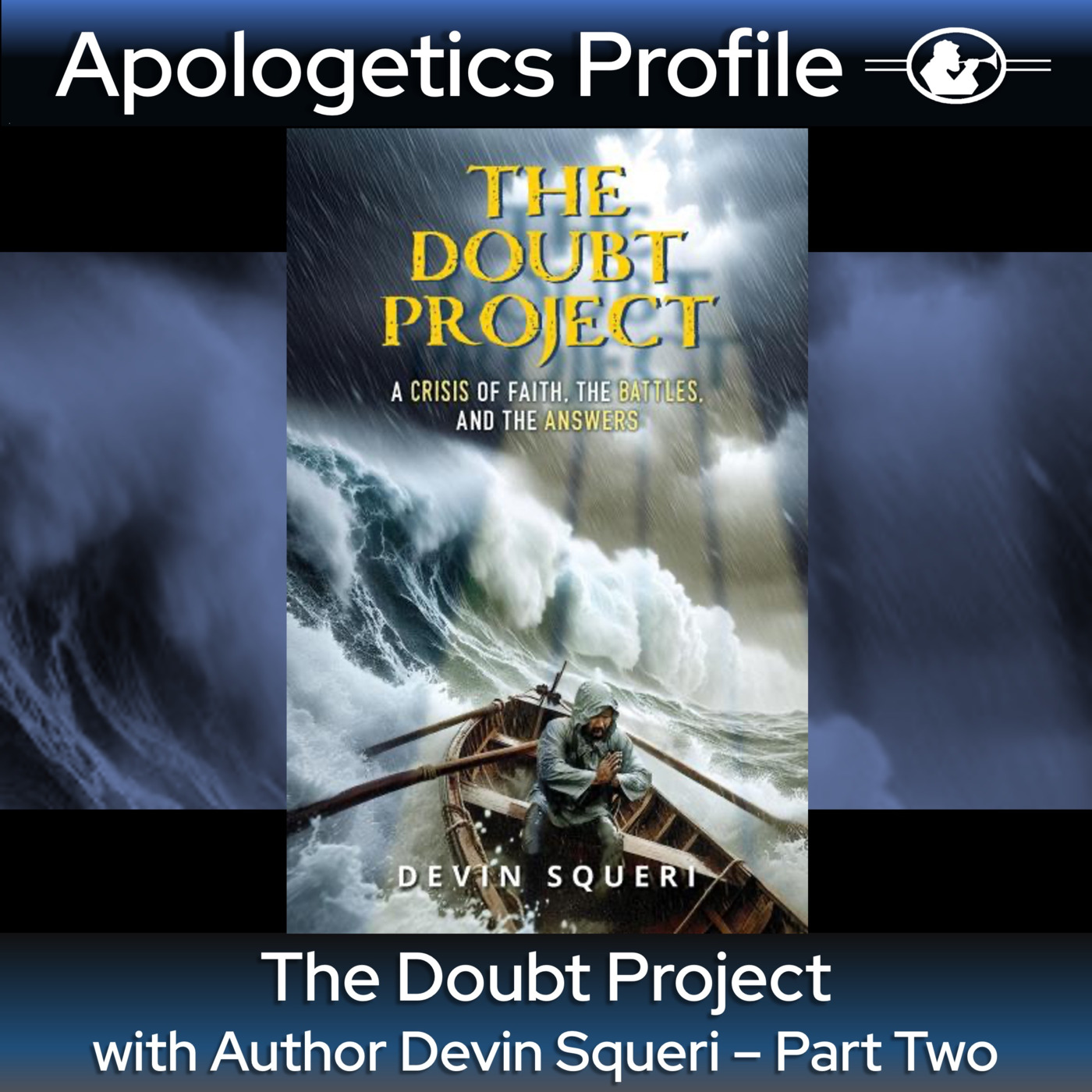
Apologetics Profile
Episode 339: The Doubt Project with Devin Squeri - Part Two
00:35:24
This week on the Profile we hear the rest of the remarkable story of Devin Squeri and how Jesus l...
Loading summary
Transcript97 lines
- [00:09]
Podcast Host
Jesus said to him, I am the way, the truth, and the life. No one comes to the Father but through me. This is Apologetics Profile, a weekly podcast examining the ideas of our time through the truth of Scripture.
- [00:41]
Narrator/Interviewer (Daniel Ray)
On Valentine's Day of 1990, the Voyager 1 spacecraft took what has become one of the most iconic images of our planet, what has popularly become the famous pale blue dot picture. The image is that of Earth, no bigger than a tiny blue pixel, suspended like a piece of dust in a sunbeam. It is a stunning reminder to all of us that in the cosmic scheme of things, we are indeed quite small. But that smallness does not equate to insignificance. Though many science popularizers over the years, such as Carl Sagan, Bill Nye, Richard Dawkins, and Neil DeGrasse Tyson, have claimed we are cosmically insignificant, declaring that we are insignificant because we are small, however, is not a scientific conclusion. It is, in logical parlance, a non sequitur. The conclusion does not necessarily follow from the premises. One cannot use empirical science, for example, to demonstrate that human beings are cosmically insignificant. As we all know, the coronavirus was indeed small, but very few would argue it was insignificant simply because it was small. At what size, though, does one attain significance? What is the standard for such a value laden term, and who determines it? These and other philosophical or metaphysical questions lie outside the domain of physical science. A scientist may certainly express his philosophical opinions, but all too often those opinions, because they are made by scientists, are passed off as having the backing and and authority of contemporary science. Remember, however, what King David concluded when he contemplated the heavens. He understood his place, but did not capitulate to despair and conclude he was insignificant. Instead, he marveled that God cared for him. As he writes in Psalm 8 when I consider thy heavens, the work of thy fingers, the moon, and the stars which thou hast ordained. What is man that thou dost take thought of him, and the Son of man, that thou dost care for him yet thou hast made him a little lower than God, and dost crown him with glory and majesty thou dost make him to rule over the works of thy hands thou hast put all things under his feet. This is precisely the same kind of experience our guest again this week, author Devin Squery, had when he thought of himself in relation to who God is. He said it was one of the most difficult confessions he made during his journey back to Jesus.
- [03:28]
Devin Squerie
I am so small in comparison to the grandeur of God, but he still loves me, and I am good enough because of him, not because of me. And for someone who has a little bit too much pride, that is super hard to swallow.
- [03:58]
Narrator/Interviewer (Daniel Ray)
This week on Apologetics Profile, we will hear part two of Devin's remarkable and at times harrowing experience of navigating through his doubts about Christianity. Be sure to listen to part one of what Devin went through, if you have not already. The link to part one will be
- [04:14]
Interviewer/Co-host
in the notes of this episode.
- [04:17]
Narrator/Interviewer (Daniel Ray)
As Dr. Gary Habermas mentioned in our conversation about dealing with doubt a few weeks ago, so too does Devin mention different types of doubt, volitional, intellectual, and emotional, and how he himself experienced the gamut of all three during his sojourn through the wilderness of unbelief. Here, once again, is Devin Squeary.
- [04:41]
Devin Squerie
When you're dealing with doubt, then there's. There's really the three types, right? There's the intellectual doubt, so factual basis, which is, you know, relatively. Not trivial, not quick, but straightforward. Then there's the emotional doubt, which is, you know, the. As Gary Habermas says, you know, it's a hallmark of the what ifs, where it's driven by some emotion. For me, it was fear. And then there's volitional doubt, where you're just basically choosing, for whatever reason, to ignore, suppress.
- [05:12]
Interviewer/Co-host
You don't.
- [05:13]
Devin Squerie
You don't really want to believe it. Typically that's usually from a behavior, although I found out for myself it's because I didn't like the idea of me being second and not primary in the universe.
- [05:23]
Interviewer/Co-host
But do you think the volitional aspect is more. More. It could be. Could be more just a matter of not wanting to follow through with the connotations. If I accept this belief, like, I'm volitionally going to refuse, because I know if I accept it, then these things follow and I don't want those things to follow.
- [05:42]
Devin Squerie
Like you just said, that's most common, you know, from what I understand, is that, you know, it's like. It's. It's like somebody who's doing something that they know they shouldn't be doing.
- [05:51]
Interviewer/Co-host
Like you say pride in the book. You just put it right out there.
- [05:54]
Devin Squerie
You're like, that's what it was. Yeah.
- [05:56]
Narrator/Interviewer (Daniel Ray)
Yeah.
- [05:56]
Devin Squerie
I mean, I finally realized. I thought. I thought that mine was. Was, you know, intellectual and emotional, and I didn't have any volitional doubt. And it was surprising to me when I realized that I had volitional doubt. And it was probably. It was that silent killer that, you don't know is creeping around back there because it's hiding under the water. And it was. It was the thing that was keeping me from accepting things that my. My rational mind looked at and said, there's no way that this is not true. Because, you know, if. If suddenly I jump in and I believe the story of Christianity, then that means that. That I need a savior. I am not good enough. I, you know, the. I am. I am so small in comparison to the grandeur of God, but he still loves me, and he. I am good enough because of him, not because of me. And for someone who has a little bit too much pride, that is super hard to swallow. And so that kind of kept me from. From embracing it and keeping. And instead, I kept things at things at arm's length and things that. If it was a scientific treatise, I would look at and be like, well, that makes sense. Okay, good. Instead, it was, you know, was like the fertilizer for the. For the what ifs, you know, so it was just very surprising to me that there was a big volitional component for myself and I had, you know, tons of intellectual doubt because I really wasn't that well versed on. On. I knew the stories from the Bible, but at a, you know, 101 level, not down. When you, when you. I think one of the most surprising things to me was that the deeper I got into Scripture, how it seamlessly integrated with all other parts to the point of just being this beautiful tapestry and a rich, rich story that, like, you look at it and you just say, man, if, if somebody could have created all of this, that just integrated. Just integrated so incredibly well. When you, when you look at it, it's kind of like in physics, when you, when you look at the way that some things work in nature, you're like, man, that is just so. It is so graceful. It's. It's. It's almost like art.
- [08:40]
Interviewer/Co-host
I love what you said in the book about how the Bible is woven together in that. Like when we read a novel, as you said, this is your description, you said, you know, we're used to thinking that the. The chronology of events in a. In a novel happen right after one after another.
- [08:55]
Devin Squerie
Yeah.
- [08:55]
Interviewer/Co-host
And you say, really what you're looking at in scripture, and I like the way you put it, is sometimes there's a space, a chronological space historically, between something like King Arthur and World War II.
- [09:04]
Devin Squerie
That's right.
- [09:05]
Interviewer/Co-host
That was a great example. I thought it was a really good example that we. This. It didn't happen today, and then this happened tomorrow. Maybe there's a gap of 100 years 200 years or something like that. But still within that gap, there's a seamlessness to it, as you were describing. And when I became a Christian in my twenties, one of the things that convinced me the Bible was the word of God, was the way the book was reading me as I was reading it.
- [09:27]
Devin Squerie
It most definitely is the living word. That is one thing I am sure of. And one thing to your previous point, I think that, that people need to remember, and honestly I needed to learn, was that just because someone lived 2000 years ago doesn't mean that they were ignorant. They weren't just weren't. It's just that they weren't as technologically as advanced.
- [09:53]
Interviewer/Co-host
They had a completely different knowledge set.
- [09:54]
Devin Squerie
Well, I mean, and it's, it's like it. You're going to tell me that, that you, you know, if Pythagoras live today, I mean, are somebody going to tell me that he was a. Because he lived what, 2500 years?
- [10:08]
Interviewer/Co-host
Yeah, it's a, It's a anachronism to say that the people that lived. I think CS Lewis makes the point. It's a. Chronological snobbery is what Lewis called it. The idea that the ancient people, the older people were not as wise because, well, they didn't go to the moon
- [10:22]
Devin Squerie
because they didn't have an iPhone.
- [10:23]
Interviewer/Co-host
Right.
- [10:24]
Devin Squerie
You know, I mean, that's. And that's a fallacy, right?
- [10:27]
Narrator/Interviewer (Daniel Ray)
It really is.
- [10:27]
Interviewer/Co-host
It really is.
- [10:28]
Devin Squerie
You know, and I mean, and then anyway, and, and then like some of these people didn't know what dead was like. No, no, I think they knew what that was. I think they knew it.
- [10:36]
Interviewer/Co-host
I think that they knew that women didn't get pregnant by any other means.
- [10:41]
Devin Squerie
Right.
- [10:42]
Interviewer/Co-host
I'm sure that they understood miracles. You know, I mean, the disciples reaction to the women saying that Jesus was alive. They, the, the disciples themselves who'd spent three years with Jesus, said initially in Luke's gospel there that their talk was foolish talk. They did completely just whoosh. And then the two disciples on the road to Emmaus, they don't even recognize Jesus. So I'm comforted by the fact that Jesus doesn't pick the wisest and the smartest or the most brilliant. He picks the commoner to proclaim him. And then he humbles us so that the message comes through. His message comes through. As John says, he must increase, but I must decrease. Yeah, and it's. Sometimes it's really painful that God sends us through decreasing processes, which it sounds like. Devin, you've been through what finally started to Take the edge off of your volitional doubt.
- [11:36]
Devin Squerie
Well, you know, the journey, like. So, so basically I started a software company when I was 27 and everything was going great. And when all this happened and I basically stopped taking care of business and just, I, I just launched into like, I gotta know what the truth is. There's, there's nothing more important right now. And everything else is just gonna have to sort itself out because I, I've got to find the answer. So I was spending like 60 to 80 hours a week reading and watching videos and all, all this great stuff. And, and so I'm going to that whole process. But I, I developed a methodology for trying to actually tackle this stuff because I'd find that I would get some closure on an issue and then feel like it was in pretty good shape and then find something else out days, weeks, months later, or not even find something else out. But then, then something would spur that doubt to, to come back up. So I finally said, all right, I got to start writing stuff down. And then when that happens, if there's new information, go back, reevaluate it, and look at it again. But if there's no new information, I just reread my notes on why I got to where I was at, and then I started making real progress on, on, on going through it. Now, one thing I suggest to people who are going through this is start a list of your doubts and get as, get as detailed down to minutia as much as you can. And when you start for a while, that list is going to grow and grow and grow and it will rapidly outpace any answers that you get. And that is okay, because what we're doing is like any problem solving. We're trying to understand the entire scope of the problem, what we're trying to deal with. And once you identify that, and by the way, sooner or later they'll start slowing down. Write the stuff down, write your answers down. Because, you know, if you're really, I'm doing this, and there's such an information overload out there when you're watching the videos and reading the books and reading the article here, and you're getting the, the atheist viewpoint and you're getting the Christian viewpoint, and by the way, I wholly subscribe to getting both sides of the story. So I wholeheartedly recommend, because to me, at least, if, if I was only listening to, you know, the acolyte for, you know, the Christian worldview or, or, or vice versa, I don't know that I would ever be satisfied that I truly decided for myself. So I really encourage to, you know, read even though it's terrifying, even if you're afraid of what you're going to hear. Go ahead. Now also keep in mind that before you make any judgments, before you have an emotional reaction, make sure that you hear both sides of the story, which is, which is more difficult than it sounds.
- [14:31]
Interviewer/Co-host
Were you engaging in person with non believers at any point? Were you talking, are we just kind of reading the atheist literature or were you asking atheists questions too?
- [14:40]
Devin Squerie
You know, I've got a couple friends who are atheists and I tried to engage with them but I didn't find their reasoning compelling. It was more ad hominem attacks, you know, just, you know, the, the super bumper sticker level mockery kind of stuff like you know, mimish, new atheism. Yeah, that kind of stuff. Which is not. When you're, when you're, when you're, when you're being an honest truth seeker, you're not looking to rip apart one side or the other. You're just looking for the facts so you can really, you can really get in and decide for yourself. So I did that at some level, but I just found that it really wasn't a good use of my time. So I kind of restricted, well, not restricted. I was left with going in and, and just reading the literature. And I gotta be honest, like I don't know what percentage, but a majority of the literature wasn't really worthwhile anyway. I mean there are some very honest truth seeking atheists and I would try to find them and listen to what to, you know, to evaluate what they had to say. But you know, one big turning point was also when, when I stopped, you know, I always put Christianity under the microscope, evaluating every claim down to the detail full on New York skepticism, you know, especially around, you know, miracles and all this stuff like, you know, like, like, like, you know, you got to prove it to me. And I, for some reason, and I think this is very common, I took atheism as a default position that it was the one that had the high ground in Christianity, had to be proved. And then I suddenly realized, well, that that's grossly unfair. If I was listening to an argument between two people, I wouldn't immediately give someone the benefit of them being the factual matter and they don't have to prove any of their claims. So I, I stopped and I started saying to myself, okay, well I like, okay, that's fine. On, on column A we've got atheism and column B, we've got Christianity. And this is what you claim. And this is what you claim now, now let's look at those and really start digging in. And one of the biggest turning points, you know, people ask me all the time, it's like, oh, what, you know, what did you learn about Christianity that, that really made you go and, and decide that it, you know, really was true? And my answer used to be, well, it's a cumulative case and all this stuff which is true. You know, I don't think there was some massive silver bullet, but I realized that there, there really was a silver bullet, but not in the way I expected. What the silver bullet for me is when I realized that materialism, which in my opinion, you can't really be an atheist without being a materialist. Like, like the way they try and work around and get compatibleists and all that, I feel like it's just a bunch of mental gymnastics, in my opinion. So you have to be a materialist. And I looked at it and for a variety of reasons, I realized that it's. Materialism can't possibly be true. There's just no way that's one, that's, that's a zero percenter, right?
- [17:55]
Interviewer/Co-host
So the idea of materialism is immaterial itself.
- [17:59]
Devin Squerie
Well, the whole thing even, even going
- [18:02]
Interviewer/Co-host
at some level, it reveals itself a very apparent contradiction because you're dealing with metaphysics, you're beyond the material world in espousing a philosophy of materialism.
- [18:12]
Devin Squerie
Well, I mean, they, they, they try to get around that with saying that consciousness is just an illusion and love is an illusion. And you know, it's like you really don't have any free will.
- [18:22]
Interviewer/Co-host
And, and all those conclusions are illusions. So what, what's the point of even
- [18:26]
Devin Squerie
saying that there's no such thing as truth. And you know, I mean, the whole thing is just a. But they keep explaining it away. But when you really look at a lot of the, a lot of the, you know, the, the world view, it's just demonstrably false. I mean, just straight up, you've got an experiential side with, you know, free will. I mean, I 100% believe in libertarian free will. I mean, without a doubt, you know, and it's, it, you know, I forgot who said it's a great quote. Is that even the, even the materialist determinists, you know, still look both ways before crossing the street, you know, which is just looking at, looking at reality. There's just no way that it was just, it was just, it was just suddenly like, oh my God, like, like, like determinism isn't true. That means materialism can't be true.
- [19:24]
Podcast Host
To financially support the Ministry of Watchmen Fellowship and Apologetics profile, visit our secure online donations page@watchmen.org give. That's watchman with an a.org give.
- [19:44]
Interviewer/Co-host
They're assuming, I mean, in cosmology or biology, they always assume a materiality. But the things thing that convinced me, Devin, that, that the materialism, I mean, even as a Christian, the idea that, that when they ascribe, like the beginning of the universe, they always have to rely on something that they twist as being eternal. They still need the, they still need something like eternality or infinity.
- [20:12]
Devin Squerie
Yeah.
- [20:12]
Interviewer/Co-host
Which, I mean, I know infinity can be a mathematical philosophy and you can at least conceivably think about an infinite set of things. But in reality, as so many philosophers have said, there nobody's ever empirically demonstrated an infinite causal chain.
- [20:27]
Narrator/Interviewer (Daniel Ray)
But you need, if you're a materialist,
- [20:29]
Interviewer/Co-host
you need an infinite causal chain of material causes, turtles, or you need something to be eternal.
- [20:35]
Devin Squerie
Yeah.
- [20:35]
Interviewer/Co-host
And to me that you're just, you just finally have metaphysically given me your God, you know, because the universe isn't eternal, so we have to posit something that we can't see that is eternal, like a multiverse.
- [20:47]
Devin Squerie
Right.
- [20:47]
Interviewer/Co-host
Wink, wink. You know that. So to me, in the, the. Where the materialism fails is where it starts borrowing from theology when it comes to the origin of the universe.
- [20:57]
Devin Squerie
Oh, yeah, absolutely.
- [20:58]
Interviewer/Co-host
You, you have basically affirmed Romans 1, that you can see God's invisible attributes through what he has made. And what do the materialists see about God? That there's something eternal behind the universe.
- [21:11]
Devin Squerie
Well, well said. Absolutely, absolutely. And, and when, when, when I realized that it wasn't purely a material universe, then it started opening me up to determinism. Can't possibly be true. So are there, you know, are there spiritual things? Are there, are there supernatural things? And you know, supernatural just means beyond nature, on nature. And I was like, well, the Big Bang, I mean, there was nothing before. And then suddenly in an instant, there was all of the energy for the entire universe in light. And he. And it's kind of like. And then I was thinking to myself, I'm like, wow, that sounds a hell of a lot like Genesis, you know, I mean, all these things started lining up. And then I started, and then I started taking that story seriously.
- [22:00]
Interviewer/Co-host
The singularity sounds a lot like God.
- [22:02]
Devin Squerie
Yeah. Yes.
- [22:02]
Interviewer/Co-host
Light, powerful, creative.
- [22:05]
Devin Squerie
Yeah.
- [22:06]
Interviewer/Co-host
You know, origin of everything.
- [22:08]
Devin Squerie
Yeah, yeah. And, and, and, and the way that it was, it was Released in, in, in so many. Right. The whole fine tuning argument. All, all of these, all of these different constants was made so that we would have the right expansion, so that galaxies would form and the proper stars would form in the proper time so that we would get chemistry. And like when you, when you start going through that, it is, it's only word for it is miraculous.
- [22:42]
Interviewer/Co-host
Well, yeah. James Clerk Maxwell was so impressed by what he discovered by realizing electricity and magnetism are two sides of the same litecoin. When the Cambridge label, when he had his hand in constructing the first lab in Cambridge. I forget the name of Cavendish. Thank you, Dan. The Cavendish lab. Over the door of the first Cavendish lab. And now the other one. There's two of them now. He put Psalm 111, two greater. The works of the Lord. They are studied by all who delight in them.
- [23:14]
Devin Squerie
Yeah.
- [23:15]
Interviewer/Co-host
And of course, Cavendish Lab is where they discovered. Watson and Crick discovered DNA. And something the biologists still cannot explain. I'm reading a book right now about a brief history of the universe and they, they spend a chapter talking about information in DNA floating on a warm pond. I'm like, basically what you're saying is that there's a, there's a, there's an Encyclopedia Britannica set just sitting in a pond. The words aren't arranged, but they, it's just, they skip. I was just impressed on how much they just pass over.
- [23:52]
Devin Squerie
Yeah.
- [23:53]
Interviewer/Co-host
The whole question about information in DNA, which is what you find in, in cosmology, why Einstein wondered, was the universe intelligible to us? Why can we even know and describe these things in terms of mathematics or information systems? To me, in talking to Alan Noble last week, I. He said something that I've, it's, it's stuck with me. I mean, I've always believed it, but just hearing somebody else say it, that, that the physical cosmos and all the life it contains is not a mystery for us to wonder if God exists. It's a declaration that God does exist.
- [24:34]
Devin Squerie
Right.
- [24:35]
Interviewer/Co-host
And we, and we suppress that.
- [24:37]
Devin Squerie
And it's only relatively recently that science is, science is being positioned as antagonistic to God, whereas historically it has been the way that we, we studied how God created the universe.
- [24:52]
Interviewer/Co-host
Right, Right. You might want to, I mean, you can almost roughly pin that antagonism to the late 19th century.
- [25:00]
Devin Squerie
Yeah.
- [25:00]
Interviewer/Co-host
Charles Darwin, I think you really start to see the, the grist. I mean, there was the Enlightenment before then, but I think you really start to see the, the trouble with Charles Darwin and natural selection. Because then to me, I Think a lot of the modern secular cosmologies sound a lot like the modern secular Neo Darwinian paradigms in terms of a long, slow, gradual evolutionary development of either the universe or life without a sentient agent behind it all. It's, it's, it all seems to be very similar in terms of going out of its way to find ulterior or other mechanisms, if you will, to explain the universe. But just wrapping up here, I wanted, I, I know at some point you crossed over from dark to light through Allen's help. And how did you, I know you, Your book, as, as we were talking before, your book kind of leaves, leaves people with this. You do a very good job of, of leaving the tension between and the importance of understanding both sides and seeing what, what still questions that you still have that still remain the issues that you're still grappling with. I appreciated how you didn't just kind of black and white it, you know, it wasn't just like, oh, I did this, and then this happened. It's still, you describe it as more of a process, and as you're describing it now, it's still more of a process and we're never going to get to a point where we've perfectly arrived at 100% about everything in our lives. But as you concluded your struggle, you talked about being out of your doubt now for about three years. What finally. Maybe there was a couple of things or what, what finally attracted you to back to Christianity?
- [26:42]
Devin Squerie
Because it's true.
- [26:48]
Interviewer/Co-host
There you go.
- [26:50]
Devin Squerie
And that's, and that's what I said.
- [26:53]
Interviewer/Co-host
Did that come about through a conversation with Alan or did you have, did you wake up one night and go, it's true?
- [26:58]
Devin Squerie
I, I think it was a gradual settling in, you know, you know, when, when I, when I, when I was in the closet and I ripped myself from staring into the abyss and I said, this is untenable. I'm losing this war with, with, with whatever this is. I need to go and figure out what, what's true and abide by whatever that means for good or bad. That's really what it was, is that I, I had to go and abide by whatever it means. And from everything that I've seen, the evidence is overwhelming on, overwhelming on the Christian side. Are there still areas that I don't understand? Absolutely. But, you know, I mean, I, but I can accept some things. They're not contradictions and they're not things that I falsified with Christianity. There are things that I don't understand, and those are two very different things.
- [27:56]
Interviewer/Co-host
Paradox. So, versus a contradiction. Something like that.
- [27:59]
Devin Squerie
Yeah. I mean, it's so, so, you know, when, when was the magic moment? Like, I don't know, there's more like
- [28:08]
Interviewer/Co-host
a sunrise than an explosion or something.
- [28:10]
Devin Squerie
Yeah. And you know what? I'm really enjoying that. I'm, I'm constantly, I'm constantly going like, you know what, three months ago I thought that I got it and I was, you know, a Christian, but man, I wasn't. I wasn't even close. Now I'm, you know, so I'm. I'm constantly having, you know, those moments as I learn more and more. And now I've just, I've always been a curious person and I've just got a love of learning and, you know, still looking at both sides. Right. Because we always have to be open to, you know, new information. But I'm just loving that the more I learn, it's just, it's. It's just, it's like a holy cow. I mean, it's just the more I learn, the more absolutely certain I get, which is just awesome.
- [29:07]
Interviewer/Co-host
That's fantastic. That's fantastic. So it sounds like, it sounds like to me, as you're describing your journey as an outsider looking into it, that you, you were, you were pulled from the closet and taken on a journey and told that you were going to follow the truth come what may, and, and you did. It sounds like, though maybe God didn't seem readily present to you as the journey began. He was. And that's what happened in my own life too. God was very gentle and very gradual in leading me to the truth. I would say the first five years of my Christianity were just an abysmal heck of trying to please God. Just a false, A completely false belief about what God is like, who God is like. I'm not sure. I wouldn't say that I wasn't a Christian, but man, my Christianity was so retarded. It was. It almost killed me. It almost killed me. And, and it was just the cult of my mind of thinking that I needed to earn favor with God by doing this, that and the other thing. But God has been my. My dad took his own life. So I see God now looking back as being infinitely gracious to me in an undeserving sort of way. So I, I had no aha moment, Devin, when I became a Christian. I mean, I eventually got baptized, but it was a gradual process. But it's like you. I love to learn. I get my job. I get to talk to people who write books and I learn every time I open the microphone, I learn something from somebody. So it's a wonderful job. I, I, I appreciate you sharing and tell our listeners where they can get your book and find out more about your, what you've been through and some resources and we'll wrap it up there.
- [30:48]
Devin Squerie
The, the, before I do that, I'm going to say the most important thing that I'm, I've said today. And besides that I love my wife so much,
- [30:59]
Interviewer/Co-host
as much as you want.
- [31:02]
Devin Squerie
Those two years were easily the most painful that I've ever experienced by an order of magnitude that I can't even describe. They were horrible. I mean, a horrible, horrible two years. In hindsight, they're the best things that ever happened to me. It's the, I lost my software company, lost some social contacts, but it was so worth it. I do feel like God knew that I was lukewarm and would never get beyond that and he needed to reach in and grab me by the lapel. Yeah, and, and give me a good solid shake. And so for anybody who's going through this, believe me, there is light at the end of the tunnel. It's not going to be trivial, but you will get there and there's plenty of places to get your help.
- [31:55]
Interviewer/Co-host
And as we heard in my interview with Alan Noble, Allen and I talked about oftentimes we're in yet darkness. There is somebody in your mind. There is somebody that you know you can reach out to. You know that intuitively, but it's that false belief that you're isolated and even that person doesn't want to listen to you. That's not true. There is always one person and God will bring them to mind that you can reach out to for a lifeline and say, even if you can't answer all my questions, I just need somebody to talk to. But, but don't go at it alone.
- [32:26]
Devin Squerie
And if there is somebody who's out there thinking, no, I don't have, I'm your person.
- [32:31]
Interviewer/Co-host
Get a hold of Devin. Yes, get a hold of Devin. And we'll put your contact information in the notes. But tell us where we can contact you verbally here.
- [32:39]
Devin Squerie
Well, you can, you can email me at ds like devinsquerieousing.com it's okay that I use it personally. It's my company. So that's Papa alpha@housing.com you can get the book on really anywhere, you know, Barnes and Noble.
- [32:57]
Interviewer/Co-host
What's the book title? I don't think we mentioned it.
- [32:59]
Devin Squerie
Oh, the book title is the Doubt Project because that's really what it was, a two year, Two year project. A two year project going through all this. So the first three chapters are going to talk about the experiential side of doubt. Then the next pile of chapters are going to be the both sides of the argument. For lots of things from aesthetics and logic and fine tuning and evolution.
- [33:24]
Interviewer/Co-host
It's a pretty comprehensive apologetic. Even though you're, you're not in, in the arguments, the way you present them in the book, it's a, it's a really nice balance. You really do give a picture of walking through both sides of the issue. You're not, this is not, it's not a pro. I mean, it is, but it isn't. It's not a overtly pro Christian apologetic book. It's. Here's how I weigh both sides of this.
- [33:44]
Devin Squerie
That's right.
- [33:45]
Interviewer/Co-host
And you're very honest in the chapters about what you think about.
- [33:47]
Devin Squerie
Well, and I, I want it to be good. A truth broker. Yeah. You know, and not only I, when I was going through it, I find it, I found it hard to find anything that would give me an honest assessment on both sides. And so that's what I tried to do because everybody, everybody should make up their own mind, you know, I'm pretty confident if you give it an honest look where I know where you're going to end up. Yeah. So the name of the book is the Dao Project. We'll link it in the notes. It's on Amazon, Barnes and Noble and all your, all your standard places.
- [34:34]
Narrator/Interviewer (Daniel Ray)
If you or someone you know is struggling with doubt and would like to get a hold of Devin, you absolutely can. He welcomes the correspondence. You can find his contact information and information about his book, as well as other helpful resources in dealing with doubt in the notes of this episode. Thank you so much for tuning in this week to Apologetics Profile and for the profile and Watchman Fellowship. I'm Daniel Ray.
- [34:59]
Podcast Host
You have been listening to Apologetics Profile, a production of Watchmen Fellowship Incorporated. Visit our website@watchmen.org that's watchmen.org.